Introduction
Negative perspectives characterise Aboriginal and Torres Strait Islander students' school attendance. Reports of school attendance aggregated to national, jurisdictional and school sector levels confirm that Australia's Indigenous students produce lower school attendance rates than their peers (e.g. Australian Curriculum and Reporting Authority (ACARA), 2011, 2017). Commonly overlooked and under-reported are students within those populations who do attend school regularly and often. In this case study, we seek to understand the factors associated with the exceptionalism of Indigenous students' attendance at one primary school. This perspective runs counter to the recognition that Indigenous students attend school less often than their non-Indigenous classmates in every jurisdiction, school sector and school grade.
Australia's Federal and State Governments have for decades implemented policies and practices to ‘close the gap’ in attendance (Ministerial Council for Education Early Childhood Development and Youth Affairs, 2011; Victorian Department of Planning and Community Development, 2012). The Closing the Gap Reports acknowledge these measures have achieved limited, if any sustained improvement (Australian Government, 2016). With a continued focus on students who attend infrequently, Indigenous students' attendance rates across Australia have remained low and stable (Australian Government, 2018). Our study coincides with the Federal Government's acknowledgement that previously agreed ‘closing the gap’ targets, including school attendance, were not met (Council of Australian Governments, 2018).
A substantial and growing body of research has investigated the sources of Indigenous students' long history of low attendance. Among a raft of factors interrupting regular attendance are student factors: poor health (O'Keefe et al., Reference O'Keefe, Olney and Angus2012) and motivation for school (Bodkin-Andrews et al., Reference Bodkin-Andrews, Craven, Parker, Kaur, Yeung, Liem and Bernardo2013), school factors: lack of quality teachers and teacher churn (Jorgensen, Reference Jorgensen2012), and socio-demographic factors: geographical remoteness, parents' low education levels (Silburn et al., Reference Silburn, McKenzie, Guthridge, Li and Li2014), mobility (O'Keefe et al., Reference O'Keefe, Olney and Angus2012; Hancock et al., Reference Hancock, Shepherd, Lawrence and Zubrick2013; Prout Quicke and Biddle, Reference Prout Quicke and Biddle2016), poverty (Baxter and Meyers, Reference Baxter and Meyers2016; Hancock, Reference Hancock2017) and intergenerational trauma (Atkinson, Reference Atkinson2002; Zubrick et al., Reference Zubrick, Silburn, De Maio, Shepherd, Griffin, Dalby, Mitrou, Lawrence, Hayward, Pearson, Milroy, Milroy and Cox2006). While identifying policy and practical strategies to ameliorate specific barriers to attendance is valuable, here we focus on the broader lessons we can learn from the analysis of a high-attending Indigenous student population.
We discern Australian Indigenous (and all other) student attendance rates from large-scale datasets. Aggregation and presentation of summary attendance data for schools, available on the My School website (ACARA, 2018a) and jurisdiction and school sector-level reports in the National Report on Schooling in Australia (ACARA, 2017), provide limited capacity to resolve individual or population-level attendance. Although schools collect individual attendance and other information daily, at district, state and federal level—perhaps of necessity, data are aggregated and summarised. However, presenting the mean of aggregated data without estimates of variation obscures attendance reality at each school and for each student. Uncritical evaluation of low mean attendance rates among Indigenous students might conclude low attendance characterises each student, and lead to normalisation of deficit perspectives that have become entrenched (Fogarty et al., Reference Fogarty, Lovell and Dodson2015) and should be challenged (Nakata, Reference Nakata2007; Fforde et al., Reference Fforde, Bamblett, Lovett, Gorringe and Fogarty2013; Sarra et al., Reference Sarra, Spillman, Jackson, Davis and Bray2018). Notwithstanding those issues relating to low Indigenous student attendance, we point to an unfortunate reality; some Indigenous students exhibit negligible attendance and their contribution to mean attendance can disproportionately influence and lower the population mean (Baxter and Meyers, Reference Baxter and Meyers2019). Examined through the lens of what remains worthy of attention is the counter stereotypical perspective. Some Indigenous students realise high attendance rates, matching or surpassing their non-Indigenous peers (Schwab, Reference Schwab1999; Driese et al., Reference Driese, Milgate, Perrett and Meston2016) and significantly exceed the 90% national attendance benchmark (Australian Government, 2018; Baxter and Meyers, Reference Baxter and Meyers2019). These students who have met the expected attendance have so far gone unnoticed and warrant research attention.
While reports of factors associated with high-attending students are rare, so too are studies focusing on individual student's attendance. Several research teams recently accessed and analysed student-matched attendance and other data (Silburn et al., Reference Silburn, McKenzie, Guthridge, Li and Li2014; Hafekost et al., Reference Hafekost, Lawrence, O'Leary, Bower, Semmens and Zubrick2017). Even then, student-matched data analysed at population-level and sub-population-level might reveal only group similarities, masking the attendance variables—singly or in combination of each student (Hancock et al., Reference Hancock, Mitrou, Taylor and Zubrick2018). Studies that identify and evaluate the factors associated with high-attending individual students within Indigenous school populations remain rare.
Taking a holistic approach to the analyses of student attendance provides a way to ascertain influential factors for each student. The potential value in adopting a holistic student approach that evaluates discrete data at student-level, rather than analysing all students' factors together, remains untapped. Without a holistic student-centred approach, we risk perpetuating the notion that Indigenous students' attendance rates are similarly low, the consequence of factors that result from approximately similar life circumstances and school experiences. With ‘more than 500 Aboriginal nations and each has its own history, affiliation to country and cultural identity’ (Walter et al., Reference Walter, Dodson, Barnes, Walter, Martin and Bodkin-Andrews2017a), Indigenous families and their children are clearly multicultural. Students also have different socio-economic profiles and live in different geolocations—remote to urban (Shipp, Reference Shipp2013; Comino et al., Reference Comino, Knight, Grace, Kemp and Wright2016), and within each Indigenous population individuals also differ (Nakata, Reference Nakata1995; Mellor and Corrigan, Reference Mellor and Corrigan2004).
Recognised as the most disadvantaged sub-group in the population (Gillan et al., Reference Gillan, Mellor and Krakouer2017), Indigenous people experience higher levels of poverty, unemployment, rates of incarceration and suicide, and have poorer health than other Australians (Walter et al., Reference Walter, Martin, Bodkin-Andrews, Walter, Martin and Bodkin-Andrews2017b). However, that generalisation belies the heterogeneity of Indigenous families because in contrast, some enjoy good health and wellbeing, with educated family members whose employment attracts excellent remuneration, among other life advantages. Adopting a strengths-based lens (Armstrong et al., Reference Armstrong, Buckley, Lonsdale, Milgate, Bennetts Kneebone, Cook and Skelton2012; Krakouer, Reference Krakouer2016) to counterbalance negative stereotypes (Fogarty et al., Reference Fogarty, Lovell, Langenberg and Heron2018), we examine a population of high-attending Indigenous students at an urban primary school to reveal factors for students' excellent school attendance.
Our previous work revealed widely varying attendance rates for Indigenous students who attend the same school and lived in similarly impoverished circumstances (Baxter and Meyers, Reference Baxter and Meyers2016, Reference Baxter and Meyers2019). In this project, we focus on high-attending students to evaluate each Indigenous student for characteristics and attitudes that alone, or in combination, are associated with their high attendance. Identifying enabling factors for Indigenous students' excellent attendance rates changes the way we conceive Indigenous students' attendance, so we can learn from individual students who, unlike their peers, attain notably high attendance. This case study sits within a wider body of research that focuses on the school attendance of Indigenous students enrolled at Australian schools.
Methodology
The first author, associated with the study school for more than a decade, holds close relationships with Indigenous students, their families and the school's Indigenous Worker. Working at the cultural interface (Nakata, Reference Nakata2007), the Indigenous Worker provided the nexus between Watney staff and the Indigenous school community, which proved a strong partnership (Baxter and Meyers, Reference Baxter and Meyers2016). Commonly, Indigenous Workers' capabilities are under-estimated and under-utilised (Price et al., Reference Price, Jackson-Barrett, Gower and Herrington2017), although at this school, the Indigenous Worker's knowledge and expertise was sought by staff and highly valued. The Indigenous Worker and Indigenous community were keen on the implementation of evidence-based research to evaluate Indigenous students' attendance and initiatives that stemmed from the school and Indigenous community partnership. In support of the research, and as a staunch advocate for students and their families, the Indigenous Worker was a critical friend, providing guidance, participating in data collection and analysis, as well as offering support and encouragement. The collaboration and co-operation guided researchers in following culturally ethical protocols and to ensure Indigenous voice was preserved (Rigney, Reference Rigney, Kunnie and Goduka2006). The Indigenous Worker was offered the opportunity to co-author this paper, however declined. Approval for the project was sought and given by the Local Aboriginal Education Consultative Group and La Trobe University's Human Ethics Committee (HEC 15-063). As non-Indigenous researchers, we acknowledge that this research would not have been possible without these permissions and the close relationship and collaboration of Watney's Indigenous Worker.
School context
While almost 80% of Australia's Indigenous population now reside in non-remote areas, they represent a small fraction of the entire non-remote population (Australian Bureau of Statistics (ABS), 2017). Watney, an urban Victorian primary school, was chosen because in each study year (2005–2015), the Indigenous student population comprised more than 20% of the student population; unusually high for a school in Australia's southern states (Productivity Commission, 2016). The school had employed an Indigenous Worker for more than 15 years, when the number of Indigenous students enrolled increased sufficiently to warrant it. Watney, located in a disadvantaged suburb of Watney City (Pope, Reference Pope2011; ABS, 2013), each year the school ranks as educationally disadvantaged on the My School website (ACARA, 2018a).
Data
We used stratified sampling to identify 45 high-attending Indigenous students enrolled at Watney between 2005 and 2015. High attendance was classified as 90% and above for the period of enrolment as it optimises learning opportunities, is associated with negligible educational risk (Murphy, Reference Murphy2009), and corresponds with the national attendance benchmark (Australian Government, 2015). Unique student identifiers were used to match student's attendance data and other student data provided from Watney's administrative records. Administrative data included student's gender and age at prep commencement; eligibility for Education Maintenance Allowance (EMA) (a payment to support families to provide essential school items each year) and integration funding (a payment to support students with additional educational needs); the number of caregiver/s and their relationship to students; and caregiver/s employment status, occupation band (ranked from A to D according to skills and qualifications), post-school qualification and level of education (State Government of Victoria, Department of Education and Early Childhood Development (2013)).
We used descriptive statistics and frequencies in SPSS (IBM Corp, 2012) to reveal similarities among the high-attending Indigenous student cohort. Variable-centred approaches used in cohort-level analysis assume a particular set of characteristics common to many students, when in fact, that constellation of factors may fit few (Hancock et al., Reference Hancock, Mitrou, Taylor and Zubrick2018). For deeper insight and more differentiated results than cohort analyses allowed, we also took a holistic approach to student characteristics. We compared similarities and differences among individual high-attending students using the pivot table functionality of a common spreadsheet application to examine individual Indigenous students and their unique combinations of characteristics. We interrogated the data through the identification of traits for individuals, and then evaluating the proportion of the population sharing that trait, or those traits.
Student questionnaire
The Indigenous Worker and researchers designed and interpreted responses to the student questionnaire collaboratively. The Indigenous Worker identified the Indigenous students and supported them to complete the online questionnaire during the 2015 school year. The researchers, not involved in conducting the questionnaire, accessed student responses via an online spreadsheet. The responses revealed each student's daily school routines, attitudes and experiences at school and employment aspirations to generate a fuller description of the high-attending cohort at Watney. Forty per cent of high-attending students (55% male; 45% female) were among the respondents.
Results
Firstly, we report student cohort characteristics and subsequently describe individual student characteristics. Reporting at cohort-level precludes reference to individual students. We have used pseudonyms to reference individual students who were de-identified before data collection.
Description of high-attending student cohort
There was a gender balance among the 45 high-attending students. All but two high-attending students qualified for EMA and fewer than one-sixth qualified for integration funding to support their learning. Although an unusually high number of Indigenous students repeated prep at Watney, few high-attending students were among them (8.9%).
Enrolment and attendance
Just over half the high-attending Indigenous student cohort began their primary school education at Watney. Two-thirds of the students who transferred to Watney at other times enrolled at the start of a school year. The length of students' enrolment varied widely. Three students were enrolled for less than 1 year, and one student who repeated the first year of primary school was enrolled for 8 years. Most students stayed until graduation, or were still enrolled on the last day of 2015. Less than a fifth of Watney's high-attending students (17.8%) left the school before graduation. Some students (13.3%) enrolled twice and in each case were enrolled for more than 3 school years (625–1351 school days).
The high-attending cohort produced stable attendance across grades. The grade-level mean attendance rate was 95.0%; ranging from 94.3% (prep) to 95.7% (grade 3). Contrastingly, Watney's entire Indigenous student population produced the higher attendance in the first school years—the highest attendance (87.7%) in grade 1 and the lowest attendance (82.0%) in grade 5.
Families
High-attending students were equally likely to be living in one or two caregiver families that comprised parent/s (73.3%), grandparent/s (15.6%) and out-of-home caregiver/s (11.1%). Almost half the primary caregivers were educated beyond year 9 and 10% had completed year 12. More than 40% had attained post-school qualifications. Over one-third of primary caregivers (37.8%) were employed, and among them over 40% worked in bands A, B and C occupations. One-quarter of students had primary caregivers with post-school qualifications who were employed, although one-sixth had a primary caregiver who while having a certificate-level qualification was unemployed.
In two caregiver families, almost a third of secondary caregivers (30.5%) completed year 12. Slightly more (39.1%) attained year 9. A higher proportion of secondary caregivers (52.2%) than primary caregivers held post-school qualifications—including degree-level qualifications (8.6%) and one-third (34.8%) were employed—band C and D occupations. Few students (10%) lived in households with two employed caregivers. Consequently, the majority of students (60%) lived in families where one or both caregivers were unemployed.
Questionnaire results
Questionnaire responses revealed 61.1% of high-attending students were regularly driven to school, and even more (83%) were never late to school. Almost all students report they had permission to stay home when they were sick, otherwise they were expected to attend school—one-sixth reported they had attended school every day since the beginning of the school year. The most common cause of absence was sickness (72.2%), while family responsibilities or problems (27.7% students), family holidays (27.7%) and cultural reasons (22.2%) were less prevalent. One student reported problems with other students as a cause of absence, although provided no further details to clarify the problems.
All students considered attending school every day important, with one exception—a student reporting that staying at home to help was of greater importance. High-attending students enjoy learning and social life at school and many reported particularly enjoying one curriculum area or activity (72.2%). Others reported liking their teachers and class (22.2%). Almost two-thirds reported they valued friends and friendships (61.1%), suggesting they had good social connections at school. Equal numbers of students (16.6%) responded they would choose to be absent if they slept in and were late for school, if there were family problems, and to avoid bullying at school. However, while high-attending students say that being bullied would dissuade them from attending school, with one exception, they report they do not experience bullying.
Profile of the ‘typical’ high-attending student
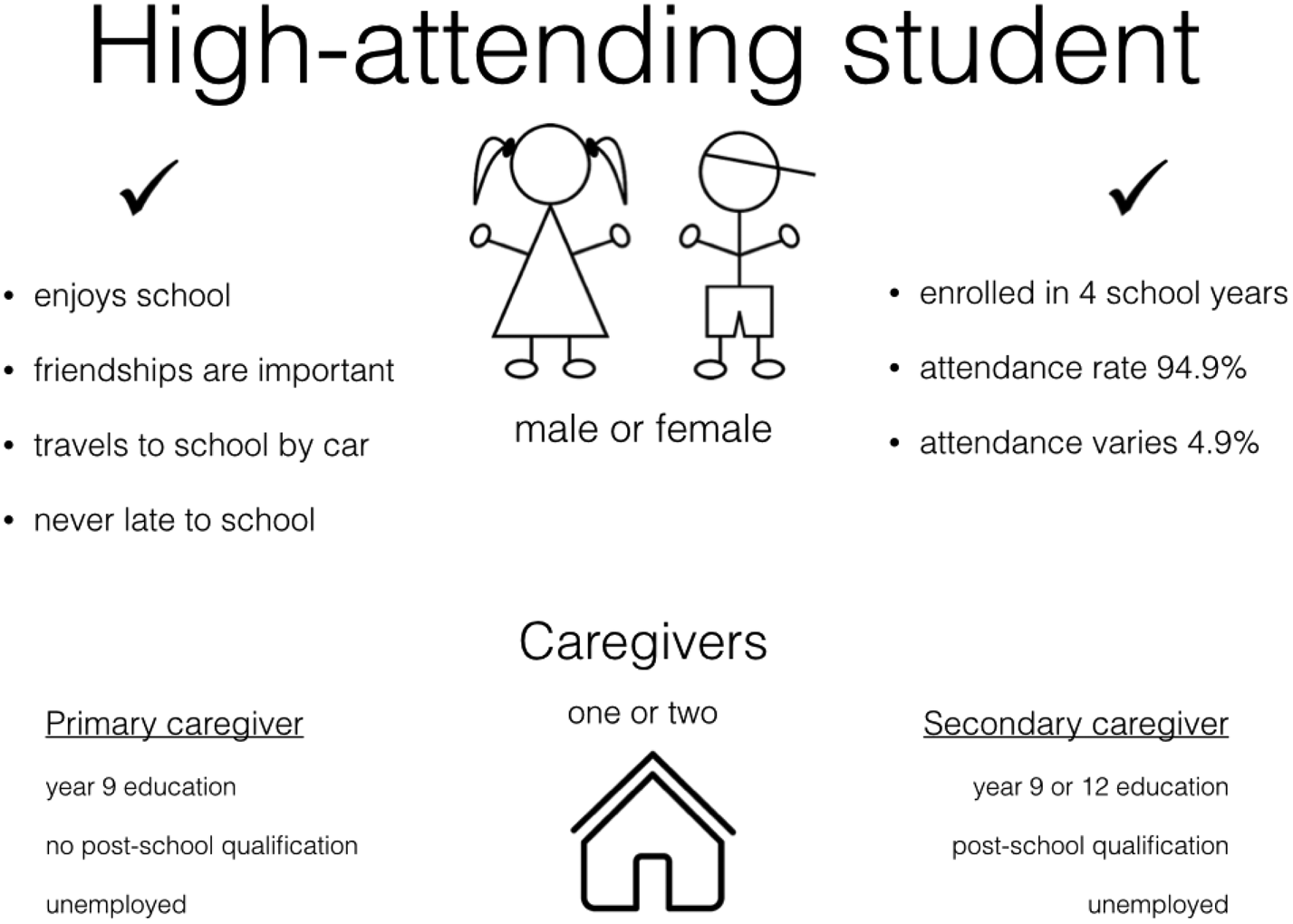
Aggregating individual student data reveal characteristics common among a population from which we can derive the characteristics of a ‘typical’ student. We profiled the characteristics of a ‘typical’ student (figure 1) to highlight similarities found among Watney's high-attending students. While the profile of common cohort characteristics reveals what might be a ‘typical’ student, it actually describes a few students. Although some students shared one or more similar characteristics, there were no characteristics universal across all students and no two students who were the same.
Profile of a ‘typical’ high-attending Indigenous student enrolled at Watney in 2015, showing student and caregiver characteristics.

Descriptions of individual high-attending students
Enrolment and attendance
Among the high-attending cohort, five students spent their entire primary school education years at Watney, although only SharniiFootnote 1, Jai and Zacchary's entire enrolment falls within 2005–2015. Contrastingly, Jarran, Coen and Mahlii were enrolled during 1 school year. Jarran enrolled at the beginning of grade two and left after 99 days enrolment. Coen and Mahlii enrolled during the first 2 weeks of prep, with 65 and 166 days enrolment, respectively.
Takeesha enrolled for the second time at Watney during the first term in her grade two year, and left again after 92 days of enrolment. Takeesha was already highly mobile having changed schools at least four times by grade two. Jarran, Coen and Mahlii represented two families with siblings at Watney, although they were not necessarily among high-attending students. Siblings in one family remained enrolled in 2015, while siblings in the other family stayed until graduation.
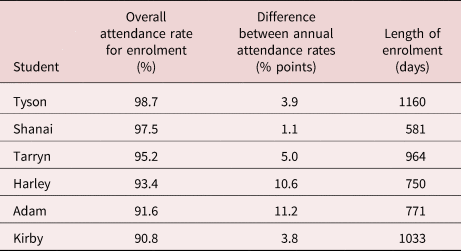
Most high-attending students maintained attendance above 90% each year. Students with an overall attendance rate above 95% attendance produced annual attendance rates above 90% in every year, while 57% of students with attendance below 95% recorded attendance below 90% in 1 year. A further 9% had attendance below 90% in 2 school years. Attendance variation between years likely represents absences for sickness, family holidays and other accepted reasons for absences, replicating variation similar for all high-attending students. Table 1 provides an example of the variation in high-attending students' attendance and enrolment, and reveals attendance rates between years and students' length of enrolment are unrelated to higher overall attendance rates.
Example of six Indigenous students among the top 45 students at Watney that shows students' attendance rate for enrolment period and the variation in attendance rate between years and length of enrolment

Tyson and Tom attained 100% attendance in 3 school years, while Jedda, Keilan and Mietta attained perfect attendance 1 year. Four students had highly consistent attendance rates between years—varying less than one percentage point—whereas seven students had attendance varying more than 10 percentage points. Zacchary had the widest attendance range (22% points) over his 8 years of enrolment; 77 and 80% in his 2 prep years and the lowest attendance recorded for high-attending students. Allirah recorded the next lowest annual attendance in grade 6 (84%), after 4 years of higher attendance (94.3–99%).
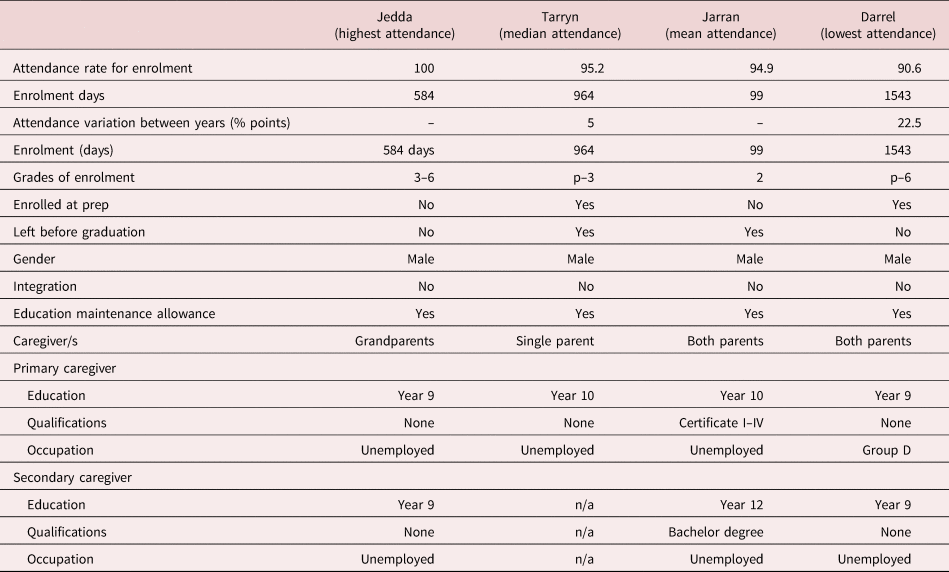
At student-level, we found substantial variation between students. As an example, students representing the highest, median, mean and lowest attendance rates are tabulated (Table 2). They highlight student diversity across the population for attendance, enrolment and other student and family characteristics collected in the data. Students at each indicator were male, although the high-attending population was gender-balanced. We subsequently sought to profile female students.
Characteristics of Watney's high-attending students (using pseudonyms) whose attendance over the period of their enrolment represents the highest, median, mean and lowest attendance rates

The two girls, Merindah (figure 2) and Kalinah (figure 3) were chosen for their gender and their capacity to provide student voice, unavailable for the four boys described previously. Merindah completed the questionnaire and although Kalinah had graduated the school in 2015, her sister completed the questionnaire. Descriptions of the girls further demonstrate diversity among Watney's high-attending Indigenous students and their families.
Profile of Merindah (pseudonym) that provides a holistic depiction of a high-attending student at Watney using data collected from the school's administrative records and questionnaire responses.

Profile of Kalinah (pseudonym) that provides a holistic depiction of a high-attending student at Watney using data collected from the school's administrative records and questionnaire responses.

Discussion
Our study sought to identify commonalities contributing to excellent school attendance in a sample of 45 Indigenous students with attendance at and above the 90% national benchmark, a departure from other studies of Indigenous students. Previous studies of Indigenous students' school attendance focus on the reasons why they cannot, will not or do not attend school regularly. Our approach runs counter to previous research that informed policies and practices designed to improve school attendance but that have met with limited success (Australian Government, 2018). Here we focus on individual Indigenous students who can, will and do go to school consistently.
Analyses of individual student's data collected by the school in compliance with national mandates showed no universally shared or overarching traits for high-attending students. With the exception of siblings who shared the same family circumstances, there existed considerable trait variation across the cohort. Poverty represented the most common, although not universally shared trait among these students and it has been indisputably associated with students' lowered rates of school attendance (Gray and Beresford, Reference Gray and Beresford2002; Jayachanran, Reference Jayachanran2002; Gottfried, Reference Gottfried2009; Daraganova et al., Reference Daraganova, Mullen and Edwards2014; Morrissey et al., Reference Morrissey, Hutchison and Winsler2014). Schools located in low socio-economic areas like Watney (ABS, 2013) record lower school-level attendance than schools in less impoverished areas (Hancock et al., Reference Hancock, Shepherd, Lawrence and Zubrick2013; Lamb et al., Reference Lamb, Jackson, Walstab and Huo2015). Most Indigenous students at Watney, a school categorised as socio-educationally disadvantaged (ACARA, 2018a), are therefore doubly at risk of lowered attendance. Without the benefits, greater affluence affords Indigenous (and other) students, many of Watney's Indigenous students do attend below 90%. However, paradoxically, 45 Indigenous students meet or surpass the national attendance benchmark.
Students
Student questionnaires revealed several traits common among students' responses: student relationships, sense of belonging and caregivers' expectations for high attendance; shared traits may prove important motivators for some, although not all, high-attending students. Friendships and belonging, associated with regular school attendance and success (Aldermann and Campbell, Reference Aldermann and Campbell2008; Dunstan et al., Reference Dunstan, Hewitt and Tomaszewski2017), were important for many high-attending students. Some students placed highest value on friendships and connections to others at the school, motivation for attendance that was anticipated by Indigenous Worker.
Students' combination of high attendance and more than 4 years enrolment facilitates the development and continuation of strong peer relationships. In turn, establishing social certainty, stability and ultimately belonging while at school further sustains high attendance (Howard, Reference Howard2002). Some students specifically noted they liked their teacher, indicating the importance of student–teacher relationships. Teachers' acceptance of students' socio-economic circumstances and understanding of Indigenous culture reinforced regular school attendance (Gray and Beresford, Reference Gray and Beresford2002), and provided evidence of a trusting school–community relationship (Trudgett et al., Reference Trudgett, Page, Bodkin-Andrews, Franklin, Whittaker, Walter, Martin and Bodkin-Andrews2017).
Bamblett and Lewis (Reference Bamblett and Lewis2006) describe the sense of belonging built on friendship and cultural inclusivity as beneficial and protective factors for Indigenous students, which may explain why at Watney, students report positive social interactions and with the exception of one student, they report no experience of bullying. Friendships can affectively engage students (Dunstan et al., Reference Dunstan, Hewitt and Tomaszewski2017) even when cognitive engagement is low and contribute to high attendance. Through the school's cultural inclusion strategies (Baxter and Meyers, Reference Baxter and Meyers2016) and the presence of an Indigenous Worker, whose skills are most often vastly under-rated (Price et al., Reference Price, Jackson-Barrett, Gower and Herrington2017), high-attending students experienced cultural safety, trust and belonging, which built social cohesion and connectedness that facilitated higher attendance; they are ‘eagerly attending school because it is a place that makes them feel strong and good about themselves—as Aboriginal and Torres Strait Islander young people’ (Shay and Wickes, Reference Shay and Wickes2017, p. 118). High-attending students, whether motivated by positive social experiences or academic success, habitually attend school every day, with very few absences. With increased connection and confidence, the habit of regular attendance becomes self-perpetuating (McLaughlin and Peace, Reference McLaughlin and Peace2008; Daraganova et al., Reference Daraganova, Mullen and Edwards2014).
While high-attending students establish the habit of attending regularly, caregivers and family play an equally crucial role because primary school students require the support of caregivers—and sometimes extended family, to get to school. Indigenous families want their children to succeed at school (Dockett et al., Reference Dockett, Mason and Perry2006), so expectations are for children to attend school every day unless ill or participating in family-sanctioned activities. School attendance becomes a joint effort that translates into caregivers' committed actions to prepare and transport students to school every day—a substantial commitment for families who live beyond the suburb of Watney.
High attendance indicates students have good health and wellbeing (Biddle, Reference Biddle2014). For primary school students, high attendance suggests families are similarly healthy and belong to the 77% of the Indigenous population who experience good health (Lovett and Thurber, Reference Lovett, Thurber, Walter, Martin and Bodkin-Andrews2017). They may be exceptional though, because the high-attending cohort and their families' circumstances approximate the majority in Watney's Indigenous community. While the root cause of other Indigenous students' non-attendance may be poor health and wellbeing associated with pervasive poverty and inter-generational disadvantage, high-attending students' attendance rates remain noticeably unaffected.
Families
Almost all Indigenous families at Watney shared poverty as a defining characteristic, and among the high-attending cohort, poverty occurred equally among single and dual caregiver households. If poverty is unequivocally associated with low attendance (Gray and Beresford, Reference Gray and Beresford2002; Zubrick et al., Reference Zubrick, Silburn, De Maio, Shepherd, Griffin, Dalby, Mitrou, Lawrence, Hayward, Pearson, Milroy, Milroy and Cox2006; Hancock et al., Reference Hancock, Shepherd, Lawrence and Zubrick2013; Driese et al., Reference Driese, Milgate, Perrett and Meston2016), the symptoms of poverty and associated intergenerational disadvantage for these families are being ameliorated in some way. We propose several explanations: the experience of poverty differs between families and students; families are remarkably resilient and stable; and students' only barrier was associated with poverty, which was ameliorated by school strategies.
The experience of poverty
Indigenous families' experience of poverty may be influenced by Indigenous customary practices that include sharing obligations, similarly impoverished extended family and friends and lack of financial management proficiency—especially in extreme circumstances (Hunter, Reference Hunter, Hunter and Biddle2012). We cannot discount these factors for Watney's Indigenous families. For high-attending students, however, families' social connections may have buoyed families in times of extreme financial stress (Ullucci and Howard, Reference Ullucci and Howard2015), or extended families may have provided in-kind help in ways that supported students' school attendance.
Many high-attending students' caregivers were educationally advantaged and likely possessed financial literacy and competence to subsist on little income. Their children's attendance remained uninterrupted, while other less educated caregivers at Watney experienced financial stress (Hunter, Reference Hunter, Hunter and Biddle2012) that negatively influenced their children's attendance. Urban families without customary sharing obligations may also have possessed greater capacity to accurately predict income and recurrent costs to reduce circumstances that might otherwise disrupt school attendance. We posit that high-attending students' families are among them.
The extent of each family's poverty varies, although it is not differentiated in school-based data, so we cannot discount the possibility high-attending students represent families from the more affluent end of the poverty scale. We cannot assume that families without an employed adult experience greater financial hardship than families with employment. Additionally, we cannot be certain that employed caregivers have full-time work and family income is above the poverty line. Whether entrenched poverty or otherwise, however, the way families experience poverty varies (Wratten, Reference Wratten1995). Families experience a myriad of experiences because as Ullucci and Howard (Reference Ullucci and Howard2015) contend, it is a myth that all people from impoverished backgrounds experience life the same. To think otherwise, creates a notion of ‘otherness’ that leads to social distancing and marginalisation (Krumer-Nevo and Benjamin, Reference Krumer-Nevo and Benjamin2010). Living in poverty creates a complex set of challenges that differs for each family, although for high-attending student's families, it has little effect on school attendance.
Family resilience
Australia's Indigenous population are at higher risk of long-term disadvantage than other Australian families when measured by ‘material resources, employment, education, health and disability, social connection, community and personal safety’ (Driese et al., Reference Driese, Milgate, Perrett and Meston2016, p. 14). Absence from school is one symptom of broad and complex disadvantages and social exclusion Indigenous families experience (Zubrick et al., Reference Zubrick, Silburn, De Maio, Shepherd, Griffin, Dalby, Mitrou, Lawrence, Hayward, Pearson, Milroy, Milroy and Cox2006; Taylor, Reference Taylor2010) and Watney's Indigenous families are not immune. However, while they are without the key associations of resilience, such as employment and income security (Lovett, Reference Lovett, Walter, Martin and Bodkin-Andrews2017), families of high-attending students show particular resilience, because their children attend school despite the challenges. Schools without strong school–community relationships may be unaware of the challenges that impact students' attendance; however, at Watney, school–community relationships were robust and sustained via the school's Indigenous Worker. Those strong relationships enabled the school to discern and respond to student and family needs (Trudgett et al., Reference Trudgett, Page, Bodkin-Andrews, Franklin, Whittaker, Walter, Martin and Bodkin-Andrews2017), and keen oversight of students while at school during periods of high stress.
High levels of unemployment among high-attending students' caregivers, and many families with no employment, suggest urban Indigenous caregivers rarely relocate for employment reasons. Families often relocate as a result of public housing availability, moving to other suburbs during school years and subsequently travel further distances for children to remain at Watney (Indigenous Worker, pers. comm.). When students transfer to other schools, or to Watney, the move usually occurs at the end of a school year. Indigenous families are choosing the timing of transfers to ensure students experience smooth transitions that reduce disruption to their children's learning and the social aspects of school, because they value education and its potential to overcome poverty (Dockett et al., Reference Dockett, Mason and Perry2006).
Bolstering some families to maintain students' high attendance may be caregivers' education levels and employment. Whether single or dual caregiver families, there are proportionally more educated caregivers in the high-attending cohort than other Indigenous families at Watney's Indigenous school community (Baxter and Meyers, Reference Baxter and Meyers2019). Associations between caregivers' high education levels and achievement and their children's high attendance are well recognised (Zubrick et al., Reference Zubrick, Silburn, De Maio, Shepherd, Griffin, Dalby, Mitrou, Lawrence, Hayward, Pearson, Milroy, Milroy and Cox2006; Daraganova et al., Reference Daraganova, Mullen and Edwards2014). With family histories of better school outcomes, caregivers are likely predisposed to hold greater educational aspirations for their children than caregivers without qualifications. However, such distinctions may represent a smaller influence overall at Watney because Baxter and Meyers (Reference Baxter and Meyers2016) found Watney's caregivers all expressed the strong desire for their children's educational success.
Caregivers' high education may also deliver less direct benefits, such as caregiver wellbeing, that may underpin the high attendance we report. Benefits include caregiver advantages such as increased employment opportunities, better health, social connectedness, less reliance on income support (The Smith Family, 2018) and lower rates of involvement in the criminal justice system (Parliament of Australia, 2011). These benefits provide students with robust family units and day-to-day stability, family resilience and social functioning that have protective effects (Lovett, Reference Lovett, Walter, Martin and Bodkin-Andrews2017) and support students' regular school attendance. The education and wellbeing association is complex and varies for individuals and their families (ABS, 2011); however, we posit Watney's urban Indigenous community comprises families whose wellbeing, enhanced by their resilience, increases caregivers' capacity to support students to attend school every day. In summary, families of high-attending students are worthy of mention and attention because they are resourceful, resilient and stable, against the odds.
The school
Watney partnered with the Indigenous community to positively influence school attendance (Baxter and Meyers, Reference Baxter and Meyers2016; Anderson et al., Reference Anderson, Lyons, Luke, Reich, Walter, Martin and Bodkin-Andrews2017). With the support of the Indigenous Worker, they implemented school-level policies and practices ‘through a frame of cultural competency and integrity’ (Rose, Reference Rose and Price2012, p. 76) to establish a school culture of Indigenous inclusion and respect—strategies designed to increase attendance (Dunstan et al., Reference Dunstan, Hewitt and Tomaszewski2017). Efforts to increase cultural inclusivity and ameliorate discernible signs poverty for students likely impacted the attendance of many, if not most students. Strategies, effective to increase all Indigenous students' attendance, may have removed high-attending students' only attendance barrier. For example, the school-based strategies to mediate poverty may have been sufficient to increase attendance frequency. Other students may have experienced multiple attendance barriers, or barriers that remained unresolved or unknown. The high-attending cohort may also have exhibited greater responsiveness to school-based strategies than the rest of the population. School-level strategies, however, remained insufficient to raise all Indigenous students' attendance above the 90% national benchmark (Baxter and Meyers, Reference Baxter and Meyers2019). More was required.
With strong connections to the Indigenous community, the Indigenous Worker played an instrumental role in monitoring attendance and recognised and understood challenges for regular attendance, responding to each student as barriers to regular attendance occurred. The Indigenous Worker took an individual-centred approach to school attendance, making connections with each student and their family to monitor attendance and identify barriers. Even so, despite the Indigenous Worker's continued efforts, some students' low attendance persisted (Indigenous Worker, pers. comm.).
Student and family diversity
Indigenous students are collectively ascribed many similarities: cultural understanding; spirituality; experiences of discrimination; low employment opportunities and poverty, for example. Such generalisations hide the reality that students and their families differ on those and other characteristics. Similarly, while at population-level, class, power, privilege and race impact the lives of Indigenous students and, in turn, their school attendance, student and family diversity suggests that there will be variation in how these factors affect individual students (Driese et al., Reference Driese, Milgate, Perrett and Meston2016). The impact of these factors, however, was beyond the scope of this research to ascertain.
Watney's high-attending students reveal they are a diverse multicultural group, like other Indigenous student populations (Trudgett et al., Reference Trudgett, Page, Bodkin-Andrews, Franklin, Whittaker, Walter, Martin and Bodkin-Andrews2017; Walter et al., Reference Walter, Dodson, Barnes, Walter, Martin and Bodkin-Andrews2017a). School-based data provided evidence of further diversity between individual Watney's high-attending students (Mellor and Corrigan, Reference Mellor and Corrigan2004). Such student diversity disproves binary categorisations of Indigenous and non-Indigenous students that implicitly and explicitly refer to Indigenous people as a homogeneous group. Watney's high-attending students are indeed an exceptional and unique cohort, and also heterogeneous (Shipp, Reference Shipp2013). We presupposed some commonalities amongst high-attending students; however, for every trait analysed, individual exceptions occurred. For example, while we can say students had at least one year 12 educated parent, others did not, and only one family lives on Country (Indigenous Worker, pers. comm.). The outcome of our analyses highlights the uniqueness of each Indigenous student (Nakata, Reference Nakata1995).
A personalised approach
Cohort-level analyses produced descriptors of the typical high-attending student. Unfortunately, averages can distort perspectives because aggregating student traits obscure individuals' unique characteristics, so each student becomes homogenised—merely a contribution to the average. Targeted to the average, a one-size-fits-all solution produces a blunt response (Driese et al., Reference Driese, Milgate, Perrett and Meston2016) and presents the same problems that school-level attendance averages in national reports (ACARA, Australian Curriculum Assessment and Reporting Authority, 2011, 2013, 2016, 2018b): the inability to distinguish individual differences. Considering Indigenous students in this way suppresses the recognition of students' unique attributes and the value of developing personalised solutions to support students to attend school regularly. As Hancock et al. (Reference Hancock, Mitrou, Taylor and Zubrick2018) report, developing intervention strategies for school absences requires recognition of the diversity in student risk profiles. In this case study, the school and, in particular, Watney's Indigenous Worker identified individual Indigenous students' attendance constraints, tailoring specific and timely responses to reduce the barriers. While acknowledging universal solutions and resourcing are needed and delivered through existing government policy, individualising intervention offers the opportunity to address ongoing challenges at federal, state and regional levels to improve Indigenous students' attendance rates.
Conclusion
High-attending urban Indigenous students in this case study reveal characteristics common among their cohort. The students belong to stable families that expect children to attend every day and have robustness and resilience that facilitates high attendance, despite experiencing socio-economic disadvantages that often impede school attendance. While these affordances characterise the cohort, they were not present for every student. Data from the school's administrative records and a student questionnaire showed wide variation among students. At individual-level, trait combinations varied and no single trait was present for every high-attending student. Assumptions of Indigenous homogeneity, however, permeate education and other associated literatures. For example, federal, state and regional policies; legislative frameworks; and educational practices often presuppose global solutions will address the needs of (all) Indigenous students. Such explicit and implicit assumptions require scrutiny and rebuttal because even among the cohort of high-attending urban Indigenous students in this study, we find significant student diversity.
Ten years of focused attention on Indigenous education has had limited effect in meeting the predetermined attendance rate and other Closing the Gap targets (Australian Government, 2018; Council of Australian Governments, 2018). Despite efforts to improve Indigenous students' attendance rates, they have remained low and stable. Whether strategies are targeted to national, jurisdictional or school-level, assumptions of homogeneity lie at the core of policies designed for universal application. Although Closing the Gap strategies positively influenced some students' attendance rates, other students' attendance remained unaffected. Without a more nuanced personalised approach that identifies and responds to each student's attendance barriers, attendance targets remain unlikely to be reached. In 2019, reassessment of previous Closing the Gap policies presents a window of opportunity to influence future strategies designed to improve Indigenous students' attendance. Continuing the one-size-fits-all approach that drives global solutions will likely maintain the attendance status quo. Acknowledging Indigenous student diversity and the need for personalising interventions for individual students offers a new way forward to improve all Indigenous students' attendance.
Acknowledgements
The generous participation and contribution of the Indigenous school community at Watney (a pseudonym) made this work possible. We thank the Elders and community leaders for their support and permission to conduct this project, without which, this research would not have been possible. Ethical constraints preclude the identification of Country on which the school is situated. We would, however, like to acknowledge and pay our respect to the Dja Dja Wurrung Community as the traditional owners and custodians of the land on which La Trobe University Bendigo is situated and where we conducted the analysis and writing for this paper. An Australian Government Research Training Program Scholarship (APA) and a grant from La Trobe University's Transforming Human Societies Research Focus Area supported this work.
Lindy Baxter has devoted over a decade of her career to raising educational aspirations and extending opportunities to all students at an urban primary school, and in particular Indigenous students. Her work involves the systematic and systemic analysis of factors associated with raising Indigenous student attendance and achievement in their crucial primary years. Lindy has recently completed her PhD (including published works of which this article forms part).
Noel Meyers is a Professor of Education and Environmental Studies at La Trobe University. Professor Meyers's research is focused on support for learners under-represented in school and higher education. He has worked extensively domestically and internationally to improve capacity and the capabilities of low SES students. Noel has earned national and international teaching accolades for his work in science education and is the co-author of the textbook used by more than 60% of Australians first-year Biology students.