“What can I do? The people need a god,” said Secretary General of the Soviet Communist Party Joseph Stalin to the writer Mikhail Sholokhov in 1933 as he was wiping out religious traditions in the Soviet Union (Monefiore Reference Monefiore2004, 139).Footnote 1 As occurred in many other countries where communist parties came to power, the Vietnamese communists dismissed preexisting deities when they established their rule in North Vietnam, for these did not correspond to their ideology and policy goals. The vacated space became a new Olympus to assist the Party and the state to achieve their aims. Instead of deities worshipped for their supernatural powers, the new Olympus in Vietnam, as in other socialist countries, was to be inhabited by humans, historical and contemporary, regarded as deities endowed with supernatural powers—a phenomenon called political religion.
Emilio Gentile, an Italian scholar and the leading figure in the field of political religion, defined this as “the sacralization of a political system founded on an unchallengeable monopoly of power, ideological monism, and the obligatory and unconditional subordination of the individual and the collectivity to its code of commandments. Consequently, a political religion is intolerant, invasive, and fundamentalist, and it wishes to permeate every aspect of an individual's life and of a society's collective life” (Gentile Reference Gentile and Staunton2006, xv). Political religions emerged with mass politics and appeared during the American and French revolutions (xvi), but they proliferated during the twentieth century with fascism, Stalinism, and Maoism.
James Gregor, a political scientist and a specialist in the study of fascism, suggests that the end of the war in 1945 “signaled neither the disappearance of, nor a diminution of, the role to be played by secular religions in the lives of humankind. The conclusion of war initiated a new period in the history of secular religions.” According to him, nationalism and communism became the two most universal manifestations of the sacralization of politics at the time, and the most dramatic forms were those “that identified themselves as Marxist in general, and Marxist-Leninist in particular” (Gregor Reference Gregor2012, 226–27). He wrote that the Soviet Union and its satellite nations “indulged in a common faith that embodied itself in a ‘Leader’ charged with defending and fostering orthodoxy” and “a system of supervision for education, publication, the transfer of information, and civilian communication” (Gentile Reference Gentile and Staunton2006, xix; Gregor Reference Gregor2012, 228).
Thus, the list of individuals who were the focal points of political religions during the prewar and war years, such as Lenin, Stalin, Mussolini, and Hitler, expanded into the postwar years with many newcomers who stood at the head of totalitarian regimes, such as Mao Zedong in China, Kim Il Sung in North Korea, Nicolae Ceaus,escu in Romania, Enver Hoxha in Albania, and Mengistu Haile Mariam in Ethiopia. These personalities inhabited new Olympuses and became representations of the political systems of which they were a part. Being at the centers of newly created political religions, they served to acquaint people with the new order and to create and perpetuate people's loyalty to the newly formed state entities. The face, front and center, of the communist political system and political religion in Vietnam was and is Hồ Chí Minh.
Hồ Chí Minh and His Cult in Scholarship
In Vietnam, hundreds of works have been written about Hồ Chí Minh. They all perpetuate the image of a staunch revolutionary leader, the father of his people, without any critical analysis of his life or work. In the West, the earliest works appeared at the end of the 1940s and looked at Hồ Chí Minh from a political perspective, concentrating on his position as a national hero and liberator, or as an agent of the Soviet Union or of the world communist system (Mohan Reference Mohan1951; Renaud Reference Renaud1949; Rous Reference Rous1947). In the 1960s and 1970s, a number of Hồ Chí Minh biographies were published, some of them as edifying as their titles; for example: Ho-chi-Minh: Ein leben für Vietnam (Ho Chi Minh: A life for Vietnam; Stuhlmann Reference Stuhlmann1960); Ho Chi Minh, notre camarade (Ho Chi Minh, our comrade; Figuères and Fourniau Reference Figuères and Fourniau1970); Ho Chi Minh, Legend of Hanoi (Archers Reference Archers1971); Ho Chi Minh, an Appreciation (Burchett Reference Burchett1972); and Ho Chi Minh: A Biographical Introduction (Fenn Reference Fenn1973). David Halberstam's Ho (Reference Halberstam1971) can also join this list, as a reviewer described it as “more of a commemorative ode than a biography” (Kirkus Review 1971).
In the 1960s and 1970s, and especially after Hồ Chí Minh's passing in September 1969, more serious academic works appeared, mostly in French, taking a somewhat deeper look at Hồ Chí Minh's life (Handache Reference Handache1970;Footnote 2 Kobelev Reference Kobelev1979; Lacouture Reference Lacouture1967, Reference Lacouture and Wiles1968; Rageau Reference Rageau1970; Sainteny Reference Sainteny1970, Reference Sainteny and Briffault1972). In the last three decades, stimulating academic works appeared, starting with the French scholars Nguyễn Thế Anh (Reference Nguyễn Thế Anh1983, Reference Nguyễn Thế Anh and Bénichou1990), Daniel Hémery (Reference Hémery1990, Reference Hémery1992), and Thu Trang Gaspard (Reference Gaspard1992). The turn of the century marked the publication of a number of scholarly monographs that give us more complex images of Hồ Chí Minh's life. In the United States, William Duiker's (Reference Duiker2000) tome covered Hồ Chí Minh's life in its entirety, while Sophie Quinn-Judge (Reference Quinn-Judge2002) focused her work on the years between 1919 and 1941. The Italian scholar of Vietnam Pino Tagliazucchi (Reference Tagliazucchi2004) published his own version of Hồ Chí Minh's biography, concentrating on the political aspect of his prerevolutionary years and relying mostly on secondary sources in both Western and Vietnamese languages. All of them reconstruct events in Hồ Chí Minh's life, but barely touch on the process of Hồ Chí Minh's sacralization.
Duiker (Reference Duiker2000, 562–80) includes an epilogue titled “From Man to Myth,” but it focuses on the later stages of Hồ Chí Minh's life and the development of his cult after his death. Duiker suggests that Hồ Chí Minh's “primary function during the mid-1960s was to serve as the beloved ‘Uncle Ho,’ visiting schools, factories, and collective farms to promote the cause of socialism and national reunification” (553). But, understandably since it was not their goal, Duiker and the other abovementioned authors do not explore the formation or the maintenance of Hồ Chí Minh's cult. Hue-Tam Ho Tai, a historian of twentieth-century Vietnam, noted in a very interesting article that “the cult of Hồ Chí Minh, carefully tended by Hồ himself, began well before his death in 1969,” but her article focused on Hồ Chí Minh's posthumous cult, using the example of Hồ Chí Minh's museum in Hanoi (Ho Tai Reference Ho Tai, Taylor and Whitmore1995, 274). Recently Marina Marouda, a British anthropologist, explored the more recent development of Hồ Chí Minh's cult in contemporary Vietnam (Marouda Reference Marouda2013). In his latest book, David Marr took a step towards consideration of the formation of Hồ Chí Minh's cult in 1945–46, but being confounded by the expanse of the topic he allotted only four pages to it (Marr Reference Marr2013, 561–65).
The title of the French scholar Pierre Brocheux's (Reference Brocheux2003) engaging book, Hô Chi Minh: Du révolutionnaire à l'icône (Hô Chi Minh: From revolutionary to icon), suggested to me that, in addition to being a biography, it would devote more attention to Hồ Chí Minh's cult than other works did.Footnote 3 In fact, he has only a short section on the issue titled “From the Legend to the Myth” (Brocheux Reference Brocheux and Duiker2007, 177–82). Brocheux traces Hồ Chí Minh's cult to the prerevolutionary period: “[By 1945], elements of the myth of Ho Chi Minh were in place; the idealized portrait of the man, the legendary tale of the past, and the use of this representation to mobilize the people and spur them to action. This was achieved via all possible means, from graphic arts to statuary, cinema, theater, poetry, songs, nursery rhymes, and education in schools” (179). He uses the passive voice in this passage, but shortly thereafter he elaborates on the agents of the creation of the cult: “A cult of personality is most often the work of the entourage (or should we say the court?), but can it spread without the consent or even the encouragement of the subject?” (180). Brocheux affirms that it can and it did. He suggests that the creation of the cult was used for the unification of the nation but also to isolate Hồ Chí Minh on a pedestal, separated from others. To support this point, he refers to the violation of Hồ Chí Minh's desire to be cremated, as he had clearly expressed in his testament, and not to be viewed. “The falsification of the Testament and what became of Ho post mortem shed light on those responsible for his cult, on the function of his cult, and thus on the real status of Hồ Chí Minh at the heart of the regime” (180). Focusing only on the later years of Hồ Chí Minh's life, Brocheux shields Hồ Chí Minh from any responsibility for or role in orchestrating his own cult.Footnote 4 He defines Hồ Chí Minh's post-mortem cult as of an almost religious character (182).
This article concentrates on Hồ Chí Minh's role in the formation of his cult, with particular attention to his biography and autobiography, his birthdays, his family, and his final testaments. I argue that Hồ Chí Minh was instrumental in the formation of his cult and that some aspects of Hồ Chí Minh's cult depart from what are commonly believed to be traditional Vietnamese practices and instead display extensions into Vietnam of practices arising in the Soviet Union that became widespread in the Marxist-Leninist world during the mid-twentieth century. I include in my consideration materials mostly published during Hồ Chí Minh's life with a special focus on Những mẩu chuyện về đời hoạt động của Hồ Chủ tịch (Vignettes of President Ho's life and activities),Footnote 5 attributed to Trần Dân Tiên, which is the master-narrative of Hồ Chí Minh's life and one of the foundations of his cult.Footnote 6
The First (Auto)biography
On September 2, 1945, during the Proclamation of Vietnamese Independence and of the Democratic Republic of Vietnam (DRV) at Ba Đình Square in Hanoi, Trần Dân Tiên saw Hồ Chí Minh for the first time. Trần Dân Tiên wanted to write Hồ Chí Minh's biography. Many Vietnamese and foreign writers and journalists aspired to do that, but it seems that President Hồ did not like to talk about his life.
The next day, Trần Dân Tiên wrote to President Hồ to ask for a meeting. That same day, he received a response from the president inviting him to come to his residence. This is how already on September 4, 1945, at 7:25 a.m. Trần Dân Tiên found himself conversing with Hồ Chí Minh. President Hồ agreed that writing his biography could be a good idea. However, he explained that the time was not yet right for that, as there were many other more urgent tasks at hand—starving people and widespread destruction after eighty years of colonial slavery. His biography would have to wait.
Undaunted by this, Trần Dân Tiên decided to find and interview people, whether Vietnamese or foreigners, who knew Hồ Chí Minh. As difficult as this approach was, it proved to be fruitful, and within two years Trần Dân Tiên had collected enough material to write stories about President Hồ. We learn of all this from Trần Dân Tiên's preface to the book that came from his efforts. Trần Dân Tiên acknowledged that many periods of Hồ Chí Minh's life fell out of the narrative. He wrote that these were possibly the most important periods, but he did not know anything about them, and he assumed that nobody but President Hồ himself knew about them.
After this opening, Trần Dân Tiên leads his readers on a journey beginning with Hồ Chí Minh's youth in Nghệ An Province in north-central Vietnam; to Saigon from where he departed for foreign lands to learn and look for ways to help his country; to Marseille and Le Havre in France; to his voyages around the world, to London, Paris, the Soviet Union, China, Hong Kong; and, finally, back to Vietnam, where he led the Việt Minh, the League for the Independence of Vietnam, to be the vanguard of the revolution. He proclaimed victory by reading the Declaration of Independence, when Trần Dân Tìên and many others saw him for the first time. This event was but the beginning and not the end of the struggle for the independence of the country. Trần Dân Tiên takes his readers through the first two years of the ensuing struggle and stops there.
Creation and Authorship: Trần Dân Tiên and Hồ Chí Minh
The edition that circulates in Vietnam to the present day is the edition published in 1955 in Hanoi (Trần Dân Tiên Reference Trần Dân Tiên1955). The work was also translated into many languages: English (Trần Dân Tiên Reference Trần Dân Tiên1958a), Russian (Trần Dân Tiên Reference Trần Dân Tiên and Karpov1958b), Indonesian (Trần Dân Tiên Reference Trần Dân Tiên1959), Esperanto (Trần Dân Tiên Reference Trần Dân Tiên1960), and French (Trần Dân Tiên Reference Trần Dân Tiên1972, 9–108).Footnote 7 But the Vietnamese 1955 edition was not the first edition of Vignettes. Some researchers list its first appearance in Paris in 1948 in French.Footnote 8 However, I have not yet found either this edition or anyone who has actually seen it. But Jean Sainteny, a Frenchman who in 1946 negotiated with Hồ Chí Minh the terms of an “accord” between France and the DRV, mentions it in his book, describing it as endeavoring “to confirm the virtuous and ascetic but meek and mild aspects of the man who was to become known as ‘the good uncle Ho’” (Sainteny Reference Sainteny1970, 27). The earliest editions of Vignettes that I found are the Vietnamese and Chinese versions published in 1949.
Hoàng Nguyên, who, with a group of other people, was charged by Hồ Chí Minh to establish the Information Bureau of the DRV in Rangoon, Burma, states that in 1948 they brought from Vietnam two books, one of which was Vignettes written in French. It was translated into several languages and sent to other countries to be distributed “to fulfill a big question of the time: who is Hồ Chí Minh that he stood up to establish the independent Vietnamese state and to skillfully lead the War of Resistance against French colonizers?” (Hoàng Nguyên Reference Nguyên1991, 55).
Hoàng Nguyên clearly reflects the situation at that time. After the excitement and elation about the Proclamation of Independence in September 1945, the newly established Democratic Republic of Vietnam found itself in a very difficult situation. The French were determined to retake the colony that they had lost to the Japanese during World War II. The Việt Minh forces responded by taking up arms. The new regime was at war with France while being disregarded by both the United States and the Soviet Union. China, to which Hồ Chí Minh tried to appeal, was preoccupied with civil war between Nationalists and Communists. Relations existed between Hồ and the Chinese Nationalist forces that arrived in North Vietnam in 1945 to accept the surrender of the Japanese army there. But after the Chinese withdrew in 1946, the Vietnamese were left to their own devices. Not officially recognized by anyone, the DRV continued to appeal for help to Nationalist China and to search for international connections with nearby Thailand and with former colonies that had their own strong independence movements. Being the president of the new state and also its Minister of Foreign Affairs,Footnote 9 it seems plausible to assume that Hồ Chí Minh and his associates thought that the publication of a book such as the one being considered here would help to make their cause known to the outside world and put the DRV on the political map. Another corroboration of this is found in the Chinese edition of Vignettes that mentions Nguyễn Ái Quốc, the name he adopted while in France, as Hồ Chí Minh's real name (Tran Dan Tien Reference Trần Dân Tiên, Nianshi and Thức1949, 4, 36). In the very last sentence of the Chinese Vignettes, indicated as a postscript, Trần Dân Tiên makes a very touching comment with reference to China: “[H]e will always keep his name Hồ Chí Minh [which he adopted while in China] to show his courtesy to China” (191). Behind this expression of loyalty might have stood Hồ Chí Minh's appeal for Chinese assistance. This comment does not appear in any other edition based on the Vietnamese Vignettes that I consulted.
While the reason for the book seems clear, the authorship is more mysterious. The only identification of the author is his name, Trần Dân Tiên, printed on the covers of all editions of Vignettes that I could locate, with a single exception that I discuss below. There does not appear to be a real person associated with this name. Vignettes is the only known work ascribed to Trần Dân Tiên. Many Vietnamese and Western scholars agree that the person who actually owns this name is Hồ Chí Minh himself (Brocheux Reference Brocheux and Duiker2007, 209n14; Duiker Reference Duiker2000, 579; Hà Minh Đức 1985, 132; Nguyễn Thế Anh Reference Nguyễn Thế Anh and Bénichou1990, 12n1, 34; Quinn-Judge Reference Quinn-Judge2002, 5).
Not everyone agrees with the identification of Trần Dân Tiên as Hồ Chí Minh. Nguyễn Khôi, a writer and former deputy director of the Secretariat of the National Assembly who once worked with high-profile communist leaders, made a case against equating Hồ Chí Minh and Trần Dân Tiên, according to a website containing an interview with him (Nguyễn Khôi 2013). Nguyễn Khôi reasoned that Hồ Chí Minh would not have had time to write his own biography in the midst of all the urgent matters for which he was responsible after the August Revolution and during the War of Resistance against the French. Moreover, Nguyễn Khôi maintains that as a modest person Hồ Chí Minh would not write about himself.
According to Nguyễn Khôi, it was necessary in 1945–46 to make Hồ Chí Minh known to the world, so Hoàng Quốc Việt, a member of the Party Central Committee, and Trần Huy Liêu, Minister of Propaganda, arranged to have a book written about the president. They assigned Hồ Chí Minh's assistant Vũ Đình Huỳnh to write it. Upon completion, Trần Huy Liêu edited it and added some details, and then handed it to Hoàng Quốc Việt and Trường Chinh, the General Secretary of the Party at the time. The team chose the penname Trần Dân Tiên, which, according to Nguyễn Khôi, means “the first citizen of the Trần family of the Democratic Republic of Vietnam.” He connects this choice to the common ancestry of several team members from the Trần clan, including Trường Chinh, whose ancestor was Trần Hưng Đạo, the Vietnamese general who successfully repelled Mongol-Yuan invasions in the thirteenth century. In Nguyễn Khôi's opinion, Trần Dân Tiên's work is an honest book that vividly describes Hồ Chí Minh's life (Nguyễn Khôi 2013).Footnote 10
To contribute to this debate, I suggest taking a look at Trần Ngọc Danh's biography of Hồ Chí Minh, Tiểu sử Hồ Chủ tịch (Biography of President Hồ), published in Paris in 1949 and mentioned by some researchers, but never discussed by them (Trần Ngọc Danh 1949). The work was evidently also published in French as Histoire du Président Ho (History of President Ho), which is also a possible translation of the term tiểu sử, which I translate here as “biography.” Jean Sainteny (Reference Sainteny1970, 27) mentions it in his book.
Trần Ngọc Danh and Authorship
The most intriguing point about Trần Ngọc Danh's publication has never been discovered or, at least, brought to light: Trần Dân Tiên's Vignettes and Trần Ngọc Danh's Biography are unmistakably the same book. Trần Dân Tiên's Vietnamese edition of 1955 and Trần Ngọc Danh's Biography of 1949 are not identical verbatim but they coincide in each and every sentence as two independently made translations of the same text, suggesting that both were translated from the original manuscript in French and that either the edition ascribed to Trần Ngọc Danh was not available in Vietnam in the 1950s or it was decided not to use it.
The edition of Trần Ngọc Danh's Biography, and only it, includes a foreword by Trần Ngọc Danh. This foreword is a quintessential panegyric on Hồ Chí Minh to explain the necessity of his cult. Recognizing that people heard Hồ Chí Minh's name for the first time on the day of the Proclamation of Independence of Vietnam, the foreword affirms that from that day “the name Hồ Chí Minh became absolutely inseparable from the Democratic Republic of Vietnam.… Now Vietnam worships [tôn sùng] Hồ Chí Minh, because Hồ Chí Minh, both spiritually and physically, is the beloved child of the Vietnamese nation…. This worshiping [sự tôn sùng] is not something excessive, because during each historical stage a nation produces a leader who meets the needs of the current situation” (Trần Ngọc Danh 1949, 5). The reference to Hồ Chí Minh as the beloved child of the Vietnamese nation appears twice in the foreword and then again in the text of both Biography and Vignettes. The foreword identifies Hồ Chí Minh as “the very life and death and the prosperity of the Vietnamese nation.… The Vietnamese masses believe that at the present time Hồ Chí Minh is the only person who deserves to lead the nation.… The cult [sự sùng bái] and adulation/idolization [chiêm ngưỡng] is a historical matter.… The cult of Hồ Chí Minh must be manifested in everyday deeds” (6–7). This foreword reflects the substance of Vignettes.
Were Trần Dân Tiên and Trần Ngọc Danh the same person, and was Trần Ngọc Danh's book published under the name Trần Dân Tiên? We cannot exclude this possibility, though, as we will see below, Trần Ngọc Danh ascribes the work to Hồ Chí Minh himself.
Unlike Trần Dân Tiên's name, which was a penname, Trần Ngọc Danh was a real name of a real person; he was a brother of the first secretary general of the Indochinese Communist Party, Trần Phú, who was executed by the French in 1931. Trần Ngọc Danh was among those who joined the communist movement at the very beginning. In 1929, he started a course of study in Moscow under the pseudonym Blokov, and he even became a member of the Soviet Communist Youth Organization Komsomol (Selivanov Reference Selivanov2014, 34, citing Russian State Archive of Socio-Political History, fond 495, op. 201, file 10; fond 82, op. 2, file 1157, 6). Without completing his education in the Soviet Union, Trần Ngọc Danh left in 1931 for China, where he joined the Indochinese Communist Party. In 1932, he was arrested there by the French and imprisoned on the island of Poulo Condore. He was freed only in 1945 after the August Revolution.
Trần Ngọc Danh became a Stalinist detractor of Hồ Chí Minh. Removed from a position of leadership in the South, he was sent to Paris in 1946 to head the DRV delegation. In Paris, he wrote brochures and articles promoting the cause of the DRV without revealing his personal views of Hồ Chí Minh. He apparently became very popular among the Vietnamese émigré community, because when French police arrested him in January 1948 for “acts against the integrity of French territory,” Vietnamese workers protested in the streets. It was reported that thirty-three Vietnamese citizens from a camp where 2,000 workers lived were arrested in Marseilles (Daily News 1948, 3; Kalgoorlie Miner 1948, 1). Later, Trần Ngọc Danh was released. He fled from Paris to Prague in August 1949; from there, in December 1949 and in January 1950, he sent letters to the Soviet Communist Party criticizing Hồ Chí Minh's leadership. Expelled from the Vietnamese Communist Party in 1950, he died soon after (de Tréglodé Reference De Tréglodé2000; Goscha Reference Goscha2003, Reference Goscha2006; Quinn-Judge Reference Quinn-Judge2002, 339).
Trần Ngọc Danh's letters denouncing Hồ Chí Minh to Stalin were sent from Prague shortly before Mao and Hồ Chí Minh's visit to the Soviet Union in early 1950. He accused Hồ Chí Minh on many points, including but not limited to Hồ Chí Minh's lack of internationalism, his superfluous knowledge of Marxism-Leninism, and his deviation from it in practice. Trần Ngọc Danh called Hồ Chí Minh a new Tito, evoking the dangers that the Soviets saw in the seemingly noncompliant Yugoslav leader who had a falling out with Stalin in 1948. The letters were apparently written to endear Trần Ngọc Danh to the Soviet leaders and to have Hồ Chí Minh deposed. But what is interesting for our topic is that Trấn Ngọc Danh accused Hồ Chí Minh of “the blind deification of leaders” (Huỳnh Kim Khánh Reference Huỳnh Kim Khánh1982, 255n51; Quinn-Judge Reference Quinn-Judge2002, 339).
In order to support his argument, Trần Ngọc Danh quotes passages that suggest the deification of Hồ Chí Minh. Some of them I have already cited while discussing Trần Ngọc Danh's foreword to Biography; others place Hồ Chí Minh in the company of dignitaries, including those who seem farfetched for the communist world: “like great historical personalities, great Chinese emperors, Jesus Christ, Sun Yat-sen, Lenin, and Mahatma Gandhi, President Ho is a simple, straightforward, and loyal person” (Selivanov Reference Selivanov2014, 245). Trần Ngọc Danh presents this as evidence of Hồ Chí Minh's incorrect thinking and self-deification. He claims that these passages come from Hồ Chí Minh's “autobiography,” which cannot be anything other than Vignettes cum Biography ascribed to Trần Dân Tiên and Trần Ngọc Danh, respectively. First, by that time it was the only widely circulated source of information about Hồ Chí Minh's life, regardless of whether it was a biography or an autobiography. Second, these passages indeed correspond to passages in Vignettes as published at that time, passages that were possibly in the original French version, and were certainly in Biography and its foreword attributed to Trần Ngọc Danh. Furthermore, they also appear in the Chinese version of Vignettes (Trần Dân Tiên Reference Trần Dân Tiên, Nianshi and Thức1949), of which linguistic analysis shows that it, like the edition attributed to Trần Ngọc Danh, was translated from French.
The attribution of authorship to Trần Ngọc Danh in the Vietnamese edition in France can be explained by his popularity among Vietnamese expatriates, as revealed by the demonstrations against his arrest. At the time, the Vietnamese community in France consisted of tens of thousands of people, and Hồ Chí Minh's government tried to reach them (Blanc Reference Blanc, Ember, Ember and Skoggard2005; Daum Reference Daum2009; Rettig Reference Rettig2012). Trần Ngọc Danh's name was well known to many Vietnamese in France, and it would accordingly “legitimize” and “authorize” Vignettes/Biography and elevate the status of the new leader of the Democratic Republic of Vietnam, Hồ Chí Minh, in the eyes of the Vietnamese diaspora in France.
Authorship in the Chinese Vignettes
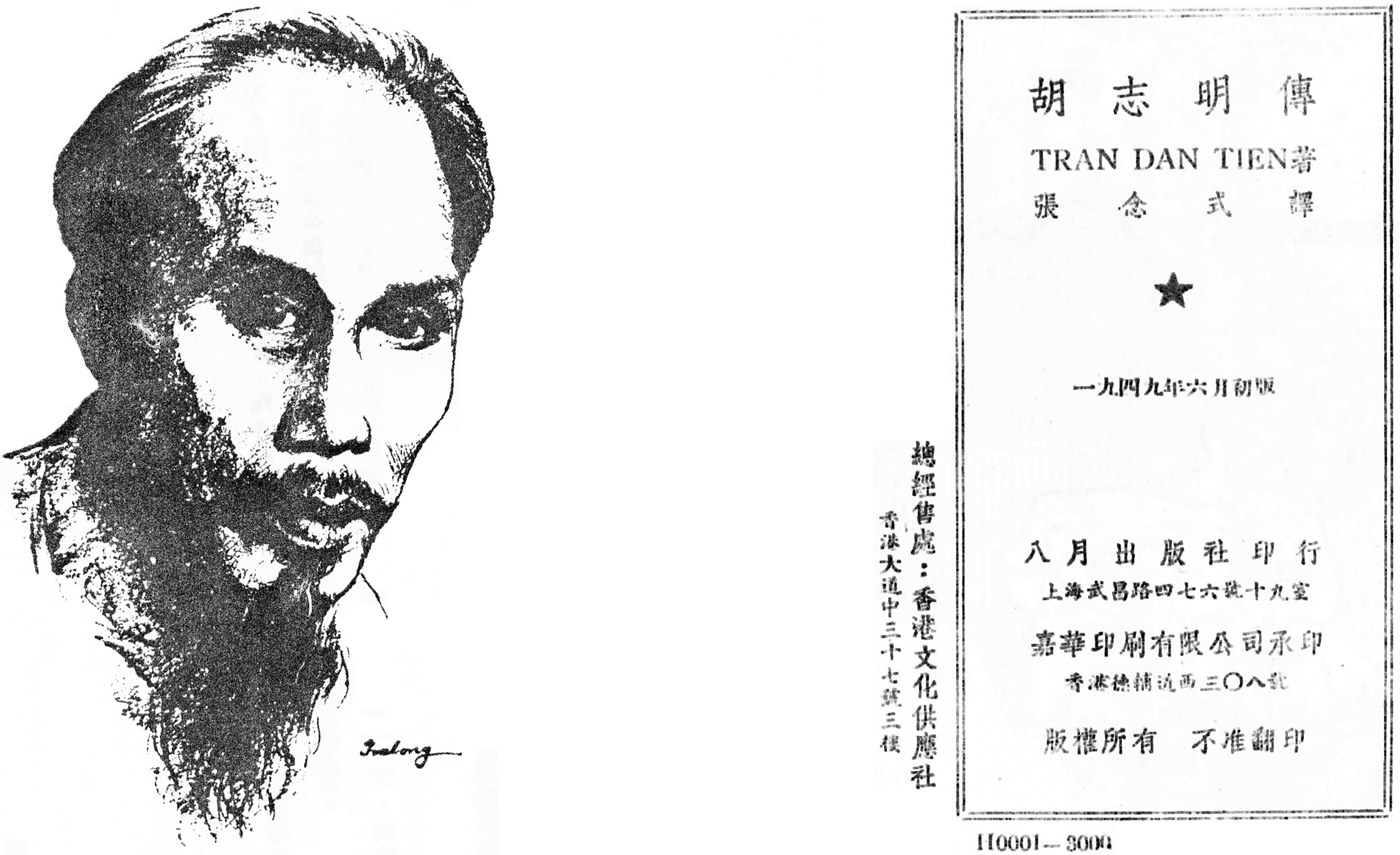
The Chinese version of Vignettes, titled Hu Zhiming zhuan 胡志明傳 (Stories about Hồ Chí Minh), was published in 1949, shortly before the fall of Nationalist China and almost simultaneously with the publication of Trần Ngọc Danh's Biography (see figure 1). Like Trần Ngọc Danh's edition, the Chinese Vignettes includes a number of passages, such as the one incorporating Hồ Chí Minh into the same company with Jesus Christ and great Chinese emperors, that never found their way into later editions of the book. The Chinese edition provides us with a fresh view of the authorship of Vignettes. With the manuscript being in Chinese, all personal names and toponyms are rendered in Chinese. A majority of them are also transliterated into French alphabetic script, which suggests that the text was translated from French.
Title page of the Chinese version of Vignettes—Hu Zhiming zhuan 胡志明傳 (Stories about Hồ Chí Minh), published in 1949 (Tran Dan Tien Reference Trần Dân Tiên, Nianshi and Thức1949).

All non-Chinese names and places are written in characters except for the author's name, Trần Dân Tiên, and that of one other person mentioned in the text. The rendering of the author's name as “Tran Dan Tien” in Romanized script on the cover of the book as well as on the two title pages truly stands out in the otherwise perfect Chinese script. Its repetition excludes a possibility of the author's or the publisher's negligence.
Unlike the other languages in which Vignettes was published, where the meaning of names often remains obscure, the Chinese system of writing actually defines the meaning of each name depending on the characters used to write it. A very large portion of the words in the Vietnamese language stems from Chinese but with Vietnamese pronunciation. This portion of the vocabulary is called Sino-Vietnamese or Hán. While in Chinese characters the meaning of each word is always clear, in Vietnamese we might need to know the character corresponding to a word in order to understand the meaning. For example, the word written in modern Vietnamese as châu signifies at least five different characters in Chinese—three pronounced in Chinese as zhuō: 州 (state, province), 洲 (continent, island), and 舟 (boat); and two pronounced in Chinese as zhū: 珠 (bead or pearl) and 朱 (vermillion). The context and general sense usually mitigate such cases. But it is more difficult to determine the meaning of separately standing words or names, and Vietnamese names usually consist of Sino-Vietnamese words with character equivalents.
Without characters, the most plausible interpretation in the Vietnamese language of the name rendered in Chinese as 陈民先 is “Trần who goes in front of the people”: Trần 陈 (Chen in Chinese) is a very common surname; dân 民 means “people”; and tiên 先 means “first, in front.” Depriving Trần Dân Tiên's name of characters or even of diacritics suggests that the author or translator did not want the reader to have a clear idea of what stands behind the Romanized rendering of this name. In fact, it seems that the author wanted to puzzle the reader, as different names with a variety of characters could easily be supplied. Consequently, Chinese readers are left to decide what they want to think about Trần Dân Tiên's name. Whether the characters were omitted as an invitation for readers to plunge into an enigmatic text or whether the translator did not know how to deal with this combination of words in the name can be debated. The latter would only support the riddle of the former, since the translator managed to render into Chinese characters the names of all Westerners and Vietnamese other than Trần Dân Tiên as well as the names of places and publications. Possibly rendering Trần Dân Tiên's name into characters was undesirable, as it would present Trần Dân Tiên, ostensibly a mere writer and author of Vignettes, as someone towering above the people, being “in front of the people.”
But the intrigue does not end with the absence of Chinese characters standing for the author's name. As Vignettes states, the book consists of reminiscences of people who knew Hồ Chí Minh at different stages of his life. To learn about Hồ Chí Minh's time in Le Havre, France, Trần Dân Tiên sent his young coworker, whom he identifies only as Trần, using the character 陈 in the Chinese version, to meet with a person named Zan, not rendered into a character. Zan is a variation of Dan if used without diacritics or Dân with diacritics, and thus is the same as Dan in Tran Dan Tien, the name on the cover of the Chinese Vignettes, or as Dân from Trần Dân Tiên's name as published in later Vietnamese editions. This “Zan” is the only other occurrence of an alphabetic word in the text, other than the name of the author Trần Dân Tiên himself, that is left freestanding in the Romanized script without a character equivalent. Moreover, the young coworker Trần addresses Zan (or Dân) as Mister Zan (Zan 先生 in the text and “Dân tiên sinh” in Vietnamese pronunciation), bringing together Dân and Tiên, which constitute a part of Trần Dân Tiên's name, even if not in an idiomatic expression. Thus, as in a puzzle, this story brings together Trần, Dân, and Tiên to become the narrator relating the events of Hồ Chí Minh's life, still teasing readers with the riddle of the author's name.
Vignettes refers to such details that, if genuine, could be known only to Hồ Chí Minh himself: his innermost thoughts and personal experiences. For example, admiring the simplicity and beauty of the works of Leo Tolstoy and Anatole France, he thought: “People should only write about things they saw and experienced themselves” (Trần Dân Tiên Reference Trần Dân Tiên, Nianshi and Thức1949, 41–42; Reference Trần Dân Tiên1955, 35). In another instance, Trần Dân Tiên describes Hồ Chí Minh's imprisonment in Hong Kong in solitary confinement: his meager daily ration of unhulled rice with bad sauce and that twice a week he received beef with white rice. “On those days it seemed to him that he attended a banquet” (Trần Dân Tiên Reference Trần Dân Tiên1955, 69). Trần Dân Tiên elaborates on descriptions of Hồ Chí Minh's cell, of his time in prison, and of his personal thoughts. Such passages beg the question of how anyone would know about the details of a solitary confinement unless the prisoner himself writes about it or relates it to the author, which Trần Dân Tiên emphatically excluded in his introduction. Similar examples abound in Vignettes/Biography.
Whether Vignettes/Biography was written by Hồ Chí Minh himself or with his approval, it demonstrates that Hồ Chí Minh was an important player in creating his own image. He decided what could be written and known, how this information could be transmitted, and what image could come out of this information. In the very unlikely event that Hồ Chí Minh has been misidentified as the author by scholars and that the real author or authors remain unknown, the fact that these books appeared supports Hồ Chí Minh's role in the creation of his image. In Vietnam, Vignettes was published only in 1955 in an edited, sanitized version in venues that were organs or extensions of the Communist Party or heavily controlled by it and that also published works of other communist leaders. After the August Revolution, Hồ Chí Minh, as the president and sometimes Minister of Foreign Affairs, was at the peak of his power. Later, at least until 1960, he still had strong political clout, and the publication of his biographies from these publishing houses could not have occurred without his direct approval, if not active participation. If he wanted, he could have stopped them. But he did not.
The Relativity of Chronology
Trần Dân Tiên explains his narrative approach with an ancient aphorism: “A good artist does not draw a detailed image of an entire dragon, but daubs to the left and daubs to the right to make the dragon's image blurred behind the clouds.” Even though he immediately refutes his application of this technique, not considering himself a good artist, and thus not trying to blur the image of the dragon, he recognizes that a lot of Hồ Chí Minh's life remains unknown (Trần Dân Tiên Reference Trần Dân Tiên, Nianshi and Thức1949, 67; Reference Trần Dân Tiên1955, 53–54).Footnote 11 Indeed, on the surface, Vignettes looks like a sieve that allows small crumbs to go through while more significant bits are left stuck behind. But we should remember that this is a collection of vignettes, not a biography, and as a consequence its chronology is chaotic.
Vignettes contains numerous chronological inconsistencies. For example, a Mr. Nam, one of the people interviewed about his encounter with Hồ Chí Minh in England, remarked how strongly he was impressed by Hồ Chí Minh's sentimentality. Hồ Chí Minh was immensely distressed, with tears filling his eyes, when he read an article in a newspaper about the heroism of a person referred to in the Vietnamese edition as Mayor Cook, an Irish patriot who was arrested by the British and died in prison after a prolonged hunger strike. Hồ Chí Minh admired his heroism and compared him to Tống Duy Tân, a Vietnamese anti-French fighter who was captured by the French and executed in 1892. Mr. Nam remembered that Hồ Chí Minh expressed his utmost admiration for both of these people, which strongly impressed him.Footnote 12
After that episode, World War I began and Hồ Chí Minh left London for France. The war raged. Nam expressed worry as the German troops advanced to the Marne, a river in France where the Germans were eventually stopped. Two months after Hồ Chí Minh left for Paris, he sent Mr. Nam a letter with a report on his activities in Paris and on his meeting with the Vietnamese nationalist Phan Châu Trịnh. It was the last communication that Mr. Nam had with Hồ Chí Minh, and he regretted that he never heard from him again.
We can see the peculiarity of this narrative if we try to make chronological order of the events. World War I started in July 1914. The Battle of Marne took place in September 1914. It appears from Mr. Nam's narrative that Hồ Chí Minh left London at some time between these two events. However, the sequence spins out of control when we consider the Irish patriot who died in the British prison, and whom Hồ Chí Minh so much admired, which in turn impressed Mr. Nam. His name was Terence Joseph MacSwiney.Footnote 13 He was the mayor of Cork, rendered Cook in the Vietnamese edition. MacSwiney indeed was arrested for his anti-British activities and died in prison. However, it happened in October 1920, long after the alleged period of friendship between Hồ Chí Minh and Mr. Nam, long after Hồ Chí Minh left London for Paris, long after his letter to Mr. Nam from France, and even after the end of World War I (Costello Reference Costello1995; Hannigan Reference Hannigan2010). I checked the history of all lord mayors of Cork in the twentieth century, and not one of them other than MacSwiney left office under the circumstances described, which leaves no possibility that Nam was remembering another but similar episode.Footnote 14 Considering that Hồ Chí Minh's reading an article about MacSwiney's death was one of the main impressions in Mr. Nam's memory about his interaction and friendship with Hồ Chí Minh (it occupies around a third of his narrative) and that he did not see Hồ Chí Minh after he left for France at the start of World War I, we cannot attribute this discrepancy to a failure of memory and should dismiss the authenticity of his entire narrative.
I will refer to another example from a different period of Hồ Chí Minh's life to demonstrate that these imprecisions do not concern only the five unidentifiable interviewees, but also exist in the narrative for Hồ Chí Minh's later life when Trần Dân Tiên himself takes over the narrative and describes Hồ Chí Minh's arrivals in the Soviet Union and in China. Trần Dân Tiên references them with events that took place at the time. According to Vignettes, Hồ Chí Minh arrived by ship in Petrograd, later renamed Leningrad. Hồ Chí Minh's goal in coming there was to see Lenin, but his dream could not be realized because, two days prior to Hồ Chí Minh's arrival, Lenin passed away. Then, he arrived in China, according to Vignettes, several days after Phạm Hồng Thái, a Vietnamese revolutionary in Guangzhou, tried to detonate a bomb to kill Martial Merlin, the governor-general of French Indochina who was visiting Guangzhou at the time. The assassination attempt failed, and Phạm Hồng Thái committed suicide. Given that Lenin died on January 21, 1924, and Phạm Hồng Thái's attempt took place on June 18, 1924, we can easily identify Hồ Chí Minh's arrival in Petrograd, according to Vignettes, as January 19, 1924, and his arrival in Guangzhou by the end of June 1924. Western scholars of Hồ Chí Minh's life give a plethora of different dates for his time in the Soviet Union, and opinions differ on whether he first arrived in Moscow or Petrograd, when he arrived, and by what means of transportation he arrived, but there seems to be a consensus that it happened in the summer of 1923, and that he arrived in Guangzhou in November 1924 (Quinn-Judge Reference Quinn-Judge2002, 51, 65).Footnote 15
Vignettes leaves Hồ Chí Minh very little time in the Soviet Union, especially if we take into account that, as per Vignettes, he visited not only Petrograd but also Moscow and managed to learn a lot about the country, its industry, and its educational system. The description of the success of the country that he provides cannot refer to the Soviet Union in 1924. Nor could he really see Lenin's granite mausoleum on his strolls around Moscow, as the granite mausoleum was completed in 1930. Hồ Chí Minh undoubtedly saw the mausoleum during his third sojourn in the Soviet Union in 1930.
The Nature of Vignettes
According to the political scientist Graeme Gill, “[l]eader cults have rarely been the result simply of a desire for personal glorification or public worship on the part of a leader, significant though such factors may be in any particular instance, but have resulted in large part from structural features of the political system in question” (Gill Reference Gill1980, 167). This perspective offers the most instructive clue to the context of Hồ Chí Minh's cult. The Party and its leadership struggled to find ways to firmly connect itself to the population; Hồ Chí Minh's cult was painted on a screen behind which the Party's revolutionary agenda, which Hồ Chí Minh embodied, could be mobilized. The structure of the Party's system of rule required unquestioning obedience, which was best elicited with invitations to demonstrate love and devotion for Uncle.
Hồ Chí Minh spent a significant amount of time in the Soviet Union. He resided there from 1923 to 1924, again from 1927 to 1928, and the third time from 1934 to 1938 (Quinn-Judge Reference Quinn-Judge2002, 51, 65, 116, 120, 216–20). Thus, he was aware of the political and cultural processes taking place there. Daniel Leese, a German historian of China specializing in Mao Zedong's cult, wrote that Stalin's cult of personality served as a blueprint for leaders' cults in other socialist countries after World War II (Leese Reference Leese2007, 623).
While in many ways the formation of Hồ Chí Minh's cult followed the Soviet blueprint, it was also different in some respects from the formation of both Lenin's and Stalin's cults. In 1945, the Communist Party in Vietnam consisted of only 5,000 members (Marr Reference Marr1995, 238). At the time, people knew nothing or very little about Hồ Chí Minh, nor did they know about the Party. With a need to create a focus of adulation, it was much easier to put on a pedestal Hồ Chí Minh, a concrete person, than a political concept or program that most people did not know about and could not understand.
Thus, Hồ Chí Minh's cult presents a special case. It was not like Lenin's cult, which was rooted in the cult of the Party and upon his death firmly switched to him. It was not like Stalin's cult, because Stalin moved to its center while still alive to use it for the sake of his own power. Hồ Chí Minh's cult trajectory was the opposite—he developed his cult to mobilize the country to carry out Party and government decisions. Gradually, the Party took over his cult, keeping Hồ Chí Minh as its representation.
Hue-Tam Ho Tai (Reference Ho Tai, Taylor and Whitmore1995, 274n5) cautions the readers of Vignettes “about the unreliability of memory.” But I do not think that memory necessarily has anything to do with Vignettes. Factual incongruences being abundant, much of Vignettes is or can be taken as parables, providing people with a moral compass, as Sainteny (Reference Sainteny1970, 26–27) noted. But Trần Dân Tiên was no Aesop or La Fontaine, and Vignettes is not Fables. Trần Dân Tiên's goal was more far-reaching. It is first of all a piece of devotional literature. Vignettes expressed two main points in accessible language. The first one was to bring Hồ Chí Minh closer to the people and to instill adulation for him. But even more importantly, Vignettes was created to teach people to take what is published by the state for granted as truth. Historicity was not important; witnesses were not important. In fact, it seems that Vignettes—with its chronological confusion, lack of clear references, and language games—is designed to hypnotize readers, saying: do not challenge me, do not check veracity or plausibility—trust me.
Vignettes was not designed to provide a learning experience, if we consider learning as “the set of statements that may be declared as true or false” (Lyotard Reference Lyotard, Bennington and Massumi1984, 18). The text was not created to be examined, and even if by chance people examined the contradictions and confusions they still had to continue to believe: to believe the narrative, the state, the Party, throwing their doubts away and learning to never question anything. That is why we see such a long life for Vignettes in different editions and in many languages, unchanged, or adapted to different audiences only in details and not in spirit. People who worked on it either fell under its spell and subscribed to its concept or, even if we assume that they did not believe but were forced to translate and work with Vignettes without questioning, they still perpetuated the doctrine for others. As such, Vignettes is a representation of a religious text, an example of the construction of adulation. It became a manual, a blueprint for perceiving and portraying Hồ Chí Minh and for establishing a foundation for his cult, which was heavily based on the economy of the gift.
The Economy of the Gift
Jeffrey Brooks, who studied Stalin's cult of personality and its promulgation, suggested an approach to understanding the construction of adulation that is applicable to Vignettes and to Hồ Chí Minh's cult. Brooks speaks of what he calls the “economy of the gift,” which appeared in the Soviet Union when Stalin and his colleagues struggled to affirm their political authority during the disastrous years of the First Five-Year Plan (1928–32), when the country was plunged into starvation. The Soviet example of the economy of the gift can be summarized in one phrase: “Thank You Comrade Stalin for a Happy Childhood.” This implies a relationship between the ruler as the selfless provider and citizens as deserving recipients. The portrayal of the ruler's selfless sacrifice was an appeal, if not a command, for gratitude, turning people for whose sake the leader made his sacrifices into his debtors (Brooks Reference Brooks2000, 83–105; Reference Brooks2003, 50).
Similarly, Vignettes expresses the boundless gratitude of people-debtors to Hồ Chí Minh the leader-creditor. The entire text of Vignettes, with its depiction of Hồ Chí Minh's activities and qualities leading to the August Revolution and its aftermath, leads readers to the idea of and the preparedness to pay for his gift to the nation: “People love President Hồ because of his love for the country and for the people. For more than forty years President Hồ pursued the goal of freeing the Fatherland and the people. President Hồ was sentenced to death in absentia, was imprisoned many times. He constantly had to overcome dangers. During his underground work, the President constantly endured unimaginable sufferings and hardships.” Trần Dân Tiên further described Hồ Chí Minh's merits and then concluded that the people who lived under colonialism for eighty years “naturally have love and admiration” for their son who delivered them from colonialism (Trần Dân Tiên Reference Trần Dân Tiên, Nianshi and Thức1949, 187; Reference Trần Dân Tiên1955, 145).
The love bursting from Hồ Chí Minh's personal touch—as expressed in his concern about whether his fellow countrymen could hear or understand him when reading the Declaration of Independence on September 2, 1945—spread far and wide, as Trần Dân Tiên reports. But it was only a start. In October 1946, Hồ Chí Minh returned from France, where he went for negotiations that produced nearly zero results, which was not disclosed until later. Similar to the description of the people's enthusiasm during the Proclamation of Independence, Vignettes recounts how the population of Hải Phòng welcomed Hồ Chí Minh with great love. People from neighboring cities and villages came to the port two or three days in advance to greet him. The entire way from Hải Phòng to Hanoi was inundated with well-wishers (Trần Dân Tiên Reference Trần Dân Tiên, Nianshi and Thức1949, 175; Reference Trần Dân Tiên1955, 132). The degree to which this was a matter of mobilization or of spontaneity cannot now be clearly determined, but organized public meetings and demonstrations certainly proliferated, as David Marr (Reference Marr2013, 518–20) has shown. Some sources deny spontaneity outright. The South Vietnamese newspaper Chính luận (Political discussion) denied any spontaneity and attributed it entirely to Việt Minh coercive organization; according to Chính luận (1965), despite the clamorous welcome, in reality a lot of people were angry at being forced to participate because they felt that they were “turned into slaves like they were before.”
Later, much as in the Soviet Union, it was reported that workers in the factories and peasants in the fields increased their working hours “for Dad Hồ.” Much as on the battlefields of World War II, the Soviet soldiers fought and died “for the Motherland and for Stalin!” Vignettes describes how soldiers charged forward to attack, shouting, “For the Fatherland and for Father Ho!” (Trần Dân Tiên Reference Trần Dân Tiên, Nianshi and Thức1949, 189; Reference Trần Dân Tiên1955, 147).Footnote 16 In another passage of the book, a wounded soldier drew Hồ Chí Minh's portrait with his own blood. Towards the end of the book, Trần Dân Tiên provides a list of other examples of the people's adoration of Hồ Chí Minh.
Love for Hồ Chí Minh emanated not only from adults but also from children. In the Vietnamese editions, strong examples of this were preserved from the original Vignettes. Hồ Chí Minh's face brightens up when he reads letters full of love from children: “Beloved Uncle Hồ, we can now read and write, we wash our faces better than before. Uncle Hồ, come to visit us! We kiss you a thousand times” (Trần Dân Tiên Reference Trần Dân Tiên, Nianshi and Thức1949, 187; Reference Trần Dân Tiên1955, 146).
Vignettes' description of the adulation of Hồ Chí Minh by the masses provided a template of what was expected of the people. Vignettes is an example of the construction of adulation. As was the case in the Soviet Union and later in China, the economy of the gift was promulgated in all possible venues. It was also closely connected to the celebration of Hồ Chí Minh's birthday.
The Invention of Birthdays
Hồ Chí Minh's birthday has remained a mystery. In the archival documents and in the documents on display in Hồ Chí Minh's museums in both Hanoi and Hồ Chí Minh City, we can see a wide range of dates for Hồ Chí Minh's birthday that have also found their way into Western scholarship. The possibilities start as early as 1887 and end as late as 1903.Footnote 17
We find an especially peculiar example of such vacillation in both Biography and Vignettes, where it shifts between 1887 and 1892. For example, Biography and the Chinese version of Vignettes mention Huang Qiang 黄强 (Vietnamese Hoàng Cương), a general in the Chinese Nationalist Army who studied in France, later lived for many years in Vietnam, and became a representative of the Military Affairs Commission sent to Hanoi by Chiang Kai-shek to accept the surrender of Japanese forces in North Vietnam in 1945 (Worthing Reference Worthing2001, 78). Huang Qiang comments on Hồ Chí Minh's birthday as follows: “This venerable old warrior was born in 1887. Now, in 1947, he is sixty years old.” Only three pages later, in the main body of Vignettes, Hồ Chí Minh's date of birth is cited in a different year, 1892. In the Vietnamese edition published in Hanoi in 1955, Hồ Chí Minh's birthday is finally settled upon as 1890 (Trần Ngọc Danh 1949, 11, 13; Trần Dân Tiên Reference Trần Dân Tiên, Nianshi and Thức1949, 4, 7; Reference Trần Dân Tiên1955, 10).
Uncertainty about his birthdate before the revolution can easily be explained by Hồ Chí Minh's life as an international revolutionary accustomed to traveling with forged documents, the details of which were not important so long as they were plausible for the purpose used. But in 1945 Hồ Chí Minh became president of a state government, not a revolutionary who had to operate clandestinely and constantly evade arrest. From then on, he needed a birthday.
On May 20, 1946, the newspaper Cứu quốc (Salvation of the country), the daily of the Việt Minh, reported the celebration of Hồ Chí Minh's birthday in Hanoi on the previous day, May 19, 1946. Crowds of adults and children came to wish him a happy fifty-sixth birthday (Cứu quốc 1946b). Thus, in 1946 it was already officially decided, at least for the Vietnamese people, that Hồ Chí Minh was born on May 19, 1890. In May 1947, L'Humanité, the newspaper of the French Communist Party, reported that in Saigon all publications noted Hồ Chí Minh's fifty-seventh birthday with extensive coverage (L'Humanité 1947, 3). Why Vignettes still indicated a different birthdate in 1949 remains a mystery.
Birthday celebrations were not a part of Vietnamese life at the time when Hồ Chí Minh came into this world. Even after decades of living under French colonialism, they still were not common among the Vietnamese. Hue-Tam Ho Tai, one of the leading scholars of modern Vietnam, remembers that her family celebrated their birthdays in the 1960s, but it was something they got used to when they lived in France beginning in the 1950s.Footnote 18
However, the tradition of celebrating the birthdays of kings was not alien to Vietnamese culture. Beginning in the late tenth century and at least until the early sixteenth century, a public festival to celebrate the birthday of the reigning king was maintained (Ngô Sĩ Liên Reference Ngô Sĩ Liên1993, Tập IV, Bản Kỷ, I:17a and 28b; II:9a and 16b; III:1a and 31b; IV:1b and 18b; V:2a, 25b, and 39b; VI:33a; VII:1a, 12a, and 40b; VIII:1b; XI:59a; XII:4a; XIV:36a–b and 41a; XV:3b and 62a). The practice is likely to have continued even after this time, but because of civil wars available information is lacking. With the birth of a new state in 1945, this tradition could be reinvented.
This was not unique to Vietnam. In Japan, where birthdays were celebrated, the observance of the emperor's birthday had begun in the eighth century, but then fell into desuetude when the shoguns, or warlords, became the de facto rulers of Japan, relegating emperors to ceremonial roles. In 1868, the first year of the Meiji Restoration, the period of modernization in Japan also marked the return to power of the imperial family, and the emperor's birthday was proclaimed to be a national holiday “as a further step in cementing the ties between the emperor and his people” (Japan and America 1902; Keene Reference Keene2002, 159). The holiday was so important for nation building that it was considered one of the culprits in the rise of Japanese imperialism and was banned after the defeat of Japan in World War II.Footnote 19
It is hard to say whether Hồ Chí Minh knew about the Vietnamese tradition of royal birthday celebrations or how much he was interested in the mechanisms that led to the rise of Japan. However, Hồ Chí Minh, as I have pointed out earlier, spent a significant amount of time in the Soviet Union. Initially, the Bolsheviks scorned the personal in favor of the political sides of their lives. Lenin was very reticent about his birthday. Pravda (Truth), the leading newspaper of the Soviet Union and the main organ of the Communist Party, did not mark Lenin's birthday, April 22, until 1923, when Lenin was already very sick and almost incapacitated. The 1923 issue on Lenin's birthday opened with letters from readers congratulating him and wishing him good health. He needed it badly, for the same issue carried a bulletin reporting his rapidly declining condition (Pravda 1923). This was the first and for a while the last celebratory issue for Lenin's birthday. Pravda commemorated his birthday only sporadically from his death in January 1924 until 1935, Lenin's sixty-fifth birthday.Footnote 20 Thereafter, Pravda paid tribute to the deceased leader on Lenin's seventieth birthday in 1940, and then sporadically during the war, praising him as a former leader of the Communist Party and the inspiration for the Soviet victories. Most of those articles were not placed on front pages. The commemoration of Lenin's birthday intensified starting in 1945. However, it was a commemoration of the dead, a memorialization solemnized mainly in memoirs (often by Stalin) or theoretical articles (Pravda 1940, 1942, 1944, 1945, 1946, 1947).
At the beginning, Stalin's birthday did not play any role in Soviet discourse. In fact, like Hồ Chí Minh, Stalin was not firm about his birthdate. He was born on December 18, 1878, but then for unknown reasons his birthday was repeatedly falsified with other dates until on December 15, 1925, he suddenly and inexplicably settled on December 21, 1879, as his official date of birth (Kun Reference Kun2003, 8–10); peculiarly, Stalin did not have his original ecclesiastical birth certificate destroyed. Stalin's birthday came to prominence several years after he came to power. Stalin's faithful associate Lazar Kaganovich orchestrated the first big celebration, combining both personal and political aspects, on the occasion of Stalin's fiftieth birthday in December 1929. The official celebration took place in the Kremlin. Pravda published a birthday issue of an unusual length of eight pages (the usual length was between four and six pages), full of congratulatory letters and telegrams suffused with adoration of Comrade Stalin (Pravda 1929). There was a lull in the celebrations until Stalin's sixtieth birthday on December 21, 1939. That occasion merited an even longer twelve-page issue of Pravda conveying similar sentiments but on a grander scale, so much so that their expressions spilled over into the next issue (Pravda 1939a, 1939b). It is implausible to imagine that Hồ Chí Minh did not know about this tradition; he was famed for being informed about events in the communist world, and much of his success is attributable to his having learned to stay abreast of leadership trends in the international communist movement and to serve as the Vietnamese emissary at the power centers in Moscow and Beijing.
There was also an international aspect to marking Hồ Chí Minh's birthday. For Westerners, the president of a country with an unstable date of birth would be unusual. The Vietnamese communists needed a leader who corresponded to some Western standards. There existed a practice in the communist world that world leaders received congratulatory telegrams on their birthdays. For example, in 1929 it was announced at the symposium organized to celebrate Stalin's birthday: “Numberless telegrams are coming in from all over the Union and foreign countries congratulating Stalin on his fiftieth birthday” (The Life of Stalin 1930, 12). Even during the most difficult period of World War II, the Soviets maintained the tradition; for example, on December 18, 1941, Mikhail Kalinin, the nominal head of the Soviet state sent to King George of Britain a congratulatory birthday telegram (Pravda 1941). But there was no public celebration or even congratulatory newspaper issues on the occasion of Stalin's birthdays during World War II. Celebrating the leader's birthday expanded after the war, particularly among those who gravitated to the Soviet orbit. Observances were published in newspapers and demonstrated to the people of various countries that they were an integral part of an international community, respected by and paying respects to others.
In 1946, there were no congratulatory telegrams to Hồ Chí Minh from foreign leaders. But Cứu quốc published a congratulatory telegram from a “Patriotic Group” in Hanoi (Cứu quốc 1946a). In April 1950, shortly after the Soviet Union recognized the DRV, “the Vietnamese comrades” approached the Soviet ambassador to China, Nikolai Roshchin, to ask for help in arranging a congratulatory telegram from the Soviet leaders on the occasion of Hồ Chí Minh's birthday. Roshchin reported to the chairman of the Foreign Affairs Committee of the Central Party Committee, Vagan Grigoryan, who in turn approached Stalin. The Soviets were puzzled by the discrepancy between their own information on Hồ Chí Minh's birthday and the date of May 19, 1890, but decided to send a telegram regardless, though not signed by Stalin but by Mikhail Suslov, editor-in-chief of Pravda on behalf of the Communist Party (Russian State Archive 1950).Footnote 21 In time, with the recognition of the DRV and the expansion of the Soviet camp, more and more congratulatory telegrams and letters from foreign leaders, organizations, and groups appeared in the media.Footnote 22 From within the country itself, the congratulatory letters streamed to Hồ Chí Minh. In addition, as in the Soviet Union, numerous competitions were organized so that their results could be reported on the leader's birthday, and winners had a chance to personally present their best wishes. Thus, the birthday proved to be an important element in the formation and development of Hồ Chí Minh's relations with the people and with his cult.
Nguyễn Thế Anh suggested that Hồ Chí Minh himself did not know the exact day of his birth, or perhaps was not able to relate the lunar calendar to the Gregorian, but that he is likely to have known the lunar year (Nguyễn Thế Anh Reference Nguyễn Thế Anh1983, 23).Footnote 23 It is conceivable that Hồ Chí Minh did not know the year of his birth in whatever calendar, for the date of birth was not important in Vietnamese traditional culture. On the lunar New Year's Day, a newborn would turn one year old, regardless of whether he or she was born one day or eleven months prior to this. Unlike in the West, there were no birth certificates. The day of one's death, not one's birth, was the most significant date in one's personal history, because upon the anniversaries of one's demise one's descendants would remember the departed and carry out ceremonies at his or her altar. With the Westernization of Vietnamese tradition and, perhaps even more importantly, with the bureaucratization of the state that came to Vietnam with French colonialism, the state gradually required documents with birthdates. But this started after the time of Hồ Chí Minh's birth, and even then the precision of dating one's birth remained very relative, as I understand from my discussions with Vietnamese.
I do not know how the year 1890 was chosen. Perhaps the choice was as random as Stalin's choice. Perhaps it was considered easier to commit to people's memory a date that ends with a zero and makes age counting as easy as, for example, were the birthdays of Lenin (1870) and Engels (1820). As for the date May 19, there exist two explanations. According to Nguyễn Thế Anh, May 19 was chosen because this was the date of the final session of the Eighth Plenum of the Indochinese Communist Party in 1941 in Pác Bó, recognized as the date of the formation of the Việt Minh front, which fought for the liberation of Vietnam from French colonialism. On May 18, 1946, Admiral Thierry d'Argenlieu, French High Commissioner in Indochina, arrived for an official visit in Vietnam. Nguyễn Thế Anh (Reference Nguyễn Thế Anh1983, 23) suggests that the celebration was organized to impress d'Argenlieu. An anti-communist version also connects it to d'Argenlieu's visit but in a different context. According to it, the communists thought that they had to decorate the city for d'Argenlieu's arrival but were ambivalent about mobilizing people to do it for a Frenchman, so they explained that the decoration was to celebrate Hồ Chí Minh's birthday (Hồ Chí Minh: Tên phản quốc số 1 1965, 2).
These reasons are not mutually exclusive. The coincidence of the formation of the Việt Minh with Hồ Chí Minh's birthday seems to be too fortuitous to disregard, as well as d'Argenlieu's visit to Hanoi. The year 1946 was the first year of Vietnamese independence, the first opportunity to publicly celebrate, and what indeed could be better than to conflate the birthday of the League that fought for independence and the birthday of its leader. D'Argenlieu's visit provided an additional bonus to demonstrate to the French that the people of Vietnam follow and love their leader, especially important in the complex situation at that time, with Chinese troops still stationed in the country and negotiations with France still in flux.
In the long run, the birthday celebration contributed to building a connection between the state and the people, signaled the consolidation of power for the new regime, and put a cornerstone in the construction of Hồ Chí Minh's cult. Even after his death and up until now, Hồ Chí Minh's birthday has remained the focal point of his remembrance, being conflated with the tradition of venerating deceased ancestors on the anniversaries of their deaths. His death on September 2, 1969, occurred, apparently by chance, on the twenty-fourth anniversary of his Proclamation of Vietnamese Independence, and it was consequently folded into what had already become a major national holiday.
The celebration of Hồ Chí Minh's birthday resonates with Eric Hobsbawm's (Reference Hobsbawm, Hobsbawm and Ranger1983, 1) concept of invented tradition “as a set of practices, normally governed by overtly or tacitly accepted rules and of a ritual or symbolic nature, which seek to inculcate certain values and norms of behavior by repetition, which automatically implies continuity with the past.” The invention and development of this tradition after the August Revolution of 1945 has served to socialize one's love for, to inculcate belief in, and to instill adoration of Hồ Chí Minh and, through him, loyalty to the Party and the government. It contributed to the psychology of nation building and to a spirit of commonality that could unify the people. Vietnamese organized competitions among both adults and children to welcome Hồ Chí Minh's birthdays. Winners of some competitions had a chance to visit Hồ Chí Minh's residence for a public celebration. Hồ Chí Minh's birthday became an important event in northern Vietnamese society. While during World War II in the Soviet Union there was no celebration of Stalin's birthday, Hồ Chí Minh's birthday was celebrated throughout the wars against the French and the Americans and South Vietnamese.
For Hồ Chí Minh, the Vietnamese tradition of observing the date of death was transformed into a tradition of honoring a living person's birthday. Pierre Brocheux argues that Hồ Chí Minh often protested against the celebrations of his birthdays. For example, Hồ Chí Minh remarked that it was legitimate to celebrate Marx's and Lenin's birthdays, but not his, as he could not be put on the same level with them (Brocheux Reference Brocheux and Duiker2007, 180). Brocheux does not provide any specific reference for the source of this statement. Moreover, statements like this were not unusual for people who were at the center of their own cults. As the British historian of Maoism Rana Mitter demonstrated, “Mao's cult depended on cheerleaders. Mao himself rarely praised his own role, and one even finds him making statements that ostensibly seem to play down the cult of personality” (Mitter Reference Mitter, Griffin, Mallett and Tortorice2008, 155). Yet, Hồ Chí Minh's active participation in celebratory events related to his official birthday, such as publicly receiving congratulatory letters and greeting winners of competitions held to honor his birthday, shows that he was directly involved in the development of his cult.
The Nation as a Family
Hồ Chí Minh, like Stalin, has been hailed as the Father of the Nation. The Chinese Vignettes employs a number of references to him in this capacity: Fuqin Hu Zhiming 父親胡志明: “Father Hồ Chí Minh”; Fuqin Ho 父親胡: “Father Hồ”; or even the very informal Hu baba 胡爸爸: “Dad or Daddy Ho,” Cha in Vietnamese, expressing the closeness and warmth of people's feelings towards Hồ Chí Minh. Among many other examples we read: “At the front, the combatants charging in assault shouted, ‘For the Fatherland and for Daddy Hồ! Forward!’ For Father Ho, the workers in the factories and in the fields have increased working time” (Trần Dân Tiên Reference Trần Dân Tiên, Nianshi and Thức1949, 189). Most of these examples moved into the Vietnamese versions.
But “Father” was a status that did not become the usual reference or term of address for Hồ Chí Minh. Form of address is important in Vietnam, as it indicates each person's place vis-à-vis others in a hierarchical social structure. The conventional form of address for Hồ Chí Minh became Bác Hồ in Vietnamese and Uncle Hồ in English. But the term “uncle” in any Western language loses the nuance of the Vietnamese bác, which means an elder brother of one's father. As an elder brother, a bác wields power not only over the young generation but also over their fathers, becoming one of the most significant figures in the family. In addition to Hồ Chí Minh or President Hồ, Bác Hồ is the term of address used in the 1955 Vietnamese edition and the term with which this man entered popular Vietnamese discourse. Bùi Tín, a journalist close to the authorities who in 1991 defected to the West, noted that in instilling the bác appellation Hồ Chí Minh played an important role that broke from Vietnamese tradition. Bùi Tín (Reference Tín, Stowe and Van1995, 17–18) argued that it was fine with young people and children, but “[t]here were many more people far older than Ho who were more deserving of this form of address,” and no other hero in Vietnamese history was addressed with this familial term. Bùi Tín traced Hồ Chí Minh's self-appellation of “Father” in Vignettes to Stalin's cult of personality, not to a Vietnamese tradition.
There is very little information about Hồ Chí Minh's family. His biographies usually mention no more than that Hồ Chí Minh's father was a scholar of peasant origin (Trần Ngọc Danh Reference Trần Dân Tiên, Nianshi and Thức1949, 11, 13; Trần Dân Tiên Reference Trần Dân Tiên, Nianshi and Thức1949, 4, 7; Reference Trần Dân Tiên1955, 10). Only the earliest editions, Trần Ngọc Danh's Biography and the Chinese version of Trần Dân Tiên's Vignettes, broach, if very briefly, the subject of Hồ Chí Minh's marital history. The aforementioned General Huang Qiang reports in Biography and in the Chinese edition of Vignettes that in his youth Hồ Chí Minh was married, was widowed, never remarried, and never had children. When asked by a friend when he would marry again, Hồ Chí Minh said that he would marry when Vietnam became independent (Trần Ngọc Danh 1949, 12; Trần Dân Tiên Reference Trần Dân Tiên, Nianshi and Thức1949, 5). However, this passage never found its way into the editions published in Vietnam or into translations into other foreign languages made after 1955.
In a letter supposedly written in 1947, Hồ Chí Minh positioned himself as the head of a national family when he wrote, “I do not have a family, and do not have children either. Vietnam is the great family of mine” (Hồ Chí Minh Reference Hồ Chí Minh1978, “Gửi bác sĩ Vũ Đình Tụng” [Letter to Dr. Vũ Đình Tụng], 26). But this statement did not necessarily preclude the existence of a wife in his earlier life, as was reported in Vignettes.
Apparently, the image of Hồ Chí Minh with Vietnam as his only family was not settled upon at the time of the original writing of Vignettes, or it was considered that there was nothing detrimental in the image of a leader having conjugal relations or of allowing a thought of his having them. After all, other leaders in whose ranks Hồ Chí Minh wanted to be considered in both the West and Asia did have personal lives (Trần Dân Tiên Reference Trần Dân Tiên, Nianshi and Thức1949). Sun Yat-sen was married thrice. The Indonesian nationalist leader Sukarno, mentioned as a leader comparable to Hồ Chí Minh in the earliest version of Vignettes, once had four wives simultaneously. Gandhi had a wife, as did Lenin and Stalin. Perhaps at that time Hồ Chí Minh did not think that his marital history would be a problem.
But after the first editions of Vignettes in 1949, no mention of his personal life is found in any other edition or in any other book published in Vietnam, nor did it appear in another work titled Stories Told on the Trail purportedly written by T. Lan, a Hồ Chí Minh penname, and first published in 1961 (Lan Reference Lan1961).Footnote 24 The image of a leader without a personal life who focused on the revolution, the country, and the people became the one to be transmitted from one publication to another, from one generation to the next.
Although married and not averse to female companions during his life, fathering a child (or children) in China and possibly in the Soviet Union (Brocheux Reference Brocheux and Duiker2007, 39–40, 181–82; Duiker Reference Duiker2000, 143, 198–99; Quinn-Judge Reference Quinn-Judge1993; Reference Quinn-Judge2002, 182–83), Hồ Chí Minh preferred the image of an ascetic revolutionary who sacrificed family relations for the revolution. Even after Hồ Chí Minh's death, his image as an ascetic leader with no personal life has been preserved and propagated in Vietnam and around the world. The denial of his own family was instrumental in creating for him an image of the avuncular figure for all Vietnamese.
Not only did his conjugal relations become a taboo subject, a similar fate befell discourse about his natal family. There is nothing about his parents and siblings, except for the comment that his father was an educated man of peasant origin. The distancing of Hồ Chí Minh from both his own family and the family of a spouse also served to avoid problems with people linked to powerful leaders by familial or marital relations.
Patricia Pelley, a historian of postcolonial Vietnam, argues that despite the communist authorities' attempts to de-familialize a society based on families, Hồ Chí Minh “cultivated fictive kinship ties” (Pelley Reference Pelley2000, 158). As the head of the Vietnamese family, Hồ Chí Minh had a right not only to command respect for his position but, more importantly, to expect love as the Father of the Nation, and even more as the uncle of every Vietnamese. This was especially facilitated by the fact that he had no apparent family connections of his own.
There was an absence of family or familial sentiments in discourse about Hồ Chí Minh's life for both adults and children. Before 1975, there were only scattered and sketchy references to Hồ Chi Minh in works other than the official biographies. One example, written for children by Vương Lộc and Vương Kính, was entitled Về quê Bác (Going to Uncle's native place) and was first published in 1965 with 18,000 copies. In 1970, after Hồ Chí Minh's death, it was republished with some changes in a very significant press run of 80,200 copies.
This book highlights the revolutionary and patriotic roots of Hồ Chí Minh's home region, but not his familial ties (Vương and Vương Reference Lộc and Kính1965, 19; 1970, 17). It relates that after Hồ Chí Minh left Vietnam in 1911, his father Nguyễn Sinh Sắc (1862–1929) eventually relocated to Saigon, where he lived in very reduced circumstances practicing medicine. Upon Nguyễn Sinh Sắc's eventual demise, one of his former students who heard about his death composed a pair of parallel sentences to commemorate his life, as was the Vietnamese tradition. These points are similar in both editions of Going to Uncle's native place (Vương and Vương Reference Lộc and Kính1965, 23; 1970, 21–22).
The authors do not relate how, if at all, Hồ Chí Minh commemorated the life and death of his father or if the former student was the only one to do it. The lack of any elaboration about this is a curiosity. The most plausible explanation for readers is that Hồ Chí Minh was far away and busy with other matters, the value of which exceeded the importance of his family; consequently, he was unable to express his feelings. However, the second edition introduces a passage that might be considered as the approximation of an explanation. It cites the memoirs of Lê Mạnh Trinh, who wrote several books about Hồ Chí Minh's pre-1940s life outside of Vietnam and about the revolutionary movement. According to the second edition, Lê Mạnh Trinh visited Hồ Chí Minh's father in 1926 and recalled that Nguyễn Sinh Sắc said, “I heard that Quốc [Nguyễn Ái Quốc, aka Hồ Chí Minh] is in Guangzhou. If you see him, tell him I'm still in good health, not to worry … that he would try to accomplish his work.… He's loyal to the country, and that means he is dutiful towards me” (Vương and Vương 1970, 22). The message here is that being loyal to the country is equivalent to being filial to one's father, a hoary Confucian cliché.
Hồ Chí Minh's relations with his two surviving siblings—elder sister Nguyễn Thị Bạch Liên (aka Nguyễn Thị Thành, 1884–1954) and elder brother Nguyễn Tất Đạt (aka Nguyễn Tất Khiêm, 1888–1950)—also appear to have been tenuous.Footnote 25 Vương Lộc and Vương Kính describe Nguyễn Thị Bạch Liên as a person with revolutionary qualities akin to those of Hồ Chí Minh; she was suffused with “the revolutionary spirit and did not think about a husband or children.” According to them, the French apprehended her twice, the first time around 1914 after which she spent seven years in prison. Shortly after her release and return to Vinh, she again got involved in revolutionary activity and was again captured by the French and released only in 1942, around the time when Hồ Chí Minh returned to Vietnam after residing abroad for thirty years. The book does not mention that Hồ Chí Minh established any contact with his sister or even attempted to do so. He continued on his path and led the country to the August Revolution and the Declaration of Independence. It was when his pictures subsequently appeared all over the country that, according to the authors, people from Hồ Chí Minh's native village Kim Liên recognized the boy who had grown up among them. Hồ Chí Minh's sister “told her fellow villagers: ‘Let me go to see for myself.’ With two ducks and two dozen eggs she departed for the capital to meet her brother.” The siblings met, and then she returned home and died in 1954 (Vương and Vương Reference Lộc and Kính1965, 25–26; 1970, 25–26). The sister certainly made an effort to reestablish contact with her brother, but they appear not to have met again and nothing is disclosed about Hồ Chí Minh's reaction to her death.
The book does not provide any information about a reunion with his elder brother Nguyễn Tất Đạt, who the book describes as a noted revolutionary and progressive in his own right. William Duiker claims that the two actually met, but the source of this information is unclear and uncorroborated. Duiker also claims that during his life abroad Hồ Chí Minh occasionally exchanged letters with his siblings. In 1926, according to Duiker, Hồ Chí Minh even sent his brother a small amount of money (Duiker Reference Duiker2000, 386). My purpose here is not to establish the historicity of their contacts but to consider how the relationship between the two brothers was portrayed in order to determine the message being published. Going to Uncle's native place does not mention any fraternal meeting and does not indicate any other form of contact.
Vương Lộc and Vương Kính portray Nguyễn Tất Đạt as being influenced by one of the first Vietnamese nationalists, Phan Bội Châu. Nguyễn Tất Đạt organized a village convention to fight against wasteful rites of worship and funerals, and against bribery. He was also the first one to teach the alphabetic script to the villagers. Like his sister, he was apprehended by the French and exiled from the village, and returned only in 1941. In 1950, Nguyễn Tất Đạt, who like his siblings did not have a spouse or children, passed away. As Vương Lộc and Vương Kính explain:
Because he was busy with affairs of state, Uncle Hồ could not attend the funeral. He sent a telegram on November 9, 1950:
On hearing about my elder brother passing, my heart filled with sorrow. Because of the volume and severity of state affairs and because of the long distance, when my elder brother was frail I could not look after him, and when my elder brother departed from this world I could not see to the arrangements.
Alas! I request to submit myself to punishment and ask you to pray for the one who sacrificed family sentiments for the sake of taking care of state affairs. (Vương and Vương Reference Lộc and Kính1965, 24–25; 1970, 23–24)
Hồ Chí Minh visited his home village for the first time in 1957; he returned there one more time in 1961 (Vương and Vương Reference Lộc and Kính1965, 31, 33; 1970, 33, 35). His relations with his family and his connection to his native place still remain rather mysterious. Shaking off his own familial ties not only put Hồ Chí Minh in the position of a patriot who chose his country over his family and his personal life but also created an aura of impartiality around him; in the absence of his personal attachments, the entire country became his family, in which children had a special place. The depiction of Hồ Chí Minh's life also clearly demonstrated to the Vietnamese people the order of importance between state and family that they were to observe, breaking away from the tradition of filial piety that had been an ideal in their society for many centuries.
Death and Hồ Chí Minh's Testament
During the late 1940s and through the 1950s when Hồ Chí Minh was at the pinnacle of his power, his cult could not have been established and developed without his initiative and participation, or at least without his active acquiescence. In the 1960s, he lost real political power, being pushed to the margins by Lê Duẩn, who assumed leadership of the Party in the late 1950s (Lien-Hang Nguyen Reference Nguyen2012, 51, 68). In an article on the occasion of Hồ Chí Minh's seventy-fifth birthday, Chính luận characterized Hồ Chí Minh's changed position as having been pushed aside by Lê Duẩn (Chính luận 1965, 1). Growing old on the margins, Hồ Chí Minh turned into an employee of his own cult that was still serving the Party and the government.
Ownership of and control over the cult were slipping from his hands as his health declined. Hồ Chí Minh wrote his first testament in 1965, requesting to be cremated to set an example for other people, as he saw cremation as more hygienic and not requiring a waste of land for burial plots. Hồ Chí Minh wanted to have his ashes scattered, and his bones buried on the top of a hill in the area of Tam Đảo Mountain, north of Hanoi, or of Ba Vì Mountain, northwest of Hanoi. He wanted a simple house built over his bones that would be spacious and cool so people who came to visit could rest there. He also hoped that everyone who came to visit would plant a tree; this way a forest would appear, which would be good for the scenery and for agriculture. He stipulated that if he died before the country was unified, some of his bones would be sent to the compatriots in the South. In 1968, he requested that his bones be divided into three terracotta containers and buried in North, Central, and South Vietnam at locations chosen by the inhabitants of those regions. His third and last version of the testament, written in May 1969, was the shortest and did not contain anything in regard to his personal affairs (Hồ Chí Minh Reference Hồ Chí Minh1989, 37, 39, 44).
In 1989, all three testaments were published by the Politburo of the Communist Party of Vietnam. In the introduction, Nguyễn Văn Linh, the then-secretary general of the Communist Party, explained the testament controversy. According to him, the Politburo decided to announce Hồ Chí Minh's Reference Hồ Chí Minh1965 testament as the official one because Lê Duẩn had witnessed it at the time of its writing. However, the Politburo decided that Hồ Chí Minh's body had to be preserved for the people of Vietnam, and especially for compatriots in the south. According to Nguyễn Văn Linh, it was because of this concern that they asked Hồ Chí Minh's permission to act differently from the testament. Nguyễn Văn Linh does not say when they requested Hồ Chí Minh's permission or whether he granted it (Hồ Chí Minh Reference Hồ Chí Minh1989, 7).
There were, if rare, precedents of not burying people. The bodies of some deceased Buddhist monks in the seventeenth century were varnished with lacquer and preserved on display for veneration in temples (Hà Văn Tấn Reference Hà Văn Tấn1993, 250). But the mummification of Hồ Chí Minh did not arise from that tradition; rather, it was inspired by Lenin's preservation in the Moscow mausoleum. The Vietnamese leadership started to prepare for this transition well in advance, after Hồ Chí Minh's first testament and before the second. Nguyễn Văn Cương, a major general, the head of the administration committee for Hồ Chí Minh's mausoleum, and the commander of the guard of the mausoleum, reminisces as follows:
As Hồ Chí Minh's health was deteriorating, on July 15, 1967, after the celebration of Hồ Chí Minh's 77th birthday, the Politburo of the Party Central Committee under the leadership of First Secretary Lê Duẩn gathered behind closed doors for a special meeting of utmost importance on the issue of the President's health. At this meeting, measures were determined for the long-term preservation of his body upon his demise so that compatriots and fighters from all over the country, especially from its southern part, could see Hồ Chí Minh and pay their respects to honor his memory.
To carry out this special task the Politburo decided to approach the USSR since the Soviet Union was a socialist country and a sincere and loyal friend of the Vietnamese people and of President Hồ Chí Minh; the USSR also had experience in preserving the body of V. I. Lenin. At the same meeting the Military Commission of the Party Central Committee was charged with preserving Hồ Chí Minh's body upon his demise; the Ministry of Construction was charged to take a lead in the construction of the Hồ Chí Minh's Mausoleum that would be worthy of his grandiose achievements.
Soon after this meeting, member of the Politburo and Vice Prime Minister of the DRV Le Thanh Nghi left for the Soviet Union to ask the Soviet side to assist in the preparation of the medical specialists specifically trained to preserve Hồ Chí Minh's body upon his demise and in the construction of the Mausoleum. Soviet friends agreed to meet the request and rendered all necessary assistance. From September 1967 to April 1968, Nguyen Gia Quyen, Le Ngoc Man, and Le Dieu took an internship in embalming in the USSR. (Nguyen Văn Cương Reference Van Cuong, Kobelev and Mazyrin2013, 396–97)
The Politburo and Hồ Chí Minh were acting separately. The Politburo made preparations for Hồ Chí Minh's embalmment after they knew about his first testament, which asked for cremation. If they asked him between 1965 and 1967, he certainly did not agree, as he reiterated his wishes in 1968. Hồ Chí Minh's own ideas about his cult diverged from that of the Party. With Nguyễn Văn Linh's explanation and the publication of the unpublished parts of Hồ Chí Minh's testament, the Politburo recognized the superiority of the Party's will over Hồ Chí Minh's personal desires.
Hồ Chí Minh did not want to be placed on display in a mausoleum. But it does not mean that he did not want a cult—quite the contrary. First of all, the ancestral cult is a huge part of the Vietnamese cultural heritage. Vietnamese people were afraid not to have descendants to venerate them upon their death. Death, rather than birth, was the main commemorative date. Hồ Chí Minh was a Vietnamese, and that was part of his culture. Moreover, even if an atheist, he apparently had some hopes for the afterlife as, in all of his three testaments, he expressed his intention to meet up with Marx, Lenin, and other senior revolutionaries (Hồ Chí Minh Reference Hồ Chí Minh1989, 35, 39, 48).
In expressing his desire to be cremated, Hồ Chí Minh seemingly departed from Vietnamese burial traditions. In the Buddhist tradition, the deceased are usually cremated. However, in Vietnam even before the August Revolution, the population, including Buddhists, preferred to bury their dead rather than cremate. None of the leaders of the communist world at that time were cremated either. We can only guess whether Hồ Chí Minh came up with this scenario himself or was inspired by the examples of the Indian leaders. Both Mahatma Gandhi, the leader of the Indian Independence Movement in British-ruled India who was assassinated in 1948, and the first Indian prime minister Jawaharlal Nehru, who died of natural causes in 1964, were cremated, according to the Hindu rites. Gandhi's ashes were distributed around India in 1948 in order to placate the mourning masses of independent India, denying the Mahatma the traditional Hindu burial—submerging the ashes in the Ganges or another body of water—that he had wanted (Ramesh Reference Ramesh2008). According to Nehru's will, his ashes were distributed all over India (New York Times 1964). Even if Hồ Chí Minh borrowed from the examples of Gandhi and Nehru, he, unlike them, preferred to have certain burial places where people could visit his ashes.
Veneration of Hồ Chí Minh was almost predetermined in Vietnam, for veneration of the dead, whether ancestors or heroic individuals, had been a major part of Vietnamese ritual life for centuries. With Hồ Chí Minh this tradition took new forms. Officially, he did not have descendants to carry out the ancestral rites, so the people of Vietnam as his family would be the ones to posthumously venerate him. Requesting to divide his ashes, Hồ Chí Minh demonstrated a perception of himself or by others as a precious entity to which Vietnamese would like to have access after his death, as they did during his life. To have his ashes divided would give access to more people. Hồ Chí Minh envisioned that trees planted near his grave would improve the scenery and agriculture, thus benefiting people and the country, and allowing his cult to continue in the same simple and easily accessible style that was employed in Vignettes, which differed from the heavy-handed writing associated with the Soviet leaders Lenin and Stalin, or for that matter, of Trường Chinh, Phạm Văn Đồng, or Lê Duẩn. This would be family-style, actually more a Vietnamese traditional style, definitely not state-style. His cult would stop serving the Party, would stop being controlled by the Party, and instead would serve the country and the people, in a sense reverting to Vietnamese tradition. But it did not happen.
Upon his death, Hồ Chí Minh's cult, which he could directly influence no more, moved completely under Party and state control. Having disregarded Hồ Chí Minh's wishes, the Party and the state carefully maintained Hồ Chí Minh's cult because it continued to serve them well.
In Hồ Chí Minh's museums in Hanoi and Hồ Chí Minh City, there is a famous picture of Hồ Chí Minh conducting an orchestra (see figure 2). The photographer Lâm Hồng Long took the photo in September 1960 on the occasion of the Third Party Congress in the Hanoi Botanical Garden with Hồ Chí Minh conducting an orchestra playing the song “Solidarity” (Kết đoàn) (Trần Đương 2014).
President Hồ Chí Minh conducts the Song of Solidarity (Kết đoàn) at the Botanic Park in Hanoi on September 19, 1960, to welcome the Third Party Congress (Trần Đương 2014).
Hồ Chí Minh is not conducting a traditional Vietnamese musical ensemble, which in any case would not need a conductor. An orchestra with a conductor was unknown in traditional Vietnamese music. Only a Western-style orchestra requires a conductor. Hồ Chí Minh's cult was something new in Vietnam. It was inspired by how communist leaders were venerated at what for Vietnamese communists was the center of their international movement. It could not function as a Vietnamese ensemble with musicians improvising within traditional modes and responding to the virtuosity of others. The instruments in Hồ Chí Minh's orchestra were from another culture, and making music required him to provide the authority of his baton.
The orchestra of Hồ Chí Minh's cult consisted of many people, organizations, and publications that elevated him to the highest level of national love. Not having skills to conduct music, he proved to be instrumental in conducting the orchestra that rhapsodized his cult and helped to hold the people in the Party's fold. Playing in unison, the orchestra and its conductor created a melody that has continued to attract new listeners, many of whom have in turn become members of the orchestra; together they transformed Vietnamese traditions and significantly contributed to the unification and mobilization of Vietnamese society. In the photograph in figure 2, we see Hồ Chí Minh turned away from the orchestra, gazing out at his audience and at us today, as though inviting us to join the Solidarity Song, to join the community, as when he was alive. This picture has appeared hundreds of times in different publications and exhibitions in Vietnam and abroad. As an article in the Party newspaper Nhân dân (People) asserts, those who look at the picture usually comment, “Uncle Hồ is a great conductor! The entire Vietnamese nation is a huge choir!” (Hoàng Kim Đáng 2007).
Acknowledgments
I would like to express my gratitude to William Duiker, without whom this project would look very different. Nguyễn Thế Anh, Hue-Tam Ho Tai, Keith Taylor, Christopher Goscha, Chester Dunning, Di Wang, Yufen Lee Mehta, and Igor Selivanov expanded my horizons in their respective fields when I consulted them. I especially want to thank Pierre Brocheux for answering my query and for his work. Even though I do not share his views, as is evident from this essay, I respect his conviction and perspective. In many ways, his work was most influential for my understanding of what Hồ Chí Minh's cult is and is not. I also thank Jeffrey Wasserstrom and the anonymous readers who helped to significantly improve this article, as well as Jennifer Munger and Andrea Kingston, who steered me through the production. This piece was first presented at the Association for Asian Studies Annual Conference in March 2015. I benefited from the discussion that transpired at the panel. All the translations, unless indicated otherwise, are mine. Any mistakes are mine as well.