Introduction
Major depressive disorder (MDD) is a common mood disorder that substantially and negatively impacts both quality and length of life (Kessler & Bromet, Reference Kessler and Bromet2013), and represents the leading cause of disability worldwide (GBD 2017 DALYs and HALE Collaborators, 2018). This review summarises our existing knowledge about the genetic basis of depression. Specifically, it details how research in this area has informed our understanding of the biology underlying depression and how this knowledge may be of use to improve patient care in the future.
Definition
The term ‘depression’ most often refers to the clinical diagnosis of MDD, as defined by the International Classification of Diseases (ICD) and the Diagnostic and Statistical Manual of Mental Disorders (DSM) diagnostic criteria. It is characterised by the core symptoms of (i) depressed mood (e.g. feelings of sadness, irritability or emptiness), and (ii) anhedonia (e.g. decreased ability to feel pleasure or to experience interest in usual activities). Individuals with depression also experience a wide range of other symptoms which can be grouped into cognitive (e.g. concentration difficulties and indecisiveness), emotional (e.g. feelings of worthlessness and hopelessness) and vegetative symptoms (e.g. significant appetite or weight changes, insomnia or hypersomnia) (Malhi & Mann, Reference Malhi and Mann2018).
MDD is a heterogeneous disorder, which has important implications for clinical practice and research (Cai, Choi, & Fried, Reference Cai, Choi and Fried2020a; Flint & Kendler, Reference Flint and Kendler2014). A clinical diagnosis of MDD may be reached in many different ways using established criteria (Fried, Coomans, & Lorenzo-Luaces, Reference Fried, Coomans and Lorenzo-Luaces2020). This phenotypic heterogeneity in clinical practice is mirrored in the broad range of case definition strategies for genetic research. Genetic studies have adopted multiple methods of classifying depression – from self-reported clinical diagnosis or electronic health record (EHR) diagnosis codes to structured diagnostic interviews (Howard et al., Reference Howard, Adams, Clarke, Hafferty, Gibson, Shirali and McIntosh2019; Smith et al., Reference Smith, Nicholl, Cullen, Martin, Ul-Haq, Evans and Pell2013). Despite the shortcomings of dichotomizing a heterogeneous disorder like MDD, a categorical definition of depression has been widely used in research. Apart from such a diagnosis-based definition, the severity of depressive symptoms is often studied as a quantitative trait, so the full variation of depressive symptoms can be taken into account. These phenotypic definitions can have a considerable impact on genetic findings (Cai et al., Reference Cai, Revez, Adams, Andlauer, Breen, Byrne and Flint2020b) and their potential interpretation and translation to the clinic. In line with previous studies (Wray et al., Reference Wray, Ripke, Mattheisen, Trzaskowski, Byrne, Abdellaoui and Viktorin2018), we will use ‘MDD’ where the study subjects met the clinical criteria for major depressive disorder, and ‘major depression’ where the subjects were ascertained using alternative strategies, but nevertheless likely to have met the diagnostic criteria for MDD.
Epidemiology
The 12-month prevalence of MDD is estimated to be ~6% and the lifetime prevalence ~20%, although these figures vary considerably across countries (e.g. the 12-month prevalence ranged from 2.2% in Japan to 10.4% in Brazil) (Bromet et al., Reference Bromet, Andrade, Hwang, Sampson, Alonso, De Girolamo and Kessler2011). Established epidemiological risk factors for MDD include age, female sex, separated/divorced marital status, physical health problems and childhood trauma (Bromet et al., Reference Bromet, Andrade, Hwang, Sampson, Alonso, De Girolamo and Kessler2011; Moskvina et al., Reference Moskvina, Farmer, Swainson, O'Leary, Gunasinghe, Owen and Korszun2007; Van Assche et al., Reference Van Assche, Moons, Cinar, Viechtbauer, Oldehinkel, Van Leeuwen and van Winkel2017a). The peak age of onset of MDD extends from mid to late adolescence to the early 40s, with the median in the mid-20s (Kessler & Bromet, Reference Kessler and Bromet2013). Women are twice as likely as men to be diagnosed with MDD (Bromet et al., Reference Bromet, Andrade, Hwang, Sampson, Alonso, De Girolamo and Kessler2011). Sex-specific differences in clinical presentation (Rice et al., Reference Rice, Fallon, Aucote, Möller-Leimkühler, Treeby and Amminger2015), environmental risk factors and differences in the brain's exposure to sex hormones have been suggested as possible explanations. MDD is associated with chronic physical health problems including cardiovascular diseases, chronic pain disorders and cancers (Kessler & Bromet, Reference Kessler and Bromet2013). The nature of the association between MDD and physical ill health is complex. There is evidence for a bidirectional causal association, as well as common antecedents such as social deprivation increasing the risk of both MDD and physical ill health (Kessler & Bromet, Reference Kessler and Bromet2013).
Genetic epidemiology
Early evidence from family-based studies clearly demonstrated a familial aggregation of MDD, with an increased risk in first-degree relatives of MDD patients [odds ratio (OR) 2.84, 95% confidence interval (CI) 2.31–3.49] (Sullivan, Neale, & Kendler, Reference Sullivan, Neale and Kendler2000). However, families share both genetic and environmental factors and quantifying their relative contributions to MDD liability has been central to genetic epidemiological studies.
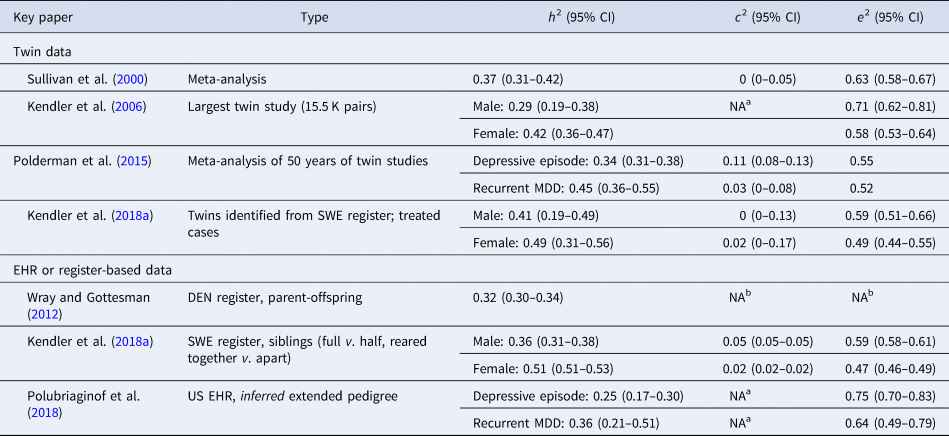
Classic quantitative genetic modelling partitions phenotypic variance into genetic and environmental components. The pedigree heritability is then estimated as the proportion of phenotypic variance attributable to additive genetic effects (‘narrow-sense heritability’) (Lynch & Walsh, Reference Lynch and Walsh1998; Visscher, Hill, & Wray, Reference Visscher, Hill and Wray2008). Such modelling is typically performed in twin or adoption studies. Twin studies, comparing monozygotic and dizygotic twins, have consistently demonstrated that MDD is moderately heritable (Table 1) and an early meta-analysis estimated the heritability at 37% (95% CI 31–42%) (Sullivan et al., Reference Sullivan, Neale and Kendler2000). Subsequent twin studies showed similar estimates, ranging between 29% and 49%, with higher estimates among treated or recurrent MDD cases – potentially due to greater clinical severity in the study samples (Kendler, Gatz, Gardner, & Pedersen, Reference Kendler, Gatz, Gardner and Pedersen2006; Kendler, Ohlsson, Lichtenstein, Sundquist, & Sundquist, Reference Kendler, Ohlsson, Lichtenstein, Sundquist and Sundquist2018a; Polderman et al., Reference Polderman, Benyamin, De Leeuw, Sullivan, Van Bochoven, Visscher and Posthuma2015). These studies also suggested that the liability variance attributable to the shared family environment is low, ranging from 0% to 11% (Kendler et al., Reference Kendler, Gatz, Gardner and Pedersen2006, Reference Kendler, Ohlsson, Lichtenstein, Sundquist and Sundquist2018a; Polderman et al., Reference Polderman, Benyamin, De Leeuw, Sullivan, Van Bochoven, Visscher and Posthuma2015; Sullivan et al., Reference Sullivan, Neale and Kendler2000). Adoption studies, comparing the transmission patterns among adoptive and intact families, are better able to separate shared genetics from other aspects of a shared family environment than twin studies (Kendler, Ohlsson, Sundquist, & Sundquist, Reference Kendler, Ohlsson, Sundquist and Sundquist2018b). Early adoption studies in MDD, however, were based on small samples and produced conflicting results (Sullivan et al., Reference Sullivan, Neale and Kendler2000). Contrary to findings from twin studies, a recent population-based adoption study reported a much lower heritability (~16%) and a higher contribution of the family environment (Kendler et al., Reference Kendler, Ohlsson, Sundquist and Sundquist2018b). In addition, the overestimation of the MDD heritability in twin studies has been raised as a potential reason for the ‘missing heritability’ – i.e. the discrepancy between the pedigree heritability and the much lower phenotypic variance explained by genomic loci identified in genome-wide association studies (GWAS) (Manolio et al., Reference Manolio, Collins, Cox, Goldstein, Hindorff, Hunter and Visscher2009). Recent studies utilised national registers and EHR to reconstruct extended familial relationships, and therefore provide estimates of pedigree heritability beyond classic twin design (Kendler et al., Reference Kendler, Ohlsson, Lichtenstein, Sundquist and Sundquist2018a; Polubriaginof et al., Reference Polubriaginof, Vanguri, Quinnies, Belbin, Yahi, Salmasian and Tatonetti2018; Wray & Gottesman, Reference Wray and Gottesman2012). These estimates, however, were very similar to those from twin studies (Table 1), suggesting that the heritability of MDD has not been overestimated.
MDD heritability estimates from selected publications

h2, narrow-sense heritability; c2, shared environment; e2, unique environment; SWE, Sweden; DEN, Denmark; EHR, Electronic Health Records.
a Missing estimate of c2 as a result of AE models (i.e. quantitative genetic models with only additive genetics and unique environment components) in the original study.
b Only the heritability was derived from the summary-level data.
One of the most intensively studied questions regarding the heritability of MDD is whether sex differences in the genetic architecture of the disorder exist. A higher heritability in women than in men might contribute to the higher rates of MDD observed in women. Early meta-analyses failed to detect either quantitative or qualitative evidence for sex differences in MDD heritability (Sullivan et al., Reference Sullivan, Neale and Kendler2000). However, more recent studies demonstrated a significantly higher MDD heritability in women than in men (Table 1), although the genetic correlation between the sexes was high (0.63–0.89) (Kendler et al., Reference Kendler, Gatz, Gardner and Pedersen2006, Reference Kendler, Ohlsson, Lichtenstein, Sundquist and Sundquist2018a). These results suggest that most, but not all, genetic risk is shared between the sexes (Kendler et al., Reference Kendler, Ohlsson, Lichtenstein, Sundquist and Sundquist2018a), consistent with the highly polygenic nature of MDD.
Research efforts have attempted to identify genetically more homogeneous MDD subtypes (Flint & Kendler, Reference Flint and Kendler2014). Parents with early-onset and recurrent MDD confer the highest risk for MDD in offspring (Birmaher et al., Reference Birmaher, Ryan, Williamson, Brent, Kaufman, Dahl and Nelson1996; Sullivan et al., Reference Sullivan, Neale and Kendler2000). Other clinical features, including greater clinical severity, comorbid anxiety disorder and the use of antidepressant and electroconvulsive therapy, also confer higher MDD risk for relatives (Kendler et al., Reference Kendler, Ohlsson, Lichtenstein, Sundquist and Sundquist2018a). Similarly, the Psychiatric Genomics Consortium (PGC) MDD GWAS demonstrated that individuals from many of these subtypes carry higher polygenic risk scores (PRS) for MDD (Power et al., Reference Power, Tansey, Buttenschøn, Cohen-Woods, Bigdeli and Hall2017; Wray et al., Reference Wray, Ripke, Mattheisen, Trzaskowski, Byrne, Abdellaoui and Viktorin2018). Studies examining the heritability of these subtypes are, however, sparse. The heritability among recurrent MDD cases (41%) may be significantly higher than in those who had single-episode (28%) (Fernandez-Pujals et al., Reference Fernandez-Pujals, Adams, Thomson, McKechanie, Blackwood, Smith and McIntosh2015), and postpartum depression has been shown to have a higher heritability (44–54%) than non-postpartum depression (32%) (Viktorin et al., Reference Viktorin, Meltzer-Brody, Kuja-Halkola, Sullivan, Landén, Lichtenstein and Magnusson2016). Ascertaining these more heritable forms of MDD has led to some of early GWAS findings (CONVERGE consortium, 2015).
Candidate gene studies
Candidate gene studies of MDD, first performed more than 40 years ago (Beckman, Beckman, Cedergren, Perris, & Strandman, Reference Beckman, Beckman, Cedergren, Perris and Strandman1978), focused on genes thought to be involved in the pathophysiology of the disorder and in drug mechanisms – as reviewed in Shadrina, Bondarenko, and Slominsky (Reference Shadrina, Bondarenko and Slominsky2018). More than 1500 publications have assessed variants in over 200 candidate genes with often conflicting results (Flint & Kendler, Reference Flint and Kendler2014). Most of these studies were vastly underpowered, lacked correction for population stratification, and the reported significance levels did not exceed what would be expected by chance (Flint & Kendler, Reference Flint and Kendler2014). Based on the observed OR and minor allele frequencies (MAF), all published candidate gene variants should be detectable in the current GWAS at genome-wide significance (Flint & Kendler, Reference Flint and Kendler2014). Yet, this has not been the case (Bosker et al., Reference Bosker, Hartman, Nolte, Prins, Terpstra, Posthuma and Nolen2011; Howard et al., Reference Howard, Adams, Clarke, Hafferty, Gibson, Shirali and McIntosh2019; Wray et al., Reference Wray, Pergadia, Blackwood, Penninx, Gordon, Nyholt and Sullivan2012, Reference Wray, Ripke, Mattheisen, Trzaskowski, Byrne, Abdellaoui and Viktorin2018). In large-scale data from the UK Biobank (UKBB) and PGC (n = 62 138–443 264 per subsample), systematic analyses of the most commonly studied polymorphisms mapping to 18 candidate genes found no evidence for significant associations with major depression, except at the gene-level for DRD2 (dopamine receptor D2) (Border et al., Reference Border, Johnson, Evans, Smolen, Berley, Sullivan and Keller2019a).
Candidate gene studies were the mainstay of genetic research in MDD until the emergence of GWAS and some are still among the most highly cited works in the field (McIntosh, Sullivan, & Lewis, Reference McIntosh, Sullivan and Lewis2019). However, a lack of robust association has led to the strong recommendation that candidate gene studies should no longer be performed (Border et al., Reference Border, Johnson, Evans, Smolen, Berley, Sullivan and Keller2019a, Reference Border, Smolen, Corley, Stallings, Brown, Conger and Evans2019b; Duncan & Keller, Reference Duncan and Keller2011; Farrell et al., Reference Farrell, Werge, Sklar, Owen, Ophoff, O'Donovan and Sullivan2015).
The role of rare genetic variants
Historical linkage studies in families with MDD failed to identify causal variants but implicated regions on chromosomes 2, 3, 11 and 15 in disorder risk (Breen et al., Reference Breen, Webb, Butler, Van Den Oord, Tozzi, Craddock and McGuffin2011; Camp et al., Reference Camp, Lowry, Richards, Plenk, Carter, Hensel and Cannon-Albright2005, p. 2005; Holmans et al., Reference Holmans, Zubenko, Crowe, DePaulo, Scheftner, Weissman and Levinson2004, Reference Holmans, Weissman, Zubenko, Scheftner, Crowe, DePaulo and Levinson2007; Levinson et al., Reference Levinson, Evgrafov, Knowles, Potash, Weissman, Scheftner and Holmans2007; Middeldorp et al., Reference Middeldorp, Hottenga, Slagboom, Sullivan, de Geus, Posthuma and Boomsma2008; Schol-Gelok et al., Reference Schol-Gelok, Janssens, Tiemeier, Liu, Lopez-Leon, Zorkoltseva and van Duijn2010; Zubenko et al., Reference Zubenko, Maher, Hughes, Zubenko, Stiffler, Kaplan and Marazita2003). A highly polygenic architecture, as is the case for MDD, can generate significant linkage study results which could be erroneously interpreted as large-effect loci (Hemani et al., Reference Hemani, Yang, Vinkhuyzen, Powell, Willemsen, Hottenga and Visscher2013). Indeed, no significant overlap was observed between the reported linkage regions and association loci from current well-powered GWAS (McIntosh et al., Reference McIntosh, Sullivan and Lewis2019). A major contribution of single highly penetrant variants within these regions to the genetic architecture of MDD is therefore unlikely.
In the past decade, association testing of rare and low-frequency variants has progressed to whole-exome (WES) and whole-genome sequencing (WGS) studies. Rare (MAF <0.5%) or low-frequency (MAF range >0.5% and <5%) variants are expected to contribute to the genetic basis of MDD (Lee, Abecasis, Boehnke, & Lin, Reference Lee, Abecasis, Boehnke and Lin2014; Yu et al., Reference Yu, Arcos-Burgos, Baune, Arolt, Dannlowski, Wong and Licinio2018). However, the largest WGS study of MDD to date, by the CONVERGE consortium (5303 cases and 5337 controls), failed to find evidence for the association of individual rare or low-frequency variants with MDD (CONVERGE consortium, 2015). Using the same dataset, it was subsequently shown that individuals with MDD had a significantly higher overall burden of singleton exonic variants predicted to be deleterious (Peterson et al., Reference Peterson, Cai, Bigdeli, Li, Reimers, Nikulova and Kendler2017). This suggests that larger sample sizes are required to identify associated rare variants with moderate effect sizes (Border et al., Reference Border, Smolen, Corley, Stallings, Brown, Conger and Evans2019b; Lee et al., Reference Lee, Abecasis, Boehnke and Lin2014). An approach to mitigate against the need for vast sample sizes is to examine MDD-related subphenotypes (summarised in Table 2). The majority of these studies identified single rare variants or gene-level burden scores as associated with at least one of the assessed subphenotypes. In most cases, these results await replication in independent and well-powered datasets.
Whole-exome sequencing and exome chip studies assessing the role of rare variants in subphenotypes of depression

MDD, major depressive disorder; WES, whole-exome sequencing; WGS, whole-genome sequencing; GWAS, genome-wide association study; TFs, transcription factors; UTR, untranslated region; TGF-ß, transforming growth factor β; MRI, magnetic resonance imaging.
Rare copy number variants (CNVs), deletions or duplications of >1 kb of DNA, play a well-established role in the risk of neurodevelopmental and psychiatric conditions such as autism spectrum disorder, schizophrenia and intellectual disability (Coe et al., Reference Coe, Witherspoon, Rosenfeld, Van Bon, Vulto-van Silfhout, Bosco and Eichler2014; Cooper et al., Reference Cooper, Coe, Girirajan, Rosenfeld, Vu, Baker and Eichler2011; International Schizophrenia Consortium, 2008; Stefansson et al., Reference Stefansson, Rujescu, Cichon, Pietiläinen, Ingason, Steinberg and Stefansson2008), but have received less attention in MDD. Until recently, studies of CNVs in depression have been underpowered and yielded inconsistent and sometimes conflicting results (Degenhardt et al., Reference Degenhardt, Priebe, Herms, Mattheisen, Mühleisen, Meier and Cichon2012; Glessner et al., Reference Glessner, Wang, Sleiman, Zhang, Kim, Flory and Hakonarson2010; O'Dushlaine et al., Reference O'Dushlaine, Ripke, Ruderfer, Hamilton, Fava, Iosifescu and Perlis2014; Perlis, Ruderfer, Hamilton, & Ernst, Reference Perlis, Ruderfer, Hamilton and Ernst2012),; Rucker et al., Reference Rucker, Breen, Pinto, Pedroso, Lewis, Cohen-Woods and McGuffin2013, Reference Rucker, Tansey, Rivera, Pinto, Cohen-Woods, Uher and Breen2016; Tansey et al., Reference Tansey, Rucker, Kavanagh, Guipponi, Perroud, Bondolfi and Uher2014; Yu, Baune, Wong, & Licinio, Reference Yu, Baune, Wong and Licinio2017).
Two recent large-scale efforts have assessed the contribution of rare CNVs to the genetic architecture of MDD. In a meta-analysis of four cohorts (5780 cases, 6626 controls), short deletions <100 kb were significantly enriched in individuals with MDD (Zhang et al., Reference Zhang, Abdellaoui, Rucker, de Jong, Potash, Weissman and Levinson2019). The enriched deletions mapped primarily to intergenic regions and, within those, to enhancers, suggesting that rare CNVs may increase the risk of MDD by altering gene expression. A study of 407 074 individuals from the UKBB (23 979 cases) implicated 53 rare CNVs associated with neurodevelopmental conditions in the risk of major depression (OR 1.3–1.5) (Kendall et al., Reference Kendall, Rees, Bracher-Smith, Legge, Riglin, Zammit and Walters2019). Three CNV loci – duplications at 1q21.1, the Prader-Willi Syndrome locus at 15q11–13 and at 16p11.2 – were individually associated with self-reported depression. Outside of this group, there was no evidence for a residual burden of rare CNVs >100 kb in major depression. However, smaller CNVs were not tested in the study by Kendall et al. Rare CNVs therefore likely contribute to MDD risk, but the exact nature of the association remains unclear.
Genome-wide association studies
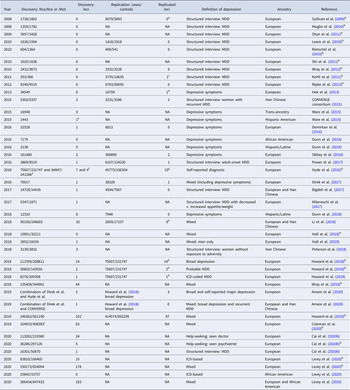
Many MDD GWAS have been conducted during the past decade, predominantly on the subjects of European ancestry (Table 3). Therefore, European-ancestry studies are described first, followed by a review of GWAS in more diverse populations.
Published genome-wide association studies on depression

Year indicates the year in which the study was first published (including online ahead of print and, where no published version as available, preprint), which may deviate from the year the article was published in print. Nca/Nco for number of cases and controls in case–control design; Ntot as total sample size for quantitative trait.
a The top locus replicated in subsequent studies (Hek et al., Reference Hek, Mulder, Luijendijk, van Duijn, Hofman, Uitterlinden and Tiemeier2010; Howard et al., Reference Howard, Adams, Clarke, Hafferty, Gibson, Shirali and McIntosh2019; Wray et al., Reference Wray, Ripke, Mattheisen, Trzaskowski, Byrne, Abdellaoui and Viktorin2018).
b Studies used for Fig. 1.
c Significant in the meta-analysis of discovery and replication cohorts in a recessive model. This association did not replicate in subsequent GWAS in additive models. Replication has, to our knowledge, not been attempted using a recessive model.
d Significant in the meta-analysis of discovery and replication cohorts.
e This association did not replicate in the follow-up Hispanic ancestry GWAS meta-analysis (Dunn et al., Reference Dunn, Sofer, Wang, Soare, Gallo, Gogarten and Smoller2018). Meta-analysis of 23andMe and PGC MDD cohorts.
f Replication of top results from the meta-analysis of 23andMe and PGC MDD cohorts.
g Only SNPs not reaching genome-wide significance in the discovery-stage were analysed in the replication phase. Six loci (of which two were not significant in the discovery GWAS) covered by these selected SNPs reached significance in the meta-analysis of discovery and replication cohorts.
h From a meta-analysis of overlapping subjects (PGC and UKBB), case and control numbers may thus be inflated.
i The study identified 102 independent variants at 101 loci.
Identified GWAS loci in relation to the number of cases. The relationship of identified loci to the number of cases based on published studies on schizophrenia, bipolar disorder (BD) and major depression (MD). To simplify the presentation, studies with different depression definitions have been combined into the MD category. The plot shows the number of cases and independent significant loci in the discovery-stage analyses (without replication). Schizophrenia GWAS saw a critical inflection point at approximately 15000 cases and are currently discovering a new locus for, on average, every 230 new cases (Levinson et al., Reference Levinson, Mostafavi, Milaneschi, Rivera, Ripke, Wray and Sullivan2014). BD currently discovers a new locus for every 400 new cases. Such an inflection point was observed for MD GWAS only at approximately 75 000 cases, as predicted (Levinson et al., Reference Levinson, Mostafavi, Milaneschi, Rivera, Ripke, Wray and Sullivan2014; Wray et al., Reference Wray, Pergadia, Blackwood, Penninx, Gordon, Nyholt and Sullivan2012), and MD GWAS using liberal phenotype definitions now identify a new locus every 1500 cases. Slopes starting at the inflection point were estimated using linear regression. The MD studies used for the plot are provided in Table 3.

Initial MDD GWAS of common variants (i.e. MAF ⩾1%) were limited by small sample sizes and failed to identify genome-wide significant loci (p value threshold <5 × 10⁻⁸) (Table 3). However, the first suggestive GWAS result implicated the gene encoding the presynaptic active zone component Piccolo (PCLO) (Sullivan et al., Reference Sullivan, de Geus, Willemsen, James, Smit, Zandbelt and Penninx2009) which has been confirmed as a risk gene in subsequent studies (Hek et al., Reference Hek, Mulder, Luijendijk, van Duijn, Hofman, Uitterlinden and Tiemeier2010; Howard et al., Reference Howard, Adams, Clarke, Hafferty, Gibson, Shirali and McIntosh2019; Wray et al., Reference Wray, Ripke, Mattheisen, Trzaskowski, Byrne, Abdellaoui and Viktorin2018). In 2011, the first genome-wide significant locus was reported – SLC6A15 (a neuron-specific neutral amino acid transporter), although this was in a recessive model (Kohli et al., Reference Kohli, Lucae, Saemann, Schmidt, Demirkan, Hek and Binder2011). This association did not reach genome-wide significance with additive models in larger follow-up GWAS (Howard et al., Reference Howard, Adams, Clarke, Hafferty, Gibson, Shirali and McIntosh2019; Wray et al., Reference Wray, Ripke, Mattheisen, Trzaskowski, Byrne, Abdellaoui and Viktorin2018). Recognising the importance of combining data across studies to increase statistical power, the PGC published its first MDD GWAS meta-analysis in 2013, although no significant locus was identified (Ripke et al., Reference Ripke, Wray, Lewis, Hamilton, Weissman and Breen2013).
Since then, large-scale GWAS of major depression have been conducted with data from the direct-to-consumer company 23andMe and large-scale biobank efforts such as UKBB (Table 3). In 2016, a GWAS by 23andMe using self-reported depression diagnosis identified 15 genome-wide significant loci (Hyde et al., Reference Hyde, Nagle, Tian, Chen, Paciga, Wendland and Winslow2016), confirming the estimate that >75 000 cases would be required for genome-wide significant results (Levinson et al., Reference Levinson, Mostafavi, Milaneschi, Rivera, Ripke, Wray and Sullivan2014). A second large GWAS meta-analysis from the PGC described 44 associated genetic loci, pooling cohorts with different phenotype definitions (Wray et al., Reference Wray, Ripke, Mattheisen, Trzaskowski, Byrne, Abdellaoui and Viktorin2018). The three datasets used in the latter studies were eventually combined in an analysis yielding 102 genome-wide significant variants, 87 of which replicated (Howard et al., Reference Howard, Adams, Clarke, Hafferty, Gibson, Shirali and McIntosh2019). The latest GWAS to date meta-analysed these datasets with data from the Million Veteran Program (MVP), yielding 178 associated loci (Levey et al., Reference Levey, Stein, Wendt, Pathak, Zhou, Aslan and Gelernter2020).
Collectively, these GWAS confirmed that major depression is highly polygenic, with ORs of individual variants under 1.05 (Howard et al., Reference Howard, Adams, Clarke, Hafferty, Gibson, Shirali and McIntosh2019; Wray et al., Reference Wray, Ripke, Mattheisen, Trzaskowski, Byrne, Abdellaoui and Viktorin2018), as suggested previously (Nishino, Ochi, Kochi, Tsunoda, & Matsui, Reference Nishino, Ochi, Kochi, Tsunoda and Matsui2018). The two loci with the overall most robust support for an association map to the genes NEGR1 and OLFM4, both with an OR of 1.04 and an MAF of ~40% (Howard et al., Reference Howard, Adams, Clarke, Hafferty, Gibson, Shirali and McIntosh2019; Wray et al., Reference Wray, Ripke, Mattheisen, Trzaskowski, Byrne, Abdellaoui and Viktorin2018). The neuronal growth regulator 1 (NEGR1) cell adhesion molecule modulates neurite outgrowth, synapse formation and synaptic function (Noh et al., Reference Noh, Lee, Choi, Joo, Kim, Kim and Lee2019; Wray et al., Reference Wray, Ripke, Mattheisen, Trzaskowski, Byrne, Abdellaoui and Viktorin2018). The secreted glycoprotein olfactomedin 4 (OLFM4) has an established function in inflammation, innate immunity and cancer (Liu & Rodgers, Reference Liu and Rodgers2016; Wray et al., Reference Wray, Ripke, Mattheisen, Trzaskowski, Byrne, Abdellaoui and Viktorin2018). Several other associated loci have functions in neurite outgrowth, synaptic function and plasticity, as well as in immunity and inflammation (Wray et al., Reference Wray, Ripke, Mattheisen, Trzaskowski, Byrne, Abdellaoui and Viktorin2018). To establish the functions of the proposed risk SNPs (single nucleotide polymorphisms) and their links to specific genes, analyses of cell-type-specific gene expression and epigenetic data are necessary (Arloth et al., Reference Arloth, Eraslan, Andlauer, Martins, Iurato, Kühnel and Mueller2020; Chan et al., Reference Chan, Turecki, Shabalin, Guintivano, Zhao, Xie and van den Oord2020; Li et al., Reference Li, Li, Li, Liu, Huo, Wang and Luo2020; Wang et al., Reference Wang, Cheng, Zhu, Yin, Chang, Yue and Yu2020; Zhong et al., Reference Zhong, Li, Zeng, Li, Gu, Liu and Luo2019).
Given the small effect sizes of single SNPs, gene-level and pathway analyses that integrate the effects of many variants across genes and pathways may be more suitable for studying the aetiology of MDD. Gene-level association analyses have implicated genes encoding pre- and post-synaptic proteins, especially receptor units, e.g. voltage-gated calcium channels (VGCC), the dopamine receptor DRD2 and glutamate receptors (Wray et al., Reference Wray, Ripke, Mattheisen, Trzaskowski, Byrne, Abdellaoui and Viktorin2018). Identified by both SNP- and gene-level analyses, the splicing regulator RBFOX1 may play an important role in the aetiology of major depression (Noh et al., Reference Noh, Lee, Choi, Joo, Kim, Kim and Lee2019; Wray et al., Reference Wray, Ripke, Mattheisen, Trzaskowski, Byrne, Abdellaoui and Viktorin2018). Gene-set analyses implicated pathways with roles in neuronal differentiation and projection and, most prominently, synaptic formation and function, including gene sets linked to VGCC and synaptic RNA-binding proteins such as FMRP and CELF4 (Levey et al., Reference Levey, Stein, Wendt, Pathak, Zhou, Aslan and Gelernter2020; Noh et al., Reference Noh, Lee, Choi, Joo, Kim, Kim and Lee2019; Wray et al., Reference Wray, Ripke, Mattheisen, Trzaskowski, Byrne, Abdellaoui and Viktorin2018).
Despite a large number of identified genomic loci, the variance explained by major depression PRS is still very low (Nagelkerke's pseudo-R2 1.5–3.2% on the liability scale) (Howard et al., Reference Howard, Adams, Clarke, Hafferty, Gibson, Shirali and McIntosh2019). This prediction accuracy was lower than achieved for, e.g. schizophrenia, where Nagelkerke's pseudo-R2 is 7.7% on the liability scale (Schizophrenia Working Group of the PGC, Ripke, Walters, & O'Donovan, Reference Ripke, Walters and O'Donovan2020). At much smaller sample sizes, the GWAS on schizophrenia also identified many more associated variants (Fig. 1). The identification of MDD risk variants has been more challenging than for schizophrenia because of its higher prevalence, lower heritability and more heterogeneous samples (Levinson et al., Reference Levinson, Mostafavi, Milaneschi, Rivera, Ripke, Wray and Sullivan2014; Ormel, Hartman, & Snieder, Reference Ormel, Hartman and Snieder2019; Wray et al., Reference Wray, Pergadia, Blackwood, Penninx, Gordon, Nyholt and Sullivan2012). Schizophrenia GWAS saw a critical inflection point at approximately 15 000 cases and are currently discovering a new locus for, on average, every 230 new cases (Levinson et al., Reference Levinson, Mostafavi, Milaneschi, Rivera, Ripke, Wray and Sullivan2014). Such an inflection point was observed for depression GWAS only at approximately 75 000 cases, as predicted (Levinson et al., Reference Levinson, Mostafavi, Milaneschi, Rivera, Ripke, Wray and Sullivan2014; Wray et al., Reference Wray, Pergadia, Blackwood, Penninx, Gordon, Nyholt and Sullivan2012). GWAS using liberal phenotype definitions of major depression now identify a new locus for every 1500 cases (Fig. 1).
Importantly, phenotype definition matters. Given the strong genetic correlations across cohorts, recent GWAS meta-analyses combined cohorts with different ascertainment strategies to maximise the overall sample size. However, a comparison of genetic analyses using different phenotype definitions in UKBB revealed that GWAS of broad phenotype definitions might identify associated loci that are not specific to MDD, but, more likely, shared with other psychiatric disorders (Cai et al., Reference Cai, Revez, Adams, Andlauer, Breen, Byrne and Flint2020b). In order to identify robustly associated MDD variants, a balanced strategy of maximising sample size while focusing on more stringent phenotype definitions has been suggested (Byrne et al., Reference Byrne, Kirk, Medland, McGrath, Colodro-Conde, Parker and Martin2020; Davies et al., Reference Davies, Kalsi, Armour, Jones, McIntosh, Smith and Breen2019; Schwabe et al., Reference Schwabe, Milaneschi, Gerring, Sullivan, Schulte, Suppli and Middeldorp2019). Quantitative definitions have also been analysed in GWAS, and a continuum between depressive symptoms and MDD was suggested (Direk et al., Reference Direk, Williams, Smith, Ripke, Air, Amare and Sullivan2017). Several variants were reported to be associated with depressive symptoms (Table 3), with limited replication success. Of these symptom-associated variants, rs62100776 (Okbay et al., Reference Okbay, Baselmans, De Neve, Turley, Nivard, Fontana and Rich2016) maps to the gene DCC, coding for a neuronal cell adhesion molecule, which was a genome-wide significant locus in the 2018 PGC case–control GWAS (Wray et al., Reference Wray, Ripke, Mattheisen, Trzaskowski, Byrne, Abdellaoui and Viktorin2018). Further noteworthy GWAS were conducted on MDD stratified by the age at onset (Power et al., Reference Power, Tansey, Buttenschøn, Cohen-Woods, Bigdeli and Hall2017), sex (Hall et al., Reference Hall, Adams, Arnau-Soler, Clarke, Howard, Zeng and McIntosh2018) or exposure to adversity (Peterson et al., Reference Peterson, Cai, Dahl, Bigdeli, Edwards, Webb and Kendler2018), or combined GWAS of different depression phenotypes (Amare et al., Reference Amare, Vaez, Hsu, Direk, Kamali, Howard and Hartman2020).
The studies discussed so far focused on patients of European ancestry. However, complex disorders show population-specific landscapes of genetic risk (Martin et al., Reference Martin, Gignoux, Walters, Wojcik, Neale, Gravel and Kenny2017). Accordingly, GWAS in non-European populations have also been conducted (Table 3). The CONVERGE study on female Han Chinese recurrent in-patient MDD cases identified two significant loci near the SIRT1 and in the LHPP gene, and replicated them in the same population (CONVERGE consortium, 2015). Neither variant was significantly associated in GWAS on European samples (Howard et al., Reference Howard, Adams, Clarke, Hafferty, Gibson, Shirali and McIntosh2019; Wray et al., Reference Wray, Ripke, Mattheisen, Trzaskowski, Byrne, Abdellaoui and Viktorin2018), possibly due to large differences in allele frequency across ancestries – both variants exhibit markedly lower allele frequencies in Europeans. Follow-up studies estimated the genetic correlation between East Asian and European MDD cohorts at 0.33–0.41, while the average genetic correlations between European cohorts was 0.76 (Bigdeli et al., Reference Bigdeli, Ripke, Peterson, Trzaskowski, Bacanu, Abdellaoui and Kendler2017; Wray et al., Reference Wray, Ripke, Mattheisen, Trzaskowski, Byrne, Abdellaoui and Viktorin2018), and identified trans-ancestral risk variants (Li et al., Reference Li, Luo, Gu, Hall, McIntosh, Zeng and Luo2018). In a study of Hispanic/Latino individuals, two out of 22 European depression GWAS loci were replicated (Dunn et al., Reference Dunn, Sofer, Wang, Soare, Gallo, Gogarten and Smoller2018). The MVP study identified no genome-wide significant loci in over 20 000 African-ancestry patients with major depression (Table 3), and only one of 206 analysed European risk SNPs formally replicated in the African sample (Levey et al., Reference Levey, Stein, Wendt, Pathak, Zhou, Aslan and Gelernter2020). However, a trans-ancestry meta-analysis conducted within the same study increased the number of risk loci from 178 in Europeans alone to 183. These findings highlight the need for greater geographical, ethnic and economic diversity in depression genetic studies (McIntosh et al., Reference McIntosh, Sullivan and Lewis2019).
Genetic overlap between MDD and other traits
Several lines of evidence, including cross-disorder analyses, support the notion that MDD shares genetic underpinnings with many other psychiatric phenotypes. A genetic overlap has also been demonstrated between MDD and non-psychiatric phenotypes. Common techniques for studying cross-disorder genetic overlap include genetic correlation (rg) estimation and PRS analyses (Grotzinger et al., Reference Grotzinger, Rhemtulla, de Vlaming, Ritchie, Mallard, Hill and Tucker-Drob2019).
Genetic correlation quantifies the genetic relationship between two traits, reflecting their underlying modes of pleiotropy – i.e. the same genetic variant influencing both traits (Baselmans, Yengo, van Rheenen, & Wray, Reference Baselmans, Yengo, van Rheenen and Wray2020; Van Rheenen, Peyrot, Schork, Lee, & Wray, Reference Van Rheenen, Peyrot, Schork, Lee and Wray2019). Mathematically, it is derived as the genetic covariance between the two traits scaled by the square roots of their genetic variances (Van Rheenen et al., Reference Van Rheenen, Peyrot, Schork, Lee and Wray2019). Two methods are commonly used to estimate rg: (i) bivariate restricted maximum likelihood which uses individual-level genotype data as the input (Lee, Yang, Goddard, Visscher, & Wray, Reference Lee, Yang, Goddard, Visscher and Wray2012), and (ii) linkage disequilibrium score regression (Bulik-Sullivan et al., Reference Bulik-Sullivan, Finucane, Anttila, Gusev, Day and Loh2015) and its recent extension, high-definition likelihood method (Ning, Pawitan, & Shen, Reference Ning, Pawitan and Shen2020), which uses GWAS summary statistics. rg ranges between −1 and 1, with 1 meaning that shared liability is caused by the same risk SNPs and −1 meaning that identical SNPs increase the risk for one trait while decreasing the risk for the other. It is important to note that rg estimates cannot infer causality.
Many studies have examined rg between MDD and both psychiatric and non-psychiatric disorders or traits. The strongest rg detected for MDD are with depressive symptoms measured as a continuous trait (0.63–1.0) (Direk et al., Reference Direk, Williams, Smith, Ripke, Air, Amare and Sullivan2017; Turley et al., Reference Turley, Walters, Maghzian, Okbay, Lee, Fontana and Benjamin2018), confirming the concept of a continuum between subthreshold depressive symptoms and clinical diagnoses of MDD. Similarly, strong rg have been found for personality traits such as neuroticism (rg = 0.70–0.75) and subjective well-being (−0.75) (Howard et al., Reference Howard, Adams, Clarke, Hafferty, Gibson, Shirali and McIntosh2019; Okbay et al., Reference Okbay, Baselmans, De Neve, Turley, Nivard, Fontana and Rich2016). Major depression was moderately correlated with several other psychiatric disorders, e.g. autism spectrum disorder (0.45), attention-deficit/hyperactivity disorder (0.44), bipolar disorder (BD) (0.36) and schizophrenia (0.34) (Cross-Disorder Group of the PGC, 2019). Further studies reported a weaker rg of major depression with type-I (0.26–0.31) than with type-II BD (0.61–0.69) (Coleman et al., Reference Coleman, Gaspar, Bryois, Byrne, Forstner, Holmans and Lawson2020; Stahl et al., Reference Stahl, Breen, Forstner, McQuillin, Ripke, Trubetskoy and Reif2019). Moreover, a positive rg was reported between the body mass index (BMI) and atypical depression with increased appetite/weight, which was not present for those without changes in appetite (Milaneschi et al., Reference Milaneschi, Lamers, Peyrot, Baune, Breen, Dehghan and Penninx2017). An investigation of genetic correlations between neurological and psychiatric disorders found little evidence of shared genetic underpinnings, except for a significant but small positive rg between MDD and migraine (The Brainstorm Consortium et al., 2018). Negative genetic correlations have been detected for major depression with educational attainment and cognitive performance (each ~−0.15) (Howard et al., Reference Howard, Adams, Clarke, Hafferty, Gibson, Shirali and McIntosh2019).
The analysis of PRS is another method used to assess the polygenic overlap between MDD and other traits. PRS use SNP effect sizes from a training GWAS to compute the cumulative genetic risk burden of each individual in a target sample. PRS are calculated as the weighted sum of the allele count multiplied by its effect size across all selected SNPs (Andlauer & Nöthen, Reference Andlauer and Nöthen2020; Lewis & Vassos, Reference Lewis and Vassos2020). Therefore, they capture the combined effects of many SNPs and are used to examine the polygenic liability for a disorder or trait or to examine the genetic overlap across traits (Wray et al., Reference Wray, Lee, Mehta, Vinkhuyzen, Dudbridge and Middeldorp2014). Although the generation of PRS requires large training GWAS, it can be applied to much smaller target sets. For example, an MDD PRS was predictive of population-based obsessive-compulsive symptoms (Zilhão et al., Reference Zilhão, Abdellaoui, Smit, Cath, Hottenga and Boomsma2018). Clinically, PRS may be used for diagnosis, prognosis and treatment prediction (Schijven, Veldink, & Luykx, Reference Schijven, Veldink and Luykx2020). However, PRS for schizophrenia have, so far, shown greater potential for such applications, given their higher variance explained (Schizophrenia Working Group of the PGC et al., Reference Ripke, Walters and O'Donovan2020). Importantly, PRS were used to demonstrate that MDD subtypes may diverge in their genetic overlaps with other disorders. For example, early-onset MDD cases show a stronger association with PRS for schizophrenia and BD than late-onset MDD patients do (Power et al., Reference Power, Tansey, Buttenschøn, Cohen-Woods, Bigdeli and Hall2017). In the future, PRS might also be used to identify aetiologically more homogeneous MDD subtypes. For example, subgrouping on the basis of treatments such as electroconvulsive therapy might be informative (Foo et al., Reference Foo, Streit, Frank, Witt, Treutlein and Kranaster2019) and provide further insights into the underlying genetic differences of the severity of the disorder. Finally, MDD PRS may also be used to study PRS–environment (PRS × E) interactions, to support treatment choice, and to refine the penetrance of high-risk variants (Lewis & Vassos, Reference Lewis and Vassos2020).
Gene–environment interaction
In addition to the heritable component of MDD, environmental factors such as stressful life events (e.g. childhood trauma) play a major role in the aetiology of MDD, both independently and in combination with genetic factors. One active area of research has been the study of gene–environment interactions (G × E). Early G × E efforts examined specific candidate genes with putative biological significance for MDD, e.g. the 5-HTTLPR polymorphism of the serotonin transporter gene, and found evidence of interaction with stressful life events (Caspi et al., Reference Caspi, Sugden, Moffitt, Taylor, Craig, Harrington and Poulton2003). However, these initial reports showed inconsistent replicability (Duncan & Keller, Reference Duncan and Keller2011), and recent meta-analytic evidence indicated no robust evidence of candidate G × E effects on MDD (Border et al., Reference Border, Johnson, Evans, Smolen, Berley, Sullivan and Keller2019a; Van der Auwera et al., Reference Van der Auwera, Peyrot, Milaneschi, Hertel, Baune, Breen and Grabe2018). Studies using genome-wide data have reported varied G × E results. First, stratified GWAS results from the CONVERGE study have suggested that MDD may have a stronger genetic basis when it occurs in the absence of environmental adversity, with genome-wide significant hits for MDD identified only among women not exposed to adversity (Peterson et al., Reference Peterson, Cai, Dahl, Bigdeli, Edwards, Webb and Kendler2018). Data from the UKBB, however, have suggested the opposite, with a higher SNP-based heritability for major depression observed among individuals reporting lifetime trauma exposure (Coleman et al., Reference Coleman, Gaspar, Bryois, Byrne, Forstner, Holmans and Lawson2020). Second, PRS have been used to aggregate genome-wide effects for MDD and examine their interactions with stressful life events. Again, this revealed discrepant findings where MDD PRS were more strongly associated with MDD among individuals both exposed (Peyrot et al., Reference Peyrot, Milaneschi, Abdellaoui, Sullivan, Hottenga, Boomsma and Penninx2014) and unexposed (Mullins et al., Reference Mullins, Power, Fisher, Hanscombe, Euesden, Iniesta and Lewis2016) to childhood trauma. A later but still modestly powered meta-analysis (n = 5765) identified limited evidence for the interaction of PRS and childhood trauma on MDD (Peyrot et al., Reference Peyrot, Van der Auwera, Milaneschi, Dolan, Madden, Sullivan and Yang2018), which was echoed in epidemiological and clinical cohorts (n = 184–1450) (Halldorsdottir et al., Reference Halldorsdottir, Piechaczek, Soares de Matos, Czamara, Pehl, Wagenbuechler and Binder2019). However, large-scale studies such as the UKBB have provided the opportunity to re-examine PRS × E effects with greater power. One study showed stronger PRS effects on major depression among individuals exposed to childhood trauma and socioeconomic adversity (Shen et al., Reference Shen, Howard, Adams, Hill, Clarke, Deary and McIntosh2020), though not other types of exposures such as adulthood stressful life events. These findings support the notion that genetic influences could vary by specific environments. Third, genome-wide G × E analyses have identified few variants with genome-wide significant G × E effects (Arnau-Soler et al., Reference Arnau-Soler, Macdonald-Dunlop, Adams, Clarke, MacIntyre, Milburn and Thomson2019; Dunn et al., Reference Dunn, Wiste, Radmanesh, Almli, Gogarten, Sofer and Smoller2016), although these studies have been largely underpowered and results have not been further replicated. Together, current evidence suggests that genome-wide influences on MDD may vary by stressful life exposures but that the detection of G × E may be sensitive to the research design (e.g. how depression and adversity are defined).
The role of stressful life events, specifically childhood trauma, was the predominant focus of G × E in MDD, but other environmental exposures have also received attention. For example, studies examining social support in combination with MDD PRS in vulnerable populations have consistently shown that social support appears to reduce the risk of depression. This effect remained even after accounting for genetic vulnerability for depression, but did not vary by or modify the genetic effects (Choi et al., Reference Choi, Chen, Ursano, Sun, Jain, Kessler and Smoller2020a; Stringa et al., Reference Stringa, Milaneschi, van Schoor, Suanet, van der Lee, Holstege and Huisman2020). Similar observations of independent effects have been made for physical activity and major depression, suggesting that even among individuals at high genetic vulnerability for depression, physical activity levels may still be protective (Choi et al., Reference Choi, Zheutlin, Karlson, Wang, Dunn, Stein and Smoller2020c). Another genetically informed approach to estimating environmental effects on MDD is Mendelian randomisation (MR). MR methods have emerged as an alternative strategy to examine causal inference, obviating typical sources of confounding (Davey Smith & Ebrahim, Reference Davey Smith and Ebrahim2003). Here, strongly associated genetic variants are selected as statistical instruments – or proxies – to estimate the effect of exposure of interest (e.g. substance use) on an outcome (e.g. MDD) under specific assumptions. MR studies have supported the role of educational attainment in reducing the depression risk and of BMI in increasing the risk (Wray et al., Reference Wray, Ripke, Mattheisen, Trzaskowski, Byrne, Abdellaoui and Viktorin2018). Studies have also suggested a potential role of lifestyle exposures in shaping the risk of major depression, such as social connections and sedentary media use (Choi et al., Reference Choi, Stein, Nishimi, Ge, Coleman, Chen and Smoller2020b). Establishing stronger causal evidence for different environmental factors with updated methods may help to clarify inconsistencies across G × E findings (Ni et al., Reference Ni, van der Werf, Zhou, Hyppönen, Wray and Lee2019). An additional source of potential bias and inconsistency in G × E research are underlying gene–environment correlations, as the presence of gene–environment correlations may lead to false G × E (Ni et al., Reference Ni, van der Werf, Zhou, Hyppönen, Wray and Lee2019; Purcell & Sham, Reference Purcell and Sham2002).
Discussion
In summary, MDD is a common, debilitating, phenotypically heterogeneous disorder. Its heritability ranges between 30% and 50%. MDD with early-onset, recurrence, comorbid anxiety, greater severity and postpartum depression may be more heritable subtypes. Compared to other psychiatric disorders, its high prevalence, moderate heritability and strong polygenicity have posed major challenges for gene-mapping. Recently, rare CNVs have been implicated in the risk of MDD. Studies of common variation in MDD, driven forward by large international collaborations such as the PGC, confirmed the highly polygenic nature of the disorder and implicated over 100 loci in disorder risk. These studies identified genes involved in neuronal growth, synaptic function and inflammation in the pathophysiology of the disorder. Finally, gene–environment interaction and MR studies have implicated childhood trauma, socioeconomic adversity, social support, physical activity and their interactions with genetic factors, in the risk of MDD.
Evidence on the genetic basis of MDD has multiple potential applications including the development of pharmacological treatments, informing discussions regarding disorder risk and treatment choice. A greater understanding of the biological processes underlying MDD may facilitate the development of new, potentially more effective medications. MDD GWAS have implicated biological processes underlying the disorder including neurotransmission and synaptic structure as well as genetically informed pharmacological modes of action (Howard et al., Reference Howard, Adams, Clarke, Hafferty, Gibson, Shirali and McIntosh2019). MDD is a very heterogeneous disorder and genetic research will likely benefit from the study of more homogeneous disorder subtypes. As an example, research on patients with atypical features of increased appetite or weight suggested that this patient subgroup might benefit from treatments specifically targeting immunometabolic pathways (Milaneschi et al., Reference Milaneschi, Lamers, Peyrot, Baune, Breen, Dehghan and Penninx2017).
An individual's genetic make-up likely impacts the disease course – from prevention to diagnosis, treatment and prognosis (Lewis & Vassos, Reference Lewis and Vassos2020). Whilst the application of MDD PRS to predict an individual risk is currently limited by its low discriminative accuracy, in the future PRS might be used for risk stratification at the population level (Andlauer & Nöthen, Reference Andlauer and Nöthen2020). This is supported by recent evidence that MDD PRS – well-established to predict prevalent depression – also predict incident cases in the general population (Musliner et al., Reference Musliner, Mortensen, McGrath, Suppli, Hougaard, Bybjerg-Grauholm and Agerbo2019). For other complex disorders such as coronary artery disease and type-2 diabetes, PRS-based risk stratification is already powerful (Khera et al., Reference Khera, Chaffin, Aragam, Haas, Roselli, Choi and Kathiresan2018). Further development of PRS to allow the identification of individuals at heightened genetic risk, coupled with targeted prevention and intervention measures, holds the potential to mitigate depression risk (McIntosh et al., Reference McIntosh, Sullivan and Lewis2019). Knowledge of the genetic architecture of MDD and its links with other psychiatric and non-psychiatric disorders might inform genetic counselling and clinical care. For example, identified genetic correlations with physical health phenotypes might facilitate the development of clinical guidelines for physical health monitoring in individuals with MDD.
MDD is a multifactorial disorder. Other levels of genetic variation, such as DNA methylation (Barbu et al., Reference Barbu, Shen, Walker, Howard, Evans, Whalley and McIntosh2020; Van Assche et al., Reference Van Assche, Vangeel, Freson, Van Leeuwen, Verschueren, Colpin and Claes2017b) and subsequent gene-expression differences (Arloth et al., Reference Arloth, Bogdan, Weber, Frishman, Menke, Wagner and Hariri2015; Schiweck et al., Reference Schiweck, Claes, Van Oudenhove, Lafit, Vaessen, de Beeck and Vrieze2020), and also the telomere length (Lin, Huang, & Hung, Reference Lin, Huang and Hung2016), influence depression risk and severity. Importantly, epigenetic mechanisms serve as an interface between the individual and its environment (Provencal & Binder, Reference Provencal and Binder2015). A better understanding of the role of epigenetic variation and an improved integration of multi-omics data may enhance our understanding of the aetiology and treatment of MDD. In addition, this review focuses on genetic factors influencing the risk or severity of depression. We did not discuss how genetic variants affect response to treatment, especially the metabolisation of antidepressant drugs via cytochrome P450 genes. This important topic was recently reviewed by Bousman et al. (Reference Bousman, Bengesser, Aitchison, Amare, Aschauer, Baune and Müller2021).
Here, we highlighted the state of the art, the promises and the pitfalls of genetic research in MDD. The field would benefit from further exploration of the stratification properties of genetics – both for the understanding of its aetiology, including the role of environmental factors, and for the development of targeted treatment opportunities. Rich datasets with high-quality and deep phenotyping are crucial for studying heterogeneous disorders such as MDD. Combining deep, harmonised phenotypes with molecular data will greatly aid the genetic stratification of MDD. Improving our insights into the impact of genetic factors on MDD holds great promise for improving clinical care, and this intense and fast-developing field has a bright future.
Acknowledgements
We thank Andrew McIntosh, Cathryn Lewis and Naomi Wray for critical comments on our manuscript.
Conflict of interest
None.