Introduction
Rice serves is a staple food and demand for production of high-quality rice in the global market has increased remarkably in recent years (FAOSTAT, 2013). Cultivated rice (Oryza sativa) is an AA genome Oryza species that was most likely domesticated from wild population of Oryza rufipogon in Asia (Waters et al., Reference Waters, Nock, Ishikawa, Rice and Henry2012). Within O. sativa two subspecies, indica and japonica are often identified and these are thought to have originated from common (Molina et al., Reference Molina, Sikora, Garud, Flowers, Rubinstein, Reynolds, Huang, Jackson, Schaal and Bustamante2011) or independent domestication events (Sweeney and McCouch, Reference Sweeney and McCouch2007). Many rice breeders have worked within the genepool of O. sativa with a relatively narrow genetic base. Gene flow between cultivated and wild populations has contaminated the Asian wild rice gene pool with cultivated rice genes (Sweeney and McCouch, Reference Sweeney and McCouch2007). Others wild rices, especially those belonging to the AA genome species, have been a valuable source of new genes and alleles for resistance to a range of pests and diseases (Brar and Khush, Reference Brar, Khush, Sasaki and Moore1997). Kasem et al. (Reference Kasem, Waters, Rice, Shapter and Henry2009) demonstrated that wild rice relatives exhibited a wide array of grain sizes and shapes.
Australian wild rice has been largely genetically isolated from cultivated rice and its gene pool has not been contaminated with cultivated Oryza allele (Waters et al., Reference Waters, Nock, Ishikawa, Rice and Henry2012), indicating a potential source of valuable alleles for rice breeding. Four species are indigenous and widespread populations across Northern Australia; Oryza officinalis (CC genome) which has been found in only two locations, Oryza australiensis (EE genome) is widespread (Henry et al., Reference Henry, Rice, Waters, Kasem, Ishikawa, Hao, Dillon, Crayn, Wing and Vaughan2009; Waters et al., Reference Waters, Nock, Ishikawa, Rice and Henry2012), and two AA genome taxa. The wild rice taxa-belonging to the AA genome include the annual species, Oryza meridionalis and perennial taxa, one of which has been reported as O. rufipogon (Australian O. rufipogon) (Vaughan et al., Reference Vaughan, Lu and Tomooka2008; Waters et al., Reference Waters, Nock, Ishikawa, Rice and Henry2012), while the other may be a perennial form of O. meridionalis (Sotowa et al., Reference Sotowa, Ootsuka, Kobayashi, Hao, Tanaka, Ichitani, Flowers, Purugganan, Nakamura, Sato, Sato, Crayn, Simon, Waters, Henry and Ishikawa2013). The whole chloroplast genome sequences of the Australian AA genome wild rice perennials when aligned to that of the Asian O. rufipogon showed differences of 124 and 125 polymorphisms respectively and differed from each other by 53 polymorphisms (Brozynska et al., Reference Brozynska, Omar, Furtado, Crayn, Simon, Ishikawa and Henry2014). Wild rice Taxa-A is an Australian O. rufipogon like taxa and wild rice Taxa-B is a perennial Australian O. meridionalis like taxa (Sotowa et al., Reference Sotowa, Ootsuka, Kobayashi, Hao, Tanaka, Ichitani, Flowers, Purugganan, Nakamura, Sato, Sato, Crayn, Simon, Waters, Henry and Ishikawa2013). Recent phylogenetic analysis places the Australian A genome taxa as a sister group to the clade, including domesticated rice in Asia and Africa (Wambugu et al., Reference Wambugu, Brozynska, Furtado, Waters and Henry2015). The genetic linkages to O. rufipogon and O. meridionalis suggest a source of novel alleles or potentially and alternative option for rice production in their own right.
The objective of this study was to describe the grain appearance, grain weight, grain dimension (length and width), grain shape [length/width (L/W) ratio] and, grain colour of Australian wild rices collected in the wild from the North of Queensland, Australia. The physical characteristic of the grains of these wild rices was compared with domesticated rice in order to demonstrate their potential value as crop plants or germplasm for rice breeding.
Materials and methods
Plant materials
Wild rice Taxa-A and wild rice Taxa-B (Brozynska et al., Reference Brozynska, Omar, Furtado, Crayn, Simon, Ishikawa and Henry2014) that have been variously known as Australian O. rufipogon and or O. meridionalis and O. australiensis were collected within their maturity stages from eleven sites within 300 km north of Cairns, Queensland, Australia at the beginning of the dry season from 12 to 15 May, 2014 (online Supplementary Fig. S1). At this time a range of maturity was found in the wild populations. Samples collected included fully expanded grain varying in colour suggesting differing maturity. The collection locations were recorded via the Global Positioning System (online Supplementary Table S1). The Australian wild rice populations were found in swamps or lakes. The wild populations shattered easily and required careful handing. Grains were harvest from the wild plants by hand either by hand removal of each grain from the spike or by cutting the whole spike. Seed and whole spikes were placed in paper bags for storage. The samples were stored at ambient temperature until transferred to the laboratory for storage at 4°C.
Paddy rice and grain appearance
The awns from paddy rice were removed before separation into two groups according to their maturity stage. Husk colour of the immature wild paddy rice was green in colour, while that of the mature wild paddy rice was either brown, green–brown–black (mixed) or, black in colour. The wild rice grains were present by removing their husk manually. The appearance of the three Australian wild rice taxa from each collection sites were examined using a light microscope captured at 10 × magnification using a digital camera (Nikon Digital Sight DS-Ril, Japan) mounted on a light microscope (Leica MZ6, USA).
Paddy rice and grain weighing
In total, 100 wild paddy rices without the awns from each collection sites and each husk colour groups as well as 20 mature grains of each wild rice taxa were used for analysis. Paddy and grain of these wild rices were weighted using an Ohaus Pioneer Balance Model PA413C (Ohaus Corporation, USA, China) with three-decimal place precision compared two paddy rice and grain of domesticated rice (O. sativa L. cv. Nipponbare).
Image analysis
Wild paddy rice grains from each sites and from each husk colour groups were randomly selected a sample size using an acceptable sampling plan with an inspection general level II designating a normal relationship between the batch size and sample size to generate representative samples. Twenty mature grains of each wild rice taxa were used for grain imaging analysis. The perennial A genome wild rice grains were placed in a long grain tray, whereas O. australiensis and O. sativa L. cv. Nipponbare grains were analysed in a medium grain tray. The tray was placed in a seed count cabinet and then scanned and analysed using a SeedCount SC-5000 rice analyser (Seedcount Australia Pty Ltd., Australia).
Seed classification
Grain size and shape were measured according to the scale of Cruz and Khush (Reference Cruz, Khush, Singh, Singh and Khush2000). Grain size was defined by the length of a grain in its longest dimension and was categorized as extra-long (>7.50 mm), long (6.61–7.50 mm), medium (5.51–6.60 mm) and short (≥5.50 mm). Grain shape was defined by the L/W ratio and ranged from slender (3.0) and medium (2.1–3.0) to bold (≤2.0).
Data analysis
Each measurement except for paddy and grain weight was taken three times. Results were statistically analysed by analysis of variance (SPSS ver 13.0, SPSS Inc., Chicago, USA). If the main effect was significant, then the means were separated using the Duncan's multiple range test. The predetermined acceptable level of probability was 5% (P < 0.05) for all the comparisons.
Results
Description of wild rice collection sites
Paddy rices of three taxa of Australian Oryza were collected from wild populations west and north of Cairns, in North Queensland, Australia in May 2014.
Wild rice Taxa-A was collected at two sites: (1) the Abattoir Swamp Environment Park (site A – online Supplementary Fig. S1) where it is still muddy during the dry season and (2) the edges of a lagoon at Mareeba wetlands (site K – online Supplementary Fig. S1). Wild rice Taxa-B was harvested along the edges of a lake at Lakefield National Park (sites D and E – online Supplementary Fig. S1) and Mareeba Wetland (site J – online Supplementary Fig. S1) as well as the edges of a small pond at Peninsula Developmental Road (sites G and H – online Supplementary Fig. S1). Oryza australiensis was found at Brooklyn Wildlife Sanctuary, Mulligan Highway (site B – online Supplementary Fig. S1), Lakefield National Park (site F – online Supplementary Fig. S1) and two locations at Peninsula Developmental Road (sites C and I – online Supplementary Fig. S1).
Appearance and weight of paddy rice and rice grain
The Australian wild rices differed in awn morphology especially with regard to length and surface properties. Oryza australiensis had the shortest and smoothest awns and these were easy to remove by cutting. The other taxa had longer awns that were more adhesive due to the presence of many long hairs.
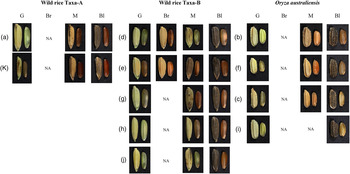
Details of the colour of paddy rice and the grain of the wild are shown in Fig. 1. During harvest, the varying grain maturity on a tiller and between tillers resulted in the harvested material being a mixture of paddy rice at different stages of ripening. As a result, the paddy rice collected had differing appearances; green husk colour consisting of immature grain and brown, mixed (green/brown/black) or black husk colour all consisting of mature grain. In contrast, the mature grain of cultivated rice is uniformly brown.
Photomicrographs showing appearance and colour of paddy rice and rice grain/kernel of three Australian wild rice genotype/taxa collected from several locations near Cairns, Queensland, Australia. a, Abattoir swamp environmental park; b, Brooklyn Wildlife Sanctuary, Mulligan Highway; d, e and f, Lakefield National Park; c, g, h and i, Peninsula Developmental Road; j and k, Mareeba Wetlands. Husk colour was found to be either green (G), brown (Br), part green/brown/black and identified as mixed (M) or black (Bl). NA, sample not available. Photographs were captured at 10× magnification using a digital camera (Nikon Digital Sight DS-Ril, Japan) mounted on a light microscope (Leica MZ6, USA).

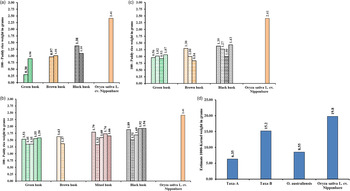
As the number of rice grains of paddy rice harvested was less than 1000 from some sites, the total paddy rice weight was reported as the hundred (100) paddy weight (100-Paddy-GrWt) instead of one-thousand (1000)-paddy weight. The thousand-grain-weight (TKW) was estimated by calculating from the weight of 20 mature grains weight of each wild rice taxa as shown in Fig. 2.
Weight of 100 paddy rice of three Australian wild rices compared with domesticated rice ( ). Sample were grouped based on their husk colour and identified as Green, Brown, Mixed (green/brown/black) or Black and missing data at any given location indicates the unavailability of the wild rice taxa or the paddy rice. (a) wild rice Taxa-A at
 site A (Abattoir Swamp Environmental Park) and site
 K (Mareeba Wetland); (b) wild rice Taxa-B at
 site D,
 site E (Lakefield National Park),
 site G,
 site H (Peninsula Developmental Road) and
 site J (Mareeba Wetland); (c) Oryza australiensis at
 site B (Brooklyn Wildlife Sanctuary, Mulligan Highway),
 site F (Lakefield National Park),
 site C and site
 I (Peninsula Developmental Road). (d) Estimate 1000 kernels weight (TKW) of mature grains of three Australian wild rices compared with domesticated rice by calculated from 20 kernels weight of each taxa.

For wild rice Taxa-A, at both sites collected, a trend of increasing 100-Paddy-GrWt was observed for paddy rice with husk colour from green to brown to black. The 100-Paddy-GrWt of wild rice Taxa-A harvested from the two sites A and K was similar at the brown husk stage, with some difference at the black husk stage but showed the biggest difference when at the green husk stage with 0.30 and 0.90 g, respectively [Fig. 2(a)]. At site A, the 100-Paddy-GrWt was the lowest at the green husk stage at 0.30 g and highest at the black husk stage at 1.38 g with pronounced differences between the green, brown and black husk stages [Fig. 2(a)]. At site K, the 100-Paddy-GrWt at green, brown and black husk stages had small differences [Fig. 2(a)]. The 100-Paddy-GrWt of black husk stage of wild rice Taxa-A was lower than that of the domesticated rice approximately 1.00–1.30 g [Fig. 2(a)].
Paddy rice of wild rice Taxa-B was collected from five sites: paddy rice with green, mixed and black husk was harvested from all sites while paddy rice with brown husk was available only at two, Lakefield National Park locations (sites D and E) [Fig. 2(b)]. At all wild rice Taxa-B collection sites a trend of increasing 100-Paddy-GrWt was observed for paddy rice with husk colour from green to mixed to black. Paddy rice of wild rice O. australiensis was collected from four collecting sites and mixed husk was not available from all sites. The trend of increasing 100-Paddy-GrWt was not observed for paddy rice with husk colour from green to brown to black [Fig. 2(c)]. The 100-Paddy-GrWt of O. australiensis for all husk colour collected was generally lower than that of wild rice Taxa-B, but was comparable with that of wild rice Taxa-A. Oryza australiensis had a small variation in the 100-Paddy-GrWt from the four sites collected, ranging from 0.93 to 1.43 g [Fig. 2(c)]. The estimate TKW of three Australian wild rice taxa compared with O. sativa L. cv. Nipponbare (domesticated rice) demonstrated in Fig. 2(d). The TKW of domesticated rice was 19.80 g and was higher than that of wild rice Taxa-A, wild rice Taxa-B and O. australiensis. Among the TKW of three Australian wild rice taxa, wild rice Taxa-B was the heaviest at 15.20 g, while O.australiensis was at 8.55 g. The lowest of TKW of Australian wild rice taxa was wild rice Taxa-A at 6.35 g.
Paddy rice length and shape from each collection site
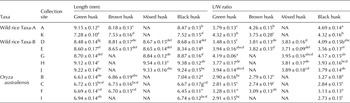
The lengths of paddy of wild rice Taxa-A and wild rice Taxa-B from each collection site were classified as an extra-long paddy rice, while that of O. australiensis was categorized as a long paddy rice (Table 1) based on the international seed classification. Wild rice Taxa-B harvested from sites D, E and G (ranged from 8.34 to 8.87 mm) was shorter than grain collected from sites H and J (more than 9.00 mm). The lengths of wild rice Taxa-B from the five different collected locations were significant difference (P < 0.05). However, the widths of the four different husk colours of wild rice Taxa-B were not significantly difference (P < 0.05) ranging from 2.10 to 2.40 mm (data shown in online Supplementary Table S2). Among of the three husk colours of O. australiensis, the length ranged from 6.60 to 7.00 mm and the width from 2.00 to 2.40 mm (data shown in online Supplementary Table S2). The length and width of O. australiensis collected from four different sites were significantly different (P < 0.05). The longest and the shortest paddy rice of this taxa were found in the black husk group at sites B and F, respectively.
Paddy rice length and length/width (L/W) ration of three Australia wild rices collected from eleven different sites in Queensland, Australia a

NA, seed not available; A, Abattoir Swamp Environmental Park; B, Brooklyn Wildlife Sanctuary, Mulligan Highway); D, E and F, Lakefield National Park; C, G, H and I, Peninsula Developmental Road; J and K, Mareeba Wetlands. Grain were obtained from paddy rice with green, brown, mixed and black colour.
a Mean ± standard deviation is calculated from triplicate of paddy rice image measurement using a Seedcount SC-5000 rice analyser.
Values with different letters in the same column and row of each taxa cultivars are significantly different at P < 0.05.
The paddy rice shape of wild rice taxa was characterized by the L/W ratio. The majority of wild rice samples had an L/W ratio of 3.0 or higher (Table 1). The L/W ratio of the three different husk colour collected from two different locations for wild rice Taxa-A was significantly different (P < 0.05).
The L/W ratio of wild rice Taxa-B collected from five different locations was significantly different (P < 0.05) (Table 1). The mean values of the L/W ratio of O. australiensis for in each collected sites and different husk colour groups were dissimilar (Table 1).
Overall paddy rice dimension and shape of Australian wild rice
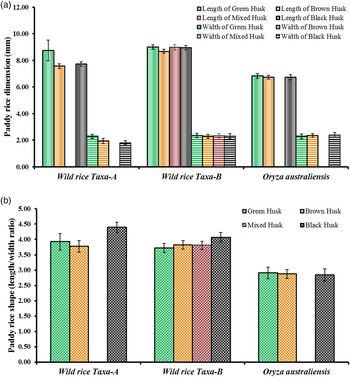
The overall paddy rice dimension and shape of three the Australian wild rice taxa collected from 11 different sites were illustrated in Fig. 3. The length of wild rice Taxa-A and wild rice Taxa-B were more than 7.5 mm which was classified in extra-long paddy rice. However, the mature grains of wild rice Taxa-A were shorter than the others. Oryza australiensis could be able to be categorized as in a long paddy rice because its length was in the range between 6.5 and 7.5 mm. The widths of wild rice Taxa-B and O. australiensis were more than 2.0 mm and were wider than that of wild rice Taxa-A especially in the black husk (online Supplementary Table S2).
Comparison paddy rice dimension and shape of three Australia wild rices collected from different locations near Cairns, Queensland, Australia. Values were grouped based on their husk colours as Green, Brown, Mixed (green/brown/black) or Black. (a) Overall of paddy rice length and width of three Australia wild rices; (b) L/W ratio of three Australian wild paddy rices.

The paddy rice shape data revealed that there were two groups of wild paddy rice. The first group was slender in shape consisting of wild rice Taxa-A and wild rice Taxa-B. The more mature grains of these two taxa were not significantly different (P < 0.05) in L/W ratio; however, wild rice Taxa-A were longer and narrower than wild rice Taxa-B. The second group was O. australiensis classified as a medium grain because it has an L/W ratio of 2.00 or more but smaller than 3.00.
Length, width and L/W ratio distribution of mature paddy rice
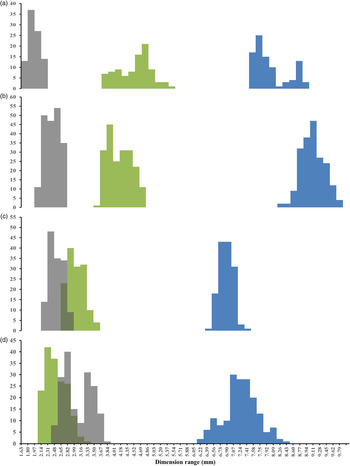
According to rice processing, a length, a width and an L/W ratio are very important criteria to choose the mill required to achieve a high production yield. The length distribution of the more mature grains of three Australian wild rices compared with O. sativa L. cv. Nipponbare (domesticated rice) is shown in Fig. 4. The longest paddy rice was wild rice Taxa-B, while the length of O. australiensis overlapped with that of the domesticated rice.
Distribution of mature paddy rice shape (L/W ratio)  , mature paddy rice length
 , and mature paddy rice width
 compared three Australian wild rices with domesticated rice; a, wild rice Taxa-A (n = 91), b, wild rice Taxa-B (n = 197), c, Oryza australiensis (n = 171) and d, Oryza sativa L. cv. Nipponbare, domesticated rice (n = 278).

The width distribution data in Fig. 4 demonstrated that the narrowest was wild rice Taxa-A following by wild rice Taxa-B as well as O. australiensis and domesticated rice. Wild rice Taxa-B and O. australiensis were similar in width distribution even though their length distributions were difference. Wild rice Taxa-A was the one taxa, with a width that was not in the same range as that of domesticated rice.
The paddy rice shape (L/W ratio) distribution data in Fig. 4 show that wild rice Taxa-A was more slender than wild rice Taxa-B that was the longest. However, these two taxa were not in the same range as the domesticated rice which was medium grain. The L/W ratio of paddy rice distribution of O. meridionalis was in the slender group and was in the same range as the domesticated rice (O. sativa L. cv. Nipponbare).
Physical properties of Australian wild rice compared with domesticated rice
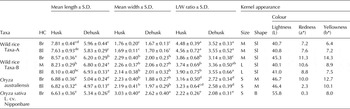
The average length of the three Australian wild paddy rices was classified into two groups; very long paddy rice including wild rice Taxa-A and wild rice Taxa-B and long paddy rice O. australiensis (Table 2). In the very long paddy rice group, wild rice Taxa-B was the longest (>8.00 mm), whereas wild rice Taxa-A was around 7.60–7.80 mm. After dehusking wild rice seeds, the grain of wild rice Taxa-B was approximately 6.20–6.80 mm and was longer than that of wild rice Taxa-A which was 5.80–5.90 mm. These Australian wild rice taxa were categorized in the medium grain except the mixed and black husk of wild rice Taxa-B, which were classifieds as long grain.
Physical properties of mature paddy rice and kernels of three Australian wild rice taxa compared with the domesticated rice a

a Mean ± standard deviation is calculated from 20 grains image measurement using SeedCount SC2000 rice analyser. Sample was grouped based on their husk colour (HC); brown (Br), part green/brown/black and identified as mixed (M) and black (Bl). Kernel size: short (S), medium (M), long (L). Kernel shape: bold (B), medium (M), slender (Sl).
Values with different letters in the same column are significantly different at P < 0.05.
Paddy rice of O. australiensis was about 6.80–6.90 mm in length and O. sativa L. cv. Nipponbare was about 6.60 mm in length. When the husk was removed the grain length of O. australiensis was shorter than that of O. sativa L. cv. Nipponbare which was about 4.90–5.00 and 5.30 mm, respectively. However, both of these were categorized as short grain.
The average width of the three Australian wild paddy rices was divided into two group; less than 2.00 mm for wild rice Taxa-A and around 2.00–3.00 mm for wild rice Taxa-B and O. australiensis, while the domesticated rice was more than 3.00 mm (Table 2). Paddy of wild rice Taxa-A was the narrowest at about 2.10 mm. The grain width of domesticated rice (approximately 2.60 mm) was the widest while that of wild rice Taxa-B (about 2.00 mm) was broader than the others wild rice.
The L/W ratio of Australian wild paddy rice shown in Table 2 was classified into two groups; slender including wild rice Taxa-A as well as wild rice Taxa-B and medium for O. australiensis. On the other hand, the paddy of the domesticated rice was bold in shape. The paddy of wild rice Taxa-A was very slender in shape because its width was narrowest even though its length was not the highest. The grain shape of the Australian wild rice and domesticated rice were classified similar to the corresponding paddy rice. Two taxa were slender in shape, wild rice Taxa-A and wild rice Taxa-B and only one taxa was medium in shape, O. australiensis, while the domesticated rice (O. sativa L. cv. Nipponbare) was bold in shape.
Grain colour of Australian wild rice compared with domesticated rice
Oryza sativa L. cv. Nipponbare was brighter, with less redness and more yellowness than the grains of the wild rice as shown in Table 2. Wild rice Taxa-A was dark brown. Wild rice Taxa-B were red brown and the intensity of colour was higher in more mature grain. The grain colour of O. australiensis was light red brown.
Discussion
The extent to which traits observed in the rice collected in the wild are due to genetic or environmental causes is not defined by this study and would be established only by analysis of seed grown in a common environment.
The husk colour is one of the morphological traits that has been altered by domestication. Zhu et al. (Reference Zhu, Si, Wang, Zhu, Shangguan, Lu, Fan, Li, Lin and Qian2011) reported that the black husk of O. rufipogon was controlled by the Black hull4 (Bh4) gene. The functional significance of this colour and the implications of selection against this trait in domestication are not understood. The significance of the wide variation of husk colour within wild population during their ripening and the relationship with other grain traits is also not clear.
One of the key determinants of rice yield is grain weight represented by 1000 grain weight. Janwan et al. (Reference Janwan, Sreewongchai and Sripichitt2013) reported phenotypic correlation coefficients between 11 traits and yield per plant in RILs derived from KDML105 × CH1. The result showed a positive correlation coefficient observed between TKW and yield per plant. Generally in cereal crops, grain weight is determined by the source capacity (photosynthetic leaves) to supply assimilate during the ripening period and by sink capacity (developing grain) to accumulate the imported assimilate (Ntanos and Koutroubas, Reference Ntanos and Koutroubas2002). However, rice grain development differs from that of the other cereals. It is depend on the sink capacity as the potential grain size is largely determined before anthesis (Chen et al., Reference Chen, Li and Sung1994). The rigid rice hull may limit the expansion of grain size (Zeng and Shannon, Reference Zeng and Shannon2000). Observation revealed that the hull of the wild rice taxa were harder than those of domesticated rice and the grain shape of wild rice was slender. This explains why the grain weight of wild rice is usually less than that of cultivated rice.
The grain weight results indicated that wild rice Taxa-B was the heaviest not only at the fluid (milky stage), but also at a mature stage. It seems that this taxa has a higher grain filling rate and a higher assimilate accumulation capacity than the other wild rice species. Estimated TKW of wild rice Taxa-B was about 15.2 g and is nearly that of the domesticated rice sample (19.8 g) and within the range of a small grained indica variety (TKW, 17.9 ± 0.7 g) (Song et al., Reference Song, Huang, Shi, Zhu and Lin2007). On the other hand, the other two Australian wild rice species studied had a grain weight <10.0 g per 1000 grains. These results suggest that wild rice Taxa-B might be able to support a greater crop capacity than the other wild species. There are many environmental factors influencing the ripening of rice plants including temperature, day length and sunlight intensity, nutrients and water absorption. The most important factor influencing wild rice grain weight could be nutrients especially limiting nitrogen content. Jeng et al. (Reference Jeng, Tseng, Wang, Chen and Sung2006) demonstrated that the average grain weight decreased due to insufficient nitrogen supply, while an excessive supply of nitrogen may cause a decrease in the sugar concentration in leaves during the early ripening stage, and inhibit the translocation of assimilated products to spikelets. Therefore, it may be possible to have much larger grain size in wild rices when they are grown with controlled nitrogen supply in a cultivated environment.
Paddy rice length and shape are very important parameters for milling which aims to remove husks and bran layers and also indicates the paddy rice price. Wild rice Taxa-A and wild rice Taxa-B are extra-long paddy rice, while O. australiensis is long paddy rice. However, all of the Australian wild rice is slender in shape. These might have greater breakage when the husk and bran layer are removed in the milling process. Generally, long grains are smaller in volume, but have a high percentage of hull. The proportion of hull is negatively correlated with milling quality (Jongkaewwattana and Geng, Reference Jongkaewwattana and Geng2001). Therefore, long grains tend to have a lower milled rice recovery and would be more difficult to mill than the other grain types. In term of paddy rice price, milling quality is used to grade and set the price (Efferson, Reference Efferson1985). The wild rice had an extra-long and long grain and could be considered low price depending on the milling yield. However, they may be high priced in gourmet markets when they sell as brown rice or a traditional method is used for their processing.
The length distribution of O. australiensis is a systematic shape and fall in the same range as O. sativa L. cv. Nipponbare. The width and L/W ratio distribution of these two rices are in the same range. Therefore, O. australiensis might be suitable for existing rice-processing equipment because its dimensions and shape are not significantly different from domesticated rice. The others Australian wild rice have a different length, width and L/W ratio from O. sativa L. cv. Nipponbare. Even though, the length of wild rice Taxa-A is shorter than the length of wild rice Taxa-B. Paddy rice shape (L/W ratio) of the two taxa was is in the same interval which is slender. This suggests revealed that these Australian wild rices might require to long grain and slender shape rice processing.
The grain dimension of Australian wild rice is long and slender in shape as well as medium and short in shape. These characteristic meet rice consumer requirement. Generally, rice consumers in each region have different preference in rice grain length and shape. The large rice-consuming countries are China [148,000 metric tonnes (Mt) year−1] and India (98,000 Mt year−1), and these countries have regional differences with respect to preference for grain length and shape. Consumers in China prefer short and bold rice grain, or long but with the grain shape ranging from medium to slender depending on the province. In India, consumer's preference is varied with grain types ranging-from short to medium, long and extra-long in length and with shapes ranging from bold to slender (Calingacion et al., Reference Calingacion, Laborte, Nelson, Resurreccion, Concepcion, Daygon, Mumm, Reinke, Dipti, Bassinello, Manful, Sophany, Lara, Bao, Xie, Loaiza, El-hissewy, Gayin, Sharma, Rajeswari, Manonmani, Rani, Kota, Indrasari, Habibi, Hosseini, Tavasoli, Suzuki, Umemoto, Boualaphanh, Lee, Hung, Ramli, Aung, Ahmad, Wattoo, Bandonill, Romero, Brites, Hafeel, Lur, Cheaupun, Jongdee, Blanco, Bryant, Thi Lang, Hall and Fitzgerald2014).
Grain colour is another measure of grain quality for all forms of rice. Colours of raw milled rice grains can range from white to dark grey or rosy (Webb, Reference Webb and Luh1991). White rices are widely accepted and generally favoured by most consumers and have been under strong selection for thousands of years. However, many coloured rice varieties are sold as a blend with common varieties and consumer's interest in coloured rice is growing (Bergman et al., Reference Bergman, Bhattacharya, Ohtsubo and Champagne2004). The grain colour of Australian wild rice is varied from light red brown to dark brown which may represent their potential antioxidant properties (Kasem, Reference Kasem2012). Fasahat et al. (Reference Fasahat, Muhammad, Abdullah and Ratnam2012) evaluated the proximate nutrition and antioxidant properties of wild rice (O. rufipogon L), which had red-colour compared with domesticated rice MR219 (O. sativa subsp. indica). The result suggested antioxidant activity of wild rice was higher than domesticated rice. Therefore, wild rice might have more potential commercialized in a health food market and provide a new choice of product in the coloured rice group.
The physical traits of the rice grain are the first thing that consumers see. Therefore, rice grain appearance is one of the most important factors which define the market price of rice and influence to rice consumer preference. Physical characteristics of Australian wild rice fall in the same range as that of domesticated rice. This indicates that the potential commercialization of these wild species especially with their coloured pericarp might contribute a valuable nutrition option. However, rice grain quality is not only based on its physical traits, but also its physicochemical properties, cooking characteristics and eating properties. These traits need to be researched on Australian wild rices and compared with domesticated rice. Rice breeders attempt to develop stress resistant rice genotypes in order to increase rice yield under unfavourable environments. However, the limited diversity in the domesticated rice gene pool is one of the main obstacles to progress. Australian wild rice has been largely genetically isolated from cultivated rice and these species may carry many useful abiotic and biotic tolerance genes. Thereby, Australian wild rice may contribute to a new rice gene pool and a new rice crop.
Supplementary material
The supplementary material for this article can be found at https://doi.org/10.1017/S1479262116000083
Acknowledgements
We gratefully acknowledge the Rural Industries Research and Development Corporation (RIRDC), Australia and the Australian Research Council for proving funding. Lucus Anstiss and Graintec Scientific Pty Ltd. are thanked for providing access to a SeedCount Machine. John Thomson and the Queensland Herbarium, Australia assisted with light microscopy and photography. T.T. gratefully acknowledges the Lampang Rajabhat University, Thailand and the University of Queensland for providing a Ph.D. scholarship.