Prior to the 1970s, only five countries in the world had adopted quotas to promote women's representation in politics. Today, more than one hundred countries have done so. With women's representation still lagging far behind men's—women made up only 18 percent of the members of the world's national legislatures in 2008—quotas have become a prominent way to promote women's representation in politics.Footnote 1 Yet the global spread of gender quotas poses a puzzle since they have often been adopted in developing countries where women seem to have an otherwise low status. As an Economist article wryly noted, the list of countries with gender quotas has been “joined in recent years by such feminist-friendly places as Afghanistan, Iraq, and Sudan.”Footnote 2 Why are quotas to ensure women's representation in politics so often adopted today in the developing world?
This article argues that international incentives have been key to the global diffusion of quotes. Since the Cold War's end, international democracy assistance has exploded. Promoting gender equality is a key aspect of aiding democracy abroad and gender quotas have gradually come to be seen as an important and legitimate part of democratization. The international legitimacy of gender quotas causes developing democracies to adopt them through two mechanisms. First, there has been significant international involvement in postconflict countries since the Cold War via liberalizing peace operations. Through them, international actors promote gender equality and gender quotas when new constitutions are being written. Second, internationally legitimate ideas create resources that political leaders can use strategically. Leaders adopt gender quotas as a signal—sincere or insincere—to the international community or to domestic actors of their commitment to liberal democracy. Since quota laws demonstrate, at least on paper, countries' intentions to include different groups in the political process, they are attractive to regimes that are less than fully representative in other ways. Their appeal comes from the diverse benefits that leaders perceive quotas to foster—from foreign aid to improved legitimacy.
To preview this article's main conclusions, I find strong evidence that international incentives are positively and significantly related to a country's likelihood of adopting a gender quota. I measure international incentives by the presence of a United Nations (UN) peace operation that supports political liberalization, whether a country receives foreign aid, and whether a country invited international election monitors to its last election. Such factors are significantly more likely to be related to the likelihood of quota adoption than are measures of gender-related development, democracy levels, transnational civil society presence, and the adoption of related laws. This conclusion is supported by a nested research design that combines cross-national statistical analysis to establish correlation and a case study of Afghanistan's 2004 quota to trace the causal process at work.
The findings are significant for at least two literatures. First, they add to recent research on the international sources of domestic politics since the Cold War. A topic of particular interest has been how international actors help spread a variety of forms of domestic liberalization.Footnote 3 It has not been obvious, however, that gender quotas comprise part of the phenomenon. This article provides a causal argument about the international sources of gender quotas by focusing on the actors involved in democracy promotion and their ideas about legitimate institutions for developing democracies. It suggests that there may be an even wider range of domestic policies that international forces influence than scholars realized. Furthermore, by outlining the direct and indirect mechanisms through which international actors encourage the spread of gender quotas, it offers a general framework through which we might study policy diffusion. The article shares constructivist scholars' interest in the development of ideas about appropriate political conduct.Footnote 4 But its findings on the impact of those ideas—that international influence and inducements prompt countries to adopt quotas—have more in common with recent research on the coercive dimensions of international impact on domestic human rights practices.Footnote 5
Second, the findings offer a new way of thinking about gender quotas, a subject of considerable interest in a rich literature in the subfield of women and politics. Much of the literature examines the domestic political incentives for quota adoption, especially in response to grassroots women's mobilization and party leaders' strategic calculations.Footnote 6 More recent research has emphasized international and transnational dynamics, such as norm diffusion, emulation, foreign imposition, and transnational support for domestic quota campaigns.Footnote 7 In the leading study of gender quotas' global diffusion, Krook emphasizes causal heterogeneity when evaluating those processes, finding that the same causal factors operate differently in different instances.Footnote 8 By looking at a theoretically relevant subgroup of countries—developing countries—we can improve the clarity of our theory by identifying the most relevant causal pattern within this more homogeneous set.Footnote 9 This article attempts to do so by developing a new theory of international incentives for adopting quotas. It also raises important questions about the impact of quotas. Previous research has indicated that quotas affect the quantity of women in politics as well as public attitudes and public policies.Footnote 10 But are the effects the same when quotas are adopted principally due to international politics?
What Are Gender Quotas?
Gender quotas are one of the key institutional innovations in the politics of the late twentieth century.Footnote 11 They come in three forms. Reserved seats are set aside for women in parliaments. Legislative quotas require a certain percentage of political parties' nominees to be women. Voluntary party quotas involve individual parties promising to nominate a certain percentage of women. Collectively, the first two categories are called legal quotas and usually require amendments to constitutions or electoral laws. Quotas can apply to the local or national level of a political system. Quotas can be large (South Korea's 50 percent legislative quota in 2004) or small (Nepal's 5 percent legislative quota in 1990), although the most common size is 30 percent. Finally, legislative quotas can be weakly enforced (France reduces noncompliant parties' public funding) or strongly enforced (Brazil requires noncompliant parties to leave seats open).
Figure 1 charts quotas' spread by decade.Footnote 12 A handful of countries adopted some type of quota prior to the 1970s. The earliest adopters included both consolidated democracies and other countries.Footnote 13 The first quotas were sometimes small, such as Pakistan's, which set aside 10 out of 310 seats in the National Assembly in its first Constitution in 1956, or vague, such as China's, which in 1955 stated that “an ‘appropriate’ and increasing proportion of women should be elected.”Footnote 14 In the 1980s, left-leaning political parties in consolidated democracies such as Austria, Belgium, Canada, Denmark, Germany, Iceland, and Sweden began to voluntarily adopt gender quotas. Subsequently, dozens of countries in Africa, Latin America, the Middle East and North Africa, and Asia adopted legal and voluntary party quotas in the 1990s and 2000s.
Countries that have adopted gender quotas, by decade

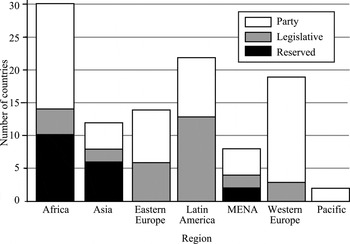
Figure 2 charts types of quotas, by region. Developing countries, which are the significant majority of post–Cold War adopters, favor legal quotas much more than the consolidated, advanced industrial democracies of Western Europe. It is only in Africa, Asia, and the Middle East and North Africa (MENA)—the regions that perform lowest on most other indicators of women's status—that quotas have ever taken the form of reserved seats.Footnote 15
Types of gender quotas, by region

This article develops a theory to explain national legal quota adoption in developing countries. Previous research on gender and politics illustrates the benefits of separately examining developed and developing countries; for example, the determinants of women's representation in high- and middle-income countries have little explanatory power in low-income countries.Footnote 16 Incumbents in advanced industrial democracies may benefit politically from adopting quotas, especially if local women's movements demand them.Footnote 17 Such political incentives are, however, less apparent in countries where women have lower status and public opinion opposes women leaders. The next section presents the international environment as a source of incentives to adopt legal quotas after reviewing the existing literature for plausible alternative explanations.
Why Adopt Gender Quotas?
Structural and Sociological Insights into Quota Adoption
Inglehart and Norris's revised modernization theory posits that the bundle of societal transformations that accompany economic development and democratization includes progress toward gender equality.Footnote 18 As countries industrialize, women enter the work force, fertility levels decrease, female literacy and education increase, and gender attitudes shift. Countries also democratize. As countries then move toward the postindustrial stage of development, new social policies promote gender equality at work and in the public sphere. Women's movements play a key role in demanding those policies. The process of economic, political, and social change depends, however, on cultural heritage. In particular, Muslim countries may have significantly more patriarchal social orders.Footnote 19
Revised modernization theory suggests at least four hypotheses about a country's likelihood of adopting gender quotas, holding all else equal. First, more developed countries should be more likely to adopt gender quotas. Second, countries that are more democratic should be more likely to adopt quotas. Third, improvements in direct measures of women's socioeconomic status—such as women's education levels, life expectancy, or literacy levels relative to men's—should also increase countries' likelihoods of quota adoption. Fourth, Muslim countries should be less likely to adopt quotas than non-Muslim countries.
The world polity theory of Meyer and colleagues offers another plausible explanation of quota adoption. It states: “Many features of the contemporary nation-state derive from worldwide models constructed and propagated through global cultural and associational processes.”Footnote 20 International organizations play a key role in spreading “policy scripts,” or models for legitimate action. One relevant study in this tradition examined the cross-national spread of women's suffrage between 1890 and 1990. It found that women's suffrage was initially brought about by pioneering women's movements but later was the result of countries' desires to adhere to emergent international citizenship norms.Footnote 21 Eventually, almost all states adopted universal suffrage, which became taken for granted as a feature of modern statehood.
Gender quotas could be viewed as features of modern statehood since the 1980s. The world polity logic predicts that as a country's ties to the world polity increase, its likelihood of quota adoption should also increase, all else equal. Ties to the world polity are often measured by the presence of international nongovernmental organizations (INGOs), which diffuse and promote human rights principles globally.Footnote 22 Women's INGOs may be especially significant for quota adoption since they provide organizational and informational resources for domestic activists.Footnote 23 Another indicator of a country's world polity ties is the previous adoption of a related “policy script,” such as extending suffrage to women or ratifying the 1979 Convention on the Elimination of Discrimination Against Women (CEDAW).Footnote 24 World polity theory also implies that as the percentage of quota adopters in a country's region or in the world increases, or both, the country should be more likely to emulate the world polity's model and to adopt quotas.
The patterns of quota adoption across world regions and over time present some prima facie evidence against modernization and world polity explanations of quota adoption, although I systematically test the theories' observable implications. Poorer, less democratic countries adopt reserved seats and legislative quotas more often than richer, long-term democracies. Contemporary states are not converging on a legitimate, universal world model. Instead, they are diverging: many developing countries have adopted legal quotas even as legal quotas remain beyond consideration in developed countries such as the United States.
The Democracy Establishment and Quotas' International Legitimacy
I argue that the international legitimacy of gender quotas as part of democratization creates incentives for developing democracies to adopt them. Although this argument shares an affinity with world polity theory's emphasis on appropriate policies, as I shall show, it offers a unique account of how quotas became appropriate as well as different predictions about which countries will adopt quotas. This section establishes the international legitimacy of gender quotas by focusing on a network that I call the democracy establishment. Who are the main actors? What do they do? How and why do they legitimize gender quotas? While this article's main goal is not to explain the origins of the democracy establishment's ideas about gender equality, it is important to offer some basis for them. The next section offers the meat of the article's theory by predicting the impact of the democracy establishment's ideas.
Democracy assistance has rapidly expanded in the past twenty-five years.Footnote 25 What in the early 1980s consisted of a few political party foundations with limited budgets is now an international, professional field that spends billions of dollars a year to promote democracy in nearly one hundred countries. The explosion of democracy assistance is part of an overall growth in democracy promotion since the Cold War's end, when democracy became viewed as a “panacea” to achieve security and development objectives.Footnote 26 Democracy promotion can be accomplished through economic sanctions and rewards, diplomatic measures, and even military intervention. Democracy assistance is an additional tool. It is “aid specifically designed to foster a democratic opening in a nondemocratic country or to further a democratic transition in a country that has experienced a democratic opening.”Footnote 27 The people and institutions that carry out democracy assistance form what I call the democracy establishment.
Intergovernmental, governmental, quasi-governmental, and nongovernmental actors make up the democracy establishment. In the United States, they include bureaus in the U.S. Agency for International Development (USAID) and the State Department, nonprofit organizations such as Freedom House and the Carter Center, and for-profit contractors such as Chemonics. In Europe, the government-affiliated actors include Germany's political party foundations and Britain's Westminster Foundation for Democracy. The democracy establishment also includes offices in major inter-governmental organizations, such as the UN, the Organization for Security and Cooperation in Europe (OSCE), the European Union, the Council of Europe, and International IDEA.
The democracy establishment resembles other networks in world politics.Footnote 28 First, many of its actors are governmental and, like a transgovernmental network, they promote professional norms and provide technical assistance. They do not, however, attempt to directly perform governance functions.Footnote 29 Second, similar to transnational advocacy networks, the democracy establishment has a principled agenda: promoting greater democracy and shared values.Footnote 30 However, it is closely tied to state governments and its actors do not usually rely on moral suasion. Finally, like an epistemic community, the democracy establishment is a professional network that provides advice and elucidates cause–effect relationships.Footnote 31 The case of an epistemic community (Keynesian economists) whose ideas served as a policy road map after a major historical break (World War II) especially parallels the democracy establishment's post–Cold War influence.Footnote 32 The democracy establishment derives its legitimacy through the normative link between democracy and good governance, however, whereas epistemic communities do so through scientific consensus.Footnote 33
Still, members of the democracy establishment share a common set of normative and cause–effect beliefs.Footnote 34 For example, in an ethnographic study of democracy assistance in the Balkans, Coles noted that OSCE election observers had to pass a test emphasizing the link between peace and democracy.Footnote 35 Although there are many definitions of democracy, a common international recipe for democracy assistance—focusing on the rule of law, elections, civil society, governance, women's participation, and local political development—has emerged.Footnote 36 Many practices and institutions that are atypical in consolidated democracies are now hallmarks of developing democracies. Elections, for example, should be managed by independent electoral management bodies and monitored by international election observers.Footnote 37
Where did the idea linking gender quotas and democracy come from? It has several sources, including democracy promoters' principled beliefs, the efforts of female activists, the personal experiences of promoters, and practical considerations of what can be accomplished. Consistent with democratic expansion in consolidated democracies, democracy promoters have a principled commitment to gender equality. Some democracy promoters had personal experiences with quotas, being familiar with them from their home countries. For example, in 1989, the Ebert Foundation sponsored seminars, assemblies, and training booklets in Argentina on the German Social Democratic Party's experience with quotas.Footnote 38 Argentina later passed a quota in 1991. Female activists also lobbied international organizations, including the UN, to pay attention to women's rights.Footnote 39 Finally, working with women was a democracy-assistance strategy that seemed achievable and successful. It often (although not always) found partners in local women's groups, helping the persuasive task of democracy promoters. It also had the advantage of being less threatening to leaders of countries where projects take place than other types of democracy assistance (for example, political party aid) because it did not directly challenge their hold on power; thus it was more likely to succeed. If authoritarian rulers do not allow democracy-establishment actors in to do work, these actors cannot obtain the funding necessary to survive.Footnote 40
The democracy establishment's professionalization spread common ideas about appropriate democratic institutions, such as quotas.Footnote 41 Three mechanisms of professionalization during the 1990s were critical. First, democracy assistance involves frequent turnover, or shifts and transfers of people across organizations and countries.Footnote 42 Such shifts cross-fertilize ideas and practices. For example, USAID launched a Community Revitalization through Democratic Action (CRDA) project in Serbia and Montenegro in 2001 that was modeled on a program that the mission director had previously overseen in Lebanon. Turnover creates a multinational group of experts in managing elections, supporting political parties, fostering independent media, and so on. Second, democracy assisters have learned over time. Since CRDA projects were viewed as successes in Lebanon and Serbia, similar programs were launched in Afghanistan, Iraq, Kazakhstan, Kyrgyzstan, Tajikistan, Turkmenistan, and Uzbekistan.Footnote 43 The concentration of democracy assisters in countries with international peacekeepers helps foster information transmission. Third, creating neutral, professional standards—such as the number of women that participated in a training session or that serve in parliament—is a survival strategy for actors in the democracy establishment in the competition to secure government funding.Footnote 44 Since democracy assistance organizations receive government grants through a process of delegation, it is crucial for them to find depoliticized and, where possible, numerical indicators that they can use to demonstrate progress to their funders.Footnote 45
Such processes of professionalization cemented the idea that gender quotas are part of democratization within the democracy establishment. Today, according to one long-time international elections expert, in postconflict countries gender quotas have become something that “the international community pushes really hard for … [as] just one of the expectations.”Footnote 46 In 2000, UN Security Council Resolution 1325 affirmed women's role in postconflict reconstruction and “the importance of their equal participation and full involvement in all efforts for the maintenance and promotion of peace and security.”Footnote 47 Shared beliefs about the appropriateness of gender quotas for developing countries came to reflect both a worldview—or a general orientation in favor of gender equality—as well as a set of causal beliefs—or ideas about the efficacy of gender quotas at achieving equality in transitional countries.Footnote 48
Interestingly, gender quotas are not conditions for foreign aid. In fact, they are sometimes controversial. For example, although the UN Transitional Administration in East Timor (UNTAET) enacted quotas for the civil service and the quasi-legislative National Council, some officials opposed quotas for the Constituent Assembly. Still, after the National Council voted against quotas, UNTAET supported women's participation by providing special funds for female candidate training and giving parties with at least 30 percent female candidates extra time on UNTAET radio and television.Footnote 49 Meanwhile, UN Secretary General Kofi Annan stated that equal participation between men and women in decision making was necessary for peace.Footnote 50
A Theory of How International Incentives Explain Quota Adoption
This section offers a theory of how the democracy establishment's ideas about gender quotas affect domestic politics. The international concern with gender equality as part of democratization and the acceptance of quotas as an appropriate means to bring it about generate incentives for leaders in developing countries to adopt quotas. Doing so demonstrates countries' commitments to gender equality and democracy. When international involvement is highest—in postconflict countries with international peacekeeping forces—the adoption mechanism is closer to imposition.Footnote 51 When international involvement is lower but still strong—in countries that are concerned with increasing or maintaining their levels of foreign aid, foreign direct investment, international legitimacy, and the like—the mechanism is closer to inducement. Although the activism of domestic women may be necessary for quota adoption, we shall see that it is not sufficient.Footnote 52
The democracy establishment's ideas lead to quota adoption both directly and indirectly. First, its ideas about gender quotas directly impact developing countries' laws through the democracy establishment's presence in postconflict countries. Since the Cold War's end, the UN has led more than two dozen postconflict peace operations that have promoted liberal democracy.Footnote 53 Although such operations' efficacy at promoting democratization has been debated, they do encourage countries to adopt some practices and institutions from the international model. In particular, international experts influence new electoral laws. Aid for writing or rewriting constitutions is a key form of democracy assistance. It involves expert advice as well as funds for constituent assemblies, constitutional commissions, and disseminating constitutions. Contrary to the stereotype of democracy assisters taking books on the U.S. constitution to transitional countries, however, legal quotas are a policy that many democracy-assisting countries themselves have not taken.Footnote 54
Thus, countries hosting a liberalizing UN peace operation will be more likely to adopt gender quotas, all else equal. The presence of a UN peace operation has causal status since it leads to heavy involvement in the country by the democracy establishment, which transmits ideas and exercises influence over new laws. Actors in the democracy establishment do not control transitional countries' constitutions, but their preferences matter. At a minimum, the high degree of foreign dependence in postconflict countries creates a strong incentive for leaders to adopt female-friendly policies and follow internationally legitimate models. Furthermore, actors in the democracy establishment try to empower local women through special funds and training sessions; in so doing, they may enhance the domestic incentives to adopt quotas. At a maximum, actors in the democracy establishment push gender quotas in postconflict societies despite an absence of local support.
H1: Countries where a democracy-promoting UN peace operation is present will be more likely to adopt gender quotas than other countries, all else equal.
Kosovo illustrates this causal mechanism. Actors from the democracy establishment were part of a large international presence that included a UN mission, bilateral donors, and nongovernmental grantees from the National Endowment for Democracy (NED). They emphasized gender equality as part of their programs to support democracy. For example, women-only meetings and special debates for female candidates ensured female participation in community programs.Footnote 55 In 2000, the UN Interim Administrative Mission in Kosovo (UNMIK) Regulation 39 also established a 30 percent quota for women among the first fifteen candidates on all party lists for local and national elections.Footnote 56 But the quota provoked a domestic backlash. Local elites argued that there were insufficient numbers of competent women candidates. After the first election, some elected women went so far as to resign in protest of what they said was an unfair international imposition.Footnote 57
Second, the democracy establishment's ideas about what is appropriate for developing democracies indirectly create incentives for quota adoption. The democracy establishment's menu of appropriate practices and institutions for developing countries provides shortcuts for international and domestic audiences to tell if a country is liberalizing.Footnote 58 Thus, new and pseudo-democracies adopt gender quotas to demonstrate their commitment to liberal values. The process parallels the diffusion of inviting international election observers, in which Western states' rewards for democratization after the Cold War encouraged first sincere and then insincere states to signal their commitment to liberal democracy by inviting observers.Footnote 59 Developing countries' tendency to adopt more legalized forms of gender quotas than developed countries lends credence to a signaling theory. But why choose the particular signal of quotas? First, since quotas enhance representation, they demonstrate that citizens' voices are being heard. Second, they may satisfy the demands of female activists. Third, in certain electoral systems, such as the single nontransferable vote, reserved seats can be used to quietly take away seats from opposition parties.
This article uses two indicators for the types of states that are likely to adopt quotas as a signal of their commitment to liberalism. First, they should be countries that are dependent on the West. National political leaders in such countries want to maintain good will and to demonstrate their good governance and liberalism. One indicator of dependence is foreign aid. As countries' foreign aid dependence increases, they will be more likely to adopt gender quotas. Foreign aid dependence is causally related to quota adoption since it directly measures material dependence.
H2: The more foreign aid that a country receives, the more likely it is to adopt a gender quota, all else equal.
Second, the type of state that will adopt gender quotas for signaling purposes should also adopt other practices or institutions that the democracy establishment views as appropriate. Beyond foreign aid dependence, there are a variety of incentives—both normative and strategic—that encourage leaders to perform democracy according to an internationally approved script. They include reputation, legitimacy (domestic or international), foreign direct investment, tourism, and foreign debt relief. Such motives are difficult to directly measure, especially in a cross-national framework, but my theory predicts that they should be evidenced both by inviting international election monitors and also by adopting quotas. Thus, inviting international election monitors serves as a proxy variable (not a causal variable) that captures countries' incentives to adopt quotas as a signal of liberalism that are not directly observable or measurable.
H3: Countries that invite international election monitors to their most recent election will be more likely to adopt gender quotas than other countries, all else equal.
Jordan illustrates the foreign-aid mechanism. King Abdullah II, who ascended in 1999, “has actively pursued stronger alliances and aid ties with the United States, Britain, and the European Union as well as international financial institutions such as the IMF and the World Bank.”Footnote 60 Jordan's continued economic development hinges on privatization, foreign investment, and, especially, Western aid. For example, since 1964, Jordan's central government annual current expenditures have closely tracked external aid receipts.Footnote 61 Over the same time period, foreign aid as a percentage of Jordanian central government budget expenditures hovered at around 25 percent (and never below 10 percent). Jordan's ties with the West strengthened after 11 September 2001, when Jordan became a key supporter of the U.S. “war on terror.” In this context, Abdullah sought to improve the status of women in society and thereby burnish Jordan's image abroad. One way to accomplish this was by setting aside six of the 110 seats in parliament for women in 2003.Footnote 62 The quota resulted in six female MPs but also some opposition. In the past, Jordanian women had campaigned unsuccessfully for a quota.Footnote 63 When Abdullah endorsed the quota by royal decree, however, he angered both the Higher Committee for the Coordination of National Opposition Parties, which issued a statement rejecting it, and also some female activists, who found that the quota discriminated against the urban areas where they lived.Footnote 64
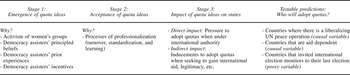
It is worth underscoring how this theory differs from previous research on the impact of norms in world politics.Footnote 65 Constructivist approaches argue that norm entrepreneurs socialize global audiences to new principled ideas that then become accepted and institutionalized. The mechanisms are first, persuasion, and then, socialization, institutionalization, and demonstration.Footnote 66 For example, in a study of the influence of norms on state behavior, Finnemore found that the social structure of the state system caused a convergence across all states in the creation of science bureaucracies, the acceptance of new rules of war, and the definition of development.Footnote 67 This article develops a theory, however, of how norms affect states differentially due to international inequalities. In the case of the spread of gender quotas, reserved seats for women proliferate in developing countries even as they remain off the table in many developed countries. Indeed, actors in the democracy establishment do not use the informational techniques of transnational activists, such as symbolism, leverage, and accountability tactics.Footnote 68 Instead, their ideas wield influence because they enjoy a privileged position in postconflict countries via peace operations and because of their perceived linkages to foreign aid, foreign investment, and international and domestic legitimacy. Table 1 below summarizes the causal argument.Footnote 69
The emergence, acceptance, and impact of the democracy establishment's ideas about gender quotas

A Quantitative Analysis of the Sources of Gender Quotas
The Sample
The unit of analysis for the quantitative analysis of the determinants of quota adoption is the country–year. The sample covers the years from 1970 to 2006 and contains all countries except long-term consolidated and developed democracies.Footnote 70 Long-term consolidated and developed democracies were removed because they are subject to different causal processes; they are neither under UN authority nor desirous of signaling their liberalism to the international community, and in fact, they promote democracy abroad.Footnote 71 I followed Finkel et al. and removed thirty advanced industrial, long-term consolidated democracies, which resulted in a sample of 165 countries for at least some amount of time.Footnote 72
The Data
I compiled data on quota adoption principally from the Global Database of Quotas for Women.Footnote 73 Because of my theory, I restrict my focus to national legal quotas since they are the quotas advocated by the democracy establishment and that signal a country's commitment to gender equality. I do, however, count a few cases of voluntary party quotas in which the adopting party was the incumbent in a noncompetitive system. Such cases are de facto legal quotas. For example, in 1994 the FRELIMO party adopted a 30 percent quota in Mozambique while it ruled as a single party for more than a decade after the country's civil war.Footnote 74 I measure quota adoption dichotomously: 0 if a quota has never been adopted and 1 if a quota was adopted that year. The year of adoption refers to the year of ratification of the electoral laws or constitution.Footnote 75 I focus on the first time that a country adopted a gender quota. Although the dichotomous measure obscures some interesting variation in terms of types of quotas, it offers a good first cut for a cross-national hypothesis test. The Appendix lists the countries with legal or de facto legal quotas.
I measured international incentives as follows. First, countries are more likely to adopt quotas when a UN peace operation that promotes liberal democracy is present. The UN Department of Peacekeeping Operations provides peace operation mandates and mission summaries that were used to identify if the operation included support for elections or democracy.Footnote 76 It is a dichotomous variable: 1 if a UN peace operation with support for democracy took place in a country that year and 0 otherwise. Twenty-nine out of forty-five UN peace operations between 1989 and 2006 were coded as liberalizing.Footnote 77 Second, countries that are more dependent on foreign aid are more likely to adopt quotas. I used the natural log of the amount of official development assistance that a country received from OECD countries during the previous year in 2007 U.S. dollars.Footnote 78 Finally, the countries that are likely to signal their commitment to liberalism via quotas are likely to also do so by inviting international election observers. I used Hyde's data on international election observation to create a dichotomous variable, which assumes the value of 1 if international election observers monitored the country's most recent election and 0 otherwise.Footnote 79
I next collected annual data to test world polity theory. First, the United Nations Development Programme's Human Development Report indicates the number of years since women obtained suffrage in a country, as well as whether a country ratified CEDAW.Footnote 80 Second, I took the natural log of the number of INGOs and women's INGOs in each country in the previous year according to the Yearbooks of International Organizations.Footnote 81 Third, I calculated the percentage of countries in the world and in a country's region that had adopted quotas in the previous year in order to create diffusion variables.Footnote 82
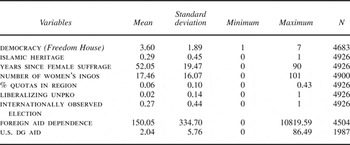
Finally, I collected annual data to test modernization theory, which argues that women's socioeconomic standing, democracy levels, economic development, and female-friendly public policies co-vary. The World Bank provides relevant yearly measures on women's socioeconomic standing; however, the data contain many missing values, which are not missing at random.Footnote 83 Thus, I present results here using the previous year's levels of democracy and economic development to capture modernization dynamics, although including variables such as the percent of the total labor force that is female does not alter the results substantively. Data on countries' real GDP per capita in logged current U.S. dollars came from the World Bank.Footnote 84 I used two measures of democracy: (1) an average of Freedom House's measures for political rights and civil liberties, which were rescaled so that 1 represents the least free countries and 7 the most free, and (2) the Polity2 variable from the Polity IV dataset, in which a score of 10 represents the most democratic and −10 the most autocratic countries.Footnote 85 Since the effects of INGOs on the likelihood of gender-quota adoption may depend on the level of democracy in a country, in robustness checks, I interacted that variable with an indicator of democracy. I also created a dichotomous variable that indicates Islamic cultural heritage.Footnote 86Table 2 reports descriptive statistics for the main variables.
Descriptive statistics

Notes: The nonlogged versions of variables are provided in this table for ease of interpretation.
The Model
I used an event history model to estimate the likelihood of a legal quota being adopted in a country given that it had not already been adopted. This method is common in studies of policy diffusion because it can incorporate both internal and regional dynamics, deal with rarely occurring, one-time events (quotas are rarely-to-never repealed), and provides the probability of policy adoption at a given time.Footnote 87 If a quota was not adopted by 2006, then the observation is right-censored. I used the semi-parametric Cox proportional hazard model because it makes no assumptions about the shape of the baseline hazard except that it does not vary across observations and because the model easily accommodates time-varying covariates.Footnote 88
The Results
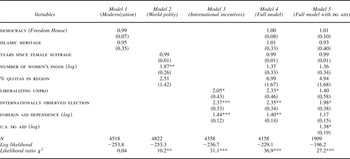
Table 3 summarizes the results of the event history analysis.Footnote 89 Event history analysis yields hazard ratios; ratios significantly less than one indicate that a variable reduces the “hazard,” or likelihood, of adopting a gender quota, while ratios significantly greater than one increase that likelihood.
Who adopts gender quotas? An event history analysis

Notes: Exponentiated hazard rates were estimated from Cox proportional hazards regressions with the Efron method for ties. Robust standard errors, clustered on country, are in parentheses. Ratios significantly less (greater) than one indicate that a variable is estimated to reduce (increase) the likelihood of adopting a gender quota.
* p < .10;
** p < .05;
*** p < .01.
The variables suggested by modernization theory generally are not related to quota adoption in developing countries. Model 1 uses lagged democracy levels as measured by Freedom House and a country's Islamic heritage to predict the likelihood of quota adoption. Not only are the variables statistically and substantively insignificant individually, but the model also fails the likelihood ratio test; that means that the variables are not jointly significant.Footnote 90 If included, a variable measuring countries' lagged, logged gross domestic product per capita is, however, positively and significantly related to quota adoption. I omit it from Table 3 in the interest of comparison across models because this variable loses statistical significance when included in fuller models and is missing a considerable number of observations.
The variables suggested by world polity theory fare better. Model 2 uses the natural log of the number of women's INGOs, the number of years since women attained suffrage, and the percentage of countries in the region with quotas to estimate a country's likelihood of quota adoption. Although the number of years since women attained suffrage and the diffusion variable were not important factors, the number of women's INGOs in a country is positively and statistically significantly related to the likelihood of quota adoption. Since a country's number of women's INGOs is highly correlated with its number of overall INGOs, however, it is difficult to separate the impact of countries' general ties to the world polity from the demands of female activists.Footnote 91
Variables that measure international incentives are positively and statistically significantly related to quota adoption. Model 3 uses the presence of a liberalizing UN peace operation, the presence of international election observers at the last election, and lagged foreign aid dependence to estimate a country's likelihood of adopting a quota. All three variables have strong positive relationships with quota adoption. Model 4 reintroduces the variables from the other models. When included in a larger model with international factors, the number of women's INGOs ceases to attain statistical significance at conventional levels (p < .33). The strong, positive relationships from Model 3 between quota adoption and international election observers, liberalizing UN peace operations, and foreign aid dependence persist, although the statistical significance levels are somewhat dampened.
My theory predicted that countries where the democracy establishment influences domestic laws via a democracy promoting UN peace operation would be more likely to adopt gender quotas. Another way to measure the democracy establishment's influence and presence in a country is by the amount of democracy assistance it receives. USAID provides data on its democracy and governance (DG) outlays to each country between 1990 and 2003.Footnote 92 According to my theory, this variable should also be positively and significantly related to a country's likelihood of adopting quotas. The U.S. government does not promote gender quotas as a policy. But democracy assistance programs, including U.S.-funded ones, are conducted by actors in the democracy establishment, who transmit ideas about gender equality and the legitimacy of quotas.
Model 5 includes the natural log of the amount of DG aid received by a country in the previous year. This model should be interpreted cautiously since the complex relationships between variables such as democracy and DG aid raise concerns about its functional form. But it does provide some interesting correlations. First, DG aid is positively and statistically significantly related to a country's likelihood of quota adoption. Second, countries that invited international election observers are still more likely to adopt quotas, while countries with more linkages to the world polity or greater “modernization” are not. But the presence of a UN peace operation is no longer a statistically significant determinant of the likelihood of quota adoption.Footnote 93 This suggests that DG aid is indeed another measure of the underlying concept of the democracy establishment's presence in a country. At the same time, Model 5's reduced sample excludes many observations with neither liberalizing UN peace operations nor quotas, as well as several observations (for example, Sudan in 2005) with both liberalizing UN peace operations and quotas; the change in the sample also accounts for the decreased magnitude of the estimated hazard ratio for the liberalizing UN peace operation variable. Model 4 therefore serves as the base model for this study.
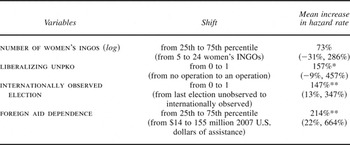
A good way to interpret the results is to simulate the percentage change in the hazard rate that is associated with a unit change in an independent variable. I shifted one independent variable at a time from the 25th to the 75th percentile, while holding all other numerical independent variables at their means and qualitative independent variables at their medians. The results for Model 4 are presented below in Table 4. We see that a country with a liberalizing UN peace operation is 157 percent more likely to adopt a gender quota than one without. Meanwhile, going from no observed elections that year to observed election(s) is associated with a 147 percent increase in the likelihood of adopting a gender quota. Finally, an increase from $14 to 155 million 2007 U.S. dollars in foreign aid results in a 214 percent increase in the likelihood of quota adoption.
Simulated hazard rates of gender quota adoption

Notes: Simulated hazard rates estimated by shifting one variable at a time from Model 4 in Table 3, while holding all other numerical variables at their means and qualitative variables at their medians. 95 percent confidence intervals for the simulated first differences are in parentheses. Results were based on 1000 simulations from an asymptotic normal distribution.
* p < .10;
** p < .05;
*** p < .01.
Robustness Checks
A potential confounding variable is a country's postconflict status. Previous research has found that armed conflict predicts women's representation in developing countries due to the structural, political, and cultural changes that accompany civil war.Footnote 94 For example, postconflict countries' populations skew female, which may make quotas politically advantageous. To test for this possibility, I replaced the UN peace operation variable in Model 3 with a dichotomous variable indicating whether a country is within five years of the end of a civil conflict. A country's postconflict status is not, however, statistically significantly related to quota adoption at conventional levels although the estimated hazard ratio is greater than one.Footnote 95 This suggests that international involvement in postconflict countries is the key factor influencing quota adoption, rather than the postconflict setting in general.
A final consideration is the robustness of the results when I analyze each region separately. This section's main finding—that liberalizing UN peace operations, foreign aid dependence, and inviting international election monitors are strongly related to gender quota adoption—still largely stands. Latin America, however, is an outlier.Footnote 96 Specifically, liberalizing UN peace operations are negatively and significantly related to a country's likelihood of quota adoption. Inviting international election observers and foreign aid dependence—measures of the democracy establishment's indirect influence—continue to be positively and significantly related to quota adoption. Prior democracy and women's INGOs, however, are also strong positive predictors of quota adoption.
What explains Latin America's difference? First, the international “supply” of quotas was weak. Many liberalizing UN peace operations in Latin America took place in the early 1990s. For example, the UN Observer Group in Central America (ONUCA) supported elections in Costa Rica, El Salvador, Guatemala, Honduras, and Nicaragua between 1989 and 1992 and the UN Observer Mission in El Salvador (ONUSAL) did the same in El Salvador between 1991 and 1995. I argue that the democracy establishment, and its ideas about the appropriate practices and institutions for developing democracies, emerged after the Cold War. The norm of gender quota adoption was therefore still in its infancy during many Latin American UN peace operations. In this sense, Latin America may be the exception that proves the rule.
Second, research on human rights shows that transnational human rights advocates have been unusually successful in Latin America. In other words, the domestic “demand” for quotas was strong. A recent review noted the large number of Latin American INGOs, the prominence of Latin America in U.S. congressional debates over human rights in the 1970s, and the early intellectual and religious roots of the region's human rights discourse.Footnote 97 Especially in women's rights, Latin America has been at the “vanguard,” with Evita Perón advocating for informal candidate selection quotas in the governing party in Argentina as early as 1951.Footnote 98 Subsequently, regional organizations, such as Parlatino (the Latin American Parliament), aided female advocates for quotas.Footnote 99 The historical legacy of quotas in Latin America as well as the relative efficacy of regional human rights actors there encouraged the region's early adoption of quotas.
A Case of International Incentives? Afghanistan's Quota
The quantitative results confirmed my hypotheses, but the analysis has limitations. First, the relationships between UN peace operations, international election observation, and quota adoption could be spurious since these phenomena have become increasingly prevalent over time. Second, some measures for key concepts, such as women's advocacy via INGOs, are blunt. A case study can check the results' robustness through process tracing. Since the preliminary large-N analysis generated satisfactory results for my theory, I chose Afghanistan—a country that was well-predicted by the statistical model.Footnote 100 The analysis used published primary and secondary accounts, news articles, and sixteen key informant interviews. The interviews were used primarily to reconstruct events, as well as to corroborate existing sources and to establish what international and local elites thought. Thus, I identified the names of key international and Afghan people from published sources and then gathered a larger sample via snowball methods.Footnote 101
Afghanistan adopted a gender quota on 4 January 2004, as part of a new constitution. The constitutional process began on 5 December 2001, after the U.S. invasion, with the Bonn Agreement, which called for “the establishment of a broad-based, gender sensitive, multiethnic and fully representative government.”Footnote 102 Gender sensitivity was of vital importance to the international community given the extraordinary repression of women under the previous Taliban regime.Footnote 103 UNAMA (the UN Assistance Mission in Afghanistan) began in March 2002 to support the constitutional process. The constitution was first drafted in October 2002 by a nine-person commission appointed by Interim President Hamid Karzai, then reviewed in May 2003 by an appointed thirty-five-person constitutional commission, and finally approved by the elected and appointed 502-person Loya Jirga that met over three intense weeks starting in December 2003. The constitution reserves 27 percent of seats for women in the lower house, the Wolesi Jirga, and 17 percent in the upper house, the Meshrano Jirga. My theory predicts that without international incentives from the UN peace operation, there would have been no quota. I look at evidence of three observable implications from the theory. First, did international experts exert influence over Afghanistan's constitution through assistance and technical advice? Second, did actors from the democracy establishment, drawing on experiences from other transitional countries, view a quota as appropriate and necessary? Third, to the extent that Afghan women advocated for quotas, were they empowered by international actors? I examine each question in turn.
First, international actors did influence Afghanistan's constitutional process, although the interim government leaders' political concerns often drove the process. One high-level diplomat said that at the early stage of the nine-person drafting commission, one of the only concessions that was made to the international community was to include two women representatives.Footnote 104 The “signature” of UN special representative Lakhdar Brahimi had “been a ‘light footprint’”; but once the constitution reached the stage of the thirty-five-person review committee, international experts Barnett Rubin, Yash Pal Gai, and Guy Carcassonne were enlisted to ensure that the text met “basic international standards.”Footnote 105 Vigorous debate took place over presidentialism, the qualifications for office, the place of Islam in the constitution, and the electoral system. But international experts' greatest influence is said to have been on articulating the need for a women's bill of rights and for assurances that gender equality be properly reflected in the constitution.Footnote 106 Even after the constitutional process was over, the international influence remained strong; for example, in interviews conducted by the Heinrich Böll Foundation in 2007 and 2008, MPs complained that they have limited influence over Afghanistan's budget because the international community was sponsoring upward of 90 percent of it.Footnote 107
Second, members of the international community, especially at the UN, favored a gender quota for Afghanistan due to the belief that there needs to be some type of gender mechanism in a postconflict society.Footnote 108 Statements to this effect from key participants are especially suggestive because international actors in Afghanistan were keenly aware of the political importance of avoiding the perception that they had imposed Afghanistan's constitution. A quote from a former UNAMA political officer in Kabul and Bamain is illustrative:
The last thing you [the UN or other outsiders] want to show is your involvement because then they will not accept this constitution, saying that it's foreign, imported, and so on. It was a very, very sensitive issue. We had to keep as low a profile as possible. We had to not get involved in the essence of the issue but try to guide them…. We were not necessarily deciding, but through intensive consultations only certain things could be approved, not necessarily with the stroke of a pen from my side, but if, for instance, they had to have a quota or proportional representation from all factions and they didn't have that, I had to be alarmed and I had to tell them, “No, we have to have proper representation.”Footnote 109
As predicted by the theory, members of the democracy establishment often treated their work on gender, peace, and development as a technical project rather than as a political enterprise—to the frustration of some Afghans.Footnote 110
Various events illustrate the international support for quotas in Afghanistan. U.S.-based efforts such as the Afghanistan Reconstruction Project provided technical advice about how women's rights fit with Islamic law and Afghanistan's legal traditions and how best to implement gender quotas.Footnote 111 When Interim President Karzai decided to switch the electoral system from closed-list proportional representation to single nontransferable vote due to concerns over public confusion and his distrust of political parties, “many international organizations, foreign diplomats, UNAMA, and emerging progressive Afghan political and civil society movements” objected due to its potentially negative consequences for women's representation.Footnote 112 There was some debate within the international community over the form that the quota ought to take, with one suggestion that women's seats ought to be assigned via a special election. But despite different opinions about implementation, one international official said that some sort of quota was “clearly something that we lobbied for.”Footnote 113 The quotas for the appointed and elected members of the constitutional commissions and the Loya Jirga facilitated agreement over the eventual reserved seats. Indeed, as early as February 2002, UN Secretary General Kofi Annan called for “temporary special measures, including targets and quotas, targeted at Afghan women” to accelerate women's participation in decision making.Footnote 114
Finally, Afghan women played an important role in the constitutional process. Women made up almost 20 percent of the constitutional commissions as well as the Constitutional Loya Jirga. Groups of these women, drawing on the example of quotas in Pakistan, advocated for reserved seats as well as other provisions.Footnote 115 Indeed, they successfully campaigned to double the proposed lower-house quota to 27 percent during the chaotic final constitutional negotiations with the support of U.S. Ambassador Zalmay Khalilzad, Loya Jirga Chairman Sibghatullah Mojaddedi, and international representatives.Footnote 116 Female advocates during the constitutional process were able to advocate, however, in part due to international assistance. For example, the international community, and specifically the United Nations Development Programme and UNIFEM, helped establish, fund, and provide technical expertise to the Ministry of Women's Affairs to facilitate gender mainstreaming in the government. This Ministry later helped press for the quota. Furthermore, U.S. officials and the National Endowment for Democracy (NED) convened meetings for Afghan activists with women from other regions and constitutional experts to prepare them for advocacy.Footnote 117 Karzai and international officials also promoted gender equality by selecting elite women's advocates to participate in the constitutional process.
Urban Afghan women were mobilized by national and international organizations to lobby for quotas.Footnote 118 But other Afghan women, especially in rural areas, were not aware of the quota and some even expressed displeasure with it. A journalist interviewed eighty Afghan women in 2002 and found them generally unsupportive or unaware of the place gender quotas would likely have the constitution: “With the exception of the feminist Soraya Parlika, a member of the Constitutional Loya Jirga, no woman in Afghanistan voiced open support for a women's quota to ensure women's participation in politics. Many women were even surprised that one might demand such a quota.”Footnote 119 Among elite women that participated in the constitutional process, there was also some disagreement; one leader at Bonn said that the quota should be temporary, stating, “We do not want charity.”Footnote 120 Although women have achieved some stunning successes since 2004—for example, nineteen women were elected to the Wolesi Jirga in the 2005 election without the aid of the quota—there is still much progress to be made. Forty-nine of the sixty-eight female members of the Wolesi Jirga that were elected in 2005 “owe[d] their election to the quota mechanism, having leaped over 422 male candidates who outpolled them.”Footnote 121
Recent events in Afghanistan continue to illustrate the difficulty facing female advocates without the international community's inducements and threats behind them. In April 2009, both houses of Afghanistan's parliament passed the Shia Family Law, which formalized practices such as bans on married Shia women leaving their homes without their husbands. About 300 Afghan women protested in Kabul, but they faced “an angry throng three times larger than their own.”Footnote 122 After signing the law into effect, however, President Karzai later promised to amend it; the final version, which still retained many elements that international observers and local women found objectionable, came into force on 27 July 2009. Some Afghans suspect that the international furor over the law, which prompted U.S. President Barack Obama to decry the law as “abhorrent,” influenced Karzai's reversal.Footnote 123 At the same time, Afghan human rights activists express frustration at how the international community champions them selectively. International actors exerted pressure only after the passage of the Shia Family Law despite activists' earlier pleas.Footnote 124 The international community tends to focus on women's legal standing—rather than responding to some activists' more passionate concerns about safety, security, and economic opportunities.Footnote 125 After Karzai nominated no women to the Supreme Court and only one woman (the Minister of Women's Affairs) to his cabinet in 2006, one female MP remarked with disappointment, “For now, women are more of a symbol, to impress the foreign aid donors.”Footnote 126
In sum, the Afghanistan case helps confirm the quantitative analysis of quota adoption. First, the international community's advice, pressure, and encouragement influenced Afghanistan's constitution. Second, a key focus of that advice, pressure, and encouragement was for the inclusion of a gender quota, a policy that the international community (especially members of the democracy establishment) believed was appropriate. Finally, although many Afghan women argued in favor of an increased quota, they were selected and empowered by the international community. What continued events suggest is that the leaders of Afghanistan have few incentives to listen to women activists, while they have strong incentives to care about international “carrots and sticks.” Although Afghan women provided crucial local “buy-in” for the quota, they would have been unable to successfully demand it on their own. Their key concerns are furthermore not always what the international community chooses to champion. Thus, Afghanistan offers a plausible account of how the democracy establishment promotes quotas for women in postconflict countries' new electoral laws. We are likely to find at least some degree of domestic demand for quotas in a country today; however, it is the international incentives for leaders to adopt quotas that are necessary in order to tip the scales in women's favor.
Conclusion
This article has argued that many gender quotas are adopted principally because of international rather than domestic pressures. They are not a product of modernization. Furthermore, they are not principally caused by states' ties to the world polity. Instead, they are adopted by developing countries due to the direct influence of the international community in postconflict societies and the indirect inducements of the international community in countries that are concerned with foreign aid, foreign investment, international reputation, and legitimacy. The shared belief that quotas are necessary and appropriate for developing democracies within the field of international democracy assistance thus makes a significant impact on countries' domestic politics. I have presented quantitative evidence from a cross-national event history analysis and qualitative evidence from the case of Afghanistan to show that this argument generally does a better job of explaining quota adoption than alternative theories.
Why should we care? First, quotas seem to matter. Tripp and Kang used cross-national regression analysis to show that quotas are the strongest predictor of the proportion of women in national legislatures.Footnote 127 And women's representation seems to matter. Women's representation has long-term impacts on the public's political attitudes and female politicians tend to invest in different types of public-good projects than their male counterparts.Footnote 128
Second, gender quotas are part of a broader story about the international community's promotion of liberal democracy in the post–Cold War era that should interest scholars of world politics. Gourevitch once wrote about the “second-image reversed,” or the international sources of domestic politics.Footnote 129 A growing literature now examines how international actors and laws promote or otherwise encourage the spread of a variety of forms of domestic liberalization.Footnote 130 This article makes a contribution to our understanding of such phenomena and expands our conception of the sort of policies that might be included. It also suggests a theoretical framework of direct international influence and indirect international inducements, and an important latent measure of leaders' desire to adhere to international norms—inviting international election monitors—that can be used to study other diffusion processes.
Finally, this article raises important normative issues. The continued under-representation of women in the world's democracies raises major concerns about political equality. Gender quotas, however, remain a controversial solution. My findings suggest that local gender equality is, in part, brought about by international inequalities, which help generate the incentives that are key for quota adoption in developing countries. Leveraging international inequality to bring about local equality is not a new phenomenon to students of human rights. Quotas, however, bring this dynamic into particularly sharp relief since they explicitly seek to overcome domestic power imbalances. Although legal quotas may yet spread to more developed democracies, the present study, which finds policy convergence among developing democracies, illuminates how international norms affect states differentially due to states' varying incentives to adhere to them.
Further research could proceed along several lines. First, in addition to international election observation and gender quotas, two internationally legitimate policies that have been shown to go together, researchers could examine additional policies and institutions that the democracy establishment supports. Such a study might investigate whether liberal democratic policies can serve as signaling substitutes for each other, whether some policies are “worth more” internationally than others, and if policies tend to aggregate together or occur in certain sequences, or both. Second, the politics of the international actors in the “second-image reversed” have thus far received little attention.Footnote 131 Future research might probe more deeply the variations in the democracy establishment's actors and how they relate to the emergence of common ideas such as gender quotas. Finally, scholars might explore whether findings that gender quotas have a significant effect on women's representation, public policies, and political attitudes hold up when quotas are mostly adopted for international reasons. Research on the strategic adoption of human rights treaties and the ambivalent relationship between treaty adoption and human rights practices should give us some pause.Footnote 132 Nevertheless, if we find that gender quotas adopted due to international incentives succeed at increasing women's representation, we would not only have an interesting research puzzle to explore but good reason to be optimistic about progress in terms of gender equality.
Appendix: List of Countries in the Sample that Adopted Legal or De Facto Legal Quotas, 1960–2006
Afghanistan (2004), Angola (2005), Argentina (1991), Armenia (1999), Bangladesh (1972), Bolivia (1997), Bosnia-Herzegovina (2001), Brazil (1997), Burkina Faso (2002), Burundi (2004), Cameroon (1996), Colombia (1999), Costa Rica (1996), Djibouti (2002), Dominican Republic (1997), Ecuador (1997), Egypt (1979), Eritrea (1994), Guyana (1998), Honduras (2000), Indonesia (2003), Iraq (2004), Jordan (2003), Kenya (1997), Liberia (2005), Macedonia (2002), Mauritania (2006), Mexico (2002), Morocco (2002), Mozambique (1994), Namibia (1997), Nepal (1990), Niger (2002), North Korea (1998), Panama (1997), Paraguay (1996), Peru (1997), Philippines (1986), Portugal (2006), Romania (2004), Rwanda (2003), Serbia (2004), Slovenia (2004), Somalia (2004), South Africa (1994), South Korea (2004), Sudan (2005), Taiwan (1997), Tanzania (1995), Tunisia (2004), Uganda (1989), Uzbekistan (2004), Venezuela (1997).