This paper analyses the 2005 electoral reforms in Taiwan and examines what drove those reforms. Taiwan adopted the first-past-the-post (FPTP) mixed system for the Legislative Yuan election in 2005. A mixed system or a mixed-member system combines the traditional British or American process of voting for individual candidates in single-seat districts by first-past-the-post with the typical continental European system of proportional representation (PR) from the party list (Shugart and Wattenberg Reference Shugart and Wattenberg2001: 1–6). The adoption of a new electoral system may cause profound political consequences. Duverger (Reference Duverger1951) finds that the first-past-the-post system tends to produce a two-party system whereas proportional representation is associated with a multiparty system. In contrast, Tsebelis (Reference Tsebelis1990) argues that the electoral system is distributional in that the single non-transferable-vote (SNTV) system encourages factionalism and intraparty competition, while proportional representation systems reinforce party discipline (Tsebelis Reference Tsebelis1990).
Political parties understand that the electoral system does have an impact on political parties (Birch et al. Reference Birch, Millard, Popescu and Williams2002; Colomer Reference Colomer2005), and so they try to estimate the gains and losses they might expect from different electoral systems. Yet, the political and distributive effects of the electoral system are uncertain. In the real world, Duverger's Law is not always right. Thus, it is hard to predict the number of political parties there will be under a particular system. In addition, electoral results usually depend on the distribution of voters and it is difficult to anticipate how voting behaviour might change under different electoral systems (Bowler Reference Bowler2008). Given these political and distributive effects and uncertainties, determining which kind of electoral system to adopt is an important issue for political parties.
Adopting a mixed system has become an international trend: Italy and New Zealand changed their systems to a first-past-the-post mixed system in the early 1990s, and Japan and South Korea also adopted first-past-the-post mixed systems in 1994 and 2004, respectively (Scheiner Reference Scheiner2008; Shugart and Wattenberg Reference Shugart and Wattenberg2001). Taiwan followed suit in 2005. The Democratic Progressive Party (DPP) led the reform and formed a party coalition with the Kuomintang (KMT). The Democratic Progressive Party and the Kuomintang argued that the existing single non-transferable vote multi-member district system would not produce the ideal number of seats in the Legislative Yuan for them. Motivated by seat maximization, these two parties proceeded with the reform process and the first-past-the-post mixed system was adopted in 2005. Small parties opposed the reform process because they feared that they would lose their seats under the new system. However, with public opinion on their side, the reformers could confidently push for reform, and in legislative elections the reformers gained more votes.
The interaction of the political parties and their desire for change were the main motivators in the reform process in Taiwan. The reforms gained public support at a time when voters were disenchanted with both politics and the behaviour of politicians; it was claimed that the changes would eliminate political corruption. Previous studies of the Taiwanese 2005 electoral reforms have focused on the causes and the results (Chang and Chang 2009; Hseih 2009; Huang and Liao 2009; Lin 2011), but have tended to overlook the motivations of political parties and their strategic interactions. Using a theoretical framework of actors’ rational choices, this article argues that the parties’ strategic interactions led to Taiwan's 2005 electoral reforms. However, there remain questions to be answered. What were the motivations of the Democratic Progressive Party and the Kuomintang in pushing for electoral reform? How did the Democratic Progressive Party initiate and lead the reforms? How was it that the party coalition was successful in the face of strong opposition from smaller parties? How did the Democratic Progressive Party mobilize the people? In order to answer these questions, this article makes use of process tracing, which utilizes interviews,Footnote 1 biographies, press releasesFootnote 2 and documents from panels from the Legislative Yuan.
The first section of the article introduces rational choice theory as an explanation for electoral reforms. It introduces the actors and goals of reform as well as the conditions needed to commence and complete the reforms. The second section explores the Taiwanese electoral reforms of 2005, focusing on the role of political parties, especially the Democratic Progressive Party. Next, the third section analyses the results of the 2008 and 2012 Legislative Yuan elections under the new first-past-the-post mixed system. The concluding section evaluates the 2005 electoral reforms and provides some implications of the findings.
THE POLITICS OF ELECTORAL SYSTEM CHANGE
Studies of electoral systems generally examine the various distributive effects of different electoral systems. Following the work of Duverger, these studies have focused on the political effects of the electoral system (Blais and Carty Reference Blais and Carty1988; Lijphart Reference Lijphart1990; Powell Reference Powell1982). In contrast, most rational choice theorists analyse this relationship from what might be seen as the opposite perspective; they insist that the effects of the political process on choice and change in the electoral system are also crucial (Benoit Reference Benoit2007; Colomer Reference Colomer2005; Shugart Reference Shugart2005). Rational choice studies tend to focus on how political actors calculate which electoral system would maximize their interests and how they use various methods to change the electoral system accordingly. Given the emerging academic trend which focuses on the roles of the actors, this section of the article adopts a rational choice theoretical background to explain the 2005 electoral reform in Taiwan.
Who are the actors in electoral reform? Shugart and Wattenberg (Reference Shugart and Wattenberg2001: 26–8) suggest contingent factors and inherent factors. Contingent factors are structural conditions that create the context for the reform; inherent factors are internal political actions that lead the process. Benoit (Reference Benoit2007: 370–7) categorizes several factors, such as political parties, non-party political actors (such as executives), external actors (such as foreign powers), non-political experts, history, society, economy and chance (unplanned events or accidents). Of these factors, Benoit points out that political parties are the most commonly identified actors in the electoral reform process.
What are the goals of electoral reform? Rational choice theorists argue that the outcomes of institutional change are driven by goal-seeking political parties. Rational choice theorists put forward three objectives for reform. First, political parties’ main goal is seat maximization in the legislature (Benoit Reference Benoit2004; Benoit and Schiemann Reference Benoit and Schiemann2001); the electoral system is important because it translates votes into seats. Each electoral system has different proportional effects and the political parties examine these effects carefully. Moreover, parties’ preferences differ depending on party size. Large parties tend to advocate stricter and more limited electoral systems in order to maintain their current seats and restrain the entry of other parties. In contrast, small parties advocate a more open electoral system in order to facilitate their break into the legislature (Colomer Reference Colomer2004). For example, small parties appeared in Hungary and South Korea after their transitions to democracy.Footnote 3
Second, political parties pursue electoral reforms for specific political purposes: policy-optimizing motivations. For instance, the Social Democratic Party (SDP) in Japan withdrew its support for the single-member majoritarian system during discussions over the 1956 electoral reforms because the party believed that that system would mean that the majority of seats would go to the Liberal Democratic Party, which supported Japanese militarism (Benoit Reference Benoit2007: 379–80).
Lastly, political parties change the electoral system for reasons of national general interest, such as representation, good governance or fairness. In stable democracies, political parties have called for electoral reforms in order to secure representation or governability. For example, arguments surrounding electoral reforms for representation and governance have continued for a long time in the UK. Benoit argues that general interest is simply a political agenda, with political calculation underlying the argument, including in the UK case (Benoit Reference Benoit2007: 380).
Under what conditions will electoral reform commence? Katz (Reference Katz2005: 63) has suggested six conditions. First, when political parties feel that their continued success is seriously at risk under the existing system; second, when the political parties are not entirely in control of the situation and thus could have reforms imposed upon them; third, when there is a division of interests among the members of the parties’ coalition; fourth, when the party leading the electoral reform is optimistic about the results of the new system or misperceives its probable consequence; fifth, when political parties value long-term change in the competitive system over short-term electoral advantage; sixth, when the party agrees to compromise on electoral reform in return for other goals. Katz's conditions imply that political parties’ prospects and calculations are crucial for reform to take place.
Many actors – most of whom are political parties – proceed with electoral reform for their own political goals. The timing of reforms is dependent on political circumstances; the reform process, once started, will not necessarily be completed. Electoral system reform is not a single player's game; parties who lead reforms need to understand the preferences of other participants and the rules governing their choices. Parties also have to make use of all available information on the preference of the electorate in order to predict vote shares (Bawn Reference Bawn1993). Therefore, Benoit (Reference Benoit2007) posits that the electoral system is able to change when the following two conditions are fulfilled: first, when a party coalition with the power to alter electoral rules is formed; and second, when each party in the coalition expects to benefit by gaining more seats under the new system.
After examining the major electoral reforms in advanced democracies since 1950, Katz (Reference Katz2005) found that ‘public outrage’ was a common factor in all cases. In related research, Gallagher (Reference Gallagher2005) and Norris (Reference Norris2011) also found that ‘public disaffection’ and ‘citizen dissatisfaction’ heighten the salience of electoral reforms. In most cases, public anger concerning the current political situation triggers discussions about reform and gives legitimacy to those pushing for reform.
Electoral reforms proceed either by referendum or through the legislative process (Sakemoto Reference Sakemoto1999). Electoral reforms in Italy and New Zealand were accomplished by referendum, while reforms in Japan and Korea were brought about through negotiations between parties. In Taiwan, electoral reform must go through the constitutional revision procedure and the reform bill has to be passed in the National Assembly. For this to take place, negotiation among political parties is required.
In light of this theoretical background, the next section analyses the 2005 electoral reforms in Taiwan. Focusing on the role of the political parties, it examines how the Democratic Progressive Party began the reform process and how it brought about the coalition.
THE ELECTORAL REFORM PROCESS IN TAIWAN
The Demand for Electoral Reforms: Controversies over the Single Non-Transferable Vote–Multi-Member District System
Before the reforms, the Legislative Yuan elections in Taiwan followed the single non-transferable vote–multi-member district (SNTV-MMD) system. The system was first used for local elections during the Japanese colonial era and was adopted by the Republic of China for the Legislative Yuan election. After the first election had taken place in 1947, Jiang Kai-shek's government moved to Taiwan and elections for the Legislative Yuan were suspended during the authoritarian regime until 1992. During that period, additional legislative elections for seats that became empty due to the deaths of legislators as well as local elections were held using the SNTV-MMD system (Cox and Niou Reference Cox and Niou1994). After the democratic transition, the Kuomintang adopted the SNTV-MMD for the revived Legislative Yuan elections.
Since the SNTV-MMD system was adopted in Taiwan, the electoral system has not been without its controversies. Criticism was made with regard to the (dis)proportionality of seats and votes. In theory, the SNTV-MMD system could be proportional, producing larger seat bonuses for small parties because small parties have a simpler nomination process and tend to avoid the problems of vote division faced by larger parties. Thus, the SNTV-MMD system is regarded as producing a multiparty system (Taagepera and Shugart Reference Taagepera and Shugart1989). Nevertheless, in Taiwan SNTV-MMD produced a two-party system with the Kuomintang as the majority party. To explain this, scholars have suggested several factors that negatively influence the introduction of new parties into the system, such as failures in nomination, the different status of parties (that is, whether they are the governing party or opposition party), electoral skills and strategies, and the distribution of voters (Cox and Niou Reference Cox and Niou1994; Lin Reference Lin2001).
The second controversy is that SNTV-MMD is an ‘extreme’ system in that it is highly candidate centred. The SNTV-MMD system requires the voter to choose one candidate while political parties nominate several candidates. In addition, each constituency selects multiple winners, regardless of the party label. Thus the party label is not important to the candidate. Rather, competition among the candidates from the same party becomes more significant. To win the election, the candidate has to differentiate him/herself by taking an extreme stance on specific issues or by mobilizing votes through ‘pork-barrel’ projects or vote buying. The candidate-centred system can be easily linked to corruption in candidate nomination and campaigning. On the party level, it encourages factionalism rather than policy debate within parties (Hsieh Reference Hsieh2009: 12; Liu Reference Liu1992: 155–6).
Concerns have been raised with regard to corruption – such as money politics – supposedly engendered by the SNTV-MMD. Of all the issues, the most severe is vote buying. The Kuomintang, which has huge party assets, used to spend money in order to garner votes. Once the Kuomintang was confronted with competitive electoral challenges from the Democratic Progressive Party, it extended its vote buying, and local factions recruited gangsters to safeguard its strongholds (Chin Reference Chin2003). The Democratic Progressive Party also followed this custom for gaining votes. In the end, the Legislative Yuan became the centre of corruption. Chronic corruption in electoral politics eroded popular trust in politics. A public opinion survey conducted by the National Taiwan University in 1992 indicated that 56.9 per cent of respondents believed that ‘a great majority of the members of the Legislators speak for big business rather than for the common people’, and 57.2 per cent felt that ‘most candidates pledge to serve the people, but they actually only look after their self-interest’. Public outrage at corruption triggered some reform-minded politicians to push for electoral reforms in the mid-1990s, and some Kuomintang members were also in favour of change (Chu Reference Chu1999). The Kuomintang suggested the idea of adopting a Japanese-style first-past-the-post mixed system in 1994, but swiftly withdrew the proposal due to opposition from other parties.
The Actors and their Calculations on Electoral Reforms
The electoral reform process began when Democratic Progressive Party legislators, represented by Wang Xing-nam, proposed a reform bill for a first-past-the-post mixed system in 2002. The important actors in the electoral reforms were the Democratic Progressive Party, the Kuomintang, President Chen Shui-bian and the public. Of these, the most significant were the Democratic Progressive Party and the Kuomintang. The Democratic Progressive Party initiated and led the reforms and succeeded in creating a party coalition. During the process, the Democratic Progressive Party gained strong public support. In the meantime, the Kuomintang joined the reform and actively supported it in the final stage. These two parties’ motivations for the reform were the same: seat maximization in the Legislative Yuan.
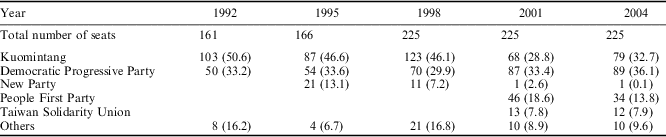
The Democratic Progressive Party had been dissatisfied with its achievement under the SNTV-MMD system. It had gained 33.4 per cent in the 1992 election, 33.6 per cent in 1995, 29.9 per cent in 1998 and 33.4 per cent in 2001 (see Table 1). Given the proportionality of the votes and seats, it was not a poor achievement, but there were fundamental limitations in the system. SNTV-MMD made it difficult for the Democratic Progressive Party to compete with the Kuomintang, since successful campaigning required competent electoral strategies and electoral financing. Even though the Democratic Progressive Party did develop its electoral skills, it could not compete with the Kuomintang's superior position during the campaigns.Footnote 4 For instance, optimistic about the outcome of the election, the Democratic Progressive Party nominated too many candidates in the 2004 election, reducing the average vote shares of its nominees and thus the number of seats the party gained.
Seats and Votes in the Legislative Yuan Elections in Taiwan (1992–2004)

Note: Entries are the number of seats with percentage seat share in parentheses.
Source: Central Election Commission, Republic of China, http://db.cec.gov.tw/cec/cechead.asp.
As a result of these shortcomings, the Democratic Progressive Party could not win more than 40 per cent in the Legislative Yuan elections. With only this share, the Democratic Progressive Party was not able to implement its own political agenda in important policy areas. The party performed better in the presidential and mayoral elections, which adopted the first-past-the-post system, gaining more than 40 per cent in the mayoral elections, and the party candidate Chen Shui-bian gained 50.1 per cent in the 2004 presidential election. Based on these experiences, the Democratic Progressive Party began to believe that its chances of winning a majority in the Legislative Yuan would improve under the first-past-the-post system (Lin Reference Lin2006: 123–5).
The Kuomintang also wanted electoral reform in 1994, but could not achieve it then. It was the Kuomintang that adopted the SNTV-MMD system for the 1992 Legislative Yuan election because the SNTV-MMD achieved satisfactory results for the party in local elections. SNTV-MMD had long been a link between the Kuomintang and local factions, and the single non-transferable vote and the relationship with local factions allowed the Kuomintang to enjoy a favourable proportion of the vote and to win the seats (Chu Reference Chu1999). However, after the democratic transition, as the Democratic Progressive Party began to develop its electoral skills and new political parties were formed, the Democratic Progressive Party and the new parties started to increase their seats in the Legislative Yuan. At the same time, the relationship between the Kuomintang and local factions became weaker (Wang Reference Wang2004). Finally, during the 1990s, when the election went ahead, the Democratic Progressive Party had grown so the difference in votes and seats was narrower (Lin Reference Lin2001: 156–7).
In 1994, some legislators defected from the Kuomintang in order to form the New Party (NP). In the 1995 elections, the Kuomintang gained 46.6 per cent of the seats and the New Party gained 13.1 per cent (see Table 1). It was the first time that the Kuomintang had won fewer than half of the seats. The Kuomintang attributed these results to the SNTV-MMD system and concluded that it would have won if the majority of the seats were filled through the first-past-the-post system (Lin Reference Lin2006: 123–5). These events encouraged the Kuomintang to consider an alternative electoral system. As a result, Lien Chan, the Kuomintang party leader, proposed a Japanese-style first-past-the-post mixed system in 1994, but the idea was at once rejected. When the Democratic Progressive Party began suggesting electoral reform in 2002, the Kuomintang did not immediately support this. Even though the Kuomintang did not have more than half of the seats, it did have more than 45 per cent and could control the Legislative Yuan with cooperation from the People First Party (PFP). In fact, the Kuomintang was not fully satisfied with the SNTV-MMD system, but the system did still work in its favour.
During the 2005 electoral reform process, the Democratic Progressive Party and the Kuomintang both supported the Japanese-style mixed system. In the Japanese-style mixed system, the voters have two votes and elect 60 per cent of the legislature via first-past-the-post and 40 per cent via proportional representation. In 1994 the Kuomintang had originally favoured a similar system with a higher share of seats (75 per cent or at least two-thirds) to be elected by first-past-the-post. In 1996 the Democratic Progressive Party had considered the German-style mixed system that incorporated more proportionality. Under the German-style mixed system, half of the members are elected from single-member districts and half through proportional representation (Chu Reference Chu1999). The two parties converged on the Japanese-style mixed system in 2005 when the Democratic Progressive Party accepted the Kuomintang's reform proposal. The Japanese-style mixed system was also attractive to the Democratic Progressive Party, which noted that the small Democratic Party of Japan made huge inroads into the long-standing majority of the Liberal Democratic Party during the first Japanese election in which the reform was applied (Lin Reference Lin2006: 123–5).
As well as these two political parties, President Chen Shui-bian and the public were important actors in the reform process. President Chen had been facing political difficulties since his inauguration in 2000. As president of a party with a short history, Chen found the formation of a new administration challenging. He appointed Kuomintang members as the heads of key departments, such as the Executive Yuan and Foreign Ministry, expecting partisan cooperation, which was not forthcoming (Rigger Reference Rigger2001). To make the situation worse, the Legislative Yuan was controlled by a coalition of the Kuomintang and the People First Party. Chen had the same motive for reform as any member of the Democratic Progressive Party: he wanted the Legislative Yuan to be controlled by the Democratic Progressive Party.
The public had different motives. They supported reforms in the hope that they would eliminate corruption, which was deeply rooted in political society. Although they did not know what the actual effect of the SNTV-MMD system was, they believed that it produced political corruption such as vote buying. Thus, they eagerly supported the large reduction of seats proposed under the reform.
Confirmation of Proposals for Electoral Reform
Since the Democratic Progressive Party legislators proposed the first reform bill in 2002, 11 out of a total of 19 bills submitted during the fifth legislative term (from 1 February 2002 to 31 January 2005) have proposed electoral system changes along with a reduction of seats. Most of the bills were submitted by Democratic Progressive Party members. The public were more interested in the reduction of seats. Unlike electoral system change, which had been considered for some time, the idea of reducing the number of seats came up abruptly when Jiang Xue-xun, a Democratic Progressive Party legislator, suggested that the total number of seats in the Legislative Yuan should be reduced by half during the 2001 Legislative Yuan election campaign. Disenchanted by political corruption, the public welcomed his idea.
Constitutional revision is an essential process in reform. To amend the constitution, a bill needs to be passed by three-quarters of the legislators, with three-quarters in attendance in the National Assembly.Footnote 5 At that time, the total number of legislators was 225, and so 169 legislators were needed to attend the vote. Bearing in mind the distribution of the seats – the Democratic Progressive Party had 87 and the Kuomintang had 68 – no single party could pass the bill. In addition, even though the two parties agreed on the reform, 14 legislators from other parties were needed to support the bill (Huang and Liao Reference Huang and Liao2009). Thus, the initial step for creating a coalition among the parties was the most critical one.
The Kuomintang refrained from commenting; the Democratic Progressive Party opened the reform debate. With coalition building in progress, Lin Yi-hsiung, the former leader of the Democratic Progressive Party, commenced actions in order to achieve compromise among the parties. As a first step, he persuaded the opposing forces within the Democratic Progressive Party to cooperate as there were opposing voices within the Democratic Progressive Party at that time. Jiang Jun-xiong, the party leader, essentially agreed with the electoral reform, arguing that the party should respect the decision made by the Central Standing Committee. Next, Lin proceeded to persuade Lien Chan, the Kuomintang leader who had proposed reform in 1994, to join the reforms. Lien did not mention the electoral system change, but stated that he agreed with the reduction in the number of seats to 113. Lin and his supporters led three street protests in front of the Kuomintang headquarters promoting the electoral reforms in December 2003. Soon afterwards, Lin visited Wang Jin-pyng, the speaker of the Legislative Yuan, to request help with the reform. Wang adhered to a neutral position that discussions among political parties were necessary, but he arbitrated a consensus among the parties.
As a result, the Constitution Amendment Committee was formed on 26 December 2003 in order to set the foundations for reform. The committee totalled 113 members, including 44 from the Democratic Progressive Party, 34 from the Kuomintang, 24 from the People First Party, six from the Taiwan Solidarity Union (TSU) and five from the Non-Partisan Solidarity Union (NPSU). The first Inquiry Council was held on 10 March 2004 and the Committee agreed to a preliminary amendment bill of Article 4 of the Constitution of the Republic of China, effective from the seventh Legislative Yuan election in 2008, and decided to approve the bill on 19 March, one day before the presidential election. Nevertheless, the plan to pass the bill before the presidential election was withdrawn due to opposition from the Non-Partisan Solidarity Union.
After his successful re-election to the presidency on 20 March 2004, Chen Shui-bian argued that the current constitution was in need of comprehensive reform as most of the articles did not meet contemporary demands to consolidate democratic rule. He also supported the reduction in the number of seats in order to increase the overall quality of the Legislative Yuan and eradicate political corruption (Chen Reference Chen2004a). His inauguration address delivered this message to the public on 20 May 2004.
The majority of the articles in the constitution no longer address the present – much less the future – needs of Taiwan. The promotion of constitutional re-engineering and the re-establishment of the constitutional order are tasks that correspond with the expectations of the people and are in accordance with the consensus shared by all political parties . . . There are many problems in our current constitution that need to be tackled, amongst which the more immediate and obvious include: . . . reform of the national legislature and relevant articles; . . . In the future, we will invite members of the ruling party and the opposition parties, as well as legal experts, academic scholars and representatives from all fields and spanning all social classes, to collaborate in forming a ‘Constitutional Reform Committee’. (Chen Reference Chen2004b)
Around that time, public sentiment towards politics was highly negative, particularly after the ‘3–19 shooting incident’.Footnote 6 Under pressure from negative public opinion, the parties formed a coalition. In May 2004, the Democratic Progressive Party and the Kuomintang resumed discussions. The initial proposal by the Democratic Progressive Party included the first-past-the-post mixed system, the reduction of seats to 150 and the extension of the legislative election term to four years. The Kuomintang, the People First Party and the Taiwan Solidarity Union suggested 113 seats as an alternative. During three days of negotiations in May, the Democratic Progressive Party, the Kuomintang and the People First Party still could not come to a consensus on the reduced number of the Legislative Yuan. The most significant obstacle was opposition from smaller parties. The People First Party, the Taiwan Solidarity Union, and the New Party opposed the reforms because the new electoral system would be disadvantageous to them. Thus, the People First Party and the Taiwan Solidarity Union insisted that electoral system change and the reduction of the seats should be handled separately.
At the end of 2004, the sixth Legislative Yuan election took place. In this election, the People First Party and the Taiwan Solidarity Union gained fewer seats than before, whereas the Democratic Progressive Party and the Kuomintang gained more seats (see Table 1). This result implies that the Democratic Progressive Party and the Kuomintang were able to pass the bill without cooperation from small parties. Small parties eventually changed their stance, assuming that the bill would pass in spite of their opposition. Some People First Party legislators, such as Lee qing-an and Zhou Xi-wei, foresaw that electoral reform would negatively affect small parties and defected from the People First Party to join the Kuomintang. Without an influential political figure except for Lee Teng-hui, the Taiwan Solidarity Union decided to prioritize the survival of the party by responding to public pressure.
Finally, the fourth National Assembly passed a bill to revise Article 4 of the Constitution on the Republic of China on 7 June 2005. All 201 legislators who attended the assembly agreed to pass the bill; no one dissented. Afterwards, the question of electoral district reconfirmation was raised in order to elect 73 out of the 113 seats via proportional representation. Based on a population of 22,723,000 (as of April 2005, excluding aboriginal peoples), there should be 73 districts of about 308,000 people. For the six constituencies that did not reach this number, the seat was assigned first. The 67 remaining seats were distributed according to population. In order to prevent gerrymandering, a panel including scholars and experts was summoned by each local government to confirm that the distribution was not partisan. The election district bill was passed on the court deadline of 31 January 2007 (Yu Reference Yu2008).
The Party Coalition and Public Opinion
The Democratic Progressive Party was successful in forming the coalition and gaining support from the public. When the Democratic Progressive Party began the electoral reforms in 2002, the first task was to convince the other political parties to support the process. Above all, the Democratic Progressive Party had to persuade its own party members who opposed the reforms and the reduction in the number of seats. Since Lin Yi-hsiung led the reform and President Chen Shui-bian strongly supported it, the opponents were persuaded. The next step was to convince the Kuomintang, the second largest party, to join the reform. Even though the Kuomintang had proposed the reform idea in 1994, it had since withdrawn the proposal. To persuade the Kuomintang, the Democratic Progressive Party contacted its leader and put pressure on the party by mobilizing public opinion. The main reason for the opposition from some Democratic Progressive Party members and the Kuomintang was the reduction in the number of seats. Some were also opposed to the first-past-the-post system, even though it was supposed to produce a two-party system.
Small parties resisted the reform because of this. If the new system did produce a two-party system, it would spell the end for the small parties. In addition, the seat reduction would cause greater losses for small parties than the Democratic Progressive Party or the Kuomintang. However, because of the public's pro-reform attitude, small parties had to join the party coalition, but they opposed the plan to pass the bill before the 2004 presidential election. As the small parties resisted the reforms, the Democratic Progressive Party and the Kuomintang gained more of the public vote in the 2004 Legislative Yuan election. The public made it possible for the Democratic Progressive Party and Kuomintang to pass the bill without the small parties’ support.
As Katz, Gallagher and Norris noted, public dissatisfaction was one of the main forces that enabled the reforms to be completed. Public outrage in Taiwan triggered some reform-minded Kuomintang politicians to push for electoral reforms in the mid-1990s and the Democratic Progressive Party politicians in the early 2000s. Due to public anger after the 2004 presidential election, any politician who raised objections to the reforms was criticized as being unjust or anti-reformist (Lin Reference Lin2009). In this vein, Wang Jin-pyng pointed out that populism was the main driving factor for the success of the reform.
The reform proposal [the reduction of the seats] prepared by the Democratic Progressive Party was welcomed by the public. Thus, no political parties could oppose it. Nevertheless, as speaker of the Legislative Yuan, I warned that it needed careful consideration . . . [The passing of the bill] was the result of populism not considering the pros and cons of the institution.Footnote 7
Lin insisted that Democratic Progressive Party reformers put the public anger for its own ends. This is certainly true, given the public's preference for reform. The public strongly supported the reduction in the number of seats but did not have any particular preference for a first-past-the-post mixed system. In an interview, Lin stated:
The public image of the legislature is considerably negative in Taiwan. Most people, therefore, welcomed the proposal for the reduction of seats. Even President Chen insisted that political reform made this change. Nevertheless, academics suggested an alternative point of view, opposing the reduction of the seats while they supported the change to a mixed system. The media preferred academia's view as well. But the bill was passed as a result of the compromise between these two arguments: the change to the SNTV-MMD and the reduction of the seats.Footnote 8
The public did not fully understand what the first-past-the-post mixed system was. According to the survey conducted by the broadcasting company TVBS in August 2004, 29 per cent of respondents supported the first-past-the-post mixed system while 17 per cent did not. Additionally, 40 per cent answered that they did not know what the first-past-the-post mixed system was. On the other hand, 76 per cent wanted the number of seats cut by half and only 9 per cent did not (TBVS Poll Center 2004). Thus, the public supported electoral reform with the simple idea that the reforms could punish corrupt politicians. The Democratic Progressive Party gathered support for the reform by stimulating and mobilizing public sentiment.
THE NEW SYSTEM AND LEGISLATIVE YUAN ELECTIONS IN 2008 AND 2012
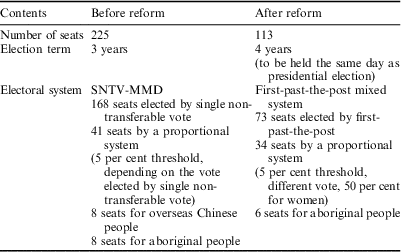
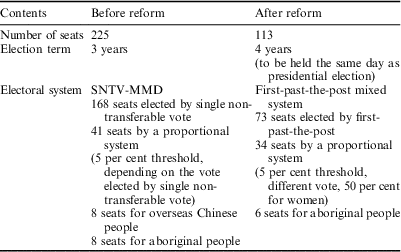
After the reform, the electoral system changed to the Japanese-style mixed system and the total number of seats was reduced from 225 to 113. Of the 113 seats, 73 seats were elected by first-past-the-post and 34 seats by proportional representation. As well as these two major changes, the electoral term for the legislature was extended from three years to four, and the presidential election and the Legislative Yuan election were set to take place on the same day. In addition, of the 73 elected seats, six were given to the aboriginal people, and seats elected by the proportional representation system were given a 5 per cent threshold (see Table 2).Footnote 9
Electoral System before and after the Reform
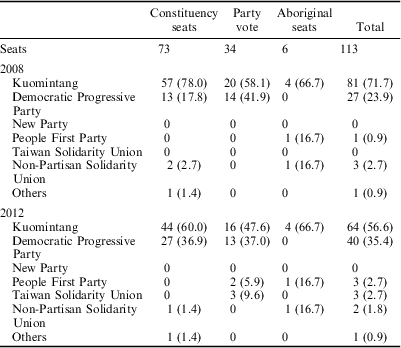
Under the new system, Legislative Yuan elections were conducted in 2008 and in 2012 (see Table 3). The result of the 2008 election showed a high voter turnout of 74.9 per cent, and the Kuomintang won a majority. The Kuomintang took 81 out of 113 total seats, including 57 seats through first-past-the-post, 20 seats through proportional representation and four seats in the aboriginal votes. The Democratic Progressive Party took 27 seats of the 113, including 13 seats through first-past-the-post and 14 seats through proportional representation. As expected, the representation of small parties was reduced.
The Legislative Yuan Elections of 2008 and 2012

Note: Entries are the number of seats with percentage seat share in parentheses.
Source: Central Election Commission, Republic of China, http://db.cec.gov.tw/cec/cechead.asp.
The 2012 election also had a high turnout, of 74.7 per cent. The Kuomintang was the overall winner again, winning 64 seats of the 113, including 44 seats through first-past-the-post, 16 seats through proportional representation and four seats in the aboriginal votes. The Democratic Progressive Party won 40 seats – 27 seats from first-past-the-post and 13 from proportional representation. Small parties won more seats than in the 2008 election: the People First Party and the Taiwan Solidarity Union gained two and three seats from the proportional representation vote, respectively.
The results of the 2008 and 2012 elections show that the first-past-the-post mixed system in Taiwan proved to be most advantageous to a single large party. Croissant and Völkel (Reference Croissant and Völkel2012: 243–7) argued that the first-past-the-post mixed system changed the party system in Taiwan from ‘a moderate multiparty system’ to ‘a moderate multiparty system with a single dominant party’. The Kuomintang became the super-majority party winning 81 seats in 2008 (a 71.7 per cent share of the seats) and 63 seats in 2012 (a 56.6 per cent share of the seats). Regardless of the 15.1 per cent decrease in the seat share from 2008 to 2012, the Kuomintang regained over half the votes that it held prior to 1995. This means that the Kuomintang achieved its goals for the reforms. On the other hand, the Democratic Progressive Party gained 27 seats in 2008 (a 23.9 per cent share of the seats) and 40 seats in 2012 (a 35.4 per cent share of the seats). The result of the 2008 election was devastating for the Democratic Progressive Party. The party's seat share increased in 2012, but the percentage was similar to what it had held under the SNTV-MMD system. This implies that the Democratic Progressive Party failed to meet its goals through the new system.
The Democratic Progressive Party raised its dissatisfaction with the first-past-the-post mixed system just after the 2008 election. Lin Chu-shui argued that the mixed system would reduce the chances of the Democratic Progressive Party securing a majority seats in the future.Footnote 10 General criticism of the reduction of the seats also followed. Wang Jin-pyng worried that the number of 113 had no academic base, and he suggested that 300 seats would be an appropriate level, given the size of the Taiwanese population.Footnote 11 Lin Cho-shui argued that one seat for every 100,000 people would be appropriate for Taiwan.Footnote 12 Calls for further reforms, including returning to the SNTV-MMD system, began to be made, but the Kuomintang's super-majority made further reforms less likely because it is harder to change the electoral system when a majority party takes advantage of the current system (Boix Reference Boix1999).
CONCLUSION
During the reform process, the Democratic Progressive Party and the Kuomintang formed a party coalition and passed the bill in the National Assembly. When the Democratic Progressive Party began the reform process in 2002, the Kuomintang hesitated and small parties opposed it. The 2004 Legislative Yuan election was the turning point. Since the Democratic Progressive Party and the Kuomintang garnered enough votes to pass the bill, they no longer needed cooperation from small parties. Additionally, the public was supportive of reforms, especially when the reforms included a reduction in the number of seats.
The public did not understand the differences between the old and new systems; they thought that they could punish corruptive politicians by reducing their seats. The Democratic Progressive Party strategically connected the electoral system change and the seat reduction and succeeded in mobilizing the public. Public support gave legitimacy to the reformists and pressured the anti-reformists to join the reform movement. As Gallagher (Reference Gallagher2005) and Norris (Reference Norris2011) point out, public disaffection or dissatisfaction was the trigger for reform in 2005, but the Democratic Progressive Party's leading role in creating a coalition and mobilizing public opinion was the main reason for the reform's success.
As mentioned at the outset, changing the electoral system is difficult because of the uncertain political and distributive effects. In addition, most incumbent parties have vested interests in the current system. The 2005 electoral reforms correspond to one of Katz's conditions (2005: 63). Katz explained that electoral reforms commence when the leading political party is optimistic about the reform or incorrectly predicts the results of the new system. The Democratic Progressive Party and the Kuomintang were both optimistic and calculated that the new system would give them more power in the legislature. Yet, the results of the new system proved that the Kuomintang's calculation was right, but the Democratic Progressive Party's was not. Even though two election results are not sufficient to demonstrate all the effects of a new system,Footnote 13 it will be difficult for the Democratic Progressive Party to achieve more than 50 per cent of the vote under the first-past-the-post mixed system.
Scheiner (Reference Scheiner2008: 168–9) suggests several factors that produce effects different from the original intent of the reforms. When voters do not have enough information about parties or when they are uncertain about their likely success, they fail to vote rationally. In addition, regionalism, clientelism or other institutions could hinder change. Scheiner found that Japan kept the two-party system for a while after the reform but failed to diminish the Liberal Democratic Party's dominance and even moved to a one-party dominant system again. In the case of Japan, Scheiner pointed to the role of clientelism and the country's centralized system. Taiwan's two recent elections and the results show a moderate one-party dominant system, and so we cannot draw any quick conclusions from this. Given the fact that Taiwan followed the Japanese institutional change, the Japanese case can suggest some implications for future institutional changes in Taiwan.
In analysing Taiwan's 2005 electoral reforms from the rational choice approach, this article provides the following implications for further studies. First, electoral reform in Taiwan is a single case, but it is one of several examples that converge towards the first-past-the-post mixed system. As previously mentioned, Italy, New Zealand, Japan and South Korea changed their electoral systems to the first-past-the-post mixed system. Thus, Taiwan could provide a good case for comparison with other similar countries. Second, electoral reforms in East Asian countries have some similarities in that the bulk of the legislative seats are chosen by the first-past-the-post system rather than by proportional representation. In practice, East Asian mixed systems are highly majoritarian, compared with Western electoral reforms (Reilly Reference Reilly2007). These regional similarities indicate the need for further comparative research.
Third, the same institutions sometimes produce different consequences. The first-past-the-post mixed system in Japan produced the growth of the Democratic Party of Japan to form the two-party system (Reed Reference Reed2005), and the first-past-the-post mixed system in South Korea produced the growth of the Third Party to form the multiparty system (Jaung Reference Jaung2006). Meanwhile, the first-past-the-post mixed system in Taiwan produced the one-party dominant system. Minor differences within the systems could be the reason for the different outcomes. The Japanese system allows candidates to transfer between tiers, which enables candidates who lose their constituency votes to have another chance from the proportional representation system; the South Korean system has a relatively low threshold of 3 per cent (Reilly Reference Reilly2007: 189–90). These differences could be explanatory variables of different party systems and provide a topic for future research.
Acknowledgements
This research was supported by the National Research Foundation of Korea (NRF-2011-330-B00026). This article is based on my 2010 article, ‘Analysing the 2005 Electoral Reforms in Taiwan’, National Strategy, 16(2): 153–78 (in Korean). I would like to thank Hyeok Yong Kwon, Jih-wen Lin, Nathan Batto, Sy-chi Doong, as well as anonymous referees for their comments and suggestions.