


Individuals tend to judge policies in group-centric terms—that is, based on whom the policies benefit (Nelson and Kinder Reference Nelson and Kinder1996; Schneider and Ingram Reference Schneider and Ingram1993). When policies distribute across identity lines, ethnocentrism—the inclination to see the world as divided into ethnic- and race-based in-groups and out-groups, and to assign positive and negative attributions accordingly (Kam and Kinder Reference Kam and Kinder2007; Sumner Reference Sumner1907)—can bias majority evaluations of welfare policies. Thus, individuals may be less likely to support redistribution across identity lines (Gilens Reference Gilens1999; Kinder Reference Kinder1986; Wright and Reeskens Reference Wright and Reeskens2013). A rich literature on welfare chauvinism—the stance that redistributive transfers should be restricted solely to in-group members (Andersen and Bjorklund Reference Andersen and Bjørklund1990, 212)—underscores the difficulty of intergroup redistribution intended to benefit disadvantaged racial, ethnic, or migrant minorities (Ford Reference Ford2016; Ford and Kootstra Reference Ford and Kootstra2017; Harrell, Soroka, and Iyengar Reference Harell, Soroka and Iyengar2016; Kros and Coenders Reference Kros and Coenders2019). In summary, dominant groups are less likely to support redistribution when beneficiaries are out-group members, and thus salient identity differences may undermine public support for social welfare programs.
Bolstering majority support for pro-out-group redistribution is important. Although the relative economic benefits of universal versus targeted welfare policies depend on factors like bureaucratic efficiency or within-minority-group inequality (Brady and Bostic Reference Brady and Bostic2015; Hanna and Olken Reference Hanna and Olken2018), targeted policies help those most in need. Due to historical oppression and ongoing patterns of prejudice, ethnic and racial minorities are often in precarious socioeconomic positions relative to majorities (Reeves, Rodrigue, and Kneebone Reference Reeves, Rodrigue and Kneebone2016). Thus, out-group redistributive policies are normatively important and potentially economically beneficial. In this article, we ask, what are effective ways to promote majority support for pro-out-group redistribution?
Two related literatures help answer this question. The first suggests that individual preferences over welfare policies result from the interaction of individual-level characteristics and policy details. At the individual level, ideology and self-interest can affect support for redistributive policies. For example, conservatives tend to be less supportive of welfare policies than liberals are because of ideological commitments to individualism and the related propensity to attribute poverty to individual rather than societal causes (Skitka Reference Skitka1999; Skitka and Tetlock Reference Skitka and Tetlock1993; Zucker and Weiner Reference Zucker and Weiner1993). Individuals also evaluate redistributive policies based on whether they stand to gain or lose from redistribution. Individuals with higher incomes or with greater labor-market security are more likely to oppose redistribution (Cavaillé and Trump Reference Cavaillé and Trump2015; Iversen and Soskice Reference Iversen and Soskice2001; Rehm Reference Rehm2011). Importantly, when it comes to redistribution across identity lines, ethnocentrism is a prominent bias. Existing work suggests that ethnocentrism works independently of and may compete with ideological commitments and self-interest when it comes to explaining individual evaluations of welfare policies (e.g., Kinder and Sanders Reference Kinder and Sanders1996). Ethnocentric bias can lead to negative evaluations of out-group beneficiaries and may also lead majorities to question beneficiary deservingness (Ford Reference Ford2016; Ford and Kootstra Reference Ford and Kootstra2017; Kootstra Reference Kootstra2016).
Policy features (policy design) and the way elites communicate these features (policy framing) also matter. Although individuals may evaluate redistributive policies along dimensions like efficiency, effectiveness, and impartiality (see Roosma, Gelissen, and van Oorschot Reference Roosma, Gelissen and van Oorschot2013; Rothstein Reference Rothstein1998), we follow the group-centrism literature and suggest that a consequential policy feature is the designated beneficiary group. The identity of the beneficiary group is important for two reasons. First, beneficiary identity signals deservingness, an individual-level perception of the extent to which the beneficiary is entitled to benefits. Deservingness perceptions are, in turn, an important determinant of welfare support (Petersen Reference Petersen2012; van Oorschot Reference van Oorschot2006; Zucker and Weiner Reference Zucker and Weiner1993). Second, the identity of the beneficiary group provides opportunities for politicization—as in the case of racialized reactions to policies that benefit minoritized groups (Fellowes and Rowe Reference Fellowes and Rowe2004; Gilens Reference Gilens1999).
A second body of work suggests that interventions meant to reduce prejudice can have positive downstream consequences on evaluations of out-group-targeted policies (Kalla and Broockman Reference Kalla and Broockman2020; Paluck et al. Reference Paluck, Porat, Clark and Green2021; Tankard and Paluck Reference Tankard and Paluck2016). By improving attitudes toward groups directly (e.g., through perspective taking) or by altering individual perceptions of social norms (e.g., by signaling low rates of prejudice in a community), interventions can bolster majority support for policies that target minoritized groups.
Together, these literatures provide important insights into how individual characteristics and policy features affect individual evaluations of redistributive policies and how to effectively mitigate prejudice. One important, though often tacit, recommendation is to design universal policies, to emphasize this universality to target audiences (see Lawrence, Stolker, and Wolman Reference Lawrence, Stoker and Wolman2013, 201–2), and to deemphasize group-centric cues or frames (Nelson and Kinder Reference Nelson and Kinder1996). Often, however, this is not possible. Instead, we argue that designing policies to incorporate principles of distributive justice—justifications for who should get what and why—and conveying these design elements to target audiences can garner majority support for policies intended to benefit minoritized groups.
We focus on three principles of distributive fairness: equality, reciprocity, and need (Deutsch Reference Deutsch1975; Miller Reference Miller2001; Reeskens and van Oorschot Reference Reeskens and van Oorschot2012).Footnote 1 Each principle represents a rationale for why a given policy is “fair” or “justified,” and together these are the three “inherent principles in social security transfers” (Clasen and van Oorschot Reference Clasen and van Oorschot2002, 89). We test whether these principles, when adopted in policy design and conveyed to an audience, bolster support for redistributive transfers to minoritized groups. Moreover, we depart from the existing literature by examining the effects of these principles among the majority and the minority. Bolstering support for out-group redistribution is difficult, and this paper provides a step toward this goal.
In three experiments (two survey, one field), we find that (1) mentioning minorities as beneficiaries or cobeneficiaries reduces majority support for redistributive policies, (2) policies formulated according to the distributive principle of reciprocity increase majority support for out-group transfers, and (3) minority out-groups, however, respond most favorably to unconditional policies (i.e., policies that do not come with stipulations based on the principles of distributive justice) and to policies motivated by need. We conduct our studies in the Slovak Republic (Slovakia) and with the Roma as the out-group. The extreme situation of Slovak Roma (Kende et al. Reference Kende, Hadarics, Bigazzi, Boza, Kunst, Lantos, Lášticová, Minescu, Pivetti and Urbiola2021) and the numerous policies meant to remedy said situation (Hrustič Reference Hrustič2020) render our case critical and worthwhile. Moreover, surveying Roma participants is difficult. A host of methodological problems—for example, defining a representative sample, hesitance of survey enumerators and Roma to engage with one another, the reluctance of Roma to identify as such, and the necessity of face-to-face interviews (Messing Reference Messing2014)—hamper recruitment efforts. Thus, our study provides needed data on the preferences of Europe’s largest minority group.
Our findings warrant both caution and optimism. Taken to their extreme, reciprocity-based policies have clear links to worker activation (“workfare”). Various studies emphasize that workfare does little to improve the economic conditions of Roma communities and may even reinforce anti-Roma stereotypes. Thus, although reciprocity-based policies may bolster support for policies that benefit minoritized groups, the consequences of such policies may reify the racialized and disadvantaged status of the Roma by reinforcing stereotypes about welfare dependence and “forced” work requirements (Dráľ Reference Dráľ2008; Kóczé Reference Kóczé, van Baar and Kóczé2020, van Baar Reference van Baar2012; Vidra Reference Vidra2018). Optimistically, however, we show that out-group transfers receive moderately high levels of support, despite benefitting a highly stigmatized group. Moreover, we show that adopting the principles of distributive fairness in policy design and conveying these principles to an audience can be an effective way to bolster majority support.
Redistributive Policy Preferences: Self-Interest, Symbolic Politics, and Ethnocentrism
Individual-level characteristics interact with policy design and frames to determine whether, and to what extent, an individual supports a redistributive policy. Many studies locate support for the expansion of the welfare state or social protection in individual self-interest (e.g., Cavaillé and Trump Reference Cavaillé and Trump2015; Iversen and Soskice Reference Iversen and Soskice2001). Those who stand to gain from redistribution support the expansion of social protection, whereas those who stand to lose oppose it. Thus, individual-level characteristics like risk of unemployment, income, or skill specificity predict support for redistribution. The influence of individual-level material interests depends on macrostructural conditions that exacerbate or reduce individual risk (Iversen and Cusack Reference Iversen and Cusack2000; Rehm Reference Rehm2011). This literature, focused on the role of material self-interest, contrasts a body of work that centers “symbolic politics” in its explanations of policy preferences (Kinder Reference Kinder1986; Sears and Funk Reference Sears, Funk and Zanna1991).
Work on policy preferences and symbolic politics suggests that although self-interest may predict preferences in some policy domains (especially those where costs are clear and imminent), “learned affective responses to particular symbols relatively early in life” are the primary determinants of policy support (Sears and Funk Reference Sears, Funk and Zanna1991, 13). A variety of symbolic attitudes can influence policy evaluations, ranging from liberal–conservative ideology and party identification to racial prejudice (Lau and Heldman Reference Lau and Heldman2009, 514). Work on the racial integration of U.S. schools serves as an example. Ideological commitments concerning the scope of government and racial prejudice led white conservatives to oppose busing programs regardless of whether they had children in the relevant schools.Footnote 2 Here, opposition manifested despite a lack of concrete self-interest. Instead, political “symbols” like integration, busing, and race, made salient by public discourse, activated psychological predispositions that shaped attitudes.
Thus, opposition to a given policy may stem from self-interest: “I do not support this policy because I will not accrue any economic benefit from it.” Or, opposition can be a function of symbolic beliefs: “I oppose this policy because it contradicts my values or ideological convictions.” Importantly, both accounts are compatible with the group-centric model of policy support (e.g., Nelson and Kinder Reference Nelson and Kinder1996; Schneider and Ingram Reference Schneider and Ingram1993). According to this model, policies are designed to benefit certain groups. These design decisions are communicated through frames and cues, and individuals use beneficiary group identity as a heuristic to determine whether a given policy warrants support.
In the case of transfers to racial or ethnic minorities, majorities may oppose such policies because they are not in their material self-interest (majorities are not a member of the beneficiary group) or due to symbolic attitudes. Symbolic attitudes may or may not relate to beneficiary group identity. For example, the ideological predisposition of liberals to attribute poverty to societal causes differs from the tendency of conservatives to locate the causes of poverty at the individual level (more below). These attributions influence policy support independently of identity-based differences between groups. Nonetheless, an extensive literature shows that identity differences remain consequential for how individuals evaluate intergroup redistribution.
When redistribution occurs across identity lines, ethnocentric bias may limit majority support. Ethnocentrism is the psychological tendency/predisposition to demarcate the social world in terms of identity-based in-groups and out-groups, particularly along racial or ethnic lines (Sumner Reference Sumner1907). This demarcation entails the attribution of positive characteristics to one’s own group and negative characteristics to out-groups, inducing sentiments of threat, resentment, prejudice, and ultimately, in-group favoritism. Thus, ethnocentrism is a broad sentiment that includes a variety of related attitudes and is not necessarily group specific (as is, for example, prejudice; Kinder and Kam Reference Kinder and Kam2009). Ethnocentric bias manifests across various policy issues. Consider Kinder and Kam’s (Reference Kinder and Kam2009) examples: the War on Terror, foreign aid, immigration, LGBTQ+ rights, and welfare. Ethnocentrism affected individual evaluations of policies in each of these areas. Other work shows the salience of ethnocentrism in college admissions (Bell Reference Bell2021), affirmative action (Feldman and Huddy Reference Feldman and Huddy2005), crime (Hurwitz and Peffley Reference Hurwitz and Peffley2005), and health care (Larsen and Schaeffer Reference Larsen and Schaeffer2021).
Existing research also shows that ethnocentrism can moderate the effect of self-interest. Specifically, majority group members who stand to lose economically from redistributive transfers oppose these policies more if the transfers cross identity lines (Ford Reference Ford2016). Moreover, many, though certainly not all, of the symbolic attitudes that determine policy support stem from identity-based differences. For example, anti-Black stereotypes and racialized notions of who benefits from social assistance are dominant explanations for the lack of support for some American welfare programs (Gilens Reference Gilens1999). Thus far, we have focused on how self-interest, symbolic politics, and ethnocentrism can influence redistributive policy support, but policy design and policy frames matter as well. A rich literature shows that support for welfare policies is intimately tied to beneficiary deservingness.
Redistributive Policy Preferences: Attributions and Deservingness
Support for redistributive policies partly hinges on the extent to which an individual considers the beneficiary to be deserving of the support granted to them (Petersen Reference Petersen2012; Skitka Reference Skitka1999; van Oorschot Reference van Oorschot2006; Zucker and Weiner Reference Zucker and Weiner1993). Attribution theory (Weiner Reference Weiner1985) provides much of the underlying logic behind deservingness criteria and suggests that individuals assign responsibility for a situation either with the individual or with society. This attribution leads to negative (in the case of the individual) or positive affect (in the case of society) toward the referent. In turn, affect determines willingness to help. Thus, “those who blame poverty on causes under the personal control of the poor [are] less likely to support government assistance” (Zucker and Weiner Reference Zucker and Weiner1993, 928). The opposite is true for those who attribute responsibility to societal causes. Importantly, differential attributions relate in part to ideology. Liberals, due to egalitarian ideological commitments, are more likely to attribute responsibility to society; conservatives, possessing tendencies toward individualism, are more likely to locate responsibility at the individual level (Skitka Reference Skitka1999). Thus, ideology leads to ideas about beneficiary deservingness which, in turn, produce support for policies.
Other beneficiary characteristics also matter for redistributive policy support. Gilens (Reference Gilens1995) shows that white respondents’ support for welfare depends on whether they think African Americans would have outcomes to equal to those of whites, “if they only tried harder” (1006). Here, there is a connection between deservingness, in the form of effort, and support for redistributive transfers. Similarly, Schneider and Ingram (Reference Schneider and Ingram1993) argue that support for public policies hinges on two beneficiary characteristics: power and construction. Together, these characteristics determine the perceived deservingness of beneficiary groups. Individuals perceive groups without power and with a positive social construction as most deserving. In this framework, power and negative social constructions lead majorities to see minorities as competitors, limiting policy support.
Deservingness can also be disaggregated into multiple constituent components. Van Oorschot (Reference van Oorschot2006) motivates these criteria with an empirical puzzle: why do individuals support social programs for the elderly or the disabled more than they do social programs for the unemployed or immigrants? The answer to this question is predicated on social solidarity—that is, the extent to which individuals feel concern for the beneficiary group. In turn, solidarity is a function of perceived deservingness, which itself is composed of five different criteria: control, need, identity, attitude, and reciprocity (see van Oorschot Reference van Oorschot2006, 26). Control refers to the degree of responsibility the beneficiary group bears for its position. Need corresponds to the situation’s severity. Identity refers to the perceived closeness between giver and receiver. Attitude signifies the extent to which the beneficiary group is judged to be likable or grateful. The final criterion is reciprocity: the extent to which beneficiaries have contributed or will contribute to the social system.
Following attribution theory, control is a first-order concern when it comes to individual support for redistribution through social policies (van Oorschot Reference van Oorschot2006). Work by Petersen and colleagues (Petersen Reference Petersen2012; Petersen et al. Reference Petersen, Sznycer, Cosmides and Tooby2012) argues that evolutionary trajectories have conditioned individuals to use a deservingness heuristic predicated on control and reciprocity. Cues about beneficiary effort—that is, if the situation warranting help is within or outside the beneficiary’s control—signify whether said beneficiary is a contributor to the social system. This heuristic determines the level of individual support for helping the beneficiary.
Ultimately, however, identity-based differences can play a consequential role in deservingness perceptions. Not only does the deservingness criterion of identity itself affect individual evaluations (de Swaan Reference de Swaan1988); Kootstra (Reference Kootstra2016) and Ford (Reference Ford2016) show that respondents penalize minorities more than they do majorities with the same deservingness profiles. The effects of deservingness criteria are themselves in part conditional on identity. Thus, an important question remains: how can we bolster support for redistribution to minoritized groups?
Bolstering Policy Support
A common prescription is to decouple policies from out-groups (e.g., Lawrence, Stoker, and Wolman Reference Lawrence, Stoker and Wolman2013; Nelson and Kinder Reference Nelson and Kinder1996). If a policy is designed or framed universally, identity differences are less likely to lead to opposition. Yet, universalization comes with trade-offs. Conferring rights and resources to minority groups boosts self-worth and rights historical wrongs (Liu Reference Liu2015). These shifts can have important downstream consequences for outcomes like political participation (Brady, Verba, and Schlozman Reference Brady, Verba and Schlozman1995). By ignoring group identity, universal policies also discount the intersectional (e.g., based on race and class) disadvantages faced by racial and ethnic minorities. However, it is important to note that some minority group members may favor universal policies precisely for this reason—deemphasizing group identity can reduce stigma. Nonetheless, if group identity forms a salient cleavage of political competition, political elites can politicize universal policies along identity lines anyway. Consider social assistance programs like American Temporary Assistance for Needy Families. This program is meant to benefit the poor, regardless of race, yet the media and political elites still racialize it (e.g., Fellowes and Rowe Reference Fellowes and Rowe2004).
Third, policies vary in the extent to which they can be delinked from an identity group. A policy’s design and the way that the design is communicated determine the extent to which audiences will associate the policy with an identity group. Consider affirmative action. Such a policy can be designed to (1) recruit low-income students (class-focused, race-blind), (2) recruit low-income students from nonmajority identity groups (class- and broadly race-focused), or (3) recruit low-income students from a specific identity group (class- and specifically race-focused). These variations will evoke different levels of opposition. Importantly, each of these policies can be communicated to target audiences to emphasize or deemphasize beneficiary identity. These variations have consequences for the extent of opposition that the policy evokes.
Often, it is difficult to delink policies from the out-group that they are meant to benefit, and, in some cases, policies cannot be delinked from out-groups at all. Consider the case of reparations for the descendants of slaves. Given the nature of the policy, there is a very limited range of design and framing decisions that could deemphasize beneficiary identity. Thus, group-neutral design or framing is not always a feasible remedy. Nonetheless, as shown in the affirmative action example, policies vary in the extent to which they can be designed and framed universally.
Identity differences are particularly likely to color policy evaluations when it comes to redistributive policies. The rich literature on racialized reactions to welfare programs underscores this point (Harell, Soroka, and Iyengar Reference Harell, Soroka and Iyengar2016; Kros and Coenders Reference Kros and Coenders2019; Reeskens and van Oorschot Reference Reeskens and van Oorschot2012; Wright and Reeskens Reference Wright and Reeskens2013). Rooted in theories of realistic group conflict, welfare chauvinism suggests that ethnicity and race are the dividing lines of intergroup competition for resources. In a world of finite resources, individuals are likely to oppose the redistribution of resources across ethnic and racial boundaries. In the (West) European context, studies of welfare chauvinism largely focus on immigration (e.g., Alesina and Glaeser Reference Alesina and Glaeser2004). Again, deservingness is often the relevant mechanism. Individuals perceive immigrants as undeserving and judge them according to a “double standard” (Kootstra Reference Kootstra2016, 328). These findings suggest that identity differences limit support for redistributive transfers to minoritized groups through shifts in deservingness perceptions.
This discussion suggests that variations in policy design and the way these variations are communicated can bolster majority support for policies that benefit out-groups, but it may be more difficult to do so when these policies are redistributive. As discussed, the most significant design decision concerns the universal versus group-specific nature of a policy. Along this continuum, design decisions designate which groups benefit from a policy and thus create space for cues and frames that can emphasize or deemphasize identity. The most consequential frames and cues directly signal beneficiary identity and how it differs from the majority. Thus, deemphasizing ethnoracial backgrounds (Harrel, Soroka, and Iyengar Reference Harell, Soroka and Iyengar2016), country of origin (Gorodzeisky Reference Gorodzeisky2011), or immigration status (Ford Reference Ford2016) can potentially bolster support. Alternatively, policy design and communication can focus on beneficiary deservingness, garnering support by emphasizing need or control. Yet, if a policy is explicitly formulated to provide benefits to racial and ethnic minorities—for example, as in the case of reparations—these strategies may have limited effects.
An alternative approach is to focus on reducing prejudice directly, with the hope that doing so has a downstream reduction on ethnocentric bias. Changing prejudiced attitudes toward specific out-groups is difficult (Paluck et al. Reference Paluck, Porat, Clark and Green2021), but some interventions do work. Narrative exchange (Kalla and Broockman Reference Kalla and Broockman2020) or informative interventions targeting individual perceptions of social norms (Tankard and Paluck Reference Tankard and Paluck2016) seem to mollify prejudice. The latter interventions work by signaling what society considers typical and desirable behavior. Given the importance of this finding, one of our experiments tests whether distributive fairness principles shift individual perceptions of social norms.
In summary, policy design decisions and the cues and frames they facilitate can mitigate ethnocentric bias by deracializing transfers or shifting perceptions of beneficiary deservingness. Strategies that reduce personal prejudice may also bolster support. We suggest an alternative strategy: incorporating principles of distributive justice in policy design and conveying these principles to target audiences. Principles of distributive justice convey ideas about who should get what and why said allocation is fair. We contend that adopting these principles in policy design can increase support for policies intended to benefit marginalized minorities.
A Distributive Fairness Approach
Although most justifications for redistribution are economic, many of them also rest on normative premises. Welfare redistribution is ultimately about distributive justice: how to fairly divide resources between individuals and groups. Reeskens and van Oorschot (Reference Reeskens and van Oorschot2012), following Deutsch’s (Reference Deutsch1975) formulation, argue that there are three main principles of welfare redistribution: equality, reciprocity, and need (also see Miller Reference Miller2001). Each of these principles offers a normative justification for who should get what and why and thus conveys information about a beneficiary group’s deservingness. We argue that incorporating these principles in policy design and conveying them to target audiences can bolster majority support for policies that benefit disadvantaged racial and ethnic minorities. We proceed by describing each principle and detailing how its adoption may lead to policy support.
The principle of equality is predicated on the universality of rights and privileges. Equality postulates that every citizen, regardless of personal need or contribution, should be entitled to the same benefits. Existing work suggests that support for equality-based allocation varies by policy area and country context. For example, Reesekens and van Oorschot (Reference Reeskens and van Oorschot2013, 1182) find that around half of respondents from 24 European countries support equality-based unemployment schemes, but they are more evenly divided between equality and reciprocity when it comes to old-age pensions.
Policy designs based on the principle of equality ignore many of the deservingness criteria that are consequential for policy support. Such policies grant benefits regardless of beneficiary need, control, or reciprocity. Thus, if majorities consider minority groups as insufficiently needy, at fault for their situation, or as not having contributed enough to warrant aid, they are likely to oppose equality-based policies because these policies do little to reassure them that this is not the case. In the language of attribution, these policies do not indicate whether the individual or society is responsible for the situation warranting aid. Instead, equality-based policies leave attitude and identity as the primary determinants of social solidarity, disadvantaging highly stigmatized groups. Moreover, policies predicated on the principle of equality break down demarcations between groups, potentially exacerbating sentiments of threat or competition.
Importantly, these policies grant benefits to all groups, including the majority. Thus, self-interest may lead to majority support. However, this support is likely to be contingent on an individual’s own level of economic security as well as the immediacy and proximity of the granted benefits. For example, majorities may not support equality programs that promise benefits in the future, yet they may be more supportive of policies that grant immediate reward. Our experimental design allows us to explore these competing predictions. Nevertheless, we predict that equality-based policies are unlikely to garner majority support because they do little to shift deservingness perceptions of minoritized groups.
The principle of reciprocity (also known as equity, proportionality, or merit) suggests that those who contribute more should be entitled to more. Importantly, formulations of reciprocity-based policies can vary substantially. Reciprocity could simply mean paying taxes to receive benefits. Yet, reciprocity is also intimately related to work activation programs (workfare), where the granting of benefits is predicated on conditionality rather than entitlement (Lødemel and Trickey Reference Lødemel and Trickey2001). In these programs, the provision of welfare benefits requires meeting certain conditions that promote and enforce work (Brodkin and Larsen Reference Brodkin and Larsen2013, 41). If these conditions are not met, benefits are not provided. At the extremes, such provisions can include the mandatory acceptance of underpaid, low-skilled labor positions.
By making benefits conditional on effort, reciprocity-based programs emphasize the reciprocity deservingness criterion. If dominant groups underestimate the contributions of out-groups, they may favor reciprocity policies that “verify” contributions. Such assessments may be particularly relevant when out-groups are stereotyped as abusers of welfare. Reciprocity-based policies can also shift individual assessments related to identity and attitude criteria. For example, the effort beneficiaries expend under a reciprocity-based policy may combat negative stereotypes. Reciprocity programs can also potentially change assessments of beneficiary control. Under these programs, the ability to expend effort suggests (at least some) capacity to alter individual circumstances. Finally, reciprocity programs say little about beneficiary need.
Reciprocity-based programs also tend to reproduce existing societal hierarchies (Clasen and van Oorschot Reference Clasen and van Oorschot2002), reinforcing the economic positions of dominant groups. Thus, we expect majorities to evaluate them favorably. Dominant groups may either contribute more or overestimate their contributions to a given social system, and thus they see reciprocity-based policies as in their self-interest. Given this discussion, we expect reciprocity to evoke favorable reactions from majorities.
The final principle of distributive justice is need. The principle of need postulates that social assistance programs should target individuals for whom assistance provides the largest marginal benefit—that is, the worst off. By doing so, such programs reduce social risk and assume that those who are better off can provide for themselves (Reeskens and van Oorschot Reference Reeskens and van Oorschot2013, 1176). Need-motivated programs clearly emphasize the deservingness criterion of need, and they may also provide some ideas about reciprocity. Generally, those most in need are also less able to contribute. When it comes to attitude and identity, need-based programs are likely to influence evaluations through preexisting stereotypes and stigma. If a minoritized group is positively perceived by the majority or if social distance between groups is small, need may lead to sympathy and willingness to help. Conversely, if prejudice and social distance are high, need-based programs may reify negative stereotypes. Thus, majority responses to the principle of need may, in part, be conditional on the deservingness criteria of identity and attitude.
Need also says very little about control—the same level of need could arise from situations both within and outside of a beneficiary’s control. In this study, we expect need to be ineffective at bolstering support for out-group redistributive policies due to pervasive stereotypes and stigma associated with Roma communities. Specifically, we expect that the majority’s tendency to blame Roma individuals (and not larger society) for Roma poverty will render need-based policies ineffective. Moreover, if majorities are in economically dominant positions relative to minorities, as is the case with majorities and Roma minorities, we expect majorities to oppose need-based redistributive policies out of self-interest. Conversely, self-interest may lead disadvantaged minorities to support these policies.
To summarize, equality, reciprocity, and need motivate allocation rules for welfare policies. These allocation rules provide signals about beneficiary deservingness by changing assessments related to deservingness criteria. Some principles, like equality, also have implications for majority self-interest. We suggest that these variations are more or less effective at garnering majority support for policies intended to benefit marginalized groups. Thus far, much of the work testing these relationships is observational (e.g., Clasen and van Oorschot Reference Clasen and van Oorschot2002; Reeskens and van Oorschot Reference Reeskens and van Oorschot2013) and few studies directly consider transfers to a highly stigmatized group. Our study fills these gaps by testing whether distributive principles, when incorporated in policy design and communicated to target audiences, affect support for policies that benefit the highly stigmatized Roma minority. We discuss the case of the Slovak Roma before turning to the experimental studies.
The Slovak Roma, Welfare, and the European Union
The Roma are Europe’s largest and most discriminated against minority (Bracic Reference Bracic2020; Kende et al. Reference Kende, Hadarics, Bigazzi, Boza, Kunst, Lantos, Lášticová, Minescu, Pivetti and Urbiola2021). In fact, recent work finds that Roma populations consistently rank at the bottom of ethnic hierarchies in most European countries (Gesthuizen, Savelkoul, and Scheepers Reference Gesthuizen, Savelkoul and Scheepers2021). In Slovakia, Roma compose 7.6% of the population (about 417,000 people; Ravasz, Kovács, and Markovič Reference Ravasz, Kovács and Markovič2020). Roma face extreme poverty and discrimination in health care, employment, housing, and education. About 85% of Roma live below the poverty line (versus 12% of the general population), 17% live on less than 3.80 euros a day (Grauzelová and Markovič Reference Grauzelová and Markovič2020), and 8% of Roma households lack running water (Ravasz, Kovács, and Markovič Reference Ravasz, Kovács and Markovič2020).
Although the Roma are often treated as a single identity group and elites formulate policies accordingly, this approach masks the substantial heterogeneity among Roma communities. For example, besides being split into two different Romani-language dialects, a substantial number of the Roma residing in Slovakia also speak and ethnically identify as Slovak, Hungarian, or Ruthenian. In fact, the reluctance of Roma to self-identify as such is seen as a major barrier to inclusion programs (Csata, Hlatky, and Liu Reference Csata, Hlatky and Liu2021). Moreover, the Roma community in Slovakia is unique in that two-thirds of the population resides in rural, segregated settlements. Despite this heterogeneity, anti-Roma prejudice is widespread—76% of Slovaks hold unfavorable views of the Roma (Wike et al. Reference Wike, Poushter, Silver, Devlin, Fetterolf, Castillo and Huang2019). Moreover, policies also treat Roma uniformly, ignoring substantial differences among the different Roma communities (Ram Reference Ram2014). Together, discrimination and universal institutional practice reify a common negative social construction, including commonly held stereotypes about Roma welfare dependence and abuse. For example, 80% of Slovaks agree that “the Roma in Slovakia enjoy undeserved benefits and abuse the social system” (Poslon et al. Reference Poslon, Lasticova, Popper, Hargašová and Belán2020). In turn, these stereotypes lead to low levels of support for Roma social assistance programs.
Policy assessments of these programs are also mixed. Spurred by European integration, the Slovak state developed a neoliberal approach toward welfare generally and the Roma specifically (Škobla and Filčak Reference Škobla, Filčák, Hall, Pimlott-Wilson and Horton2020). Work activation, or workfare, is a central element of the Slovak welfare system. To receive full unemployment subsidies, a worker has to complete 32 hours of “activation” work per week. Generally, this means low-skilled, labor-intensive jobs provided by municipal governments. Critics of these programs point to their inability to increase labor force participation and their lack of focus on the structural causes of poverty (Škobla, Csomor, and Filadelfiová Reference Škobla, Csomor and Filadelfiová2018). Activation can also intensify ethnic disparities and the racialized subjection of minority groups (Grill Reference Grill2018). Ultimately, these shortcomings reinforce the socioeconomic marginality of Roma communities and exacerbate negative stereotypes of Roma welfare dependence (Dráľ Reference Dráľ2008; Vidra Reference Vidra2018).
European integration did not just spur Central European countries to modify their welfare systems; it also provided (and provides) European Structural Funds for supporting the integration of marginalized groups. For example, during the 2014–2020 programming period, the European Union allocated around 1.5 billion euros for Roma integration (European Court of Auditors 2016, 8) including 52.4 million euros to improve infrastructure in Slovak Roma communities (European Commission 2020). Due to comparatively low levels of development, Central Europe receives the bulk of this funding, and Roma communities are major targets of these programs. However, the effects of European Structural Funding on Roma socioeconomic inclusion are inconsistent at best. For example, European funds improved the basic infrastructure in many Slovak Roma communities (e.g., wells, roads, and housing; see Filčák, Szilvasi, and Škobla Reference Filčák, Szilvasi and Škobla2018). Yet, funding fails to elevate the Roma as equal cocitizens (Rövid Reference Rövid2011), and it fails to incentivize majorities to invest in the well-being of Roma communities (Sobotka and Vermeersch Reference Sobotka and Vermeersch2012). At the same time, funding programs lack verification mechanisms and are undermined by the EU’s own lack of commitment to Roma rights (Ram Reference Ram2014). Some scholarship even suggests that the funding system sustains a hierarchical core–periphery relationship with West Europeans at the top, East Europeans in the middle, and Roma at the bottom (Trehan and Kóczé Reference Trehan, Kóczé, Huggan and Law2009). Funding for Roma communities is also not free from politicization—far-right Eurosceptic parties often politicize these transfers to mobilize voters (Hlatky Reference Hlatky2021; Vermeersch Reference Vermeersch2012).
In October 2020, the European Commission launched a new EU Roma Strategic Framework for Equality, Inclusion and Participation for 2020–2030, engaging some of these challenges. Through three horizontal priorities—“preventing discrimination, reducing poverty and exclusion, and promoting participation”—the framework recognizes that effective Roma socioeconomic integration depends on authentic Roma participation and on addressing systemic anti-Roma racism and discrimination (European Commission 2020). However, as the implementation of this framework in national Roma inclusion strategies is not binding, the new strategy could be considered somewhat “toothless” (Franz Reference Franz2020), especially because implementation at national (and local) levels is critical for success.
As this discussion shows, social assistance for Roma communities—although not lacking resources—often fails to remedy essential challenges. Moreover, such policies may reinforce stereotypes and prejudice and be subject to politicization. For these reasons, improving attitudes toward policies that benefit the Roma is likely to be difficult. Yet, welfare schemes are extensive at both national and European levels, and improving attitudes is necessary to bring about change. Thus, we consider our case tough but critically important.
Research Design Overview
We test whether policies designed to incorporate the principles of distributive justice bolster majority support for redistributive transfers to Roma communities through three experiments.Footnote 3 In Studies 1a and 1b, we measure the extent of opposition to policies that benefit the Roma among Slovaks.Footnote 4 In Study 2, we conduct a field experiment with survey outcomes in an ethnically divided Slovak municipality to determine which distributive principles bolster support and whether the principles have differential effects among majority Slovaks and minority Roma. Study 3 generalizes to a nationally representative sample of the Slovak population.Footnote 5
Study 1: Slovak Opposition to Out-Group Transfers
Our first goal is to establish the extent to which ethnic Slovaks oppose policies that benefit Roma communities. To do so, we conducted two between-subjects, single-treatment experiments. We conducted both experiments with a representative sample of the Slovak population, using quotas on gender, age, region, size of municipality, and education. The final sample included 1,002 participants (52% female, Mage = 43.6, SDage = 15.9) split across four groups (a control and treatment group for each study).Footnote 6 The first study (1a) asks Slovaks how much money should go toward building a water well in either a hypothetical Slovak village or a hypothetical Roma settlement. Given the scenario—that is, none of the respondents live in either of these fictional places—we expect self-interest to play a minimal role in shaping respondent preferences. The second study (1b) moves from a specific, targeted transfer to a more general question about government allocations for less-developed regions with or without substantial Roma populations. Importantly, this vignette mentions Roma and Slovaks as cobeneficiaries. The vignette suggests that Slovaks in less developed regions will also benefit from the transfers, potentially leading some Slovak respondents to support these policies out of self-interest. This design allows us to test whether opposition to pro-out-group redistribution persists despite self-interest or in-group favoritism. We present the vignettes for both studies, with differences between control and treatment noted in bold text:
Study 1a: [Many residents of Demerice have not had access to drinking water for a long time.] OR [Inhabitants of the Roma settlement belonging to Demerice have not had access to drinking water for a long time.] Construction of a new well will ensure healthy drinking water for inhabitants of the village.
Study 1b: There are regions in Slovakia where the economic situation and the standard of living of the population are considerably lagging compared to the more developed regions of Slovakia. [Most Roma settlements in Slovakia are located in these regions.] The government plans to adopt regional development measures to help these less developed regions catch up with the economically stronger regions of Slovakia. [These measures will also help many residents of Roma settlements.]
After reading the vignettes, respondents indicated how many euros they would allocate to the given policy on an 11-point scale (ranging from 0 to 10,000 euros for Study 1a and 0 to 10 million euros for Study 1b). We predict that respondents allocate significantly less to projects that mention the Roma.
Results: Study 1
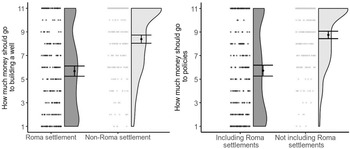
We find strong evidence of opposition to policies that benefit the Roma. Including references to Roma communities dropped the allocation amount by roughly 25% in both studies. Figure 1 shows the distribution of responses across all experimental groups as well as mean responses and associated 95% confidence intervals.
Funding Allocations, Study 1a and 1b
Note: Distribution plot showing difference between treatment and control for Study 1a (left) and 1b (right). Point estimate is mean, presented with 95% confidence intervals. See Tables A5–A10 in the SI for estimates.

Unpaired, two-sample t tests confirm these findings. On average, participants in the Roma condition wanted the village to spend significantly less money for the construction of the well (ΔM = −2.71, 95% CI [−3.26, −2.15], p < 0.001); likewise, they wanted the government to spend less money for regional development (ΔM = −3.03, 95% CI [−3.59, −2.47], p < 0.001). A linear model, estimated with ordinary least squares, both with and without covariate adjustment, confirms these findings (SI, Tables A5–A10). Finally, we probed whether material self-interest plays a role in respondent preferences. We divided the respondents into two groups: those at or below the sample median income (less than 801 euros/month) and those above the median income. We found no evidence of moderation. In other words, low-income individuals and high-income individuals did not respond to the treatments differently. We present this analysis in the SI (Tables A11–12).
Discussion: Study 1
These results establish a baseline assessment of Slovak support for transfers targeting Roma communities. Given that mentioning Roma beneficiaries had a large negative effect on funding allocations, we take these results to indicate some level of ethnocentric bias in majority evaluations. Study 1b also shows that reservations about these transfers persist despite possible self-interest on the part of the majority group. Moreover, by conducting this experiment with two different policies and observing similar results, we can be more confident that differences between control and treatment are not a result of policy domain. Participants allocated more municipal money to building a well when it was not in a Roma settlement. Likewise, they were willing to spend more money on regional development when these regions did not include Roma settlements. Designating minority beneficiaries triggered a reaction in both studies. Redefining who gets help influences policy support.
Study 2: Majority and Minority Preferences
To investigate whether distributive principles can bolster both majority and minority support for transfers to marginalized minority groups, we conducted a within-subject field experiment with survey outcomes (Broockman, Kalla, and Sekhon Reference Broockman, Kalla and Sekhon2017). We conducted the experiment in a small Slovak municipality (approximate population 3,200), where the population is about evenly split between Slovaks and Roma. We collaborated with the mayor’s office in order to field the survey and thus included some questions on the municipality’s behalf. After the completion of the study, we shared the results with the municipality and interested participants.
Although the mayor of the municipality is Roma and received votes from both Slovaks and Romas, interethnic relations are not amicable. The town is residentially segregated, and Slovaks and Roma do not interact with one another in cultural, educational, or government spheres. The general acceptance of the Roma population by Slovaks is very low (Author interview with mayor, January 31, 2019). We believe that this context offers a unique opportunity to test whether distributive principles bolster majority support for transfers to disadvantaged minorities. The design also allows us to survey the Roma population, providing important information about the effects of these principles among minority groups. Furthermore, the field component of the study offers a high degree of realism—respondents are surveyed about real policies that would have a substantial and proximate effect on their municipality. The proximate nature of the treatment allows us to explore the role of self-interest.
Although we attempted 400 different contacts with respondents, we ultimately recruited 113 participants: 52 were Slovak, 61 were Roma (62% female, Mage = 49.34, SDage = 16.05).Footnote 7 After providing informed consent, respondents answered several pretreatment questions, including those requested by the municipality. Then respondents moved on to the experimental portion of the survey.
We based the control and three treatment vignettes on the same scenario. Enumerators told respondents that the municipality was considering a new social housing project for the Roma in the community. The Roma would pay rent to live there, and the EU would finance 95% of the construction. In the control condition, always presented first, this is the only information respondents received. Then every respondent received the three distributive principle treatments in random order. The equality vignette mentioned that a condition for building social housing is an equivalent allocation of money for the non-Roma community. The reciprocity condition noted that only Roma who worked on the actual construction would be allowed to live in social housing. The need condition mentioned that only Roma “who are in greatest need” would be allowed to live in the social housing project. After each condition, respondents indicated their support for the construction of the social housing project on a 1 (“completely disagree”) to 4 (“completely agree”) scale.
Results: Study 2
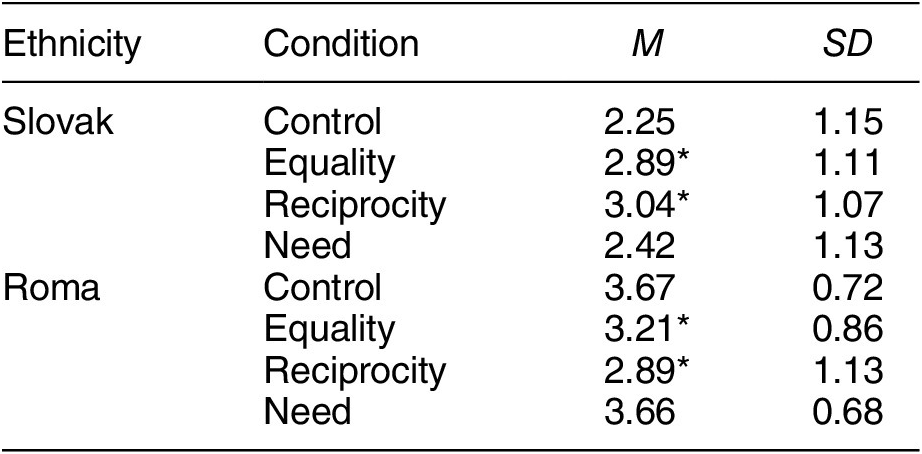
Table 1 shows the levels of support across ethnicities and experimental conditions. First, we see that baseline levels of support were much lower among Slovaks than among Roma. Second, looking at the Slovak respondents, we see that all experimental conditions bolstered support, but only equality and reciprocity did so at statistically significant levels. Among the Roma, equality and reciprocity depressed levels of support, whereas need had no effect. The distributive principles appear to have counteracting effects among majorities and minorities.
Support for Social Housing across Experimental Conditions and Ethnicity

Note: Asterisks indicate a significant difference between the control and experimental condition at p < 0.05; N = 113.
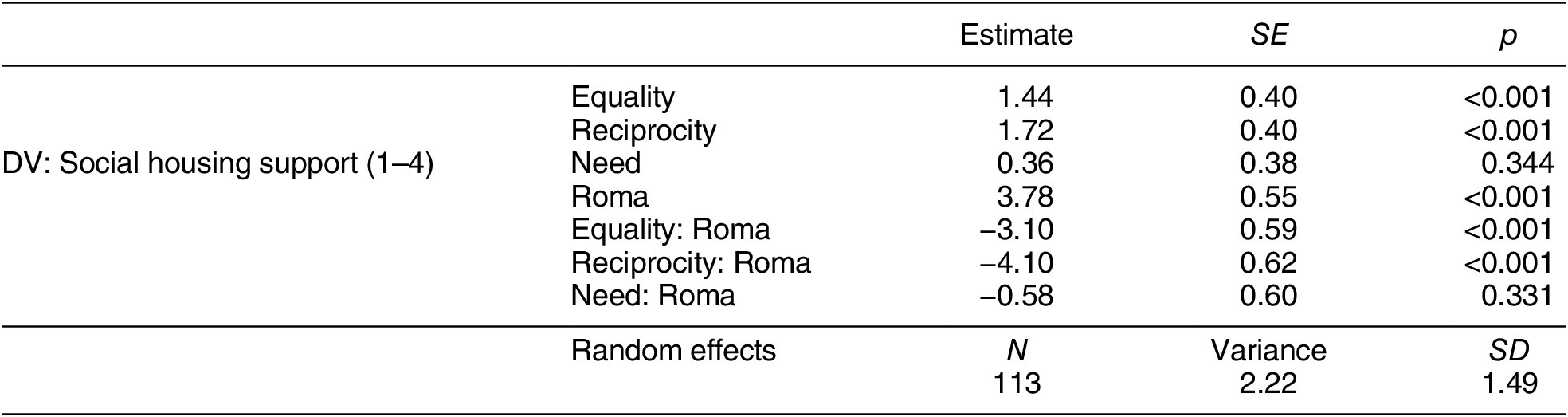
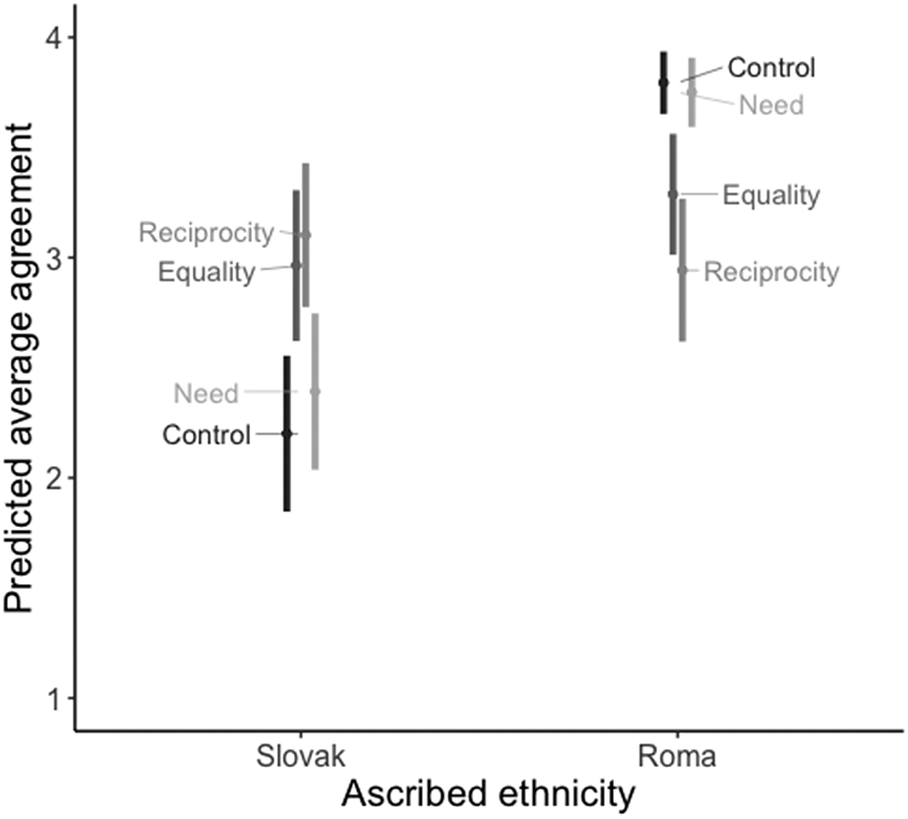
To further analyze the data, we fit an ordinal logit model and included participants as random factors (clmm function, ordinal package in R).Footnote 8 We used condition, ethnic identity, and their interaction as predictors, and willingness to support the social housing project was the dependent variable. Overall, there was a nonsignificant effect of experimental condition on agreement with social housing construction, χ2 (3) = 1.3, p = 0.74, a significant effect of ethnic identity, χ2 (1) = 24.5, p < 0.001, and a significant interaction between the two, χ2 (3) = 68.4, p < .001. Table 2 reports the results and Figure 2 shows the predicted mean responses across experimental conditions and ethnicities. Supporting the descriptives, Slovak participants were more likely to support social housing under the reciprocity and equality conditions, whereas Roma participants were less likely to do so.
Support for Roma Social Housing

Note: Ordered logit regression with participants as random factors; AIC = 1,009.38; DV = dependent variable.
Predicted Average Agreement across Ethnicity and Experimental Condition
Note: Predicted averages and 95% confidence intervals calculated using the emmip function from emmeans package.Footnote 9 Table A17 in the SI presents numerical estimates.

Discussion: Study 2
Among the majority, these results suggest three conclusions. First, self-interest seems to drive respondent preferences when policy effects are proximate. In the equality condition, Slovaks would also benefit from the policy, and thus it is in their material self-interest to support it. Given the cobeneficiary status of Slovaks in the equality condition, we cannot conclude that the equality principle bolsters support for the policy by changing perceptions of the minority group. In fact, we consider self-interest as the more likely mechanism. Nonetheless, we can conclude that the majority is more supportive of pro-out-group redistribution when these policies incorporate the equality principle.
Second, reciprocity-motivated programs also garner support among majorities. Given that Slovaks are not cobeneficiaries in the reciprocity policy design, self-interest is an unlikely mechanism. Instead, we believe that that reciprocity altered deservingness perceptions of the Roma by counteracting a popular stereotype: the Roma purposefully do not work so that they may claim welfare benefits. Thus, incorporating reciprocity in policy design may be an effective strategy for creating support for welfare policies targeting marginalized groups. Nonetheless, given the clear link between reciprocity-based policies and work-activation programs, these results are not necessarily normatively reassuring. In fact, they may further reinforce stereotypes about “good” Roma who work to receive benefits and “bad” Roma who simply profit from the system.
Finally, reassuring majorities that benefits go to only those who actually need them has little effect on support levels. Need is an important criterion for both deservingness perceptions and for many of the EU policies intended to benefit Roma communities. Yet, need may not be the most effective policy motivation, as it may do too little to counteract stereotypic beliefs about minoritized groups and, in fact, may even reinforce them.
Among the Roma minority, two points merit discussion. First, the distributive principles do little to bolster policy support and may even depress it. In general, these effects are likely a result of conditionality. In the control condition, benefits are granted without stipulation; in the treatment conditions, stipulations are clearly enumerated. Thus, it is not necessarily in the self-interest of Roma respondents to support the modified policies. When it comes to the specific distributive principles, low support for equality could be a function of identity-based reservations or deservingness perceptions. Romas, like their majority counterparts, may simply disapprove of redistribution across identity lines, even if such a policy includes benefits for themselves. Alternatively, deservingness perceptions may limit support: why should economically dominant groups receive the same benefits as do the disadvantaged? In contrast to the majority, the Roma least supported reciprocity (likely due to its strong message of conditionality and its connection to work-activation programs). Second, the control and need conditions evoked similarly high levels of support. Given a sense of coethnic identification, it is not surprising that minority group members would want policies to benefit the neediest among them.
Two final points merit discussion: order effects and external validity. In expectation, the random order of the treatments should mitigate potential order effects (Mutz Reference Mutz, Green and Druckman2021, 233–4). However, the design does always present the control condition first, which may alter treatment effects. Reassuringly, recent work arguing for the benefits of repeated-measures suggests that such alterations are unlikely (Clifford, Sheagley, and Piston Reference Clifford, Sheagley and Piston2021). Moreover, the fact that we find very similar results in the between-subjects design (detailed below) makes us more confident in the validity of the findings. Importantly, these findings also need to be interpreted in light of their context. Despite the high degrees of realism, they represent the situation of one Slovak municipality, characterized by its own ethnic dynamics. In different municipal contexts—with different levels of socioeconomic inequality and different patterns of intergroup relations—the results may have differed.
Study 3: Slovak Preferences over Distributive Fairness
To generalize the results of Study 2 to a nationally representative sample of Slovaks, we recruited 1,009 respondents for an online survey experiment (52% female, Mage = 44.7, SDage = 16.1).Footnote 10 We used the same quotas as in Study 1. We employed a between-subjects design with a control group and three treatment conditions (each corresponding to a distributive principle).Footnote 11 Participants read a scenario about a fictional village:
Demerice is one of many villages in Slovakia which includes a Roma settlement. Demerice could build a new apartment building, which would serve as social housing.
These apartments will be intended for the poorest inhabitants of the Roma settlement, who will pay rent for the apartments. 95% of construction costs of this apartment building would be covered by the EU funds, 5% by the municipality.
Participants in the treatment groups were also randomly assigned to one of following additional statements:
Equality: The condition for building the housing for the poorest inhabitants of the Roma settlement would be that Demerice would use the same amount of money for projects intended for non-Roma inhabitants of the municipality. The same amount of funding given for the construction of housing for residents of the Roma settlement would go to projects for non-Roma residents of the village.
Reciprocity: […] would be that only those who deserve it by working on its construction would be allowed to live there. Only those residents of the Roma settlement who deserve it could get the social housing.
Need: […] would be that only those who need it the most could live there. Only those inhabitants of the Roma settlement who need it most because of their difficult life situation would get the social housing.
Participants indicated whether they (1) agree or disagree with the construction personally and (2) whether they think “most people in Slovakia” agree or disagree with the construction, both measured on a 1 (“strongly disagree”) to 4 (“strongly agree”) scale. The first question measures personal support, whereas the second question measures perceptions of majority support.
Results: Study 3
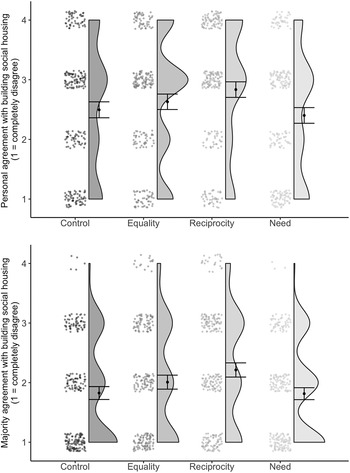
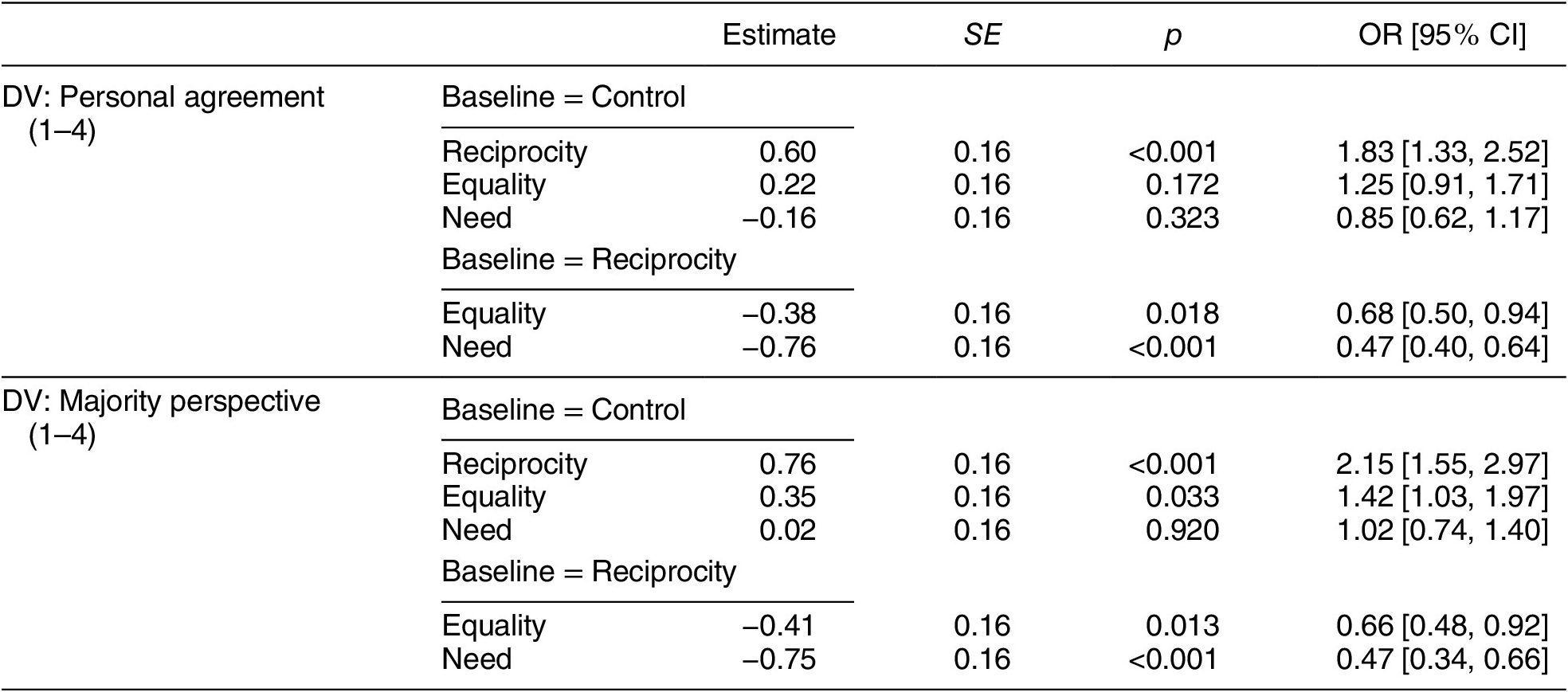
A visual inspection of the data suggests that the reciprocity condition elicited the most positive attitudes toward building the social housing project, whereas the need condition evoked the most negative reactions (see Figure 3).Footnote 12 This pattern manifested across both personal support and assessments of majority support. On average, however, individuals were more pessimistic about societal support than personal support. We use ordinal logistic regression to estimate treatment effects (see Table 3). We present analyses with both the control and reciprocity conditions as baselines. For both personal and majority agreement, reciprocity bolstered support relative to control, and this effect was also statistically distinguishable from the effects associated with equality and need.
Distribution of Responses across Experimental Conditions
Note: Panel 1 (top) presents personal agreement with building social housing; panel 2 (bottom) presents perceptions of majority agreement with building social housing. Point estimate is mean, presented with 95% confidence intervals. See Tables A20–A21 in the SI for numerical estimates and Table 3 in main text for the regression analysis.

Support for Building Social Housing

Note: Ordered logit regression; N = 1,009, DV = dependent variable, OR = odds ratio, CI = 95% confidence interval.
Discussion: Study 3
Results from a nationally representative survey experiment largely confirm the findings from the field experiment. Majorities are more likely to support policies benefiting minority groups when these policies are justified by the distributive principle of reciprocity. Unlike in the field experiment, equality does not have a significant influence on majority support. We believe that this is because the fictional village scenario is fairly distant to survey respondents, especially compared with the proximate case of the municipal building project in the field experiment. In the latter case, self-interest is a more likely mechanism for bolstering support through the equality principle. This difference suggests that self-interest is an important determinant of policy support when policies provide clear and proximate benefits for individuals. The same patterns manifest across individual perceptions of societal support—though respondents were much more pessimistic about the views of their coethnics than about their own views. Unfortunately, we expect these perceptions of societal support to be a more accurate measure of majority support due to possible social desirability bias in individual responses. Finally, equality and need do little to garner majority support for the transfers. And, as in the field experiment, need actually depresses support (though this effect is not statistically significant).
Concluding Remarks
Redistribution across identity lines can be difficult. Self-interest, symbolic attitudes, ethnocentrism, and policy-design decisions all affect whether and to what extent majorities support transfers to marginalized identity groups. In this article, we propose one potential pathway for bolstering support: designing policies to incorporate principles of distributive justice.
We test the effects of three distributive justice principles on support for redistributive policies: equality, reciprocity, and need. We expected that reciprocity would garner support among majorities because reminders of the out-group’s contribution to a given social system can verify contribution and alter perceptions of deservingness. We also expected that policies predicated on need would reinforce stereotypes and group boundaries, lowering support among majorities. Finally, we predicted that minority groups, due to their disadvantaged situation, would be most receptive to needs-based arguments.
To test, we conducted three experiments. We found that mentioning Roma as beneficiaries or cobeneficiaries of a policy drastically reduced the Slovak majority’s level of support. Next, we found that arguments centered on the principle of reciprocity bolster support for out-group redistributive transfers among the majority. Need-based justifications, on the other hand, depressed support. Conversely, minorities were most likely to support either unconditional policies or policies justified by the principle of need. However, reciprocity and equality principles evoked reservations due to the stipulations and conditions inherent in policies designed according to these principles. Finally, we generalized our findings to a nationally representative sample of the Slovak population. Again, reciprocity bolstered support, whereas need did little to shift opinion. These findings were consistent across both individual opinion and perceptions of societal opinion.
We suggest that majority support for reciprocity-based programs be viewed cautiously. Reciprocity is at the heart of the “activation” approach to welfare, under which benefits are conditional on actively seeking and accepting jobs. Scholarship criticizes activation for its punitive character (Škobla, Csomor, and Filadelfiová Reference Škobla, Csomor and Filadelfiová2018) and for promoting “disputable forms of Romani minority governance, including dehumanization” (van Baar Reference van Baar2012, 1289). Although reciprocity justifications may bolster support for out-group redistribution, they may also make welfare conditional upon the acceptance of underpaid and poor-quality jobs. Reciprocity may also do little to remedy the intertwined structural causes of Roma poverty and anti-Roma racism and discrimination. We suggest that policy makers pay attention to how reciprocity is taken on board in the design of a policy. For example, compulsory and voluntary reciprocity policies may reinforce different beliefs about Roma work ethic. Compulsory reciprocity-based programs may reinforce negative stereotypes about “lazy” Roma—by definition, the program suggests that work must be forced. Voluntary reciprocity-based programs may, instead, reinforce beliefs about active Roma who work willingly. Thus, the ways in which policy makers incorporate reciprocity can have important implications for the perceptions of majorities.
Given that many social assistance programs are justified by need-based arguments, our findings concerning the negative or null effect of need are concerning. Focusing on the needs of highly stigmatized groups may reinforce stereotypes. Whereas equality signals benefits for the majority and reciprocity signals effort, need signals marginalization, and this may not be enough to change preexisting stereotypes and ideas about Roma impoverishment. We also suggest that this finding may be a function of salient identity differences between majority Slovaks and the Roma. As previous work shows, majorities hold minorities to a deservingness double standard, and the more salient the demarcations between identity groups, the stronger the double standard. Thus, the effectiveness of need may be conditional on group differences. This would also explain the positive effect of need (relative to equality and reciprocity) among the Roma minority. Other possible pathways for increasing support—also related to principles of distributive fairness—could explicitly focus on manipulating beneficiary deservingness characteristics. For example, interventions could focus on decreasing the degree of perceived differences between minority and majority groups or they could focus on combating identity-based stereotypes directly. We leave these open questions to future research.
We also consider the issue of generalizability. As it pertains to our field experiment, findings from one municipality should be generalized with caution. Municipal intergroup contexts in other localities may make the results more or less pronounced. Also, as suggested throughout this article, we focus on an extreme case. Not only are majorities prejudiced against Roma; they also associate Roma with welfare misuse and dependence. This contrasts welfare support dynamics in Western Europe and the United States, where immigration status and race are the primary cleavages. Given the extreme situation of the Roma, however, we consider our findings a floor. For less stigmatized groups, reciprocity may be even more effective at bolstering support, and the other principles could also have an effect.
Despite these qualms, our results also warrant optimism. Majority support for redistributive transfers to a highly stigmatized minority is not disastrously low. In the two national experiments, despite Roma beneficiaries, participants still chose allocations that, on average, were above the scale midpoints. The field experiment, which asked respondents about a more proximate and personally consequential transfer, led to similar results. Thus, although ethnocentrism lowers support for out-group redistribution, support remains moderately high. Ultimately, our work suggests that policy makers and governments can incorporate principles of distributive justice to garner majority support for policies that benefit marginalized groups.
Supplementary Materials
To view supplementary material for this article, please visit http://doi.org/10.1017/S0003055422001046.
DATA AVAILABILITY STATEMENT
Research documentation and data that support the findings of this study are openly available at the American Political Science Review Dataverse: https://doi.org/10.7910/DVN/6KCW8Z.
ACKNOWLEDGMENTS
The authors would like to thank Madeline Vadkerty and Nina Galanská from the Milan Šimečka Foundation for research support and helpful insights in the development of the research design; Amy H. Liu, Jangai Jap, Eric McDaniel, Mike Medeiros, Marcel Roman, Hannah Walker, and the rest of the Politics of Race and Ethnicity Lab at the University of Texas at Austin; and the reviewers and editors of the American Political Science Review for their helpful comments on this manuscript. All errors remain our own.
FUNDING STATEMENT
This research was funded by the European Union’s Rights, Equality and Citizenship Programme (Grant No. 809869—PERCOM). They were not involved in any stage of the research process. The content of this article represents the views of the authors only and is their sole responsibility. The European Commission does not accept any responsibility for use that may be made of the information it contains.
CONFLICT OF INTEREST
The authors declare no ethical issues or conflicts of interest in this research.
ETHICAL STANDARDS
The authors declare the human subjects research in this article was determined exempt from ethical review under Slovak regulation and law. The authors affirm that this article adheres to the APSA’s Principles and Guidance on Human Subject Research. Further information and proof of exemption can be found in the Supplementary Materials and at the American Political Science Review Dataverse: https://doi.org/10.7910/DVN/6KCW8Z.




Comments
No Comments have been published for this article.