Introduction
The association is one of comparatively few international bodies to celebrate one hundred years of activity. It is quite coincidental that I have personally belonged to the association for fifty years. My first copy of the journal is volume 18, number one, dated January, 1962. In this paper, for the first fifty years I have made extensive use of A.W. Jasper's excellent history (1978), and the Association's archive, held at the National Agriculture Library (NAL) of the US, in Beltsville MD. For the second fifty years, resources include personal copies of the journal, as well as my own experiences of working within poultry science.
Before continuing, it is important to make reference to the state of poultry keeping in the early years of the twentieth century, around the time the association was formed and the first World's Congress held. The vast majority of poultry were kept in very small flocks, mostly as a hobby. Eggs and carcasses that were sold were largely the surplus from these small flocks. There was no industry as such. However, it is clear from looking at the transactions of the First World's Poultry Congress (WPC) in 1921, that things were destined for major changes. Far-sighted people from all over the world had begun to recognise the potential of chickens, turkeys and ducks to form the basis of a highly developed and efficient food production industry. I wonder how many of them could have foreseen that their vision would lead to what we see today, celebrating WPSA's 100th Anniversary as a mature and prosperous industry.
Potential teachers and researchers faced enormous challenges at that time. There was no airmail and the telephone was expensive and limited in use. Contact with colleagues outside their immediate locale could take months. The establishment of the association, and the holding of congresses was, as we shall see, a way of advancing research and teaching on all fronts.
Initial formation
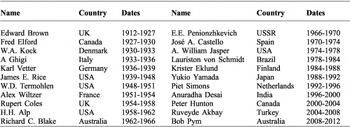
From the outset, the association has been truly international in scope. It was first formed as the International Association of Poultry Instructors and Investigators after a meeting in London, England, in 1912. At this meeting 14 countries were represented: Australia, Belgium, Canada, Cyprus, Denmark, France, Germany, Holland, India, Ireland, Norway, Russia, the United Kingdom, and the United States of America. Edward Brown (UK) was elected President and Raymond Pearl (USA), Secretary. Although a WPC was planned for 1916, this was pre-empted by the First World War, and the first congress was actually held in The Hague, Holland, in 1921.
It is interesting to note that four years before the founding of the association, another organisation called the International Association of Instructors and Investigators in Poultry Husbandry was formed, which became the Poultry Science Association. For much of its history, however, its membership has been almost exclusively from North America, and it has never appointed a Board member or a President from outside that continent.
The first official Constitution of our association was adopted in 1921. The association emblem is said to have originated in 1924, at the WPC in Ottawa, Canada, showing the rooster standing on top of the world, with torches at each side. I am sure it was inspired by the emblem for the First WPC in The Hague, which shows a rooster on a single globe, as well as the torches. The pillars denoting the aims of the organisation, education, organisation and research, completed the emblem.
In 1928, the name of the organisation was changed to the World's Poultry Science Association. Thus, in the space of 16 years, an original meeting of 19 people led to a thriving worldwide organisation that could attract more than 500 people to an international gathering. This is particularly impressive when we remember the means of communication and travel which were available in those early days.
Development of the association
The association grew from these relatively small beginnings. Members met primarily at organised congresses. In its original (1921) constitution, the objectives were specified as follows:
• To facilitate in all possible ways the exchange of knowledge and experience among persons in all parts of the world who are interested in the advancement of the poultry industry by teaching, demonstration and investigation.
• To promote the extension of knowledge in this field by the encouragement of scientific research, practical experimentation, the collection and publication of statistics, the study of problems of marketing and the world's markets, and in every other possible way.
These were modified in 1962, 1972, 1984 and completely revised in 2010, but in principle, not a great deal has changed. The 2010 objectives are:
• To promote the advancement and dissemination of knowledge in all aspects of poultry science and the poultry industry.
• To promote education in the field of poultry science for students and extension services, and to facilitate exchanges between research, education and industry.
• To encourage the staging of local, national and regional meetings, seminars, symposia and conferences and to facilitate the staging of WPCs.
• To co-operate with other national and international organisations in achieving these aims.
Membership has always been open to anyone with an interest in the association's objectives and there are no barriers based on education, nationality or culture. However, until 1958, new members had to be vouched for by two existing members and approved by the Council. Membership includes not only teachers and researchers, but also poultry farmers, technicians and members of the ancillary trades, who have been welcomed and have found the organisation useful. Initially, most members were from Europe and the United States. This began to change rapidly after 1947, when the first national branch was formed in the UK. Several branches have already celebrated their 50th anniversaries.
National branches allowed members to meet more frequently than just at World's Congresses. Many national branches have scientific meetings on an annual basis where original research data can be presented prior to publication in peer-reviewed journals.
According to Jasper (Reference JASPER1978) membership in the 1950's was around 2,000. In 2011, there were 7,700 members in 80 branches. Some of the branches function as poultry trade groups as well as scientific and technical associations, typically where no alternative trade association exists. An example is the Bangladesh branch which holds its International Seminar and Trade Exhibition every two years.
Even with the large increase in membership following the establishment of branches, the Executive Committee did not begin to have regular meetings until 1967. In that year, under the Presidency of Prof. Penionzhkevich, the Committee met in Durham NH at the same time as the PSA meeting. Thereafter, the committee met annually. For the first five years, the meetings were in Paris, and thereafter in various locations by invitation, usually by national branches.
Membership dues began to be levied in 1921 at the rate of UK£1.00 or US$3.00 per head. This gradually increased, and when branches began to form and conduct their own affairs, it was set at US$20.00 for the international organisation, plus whatever the branch determined was necessary to cover its national activities. The branches now collect the membership dues and forward US$20.00/member to the Association Treasurer. Since the 1970's, the association's money and accounts have been held in US$ in the United States. There is a satellite account in Europe held in UK£. Branches collect dues in their own currencies and convert to either UK£ or US$ before submitting money to the Treasurer's office.
In the preamble to the 1980 Constitutional Review, reference is made to recruiting members from low-income countries. However, it was not until the 1990's that a dual dues structure was established, in which low-income countries were assessed at only US$10.00 per member, while high-income countries continued to pay US$20.00. This has undoubtedly helped in the establishment and maintenance of many branches in the developing world. This initiative was not without critics: former Secretary Rupert Coles was vehemently opposed, believing that most potential members from low-income countries lacked the skills necessary to benefit from membership.
In the early years, members' dues easily covered the cost of operations, including the journal. Even in 1961, membership dues exceeded the cost to print and mail the journal. Thirteen years later, dues had more than doubled, while journal costs remained stable. By the 1990's, however, printing and mailing costs were approaching $100,000 annually, while membership dues were averaging only $80,000. At this time, the Sponsorship Program, which had been operational for many years, was greatly expanded. Since the mid 1990's it has been the association's goal to pay for the journal with sponsorship and advertising revenue, and this has been accomplished. An important feature of WPSA administration is that Association Officers are all volunteers. The Secretary, Editor-in-Chief and Treasurer receive small honoraria in order to operate their offices, but there are no full-time paid employees.
The association is administered on a hierarchical basis. The supreme governing body is the Council, on which the branches are represented according to their membership. Members elect or appoint councillors representing their branches, while the councillors elect the President, five Vice-Presidents, plus the Secretary and the Treasurer. Although it is not a part of the constitution, it has become traditional that the leader of each congress becomes President following that event.
Presidents of the WPSA.

Shortly after the formation of branches began, those in Europe established the European Federation of WPSA Branches, and they began holding regional conferences in even-numbered years between WPCs. The European Federation also established the following Working Groups, devoted to special interests:
1. Economics and marketing
2. Nutrition
3. Breeding and Genetics
4. Egg Quality
5. Poultry Meat Quality
6. Reproduction
7. Hygiene and Pathology
8. Waterfowl
9. Poultry Welfare and Management
10. Turkeys
11. Education and Information
12. Physiology
13. Ratites
The Working Groups began to hold their own specialist meetings in various locations in Europe, and rapidly became a major factor in the exchange and dissemination of scientific information. Proceedings of Working Group Symposia provide excellent resources, as do the European Conference Proceedings. The European Federation will celebrate its 50th Anniversary this decade.
In 1982, branches in the Far East and South Pacific region formed their own federation, and they too hold regional conferences between World's Congresses. This has since been re-named the Asia-Pacific Federation. It has established Working Groups dealing with Family Poultry, Waterfowl and Ratites.
Due partly to the dominance of the Poultry Science Association in North America, branches on that continent were slow to form. The US branch was initiated in 1965, Canada in 1970, and Mexico in the early 2000's.
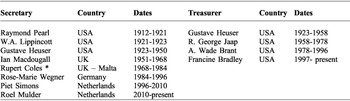
Secretaries and Treasurers of WPSA.

[Initially, the Treasurer and Secretary positions were combined. Subsequently, for most of the Association's history, it has been the practice for the Secretary to be the Assistant Treasurer, and the Treasurer, Assistant Secretary. * Rupert Coles was ‘Acting Secretary’ from the time of Macdougall's death in 1968 until the Madrid Congress in 1970]
The association instituted the Macdougall Medal for meritorious service in 1962, and its first recipient was Major Macdougall himself. It was subsequently awarded to Gustav Heuser, George May, George Jaap, Rupert Coles, Harald Ebbell, Rose-Marie Wegner, Wade Brant, Chris Hann and Piet Simons. Macdougall was also supposed to have been recognized by a lecture in his name at WPCs, but this seems never to have happened.
The International Poultry Hall of Fame was approved by the Executive Committee in 1984 to recognise people who have made outstanding contributions to the development of the world's poultry industries. The first recipients were named in 1988 at the WPC in Japan. Twenty-five recipients were named on this occasion, while at subsequent congresses only five new inductees are permitted. Notable among the first group was Wade Brant, who was involved with the association for many decades, including serving 18 years as Treasurer. Dr. Brant attended a total of thirteen WPC's. He died in 2011. Also included was Edward Brown, the association's first President, who served for 15 years following establishment in 1912. Fifty people have now been inducted to the Hall of Fame, not including those at the 2012 WPC.
Following the financially successful congress in Amsterdam in 1992, the Dutch branch instituted a series of awards for, respectively, education, organisation and research, the three pillars on which the organisation is based. These awards are made at each congress, with applications submitted by branches or individuals to a small International Committee that recommends the winners.
The Dutch Branch also established the ‘Foundation for the Promotion of Poultry Science’, which funds travel and other expenses to applicants, mainly from developing countries, to attend congresses and other WPSA events. The foundation also provides funding to assist in the establishment of new branches.
As another ‘outreach’ initiative, in 2000 the association created the Speakers' Bureau. This provides for speakers to attend regional or national WPSA events, mostly in developing countries. Local costs are borne by the branches but international travel is paid by the association. Speakers frequently become involved in ‘hands-on’ advice and consultation as well as formal talks.
Beginning in the 1990's, the association has cooperated closely with the International Network for Family Poultry Development. This network began in Africa but later became international in scope. Symposia, largely funded by the Food and Agriculture Organisation of the United Nations, were held at WPCs and network members were encouraged to join WPSA. In 2002, the network was formally recognized as a ‘Global Network Group’ within WPSA, and its members receive full benefits of the association.
World's Poultry Congresses
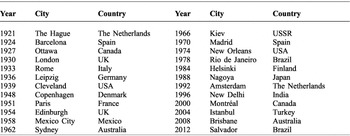
The first WPC was held in The Hague in 1921. With the exception of the period 1939-45, WPCs were held every three years until 1954, and every four years thereafter. There was a six year interval between 1978 and 1984 when a WPC planned for Poland had to be cancelled. WPCs have been held in the following locations (Table 3).
Dates and Locations of WPCs.

Although the WPCs are one of the association's main activities, the responsibility for planning, financing and conducting them is the responsibility of the host country. Prior to the establishment of national branches, invitations were received from governments or even from groups of individuals who believed they could organise such a meeting. However, government involvement has been a required part of the congress award process since the 1960's. The WPC's main function is to bring together scientists from around the world, to exchange information, opinions and ambitions.
Attendance at WPC's has been quite spectacular. At the first WPC in The Hague, the membership list consisted of 384 names representing 23 countries (Jasper, Reference JASPER1978). The proceedings (actually entitled ‘Transactions’) covered 386 pages with a 180 page appendix. There were four sections to the congress and the transactions: experiments and breeding, state and other official activities, hygiene and diseases, and training and education. At this stage of poultry science research, genetics was in its infancy. People were still trying, unsuccessfully, to fit Mendelian ratios to various aspects of egg production. In the disease section, there was much concentration on what is now called ‘Pullorum Disease’, and tuberculosis. A great deal of attention was paid to a variety of schemes to market eggs and poultry products. This was a challenge because of the small scale of production. There were essentially no regulations, although various authorities were beginning to develop them. There were many institutions offering poultry education, often at an elementary level, to prepare young people to operate poultry farms. There was a definite tendency to favour women for these educational opportunities.
Jasper (Reference JASPER1978) stated that at the second WPC in Barcelona, there were 750 people from 37 countries, and at the third in Ottawa 2,599 people. However, all but 230 of these were from Canada and the US. Interestingly, the number registered for the 20th WPC, also in Canada, was almost 3,000, but this included those attending the annual meeting of the Poultry Science Association, and the special Marek's Disease Symposium. At this meeting, about half of the delegates were from Canada and the US; the balance came from 82 other countries. According to Jasper (Reference JASPER1978) attendance at subsequent early WPCs were: London, 2,415 from 56 countries, Rome, 1,400 from 39 countries, and Leipzig, over 1,500 from 42 countries. More than two years prior to the London WPC in 1930, a Canadian railway company was offering a ‘package deal including rail and sea passages, and visits to several European countries following the Congress, for a total period out of Canada of seven weeks’.
Subsequently, numbers varied considerably, with, according to Jasper (Reference JASPER1978) the largest being at the WPC in Cleveland in 1939 where 10,000 apparently attended. Attendance at WPCs varies due to several factors including accessibility, cost, and political situations. The association always strives to persuade host governments to facilitate the granting of visas to potential delegates, with varying degrees of success. The cost of both hosting and attending WPCs has increased rapidly since the early days. Total budget for staging a congress is currently in the range of US$3-5 million.
At many of the early WPCs, simultaneous translation into a variety of languages was offered to delegates. As English became increasingly used in scientific circles, this practice has been largely discontinued. It is now used almost exclusively to translate papers into the language of the host country. Some delegations take their own translators to WPCs to provide assistance to their members.
At the 1992 WPC in Amsterdam, a highly successful ‘Youth Program’ was initiated, and this has been a feature of all subsequent congresses. Young delegates are usually paid for by their home branches. They participate in the congress, and following this, the host country arranges tours of industry, universities and tourist attractions. With the advent of easy electronic communication, many participants from these programs keep in touch over extended periods of time.
One of the great benefits arising from the WPCs has been the published proceedings. These were in hard copy until the Montréal congress, at which only abstracts were printed, with full proceedings distributed as a CD. All of the congress proceedings are held at the NAL as hard copies when available and have been digitized.
The World's Poultry Science Journal
World's congresses provided a means of exchanging information, but they were held only every three years. In order to improve the dissemination of accumulating scientific knowledge, the association decided, in 1928, to publish its own scientific journal. The International Review of Poultry Science was published twice annually (in Rotterdam, The Netherlands) for 13 years ending in 1940. The editors were Dr. B.J.C. te Hennepe (The Netherlands) and Dr. Gustave Heuser (USA). From the very first issue, we can observe the very large influence of the Dutch – as editors, publishers and contributors, but perhaps most importantly, as motivators. In his editorial in the first issue, te Hennepe wrote: ‘Let us make the association a great clearing house for poultry knowledge and international good fellowship, keeping always in mind the difficulties and problems of fellow members ...’ The first issue was 24 pages and included sections entitled; breeding, diseases, nutrition, extension and general. The second issue was 44 pages, and 12 countries contributed to these first two issues. The intention was to give titles and a very brief abstract, plus references, so that members could obtain original documents. The Review also included at some point, a membership list to enable members to contact each other. In terms of individual countries, Canada also seems to have made a disproportionately large contribution to the association. Many articles are quoted in the early issues of the Review, and Canada became the location for the 3rd Congress in 1927.
In 1945, with a new title; the World's Poultry Science Journal (WPSJ), publication resumed on a quarterly basis. The WPSJ's mandate, as identified in the first issue, was to ‘deal with practical, semi-technical, and technical problems pertaining to every branch of the poultry industry, including production, marketing and consumption problems.’ The journal serves as a vehicle for association news, announcements of congresses and other meetings, and news from branches. As the association grew, it became more difficult to include all relevant news of it and its branches in the journal. Thus, in the early 21st century, a separate newsletter was developed for members that is published on the internet, four times annually. This newsletter is available by email to members and is posted on the WPSA web site.
The journal publishes occasional book reviews and obituaries of prominent members. It has always enjoyed international readership, as well as a wide range of contributors. In the period 1992-95, Editor Chris Hann analysed the source of papers and identified twenty-one countries of origin for the 56 reviews published in the four year period. In the subsequent four-year period, 82 reviews came from 29 countries.
In 1964, George May (UK) was appointed Production Manager for the WPSJ and production began at Pendragon Press in Cambridge, UK. It had previously been printed in the US. Pendragon continued until 1988. In 1989 Butterworth Scientific became the publisher until 1994 when Watt Publishing took over production and distribution, for approximately two years. Since then, print production has been centred in The Netherlands, with online publishing performed by Cambridge University Press.
George May was succeeded as Production Manager in 1973 by Molly French (UK) who continued in this position until 1988. When Butterworth became publishers, the position of Production Manager was discontinued.
The World's Poultry Science Journal has continued until the present day with mounting success. It's measured ‘Impact Factor’ based on citations is above average in its category. Beginning in the early twenty-first century, the Journal has been offered in electronic format, by Cambridge Journals Online. This version is completely searchable, with appropriate links to other publications from citations.
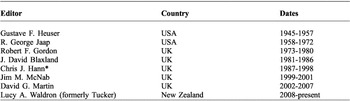
Editors have originated predominantly from the UK and the US. Our present editor is an impressive departure from this tradition.
Editors of the World's Poultry Science Journal.

* for a brief period in the 1990's Dr. Peter Lewis was Assistant Editor
Over the years, the policies of the journal have changed. In its early form, it included original research, and many articles describing poultry and egg production in a wide variety of countries. For example in the first copy I received, (vol.18, 1962) there are two items of association news, the announcement of the XII WPC in Sydney, Australia, surveys of the poultry industry in Ceylon, the Mediterranean, and six East African countries. There is one piece of original research, and a review of poultry nutrition research in Australia. But more than half the space was occupied by abstracts of poultry research papers, reprinted from Animal Breeding Abstracts, Nutrition Abstracts and Reviews, and Biological Abstracts. Subsequent issues contained the table of contents from Poultry Science which gave members a direct link to a major source of original research papers. In 1963, then-Editor George Jaap asked members to send original research papers to journals that specialised in them, and discouraged publication in WPSJ. By the mid-1960's, all scientific papers consisted of literature reviews. This policy continues today. The publication of abstracts from other scientific journals was discontinued in 1975.
In the early days, the journal contained some advertising, but not nearly as much as today. In 1962, supporting companies included Shaver, Watt Publishing, Merck, Whitmoyer Laboratories, Chick Master Incubators, Honegger Layers, Multiplo Incubator and Brooder Co., Dr. Salsbury's Laboratories and Qantas Airways. Of these, most survive, but under different ownership. The relationship with Watt has been longstanding and, for a brief period from 1994 to 1996, the company was both publisher and producer of the journal. When printing and mailing costs escalated in the 1980's and 1990's, the association intensified recruitment of commercial Sponsors whose financial contributions would permit the Journal's publication and distribution. This program has been extremely successful and has enabled the association to continue to supply the journal to all of its members, even while maintaining membership dues at an extremely low level. Sponsors receive advertising space in the journal according to the level of their contributions. Members now have the choice of receiving a hard copy of the journal, or the electronic version. At this point, about 850 members receive the journal in electronic format. Since the advent of the electronic journal, there are links to sponsors' web pages from their advertisements.
In 1963, the European Federation recommended to the association that the journal (or parts of it) be printed in other languages. In 1970 the journal began to publish summaries in French. Summaries began in German in 1974, Russian in 1980, Spanish in 1986 and Chinese in 2004. Complete translations of the journal have been attempted, but proved financially impossible. A notable example was translation into Spanish, initiated by the Spanish Branch.
Membership lists have been a feature of the journal. New members' names and addresses were regularly listed and full membership lists published from time to time. The last one was in 2001. Privacy issues now make the publication of membership lists in any form a questionable initiative.
Conclusions
From a meeting of 19 people in 1912, the World's Poultry Science Association has evolved into a truly international organisation, serving over 7000 members in more than 80 countries. It spearheaded the establishment of WPCs, beginning in 1921, and continuing to the present day. Its branches are important national centres and meeting places for all those interested in poultry science. Its journal is a respected source of information around the world, increasingly so since it was made available on-line in the early 21st century.