Introduction
Toxoplasma gondii, Giardia duodenalis and Cryptosporidium spp. are protozoan parasites that are considered as emerging food and waterborne pathogens according to the Food and Agriculture Organization of the United Nations and the World Health Organization (FAO/WHO, 2012). Sometimes, these parasites are present in the environment in high numbers in their transmission stages, which are oocysts for T. gondii and Cryptosporidium spp., and cysts for G. duodenalis. Therefore, these forms can contaminate water and soil and may be considered as vehicles of parasitic contamination and disease outbreak. However, these parasitic forms are not capable of multiplying as bacteria, which implies the need for sensitive methods for their detection in food matrices. The rates of parasitic contamination are different from one country to another and even between regions in the same country.
Vegetables and fruits are an important part of a balanced diet due to their nutritional value (Losio et al., Reference Losio, Pavoni, Bilei, Bertasi, Bove, Capuano, Farneti, Blasi, Comin, Cardamone, Decastelli, Delibato, De Santis, Di Pasquale, Gattuso, Goffredo, Fadda, Pisanu and De Medici2015). Nowadays, there is a global increase in the tendency to eat raw or slightly cooked vegetables, which may increase the risk of foodborne infections (FAO/WHO, 2012). Parasitic diseases are an important health problem that can, in some cases, occur by the transmission of parasites to humans through the ingestion of contaminated water or foodstuffs such as vegetables. Infections such as giardiasis and cryptosporidiosis are usually characterized by diarrhoea, stomach pain and vomiting. The presence of these pathogens in fresh vegetables, even in very low concentrations, poses a high risk to the consumer (Ali et al., Reference Ali, Al-Herrawy and El-Hawaary2004). The extent of contamination depends on various factors that include among others, the use of untreated or contaminated water for irrigation, irregular hygiene practices during post-harvest handling as well as environmental pollution (Kumar et al., Reference Kumar, Onichandran, Lim, Sawangjaroen, Ithoi, Andiappan, Salibay, Dungca, Chye, Sulaiman, Lau and Nissapatorn2014).
In the past, the risk of human infection due to parasites was limited to distinct geographic regions, because of parasites' adaptation to definitive hosts, specific intermediate hosts and environmental conditions. These barriers have been gradually removed due to the expansion of international commerce of foodstuffs, facilitated by refrigerated transport (El Said Said, Reference El Said Said2012). Indeed, several parasitic infection cases were linked to imported foodstuffs, for example, horse meat imported from Canada and Brazil was implicated in particular cases of toxoplasmosis in individuals in France (Pomares et al., Reference Pomares, Ajzenberg, Bornard, Bernardin, Hasseine, Darde and Marty2011), because there are virulence differences in Toxoplasma strains which are associated with geographic localization, the exchange of fresh or chilled meat – but not frozen – may induce the spreading of such strains (Robertson et al., Reference Robertson, Sprong, Ortega, van der Giessen and Fayer2014). On the other hand, imported fresh produces to non-native regions or countries were incriminated in multiple foodborne outbreaks, for example, imported raspberries from Guatemala were responsible for cyclosporiasis outbreak in Canada and the United States (Ortega and Sanchez, Reference Ortega and Sanchez2010).
The lack or the absence of adequate methods for the detection of parasites in fresh vegetables can lead to the underestimation of foodborne parasitic outbreaks or even their non-detection. In fact, standardized methods exist only for the microscopic detection of Cryptosporidium spp. and G. duodenalis in leafy green vegetables and berry fruits after immunomagnetic separation (IMS) (method 18744) (ISO, 2016). Other harmful parasites such as T. gondii require the establishment of reliable and practical methods for their detection.
Existing studies on the prevalence of parasites are heterogeneous due to numerous factors, such as (i) sampling methods, (ii) detection procedures with different recovery efficiencies (REs) and also variable detection limits (LODs), (iii) geographic locations, (iv) levels of development between countries as well as (v) seasonal changes within countries.
The aim of this review is to compare the findings of multiple studies carried out in order to analyse leafy greens [lettuce (Lactuca sativa), parsley (Petroselinum crispum) and coriander (Coriandrum sativum)] and root vegetables [radish (Raphanus raphanistrum subsp. sativus) and carrot (Daucus carota subsp. sativus)] for the presence of T. gondii and Cryptosporidium spp. oocysts and G. duodenalis cysts; this includes the methods used and the results obtained in order to demonstrate prevalence rates of parasitic contamination.
Literature selection criteria
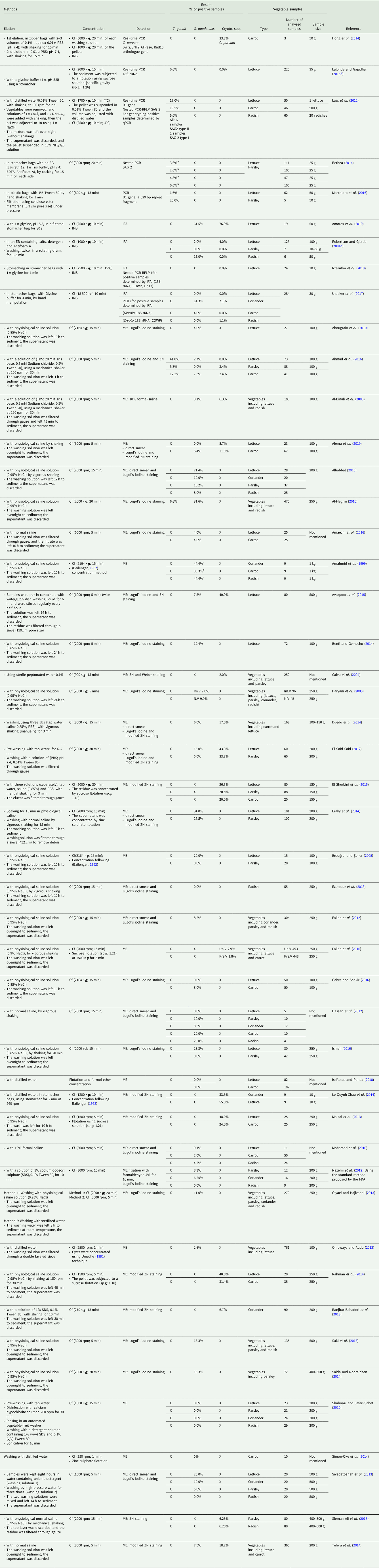
In this review, we have evaluated the different monitoring methods for T. gondii, G. duodenalis and Cryptosporidium spp. in some fresh leafy green vegetables such as lettuce, parsley and coriander, and root vegetables such as carrot and radish, and we have listed the different described procedures used for the detection of the three protozoans in fresh vegetables and the prevalence rates reported worldwide. For this purpose, we have performed a search of the literature databases since 2000 (e.g. PubMed, ScienceDirect and Google Scholar), in which, the terms ‘detection of parasites in vegetables’, ‘prevalence of parasites in vegetables’, ‘vegetables and protozoan parasites’, ‘T. gondii in vegetables’, ‘G. duodenalis in vegetables’, ‘Cryptosporidium in vegetables’ and ‘foodborne parasites’ were applied. The obtained literature included about 200 papers relevant to the detection of protozoan and helminth parasites in various fresh vegetables. We have selected the articles investigating the presence of at least one of the parasites of interest (T. gondii, G. duodenalis or Cryptosporidium spp.), in marketed fresh vegetables, even if the studies involved other parasites. As we have also taken into account the studies reported on the detection of the three protozoan parasites, in different vegetable types including at least one of the vegetables in focus. This selection led to keeping 48 papers as represented in Table 1.
Methods used for monitoring T. gondii, G. duodenalis and Cryptosporidium spp. in fresh vegetables (lettuce, parsley, coriander, radish and carrot), and the prevalence of these parasites according to different studies

Cf, centrifugation; FDA, Food and Drug Administration of United States of America; IFA, immunofluorescence assay; IMS, immunomagnetic separation; Im.V, imported vegetables; ME, microscopic examination; N.V, native vegetables; PCR, polymerase chain reaction; Pre.V, prewashed vegetables; Un.V, unwashed vegetables; X, not done; ZN, Ziehl–Neelsen.
a Samples from Peru.
b Samples from the USA.
c Crops of vegetables irrigated with raw wastewater.
Detection of parasitic transmission stages in fresh vegetables
Sampling
For the detection of T. gondii, G. duodenalis and Cryptosporidium spp. in fresh vegetables, the commonly consumed fresh vegetables in each study area were collected randomly from retail markets, supermarkets or street vendors. Then, they were transported in plastic or nylon sterile labelled bags to the laboratory for parasitological analysis. Different types of vegetables were analysed, especially leafy ones, such as lettuce, parsley, coriander, etc.
Parasites were investigated in portions of about 10 g–1 kg of each vegetable depending on the studies. Three distinct steps were followed: elution, concentration and detection. The methods used to detect parasites and their prevalence in fresh vegetables, according to different studies, are summarized in Table 1.
Elution
The elution step aims to extract parasites from vegetable samples. It is crucial because all subsequent steps depend on the efficiency of (oo)cyst recovery. Therefore, the use of adequate elution buffers (EBs) and efficient separation (isolation) methods is required to maximize the (oo)cyst recovery as well as the accuracy of the results. Various elution methods were evaluated for the elution of protozoan parasites from vegetable matrices. Indeed, Cook et al. (Reference Cook, Paton, Wilkinson, Nichols, Barker and Smith2006) evaluated different EBs [e.g. phosphate-buffered saline (PBS), pH 7.2; 0.1 m tricine, pH 5.4; 1% lauryl sulphate; 1 m glycine, pH 5.5] for the detection of Cryptosporidium parvum in lettuce, as they tested various elution procedures (e.g. stomaching, pulsification, rolling and orbital shaking), coupled with immunofluorescence assay (IFA). They demonstrated that the extractants and physical extraction methods influenced the percentage of recovered oocysts. According to this study, glycine buffer ‘1 m glycine’, pH of 5.5 was the cheapest and effective buffer compared to other ones, especially when it was coupled with stomaching for 1 min (RE of C. parvum oocysts from lettuce was 59.0 ± 12.07%). However, using similar methods, the recovery of parasites from lettuce has varied as reported by Rzezutka et al. (Reference Rzezutka, Nichols, Connelly, Kaupke, Kozyra, Cook, Birrell and Smith2010) (RE of Cryptosporidium was 19%) and Utaaker et al. (Reference Utaaker, Huang and Robertson2015) (RE were 53% for Cryptosporidium and 33% for Giardia), that could be related to the number of replicates tested. Noting that slight changes in the method could affect the recovery as illustrated in the finding of Amoros et al. (Reference Amoros, Alonso and Cuesta2010) (RE were 24.5 ± 3.5% for Cryptosporidium and 16.7 ± 8.1% for Giardia in fresh produce) when reducing the time of stomaching to 30 s. Otherwise, Shields et al. (Reference Shields, Lee and Murphy2012) compared various buffers such as deionized water; 1 m glycine, pH 5.5; a detachment solution and 0.1% Alconox®, to recover C. parvum and Cyclospora cayetanensis from lettuce, herbs and raspberries; the RE of C. parvum from spinach and raspberries using deionized water were 38.4 ± 10.1% and 34.9 ± 6.2%, respectively, whereas there was no statistically significant difference between the deionized water and 1 m glycine, pH 5.5. Furthermore, they revealed that 0.1% Alconox® allowed a significant improved recovery (72.6 ± 6.6%) of C. parvum oocysts from basil. On the other hand, EBs composed of Laureth 12, 1 m Tris buffer; pH 7.4, ethylenediaminetetraacetic acid (EDTA) and Antifoam A were also used (Robertson and Gjerde, Reference Robertson and Gjerde2000; Bethea, Reference Bethea2014) and evaluated when coupled with rotating and IFA, revealing an RE of 42% for Cryptosporidium, and 67% for Giardia in lettuce, Chinese leaves and strawberries (Robertson and Gjerde, Reference Robertson and Gjerde2000). A recent study (Shapiro et al., Reference Shapiro, Kim, Rajal, Arrowood, Packham, Aguilar and Wuertz2019) described a method for simultaneous detection of C. parvum, G. duodenalis, T. gondii and C. cayetanensis, that coupled leaf-washing with multiplex polymerase chain reaction (PCR) allowing higher recoveries (46% for Cryptosporidium, 38% for Giardia and 43% for T. gondii) with 90% certainty of their detection when contamination levels ranged from 1 to 10 (oo)cysts per g of spinach, and permitting more consistent detection of parasites compared to stomaching process. Furthermore, various studies employed physiological saline solution to detach parasites from vegetables (Daryani et al., Reference Daryani, Ettehad, Sharif, Ghorbani and Ziaei2008; Abougrain et al., Reference Abougrain, Nahaisi, Madi, Saied and Ghenghesh2010; Ezatpour et al., Reference Ezatpour, Chegeni, Abdollahpour, Aazami and Alirezaei2013; Benti and Gemechu, Reference Benti and Gemechu2014; Alhabbal, Reference Alhabbal2015; Gabre and Shakir, Reference Gabre and Shakir2016), followed by microscopic examination (Table 1) because it is a simple and low coast approach, but the REs were not determined.
The difference in REs (Table 2) between the different EBs could be stemmed from their composition and interaction with the foodstuffs tested. For lettuce, 1 m glycine with optimal pH allowed for instance no excess debris formation and did not influence Cryptosporidium oocyst recovery in IMS (Cook et al., Reference Cook, Paton, Wilkinson, Nichols, Barker and Smith2006), contrarily to EB that has a low molarity and a neutral pH that made the recovery suboptimal. This latter could be overcome by increasing both molarity and pH (Cook et al., Reference Cook, Paton, Wilkinson, Nichols, Barker and Smith2006). Although 0.1% Alconox®, which contains both synthetic detergent surfactant agents and food additives with emulsifying and dispersing properties, allowed an efficient removal of oocysts from vegetable surfaces (Shields et al., Reference Shields, Lee and Murphy2012), but when used with stomaching, produced an excessive foam that interferes with oocyst recovery (Lalonde and Gajadhar, Reference Lalonde and Gajadhar2016a).
REs and LODs of published methods for the detection of Cryptosporidium, G. duodenalis and T. gondii, in leafy greens and root vegetables

a Most studies targeted detection of one or two of the protozoan parasites, whereas two publications described methods for detection of three parasites.
b IMS-IFA.
c Not reported.
d PCR-restriction fragment length polymorphism.
e Loop-mediated isothermal amplification.
Concentration
The concentration step is usually done by centrifugation (Maikai et al., Reference Maikai, Elisha and Baba-Onoja2012; Benti and Gemechu, Reference Benti and Gemechu2014; Avazpoor et al., Reference Avazpoor, Yousefipoor, Dusty, Mehdipour, Seifipour and Gholam2015; Ahmad et al., Reference Ahmad, El Fadaly, Zaki and Barakat2016; Marchioro et al., Reference Marchioro, Tiyo, Colli, De Souza, Garcia, Gomes and Falavigna-Guilherme2016), as it can then be followed by isolation methods such as IMS (Robertson and Gjerde, Reference Robertson and Gjerde2001a; Rzezutka et al., Reference Rzezutka, Nichols, Connelly, Kaupke, Kozyra, Cook, Birrell and Smith2010; Utaaker et al., Reference Utaaker, Kumar, Joshi, Chaudhary and Robertson2017). This latter is recommended in the standardized method 18744 for Cryptosporidium spp. and G. duodenalis detection in fresh leafy green vegetables and berry fruits (ISO, 2016), but it is time consuming and expensive, thus not suitable for industries trying to establish parasitic control for foodstuffs. In this context of minimizing the cost and the duration of sample treatment, Utaaker et al. (Reference Utaaker, Huang and Robertson2015) reduced the number of IMS reagents and modified the buffering system, whereas others replaced the immunofluorescence method by molecular techniques.
Detection
Among the described methods, direct microscopic examination, acid-fast stains such as modified Ziehl–Neelsen staining (used for Cryptosporidium detection) or Lugol's iodine stain (used to detect Giardia) were commonly used (Table 1), because of their low cost. However, compared to other methods, they were suboptimal for the detection of parasites. Indeed, Ramirez-Martinez et al. (Reference Ramirez-Martinez, Olmos-Ortiz, Barajas-Mendiola, Giono Cerezo, Avila and Cuellar-Mata2015) reported an RE of 20 ± 4.3% and an LOD of 20 cysts of Giardia per g of lettuce, using light microscopy, whereas PCR targeting the β-giardin gene was 10-fold more sensitive. Another method is the IFA, which was used for the detection of parasite (oo)cysts in various vegetable matrices, it is in fact the method recommended by the method 18744 (ISO, 2016). The combination of immunofluorescence, size and morphology allowed to identify and recognize (oo)cysts from the other particles (Miller et al., Reference Miller, Gardner, Atwill, Leutenegger, Miller, Hedrick, Melli, Barnes and Conrad2006; Keserue et al., Reference Keserue, Füchslin, Wittwer, Nguyen-Viet, Nguyen, Surinkul, Koottatep, Schürch and Egli2012). However, the auto-fluorescence of some particles present in foodstuff matrices could interfere with labelled (oo)cysts making the IFA unsuitable for their analysis. Besides, this method was claimed to be time consuming, requiring an expensive technology and microscopy expertise (Ahmed and Karanis, Reference Ahmed and Karanis2018). Because the IFA does not provide the genotype of detected parasites, it was coupled with PCR to improve the specificity as used by Rzezutka et al. (Reference Rzezutka, Nichols, Connelly, Kaupke, Kozyra, Cook, Birrell and Smith2010) and Utaaker et al. (Reference Utaaker, Kumar, Joshi, Chaudhary and Robertson2017). On the other hand, different studies have described molecular approaches that allow the detection of protozoan parasites in vegetables; these methods' efficiency is strongly correlated with the recovery of (oo)cysts from vegetables as well as the DNA extraction step. Technically, this latter could be performed by altering cycles of freezing/thawing, which is time consuming, or using commercial kits based on a mechanical disruption of (oo)cysts walls, that was proved to be more suitable for the DNA extraction of T. gondii (Lass et al., Reference Lass, Pietkiewicz, Szostakowska and Myjak2012), G. duodenalis and C. parvum from complex matrices such as vegetables (Berrouch et al., data not shown). Throughout the described studies, Marchioro et al. (Reference Marchioro, Tiyo, Colli, De Souza, Garcia, Gomes and Falavigna-Guilherme2016) conclude that the LODs of T. gondii in lettuce were 10 and 100 oocysts per μL, using a PCR targeting the B1 gene and the 529 bp fragment, respectively. Taking into account that this difference was explained by the fact that the B1 gene consists of a highly conserved region of the genome of the parasite and is repeated 35 times whereas the 529 bp fragment is repeated 200–300 times in the genome and corresponds to a non-coding region (Marchioro et al., Reference Marchioro, Tiyo, Colli, De Souza, Garcia, Gomes and Falavigna-Guilherme2016). In addition, Hohweyer et al. (Reference Hohweyer, Cazeaux, Travaillé, Languet, Dumètre, Aubert, Terryn, Dubey, Azas, Houssin, Loïc, Villena and La Carbona2016) evaluated the LOD of T. gondii, G. duodenalis and C. parvum in basil using quantitative PCR (qPCR), the results were 3 (oo)cysts per g for both C. parvum and G. duodenalis, and below 1 oocyst per g for T. gondii. However, Lass et al. (Reference Lass, Pietkiewicz, Szostakowska and Myjak2012) reported an LOD of 100 oocysts T. gondii in radish, using qPCR. Lalle et al. (Reference Lalle, Possenti, Dubey and Pozio2018) have also assessed the LOD of this parasite in baby lettuce at 0.5 oocyst per g, using LAMP-Chromatographic Lateral-Flow Dipstick. Although this technique requires more time compared to qPCR, it requires cheaper equipment which makes it a valuable molecular test to be established in resource-limited cases (Table 2).
Currently, there is one standardized method 18744 (ISO, 2016) for the detection and enumeration of Cryptosporidium and Giardia in fresh leafy green vegetables and berry fruits. However, there are many parasites such as T. gondii which are harmful for humans and can't be monitored using this method, because there are no monoclonal antibodies for T. gondii oocyst walls to perform IMS separation and IFA detection. Considering the finding of Dumètre and Dardé (Reference Dumètre and Dardé2005) where the monoclonal antibody mAbs 3G4 was described and incorporated in an IMS procedure against T. gondii oocyst wall, Hohweyer et al. (Reference Hohweyer, Cazeaux, Travaillé, Languet, Dumètre, Aubert, Terryn, Dubey, Azas, Houssin, Loïc, Villena and La Carbona2016) tested the IMS Toxo method [using the monoclonal antibody mAb 3G4 coupled with Super paramagnetic beads (Activ Master Beads® #02650)] for two food matrices, basil and raspberries, and the mean recovery rates in basil were 0.2% and 35% by microscopy and qPCR, respectively, whereas they were 2.0% by microscopy against 29% by qPCR, in raspberries.
Prevalence of T. gondii and Cryptosporidium spp. oocysts and G. duodenalis cysts in vegetables
As summarized in Table 1, fresh vegetables were found to be contaminated with protozoan parasites namely T. gondii, G. duodenalis and Cryptosporidium spp. with different rates.
Prevalence of T. gondii oocysts
There have only been few studies on the prevalence of T. gondii in fresh produce that reported different rates of T. gondii, based on different elution methods and a variety of microscopic and molecular assays (Table 1). The contamination rates of fresh produce marketed in Canada (Lalonde and Gajadhar, Reference Lalonde and Gajadhar2016b) (lettuce 0%), United States of America (lettuce 2%, parsley 0%) and Peru (Bethea, Reference Bethea2014) (lettuce 3.6%, parsley 4.3%) were largely lower than those reported in Egypt (Ahmad et al., Reference Ahmad, El Fadaly, Zaki and Barakat2016) (lettuce 41%, carrot 12.2% and parsley 5.7%) or Saudi-Arabia (Al-Megrm, Reference Al-Megrm2010) (leafy vegetables 6.6%). The contamination of fresh produce with T. gondii could be affected by various factors (see the section ‘Factors affecting the prevalence of parasitic contamination of vegetables’) as it could be underestimated because there is a loss of oocysts during the recovery procedures as demonstrated by Lass et al. (Reference Lass, Pietkiewicz, Szostakowska and Myjak2012) when comparing the results of qPCR performed with DNA extracted from T. gondii oocysts suspension in distilled water with the results of recovery from experimentally contaminated vegetables, in the case of vegetables samples, 10-fold loss of T. gondii oocysts was recorded. Furthermore, Escotte-Binet et al. (Reference Escotte-Binet, Da Silva, Cancès, Aubert, Dubey, La Carbona, Villena and Poulle2019) proved the improvement of T. gondii oocyst recovery when using a mechanical procedure for the lysis of oocysts' walls instead of alternate freeze–thaw cycles, because T. gondii oocysts possess very robust cell walls, as they underlined the interference of many parameters with the efficiency of oocyst recovery as the composition of analysed matrices. Consequently, pretreatment and detection procedures should be adapted depending on the matrices.
Although many studies have been conducted on the presence of other protozoan parasites (e.g. Giardia and Cryptosporidium) that have been incriminated in numerous foodborne outbreaks worldwide, only a few studies have been reported on T. gondii in vegetables due to the lack of standardized methods for the investigation of this parasite in food matrices and the under-recognition of this mode of transmission for T. gondii. Another factor that has contributed to the paucity of surveillance studies on fresh produce was the low number of reported toxoplasmosis foodborne outbreaks, indeed, there have been only two outbreaks of toxoplasmosis associated with the consumption of fresh produce (Ekman et al., Reference Ekman, do Chiossi, Meireles, de Andrade, Figueiredo, Marciano and de Luna2012) or juice (dos Morais et al., Reference dos Morais, Freire, Barbosa, da Silva, Pinheiro, da Costa, de Ramos, Bichara, Lima and da Silva2016), both reported in Brazil. Robertson (Reference Robertson2016) concluded that the rarity of reported toxoplasmosis associated with the consumption of salad vegetables could be due to the many potential routes of infection for this parasite and the fact that infections are often asymptomatic.
There is no doubt that the prevalence of T. gondii genotypes in the environment remains unknown (Lass et al., Reference Lass, Pietkiewicz, Szostakowska and Myjak2012), which is due, in part, to the low number of oocysts present in environmental samples. However, it is important information for human health. Lass et al. (Reference Lass, Pietkiewicz, Szostakowska and Myjak2012) have investigated the presence of T. gondii in 216 fresh produce samples collected in Poland and determined two genotypes: SAG2 type I (in six samples) and SAG2 type II (in two samples), which is surprising as type II was found to be the most prevalent genotype in human disease in Europe (mainly in France) (Ajzenberg et al., Reference Ajzenberg, Cogné, Paris, Bessières, Thulliez, Filisetti, Pelloux, Marty and Dardé2002).
Prevalence of G. duodenalis
Giardia duodenalis has been incriminated in numerous foodborne outbreaks. In the last one reported in El Salvador (Kasper et al., Reference Kasper, Lescano, Lucas, Gilles, Biese, Stolovitz and Reaves2012), the consumption of local food prepared without proper monitoring has been suspected as a factor for this diarrhoeal illness. Besides, in 2016, Adam et al. (Reference Adam, Yoder, Gould, Hlavsa and Gargano2016) have analysed all the giardiasis outbreaks reported to the Centers for Disease Control and Prevention for 1971–2011, the 242 outbreaks affecting ~41 000 persons, resulted in 15.7% from foodborne transmission. Otherwise, an expert elicitation study (Hald et al., Reference Hald, Aspinall, Devleesschauwer, Cooke, Corrigan, Havelaar, Gibb, Torgerson, Kirk, Angulo, Lake, Speybroeck and Hoffmann2016) estimated the proportion of cases of giardiasis caused by the foodborne route; it indicated that the importance of the foodborne route of infection was quite similar across regions (e.g. 0.11 in African region; 0.13 in Eastern Mediterranean region and 0.12 in European region). Recently, numerous studies worldwide have investigated the occurrence of G. duodenalis in fresh produce, using different elution procedures and detection methods based on immunofluorescence (Robertson and Gjerde, Reference Robertson and Gjerde2001a; Amoros et al., Reference Amoros, Alonso and Cuesta2010; Utaaker et al., Reference Utaaker, Kumar, Joshi, Chaudhary and Robertson2017), fast-stains (e.g. Lugol's iodine staining) (Ahmad et al., Reference Ahmad, El Fadaly, Zaki and Barakat2016; Amaechi et al., Reference Amaechi, Ohaeri, Ukpai and Adegbite2016; Mohamed et al., Reference Mohamed, Siddig, Elaagip, Edris and Nasr2016; Alemu et al., Reference Alemu, Mama, Misker and Haftu2019) and molecular assays (Utaaker et al., Reference Utaaker, Kumar, Joshi, Chaudhary and Robertson2017). The contamination rates were variable, in leafy greens such as lettuce; 61.5% was recorded in Spain (Amoros et al., Reference Amoros, Alonso and Cuesta2010), 2% in Norway (Robertson and Gjerde, Reference Robertson and Gjerde2001a), 2.7% in Egypt (Ahmad et al., Reference Ahmad, El Fadaly, Zaki and Barakat2016), 0% in India (Utaaker et al., Reference Utaaker, Huang and Robertson2015) and Southern Ethiopia (Alemu et al., Reference Alemu, Mama, Misker and Haftu2019), whereas in parsley 0% was reported in Norway (Robertson and Gjerde, Reference Robertson and Gjerde2001a), Iran (Shahnazi and Jafari-Sabet, Reference Shahnazi and Jafari-Sabet2010) and Turkey (Erdoǧrul and Şener, Reference Erdoǧrul and Şener2005), 25.5% in Egypt (Eraky et al., Reference Eraky, Rashed, Nasr, El-Hamshary and Salah El-Ghannam2014). However, in root vegetables such as carrot, 14% was reported in India (Utaaker et al., Reference Utaaker, Kumar, Joshi, Chaudhary and Robertson2017), 4% in North Central Nigeria (Amaechi et al., Reference Amaechi, Ohaeri, Ukpai and Adegbite2016) and 6.4% in Southern Ethiopia (Alemu et al., Reference Alemu, Mama, Misker and Haftu2019). The difference in contamination rates could be affected by multitude factors as detailed in the section ‘Factors affecting the prevalence of parasitic contamination of vegetables’.
In parallel with the detection, the determination of genotypes is important to identify the source of contamination and the risk to human health. For Giardia, either humans or animals could be the source of contamination. The most frequent assemblages detected in humans are Assemblages A and B. The finding of Utaaker et al. (Reference Utaaker, Kumar, Joshi, Chaudhary and Robertson2017) revealed the presence of both Assemblages A and D in fresh produce (cucumber and tomato) sold in Chandigarh, in India. Assemblage D, which was found contaminating cucumber, indicates most likely a contamination from canine feces, and probably does not represent a risk to human health. However, Assemblage A, which was found contaminating tomatoes, is infectious to both humans and a range of other animals, and thus it is not possible to narrow down the likely source of contamination.
Prevalence of Cryptosporidium spp.
Cryptosporidium spp. is considered as one of the most important foodborne parasites. It is responsible for several well-documented foodborne outbreaks worldwide (Chalmers et al., Reference Chalmers, Robinson, Elwin and Elson2019; Gharpure et al., Reference Gharpure, Perez, Miller, Wikswo, Silver and Hlavsa2019; Robertson et al., Reference Robertson, Temesgen, Tysnes and Eikås2019) that were mainly associated with lettuce, pre-cut mixed salad leaves, apple cider, milk chicken salad and raw meat. The proportion of cryptosporidiosis outbreaks originated from food was higher in the African region (0.15) than other regions such as European region (0.10) or Western Pacific region (0.10), as estimated by Hald et al. (Reference Hald, Aspinall, Devleesschauwer, Cooke, Corrigan, Havelaar, Gibb, Torgerson, Kirk, Angulo, Lake, Speybroeck and Hoffmann2016).
Fresh produce that is consumed after minimal preparation is most likely a vehicle for the transmission of Cryptosporidium infection (Amoros et al., Reference Amoros, Alonso and Cuesta2010). Therefore, several studies investigated the presence of Cryptosporidium in fresh produce based on molecular or immunofluorescence assays, as well as acid-fast stains (e.g. modified Ziehl–Neelsen staining) that are commonly used (Table 1). The contamination of leafy greens such as lettuce was low in Canada (0%) (Lalonde and Gajadhar, Reference Lalonde and Gajadhar2016b) and India (0%) (Utaaker et al., Reference Utaaker, Kumar, Joshi, Chaudhary and Robertson2017), compared to that reported in African regions such as Egypt (43.3%) (El Said Said, Reference El Said Said2012) and (26.3%) (El Sherbini et al., Reference El Sherbini, Hany Kamel, Geneedy and Temsah2016). Similarly, for root vegetables that ranged from (0%) in India (Utaaker et al., Reference Utaaker, Kumar, Joshi, Chaudhary and Robertson2017) to (33.3%) in Seoul (Korea). The distribution of parasites in fresh produce could be affected by numerous factors (see the section ‘Factors affecting the prevalence of parasitic contamination of vegetables’).
Unlike microscopic assays that are unable to identify the infectious Cryptosporidium species, molecular analyses allow the determination of species and genotypes that may provide information on the sources of contamination, particularly whether the parasites are likely to be from humans (Cryptosporidium hominis) or animals (generally C. parvum). Rzezutka et al. (Reference Rzezutka, Nichols, Connelly, Kaupke, Kozyra, Cook, Birrell and Smith2010); Hong et al. (Reference Hong, Kim, Yoon, Park, Sim and Yu2014); Lalonde and Gajadhar (Reference Lalonde and Gajadhar2016b) and Utaaker et al. (Reference Utaaker, Kumar, Joshi, Chaudhary and Robertson2017) reported that DNA isolated from vegetable samples positive for Cryptosporidium belongs to C. parvum, the source of contamination of fresh produce could thus be from either dirty hands or infected livestock or other animals.
Factors affecting the prevalence of parasitic contamination of vegetables
The variation of the parasitic prevalence reported among the different studies could be related to multiple factors: (i) the processing procedures of analysed vegetables, (ii) the climatic conditions, (iii) the geographic location, (iv) the vegetable type, (v) the quality of irrigation water and fertilizers and (vi) the source of vegetables.
Processing procedures
As detailed in the section ‘Detection of parasitic transmission stages in fresh vegetables’, there are various methods to analyse fresh vegetable samples for the presence of protozoan parasites; these methods showed variable sensitivity, efficiency and LODs as demonstrated by several authors. Alongside these studies, Duedu et al. (Reference Duedu, Yarnie, Tetteh-Quarcoo, Attah, Donkor and Ayeh-Kumi2014) evaluated the effect of three EBs namely tap water, PBS and saline (0.85%) on the recovery of Cryptosporidium and Giardia; saline was the most effective and recovered (52%) of parasites followed by PBS (34%) and tap water (14%). There was however some correlations between the methods used and the type of parasite recovered, Cryptosporidium was the most parasite recovered in saline whereas others such as Strongyloides stercoralis recovered most from PBS. Concordantly, Al-Binali et al. (Reference Al-Binali, Bello, El-Shewy and Abdulla2006) demonstrated that the use of Tris-buffer-saline for the extraction of Cryptosporidium, Giardia and other parasites, significantly increased the isolation rate (27.2%) of the parasites compared with the use of tap water (7.8%). Furthermore, Robertson and Gjerde (Reference Robertson and Gjerde2001b) evaluated factors affecting the recovery of both Cryptosporidium oocysts and Giardia cysts from vegetable produce (lettuce). These were: (i) sample weight, (ii) contribution of elution procedure to losses, (iii) IMS kit used and (iv) strength of magnet during IMS. The evaluation indicated that the differences in sample weight (30 and 100 g), rather than elution technique, IMS kit or magnet strength were responsible for the increase of (oo)cyst recovery. This latter may be related to several factors, namely lighter samples required the use of smaller volumes of EB which may reduce the potential for losses during manipulation and centrifugation. In addition, lighter samples required less space in the bag for washing that provided more contact space between EBs and samples. On the other hand, Macarisin et al. (Reference Macarisin, Bauchan and Fayer2010) demonstrated that Cryptosporidium oocysts were capable of strongly adhering to spinach plants after contact with contaminated water and were also internalized within the leaves, that made this pathogen resist to washing. Hence, samples processing using an effective elution method may result in preventing a better recovery of oocysts internalized in vegetable leaves.
Otherwise, Robertson and Gjerde (Reference Robertson and Gjerde2000) proved that both the washing procedure and the subsequent separation by IMS will have contributed to the improved REs of Giardia and Cryptosporidium. The IMS provides improvement by selecting the parasites from the other debris present in the concentrate. In addition, Lass et al. (Reference Lass, Pietkiewicz, Szostakowska and Myjak2012) underlined the contribution of the DNA extraction step to the improvement of T. gondii oocyst recovery, accordingly, the reported rates of T. gondii in vegetables could be underestimated, because of the resistance of oocyst wall resulting in difficulty in T. gondii DNA extraction. Moreover, PCR inhibitors such as humid acids or polysaccharides play a role in environmental samples. They may reduce the PCR sensitivity by up to 100–1000 times.
Climatic conditions
The distribution of parasitic contamination could be influenced by seasonal changes. Indeed, Daryani et al. (Reference Daryani, Ettehad, Sharif, Ghorbani and Ziaei2008); Al-Megrm (Reference Al-Megrm2010) and Fallah et al. (Reference Fallah, Pirali-Kheirabadi, Shirvani and Saei-Dehkordi2012) revealed that the rate of contamination was significantly higher in warm seasons than in cold ones, which may be related to the frequent use of untreated wastewater for irrigation of vegetables during spring and summer resulting in higher rate of parasitic contamination in these seasons. However, Charron et al. (Reference Charron, Thomas, Waltner-Toews, Aramini, Edge, Kent, Maarouf and Wilson2004) correlated the presence of parasites to both drought and rainy periods because the increase in precipitation could intensify erosion leading to potential parasitic contamination of surface and groundwater, and decrease the effectiveness of water treatment. As the heavy rain following drought could lead to more severe runoff and risk of water contamination.
The climate could also affect (oo)cysts’ lifetime. In fact, Amahmid et al. (Reference Amahmid, Asmama and Bouhoum1999) reported that after contamination induced by irrigation with sewage, 3 days were sufficient for the apparent disappearance of Giardia cysts. This decrease in the burden of Giardia cysts can be related to high temperatures and intense solar radiation, which would favour the desiccation of cysts. Indeed, factors such as solar radiation, temperature, humidity and rainfall directly affect the persistence of microorganisms (Larkin et al., Reference Larkin, Tierney, Lovett, Van Donsel, Francis and Jackson1978). Concordantly, Lélu et al. (Reference Lélu, Villena, Dardé, Aubert, Geers, Dupuis, Marnef, Poulle, Gotteland, Dumètre and Gilot-Fromonta2012) proved that drought affects the survival of T. gondii oocysts as the proportion of oocysts surviving in soil after 100 days was 7.4% under dry conditions (281 mm of precipitation per year) and 43.7% under damp conditions (3648 mm of precipitation per year).
Geographic location
The geographic location reflects, in part, the levels of development and application of hygiene practices in regions/countries. For instance, Utaaker et al. (Reference Utaaker, Kumar, Joshi, Chaudhary and Robertson2017) investigated the presence of parasites in vegetables sold in Chandigarh, which is generally regarded as one of the cleanest cities in India; vegetables were contaminated by protozoan parasites, with 6% contaminated with Cryptosporidium oocysts and 5% with Giardia cysts. Studies from some other low- or middle-income countries where hygiene, sanitation and water quality may be sub-optimal (Dixon, Reference Dixon2016) have indicated similar or higher levels of contamination (El Said Said, Reference El Said Said2012; Maikai et al., Reference Maikai, Baba-Onoja and Elisha2013). In more developed countries, the rate of contaminated vegetables with these parasites tends to be lower (Robertson and Gjerde, Reference Robertson and Gjerde2001a; Rzezutka et al., Reference Rzezutka, Nichols, Connelly, Kaupke, Kozyra, Cook, Birrell and Smith2010; Lalonde and Gajadhar, Reference Lalonde and Gajadhar2016b).
Vegetable types
The structure of vegetables was largely involved in the level of parasitic contamination. El Said Said (Reference El Said Said2012); Duedu et al. (Reference Duedu, Yarnie, Tetteh-Quarcoo, Attah, Donkor and Ayeh-Kumi2014) and Istifanus and Panda (Reference Istifanus and Panda2018) reported that leafy greens such as lettuce, cabbage and rocket were more susceptible to contamination compared to other vegetables with smooth surfaces, due to their curly leaves that may increase the attachment of parasites such as Cryptosporidium and Giardia. In addition, Amahmid et al. (Reference Amahmid, Asmama and Bouhoum1999) found that leafy greens such as coriander and mint were relatively more contaminated with Giardia compared to carrots and radish, which could be related to their dense foliage offering a large contamination surface. Contrarily to Sleman, Ali et al. (Reference Ali, Al-Herrawy and El-Hawaary2018) showed that contamination rates of Cryptosporidium were not significantly related to vegetable type, which is similar to the results of Maikai et al. (Reference Maikai, Baba-Onoja and Elisha2013) and Rahman et al. (Reference Rahman, Islam Talukder, Hossain, Mahomud, Atikul Islam and Shamsuzzoha2014) who found no difference between contamination rates of Cryptosporidium in different types of vegetables.
Quality of irrigation water and fertilizers
The quality of irrigation water was usually incriminated in the presence of waterborne parasites in fresh produce. Indeed, several studies found that the use of raw water in irrigation leads to contamination of vegetables with G. duodenalis (Amahmid et al., Reference Amahmid, Asmama and Bouhoum1999; Daryani et al., Reference Daryani, Ettehad, Sharif, Ghorbani and Ziaei2008; Abougrain et al., Reference Abougrain, Nahaisi, Madi, Saied and Ghenghesh2010; Amoros et al., Reference Amoros, Alonso and Cuesta2010; Shahnazi and Jafari-Sabet, Reference Shahnazi and Jafari-Sabet2010), and Cryptosporidium (Sleman Ali et al., Reference Sleman Ali, Mageed, Khaniki, Shariatifar, Yunesian, Rezaeian and Saleh2018) or both parasites (Amoros et al., Reference Amoros, Alonso and Cuesta2010). Another factor contributing to the contamination of crops with Cryptosporidium is the fertilization using manure from cattle and sheep, containing viable oocysts of Cryptosporidium (Moore et al., Reference Moore, Millar, Kenny, Lowery, Xiao, Rao, Nicholson, Watabe, Heaney, Sunnotel, McCorry, Rooney, Snelling and Dooley2007; Rzezutka et al., Reference Rzezutka, Nichols, Connelly, Kaupke, Kozyra, Cook, Birrell and Smith2010; Sleman Ali et al., Reference Sleman Ali, Mageed, Khaniki, Shariatifar, Yunesian, Rezaeian and Saleh2018), because oocysts can remain viable in manure for several months (Bukhari, Reference Bukhari1995), and in soil for several weeks especially at low temperature (Nasser et al., Reference Nasser, Tweto and Nitzan2007).
Vegetables’ source
In the reviewed studies, some have tested vegetable samples from different sources to investigate the effect of this parameter on parasitic contamination. Duedu et al. (Reference Duedu, Yarnie, Tetteh-Quarcoo, Attah, Donkor and Ayeh-Kumi2014) revealed a very low prevalence of parasites in vegetables obtained within the supermarkets and this was about 10 times more among vegetables obtained from the open-aired markets. Moreover, Alemu et al. (Reference Alemu, Mama, Misker and Haftu2019) found that vegetables directly supplied by farmers to vendors were 3.5 times more likely to be contaminated with parasites as compared to vegetables supplied by large-scale vendors. Note that large-scale vendors in the study area used appropriate vehicles for the distribution of vegetables, whereas small-scale vendors were supplied directly by farmers via back of animals or human labour, which exposed vegetables to contamination. Furthermore, Lass et al. (Reference Lass, Pietkiewicz, Szostakowska and Myjak2012) proved that the cultivation of vegetables in farms where the contact with feline feces is more probable increase the risk of contamination with T. gondii. Contrarily, Hassan et al. (Reference Hassan, Farouk and Abdul-Ghani2012) and Omowaye and Audu (Reference Omowaye and Audu2012) showed no difference between the contamination rates found at the various markets; this could be explained, in part, by the various sources from which vegetables are brought to these markets.
Conclusion
Toxoplasma gondii, G. duodenalis and Cryptosporidium spp. are considered as pathogens in human and are frequently present in the environment leading to the contamination of fresh vegetables worldwide. These matrices are potentially contaminated by protozoan and could represent a health risk for populations. Existing studies are heterogeneous supporting the need for further investigation of standardized methods
In this review, we underline the importance of the determination of (oo)cysts’ RE and LODs to validate the methods for monitoring protozoan parasites. These standardized methods will enable us to compare the efficiency and sensitivity between methods as well as the prevalence of resistance forms between the different regions.
Acknowledgements
The authors are grateful to Nikki Sabourin-Gibbs, Rouen University Hospital, for her help in editing the manuscript.
Financial support
Financial support was granted by CAMPUS FRANCE (PHC TOUBKAL 2018 (French-Morocco bilateral program) Grant Number: 38970PE.
Conflict of interest
The authors declare that there is no conflict of interest.
Ethical standards
Not applicable.