Introduction
Medical emergency conditions are a leading cause of morbidity and mortality world-wide with an estimated 973 million injuries and 4.8 million deaths in 2013, most of which occur in low- and middle-income countries (LMICs) in sub-Saharan Africa.Reference Haagsma, Graetz and Bolliger1 Although data on the burden of disease and outcomes for many medical emergency conditions in LMICs are lacking, it is estimated that 60% of surgical operations are performed for acute emergencies,Reference McCord, Ozgediz and Beard2 and non-trauma surgical emergencies are associated with high mortality in these settings.Reference Jasseh, Howie and Gomez3 In a recent report by the Gambian Ministry of Health & Social Welfare (MoHSW; Banjul, Gambia), trauma due to burns and road traffic accidents were the leading causes of emergency department visits, accounting for over 50% of cases.4
Until recently, health programs in The Gambia have focused heavily on primary prevention of infectious diseases like malaria, diarrheal diseases, human immunodeficiency virus (HIV), and tuberculosis through a combination of modalities including vaccinations, provision of clean water, sanitation, and the use of insecticide-treated bed nets with significant improvements in childhood mortality.Reference Pinder, Jawara and Jarju5–Reference Adetifa, Kendall and Bashorun9 Currently, however, the country is undergoing a rapid epidemiologic transition with non-communicable disease taking the lead as the most common cause of morbidity and mortality, especially among adults.4, 10–Reference Omoleke13
This report presents findings of a survey that assessed the incidence of acute medical emergency events, specifically looking at outcomes, health-seeking behavior, and barriers to accessing emergency care services in a selection of communities in The Gambia.
Materials and Methods
Study Site
The Gambia is the smallest country on the African mainland with a land area of 10,689 square kilometers, bisected into two-halves by the river Gambia into the North and South Bank, and completely surrounded by Senegal, except for a 60-kilometer coastline on the Atlantic Ocean. The country has a population of two million inhabitants with an agriculture-based economy employing 70% of the workforce. It is among the least developed countries in the world with Gross Domestic Product (GDP) per capita of US$1,676.14 Around 60% of the population resides in urban and peri-urban areas in three administrative districts (also known as local government areas; LGAs), namely Banjul, Kanifing, and Brikama.15
Health care is delivered through a three-tiered system of hospitals and health centers stratified into primary, secondary, and tertiary health care facilities. Primary health care is provided through a network of health centers and village health posts providing basic services, including antenatal care and well-baby clinics delivered by Village Health Workers and Community Health Nurses. Secondary health care delivered through a network of major and minor health centers providing routine preventive and curative services for conditions such as malaria and acute respiratory infections, diarrheal diseases, and basic antenatal care. Tertiary care is comprised of a network of five general hospitals (also known as district hospitals) and six major health centers with a total bed capacity of 4,450 acute care beds according to the Gambian MoHSW. Tertiary care includes general anesthesia, surgery, comprehensive emergency obstetric care, and trauma services. The country has one trauma center, 10 nongovernmental organization (NGO) health facilities, and 14 private clinics.4
Questionnaire Development and Survey Administration
A survey instrument comprised of 30 questions covering several domains, including demographic information such as age, sex, marital status, level of education, occupation, and self-reported monthly income was developed to collect respondent characteristics. To estimate the incidence of acute medical emergencies, respondents were asked if they experienced a severe acute emergency condition that required prompt evaluation and treatment at a health facility in the preceding year. An acute medical emergency was defined in lay terms as any health condition for which the respondent was sick enough that they felt they needed urgent medical attention at a health facility. Participants who answered “yes” to this question were then asked about the outcome of the emergency, what type of facility they sought care in, and perceived barriers to accessing emergency care, such as travel time to health facilities and cost (Appendix 1; available online only).
To assess health-seeking behaviors during emergencies, respondents were then presented with a hypothetical scenario involving a witnessed pedestrian struck unconscious by a car. Respondents were asked questions on where they would take such a victim to receive medical care and how they would transport the victim to such a destination. This conceptual hypothetical scenario was adopted from prior studies in the sub-region.Reference Mould-Millman, Rominski and Bogus16
Survey locations were selected using a stratified sampling approach involving two layers. In the first stage, three LGAs were selected, namely: Banjul, Kanifing, and Brikama LGAs. The rationale for selecting these three areas was because they have the highest population densities in the country (particularly, Brikama LGA) and include a mixture of urban, peri-urban, and rural dwellings representing different community settings. In the second stage, 34 enumeration areas (EAs) from a list of towns in the aforementioned LGAs were chosen, sampling every third person within each EA with a goal of eight to 10 interviews per site. At each EA, schools, places of worship, commercial, residential, and recreational areas were chosen as recruitment sites to maximize the diversity of respondents. All adults aged 18 and older were eligible for individual interviews. The survey was conducted in Mandinka or Wolof, the two most commonly spoken languages in this part of the country.
Data were entered manually and researchers verified the information before entry from the source documents and after data entry.
Statistical Analysis
Continuous data were summarized using mean (standard deviation; SD) if normally distributed or median (interquartile range; IQR) if not normally distributed. Categorical variables are presented as count (percentage). All statistical analyses and plots were performed using STATA version 10 (StataCorp; College Station, Texas USA).
Ethical Approval
The University of Massachusetts Institutional Review Board (IRB #H00013199; Worcester, Massachusetts USA) reviewed this study and the MoHSW of the Republic of The Gambia approved the study proposal.
Results
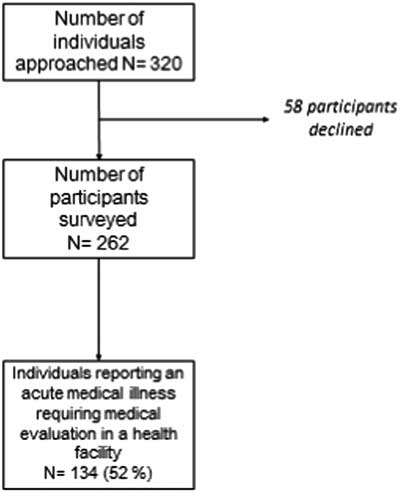
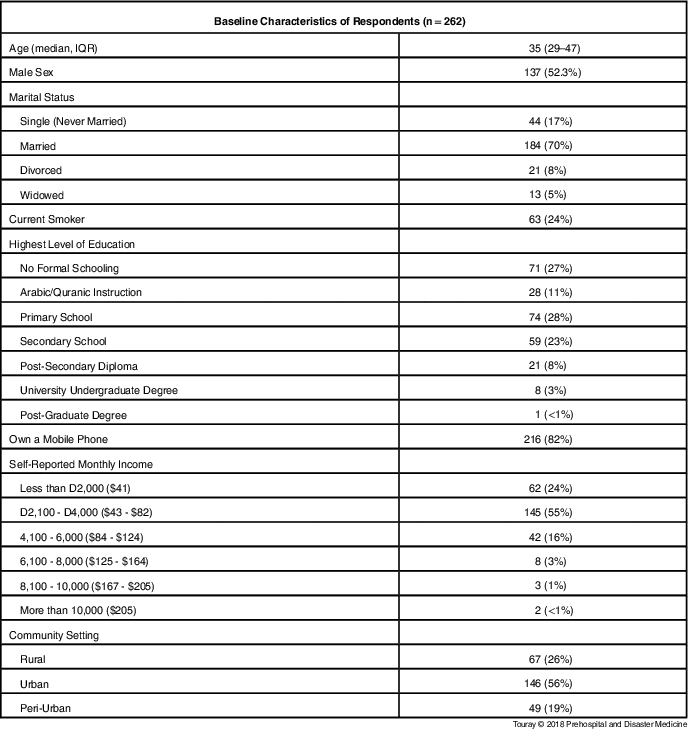
A total of 320 people were approached, of which, 262 agreed to participate in the survey, yielding a response rate of 82% (Figure 1). Baseline characteristics are presented in Table 1. The mean age was 35 years, 52% were men, and 70% of respondents were married. Over one-half of respondents (55%) reported a monthly income between GMD2,100 - 4,000 (US$43 - $82). The smoking prevalence rate was 24%, and 82% owned a mobile phone. Twenty-seven percent had no formal schooling, 28% attained a primary school education, 23% had a secondary school education, and 12% had an education above the secondary school level.
Survey Participant Recruitment.

Baseline Characteristics among Respondents in Various Communities in the Greater Banjul Area

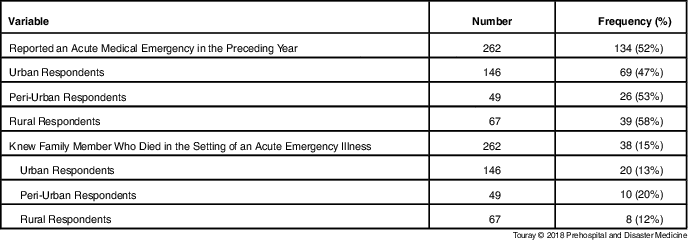
Among survey participants, 134 respondents (52%) reported experiencing an acute medical emergency condition in the preceding year (Figure 1 and Table 2). There was a higher incidence of self-reported acute medical emergencies among rural (58%) and peri-urban (53%) respondents compared to urban respondents surveyed (47%). Thirty-eight respondents (15%) reported that they knew a family member who died in the setting of an emergency illness in the preceding year. This was more frequently reported among respondents in peri-urban areas (20%) compared to urban (13%) and rural areas (12%).
Incidence of an Acute Emergency in the Preceding Year

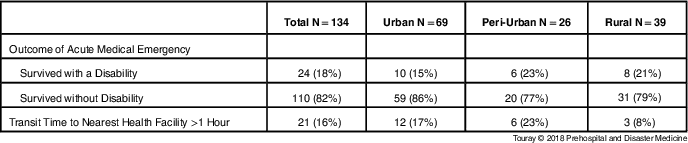
Among the 134 respondents who reported experiencing an acute medical emergency, 24 (18%) survived the incident with a disability (Table 3). When stratified by community type, the occurrence of a disability following a medical emergency was higher among respondents from peri-urban and rural communities (23% and 21%, respectively) compared to respondents in urban communities (15%). The reported travel time to a health facility during an emergency was under one hour for most respondents, with 21 respondents (16%) reporting a travel time to the nearest health facility of more than one hour. There were more respondents in peri-urban areas who reported travel times greater than one-hour (23%) compared to urban (17%) and rural (8%) respondents.
Outcomes Among Respondents Who Reported an Acute Medical Emergency in the Preceding Year

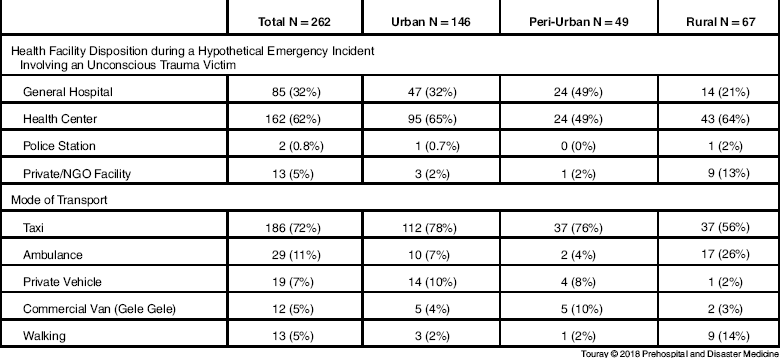
Table 4 summarizes responses to a hypothetical scenario in which a car struck a pedestrian unconscious. The most frequently chosen health facility for both rural and urban respondents in such a scenario was a health center with 162 respondents (62%) reporting that they would take an unconscious motor vehicle trauma victim to this type of health facility. When stratified by community type, more respondents in urban and rural areas selected a health center as the initial destination for an unconscious trauma victim (65% and 64%, respectively) compared to respondents in peri-urban areas (49%). The most common mode of transportation during such emergencies was a taxi with 186 respondents (72%) choosing this as the preferred mode of transport. Hypothetical taxi use was more common among urban (78%) and peri-urban respondents (76%) compared to respondents from rural areas (56%), where hypothetical ambulance use was more common (24%) compared to urban (7%) and peri-urban communities (4%).
Response to Hypothetical Scenario Following a Pedestrian vs Motor Vehicle Accidenta

Abbreviation: NGO, nongovernmental organization.
a Responses to a hypothetical scenario of a pedestrian knocked unconscious by a motor vehicle.
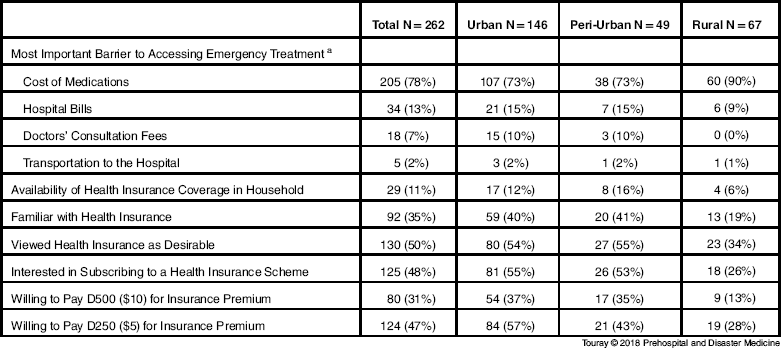
Table 5 shows responses to questions on the barriers to accessing health care during medical emergencies. Two-hundred-five respondents (78%) cited the cost of medicines as the most important barrier when seeking care during emergencies. The second most important barrier reported were hospital bills (13%). Costs of medications were cited as the most important barrier more frequently among respondents in rural communities (90%) compared to urban (73%) and peri-urban respondents (73%).
Measures of Cost and Health Insurance

a Respondents were asked what accounted for the largest share of health care spending in preceding year.
Responses to questions about medical insurance are also presented in Table 5. Twenty-nine respondents (11%) reported having any type of health insurance in their household, and this was higher among respondents in urban communities compared to peri-urban and rural communities. Ninety-two respondents (35%) were familiar with the concept of health insurance, and urban and peri-urban respondents were more familiar with health insurance than their rural counterparts (40% and 41% compared to 19% for rural residents, respectively). One-hundred-thirty respondents (50%) viewed health insurance as desirable, although fewer respondents in rural areas held such a view (34%) compared to their urban (54%) and peri-urban counterparts (55%). After brief counseling and education on the nature and benefits of health insurance, 125 respondents (48%) expressed interest in subscribing to a health insurance scheme if it were made available (Table 5). Similarly, more urban (55%) and peri-urban residents (53%) expressed interest in subscribing to health insurance than rural residents (26%).
Overall, 80 respondents (31%) were willing to pay GMD500 (US$10) as an annual health insurance premium. The number of respondents in urban, peri-urban, and rural areas willing to pay D500 (US$10) for insurance premiums were 54 (37%), 17 (35%), and nine (13%), respectively. When presented with a lower premium of GMD250 (US$5), 124 respondents (47%) reported that they were willing to pay this amount. The number of respondents willing to pay the reduced amount in urban, peri-urban, and rural areas were 84 (57%), 21 (43%), and 19 (28%), respectively (Table 5). In both instances, fewer respondents in rural areas were willing to pay the offered amount compared to their urban and peri-urban counterparts.
Responses to questions on health care funding are presented in Table 6. Overall, 186 respondents (71%) agreed with the statement that health services should be free at the point of care, and this was similar across the different communities with 68%, 76%, and 72% of respondents in urban, peri-urban, and rural communities stating this preference, respectively. One-hundred-thirty-one respondents (51%) agreed with the statement that health care should be fully funded by the Gambian government, and a similar number reported this preference in urban, peri-urban, and rural settings.
Responses to Questions on Health Care Funding

Discussion
The present study reveals a high incidence of mortality and disability associated with acute medical emergencies in a young population of adults across communities in The Gambia. Around one-half of the respondents in the present study reported an emergency incident requiring a visit to a health facility. This observation is similar to that of a recent survey in Ghana that found that approximately 75% of respondents had a prior experience with an emergency incident.Reference Mould-Millman, Rominski and Bogus16 Although this study does not delve into the nature of the emergency, it does suggest that the conditions for which respondents sought care were severe and associated with a high morbidity, as evidenced by the observation that 18% of respondents survived the acute medical emergency with a disability. A national disability survey performed in The Gambia two decades ago found that 12% of households had a resident with a disability, while a recent demographic and health survey found a peak disability prevalence of 13% among individuals age 55–64.17, 18 The findings of the present study suggest an increasing rate of disabilities in the country. The nature of the acute emergences can be inferred from findings of a recent survey of hospitals in the country which found that trauma, obstetric emergencies, stroke, and hypertensive emergencies were the major reasons for acute hospitalization among adults, respectively.4
The findings of this study can be explained using the “three delays” model originally described for maternal mortality.Reference Thaddeus and Maine19 First, there are delays in recognizing the need to seek care during acute illnesses due to a lack of knowledge of warning signs of severe clinical conditions. There are no studies that have looked at the community awareness of warning signs of common medical emergencies, including stroke, acute coronary syndromes, hypertensive, and diabetic emergencies, in The Gambia; however, data from the sub-region suggest a low level of awareness in the general public.Reference Donkor, Owolabi and Bampoh20, Reference Komolafe, Obembe and Olaogun21 This highlights an important need for the integration of community sensitization on the presentation and warning signs of common medical emergencies in the existing primary health care programs.Reference Kakou-Guikahue, N’Guetta and Anzouan-Kacou22 At the present time, there are no formal community training programs specifically targeting these conditions, in spite of robust evidence of their effectiveness in improving knowledge and promotion of early health-seeking behavior for conditions such as stroke, obstetric emergencies, and other cardiovascular and respiratory disease.Reference Stern, Berman and Thomas23–Reference Bryant-Stephens and Li29
Second, once a decision is made to seek medical attention, multiple barriers to care exist, including difficulties with transportation, lack of early resuscitation attempts during said transportation, and seeking care at facilities that are ill equipped to handle emergencies. The present study illustrates this point because when presented with a scenario of an unconscious trauma victim, most of the respondents reported that they would transport such a victim to a health center, which is a primary level facility that is poorly equipped and staffed by personnel who are poorly trained in delivering appropriate emergency care. Cham, et al found similar barriers among pregnant women with acute symptoms seeking care at an inappropriate level facility, some of whom had to go to two or more facilities before arriving at a facility capable of providing the appropriate level of care.Reference Cham, Sundby and Vangen30 These findings highlight a need for the incorporation of low-cost, acute emergency care training, including triage protocols for patients with trauma, respiratory failure, and obstetric emergencies at the community level.Reference Gomez, Berube and Xiong31–Reference Stolz, Muruganandan and Bisanzo33 Several studies have shown that training non-physician providers in emergency care services is both feasible and associated with improved outcomes in resource-limited settings.Reference Bitter, Rice and Periyanayagam32–Reference Nafissi, Saghafinia and Balochi38 At the present time, The Gambia does not have a prehospital Emergency Medical Service (EMS) and there are no trained physicians or mid-level providers in emergency medicine, even though it has been reported that more than one-half of all deaths and around one-third of all disability-adjusted life years in LMICs like The Gambia could be addressed through prehospital and facility-based EMS.Reference Marsh and Rouhani39
The transport time to a health facility was under one hour for most respondents. Respondents in the present study cited cost of medicines (and not transportation) as the most important barrier to accessing care during acute emergency conditions. Prior studies in the country have also reported short transit times with greater than 85% of the population residing within three to five kilometers of a health facility.Reference Cham, Sundby and Vangen40, Reference Telfer, Rowley and Walraven41 The short transit times reported in The Gambia are due to its small size measuring about 11,000 square kilometers and differs remarkably from the rest of the African sub-region where it is estimated that over 200 million people (29% of the African population) live more than a two-hour travel time away from emergency hospital care.Reference Ouma, Maina and Thuranira42 Additionally, the survey found that most acutely ill patients are transported by taxis and do not receive resuscitation during transport. This makes a strong case for the strengthening of access to EMS at the primary health care level, which was the most common disposition for acute medical emergencies. The lack of EMS and prehospital care in The Gambia results in a referral pattern for medical emergencies whereby critically ill patients are transferred to referral hospitals farther away, with poor communication between facilities during said emergencies.
Third, once patients arrive at health facilities, there is often a delay in receiving appropriate care due to lack of equipment, medications, blood products, and skilled professionals.Reference Razzak and Kellermann43, Reference Sodemann, Jakobsen and Mølbak44 A recent survey on critical care capacity in The Gambia found that most health facilities (including referral hospitals) lacked skilled health workers and equipment necessary to diagnose and resuscitate critically ill patients.Reference Kironji, Hodkinson and Ramirez45, Reference Touray, Sanyang and Zandrow46 This observation is crucial because it suggests that the chain of survival in an acute emergency can be strengthened significantly by the prompt initiation of simple, critical, time-sensitive interventions at primary health centers and village health posts, which were the most frequent disposition during emergencies in the present study.
Tackling the aforementioned challenges will require a novel strategy that simultaneously addresses the current needs for emergency services at major hospitals, while designing and implementing policies aimed at developing and scaling up access to EMS at health centers in the country. Historically, this effort has focused primarily on training physicians with the establishment of a medical school about a decade ago, as well as training community nurses. Currently, however, the country has no specialists or faculty trained in emergency medicine or critical care, and there is currently only one Gambian trauma surgeon in the country. Training specialists takes decades and current medical school enrollments are unlikely to meet the pressing demands for emergency care. Increasing current physician enrollment alone, therefore, will not meet the demands of skilled providers necessary to care for the large population with an annual growth rate of 3.3% and a projected population expected to exceed five million by 2050.Reference Touray, Sanyang and Zandrow46 One strategy that has the potential to close the deficit of skilled emergency care providers involves task shifting of emergency care through the establishment of prehospital care services, comprised of mid-level providers skilled in Basic Life Support and Advanced Cardiac and Trauma Life Support. This strategy has been implemented in other African countries and has been shown to result in improvements in outcomes.Reference Chamberlain, Stolz and Dreifuss34
In keeping with findings in the sub-region, out-of-pocket costs were a significant barrier to accessing appropriate care during emergencies.Reference Mould-Millman, Rominski and Bogus16, Reference Cham, Sundby and Vangen40, Reference Kironji, Hodkinson and Ramirez45 A 2011 survey in The Gambia reported that an average household spent around GMD 880 (US$35) per year on health care, of which medication costs accounted for the largest share of out-of-pocket expenditures.47 There was a low level of awareness of the concept of health insurance among respondents, and a low willingness to participate in a health insurance scheme after brief counseling during the survey. Because the country does not have a national health insurance scheme, it will have to design innovative, universal coverage funding mechanisms to cover essential medical services, including emergency medical care.
Limitations
This study was conducted in the Greater Banjul area, which is a predominantly urban setting with residents who are more educated and have a relatively higher income, which may influence the generalizability of the findings to other parts of the country where poverty and illiteracy rates are higher. This limitation suggests that reported estimates may be lower than would be found if other parts of the country were surveyed. Secondly, the estimates are based on self-reported recollections of survey respondents, which introduces recall bias with participants who had more severe illnesses reporting this more frequently than those with mild illnesses.
Conclusion
Acute medical emergencies are highly prevalent in The Gambia and are associated with a high mortality and disability rate due to low health literacy, difficulty accessing health facilities, and poor access to EMS at the primary health care level. Improvements in life expectancy and achievement of the country’s long-term goals are more likely to be realized if programs are developed that scale up the capacity of primary health care facilities to deliver acute emergency services.
Acknowledgements
The authors would like to thank Mustapha Manneh for his contribution to this study. They would also like to acknowledge the support of Saffie Lowe-Ceesay and Scott E. Kopec, MD, FCCP for their support in the conduct of this study.
Authors Contributions
ST, GZ, and BS designed the study and contributed to analysis and draft manuscripts. All authors were involved, provided analysis, and write up and final corrections of the manuscript.
Supplementary Material
To view supplementary material for this article, please visit https://doi.org/10.1017/S1049023X1800105X