Introduction
Post-traumatic stress disorder (PTSD) symptomatology, as described in DSM-IV, include intrusive memories and thoughts, avoidance and numbing, and persistent symptoms of arousal (APA, 1994). Whereas several studies have focused on prevalence, trajectories and the phenomenology of these symptoms (Dougall et al. Reference Dougall, Craig and Baum1999; Breslau, Reference Breslau2001; Ehlers et al. Reference Ehlers, Hackmann and Michael2004; O'Donnell et al. Reference O'Donnell, Elliott, Lau and Creamer2007), research focusing on PTSD symptom dimensionality and cluster interplay over time are still scarce (Solomon et al. Reference Solomon, Horesh and Ein-Dor2009). In fact, as far as we know, only four studies to date (Schell et al. Reference Schell, Marshall and Jaycox2004; Marshall et al. Reference Marshall, Schell, Glynn and Shetty2006a ; Solomon et al. Reference Solomon, Horesh and Ein-Dor2009; Pietrzak et al. Reference Pietrzak, Feder, Schechter, Singh, Cancelmo, Bromet, Katz, Reissman, Ozbay and Sharma2014) have examined the course and symptom interplay in PTSD clusters over time.
In the first of these studies, Schell et al. (Reference Schell, Marshall and Jaycox2004) reported that PTSD symptom clusters were differentially interrelated over time, with the hyperarousal cluster appearing as the strongest predictor of symptom severity. In particular, violence victims in a ‘hyperarousal prominent group’ showed little symptom improvement over the course of 1 year, whereas violence victims in an ‘other symptom prominent’ group improved substantially within the same time period. In the second study (Marshall et al. Reference Marshall, Schell, Glynn and Shetty2006a ), these findings were replicated in a sample of patients with orofacial injury resulting from assaultive violence or accidents. The results again pointed to the central role of hyperarousal symptoms. In fact, hyperarousal symptoms were shown to be ‘more influential’ over a 12-month period than re-experiencing and avoidance clusters' autoregressive effects themselves. In the third study (Solomon et al. Reference Solomon, Horesh and Ein-Dor2009), similar findings were reported in a sample of ‘clinical’ and ‘non-clinical’ war veterans. The results again showed that hyperarousal symptoms predicted avoidance and intrusions over and above their autoregressive estimates over a period of 1 year. In addition, intrusions predicted hyperarousal from 1 year to the next in the ‘non-clinical group’. Finally, in the fourth study, Pietrzak et al. (Reference Pietrzak, Feder, Schechter, Singh, Cancelmo, Bromet, Katz, Reissman, Ozbay and Sharma2014) examined how PTSD symptom clusters interrelated over 3, 6 and 8 years after 9/11 in police and ‘non-traditional’ responders. Their results, within a five-cluster framework of PTSD symptomatology, suggested that anxious arousal might be the primary driver behind the development of intrusions, while dysphoric arousal might drive the development of emotional numbing symptoms. Taken together, all four studies identify hyperarousal symptoms as the ‘psychological engine’ (Solomon et al. Reference Solomon, Horesh and Ein-Dor2009) for early symptom formation and longitudinal development of post-traumatic stress symptomatology. However, this interpretation of findings are somewhat challenged by two merited theoretical models of PTSD presented by Rubin et al. (Reference Rubin, Berntsen and Bohni2008) and Ehlers & Clark (Reference Ehlers and Clark2000), respectively.
According to Rubin and colleagues' memory-based model of PTSD, a general theoretical understanding of memory and emotion should be used to understand the nature of traumatic memories and how they generate PTSD symptoms. According to their model, it is the memory of the traumatic event, and not the event itself that determines trauma symptoms, which suggest a shift from ‘a pathogenic event’ perspective to a ‘pathogenic memory’ perspective of PTSD development and chronicity maintenance (Rubin et al. Reference Rubin, Berntsen and Bohni2008). In other words, a disturbing memory from a traumatic experience should be thought of as the driving factor behind the manifestation and maintenance of psychopathology, not the event itself.
In the second model, Ehlers & Clark (Reference Ehlers and Clark2000) suggest that PTSD becomes persistent when individuals appraise memories of a traumatic event in such a way that the memory produces a sense of serious, current threat. Positive changes in appraisals and the trauma memory itself are prevented by a series of dysfunctional coping strategies. In other words, psychopathology is again related to the memories of the incident and the appraisal of these, which in turn creates a sense of serious, current threat. As suggested in the aforementioned studies, hyperarousal symptoms also play a prominent role in Ehlers & Clark's model, but these symptoms are thought to be provoked by the memory of the incident, not the other way around.
Some methodological issues in the four aforementioned studies also need to be addressed. All four studies differ in respect to their assessment period length and in timing of measurements. While the first two studies (Schell et al. Reference Schell, Marshall and Jaycox2004; Marshall et al. Reference Marshall, Schell, Glynn and Shetty2006a ) capture a very interesting period of early symptom formation, we also need to know what happens beyond the 1-year mark. In their study of the 1982 Lebanon war, Solomon et al. (Reference Solomon, Horesh and Ein-Dor2009) investigated a 20-year time period with three measurements spaced 1, 2 and 18 years apart. Here, between the two first measurements, we would expect symptomatology at the first assessment to influence the next. However, as noted by the authors, it is not clear as to how, e.g. symptoms of avoidance should predict change in other symptom clusters from the second assessment (2 years after the war) to the third assessment 18 years later. Finally, Pietrzak et al. (Reference Pietrzak, Feder, Schechter, Singh, Cancelmo, Bromet, Katz, Reissman, Ozbay and Sharma2014) investigated a later time period with three assessments spaced 3, 6 and 8 years after 9/11, leaving out ‘early’ symptom formation.
The characteristics of the samples in the four studies should also be mentioned. In all the studies, samples only include directly exposed participants and are mainly limited to specific groups such as policemen, construction workers, war veterans and victims of violence, predominantly consisting of men (>84%). The two studies measuring the first 12 months after trauma also include relatively small samples (Schell et al. Reference Schell, Marshall and Jaycox2004; Marshall et al. Reference Marshall, Schell, Glynn and Shetty2006a ). This limits the generalizability of the results, especially considering that indirectly exposed populations are overlooked (May & Wisco, Reference May and Wisco2016).
Finally, none of the studies reviewed here included functional correlates in their analyses. Although the link between impaired functioning, diminished quality of life and PTSD is well-documented (Zatzick et al. Reference Zatzick, Marmar, Weiss, Browner, Metzler, Golding, Stewart, Schlenger and Wells1997; Mendlowicz & Stein, Reference Mendlowicz and Stein2000; Dobie et al. Reference Dobie, Kivlahan, Maynard, Bush, Davis and Bradley2004; Holowka & Marx, Reference Holowka and Marx2012; Rodriguez et al. Reference Rodriguez, Holowka and Marx2012), less is known about the relationships between unique symptom clusters and such impairment over time. In order to fulfil the diagnostic criteria for PTSD, criterion G in DSM-5 must be met. Criterion G states that ‘The disturbance causes clinically significant distress or impairment in social, occupational, or other important areas of functioning’ (DSM-5, APA, 2013). In other words, before a comprehensive theoretical model of PTSD symptom formation and interplay can be fully formulated we also need to understand how the different PTSD dimensions relate to other functional correlates significant to trauma-exposed individuals (Elhai & Palmieri, Reference Elhai and Palmieri2011).
Considering the low number of empirical studies examining the longitudinal PTSD symptom cluster interplay and the aforementioned methodological and theoretical considerations, further examinations of this subject in a wider range of contexts, populations and time frames are warranted. The aim of the present study is therefore threefold; (1) to examine longitudinal symptom interplay in individuals directly or indirectly exposed to terrorism using a five-cluster model of PTSD, (2) to explore whether this conceptualization of the PTSD symptomatology shows utility in predicting everyday functioning in revealing associations between specific PTSD clusters and concurrent functional impairment, and (3) to expand on contemporary models of PTSD development and chronicity.
Method
Design and participants
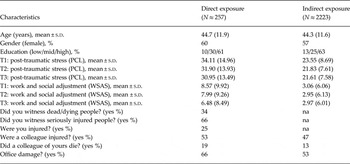
The study used a longitudinal design with three waves of data collection conducted roughly 10 (T1), 22 (T2) and 34 (T3) months after the Oslo terrorist attack, 22 July 2011 as seen in Fig. 1. All employees in all of the 17 Norwegian ministries were invited to participate at T1. Employees who did not withdraw were assigned a unique project ID number and sent an invitation containing a code to access the study's web-based questionnaire. The final sample consisted of directly (n = 257) and indirectly (n = 2223) exposed government employees as shown in Table 1. The study was approved by the Regional Committee for Medical and Health Research Ethics, and all participants were informed about the purpose and content of the study as well as the opportunity to withdraw.
Assessment timeline. The present study indicated with grey.

Characteristics of the sample

PCL, Post-traumatic Checklist; WSAS, Work and social adjustment scale.
Demographics
Demographic data, including, e.g. gender, age, and educational level were collected. Educational level was divided into categories of low, mid and higher education, corresponding to ‘<13 years’, ‘13–16 years’ and ‘>16 years’, respectively.
Direct and indirect exposure
Exposure to the actual site or epicenter of the explosion was assessed by asking employees where they were located when the bomb went off, using five exposure categories: (1) ‘in the government district downtown’, (2) ‘in downtown Oslo, but not in the government district’, (3) ‘in Oslo, but not downtown’, (4) ‘in Norway, but not in Oslo’ and (5) ‘abroad’. These categories were subsequently collapsed into two categories (1 and 2–5) reflecting direct and indirect exposure. We also asked whether participants had, for example, witnessed dead or dying people; whether they had witnessed people seriously injured; and whether they had been physically injured themselves (see Table 1 for details).
Post-traumatic check list (PCL)
PTSD symptoms were assessed using a Norwegian version (Hem et al. Reference Hem, Hussain, Wentzel-Larsen and Heir2012) of the PCL (Weathers et al. Reference Weathers, Litz, Herman, Huska and Keane1993). The PCL is a 17-item self-administered questionnaire that assesses the full PTSD domain described in DSM-IV (APA, 1994). In the present study the PCL-S version was used (Weathers et al. Reference Weathers, Litz, Herman, Huska and Keane1993; Blanchard et al. Reference Blanchard, Jones-Alexander, Buckley and Forneris1996; Forbes et al. Reference Forbes, Creamer and Biddle2001). In this version the symptoms endorsed are specifically linked to a traumatic event, and instructions to consider the Oslo bombing of 22 July 2011 as reference point were given. In PCL respondents are asked to what degree they have been bothered by each symptom (e.g. unpleasant memories, nightmares, sleep disturbances, etc.) in the previous month on a scale ranging from 1, ‘not at all’ to 5, ‘extremely’, with a total score of 85. The Norwegian version of the scale has been shown to perform well as a diagnostic instrument for detecting PTSD in the Norwegian population (Hem et al. Reference Hem, Hussain, Wentzel-Larsen and Heir2012). In the present sample the internal consistency of the PCL was high with a Cronbach's α of 0.94. Subscale symptom clusters within PCL were grouped according to the ‘Dysphoric arousal model’ in line with recent factor recommendations for DSM-IV-based measures (Elhai & Palmieri, Reference Elhai and Palmieri2011; Pietrzak et al. Reference Pietrzak, Feder, Schechter, Singh, Cancelmo, Bromet, Katz, Reissman, Ozbay and Sharma2014; Armour et al. Reference Armour, Műllerová and Elhai2016). This grouping corresponds to Intrusions/Re-experiencing (items 1–5), Avoidance (items 6–7), Emotional numbing (items 8–12), Dysphoric arousal (items 13–15) and Anxious arousal (items 16–17).
Work and social adjustment scale (WSAS)
In an effort to assess the burden of PTSD symptomatology, a five-item scale of functional impairment attributable to an identified problem/disorder was utilized (Mundt et al. Reference Mundt, Marks, Shear and Greist2002). According to the authors the WSAS exhibits strong psychometric properties (Cronbach's α = 0.79–94) across several studies. In the present sample the internal consistency of a Norwegian version of WSAS was high with a Cronbach's α of 0.96. Items include statements such as. ‘Because of my disorder my ability to work is impaired’ and/or ‘Because of my disorder my social leisure activities (with other people, such as parties, bars, clubs, visits, dates and home entertainment) are impaired’. Scores range from (0) ‘not at all impaired’ to (8) ‘very severely impaired’, with a total score of 40. According to Mundt et al. a WSAS score of ⩾20 indicates moderately severe or worse psychopathology, whereas scores <10 are associated with subclinical populations. Scores between 20 and 10 suggest significant impairment, but less severe symptomatology.
Statistical analyses
We used structural equation modelling (SEM) to analyse the relationships between symptom clusters and functional impairment over time. SEM analyses were conducted in four steps. In the first step, we used confirmatory factor analyses to examine the measurement models. In the second step, we examined the concurrent and cross-lagged relationships by specifying a series of cross-lagged panel models for directly and indirectly exposed individuals together in a multi-group model. However, preliminary analyses indicated that the processes in the two groups were too different to be appropriately represented by a single multi-group model. The two groups were therefore analysed separately. We started the model building process with a minimal set of paths, and then added paths as suggested by the data and the model modification indices (Little, Reference Little2013). In the first model, each variable was assumed to be predicted by itself measured 1 year previously (autoregressive paths) and all variables measured simultaneously assumed to be associated with each other. Modification indices were used to suggest paths until the best-fitting model was ascertained.
All data modelling were performed with Mplus version 7.11 (Muthén & Muthén, Reference Muthén and Muthén1998–Reference Muthén and Muthén2014). To correct for the somewhat skewed distributions, maximum-likelihood estimation with robust errors (MLR) was applied. To determine model fit, χ2, root mean square error of approximation (RMSEA), and comparative fit index (CFI) were assessed. Values of RMSEA <0.05 and values of CFI >0.95 were considered to denote a well-fitting model (Browne & Cudeck, Reference Browne and Cudeck1992; Hu & Bentler, Reference Hu and Bentler1999). To test differences between models, Satorra–Bentler χ2 difference tests were used (Satorra & Bentler, Reference Satorra and Bentler2001).
Missing data
Most missing data were due to wave non-response at T1, T2 or T3. To assess selective participation, participation at T2 was regressed on scores of post-traumatic stress at T1, and participation at T3 was regressed separately on scores of post-traumatic stress at T1 and T2. Logistic regression revealed that a higher level of post-traumatic stress at T1 increased probability of responding at T2 [odds ratio (OR) 1.206, p = 0.038]. Furthermore, a higher level of post-traumatic stress at T1 and T2 also increased probability of responding at T3 (OR 1.509, p = 0.000, and OR 1.512, p = 0.000, respectively). Thus, missing was related to one of the measured variables, which is consistent with a situation which is often termed missing at random (MAR) (Enders, Reference Enders2010). Thus, the Mplus 7.11 inbuilt full information maximum likelihood (FIML) estimation with robust standard errors was used to handle missing data. This approach assumes data are MAR, and all observed information is used to produce the maximum-likelihood estimation of parameters. This is one of the best approaches currently available to handle missing data (Graham, Reference Graham2009).
Results
Preliminary confirmatory factor analyses
To assess the measurement models at each time point, a series of confirmatory factor analyses were conducted. A model with five correlated factors was superior to models, other commonly proposed three- and four-factor models. The model fits were good at both T1 [χ2(242, N = 1872) = 651.244, p < 0.05, CFI = 0.956, RMSEA = 0.043], T2 [χ2(242, N = 1692) = 607.135, p < 0.05, CFI = 0.951, RMSEA = 0.042] and T3 [χ2(242, N = 1516) = 620.040, p < 0.05, CFI = 0.949, RMSEA = 0.045].
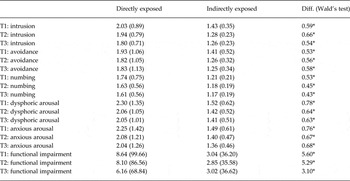
Levels of symptom clusters and functional impairment over time
Table 2 presents estimated means and variance of the variables at each time point, and shows that individuals who were directly exposed to the attack reported higher levels for all symptom clusters and also higher levels of functional impairment. Levels of all symptom clusters declined somewhat from T1 to T2, but were relatively stable from T2 to T3. An exception is anxious arousal, which seems to decline also from T2 to T3.
Estimated means (variance) of clusters and functional impairment after 10 months (T1), 2 years (T2), and 3 years (T3) in directly and indirectly exposed individuals

* Wald p < 0.001.
Associations between symptom clusters and functional impairment over time
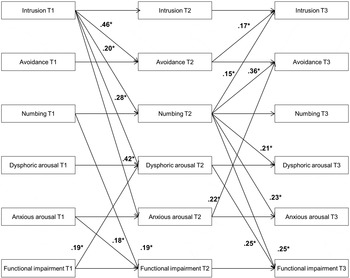
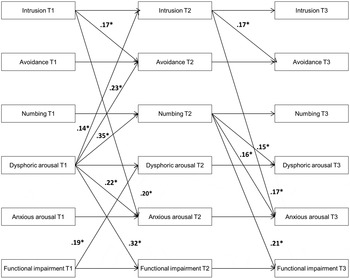
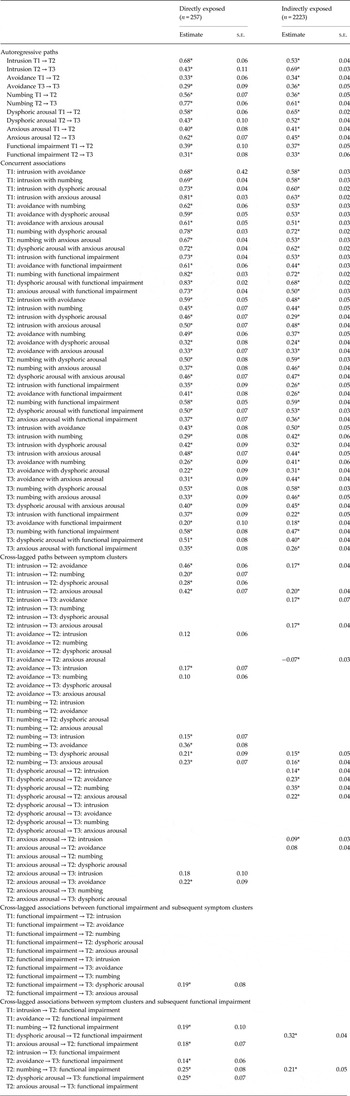
Among those directly exposed, a stability model with no cross-lagged paths did not fit the data well [χ2(96, N = 257) = 296.274, p < 0.05, CFI = 0.899, RMSEA = 0.090]. By using the modification indices to suggest paths to include, we added paths into the model until further changes did not significantly improve the model fit. Model fit of the final model was: [χ2(77, N = 257) = 111.698, p < 0.05, CFI = 0.982, RMSEA = 0.042]. Similarly, among those indirectly exposed, a stability model did not fit the data well: [χ2(96, N = 2223) = 536.807, p < 0.05, CFI = 0.924, RMSEA = 0.045]. After adding paths as suggested by the modification indices, the model was significantly improved: [χ2(96, N = 2223) = 251.522, p < 0.05, CFI = 0.971, RMSEA = 0.031]. Standardized autoregressive, concurrent, and cross-lagged associations for both subgroups are shown in Table 3 and Figs 2 and 3 present the significant cross-lagged paths >0.15.
Cross-lagged model with standardized estimates of relationships between symptom clusters and functional impairment for the directly exposed group. Only significant cross-lagged relationships >0.15 are shown.

Cross-lagged model with standardized estimates of relationships between symptom clusters and functional impairment for the indirectly exposed group. Only significant cross-lagged relationships >0.15 are shown.

Final estimates of autoregressive, concurrent and cross-lagged associations between symptom clusters and functional impairment in directly and indirectly exposed individuals

*p < 0.05.
The estimates of the autoregressive paths showed that all clusters had a stable component over time, and that the most stable cluster was the emotional numbing cluster. The concurrent associations indicated that whereas all clusters were associated with each other, some were more closely related. For example, intrusion, dysphoric and anxious arousal were highly correlated, especially at T1 among those directly exposed to the attack. Regardless of time, functional impairment was most strongly related with concurrent high levels of numbing and dysphoric arousal in both groups.
In the directly exposed group, the estimates of the cross-lagged paths indicated that high levels of intrusion at T1 were associated with higher levels in all symptom clusters at T2, whereas high levels of numbing at T2 were associated with higher levels in all symptom clusters at T3. Furthermore, avoidance at T2 was associated with higher levels of intrusion at T3, and anxious arousal at T2 was associated with avoidance at T3.
In the indirectly exposed group, the patterns of the main cross-lagged paths were somewhat different. Here high levels dysphoric arousal at T1 was associated with higher symptom levels in all of the clusters at T2. Similarly to the directly exposed group, intrusions at T1 and T2 also predicted anxious arousal at the subsequent measurement point, but estimates were small (e.g. 0.15) as shown in Fig. 3.
Discussion
The present study examined the longitudinal relationship between PTSD symptom clusters and their associations with functional impairment in individuals directly and indirectly exposed to terrorism. The results for the directly exposed group showed that intrusions, measured 10 months after the event, predicted all symptom clusters at the next measurement point, approximately 2 years after the event. However, in the indirectly exposed group, dysphoric arousal played the most prominent role in predicting all symptom clusters at the same 2-year measurement. Furthermore, emotional numbing seemed to be the main driver behind prolonged stress 3 years after the event for both groups. Functional impairment was predominately associated with dysphoric arousal and emotional numbing in both groups. In the following paragraphs, we outline an exposure-dependent model of post-traumatic symptom development and maintenance based on current results, Rubin et al.'s (Reference Rubin, Berntsen and Bohni2008) memory-based model of PTSD and Solomon et al.’s (Reference Solomon, Horesh and Ein-Dor2009) ‘psychological engine’ metaphor.
Direct exposure
For the directly exposed group in this study, the intrusion cluster, measured 10 months after the attack, emerged as the best single predictor of subsequent symptom severity by directly influencing all other symptom clusters 1 year later. In fact, cross-lagged relationships linking intrusions at 10 months to avoidance and anxious arousal at 22 months were stronger than their autoregressive paths.
Building on Solomon et al.’s (Reference Solomon, Horesh and Ein-Dor2009) ‘psychological engine’ metaphor, this might indicate that when individuals are directly exposed, intrusive memories of the traumatic event function as a ‘fuel’ for an anxious arousal ‘spark plug’, and together these two primary symptoms create the ‘psychological engine’ that maintain symptom levels and dynamic symptom interplay over time. Theoretically, this is in line with Rubin et al.'s (Reference Rubin, Berntsen and Bohni2008) memory-based model of PTSD and Ehlers & Clark's (Reference Ehlers and Clark2000) cognitive model of PTSD, in indicating that it is both the memory of the event and the following negative, arousal-provoking appraisal of the memory that together drive symptom development and chronicity.
Together, intrusions and anxious arousal can in turn cause dysphoric arousal, i.e. irritability, sleep disturbances and concentration problems. The lack of sleep and feelings of restlessness caused by intrusions and arousal might eventually affect cognitive functions (Parslow & Jorm, Reference Parslow and Jorm2007) that help individuals explore, control and cope with negative thoughts, again letting intrusive memories pass into consciousness more frequently. In other words, it may not be primarily anxious arousal symptoms that trigger the intrusions; rather, it may be the fatigue caused by the dysphoric arousal symptoms that breaks down our ability to handle such intrusions effectively. In line with this, the literature suggests that disturbed sleep can contribute to maladaptive trauma responses and may constitute a risk factor for mental health outcomes (Bryant et al. Reference Bryant, Creamer, O'Donnell, Silove and McFarlane2010; Germain, Reference Germain2013). In an effort to cope, individuals often revert to experiential avoidance, possibly expending cognitive, behavioral, and emotional efforts in an attempt to manage their symptoms, thereby exhausting or depleting emotional resources in the process (Litz, Reference Litz1992; Litz et al. Reference Litz, Litz and Gray2002; Yoshihama & Horrocks, Reference Yoshihama and Horrocks2005; Palyo et al. Reference Palyo, Clapp, Beck, Grant and Marques2008; Solberg et al. Reference Solberg, Blix and Heir2015). Over time this can create a state of emotional numbness. Finally, such a state of emotional numbness might in turn maintain levels of intrusions, dysphoric arousal, anxious arousal and avoidance, as suggested by our results.
Indirect exposure
When individuals are indirectly exposed, intrusions naturally play a less salient role. Re-occurring thoughts do not contain imagery that triggers the anxious arousal ‘spark plug’ to the same degree. Although a pattern linking intrusions to avoidance and anxious arousal was also found in this group, the intrusion cluster appears to play a modest role in predicting subsequent symptom severity. Instead, dysphoric arousal emerged as the best single predictor of subsequent symptom severity, directly influencing all other symptom clusters from the 10-month measurement, with an especially strong cross-lagged relationship with emotional numbing. In other words, the aforementioned ‘engine’ that drive symptom levels in the directly exposed group receives less potent or no ‘fuel’ at all from intrusions in the indirectly exposed group, resulting in lower symptom levels overall. Instead a sequela of dysphoric arousal and emotional numbing possibly related to depressive symptoms or negative affect seem to emerge (Byllesby et al. Reference Byllesby, Durham, Forbes, Armour and Elhai2016b ). It should be noted that only 3.7% in the indirectly exposed group had scores indicating probable PTSD, compared to 24% in the directly exposed group (Hansen et al. Reference Hansen, Nissen and Heir2013). Instead, individuals in the indirectly exposed group seem to some degree report symptoms within the PTSD symptomatology that overlap with concurrent symptoms of depression (Solberg et al. Reference Solberg, Blix and Heir2015; Byllesby et al. Reference Byllesby, Charak, Durham, Wang and Elhai2016a ). This in turn might further explain why intrusive and anxious arousal symptoms played a more modest role in predicting subsequent symptom severity in this group.
Symptom interplay and functional impairment
In the present study, the separation of hyperarousal into the anxious arousal and dysphoric arousal clusters showed predictive utility, as dysphoric arousal symptoms, but not anxious arousal symptoms, together with emotional numbing were most strongly and reliably associated with functional impairment over time. This was especially true for the directly exposed group. This is in accordance with the notion that emotional numbing and parts of the hyperarousal cluster appears to have especially deleterious effects on functional outcomes (Marshall et al. Reference Marshall, Turner, Lewis-Fernandez, Koenan, Neria and Dohrenwend2006b ; Maguen et al. Reference Maguen, Stalnaker, Mccaslin and Litz2009; Heir et al. Reference Heir, Piatigorsky and Weisæth2010; Pietrzak et al. Reference Pietrzak, Goldstein, Malley, Rivers and Southwick2010; Gootzeit & Markon, Reference Gootzeit and Markon2011).
Interestingly, re-experiencing/intrusions were not responsible for impairment in work and social functioning. Although intrusions and anxious arousal symptoms may be critical for the formation and maintenance of PTSD symptomatology, it might be that the symptom sequela that these symptoms produce plays the most important role in the functional impact of PTSD symptomatology. Consistent with this interpretation, a study by Shnaider et al. (Reference Shnaider, Vorstenbosch, Macdonald, Wells, Monson and Resick2014) found that reductions in hyperarousal symptoms were positively associated with overall psychosocial functioning. Moreover, improvements in emotional numbing symptoms were positively associated with function in social domains. Regrettably, the hyperarousal cluster in their study was not divided into anxious arousal and dysphoric arousal which would have enabled a more accurate comparison with our results. Still, as argued in the present study, Shnaider et al. (Reference Shnaider, Vorstenbosch, Macdonald, Wells, Monson and Resick2014) discuss the possibility that certain hyperarousal symptoms (i.e. sleep disturbances, difficulty concentrating, hypervigilance) may be particularly detrimental to individuals’ ability to complete daily activities. Similar results were found in a study by Pietrzak et al. (Reference Pietrzak, Goldstein, Malley, Rivers and Southwick2010). Here the authors suggested that dysphoria symptoms (again incorporating items concerning sleep disturbance, irritability and difficulty concentrating) were most strongly associated with a broad range of psychosocial variables, as well as suicidal ideation and mental health treatment utilization.
Clinical implications
When we are confronted with reminders of traumatic experiences, intrusions can overwhelm us completely, and attempts to inhibit them will follow. In individuals with PTSD this ability seems to be compromised (Catarino et al. Reference Catarino, Küpper, Werner-Seidler, Dalgleish and Anderson2015) and since we cannot erase or un-live the event, an alternative may be to reduce the arousal associated with the intrusions that arise. In fact, previous studies have shown that trauma recovery is likely to occur when memories lose their sensory richness (Stickgold, Reference Stickgold2002). If the potency of a reoccurring intrusive memory is gradually reduced there will be less intense anxious arousal which in turn will attenuate other symptoms over time. Here, individual differences might be particularly relevant, as attentional bias to threat, idiosyncrasies in fear conditioning and fear extinction processes have been shown to be core characteristics of trauma-related psychopathology (Berman et al. Reference Berman, Wheaton, Mcgrath and Abramowitz2010; Fani et al. Reference Fani, Tone, Phifer, Norrholm, Bradley, Ressler, Kamkwalala and Jovanovic2012). In light of this, therapeutic interventions, such as eye movement desensitization and reprocessing, that aim to calm the initial arousal associated with the memory of the event (Sack et al. Reference Sack, Lempa, Steinmetz, Lamprecht and Hofmann2008; Lee & Cuijpers, Reference Lee and Cuijpers2013; van den Hout et al. Reference van den Hout, Eidhof, Verboom, Littel and Engelhard2013; Leer et al. Reference Leer, Engelhard and Van Den Hout2014), should be especially effective. On the other hand, indirectly exposed individuals or individuals suffering from more depression-like symptoms should benefit from therapeutic techniques that to a larger extent target symptoms within the dysphoric arousal and emotional numbing clusters.
Limitations
This study is part of a lager research project and previously published papers have noted limitations concerning response rate, sample characteristics and measures (Hansen et al. Reference Hansen, Nissen and Heir2013; Birkeland et al. Reference Birkeland, Hafstad, Blix and Heir2015; Nissen et al. Reference Nissen, Birkeland Nielsen, Solberg, Bang Hansen and Heir2015). Specifically for the present study we note the following.
First, PTSD is known to develop within the first months following a traumatic event, so when we describe the formation and development of PSTD symptomatology over a 3-year period from a starting point of 10 months, it is important to remember that we only have measured simple associations between clusters at a specific period in time. Still, associations or trends can help us create models that tell us something about what is going on within shorter time periods. As argued in the present study, if, for example, intrusions predict anxious arousal 1 year later, it is not far-fetched to think that an intrusion will also predict anxious arousal 1 min, or even 1 s after entering consciousness. Over time many such processes will create the trends that we observe.
Second, with the first measurement placed 10 months after the attack, it could also be argued that we lost important information in regards to early symptom interplay and therefore only measure processes that maintain symptom levels or chronicity over time. As described in the Introduction, the first two studies (Schell et al. Reference Schell, Marshall and Jaycox2004; Marshall et al. Reference Marshall, Schell, Glynn and Shetty2006a ) focused on a period of early symptom formation and found that temporal progression of all symptom clusters were determined by hyperarousal symptoms across all intervals. In the present study we therefore cannot rule out that an additional measurement placed before the 1-month mark would reveal early symptom development similar to the one found in the studies of Schell et al. (Reference Schell, Marshall and Jaycox2004) and Marshall et al. (Reference Marshall, Schell, Glynn and Shetty2006a ).
Third, since we had little previous research to build upon we started with a stability model in our analyses where all constructs were regressed on themselves measured at the previous time point, and all constructs measured at the same time were allowed to be correlated. We then added paths as suggested by the data and the model modification indices until the modification indices suggested no modification that would result in a statistically significant reduction in χ2. A weakness of this strategy is that it may lead to model misspecification and overfitting due to chance associations in the sample. Moreover, when using a five-factor framework corresponding to Pietrzak et al. (Reference Pietrzak, Feder, Schechter, Singh, Cancelmo, Bromet, Katz, Reissman, Ozbay and Sharma2014) some clusters will consist of only 2–3 items. This might increase the probability of chance findings in a sample of a moderate size. Results should therefore be interpreted with some caution.
Finally, a more comprehensive measure of functional impairment would have been desirable. In the present study, we assessed functioning in work and social domains rather than more comprehensively assessing functional outcomes, possibly leaving out important information that could have broadened the scope of our findings.
Conclusions
In the present study we integrate previous findings with our own results and propose an exposure-dependent version of Rubin et al.'s memory-based model for PTSD. The model highlights an exposure-dependent, dynamic relationship between intrusions and anxious arousal symptoms and these symptoms primary role in the course of PTSD development and chronicity. Furthermore, the model also emphasizes the close relationship between dysphoric arousal, emotional numbing and functional impairment within both directly and indirectly exposed groups. Still, meta-analyses of existing research incorporating autoregressive cross-lagged panel designs from prospective studies are warranted in order to further gather evidence for this possible exposure-dependent, dynamic relationship between intrusions and anxious arousal symptoms and these symptoms primary role in the temporal course of PTSD development, chronicity and functional impairment. Future research should also attempt to incorporate more comprehensive measures of impairment and functional outcomes (e.g. problem drinking, violent behaviours, use of prescription drugs, etc.) in addition to important factors (e.g. sex, coping strategy, centrality of the event, negative affect) that could broaden the scope of the literature.
Supplementary material
For supplementary material accompanying this paper visit http://dx.doi.org/10.1017/S0033291716001860.
Acknowledgements
This work was funded by the Norwegian Directorate of Health and the Research Council of Norway, project number 227039/H20.