Introduction
People with dementia experience the full range of acute illnesses and are relatively high users of general hospitals. Common reasons for hospitalization include hip fractures and other injuries, lower respiratory tract infections, urinary tract infections, strokes and delirium (Natalwala et al., Reference Natalwala, Potluri, Uppal and Heun2008; Zuliani et al., Reference Zuliani2011).
There is evidence that people with dementia can experience a range of adverse outcomes in hospitals (Kurrle, Reference Kurrle2006), including functional decline, polypharmacy, undernutrition, skin tears, pressure areas, fall-related injuries, nosocomial infections and deconditioning (Torian et al., Reference Torian, Davidson, Fulop, Sell and Fillit1992; Creditor, Reference Creditor1993; Foreman and Gardner, Reference Foreman and Gardner2005; Borbasi et al., Reference Borbasi, Jones, Lockwood and Emden2006). In some studies, the relatively high case-mix complexity of older patients with dementia contributes to longer hospital stays and this has an impact on a patient's physical and mental state (Nichol et al., Reference Nichol, Lonergan and Mould2000; ACEMA, 2003; King et al., Reference King, Jones and Brand2006; Zekry et al., Reference Zekry2009). These adverse outcomes may also result in increased mortality or increased risk of transfer to nursing home care, although there are discrepant findings (Peut et al., Reference Peut, Hogan, Goss, Mann and Levings2007; Zekry et al., Reference Zekry2009; Zuliani et al., Reference Zuliani2011).
Previous research into the acute hospitalization of persons with dementia has focused on older patients (Saravay et al., Reference Saravay2004; Natalwala et al., Reference Natalwala, Potluri, Uppal and Heun2008; Zekry et al., Reference Zekry2009; Douzenis et al., Reference Douzenis2010; Zuliani et al., Reference Zuliani2011). Early-onset dementia is clinically more heterogeneous than late-onset dementia, with a number of causes such as HIV/AIDS-related dementia, alcohol-related dementia and dementia secondary to multiple sclerosis that might require medical treatment for the dementia or related conditions (Harvey et al., Reference Harvey, Skelton-Robinson and Rossor2003; Withall and Draper, Reference Withall and Draper2009). Hence it is possible that the hospitalization of younger people with dementia might be for different reasons and have different outcomes than those reported in older people with dementia.
The Hospital Dementia Services Project is an innovative mixed methods study that explores at the patient level how hospital experiences and outcomes vary for people with and without dementia, and at the system level how hospital-based aged care and dementia care influence outcomes for people with dementia. This paper uses internally linked existing hospital administrative data to create a dataset containing patient trajectories in hospitals. It focuses on people aged 50 years and over who had at least one multi-day stay in a public hospital in the state of New South Wales (NSW, total population 6.9 million) in Australia in 2006–2007 (termed HDS patients) and it aims to explore the effects of age upon reasons for hospitalization and outcomes in persons with dementia compared with persons without dementia. The analysis incorporates data on stays in both public and private hospitals for this cohort of patients.
Methods
For this study, data were extracted by the NSW Department of Health from the NSW Admitted Patient Care Database for hospital episodes in public and private NSW hospitals between 1 July 2005 and 30 June 2007. The Admitted Patient Care Database records new episodes for every within-hospital change in care type and each transfer between hospitals (Karmel et al., Reference Karmel, Lloyd and Anderson2008). A unique patient identifier, derived by the Centre for Health Record Linkage (or CHeReL), was added to the extract to permit, first, combining related hospital episodes into a single completed hospital stay (i.e. from initial admission to final discharge from hospital, allowing for movement both within and between hospitals) and, second, identification of re-admissions by individuals. Transfers and re-admissions for individual patients were identified using episode start and end dates and reported mode of episode discharge.
This linking of patients’ data is a major advance on traditional analyses of national hospital statistics (Peut et al., Reference Peut, Hogan, Goss, Mann and Levings2007; Karmel et al., Reference Karmel, Lloyd and Anderson2008). Of most significance is the capacity to report on the full period of hospitalization from admission to discharge as experienced by the patient, whereas national hospital data are most commonly reported in terms of separate “episodes of care”, whereby a person whose care type changes from acute care to rehabilitation and then to palliation in one hospital stay is reported in national statistics as three episodes of care (with three lengths of stay and so forth). The present method also integrates hospital stays involving transfers between hospitals, creating one record per patient from admission to final discharge.
Combining the patient-level hospital episode data, we identified 253,000 persons aged at least 50 years on 1 July 2006 who had at least one multi-day stay ending between 1 July 2006 and 30 June 2007 in one of the 222 public hospitals in NSW (including seven public psychiatric hospitals). Between them, these people had 409,000 multi-day stays and 252,000 single day stays ending in that year across 222 public hospitals and 167 private hospitals.
Up to 55 diagnoses could potentially be recorded per episode of care. Diagnoses were coded using the International Statistical Classification of Diseases and Related Health Problems, 10th Revision, Australian Modification (ICD-10-AM) (National Centre for the Classification of Health, 1998). The principal diagnosis was defined as the diagnosis chiefly responsible for occasioning the hospitalization episode.
The group of interest was patients for whom dementia was recorded on at least one hospital stay from July 2005 to June 2007 as contributing significantly to the cost of hospital care, the criterion used by hospitals when coding medical records. Where recorded, the type of dementia was determined. If more than one dementia diagnosis was recorded in separate hospital admissions, we categorized the patient as having “dementia with mixed diagnoses”.
We also investigated for the presence of comorbid delirium, which in some cases was captured with the ICD-10-AM category “dementia with delirium” and in other cases was captured as a separate diagnosis comorbid with a dementia diagnosis. Medical disorders associated with types of dementia, including alcohol abuse, HIV/AIDS, Parkinson's disease and multiple sclerosis, were determined. We also examined other comorbidities associated with hospital admission including hip (femur) fractures, head injuries, other mental and behavioral disorders, lower respiratory tract infections, urinary tract infections, stroke, subdural hematoma, epilepsy, transient ischemic attacks, collapse/syncope, septicemia and constipation.
Principal procedures that were undertaken during each hospital episode were grouped into the following broad ICD10-AM categories: nervous system; endocrine system; respiratory system; cardiovascular system; blood and blood forming organs; digestive system; urinary system; musculoskeletal system; non-invasive, cognitive and other interventions; allied health; and imaging. Some specific subcategories of procedures were examined: skull, meninges and brain; stomach; large intestine; bladder; pelvis and hip; generalized allied health; and computerized tomography.
The following outcomes of hospitalization were examined: length of stay; mortality; discharge destination; and re-admission. The data were analyzed by four age groups: 50–64 years; 65–74 years, 75–84 years; and 85 years and over. Comparisons were made between admissions with and without dementia, both overall and within age groups. In particular, this was done by fitting logistic regressions to calculate the odds ratios for principal diagnoses and procedures and destination on discharge for people with dementia compared with those without dementia, allowing for the effects of sex and age (using five-year age groups up to 95+). Both odds ratios and 95% confidence intervals are presented, and the statistical significance of age/dementia interaction effects is also reported. In addition, the statistical significance of differences in proportions cited in text for people with and without dementia were tested allowing for sex and age differences (due to the large number of comparisons being made, a significance level of p < 0.001 was used for these). Lengths of stay distributions were compared using non-parametric methods, and the resulting statistical significance of these tests is presented.
Institutional Ethics Committee approval was obtained from the Australian Institute of Health and Welfare Ethics Committee, the NSW Population and Health Services Research Ethics Committee, the University of NSW Human Research Ethics Committee, and 19 Site Specific Approvals that covered all of the public hospitals in NSW.
Results
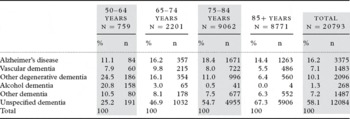
Dementia occurrence was related to age with 25% of patients aged 85 years and over having dementia compared with 0.9% of patients aged 50–64 years. The majority of dementia patients were female (n = 12,489; 60%); however this increased with age, from only 38% of those aged 50–64 years to 69% of those aged 85 years and over. Overall, the type of dementia was not specified in 58% of patients with dementia but this lack of categorization of dementia type showed an association with age group, occurring for 25% of 50–64 year old patients with dementia, but for 67% of those aged 85 years and over. When the type of dementia was specified, there were significant differences in the types of dementia reported for the different age groups (χ2 = 1522, df = 12, p < 0.0001). Patients aged 50–64 years were more likely than others to have non-Alzheimer non-vascular dementia, with particularly high rates of alcohol-related dementia (21%, 158 out of 568). Dementia in other degenerative disorders (including Parkinson's disease and Pick's disease) and other dementias (including HIV/AIDs dementia complex and Huntington's dementia) were also more common in this age group (see Table 1).
Types of dementia specified, by patient age (HDS patients, New South Wales, 2006–2007)

Among people with dementia, age had a limited association with the rates of comorbid delirium, with 12% of 50–64 year olds with dementia having delirium during at least one hospital stay compared with 17% of people with dementia in the two older age groups. However, older patients who experienced delirium were more likely than younger patients to have dementia: 12% of 50–64 year olds who experienced delirium had dementia compared with 57% of patients aged 85+. Delirium was less common among people without dementia, with propensity increasing with age – from 0.8% of patients aged 50–64 to 4.1% among those aged 85+.
Reasons for admission
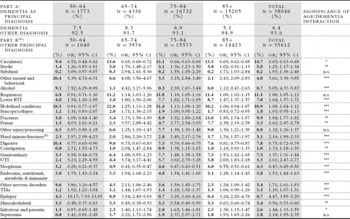
Dementia was the principal reason for admission in only 6% of multi-day stays for people with dementia. Excluding dementia, the principal diagnoses for this group were commonly related to the circulatory system (15%), respiratory system (11%), fractures (10%), other injury and poisoning (8%) and the digestive system (8%). There were significant differences in the principal reasons for admission when comparing people with and without dementia. In particular, people with dementia were more likely to be admitted principally because of mental and behavioral disorders (OR 3.61, 3.39–3.85), other nervous disorders (OR 1.71, 1.61–1.83), fractures (OR 1.84, 1.77–1.92) or other injury/poisoning (OR 1.32, 1.26–1.37), but were less likely to be admitted because of neoplasms (OR 0.47, 0.45–0.50), circulatory disorders (OR 0.65, 0.63–0.68) or digestive disorders (OR 0.75, 0.72–0.78).
Examining specific disorders, people with dementia were more likely to be admitted because of alcohol disorders (OR 5.05, 4.37–5.83), epilepsy (OR 4.47, 3.85–5.20), fractured femur (OR 2.62, 2.47–2.78), urinary tract infection (OR 2.61, 2.47–2.77), lower respiratory tract infections (OR 1.64, 1.57–1.72), head injuries (OR 2.16, 1.99–2.33), stroke (OR 1.25, 1.17–1.34), subdural (OR 1.83, 1.39–2.40), constipation (OR 1.33, 1.18–1.50) and septicemia (OR 2.14, 1.95–2.35) than those without dementia.
As shown in Table 2, for those with dementia, there was variation with age in the proportion of admissions attributed to particular diagnoses. For example, admissions resulting from mental and behavioral disorders, other nervous disorders and epilepsy were more prominent among 50–64 year olds than older groups, while admissions due to fractures in general, fractures of the femur, head injuries, urinary tract infections and respiratory tract infections were more common at older ages. The ORs across the age groups show that for many conditions the effect of dementia on reason for admission also varied with age. For some conditions, the ORs tended to increase with age (e.g. admissions due to fractures and genitourinary conditions); for others the ORs decreased with age (e.g. admissions due to other mental and behavioral disorders and other nervous disorders).
Selected principal diagnosis for hospital admission of patients with dementia compared with patients without dementia, by age (multi-day stays for HDS patients, New South Wales, 2006–07)

(a) Part B excludes stays with dementia as the principal diagnosis.
(b) A subset of Fractures and Other Injury/Poisoning combined.
*0.01 ≤ p < 0.05; **0.001 ≤ p < 0.01; ***p < 0.001; n.s. = not significant at 95% level.
RTI = respiratory tract infection; UTI = urinary tract infection; TIA = transient ischemic attack.
Note: This table is based on first episode of a stay and excludes 953 stays with missing principal diagnosis, and six cases with perinatal or obstetrics as the principal diagnosis.
Principal procedures
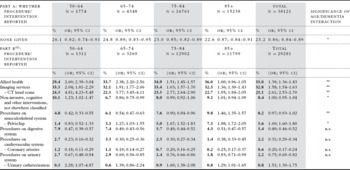
Patients with dementia were less likely than non-dementia patients to have no procedure recorded in a hospital stay (OR 0.86, 0.84–0.89). In stays with a procedure recorded, dementia patients were more likely than non-dementia patients to have an imaging procedure as the principal procedure (OR 1.58, 1.54–1.63), in particular computer tomography brain scans (OR 2.61, 2.53–2.70). Overall, dementia patients had higher odds of having hip and pelvis procedures as the principal procedure than non-dementia patients (OR 1.69, 1.60–1.80); however, this difference was only significant for patients aged 65 and over. Also, urinary catheterization was more likely to be the principal procedure in dementia patients (OR 1.51, 1.30–1.75). Dementia patients were much less likely than other patients to have digestive system procedures (OR 0.49, 0.46–0.52, with little variation across the age groups) or cardiovascular procedures as the principal procedure (OR 0.31, 0.29–0.34); the latter were largely driven by coronary artery procedures (OR 0.20, 0.17–0.24). Dementia patients were more likely to receive allied health input than non-dementia patients (OR 1.39, 1.36–1.43); the difference was particularly marked in patients aged under 85 years. This was mainly physiotherapy and social work (Table 3).
Selected principal procedures and interventions for patients with dementia compared with patients without dementia, by age (multi-day stays for HDS patients, New South Wales, 2006–07)

(a) Part B excludes stays with no procedure/intervention reported.
* 0.001 ≤ p < 0.01.
** p < 0.001.
n.s. no statistical significance at 95% level.
Note: Table is based on first episode of a stay, and excludes 1576 cases with missing procedures (i.e. not reported as “none given”).
Length of stay and readmission
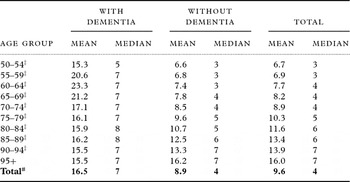
Mean length of stay (LOS, including transfers within and between hospitals) for multi-day stays for persons with dementia was 16.5 days compared with 8.9 days for those without dementia (medians of 7 and 4 days, respectively) (Table 4). This difference was more pronounced in younger people with dementia, particularly those aged 55–69 years, with mean LOS for persons with dementia in this age range being over 20 days compared with less than eight days in those without dementia. In the older age groups, differences in LOS between persons with and without dementia decreased, and by age 95 the two groups had similar LOS. The much longer mean LOS in patients aged under 70 years was due to a small percentage having very long stays and thus the difference in median LOS for this younger age group was much less. Reported discharge outcomes of the long-stay 50–64 year olds with dementia showed that over two-thirds (69%) returned to their usual accommodation, while nearly 25% were transferred to residential care or a different type of accommodation.
Average length of multi-day hospital stays by dementia status and age (multi-day stays for HDS patients, New South Wales, 2006–2007) (nights)

‡ Indicates significant difference (all at p < 0.0001) using the Kolmogorov-Smirnov test to compare the distribution of length of stay (LOS) for people with and without dementia. Similar results were found using reported length of stay and the log transform. For the statistical test, LOS for the patients’ first stay in 2006–2007 was used to ensure independence.
# Not tested for statistical significance.
Persons with dementia were more likely to be readmitted within three months for another multi-day stay (40%) than persons without dementia (32%) (p < 0.001). Among patients with dementia, younger people were considerably more likely to be readmitted than older people (p < 0.001 for 50–64 group compared with 85+ group) – a pattern not seen among patients without dementia. Consequently, the difference in readmission rates for people with and without dementia was more marked for younger people. Readmission for patients aged 50–64 was almost twice as likely for persons with dementia (55%) than without dementia (29%).
Among people with a readmission within three months for another multi-day stay, 12% were readmitted within a day of leaving hospital. There were no statistically significant differences between people with and without dementia in the timing of readmission. Across age groups there were some differences, with older people a little more likely than younger people to be readmitted within a day of discharge. For example, 10% of readmissions for persons aged 50–64 were within a day compared with 13% for patients aged 85 years and over (p < 0.001). Similar differences were observed for patients with and without dementia; however, these differences were not statistically significant for people with dementia (n = 503 for 50–64 group and n = 3001 for 85+ group, p>0.05).
Discharge outcomes
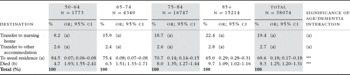
Table 5 presents reported hospital discharge outcomes (non-hospital care, discharges home and deaths) for persons with and without dementia in the four age groups. Mortality rates were higher for people with dementia across all age groups, with the effect more pronounced in patients aged 50–64 years where the mortality rate in persons with dementia was about double that for people without dementia (death vs other discharge: OR 1.93; 1.55–2.41). The cause of death was not recorded in the dataset, although 22 of the 84 dementia patients aged 50–64 years who died were admitted with a respiratory condition, 15 with a digestive condition and 10 with a neoplasm. For hospital stays that did not end in death, transfer to nursing home care and other accommodation was more likely in dementia patients across the age range but more pronounced under the age of 75 (discharge to own accommodation vs discharge to non-hospital care, 50–64 years OR 0.07, 0.06–0.08; 65–74 years OR 0.08, 0.07–0.08).
Reported destination on discharge following a multi-day hospital stays by dementia status and age (multi-day stays for HDS patients, New South Wales, 2006–2007)

*** p < 0.001.
(a) ORs and 95% CIs were calculated for whether a stay ended with discharge to own accommodation versus discharged to nursing home or other accommodation. Stays ending with death in hospital were excluded for this analysis. ORs were not derived separately for discharges to nursing home or other accommodation.
(b) ORs and 95% CIs were calculated for a stay ending in death versus other.
Note: Table provides preliminary estimates and excludes 295 cases with destination unknown. “To usual accommodation” includes a small proportion (under 2% of all multi-day stays) coded as discharged while on leave, discharged at own risk and unidentified transfer to other hospital.
Discussion
In this study we found that nearly 21,000 patients with dementia aged 50 years and over had a multi-day stay in one or more of the 222 public hospitals in the state of New South Wales, Australia, over a 12-month period, representing approximately 25% of all persons with dementia in the state. This estimate draws on prevalence data calculated by Access Economics (2009); however, given that these prevalence data used in the denominator include mild cases of dementia, and mild cases of dementia are less likely to be recorded as a hospital diagnosis, this 25% figure is almost certainly an underestimate.
Our findings indicate that the outcomes of hospitalization in terms of length of stay, mortality, readmission within three months and discharge destination are significantly different in patients with dementia, with longer periods of hospitalization, higher death rates, higher rates of transfer to nursing home care and higher re-admission rates. This pattern is most evident among patients under the age of 65 years. This disproportionate effect of dementia upon hospital outcomes in younger patients has been previously noted in terms of length of stay (Zilkens et al., Reference Zilkens, Spilsbury, Bruce and Semmens2009), but not other outcomes, possibly because most other studies have been limited to older patients from one hospital site (Saravay et al., Reference Saravay2004; Natalwala et al., Reference Natalwala, Potluri, Uppal and Heun2008; Zekry et al., Reference Zekry2009; Douzenis et al., Reference Douzenis2010). Our finding that dementia has less impact upon outcomes of hospitalization in older patients is consistent with a prospective study from Switzerland of patients aged 75 years and over, which found that, apart from a higher rate of discharge to nursing homes, dementia was less important than comorbidity and functional status in predicting outcome (Zekry et al., Reference Zekry2009).
There are a number of possible explanations for the more negative outcomes in younger people with dementia. Our analyses indicate that the longer average LOS is largely due to a small proportion of younger patients with very long admissions. In addition, in almost a third of cases the principal reason for admission in younger dementia patients is due to a mental or behavioral problem or nervous system disorder. Younger dementia patients are also more likely to have alcohol-related dementia and “other degenerative dementias” (the category that includes fronto-temporal dementia), which are dementia types known to have high rates of behavioral symptoms. We therefore suspect that behavioral and psychological symptoms of dementia (BPSD) are a factor contributing to these findings, with younger patients more likely to be admitted for BPSD and who require ongoing institutional care but prove to be difficult to place due to a combination of a lack of suitable facilities for younger people and their degree of behavioral disturbance (Zilkens et al., Reference Zilkens, Spilsbury, Bruce and Semmens2009). It is possible that the higher rates of mortality in the younger group might indicate that the hospital is being used for terminal care but there is nothing in the dataset to clarify this.
Our study replicates research from the UK that found that only a small proportion of dementia patients are admitted with dementia as the principal reason and that urinary tract infections, lower respiratory tract infections, fractured femur, septicemia and epilepsy are more frequent principal reasons for admission in dementia patients than non-dementia patients (Natalwala et al., Reference Natalwala, Potluri, Uppal and Heun2008). These principal reasons for admission vary with age; for example, epilepsy is prominent in patients aged 50–64 years (partly attributable to the high rates of epilepsy associated with alcohol-related dementia), while urinary tract and lower respiratory tract infections are prominent in older patients, presumably related to increased rates of falls and osteoporosis at this age.
Although rates of delirium increased with age in the overall sample, this basically reflected the higher rates of dementia in old age groups. Surprisingly, we found that in persons with dementia, older age had a very limited effect on rates of delirium and, in particular, older persons without dementia had relatively low rates of delirium. Previous research has shown delirium goes unrecognized by clinicians in between one-third to two-thirds of elderly patients (Inouye et al., Reference Inouye, Schlesinger and Lydon1999). It is possible that the confusion and behavior change due to delirium is more easily recognized by clinicians as being abnormal in younger patients.
There are also medical diagnoses that were less frequent principal reasons for admission in dementia patients and these included neoplasms, circulatory system disorders (with principal procedures related to coronary arteries much less frequently performed on dementia patients) and digestive system disorders (fewer principal procedures related to the digestive system were performed on dementia patients). The reason for the infrequent use of coronary artery procedures in persons with dementia is not clear in this dataset and we can only speculate that this might be due to clinicians being less prepared to offer the procedure to people with dementia as there is no evidence that they have lower rates of coronary artery disease. There is not such a clear explanation for the low rates of neoplasms as the principal reason for admission in dementia patients; the use of radiation oncology and chemotherapy was lower but not enough to explain the difference.
These data lend further support to the important role that alcohol plays in early onset dementia, with alcohol-related dementia – the commonest dementia diagnosis in patients aged 50–64 years – being responsible for over 20% of cases. It is also noteworthy that in patients aged 50–64 years, an alcohol-related disorder was a much more common principal reason for admission in dementia patients than non-dementia patients. Many studies of the epidemiology of early onset dementia exclude alcohol-related cases, but those that have included alcohol-related dementia have produced similar findings to ours (Harvey et al., Reference Harvey, Skelton-Robinson and Rossor2003; Withall and Draper, Reference Withall and Draper2009). A surprising finding, however, was that alcohol-related mental disorders were significantly more common as the reason for admission in dementia patients up to the age of 85. In most cases, alcohol was regarded as comorbid rather than the cause of the dementia and this may reflect the inadvertent misuse of alcohol by cognitively impaired patients. The challenge that this presents for families and clinicians is how to minimize the adverse effects of alcohol in order to prevent hospitalizations in this compromised population.
There are a number of limitations to this study. The NSW Admitted Patient Care Database is derived from data obtained from numerous clinicians making diagnoses and hence their validity is variable. The accuracy of coding of diagnoses and data entry by medical record staff is also unknown. There have been no published studies of the validity of routine diagnoses of dementia in Australia. It is likely that dementia is underestimated in this population due to a combination of poor recognition by medical staff, deficiencies in the medical record, and the requirement that to be recorded in the hospital admission data, the medical diagnosis has to be deemed to contribute to the cost of the hospital stay. It is also possible that, in this study, patients who had multiple or longer stays were more likely to be identified as having dementia than patients with short or single admissions and this might overestimate the effect of dementia. These two factors have opposing effects; however, it is not currently possible to measure their impact on estimates. It is also possible that cases of delirium are misdiagnosed as dementia. Nevertheless, because of the large scale of the study, it is expected that patterns seen in hospital use for HDS patients with and without dementia are robust. The age cut-off of 50 years may also have excluded some younger people with dementia.
There are also important strengths to the dataset. The sample size is large, comprising over 20,000 patients with dementia of whom more than 750 were aged 50–64 years. The database covers the whole population of admitted multi-day public hospital patients aged 50 years and over in NSW, the most populous state of Australia. In addition, all hospital stays for these people are included (public and private, multi-day and single-day) allowing comprehensive analysis of their hospital experience.
In conclusion, patients with dementia are more likely to have negative outcomes associated with hospital admission than non-dementia patients and this is accentuated in dementia patients aged 50–64 years. Further investigation of these age-related effects on hospital outcomes is warranted.
Conflict of interest
None.
Description of authors' roles
BD contributed to the study design, obtained research funds, took part in data analysis, and helped prepare the first draft and final paper. RK contributed to the study design, prepared the data for patient-based analysis, undertook the data analysis, and assisted in preparation of the final paper. AP and DG contributed to the study design, obtained research funds, and assisted in preparation of the final paper. PA contributed to the study design, involvement in data analysis, and assisted in preparation of the final paper.
Acknowledgments
This study was funded by NHMRC dementia research grant no. 465701. The authors thank the New South Wales Department of Health for permission to use data from the Admitted Patient Data Collection and for provision of the data extract with patient identifiers derived by the Centre for Health Record Linkage (or CHeReL). We thank the other members of the Hospital Dementia Services project team – Gail Brien, Le Anh Pham Lobb, Natalie Chan and Charles Hudson – for their work on the project and assistance with this paper, and the Australian Institute for Health and Welfare for hosting and supporting the project. We thank Srikar Velivela for assistance with the data analysis.