Introduction
Today, cloned livestock animals are a scientific reality and have potential application in agriculture. Cloning farm animals makes it possible to select and propagate animals with desirable genetic merit and allows the characteristics of their food products to be predicted. The somatic cloning technology for farm animals is improving, especially in the bovine species. Over 2000 cloned cattle have been obtained worldwide since 1998 when the first calves were born from somatic cell nuclear transfer (Cibelli et al., Reference Cibelli, Stice, Golueke, Kane, Jerry, Blackwell, Ponce de Leon and Robl1998; Vignon et al., Reference Vignon, Chesné, Lebourhis, Fléchon, Heyman and Renard1998). Before the commercial use of food products derived from cloned animals is possible, an evaluation of the products and an assessment of the possible risks associated with consumption are required. Such assessments are carried out by national or international organisations such as US-FDA, EFSA. Previous publications have focused on the composition and nutritional value of meat derived from cloned animals (Takahashi and Ito, Reference Takahashi and Ito2004; Tian et al., Reference Tian, Kubota, Sakashita, Izaike, Okano, Tabara, Curchoe, Jacob, Zhang, Smith, Bormann, Xu, Sato, Andrew and Yang2005; Yamaguchi et al., Reference Yamaguchi, Ito and Takahashi2007). No obvious differences were found for the gross chemical composition of meat produced by cloned or non-cloned animals but the contractile and metabolic muscle characteristics, which contribute to explain meat quality traits, were not studied. Relationships between muscle characteristics and meat quality have been described (Geay et al., Reference Geay, Bauchart, Hocquette and Culioli2001; Maltin et al., Reference Maltin, Balcerzak, Tilley and Delday2003). More specifically, meat-eating quality depends not only on post-mortem factors associated with meat ageing but also on muscle characteristics of live animals, which themselves depend on genetic, nutritional, rearing and environmental factors. So, a large inter-muscle and inter-animal variation exists in meat-eating quality, which is often related to metabolic and contractile properties as determined by their muscle fibre-type distribution (Hocquette et al., Reference Hocquette, Ortigues-Marty, Pethick, Herpin and Fernandez1998; Klont et al., Reference Klont, Brocks and Eikelenboom1998).
The present paper is consistent with a multidisciplinary approach to establish scientific expertise on clones and their milk and meat products (Heyman et al., Reference Heyman, Chavatte-Palmer, Berthelot, Fromentin, Hocquette, Martignat and Renard2007a and Reference Heyman, Chavatte-Palmer, Fromentin, Berthelot, Jurie, Bas, Dubarry, Mialot, Remy, Richard, Martignat, Vignon and Renard2007b) and aims to compare the evolution of muscle contractile and metabolic characteristics from cloned and control Holstein heifers at different ages.
Material and methods
Animals
A total of 17 bovine females (nine clones and eight controls) were used. The clones were obtained from somatic nuclear transfer using fibroblasts from one adult donor cow of the Holstein breed, according to the technique of Vignon et al. (Reference Vignon, Chesné, Lebourhis, Fléchon, Heyman and Renard1998). They were compared with non-cloned breed, age and sex-matched control animals. These controls were obtained by the artificial insemination of Holstein cows by six different bulls and were not genetically related to the clones. All animals were born at the same experimental farm (INRA-Bressonvilliers, France) and raised together under the same conditions from birth to adulthood. At birth, clones and controls were housed in the same nursery in individual box stalls until 6 months of age. Afterwards, they were grouped in the same cowshed, were fed the same standard diet (grass silage, hay, corn straw and minerals) and had free access to water.
Repeated biopsies of the semitendinosus (ST) muscle were obtained surgically under local anaesthesia from each animal at 8, 12, 18 and 24 months of age. Samples were immediately frozen in liquid nitrogen and stored at −80°C until analysis.
This study was carried out as part of the research project on bovine cloning approved by the institutional ethical committee of INRA (COMEPRA). Animal-related manipulations were conducted by veterinarians or technicians holding a licence for animal experimentation.
Contractile characteristics
The contractile muscle type was determined in all samples by quantifying the different myosin heavy chain (MyHC) isoforms that were separated by electrophoresis SDS-PAGE according to the method of Picard et al. (Reference Picard, Barboiron, Duris, Gagnière, Jurie and Geay1999). Each well of gel was loaded with 3 μg of myofibrillar protein. The relative proportion of slow isoform (MyHC I) and fast isoforms (MyHC IIa and MyHC IIx) was determined after staining the gels in a solution of Coomassie Blue R250 and quantifying with densitometry analysis software (ChemiImager™ 5500; Alpha Innotech Corporation).
Metabolic enzyme activities
Maximal activity levels of the enzymes reflecting the glycolytic metabolic pathway (lactate dehydrogenase (LDH)), mitochondrial density (isocitrate dehydrogenase (ICDH)), oxidative phosphorylation (cytochrome-c oxidase (COX)) and the potential for fatty acid (FA) β-oxidation (β-hydroxyacyl-CoA dehydrogenase (HAD)) were measured spectrophotometrically according to the methods cited by Jurie et al. (Reference Jurie, Ortigues-Marty, Picard, Micol and Hocquette2006). One unit of the enzyme was defined as the amount that catalyses per min the disappearance of 1 μmol of nicotinamide adenine dinucleotide (NADH) reduced form for LDH and HAD, the reduction of 1 μmol of NADP for ICDH and the oxidation of 1 μmol of cytochrome-c for COX. The respective results for LDH and ICDH activities are already published (Heyman et al., Reference Heyman, Chavatte-Palmer, Fromentin, Berthelot, Jurie, Bas, Dubarry, Mialot, Remy, Richard, Martignat, Vignon and Renard2007b); so in the present paper, an LDH/ICDH ratio is reported as an indicator of any modification in muscle metabolic activity since this ratio is more sensitive to physiological changes than the absolute enzyme activities. The results are expressed in μmol/min per g of muscle for COX and HAD activities.
Statistical analysis
The SAS software (SAS Institute, Cary, NC) was used for the statistical analysis. Data from age and live weight at the time of biopsies, contractile and metabolic characteristics were analysed using the MIXED procedure, based on the assumption that repeated observations on the same heifer (repeated biopsies at different ages) are likely to be related (Littell et al., Reference Littell, Henry and Ammerman1998). Data were analysed with a model that contained the fixed effects of group, age and the group × age interaction. The statistical analysis included animal nested within the group as a random effect and age as the repeated effect. When significant effects were detected, differences between means were further separated by the PDIFF option of SAS.
Results
Growth and live weights of animals
Birth weights were similar between control and cloned heifers, namely 42.5 ± 3.0 and 42.4 ± 2.9 kg, respectively. Live weights at the time of the fourth biopsy, at 24 months of age, were similar between control and cloned heifers, namely 572 and 570 kg, respectively (Table 1). Then, daily weight gain between birth and 24 months of age was 0.72 ± 0.02 kg/day for both groups.
Age and live weight from control (n = 8) or cloned (n = 9) heifers at the time of the four samplings by biopsy

a,bMeans within column with different superscript are significantly different at P < 0.05.
However, daily weight gain between birth and the time of the first biopsy, around 8 months of age, tended to be slightly lower for control (0.71 kg/day) than for cloned (0.76 kg/day) heifers, but not significant (P = 0.12). Moreover, it is worth noting that cloned heifers were slightly older than control heifers at the time of the first, second and third biopsies. Therefore, some differences in weights, but not significant, were noted between control and cloned heifers (Table 1).
Contractile characteristics
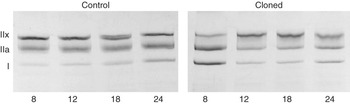
The separation of different MyHC isoforms by electrophoresis SDS-PAGE revealed the three MyHC isoforms (I, IIa and IIx) generally described in bovine adult muscle (Figure 1). A third band in the fast isoforms, namely MyHC IIb, sometimes described in bovine muscle (Picard et al., Reference Picard, Barboiron, Duris, Gagnière, Jurie and Geay1999), has not been revealed in these samples.
Separation of different myosin heavy chain (MyHC) isoforms of semitendinosus muscle by electrophoresis SDS-PAGE from control and cloned heifers at 8, 12, 18 and 24 months of age.

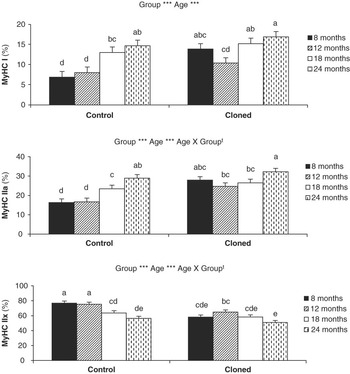
At 8 months of age, cloned heifers had a greater proportion of MyHC I and MyHC IIa isoforms (13.9% v. 6.9% P = 0.0008 and 27.9% v. 16.3% P < 0.0001, respectively) and a lower proportion of the MyHC IIx isoform (58.2% v. 76.8% P < 0.0001) compared with control heifers (Figure 2). In cloned heifers at 12 months of age, the proportion of MyHC IIa was greater (24.7% v. 16.7% P = 0.004) and the MyHC IIx lower (64.9% v. 75.3% P = 0.012) compared with control heifers.
Proportion of different myosin heavy chain (MyHC) isoforms of semitendinosus muscle from control (n = 8) and cloned (n = 9) heifers at 8, 12, 18 and 24 months of age. Results are means ± s.e. and means with different superscript differ at P < 0.05. Levels of significance for the effects are tP < 0.10, *P < 0.05, **P < 0.01 and ***P < 0.001.

In addition, the proportions of the different MyHC isoforms were significantly modified with age between 8 and 24 months (P < 0.001) (Figure 2). Between 8 and 12 months of age, the proportion of each of the three MyHC isoforms did not change in either group. Changes with age in the proportion of MyHC isoforms were observed from 12 to 24 months and a greater change occurred in control than in cloned heifers (age × group interaction P < 0.10) (Figure 2). In control heifers between 12 and 24 months of age, the proportion of MyHC I and MyHC IIa increased 1.8-fold (8.0% to 14.7%, P = 0.002) and 1.7-fold (16.7% to 28.9%, P<0.0001), respectively. In cloned heifers, the proportion of MyHC I and MyHC IIa increased only 1.6-fold (10.4% to 16.9% P = 0.0015) and 1.3-fold (24.7% to 32.2%, P = 0.006), respectively. Meanwhile, the proportion of MyHC IIx decreased by a factor 1.3 for both control (75.3% to 56.4% P < 0.0001) and cloned heifers (64.9% to 50.9% P = 0.001).
Then, the proportions of the different MyHC isoforms were modified with age in the same sense from 12 to 24 months both for control and for cloned heifers, nevertheless not with the same extent. However, these proportions being very different between groups at 8 months of age, the modifications in the proportions of the different MyHC isoforms between 8 and 24 months of age were not the same for control and cloned heifers.
Metabolic characteristics
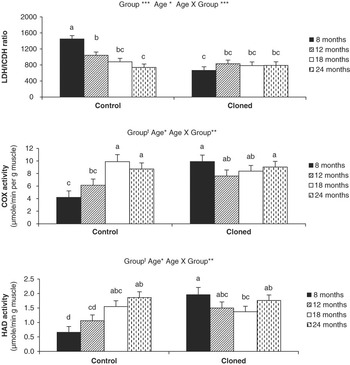
In agreement with the contractile characteristics, the metabolic characteristics were significantly different between groups (P < 0.07 to 0.001). A significant age × group interaction was observed (P < 0.01 to 0.001) since the differences in the LDH/ICDH ratio, COX and HAD activities between cloned and control heifers were only significant at 8 months of age (Figure 3). At this age, the LDH/ICDH ratio was 2.2-fold lower (666 v. 1448, P < 0.0001) and COX and HAD activities were 2.4- and 3-fold greater (9.91 v. 4.20 μmol/min per g muscle, P = 0.0004 and 1.96 v. 0.66 μmol/min per g muscle, P = 0.0003, respectively), for cloned than for control heifers. From 12 months onwards, cloned and control heifers were not different in metabolic characteristics.
Metabolic characteristics of semitendinosus muscle from control (n = 8) and cloned (n = 9) heifers at 8, 12, 18 and 24 months of age: lactate dehydrogenase (LDH)/isocitrate dehydrogenase (ICDH) ratio; cytochrome-c oxidase (COX) and β-hydroxy-acyl-CoA dehydrogenase (HAD) activities (μmol/min per g muscle). Results are means ± s.e. and means with different superscript differ at P < 0.05. Levels of significance for the effects are tP < 0.10, *P < 0.05, **P < 0.01 and ***P < 0.001.

The LDH/ICDH ratio and COX activity were not modified for cloned heifers between 8 and 24 months of age but the HAD activity decreased between 8 and 18 months of age (from 1.96 to 1.37 μmol/min per g muscle, P < 0.05) (Figure 3). For control heifers between 8 and 24 months of age, the LDH/ICDH ratio decreased by a factor 2 (1448 to 738, P < 0.0001) and COX and HAD activities increased by a factor 2.1 (4.20 to 8.72 μmol/min per g muscle, P = 0.002) and a factor 3 (0.66 to 1.86 μmol/min per g muscle, P < 0.0001), respectively.
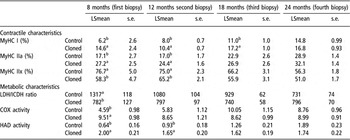
However, in order to take into account the differences in age and live weights at the time of the first, second and third biopsies, additional statistical analysis were realized. Thus, separately for each time of biopsy, age and live weight were introduced as covariates in the statistical model that contained the group as fixed effect. The differences in contractile and metabolic characteristics between control and cloned heifers previously described, in particular at 8 months of age, were confirmed with the introduction of age and live weight as covariates (Table 2).
LSmeans of contractile and metabolic characteristics of semitendinosus muscle, adjusted for age and live weight at each time of biopsy, from control (n = 8) and cloned (n = 9) heifers

MyHC = myosin heavy chain; LDH = lactate dehydrogenase; ICDH = isocitrate dehydrogenase; COX = cytochrome-c oxydase; HAD = β-hydroxy-acyl-CoA dehydrogenase; enzyme activity in μmol/min per g muscle.
a,bMeans within each column and for each item, with different superscript are significantly different at P < 0.05.
Discussion
To our knowledge, only two studies report an evaluation of meat from cloned cattle (Takahashi and Ito, Reference Takahashi and Ito2004; Tian et al., Reference Tian, Kubota, Sakashita, Izaike, Okano, Tabara, Curchoe, Jacob, Zhang, Smith, Bormann, Xu, Sato, Andrew and Yang2005). Biochemical and biological characteristics of meat were similar between cloned and control cattle (Takahashi and Ito, Reference Takahashi and Ito2004) and if differences in the composition of the meat were observed they were within the normal industry standards (Tian et al., Reference Tian, Kubota, Sakashita, Izaike, Okano, Tabara, Curchoe, Jacob, Zhang, Smith, Bormann, Xu, Sato, Andrew and Yang2005). These studies were limited by using samples from only one or two cloned animals slaughtered at 28 or 26 months of age. Thus, it is difficult to conclude whether the results were representative of the potential differences that occur between cloned and control populations.
Beef quality, especially tenderness, is affected by muscle characteristics, by factors at slaughter and by post-mortem conditions during meat ageing. Somatic cell nuclear transfer, in case of possible effect of the technique, could affect some tissue biological activities. Therefore, it is important to assess the potential effect of cloning on muscle characteristics, which influence the final quality of beef, including the contractile and metabolic properties of muscle associated with tenderness (Maltin et al., Reference Maltin, Balcerzak, Tilley and Delday2003). Thus, this study endeavoured to compare muscle contractile and metabolic parameters on nine cloned heifers and eight control heifers.
The repeated biopsies of the ST muscle demonstrated higher proportions of MyHC I (slow oxidative isoform) and MyHC IIa (fast oxido-glycolytic isoform), a lower proportion of MyHC IIx (fast glycolytic isoform), higher COX and HAD activities (oxidative activities) and the lower LDH/ICDH ratio in cloned than control heifers at 8 months of age. This demonstrates that the muscles of young cloned heifers are of a slower contractile type with a more oxidative metabolism than control heifers. However, this was not observed in older animals, in particular from 18 months of age. In fact, at 12 months of age some significant differences in the proportions of MyHC isoforms and in the HAD activity still persisted between control and cloned heifers, which demonstrated, as at 8 months of age, a slower and more oxidative muscle in cloned than in control heifers.
The different types of muscle fibre can be classified on the basis of their contractile and metabolic activities into at least three types depending on the methods used. The common classification involves slow-twitch oxidative (SO; type I), fast-twitch oxidative glycolytic (FOG; type IIA) and fast-twitch glycolytic (FG; type IIB) fibre types. These different fibre types differ in MyHC isoforms. The major MyHC isoforms (slow or MyHC I; fast or MyHC IIa, IIb) determine the contractile properties of a fibre. Initially, in mammalian species, fast MyHC IIa and IIb were reported to be expressed in type IIA and IIB fibres, respectively. However, an additional fast MyHC called IIx was identified in several species (for review Picard et al., Reference Picard, Lefaucheur, Berri and Duclos2002). It is expressed in fibres called IIX, which cannot be distinguished from type IIB fibres by conventional histochemical techniques. The IIX fibres appear to be intermediate between type IIA and IIB fibres with respect to their oxidative metabolism, resistance to fatigue and maximum velocity of shortening. Chikuni et al. (Reference Chikuni, Muroya and Nakajima2004) demonstrated that the MyHC IIb gene is present in bovine genome but not expressed. This indicates that fibres classified IIB by conventional histochemical techniques contains the MyHC IIx isoform and not the IIb. So the electrophoretic separation of MyHC isoforms in bovine muscles reveal the three isoforms: MyHC I contained in fibres I (slow oxidative), MyHC IIa contained in fibres IIA (fast oxido-glycolytic) and MyHC IIx contained in fibres IIX (fast glycolytic) (Picard et al., Reference Picard, Barboiron, Duris, Gagnière, Jurie and Geay1999).
During early postnatal growth (up to about 6 months of age), there is a conversion in fibre types, namely from fast oxido-glycolytic fibres (type FOG or IIA) into fast glycolytic fibres (type FG or IIX), which indicates a modification of muscle metabolism (Jurie et al., Reference Jurie, Robelin, Picard, Renand and Geay1995; Wegner et al., Reference Wegner, Albrecht, Fiedler, Teuscher, Papstein and Ender2000). From 6 to 12 months of age, there is a slowing down of this conversion, the rate of which is dependent on the breed (Wegner et al., Reference Wegner, Albrecht, Fiedler, Teuscher, Papstein and Ender2000). So the results from this study, namely the lack of changes in % MyHC IIa and IIx isoforms between 8 and 12 months of age, were in agreement with the literature. A conversion from fast to slow muscle fibre types was described from 19 months of age onwards in young bulls (Maltin et al., Reference Maltin, Sinclair, Warriss, Grant, Porter, Delday and Warkup1998; Jurie et al., Reference Jurie, Martin, Listrat, Jailler, Culioli and Picard2005), indicating a modification of contractile type. These changes in the frequencies of different fibre types with age are accompanied by changes in area and percentage of total muscle area of each fibre type, and in muscular metabolism as indicated by metabolic enzyme activities (Jurie et al., Reference Jurie, Robelin, Picard, Renand and Geay1995 and Reference Jurie, Martin, Listrat, Jailler, Culioli and Picard2005). Thus, in the muscles of young bulls, LDH activity (glycolytic metabolism) increases and ICDH activity (oxidative metabolism) decreases after birth. The rate of these changes slows down until 19 months of age followed by the decreasing LDH activity and the increasing ICDH activity. Therefore, these modifications in enzyme activities indicate a more oxidative muscular metabolism with increasing age. In the present study, an increased MyHC I proportion and concomitant decreased MyHC IIx proportion from 12 months of age onwards were observed with increasing age for control heifers. This conforms with a transition from fast to slow contractile type but occurring at an earlier age in heifers of this study than in bulls, as previously described in bulls by Jurie et al. (Reference Jurie, Martin, Listrat, Jailler, Culioli and Picard2005). The differences between these two studies may be explained by differences in maturity between sex and breeds as heifers are early-maturing compared with entire males, and dairy breeds (e.g. Holstein) are early-maturing compared with beef breeds (e.g. Aberdeen Angus, Charolais and Limousin). In addition, changes in MyHC isoforms with age for control heifers were accompanied by changes in the LDH/ICDH ratio (which decreased) and COX and HAD enzyme activities (which increased between 8 and 24 months of age). The respective results for LDH and ICDH activities were published previously (Heyman et al., Reference Heyman, Chavatte-Palmer, Fromentin, Berthelot, Jurie, Bas, Dubarry, Mialot, Remy, Richard, Martignat, Vignon and Renard2007b). The ICDH activity was significantly higher (+110%, P < 0.001) in the muscle of clones than in controls at 8 months of age. A smaller difference was observed at 12 months of age (+35%, P < 0.07) and no differences were detected between the groups at later ages. The LDH activity, however, was not different in the muscle between clones and controls at all ages. To our knowledge, this is the first study to describe the evolution of COX and HAD activities with age in bovine muscle. The ST muscle of control heifers was increasingly oxidative and the proportion of slow contractile-type fibres increased with age. However, these changes in the contractile and metabolic muscle characteristics with age were smaller for cloned heifers.
Furthermore, the results of this study suggest a delay in muscle differentiation and maturation in cloned animals, whereas the birth weight and daily weight gain were similar for control and cloned heifers. Picard et al. (Reference Picard, Jurie, Duris and Renand2006a) have reported that muscular metabolism is the most oxidative around birth than later; maximal values were observed at 260-day post-conception and 3-week post-natal. Then during the first months of life, it becomes more glycolytic (Jurie et al., Reference Jurie, Robelin, Picard, Renand and Geay1995). So according to the fact that the ST muscle of cloned heifers is slower and more oxidative than that of control heifers at 8 months of age, a delayed maturation was supposed. The results from this study, namely the LDH/ICDH ratio, observed in clones at 8 months of age were similar to that described in control animals at 1 month of age in a previous study (Jurie et al., Reference Jurie, Robelin, Picard, Renand and Geay1995), and the observed values for COX and HAD activities, another enzyme reflecting the oxidative pathway, were greater for cloned than for control heifers at 8 months of age, which was in agreement with this hypothesis. In addition, this delay probably originates from foetal myogenesis, since early in foetal life, a higher proportion of primary myotubes, and just before birth at 260-day post-conception the presence of foetal MyHC isoform, a lack of adult MyHC isoforms and a higher oxidative metabolism were observed in the ST muscle from cloned Holstein foetuses compared with control Charolais foetuses (Picard et al., 2006b).
The muscle biopsy samples on the cloned and control heifers of this study have also been used to compare FA composition (Berthelot et al., 2004; Heyman et al., Reference Heyman, Chavatte-Palmer, Fromentin, Berthelot, Jurie, Bas, Dubarry, Mialot, Remy, Richard, Martignat, Vignon and Renard2007b). Interestingly, several differences were observed between cloned and control heifers at 8 months of age. Clones showed a significantly higher proportion of polyunsaturated fatty acids (PUFA) and lower proportions of saturated and mono-unsaturated FA than controls. As in the present study, this could be related to a delay in the changes in the FA composition with age. In fact, as animals become older, the proportions of saturated and mono-unsaturated FA increase in several muscles whereas that of PUFA decreases as shown in bulls by Lengyel et al. (Reference Lengyel, Husvéth, Polgár, Szabó and Magyar2003). No differences in FA composition were observed in the muscle of clones at later stages (Berthelot et al., 2004). In addition to these putative delays in muscle maturity in cloned heifers, Heyman et al. (Reference Heyman, Chavatte-Palmer, Fromentin, Berthelot, Jurie, Bas, Dubarry, Mialot, Remy, Richard, Martignat, Vignon and Renard2007b) also reported a delay in sexual maturation for the onset of puberty, suggesting that not only muscle biology is affected.
In conclusion, muscle contractile and metabolic characteristics did not significantly differ between cloned and control animals from 12 months of age onwards but there was a difference at 8 months of age, suggesting a delay in muscle differentiation and maturation in cloned animals. Differences in muscle properties observed after birth could be the consequence of a delay in muscle development during foetal life. Studies are in progress to confirm this hypothesis. In the present study, only one muscle type and one genotype or family of clone animals was studied. More work is needed to investigate other muscle types and other genotypes to confirm that differences of cloned animals to control animals are well characterized.
Acknowledgements
The authors thank all the staff of the experimental farm at Bressonvilliers, F-91630 Leudeville, France and C. Barboiron and D. Chadeyron (URH, Theix) for their expert technical assistance.