Introduction
Interest in duration of untreated psychosis (DUP) has increased significantly since a growing body of evidence has shown a shorter DUP leading to higher engagement in treatment, and increased chances of recovery in the short term (Marshall et al. Reference Marshall, Lewis, Lockwood, Drake, Jones and Croudace2005; Perkins et al. Reference Perkins, Gu, Boteva and Lieberman2005; Doyle et al. Reference Doyle, Turner, Fanning, Brennan, Renwick, Lawlor and Clarke2014) as well as in the long term (White et al. Reference White, Stirling, Hopkins, Morris, Montague, Tantam and Lewis2009; Larsen et al. Reference Larsen, Melle, Auestad, Haahr, Joa, Johannessen, Opjordsmoen, Rund, Rossberg, Simonsen, Vaglum, Friis and McGlashan2011; Penttilä et al. Reference Penttilä, Jääskeläinen, Hirvonen, Isohanni and Miettunen2014; Tang et al. Reference Tang, Chang, Hui, Wong, Chan, Lee, Yeung, Wong, Tang, Chan, Pang, Tso, Ng, Hung, Dunn, Sham and Chen2014) in patients with a first episode of psychosis (FEP). Early intervention in psychosis (EIP) is further associated with a decrease in inpatient admissions, length of stay and related treatment costs (Behan et al. Reference Behan, Cullinan, Kennelly, Turner, Owens, Lau, Kinsella and Clarke2015; Valmaggia et al. Reference Valmaggia, Byrne, Day, Broome, Johns, Howes, Power, Badger, Fusar-Poli and McGuire2015). Treatment delay itself creates disutility for patients due to delayed benefits, anxiety while waiting and a reduced ability to maintain social networks and employment commitments (Lindsay & Feigenbaum, Reference Lindsay and Feigenbaum1984; Propper, Reference Propper1995; Revier et al. Reference Revier, Reininghaus, Dutta, Fearon, Murray, Doody, Croudace, Dazzan, Heslin, Onyejiaka, Kravariti, Lappin, Lomas, Kirkbride, Donoghue, Morgan and Jones2015). In England, a policy focus on reducing DUP has recently gained new emphasis by the introduction of an EIP maximum waiting time target (Department of Health, 2014; NHS England & NICE, 2016).
Both the incidence of psychosis and DUP are correlated not only with clinical factors but also with socioeconomic factors such as reduced social networks, unemployment and less family involvement (Drake et al. Reference Drake, Haley, Akhtar and Lewis2000; Morgan et al. Reference Morgan, Abdul-al, Lappin, Jones, Fearon, Leese, Croudace, Morgan, Dazzan, Craig, Leff and Murray2006; O'Donoghue et al. Reference O'Donoghue, Lyne, Renwick, Lane, Madigan, Staines, O'Callaghan and Clarke2016). Relatives and friends are often involved in the help-seeking process and engage the patient in order to receive treatment (Fridgen et al. Reference Fridgen, Aston, Gschwandtner, Pflueger, Zimmermann, Studerus, Stieglitz and Riecher-Rössler2013). In more socioeconomically deprived areas this supportive social network may be less well established, and delays within mental health services are likely to contribute further (Birchwood et al. Reference Birchwood, Connor, Lester, Patterson, Freemantle, Marshall, Fowler, Lewis, Jones, Amos, Everard and Singh2013). While the existence of a socioeconomic gradient of waiting for physical health interventions is well established (Siciliani, Reference Siciliani, Sobolev, Levy and Goring2016), little is known about the relationship of socioeconomic status and DUP.
Our aim was to empirically investigate inequalities in DUP by socioeconomic deprivation, controlling for the severity of hallucinations and delusions, and previous mental health service use. We advance the literature in a number of ways: (1) this is the first study that focuses on the relationship between DUP and socioeconomic deprivation in England; (2) this is the first study to use administrative data to measure DUP, which allows us to include a large number of mental health providers from different regions in England; (3) we explicitly model non-linearity to account for the skewed nature of DUP; and (4) we look at the whole distribution of DUP using quantile regression.
Method
Data and sampling
This study uses secondary patient-level data from the Mental Health Services Data Set (MHSDS). The MHSDS is a national administrative database of mental health-related treatment in hospitals and community settings within the English NHS (NHS Digital, 2017). We look at the latest data releases available to us. Patients were included if both their FEP and their anti-psychotic treatment started within the study period April 2012 to March 2015. We exploited the MHSDS variable ‘EMERPSYCHDATE’ and ‘MANPSYCHDATE’ corresponding to the emergent and manifest date of the psychosis to identify relevant patients. This information is recorded by a clinician or care coordinator at the first detailed assessment following referral to an EIP service.
Measures
Duration of untreated psychosis
DUP measures the time from the first onset of psychotic symptoms to the initiation of treatment (Norman & Malla, Reference Norman and Malla2001). Following Singh et al. (Reference Singh, Cooper, Fisher, Tarrant, Lloyd, Banjo, Corfe and Jones2005), DUP can be subdivided into three phases: (1) duration of untreated illness: from first change in behaviour to start of anti-psychotic medication; (2) duration of emergent psychosis: from first psychotic symptom to start of anti-psychotic medication; (3) duration of manifest psychosis: from definite diagnosis to start of anti-psychotic medication. The MHSDS contains the prodromal date (first noticeable change in behaviour), the emergent date (first positive psychotic symptom), the manifest date (psychotic symptoms lasting for a week), the date of anti-psychotic medication and the treatment date (medication taken for 75% of the next month). Figure 1 compares median and mean durations of all three phases of FEP in our sample. We used the emergent date as DUP start and the date of anti-psychotic medication as the endpoint. If there was no valid emergent or medication date, we used the manifest or treatment date instead.
Median (mean) days for three different definitions of duration of untreated psychosis (DUP).

Socioeconomic status (SES)
We measure SES through the index of multiple deprivation (IMD) 2010, which captures deprivation at small area, or lower super output area (LSOA) level (McLennan et al. Reference McLennan, Barnes, Noble, Davies, Garratt and Dibben2011). The IMD or comparable indices based on small areas are a widely used and accepted measure in the analysis of socioeconomic inequalities in health and in particular with regard to waiting times not only in England (Laudicella et al. Reference Laudicella, Siciliani and Cookson2012; Gutacker et al. Reference Gutacker, Cookson and Siciliani2015; Siciliani, Reference Siciliani, Sobolev, Levy and Goring2016) but also internationally (Johar et al. Reference Johar, Jones, Keane, Savage and Stavrunova2013; Sharma et al. Reference Sharma, Siciliani and Harris2013; Kaarboe & Carlsen, Reference Kaarboe and Carlsen2014). The IMD includes seven domains of deprivation (income, employment, health and disability, education, barriers to housing, crime and living environment), which are measured by 38 different indicators. Domains are each weighted according to their perceived importance to calculate the overall index. Each LSOA is ranked, where a rank of 1 equals the most deprived and a rank of 32 482 equals the least deprived area. We derived quintiles of the rank based on the distribution in the general population to indicate the 20% least deprived to the 20% most deprived small areas in England.
Severity of hallucinations and delusions
The severity of hallucinations and delusions is likely to impact a patient's DUP as patients may lack insight into their illness, fear of being stigmatised, or not be able to attend appointments due to their condition (Compton et al. Reference Compton, Gordon, Weiss and Walker2011). To approximate the patient's severity of condition we used the Health of the Nation Outcome Scales (HoNOS). HoNOS is a clinically validated tool that was developed to measure the health and social functioning of people with severe mental illness (Wing et al. Reference Wing, Beevor, Curtis, Park, Hadden and Burns1998; Orrell et al. Reference Orrell, Yard, Handysides and Schapira1999). HoNOS ratings consist of 12 scales of which we use item 6 which focuses on problems with hallucinations and delusions. The scale is evaluated between 0 (no problem) and 4 (severe to very severe problems). We used the score closest to the psychosis start and within a maximum window of 30 days after the treatment started.
Previous mental health service use
Patients’ ability to navigate themselves through the health care system might be influenced by previous experience of service contacts. Therefore, we considered additional variables of previous mental health service use not related to psychosis. For each patient we counted the number of mental health-related professional contacts, outpatient episodes and ward stays in the 12 months prior to the psychosis start.
Patient demographics
We included a set of patient characteristics: age at onset, gender, ethnicity, marital status, accommodation status, employment status, number of physical comorbidities and number of mental comorbidities. Comorbidities were counted as the number of ICD-codes recorded as secondary diagnoses for each patient. ICD-codes starting with an ‘F’ where categorised as mental illness comorbidities, while all others as physical comorbidities. Each patient characteristic was measured at the time of the psychosis start. We additionally controlled for the primary diagnosis group measured at the start of the anti-psychotic treatment to distinguish between affective and non-affective psychoses.
Model and statistical methods
We define DUP as the number of days elapsed between the emergence of the patient's psychosis and the start of the first anti-psychotic prescription. Formally, the model is specified as
 $${\rm DU}{\rm P}_{ijk} = {\beta} ^{\prime}_1d_j + {\beta} ^{\prime}_2s_{ik} + {\rm \;} {\beta} ^{\prime}_3p_{ijk} + y_i + \alpha _k + u_{ijk}\;, $$
where DUP ijk is the DUP for patient i = 1, …, n living in the LSOA j = 1, …, J and being treated at provider k = 1, …, K. The socioeconomic status is represented by the vector d j , which contains a factor variable for the quintiles of overall deprivation at LSOA-level. The vector s ik contains factor variables to account for severity, namely the HoNOS subscale and the variables of previous service use. The vector p ijk summarises the patient demographics. We included year dummies y i to eliminate any effects due to changes over time not being captured in the control variables and used provider fixed effects α k to control for differences in DUP between providers, thus estimating the within-provider variation. Previous literature has shown the importance of controlling for provider related differences in waiting times (Laudicella et al. Reference Laudicella, Siciliani and Cookson2012; Sharma et al. Reference Sharma, Siciliani and Harris2013). Controlling for variations between providers by introducing provider fixed effects allows us to control for the fact that wealthier and better educated people may choose providers with shorter waiting times. As a result, all observed variation needs to be interpreted as inequalities within providers rather than between. The term u ijk represents the idiosyncratic error. All analyses were conducted in Stata version 14.1.
Both the Shapiro–Wilk test (Shapiro & Wilk, Reference Shapiro and Wilk1965) and the Shapiro-Francia test (Shapiro & Francia, Reference Shapiro and Francia1972) strongly reject the null hypothesis of DUP ijk being normally distributed. We accounted for the skewness of DUP by using generalised linear regression methods (Nelder & Wedderburn, Reference Nelder and Wedderburn1972), which were found to appropriately fit waiting time data and deal with its non-normality (Marques et al. Reference Marques, Noble, Blom and Hollingworth2014). GLM allows predictions of waiting time on the raw scale which avoids the problem of re-transformation and simplifies interpretation of results. The modified Park test confirmed the gamma distribution to fit the data best. Both the Pregibon link test (Pregibon, Reference Pregibon1980) and the modified Hosmer–Lemeshow goodness-of-fit test (Hosmer & Lemeshow, Reference Hosmer, Lemeshow, Hosmer, Lemeshow and Sturdivant2005) accepted the log-link function. The RESET test (Ramsey, Reference Ramsey1969) further confirmed the model specification. Results of the model diagnostics can be found in online Supplementary Appendix 1. We used cluster robust standard errors for 31 providers. To extend our results we analysed the impact of socioeconomic deprivation at different quantiles of the DUP distribution. Quantile regression has been suggested to account for heterogeneous effects of predictors across different quantiles of DUP (Guloksuz et al. Reference Guloksuz, Li, Tek, Woods, McGlashan, Frii and Srihari2016). Especially in the presence of extreme outliers it can provide more accurate estimates. Due to small sample sizes we could only estimate the effect of socioeconomic deprivation and unemployment on DUP without including further covariates.
Sensitivity analyses
We conduct a number of sensitivity analyses to test the robustness of our results. First, we test to what extent the start and end point definitions of our DUP measure influenced the results: (i) we use only the emergent and the prescription date as start and end dates (no substitution of manifest and treatment date), (ii) we use the same DUP definition but include only observations that have a valid treatment date, (iii) we calculate DUP with the end point being the treatment date only and compare results with and without provider fixed effects. Second, we test the results for the impact of potential outliers: (i) we restrict the sample to the ages 14 to 35 as the main target group for early intervention services; (ii) we exclude patients with a DUP of zero as this may be an artefact in the data recording; and (iii) we exclude patients with a DUP longer than 2 years and 1.5 years, respectively. Third, we use marital, accommodation and employment status as alternative measures of SES at the patient-level and look at the differences compared to using our small-area SES measure or a combination of the two.
Results
Descriptive statistics
We identified 1368 patients with a valid psychosis start and treatment date within the study period (full sample). Six observations were dropped due to missing LSOA codes and 97 observations due to missing HoNOS scores. We further excluded 365 patients from the analysis if the HoNOS rating happened more than 30 days after the treatment start to account for the level of severity at the early stages of the psychosis. 16 providers (22 corresponding patients) were dropped as they treated fewer than three patients. The final sample comprised 887 patients (65% of full sample) and 31 providers (60%) (see online Supplementary Appendix 2 for more details).
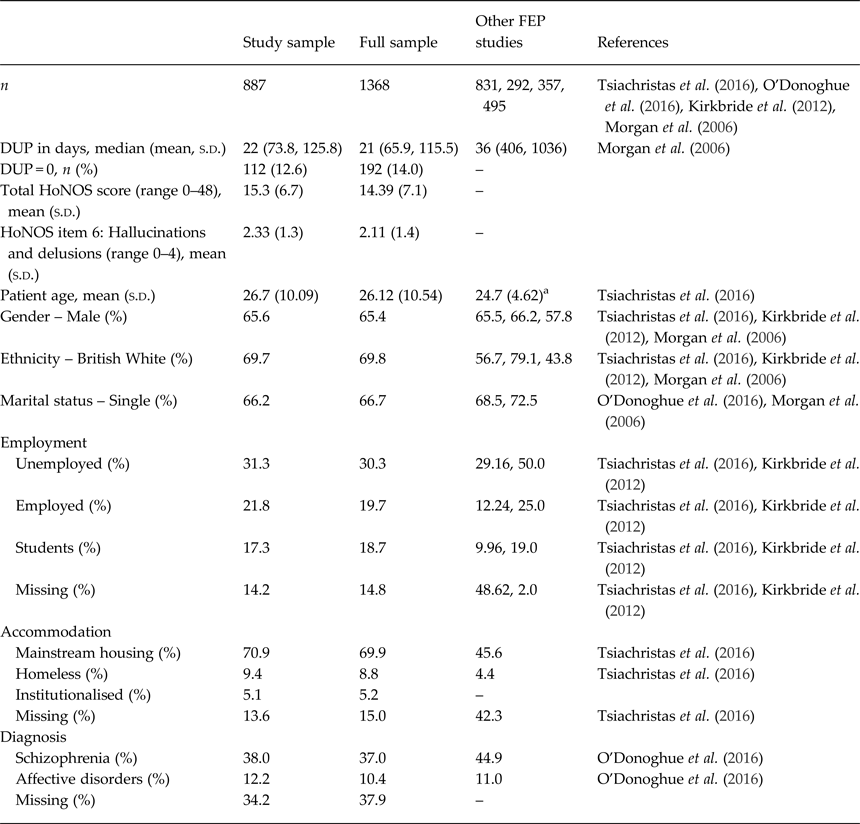
Table 1 summarises the demographic characteristics of the study sample and compares it to the full sample as well as to other recent FEP studies. The cohort was on average 26 years old, predominantly male (65.6%), of White origin (69.8%) and single (66.2%). Most patients lived in mainstream housing (70.9%), many were unemployed (31.3%) and diagnosed with schizophrenia (38%). There are no significant differences between demographic characteristics of the study sample and the full sample implying that there is no selection bias due to the exclusion of incomplete observations (see also online Supplementary Appendix 3). Further, our study sample appears to be comparable to other recent FEP studies by Tsiachristas et al. (Reference Tsiachristas, Thomas, Leal and Lennox2016), O'Donoghue et al. (Reference O'Donoghue, Lyne, Renwick, Lane, Madigan, Staines, O'Callaghan and Clarke2016), Kirkbride et al. (Reference Kirkbride, Stubbins and Jones2012), and Morgan et al. (Reference Morgan, Abdul-al, Lappin, Jones, Fearon, Leese, Croudace, Morgan, Dazzan, Craig, Leff and Murray2006).
Demographic characteristics of the study sample compared to the full sample and other FEP studies

DUP, Duration of untreated psychosis.
Full sample includes all patients with a valid psychosis start date and a valid prescription date in the financial year 2012/2013–2014/2015. The study sample is based on the full sample and excludes observations with missing LSOA, missing HoNOS score (or HoNOS more than 30 days after treatment start), and providers where fewer than three patients were treated. ‘Institutionalised’ includes accommodation with mental health or other care support or criminal justice, acute or long-stay healthcare facility, or sheltered housing.
a Study sample was restricted to 16 to 35 year old patients
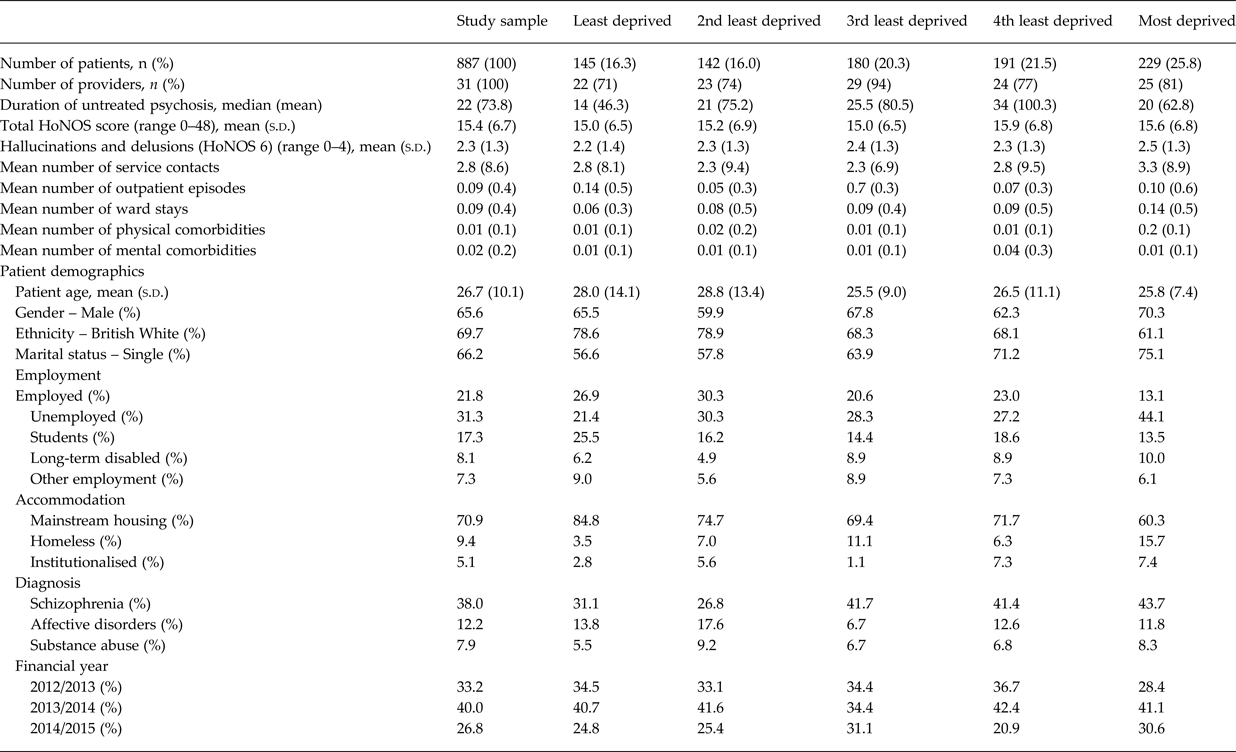
In Table 2, all covariates included in the model are presented for the study sample in total and by socioeconomic deprivation quintile. There is an increase in FEP patients as the level of deprivation increases. At least 71% of all providers in our sample treated patients from all five socioeconomic quintiles. We note that providers are counted multiple times if they treated patients from more than one socioeconomic quintile. The median DUP overall was 22 days (mean = 73.8 days). Patients from the least deprived quintile waited shortest followed by a clear increase in DUP with every deprivation quintile – with the exception of the most deprived quintile. On average, patients had mild to moderately severe problems with hallucinations and delusions according to their HoNOS score (mean = 2.33). We note that patients from the most deprived quintiles differ in a number of characteristics from the rest of the sample. Compared with the study sample, they are more likely to be single, unemployed, homeless and in contact with mental health services before the psychosis. The sample is distributed across all nine English regions with the largest proportion of patients from the South East (25.7%) and the smallest proportion from the North East (0.3%) (see online Supplementary Appendix 4).
Distribution of patients and providers by socioeconomic status
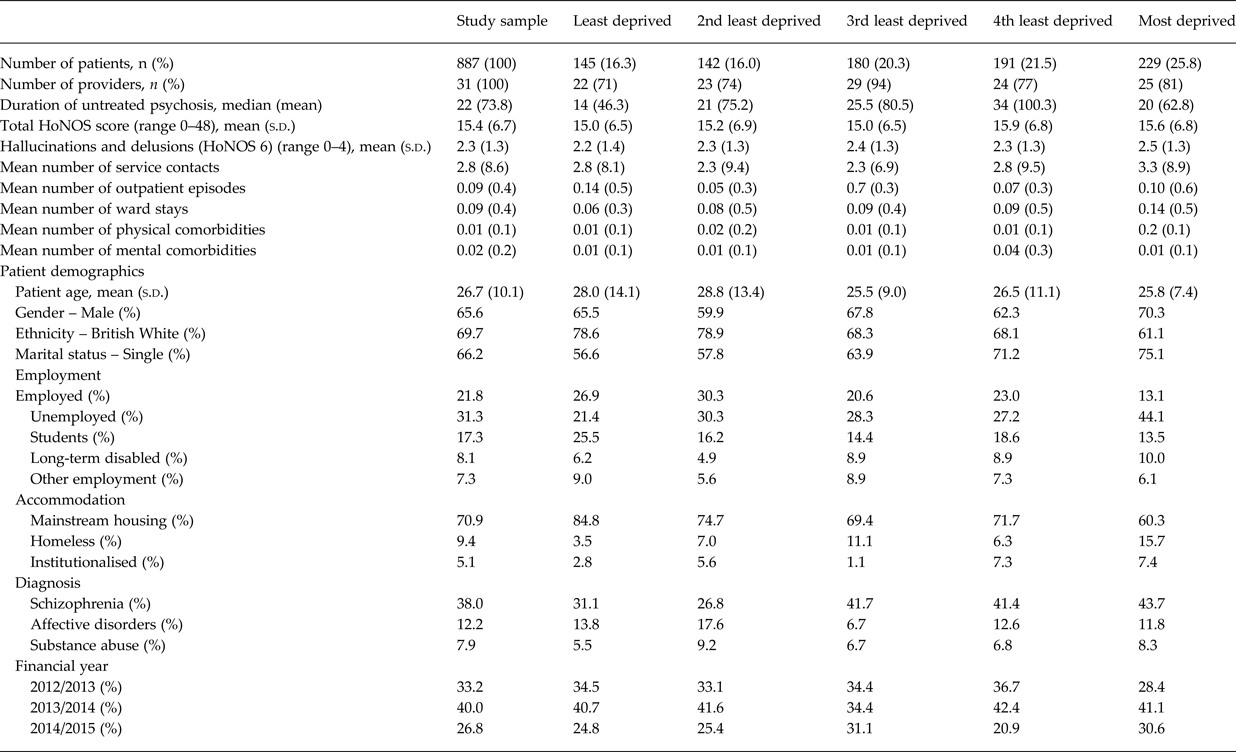
DUP, Duration of untreated psychosis.
Categorical variables may not sum up to 100% as categories of missing values are not presented. The number of providers refers to those that treated at least one patient from the given socioeconomic quintile, providers can be counted more than once if they treated patients from more than one socioeconomic quintile. ‘Hallucinations and delusions’ refers to the HoNOS item number 6. Service contacts, outpatient episodes and ward stays refer to mental health related service use in the 12 months prior to the psychosis start.
Estimation results
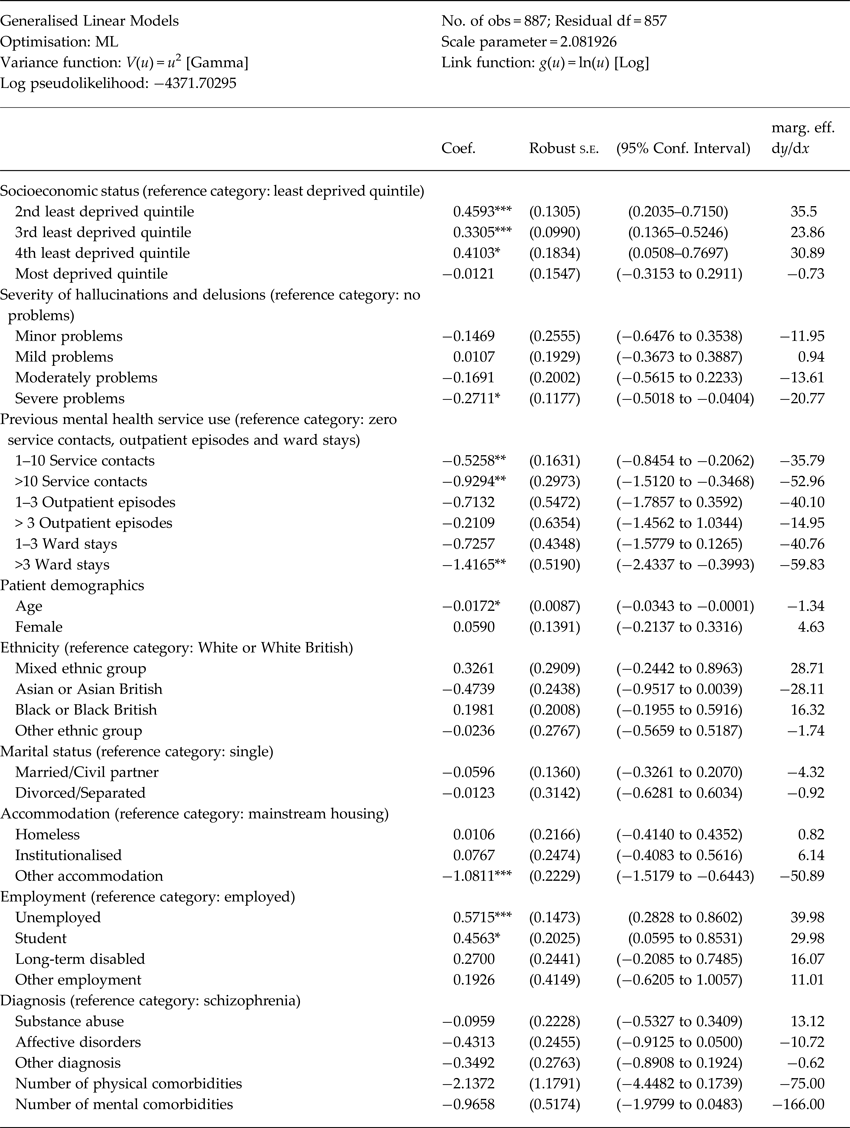
Estimation results from Table 3 confirm a socioeconomic gradient in DUP for the first four deprivation quintiles (least to fourth least deprived). Patients in the second least deprived quintile have a 35.5 day longer DUP than patients from the least deprived quintile. Patients from the third and fourth least deprived quintiles face a DUP that is 24 and 31 days longer than the patients’ DUP from least deprived neighbourhoods. The most deprived quintile has a negative coefficient indicating a slightly shorter DUP for patients from most deprived areas compared to the least deprived quintile. However, the result is not statistically significant. Experiencing very severe problems with hallucinations and delusions has a significant impact on DUP. Patients suffering from severe hallucinations and delusions wait 21 days shorter than patients having no problems at all. Negative coefficients for moderately severe problems and minor problems indicate the same severity gradient in DUP; however, the estimates are not statistically significant. Mental health professional contacts in the 12 months prior to the psychosis start, significantly reduce DUP by 36 days for 1–10 contacts and by 53 days for more than 10 contacts compared with no contact at all. Having had an outpatient mental health consultant episode before the psychosis, did not show a significant effect on DUP. However, for patients with more than three previous ward stays related to a mental health condition, DUP was 60 days shorter. Patient numbers in the latter case were low, which might have affected their statistical significance. Regarding other patient characteristics, we find a small effect of age on DUP. Further, there is a strong relationship between employment status and DUP. Patients being unemployed have a 40-day longer DUP than employed patients. Also students have a 30-day longer DUP compared with patients in employment. We could not find any significant inequalities in DUP with regards to gender, ethnicity, marital status, or accommodation status.
Generalised Linear Model regression results
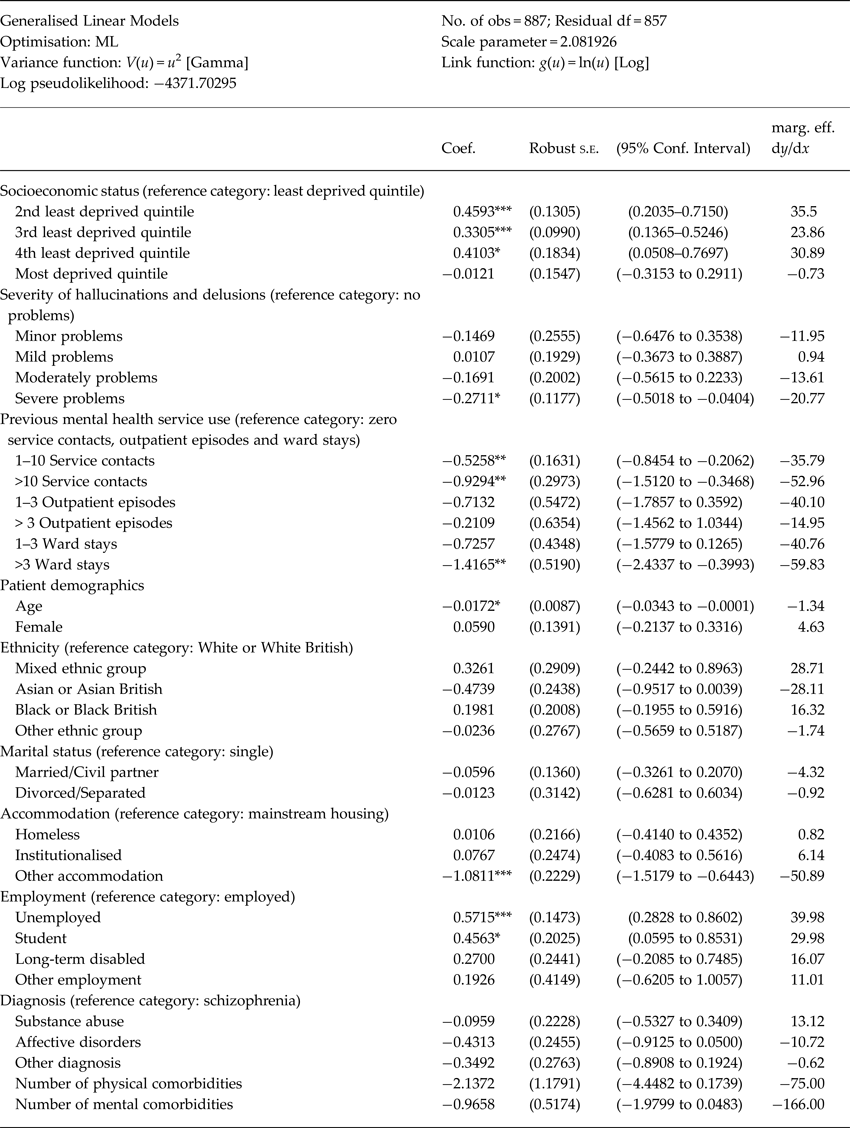
*p < 0.05, **p < 0.01, ***p < 0.001.
Dependent variable is duration of untreated psychosis in days (DUP). Included are year dummies for three financial years and provider dummies for 31 providers. Marginal effects are average marginal effects in days. For factor levels they present the discrete change from the reference category. Cluster robust standard errors were applied for 31 providers.
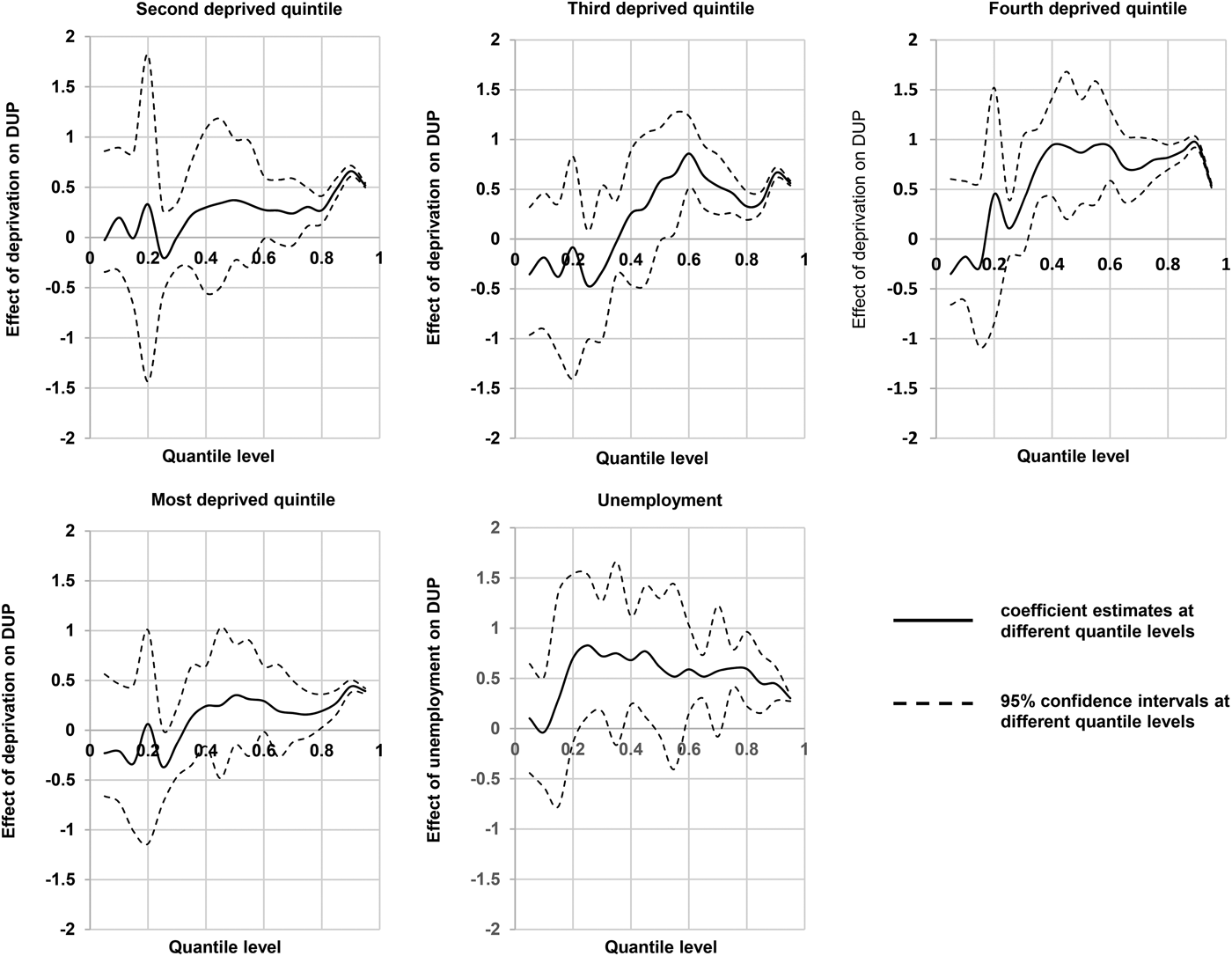
The graphical analysis in Fig. 2 confirms that the socioeconomic gradient is prevalent in the higher quantiles of the DUP distribution. The coefficients for all deprivation quintiles are smaller or negative for the lower quantiles and increase along the DUP distribution. While estimates at the lower end are mainly insignificant with large confidence intervals, coefficients at the higher end of the DUP distribution are highly significant. In contrast, the effect of unemployment on DUP seems to slightly decrease along the DUP distribution.
Differential effects of socioeconomic deprivation and unemployment by quantile.

Sensitivity analyses
Estimation results for the sensitivity analyses can be found in online Supplementary Appendices 5–8. Results were shown to be robust against different definitions of the DUP measure (online Supplementary Appendix 5). Using only the emergent and prescription date as start and end point does not seem to influence the results in a significant way. Also, using only observations with a valid treatment date did not change the gradient we observe. Online Supplementary Appendix 6 shows the results when using the treatment date as an alternative end point to calculate DUP. Again, the gradient remains similar with and without provider fixed effects. Restricting the sample to the ages 14–35 reveals an even stronger socioeconomic gradient compared with the full sample (online Supplementary Appendix 7). The socioeconomic gradient decreases in magnitude and the second least deprived quintile loses significance as we exclude DUP that exceeds 1.5 years. This suggests the socioeconomic gradient is stronger for patients with very long waits, which is further confirmed when we exclude patients with a zero DUP. In the subsample of non-zero DUP patients, we observe a clear socioeconomic gradient. Excluding marital, accommodation and employment status as patient-level SES measures from the regression, does not change the observed gradient (online Supplementary Appendix 8). Among the patient-level variables, only employment has a significant effect, which is similar to what we observe in the main model. The IMD quintiles seem to capture aspects of deprivation, which are not included as separate covariates in the model. The most deprived quintile remains insignificant regardless of the specification.
Discussion
Since the prevalence of FEP in more deprived neighbourhoods is found to be higher compared to less deprived areas (O'Donoghue et al. Reference O'Donoghue, Lyne, Renwick, Lane, Madigan, Staines, O'Callaghan and Clarke2016) we asked whether the level of socioeconomic deprivation determines the patient's help-seeking behaviour and access to care. Being the first to investigate the relationship between DUP and socioeconomic deprivation in England, we were able to use a large sample from administrative data, including a large number of mental health providers. Compared with other literature in the field we control for a rich set of covariates and apply statistical methods that adequately account for non-linearity in DUP. The results were robust in a number of sensitivity analyses.
Our findings revealed significant inequalities regarding the level of socioeconomic deprivation. The gradient, however, was not linear. Patients from the second least deprived quintiles have the longest DUP followed by patients from the fourth, and the third least deprived quintiles. For the most deprived quintile, differences were not statistically significant. Severe hallucinations and delusions and previous mental health service contacts not related to the psychosis, significantly reduced the DUP. We did not find any significant inequalities in DUP with regard to age, gender, or ethnicity, which also confirms findings from previous studies (Morgan et al. Reference Morgan, Abdul-al, Lappin, Jones, Fearon, Leese, Croudace, Morgan, Dazzan, Craig, Leff and Murray2006; Large et al. Reference Large, Nielssen, Slade and Harris2008; Cascio et al. Reference Cascio, Cella, Preti, Meneghelli and Cocchi2012; Ghali et al. Reference Ghali, Fisher, Joyce, Major, Hobbs, Soni, Chisholm, Rahaman, Papada, Lawrence, Bloy, Marlowe, Aitchison, Power and Johnson2013). We used a comprehensive measure of SES, which captures various aspects of socioeconomic deprivation and is widely used in other literature on health inequalities. It should be noted that our measure is relative – not every person living in a highly deprived area will themselves be deprived and vice versa. At a patient level, marital, accommodation and employment status could serve as proxies for the patient's SES. Results consistently indicate that employment status plays an important role in the length of DUP as has been found by other studies (Morgan et al. Reference Morgan, Abdul-al, Lappin, Jones, Fearon, Leese, Croudace, Morgan, Dazzan, Craig, Leff and Murray2006). Marital and accommodation status, however, do not explain any differences in DUP. Since we control for provider fixed effects and patient-level SES variables in our model, the observed socioeconomic gradient in DUP is independent of provider characteristics and of the patient's marital, accommodation and employment status.
Limitations
It remains to be explained why the most deprived neighbourhoods have a shorter DUP than the other deprivation quintiles, which contradicts findings of a clear socioeconomic gradient within the physical health literature (Siciliani, Reference Siciliani, Sobolev, Levy and Goring2016). It may be that patients from most deprived neighbourhoods enter the system more often through the criminal justice system, which may shorten their DUP or they are more likely to be in contact with a GP due to a poorer general health. Comparing most deprived patients with the rest of the sample revealed that they are more likely to be single, unemployed and homeless. They were also more likely to have been in contact with mental health services before the psychosis which seems to support our theory. Further, this could represent a recall bias by the patient. The information on the emergence of the psychosis relies on self-report. Patients from more deprived neighbourhoods may systematically report their symptom history differently from others due to different educational levels or insight into the disease.
Our study focuses on DUP as one of the key parameters in managing FEP patients. The importance of the DUP concept lies in its strong relationship to improved clinical outcomes while at the same time being a modifiable risk factor. The median DUP in our study was 22 days, which is close to figures in some studies (Apeldoorn et al. Reference Apeldoorn, Sterk, van den Heuvel, Schoevers, Islam, Bruggeman, Cahn, deHaan, Kahn, Meijer, Myin-Germeys, van Os and Wiersma2014) but shorter compared with other studies reporting a median DUP of 50–120 days (Birchwood et al. Reference Birchwood, Connor, Lester, Patterson, Freemantle, Marshall, Fowler, Lewis, Jones, Amos, Everard and Singh2013; Behan et al. Reference Behan, Cullinan, Kennelly, Turner, Owens, Lau, Kinsella and Clarke2015; O'Donoghue et al. Reference O'Donoghue, Lyne, Renwick, Lane, Madigan, Staines, O'Callaghan and Clarke2016). On the one hand, differences may be caused by our study period being limited to 3 years. Thus, we possibly exclude a number of DUP observations exceeding the study period. If we are underestimating the DUP and it holds true that the socioeconomic gradient increases as the DUP increases, then we are likely to further underestimate socioeconomic inequalities. We also note a significant decline in DUP across the 3 years of study. It is likely that the increasing international awareness of early intervention has contributed to an overall reduction in DUP. Since previous studies use data from 1995 to 2011 our study provides a much more recent measure of DUP. On the other hand, differences may be rooted in the measurement of DUP. Despite its strengths, the DUP concept has been criticised in the literature as its definition varies across studies (Singh, Reference Singh2007; Large et al. Reference Large, Nielssen, Slade and Harris2008; Register-Brown & Hong, Reference Register-Brown and Hong2014). From our data we are not able to provide information on the methods being applied to define the emergent date and what training the clinical teams received with regard to this. It is also very likely that methods varied between the providers in our sample. By applying provider fixed effects we controlled for any measurement differences between providers. However, we were not able to capture any variation if clinicians within the same provider were recording dates differently. This would have influenced results if clinicians within a provider would record dates for patients from socioeconomically more deprived areas differently to those from less deprived areas. We defined the first antipsychotic prescription as the treatment start as it can be consistently defined within our dataset. But we appreciate that the prescription of medication does not necessarily imply a patient has received effective treatment (Breitborde et al. Reference Breitborde, Srihari and Woods2009). Using this approach introduces the problem of reliably defining effective treatment. To date there is no agreed best way of measuring DUP (Register-Brown & Hong, Reference Register-Brown and Hong2014). Assuming that effective treatment will be put in place from the first antipsychotic prescription, we are likely to underestimate the actual DUP and look at just a part of its full duration. We do, however, cover the period of help-seeking, which is expected to be much more influenced by the patient's socioeconomic background than the aspect of receiving effective treatment after the first service contact. Our results were also robust against changing the DUP endpoint. Nevertheless, future research should aim to address this limitation by establishing a DUP measure that goes beyond the traditional definition, using for example the acceptance onto the caseload of an EIP service as the endpoint. This approach will allow the inclusion of patients who never received any anti-psychotic medication.
Despite the policy relevance of DUP, the reporting of relevant data is not mandatory for providers. Hence, we cannot rule out that there is a bias in the composition of our sample as we may miss out FEP patients not being reported by providers. Our sample proved, however, to be comparable with FEP patient cohorts from other recent studies.
Finally, any unobserved heterogeneity cannot be ruled out due to factors such as drug abuse, family history in psychosis, or patients’ social network. For example, there is evidence of interactions between age, gender and cannabis use (Broussard et al. Reference Broussard, Kelley, Wan, Cristofaro, Crisafio, Haggard, Myers, Reed and Compton2013; Donoghue et al. Reference Donoghue, Doody, Murray, Jones, Morgan, Dazzan, Hart, Mazzoncini and MacCabe2014). Also stigma-related processes have been found to influence help-seeking and service contact at early stages of psychotic disorders (Gronholm et al. Reference Gronholm, Thornicroft, Laurens and Evans-Lacko2017). Although HoNOS is a validated tool in the application of psychoses it might not capture all aspects of disease-related severity. This could lead to an over- as well as underestimation of the effects of socioeconomic deprivation on DUP depending on whether hallucinations or delusions are more prevalent in certain deprivation quintiles.
Implications for EIP services
DUP captures the complete waiting experience of the patient, including time from first symptom to help-seeking, from referral to assessment, and from assessment to treatment. Therefore, we cannot distinguish between the patient's and the care system's contribution to the delay and factors are likely to interact with each other. However, socioeconomic deprivation is a contributing factor to a prolonged DUP independent of severity of hallucinations, previous service contacts and patient demographics. Inequalities arise predominantly at the higher end of the DUP distribution. Policies to improve equitable access to care should therefore focus on preventing very long delays in treatment and target unemployed patients and students. Being known to mental health services for reasons other than psychosis seems to make it easier to access the system a second time regardless of the severity of the condition. Efforts aimed at shortening DUP should particularly target people that have not been in contact with any mental health professional in the past. For example, GP or other health professional education campaigns could improve awareness of the signs of early psychosis and encourage them to refer patients promptly to specialist services (Lloyd-Evans et al. Reference Lloyd-Evans, Crosby, Stockton, Pilling, Hobbs, Hinton and Johnson2011). Also information campaigns for young people and their families in schools or in mainstream media may contribute to a reduced stigmatising image of psychosis and will promote early help-seeking. The decrease in DUP over the past years indicates that the awareness of its importance has increased. However, significant variations within providers remain and should be addressed further to reduce inequalities.
Supplementary Material
The supplementary material for this article can be found at https://doi.org/10.1017/S0033291717002197
Acknowledgements
This study uses secondary data, so there was no need for ethical approval. Under a Data Sharing Agreement with NHS Digital the MHSDS dataset is released on condition that it is not shared with any third party. Copyright © 2011/2012–2014/15, re-used with the permission of NHS Digital. All rights reserved. Our thanks go to Stephen Wright, Tracey Walker and the York EIP Service from Tees, Esk and Wear Valleys NHS Foundation Trust for a helpful visit and discussions with the team. We would also like to thank three anonymous reviewers and the discussant and participants at the HESG conference 2017 in Birmingham for their very helpful comments. This research received no specific grant from any funding agency, commercial or not-for-profit sectors. Anika Reichert conducted this research as part of her Ph.D. study which is funded by a scholarship from the Centre for Health Economics, University of York.
Declaration of Interest
None.