


INTRODUCTION
Voters in most federalist countries elect representatives to serve in political institutions that vary in scope and scale. Representatives in such multilevel governments are selected in a mix of concurrent and separate elections, often referred to as the electoral cycle. Previous research has identified a number of channels through which the electoral cycle can cause contamination effects such that electoral outcomes at one level of government are affected by a feature of another level of government.Footnote 1 One contamination effect that has long interested academics, journalists, and political pundits is the coattail effect. Miller (Reference Miller1955) defines a coattail effect as the effect that the personal identity of a party's candidate in one election has on the performance of the party's candidates in concurrent elections.Footnote 2 Coattails affect the chances that personally popular executives such as Ronald Reagan or Luiz Inácio Lula da Silva will come into office with a supportive legislature, which in turn has consequences for whether such leaders can enact their agendas. Coattails also have important implications for the structure of political parties, campaign finance, and the electoral incentives of representatives (Samuels Reference Samuels2002, Reference Samuels2004).
Since the 1940s, scholars have tried to empirically test for the existence of coattails and to estimate the magnitude of their influence in a variety of contexts. Estimating these effects might seem like a straightforward exercise, but this is not the case because a number of factors, for instance, voters’ preferences and the state of macroeconomy, affect how a party's candidates perform at both the top and bottom of the ballot. Regressions are typically used to control for variables that are thought to affect both a party's top- and down-ballot performance, and any remaining association between a party's top- and down-ballot vote share is interpreted as the coattail effect (Samuels Reference Samuels2003, 83). Unfortunately, it is difficult to observe, measure, and specify the proper functional relationship between all these variables. These unmeasured or mismeasured determinants of a party's down-ballot vote share are also likely to affect the party's vote shares in other races. When this happens, the association between a party's top- and down-ballot vote shares is expected to be larger than the true coattail effect due to these omitted variables. Even if all of the other joint determinants of top- and down-ballot vote shares are properly included in a regression, additional problems arise when down-ballot candidates’ coattails also affect the top-ballot race. In such cases, endogeneity will cause the expected association between top- and down-ballot vote shares to overstate the coattail effect. Consequently, previous research that interprets this association as a coattail effect is likely to overstate the magnitude of coattails.
In this article I present a technique for overcoming this identification problem. Rather than trying to model all of the joint determinants of top- and down-ballot vote shares, I isolate variation in the personal votes received by candidates across different constituencies. A personal vote refers to a vote that is cast on the basis of a candidate's characteristics or record, rather than party (Cain, Ferejohn, and Fiorina Reference Cain, Ferejohn and Fiorina1990). Previous work shows that candidates tend to receive more personal votes from geographically proximate constituents, which is often referred to as friends-and-neighbors voting (Key Reference Key1949; Lewis-Beck and Rice Reference Lewis-Beck and Rice1983). Such forms of personal voting may provide variation in candidate performance that is unrelated to the unmeasured or mismeasured factors that affect both top- and down-ballot party choice. In such cases, the resulting association between the personal vote received by a top-ballot candidate and the vote shares received by down-ballot candidates from his or her party can be used to get an unbiased estimate of the coattail effect.
I use this approach to estimate the magnitude of coattail effects in concurrent U.S. statewide executive-office elections from 1987 to 2010. Data on the location of birth and residence of gubernatorial, secretary of state, and attorney general candidates are used to isolate variation in the performance of both top- and down-ballot candidates in a county that is due to friends-and-neighbors voting. This variation is related to the performance of their party in other concurrent races. My point estimates show that a one-percentage-point increase in the personal vote received by a party's gubernatorial candidate in a county increases the vote share received by the party's secretary of state or attorney general candidate by 0.1 to 0.2 percentage points. These instrumental variable (IV) point estimates are smaller than the point estimates from comparable ordinary least-squares (OLS) regressions, although generally not statistically distinguishable. In contrast, OLS and IV specifications produce estimates of secretary of state and attorney general candidates’ coattails that are both statistically and substantively different. These findings suggest that although coattails do exist in some contexts, previous work likely overestimates their influence and may even incorrectly identify their presence.
RELEVANT LITERATURE
A coattail effect occurs when an individual who would usually support a down-ballot candidate from party A instead votes for the down-ballot candidate from party B because he or she supports the top-ballot candidate from party B.Footnote 3 One potential explanation for such behavior is that people generally dislike holding conflicting beliefs, such as simultaneously supporting Democratic and Republican candidates (Mondak and McCurley Reference Mondak and McCurley1994). As such, voters may prefer to cast down-ballot votes for candidates from the party of their preferred top-ballot candidate. Ballot features can also encourage voters to cast straight-ticket ballots and support the party of their preferred top-ballot candidate in down-ballot elections. Campbell and Miller (Reference Campbell and Miller1957) contend that the straight-party option, which allows voters to cast a ballot for a party's candidate in every concurrent election with a single vote, increases the prevalence of straight-ticket voting.Footnote 4
Coattails can also result from top-ballot candidates mobilizing a party's supporters. Campbell (Reference Campbell1960) distinguishes between a party's core supporters, who generally vote, and peripheral supporters, who often require additional political stimulation to turn out. The attractiveness of a top-ballot candidate is one of the political stimulants that Campbell highlights as an important determinant of whether these peripheral supporters ultimately vote. Coattails arise because these peripheral supporters are also likely to support their party's down-ballot candidates once at the polls.
Early studies of coattail effects by Bean (Reference Bean1948) and Moos (Reference Moos1952) look at the relationship between a party's performance in U.S. presidential and congressional elections. Miller (Reference Miller1955) cautions against interpreting these studies as definitive evidence of coattail effects, in part because there are factors besides coattails that could result in a voter supporting a presidential and congressional candidate from the same party. More recent work on coattail effects uses regression analysis in an attempt to control for these factors.
Studies of coattail effects generally employ one of three different estimation approaches: OLS regressions, structural modeling, or IV regressions.Footnote 5 The most common form of OLS analysis is a cross-sectional regression of a party's down-ballot vote share in an electoral district on a host of district-level variables that are thought to relate to support for the party in the down-ballot election, including the party's vote share in the district in a top-ballot election. The coefficient on the party's top-ballot vote share generally is interpreted as the coattail effect. Other studies run this analysis using individual-level vote choice data, again interpreting the coefficient on top-ballot party vote choice as the coattail effect. Another OLS approach is a time-series regression of a party's aggregate down-ballot vote share on a party's vote share in a top-ballot race, with the coefficient on the party's top-ballot vote share interpreted as the coattail effect.
The OLS regression approach is problematic because factors other than coattail effects, such as voters’ ideology and the state of the economy, also contribute to the positive association between the support received by a party's candidates running for top- and down-ballot offices. These joint determinants are challenging to observe and measure, and it can be difficult to specify the proper functional relationship between these variables and down-ballot candidate performance. The unobserved determinants of down-ballot candidate performance also likely affect the performance of the party's top-ballot candidate. Consequentially, the coefficient obtained when regressing a party's down-ballot vote share on its top-ballot vote share is likely to overstate the true coattail effect. The importance of properly accounting for these joint determinants when estimating a coattail effect is demonstrated by studies that produce substantially different estimates of coattail effects in the same context. For example, Mondak (Reference Mondak1993) and Flemming (Reference Flemming1995) estimate the effect of presidential coattails on a similar set of open-seat U.S. House races. Where Mondak finds that a one-percentage-point increase in a party's presidential vote share associates with a 0.82 percentage point increase in the party's House candidates’ vote shares, Flemming estimates an association of only 0.29 percentage points.
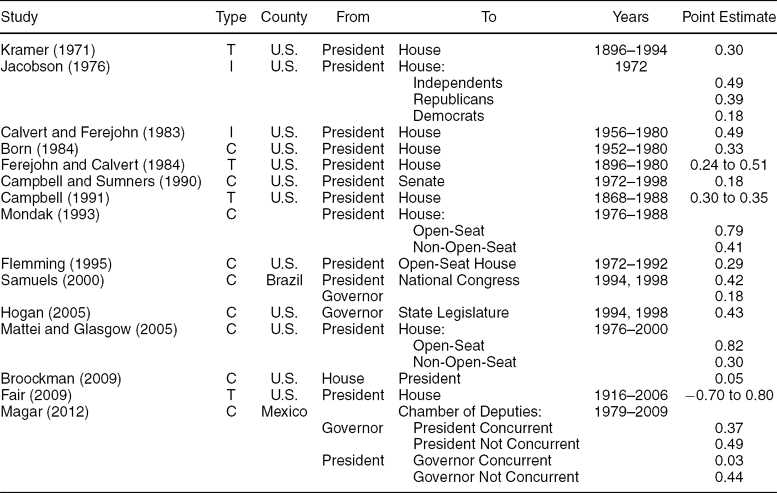
Other studies employ structural models to estimate the presidential coattail effect on House elections. Kramer (Reference Kramer1971) estimates a joint model of aggregate presidential and House vote shares that includes a presidential coattail effect. The model is identified by an assumption that the unobserved determinants of a party's House vote share have an equal effect on the party's presidential and House vote shares. Kramer's point estimates imply that a one-percentage-point increase in the personal vote received by a presidential candidate increases the vote share received by their party's House candidates by 0.3 percentage points. Ferejohn and Calvert (Reference Ferejohn and Calvert1984) weaken Kramer's assumption of a common unobservable determinant of presidential and House vote shares, estimating a range of coattail effects depending on the assumed correlation between these unobservable determinants of presidential and House vote shares. Their point estimates suggest that a one-percentage-point increase in the personal vote received by a presidential candidate increases the vote share received by their party's House candidates by between 0.24 and 0.51 percentage points.
Fair (Reference Fair2009) shows that these structural models are sensitive to model specification. Using a similar model to Kramer (Reference Kramer1971), Fair's point estimates indicate that a one-percentage-point increase in the personal vote received by a presidential candidate reduces his party's House vote share by almost 0.5 percentage points. Using the approach of Ferejohn and Calvert (Reference Ferejohn and Calvert1984) his point estimates range between a 0.71-percentage-point decrease and a 0.8-percentage-point increase in a party's House vote share because of a one-percentage-point increase in the personal vote received by their presidential candidate.
Finally, Calvert and Ferejohn (Reference Calvert and Ferejohn1983) use an IV approach to estimate the effect of reported U.S. presidential vote choice on reported House vote choice. They isolate personal votes for the president by instrumenting for presidential vote choice with a measure constructed from responses to an open-ended survey question “is there anything in particular about (name of candidate for president) that might make you want to vote for or against him.” Their estimates suggest that a one-percentage-point increase in the probability of a personal vote for a presidential candidate increases the probability of supporting the House candidate of the same party by 0.5 percentage points.Footnote 6
One concern with Calvert and Ferejohn's (1983) approach is that some reported likes and dislikes are rationalizations of vote choice (Rahn, Krosnick, and Breuning Reference Rahn, Krosnick and Breuning1994). As a result, reported likes and dislikes likely relate to omitted variables resulting from imperfect measurement of variables such as party identification. This calls into question whether this instrument satisfies the necessary exclusion restriction for IV to consistently estimate the coattail effect.
Like Calvert and Ferejohn (Reference Calvert and Ferejohn1983), I use an IV approach that attempts to isolate personal votes for top-ballot candidates with the goal of identifying a coattail effect. I focus specifically on the increase in personal votes that candidates receive from geographically proximate voters. One of the first and best known treatments of how the geographic proximity of candidates affects voter behavior is Key's (Reference Key1949) work on primaries in the American South in the first half of the 20th century. Key coined the phrase “friends-and-neighbors voting” to describe the increased support that candidates receive near their place of birth and residence. Subsequent work shows that candidates receive disproportionate support from geographically proximate voters across a broad spectrum of elections worldwide, including in the American statewide executive-office elections that are the focus of this article (Gimpel et al. Reference Gimpel, Karnes, McTague and Pearson-Merkowitz2008; Rice and Macht Reference Rice and Macht1987a). The first stage of my IV regressions estimates the increase in the personal vote that candidates received in counties near their place of birth and residence. The second stage of the IV regressions relates these friends-and-neighbors votes to the vote shares that down-ballot candidates from their party received in these counties in concurrent elections.
Although the approach presented in this article has a number of advantages over previous attempts to isolate coattail effects, these advantages come with some costs associated with using IV. The validity of the instruments hinges on the assumption that, conditional on the control variables, coattail effects are the only channel through which the place of birth or residence of a party's gubernatorial candidate affects the vote shares received by its down-ballot candidates. Ultimately this is an untestable assumption, but I conduct robustness and placebo tests to help justify the assumption, as well as sensitivity analysis that estimates the coattail effect under an alternative set of assumptions. The local average treatment effect (LATE) property of IV also potentially limits the generalizability of the coattail effects estimated using my instruments (Imbens and Angrist Reference Imbens and Angrist1994). The LATE property implies that IV estimates are specific to the observations affected by the instruments, which in this case are counties with geographically proximate candidates. While the demographics of candidates’ home counties are demonstrated to be representative of their state on most dimensions, there is no guarantee that the coattail effects resulting from friends-and-neighbors voting are of a similar magnitude as the coattail effects resulting from other forms of personal voting.
DATA
I use two new datasets to estimate the effect of gubernatorial coattails on down-ballot U.S. statewide executive office elections. County election returns were collected for all partisan statewide executive office election outcomes from 1987 to 2010.Footnote 7 These data are supplemented with the county of birth and residence for nearly all candidates for attorney general, governor, and secretary of state in that same time period.
Election Data
County election return records are usually maintained by the office in charge of running a state's elections, which is typically the secretary of state's office. Whenever possible, data were collected from the websites of these offices. Data that were unavailable on state websites, which is often the case for elections in the 1980s and 1990s, were collected from a variety of alternate sources, including hard copies obtained from the election officials, state Blue Books, and other existing online election archives.Footnote 8 Using these data I construct off c, t, the two-party vote share of the Democratic candidate running for office off in county c at time t.
As I discuss in the next subsection, candidates’ place of birth and residence were collected for one selected down-ballot race in each state. In states that concurrently elect their governor and secretary of state, data were collected for the secretary of state candidates. For states that do not, data were collected for the attorney general candidates. I define down c, t as the Democratic candidate's percentage of the two-party vote share in county c at time t in this selected down-ballot race and downc,t as the average Democratic percentage of the two-party vote cast in all statewide executive office races except the gubernatorial race in county c at time t.Footnote 9
Home County Data
I attempted to collect data on county of birth and county of residence for all gubernatorial and selected down-ballot candidates in each election held between 1987 and 2010. The primary source of data was biennial publications of Who'sWho in American Politics, each edition of which has thousands of short biographical records for individuals active in politics. I extracted from these records both a candidate's county of birth and county of residence. For 2010 candidates, I relied on questionnaires distributed by Project Vote Smart.Footnote 10
I drew on several secondary sources, including archived newspaper articles, Wikipedia, Ballotpedia, Political Graveyard, and archived candidate websites, to obtain place of birth and residence for candidates who are not listed in Who'sWho in American Politics or don't provide information to Project Vote Smart.Footnote 11 Ultimately, I observe place of birth for 99% of gubernatorial candidates and 83% of candidates in the selected down-ballot race, and place of residence for 100% of gubernatorial candidates and 97% of candidates in the selected down-ballot race.Footnote 12
By combining these data on county of birth and residence, I construct measures predicting which candidate, if either, is likely to receive more friends-and-neighbors support in a given county in a given race. The intuition behind my measures is that if one party's candidate was born or resides in close proximity to a given county and the other party's candidate was neither born in nor resides near that county, the former party's candidate should receive more friends-and-neighbors votes in that county.
Turning this intuition into a measure of geographic advantage requires that I specify both the geographic proximity of a candidate to a county and how this geographic proximity translates into a geographic advantage. The geographic proximity of the Democratic candidate for office off at time t to county c is captured using DemDist c, t, off. DemDist c, t, off measures the distance between county c and a county where the Democratic candidate for office off at time t was either born or resides.Footnote 13 The geographic proximity of the Republican candidate for office off at time t to county c is captured in an analogous manner with RepDist c, t, off. Two approaches are used to translate these distance measures into a measure of a candidate's geographic advantage in a county. The most straightforward, Home c, t, off, indicates whether one party's candidate was born in or resides in a county in which the other party's candidate was neither born nor resides. Specifically,
 \begin{eqnarray*}
&&Home_{c,t,{off}} \\
&&= \left\lbrace
\begin{array}{r@{}l}
1 & \mbox{if } DemDist_{c,t,{off}} = 0 \mbox{ and } RepDist_{c,t,{off}} > 0 \\
-1 & \mbox{if } DemDist_{c,t,{off}} > 0 \mbox{ and } RepDist_{c,t,{off}} = 0 \\
0 & \mbox{if } DemDist_{c,t,{off}} > 0 \mbox{ and } RepDist_{c,t,{off}} > 0 \\
\emptyset & \mbox{if } DemDist_{c,t,{off}} = 0 \mbox{ and } RepDist_{c,t,{off}} = 0 \\
\end{array} \right.\end{eqnarray*}
The second approach takes a broader view of what constitutes a geographic advantage in a county. Within50c, t, off indicates whether one party's candidate for office off at time t was born or resides in a county within 50 miles of county c, while the other party's candidate neither was born nor resides in a county within 50 miles of the county.Footnote 14 Specifically,
\begin{eqnarray*}
&&Within50_{c,t,{off}} \\
&&= \left\lbrace
\begin{array}{@{}r@{}l}
1 & \mbox{if } DemDist_{c,t,{off}} < 50 \mbox{ and } RepDist_{c,t,{off}} > 50 \\
-1 & \mbox{if } DemDist_{c,t,{off}} > 50 \mbox{ and } RepDist_{c,t,{off}} < 50 \\
0 & \mbox{if } DemDist_{c,t,{off}} > 50 \mbox{ and } RepDist_{c,t,{off}} > 50 \\
\emptyset & \mbox{if } DemDist_{c,t,{off}} < 50 \mbox{ and } RepDist_{c,t,{off}} < 50 \\
\end{array} \right.\end{eqnarray*}It is not clear which party's candidate, if either, has a friends-and-neighbors voting advantage in county c when both parties candidates either were born in or reside in that county. Setting Home c, t, off to a missing value in such cases causes them to be excluded from the analysis when Home c, t, off is included as a regressor. Likewise, setting Within50c, t, off to a missing value when both parties’ candidates were born in or reside in a county within 50 miles of county c causes such cases to be excluded from the analysis when Within50c, t, off is included as a regressor.
Descriptive Statistics
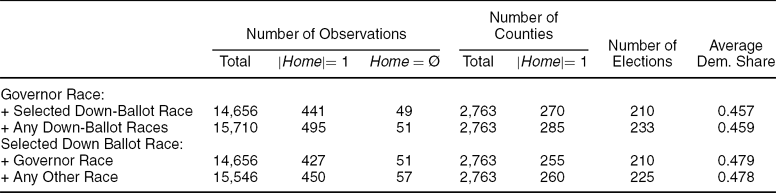
Table 1 shows that 210 elections are observed with both a valid gubernatorial and selected down-ballot election, producing a total of 14,656 observations in 2,763 counties. There are 441 cases where one party's gubernatorial candidate was born in or resides in a given county. A total of 270 of the 2,763 counties in the dataset have at least one case where one party's gubernatorial candidate was born in or resides in that county. There also are 49 cases where both gubernatorial candidates share a common home county.
Descriptive Statistics
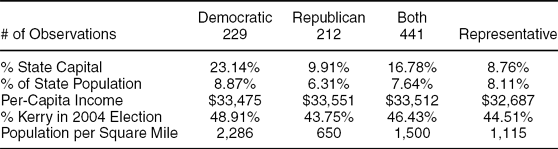
Table 2 shows that candidates’ home counties are similar to their states in terms of the county's share of population, per-capita income, and John Kerry's vote share in the 2004 presidential election. This similarity reduces concerns that the coattail effect identified by my instruments is unrepresentative of the coattail effect in the general population of counties. However, home counties are somewhat more densely populated and substantially more likely to contain the state capital. Democratic candidates are particularly likely to have been born in or reside in densely populated counties and the county that contains the state capital. Candidates also tend to come from counties that were more supportive of their party's candidate in the 2004 presidential election than their state at-large.
Characteristics of Gubernatorial Candidates’ Home Counties
Notes: The representative column presents the demographics that would be expected if the home counties of gubernatorial candidates were representative of their state's demographics.
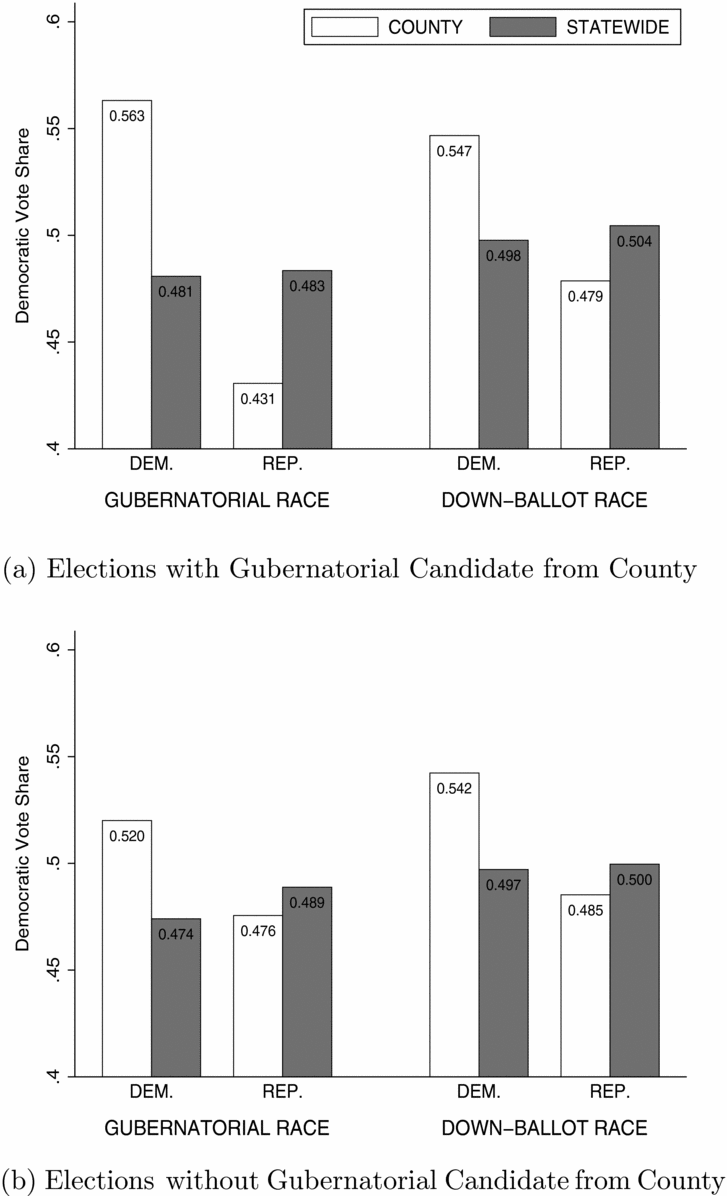
Figure 1a shows that a party's candidates generally perform better in a home county of their gubernatorial candidate. Democratic gubernatorial candidates outperform their statewide vote share by an average of 8.2 percentage points in their home counties, as they receive an average of 56.3% of the vote in a home county as compared to 48.1% of the vote statewide. Similarly, Republican gubernatorial candidates outperform their statewide vote share by an average of 5.2 percentage points in their home counties. Selected down-ballot candidates also receive more votes in these counties, with Democratic and Republican selected down-ballot candidates outperforming their statewide vote share by an average of 4.9 and 2.5 percentage points respectively in a home county of their party's gubernatorial candidate.
Average Vote Shares in Gubernatorial Candidates’ Home Counties
Notes: The top panel plots the average vote share that a party's candidates receive in a home county of their current gubernatorial candidate. The bottom panel plots the average vote share that a party's candidates receive in these same counties in elections when the county is neither a home county of the Democratic nor the Republican gubernatorial candidate. The sample includes 202 home counties of Democratic gubernatorial candidates and 196 home counties of Republican gubernatorial candidates.
A party's candidates may do better in a home county of their gubernatorial candidate because their gubernatorial candidate attracts a number of personal votes in the county, some of which spillover onto their party's down-ballot candidates because of coattails. It could also reflect differences in the party preferences of voters in the home counties of gubernatorial candidates. One way of separating these two potential explanations is to look at how a party's candidates perform in these same counties in elections where neither party's gubernatorial candidate is from the county. If similar patterns are observed in these counties in elections where neither party's gubernatorial candidate is from the county, this suggests that party preferences are likely to cause the patterns observed in Figure 1a. Alternatively, if a party's candidates generally do better in a county when the party's gubernatorial candidate is from the county, this suggests that personal voting and coattails are part of the explanation.
The patterns displayed in Figure 1b are consistent with the hypothesis that, while party preferences play an important role, personal voting and coattails also explain some of the increase in a party's vote share in a home county of their gubernatorial candidate. Figure 1b shows how a party's candidates perform in the counties highlighted in Figure 1a in a different set of elections. In the election results shown in Figure 1b, neither party's gubernatorial candidate was born in or resides in the county. The differences between county and statewide performance are larger in both the gubernatorial and down-ballot races in Figure 1a. For example, while Figure 1a shows that Democratic gubernatorial candidates outperform their statewide vote share by an average of 8.2 percentage points in a home county, Figure 1b shows that other Democratic gubernatorial candidates only outperform their statewide vote share by an average of 4.6 percentage points in these same counties. This 3.6 percentage point difference suggests the presence of a substantial number of personal friends-and-neighbors votes. The IV method developed in the next section is based on the premise that if gubernatorial coattails exist, these personal friends-and-neighbors votes should also cause Democratic down-ballot candidates to perform better in a county when it is a Democratic gubernatorial candidate's home county. Consistent with this prediction, Democratic down-ballot candidates outperform their statewide vote share by an average of 4.9 percentage points when it is the home county of the Democratic gubernatorial candidate, as compared to 4.5 percentage points when it is not. Likewise, Republican gubernatorial and down-ballot candidates perform relatively better in a county when it is a Republican gubernatorial candidate's home county.
COATTAIL EFFECTS
Empirical Specification
This subsection explains how the increase in vote share that candidates receive in and near their place of birth and residence can be used to estimate coattail effects. The specific coattail effect of interest is how increases in personal votes cast for a gubernatorial candidate in a county also increases the vote share of down-ballot candidates from the gubernatorial candidate's party in that county. As was previously discussed, estimating this relationship is complicated by the presence of a number of variables, some of which are difficult to observe, that jointly affect support for a party's gubernatorial and down-ballot candidates in a county. Below I show how knowledge of a candidate's place of birth and residence and panel data can be used to overcome this identification problem.
Equation (1) presents a specification often used in previous work to identify coattail effects. The down-ballot Democratic vote share in county c at time t is modeled as a separable linear function of the Democratic vote share in the concurrent gubernatorial election, gov c, t, a vector of control variables, X c,t, and an unobservable component, εc,t. This model is typically estimated by OLS, with  $\skew4\hat{\beta }$ interpreted as the estimated coattail effect. Such an interpretation relies on X c,t containing all of the joint determinants of a county's general support for Democratic candidates. If some of these variables are unobserved or if the functional relationship between these variables and the down-ballot vote share is misspecified this calls into question whether the error term is truly unrelated to the gubernatorial vote share after conditioning on the control variables. The condition that E[εc, t∣gov c, t, X c, t] = 0 must hold for OLS to consistently estimate the coattail effect. It is important to note that this condition will also be violated if coattails also operate in the opposite direction such that down-ballot candidates’ vote shares affect their party's performance in the gubernatorial election.
 \begin{equation}
{down}_{c,t} = \beta {gov}_{c,t} + \theta X_{c,t} + \epsilon _{c,t}
\end{equation}
Identifying and collecting all of the joint determinants of a party's gubernatorial and down-ballot vote shares in a county is nearly impossible. I instead use IV to isolate variation in the personal votes cast for gubernatorial candidates across counties. A set of instruments, Z c,t, that affect a gubernatorial candidate's personal support in a county can potentially identify β when the unobserved determinants of down-ballot vote share are conditionally independent of the instruments. This exclusion restriction is denoted mathematically as E[εc,t∣Z c,t, X c,t] = 0. A randomly assigned treatment that affects a gubernatorial candidate's personal support in a county is the ideal instrument because it is assigned independent of a party's expected down-ballot vote share in the county. Because such an experiment does not exist, I next consider other variables that affect the personal votes a gubernatorial candidate receives in a county. Unlike a randomly assigned treatment, it is generally incorrect to assume that such variables are assigned independent of a party's down-ballot vote share. However, focusing on the right set of instruments can reduce the set of control variables that are necessary in order for the exclusion restriction to hold.
Equation (2) is an example of a first-stage equation that instruments for gubernatorial vote share using information about gubernatorial candidates’ place of birth and residence. This first-stage equation instruments for the gubernatorial vote share in the county using Home c,t,gov, the variable that indicates whether one party's gubernatorial candidate was born in or resides in the county (i.e., Z c,t = Home c,t,gov). For Home c,t,gov to potentially be an instrument for gubernatorial vote share, it is necessary that gubernatorial candidates receive additional personal votes in their county of birth and residence (i.e., ψ > 0). Figure 1 presented preliminary evidence that this is the case. However, this alone does not make Home c,t,gov a good instrument. The exclusion restriction that must hold for the system of equations (1) and (2) to identify the gubernatorial coattail effect is that E[εc,t∣Home c,t,gov, X c,t] = 0. Explained in words, this exclusion restriction requires that any relationship between the unobserved determinants of down-ballot vote share and the place and birth and residence of gubernatorial candidates is captured by the control variables. Figures 1a and 1b show that candidates tend to come from counties that are predisposed to support their party. Thus, the validity of this exclusion restriction hinges on the ability of the control variables to fully account for these differences in the party preferences of voters in the counties near candidates’ place of birth and residence.
 \begin{equation}
{gov}_{c,t} = \psi\,\, Home_{c,t,gov} + \zeta X_{c,t} + \nu _{c,t}
\end{equation}
Equation (3) shows how I parameterize the controls, ζX c,t, in my baseline specification. Following Levitt and Wolfram (Reference Levitt and Wolfram1997) and Ansolabehere and Snyder (Reference Ansolabehere and Snyder2002), I use a combination of fixed effects to model the expected gubernatorial vote share in a county in a given election. An election fixed effect, λs(c),t, controls for the differences in relative quality of Democratic and Republican gubernatorial candidates within state s(c) across elections. A county fixed effect, λc, controls for differences in the gubernatorial normal vote across counties within a state.Footnote 15 I also include a county time trend, τc, in some specifications to account for Miller's (Reference Miller1979) critique of measures of the normal vote that do not account for the possibility of changes across time. Finally, I include Home c,t,down, an indicator for whether a party's down-ballot candidate was either born in or resides in the county.
 \begin{equation}
\zeta X_{c,t} = \lambda _{s(c),t} + \lambda _{c} + \tau _{c} t + \delta Home_{c,t,down}
\end{equation}
Equation (4) shows that I parametrize θX c,t in an analagous fashion to ζX c,t when estimating the second-stage equation, as is required in IV estimation. γs(c),t controls for the differences in relative quality of Democratic and Republican down-ballot candidates within state s(c) across elections, γc controls for differences in the down-ballot normal vote across counties within a state, and ω accounts for the increase in vote-share down-ballot candidates receive in their county of birth or residence.
 \begin{equation}
\theta X_{c,t} = \gamma _{s(c),t} + \gamma _{c} + \phi _{c} t + \omega Home_{c,t,down}
\end{equation}
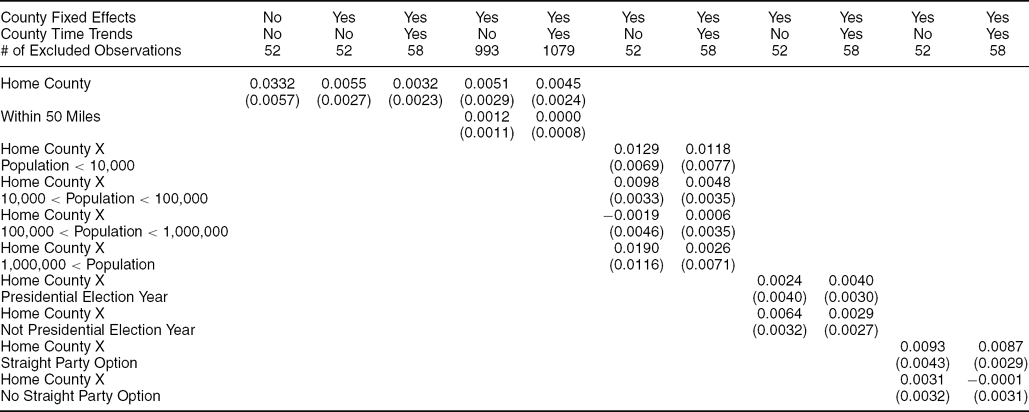
I estimate the system of equations (1) and (2) using a number of different combinations of instruments to examine the robustness of the results obtained using this baseline specification. Some specifications also include Within50c,t,gov, the indicator for whether a county is within 50 miles of a home county of one candidate, as an instrument to exploit the smaller increase in personal votes that candidates receive in other counties near their place of birth and residence. Other specifications include the interactions between Home c,t,gov and the population of the county as instruments to exploit the fact that friends-and-neighbors voting is more prevalent in less populated counties (Rice and Macht Reference Rice and Macht1987a). Including multiple instruments allows for the use of overidentification tests to examine whether these different instruments generate similar estimates of the coattail effect.Footnote 16 Standard errors are clustered by county when estimating the system of equations (1) and (2) to account for autocorrelation in the place of birth and residence of a party's candidates across time.
Results
Baseline Results
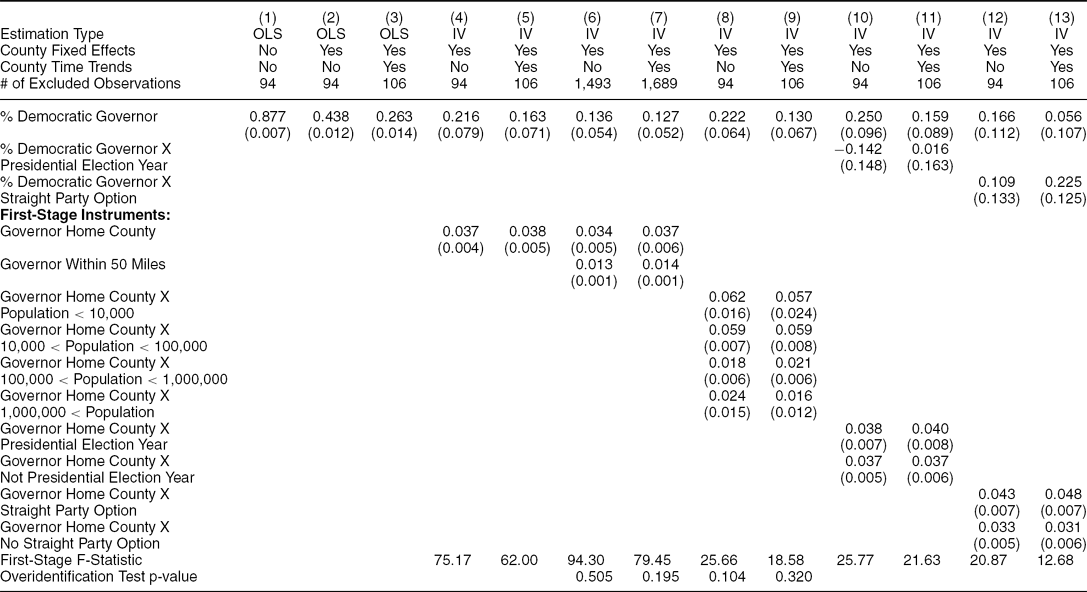
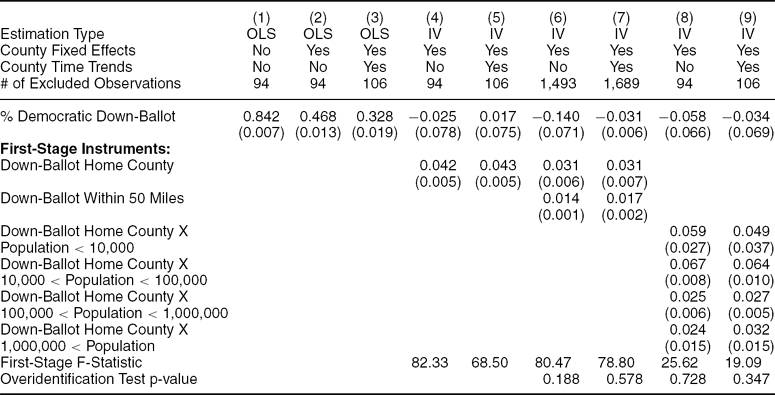
Table 3 presents estimates of the gubernatorial coattail effect estimated using a variety of OLS and IV specifications. The OLS regressions find substantial positive associations when a party's down-ballot vote share in a county is regressed on the party's vote share in a concurrent gubernatorial election. Column 1 shows that a one-percentage-point increase in a party's gubernatorial vote share in a county associates with 0.877 (s.e. 0.007) percentage-point increase in the party's down-ballot vote share when no controls are included to account for a county's general political tendencies. Including county fixed effects (column 2) reduces this estimate to 0.438 (s.e. 0.012), with a further reduction to 0.263 (s.e. 0.014) when county time trends are also included (column 3). It is on the basis of these types of regressions that some previous work infers that coattails from top-ballot candidates affect down-ballot races. However, Table 4, which presents estimates of the coattail effect from the selected down-ballot candidate onto their party's gubernatorial candidate, shows that there is a potential problem with interpreting these coefficients as coattail effects. While theories of coattails predict that secretary of state and attorney general candidates should have less, if any, affect on gubernatorial elections. Table 4 shows that a one-percentage-point increase in a party's down-ballot vote share associates with a 0.842 (s.e. 0.007), 0.468 (s.e. 0.013), and 0.328 (s.e. 0.019) percentage-point increase in the party's gubernatorial vote share when county fixed effects are excluded, county fixed effects are included, and time-trended county fixed effects are included respectively. This pattern suggests that there may be unobserved variables affecting the vote shares of both gubernatorial and down-ballot candidates.
Effect of Gubernatorial Coattails on Democratic Vote Share in Selected Down-Ballot Races
Notes: N = 14,656 observation in 2,763 counties in 210 elections. Regressions also include state-year fixed effects and equivalent local-candidate indicators for selected down-ballot candidates. Robust standard errors clustered by county in parentheses.
Effect of Selected Down-Ballot Candidate Coattails on Democratic Vote Share in Gubernatorial Races
Notes: N = 14,656 observation in 2,763 counties in 210 elections. Regressions also include state-year fixed effects and equivalent local-candidate indicators for gubernatorial candidates. Robust standard errors clustered by county in parentheses.
Gubernatorial coattails are also found to affect down-ballot races in my baseline IV specifications. The first-stage regression presented in column 4 of Table 3 show that gubernatorial candidates receive a 3.7 (s.e. 0.4) percentage point increase in their vote share in counties where they were born in or reside in prior to entering statewide office when county time trends are excluded. The F-statistic testing the hypothesis that the place of birth and residence of gubernatorial candidates have no explanatory power on gubernatorial vote shares is 75.17, which is substantially larger than what Stock, Wright, and Yogo (Reference Stock, Wright and Yogo2002) suggest is necessary to avoid bias due to weak instruments. Using this instrument, I find that a one-percentage-point increase in the personal vote increases their party's down-ballot candidate's vote share by 0.216 (s.e. 0.079) percentage points (column 4).Footnote 17 Including county time trends slightly increases the estimated first-stage effect of gubernatorial home counties on gubernatorial vote share from 3.7 to 3.8 (s.e. 0.5) percentage points, while slightly reducing the estimated coattail effect to 0.163 (s.e. 0.071) percentage points (column 5).Footnote 18 The stability of both my first-stage and IV coefficients to the inclusion of county time trends supports my claim that only a sparse set of control variables are necessary to capture the joint determinants of gubernatorial home counties and down-ballot vote shares.
Columns 6 and 7 of Table 3 show that coattail effect estimates are slightly smaller, but still statistically significant at conventional levels, when an indicator for a county being within 50 miles of a home county is also used as an instrument. As compared to a county that is more than 50 miles away from a home county, gubernatorial candidates are estimated to receive an additional 4.7 (i.e., 3.4 + 1.3) percentage points of vote share in a home county and an additional 1.3 (s.e. 0.1) percentage points of vote share in a county that is within 50 miles of a home county when county time trends are excluded. Using these instruments, the estimated gubernatorial coattail effect is 0.136 (s.e. 0.054) percentage points. The p-value on the overidentification test is 0.505, indicating that the null hypothesis that the coattail effect estimated by the two instruments is the same cannot be rejected. Again including county time trends slightly increases the estimates of the friends-and-neighbors vote and slightly decreases estimates of the coattail effect.
Previous work by Rice and Macht (Reference Rice and Macht1987a) finds that the magnitude of the home-county advantage is larger in less populated counties. Using instruments that account for this heterogeneity could improve the efficiency of the IV estimates, although risks increasing their susceptibility to bias due to weak instruments. As expected, columns 8 and 9 of Table 3 shows that gubernatorial candidates’ vote shares increase by about six percentage points in home counties that contain fewer than 100,000 people, but only by about two percentage points in home counties that contain more than 100,000 people. Consistent with my expectations, using the interactions between home county and population size slightly reduces the standard errors on my coattail effect estimates. When these interactions are used as instruments the estimated coattail effect is slightly larger than in the baseline specification when county time trends are excluded, and slightly smaller than in the baseline specification when county time trends are included.
I conclude this subsection by examining whether two characteristics of state elections moderate the gubernatorial coattail effect. While some states hold their gubernatorial election concurrently with the presidential election, others states elect their governor in the midterm or an odd year election. Because a candidate's coattails are thought to be longest when they are running for the most prominent office on the ballot (Campbell Reference Campbell1991), I hypothesize that gubernatorial coattails will be smaller when the election is held concurrent with the presidential election. However, columns 10 and 11 of Table 3 shows no significant difference in the magnitude of gubernatorial coattails in states that elect their governor concurrently with the president. States also vary in whether they give voters the option to cast a straight-party ballot, a feature which may magnify the coattail effect by making it easier for voters to select down-ballot candidates of the same party (Campbell and Miller Reference Campbell and Miller1957). Columns 12 and 13 of Table 3 show somewhat larger estimates of the gubernatorial coattail effect in states with the straight party option, with this difference bordering on being statistically significant when county time trends are included.
Robustness Tests
The results presented in previous section suggest that while the gubernatorial coattail effect does exist, it is somewhat smaller than what is implied by OLS associations. This finding is subject to the standard concerns highlighted by Sovey and Green (Reference Sovey and Green2011) about using observational instrumental variables like the place of birth and residence of gubernatorial candidates. The primary threat to the internal validity of my IV approach is that candidates may come from counties where a party's candidates are going to perform better than my models predict even absent any coattail effects. For example, county fixed effects and time trends may not sufficiently control for the tendency of candidates to come from home counties that are generally supportive of their party. Alternatively, candidates may win their party's primary partially because their local area is unusually supportive of their party in a given year. Either of these occurrences would result in a violation of the exclusion restriction, which requires that the unobserved determinants of down-ballot vote shares must be conditionally independent of the county of birth and residence of gubernatorial candidates.
One strategy for determining whether my instruments satisfy the exclusion restriction is to look at whether my estimates of the home-county advantage are affected by the inclusion of county specific time trends. If a party's gubernatorial candidates tend to come from areas where the party is currently popular then shifts in the place of birth and residence of a party's candidates across time should relate to shifts in the relative popularity of the party across counties. Thus, we would expect to see the first-stage relationship of gubernatorial home county on gubernatorial vote share being attenuated by the inclusion of county specific time trends. However, the estimated increase in a gubernatorial candidate's personal vote in their home counties is nearly an identical 3.73 (s.e. 0.45) and 3.79 (s.e. 0.52) percentage points when county time trends are excluded and included respectively. A similar pattern is observed in counties near gubernatorial candidates’ home counties.Footnote 19
Additional analyses further investigate the plausibility of the assumption that the unobserved determinants of down-ballot vote shares are conditionally independent of the county of birth and residence of gubernatorial candidates. I first test whether a party's candidates perform better in their gubernatorial candidates’ home counties in elections that take place just before or just after a gubernatorial election. If gubernatorial candidates tend to come from home counties in which their party is currently popular, other candidates from their party should also do better in these home counties in temporally proximate elections. I test this relationship by re-estimating the first-stage regressions in Table 3 and setting the dependent variable as the two-party Democratic presidential vote share in the most proximate presidential election to the gubernatorial election.Footnote 20 Because gubernatorial candidates tend to come from counties that are predisposed to support their party, it is not surprising that presidential candidates receives almost a three-percentage-point higher vote share in the home counties of their party's gubernatorial candidates. However, once county fixed effects are included as controls, a presidential candidate performs 0.03 (s.e. 0.30) percentage points worse than expected in home counties of their party's gubernatorial candidate.Footnote 21 Observing that a presidential candidate performs no better than expected in the home counties of their party's gubernatorial candidate again suggests that the home counties of gubernatorial candidates are not related to unmeasured party preferences.
Given that only a small number of observations are home counties, another concern is that the coattail effect estimates might be particularly sensitive to the inclusion of certain observations. I address this concern by re-estimating the baseline IV model 40 different times, each time excluding a state from the analysis. This allows me to assess how much the estimated coattail effect differs from the estimate obtained when all states are included in the regression. The estimated coattail effect ranges from 0.175 (s.e. 0.078), excluding Vermont, to 0.242 (s.e. 0.078), excluding Mississippi, when county time trends are excluded. When county time trends are included, estimates range from 0.130 (s.e. 0.077), excluding Kentucky, to 0.197 (s.e. 0.070), excluding Arkansas. A block jackknife estimator uses the variation across these 40 coefficients to estimate a more conservative standard error than the robust standard errors clustered by county (Miller Reference Miller1974).Footnote 22 The block jackknife standard error estimates are 0.094 and 0.084 when county time trends are excluded and included respectively. These findings suggest that the results reported in Table 3 are not being driven by a small number of observations and that the robust standard errors clustered by county are not dramatically understating the potential influence of sampling error in the baseline specification.Footnote 23
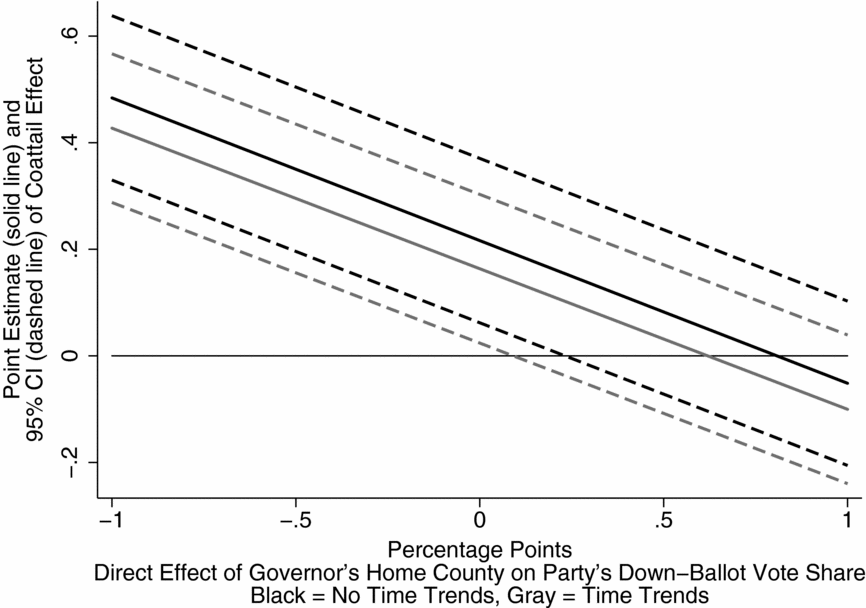
I also undertake additional sensitivity analysis using the local-to-zero method proposed by Conley, Hansen, and Rossi (Reference Conley, Hansen and Rossi2012) to investigate how IV estimates change as a result of small violations of the exclusion restriction. Rather than assuming that the instruments have no direct effect on down-ballot vote shares, the local-to-zero method allows for IV estimation under any assumed direct effect of the instruments on the dependent variable.Footnote 24Figure 2 shows how the estimated coattail effect and 95% confidence interval varies in the baseline IV specifications (i.e., the specifications shown in columns 4 and 5 of Table 3) as a function of the assumed direct effect of gubernatorial home county on down-ballot vote share. The gubernatorial coattail effect remains statistically significant at the 95% level if the direct effect of gubernatorial home county on down-ballot vote share is less than 0.23 and 0.09 percentage points when county time trends are excluded and included respectively.
Estimated Coattail Effect under Alternative Identification Assumptions
Notes: The standard IV assumption is that a gubernatorial candidate's home county has no direct effect on a party's down-ballot vote share (i.e., a gubernatorial candidate's home county only affects down-ballot vote share because of coattails). The black line represents the point estimate and the dotted lines represent the 95% confidence interval of the estimated coattail effect assuming alternative direct effects.
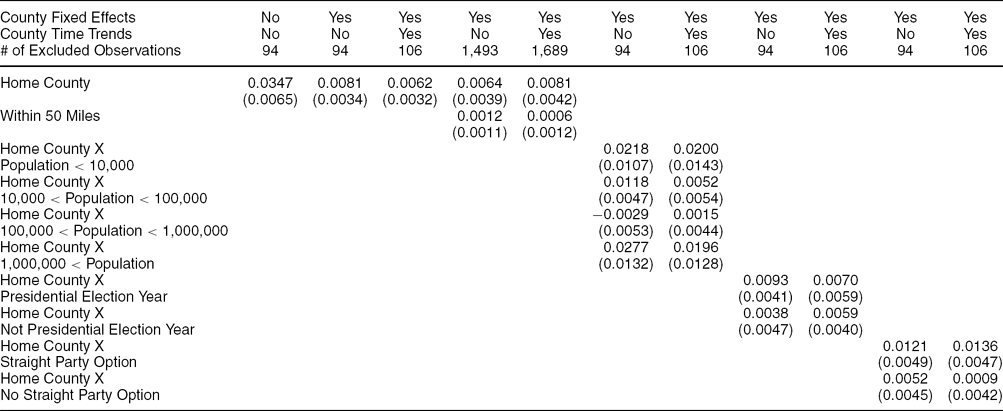
I next examine whether gubernatorial candidates perform better in the home counties of down-ballot candidates. If something about the gubernatorial candidate selection process causes gubernatorial candidates’ place of birth and residence to relate to unmeasured county-level party preferences, then it seems likely that the down-ballot candidate selection process would do the same for down-ballot candidates. If so, gubernatorial candidates should perform better than expected in the home counties of down-ballot candidates from their party. Gubernatorial candidates may also perform better than expected in the home counties of down-ballot candidates from their party because of reverse coattails. However, Table 4 shows that governors do not perform significantly better in the home counties of down-ballot candidates from their party. Much like gubernatorial candidates, secretary of state and attorney general candidates receive about a four-percentage-point increase in their vote share in their home counties. However, IV estimates of the reverse coattail effect are generally statistically insignificant and negative.Footnote 25 This finding suggests both that reverse coattails are nonexistent and that down-ballot candidates are not selected from counties where their party is going to run particularly strong in a given year.
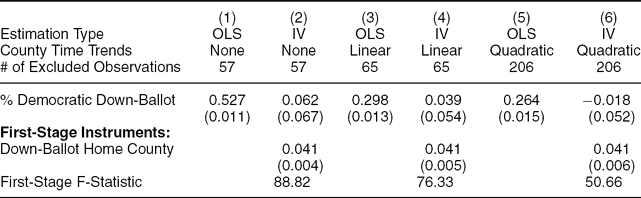
The null IV results in Table 4 contrast with the OLS results that show robust positive associations when a party's gubernatorial vote share in a county is regressed on the party's selected down-ballot vote share in the county. Because previous work frequently interprets OLS coefficients as coattail effects, this creates concern that this work may be overstating the importance of coattails. However, there are some idiosyncratic features of the OLS regressions reported in Table 4 that may make these regressions particularly susceptible to both simultaneity and omitted variable bias. The existence of gubernatorial coattails may bias these OLS estimates upwards because of reserve causality. It is also possible that more flexible time trends are needed to capture changes in the county's normal vote across time. To address these possibilities, I regress the average Democratic vote share in the county in all other down-ballot races (e.g., treasurer and comptroller) on the Democratic vote share in the selected down-ballot race. Because the coattails from other down-ballot candidates onto the secretary of state or attorney general race are thought to be relatively small, the OLS estimates from these regression should be less affected by reverse causality. I also include quadratic, rather than linear, county time trends in some of these analyses to investigate the possibility that the differences between the OLS and IV analyses could be eliminated with more flexible controls for the normal vote.
Despite these modifications, Table 5 continues to show large differences between the OLS and IV estimates of the coattail effect from secretary of state and attorney general candidates onto other down-ballot races. When linear county time trends are included, the OLS coefficient on the selected down-ballot vote share is 0.298 (s.e. 0.013), as compared to 0.328 (s.e. 0.019) when gubernatorial vote share is the dependent variable. Using quadratic, rather than linear, county time trends only slightly attenuates this estimate to 0.264 (s.e. 0.015). In contrast, the IV specifications find no evidence of a coattail effect. Moreover, in all of the specifications I can reject the null hypothesis that the OLS and IV coefficients are the same at conventional levels. These findings provide additional evidence that the OLS approach typically used to estimate coattail effects is highly susceptible to omitted variable bias.
Effect of Selected Down-Ballot Candidate Coattails on Democratic Vote Share in Other Down-Ballot Races
Notes: N = 15,546 observation in 2,762 counties in 225 elections. Regressions also include county and state-year fixed effects. Robust standard errors clustered by county in parentheses.
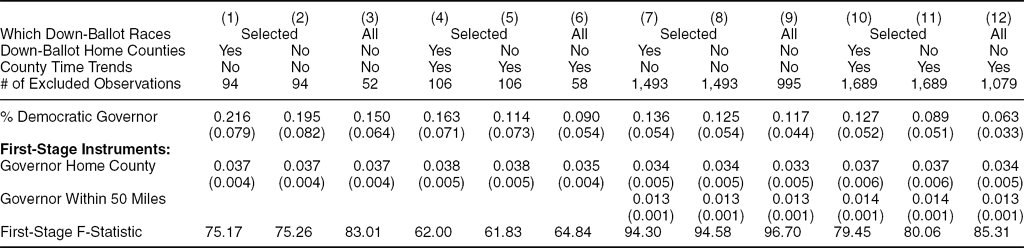
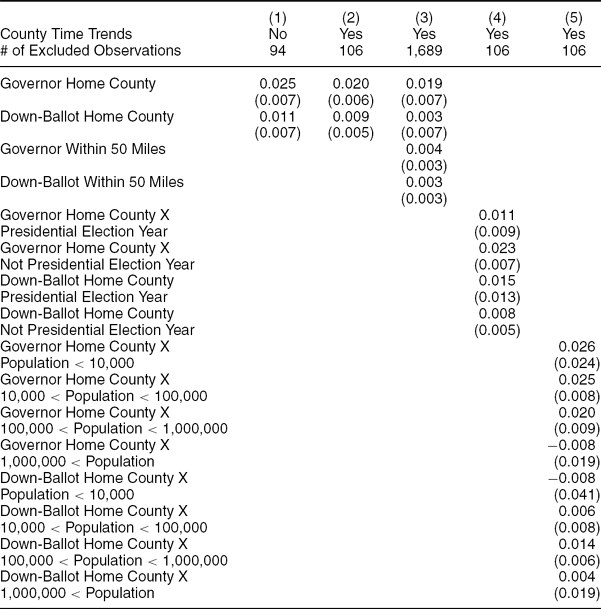
A final robustness test looks at whether the effect of gubernatorial coattails on secretary of state and attorney general races generalize to a broader set of down-ballot races. One disadvantage of looking at a broader set of races is that I do not observe the home counties of candidates in other down-ballot races. This is problematic because gubernatorial candidates often hold down-ballot office prior to running for governor, and thus I expect there to be a negative association between a party's geographic advantage in a county in the gubernatorial and a down-ballot race. Failing to account for this relationship will likely cause me to underestimate the coattail effect. This prediction is born out in Table 6, which shows that the estimated gubernatorial coattail effect on the selected down-ballot race decreases when controls for the home counties of secretary of state and attorney general candidates are excluded. In my baseline specification without county time trends, for example, the coattail effect attenuates from 0.216 (s.e. 0.079) to 0.195 (s.e. 0.082) when down-ballot home county indicators are excluded.
Comparing Gubernatorial Coattails in Selected and All Down-Ballot Races
Notes: N = 14,656 observations in 2,763 counties in 210 elections in the selected down-ballot race sample and N = 15,710 observations in 2,763 counties in 233 elections in the all down-ballot race sample. All specifications include county and state-year fixed effects. Robust standard errors clustered by county in parentheses.
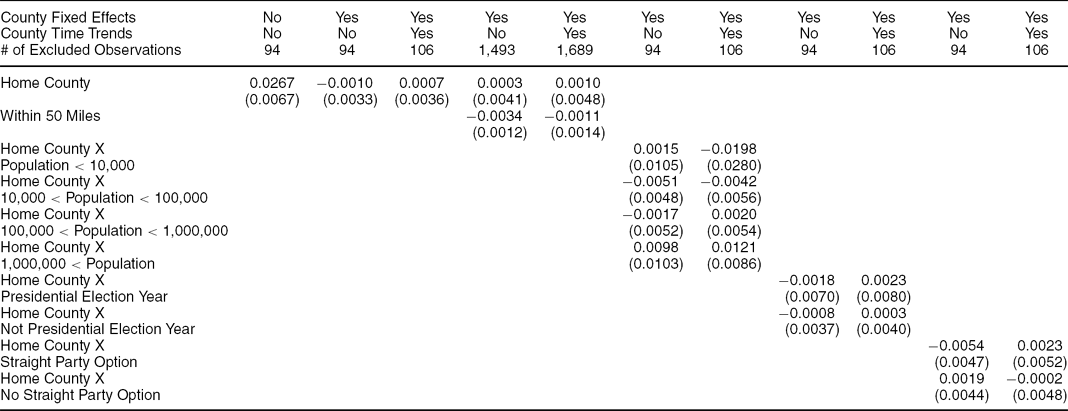
Table 6 shows that when controls for the home counties of secretary of state and attorney general candidates are excluded, I find similar estimates of gubernatorial coattail effects on all down-ballot races and on the selected down-ballot race. The point estimates are somewhat smaller on all down-ballot races when only the home-county indicators are used as instruments and slightly larger on all down-ballot races when the nearby counties are also used as instruments. In my baseline specification without county time trends, for example, I find a one-percentage-point increase in a gubernatorial candidate's vote share increases a party's down-ballot vote share in all races by 0.150 (s.e. 0.064) percentage points (column 3), as compared to 0.195 (s.e. 0.082) percentage points in the selected down-ballot race (column 2). These findings suggest the gubernatorial coattail effect identified in the selected down-ballot race is broadly consistent with the gubernatorial coattail effect in other down-ballot statewide executive office races.
Mechanisms
This section discusses some potential individual-level mechanisms that underlie friends-and-neighbors voting, and their implications for estimates of the coattail effect. The first-stage increase in a candidate's vote share near their place of birth and residence is caused by a combination of three factors: supporters of a local candidate's party voting more, opponents of a local candidate's party voting less, and opponents of a local candidate's party deviating from their usual vote. These different potential sources of the home-county advantage have implications for the coattail effect. An increase in the proportion of voters who support the party of the local candidate is consistent with Campbell's (Reference Campbell1960) theory that coattails are caused by top-ballot candidates mobilizing a party's peripheral supporters, who also support the party's down-ballot candidates. In contrast, observing that individuals who are persuaded to support local gubernatorial candidates are also persuaded to support down-ballot candidates from the party of the local gubernatorial candidate is consistent with Mondak and McCurley's (Reference Mondak and McCurley1994) cognitive dissonance theory.
The aggregated data used in this article are not well suited for identifying these individual-level mechanisms. However, I can shed light on the possible role of mobilization in causing friends-and-neighbors voting. I do this by estimating a modified version of Equation (2) in which I replace the home-county indicators with their absolute value and make the dependent variable the natural log of the total votes cast in the selected down-ballot race. The results in Table 7 show that the total number of votes cast in a down-ballot race is significantly higher in the home counties of gubernatorial candidates. The point estimates suggest that the number of down-ballot votes increases by about 2.0 (s.e. 0.6) percent in a gubernatorial candidate's home county, which translates into about a one percentage point increase in turnout when the baseline turnout rate is 50%. This demonstrates that Rice and Macht's (Reference Rice and Macht1987b) conclusion that the presence of local candidates on the ballot increases turnout generalizes beyond the 24 gubernatorial elections in 1982 that they study. However, the magnitude of this turnout increase is substantially smaller than the increase in vote share candidates receive in their home counties. Unless having a local candidate also demobilizes voters who would otherwise vote against the local candidate, this suggests that friends-and-neighbors voting is primarily caused by persuasion.
Effect of Local Candidates on Logged Votes in Selected Down-Ballot Races
Notes: N = 14,656 observation in 2,763 counties in 210 elections. Regressions also include county and state-year fixed effects. Robust standard errors clustered by county in parentheses.
The remainder of Table 7 looks at heterogeneity across states and counties in the effect of having a local gubernatorial candidate on down-ballot votes. When the gubernatorial candidate was born or resides in a county, the number of down-ballot votes increases by about 1.1 (s.e 0.9) percent in elections held concurrently with the presidential election, as compared to 2.3 (s.e. 0.7) in nonpresidential elections. This pattern suggests some of those individuals mobilized by the presence of local candidates are also mobilized by the presidential election. Table 7 also shows that turnout increases are largest in less populated counties.
While these findings suggest that persuasion is the primary mechanism causing the home-county advantage, I cannot rule out that mobilization is an important cause of the gubernatorial coattail effect. My estimates of the coattail effect are based on down-ballot candidates performing about one percentage point better in the home counties of gubernatorial candidates from their party. Thus, mobilization could explain all of the coattail effect if the results in Table 7 are caused by an increase in turnout by peripheral supporters of the local gubernatorial candidate's party. However, it is also possible that the party preferences of these marginal voters roughly mirror the average voter in the county. If this is the case, these extra voters may not contribute to the coattail effect. Thus, I leave it to future research using individual-level data to better sort out the mechanisms that lead to these coattail effects.
Discussion
The results of this article have important implications for the study of how structural features of the electoral cycle affect representation. The existence of coattail effects suggests that holding concurrent elections can affect the outcome of less salient elections and the incentives of down-ballot candidates to engage in personal vote-seeking behavior. The number of down-ballot races that may be swung by the personal popularity of top-ballot candidates increases in the magnitude of the coattail effect. Consider the effect of U.S. presidential coattails on House races. Previous estimates generally show that a one-percentage-point increase in a presidential candidate's vote share is associated with a 0.3- to 0.5-percentage-point increase in the vote shares received by his party's House candidates. Interpreting these estimates as coattails implies that when the personal characteristics of a presidential candidate causes his vote share to increase by five percentage points, he can lead his party's House candidate to victory who might otherwise lose by up to five percentage points. Using OLS, I estimate similar associations between gubernatorial and down-ballot statewide executive office candidates. However, my IV point estimates indicate that a five-percentage-point increase in the personal vote received by a gubernatorial candidate affects only the outcome of down-ballot elections in which her party would otherwise lose by fewer than two percentage points. The difference suggests that interpreting these previous estimates as coattails may substantially overstate the effect of presidential candidates on House elections.
The existence of coattail effect may also alter the incentives of down-ballot office holders to represent their constituents’ interests. The existence of a significant coattail effect raises the question of whether the electoral fortunes of down-ballot office holders are tied too closely to concurrently elected gubernatorial candidates for there to be incentives to represent their constituents’ interests. In the extreme case where down-ballot votes are simply a reflection of vote choice in the top-ballot election, there is no relationship between a down-ballot office holder's performance in office and whether he or she is reelected. Under such a scenario, coattail effects would eliminate the incentive for down-ballot office holders to engage in personal vote seeking behavior. A more complete model of elections is needed to understand the consequences of my estimates of the coattail effect on the incentives of down-ballot office holders to represent their constituents. However, my finding that the presence of a concurrent presidential election has no effect on the magnitude of friends-and-neighbors voting in gubernatorial or down-ballot races shows that one form of personal voting is not crowded out by coattails.
Finally, my findings have implications for the research designs that scholars use to study the personal vote. An appealing empirical strategy for estimating the amount of personal voting is to look at how a party's vote share within a constituency varies across concurrent elections as a function of characteristics of the candidates in a race (Ansolabehere and Snyder Reference Ansolabehere and Snyder2002; Gerber, Kessler, and Meredith Reference Gerber, Kessler and Meredith2011). However, the presence of coattails introduces the potential for omitted variable bias when using such a design, implying that down-ballot races do not make good control races from which to estimate the personal vote in gubernatorial races. However, the lack of coattails generated by down-ballot statewide races like attorney general and secretary of state means that these elections may make good control races from which to estimate the personal vote in other down-ballot races.
CONCLUSION
This article demonstrates that while top-ballot candidates can influence the outcome of concurrent elections, their influence may be smaller than previously thought. Consistent with previous work, I find robust large associations when I regress a party's vote share in one race on their vote share in a concurrent race. But while previous work frequently interprets such an association as a coattail effect, my results cast doubt on this interpretation. For example, such an interpretation would lead someone to conclude that the coattails of gubernatorial and secretary of state candidates are of a similar magnitude. This also highlights the danger in assessing the relative influence of candidate spillovers on races by comparing regression coefficients. For example, Samuels (Reference Samuels2000) regresses a party's vote share in a down-ballot election in Brazil on the party's vote share in concurrent presidential and gubernatorial elections, and concludes that gubernatorial coattails are more than twice as strong as presidential coattails because the coefficient on gubernatorial vote share is more than double the coefficient on presidential vote share.
In contrast, my IV approach provides clear evidence of gubernatorial coattail effects. My point estimates indicate that a one-percentage-point increase in the personal vote received by a gubernatorial candidate increases the vote share of secretary of state and attorney general candidates from their party by 0.1 to 0.2 percentage points. These point estimates are somewhat smaller than the estimates obtained from corresponding OLS regressions, although the OLS and IV estimates are generally statistically indistinguishable. These IV estimates are relatively robust to inclusion of county time trends and to alternative specifications. Unlike the OLS regressions, the IV regressions show no effect of personal votes received by secretary of state or attorney general candidates on the performance of other candidates from their party. Moreover, placebo tests show that the instruments do not predict a party's performance in other elections. These additional analyses strengthen my claim that the IV regressions are identifying coattail effects rather than unmeasured partisan preferences. My findings also suggest that the methods commonly used to measure contamination effects are too susceptible to omitted variable and simultaneity bias to produce reliable estimates of contamination effects.
The method used in this article is both straightforward to implement and portable to other election contexts in the United States and abroad. Because friends-and-neighbors voting has been demonstrated in many electoral contexts, the effect can be used to compare how the magnitude of coattail effects varies across different offices, electoral systems, and types of voters. Other candidate characteristics that systematically relate to candidate preferences can also be incorporated into the analysis as additional instruments. For example, the match between a candidate's religious affiliation and the religious demographics of a county may potentially isolate personal votes cast on the basis of a candidate's religion.
More generally, this article shows the importance of careful research design when measuring spillovers. Theories of spillovers are pervasive in the study of political science. Coattails are just one of the many contamination effects that are posited to occur across multilevel governments. Beyond the study of elections, policy change in one state is hypothesized to influence policies in neighboring states, partisan identification when young is believed to affect political preferences later in life, and social capital is thought to be transmitted through interpersonal networks. Estimating the magnitude of such spillovers is generally quite difficult because a relationship between the two outcomes is expected even in the absence of spillovers. Researchers are aware of this problem and address it by including additional control variables in most tests of spillovers (Hainmueller and Kern Reference Hainmueller and Kern2008). Yet, most studies pay insufficient attention to whether their specific set of control variables plausibly account for all these joint determinants. In particular, researchers should make greater use of robustness analysis to strengthen their case for making causal statements about spillovers in observational data.
Finally, this article provides a general blueprint for estimating spillover effects in observational data. I use previous literature to identify a relatively idiosyncratic source of variation in the outcome that I expect to spill over. The best case scenario of such an approach is that it uncovers something that approximates experimental variation in the outcome. However even when this does not occur, focusing on a specific source of variation in an outcome can greatly reduce the set of control variables that must be included in order to prevent omitted variable bias when estimating spillover effects. This approach made it so that I only needed to control for the factors that affect gubernatorial home counties and down-ballot vote shares, rather than all of the factors that affect gubernatorial and down-ballot vote shares more generally.Footnote 26 For example, I did not necessarily have to model the effects of variables like economic conditions, which are known to affect partisan preferences in both top- and down-ballot races, but are plausibly unrelated to candidate selection. Moreover the relative stability of my estimates of the friends-and-neighbors vote to the inclusion of control variables like county time trends provides support for my claim that a relatively sparse set of controls can account for the joint determinants of gubernatorial home counties and down-ballot vote shares.
I conclude by cautioning that this approach is not without costs. The bias resulting from any remaining omitted variables is amplified when using IV. The LATE property of IV estimation also means that the coattail effect identified for friends-and-neighbors voters may not apply to other personal voters, such as those who select a gubernatorial candidate on the basis of their religious preference or the attractiveness of their facial features. Thus, IV results should always be benchmarked against an OLS specification that attempts to control for as many observable joint determinants as possible. In cases where these OLS and IV regressions produce different findings, one should not necessarily conclude that the OLS results are incorrect. But particularly in situations where data quality is poor or outcomes are thought to contaminate each other, it is difficult to convincingly demonstrate the existence of spillovers only on the basis of these OLS regressions. Thus while my approach lacks some of the internal and external validity associated with experiments, it provides a good alternative for estimating spillovers when experimentation is not feasible, ethical, or cost-effective.
Selected Previous Estimates of Coattail Effects
Reduced Form of Local Gubernatorial Candidates on Party's Vote Share in Selected Down-Ballot Race
Reduced Form of Local Selected Down-Ballot Candidates on Party's Vote Share in Gubernatorial Race
Reduced Form of Local Gubernatorial Candidates on Party's Vote Share in All Down-Ballot Races



Comments
No Comments have been published for this article.