Introduction
Alzheimer's disease (AD) is increasingly viewed as a major public health concern. Within the U.S.A. and much of the developed world the number of individuals with this disease is expected to double within about 20 years, largely due to the aging of the overall population (Alzheimer's Association, 2008). The burden of these conditions on society, business and individual families is high. Within the U.S.A., an analysis of government expenses for medical care of people with Alzheimer's disease and related dementias (ADRD) revealed that they are three times more costly to the publicly funded Medicare program than other beneficiaries (Bynum et al., Reference Bynum, Rabins, Weller, Neifeild, Anderson and Wu2004). The overall cost to the U.S. economy is estimated to be $148 billion dollars annually (Alzheimer's Association, 2008). There is also a cost born by families that is both financial and emotional. Family caregivers have higher rates of stress, depression and health problems than their age-matched peers (Schulz et al., Reference Schulz, O'Brien, Bookwala and Fleissner1995; Vitaliano et al., Reference Vitaliano, Zhang and Scanlan2003).
Most people living with ADRD receive their medical care in primary care settings. However, research suggests that ADRD conditions are not well recognized or systematically diagnosed in primary care (Callahan et al., Reference Callahan, Hendrie and Tierney1995; Boise et al., Reference Boise, Camiciolo, Morgan, Rose and Congleton1999). Individuals with undiagnosed dementia and their families are less likely to gain access to available pharmaceutical treatments (Boise et al., Reference Boise, Neil and Kaye2004). They are also less likely to connect with supportive management interventions that have been demonstrated to ameliorate caregiver burden and delay institutionalization (Mittelman et al., Reference Mittelman, Ferris, Shulman, Steinbers and Levin1996).
AD presents particular challenges to primary care practitioners. There is no single, definitive diagnostic test. Currently available disease modifying pharmacologic treatments have only modest impact on symptoms (Qaseem et al., Reference Qaseem2008). Further, management of this disease and related conditions is time-consuming, involving support and education of the person living with the disease and, when appropriate, of their family members (Hinton et al., Reference Hinton, Franz, Reddy, Flores, Kravitz and Barker2007).
Clinical practice guidelines for the management of AD have been developed and are useful tools both for educating physicians and for setting quality care benchmarks. In 1998, the California Guideline for Alzheimer's Disease Management, an evidence-based practice guideline for primary care providers, was first released (Cummings et al., Reference Cummings2002a; Reference Cummings2002b). Since then, this guideline has been updated twice, once in 2002 and again in 2008. It has stimulated the development of several projects to improve management of this disease in large health care systems (Cherry et al., Reference Cherry, Vickrey, Schwankovsky, Heck, Plauché and Yep2004; Vickrey et al., Reference Vickrey2006). Community-based organizations can provide guideline-recommended social services to patients and their families. However, most health care systems do not coordinate care with community organizations like the Alzheimer's Association, to ensure patients and caregivers access disease education programs and support services.
This article outlines a strategy for the use of evidence-based clinical practice guidelines to: (1) set quality benchmarks; (2) train providers to deliver guideline-recommended care; (3) put in place care processes, including dementia care management, to support this care; and (4) use the benchmarks to evaluate whether a better quality system of care has been implemented. The first of the projects to use this approach was the Kaiser Permanente–Alzheimer's Association Dementia Care Project (Cherry et al., Reference Cherry, Vickrey, Schwankovsky, Heck, Plauché and Yep2004), a small-scale project in which quality benchmarks were derived from two practice guidelines and then reinforced through training programs for physicians and social workers as well as through the institutionalization of a social worker-based dementia care management program. The second project, called ACCESS (Vickrey et al., Reference Vickrey2006), identified 23 quality of care goals from two existing clinical practice guidelines, then trained health care providers and care managers within three large health care systems to provide guideline-recommended care. This study used a controlled design to evaluate the effectiveness of this model (Vickrey et al., Reference Vickrey2006). The third project is a partnership between HealthCare Partners Medical Group, the Alzheimer's Association and the University of California, Los Angeles. Following a model similar to the first two, this project is currently collecting data to evaluate whether the approach helps to achieve quality benchmarks in a cost-effective and sustainable manner.
The Kaiser Permanente–Alzheimer's Association Dementia Care Project
In 1995, Kaiser Permanente, a group model health maintenance organization (HMO), entered into a partnership with the Alzheimer's Association in Los Angeles to assess and improve the quality of care provided to people with dementia. The collaboration grew from both organizations' concerns about quality health care for people with dementia. There was also consensus that provider education was necessary but insufficient to bring about desired performance improvements. This project was initiated in the metropolitan Los Angeles region, a densely urban and ethnically diverse area. Nearly 54,000 Kaiser patients in the target area were over age 65 at the time of this project. Based on extrapolated demographic estimates (Evans et al., Reference Evans1989), it was estimated that nearly 5,000 people with AD were among Kaiser's patient population in the target area.
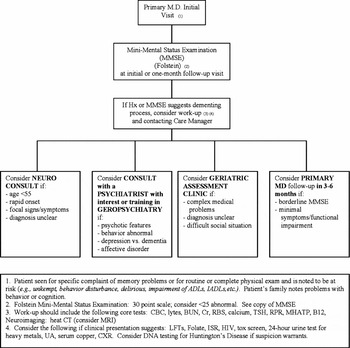
Using evidence- and consensus-based practice guidelines, the Alzheimer's Association and Kaiser Permanente staff reviewed practice recommendations and selected quality benchmarks for the diagnosis and management of people with ADRD. The diagnostic guideline was developed by Kaiser staff and members of the Alzheimer's Association of Los Angeles' Medical and Scientific Advisory Board. Later, the California Guideline for Alzheimer's Disease Management was used for the development of post-diagnostic care benchmarks. The benchmarks selected for this study were: Diagnosis:
• administration of the Mini-mental State Examination (MMSE; Folstein et al., Reference Folstein, Folstein and McHugh1975)
• referral for selected laboratory tests
Management
• referral to the Alzheimer's Association and its Safe Return™ Program
• assessment for depression, performance of activities of daily living, and wandering risk
• development of an advance directive
While there were many other practice recommendations contained within these two guidelines, the interdisciplinary and inter-organizational project team selected these five recommendations as the focus of this intervention.
Educational sessions were developed for both primary care providers and for Kaiser's social work care managers, two of whom were designated to be trained as the Dementia Care Managers. The educational sessions focused on the diagnosis and management of people with ADRD. The program emphasized the recommendations in the selected practice guidelines, with special stress on building skills to implement the benchmarked quality activities. An educational theater troupe was utilized to make the training program more engaging. The actors portrayed scenarios in which people with cognitive impairment were missed in a typical, busy physician's practice and then also modeled how practitioners could gather information efficiently and make internal referrals to assure that better quality care was offered. For example, physicians were given didactic training on how to administer the MMSE. They then observed actors who modeled administration of the exam with a somewhat resistant patient. The handouts distributed for this educational session included copies of the exam they could use in their practices and the telephone numbers of the Dementia Care Managers who were available to administer this test for them.
Diagnostic Guidelines for Alzheimer's Association-Kaiser Permanente Los Angeles Dementia Care Project

After the formal educational sessions were completed, each physician received a provider checklist and “tool kit” to reinforce the key educational points. Whenever possible, these materials were delivered to the physician during a one-to-one office visit from one of the Dementia Care Managers. During the visit the Dementia Care Manager introduced herself, explained that she was available to assist with the evaluation and post-diagnostic management of patients with ADRD, and gave the physician a provider checklist and a “tool kit”, offering to review its contents. These interactions were developed to mimic the “educational detailing” commonly used by pharmaceutical companies to encourage changes in physician prescribing behaviors. Educational detailing can be defined as the process by which a health educator visits a physician in his or her office to provide a brief educational intervention on a specific topic. The purpose of educational detailing is to provide complete and objective information based on best available evidence. Educational detailing has been demonstrated to be a moderately effective strategy for impacting provider practice behaviors (Soumerai and Avorn, Reference Soumerai and Avorn1990).
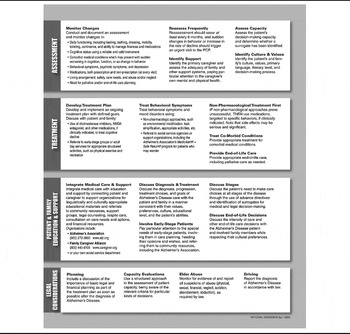
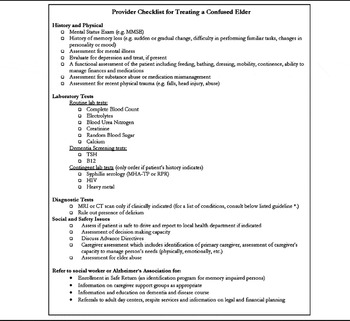
The contents of both the provider checklist and the “tool kit” were created to reinforce adoption of the quality benchmark practice behaviors. The checklist was developed by lead geriatricians on the project and Alzheimer's Association staff. It provided a step-by-step comprehensive overview of the diagnostic and management process. Thus, the MMSE is referenced on the checklist and an educational DVD describing how to administer this screening tool was placed in the “tool kit” along with copies of the test. The recommended laboratory tests for a diagnostic work-up of dementia were referenced on the provider checklist. Referrals to the Dementia Care Manager and the Alzheimer's Association were reinforced on the checklist and a prescription pad with the Alzheimer's Association's contact information was part of the “tool kit”, as were brochures for the Safe Return™ wanderers program. Other contents of the physician “tool kit” included the diagnostic guideline developed for this Dementia Care Project printed on a laminated card with a mental status questionnaire on the opposite side, the California Alzheimer's Disease Management Guideline presented in a two-page format, the Geriatric Depression Scale (Yesavage et al., Reference Yesavage1983), and detailed information on legal requirements for reporting driving risk and elder abuse.
Guideline for Alzheimer's Disease Management

Physicians who missed the educational detailing visits with the Dementia Care Managers were mailed their “tool kits” and provider checklists with a letter signed by their chief of service explaining the contents. The Dementia Care Program frequently used physician and administrative leaders to endorse the quality benchmarks in the belief that their support would increase the likelihood of these practices being adopted.
A key component of the three projects described in this paper is Dementia Care Management. In the Kaiser Project, these individuals were social workers, the professional discipline already used for care management functions within this healthcare system. These Dementia Care Managers provided back-up to primary care providers, assuring that the target quality processes were completed. They reminded physicians to complete a mental status exam on diagnosed patients and offered to do this for them. They reviewed patient charts to assure that recommended laboratory tests were completed and mandatory reporting laws were followed. In the course of a home visit and telephone follow-up, they assessed patient capacity to complete activities of daily living and risk for wandering, evaluated patient and caregiver depression, and made appropriate referrals both within the Kaiser system and to services in the community, enrolling patients in the Alzheimer' Association Safe Return™ program as appropriate.
Alzheimer's Association-Kaiser Permanente Dementia Care Project Provider Checklist

The project's evaluation used pre- and post-intervention provider surveys and chart audits conducted on 83 patients served through the Dementia Care Project to determine if there had been an improvement in achieving the quality benchmarks. Forty-three of the chart audits had pre- and post-intervention chart abstractions completed. Improvements were found in all five quality benchmarks but not all care processes were completed by the primary care physicians.
There was an increase in the reporting of MMSE scores from 16% prior to the project to 93% after the project (χ2 p < 0.001) per the chart audits. There was an improvement in the ordering of recommended laboratory tests from 46% of physicians reporting that they never obtain laboratory tests as part of a diagnostic assessment of dementia prior to the project to 14% after the intervention (χ2 p < 0.001). Per the chart audits, documentation of referrals to the Alzheimer's Association increased from 3% prior to the project to 76% afterwards (χ2 p < 0.001), and referrals to the Alzheimer's Association's Safe Return™ program increasing from 0 to 29% (χ2 p < 0.001). Dementia Care Managers, not physicians, made most of the referrals to the Alzheimer's Association (34%), followed in frequency by other staff social workers (19%). The medical record abstraction identified increased documentation of assessments of activities of daily living (13% pre, 93% post; p < 0.001), decision-making capacity (3% pre, 19% post; p < 0.001), depression (11% pre, 57% post; p < 0. 001), and wandering potential (8% pre, 74% post; p < 0.001). Dementia Care Managers documented 68% of all assessments for wandering risk. However, depression was noted most frequently by primary care physicians.
This project assumed that training of primary care physicians alone would not be sufficient to achieve the guidelines-derived quality benchmarks and used creative training strategies supplemented by provider tool kits, provider checklists, educational detailing, endorsement from organizational leadership, and, most importantly, the creation of a system of care to reinforce what the primary care providers learned in educational sessions. The findings support the premise that to change care practices significantly, training needs to be supplemented and reinforced by coordinated, multi-faceted interventions that are supported by health care system leadership.
ACCESS trial
The Alzheimer's Disease Coordinated Care for San Diego Seniors (ACCESS) study was a randomized controlled trial of a multi-faceted, dementia care management quality of care improvement intervention; the intervention also included a primary care provider education component (ACCESS Project, 2001). ACCESS brought together three healthcare organizations and three community agencies in the San Diego area in a collaboration that created a “virtual” system for providing dementia care, spanning traditional healthcare delivery systems and community agencies (Vickrey et al., Reference Vickrey2006; http://www.adc.ucla.edu/access/access.swf). The ACCESS trial enrolled 408 pairs of caregivers and persons with dementia (65 years of age or older) and followed them for 18 months. Participants were enrolled from 18 primary care clinics in the three healthcare organizations; clinics were the unit of randomization in the trial to test whether the new dementia care delivery model improved quality of care.
At the beginning of the study, a Steering Committee came to consensus in selecting a set of 23 dementia care “goals” from two existing primary care guidelines for management of dementia (American Medical Association, 1999; Cummings et al., Reference Cummings2002a; Reference Cummings2002b). The components of the intervention were designed with the objective of meeting these 23 guideline-recommended care goals. These 23 care goals addressed four overarching domains of assessment, management, caregiver education and support, and safety. The Steering Committee was comprised of physician champions from the three participating healthcare organizations, CEO or CEO-designated leadership, and of key local community agencies including the Alzheimer's Association and Caregiver Resource Center, and caregiver representatives identified by the community agencies. In the coordinated system of dementia care that was designed and offered to patient and caregiver dyads in intervention arm clinics, a care manager – usually a social worker – educated the caregiver, conducted regular assessments and helped arrange for the caregiver and dementia patient to get the services they needed. These assessment and management protocols were collaboratively developed by the Steering Committee.
A primary care provider education component was also part of the intervention offered to providers at the nine intervention arm clinics. An overview of the ACCESS care management program and an introduction to that organization's care managers were offered in two seminar-format modules. Three additional modules on topics most relevant to guideline-recommended dementia care that would be directly provided by a clinician were also created and offered. These topics were: recognition and treatment of depression in dementia;, recognition and evaluation of delirium in dementia; and assessment of medical decision-making capacity in dementia. All modules were delivered by a geriatrician in a small group setting – typically part of a routine provider meeting or educational seminar at that clinic – and totaled 100 minutes duration. PowerPoint slides were posted on a website whose link was made available to all primary care clinicians at intervention clinics. On average, providers attended half of the offered modules (Chodosh et al., Reference Chodosh2006).
The ACCESS intervention yielded substantial and meaningful improvements in both processes of dementia care and in patient and caregiver outcomes among those pairs of caregiver and persons with dementia who were in the intervention arm, relative to those receiving usual care: adherence to 23 dementia care guideline recommendations was twice as high in the intervention group as in the group receiving usual care (Vickrey et al., Reference Vickrey2006). Furthermore, patients in the intervention group had better health-related quality of life at the end of the trial than the patients receiving care as usual, and caregivers in the intervention group had higher self-efficacy, higher social support, and less unmet need for caregiving assistance than caregivers in the usual care arm. However, these improvements in quality and outcomes of care occurred in the context of relatively modest impacts on physician knowledge (Chodosh et al., Reference Chodosh2006), suggesting that the care management component was a stronger driver of change in quality of care.
HealthCare Partners – Alzheimer's Association Dementia Care Project
In 2005, HealthCare Partners (HCP) Medical Group, a mixed staff/preferred provider organization (PPO) model Medicare managed care organization, partnered with the Alzheimer's Association and the UCLA Alzheimer's Disease Research Center to create and implement a project designed to improve the quality of care given to people with dementia and their caregivers. The purpose of the project was to build a replicable and sustainable model with an evaluation-based intervention to demonstrate effectiveness in reducing costs while improving quality of care. As in the previously reviewed projects, evidence-based practice guidelines were used to set quality benchmarks. The following outcomes were chosen for the project:
• documentation that a cognitive test was conducted within the past 12 months
• documentation of discussion about or use of anti dementia medications
• non-pharmacological treatment of behavior problems tried prior to pharmacological treatment
• referral to the Alzheimer's Association.
Secondary outcomes where also chosen to examine utilization, caregiver needs and perception of the program, and other characteristics of the sample.
Provider education was central to this project. Training programs were developed and implemented for primary care physicians and nurse care managers, one of whom became the Dementia Care Manager. In addition, a provider “tool kit” was developed and distributed to all physicians and to the Dementia Care Manager. The “tool kit” helped strengthen the education they received and reinforced the outcomes of the project. Included were items such as the Mini-Cog Assessment Instrument for dementia (Borson et al., Reference Borson, Scanlan, Brush, Vitaliano and Dokmak2000), and information about medications for dementia, about the Alzheimer's Association, and about legal requirements for reporting driving issues and elder abuse.
Education for the physicians consisted of three one-hour sessions conducted during a normally scheduled meeting, which helped ensure attendance. The classes consisted of a variety of teaching strategies including lecture, question and answer, personal story, and case study. The first session began with a presentation by a patient who had early stage AD. She was able to discuss her fears, frustrations, and experience with early memory loss and obtaining a diagnosis. The remainder of the hour included information on recognition and diagnosis of dementia by a prominent physician researcher.
The second session began with tools for evaluation of memory loss which was taught by one of the lead physicians at HealthCare Partners (HCP). This physician is well respected in the organization. His expertise with the subject matter and the HCP system allowed him to give specific examples to the physicians and how they would use these tools in their practice. The remainder of the session dealt with behavior management and was led by a prominent physician from an AD research center.
The third session included a HCP physician covering the medications used in the treatment of dementia, the Dementia Care Manager discussing important end of life issues, and Alzheimer's Association personnel and the Dementia Care Manager reviewing project referral procedures and “tool kit” contents. The physicians were able to meet the Dementia Care Manager and learn about the service she would be able to provide to them and to their patients.
Education for the Dementia Care Manager was conducted by the Alzheimer's Association and consisted of four two-hour classes. The classes included an overview of dementia and AD, planning care for the patient with dementia, managing difficult behaviors, and community services for people with dementia. These interactive, one-on-one sessions allowed for discussion, questions, and immediate feedback related to current patient issues. This application of knowledge to actual practice helps strengthen the information provided in the training sessions. One-on-one mentoring was available as needed.
The project model allows HCP physicians to refer patients with a diagnosis of dementia and their caregivers to the Dementia Care Manager who then completes a psychosocial assessment of both members of the dyad. She documents the assessment and creates a care plan recommendation that is inserted into the patient's electronic medical record. These recommendations include interventions such as non-pharmacological behavior management education and strategies, caregiver education, referrals to internal services when needed and referrals to external sources, like the Alzheimer's Association.
This Dementia Care Project is currently underway. Outcomes in a service region that is receiving this training and the dementia care management intervention will be compared to outcomes in a service region delivering usual care. Caregiver interviews and medical record abstractions will be conducted to measure whether key dementia care benchmarks have been met. Administrative data will be used to examine service utilization (emergency room use, doctors' visits and hospitalizations) comparing the 18 months before the intervention began to the 18 months after participation in the program. These data will also compare service utilization in the intervention region with service utilization by dementia patients in the comparison region. Program costs will be calculated to provide information to the medical plan about the cost of the program relative to the quality of care achieved.
Discussion
The three studies reviewed in this article each supplemented training of primary care providers with dementia care management and additional interventions to improve quality of dementia care, as defined by evidence-based practice guidelines. The two completed studies each found that training was part of a strategy to improve care but that systemic support given to primary care providers through dementia care management and other supports led to improved adoption of guideline-recommended care. In the ACCESS study, the researchers concluded that dementia care management was a stronger predictor of quality care than was provider education. However, in that study, the education program was not reinforced with educational detailing, “tool kits”, checklists and other strategies. The authors concur that training alone is likely to be insufficient to achieve quality benchmarks in dementia care and that it needs to be reinforced through multiple strategies, backed up through dementia care management and collaboration with community-based support organizations.
Conflict of interest declaration
Funding for the Kaiser Permanente-Alzheimer's Association Dementia Care Project was provided in part by the Alzheimer's Association, the Garfield Foundation of Kaiser Permanente and by Pfizer Pharmaceuticals. Funding for the ACCESS Project was provided by the California Department of Health Services and the California HealthCare Foundation. Funding for the HealthCare Partners–Alzheimer's Association Dementia Care Project was provided in part by Forest Pharmaceuticals.
Description of author's roles
Dr. Debra Cherry was the primary author. The section on the ACCESS project was written by Dr. Barbara Vickrey and the section on the HealthCare Partners–Alzheimer's Association Dementia Care Project was written by Carol Hahn.