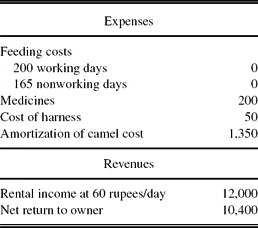
Consider the data from the painstaking economic analysis of contemporary camel transport in Pakistan done by Alan Heston and several Pakistani associates in 1985 (see Table 1). It shows the typical annual costs and income in rupees of someone earning his livelihood by renting out a pack camel.
The economics of camel transport

Source: Alan Heston et al., “The Economics of Camel Transportation in Pakistan,” Economic Development and Cultural Change 34 (1985): 132.
Pay particular attention to the zeros that represent the actual cost of animal energy at its most basic level: food. The cost of harnessing the energy would obviously be higher for camels used to draw carts, which are plentiful on the streets of Karachi, or to operate mechanical devices. However, balancing that is the amortization cost, which might be much lower if, as in earlier times, the energy contractor should have close ties with camel-breeding nomads. Altogether, the import of these figures, or at least of what they would seem to imply if they were taken as typical, is that even today animal power can sometimes be phenomenally inexpensive. In camel-using districts of Pakistan, as in most other parts of the arid zone, which for our purposes means most of North Africa, the Middle East, and Central Asia, the natural vegetation growing on vast expanses of land that are too dry for agriculture constitutes a resource that the nomadic sectors of human societies have long converted into utilizable animal power at minimal expense. Not just camels but also donkeys and, to a lesser degree, horses, mules, and oxen have a history of carrying burdens, pulling vehicles and plows, and operating irrigation devices and mills at very little cost. Heston summarizes his findings this way:
One conclusion is that the camel can compete successfully against other work animals and/or machinery in several ecological situations. Wherever there are no direct feeding costs for camels, their number is likely to dominate that of all other work animals, except perhaps that of donkeys. . . It is our conjecture that if it is necessary to incur feed costs for camels, they cannot compete in traditional tasks like sugarcane crushing and drawing a Persian wheel for irrigation. In these areas the machine is likely to be more cost effective in view of the pricing of machinery and fuels.Footnote 1
In other words, the study's finding is that a Pakistani businessman who had it in mind in the 1980s to invest in a small Suzuki truck, a sugarcane crusher, or an irrigation wheel would have found it an uneconomical proposition in districts that could supply free forage for camels and donkeys.
To spin out the implications of the finding for environmental history, consider the parallel between this situation and the dilemma of modern energy companies whose plans are frustrated by the low cost of petroleum. Alternative energy schemes, even those that have zeros in the most basic cost of energy column because they rely on sunshine or wind, make little headway against cheap oil because the initial investment for harnessing and distributing the power they generate is too high. Though animal power may seem today to be simply another alternative energy source vis-à-vis gasoline, in the prepetroleum era it was the standard of comparison.
Applying these observations about cheap camels and cheap oil to the broad sweep of Middle Eastern economic history suggests a possible explanation for the fateful divergence between the Muslim world and Europe that between roughly 1100 and 1400 reversed the centuries-old economic dominance of the former over the latter. The low cost of animal power in the arid zone, in the manner of today's cheap oil, forestalled the transition to alternative energy sources that transformed Europe and lay the foundation for the Industrial Revolution.
Europe and the arid zone were equally heir to the technological toolkit and environmental strategies of late antiquity. A pertinent indicator comes from Emperor Diocletian's edict of 301 fixing prices for the whole of the Roman Empire. It lists the costs of four types of mill: a horse mill, 1,500 denarii; a donkey mill, 1,250 denarii; a watermill, 2,000 denarii; and a hand mill, 250 denarii. It is not surprising that donkey mills and rotary hand mills were much more common than watermills, although the technology of the latter seems to have been known in all parts of the empire. Environmentally, however, the regions of the empire were not equal. The pasturelands of Europe, particularly those exploited by transhumant pastoralists, were devoted more to the production of meat, milk, and fiber than to the raising of draft animals. Moreover, cold winters required the stabling of working animals, and artificial feeding raised their maintenance costs. Also, there were no camels.
The approximate tripling of western Europe's population between 1000 and 1340, on the eve of the Black Death, was accompanied by a vast expansion in the acreage devoted to food crops. Better harnessing and horseshoeing played a role in the population increase by making heavier soils arable and improving the transportation of foodstuffs. However, the cost of animal labor rose as a result. Hard-working plow and draft horses—not to mention the steeds of armored knights—needed oats or other energy-rich nutrients, but fodder crops competed for acreage with crops devoted to feeding the growing population.
This interplay of supply and demand erased the cheap animal-power barrier that until that time had stood in the way of utilizing alternative energy sources. Watermills and windmills proliferated at an even greater rate than the human population, but animal-operated mills played no part in this expansion. The initial investment required for a state-of-the-art watermill or windmill was very high, but the free kinetic energy that they exploited functioned like the zeros in the budget of the Pakistani camel driver. Free wind and water offered a clear advantage over feeding expensive oats to an ox or a horse. This differential was symbolized by the installation of alternative rigging in many watermills to allow them to keep functioning with animal power if drought or freezing temperatures threatened to put them out of action.
In the arid zone, the old energy equation did not change. Regardless of whether the human population went up or down, the abundance of free forage from nonarable land combined with the age-old routines of pastoral nomads, whose peregrinations dictated lives of minimal material accumulation (apart from livestock), to keep the cost of animal power extraordinarily low. Watermills and windmills, usually of inexpensive construction, were used where opportune, but in general, the Middle East, North Africa, and Central Asia continued to rely on working animals rather than alternative energy sources.
What was the consequence? In the history of Europe, there is no disputing the crucial role played by mill owners, the new, nonaristocratic, rural elite, in laying the foundations of the industrial revolution, and of technological enterprise in general. “Mill” ultimately became synonymous with “factory,” and the name Miller connoted economic prestige throughout Europe. However, in the arid zone, milling remained a small-scale operation typically using a single cow, camel, or donkey. As a consequence, the social class of prosperous, innovative millers never arose to set the Muslim world on a different economic path.
Did cheap animal power play a crucial or an ancillary role in creating the chasm in economic development that separated Europe and the Muslim lands in the early modern period? Research into environmental history, in this case, the fundamental characteristics of life in the arid zone, will eventually tell the tale. In the meantime, however, it is encouraging to think that environmental and economic factors may have had more to do with the opening of that chasm than the ideological, religious, and political factors historians are accustomed to debating.