Introduction
Garenne (Reference Garenne2009) presented data based on 2 million births from maternity histories in sub-Saharan Africa. The offspring sex ratio (proportion male) of parents with no previous children was 0.511. Offspring sex ratios following unisexual male sibships rose roughly monotonically with the number of previous boys to 0.529 in those parents with seven previous sons (and no daughters). Sex ratios following unisexual female sibships declined roughly monotonically with the number of previous girls to 0.476 in those parents with seven previous daughters (and no sons). Similar data had been presented by Malinvaud (Reference Malinvaud1955) in respect of 4 million French births. Both these authors concluded that couples vary in their probability of producing a boy. Garenne (Reference Garenne2009, p. 400) wrote: ‘However, these analyses do not clearly answer the question of whether these effects are more likely to be biological or behavioural.’ Here I consider his discussion of these matters.
Theoretical background
The probability p that a birth will be male is potentially subject to three different forms of variation, namely Poisson, Lexis and Markov variation. These will be described later. Moreover analysis is made complicated by the fact that couples operate ‘stopping rules’ (also to be described later) by which decisions to reproduce further are based on the sex(es) of existing offspring. These rules falsify the assumption of randomness that would otherwise simplify analysis.
Definitions
Lexis variation. Here p is constant within a given couple, but varies across couples.
Markov variation. Here p varies within couples according to the sex (or sexes) of previous births. Where p increases with previous male births, Markov variation is called ‘positive’; where p decreases with previous male births, it is called ‘negative’.
Poisson variation. Here p varies from one pregnancy to the next within couples regardless of the sexes of the existing sibs and has the same mean for all couples. Poisson variation may be called ‘chaotic’, where p varies randomly across this mean within each individual couple. Poisson variation may be called ‘systematic’, where p varies from one pregnancy to the next in parallel across all couples (as in the declines in sex ratio associated with birth order, maternal age, paternal age and duration of marriage). In his account of the forms of variation to which p may, in principle, be subject, Edwards (Reference Edwards1960) confined himself to systematic Poisson variation, neglecting the possibility of chaotic Poisson variation. However, it is here suggested that the chaotic Poisson variance of p is of greater magnitude than the systematic Poisson variance of p.
Reproductive stopping rules
There are two important forms of stopping rule. The Type I rule is where couples wish for one or more children of one sex and cease reproducing when they have arrived. The Type II rule is where couples wish for given numbers of representatives of both sexes among their progeny, and cease reproducing when they have arrived.
Co-existence of these forms of variation and stopping rules
All these forms of variation and stopping rule may co-exist and interact, and no statistical test has been devised for the independent presence of each. In comparison with binomial expectation, the variances of the distributions of the combinations of the sexes (and the correlations between the sexes of sibs within sibships) are independently increased by Lexis and positive Markov; and decreased by Poisson and negative Markov variation (see, for example, Weatherburn, Reference Weatherburn1949, or Feller, Reference Feller1950).
The empirical evidence
Markov variation
I have previously suggested that there is no decisive evidence for the existence of Markov variation (either negative or positive) of p in mammals, including human beings (James, Reference James2000a, Reference James2009a). For the purpose of simplicity, the possibility of Markov variation will here be provisionally ignored. In contrast, there is overwhelming empirical evidence for the existence of both Lexis and Poisson variation: this is now summarized.
The evidence for Poisson and Lexis variation
At the outset it should be acknowledged that it is unclear whether some (or most) sources of sex ratio variation may be usefully categorized as predominantly Lexis or Poisson. Influences that operate throughout the reproductive life may reasonably be taken as Lexis; in contrast, those that vary across individual cycles, or from one cycle to another, may certainly be taken as Poisson. So, for instance, the variations in sex ratios by race (James, Reference James1987) and dominance (Grant, Reference Grant1990) may be classified as Lexis. And variation by time of insemination within the cycle (James, Reference James2008) and by side of ovulation (Fukuda et al., Reference Fukuda, Fukuda, Andersen and Byskov2001), may be regarded as Poisson. However, the variations by, for example, war (James, Reference James2009b) and by stress (e.g. Catalano et al., Reference Catalano, Bruckner, Marks and Eskenazi2006) are not so readily classifiable. This is so because in some sibships, such sources of variation operate at the times of all conceptions; in other sibships they operate at the times of some conceptions only. In other words, these sources of variation act as Lexis in some sibships, and Poisson in others. However, there are three important points here, viz:
(1) both Lexis and Poisson variation exist and;
(2) they have counteracting effects on variances and correlations and;
(3) overall, the Lexis variation slightly outweighs the Poisson variation.
This latter conclusion may be drawn from inspection of Geissler's huge quantity of nineteenth century German data as reproduced by Edwards (Reference Edwards1958). In those data, the variances of the distributions of the combinations of the sexes within sibships are super-binomial for all sibship sizes.
Adverse exposures occasioning both Poisson and Lexis variation
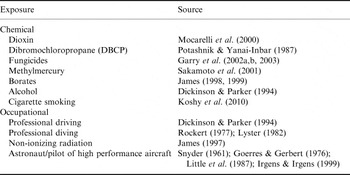
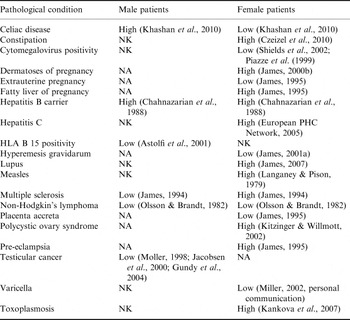
Tables 1 and 2 illustrate the wide range of variables with which offspring sex ratio has been reported to vary. Table 1 lists selected human paternal chemical and occupational exposures associated with reported low offspring sex ratios. Table 2 lists pathologies in male and female patients that reportedly are associated with significantly biased offspring sex ratios. (It should be emphasized that in no case is it suspected that the offspring sex is causally responsible for the parental pathology.) Thus it seems that there must be substantial Lexis variation even though it is not readily quantifiable. Attempts to estimate this variation have been made by Edwards (Reference Edwards1958), James (Reference James1975) and Pickles et al. (Reference Pickles, Crouchley and Davies1982). Their estimates of the Lexis standard deviation were respectively 0.05, 0.045 and 0.051; however, it has been questioned whether this apparent agreement is a spurious effect of various forms of flawed estimate (James, Reference James2000a, Reference James2009a).
Reports of low offspring sex ratios associated with selected adverse human paternal exposures

It will be noted that under a wide variety of circumstances, adverse exposures to men are reportedly associated with the production of daughters. I know of only two forms of adverse paternal exposure associated with the production of sons, viz celiac disease (Khashan et al., Reference Khashan, Henriksen, McNamee, Mortensen, McCarthy and Kenny2010) and hepatitis B carrier (Chahnazarian et al., Reference Chahnazarian, Blumberg and London1988). To these may be added (some) exposures to war (though it is not clear which parent is affected by war). Some conflicts (notably World Wars I and II) were associated with additional male births. Other more recent hostilities were reportedly associated with additional female births. An attempt has been made to summarize and explain these disparate findings (James, Reference James2009b).
Directions of significantly biased sex ratios associated with selected pathologies

NA=not applicable. NK=not known.
It is acknowledged that there may be bias within the table occasioned by selecting only results that met arbitrary significance levels. Moreover, considerations of publication bias would suggest that some of the cited conclusions – especially the uncorroborated ones – may prove to be false. However, some of the data have been extensively replicated, e.g. those relating to adverse obstetric conditions, hepatitis B status, cytomegalovirus status and testicular cancer; and also those relating to men exposed to various forms of chemical exposure and gravitational change.
Poisson variation
As noted above, this may be categorized into systematic and chaotic.
Systematic Poisson variation. The systematic variation (that associated with parity, duration of marriage and ages of spouses) is clearly minuscule (James, Reference James1987). Indeed, though most univariate analyses suggest that sex ratio declines with each of these (highly intercorrelated) variables, multivariate analyses have not finally established whether – or to what extent – such declines are independent. For the present purpose, it is sufficient to note that within sibships, there is a general very slight overall decline in sex ratio with time. As will be seen, it is important to distinguish this effect from that of chaotic Poisson variation.
Chaotic Poisson variation. Two presumably independent sources of chaotic Poisson variation will be mentioned here. The first source is that associated with time of insemination within an individual cycle (James, Reference James2009b). The second source of chaotic Poisson variation is that associated with side of ovulation (Fukuda et al., Reference Fukuda, Fukuda, Andersen and Byskov2001): here p varies from one cycle to another within the same woman. The magnitude of the variance of p associated with these two sources seems to be appreciable, in contrast with that associated with the systematic Poisson variation.
Garenne's treatment of his data
The asymmetry
As noted above, the probability that a current birth will be male reportedly rises with the number of prior boys and decreases with the number of prior girls (Malinvaud, Reference Malinvaud1955; Garenne, Reference Garenne2009). In both sets of data the effect was not symmetrical, being significantly stronger for females. Garenne (Reference Garenne2009) accordingly fitted his data to an asymmetric log-gamma function. He suggested (p. 405) that this asymmetry deserves further research, and that it is probably explained by biological factors. However, I think I may already have identified the cause of this asymmetry: I suggest that it lies in the systematic Poisson variation described above (viz the very slight decline in p within sibships with time) (James, Reference James1975). The argument is as follows.
Malinvaud (Reference Malinvaud1955) published data on nearly 4 million births in France in 1946–50. He gave the sex ratios of these births by the numbers of pre-existing boys and pre-existing girls. He showed that these data are fairly well fitted by the linear relationship:
pi=0.5145+0.003ni −0.005mi,
where pi is the probability that the present pregnancy will yield a boy, ni is the number of pre-existing boys and mi is the number of pre-existing girls. This formula apparently exemplifies the asymmetry that elicited the comments of Garenne (Reference Garenne2009). I suggested (James, Reference James1975) that this formula might be re-arranged thus:
pi=0.5145−0.001(ni +mi)+0.004ni −0.004mi.
In other words, it is suggested that symmetry (as between the sexes) is restored (or the asymmetry explained) if it is assumed that the probability of a boy declines very slightly (by 0.001) within each couple for each preceding live birth. Justification for this assumption exists in the systematic Poisson variation identified above. Moreover, Garenne's data are also susceptible to such adjustment. So I suggest that the asymmetry does not have the causal significance that Garenne is inclined to ascribe to it.
Garenne's suggestion of ‘behavioural’ determinants of sex ratio heterogeneity
Garenne (Reference Garenne2009, p. 400) was uncertain whether the heterogeneity of p (the probability of a male birth) among couples may have biological or behavioural determinants. He inferred (if I understand) that since the heterogeneity exists in sub-Saharan Africa (where birth limitation is not widespread), the cause is biological. However, I now suggest that birth limitation (as exemplified in stopping rules) can have only very limited effects on sex ratio heterogeneity. The argument is as follows:
1. If p were distributed binomially within and across couples, such stopping rules would have no effect on sex ratio heterogeneity. Nor would they have any effect on population sex ratio.
2. If p were subject only to Lexis variation across couples, then the most probable result of such stopping rules would be further children of the same sex as the prior sib(s). Cessation or continuation of reproduction would depend on the stopping rule employed by each individual couple. Such a process would affect sex ratio heterogeneity in the following ways. In societies in which boys and girls were equally valued, natural boy-producing parents wanting girls would presumably be roughly equalled by girl-producing parents wanting boys. Here the effect of the stopping rule is slightly to increase the heterogeneity of p with increase of parity. However, in societies valuing one sex (e.g. boys) over the other, girl-producing parents would (on average) have more children than boy-producing parents. This effect may be thought of as counter-productive, and the overall population sex ratio would be lower than if parents did not operate such a rule. Again, the effect is very slightly to increase the heterogeneity of p with parity.
3. If p were subject only to Poisson variation within couples, then the most probable result of such stopping rules would be further children opposite in sex to their existing sib(s). But cessation or continuation of reproduction would have no appreciable effect on heterogeneity of p.
4. Lastly if (as is suggested here), Lexis and Poisson variation co-exist (the Lexis very slightly outweighing the Poisson), then the effect of stopping rules (of either sort) on sex ratio heterogeneity are unclear, but, in any case, must be of very small magnitude. For instance, two recent studies on large samples of Scottish and Danish births failed to find significant correlations between the sexes of sibs within sibships (Maconochie & Roman, Reference Maconochie and Roman1997; Jacobsen et al., Reference Jacobsen, Miller and Engholm1999). So, for practical purposes, p may be considered as distributed binomially in these populations. Thus, though it may be agreed that the heterogeneity of p across couples has biological rather than (or as well as) behavioural causes, it would seem invalid to infer this from the paucity of family limitation in sub-Saharan Africa.
Acknowledgments
The author is grateful to Dr Elizabeth Miller (Public Health Laboratory Service, London) for a letter dated 13th December 2002, cited in Table 2. It is a pleasure to acknowledge the help and encouragement given by Professor Andrew Pomiankowski of University College London.