





Introduction
Managed turfgrass systems include golf courses, playing fields, parks and recreational areas, lawns and landscapes that provide numerous ecosystem services. In the United States alone, managed turfgrass covers approximately 16.4 million ha (Milesi et al. Reference Milesi, Running, Elvidge, Dietz, Tuttle and Nemani2005). Although this area is nearly half that devoted to growing major production crops such as corn (Zea mays L.) or soybean [Glycine max (L.) Merr], annual revenues associated with turfgrass management are estimated to be US$58 billion (Haydu et al. Reference Haydu, Hodges and Hall2006; USDA-FSA 2026). Turfgrass and crop production systems differ markedly in their aesthetic demands, management intensity, output, and potential environmental impacts. Unlike annual row crops, turfgrass is intimately associated with urban and suburban living (Robbins and Birkenholtz Reference Robbins and Birkenholtz2003), resulting in heightened public scrutiny and regulatory attention to weed management practices (Askew et al. Reference Askew, Goncalves, Romero, De Castro, McCurdy, McKeithen, Unruh, Tang and Kaminski2025a; Hahn et al. Reference Hahn, Sallenave, Pornaro and Leinauer2020; Wallace et al. Reference Wallace, Bartholomew and Campbell2016).
Integrated weed management (IWM) entails using biological, chemical, cultural, and mechanical weed control tactics to achieve effective and sustainable weed control while accounting for economic, ecological, and sociological consequences (Owen et al. Reference Owen, Beckie, Leeson, Norsworthy and Steckel2015; Swanton and Weise Reference Swanton and Weise1991; Walker and Buchanan Reference Walker and Buchanan1982). IWM was first described in 1982 and was followed by extensive research and extension efforts to integrate alternative nonchemical strategies for managing herbicide-resistant weeds in production agriculture (Owen et al. Reference Owen, Beckie, Leeson, Norsworthy and Steckel2015; Shaw Reference Shaw1982). Despite the recognized benefits of IWM in crop production, few case studies have documented the combined use of multiple weed control tactics or addressed the practical implementation of IWM strategies in turfgrass systems (Braithwaite et al. Reference Braithwaite, Stock and Kowalewski2022; Diehl et al. Reference Diehl, Elmore, Koppenhöfer, Murphy and Kostromytska2021, Reference Diehl, Elmore, Koppenhöfer, Murphy and Kostromytska2022; Ervin et al. Reference Ervin, Frisvold, Allen, Patton, Brosnan, Bowling, Elmore, Bagavathiannan, McCurdy, Gannon, Kaminski, Kowaleski, McElroy, McCullough, Unruh, Askew and McCarty2025; McCurdy et al. Reference McCurdy, Bowling, de Castro, Patton, Kowalewski, Mattox, Brosnan, Ervin, Askew, Goncalves, Elmore, McElroy, McNally, Pritchard, Kaminski, Gannon, Unruh and Bagavathiannan2025; Petelewicz et al. Reference Petelewicz, Joseph, Sierra Augustinus, Arevalo Alvarenga, McLoughlin, Gallo, MacDonald and Schiavon2025). Although IWM is less extensively characterized in turfgrass systems, it is recognized as a cornerstone strategy for sustainable weed control in both turfgrass and crop production systems (McCurdy et al. Reference McCurdy, Bowling, de Castro, Patton, Kowalewski, Mattox, Brosnan, Ervin, Askew, Goncalves, Elmore, McElroy, McNally, Pritchard, Kaminski, Gannon, Unruh and Bagavathiannan2025; Norsworthy et al. Reference Norsworthy, Ward, Shaw, Llewellyn, Nichols, Webster, Bradley, Frisvold, Powles, Burgos, Witt and Barrett2012). However, adoption rates and driving forces differ substantially among these systems, particularly in regard to herbicide resistance. While herbicide-resistant weeds are the primary driver of IWM adoption by crop producers (Beckie Reference Beckie2006), public perception and concern over environmental and human health risks are more common drivers of IWM adoption by turfgrass managers (Hahn et al., Reference Hahn, Sallenave, Pornaro and Leinauer2020; Larson et al. Reference Larson, Cook, Strawhacker and Hall2010; Strandberg et al. Reference Strandberg, Blomback, Jensen and Knox2012).
Weeds negatively affect the aesthetics, athletic safety, economic returns, and playability of managed turfgrass systems (Brosnan et al. Reference Brosnan, Dickson, Sorochan, Thoms and Stier2014; McCarty et al. Reference McCarty, Murphy, Turgeon and Turgeon1994; Perez et al. Reference Perez, Harwood, Johnson, Somwaru and Zepp1995; Rana and Askew Reference Rana and Askew2018), whereas yield reduction and economic profitability are key impacts of weeds in crop production (WSSA 2026a). Although more than 250 weed species have been identified in turfgrass systems (McCarty et al. Reference McCarty, Everest, Hall, Murphy and Yelverton2008), the most problematic species include annual and perennial weeds such as annual bluegrass (Poa annua L.), bermudagrass [Cynodon dactylon (L.) Pers], sedges (Cyperus spp.), goosegrass [Eleusine indica (L.) Gaertn.], and crabgrass (Digitaria spp.) (Van Wychen Reference Van Wychen2023). In corn and soybean crops, the most problematic species are summer annuals such as waterhemp [Amaranthus tuberculatus (Moq.) Sauer], Palmer amaranth (Amaranthus palmeri S. Watson), and morningglory (Ipomoea spp.) (Van Wychen Reference Van Wychen2023, Reference Van Wychen2025). Differences in problematic weed species of turfgrass and crop productions systems can be attributed to differences in morphological and physiological traits of the weed species, management intensity, and tactics used. Managed turfgrass systems contain perennial swards of a desired species (e.g., creeping bentgrass [Agrostis stolonifera L.]) that are used year-round. This attribute of managed turfgrass systems has led to a heavy reliance on herbicides to control problematic weeds (Brosnan et al. Reference Brosnan, Elmore and Bagavathiannan2020a, Reference Brosnan, Barrett and Bhowmik2020b; McElroy and Bhowmik Reference McElroy, Bhowmik, Stier, Horgan and Bonos2013) given that other practices used in crop production such as crop rotation, cover crops, tillage, and variable planting rates, are not applicable (Owen et al. Reference Owen, Beckie, Leeson, Norsworthy and Steckel2015).
Despite intensive herbicide use, the evolution of herbicide-resistant weeds has remained far less widespread in turfgrass than in agronomic crops (Brosnan et al. Reference Brosnan, Elmore and Bagavathiannan2020a, Reference Brosnan, Barrett and Bhowmik2020b). In agronomy, selection pressure is amplified by synchronized seedling emergence and annual weed population–wide screening during the critical period for weed control due to repeated management interventions (Kumari et al. Reference Kumari, Price, Korres, Gamble and Li2023a, Reference Kumari, Price, Korress, Gamble and Li2023b), which contributes to approximately eight times more characterized herbicide-resistant weeds cases in corn and soybean hectares compared with turfgrass systems (Heap Reference Heap2026; Vencill et al. Reference Vencill, Nichols, Webster, Soteres, Mallory-Smith, Burgos, Johnson and McClelland2012). In turfgrass, discontinuous weed germination throughout the growing season prevents individual plants or limits herbicide applications from population-wide screening events (Darmency et al. Reference Darmency, Colbach and Le Corre2017). Moreover, surviving weeds typically compete against dense, perennial turfgrass swards maintained through regular mowing, fertilization, and irrigation efforts to limit the seed return of herbicide-resistant weeds (Busey Reference Busey2003; Hahn et al. Reference Hahn, Sallenave, Pornaro and Leinauer2020). Consequently, most characterized herbicide-resistant biotypes in turfgrass have been found in southern regions (Bowling et al. Reference Bowling, McCurdy, de Castro, Patton, Brosnan, Askew, Breeden, Elmore, Gannon, Conçalves, Kaminski, Kowalewski, Liu, Mattox, McCarty, McCullough, McElroy, McKeithen, Osburn, Rogers, Rutland, Tang, Taylor, Unruh, Vargas and Bagavathiannan2024; Brosnan et al. Reference Brosnan, Elmore and Bagavathiannan2020a, Reference Brosnan, Barrett and Bhowmik2020b) where warm-season turfgrass enters winter dormancy, thereby enabling reduced plant competition and repeated herbicide exposure during a narrow emergence window, which more closely resembles the high-selection pressure of annual cropping systems.
Managed turfgrass systems provide numerous environmental benefits such as improved soil health, reduced stormwater runoff, enhanced water filtration, habitat for vertebrate and invertebrate organisms, and spaces for recreation (Brosnan et al. Reference Brosnan, Chandra, Gaussoin, Kowalewski, Leinauer, Rossi, Soldat, Stier and Unruh2020c). However, turfgrass systems have been associated with environmental disservices, including potential nutrient and pesticide runoff (Braun et al. Reference Braun, Mandal, Nwachukwu and Stanton2024). These environmental risks are important considerations in regulatory decisions regarding herbicide use in turfgrass. Recent regulatory decisions for atrazine and simazine illustrate the U.S. Environmental Protection Agency (EPA) approach to assess and mitigate risks to endangered or threatened species, with proposed requirements for downwind buffers adjacent to freshwater and saltwater surface waters and conservation practices to reduce runoff and soil erosion from treated areas (US EPA 2020a, 2020b). Additionally, where infants and children may come into physical contact with herbicide-treated turfgrass, the EPA applies heightened scrutiny to herbicide-related health risks. Recently, the EPA has assessed and mitigated human health risks from potential herbicide exposure. For example, the 2022 interim decision for oxadiazon resulted in multiple new label requirements, including its classification as a Restricted Use Pesticide, which reduced its maximum application rate and treated acreage, and immediate watering-in requirements to address identified health risks (US EPA 2022). Due to increased regulatory scrutiny, and additional constraints imposed by the need to comply with Endangered Species Act (ESA) obligations (Duzy et al. Reference Duzy, Campana and Brain2023), the need for alternative weed control strategies has intensified in managed turfgrass systems where herbicides are the primary means of controlling problematic weed species.
Synthesizing the current understanding of IWM components is a crucial step in enhancing the coordinated use of multiple weed control strategies in turfgrass systems, allowing practitioners to potentially move beyond heavy reliance on herbicides. With the impending implementation of ESA compliance requirements for turfgrass managers now on the horizon, this review aims to summarize the existing literature on IWM components for turfgrass systems, highlight key management differences between IWM practices for turfgrass and crop production systems, and underscore the need for turfgrass-specific regulatory considerations when developing ESA mitigation measures.
Current State of Knowledge on IWM Components in Turfgrass Systems and Differences with Crop Production
Cultural Weed Management
Turfgrass Species and Cultivar Selection
Bermudagrass, centipedegrass [Eremochloa ophiuroides (Munro) Hack.], seashore paspalum (Paspalum vaginatum Swartz.), St. Augustinegrass [Stenotaphrum secundatum (Walt.) Kuntze], and zoysiagrass (Zoysia spp.) are commonly used warm-season turfgrass species, whereas creeping bentgrass, fine fescues (Festuca L. spp.), Kentucky bluegrass (Poa pratensis L.), tall fescue [Lolium arundinaceum (Schreb.) S.J. Darbyshire], and perennial ryegrass (Lolium perenne L.) are widely used cool-season turfgrasses (Bonos and Huff Reference Bonos, Huff, Stier, Horgan and Bonos2013; Hanna et al. Reference Hanna, Raymer, Schwartz, Stier, Horgan and Bonos2013). Turfgrass species with poor resistance against biotic stressors (insects, fungi, bacteria, viruses) and abiotic stressors (shade, lack of fertility, poor drainage, traffic tolerance, etc.) are at increased risk of weed invasion (Hahn et al. Reference Hahn, Sallenave, Pornaro and Leinauer2020). Relatively few weeds will colonize established, healthy swards of zoysiagrass because of its higher shoot density than bermudagrass, but overfertilization during summer can increase the risk of weed invasion (Doroh and McElroy Reference Doroh and McElroy2010; Patton et al. Reference Patton, Schwartz and Kenworthy2017). Fine fescues commonly used for low-input sites have been demonstrated to suppress grassy and broadleaf weeds better than Kentucky bluegrass and tall fescue because they establish a dense canopy faster and have allelopathic characteristics (Braun et al. Reference Braun, Patton, Watkins, Koch, Anderson, Bonos and Brilman2020, Reference Braun, Courtney and Patton2023). Seeding mixtures of hybrid bluegrass (Poa pratensis L. × Poa arachnifera Torr.) and tall fescue had lower smooth crabgrass (Digitaria ischaemum Schreb. Ex Muhl) and purple deadnettle (Lamium purpureum L.) density and higher turfgrass cover than monocultures (Cutulle et al. Reference Cutulle, Derr, McCall, Horvath and Nichols2013). Overseeding perennial ryegrass at 400 to 800 kg ha−1 resulted in a decreased cover of perennial weeds, including white clover (Trifolium repens L.) and dandelion (Taraxacum officinale G.H. Weber ex Wiggers) (Elford et al. Reference Elford, Tardif, Robinson and Lyons2008). The allelopathic potential of turfgrasses can also limit weed growth, as tall fescue leaf extracts grown at temperatures under <5 C suppressed seed germination of annual bluegrass by up to 90% (Koo et al. Reference Koo, Gonçalves and Askew2022).
Cultivars with rapid germination and high establishment rates, adapted to local microclimates and resistant to biotic and abiotic stresses, should be used to reduce weed infestations. Elmore et al. (Reference Elmore, Bonos and Tuck2025) assessed the competitive ability of eight creeping bentgrass cultivars against annual bluegrass in fairways and reported that the cultivars Shark, Piranha, 007, and Flagstick were more competitive than the Penncross and L-93 cultivars. Bertin et al. (Reference Bertin, Senesac, Rossi, DiTommaso and Weston2008) reported that creeping fescue (Festuca rubra ssp. rubra) and chewing fescue (F. rubra ssp. commutata) cultivars offered higher suppression of crabgrass, broadleaf plantain (Plantago major L.), dandelion, and white clover than hard fescue (F. longifolia auct. non Thuill.) and blue fescue (F. glauca Vill.). St. Augustinegrass cultivar blends enhanced turfgrass quality and resulted in less density of sedges, bermudagrass, and spurge (Euphorbia spp.) in lawns due to denser canopy formation compared to cultivar monocultures (Pinkney et al. Reference Pinkney, Laplante and Dale2022). Transgenic cultivars of St. Augustinegrass and Kentucky bluegrass are commercially available as ProVista, which allow over-the-top application of glyphosate for broad-spectrum weed control and also contain traits to limit vertical growth of turfgrass (Blume et al. Reference Blume, Fei and Christians2010; Buhlman et al. Reference Buhlman, Freshour, Harriman, Koch, Unruh, van Santen, Williams, Yurisic and Kenworthy2022).
In contrast to agronomic cropping systems, where growers can adopt new cultivars annually to incorporate the latest improvements in competitiveness, stress tolerance, or input efficiency (Duvick Reference Duvick2005), turfgrass systems have slower genetic turnover because of perennial establishment. Developing and releasing improved turfgrass cultivars typically requires extensive multiyear evaluations under perennial sward conditions (Meyer et al. Reference Meyer, Hoffman and Bonos2017), relative to those for annual crops such as corn (Atlin et al. Reference Atlin, Cairns and Das2017). Moreover, practitioners must fully renovate or destroy an existing perennial turfgrass stand to introduce a new cultivar, which is a costly and disruptive process that limits rapid adoption (Johnson Reference Johnson1976). As a result, initial species and cultivar selection in turfgrass system assumes greater long-term importance for sustained weed suppression through enhanced density, vigor, and resource capture.
Mowing Height, Frequency, and Equipment Effect
Weed suppression from mowing is a unique attribute to turfgrass systems not used in row crop production. Reducing mowing heights can increase the risk of weed invasion in several turfgrass species. For example, tall fescue was more competitive against common bermudagrass invasion when mowed at 5.7 cm compared with 1.9 cm (Brede Reference Brede1992). Similarly, Dernoeden et al. (Reference Dernoeden, Carroll and Krouse1993) showed that tall fescue had less smooth crabgrass cover when mowed at 8.8 cm compared with 5.5 or 3.2 cm. Annual bluegrass cover was at least 24% lower when perennial ryegrass was mown at 3.8 cm compared with 1.1 cm (McNally et al. Reference McNally, Elmore, Kowalewski, Braithwaite and Cain2025). Similarly, green kyllinga (Kyllinga brevifolia Rottb.) density and biomass increased 2-fold to 5-fold when hybrid bermudagrass (Cynodon dactylon Burtt-Davey × C. transvaalensis L. Pers.) was maintained at 2.5 cm instead of 5 cm during the growing season (Lowe et al. Reference Lowe, Whitwell, McCarty and Bridges2000). Likewise, goosegrass seedling emergence was reduced by 57% and produced fewer tillers per plant when bermudagrass was maintained at 2.5 cm compared with 1.3 cm (Arrieta et al. Reference Arrieta, Busey and Daroub2009).
Mowing frequency (ranging from twice a week to once every 2 wk) did not affect inflorescence production of buckhorn plantain (Plantago lanceolata L.) in a Kentucky bluegrass lawn but the number of viable weed seeds was smaller compared with a turfgrass that was mown once every 4 wk (Law Reference Law2021). Returning clippings after mowing can increase the risk of weed infestation when weeds are flowering; for example, annual bluegrass cover increased by 12% after the clippings were returned to creeping bentgrass mown at 1.3 cm (Gaussoin and Branham Reference Gaussoin and Branham1989). Clipping collection is recommended in spring for annual bluegrass management once seedheads reach maturity, at around 600 growing degree days, to reduce viable seed return to the soil seedbank (Carroll et al. Reference Carroll, Brosnan, McCurdy, De Castro, Patton, Liu, Kaminski, Tang, McCullough and Westbury2021a). In addition to clipping management, mower type also plays a critical role in turfgrass quality and plant competition with weeds. Reel mowers have consistently been shown to increase bermudagrass shoot density compared to rotary mowers (Johnson et al. Reference Johnson, Carrow and Burns1987), resulting in a reduced risk of weed invasion. Pirchio et al. (Reference Pirchio, Fontanelli, Frasconi, Martelloni, Raffaelli, Peruzzi, Gaetani, Magni, Caturegli, Volterrani and Grossi2018) found that autonomous mowers set to mow daily favored infestations of white clover, subterranean clover (Trifolium subterraneum L.), birdsfoot trefoil (Lotus corniculatus L.), and English daisy (Bellis perennis L.) compared to a walk-behind rotary mower used once per week. Increased weed density was attributed to planophile characteristics of these weed species, limited turfgrass competition, and apical meristems being protected below the constant mowing height imparted via an autonomous mower (Pirchio et al. Reference Pirchio, Fontanelli, Frasconi, Martelloni, Raffaelli, Peruzzi, Gaetani, Magni, Caturegli, Volterrani and Grossi2018).
Fertility Management
In turfgrass systems, nitrogen response varies widely by species, offering management flexibility that is not readily available in most agronomic row crops. Centipedegrass, fine fescues, and zoysiagrass can maintain competitive turfgrass density and weed suppression with relatively modest rates of 50 to 100 kg N ha−1 yr−1, which is comparable to the nitrogen rate required for grain crops such as wheat (Triticum aestivum L.) (Busey Reference Busey2003; Sprunger et al. Reference Sprunger, Culman, Robertson and Snapp2018). However, Kentucky bluegrass and hybrid bermudagrass often require 150 to 300 kg N ha−1 yr−1, similar to the nitrogen requirement for corn (Hahn et al. Reference Hahn, Sallenave, Pornaro and Leinauer2020; Scharf et al. Reference Scharf, Wiebold and Lory2002). Unlike annual crops, for which fertilizer timing is constrained by planting windows, canopy closure, and equipment access (Vetsch and Randall Reference Vetsch and Randall2004), the perennial nature of turfgrass allows multiple, split applications throughout the growing season (Carey et al. Reference Carey, Hochmuth, Martinez, Boyer, Nair, Dukes, Toor, Shober, Cisar, Trenholm and Sartain2012). Coupled with continuous vegetative cover and higher soil organic matter, results in greater nutrient retention and at least two times lower potential for nitrogen leaching and runoff in turfgrass compared to annual cropping systems (Hussain et al. Reference Hussain, Robertson, Basso and Hamilton2020; Petrovic and Easton Reference Petrovic and Easton2005).
Increasing a nitrogen application rate from 0 to 300 kg N ha−1 year−1 resulted in lower crabgrass and dandelion cover in Chewings fescue (F. rubra ssp. fallax), Kentucky bluegrass, and tall fescue (Busey Reference Busey2003). White clover cover was reduced by 61% to 88% when a mixture of Kentucky bluegrass, perennial ryegrass, and fescues was fertilized with 150 kg N ha−1 yr−1 (Calhoun et al. Reference Calhoun, Rinehart, Hathaway and Buhler2005). Similarly, a kyllinga-infested area was limited by at least 40% when hybrid bermudagrass was fertilized with 49 kg N ha−1 mo−1 compared to no fertilization (Lowe et al. Reference Lowe, Whitwell, McCarty and Bridges2000). But increasing the nitrogen rate from 75 to 300 kg ha−1 yr−1 applied to perennial ryegrass resulted in an increase of annual bluegrass cover from 6% to 18%, respectively (Kowalewski et al. Reference Kowalewski, Cain, Braithwaite, McDonald and Schmid2022). Limiting nitrogen and phosphorus fertilization, lowering the soil pH with acidifying fertilizers, and increasing the amount of zinc can help reduce annual bluegrass infestations; however, these practices must be carefully balanced to maintain optimum turfgrass growth and quality (McCurdy et al. Reference McCurdy, Bowling, de Castro, Patton, Kowalewski, Mattox, Brosnan, Ervin, Askew, Goncalves, Elmore, McElroy, McNally, Pritchard, Kaminski, Gannon, Unruh and Bagavathiannan2025; McNally et al. Reference McNally, Elmore, Murphy and Murphy2024). In Tifway hybrid bermudagrass, applications of 49 kg N ha−1 mo−1 resulted in an increase in doveweed [Murdannia nudiflora (L.) Brenan] cover by 75% compared with an application of 24.5 kg N ha−1, suggesting that limiting nitrogen fertilization during late summer can reduce doveweed encroachment in hybrid bermudagrass (Atkinson et al. Reference Atkinson, McCarty, Yelverton, McElroy and Bridges2019).
Irrigation Management
In contrast to agronomic row crops, in which irrigation is used on less than 15% of total harvested U.S. corn and soybean acreage (Hrozencik and Aillery Reference Hrozencik and Aillery2021), turfgrass benefits from far greater flexibility in water management as an IWM tool. Most managed turfgrass areas such as golf courses and sports fields feature in-ground irrigation systems that enable precise, site-specific scheduling (Braun et al. Reference Braun, Mandal, Nwachukwu and Stanton2024; Shaddox et al. Reference Shaddox, Unruh, Johnson, Brown and Stacey2022). Alternating wet and dry cycles from frequent irrigation during peak weed germination periods can promote the breaking of weed seed dormancy (Busey Reference Busey2003). However, this response may not be universal across species and environments; for example, dandelion and smooth crabgrass occurrence in perennial ryegrass was not affected by daily irrigation or supplying water based on evapotranspiration rate (Jiang et al. Reference Jiang, Fry and Tisserat1998). Deep, infrequent irrigation can aid in reducing annual bluegrass survival during summer months (McCurdy et al. Reference McCurdy, Bowling, de Castro, Patton, Kowalewski, Mattox, Brosnan, Ervin, Askew, Goncalves, Elmore, McElroy, McNally, Pritchard, Kaminski, Gannon, Unruh and Bagavathiannan2025). Green kyllinga and false-green kyllinga (Kyllinga gracillima Miq.) infestations were positively correlated with increasing soil volumetric water content (McElroy et al. Reference McElroy, Yelverton, Burton and Brownie2005), indicating that improving drainage is critical for reducing the density of these weed species. Similarly, doveweed accumulated more than 200% biomass when maintained at ≥50% of field capacity compared with plants of ≤25% field capacity in potting media, suggesting moisture management is essential in preventing weed growth (Atkinson et al. Reference Atkinson, McCarty, Yelverton, McElroy and Bridges2019).
Unlike row crop production, for which tillage, interrow cultivation, and cover crops are widely used for direct weed suppression through soil disturbance, weed seed burial, or plant uprooting (Godar et al. Reference Godar, Norsworthy and Barber2026; Kumari et al. Reference Kumari, Price, Li, Gamble and Jacobson2025; Norsworthy et al. Reference Norsworthy, Ward, Shaw, Llewellyn, Nichols, Webster, Bradley, Frisvold, Powles, Burgos, Witt and Barrett2012), cultivation practices in turfgrass primarily influence weed dynamics by altering turfgrass vigor and competitiveness. Core aerification, slicing, solid tine aerification, verticutting, and topdressing are commonly used cultivation practices for thatch mitigation and soil compaction reduction. Arrieta et al. (Reference Arrieta, Busey and Daroub2009) observed that bermudagrass root growth was reduced due to high compaction (1.26 g cm−3 bulk density), but goosegrass remained unaffected. Aerification once or twice a year with 1.25-cm hollow tines followed by topdressing to alleviate compaction in ultradwarf bermudagrass (cultivar TifEagle) putting greens after herbicide applications did not affect goosegrass control (Petelewicz et al. Reference Petelewicz, Joseph, Sierra Augustinus, Arevalo Alvarenga, McLoughlin, Gallo, MacDonald and Schiavon2025). While verticutting reduced thatch in a Tifway hybrid bermudagrass, this practice had minimal effect on crabgrass and winter annual weed cover (Johnson Reference Johnson1979). Henry et al. (Reference Henry, Johnston and Tucker2025a) found that verticutting bahiagrass (Paspalum notatum Flüggé) two to three times per year limited lateral spread due to shallow rhizomes but did not affect dallisgrass (Paspalum dilatatum Poir.) due to belowground, protected rhizomes. The study was limited in scope because it was conducted in bareground conditions without turfgrass competition and in a single growing season; therefore, effects of verticutting warrant further investigation.
Applicability, Limitations, and Research Gaps
Cultural weed management is foundational to IWM for turfgrass because it leverages the competitive ability of healthy, perennial swards. Strategic species and cultivar selection, overseeding, optimized mowing regimes, fertility inputs, irrigation management, and cultivation practices can collectively suppress weeds while improving long-term turfgrass resilience (Busey Reference Busey2003; Gannett et al. Reference Gannett, Bray, Lampman, Lerner, Murray, Wallace, Yeh, Slavens, Thompson and Kao-Kniffin2021; Hahn et al. Reference Hahn, Sallenave, Pornaro and Leinauer2020; McCurdy et al. Reference McCurdy, Bowling, de Castro, Patton, Kowalewski, Mattox, Brosnan, Ervin, Askew, Goncalves, Elmore, McElroy, McNally, Pritchard, Kaminski, Gannon, Unruh and Bagavathiannan2025). These tactics are particularly valuable for reducing selection pressure on herbicides and managing herbicide-resistant weed populations (Bowling et al. Reference Bowling, McCurdy, de Castro, Patton, Brosnan, Askew, Breeden, Elmore, Gannon, Conçalves, Kaminski, Kowalewski, Liu, Mattox, McCarty, McCullough, McElroy, McKeithen, Osburn, Rogers, Rutland, Tang, Taylor, Unruh, Vargas and Bagavathiannan2024).
However, cultural methods have several limitations. Cultural tactics generally provide slower and more gradual weed suppression than herbicides (Busey Reference Busey2003). These practices often require sustained management intensity over multiple years to achieve meaningful reductions in weed density and can be affected by environmental variability or site-specific constraints (Elford et al. Reference Elford, Tardif, Robinson and Lyons2008; Gannett et al. Reference Gannett, Bray, Lampman, Lerner, Murray, Wallace, Yeh, Slavens, Thompson and Kao-Kniffin2021; Tomis et al. Reference Tomis, Campbell, Henderson, Siegel-Miles and Wallace2025a). Enhanced cultural practices to suppress weeds often increase labor, cost, and duration of unacceptable turfgrass quality (Hinson et al. Reference Hinson, Askew, Godara, Munshaw and Goatley2025; Tomis et al. Reference Tomis, Campbell, Henderson, Siegel-Miles and Wallace2025a, Reference Tomis, Campbell, Henderson and Wallace2025b). Breeding for enhanced resistance to herbicides to produce cultivars such as glyphosate-resistant Kentucky bluegrass and St. Augustinegrass, has enabled turfgrass managers to apply glyphosate for nonselective weed control without damaging turfgrass (Blume et al. Reference Blume, Fei and Christians2010; Buhlman et al. Reference Buhlman, Freshour, Harriman, Koch, Unruh, van Santen, Williams, Yurisic and Kenworthy2022). However, these types of cultivars become a challenge during renovation (Figure 1), and their existence may lead to a faster evolution of glyphosate-resistant weeds, pollen-mediated gene flow, and off-target transgene spread (Binkholder et al. Reference Binkholder, Fresenburg, Teuton, Xiong and Smeda2011; Johnson et al. Reference Johnson, Larson, Anderton, Patterson, Cattani and Nelson2006; Zapiola et al. Reference Zapiola, Campbell, Butler and Mallory-Smith2008). St. Augustinegrass and buffalograss [Buchloe dactyloides (Nutt.) Engelm.] have limited outcrossing possibilities and could be viable choices for the development of herbicide-resistant cultivars with proper stewardship guidelines to limit the potential concerns about resistance. Given the negative public perceptions of both genetically modified plants and associated pesticide use (Jun et al. Reference Jun, Feng, Avanasi, Brain, Prosperi and Bian2023; Verma Reference Verma2013), transgenic cultivars may not be a suitable IWM strategy for turfgrass systems.
ProVista Kentucky bluegrass (Poa pratensis L.) surviving multiple glyphosate applications during golf course renovation, demonstrating the practical challenges of managing glyphosate-resistant turfgrass. Images by James Brosnan, University of Tennessee, Knoxville.

Key research and development goals should include 1) an acceleration in turfgrass breeding for weed-suppressive traits (e.g., rapid establishment, canopy density, and allelopathy) rather than a primary focus on herbicide resistance or stress tolerance; 2) long-term studies to evaluate the effect of combinations of cultural tactics such as overseeding, mowing height, and fertility adjustments under pesticide-restricted or low-input scenarios on weed seedbank dynamics, turfgrass performance, and economic viability; and 3) the development of data-driven decision tools to ensure precision when applying fertilizers and irrigation for various turfgrass species that optimize weed suppression while minimizing inputs.
Physical Weed Management
Mechanical Weeding
The primary means of mechanical weeding turfgrass is mowing, a practice that creates a uniform canopy by physically cutting all plants to the same height. Mowing also helps to reduce weed infestations. When performed repeatedly, mowing is an effective way to control annual broadleaf weeds by eliminating their apical dominance and depleting their underground carbohydrate reserves (Busey Reference Busey2003). However, many problematic weeds in turfgrass systems, including annual bluegrass and goosegrass, and broadleaf weeds with prostrate growth habits, are highly tolerant to mowing (Busey Reference Busey2003). Mowing can also reduce insecticide exposure risk to pollinators in turfgrass by lowering white clover floral density by 85%, with concomitant reductions in insect visitation (Godara et al. Reference Godara, Del Pozo-Valdivia, Romero Cubas, Leo and Askew2026a). Henderson (Reference Henderson2022) evaluated a modified reel mower equipped with four rows of helical-shaped brushes and reported 24% to 89% control of broadleaf weeds in Kentucky bluegrass with minimal injury to turfgrass.
Similar to several harvest weed seed control measures used in row crops like soybean and wheat (Beam et al. Reference Beam, Mirsky, Cahoon, Haak and Flessner2019), fraise mowing is a mechanical weeding practice that removes the entire warm-season turfgrass canopy, along with the associated weed seed in the underlying thatch and soil (Brosnan et al. Reference Brosnan, Breeden, Zobel, Patton and Law2020d). Turfgrass recovers vegetatively, but the recovery rate is affected by fraise mowing depth and turfgrass species (Carroll et al. Reference Carroll, Brosnan, Unruh, Stephens, McKeithen and Boeri2021b). Fraise mowing hybrid bermudagrass collars in summer at a depth of 0.8 cm provided more than 80% control of annual bluegrass when assessed at 34 wk after treatment, with recovery occurring in fewer than 14 d (Brosnan and Breeden Reference Brosnan and Breeden2025). Fraise mowing a zoysiagrass fairway to a depth of 2.5 cm in June resulted in a 24% reduction in annual bluegrass the following April, but 60 d were required for turfgrass to achieve comparable cover to that of nontreated areas (Brosnan et al. Reference Brosnan, Breeden, Zobel, Patton and Law2020d). A bermudagrass fairway reached complete recovery in 52 to 98 d after fraise mowing at a 1.5-cm depth with 42% to 97% control of annual bluegrass reported the following spring (Carroll et al. Reference Carroll, Brosnan, Unruh, Stephens, McKeithen and Boeri2021b). Autonomous crop thinners and intrarow weed cultivators are currently used in agronomic and specialty crops that use machine vision systems to selectively thin crops based on size and color of desired plants (Fennimore et al. Reference Fennimore, Slaughter, Siemens, Leon and Saber2016; Yang et al. Reference Yang, Zhao, Li, Liu, Yu, Wu and Zhai2025), but the development of such tools for turfgrass systems has been limited to date.
Laser Weeding
Laser weeding involves the use of diode, carbon dioxide, or fiber lasers to deliver radiation that disrupts plant cell integrity (Andreasen et al. Reference Andreasen, Vlassi and Salehan2024; Kaierle et al. Reference Kaierle, Marx, Rath and Hustedt2013). Previous research on agronomic and vegetable production reported the feasibility of using laser treatments to control weed seedlings by delivering a high-intensity laser spot (Andreasen et al. Reference Andreasen, Vlassi and Salehan2024; Coleman et al. Reference Coleman, Betters, Squires, Leon-Saval and Walsh2021; Mwitta et al. Reference Mwitta, Rains and Prostko2022; Sosnoskie et al. Reference Sosnoskie, Bill, Butler-Jones, Bouchelle and Besançon2025). Carbon dioxide lasers have been shown to control erect annual broadleaf weeds such as common lambsquarters (Chenopodium album L.) and common ragweed (Ambrosia artemisiifolia L.) more effectively than annual grasses and prostrate broadleaf species such as purslane (Portulaca oleracea L.). This difference is likely due to variations in emergence pattern, growth habit, and protected meristem region (Sosnoskie et al. Reference Sosnoskie, Bill, Butler-Jones, Bouchelle and Besançon2025). A recently commercialized laser weeding unit (LaserWeeder; Carbon Robotics, Seattle, WA) for crop production systems weighs more than 4,000 kg, which could cause soil compaction and lead to poor turfgrass growth, reduced quality, and weed encroachment (Carrow Reference Carrow1980; Waddington and Baker Reference Waddington and Baker1965). In turfgrass systems, weeds typically cannot be targeted with laser at early growth stages because of interference from the dense turfgrass canopy. To control more mature weeds, Romero et al. (Reference Romero, Godara and Askew2026) evaluated various delivery patterns of a diode-laser and found that optimized line spacing can improve weed control for a given pattern-averaged laser intensity (Figure 2A). Although key weeds such as smooth crabgrass (Figure 2B) and annual bluegrass were effectively controlled at multi-tiller stages, the trade-offs in laser energy, cost, and time will likely restrict the technology to small-scale, targeted applications for managing herbicide-resistant biotypes. Likewise, laser weed control would be restricted to use on actively growing turfgrass due to the potential risk of fire in dormant turfgrass.
A: Smooth crabgrass (Digitaria ischaemum Schreb. ex Muhl.) control in creeping bentgrass (Agrostis stolonifera L.) turfgrass using a 10-W diode laser weeder with a 0.08 × 0.06-mm laser spot. B: Wider line spacing (2 mm) achieved up to 83% mortality at approximately half the pattern-averaged laser intensity compared with narrow line spacing (1 mm). Images by Shawn Askew, Virginia Tech, Blacksburg.

Thermal Weeding
Thermal weeding uses heat from an external energy source to raise plant tissue temperature to lethal levels, causing cuticle breakdown and plant death due to desiccation (Bauer et al. Reference Bauer, Marx, Bauer, Flury, Ripken and Streit2020; Knezevic et al. Reference Knezevic, Fennimore, Datta, Thomas, Murray and Gand Murphy2016). Thermal weeding includes practices such as electrical weeding, flaming, hot water, radiant heat, solarization, and steaming (Bauer et al. Reference Bauer, Marx, Bauer, Flury, Ripken and Streit2020; Hahn et al. Reference Hahn, Sallenave, Pornaro and Leinauer2020). Electric weeding involves the use of an electric current either via spark discharge or continuous electrode-plant contact to transfer heat energy into plant cells to rupture membranes, which leads to plant death or suppression (Slaven et al. Reference Slaven, Koch and Borger2023). Seedling annual bluegrass was controlled with 200 W of energy per plant via a handheld electric weeding device (Mizuno et al. Reference Mizuno, Nagura, Miyamoto and Chakrabarti1993). Sequential applications of electric weeding will be needed to maintain effective control of perennial weeds such as yellow nutsedge (Cyperus esculentus L.) and grassy weeds at tillering stages compared to annual broadleaf weeds due to differential sensitivity (Baccin and Moretti Reference Baccin and Moretti2025; Bloomer et al. Reference Bloomer, Harrington, Ghanizadeh and James2022; Slaven et al. Reference Slaven, Koch and Borger2023).
Hoyle et al. (Reference Hoyle, McElroy and Rose2012) reported thermal treatments are a viable method for weed control in managed turfgrass without affecting tall fescue establishment. Solarization for 6 wk using a 6-mm transparent polythene plastic cover provided more than 80% control of carpetweed (Mollugo verticillata L.), goosegrass, large crabgrass [Digitaria sanguinalis (L.) Scop.], spotted spurge (Chamaesyce maculata L.), and Virginia buttonweed (Diodia virginiana L.) but did not effectively control cockscomb kyllinga (Kyllinga squamulata Thonn. ex Vahl) and yellow nutsedge (Hoyle et al. Reference Hoyle, McElroy and Rose2012). Solarization using a similar method for 8 to 9 wk also reduced annual bluegrass seed survival by at least 89% in the top 5 cm of the soil profile (Peachey et al. Reference Peachey, Pinkerton, Ivors, Miller and Moore2001). Weed flaming applied twice using an enclosed flame sanitizer directing 1,121 C heat toward the soil surface provided equivalent or greater control than dazomet applied at 389 kg ha−1 for the above-mentioned weed species (Hoyle et al. Reference Hoyle, McElroy and Rose2012).
Another study also found that flame weeding at 70 to 100 kg ha−1 of liquified propane reduced annual broadleaf weed cover to 5% or less, including black medic (Medicago lupulina L.), field bindweed (Convolvulus arvensis L.), and horseweed (Erigeron canadensis L.) (Martelloni et al. Reference Martelloni, Caturegli, Frasconi, Gaetani, Grossi, Magni, Peruzzi, Pirchio, Raffaelli, Volterrani and Fontanelli2018). However, flame treatments were initiated during the time when the Patriot hybrid of bermudagrass greens up in spring and consequently transition was delayed by 3 wk (Martelloni et al. Reference Martelloni, Caturegli, Frasconi, Gaetani, Grossi, Magni, Peruzzi, Pirchio, Raffaelli, Volterrani and Fontanelli2018). Bermudagrass and Kentucky bluegrass produced more than 90% turfgrass cover within 3 wk after flaming with 152 to 612 kg ha−1 of liquified propane but zoysiagrass, tall fescue, and perennial ryegrass took longer to achieve acceptable turfgrass cover (Askew and Goncalves Reference Askew and Goncalves2021; Godara et al. Reference Godara, Askew and Goncalves2023). Flaming at 80 kg ha−1 resulted in decreased annual bluegrass biomass, but 50% of the treated plants still produced flowers, indicating lower effectiveness on grasses due to their ability to regrow from the apical meristem (Rask et al. Reference Rask, Kristoffersen and Andreasen2012). Flaming at 366 to 732 kg ha−1 provided control of ground ivy (Glechoma hederacea L.) for up to 4 wk after treatment (Patton et al. Reference Patton, Braun and Weisenberger2019), but regrowth occurred thereafter due to presence of creeping stolons and protected meristems.
Steaming at 4,000 kg ha−1 delivering approximately 120 C using a self-propelled device was more effective in desiccating tall fescue and perennial ryegrass with meristems located in crowns immediately above the ground compared to flaming treatments (Fontanelli et al. Reference Fontanelli, Pirchio, Frasconi, Martelloni, Raffaelli, Peruzzi, Grossi, Caturegli, Magni, Gaetani and Volterrani2017). Steaming at 3,200 kg ha−1 with 175 C provided control of seedling-stage redroot pigweed (Amaranthus retroflexus L.) and common lambsquarters but did not affect weed emergence (Kolberg and Wiles Reference Kolberg and Wiles2002), demonstrating the use of thermal treatments during renovations to kill existing vegetation. Hot water (95 C) applied at 61 kL ha−1 biweekly over six applications provided a minimum 60% reduction in dormant bermudagrass and zoysiagrass (Romero et al. Reference Romero, Godara, Koo and Askew2024). Another study found that using hot water (>80 C) provided control of a perennial weed, broadleaf dock (Rumex obtusifolius L.), without damaging the soil structure (Latsch et al. Reference Latsch, Anken, Herzog and Sauter2017). De Cauwer et al. (Reference De Cauwer, Bogaert, Claerhout, Bulcke and Reheul2015) showed that increasing the water temperature from 78 C to 98 C raised the sensitivity of annual bluegrass, broadleaf plantain (Plantago major L.), dandelion, mouseear chickweed (Cerastium fontanum Baumg.), and horseweed, but failed to control these perennial weeds at 12 wk after treatment. Biweekly applications of radiant heat (300 C) using a metal plate positioned 3.8 cm above dormant turfgrass for 15 s reduced annual bluegrass density by at least 85% and controlled this species in a similar way to that of glyphosate (Romero et al. Reference Romero, Godara, Koo and Askew2024). Close placement of a radiant heat source to the turfgrass canopy or increasing the exposure time improved annual bluegrass control, potentially due to less ambient convection and higher thermal conductivity (Bauer et al. Reference Bauer, Marx, Bauer, Flury, Ripken and Streit2020; Romero et al. Reference Romero, Godara, Koo and Askew2024).
Applicability, Limitations, and Research Gaps
Physical weed management strategies can be integrated with other IWM practices, particularly to control herbicide-resistant weed populations and during turfgrass establishment or renovation. Fraise mowing effectively removes weed seeds from the thatch and upper soil profile (Brosnan et al. Reference Brosnan, Breeden, Zobel, Patton and Law2020d; McCurdy et al. Reference McCurdy, Bowling, de Castro, Patton, Kowalewski, Mattox, Brosnan, Ervin, Askew, Goncalves, Elmore, McElroy, McNally, Pritchard, Kaminski, Gannon, Unruh and Bagavathiannan2025), modified reel mowers offer selective broadleaf weed suppression (Henderson Reference Henderson2022), and thermal methods can desiccate existing vegetation with minimal soil disruption (Godara et al. Reference Godara, Askew and Goncalves2023; Martelloni et al. Reference Martelloni, Caturegli, Frasconi, Gaetani, Grossi, Magni, Peruzzi, Pirchio, Raffaelli, Volterrani and Fontanelli2018; Patton et al. Reference Patton, Braun and Weisenberger2019; Rask et al. Reference Rask, Kristoffersen and Andreasen2012). While most thermal weed control methods lack selectivity, they could be used on warm-season turfgrasses during winter dormancy to manage herbicide-resistant weeds and to reduce the selection pressure associated with repeated use of nonselective herbicides.
Solarization can reduce seed survival of annual problematic weeds that are usually present in the first 0 to 5 cm of soil depth (Pareja et al. Reference Pareja, Staniforth and Pareja1985), by reducing weed infestations during turfgrass establishment. Steaming and flaming were viable alternatives to applications of glufosinate for desiccating cool-season turfgrass or existing vegetation to establish warm-season turfgrass (Fontanelli et al. Reference Fontanelli, Pirchio, Frasconi, Martelloni, Raffaelli, Peruzzi, Grossi, Caturegli, Magni, Gaetani and Volterrani2017). Laser weeding shows promise for targeted control in established turfgrass (Romero et al. Reference Romero, Godara and Askew2026). Hand-pulling and hoeing are labor-intensive and costly for large-scale adoption in turfgrass systems and are currently used mainly on sensitive surfaces such as putting greens (Figure 3), where herbicide options for controlling mature weeds are limited. Future integration of hoeing with autonomous machine vision-guided systems may enable selective weed removal in turfgrass, analogous to autonomous crop-thinning technologies used in other cropping systems (Fennimore et al. Reference Fennimore, Slaughter, Siemens, Leon and Saber2016).
Workers hand-weeding oxadiazon-resistant goosegrass [Eleusine indica (L.) Gaertn.] on a golf course tee in Richmond, Virginia, illustrating the labor-intensive nature and associated costs of managing herbicide-resistant weeds. Image by Shawn Askew, Virginia Tech, Blacksburg.

However, several limitations constrain the widespread adoption of thermal weed control methods. Most physical methods are nonselective or only partially selective, require significant labor, equipment, or energy inputs, and can delay turfgrass recovery depending on species, timing, and intensity (Brosnan et al. Reference Brosnan, Breeden, Zobel, Patton and Law2020d; Busey Reference Busey2003; Carroll et al. Reference Carroll, Brosnan, Unruh, Stephens, McKeithen and Boeri2021b; Romero et al. Reference Romero, Godara and Askew2026). Fraise mowing and thermal treatments often necessitate downtime for turf regrowth (Brosnan et al. Reference Brosnan, Breeden, Zobel, Patton and Law2020d; Martelloni et al. Reference Martelloni, Caturegli, Frasconi, Gaetani, Grossi, Magni, Peruzzi, Pirchio, Raffaelli, Volterrani and Fontanelli2018), while laser weeding remains slow and costly for use on large areas (Romero et al. Reference Romero, Godara and Askew2026). Many tactics perform best on young annual weeds but are less effective on mature grasses, prostrate species, or perennials with protected meristems or underground reserves (Patton et al. Reference Patton, Braun and Weisenberger2019; Slaven et al. Reference Slaven, Koch and Borger2023; Sosnoskie et al. Reference Sosnoskie, Bill, Butler-Jones, Bouchelle and Besançon2025). Repeated use of a single tactic such as thermal weed control will potentially cause flora shifts to more heat-tolerant species or weeds will evolve morphological traits to survive alternative treatments (Slaven et al. Reference Slaven, Koch and Borger2023), so integrating different management techniques would be essential. Such adaptations have been documented in row crops, where, for example, early flowering of wild radish (Raphanus raphanistrum L.) has facilitated escape from harvest weed seed control following repeated use of this technology in wheat fields (Sun et al. Reference Sun, Ashworth, Flower, Vila-Aiub, Rocha and Beckie2021).
Key research and development needs include 1) the development and field validation of autonomous, machine vision-guided mechanical and laser systems suitable for turfgrass; 2) optimization of thermal and laser weeding (energy dose, application timing, and frequency) across turfgrass species, weed growth stages, and environmental conditions; and 3) an assessment of the effect of integrated strategies that combine physical methods with cultural and chemical tactics on weed population shifts and turfgrass recovery through long-term studies.
Biological Weed Management
Bioherbicides
Bioherbicides are natural weed control products consisting of microorganisms or phytotoxins derived from microbes (bacteria, fungi, virus, nematodes), insects, or plant extracts (Bailey Reference Bailey and Bailey2014). Thaxtomin-A, which is produced by fermentation of Streptomyces scabies, resulted in a 35% to 75% reduction in smooth crabgrass cover when applied four times (380 g ha−1) at 4-wk intervals, a response that was comparable to sequential applications of pendimethalin at 1,680 g ha−1 (Wolfe et al. Reference Wolfe, Neal, Harlow and Gannon2016a). Annual bluegrass cover was also reduced by 61% to 82% when thaxtomin-A was applied at 380 g ha−1 as a preemergence treatment followed by two applications of 190 or 380 g ha−1 (Wolfe et al. Reference Wolfe, Neal, Harlow and Gannon2016a). Thaxtomin-A is not safe to use on creeping bentgrass maintained at 0.32 cm mowing height, but it can be applied to perennial ryegrass and tall fescue 2 wk before or after seeding for preemergence weed control (Wolfe et al. Reference Wolfe, Neal, Harlow and Gannon2016a). Pseudomonas fluorescens are naturally occurring soil bacteria, which can suppress annual bluegrass 55% to 78% by inhibiting root formation, root growth, and tiller initiation (Kennedy Reference Kennedy2016). Shabana et al. (Reference Shabana, Stiles, Charudattan and Abou Tabl2010) reported that a 30% oil emulsion containing the mycelium of the fungal pathogen Drechslera gigantea in a culture filtrate with ammonium sulfate provided 77% to 100% control of tropical signalgrass [Urochloa subquadripara (Trin.) R.D. Webster], smutgrass [Sporobolus indicus (L.) R. Br], and large crabgrass under greenhouse conditions; however, further field evaluation is needed to determine the efficacy of using these organisms for spot applications. Thaxtomin-A applied at 380 g ha−1 and Phomo macrostoma applied at 13,000 macrocidin units per m−2 provided 72% and 64% control, respectively, of several broadleaf weeds at 4 wk after preemergence treatment, but sequential applications were required for season-long weed control due to the short residual activity of these bioherbicides (Wolfe et al. Reference Wolfe, Neal and Harlow2016b). Currently, bioherbicides for selective annual grass control in turfgrass are commercially unavailable, primarily because most are still in the development phase and require further research to improve field performance consistency.
Insect Mediation and Other Biological Methods
Annual bluegrass weevil (Listronotus maculicollis Kirby) can be used as a biological control method for suppressing annual bluegrass in cool-season turfgrass (Diehl et al. Reference Diehl, Elmore, Koppenhöfer, Murphy and Kostromytska2021, Reference Diehl, Elmore, Koppenhöfer, Murphy and Kostromytska2022). Diehl et al. (Reference Diehl, Elmore, Koppenhöfer, Murphy and Kostromytska2021) showed that withholding insecticide applications for targeting annual bluegrass weevil can reduce annual bluegrass infestations in creeping bentgrass fairways due to continued larval feeding. Integrating a threshold-based insecticide with monthly paclobutrazol treatments at 105 g ha−1 further improved annual bluegrass control due to a synergistic effect (Diehl et al. Reference Diehl, Elmore, Koppenhöfer, Murphy and Kostromytska2022). Another emerging tool is the use of ribonucleic acid interference (RNAi), in which double-stranded ribonucleic acid (dsRNA) molecules enter plant cells and silence target genes by degrading messenger RNA, ultimately causing weed death due to inhibition of protein synthesis (Ethridge et al. Reference Ethridge, Grieger, Locke, Everman, Jordan and Leon2023). Panozzo et al. (Reference Panozzo, Milani, Bordignon, Scarabel and Varotto2025) highlighted RNAi as a promising approach for managing multiple herbicide–resistant annual bluegrass and goosegrass biotypes, due to the availability of sequenced genomes that enable the development of highly specific dsRNAs without off-target gene silencing. However, public perceptions of such technology in managed turfgrass systems may not be favorable.
Applicability, Limitations, and Research Gaps
Biological tactics offer nonchemical means of managing herbicide-resistant weeds in turfgrass, particularly where the regulatory environment or public perception limits the use of conventional herbicides. Bioherbicides such as thaxtomin-A and Phoma macrostoma have shown good activity against several broadleaf and annual grassy weeds when applied sequentially (Wolfe et al. Reference Wolfe, Neal, Harlow and Gannon2016a, 2016b). Phoma macrostoma produces macrocidins that control susceptible plants via multiple modes of action, thereby lowering the risk of resistance development (Hubbard et al. Reference Hubbard, Taylor, Bailey and Hynes2016). Annual bluegrass weevil provides an effective insect-based way to suppress annual bluegrass in cool-season turfgrass (Brown et al. Reference Brown, Islam, McGraw, Kostromytska, Wu and Koppenhöfer2026; Diehl et al. Reference Diehl, Elmore, Koppenhöfer, Murphy and Kostromytska2021, Reference Diehl, Elmore, Koppenhöfer, Murphy and Kostromytska2022). RNAi technology also represents a high-specificity future option for herbicide-resistant biotypes, but no commercialized product with this technology exists in the turfgrass marketplace (Ethridge et al. Reference Ethridge, Grieger, Locke, Everman, Jordan and Leon2023; Panozzo et al. Reference Panozzo, Milani, Bordignon, Scarabel and Varotto2025). McCurdy et al. (Reference McCurdy, Bowling, de Castro, Patton, Kowalewski, Mattox, Brosnan, Ervin, Askew, Goncalves, Elmore, McElroy, McNally, Pritchard, Kaminski, Gannon, Unruh and Bagavathiannan2025) indicated that anthracnose, caused by the fungus Colletotrichum cereale, could potentially be used as a bioherbicide to control annual bluegrass in tolerant turfgrass cultivars, but additional research is warranted to validate the concept.
Several important limitations remain. Most bioherbicides exhibit short residual activity, a narrow spectrum of weed activity, and high sensitivity to environmental conditions, often requiring multiple applications and integration with cultural practices for acceptable control (Wolfe et al. Reference Wolfe, Neal, Harlow and Gannon2016a, Reference Wolfe, Neal and Harlow2016b). Bioherbicides derived from microbial extracts, rather than containing live pathogens, may help overcome key commercialization barriers such as inconsistent field performance, short shelf life, and high production costs (Neal Reference Neal2023), evidenced by the cancellation of Phoma macrostoma registration in 2020. Although using annual bluegrass weevils may be effective, damage to desirable turf species may occur when infestation levels are high (Brown et al. Reference Brown, Islam, McGraw, Kostromytska, Wu and Koppenhöfer2026; Diehl et al. Reference Diehl, Elmore, Koppenhöfer, Murphy and Kostromytska2021, Reference Diehl, Elmore, Koppenhöfer, Murphy and Kostromytska2022). RNAi faces delivery challenges, variable weed control, and public acceptance concerns (Ethridge et al. Reference Ethridge, Grieger, Locke, Everman, Jordan and Leon2023).
Key research and development needs include 1) improvements in bioherbicide formulation and delivery methods to enhance field performance consistency and residual activity; 2) an evaluation of how biological agents can be integrated with cultural and chemical tactics under field conditions; 3) screening for additional microbial strains or insects with broader host ranges and improved environmental stability; and 4) the development of practical, cost-effective RNAi delivery systems for fighting turfgrass weeds.
Chemical Weed Management
Herbicides
Herbicides are used as one of the primary strategies for managing weeds in turfgrass. In the United States, more than 60 herbicide active ingredients representing 17 different modes of action (MOAs) are registered for weed control in turfgrass systems, either as individual active ingredients or as components of premix formulations (Table 1). The EPA reported that nonagricultural users (which includes commercial, industrial, governmental, and home users) spent more than $900 million on herbicides and accounted for 9% of the total herbicide volume used in the United States in 2012 (US EPA 2017). The herbicides 2,4-dichlorophenoxyacetic acid (2,4-D), glyphosate, methylchlorophenoxypropionic acid (also known as mecoprop or MCPP), pendimethalin, prodiamine, dicamba, simazine, and 2-methyl-4-chlorophenoxyacetic acid (known as MCPA) were among the top 10 pesticides used by commercial and industrial site managers, and by residential applicators (US EPA 2017).
Herbicide active ingredients registered for use on turfgrass and confirmed incidence of herbicide-resistant weeds.a

Table 1. Long description
A table with 30 rows and 4 columns. The columns are labeled WSSA group, Site of action, Active ingredient, and Weeds exhibiting herbicide resistance. The table lists various herbicide active ingredients grouped by their WSSA group and site of action, along with the weeds that exhibit resistance to these herbicides. Each row provides specific details on the active ingredients and the corresponding resistant weeds.
a Abbreviation: WSSA, Weed Science Society of America. (Herbicides are categorized into groups according to their site of action or mode of action.)
b Reports of herbicide resistance in turfgrass were obtained from Heap I (2026).
c Weed species have been confirmed resistant to a single active ingredient within a given mode of action.
d Weed species have been confirmed resistant to multiple active ingredients within a given mode of action.
Cultural practices, environmental conditions, tank mixtures, spray adjuvants, and weed growth stages can affect herbicide performance. Fraise mowing bermudagrass at a depth of 3.75 cm before a treatment with glyphosate or a tank mixture of glyphosate and fluazifop provided greater weed control over the use of herbicides alone (Richardson et al. Reference Richardson, Brosnan, McCalla and Breeden2021). Mowing turfgrass or weeds immediately after herbicide application should be avoided to allow sufficient time for systemic herbicides to translocate within the plant. Environmental conditions such as air temperature, light intensity, relative humidity, and soil moisture also affect herbicide performance (Corbett et al. Reference Corbett, Crawford, Godara and Askew2026; Craft et al. Reference Craft, Godara, Brewer and Askew2023; Godara et al. Reference Godara, Norsworthy, Butts, Roberts and Gbur2022; Shekoofa et al. Reference Shekoofa, Brosnan, Vargas, Tuck and Elmore2020). Irrigation with 0.25 to 0.5 cm of water after a treatment with topramezone reduced phytotoxicity on bermudagrass but negatively affected goosegrass control (Brewer et al. Reference Brewer, Craft and Askew2022; Petelewicz et al. Reference Petelewicz, Joseph, Sierra Augustinus, Arevalo Alvarenga, McLoughlin, Gallo, MacDonald and Schiavon2025). Godara et al. (Reference Godara, Craft, Gonçalves and Askew2025) showed that glyphosate applied to dormant zoysiagrass followed by 3 mm of rain or dew 1 wk later can injure turfgrass during spring transition. Shekoofa et al. (Reference Shekoofa, Brosnan, Vargas, Tuck and Elmore2020) reported less than 25% control of goosegrass plants maintained at <12% soil volumetric water content (VWC) after applications of foramsulfuron, a premix of thiencarbazone + foramsulfuron + halosulfuron, and a premix of 2,4-D + dicamba + MCPP + carfentrazone compared with more than 70% weed control when plants were maintained with a greater than 20% VMC.
Synergistic tank mixtures can be used to improve weed control without compromising turfgrass safety. Trifloxysulfuron and metcamifen tank mixed with fluazifop can kill bermudagrass without causing injury to manilagrass [Zoysia matrella (L.) Merr.] and St. Augustinegrass (Godara et al. Reference Godara, Gannon and McCauley2026b; Henry et al. Reference Henry, Wang, Begitschke, Young, Tucker, Brosnan, Breeden, Dant and Tredway2025b). McCullough and Hart (Reference McCullough and Hart2008) demonstrated that bispyribac-sodium absorption increased by 45% to 75% when applied with adjuvants to annual bluegrass while not affecting turfgrass quality. Some tank mixtures, however, can be antagonistic to herbicide performance; for example, auxin herbicides have been shown to antagonize various graminicides for annual grass control (Cox and Askew Reference Cox and Askew2014). Weed growth stage also influences herbicide performance; for example, Peppers et al. (Reference Peppers, McElroy, Orlinski, Baird, Petelewicz, Joseph, Sierra-Augustinus, Schiavon and Askew2024a) reported that methiozolin rates required to achieve a 90% reduction in smooth crabgrass biomass increased from 235 g ha−1 to more than 1,278 g ha−1 when targeting 1- to 2-leaf plants compared with weeds that had formed tillers.
Plant Growth Regulators
Type II plant growth regulators (PGRs) such as flurprimidol, paclobutrazol, prohexadione calcium, and trinexapac-ethyl are commonly used in turfgrass management. PGRs work by inhibiting gibberellic acid synthesis, which regulates cell elongation (Petelewicz et al. Reference Petelewicz, Orliński and Baird2021; Reicher et al. Reference Reicher, Sousek, Patton, Weisenberger, Hathaway and Calhoun2015). Peppers et al. (Reference Peppers, McElroy and Askew2024b) showed that seven applications of flurprimidol or paclobutrazol at 3-wk intervals provided, respectively, 73% and 46%, control of smooth crabgrass at the end of the growing season in putting greens sown with creeping bentgrass. Flurprimidol and paclobutrazol also reduced goosegrass biomass by 59% to 80% in greenhouse studies (Peppers et al. Reference Peppers, McElroy and Askew2024b) and can be combined with preemergence herbicides to maintain season-long control in putting greens. These same PGRs can be applied at 2- to 4-wk intervals to reduce annual bluegrass cover in creeping bentgrass putting greens and fairways (Brosnan et al. Reference Brosnan, Breeden and Hathaway2025; Diehl et al. Reference Diehl, Elmore, Koppenhöfer, Murphy and Kostromytska2021, Reference Diehl, Elmore, Koppenhöfer, Murphy and Kostromytska2022; Petelewicz et al. Reference Petelewicz, Orliński and Baird2021; Reicher et al. Reference Reicher, Sousek, Patton, Weisenberger, Hathaway and Calhoun2015). Other PGRs, such as ethephon, applied in winter followed by a sequential application of ethephon + trinexapac-ethyl in spring provided ≥90% suppression of annual bluegrass seedhead production in creeping bentgrass putting greens (Askew Reference Askew2017).
Organic and Nonsynthetic Herbicides
Corn gluten meal provides a competitive advantage to turfgrass over weeds due to its high nitrogen content, which allows weed suppression via plant competition (Hahn et al. Reference Hahn, Sallenave, Pornaro and Leinauer2020). Acetic acid and pelargonic acid act as nonselective contact herbicides that disrupt cellular membranes upon exposure (Askew et al. Reference Askew, Goncalves, Romero, De Castro, McCurdy, McKeithen, Unruh, Tang and Kaminski2025a, Reference Askew, Koo, Goncalves and Hale2025b). Acetic acid (224 kg ha−1) provided ≥90% control of corn speedwell (Veronica arvensis L.) and common chickweed [Stellaria media (L.) Vill.], but annual bluegrass control was only 78% after three applications at 10-d intervals (Askew et al. Reference Askew, Koo, Goncalves and Hale2025b). Annual bluegrass control increased to ≥80% for 28 d as acetic acid rates increased from 448 kg ha−1 to 894 kg ha−1 (Askew et al. Reference Askew, Koo, Goncalves and Hale2025b). Patton et al. (Reference Patton, Braun and Weisenberger2019) evaluated the use of nonsynthetic herbicides for ground ivy control in Kentucky bluegrass and observed 75% or more weed control at 3 wk after an application of pelargonic acid, and tank mixture of eugenol and octanoic acid, and premix of citric acid and clove oil. These alternatives to synthetic herbicides typically cause unacceptable injury to actively growing turfgrass for at least 4 wk after treatment due to their nonselective nature. Carroll et al. (Reference Carroll, Kaminski and Borger2022) observed similar control of dandelion and white clover after an application of chelated iron (80 L ha−1) over a premix of 2,4-D + MCPP + dicamba, but it caused transient injury to turfgrass. Liquid carbon dioxide applied at 5 kg m−2 provided >90% control of large crabgrass when it was applied prior to tillering but it caused unacceptable injury to turfgrass (Mahoney et al. Reference Mahoney, Jeffries and Gannon2014). Romero (Reference Romero2025) observed 90% control of annual bluegrass and goosegrass after exposure to 2.3 L of liquid N per m−2 via mechanical cell rupture and desiccation.
Precision Weed Control
Targeted application technologies (TATs) represent a practical bridge between conventional broadcast spraying and site-specific weed management in turfgrass systems (Table 2). TATs minimize herbicide inputs, reduce off-target injury to desirable turfgrass, lower pesticide environmental load, and help mitigate selection pressure for herbicide resistance (Christensen et al. Reference Christensen, Søgaard, Kudsk, Nørremark, Lund, Nadimi and Jørgensen2009; Heikkila et al. Reference Heikkila, Godara and Petelewicz2026; Petelewicz et al. Reference Petelewicz, Zhou, Schiavon, MacDonald, Schumann and Boyd2024). Automated systems that incorporate drones, global positioning systems, and machine vision have extended site-specific weed management capabilities to managed turfgrass areas. Ultra-low-volume (ULV) sprayers deliver concentrated pesticide formulations in fine droplets at dramatically reduced carrier volumes. In established turfgrass, herbicide applications via ULV sprayers provided weed control and disease control equivalent to conventional high-volume sprayers while using up to 15-fold and 30-fold less spray solution, respectively, thereby improving application efficiency without compromising efficacy (Ferguson et al. Reference Ferguson, Gaussoin, Eastin, Sousek and Kruger2016a, Reference Ferguson, Gaussoin, Eastin, Sousek and Kruger2016b). Such systems are useful in utility turfgrass settings where carrier volume is limited on autonomous equipment, and reduced payload improves energy efficiency.
Emerging technologies for site-specific herbicide application and alternative weed management in turfgrass systems.

Table 2. Long description
The table compares various technologies for site-specific herbicide application in turfgrass systems. It has 10 rows and 4 columns. The columns are labeled ‘Dormant’, ‘Application technology’, ‘Weed species targeted’, and ‘Key findings’. The rows list different technologies and their specific details. For example, the first row mentions bermudagrass (Cynodon dactylon L.) Pers. with a machine vision sprayer targeting broadleaf weeds like dandelion, white clover, and purple deadnettle. Another row describes a simulated machine vision-based system targeting large crabgrass. The table also includes details on the effectiveness and efficiency of these technologies, such as reduced herbicide input and improved application precision.
Modern automated sprinkler and spraying systems have the potential to transform individual plant treatments that have historically been limited due to human labor costs, application errors, and risk of turfgrass injury. Drone-based “map-to-spray” systems generate prescription maps from high-resolution aerial imagery, enabling variable-rate or spot applications of pesticides over larger turfgrass areas (Booth et al. Reference Booth, McCall, Sullivan, Askew and Kochersberger2021). GPS-guided boom sprayers with individual nozzle control is further enhancing precision by preventing overlaps, skipping pest-free zones, and applying inputs only to georeferenced infestation areas. These technologies have already been adopted by many golf course and athletic field managers to improve uniformity and reduce herbicide use (Carlson et al. Reference Carlson, Gaussoin and Puntel2022; Henderson et al. Reference Henderson, Haak, Mehl, Shafian and McCall2025). A remotely piloted drone equipped with low-drift nozzles and operating at carrier volumes of 10 to 15 L ha−1 provided effective control of large crabgrass after an application of quinclorac, and control was comparable to that of traditional ground applications delivered at 102 L ha−1 (Costa et al. Reference Costa, Martin, Torres, Floyd, Fritz and Straw2025). Quinclorac applied through air-induction and drift-guard nozzles provided higher crabgrass control than extended-range flat-fan nozzles at low carrier volumes, demonstrating the importance of nozzle selection for effective low-volume, site-specific herbicide applications (Costa et al. Reference Costa, Martin, Torres, Floyd, Fritz and Straw2025). However, drone sprayers suffer from substantial drift, spray evaporation, and poor coverage as evaluated by multipass deposition studies (Koo et al. Reference Koo, Godara, Cubas and Askew2025).
The latest generation of machine-vision guided artificial-intelligence sprayers use real-time cameras and deep-learning models to detect weeds and trigger individual nozzles with subcentimeter accuracy (Table 2). Prototypes and commercial units (e.g., ALBA; Ecorobotix Inc., Pasco, WA) have demonstrated up to 95% herbicide savings while maintaining weed control equivalent to broadcast applications to dormant bermudagrass and actively growing turfgrass (Table 2; Figure 4, A and B) (Jin et al. Reference Jin, Liu, Yang, Xie, Bagavathiannan, Hong, Xu, Chen, Yu and Chen2023a, Reference Jin, McCullough, Liu, Yang, Zhu, Chen and Yu2023b; Heikkila et al. Reference Heikkila, Godara and Petelewicz2026; Jakhar et al. Reference Jakhar, Askew, Romero, Crawford and Godara2025; Petelewicz et al. Reference Petelewicz, Zhou, Schiavon, MacDonald, Schumann and Boyd2024). In addition to reducing herbicide inputs, targeted spraying expands opportunities for managing herbicide-resistant weed populations by enabling the use of nonselective herbicides, organic herbicides, and novel tank mixtures with minimal injury risk to desirable turfgrass (Heikkila et al. Reference Heikkila, Godara and Petelewicz2026). Additional details about emerging technologies for site-specific weed management in turfgrass systems are discussed in Table 2. Targeted spraying also provides regulatory and operational flexibility, particularly for herbicide formulations with area-use restrictions or limited residual activity. Mitigation measures outlined in the ESA also provide additional compliance credit, as reduced treated area from TAT results in higher point allocation. TATs can be used to deliver other inputs such as fertilizers, fungicides, insecticides, and PGRs specifically to desirable turfgrass while excluding weed-infested areas (Figure 4C). This approach to weed management optimizes resource allocation to turfgrass, and enhances turfgrass plant vigor and competitiveness.
A: Machine vision-guided targeted sprayer, ALBA (Ecorobotix Inc., Pasco, WA) on a golf course fairway in Wilmington, NC. B: targeted applications to 5% cover of annual bluegrass (Poa annua L.) in semidormant bermudagrass [Cynodon dactylon (L.) Pers] reduced herbicide volume used by 75% compared to broadcast application. C: Targeted applications excluding fertility and fungicide treatments from dallisgrass (Paspalum dilatatum Poir.) plants in bermudagrass rough height of cut. Images by Juan Romero, Ecorobotix Inc. and Navdeep Godara, NC State University, Raleigh.

Applicability, Limitations, and Research Gaps
Herbicides are extensively used for weed control in both row crops and turfgrass systems, but they come with strong selection pressure for evolution of herbicide-resistant weed populations (Brosnan et al. Reference Brosnan, Elmore and Bagavathiannan2020a; Ervin et al. Reference Ervin, Frisvold, Allen, Patton, Brosnan, Bowling, Elmore, Bagavathiannan, McCurdy, Gannon, Kaminski, Kowaleski, McElroy, McCullough, Unruh, Askew and McCarty2025; Ethridge et al. Reference Ethridge, Grieger, Locke, Everman, Jordan and Leon2023; Owen et al. Reference Owen, Beckie, Leeson, Norsworthy and Steckel2015). Turfgrass managers often apply herbicides four times annually with costs averaging around US$326 ha−1, whereas corn and soybean producers spend less than US$130 ha−1 on herbicides by applying herbicides only twice per growing season (Neal Reference Neal2023; Singh and Jhala Reference Singh and Jhala2025). IWM tactics in row crops include the use of genetically engineered herbicide-tolerant crops, tillage, crop rotation, fallowing, planting cover crops, adjusting planting timing, using narrow row spacing, and postharvest weed seed management (Kumari et al. Reference Kumari, Price, Gamble, Li and Jacobson2024; Norsworthy et al. Reference Norsworthy, Ward, Shaw, Llewellyn, Nichols, Webster, Bradley, Frisvold, Powles, Burgos, Witt and Barrett2012; Owen et al. Reference Owen, Beckie, Leeson, Norsworthy and Steckel2015; Sun et al. Reference Sun, Ashworth, Flower, Vila-Aiub, Rocha and Beckie2021). These tactics are not applicable in turfgrass systems, which reinforces the need for the development of alternative weed control tools and tactics to mitigate herbicide resistance concerns.
In U.S. turfgrass systems, eight weed species, including annual bluegrass, annual sedge (Cyperus compressus L.), buckhorn plantain, goosegrass, green kyllinga, large crabgrass, smooth crabgrass, and spotted spurge, have developed resistance to one or more herbicides (Table 1). Annual bluegrass has already developed resistance to eight herbicide MOAs, including a confirmed five-way multiple-resistant biotype in Australia, while goosegrass has evolved resistance to four MOAs with no multiple-resistant cases yet reported in turfgrass (Heap Reference Heap2026). Repeated use of herbicides with the same MOA to control annual bluegrass has imposed persistent selection pressure, favoring the survival and reproduction of resistant biotypes. Emerging TATs also warrant consideration from a resistance management perspective. Although TATs can substantially reduce overall herbicide use, weed detection failure may allow some plants to escape treatment, whereas repeated treatment of the same individual plants with herbicide across multiple application timings in a season may increase selection pressure by repeatedly exposing survivors to the same postemergence active ingredient, potentially accelerating the evolution of herbicide resistance. Thus, TATs should be evaluated and integrated into IWM programs that rotate herbicide sites of action, incorporate residual herbicides, optimize spot application rates and timings, and combine nonchemical management practices to reduce resistance risk while maintaining the benefits of lower herbicide inputs.
Limited availability of novel herbicide MOAs highlights the need for alternative management strategies to address herbicide-resistant weeds in turfgrass systems. Methiozolin and tetflupyrolimet represent two of only three novel herbicide MOAs introduced or anticipated for commercialization in turfgrass over the past three decades. PGRs provide selective suppression of annual bluegrass, smooth crabgrass, and goosegrass while conferring a competitive advantage to desirable turf species (Peppers et al. Reference Peppers, McElroy and Askew2024b; Petelewicz et al. Reference Petelewicz, Orliński and Baird2021; Reicher et al. Reference Reicher, Sousek, Patton, Weisenberger, Hathaway and Calhoun2015). Their utility, however, is constrained by the need for frequent applications across multiple seasons, limiting their practicality in less intensively managed areas. However, goosegrass control data with applications of flurprimidol and paclobutrazol remain limited to controlled environments (Peppers et al. Reference Peppers, McElroy and Askew2024b). Nonsynthetic herbicides can be used for spot treatments or during dormancy of warm-season turfgrass, but their broader adoption is hindered by high cost, substantial environmental load, transient turfgrass injury, and inconsistent efficacy. In a multistate assessment of 14 nonsynthetic products over 20 site-years, most caused temporary turfgrass phytotoxicity and failed to control annual bluegrass with single applications (Askew et al. Reference Askew, Goncalves, Romero, De Castro, McCurdy, McKeithen, Unruh, Tang and Kaminski2025a). Effective rates of acetic acid and similar organic formulations were 240 times to 2,370 times more expensive than glyphosate and introduced 132 times to 1,596 times more active ingredient into the environment (Askew et al. Reference Askew, Koo, Goncalves and Hale2025b). Targeted weed control technologies can enhance the applicability of organic alternatives by reducing the amount of active ingredient needed, off-target injury, and environmental load (Jakhar et al. Reference Jakhar, Askew, Romero, Crawford and Godara2025) while mitigating resistance selection pressure. Although precision technologies are promising, they often involve high upfront equipment costs, require technical expertise for operation and calibration, and may have limited efficacy against weeds on which the targeting system has not been trained.
Key research and development needs include 1) an evaluation of the tolerance of newly established turfgrass from seed, sprigs, or plugs to tetflupyrolimet and other new herbicides across a range of turfgrass species; 2) a validation of goosegrass control with PGRs under field conditions in putting greens, particularly in combination with preemergence herbicides; 3) new TATs for nonsynthetic, organic, and herbicide tank mixtures to minimize turf injury while optimizing herbicide savings; and 4) an assessment of the economic viability, long-term durability, and integration of precision platforms into IWM programs guided by weed-density thresholds rather than calendar-based broadcast applications.
Regulatory Contrasts Between Turfgrass and Row-Crop Production
Pesticide Registration
Pesticides are registered for use in the United States using several federal statutes. The Federal Insecticide, Fungicide, and Rodenticide Act (FIFRA) is administered by the U.S. EPA and requires that any pesticide (e.g., a herbicide) registered for use in the United States must not pose an unreasonable risk to humans or the environment (US EPA 2026a). EPA’s registration decisions must balance the economic, social, and environmental costs of the use of the product with the benefits of that product registration. Section 408 of the Federal Food, Drug, and Cosmetic Act (FFDCA) authorized the EPA to establish tolerances for residues of pesticides in/on food commodities as part of the pesticide registration process (US EPA 2026b). The Food Quality Protection Act (FQPA) subsequently amended the FIFRA and the FFDCA to require, among other things, that EPA determine safety standards when establishing tolerances (e.g., “a reasonable certainty of no harm”), consider aggregate risk from multiple sources of exposure (food, drinking water, and residential exposures), and in particular, consider the susceptibility of especially vulnerable populations such as children in their safety findings (US EPA 2026c).
To sell pesticides, companies must have federal and state licenses in the state where the product will be used. Pesticide registration is a rigorous process that often requires hundreds of studies that address product chemistry, efficacy, environmental fate and transport, and ecological and human health effects, and relies on assumptions and models designed to minimize ecological and human health risks (Moore et al. Reference Moore, McCarroll-Butler, Avanasi, Chen, White and Brain2021). As required by the FQPA, the EPA reviews registered pesticides every 15 yr to provide an up-to-date accounting of risks based on new data and policies, and improved modeling approaches. The risk assessment frameworks the EPA employs to support its registration decisions are based on models and scenarios intended to be specific to likely exposure pathways relevant to possible pesticide uses. In order to satisfy statutory requirements under the FFDCA and the FQPA, the EPA uses an aggregate exposure assessment framework for human health risks, which considers exposure to different population segments that might apply or encounter residues of a single chemical from multiple exposure pathways (e.g., food, drinking water, residential exposure pathways) (US EPA 2001).
The EPA also uses different assumptions for human health risks for turfgrass uses than for agricultural uses, informed by likely exposure pathways. For agricultural food crops, non-occupational human health exposure scenarios are primarily driven by potential dietary exposure through consumption of commodities or drinking water containing pesticide residues, whereas turfgrass exposure scenarios are influenced by dermal contact with, and even potential ingestion of, treated vegetation. Across turfgrass use sites, EPA’s assumptions for age groups exposed also varies, as EPA assumes that individuals aged anywhere from 6 yr and up (i.e., to adults) could experience dermal exposure to pesticide residues on golf courses, while residential turf scenarios also include younger populations; for example, incidental ingestion by children aged 1 to <2 yr of pesticide residues through “hand-to-mouth” contact with treated turf (US EPA 2012). These varying exposure assumptions, particularly those involving young children potentially contacting treated surfaces, introduce additional conservatism and often result in greater regulatory scrutiny of herbicides for turfgrass uses compared to row crop systems.
In addition to differences in exposure pathways between row crops and turfgrass herbicide uses, EPA’s parameterization of exposure models, and subsequent characterization of model conclusions, can only be informed by high-quality evidence. For these uses, site-specific data are often provided to the EPA by exposure taskforces composed of pesticide registrants and other industry stakeholders (https://exposuretf.com/). The Agricultural Handler Exposure Task Force and the Agricultural Re-entry Task Force conduct research to inform potential occupational exposure to agricultural workers, while the Outdoor Residential Task Force conducts research to inform both occupational and non-occupational exposure in residential settings (Thomasen Reference Thomasen, Barnekow and Krolski2021). The EPA also works closely with other industry stakeholders, such as the Golf Course Superintendents Association of America (GCSAA) to generate data that can refine exposure models. For example, following extensive research supported by GCSAA, the EPA began to employ a “golf course correction factor” to proportionately reduce estimated exposure when herbicide use is limited to specific parts of a golf course (e.g., tees and greens, or fairways only) (US EPA 2005). As another example, when assessing potential human health risks from turfgrass herbicide use on golf courses, the EPA relies on its Pesticide in Water Calculator (PWC) model to assess potential exposure to surface and ground waters (US EPA 2026d). When preliminary generic modeling indicates potential exposures of concern resulting from pesticide transport to surface and groundwater, the EPA can employ using site-specific refined parametrization in PWC models. Recently, in support of the oxadiazon registration review decision, the EPA modified the soil parameterization (i.e., increased soil organic matter content, perennial vegetation) of the turf PWC scenario to better represent unique golf course soil characteristics that can influence pesticide movement (US EPA 2021).
While the EPA has refined risk assessments for some herbicides used on golf courses, similar refinements are not typically applied to other turfgrass use sites, despite having similar characteristics affecting pesticide fate, including the presence of perennial vegetative coverage, production of underlying organic matter and thatch, soil type, and timing of herbicide application (Haith and Duffany Reference Haith and Duffany2007; Havens et al. Reference Havens, Sims, Erhardt-Zabik and Smith2017, Kim et al. Reference Kim, Marshall, Brain and Caseley2011). Additionally, common turfgrass management practices such as hollow tine core cultivation, regular irrigation, and frequent mowing can reduce the potential risk of off-target exposure to pesticides applied to turfgrass (Jeffries et al. Reference Jeffries, Gannon, Brosnan and Breeden2016; Rice et al. Reference Rice, Horgan and Hamlin2017; Sears et al. Reference Sears, Bowhey, Braun and Stephenson1987) that would not be used in field crop production. Turf-specific uses listed on herbicide labels frequently have higher application rates than their row-crop counterparts for the same active ingredient. This disparity arises because perennial turfgrass systems typically contain high levels of thatch and soil organic matter that bind herbicides and reduce their availability to target weeds, while also supporting large microbial populations that accelerate degradation (Hurto and Turgeon Reference Hurto and Turgeon1979; Magri and Haith Reference Magri and Haith2009; Upchurch and Mason Reference Upchurch and Mason1962). Additionally, turfgrass managers routinely target more mature weeds due to constant canopy closure, further necessitating higher application rates for acceptable control. In many cases, herbicides are initially developed and registered for production crops because of larger market potential, with additional crops and use sites such as turfgrasses evaluated and added later as resources and testing capacity allows.
Applicator Training and Application Differences
Certification training for applying herbicides to both turfgrass and crops cover core topics such as drift mitigation, safe mixing and handling of herbicides, environmental fate, and use of personal protective equipment. However, applicator training targeting turfgrass audiences typically places heavier emphasis on public exposure and bystander safety, including requirements for securing products in vehicles, marking treated areas with appropriate signage, and managing reentry intervals in high-traffic or residential-adjacent settings (Kruse et al. Reference Kruse, Unruh, Reisinger and Bean2025). Additionally, calibration exercises for turfgrass managers devote significant time to using equipment for small-scale, precise applications (i.e., backpack sprayers, hand-held units, or low-volume sprayers) compared with calibrating large-scale equipment (e.g., tractors, aerial applicators, or high-clearance sprayers) for row crops, worker protection standard requirements for field workers, as well as harvest-related reentry and replanting intervals. These differences reflect distinct operational environments as turfgrass is managed in close proximity to humans, whereas crops are managed at a much larger scale with different exposure pathways.
The FIFRA can classify an herbicide as a restricted use pesticide (RUP), a distinction that allows only certified pesticide applicators or those under the supervision of a certified pesticide applicator to apply the product (US EPA 2026a). The classification of herbicide as an RUP is especially consequential for residential and other-use sites often managed by the general public. For example, atrazine is an RUP that is a commonly used on turfgrass. In a recent registration review decision, the EPA required reductions in the maximum permitted application rates to reduce human exposure risk (US EPA 2020a). The maximum single application use rate of atrazine on turfgrass is 1,122 g ha−1, whereas 1,795 g ha−1 can be applied on highly erodible soils covered with less than 30% plant residues in corn production (US EPA 2020a). Atrazine use on row crops is primarily regulated around large-scale environmental exposure, with emphasis on runoff, watershed contamination, and impacts on aquatic ecosystems, often leading to mitigation strategies such as runoff controls. For turfgrass systems, regulation of the same active ingredient focuses more on direct human exposure, resulting in stricter use limitations such as lower use rates or site-specific restrictions even when precautionary measures are implemented.
Local Versus Federal Oversight
In recent years, in addition to federal and state registrations, some local municipalities have imposed pesticide bans that prohibit herbicide applications to managed turfgrass systems, despite products being labeled for such use by federal regulations (Wallace et al. Reference Wallace, Bartholomew and Campbell2016). Consequently, turfgrass quality has deteriorated in these situations, and weed infestations have worsened despite increased reliance on other management practices such as mowing and interseeding (Tomis et al. Reference Tomis, Campbell, Henderson, Siegel-Miles and Wallace2025a, Reference Tomis, Campbell, Henderson and Wallace2025b). These pesticide bans have resulted in broader management challenges, including consideration of alternative surfaces such as synthetic turf and increased operating budgets to maintain acceptable playing conditions (Tomis et al. Reference Tomis, Campbell, Henderson and Wallace2025b, Reference Tomis, Campbell, Henderson, Howell and Wallace2025c). With more than 19,000 municipalities in the United States, local governments represent a substantial layer of authority and, in some cases, have imposed pesticide restrictions that supersede or further limit federally authorized uses on turfgrass surfaces. In contrast, herbicide use on row crops is primarily governed by federal and state regulations, with many states maintaining pesticide preemption laws that limit the ability of municipalities to impose stricter local restrictions.
Endangered Species Act
The ESA requires federal agencies to ensure that any actions they take do not jeopardize a species that is considered to be endangered or threatened or its designated critical habitat (WSSA 2026b). The registration of a herbicide by the EPA’s Office of Pesticide Programs is considered an “action” that triggers these obligations. If the EPA determines that populations of endangered species or their critical habitat may be negatively impacted by a pesticide registration action, then the EPA must conduct an evaluation and consult as needed with the U.S. Fish and Wildlife Service or the National Marine Fisheries Service (the U.S. Department of the Interior agencies that administer the ESA) to ensure that the registration will not harm endangered species (WSSA 2026b). As the EPA moves forward with bringing registration decisions into compliance with ESA obligations, labeling of registered products may contain new mitigations to protect endangered or threatened species. Pesticide product labels may direct users to implement mitigation measures to limit exposure by reducing runoff, erosion, or spray drift and additionally may direct the user to the EPA’s Bulletins Live! Two (https://www.epa.gov/endangered-species/bulletins-live-two-view-bulletins) webpages to determine whether areas where pesticides are being applied are in a Pesticide Use Limitations Area (US EPA 2026e).
Similar to exposure assumptions and models used for pesticide registration under FIFRA (Moore et al. Reference Moore, McCarroll-Butler, Avanasi, Chen, White and Brain2021), the EPA’s current mitigation framework to reduce off-target exposure of endangered or threatened species and their critical habitats is primarily focused on crop production uses of pesticides. This overall framework is laid out in the EPA’s 2022 ESA Workplan document, and in subsequent pesticide-specific Herbicide Strategy documents for herbicides (US EPA 2024a). The current focus of these strategies is nominally on agricultural uses of pesticide in the contiguous United States. However, the Vulnerable Species Action Plan (US EPA 2024b), which is part of the 2022 ESA Workplan, expand the scope of these mitigations to nonagricultural uses such as turfgrass. Since January 2022, the EPA has issued approximately 50 conventional pesticide registration decisions that contained mitigation language addressing ESA compliance, 15 of which were for herbicides. Of the roughly 50 conventional pesticide decisions with ESA compliance language issued in the past 4 yr, nine involved pesticide active ingredients that have turfgrass uses, but the only herbicides among these were atrazine and simazine (FESTF 2026). Two main hurdles exist to fully implementing the EPA’s ESA strategies for turfgrass and other nonagricultural use sites, namely: 1) the absence of accurate geospatial data that can be used to inform overlap analyses, which is an important component of the EPA’s risk assessment process for endangered or threatened species; and 2) the mitigation measures EPA has issued thus far under its “Strategies for Agricultural Uses” are not applicable or relevant for many nonagricultural sites. We acknowledge that representatives of federal regulatory agencies, pesticide registrants, and turfgrass industry groups are working to overcome these hurdles and, we expect that these efforts will inform future EPA decisions regarding the use of herbicides for turfgrass purposes.
The EPA’s ESA risk assessment framework consists of three steps, the third of which is “Identifying Where Mitigations Apply.” The core of this step entails carrying a geospatial analysis that compares data on the spatial extent of endangered or threatened species with land cover data. For these analyses, the EPA primarily relies on land cover data from the U.S. Department of Agriculture’s cropland data layers and then aggregates some of these into “Use Data Layers (UDLs)” that are used for overlap analyses (US EPA 2026f). The UDLs for row crops are often specific and accurate, whereas aggregated nonagricultural UDLs, which encompasses land cover classes representative of golf courses and other turfgrass use sites, except for sod farms that are included in the “Other Crops” UDL, are less specific. The lack of refinement for these nonagricultural UDLs means that for use sites such as turfgrass a higher probability of overlap may exist with the spatial extent of species covered by the ESA, and reduced precision with this analysis. Studies by industry stakeholders to increase the accuracy of GIS maps for turfgrass use sites is necessary for bringing more parity to the overlap analysis component of ESA risk assessment framework between turfgrass and row crops.
Similarly, because the EPA’s focus under the strategies has been primarily on agricultural pesticide uses, the list of mitigation measures designated as options for satisfying runoff and soil erosion mitigation requirements are framed largely withing the context of row-crop production. Whether it’s a specific mitigation measure (e.g., landscape-level practices such as terracing) or the functional definition of the mitigation measures (US EPA 2026e), the current list of runoff/soil erosion mitigation measures is largely irrelevant to turfgrass uses. However, many management practices that are common in turfgrass systems are functionally similar to those in the EPA’s current list of runoff/soil erosion mitigation measures and offer equivalent reductions in off-target pesticide movement. Examples of mitigation measures that occur in turfgrass that are functionally analogous to measures in agriculture with respect to exposure reductions include the following:
-
• Incorporating herbicide applications into the soil via irrigation or rainfall
-
• Reducing annual and/or single application rates
-
• Using precision sprayers or spot treatments to reduce the proportion of treated turfgrass
-
• Adopting conservation tillage
-
• Planting a continuous ground cover
-
• Better irrigation management, specifically via the use of soil moisture sensors
-
• Using grassed waterways or vegetative filter strips
-
• Using vegetated ditches or riparian areas
-
• Mulching
Therefore, the absence of refined geospatial data representing the extent of turfgrass use sites and the irrelevance of current runoff/soil erosion mitigation measures, there is a risk of the EPA imposing overly restrictive mitigation measures for turfgrass systems. These could include rate reductions that pose unreasonable concerns about herbicide resistance especially in light of relatively fewer herbicides available for use on turfgrass systems or treated-area limitations. Herbicide runoff from managed turfgrass sites is typically low, ranging from 1% to 3% of applied concentration, which thereby reduces the potential for off-target movement (Table 3). Survey responses from representatives of more than 1,750 golf courses revealed a greater adoption of handheld moisture sensors, irrigation audits, and wetting agents as irrigation management tools over the past two decades (Shaddox et al. Reference Shaddox, Unruh, Tapp, Brown, Stacey and Fuger2025), further justifying their inherent attributes. Turfgrass-specific data and recognition of these benefits are therefore essential for equitable and science-based implementation of ESA mitigations for turfgrass pesticides.
Herbicide runoff in turfgrass systems following simulated precipitation after treatment.

Table 3. Long description
A table with six columns and six rows, including a header row. The columns are labeled Turfgrass species, Herbicide, Use site, Runoff (percent of total applied), Study location, and Reference. The table compares different turfgrass species, the herbicides used, the use sites, the percentage of herbicide runoff, the study locations, and the references. Row 1: Bermudagrass (Cynodon dactylon L.), 2,4-D, Fairways, 3 percent, Atlanta, GA, Armbrust and Peeler 2002. Row 2: Bermudagrass (Cynodon dactylon L.), Dicamba, mecoprop, 2,4-D, Fairways, 3 percent, 1 percent, 3 percent, Stillwater, OK, Cole et al. 1997. Row 3: Creeping bentgrass (Agrostis stolonifera L.), Oxadiazon, Fairways, greens, 2 percent, Boston, MA; Philadelphia, PA; Rochester, NY, Haith and Rossi 2003. Row 4: Warm and cool-season grasses, Benefin, bensulide, dicamba, dithiopyr, MCPA, MCPP, MSMA, oryzalin, oxadiazon, pendimethalin, quinclorac, 2,4-D, Fairways, lawns, 1 percent, Albany, NY; Atlanta, GA; Bismarck, ND; Columbus, OH; Fresno, CA; Houston, TX; Madison, WI; Olympia, DC; Roswell, NM, Haith and Duffey 2007. Row 5: Zoysiagrass (Zoysia japonica Steud), Pendimethalin, Fairways, 1 percent, Kyongsan, South Korea, Lee et al. 2000.
a Simulated models were used for calculating the herbicide runoff.
Challenges and Knowledge Gaps
The EPA’s regulatory frameworks reflect the acknowledgement that inherent differences exist between turfgrass and row-crop systems, yet the EPA does not consistently apply the same effort and rigor to the refinement of risk assessments, characterization, and mitigation efforts for turfgrass systems (especially outside of golf courses) as it does for crop production systems. This mismatch overlooks turfgrass-specific attributes such as perennial canopy cover, thatch accumulation, root architecture, precision irrigation (Haith and Duffany Reference Haith and Duffany2007), and application methods that often reduce herbicide off-target movement and environmental exposure compared with tilled row crop fields. Turfgrass managers face additional layers of complexity from municipal bans and stricter public-exposure protections that have no direct parallel in production agriculture, where federal and state preemption laws have until recently proposed more restrictions. Key challenges include limited turfgrass-specific environmental fate data for registration, absence of refined geospatial data representing the extent of turfgrass use sites, higher per-hectare herbicide costs, and the potential for ESA mitigations to constrain effective turfgrass weed management without commensurate risk reduction. Knowledge gaps persist in long-term, system-level evaluations of how regulatory differences affect weed control, resistance evolution, economic viability, and turfgrass aesthetics.
Conclusions and Future Directions
Summary of Key Findings and Differences Between Turfgrass and Row Crops
This review demonstrates that IWM is essential for both turfgrass and row-crop systems, yet its implementation diverges substantially due to differences in management objectives; available tactics; societal expectations; and federal, state, and local regulations. In turfgrass, IWM adoption is driven by high aesthetic and functional standards, public scrutiny in urban settings, and layered regulatory oversight. In contrast, row crops rely on wide variety of weed management tactics, some of which are unavailable for perennial turfgrass swards. Other physical, biological, and precision-tool efforts offer promising alternatives, but most remain limited by cost, scalability, selectivity, or inconsistent field performance in turfgrass.
Chemical weed control remains dominant in both systems, but turfgrass generally requires more frequent applications at higher per-hectare costs while facing greater regulatory scrutiny and visibility to public perceptions and concerns around the use of pesticides. Federal regulations should better represent the inherent differences between these systems and acknowledge the turfgrass-specific attributes such as perennial cover, spot treatments, thatch, and irrigation management efforts to reduce off-target environmental risks. Turfgrass systems also encounter more restrictive local municipal oversight, whereas row crops benefit from greater federal and state exemptions. IWM assessments in row crops commonly span multiple years and demonstrate reductions in selection pressure while maintaining yields and profitability (Godar et al. Reference Godar, Norsworthy, Barber, Farr and Smith2025, Reference Godar, Norsworthy and Barber2026; Swanton et al. Reference Swanton, Shrestha, Clements, Booth and Chandler2002), whereas turfgrass studies typically in shorter time frames and they less frequently quantify the long-term economic or ecological benefits of turfgrass.
Overall, turfgrass systems exhibit higher regulatory sensitivity and fewer transferable nonchemical tools than row-crop systems. Major barriers to adopting IWM by turfgrass managers include limited nonchemical options and time constraints for weed management (Ervin et al. Reference Ervin, Frisvold, Allen, Patton, Brosnan, Bowling, Elmore, Bagavathiannan, McCurdy, Gannon, Kaminski, Kowaleski, McElroy, McCullough, Unruh, Askew and McCarty2025). In contrast, although diverse tactics are available in row crops, adoption is often delayed due to limited motivation and proactive decision-making (Moss Reference Moss2018). Information regarding ecological and socioeconomic risks of herbicide-resistant weeds should be better communicated to practitioners to promote IWM adoption.
Recommendations for Policy, Research, and Practitioners
Future federal regulations should incorporate turfgrass-specific models for all types of managed sites to better assess the unique pesticide fate, environmental transport, and exposure characteristics, as demonstrated in recent regulatory decision for oxadiazon. The EPA’s registration of turfgrass herbicides and mitigation requirements specific to off-target exposure of ESA-listed species should recognize existing turfgrass management practices that inherently reduce environmental risks. Furthermore, greater regulatory alignment is needed between federal and local jurisdictions to ensure that pesticide-use decisions remain science-based and consistent with federal labeling.
Future research should prioritize the development of IWM programs that include machine vision-guided TATs and nonchemical methods such as laser and electric weeding for turfgrass systems. Interdisciplinary research that integrates engineering, weed science, and socioeconomics will be necessary to improve adoption and scalability of novel weed management tools. Economic analyses and ecological assessments should be integrated alongside agronomic evaluations for turfgrass systems to provide a more comprehensive understanding of management impacts and sustainability outcomes. Given the limited discovery of new herbicide MOAs, extension efforts should emphasize herbicide stewardship, resistance management, and optimization of existing chemistries. Practitioners should proactively implement herbicide resistance management strategies, including rotating MOAs and integrating nonchemical tactics where feasible. Continued education and engagement with state and university extension personnel will be essential for staying informed about emerging tools, regulatory changes, and best management practices.
Future Outlook
With only a few new herbicide MOAs having been introduced in recent decades, stewardship of existing chemical formulations remains critically necessary for turfgrass managers. Machine vision-guided TATs show strong potential for dramatically reducing herbicide inputs while enabling the use of nonselective, novel tank mixtures of herbicides, and organic options with minimal turfgrass injury. These technologies will also support ESA compliance by reducing treated areas and may expand to precision delivery of fertilizers, fungicides, PGRs, and other inputs. After development, training, and validation, machine vision-guided TATs could be deployed in the future to support precision chemical and nonchemical weed control tools, including mechanical, laser, electric, and liquid nitrogen applications to managed turfgrass systems. Continued interdisciplinary research, extension education, and science-based alignment among federal, state, and local regulations will be essential to support sustainable IWM in turfgrass systems amid evolving societal and environmental demands.
Acknowledgments
We thank Bill Chism (Retired Senior Biologist, U.S. EPA and Chair, WSSA Endangered Species Act Committee) and other reviewers for their critical edits to this article.
Funding
The authors of this review received no specific grant from any funding agency, or from any commercial or not-for-profit organizations.
Competing Interests
The authors declare they have no competing interests.


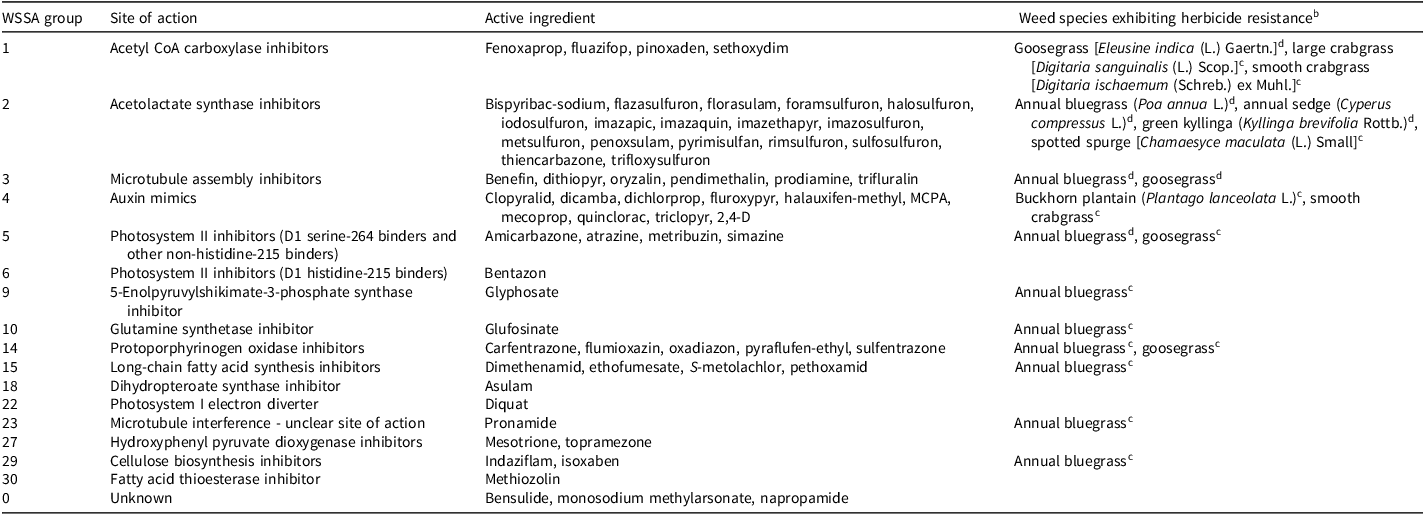




 Open access

