1. Introduction
Land was the underpinning of medieval society. It was not only the most important means of production and source of income, but also provided access to status and political participation. Therefore, to a large degree, economic and social development were dictated by who held land, who exploited it, and how it was transferred. However, access to land and the free alienability of landed property could not be taken for granted. Unlike markets for goods, factor markets, particularly markets for land, continued to be comparatively weak, restricted, and inflexible for much longer – in some parts of Europe, even until far into the modern period. A large number of studies have demonstrated that there were many hindrances to the rise of a market for land. In medieval society, there was a deep-seated belief that land belonged to the family or the community rather than to the individual. In many European regions, the family possessed the right of first refusal. Neighbours or villagers sometimes had the right to withdraw a sale, too, reflecting the idea that land should remain within the community and not be sold to outsiders.Footnote 1
It is widely argued that in pre-modern societies, a strong moral condemnation of land alienation prevailed. According to this view, the moral – or, at least, normative – social belief that land is alienable is a modern phenomenon. Pre-modern societies, in contrast, operated under ‘moral economies’ in which both the selling and buying of land, for reasons ranging from the protection of the economically disadvantaged to ancestor worship to village solidarity, was seen as a moral offence. Correspondingly, these societies developed legal and customary institutions to hinder land selling. The argument, therefore, is not merely that moral factors influenced land markets, but that the very act of buying and selling land was substantially moralised; in other words, there were moral economies in land. This ‘moral economy thesis’ can be questioned.
As Taisu Zhang has suggested, the logic is backwards. Rather, the more crucial land is to economic livelihood, the greater the pressure to maximise its material value and, therefore, the less room there is likely to be for systemic moralisation. However, the high economic value of land did not necessarily promote its alienability. Quite the opposite: when landed agriculture was the primary form of economic production, many social groups often had strong material, rather than moral, incentives to oppose the free alienability of land.Footnote 2 Thus, regardless of whether we follow the ‘moral’ or ‘economic’ reasoning, land markets seem to have been a particularly static sector of the economy and have been slow to adopt the elements that are associated with a market economy.
It has been argued that the dynamic development of European economies since the high Middle Ages was attributed to the rise of long-distance trade and the related institutions that supported exchange rather than long run changes related to the rise of land markets. According to this notion, institutions anchored in European individualism and corporations, such as guilds and town communities, permitted impersonal trade, which was the key to economic development in general.Footnote 3 However, there is no doubt that in pre-modern times, only a tiny share of output was traded across international boundaries, despite the rising bulk trade in northern Europe from the twelfth century onwards.Footnote 4 Agriculture had not lost its place as the occupation or livelihood of the vast majority; indeed, it continued to be predominant across wide expanses of Europe for many years after the beginning of the industrial revolution. Even if long-distance trade expanded in the medieval period from an almost zero point, in the tenth or eleventh century, this does not address the question of how important trade volumes were to the overall efficiency of pre-industrial economies.Footnote 5
The argument made here is that, given the fundamental economic importance of land in the pre-modern era, any changes that mitigated the various restrictions related to the transfer of land are likely to have increased overall economic performance. The more widespread the opportunities were for all social groups to deal with landed property as a seller, buyer, or pledger, the more dynamic the economy is likely to have been. Accordingly, the arrangements that buttressed the transfer of land involving market transactions, and, ultimately, active land markets, were even more vital to the expansion of a market society than those that were limited to commodity markets. Because of the many restrictions related to the transfer of land, whether they were customary or moral beliefs or formal legislation, changes in the institutional structure were particularly important.
Findings from many parts of Europe suggest that, despite numerous constraints, in the course of the late Middle Ages, more and more land was being traded on the market instead of being embedded in social frameworks, such as the family, the village, the commons, or the manor. For example, in Holland, and to an almost equal extent in Flanders, non-market transfers of land lost their strength. As peasants were free and the vast majority owned the land they cultivated, the way for market transactions was open.Footnote 6 From England there is evidence of land-marketing activities from the Anglo-Saxon period onwards.Footnote 7 In the late Middle Ages, there were neither significant legal nor social restrictions on land selling, as Alan Macfarlane has shown. He did not, however, provide much evidence that land was actually transferred frequently.Footnote 8 Margaret Yates, in contrast, has demonstrated that by the first half of the fourteenth century, the market for freehold land was thriving. There were large numbers of transactions and they involved a diverse range of properties, although the numbers decreased during the following century.Footnote 9 In the early modern period, land markets in England continued to be active, relative to property transferred within the family.Footnote 10 In Tyrol, from the thirteenth century onward, market-based transactions of land were common.Footnote 11 In late medieval east-central Europe too, land markets had begun to evolve, as the landlord's consent for land transfer was usually regarded as a formality.Footnote 12
Although regional differences remained vast, it seems fair to say that the general trend in Europe was a move away from restrictive institutions towards ones that supported market transactions of land, rather than suppressed them. This article examines this process from the perspective of land markets in medieval Finland. The focus is not only on the emergence of ‘good’ institutionsFootnote 13 but also on their impact on the land market. The aim is to verify that a market for land existed, and to explain how it functioned and to what extent it touched all groups in society. Two problems stand out: the scale and the integration of the markets. First, the more participants and transactions there are, the more efficiently the market functions. We can assume that if the land market is easy to enter and if it is open to large groups, there are more likely to be transactions between not only family members and other people who are personally known to each other but also participants who do not have previous knowledge of each other. Second, efficient land markets are also determined by their social and geographical integration. Transactions that involve buyers and sellers from all social groups in addition to parties from different regions, not only from the same locality, suggest that institutional and informational barriers are low.
As Bas van Bavel has pointed out, European-level generalisations do not work and are not helpful in the context of understanding the development of land markets. The determining factors appear to have been at play mainly at the regional level.Footnote 14 Therefore, this article presents new data from northern Europe that has so far been neglected in the study of land markets, in order to contribute to the research that has focused on cases in central, western, and southern Europe, and, possibly, to provide some data for comparative analysis. Finland, which used to be the eastern part of the Swedish realm, is a distinct case in the European context. Many of the elements that determined land ownership and land markets elsewhere, including Sweden proper, were more or less absent in medieval Finland.
First, in Finland peasantsFootnote 15 were free, and the vast majority of them owned the land they cultivated. The manors were few and the noble landlords were able to control landed property to a small degree only, although in south-west Finland the nobility and the church owned more land than they did in the rest of Finland. Second, the landowning peasants retained a considerable amount of political power at the local level through the right to participate in political decision-making at the half-yearly district courts (‘thing’ in Scandinavia), which functioned as local parliaments and courts of law. Peasants even possessed the formal right to be present at the general assemblies of the realm, the diets. The nobility did not succeed in taking control of land and political power, because it depended on the support of peasants in the struggle against the rulers during the Kalmar Union in the late Middle Ages. The finite economic resources of peripheral Finland limited the influence of the nobility, too. Finally, Finland did not experience as deep an agrarian crisis as most of Europe did after the middle of the fourteenth century. In fact, the population and the number of holdings seem to have grown almost continuously until well into the sixteenth century. This is a striking contrast to the situation in Sweden proper, where mortality rates caused by the Black Death may have been as high as 30 to 40 per cent, reducing land rents by half.Footnote 16 Thus, potentially, land in medieval Finland was very open to market transactions.
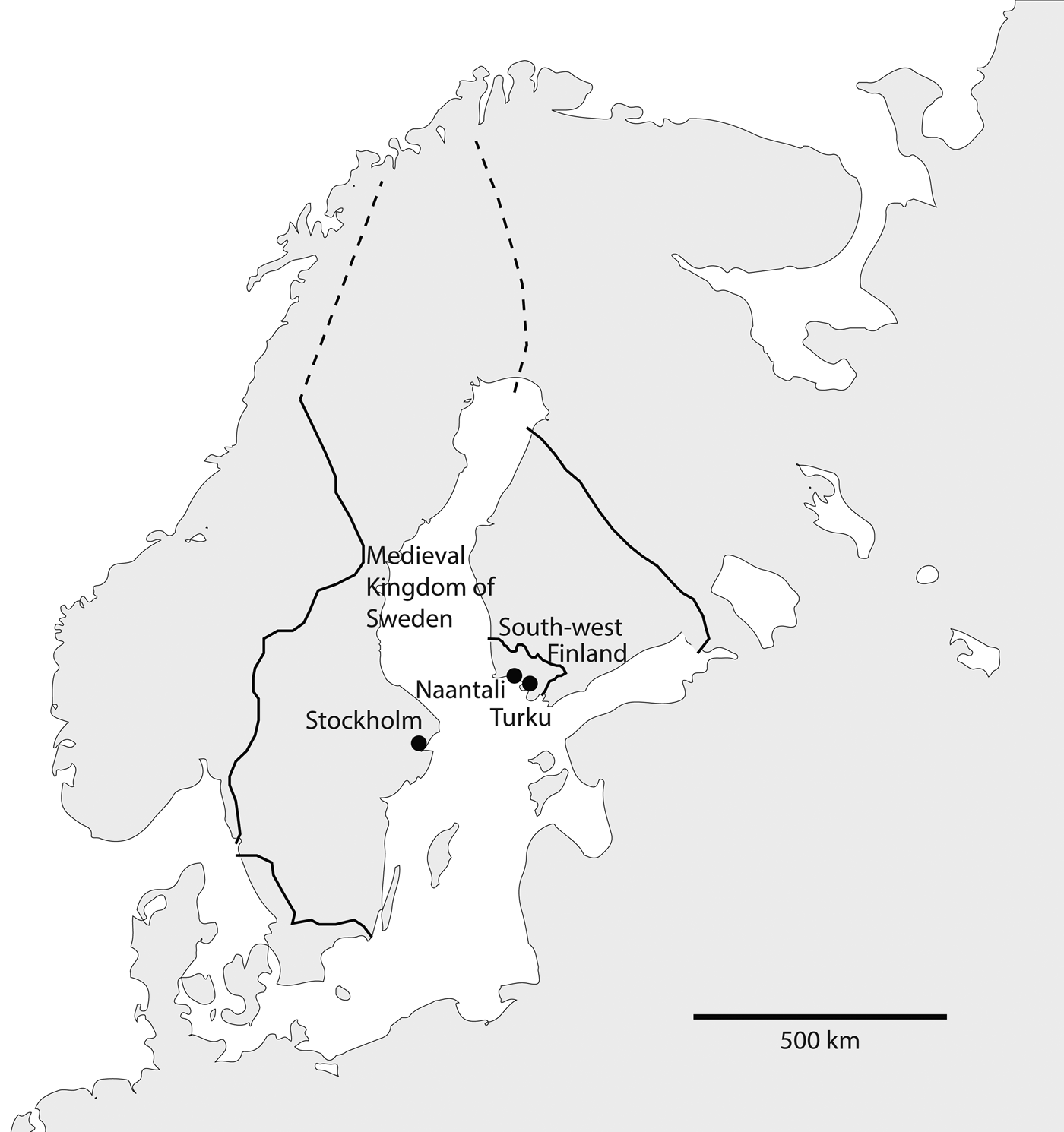
The scope of this article is confined to the rural areas of south-west Finland, also referred to as Finland proper, which became part of Sweden in the thirteenth century (Figure 1). This was the most densely populated and centrally located province of Finland, where far more documents have survived than in the other provinces. In the context of the Finnish land transactions as a whole, it is fair to assume that these documents are typical, because the process of land transfer was determined by the Law of the Land that applied equally to every part of the Swedish realm. Primary materials from south-west Finland dealing with sales, purchases, swaps, and pledges of land are used.Footnote 17 The database consists of all the surviving 234 documents, covering 216 transactions, between 1303 and 1517.Footnote 18 Of the documents analysed for this article, 89 per cent are letters of confirmation, required by the law, and only 11 per cent are deeds.Footnote 19
Map of the medieval kingdom of Sweden. Note: The dashed lines imply borders that were vague or even unknown.

These documents are not evenly distributed over the period under examination. Only 17 per cent come from the fourteenth century, whereas 34 per cent are preserved from the years 1400–1449, 43 per cent from 1450–1499, and 6 per cent from 1500–1517. The documents do not reflect the total number of transactions: over the course of time, many of the Finnish medieval archives have been lost. Accordingly, it is not possible to look at the entire land market, only individual aspects of it that survive in the archives. However, in the context of Finnish medieval materials, this number of documents is significant. It is worth noting that for the medieval period, we are missing data regarding the transfer of land from one generation to the next, which, as a rule, did not entail letters of confirmation or other written documents,Footnote 20 and the same applies to other intra-family transfers. Thus, the data in this article are restricted to market-based transactions and do not include intra-family transfers, making it impossible to assess the share of market transaction relative to all transfers.Footnote 21
2. The scale of land transactions
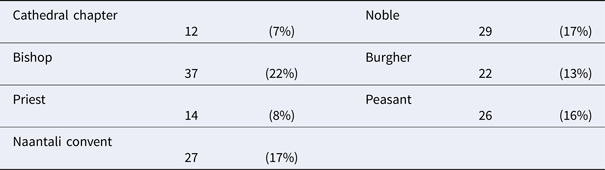
In south-west Finland, the first time we are able to see a clear picture of the total number of holdings and their distribution among different social groups is around the year 1540, when a tax reform took place, whereby multiple complex taxes on independent farmers were simplified and standardised throughout the realm in a register (jordebok). In the 1540s, there were some seven thousand holdings in the province, making up approximately 21 per cent of all holdings in Finland. Most of the land was owned by peasants, as stated previously. This land was freehold; in other words, people owned their properties outright, although they were required to pay annual tithes to the church and taxes to the crown. In the south-western part of Finland, nobles and the church (and the clergy) owned proportionately more land than they did in the rest of Finland (Table 1). This part of Finland had the best arable land, which attracted the few and relatively small manors, such as they were. On the other hand, Turku (Swedish Åbo), in the middle of the province, was the leading town and ecclesiastical centre of the whole of Finland. The cathedral chapter of the only diocese of Finland was located there, which contributed to the relatively large number of clergy in the province.Footnote 22 However, it is fair to say that even south-west Finland was dominated by freehold land. In Sweden proper (excluding Scania and other provinces acquired later) only some 45 per cent of the land was owned by freehold peasants and 25 per cent by the church, while the nobility controlled 25 per cent and the crown 6 per cent.Footnote 23
Distribution of land owned by social groups, percentage shares (1303–1517)

Source: Eljas Orrman, ‘Talonpoikainen maatalousyhteiskunta’, in Viljo Rasila, Eino Jutikkala and Anneli Mäkelä-Alitalo eds., Suomen maatalouden historia 1: Perinteisen maatalouden aika esihistoriasta 1870-luvulle (Helsinki, 2003), 120.
The data collected for this article show that land was bought, sold, swapped and pledged. The 216 transactions performed between 1303 and 1517 consisted of 150 sales and purchases, 52 swaps, and 14 pledges of land. What do these figures tell us about the activity of the land market? Van Bavel has compiled evidence from several English, Dutch, and German sources from the medieval and early modern period, which suggest that roughly 1 or 2 per cent of the total area of land was transferred each year. There were strong regional and temporal differences in the annual turnover, varying from 0.1 per cent to less than 5 per cent, making all conclusions unclear. However, it seems that peasant land ownership was more mobile than noble land ownership, which was often restricted by jurisdictional rights.Footnote 24 In the case of south-west Finland, the data do not allow quantitative reconstructions of the mobility of land on the market. All we can say is that of the approximately seven thousand holdings in the area, only about 3 per cent were transferred during the two centuries under examination.
This does not necessarily mean that the land market in south-west Finland was less active than it was elsewhere. Because of the predominantly peasant land-ownership, one may expect the market for land to have been fairly mobile. Moreover, peasants were familiar with trade, both in the countryside and overseas. On a relatively large scale, they turned agricultural surpluses consisting of agricultural produce and underutilised manual skills, such as weaving or wood- and metalworking, into marketable products. A large fleet of small ships owned by coastal peasants carried fish, skins, and other natural products to Stockholm and the Estonian coasts. In the early sixteenth century, approximately three hundred and fifty peasants from south-west Finland were indebted to merchants in Tallinn alone. Trade in the countryside was widespread as well, at least as a secondary income to support peasants’ livelihoods.Footnote 25 There is no doubt that even in rural areas, many activities were commercialised and people were used to operating in the market. Thus, the view of the limited mobility of land in south-west Finland may be determined by the incompleteness of the sources rather than the land market actually being inactive.
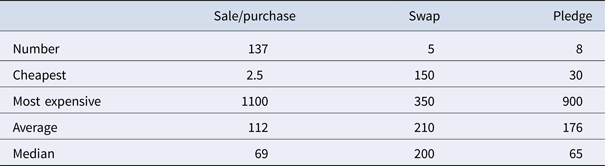
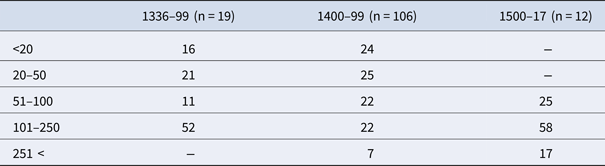
As Table 2 implies, the prices of land transferred by sale varied greatly. Among the 216 transactions including sales, purchases, swaps, and pledges of land, there are 150 transfers for which the price, or at least the monetary value, is given. The smallest transaction, in which two small meadows were sold, was worth just 2.5 Swedish marks.Footnote 26 By comparison, a cow cost two marks and an ox four marks.Footnote 27 At the other extreme, a noblewoman sold all her dower, three holdings in Kemiö parish, for 1,100 marks, which was worth 550 cows or 275 oxen.Footnote 28 The monetary values of sales and purchases were quite evenly distributed particularly in the fifteenth century, as Table 3 suggests, although the nominal values were higher in the early sixteenth century, probably because of a loss in the real value of money. On the other hand, the values of pledges and, particularly, swaps of land, were larger than those of sales. However, information about the monetary values for both of these types of transactions is limited.
Monetary value of land transfer by the type of transaction (1303–1517), nominal values in Swedish marks

Source: Diplomatarium Fennicum (hereafter DF), http://df.narc.fi/ [accessed 14 Nov 2016]. See n. 18.
The percentage shares of sales and purchases by monetary values (1336–1517), nominal values in Swedish marks

Source: DF (see n. 18).
An examination of individual transfers reveals the extensive use of ready money. Of the 150 sales and purchases, ready money was exchanged for land in 92 per cent of the cases. In 11 transactions, money and goods were used, and only one involved solely goods: in 1451, a sister and brother sold a small piece of land they had inherited to a burgher from Turku for 11 cubits (c. 6.5 metres) of cloth.Footnote 29 Interestingly, land was paid for in kind only rarely. Instead, when goods were used in addition to money, transactions were paid in precious metals or in merchandise that was common in overseas trade. Besides cloth, this included gold, silver, copper, and iron.Footnote 30
Given the frequent references to ready money (reda pengar) in the documents, ready money must have been relatively commonplace in the countryside. Arguably, the widespread conduct of peasant trade was an important source of cash in rural areas, emphasising the relatively high degree of commercialisation.Footnote 31 The economic resources of the bishops and other ecclesiastical actors were based on other sources, such as tithes, other ecclesiastical taxes and rents from tenant farms. The members of the nobility were paid, of course, rents by their tenant farmers. These resources were usually delivered in kind, but they could be traded on the international market for money. For example, the bishop and the cathedral chapter of Turku exported goods on a large scale to all major Hanseatic towns in the Baltic Sea region.Footnote 32
3. Restricting and protecting institutions
In medieval Finland, it is clear that there was a market for land, a construct related to individuals making economic decisions, but how did it work? The institutional view is different from that of neoclassical economics, which is, by and large, interested in the markets as an abstraction that says little about how the markets actually function. Institutionalists, by contrast, argue that markets are always embedded in social structures; that is, in exchange processes that take place within a set of social rules. There is a wide consensus that beneficial institutions provide order and predictability to human interaction and improve the performance of the markets by reducing opportunism and uncertainty. They can do this by minimising the cost of using the market, by providing a guide to cooperation, and, for example, by securing property rights.Footnote 33
This idea has interesting implications in the context of land markets. Historically, land has hardly ever been transferred completely freely, without any societal constraints. It could be argued that, because of its importance as an economic and a social asset, land has been more prone to attempts both to define rules for how it can be transferred and to create mechanisms to make its ownership and transfer secure. In the Swedish realm, including Finland, institutions limiting the transfer of land evolved at an early stage. Although peasants were free and, in general, owned the land they cultivated, the right to own property was more complicated than this would suggest. The pre-Christian legal code and the later medieval formal legislation both aimed to protect the family by giving the family control over a holding.
The Swedish Law of the Land, passed in the middle of the fourteenth century, guaranteed the right of the family to the land, the right of the elderly to have a safe old age and the right to support the young to grow up without want. All members of the family had a ‘birthright’ to the land. Property should not be understood as we would today: different types of property were owned in different ways. Although household headship was individual, no individual could own family land in the sense that she or he could dispose of it at will. Family land could not be bought or sold without the permission of all the family members. Thus, the right to hold and use family land was passed on through inheritance. On the other hand, land that was purchased and disposable objects, such as cattle, grain, and money, which were acquired individually without family property being involved, could be owned outright by an individual.Footnote 34
If an heir wanted to sell a holding that he had inherited, he first had to offer relatives the opportunity to purchase the property. According to this right of first refusal, stipulated in the Law of the Land, the property had to be offered for relatives in three consecutive district courts. As district courts gathered only twice a year, in spring and in winter, it would be a whole year until the holding could freely be transferred to outsiders, given that the family did not use its right.Footnote 35 The documents examined for the purposes of this article show that the right of first refusal was by no means obsolete. On the contrary, the legal provision was followed conscientiously. In each case when it is mentioned that inherited land was sold, the letters of confirmation carefully state that the land was first offered to members of the family or that the property was sold ‘by mutual consent with the relatives’ or ‘close relatives’ and ‘according to the Law’.Footnote 36
The family's right to its land even continued after marriage. There was a separation of female and male property that enabled the woman's male relatives to control her property within the marriage. Even though the husband had authority over his wife in selling her land, he could not freely administer his wife's property. When a husband wanted to sell his wife's land, it was not sufficient to obtain only her approval; he was obliged to ask her relatives, usually brothers, for consent. The same applied to a widow. A widow had to obtain her children's consent, but if her children were underage, her brothers or other relatives had to accept the transaction.Footnote 37 These practices, too, are reflected clearly in the documents.Footnote 38
In the 1970s, Macfarlane famously argued that as early as the thirteenth and fourteenth centuries in England, individuals pursued their own well-being, without much regard for broader communal or even household welfare. Because land rights lay with the individual and not the family, the inhabitants of rural England were, in fact, not peasants but individualists. As a result, English society was likely to have been individualist all along, especially when it is compared with continental societies, and there was no transformation of English society from a peasant society to an individualistic and commercial one in the sixteenth or seventeenth centuries.Footnote 39
It is not the aim of this article to compare English and Finnish societies, even less to take a stand on Macfarlane's thesis. However, at first glance, the institutions guiding the Finnish (and Swedish) land market seem to reflect more collectivist than individualistic ideas. Individuals belonging to all social groups, including women, were allowed to operate in the market and to sell land, but only within the limits set by the interests of the family. It could be argued that these medieval claims and rights to land served needs other than purely economic ones aimed at market exchange. The restrictive institutions brought stability and continuity to the transfer of land, which was dominated by social relations and considerations, not just economic motivations.Footnote 40
However, these restrictive institutions had already begun to be mitigated, undermining the familiar or collective nature of land transfers. In the early Middle Ages, it was possible to sell inherited land (with the family's consent) only if the owner of the holding was in financial distress. By the thirteenth century, such a restriction was no longer employed. The church was successful in limiting the control of the family over land; it was vital to the church that land could be devised freely.Footnote 41 On the other hand, the right of first refusal applied only to the seller's immediate family. There was no broader kin control over land, which weakened the grip of distant relatives. Additionally, the village community had no say in land sales. Even though a new owner of a piece of land became a member of the village and had to comply with the joint decisions on when to sow, for example, the landowner did not need the approval of the villagers to buy the land.Footnote 42 Finally, as the documents from medieval south-west Finland suggest, often families did not want, or were not able, to redeem family land when it was sold,Footnote 43 which resulted in an apparently widespread transfer of inherited land on the market, although the number of market transactions relative to all landholdings cannot be determined with any precision. Thus, in the European context, the land market in medieval Finland followed a comparable institutional path.
Besides the institutions that protected family property, other institutions aimed to secure the legal transaction of land transfer, based on the Law of the Land and, to a lesser degree, based on informal institutions, such as conventions and codes of behaviour that had evolved over time. In general, the literature is optimistic about the efficiency of institutional arrangements that strengthen property rights. Secure property rights are, of course, a necessary condition for efficient land markets. By securing contracts, such institutions enhance trust and, ultimately, contribute to active markets for land.Footnote 44
The process of a land sale (as well as a swap or a pledge), determined by the state in the Law of the Land, defined the formal requirements that had to be met in order to make a transaction legal. Because of the strong fiscal interest of the state, it was important for the rulers to protect land ownership and make transactions open and visible to everybody through a formal process, including land registration. This process aimed to make explicit the nature of the transaction and the identities of the new and previous owners of a holding. In the case of inherited land, if the land was offered to family members for the third time and nobody was willing to redeem it, the closing of the sale would then begin.
Usually the parties to a transfer first made an agreement and only after that went to a district court to make it formal. The transaction was binding from the beginning, and the parties could not withdraw from it during the process. The court process of transferring the ownership of landed property was oral and took place at a district court. In order for the process to be valid, the parties and the local witnesses (fastar), usually 12, had to be present. The district judge then provided a written letter of confirmation (fastebrev), which carefully specified the names of the parties, described the property conveyed, and confirmed that it had been legally offered to relatives and that the payment had been made and received. Including a specific precautionary statement was also common practice. As a rule, the seller committed to compensate the buyer fully in the event that the land purchased did not comply with the terms of the agreement within six weeks of the time when the buyer took over the property. No written deed between the parties was needed; such a document became compulsory only in 1734. The Law of the Land stipulated that a written confirmation letter issued by the district judge should be given to the receiver of the landed property, but the letter aimed at making the transaction open more generally. The confirmation letter was usually called an ‘open letter’ (öppet brev), to be ‘known to everybody who should hear or see this letter’.Footnote 45
Across Europe, various systems to register land transfers were created early on, which was an important step in the securing of property rights. The main difference in the registration systems was whether only a service provided by notaries or the courts was available, which ratified individual transactions primarily for the use of the parties to a transfer, or whether there was a public land registry, which provided centralised storage of all land transfers. As a rule, the former system preceded public land registries. Italy led the registration of land transfers, with sales being recorded as early as in the eighth and ninth centuries. From the eleventh century in Italy, public notaries began to perform this service, not only in cities but also in rural areas. This system was one of the most advanced in Europe until the northern parts of the Low Countries established a more sophisticated arrangement of registration by the public courts during the fourteenth century. In some areas, especially in the sixteenth century, registration was made compulsory, which resulted in an ever-increasing proportion of land transfers being registered. In Italy, on the other hand, the downside of notarial registration was its territorial fragmentation: it was difficult for potential buyers to determine which of the many notarial registers held the information that they needed.Footnote 46
In England, since the beginning of the fourteenth century, records of the conveyances of free land by royal clerks were drawn up. Each of the two parties were given a copy of the document, but the third copy (the ‘foot of the fine’) was kept by the court as a central record of the transaction and was open to inspection. This system was attractive because it afforded incontestable evidence of the transaction, binding the parties to uphold it.Footnote 47 In most regions of present-day Austria, the Czech Republic, eastern Germany, and Poland, sales were systematically recorded in various types of landlord and village land transfer registers from the fifteenth and sixteenth centuries onwards. In Poland, for example, since the beginning of the fifteenth century as much as 70 per cent of all entries in the records of village courts have concerned transfers of land.Footnote 48
Likewise, in Finland (and in Sweden), the need to make land transfers publicly available was acknowledged early on. The Law of the Land set down in the middle of the fourteenth century made open registration in writing by the district courts obligatory. Even before this, land transfers were public, as the letters of confirmation start with the expression ‘All present’ (Omnibus presentes).Footnote 49 However, in the Middle Ages, the district courts did not maintain records of land transfers in rural areas, similar to the practice of notaries and courts in many other parts of Europe. District judges often kept judgement books already in the fifteenth century, but these were of private nature. Such medieval judgement books from south-west Finland have not been preserved. In the 1530s and 1540s, the state began to register information about all holdings in the realm for fiscal purposes, but it took until the eighteenth century for the courts to provide centralised registers of land transfers. In the Middle Ages, if a potential buyer was uncertain about whether a seller's letter of confirmation (fastebrev) issued by a district court was correct, the buyer had to approach the people who had witnessed the transaction (fastar), stressing the witnesses’ importance as carriers of the collective memory of legal transactions.Footnote 50
Thus, property in medieval Finland was not as secure as it was in some other European countries, because individuals could not be wholly certain of who owned which tracts of land; or, at least, it was arduous to confirm it, especially if a long time had passed since the last change of ownership. That said, there were several institutional arrangements that strengthened property rights. A land sale, swap, or pledge required that a written document (a letter of confirmation) was drawn up, witnesses were used, and the transaction was made public at a district court, all conveying institutionalised, public information about a transaction to all parties. Moreover, these institutions treated all people equally, including women, who were allowed to participate in the land market under certain restrictions. Finally, a specific precautionary statement was included in letters of confirmation to protect the buyer. Therefore, it is fair to conclude that the property rights institutions, despite the lack of a centralised register, potentially contributed to the rise of a land market rather than hindering it.
4. The social and geographical integration of the land market
An essential aspect of the functioning of land markets is their integration in the sense of whether they are open to all social groups. Arguably, land markets can function adequately if property rights are sufficiently protected and they are equally accessible to all. Institutional or other barriers that hinder entry can narrow the market by limiting the possibilities to sell or buy land for some groups more than others. The integration of medieval commodity and capital markets has been examined widely, but we still know very little about the development of markets for land, which means that it is impossible to assess any overall developments on a European level.Footnote 51 In the case of medieval south-west Finland, the land market was open to participants from all social classes. Ecclesiastical agencies, nobles, burghers, and peasants were all strongly represented. However, the market was characterised by vertical rather than horizontal integration. Seventy-four per cent of all transactions, including swaps, took place between participants from different social groups. Bishops and nobles could transact with peasants, and sales offered ordinary people an opportunity to enter into relations with the most powerful figures in society.
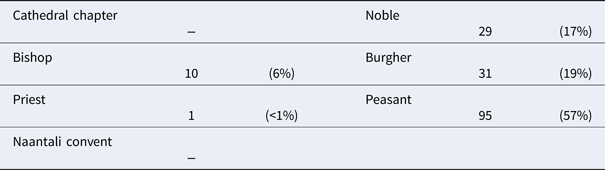
Tables 4 and 5 show the different social groups that sold, bought, or pledged land. These groups are defined on the basis of status or office given in the documents. The letters of confirmation tend to specify information about the parties involved in a precise way. Peasants, however, are usually referred to only by name and not by their status, which introduces some degree of uncertainty. Despite the incompleteness of the sources, some conclusions can nonetheless be drawn. It is hardly surprising that ecclesiastical agents and organisations, as big landowners, were active in the land market. On the eve of the Reformation, the bishop of Turku owned nearly two hundred and fifty holdings, and the Naantali convent of the Order of St Birgitta owned approximately two hundred, mostly in south-west Finland. Both were by far the largest landowners in the whole of Finland.Footnote 52 However, the vertical integration of the market was unidirectional rather than pertaining equally to all parties. Ecclesiastical agencies sold or pledged their land in only 7 per cent of transactions. By contrast, when land was bought or money was lent against land, the church and its representatives were active in over half of the transactions, indicating that landed property was increasingly ending up in the hands of bishops, the clergy, the cathedral chapter of Turku, and the Naantali convent since its foundation in the 1440s.
Identities of sellers and pledgers (1303–1517)

Source: DF (see n. 18).
Identities of buyers and pledgees (1303–1517)

Source: DF (see n. 18).
Nobles sold and acquired land in equal measure, not only within their own ranks, but also in transactions with the other groups. Burghers, too, were active both in increasing their landed property and selling it. There is plenty of evidence that in the Middle Ages, burgher ownership of land in rural areas increased throughout Europe. It was very common for burghers to own landholdings in the areas surrounding towns.Footnote 53 Similarly, most of the rural land owned by the burgers of Turku, the only major town in south-west Finland, was in the three nearest parishes surrounding Turku: Raisio, Maaria and Kaarina.Footnote 54
Peasants, on the other hand, differed from nobles and burghers in terms of their land transactions. Peasants were clearly more active as sellers and pledgers than as buyers and pledgees of land. This points to a conclusion that during the medieval period, peasant land was being transferred primarily to the ecclesiastical elite. Of all the transactions analysed in this research, in nearly one third of the cases peasant land was being conveyed to an ecclesiastical agent.Footnote 55 Of course, this may reflect the more careful preservation of documents by the clergy of land they had acquired, in contrast to property that had been sold. Yet, the strong influence of the church is not surprising, as all the major ecclesiastical agencies – the cathedral chapter, the bishop, and the Naantali convent – resided in south-west Finland.Footnote 56
Peasants mostly acquired land within their own social group. There are 47 cases in which a peasant acted as a buyer or a pledgee in a land transfer, or as a party to a swap. In over half of the cases (26), both parties were peasants. Nobles did not, as a rule, shift land over into peasant ownership, again stressing the unidirectional integration of the land market. In only two such cases does the buyer seem to have been a peasant, and in just one case did the other party to a swap belong to that group.Footnote 57 Although peasants could sell landed property to other peasants and other social groups, privileged land was usually not passed over to peasants. The Naantali convent was a quite active actor in the land market in the 1440s, 1450s, and 1460s. This explains why there are as many as ten swaps between the convent and local peasants.Footnote 58
Thus, the land market was to a great degree characterised by asymmetric verticality. Although peasant land was transferred to the hands of the elite, ecclesiastical and noble, due to legal and societal hindrances peasants only rarely acquired land from the elites. The strong vertical integration of the land market, albeit asymmetric, suggests that institutional barriers were low and that an individual aiming to sell, buy, swap, or pledge land was not restricted to transacting with a party who was personally known to them. Of course, they had to meet in person to arrange and close the transaction, but it is unlikely that personal acquaintance and, even less likely, personal trust, were needed in order to enter the market, again implying that institutions supporting property rights were in place.
Besides social integration, the land market was characterised by geographical integration. When land was bought, sold, or pledged by peasants, it is not always possible to determine the parish from which each party came. On the other hand, as we have seen, ecclesiastical agencies and burghers operated across the whole province. However, the relatively numerous swaps are more illustrative in this respect. In each swap, both holdings (or, in some cases, more than two) and their locations were carefully recorded. Therefore, it can be identified whether land was exchanged between parties living in the same parish or between more distant participants. Of the 52 swaps, only one quarter took place within one parish. In about one fifth of the cases (11), land was swapped between parties in neighbouring parishes and in one third of the cases (18) it was exchanged between parties in more distant (not neighbouring) parishes in south-west Finland. In ten cases, the other object of a swap was located outside the province, as far away as Viipuri (Viborg) province in eastern Finland, Ostrobothnia in western Finland, the Åland Islands, and even Sweden proper.
The relatively common practice of acquiring land from other parishes or even from more remote areas contests the view of a static medieval society. It is clear that people did not transfer land only to reorganise holdings within the village or parish community in which they lived; for example, to fine-tune the organisation of their fields and meadows for economic reasons. The geographical scope of the transactions raises the question of market information. How did investors wanting to buy or swap land in a remote parish find out if there was land available and who would be willing to enter a transaction? Information was probably disseminated through word of mouth and the brokerage of local judges at the half-yearly district courts. We may also assume that Turku, as the central town of the province, functioned as an information centre that was visited by people from all over the surrounding countryside. Interestingly, 91 (two fifths) of the 234 surviving letters of confirmation were drawn up in Turku and not in the parish where the land was located. Many of the parties to transactions resided in Turku, including the bishop, the cathedral chapter, and the burghers of Turku, but many peasants and nobles came to Turku to close transfers there.
We can only speculate on why individuals chose to swap and, in particular, to sell or pledge land, which, after all, was the fundamental source of their income and status. It is unlikely that people would give up their land and lose their place in society unless they had compelling reasons.Footnote 59 In some rare cases, the motive to sell is stated. In 1446, a widow had to sell some land because of a large debt she was left with after her husband died. A decade later, two priests sold their hereditary holdings in order to fund a pilgrimage and ‘a study trip’. In 1487, a woman sold some land to the Naantali convent, explaining that ‘she [was] not able to gain her livelihood from such a small holding’.Footnote 60
Of course, in many cases, people did not sell the only land they owned; rather, they sold just some of it. The sale of peasant land did not necessarily lead to the proletarianisation of the rural population and an accumulation of property in the hands of the elite, because we can presume that not all peasants were compelled to sell their land to ease financial distress or for another overriding reason. After all, as noted earlier, even the largest landowners in Finland – the bishop of Turku and the Naantali convent – managed to amass a property of only about four hundred and fifty landholdings altogether, a very small proportion in comparison with the approximately thirty-three thousand holdings in the whole of Finland. Rather, although the volume of annual transactions remains obscure, the fact that land was transferred on a regular basis indicates that land was treated as a commodity that could be sold, bought, swapped, and pledged like any other merchandise on the market. This provided invaluable opportunities for those wanting to invest and those needing to liquidate their property, increasing the margin of security for many in medieval society, where hunger was never far from the doorstep. After all, as the market in south-west Finland suggests, land was a fairly liquid security.
5. Conclusion
There is no doubt that a market for land existed in medieval south-west Finland. The land market adopted many of the elements that are usually associated with a market economy. The practice of acquiring control over land in return for payment was widespread, surprisingly often involving ‘ready money’. Land was increasingly treated as something to be sold, bought, exchanged, and pledged, although the family was protected by the right of first refusal. The land market was also open to large segments of society, suggesting that barriers to entry were low. It was characterised by strong vertical integration, as the majority of transactions took place between participants from different social groups. However, integration was asymmetric by nature, because peasant land was transferred to the hands of the elite, and not vice versa. There was a high degree of geographical integration in the land market. In about four fifths of the swaps, land was exchanged between neighbouring or more distant parishes instead of being swapped within one parish only.
The extensive social and geographical integration of the land market implies that transactions were not restricted to parties who were personally known to each other. Therefore, it could be argued that the land market enabled impersonal connections in the sense that the parties involved did not necessarily need to have an existing personal interaction with one another. If we accept that land transfers were carried out on a large scale on such an impersonal basis, the institutions securing property rights must have been effective. In the Swedish Law of the Land, formal requirements were defined that had to be met in order to make a transaction legal, which made explicit the nature of the transaction and the identities of the new and the previous owner of a holding. A successful land sale, swap, or pledge stipulated that written documents were drawn up, witnesses were used, and the transaction was made public at a district court. Transfers were registered, too. Although in the Middle Ages there were not yet any centralised registers of land transfers in Sweden or Finland, open registration in writing by a judge at a district court was obligatory.
It is worth noting that the right to enter the land market and the property rights institutions involved applied equally to all, including women under certain restrictions. Free access to markets could not be taken for granted in pre-modern societies. The many corporations that emerged in the Middle Ages, whether craft guilds, merchant guilds, town councils, or, for example, the Hanseatic League, aimed to monopolise the markets and exclude outsiders from the protective institutions that they oversaw. In fact, institutions that apply equally to all members of a society are associated with the emergence of a market economy in the centuries following the Middle Ages.Footnote 61 The development that led to open land markets seems to have influenced most parts of Europe, although it is difficult to make generalisations across the whole continent because of different research traditions, the unequal nature of sources, and differences in terminology. However, there appear to have been more or less active land markets everywhere, with institutions that increasingly supported land transfers for everyone instead of protecting only the interests of the family or the elite, for example. The roots of later economic development in Europe may very well lie in the medieval institutions that evolved to govern land markets, although the tentative nature of this assumption must be emphasised.
Acknowledgements
I am grateful to the editors and reviewers for their helpful comments on earlier drafts of this article.