1 Introduction
The eruv is an ingenious rabbinical device that makes it possible for observant Jews to transfer objects in public on Shabbat – an activity otherwise forbidden during the Jewish day of rest. By symbolically extending the domestic sphere into the public space of the city, the eruv creates the fiction of a shared home for one day of the week, allowing observant Jews to move freely through the public space enclosed by the eruv. The walls of this imagined home are demarcated by existing boundary structures such as walls, fences, railway tracks, cliff faces and steep slopes. Remaining gaps are closed by poles and wires, often relying on existing utility poles. Bread, usually a box of unleavened matzah bread, symbolises the eruv community unified by the eruv (see Figure 1). Although eruvin may seem an innocent Talmudic fiction, the establishment of these imagined religious spaces can be fraught with difficulties. From Outremont to Johannesburg, from Palo Alto to Sydney, neighbours have struggled against each other over what looks like an ordinary piece of wire. The minimalist architecture of the eruv contrasts with the fierce opposition that neighbours voice against proposals to set up such a device, often investing significant resources and time to prevent the eruv from being established. As a form of public religiosity, the eruv serves as a microcosm in which broader concerns about religious and cultural diversity in Western societies play out, including the contested place of religion in public space, the challenges of planning in multicultural cities and the spatial dimension of the formation of collective identities. The eruv makes visible the difference of the Jewish neighbour – a difference that some residents do not wish to be confronted with and that they seek to contain through recourse to the law.
Part of the eruv installation in St Ives and a box of matzah bread symbolising the eruv community in the local rabbi's office (photos by author).

Socio-legal scholarship studying the legal governance of religious diversity has documented widely how law in various national contexts continues to exclude difference that is seen as challenging dominant religious and racial norms, despite official commitments to religious neutrality and colour-blindness (Beaman, Reference Beaman2012; Bhandar, Reference Bhandar2009; Jivraj, Reference Jivraj2013). Even though Jewish practices, such as eruvin, but also shechita (the slaughter of animals for the production of kosher meat), infant male circumcision and the wearing of the yarmulke, continue to be sources of legal tension, to date, little work exists that critically examines the role of law in regulating Jews and Judaism in relation to dominant norms (Herman, Reference Herman2011; Feldman, Reference Feldman1998).Footnote 1 In this paper, I use an eruv dispute in the Australian suburb of St Ives as a case-study to offer an illustration of how the law continues to exclude certain forms of Jewish difference. The wires and poles of the eruv, as I will show, became a catalyst for the surfacing of prejudice and tensions that lurk in the community but otherwise often remain hidden. Australia provides an interesting context in which to study the interaction between law and Jewish difference. Often hailed as a Jewish success story, Australia has offered a welcoming place to Jews away from European anxieties about Jewish particularity (Turnbull, Reference Turnbull1999). The fact that Australian Jews encountered fewer legal and social obstacles than those in many other Western countries, however, conceals to some extent how similar anxieties have shaped and continue to shape Jewish belonging. In this paper, I trace these anxieties as they surfaced in opposition to the eruv and analyse how the law assigned value to these anxieties in a way that legitimised the exclusion of Orthodox Jews from public space.Footnote 2
In order to understand how the law became complicit in excluding Orthodox Jews in this Australian suburb, it is important to consider the particular legal setting that governed the dispute in St Ives. Much critical work on the legal governance of religious diversity has focused on the level of the nation state. The governance of religious difference, however, is also often a local affair, as the eruv illustrates. As socio-legal scholars and legal geographers have shown (e.g. Valverde, Reference Valverde2005; Reference Valverde2012; Hubbard, Reference Hubbard2012; Blomley, Reference Blomley2007), this shift in scale has important legal consequences since the particular logic of local law can enable a much more coercive and restrictive regulation than a regulation through a rights framework, while restricting avenues for resistance. Building on this discussion, this paper aims to shed light on how local planning law provided a particularly fertile ground for marginalising Orthodox Jews, underlining the necessity for considering the role of local law in perpetuating exclusion and inequality.
In order to examine the interaction between residents’ narratives about Orthodox Jews and the planning system, I analyse a wide range of material, including letters sent to local newspapers and residents’ statements in media reports published between 2008 and 2016. I also consider statements from a survey sent out by the local planning authority, Ku-ring-gai Council, in 2016 to 2,400 residents affected by the eruv boundary (with responses received from 618) as well as other submissions to the council, such as petitions, over the course of the dispute that are contained in official council documents.Footnote 3 All of these different documents were coded thematically to identify recurrent and dominant themes. In addition, I conducted ten semi-structured interviews (between 2015 and 2016) with councillors, rabbis, representatives of Jewish organisations and former as well as present members of the eruv group.Footnote 4 While the main purpose of these interviews was to verify facts and to clarify the Talmudic background of the eruv as part of a broader research project on the eruv, I have included some statements from these interviews in this paper to further illustrate certain themes and arguments.
Before turning to the specific case of the St Ives eruv, this paper begins with some brief general comments on the questions that have historically surrounded the integration of Jews and relates these questions to the contemporary debate about the governance of religious diversity in Western societies. The next sections zoom in on a contemporary legal event that brings some of these questions back to the fore. I first introduce the St Ives dispute, followed by a discussion of how the particularities of local law shaped and enabled the exclusion of Orthodox Jews. I then explore how residents manipulated the categories of planning law to enforce their vision of identity and difference in St Ives and situate these claims in the longer history of Jewish belonging in Australia. The conclusion considers the significance of the St Ives dispute beyond the boundaries of this leafy Australian suburb.
2 Law, diversity and religious difference
The legal regulation of Jewish difference has a long history in Western societies. For centuries, Christian societies have tightly regulated the non-Christian Other in their midst. If they were not persecuted or expelled, Jews often had to, for example, pay special taxes; live in separate quarters, such as in the infamous Ghetto of Venice; or make themselves recognisable by wearing special attire, such as hats and badges. The American and French revolutions during the eighteenth century eventually laid the philosophical groundwork for turning the Jewish Other into a citizen with equal rights and instigated a lively discussion about the possibility and the conditions of Jewish emancipation – a discussion that became known as the ‘Jewish question’. Sceptics of Jewish emancipation cited adherence to Jewish law and practices as well as the corporatist structures of Jewish communities as obstacles for access to universal citizenship – quite similar claims to some contemporary debates about the integration of Muslims in Western societies. Jews were described in orientalist and racialising terms as foreign ‘Asiatics’, casting doubts on their ability to assimilate (Hess, Reference Hess2002). Even though proponents prevailed, for Jews, access to rights and full belonging would come at a price. Their change in legal status was frequently premised on a profound transformation of traditional notions of Jewishness, requiring Jews to shed both their cultural particularities and their communal structures in order to join into the nation state as equal citizens (Brown, Reference Brown2006, p. 89). Despite national differences, in many countries of the West, Jews were expected to remake their identity according to dominant norms of the societies they were meant to join (Birnbaum and Katznelson, Reference Birnbaum and Katznelson1995). A particular form of Christianity thereby often provided the blueprint for what constituted acceptable religious difference in the modern nation state (Batnitzky, Reference Batnitzky2011, p. 2). Jewishness had to be refashioned as a matter of privatised and inner faith in ‘mimicry of Christianity’ (Heschel, Reference Heschel1999, p. 62) – according to the dictum: ‘A Jew at home and a citizen in the street.’
Already back then, Jewish practices, such as shechita and brit milah (circumcision), which continued to mark Jews publicly as distinct, became important sites to negotiate these questions. Jewish insistence on these traditions rendered them in the eyes of some as unable to fully integrate into the modern secular nation state, proving their religious and racial difference (Judd, Reference Judd2007). The construction of eruvin also became enmeshed in the process of turning Jews into citizens. In the early nineteenth century in Bromberg (now Bydgoszcz in Poland), for example, municipal authorities sought to dismantle an eruv that they understood as an obstacle to Jewish residential integration. The so-called ‘Shabbat strings’, the authorities argued, would disfigure the already unsightly streetscape, introduce religious practice into the public streets of the city and only foster the segregation of the ‘Mosaic fellow believer’ (Schlör, Reference Schlör2005, pp. 11–27). Similarly, eruvin in Hamburg and Würzburg drew the ire of public authorities and local residents who deemed these installations to be not in accordance with the ‘values of the modern world’. By insisting on symbolic walls and their particular way of life, contemporary commentators argued, Jews acted in an ungrateful manner after Christian societies had so generously supported their emancipation (Freimark, Reference Freimark and Freimark1983, p. 51).
For both Jews and the state, emancipation raised far-reaching questions about the scope of pluralism and many of these questions continue to resonate today in debates about the management of religious diversity. Much of this debate has focused on Islam and the alleged problems of Muslim integration, including the highly charged discussion about the accommodation of Sharia law (Razack, Reference Razack2007) and the various types of veiling as practised by Muslim women (Mancini, Reference Mancini2012; Aly and Walker, Reference Aly and Walker2007). In both law and public discourse, these symbols and practices have been interpreted as violations of liberal and secular democratic values, such as gender equality and as evidence of Islam's supposedly pre-modern character. Scholars have critiqued this legal ‘clash of civilisation’ discourse, noting how Muslims have become targets of cultural racism and orientalising depictions that cast them as a threat to the cultural identity of Western societies (Bhandar, Reference Bhandar2009; Jivraj, Reference Jivraj2013; Razack, Reference Razack2008). Susannah Mancini argues that the attempts to ban or restrict the wearing of the headscarf are part of ‘a strategy of exclusion and cultural homogenization which aims at anchoring European identity in secularized Christianity’ (Mancini, Reference Mancini2012, p. 413). Similar to eruvin, the building of mosques and Islamic religious schools has taken the anxieties around Muslim difference to the city space across countries of the West, where Muslim communities have found themselves embroiled in fierce conflicts with local residents and municipal authorities who use the law to restrict Muslim urban citizenship and protect the spatial dominance of established majorities (Dunn, Reference Dunn2001; Chiodelli and Moroni, Reference Chiodelli and Moroni2017). Instead of being an objective arbiter in the governance of diversity, law is deployed as a technology for remaking and restricting difference that is seen as undermining majoritarian norms and values.
Jewish difference too continues to be perceived as a challenge to these norms and values. While less frequently than is the case with Islam, Jewish practices and symbols still animate legal debates today. The eruv is but one example of how Jewish practices have become the subject of legal conflicts. Infant male circumcision has come under legal scrutiny in a number of European countries, including Germany, Denmark and Iceland.Footnote 5 Belgium and New Zealand have sought to ban shechita,Footnote 6 whereas the yarmulke, the Jewish kippa, has been a source of legal tension in the US.Footnote 7 Even though Jews are today often perceived to be a successful model minority, a problematic myth in itself (Horsburgh, Reference Horsburgh1999), these conflicts suggest that the acceptance of Jewish difference is far less settled and that the law still has a role to play in regulating the conditions of Jewish belonging in Western societies.
As Didi Herman (Reference Herman2011) has already shown in her analysis of English case-law, older anxieties about Jewish religious difference continue into the realm of modern law, often under the cover of secularism and liberalism. Herman demonstrates how judicial discourse assesses Jewish claims and claimants through a Christian gaze – a gaze that also orientalises and racialises Jews as not quite ‘English’. Stephen Feldman (Reference Feldman1998) makes a similar argument in the context of the US, where he shows how US constitutional law continues to deny Jewish difference despite the ‘Whitening’ of Jews (Brodkin, Reference Brodkin1998).Footnote 8 Jews, he argues, constitute a subculture in the US that is rendered inferior to by the (White) Christian majority culture and its law (Feldman, Reference Feldman1998, pp. 258–259). Both Feldman's and Herman's work indicate that tensions around the inclusion of Jews persist and continue to play out in law.
By analysing some of these tensions in the context of Australian law, this paper seeks to add to this literature, which has so far only begun ‘mapping the terrain’ of how the law encounters Jewish identity (Herman, Reference Herman2006, p. 278). In what follows, I turn to the case-study of the St Ives eruv and the legal dispute it engendered to offer another illustration of the role of law in regulating Jewish difference.Footnote 9 The case may seem like a highly localised event and far removed from discussions of belonging and exclusion that often focus on the national level. Yet, as Mariana Valverde (Reference Valverde2012, p. 22) has pointed out, local planning law has become a ‘funnel’ for all kinds of national and global anxieties about diversity and difference. Focusing on a local event allows us to uncover processes of exclusion that may not always be visible in the law and politics of diversity on the level of the state. Although physically distant and divided by more than a century, echoes of Bromberg can be heard resonating through the streets of St Ives, where residents mobilised the law to renegotiate the Jewish question in Australian suburbia and to draw the boundaries of acceptable Jewishness through the planning regime.
3 Planning an eruv in St Ives
St Ives is a verdant and quiet suburb approximately eighteen kilometres from the central business district in Sydney's upper North Shore on the edge of Ku-ring-gai national park. In the 2016 Australian census, 13 per cent of St Ives’ residents identified as Jewish,Footnote 10 making St Ives the second largest centre of Jewish life in Sydney after the eastern suburbs, where the majority of the city's Jewish residents live. In the early 2000s, a group of Shabbat-observant Jews began planning an eruv for St Ives to meet the needs of families with young children and the elderly. Over the course of several years, the group submitted multiple development applications to the responsible Ku-ring-gai Council to obtain development consent for poles and wires that would form part of the eruv perimeter. These applications were rejected on the grounds that insufficient information had been provided. Beginning in 2010, the eruv group submitted detailed applications under the Environmental Planning and Assessment Act (EPA Act) and the Roads Act for the erection of poles on private land and road reserves.
Soon afterwards, the council received numerous objections and three opposing petitions signed by over 1,000 residents, who raised concerns about the visual appearance of the eruv and its allegedly divisive potential (in Ku-ring-gai Council, 2011b, items 271–273). The St Ives Progress Association (SIPA), a local community group, was among the most vocal and active opponents and devoted significant energy and time to fight the eruv proposal, thereby confirming the suburb's reputation as an area notorious for its opposition to development (Ruming and Houston, Reference Ruming and Houston2013). In a flyer distributed to residents in 2010, SIPA described the eruv as a ‘part-symbolic and part-physical wall’ that would ‘encapsulate most of St Ives’ and warned that it would be ‘inconsistent with the visual character’ of the suburb (Tovey, Reference Tovey2010). In 2011, the local council rejected the eruv application, eager to stress that planning issues were the major concern and ‘not religious or racial views’ (Levi, Reference Levi2011). The eruv group appealed the decision in the Land and Environment Court of New South Wales, without success.Footnote 11 While the court agreed with the group that the eruv was inconspicuous and would not harm the suburb's amenity, it refused the appeal as it lacked jurisdiction for part of the application that fell under the Roads Act.
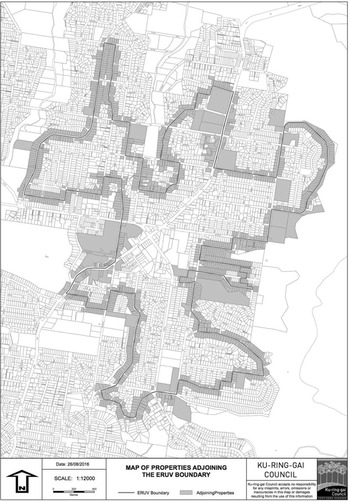
Nonetheless, the St Ives eruv began operating in April 2015 thanks to the local power provider, Ausgrid, which had granted permission to use its power poles to complete the eruv boundary after the perimeter had been redesigned in a way that, as the group running the eruv assumed, would not require council consent.Footnote 12 Soon, the local council, after having been alerted by residents, threatened to dismantle the eruv, but the eruv group was granted an injunction in the New South Wales Supreme Court and agreed to lodge a retrospective application for development consent. In August 2016, the group – now called Helping Families Unite – submitted this application for retrospective approval of the placement of plastic conduit poles. As part of the approval process, the council sent out a survey to 2,400 residents whose properties were affected by the eruv boundaries (see the map in Figure 2), asking them for their opinion on the eruv (Ku-ring-gai Council, 2016, apps. 2, 3). Six hundred responses reached the council, of which 50 per cent disagreed with the proposal, while 41 per cent agreed. The rest felt neutral about the eruv.
Map of the St Ives eruv. Prepared by Ku-ring-gai Council 2016 (item GB.6, Appendix No. 1 – Notification Map). Reproduced with permission from Ku-ring-gai Council.

Meanwhile, the dispute took a nasty turn when SIPA distributed an openly antisemitic leaflet in the neighbourhood which claimed that the eruv was an attempt to fundamentally change the demographics of St Ives by encouraging ‘those of their faith to settle in the area’. Another letter, sent anonymously to residents, claimed that the purpose of the eruv was to ‘establish a modern version of the ghetto under Rabbinical control’.Footnote 13 Politicians, councillors and residents criticised the leaflets’ message, but the tone had become increasingly harsh. One day, a pole was found with a swastika etched into it, which was quickly condemned as ‘racial hatred at its worst’ (Rapana, Reference Rapana2016b, p. 7) by St Ives community leaders. In November 2016, councillors met again to decide on the fate of the eruv and, despite persistent resistance among some residents, this time the council granted retrospective development consent to the St Ives eruv.
4 Much ado about poles and wires?
Reading the legal documents produced throughout the dispute, the case of the St Ives eruv never appeared to be about grand questions of diversity, religion or race. Instead, the entire legal discussion circled around the optics of poles and the impact of wires on the streetscape. This particular framing is the result of both the Australian legal context, but it also reflects the particular ways in which religious diversity is governed on the level of the local. In this section, I discuss how the absence of rights and the logic of planning law shaped the St Ives dispute, turning the law into a powerful vehicle for the exclusion of Orthodox Jews.
4.1 The absence of rights
The St Ives eruv is not the only eruv that has proven controversial. Several eruvin have been at the centre of neighbourhood disputes, predominantly in the US, where there are more than 200 of these structures,Footnote 14 but also in Canada. Some of these cases have been litigated in court and, in this small body of case-law, courts have assessed eruvin through the constitutional lenses of state neutrality and religious freedom. Given that the eruv is installed on public land, sometimes making use of existing public infrastructure, such as utility poles, a question arises as to whether the permission to erect an eruv infringes upon the secular state's commitment to religious neutrality (Susman, Reference Susman2009). In the US case Tenafly Eruv Association, Inc. v. Borough of Tenafly, the Borough of Tenafly in New Jersey claimed that allowing an eruv onto public land would amount to an unconstitutional endorsement of Orthodox Judaism and therefore violate the establishment clause of the First Amendment that prevents government from establishing religion.Footnote 15 The court, however, rejected this claim by referring to the inconspicuous nature of the eruv and noted instead that Orthodox Jews’ right to free exercise of their religion would be unduly restricted by the borough's refusal to allow an eruv to be attached to power poles. Similarly, in the Canadian case Rosenberg v. Outremont (City), the Superior Court of Quebec found that the city's attempt to dismantle the eruv in order to protect Outremont's ‘secular vocation’ infringed upon Orthodox Jews’ freedom of religion.Footnote 16 In fact, the court found that the city had a duty to accommodate the eruv. To date, no secular court has banned an eruv from public land on grounds that it is a religious structure.
In St Ives, however, the court upheld the council's decision to reject the construction of the eruv without mentioning religious freedom or the secularity of public space. Part of the reason for this absence of rights discourse is the particular Australian legal context. Despite rights being legislated in some state-level jurisdictions, Australia still lacks a national Bill of Rights. The country's Constitution only mentions a handful of rights, which traditionally have been interpreted in a rather narrow fashion by the Australian High Court (Williams, Reference Williams2002). Among these few provisions is section 116, a section concerning religion, which is modelled on the First Amendment of the Constitution of the US:
‘The Commonwealth shall not make any law for establishing any religion, or for imposing any religious observance, or for prohibiting the free exercise of any religion, and no religious test shall be required as a qualification for any office or public trust under the Commonwealth.’
As the wording shows, differently than in Canada or the US, the section only applies to the Commonwealth government, but not to the states nor to local councils. On the state and territory level, Victoria, Queensland and the Australian Capital Territory have introduced their own human rights legislation. The Tasmanian Constitution Act 1934 protects the ‘freedom of conscience and the free profession and practice of religion’. New South Wales (NSW) – the state of which Sydney is the capital – however, lacks such legislative protection.Footnote 17
Even though Australia and the state of NSW lack a comprehensive protection of human rights, the national Australian multicultural policy from 2011, the relevant policy document at the time of the planning of the eruv, asserted the right of all citizens to practise and maintain their heritage and culture.Footnote 18 Moreover, the Multicultural NSW Act obligates institutions to, inter alia, ‘respect and make provisions for the … religion of others’.Footnote 19 In the local politics of diversity, however, these policies and laws are often toothless. Despite government direction, matters of religious diversity and multiculturalism more broadly remain only poorly implemented at the level of local planning and government (Bugg, Reference Bugg2013, p. 1152; Dunn et al., Reference Dunn2001). As David Knoll (Reference Knoll2016, p. 12) notes, in the daily planning business, many councils avoid dealing with politically sensitive issues of religious diversity and instead pass the ball to the NSW Land and Environment Court after refusing a proposal in order to not be held accountable by their constituency, as also happened in St Ives. This strategy leads to little protection for minority communities, as the Multicultural NSW Act also stipulates in its subsection 22 that the multicultural principles do not ‘give rise to, or can be taken into account, in any civil cause of action’.
Indeed, in its appeal decision on the matter of the St Ives eruv, the NSW Land and Environment Court did not consider the multicultural dimension of the council's decision to refuse development consent for the eruv. This does not mean that the court never engages with the impact of planning decisions on religious equality. In New Century Developments Pty Limited v. Baulkham Hills Shire Council, the court upheld an appeal against the refusal of planning consent for a mosque and emphasised the preservation of religious equality and religious freedom as public interest.Footnote 20 Yet, in St Ives, the materiality of the eruv played an unfortunate role when the court defined its jurisdictional power in relation to the appeal. Differently to a house of worship, the eruv entered the planning realm as a set of individual poles scattered across the suburb that, given the subdivision of land into individual parcels of public and private land, meant that each required an individual application, under either the Roads Act or the EPA Act. The court's power to decide on the application under the Roads Act required a nexus with the applications under the EPA Act. Since there was no eruv yet, the court found that the nexus between the individual applications was missing. The court thereby took a strictly material approach to the poles as individual developments, without considering the symbolic meaning of each of the poles as contributing to the whole of the eruv space (Knoll, Reference Knoll2016, p. 20).
4.2 Planning religious difference
When one of the Ku-ring-gai councillors called the looming removal of the eruv the ‘removal of the human rights of many members of the community’ (Rapana, Reference Rapana2016a), his claim had consequently little legal edge. Opponents dismissed appeals to human rights as a diversion and referred the dispute back to concerns of planning relevance: ‘Let's not get side-tracked with statements about democracy or religion. The eruv is about permanent physical infrastructure imposed on public and private land affecting the amenity and environment of the entire community’ (Brady, Reference Brady2011, p. 4).
To understand the fate of the St Ives eruv, it is necessary to consider how local planning law shaped the conflict. Scholars have called for closer attention to the level of the local and the ways in which local authorities and laws micro-manage religious and other aspects of diversity on the ground (Valverde, Reference Valverde2012; Burchardt, Reference Burchardt2019; see also Hubbard, Reference Hubbard2012). Work in this area shows how the particular mechanisms of local law can work to reinforce dominant and ethnocentric norms through prima facie technical and apolitical categories concerned with buildings, objects and spaces (Valverde, Reference Valverde2005; Trudeau, Reference Trudeau2006) and seemingly inclusive democratic features, such as planning consultations (Valverde, Reference Valverde2012; Thorpe, Reference Thorpe, Durbach and Lixinski2017). In tandem, these features can work to enshrine ‘the wishes of civic society's squeaky wheels’, as Mariana Valverde (Reference Valverde2012, pp. 22, 211) describes the established and well-resourced residents who use the planning regime in a way that perpetuates exclusion and inequality.
In order to wield power in the local context, residents have to learn ‘seeing like a city’ – that is, to frame their concerns as relevant to the categories of local law, such as planning law (Valverde, Reference Valverde2012, p. 3). In St Ives, both residents and the local council based their rejection of the eruv on the planning category of amenity. Amenity, as Mariana Valverde (Reference Valverde2005, p. 45) points out, is one of those multivalent terms that allows local authorities ‘to govern people – and relations of class, ethnicity and respectability – without governing through persons’ (emphasis in original). Amenity is not per se an exclusionary term and a ‘pliable’ planning law certainly has its virtues in order to respond to cultural diversity (Hubbard and Prior, Reference Hubbard and Prior2018). Yet, the category's elusive and subjective nature as well as its frequent lack of legislative definition, such as in the context of NSW, make it prone to becoming the container for all kinds of claims that can work to preserve the status quo as favoured by the dominant cultural group. In its assessment of the eruv application, the Ku-ring-gai Planning Panel described amenity as encompassing considerations that are
‘practical and tangible such as traffic generation, noise, and nuisance, appearance and even the way of life of the neighbourhood. Other considerations are more difficult to appreciate such as the standard or class of a neighbourhood and the reasonable expectations of a neighbourhood. In particular, knowing the use to which a particular site is or may be put by a particular user group may affect one's perception of amenity.’ (Ku-ring-gai Planning Panel, Reference Ku-ring-gai2011, item GB.1/35)
Research has documented widely how residents have been able to successfully manipulate categories such as amenity alongside ‘character’, ‘heritage’, but also ‘land use’ for exclusionary agendas (Villaroman, Reference Villaroman2012; Sandercock, Reference Sandercock2000). Analysing opposition to the development of mosques in Australia, Kevin Dunn (Reference Dunn2001) has shown how stereotypes of Muslims as religious fanatics who allegedly chant and worship excessively have been turned into concerns about ‘noise nuisance’. In Australia's urban fringe, residents objected to a Hindu temple based on arguments about inappropriate noise emissions with exotic and foreign ‘sitars and drums’ disturbing the local sounds of ‘cicadas and frogs’ (Bugg, Reference Bugg2013). Such framing strategies are not unique to the Australian planning process, but can be observed elsewhere where local planning law meets diversity claims. In Toronto, a mosque proposal faced opposition based on concerns about parking congestion (Valverde, Reference Valverde2012, chapter 8), while a Swiss Muslim community's attempt to add a minaret to a prayer space-turned factory building was initially rejected on the basis that the minaret would turn the already-existing prayer space into a full sacred building and constitute an unlawful use of space (Guggenheim, Reference Guggenheim2010). Similarly, in St Ives, residents objected to the eruv as an amenity-destroying ‘eyesore’ and an improper and insensitive use of green and peaceful public suburban land.
Residents’ statements in development consultations play an important role throughout many Western planning systems that often afford great weight to the claims made by local residents (Valverde, Reference Valverde2012; Thorpe, Reference Thorpe, Durbach and Lixinski2017). Although on the surface a laudable democratic feature to make planning more responsive to local residents’ needs, the participatory nature of the planning process can skew the process in a way that privileges some views over others. The planning regime not only invites residents to frame their objections in terms of significance to the wider public, but, as Amelia Thorpe (Reference Thorpe, Durbach and Lixinski2017, p. 140) points out, then often also treats them as in fact representing the ‘public interest’ (see also Sandercock, Reference Sandercock2000).
‘Public interest’, like amenity, is a key concept in planning regimes that authorities have to consider during their decision-making process, although it is often not defined in legislation and therefore needs to be interpreted (Wheeler, Reference Wheeler2006). In this interpretation process, objections raised by residents can become conflated with the public interest. Indeed, in 2011, Ku-ring-gai's director of operations noted in his report to the council that twenty-five objections had been received from residents who opposed the eruv proposal. The director concluded that the proposal should not be supported: ‘Given that the majority of the residents surrounding the proposals are objecting to the installation of the poles and wires, it is considered that there is no significant benefit to Council and the community arising from this proposal’ (in Ku-ring-gai Council, 2011a, item GB.1/70). The council followed this recommendation when it denied development consent to the eruv:
‘While the decision will be disappointing to many people in Ku-ring-gai's Jewish community, we needed to take into account the wider public interest. The majority of residents objected to the proposal, with many concerned about the negative impact of visual clutter the additional structures would have on the streetscape. This was the major concern and not a religious or racial view.’ (Levi, Reference Levi2012)
As one councillor who was generally supportive of the eruv further explained:
‘You have to weigh up the public feedback. … It was within our authority to go ahead or not. … In this instance that level of compulsion wasn't there, and as a Councillor, I feel that if you have latitude to make a decision and the community isn't with you for whatever reason, it's much better to not go ahead and take the status quo as your basis for your decision and retain the status quo unless there is a shift in the thinking of your population.’Footnote 21
While planning law may not exclude certain groups per se, it provides a powerful vehicle for inequality and exclusion. Through its focus on seemingly technical matters that allow the sidestepping of diversity (cf. Trudeau, Reference Trudeau2006, p. 430), such as when in St Ives the court approached the eruv as an unconnected assortment of scattered poles, as well as its emphasis on residents’ objections, the planning regime enables local actors, such as councillors and residents, to preserve an ethnocentric vision of the city. In this way, planning perpetuates certain religious, cultural and racial assumptions as the norm even if state and national laws and policies seek to foster diversity and religious equality. The exclusionary potential of the planning process is further amplified in Australia where the protection of rights has been largely left to politics (Evans, Reference Evans2008) – a strategy whose weaknesses the eruv exposes.
That the St Ives eruv was nonetheless ultimately established speaks to the skills of the local Jewish community to understand the necessity of a strategy based on the inherent logics of the laws governing local space. By attaching the eruv to poles owned by the electricity company, the group moved the eruv beyond the council's authority. While this outcome constituted a legal success, the logic of ownership and jurisdiction, in which the eruv turned into merely an assemblage of individual poles, glossed over its religious significance and the privileging of majoritarian dominance through the planning process went largely unquestioned.
5 Unpacking amenity
Having set out the particular legal context of the St Ives dispute, in this section, I take a closer look at how objecting residents conceptualised the amenity of their neighbourhood. The aim is to unpack the cultural, religious and racialising assumptions underpinning residents’ claims and what they tell us about Jewish belonging in this Australian suburb. The material I analyse here includes submissions to the council, the survey conducted by the council, as well as in local media, and letters to the editor in local newspapers. I focus on three sites of objection: visual amenity, the secularity of public space and St Ives as a multicultural community.
5.1 An ugly eyesore: majority taste and minority space
Claims about the destructive aesthetic effects of an eruv have been the bread and butter of eruv opponents around the world. In St Ives, objecting petitions warned that the eruv would be an ‘eyesore’, ‘ugly and intrusive to the landscape’, and that the ‘streetscape and trees would be destroyed’ (Ku-ring-gai Council, 2011b, items 272, 273). While objectors expressed their concerns in terms of visual amenity, these claims nonetheless contained assumptions about who can rightfully claim and shape urban space, establishing hierarchies of belonging in the suburb:
‘The environment and the general public have more than enough to deal with due to mandatory signage, light poles and wires without adding 27 more poles with wiring to assist a small group who embrace a way of life which is very restrictive in modern society.’ (North Shore Times, 9 July 2010, p. 23)
For objectors, the clutter of the eruv was an undue burden on the majority and they made clear that, in ‘not representing the views of the majority of the St Ives community, the applications are contrary to public interest and should be rejected’ – a claim the council followed. The pseudo-inclusive paradigm that underpinned both planners’ and residents’ reasoning is that public space has to be a space for all, and changes or developments have to cater to the needs of all, or most, residents. Opponents in St Ives explained this need by differentiating between the useful purpose of electricity poles and telecommunication cables as a basic necessity and the eruv as a private luxury for a limited few in the neighbourhood. Installations that would negatively affect the visual amenity would only be acceptable when they bring advantage to a majority of residents whose needs represent the public interest.
Opposition to houses of worship or other religious buildings frequently draws on a contrast between ‘established’ residents with ‘natural’ rights to a place and the ‘newly arrived’ who have to learn the local way of life and its spatial manifestation (Villaroman, Reference Villaroman2012). A temporality of belonging is thereby established. In St Ives, the perceived failure of Orthodox Jews to respect locally expected behaviour placed them in the category of the newly arrived:
‘I've been here 50 years and it's been a very congenial, harmonious atmosphere. But these Orthodox people seem to have a different set of values and they're aggressively insensitive to what people feel about them moving in with their poles and wires.’ (Cornwall, Reference Cornwall2010, available at https://www.youtube.com/watch?v=6iDHIYZYd9g&_channel=ABCNews%28Australia%29 (accessed 4 January 2021))
Another opponent, emphasising that she had lived in the suburb since 1977, complained about the chutzpah of the Orthodox Jews:
‘How is that a minority group of Orthodox Jews who have recently come to live in St Ives, in the name of their religion, have the right to request alteration to the whole environment of this suburb against the opinion of the majority of residents … and those who have been in this area for many years. What is proposed would further deface St Ives nearly as badly as the new high-rise.’ (North Shore Times, 25 June 2010, p. 36)
Although Jews have been present in the North Shore for a long time – the North Shore Synagogue opened in 1947 – objectors wrote Orthodox Jews out of their suburb's history and rightful community, instead demanding their assimilation to the norms of non-Jewish residents. Jewish history in Australia in fact dates back to the arrival of the first European settlers in January 1788. On board of the First Fleet, alongside other British convicts, a handful of Jews came to the continent, arriving in what would become Sydney. Because of Australia's status as a settler colony, Australian Jews did not have to undergo a formal process of emancipation – they secured, quite similarly to American Jews, legal and political emancipation by virtue of their arrival. Yet, assimilation to Anglo-Christian norms was still the expectation. In order to integrate into Australian society, early Jewish settlers put much effort into emulating British settlers, eventually becoming ‘more English than the Jews in England’ (Rutland, Reference Rutland1997, p. 413). Another St Ives resident, a Jewish Holocaust survivor and one of the few Jewish eruv opponents in St Ives, repeated this call for assimilation: ‘If it is an inconvenience for a minority of orthodox [sic] Jews not to be able to push a pram on the Sabbath, they should accept it and not make it a problem for the Australian people’ (Michelmore, Reference Michelmore2012).
That the construction of eruvin draws opposition from other Jews is not unique in St Ives. In Westhampton Beach in the US, a group called Jewish People for the Betterment of Westhampton Beach (also known as JPOE – Jewish People Opposed to the Eruv) sought to prevent an eruv through court litigation, arguing that the eruv amounted to an unconstitutional endorsement of Orthodox Judaism at the expense of other Jews and non-Jews.Footnote 22 While this case reflects on the one hand the ongoing struggle within American Jewry about the interpretation of ‘authentic’ Judaism (Fonrobert, Reference Fonrobert2015), it also points to concerns among more liberal and secular-identifying Jews of becoming associated with their more visibly Jewish neighbours (Cooper, Reference Cooper1996; Watson, Reference Watson2005). This fear is not unfounded in light of Jewish history given the inherent risks involved with making Jewish difference visible. Invisibility has been the tacit price paid by many Jews in exchange for equal belonging and it continues to be enforced today – despite the popular narrative of Western societies, such as Australia, having become more religiously tolerant and more multicultural. Eruv opposition expressed a nostalgia for the ideal of assimilationism as the appropriate pathway to belonging in Australia (Dunn, Reference Dunn2005) – an ideal that the planning regime honoured through its protection of the status quo.
5.2 Private uses of public land: porous walls of secular separation
While many objections focused on the question of visual amenity and the necessity to take into account the aesthetic needs and preferences of the established and dominant population, another set of objections related to the more intangible and subjective aspects of amenity. Here, residents spoke to the secularity of their suburb that protected St Ives as peaceful space devoid of ostensible religious symbols, only dotted by discreet houses of worship:
‘People come to this suburb because it is still a residential area with peaceful green areas, the houses do not have religious symbols outside advertising to which religion they belong. People go to their places of worship where these symbols belong.’ (North Shore Times, 25 June 2010, p. 36)
Another argued that
‘There is no place for religious symbols on public crown land. Religion in a secular state, such as we are fortunate to enjoy in Australia, is foremost for the homes and then for those places zoned by government, including councils for that purpose.’ (Sydney Morning Herald, 26 August 2011, p. 10)
These arguments produce a specific politics of visibility in which the practice of religion is tightly controlled through architecture. While opponents acknowledged that religion is not a purely private exercise for the home, the only legitimate public expression is in designated and circumscribed spaces such as the synagogue, whose walls mimic the walls of a house and therefore do not confront outsiders with the religiosity and therefore difference that is contained inside. By attaching itself to power poles, the eruv spilled religion into the street, violating the premise of Jewish emancipation to be a Jew at home and a citizen in the street.
However, not all religious transgressions into public space are policed equally. In Sydney's North Shore, every year, a Christmas tree is placed in front of the chambers of Ku-ring-gai Council and the council has given annual subsidies to sponsor the Christian event Carols in the Park, which takes place in the public Bicentennial Park (Huffer, Reference Huffer2010). Although this financial and logistical support does not involve the setting-up of permanent structures, it affords Christianity a much more prominent and visible forum as compared to the eruv – a structure that is barely noticeable and that receives no public subsidies, as it is maintained by the Jewish community alone. The preferential treatment of Christian symbols and practices reflects how Christianity still holds a prominent and normalised position in Australia. Australian society is often assumed to be highly secular or even ‘post-religious’ (Chavura and Tregenza, Reference Chavura and Tregenza2014, p. 301), yet a large proportion of Australians are still affiliated with Christianity.Footnote 23 Some argue that ‘historically Australia is a country as “Christianised” as secular, and, in terms of its values possibly more Christianised than secular’ (Piggin, Reference Piggin2014, p. 322). Despite the constitutional barrier against the establishment of religion, Christianity continues to enjoy a privileged position reflecting its status as the majority religion. The practice of parliamentary prayers, for example, reinforces Christian symbolism in an official public setting. Attempts to change this practice in order to reflect the religiously plural make-up of society have been, to date, unsuccessful (Davies, Reference Davies, Hosen and Mohr2011, p. 60).
The privileging of Christianity in public is not unique to Australia. Across Western societies, majoritarian Christian symbols have often been exempted from secularist legal scrutiny, allowing crucifixes, nativity crèches and crosses to remain in public as signs of a common and shared secular culture, while non-Christian symbols and practices have been attacked as religious disturbances of secular public space (Mancini, Reference Mancini2009; Beaman, Reference Beaman2012). There is, as Stephen Feldman (Reference Feldman1998, pp. 262–263) has argued, an intimate link between the public–private dichotomy and ongoing Christian societal and cultural domination, in which the wall of separation offers a powerful legal tool to contain minority religious difference, while protecting Christianity's privileged position in public. The dominance of Christianity also sets the limits for the inclusion of Jews, despite political claims of Jewish–Christian closeness in Western societies. Since the 2000s, mainly conservative Australian politicians, similar to those in the US and in Europe, have made use of the questionable term ‘Judeo-Christianity’ to describe a supposedly shared culture (Stratton, Reference Stratton2016), largely in an attempt to exclude Islam. However, conflicts such as the St Ives eruv dispute suggest that this common culture still relies to some extent on the exclusion of certain forms of Jewishness.
5.3 Segregation: White multiculturalism and fears of a ghetto
A third prominent theme of opposition circled around the vision of St Ives as a multicultural space and the supposedly divisive potential of the eruv. Fears of a ghetto radiated through St Ives streets. In submissions to the council, opponents warned that the eruv would ‘create a separate community’, lead to ‘a Jewish enclave’ and install a ‘ghetto-type situation’. One resident worried that the eruv would ‘perpetuate societal division and reduce integration into the municipality’. Another urged: ‘We need to integrate them rather than segregate communities’ (Adamski, Reference Adamski2008). Like their Prussian predecessors in Bromberg, eruv opponents saw the refusal of the eruv as a way to liberate Jews from their self-imposed segregation. Residents also insisted that accommodating the eruv had nothing to do with multiculturalism – quite the opposite: St Ives was ‘already multicultural and should remain so’. As one resident made clear: ‘There is no benefit for St Ives and/or Ku-ring-gai residents who are not eruv supporters. Australia is about multiculturalism and the benefits it brings to everyone; it is not about creating ghettos for the promotion of religious minorities’ (North Shore Times, 30 June 2010, p. 19).
The way in which opponents evaluated the eruv in relation to multiculturalism reflects how the relationship between Australian multiculturalism and national identity remains contested, especially with regard to the role of the previously dominant White Christian Anglo identity (Levey, Reference Levey and Levey2012; Moran, Reference Moran2011). The opposition to the St Ives eruv and its community echoes the broader conservative backlash against Australian multiculturalism in which the accommodation of minority cultures is seen as marginalising ‘mainstream’ Australians at the expense of non-mainstream – that is, non-Anglo-Christian groups (Forrest and Dunn, Reference Forrest and Dunn2006; Dandy and Pe-Pua, Reference Dandy and Pe-Pua2010). In St Ives, the search for the suburb's ‘mainstream’ identity through the eruv dispute exposed the tenuous position of Orthodox Jews within Australia's multicultural society. Their visible Jewishness appeared for some as a symbolic threat to the privileged dominant identity – presumably White Christian Anglo-Australians. Allowing a minority identity into the public space carried the risk of turning the cultural majority of St Ives into the new ‘dispossessed’ and ‘oppressed’ (Cooper, Reference Cooper1996, p. 535). At the same time, by presenting the eruv as a ghetto, concentrations of some groups are rendered problematic, while the concentration of other groups is normalised and legitimised (Connell and Iveson, Reference Connell and Iveson2014, p. 436).
The type of multiculturalism that lurks behind eruv opponents’ language is what Ghassan Hage (Reference Hage2000, p. 19) called ‘white multiculturalism’ – a multiculturalism that, clouded in a language of tolerance, works towards ‘containing the increasingly active role of non-White Australians in the process of governing Australia’. By taking Orthodox Judaism into public space, the eruv points to an ambiguous relationship between Jewishness and Whiteness in Australia. As Jon Stratton (Reference Stratton2016, p. 30) has pointed out, there is an intimate link between Australian notions of Whiteness and Christianity, and consequently between non-Whiteness and non-Christianity. In Australia, Whiteness has historically functioned as a benchmark to assess the ability of migrants to assimilate into a nation state imagined as culturally homogenous (Stratton, Reference Stratton2000, p. 222). Built on the fiction of terra nullius to justify indigenous dispossession, Australia was founded as a White Anglo-Saxon Christian country (Moran, Reference Moran2011, p. 2156). The ‘White Australia Policy’ played a crucial role in protecting this identity through a set of policies that, since the introduction of the Immigration Restriction Act in 1901, effectively prevented persons of non-European descent from migrating to Australia.
The peculiar context of colonialism had enabled most Jews from Britain to be considered as White along with other British settlers, whereas the role of the Other was assigned to indigenous Australians as well as Chinese, whose migration the British settlers observed with great suspicion. The racial belonging of Jews in Australia, however, was not free of ambivalences under the White Australia Policy. While the highly assimilated Anglo-Jewry were accepted as White and British, Jews migrating from Russia and the Middle East, as well as Jewish refugees from war-ravaged Europe, were seen as a cultural and racial threat to Australia's White Christian identity and unwanted economic competition during the first half of the twentieth century (Rutland, Reference Rutland2003). Moreover, the migration of Sephardic Jews from Asian countries raised questions about the Whiteness of these Jews that were perceived, much like Jews around the time of their emancipation in Europe, in orientalist terms as ‘Asiatic’ (Gale, Reference Gale1994).
Despite these ambivalences, many Jews were able to access the privileges of Whiteness in Australia, leaving behind European antisemitism and nationalism in which they had figured as racial Others. In St Ives, the sense of Whiteness that many Jews had of themselves was further entrenched by the fact that many community members had migrated from South Africa where apartheid had rendered Jews White. For some, the opposition to the eruv unsettled a taken-for-granted sense of belonging to the privileged culture:
‘that's why the Jewish community got such a big shock, because they consider themselves part of the white mainstream, especially the South Africans. The South Africans grew up under apartheid, where we were not part of the blacks, we were part of the whites, and coming here, all of a sudden, they are the Other, and being the Other is very frightening because we've only heard about that from our grandparents, we've never experienced that as a people in Australia, at least not in any major way.’Footnote 24
The St Ives eruv dispute reflects how Australia's move to multiculturalism has posed its own challenges for the country's Jewish community. After World War II, economic factors contributed to an increased need for migration and the country gradually dismantled its restrictive migration regime. This change also involved a shift from a policy of Anglo-assimilation to a multicultural policy, inviting migrants to preserve their cultural and religious heritage. For Australian Jews, Geoffrey Levey (Reference Levey, Levey and Mendes2004, p. 185) explains, multiculturalism ‘held out an opportunity to exchange their traditional quest for “invisibility” before the law for group visibility and a public profile, which, in Jewish historical experience, had been associated with persecution and invidious discrimination’. Although, as Levey further notes, Australian Jews grew more accustomed to multicultural identity politics over time, the St Ives eruv conflict revealed that the accommodation of visible Jewish difference is not a given and that the law may not only offer little protection, but may also become complicit in enforcing lingering expectations of Jewish invisibility in exchange for acceptance.
6 Conclusion
‘The trouble begins when Jews stop being visible’, Matthew Kalman (Reference Kalman1997) once observed in the context of Great Britain. In this paper, I have analysed what happens in the realm of law when Jews stop being invisible by exploring the legal controversy that surrounded the construction of an eruv in Australian suburbia. In my reading of the St Ives case, I have placed residents’ claims within the broader context of Jewish history in Australia and the anxieties that have surrounded the integration of the West's once paradigmatic non-Christian minority group. By analysing how the planning regime valued and legitimised residents’ exclusionary claims about the eruv, I have shown how the law can be mobilised to exclude certain forms of Jewish difference that are seen to challenge dominant religious and racial norms, thereby protecting a vision of suburban space as Christian and White behind a façade of arguments about religious neutrality and multicultural inclusion. The St Ives eruv dispute thereby illustrates how Jewish belonging can become precarious when Jews are seen to overstep the boundaries of acceptable difference by taking Jewish identity into public space.
That Jews should still face the demand to privatise their difference is in itself perhaps not surprising given how the relegation of religious difference to the private sphere has become a crucial tool for the management of religious diversity. However, as this paper and research on the governance of non-Christian religious difference more broadly have shown, this demand does not apply equally to all religions (e.g. Beaman, Reference Beaman2012). Both in St Ives and elsewhere, Christian symbols have often received a pass as signs of a common and shared culture, while non-Christian symbols, such as the eruv, have been rejected as a divisive and foreign religious overreach. Opposition to the eruv thereby echoes responses to the Muslim headscarf that has been interpreted as an illegitimate intrusion of religion into the public, often with undertones of cultural racism that essentialises Muslims as foreign and dangerous (Mancini, Reference Mancini2012). A similar cultural racism can be observed in St Ives, where Jews were presented as pushy foreigners who conspire to take over the suburb, hinting simultaneously at the ambivalent racialisation of Australian Jews in a society historically imagined as White.
Future research could explore how the privileging of Christianity under the veil of the secular regulation of diversity continues to shape the belonging of Jews and what the treatment of a minority group perceived to be highly successful relative to other minority groups reveals about the limits of liberal inclusion for non-Christians in the West. I would also suggest that we cannot understand the St Ives eruv dispute – or other legal disputes involving Jewish practices, such as infant male circumcision – outside of the context of broader global anxieties around diversity and the rise of Islamophobia. Indeed, several statements of residents worried that the eruv ‘sets [a] precedent for other religions’. The implicit fear appeared to be that allowing the Jewish eruv today would lead to a Muslim mosque tomorrow, hinting at the interconnection between prejudice towards Christianity's two Others (Meer, Reference Meer2013; see also Herman, Reference Herman2011, p. 14).
As this paper has shown, local law can provide fertile ground for these anxieties about the religious Other. Apart from highlighting the enduring role of law in regulating Jewish difference, the St Ives eruv dispute indicates the need to consider the exclusionary potential of laws below the level of the state. While scholars studying the governance of religious diversity have shown how national frameworks focused on rights can work to restrict difference that is seen to threaten dominant norms (Beaman, Reference Beaman2012; Feldman, Reference Feldman1998), the research shown here further underlines the importance of seemingly technical and inclusive mechanisms of local law as tools for social division and the regulation of social life along lines of religious and racialised difference.Footnote 25 My point in this paper, however, is not to suggest that planning law reflects some exclusionary ideology, such as antisemitism. Rather, the problem identified is that the power granted to local actors, including councils and residents, to enforce dominant norms and cultural conformism can create ‘scales of citizenship’, thereby undermining local belonging for marginalised groups despite official policies to protect equality and rights (cf. Hubbard, Reference Hubbard2012).
Eruvin disputes, such as the case analysed here, may seem at first sight like bizarre local quarrels between neighbours. Yet, we can also read them as seismographs for relations between Jews and non-Jews, and for the ability of law to respond to persistent anxieties around Jewish difference and their everyday manifestation.
Conflicts of Interest
None
Acknowledgements
I am grateful to Lisa Harms, Marie-Eve Loiselle, Hilary Charlesworth, Margaret Davies, Didi Herman, Stefan Salomon, Jay Watkinson and the reviewers for their critical feedback and insightful comments on earlier drafts. All errors are mine. Thanks also to the various people in St Ives who took the time to talk with me as well as to Ku-ring-gai Council for granting permission to reproduce the map of the eruv. My thanks to John Connell and Kurt Iveson for sharing some of the earlier media material on the eruv with me.