Introduction
Once considered exclusively a disorder of childhood, attention-deficit/hyperactivity disorder (ADHD) is now recognized to exist syndromatically or symptomatically into adulthoodReference Adler, Shaw, Sitt, Maya and Morrill1–Reference Kessler, Adler and Barkley4 and late lifeReference Kooij, Michielsen, Kruithof and Bijlenga5, Reference Michielsen, Semeijn and Comijs6 in a considerable number of individuals. In both the Diagnostic and Statistical Manual of Mental Disorders, Fifth Edition (DSM-5)7 and the International Classification of Diseases (ICD-10),8 the hallmark symptoms of ADHD are classified along two major dimensions, inattention and hyperactivity-impulsivity. Many studies using factor analysis have found support for this 2-dimensional model of ADHD in childrenReference DuPaul, Reid, Anastopoulos, Lambert, Watkins and Power9, Reference Rodenacker, Hautmann, Görtz-Dorten and Döpfner10; however, several recent lines of evidence raise doubts about this conceptualization of the disorder.
The most important line of evidence comes from findings, largely in youths, that support a bifactor model rather than a simpler 2-factor model.Reference Arias, Ponce and Nunez11 Bifactor models are defined as having a global factor (G) that captures variance shared by all symptoms, as well as specific factors (S) that capture variance shared among a smaller subset of symptoms that is uncorrelated with both the global factor and the other specific factors. It has been argued that bifactor models more accurately represent the etiological heterogeneity of ADHD: a bottom-up pathway resulting in hyperactivity/impulsivity, with inattention being secondary to those symptoms, and a top-down pathway leading mostly to inattention.Reference Burns, de Moura, Beauchaine and McBurnett12, Reference Lee, Burns, Beauchaine and Becker13 In adults, a number of studies have indeed found support for bifactor models with 2 specific factors (inattention and hyperactivity/impulsivity)Reference Matte, Anselmi and Salum14, Reference Martel, von Eye and Nigg15 or with 3 specific factors (inattention, hyperactivity, and impulsivity).Reference Gibbins, Toplak, Flora, Weiss and Tannock16, Reference Morin, Tran and Caci17 Among the studies finding support for a bifactor model with 2 specific factors, however many failed to directly test the fit of a model with 3 specific factors, leaving the possibility that the latter may be preferable. Moreover, some studies have found that bifactor models with 2 specific factors had a factor that was difficult to interpret, with hyperactivity and impulsivity symptoms having both positive and negative loadings on the same factors.Reference Gibbins, Toplak, Flora, Weiss and Tannock16
To our knowledge, the factor structure of ADHD has not been specifically explored in older adults relative to young or middle-aged adults. It is crucial to clarify the factor structure of ADHD in all age groups to determine how to best conceptualize this disorder across the lifespan, especially considering that the first cohorts of individuals to receive a formal diagnosis of ADHD (then called “hyperkinetic reaction of childhood”18) are now nearing their sixth decade of life. Up to 40% of adult ADHD cases persist into old age, and prevalence rates may reach 3–4% in seniors.Reference Kooij, Michielsen, Kruithof and Bijlenga5, Reference Michielsen, Semeijn and Comijs6 However, these cases are often unrecognizedReference Fischer, Gunter-Hunt, Steinhafel and Howell19 or misdiagnosed,Reference Callahan, Bierstone, Stuss and Black20 likely in part because our current understanding of how ADHD symptoms present in older adults, relative to younger patients, is sorely lacking.
In addition, the known relationships between ADHD symptoms and cognitive function may depend on age. Meta-analyses of young adult samples with ADHD (mean age 19–46 years) reveal deficits in working memory (both phonological and visuospatial)Reference Alderson, Kasper, Hudec and Patros21 and verbal long-term memory.Reference Skodzik, Holling and Pedersen22 In contrast, work in adults ≥ 60 years with ADHD reveals normal performance across these neuropsychological measures.Reference Ivanchak, Abner and Carr23 Response inhibition as measured by the Stroop task does not seem to be impaired in ADHD patients aged 9–41,Reference Schwartz and Verhaeghen24 but may be affected in older adults.Reference Thorell, Holst, Chistiansen, Kooij, Bijlenga and Sjöwall25 This heterogeneity may be linked to age-related differences in ADHD symptomatology, such as the age at which ADHD symptoms are measured or first appear.Reference Moffitt, Houts and Asherson26 For this reason, it is essential to clarify patterns of symptom presentation across different age groups and to determine how this relates to cognition.
Aims of the Study
The present study aimed to: (1) determine the factor structure of the Conners Adult ADHD Rating Scale Self Report Short Version in a large sample of adults aged > 18 years; (2) test the invariance of this factor structure across young (ages 18–59) and older adult samples (ages 60–85); and (3) investigate the independent associations between each factor and executive functions. We hypothesized that the data would yield a model with a global factor as well as 3 specific factors (inattention, hyperactivity, impulsivity), and that this model would be invariant across age groups. Investigations into the associations with executive functions were largely exploratory due to conflicting findings in prior literature.
Methods
Participants
Data for this study were obtained from the Nathan Kline Institute Rockland Sample (NKI-RS). Participants in the NKI-RS are recruited from the Rockland County community, a rural county 20 miles northwest of New York City whose demographics are considered representative of the broader U.S. population. The NKI-RS cohort is designed to represent a heterogeneous community sample with minimal exclusion criteria. Individuals ages 6–85 are recruited, but only those >18 years were retained for this study. This resulted in a sample size of 880 participants (645 aged 18–59, 233 aged 60–85). Details regarding recruitment and data collection can be found at http://fcon_1000.projects.nitrc.org/indi/enhanced.
Materials
All participants provided basic demographic data and completed a comprehensive clinical battery as part of the NKI-RS. Data used for the purposes of this study include the Conners Adult ADHD Rating Scale Self Report Short Version (CAARS-S:S)Reference Conners, Erhardt and Sparrow27 as well as select neuropsychological tests, described below.
ADHD symptoms
The CAARS-S:S is a 26-item self-report questionnaire assessing ADHD symptoms in adults on a scale from 0 (not at all/never) to 3 (very much/very frequently). The 15 items retained for the present study assess symptoms of inattention/memory problems, hyperactivity/restlessness, and impulsivity/emotional lability (five items per scale). The CAARS-S:S also contains items referring to problems with self-concept, but these were not retained for analysis because they are presumed to be a downstream consequence of other ADHD symptoms.Reference Houck, Kendall, Miller, Morrell and Wiebe28
Working memory
Working memory was measured using 2 tasks. In the digit span subtests from the Wechsler Adult Intelligence Scale Revised (WAIS-R),Reference Wechsler29 participants are aurally presented increasingly long series of digits, which they are asked to recall forward or backward. Digit span length was used in all analyses. In the Letter N-Back from the Penn Computerized Neurocognitive Battery (CNB),Reference Gur, Richard and Hughett30 participants are shown series of letters on a computer screen and must respond when the stimulus presented is “X” (0-back), when the stimulus matches the letter presented immediately previously (1-back) or immediately before the previous letter (2-back). Performance was indexed using the number of true positives in the 1- and 2-back trials.
Vigilance
Sustained attention (vigilance) was measured using the Short Continuous Performance Test–Number/Letter Version from the CNB. Participants are shown vertical and horizontal lines in 7-segment displays for 1 second each, and must respond when the lines form a number (first half of the test) or a letter (second half of the test). Performance was indexed using the True Positive score.
Cognitive flexibility
The Penn Conditional Exclusion TestReference Kurtz, Ragland, Moberg and Gur31 measures the ability to discover principles based on feedback, as well as to identify and adjust when those principles are changed. Participants are presented 4 objects and must identify the one that differs from the others based on 1 sorting principle (ie, line thickness, shape, or size). Feedback is provided after each response. After 10 consecutive correct responses, the sorting principle is changed without notice and the participant must identify the new principle. Performance was indexed by the proportion of correct responses multiplied by the number of principles learned plus 1 (to correct for participants who did not discover any rules).
Attentional networks
Three attentional networks (alerting, orienting, and conflict) were assessed using the Attention Network Test.Reference Fan, McCandliss, Sommer, Raz and Posner32 The alerting network is defined as having high sensitivity to incoming stimuli. The orienting network serves to select information from an array of sensory input. The conflict network resolves conflicts among thoughts, feelings, and responses. In this task, participants must determine whether a central arrow points left or right. Prior to arrow presentation, they receive cues with or without spatial information to alert them to arrow orientation. In addition, the target arrow may be flanked by other arrows pointing in the same or opposite direction. The efficiency of attentional networks is measured by the extent to which response times are influenced by nonspatial alerting cues (alerting network), spatial cues (orienting network), and flankers (conflict network).
Statistical analyses
All analyses were performed in MPlus v.8.Reference Muthén and Muthén33 To investigate the factor structure of ADHD symptoms and their invariance as a function of age, we used confirmatory factor analyses. Levels of invariance are as follows. First, configural invariance refers to the fact that the same factor structure is found across groups. Here, parameters (eg, factor loadings) are free to vary across groups. Second, metric invariance refers to invariance in factor loadings across groups. Third, scalar invariance refers to invariance in item intercepts across groups. To test if each level of invariance holds, we compare the fit of each model to the previous model (see model comparisons below).
There are multiple indicators of model fit. The χ2, a measure of exact fit, should be small and nonsignificant. Indicators of approximate fit are the Comparative Fit Index (CFI) and the Tucker–Lewis Index (TLI), with values ≥ .95 indicating good fit, as well as the root-mean square error of approximation (RMSEA), with values ≤ .05 indicating good fit.Reference Little34 These indices may also be used to compare whether applying constraints on model parameters, as is the case when testing invariance, decreases model fit. Based on the χ2, we can test whether constraints result in a significantly poorer model fit using the χ2 difference test. Models can also be compared based on the change in CFI and TLI (where a decrease of ≥ .01 indicates worse fit) and on the change in RMSEA (where a decrease of ≥ .015 indicates worse fit).Reference Chen35, Reference Cheung and Rensvold36
To document the associations between the dimensions of ADHD symptomatology and executive functions, we performed multiple linear regressions predicting each outcome, controlling for sex and age. These regressions were performed in a multiple group model, allowing the effects to differ across young and older groups. Because effects in the multiple linear regressions take into account all predictors simultaneously (ie, G-ADHD, S-inattention, S-hyperactivity, S-impulsivity), they can be interpreted as independent effects.
Results
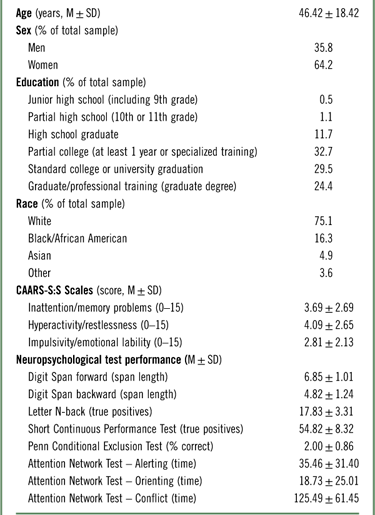
Participant demographic characteristics and performance on the measures of interest are summarized in Table 1. We first investigated the factor structure in the overall sample. Fit indices for each model are summarized in Table 2. Based on these numbers, only the bifactor model with 1 general factor (G-ADHD) and 3 specific factors (S-inattention, S-hyperactivity, and S-impulsivity) met conventional criteria for good fit. As a result, this model was subsequently used to investigate factor structure invariance of ADHD symptomatology across age groups.
Participant characteristics and performance on measures of interest
Note. Participants’ age distribution was bimodal, with peaks at approximately 25 years and 60 years. M=mean; SD=standard deviation; CAARS-S:S=Conners Adult ADHD Rating Scale Self Report Short Version.
Fit indices of each model

Note. *p<.05. CFI=Comparative Fit Index; TLI=Tucker–Lewis Index; RMSEA=root-mean square error of approximation.
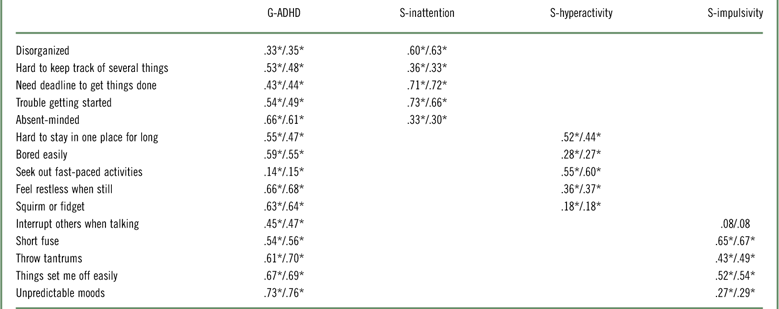
Fit indices of the various models with different degrees of invariance can be found in Table 3. Configural invariance was supported, showing that the same factor structure (ie, a bifactor model with 3 specific factors) was found across both groups (M1 in Table 3). Metric invariance was also supported, showing that factor loadings were invariant across groups (M2 in Table 3). Finally, scalar invariance was supported, showing that item intercepts were invariant across groups (M3 in Table 3). Overall, these results indicate that the factor structure was highly invariant across groups. Standardized factor loadings in young and older adults are reported in Table 4. Factor loadings on the G-ADHD factor were all significant and moderate to large in magnitude, except for a small but significant loading for “Seek out fast-paced activities.” All items also had significant and moderate to large factor loadings on their respective specific factors, except “Squirm or fidget,” which had a small but significant loading, and “Interrupt others when talking,” which had a small, nonsignificant loading.
Fit indices of the models for testing invariance

Note. *p<.05. CFI=Comparative Fit Index; TLI=Tucker–Lewis Index; RMSEA=root-mean square error of approximation.
Standardized factor loadings in younger and older adults

Note. *p<.05. For each factor loading, the first one pertains to younger adults, whereas the second pertains to older adults.
Once scalar invariance was supported, we then tested whether latent factor variances and means were equal across groups. Although constraining variances to be equal across groups resulted in a significant χ2 difference test, changes in CFI, TLI, and RMSEA were small (M3.1). This suggests that variances are not exactly equal across groups, but that these differences are small and negligible. In contrast, most indices indicated that constraining means to equality across groups resulted in a worse model fit (M3.2). Modification indices suggested freeing the means of the hyperactivity and impulsivity factors, which resulted in a model that did not differ from the previous model (M3.3). This model showed that the means of the latent factors were significantly lower among older adults relative to younger adults (hyperactivity, M=–.82; impulsivity, M=–.53).
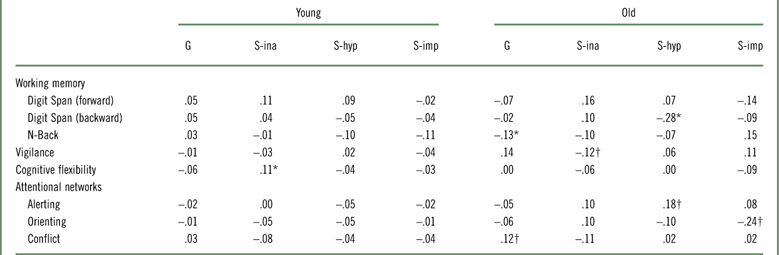
We then investigated whether ADHD symptomatology predicted executive functions among younger and older adults. The results, summarized in Table 5, showed only 1 significant association among younger adults. Here, the effect of S-inattention on cognitive flexibility was small and positive (β=.11). Among older adults, 2 effects were significant: S-hyperactivity predicted poorer performance on the Digit Span (backwards) (β=–.28), and G-ADHD predicted poorer performance on the N-Back task (β=–.13).
Summary of multiple linear regressions predicting executive functions among young and older adults.

Notes. †p<.10, *p<.05. G=G-ADHD; S-ina=S-inattention; S-hyp=S-hyperactivity; S-imp=S-impulsivity. All effects are standardized regressions weights (β). Proportion of variance explained (R2) of the executive function measures can be found in a Supplementary Appendix.
Discussion
The present study used bifactor modeling to compare the factor structure of ADHD symptoms in young (age 18–59) and older adults (age 60–85) using the CAARS-S:S. A secondary objective was to determine the extent to which each factor was independently associated with executive functions.
Consistent with hypotheses, the best fitting bifactor model across both age groups included 1 global G-ADHD factor and 3 specific factors (S-inattention, S-hyperactivity, and S-impulsivity). This is consistent with findings from other bifactor modeling studies, which have contrasted 2 and 3 specific factors in both childrenReference Wagner, Martel and Cogo-Moreira37 and adults.Reference Gibbins, Toplak, Flora, Weiss and Tannock16, Reference Morin, Tran and Caci17 However, it conflicts with DSM and ICD conceptualizations of ADHD in 2 ways: (1) DSM and ICD do not include a global factor and (2) they describe hyperactivity and impulsivity as occurring together. Previous results along with ours from this study provide evidence that the conceptualization of ADHD in both the DSM and the ICD do not reflect how ADHD symptoms are manifested throughout the lifespan. If we assume that the factor structure is partly indicative of the underlying etiology of symptomatology, these results support the idea that there are multiple sources of influences underlying the manifestation of ADHD. Initial bifactor models with 2 specific factors were thought to be consistent with the idea that there were 2 main etiological pathways (ie, a top-down pathway, accounting mostly for inattention, and a bottom-up pathway, accounting for hyperactivity/impulsivity, and, secondary to these symptoms, inattentionReference Burns, de Moura, Beauchaine and McBurnett12). Although the identification of distinct hyperactivity- and impulsivity-specific factors raises the possibility that they have a distinct etiology, others have argued that the extremely low reliability of these specific factors raises doubts as to whether they should even be considered as distinct entities with their own etiology.Reference Rodenacker, Hautmann, Görtz-Dorten and Döpfner10
One finding in the present study also raises questions about the manifestations of impulsivity: 1 impulsivity symptom did not load significantly on the S-impulsivity factor (“Interrupts others when talking”). This item is largely motoric in nature (consistent with the impulsivity symptoms identified in the DSM and the ICD), whereas the other symptoms largely reflect emotional impulsivity, the latter of which may be an under-recognized aspect of ADHD.Reference Barkley and Fischer38 It is also possible that this item captures a social dimension not reflected in other items, and may relate to aspects of social skills that are dysfunctional in many individuals with ADHD.Reference Gardner and Gerdes39 It will be important to investigate whether motoric and emotional impulsivity represent distinguishable constructs, and whether their importance varies across the lifespan.
In this sample, the CAARS-S:S was a comparable measure of ADHD symptoms in both age groups. In addition to manifesting similar clusters of symptoms (ie, inattentive, hyperactive, and impulsive as indicated by the configural invariance model), our statistical models confirmed that: (1) these symptoms were similarly strong indicators of symptomatology in young and older adults (as indicated by the metric invariance model) and (2) symptoms were endorsed at similar rates across both groups within each construct (as indicated by the scalar invariance model). These results show that ADHD symptoms captured by this self-reported measure do not show any age-related bias, which suggests that no age-specific items need to be developed.
The most recent revision of the DSM7 acknowledged that fewer inattentive and hyperactive symptoms are needed to cause clinically significant distress in patients ≥ 18 years. In the present sample, hyperactivity and impulsivity means were slightly but significantly lower in older relative to younger adults. If these results are replicated in independent samples, it may be worthwhile to consider further lowering the threshold for hyperactivity/impulsivity symptoms in adults ≥ 60 years in future revisions of ADHD criteria. At the very least, normative data and cut-off thresholds for the CAARS-S:S should be age-adjusted with regard to hyperactive and impulsive symptoms.
A secondary objective of this work was to examine associations between symptom factors and executive functions. In young adults, the inattention factor was positively associated with the Penn Conditional Exclusion Test, a measure of cognitive flexibility. This association may reflect increased ability to disengage from a condition or rule due to inattention. This association was not present in older adults, perhaps due to relative improvements in inattentive symptoms with age.Reference Bramham, Murphy, Xenitidis, Asherson, Hopkin and Young40 This age-specific pattern may also reflect changes in the strength of associations between ADHD symptoms and cognition, which has been found to decrease in older age.Reference Das, Cherbuin, Easteal and Anstey41 No other relationships reached statistical significance in the young adult group. This conflicts with a recent study reporting associations between inattention, impulsivity, and a number of working memory tasks in adults aged 18–35,Reference Elisa, Balaguer-Ballester and Parris42 although this is perhaps not surprising given the recognized cognitive heterogeneity in adult ADHD.Reference Mostert, Onnink and Klein43
In older adults, the G-factor was associated with worse N-back task scores, which likely reflects the multiple contributions of attention (attending to the current stimulus while mentally holding previous stimuli online) and motor-impulse control (pressing a button only in response to the N-previous stimulus) for successful performance on this task. Increased hyperactivity loadings were associated with worse backward digit span, a measure of working memory. This association has been similarly shown in children, and has been taken as evidence that increased motor activity deleteriously imposes on working memory demands.Reference Rapport, Bolden, Kofler, Sarver, Raiker and Alderson44
One limitation of the study is that we did not include all the scales included in the CAARS-S:S. Indeed, we decided to omit the emotional dysregulation scale, as this construct is not part of ADHD as defined in the DSM or in the ICD. Although we did not aim to investigate the characterization of ADHD symptomatology in the current study, there is evidence that constructs such as emotional dysregulation and sluggish cognitive tempo are frequently observed in individuals with ADHD.Reference Barkley45, Reference Retz, Stieglitz, Corbisiero, Retz-Junginger and Rösler46 It will be important to investigate further if they should be considered an inherent part of ADHD symptomatology or frequently co-occurring deficits, both in children and adults.
An important consideration is that our sample was community-based and not specifically enriched for participants with clinical ADHD. Thus, the measures of interest in this study were administered to individuals who did not necessarily have a diagnosis of adult ADHD, resulting in performance that was largely normal in most respects. This is unlikely to have affected out results, as prior research has shown that the same factor structure is generated in healthy and clinical samples.Reference Christiansen, Hirsch and Philipsen47 In addition, this study relied only the CAARS-S:S as a measure of ADHD symptoms, and it is possible that using a different symptom scale may have resulted in an altered factor structure.
Conclusion
This study found that the factor structure of ADHD symptomatology is consistent across adulthood and is associated with aspects of executive functioning. In both young (18–59 years) and older adults (60–85 adults), ADHD symptoms manifest as 1 global factor (capturing variance shared by all symptoms) and 3 specific factors (inattention, hyperactivity, impulsivity). This diverges from the current conceptualization of ADHD in younger individuals and suggests a need for age-appropriate criteria.
Disclosure
Brandy Callahan and André Plamondon have nothing to disclose.
Supplementary material
To view supplementary material for this article, please visit https://doi.org/10.1017/S1092852918001190