Major depressive disorder (MDD) is a major public health concern. It occurs frequently in the general population and is associated with serious, pervasive, and lasting impairment. The National Comorbidity Survey Replication, an epidemiological survey that assessed diagnoses of common psychiatric disorders using retrospective, cross-sectional assessment, found a lifetime prevalence estimate of 16.6% for MDD (Kessler, Berglund, et al., Reference Kessler, Berglund, Demler, Jin, Merikangas and Walters2005). Recent prospective, longitudinal studies suggest that MDD may be even more common, with lifetime prevalence estimates through early to middle adulthood ranging from 26.0% to 54.8% (Beesdo et al., Reference Beesdo, Hofler, Leibenluft, Lieb, Bauer and Pfennig2009; Hamdi & Iacono, Reference Hamdi and Iacono2014; Moffitt et al., Reference Moffitt, Caspi, Taylor, Kokaua, Milne and Polanczyk2010; Olino et al., Reference Olino, Shankman, Klein, Seeley, Pettit and Farmer2012). For many individuals, depressive disorders emerge well before adulthood; the 3- to 12-month prevalence estimate is relatively low at 2.8% for children under age 13, but the estimate for MDD of 5.7% for adolescents aged 13 to 18 (Costello, Erkanli, & Angold, Reference Costello, Erkanli and Angold2006) is comparable to the 12-month estimate of 6.7% for adults (Kessler, Chiu, Demler, Merikangas, & Walters, Reference Kessler, Chiu, Demler, Merikangas and Walters2005).
MDD has tremendous negative implications for society as a whole and for the individuals it affects. At a societal level, MDD is ranked by the World Health Organization as the fourth leading cause of disability worldwide, and overall lost work performance due to MDD is estimated at $30 to $50 billion a year (Sartorius, Reference Sartorius2001; Üstün, Ayuso-Mateos, Chatterji, Mathers, & Murray, Reference Üstün, Ayuso-Mateos, Chatterji, Mathers and Murray2004). At an individual level, MDD is associated with decreased quality of life, impaired academic and occupational functioning, problematic interpersonal relationships, psychiatric comorbidity, suicidality, negative health behaviors (e.g. smoking, alcohol abuse, disordered eating, poor medication compliance), and increased mortality (Kessler, Reference Kessler2012). There is considerable interest in better understanding the etiology and phenomenology of MDD with the aim of preventing its onset and recurrence and ameliorating its consequences. A large body of literature on risk for MDD has identified family (e.g., family environment, socioeconomic status) and individual (e.g., gender, psychiatric comorbidity, personality) risk factors (see Dobson & Dozois, Reference Dobson and Dozois2008, for a review). There have also been attempts to differentiate factors that confer risk for the first onset of MDD from risk for recurrence after its onset (Burcusa & Iacono, Reference Burcusa and Iacono2007; Coryell, Endicott, & Keller, Reference Coryell, Endicott and Keller1992; Lewinsohn, Allen, Seeley, & Gotlib, Reference Lewinsohn, Allen, Seeley and Gotlib1999). For example, being female, lower socioeconomic status, and experiencing divorce are associated with the onset of MDD but not its recurrence, while stressful life events and the personality trait negative emotionality/neuroticism are associated with first onset, as well as subsequent recurrence, of MDD.
In the present paper, we examine premorbid risk for the development of MDD, as well as predictors of an earlier onset or recurrent course, in a large, community-based sample. We assess a broad range of putative risk factors in late childhood, well before the onset of MDD, and assess MDD prospectively at multiple points from late childhood through adolescence and into adulthood. Because a relatively large proportion of cases of MDD onsets by adolescence (Costello et al., Reference Costello, Erkanli and Angold2006; Hasin, Goodwin, Stinson, & Grant, Reference Hasin, Goodwin, Stinson and Grant2005), investigations of premorbid risk for MDD and particularly early onset MDD require assessments prior to adolescence. Our longitudinal investigation spans two decades, from late childhood into adulthood, and offers a unique opportunity to identify premorbid risk factors for MDD.
Overview of This Study
We considered several indicators of risk for MDD in two studies. The overarching aim of these studies was to identify risk factors for MDD and for its most severe forms: early onset and recurrent MDD. We first provide operational definitions of the terms used in the present paper, including MDD, early onset MDD, and recurrent MDD. We take the pragmatic approach of using age of onset and course categories that facilitate empirical investigation and clinical decision making, though we consider these features to be best conceptualized as dimensional constructs. We then consider the overlap in early onset and recurrent MDD and highlight the difficulty inherent in disentangling these clinical features. Next, we review the existing literature on risk for MDD, focusing in particular on studies of early onset and recurrent MDD. Finally, we present two empirical studies of risk for MDD. In Study 1, we examined a range of putative risk factors assessed in late childhood, well before the onset of MDD, with the aim of identifying risk factors that predict the subsequent development of MDD, as well as an early onset or recurrent course. We considered risk factors drawn from a number of important domains and assessed using multiple methods and reporters. In addition to indicators of risk at the family (parental psychiatric status, parent–child relationship quality) and individual (personality, internalizing and externalizing psychopathology, academic functioning, physical development, childhood maltreatment) levels, in Study 2, we extended our examination to the genetic level by examining associations between MDD and candidate genes involved in the glutamatergic system that were recently identified using a novel gene set-based association analysis.
Definitions of constructs considered in the present paper
MDD
MDD is defined in the current psychiatric classification systems DSM-5 and ICD-10 (World Health Organization, 2010) and similarly in earlier editions of the DSM by the presence of a major depressive episode and absence of any manic or hypomanic episodes, with a major depressive episode defined as a period of 2 weeks or longer in which five or more symptoms (depressed mood, anhedonia, weight or appetite disturbance, sleep disturbance, psychomotor agitation or retardation, fatigue, feelings of worthlessness or guilt, difficulty concentrating or indecisiveness, suicidal ideation) are present most of the day nearly every day. Although some researchers have used symptom checklists or rating scales (e.g., Beck Depression Inventory; Beck, Steer, & Brown, Reference Beck, Steer and Brown1996) to measure depressive symptomatology, we largely limit our review to studies that have used DSM or ICD criteria to make formal diagnoses.
Early onset MDD
There is a considerable variability in how early onset is defined across studies, with definitions ranging from onset in childhood or adolescence through age 60. Although an earlier onset generally indexes greater severity and impairment, there does not appear to be a clear demarcation between proximal developmental periods (e.g., childhood and adolescence, adolescence and early adulthood). For example, Zisook et al. (Reference Zisook, Lesser, Stewart, Wisniewski, Balasubramani and Fava2007) examined a wide range of outcomes (quality of life, social and occupational functioning, physical and psychiatric comorbidity) among individuals with MDD who were classified into five discrete age-of-onset groups: childhood onset (by age 12), adolescent onset (between ages 12 and 17), early adult onset (between ages 18 and 44), middle adult onset (between ages 45 and 59), and late adult onset (after age 60). Earlier onset was associated with greater severity and impairment compared to later onset, but few outcomes differed markedly between age-of-onset groups. For ease of communication, in the present paper we use the term early onset for MDD that onsets during childhood or adolescence.
Recurrent MDD
Recurrent MDD is defined as the presence of multiple MDD episodes. Standard definitions for MDD remission, recovery, relapse, and recurrence have been proposed (Frank et al., Reference Frank, Prien, Jarrett, Keller, Kupfer and Lavori1991; Kupfer & Frank, Reference Kupfer and Frank2001), though few investigations formally assess or report this information. Many individuals with recurrent MDD fail to show complete interepisodic recovery, which takes on particular importance given evidence that the persistence of subthreshold interepisodic depressive symptoms is associated with shorter asymptomatic periods, more rapid and increased rates of relapse and recurrence, and a greater number of and more chronic MDD episodes (Judd et al., Reference Judd, Paulus, Schettler, Akiskal, Endicott and Leon2000), as well as significant social and occupational impairment (Romera et al., Reference Romera, Perez, Menchon, Delgado-Cohen, Polavieja and Gilaberte2010). Much of the existing research on course has focused on factors that predict the recurrence of MDD among individuals who have already experienced an episode (see Burcusa & Iacono, Reference Burcusa and Iacono2007). In the present paper, we focus instead on identifying risk factors for MDD that follows a recurrent course relative to no MDD or single-episode MDD.
Age of onset and course of MDD
MDD often onsets early in life and frequently follows a recurrent course. Epidemiological studies indicate relatively low prevalence of MDD until early adolescence, at which point rates increase rapidly, then continue to increase at a more gradual rate into middle adulthood (Hasin et al., Reference Hasin, Goodwin, Stinson and Grant2005; Kessler et al., Reference Kessler, Berglund, Demler, Jin, Koretz and Merikangas2003). Longitudinal studies with population-based and psychiatric samples indicate that about half of individuals with a first episode of MDD will experience a second or more episodes (estimates range from 40% to 85% depending on the sample and length of follow-up assessment; Eaton et al., Reference Eaton, Shao, Nestadt, Lee, Bienvenu and Zandi2008; Keller et al., Reference Keller, Lavori, Mueller, Endicott, Coryell and Hirschfeld1992; Mattisson, Bogren, Horstmann, Munk-Jorgensen, & Nettelbladt, Reference Mattisson, Bogren, Horstmann, Munk-Jorgensen and Nettelbladt2007; Rohde, Lewinsohn, Klein, Seeley, & Gau, Reference Rohde, Lewinsohn, Klein, Seeley and Gau2013; Solomon et al., Reference Solomon, Keller, Leon, Mueller, Lavori and Shea2000). A recurrence of MDD typically occurs within 5 years of the first episode, whether assessed in samples of children (Kovacs et al., Reference Kovacs, Feinberg, Crouse-Novak, Paulauskas, Pollock and Finkelstein1984), adolescents (Lewinsohn, Clarke, Seeley, & Rohde, Reference Lewinsohn, Clarke, Seeley and Rohde1994; Rao et al., Reference Rao, Ryan, Birmaher, Dahl, Williamson and Kaufman1995), or adults (Solomon et al., Reference Solomon, Keller, Leon, Mueller, Lavori and Shea2000), and individuals with MDD will experience an average of five separate episodes within their lifetimes (Hasin et al., Reference Hasin, Goodwin, Stinson and Grant2005). Individuals with early onset MDD are more likely to experience recurrent episodes (Pettit, Lewinsohn, Roberts, Seeley, & Monteith, Reference Pettit, Lewinsohn, Roberts, Seeley and Monteith2009; Rao, Hammen, & Daley, Reference Rao, Hammen and Daley1999; Rohde et al., Reference Rohde, Lewinsohn, Klein, Seeley and Gau2013; Weissman et al., Reference Weissman, Wolk, Goldstein, Moreau, Adams and Greenwald1999; Wickramaratne, Warner, & Weissman, Reference Wickramaratne, Warner and Weissman2000; Zisook et al., Reference Zisook, Lesser, Stewart, Wisniewski, Balasubramani and Fava2007, Reference Zisook, Rush, Albala, Alpert, Balasubramani and Fava2004). That these clinical features naturally co-occur means that investigations of early onset MDD almost invariably include a large proportion of individuals with recurrent MDD, and investigations of recurrent MDD include many individuals with an early onset. This means that it can be difficult to discern from existing research whether risk or impairment is specific to one or both clinical features or to individuals experiencing early onset MDD that follows a recurrent course. In the present paper, we sought to differentiate these clinical features by identifying risk factors that predicted an early onset from a later onset of MDD and a recurrent from a single-episode course of MDD, while accounting for effects of age of onset on course and vice versa.
Risk factors for MDD
In this section, we review the literature on several putative risk factors for MDD, paying particular attention to indicators of risk that are associated with an earlier (vs. later) age of onset or a recurrent (vs. single-episode) course.
Genetic influences
Considerable research has sought to understand genetic influences on MDD. There is evidence from family and twin studies that depressive disorders aggregate in families (see Rice, Harold, & Thapar, Reference Rice, Harold and Thapar2002; Sullivan, Neale, & Kendler, Reference Sullivan, Neale and Kendler2000). The heritability of MDD is estimated at approximately 37% (Sullivan et al., Reference Sullivan, Neale and Kendler2000), and there is evidence that early onset and recurrent MDD show even greater familial risk. For example, Weissman et al. (Reference Weissman, Wickramaratne, Merikangas, Leckman, Prusoff and Caruso1984) found that early onset (before age 20) MDD was associated with increased rates of MDD in family members, while later onset MDD (after age 40) showed rates that were comparable to healthy controls. Klein, Lewinsohn, Seeley, and Rohde (Reference Klein, Lewinsohn, Seeley and Rohde2001) also found that early onset MDD was associated with increased rates of MDD in family members, but a later report noted that rates were even higher for early onset, recurrent MDD (Klein, Lewinsohn, Rohde, Seeley, & Durbin, Reference Klein, Lewinsohn, Rohde, Seeley and Durbin2002). Bland, Newman, and Orn (Reference Bland, Newman and Orn1986) and Pettit, Hartley, Lewinsohn, Seeley, and Klein (Reference Pettit, Hartley, Lewinsohn, Seeley and Klein2013) found that, relative to single-episode MDD, recurrent MDD was associated with increased rates of MDD in family members, and McGuffin, Katz, Watkins, and Rutherford (Reference McGuffin, Katz, Watkins and Rutherford1996) found that having three or more MDD episodes was associated with greater concordance among monozygotic than dizygotic twin pairs. In addition, there is evidence of psychopathology other than depressive disorders in the family members of probands with early onset or recurrent MDD, including anxiety disorders, substance use disorders, and antisocial personality disorder (e.g., Klein et al., Reference Klein, Lewinsohn, Seeley and Rohde2001; Klein, Shankman, Lewinsohn, Rohde, & Seeley, Reference Klein, Shankman, Lewinsohn, Rohde and Seeley2004; Kovacs, Devlin, Pollock, Richards, & Mukerji, Reference Kovacs, Devlin, Pollock, Richards and Mukerji1997; Weller et al., Reference Weller, Kapadia, Weller, Fristad, Lazaroff and Preskorn1994). However, few studies have attempted to differentiate the effects of MDD onset and course, meaning that it is difficult to determine their relative influences. For example, the increased rates of MDD in family members found by Klein et al. (Reference Klein, Lewinsohn, Rohde, Seeley and Durbin2002) for probands with early onset, recurrent MDD could be due to greater familial risk for early onset MDD or for recurrent MDD or may be specific to early onset MDD that follows a recurrent course.
Evidence of the heritability of MDD from family and twin studies has prompted efforts to identify specific genetic variants associated with MDD. Earlier molecular genetics research included genome-wide linkage and candidate gene association studies of MDD, which showed little consistency in results across studies and multiple failures to replicate (see Bosker et al., Reference Bosker, Hartman, Nolte, Prins, Terpstra and Posthuma2011; Lopez-Leon et al., Reference Lopez-Leon, Janssens, Ladd, Del-Favero, Claes and Oostra2008). More recent genome-wide association studies (GWAS) of MDD, including early onset and recurrent MDD, have likewise failed to identify genetic variants that achieve genome-wide significance (Kohli et al., Reference Kohli, Lucae, Saemann, Schmidt, Demirkan and Hek2011; Lewis et al., Reference Lewis, Ng, Butler, Cohen-Woods, Uher and Pirlo2010; Muglia et al., Reference Muglia, Tozzi, Galwey, Francks, Upmanyu and Kong2010; Rietschel et al., Reference Rietschel, Mattheisen, Frank, Treutlein, Degenhardt and Breuer2010; Shi et al., Reference Shi, Potash, Knowles, Weissman, Coryell and Scheftner2011; Shyn et al., Reference Shyn, Shi, Kraft, Potash, Knowles and Weissman2011; Sullivan et al., Reference Sullivan, de Geus, Willemsen, James, Smit and Zandbelt2009; Wray et al., Reference Wray, Pergadia, Blackwood, Penninx, Gordon and Nyholt2012), as did a recent mega-analysis of participants pooled across multiple GWAS (Sullivan et al., Reference Sullivan, Daly, Ripke, Lewis, Lin and Wray2013). The etiology of MDD is likely heterogeneous and influenced by complex interactions of genetic and nongenetic factors, and these results suggest polygenic effects on MDD, with individually weak effects of specific genetic variants (for a review, see Lohoff, Reference Lohoff2010). The failure of single nucleotide polymorphism (SNP) based association tests typically used in current GWAS approaches to identify genetic variants for MDD has prompted the application of novel approaches, such as gene set-based GWAS analysis, that hold considerable promise for identifying specific genetic risk factors and helping to elucidate the neurobiological basis of MDD and other psychiatric disorders (e.g., Glessner et al., Reference Glessner, Wang, Cai, Korvatska, Kim and Wood2009; Han et al., Reference Han, Yang, Kranzler, Liu, Zhao and Farrer2013; Holmans et al., Reference Holmans, Green, Pahwa, Ferreira, Purcell and Sklar2009; Lee et al., Reference Lee, Perlis, Jung, Byrne, Rueckert and Siburian2012; Lips et al., Reference Lips, Cornelisse, Toonen, Min and Hultman2012). However, the success of these alternative approaches hinges upon replication of the genetic variants identified, and attempts to confirm positive findings of associations between MDD and specific genetic variants identified in recent studies are needed.
Personality
A well-established body of cross-sectional literature demonstrates concurrent links between normal-range personality traits and psychiatric disorders (see Kotov, Gamez, Schmidt, & Watson, Reference Kotov, Gamez, Schmidt and Watson2010, for a meta-analysis). Negative emotionality/neuroticism (a tendency to experience negative mood states) appears to be a nonspecific risk factor for psychopathology in general, while (low) positive emotionality/extraversion (a tendency to experience positive mood states) has been implicated as specific to depressive disorders (Clark & Watson, Reference Clark and Watson1991; Mineka, Watson, & Clark, Reference Mineka, Watson and Clark1998; Watson & Tellegen, Reference Watson and Tellegen1985). Higher negative emotionality and, less consistently, lower positive emotionality predict MDD and depressive symptoms in childhood and adolescence (Beevers, Rohde, Stice, & Nolen-Hoeksema, Reference Beevers, Rohde, Stice and Nolen-Hoeksema2007; Lonigan, Phillips, & Hooe, Reference Lonigan, Phillips and Hooe2003; Wetter & Hankin, Reference Wetter and Hankin2009) and adulthood (de Graaf, Bijl, Ravelli, Smit, & Vollebergh, Reference de Graaf, Bijl, Ravelli, Smit and Vollebergh2002; Fanous, Neale, Aggen, & Kendler, Reference Fanous, Neale, Aggen and Kendler2007; Kendler, Gatz, Gardner, & Pedersen, Reference Kendler, Gatz, Gardner and Pedersen2006; Kendler, Neale, Kessler, Heath, & Eaves, Reference Kendler, Neale, Kessler, Heath and Eaves1993; Ormel, Oldehinkel, & Vollebergh, Reference Ormel, Oldehinkel and Vollebergh2004; Shea et al., Reference Shea, Leon, Mueller, Solomon, Warshaw and Keller1996; Wilson, DiRago, & Iacono, Reference Wilson, DiRago and Iacono2014). Although less frequently considered, there is also evidence that (low) constraint/conscientiousness (a tendency to inhibit impulsive, risky behavior) is concurrently associated with MDD and depressive symptoms in childhood (John, Caspi, Robins, Moffitt, & Stouthamer-Loeber, Reference John, Caspi, Robins, Moffitt and Stouthamer-Loeber1994), adolescence (Wilson et al., Reference Wilson, DiRago and Iacono2014), and adulthood (Kotov et al., Reference Kotov, Gamez, Schmidt and Watson2010). We are aware of only two studies, which are from our own group, that explicitly compared personality traits for early onset and later onset MDD. Although we found higher negative emotionality for both early and later onset MDD relative to no MDD (Wilson et al., Reference Wilson, DiRago and Iacono2014, in press), and we also found that negative emotionality in adolescence prospectively predicted the onset of MDD in adulthood (Wilson et al., Reference Wilson, DiRago and Iacono2014), we found little evidence of differences in negative emotionality or positive emotionality in adulthood as a function of age of onset once course was accounted for (Wilson et al., in press). A handful of studies have considered effects of personality traits for the course of depressive disorders. Duggan, Lee, and Murray (Reference Duggan, Lee and Murray1990) and Duggan, Sham, Lee, and Murray (Reference Duggan, Sham, Lee and Murray1991) found that higher negative emotionality was prospectively associated with recurrent MDD. Wilson et al. (Reference Wilson, DiRago and Iacono2014) found that negative emotionality was concurrently and prospectively associated with both recurrent/chronic MDD and nonrecurrent/nonchronic MDD, relative to no MDD, but positive emotionality was concurrently and prospectively associated only with recurrent/chronic MDD (regardless of whether it onset early or later). Wilson et al. (in press) explicitly compared personality traits for recurrent and single-episode MDD and found that recurrent MDD predicted lower positive emotionality and higher negative emotionality. Wilson et al. (in press) found the lowest positive emotionality and highest negative emotionality for individuals with early onset, recurrent MDD. Consistent with these results, Durbin, Klein, Hayden, Buckley, and Moerk (Reference Durbin, Klein, Hayden, Buckley and Moerk2005) found that positive emotionality was lower among young children of parents with early onset or recurrent/chronic depressive disorders relative to parents with later onset or nonrecurrent/nonchronic depressive disorders.
Psychopathology and psychosocial functioning
There is ample evidence that MDD is associated with comorbid internalizing and externalizing symptomatology, including anxiety, substance use, and antisocial behavior, as well as impaired functioning in important psychosocial domains, including conflictual interpersonal relationships, academic and work dysfunction, and poor physical health (see Chapman, Perry, & Strine, Reference Chapman, Perry and Strine2005; Hirschfeld et al., Reference Hirschfeld, Montgomery, Keller, Kasper, Schatzberg and Moller2000; Kessler, Reference Kessler2012; Swendsen & Merikangas, Reference Swendsen and Merikangas2000, for reviews). A number of studies suggest particularly severe dysfunction for early onset and recurrent MDD, including concurrent and prospective associations with alcohol, nicotine, and illicit substance use and abuse, and antisocial behavior (Hammen, Brennan, Keenan-Miller, & Herr, Reference Hammen, Brennan, Keenan-Miller and Herr2008; Lewinsohn, Rohde, Seeley, Klein, & Gotlib, Reference Lewinsohn, Rohde, Seeley, Klein and Gotlib2003; Sihvola et al., Reference Sihvola, Rose, Dick, Pulkkinen, Marttunen and Kaprio2008; Wilson et al., in press); relationship impairment (Hammen, Brennan, & Keenan-Miller, Reference Hammen, Brennan and Keenan-Miller2008; Hammen, Brennan, Keenan-Miller, & Herr, Reference Hammen, Brennan, Keenan-Miller and Herr2008; Jonsson et al., Reference Jonsson, Bohman, Hjern, von Knorring, Paaren and Olsson2011; Lewinsohn et al., Reference Lewinsohn, Rohde, Seeley, Klein and Gotlib2003; Puig-Antich et al., Reference Puig-Antich, Kaufman, Ryan, Williamson, Dahl and Lukens1993; Weissman et al., Reference Weissman, Wolk, Goldstein, Moreau, Adams and Greenwald1999, in press) and intimate partner violence (Jonsson et al., Reference Jonsson, Bohman, Hjern, von Knorring, Paaren and Olsson2011); lower rates of graduation, less educational attainment, greater unemployment, and lower income (Breslau, Michael, Nancy, & Kessler, Reference Breslau, Michael, Nancy and Kessler2008; Fergusson, Boden, & Horwood, Reference Fergusson, Boden and Horwood2007; Fergusson & Woodward, Reference Fergusson and Woodward2002; Jonsson et al., Reference Jonsson, Bohman, Hjern, von Knorring, Paaren and Olsson2011; Lewinsohn et al., Reference Lewinsohn, Rohde, Seeley, Klein and Gotlib2003); and poorer mental health, more acute and chronic health conditions, and more visits to health professionals (Bardone, Moffitt, Caspi, Dickson, & Silva, Reference Bardone, Moffitt, Caspi, Dickson and Silva1996; Copeland, Shanahan, Worthman, Angold, & Costello, Reference Copeland, Shanahan, Worthman, Angold and Costello2012; Keenan-Miller, Hammen, & Brennan, Reference Keenan-Miller, Hammen and Brennan2007; Lewinsohn, Seeley, Hibbard, Rohde, & Sack, Reference Lewinsohn, Seeley, Hibbard, Rohde and Sack1996; Marmorstein, Iacono, & Legrand, Reference Marmorstein, Iacono and Legrand2014; Wilson et al., in press).
Although these studies indicate that MDD is associated with comorbid psychopathology and impaired functioning in important domains, several methodologically rigorous studies carefully designed to examine whether MDD has lasting consequences suggest that dysfunction is limited to proximal (i.e., residual) depressive symptomatology and/or was apparent prior to the onset of MDD (for reviews, see Burcusa & Iacono, Reference Burcusa and Iacono2007; Wichers, Geschwind, van Os, & Peeters, Reference Wichers, Geschwind, van Os and Peeters2010). For example, Beevers et al. (Reference Beevers, Rohde, Stice and Nolen-Hoeksema2007) found in a sample of adolescents that internalizing (depressive symptoms, lower self-esteem, rumination) and externalizing (substance use, antisocial behavior) problems, interpersonal dysfunction (less parent and peer support, greater parent control), and stressful life events were evident even before the onset of MDD. Ormel, Oldehinkel, Nolen, and Vollebergh (Reference Ormel, Oldehinkel, Nolen and Vollebergh2004) similarly found in a sample of adults evidence of dysfunction in important social roles prior to the onset of MDD; however, when participants with recurrent MDD were considered separately, there was greater dysfunction following MDD remission than had been evident prior to onset, suggesting that recurrent MDD may have a “scar” effect on functioning. This finding dovetails with evidence from our group and others that early onset MDD is concurrently associated with psychosocial impairment in adolescence, but ongoing psychosocial impairment into adulthood is largely a function of a recurrent course (Hammen, Brennan, Keenan-Miller, & Herr, Reference Hammen, Brennan, Keenan-Miller and Herr2008; Lewinsohn et al., Reference Lewinsohn, Rohde, Seeley, Klein and Gotlib2003; Wilson et al., in press); moreover, we found that the negative psychosocial outcomes in adulthood found for recurrent MDD held over and above psychosocial impairment evident in adolescence, indicating that recurrent MDD predicts decrements in functioning over time (Wilson et al., in press). In one of the few studies to have examined whether premorbid dysfunction is evident prior to adolescence, or whether early onset MDD shows greater premorbid dysfunction than later-onset MDD, Jaffee et al. (Reference Jaffee, Moffitt, Caspi, Fombonne, Poulton and Martin2002) found a number of premorbid risk factors assessed in childhood that predicted MDD onset by adolescence versus in adulthood, including internalizing and externalizing symptoms; however, there was no evidence of premorbid differences for early onset MDD that recurred in adulthood versus nonrecurrent early onset MDD.
Study 1
In Study 1, we examined a number of putative indicators of risk for MDD, including parental psychiatric disorders and premorbid functioning. Consistent with evidence of the familial aggregation of MDD (Rice et al., Reference Rice, Harold and Thapar2002; Sullivan et al., Reference Sullivan, Neale and Kendler2000), we expected that offspring with MDD would show increased rates of MDD and other psychiatric disorders in their parents. Previous research on premorbid risk for MDD has largely been conducted in adolescence and adulthood (Beevers et al., Reference Beevers, Rohde, Stice and Nolen-Hoeksema2007; de Graaf et al., Reference de Graaf, Bijl, Ravelli, Smit and Vollebergh2002; Fanous et al., Reference Fanous, Neale, Aggen and Kendler2007; Kendler et al., Reference Kendler, Neale, Kessler, Heath and Eaves1993, Reference Kendler, Gatz, Gardner and Pedersen2006; Lonigan et al., Reference Lonigan, Phillips and Hooe2003; Ormel, Oldehinkel, & Vollebergh, Reference Ormel, Oldehinkel and Vollebergh2004; Shea et al., Reference Shea, Leon, Mueller, Solomon, Warshaw and Keller1996; Wetter & Hankin, Reference Wetter and Hankin2009). We extended this research to late childhood, and hypothesized that premorbid dysfunction would predict the subsequent development of MDD.
Our prospective assessment of MDD at multiple time points from childhood into adulthood also allowed us to examine indicators of risk that predict an earlier onset and recurrent course of MDD. We expected to find increased rates of parental MDD and other psychiatric disorders for offspring with early onset and recurrent MDD, as suggested in earlier research (Bland et al., Reference Bland, Newman and Orn1986; Klein et al., Reference Klein, Lewinsohn, Rohde, Seeley and Durbin2002, Reference Klein, Shankman, Lewinsohn, Rohde and Seeley2004; Pettit et al., Reference Pettit, Hartley, Lewinsohn, Seeley and Klein2013; Weissman et al., Reference Weissman, Wickramaratne, Merikangas, Leckman, Prusoff and Caruso1984). We further hypothesized that (a) premorbid negative emotionality would be highest for early onset, recurrent MDD, as suggested by our findings in late adolescence and young adulthood (Wilson et al., Reference Wilson, DiRago and Iacono2014, in press); (b) higher disconstraint would predict early onset MDD, as suggested in our previous work (Wilson et al., Reference Wilson, DiRago and Iacono2014); and (c) lower premorbid positive emotionality would be specific to recurrent MDD. Our hypotheses for other domains of premorbid functioning on onset and course were more exploratory. Drawing on the results of the only similar study in childhood of which we are aware (Jaffee et al., Reference Jaffee, Moffitt, Caspi, Fombonne, Poulton and Martin2002), we hypothesized that, in general, premorbid dysfunction would predict an earlier onset of MDD but not a recurrent course.
Methods
Participants and procedures
Participants were 2,764 male and female twins from the Minnesota Twin Family Study (MTFS; 54% female) and their parents. The MTFS is an ongoing community-based, longitudinal study of reared-together twins and their parents, and it is one of several ongoing studies that compose the Minnesota Center for Twin and Family Research (MCTFR); the study design and sample have been described extensively elsewhere (see Iacono, Carlson, Taylor, Elkins, & McGue, Reference Iacono, Carlson, Taylor, Elkins and McGue1999; Iacono & McGue, Reference Iacono and McGue2002; Iacono, McGue, & Krueger, Reference Iacono, McGue and Krueger2006) and are only briefly reviewed here. The present study included two cohorts first recruited for participation at offspring age 11 (younger cohort, n = 1,512) or 17 (older cohort, n = 1,252). Consistent with the demographic makeup of Minnesota during the targeted birth years, families were predominately Caucasian (98%). The MTFS design includes assessments at offspring target ages of 11 (M = 11.72, SD = 0.43), 14 (M = 14.80, SD = 0.53), 17 (M = 17.83, SD = 0.69), 20 (M = 21.10, SD = 0.82), 24 (M = 25.01, SD = 0.90), and 29 years (M = 29.42, SD = 0.65). The present study includes data on offspring MDD diagnoses at each assessment. Parental psychiatric diagnoses were assessed for mothers and fathers of younger and older cohort offspring at study intake (the older cohort was used only in analyses of parental psychiatric disorders). Offspring functioning variables were assessed at age 11 for the younger cohort (analyses of premorbid functioning used only the younger cohort because only it was assessed at age 11, prior to the majority of first onset cases of MDD). Rates of retention across follow-up waves were universally high (ranging from 87% to 94% across assessments).
Offspring MDD diagnoses
Offspring MDD diagnoses and information on the onset and course of depressive symptoms were assessed in semistructured interviews using the Diagnostic Interview for Children and Adolescents—Revised (DICA-R; Reich & Welner, Reference Reich and Welner1988) in offspring younger than age 17, and the Structured Clinical Interview for DSM-III-R (Spitzer, Williams, Gibbon, & First, Reference Spitzer, Williams, Gibbon and First1987) in offspring aged 17 and older. Mothers also reported on offspring aged 17 and younger using the DICA-R, and a best estimate procedure was used to assign MDD diagnoses if symptoms were endorsed by either offspring or their mothers. MDD diagnoses were based on DSM-III-R criteria to maintain continuity with the diagnostic system in use at the time of the MTFS intake. MDD diagnoses were assigned if criteria were met at a “definite” (i.e., full DSM-III-R criteria met) or “probable” (i.e., one criterion less than full DSM-III-R criteria met) level, following guidelines introduced in the Research Diagnostic Criteria (Spitzer, Endicott, & Robins, Reference Spitzer, Endicott and Robins1978) to account for the episodic nature of MDD and that participants were rarely acutely symptomatic at the time of assessment, meaning that they relied on memory when reporting on MDD symptoms. Diagnostic interviews were conducted by extensively trained interviewers with bachelor's or master's degrees in psychology or a related discipline. All diagnostic interviews were reviewed in case conferences with at least two advanced clinical psychology graduate students, and consensus was required prior to assigning each symptom. Computer algorithms were used to assign diagnoses at each time point. Interrater reliability for MDD diagnoses was assessed on a randomly selected subsample of 600 MTFS participants (κ = ≥0.78).
A total of 891 (40%) offspring reported a lifetime history of MDDFootnote 1 through age 29 (i.e., criteria met for at least one MDD episode at any assessment). MDD age of onset was defined as early onset (n = 332) if onset was prior to the age 17 assessment and as later onset (n = 499) if onset was after the age 17 assessment. MDD course was defined as single episode (n = 403) if only one MDD episode was reported through age 29, and recurrent (n = 428) if multiple MDD episodes were reported through age 29. In addition, early onset, recurrent depression (n = 193) was defined as MDD onset prior to the age 17 assessment with multiple MDD episodes reported through age 29; 584 participants were classified as having other forms of MDD (i.e., lifetime history of MDD but not early onset, recurrent MDD). No MDD (n = 1,366) was defined as never meeting criteria for MDD (definite or probable) at any assessment point through age 29.Footnote 2
Parental psychiatric diagnoses
Parental psychiatric diagnoses were assessed in semistructured interviews with mothers and fathers using the Structured Clinical Interview for DSM-III-R (Spitzer et al., Reference Spitzer, Williams, Gibbon and First1987) at study intake. As for offspring, diagnoses were assigned if criteria were met at a definite or probable level, and diagnostic interviews with parents followed the same procedures to ensure consensus and reliability as followed for offspring. Parental psychiatric diagnoses included either mother or father meeting criteria for a lifetime history of MDD, anxiety disorder (panic disorder with or without agoraphobia, agoraphobia, social phobia, specific phobia, generalized anxiety disorder),Footnote 3 substance use disorder (alcohol or drug abuse or dependence), conduct disorder, or adult antisocial behavior (the adult component of antisocial personality disorder).
Offspring premorbid functioning
Premorbid (age 11) functioning was assessed using multiple methods and informants (offspring, parents, teachers). The frequency distributions of all variables were examined and transformations were applied as appropriate. All continuous variables were transformed to z scores (M = 0, SD = 1); all binary variables were coded so that 0 = absence and 1 = presence.
Personality
Offspring positive emotionality, negative emotionality, and disconstraint were assessed at age 11 using mothers' reports on the Multidimensional Personality Ratings (Cukrowicz, Taylor, Schatschneider, & Iacono, Reference Cukrowicz, Taylor, Schatschneider and Iacono2006; Oliva, Keyes, Iacono, & McGue, Reference Oliva, Keyes, Iacono and McGue2012; Tackett, Krueger, Iacono, & McGue, Reference Tackett, Krueger, Iacono and McGue2008) and teachers' reports on the Teacher Rating Form (TRF; Hicks, Iacono, & McGue, Reference Hicks, Iacono and McGue2014; Hicks et al., Reference Hicks, Johnson, Durbin, Blonigen, Iacono and McGue2014). The 34-item Multidimensional Personality Ratings was developed to approximate the adult Multidimensional Personality Questionnaire (Tellegen & Waller, Reference Tellegen, Waller, Boyle, Matthews and Saklofske2008) and includes the three higher order scales of positive emotionality (12 items; α = 0.82), negative emotionality (9 items; α = 0.74), and disconstraint (8 items; α = 0.73). The TRF includes 129 items that assess personality, behavior, and academic domains, and was completed by up to four teachers nominated by each participant. TRF positive emotionality (11 items; α = 0.88), negative emotionality (6 items; α = 0.88), and disconstraint (8 items; α = 0.93) scales were computed based on the results of a principal axis factor analysis with varimax rotation of the personality items. Composite positive emotionality, negative emotionality, and disconstraint variables were computed by transforming mother and teacher reports to z scores and averaging across raters (interrater r = .40 for positive emotionality, .25 for negative emotionality, and .37 for disconstraint).
Psychopathology
Offspring reported on their general level of anxiety at age 11 using a 20-item self-report anxiety scale (α = 0.83; Spielberger, Reference Spielberger1983). Offspring substance use and misuse at age 11 was assessed using offspring and their mothers' reports of DSM-III-R symptoms of alcohol, nicotine, and drug abuse or dependence on the DICA-R (using a best estimate procedure to assign symptoms if endorsed by either offspring or their mother), as well as offspring reports of the quantity and frequency of alcohol, nicotine, and drug use using a computer-administered substance-use assessment. All substance use/misuse variables were log(1 + x) transformed to reduce positive skew. Offspring alcohol use/misuse included the quantity of alcohol use in the preceding year, frequency of use in the preceding year, maximum number of drinks consumed in 24 hr, and alcohol abuse/dependence symptoms. The mean r between alcohol use/misuse variables was .71, and variables were transformed to z scores and averaged to create an alcohol use/misuse composite variable. Offspring nicotine use/misuse included the quantity of nicotine use in the preceding year, frequency of use in the preceding year, and nicotine dependence symptoms. The mean r between nicotine use/misuse variables was .56, and variables were transformed to z scores and averaged to create a nicotine use/misuse composite variable. Offspring drug use/misuse included ever using marijuana and abuse/dependence symptoms for the drug class with the highest number of reported symptoms. The r between drug use/misuse variables was .38, and variables were transformed to z scores and averaged to create a drug use/misuse composite variable. The mean r among alcohol, nicotine, and drug use/misuse variables was .35, and variables were transformed to z scores and averaged to create a substance use/misuse composite variable. Offspring externalizing symptoms at age 11 were assessed using offspring and their mothers' reports of DSM-III-R oppositional defiant disorder, conduct disorder, and attention-deficit/hyperactivity disorder symptoms on the DICA-R (using a best estimate procedure to assign symptoms). All externalizing symptom count variables were log(1 + x) transformed to reduce positive skew. The mean r between externalizing symptom variables was .35, and variables were transformed to z scores and averaged to create an externalizing symptoms composite variable.
Psychosocial functioning
Offspring and their mothers reported on academic functioning (cumulative GPA, academic engagement) at age 11 using the Academic History Questionnaire (Johnson, McGue, & Iacono, Reference Johnson, McGue and Iacono2006). The Academic History Questionnaire academic engagement scale includes seven items (α = 0.83) that assess interest in and enjoyment of school, and study habits. The r between GPA and academic engagement was .53. Variables were transformed to z scores and averaged to create an academic functioning composite variable, with higher values indicating poorer academic functioning. Offspring and their parents reported on the quality of the parent–child relationship (involvement, conflict, regard, structure) at age 11 using the 50-item Parental Environment Questionnaire (PEQ; Elkins, McGue, & Iacono, Reference Elkins, McGue and Iacono1997). The Cronbach αs for the PEQ scales ranged from 0.69 to 0.82; the mean of offspring, mother, and father ratings on the first principal component among the PEQ scales (mean r across informants = .41) was used to create the parent–child relationship composite variable, with higher values indicating lower quality parent–child relationship.
Physical development
Offspring reported on their pubertal development at age 11 using the Pubertal Development Scale (Petersen, Crockett, Richards, & Boxer, Reference Petersen, Crockett, Richards and Boxer1988). The Pubertal Development Scale includes five (males) and seven (females) items that assess Tanner stages, including (for males) pubic hair and voice changes, and (for females) breast development and menarche, with higher values indicating more advanced pubertal development. Offspring body mass index (BMI), a height-corrected weight–height index (weight in kilograms/height in meters2), was calculated by measuring height and weight in person in the laboratory.
Childhood maltreatment
Offspring reported on their history of physical abuse/assault or sexual abuse/assault using the Life Events Interview (Bemmels, Burt, Legrand, Iacono, & McGue, Reference Bemmels, Burt, Legrand, Iacono and McGue2008; Billig, Hershberger, Iacono, & McGue, Reference Billig, Hershberger, Iacono and McGue1996) retrospectively at the age 29 assessment. Offspring reports of the age at which the abuse first occurred were used to create physical and sexual abuse/assault by age 11 variables.
Data analyses
We conducted a series of two-level multilevel models that accounted for the interdependence of the family data (individual offspring at Level 1, nested within families at Level 2) to examine associations between indicators of risk and MDD. We calculated odds ratios with 95% confidence intervals to index the odds of offspring MDD when risk was present relative to when it was not (parental psychiatric disorders, childhood maltreatment), or the odds of offspring MDD for every one unit (i.e., one standard deviation) change in the risk variable (personality, psychopathology, psychosocial functioning, physical development). First, we considered any MDD diagnosis (i.e., regardless of age of onset or course). We fit a series of models predicting offspring MDD (0 = no MDD, 1 = MDD) as a function of a parental psychiatric disorder (0 = no disorder, 1 = disorder) and offspring functioning variables (in separate models). Second, we sought to differentiate risk for MDD onset and course by examining whether risk for MDD was specific to early onset or recurrent MDD; to reduce the number of statistical tests conducted, only risk factors that showed significant associations with MDD were examined for early onset and course. We fit a series of models predicting MDD onset (0 = later onset, 1 = early onset) and course (0 = single episode, 1 = recurrent episodes) as a function of risk variables (in separate models); in order to account for the overlap between MDD onset and course, we included course in models predicting onset, and onset in models predicting course. We considered an effect specific to early onset or recurrent MDD if two criteria were met: (a) the results were significant for either early onset or recurrent MDD, but not the other and (b) the 95% confidence interval for the odds ratio for the significant result did not include the odds ratio for the nonsignificant result. Finally, we considered risk for the most severe form of MDD by examining whether risk was greatest for early onset, recurrent MDD. We fit a series of models for the type of MDD (0 = other MDD, 1 = early onset, recurrent) as a function of risk variables (in separate models). All analyses that included premorbid offspring functioning variables were conducted excluding offspring with a definite or probable diagnosis of MDD at age 11 (n = 48). Offspring sex was included as a covariate in all models.Footnote 4 All analyses were conducted using Scientific Software International's HLM 6.04 (Raudenbush, Bryk, & Congdon, Reference Raudenbush, Bryk and Congdon2004) with full maximum likelihood estimation. The significance level was set at p < .05 for all analyses.
Results
Risk factors for MDD
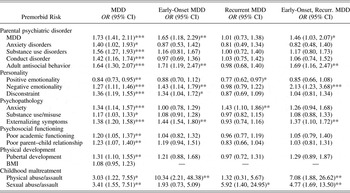
The results of analyses examining risk factors for an MDD diagnosis are presented in the second column of Table 1. Offspring with psychiatric disorders in their parents, including MDD, anxiety disorders, substance use disorders, conduct disorder, and adult antisocial behavior, were at significantly greater risk of a diagnosis of MDD. Moreover, many indicators of premorbid dysfunction evident at age 11 predicted increased risk of a diagnosis of MDD, including lower positive emotionality, higher negative emotionality and disconstraint, higher trait anxiety, substance use/misuse, externalizing symptoms, poorer school functioning, poorer parent–child relationship quality, and more advanced pubertal development. Finally, childhood physical and sexual abuse/assault predicted increased risk of a diagnosis of MDD.
Effects of parental psychiatric disorders and premorbid (age 11) functioning on MDD

Note: The results of multilevel models examining risk for major depressive disorder (MDD; 0 = no MDD, 1 = MDD); early-onset MDD (0 = later onset, 1 = early onset); recurrent MDD (0 = single episode, 1 = recurrent episodes); and early-onset, recurrent MDD (0 = other MDD, 1 = early onset, recurrent) as a function of parental psychiatric disorder (0 = no disorder, 1 = disorder), premorbid (age 11) personality, psychopathology, psychosocial functioning, physical development, and childhood maltreatment (0 = no abuse/assault, 1 = abuse/assault; in separate models); models for early-onset MDD include recurrence, and models for recurrent MDD include age of onset. Participant sex was entered as a covariate in all models. Statistics are odds ratios (95% confidence intervals). For binary variables (parental psychiatric disorders, childhood maltreatment), odds ratios index the odds of offspring MDD when the risk is present relative to when it is not; for continuous variables (personality, psychopathology, psychosocial functioning, physical development), odds ratios index the odds of offspring MDD for every unit (i.e., 1 SD) change in the risk variable. Only risk factors that were significantly associated with MDD were evaluated in models for early-onset, recurrent, and early-onset, recurrent MDD; risk factors that were not further evaluated because of nonsignificant associations with MDD are noted as —. BMI, Body mass index.
*p < .05. **p < .01. ***p < .001.
Risk factors for early onset and recurrent MDD
The results of analyses examining risk factors for early onset (vs. later onset) and recurrent (vs. single-episode) MDD, accounting for the effects of onset on course, and course on onset, are presented in the third and fourth column of Table 1. Offspring with MDD or adult antisocial behavior in their parents were at significantly greater risk of an early onset of MDD (regardless of whether it ultimately followed a recurrent or single-episode course). In contrast, parental psychiatric disorders were not associated with risk for a recurrent course of MDD, after accounting for age of onset. Several indicators of premorbid dysfunction at age 11 predicted an earlier onset of MDD or a recurrent course. Higher negative emotionality, higher disconstraint, and externalizing symptoms, as well as childhood physical abuse/assault predicted an earlier onset of MDD, after accounting for course. Lower positive emotionality, higher trait anxiety, and childhood sexual abuse/assault predicted a recurrent course of MDD, after accounting for age of onset. Using the criteria for specificity given above, effects for parental MDD and adult antisocial behavior, negative emotionality and disconstraint, externalizing symptoms, and physical abuse/assault were specific to early onset MDD, but only the effect for trait anxiety was specific to recurrent MDD.
Risk factors for early onset, recurrent MDD
The results of analyses examining risk factors for early onset, recurrent MDD (vs. all other forms of MDD) are presented in the fifth column of Table 1. Offspring with MDD or adult antisocial behavior in their parents were at significantly greater risk for early onset, recurrent MDD, and higher premorbid negative emotionality, externalizing symptoms, and childhood physical or sexual abuse/assault predicted increased risk for early onset, recurrent MDD. These risk factors were also found to be specific to early onset MDD, after accounting for course.
Discussion
In Study 1, we considered premorbid risk factors for MDD, including parental psychiatric disorders, premorbid personality traits, psychopathology, psychosocial functioning, physical development, and childhood maltreatment. We identified a number of risk factors; almost all of the risk factors we considered predicted the subsequent development of MDD. This is a remarkable finding, considering the range of important domains considered and especially that premorbid risk was assessed in late childhood, well before the onset of MDD for most cases. The present results highlight the serious implications of familial risk, including parental MDD and other psychiatric disorders, and a poorer quality parent–child relationship, and individual risk, including higher negative emotionality and disconstraint, lower positive emotionality, internalizing and externalizing psychopathology, poorer academic functioning, early pubertal development, and childhood maltreatment. The results also add to the existing literature by identifying several factors that predict an earlier onset or recurrent course of MDD. Given that early onset and recurrence frequently co-occur, much of the previous research on early onset or recurrent MDD has actually included individuals with early onset, recurrent MDD. We attempted to disentangle risk for these clinical features by statistically accounting for effects of onset on course and course on onset, and by explicitly considering risk for early onset, recurrent MDD. We identified several risk factors that predicted an earlier onset of MDD, including parental MDD and adult antisocial behavior, higher premorbid negative emotionality and disconstraint, premorbid externalizing symptoms, and childhood physical abuse/assault, as well as several risk factors that predicted a recurrent course of MDD, including lower premorbid positive emotionality, premorbid trait anxiety, and childhood sexual abuse/assault. Almost all of the risk factors for early onset, recurrent MDD were specific risk factors for early onset MDD, suggesting that risk for recurrent MDD is largely a function of the typically earlier onset of recurrent MDD. It is also notable that a number of factors that conferred risk for a diagnosis of MDD did not predict an earlier onset or recurrent course, including parental anxiety disorders, substance use disorders, or conduct disorder, and alcohol use, the parent–child relationship, academic functioning, and early pubertal development, suggesting that these are more general risk factors.
Our finding of increased rates of parental MDD for early onset MDD is consistent with evidence from family and twin studies that early onset depressive disorders are more heritable than later onset depressive disorders (Bland et al., Reference Bland, Newman and Orn1986; Klein et al., Reference Klein, Lewinsohn, Rohde, Seeley and Durbin2002, Reference Klein, Lewinsohn, Seeley and Rohde2001, Reference Klein, Shankman, Lewinsohn, Rohde and Seeley2004; McGuffin et al., Reference McGuffin, Katz, Watkins and Rutherford1996; Pettit et al., Reference Pettit, Hartley, Lewinsohn, Seeley and Klein2013; Weissman et al., Reference Weissman, Wickramaratne, Merikangas, Leckman, Prusoff and Caruso1984). In contrast, our finding that MDD recurrence was not associated with increased rates of parental psychiatric disorders, after accounting for age of onset, suggests that previous evidence of greater heritability for recurrent MDD may be attributable to its typically earlier age of onset. Furthermore, our finding that parental adult antisocial behavior, in addition to parental MDD, was associated with increased risk for early onset MDD, as well as early onset, recurrent MDD, suggests possible genetic and environmental influences; increased liability for general psychopathology, as well as a dysfunctional rearing environment consequent to parental psychopathology, may lead to an earlier onset and more pernicious course of MDD.
It is notable that personality traits measured in late childhood, well before the onset of MDD, predicted its age of onset and course in adolescence and adulthood. The results of the present study add to the relatively large body of evidence that negative emotionality is a risk factor for the development of MDD (Beevers et al., Reference Beevers, Rohde, Stice and Nolen-Hoeksema2007; de Graaf et al., Reference de Graaf, Bijl, Ravelli, Smit and Vollebergh2002; Fanous et al., Reference Fanous, Neale, Aggen and Kendler2007; Kendler et al., Reference Kendler, Neale, Kessler, Heath and Eaves1993, Reference Kendler, Gatz, Gardner and Pedersen2006; Lonigan et al., Reference Lonigan, Phillips and Hooe2003; Ormel, Oldehinkel, & Vollebergh, Reference Ormel, Oldehinkel and Vollebergh2004; Shea et al., Reference Shea, Leon, Mueller, Solomon, Warshaw and Keller1996; Wetter & Hankin, Reference Wetter and Hankin2009; Wilson et al., Reference Wilson, DiRago and Iacono2014) and extend prior evidence of higher premorbid negative emotionality to late childhood. Results also help clarify inconsistencies regarding positive emotionality (Fanous et al., Reference Fanous, Neale, Aggen and Kendler2007; Kendler et al., Reference Kendler, Neale, Kessler, Heath and Eaves1993, Reference Kendler, Gatz, Gardner and Pedersen2006; Lonigan et al., Reference Lonigan, Phillips and Hooe2003; Shea et al., Reference Shea, Leon, Mueller, Solomon, Warshaw and Keller1996; Wetter & Hankin, Reference Wetter and Hankin2009) in that effects appear to be specifically associated with recurrent MDD (see also Wilson et al., Reference Wilson, DiRago and Iacono2014, in press), and add to a small body of research suggesting that disconstraint is associated with early onset MDD (John et al., Reference John, Caspi, Robins, Moffitt and Stouthamer-Loeber1994; Wilson et al., Reference Wilson, DiRago and Iacono2014). Our finding that psychopathology and impaired functioning was apparent even prior to the onset of MDD extends previous research (Beevers et al., Reference Beevers, Rohde, Stice and Nolen-Hoeksema2007; Ormel, Oldehinkel, Nolen, et al., Reference Ormel, Oldehinkel, Nolen and Vollebergh2004) by showing that premorbid dysfunction is evident even in late childhood.
Although the present study identifies a number of factors that are associated with increased risk of MDD, and of early onset or recurrent MDD, it is not necessarily the case that these are causal risk factors. Dysfunction may reflect an underlying liability to MDD and related psychopathology (see Burcusa & Iacono, Reference Burcusa and Iacono2007); increased liability marked by multiple indicators of risk may lead to an earlier onset or recurrent course of MDD. It is interesting that many of the factors considered in the present study that were associated with increased risk for an earlier onset of MDD reflected externalizing psychopathology (parental adult antisocial behavior, higher disconstraint, externalizing symptoms), whereas the factors associated with increased risk for a recurrent course of MDD reflected internalizing psychopathology, including lower positive emotionality and trait anxiety. This suggests potentially different mechanisms may play a role for an earlier onset and recurrent course.
The results of Study 1 identify several family- and individual-level risk factors for MDD. These results are bolstered by the inclusion of multiple indicators of risk from a range of important domains assessed using multiple methods and reporters. It is important that parental MDD predicted the development of offspring MDD, as well as an earlier onset of MDD. This finding, coupled with the literature reviewed above indicating that the genetic influence on early onset MDD may be particularly strong (Bland et al., Reference Bland, Newman and Orn1986; Klein et al., Reference Klein, Lewinsohn, Rohde, Seeley and Durbin2002, Reference Klein, Lewinsohn, Seeley and Rohde2001, Reference Klein, Shankman, Lewinsohn, Rohde and Seeley2004; McGuffin et al., Reference McGuffin, Katz, Watkins and Rutherford1996; Pettit et al., Reference Pettit, Hartley, Lewinsohn, Seeley and Klein2013; Weissman et al., Reference Weissman, Wickramaratne, Merikangas, Leckman, Prusoff and Caruso1984), prompted us to undertake a molecular genetic investigation of MDD to determine if we could identify specific genetic variants associated with MDD and with early onset MDD.
Study 2
Any study that endeavors to find genetic variants associated with MDD is confronted with the important challenge of identifying an analytic strategy likely to bear fruit given a literature that documents the great difficulty of the pursuit. As we noted above, candidate gene studies have largely proven unreplicable (see Bosker et al., Reference Bosker, Hartman, Nolte, Prins, Terpstra and Posthuma2011; Lohoff, Reference Lohoff2010; Lopez-Leon et al., Reference Lopez-Leon, Janssens, Ladd, Del-Favero, Claes and Oostra2008). GWAS investigations have failed to turn up hits (Kohli et al., Reference Kohli, Lucae, Saemann, Schmidt, Demirkan and Hek2011; Lewis et al., Reference Lewis, Ng, Butler, Cohen-Woods, Uher and Pirlo2010; Muglia et al., Reference Muglia, Tozzi, Galwey, Francks, Upmanyu and Kong2010; Rietschel et al., Reference Rietschel, Mattheisen, Frank, Treutlein, Degenhardt and Breuer2010; Shi et al., Reference Shi, Potash, Knowles, Weissman, Coryell and Scheftner2011; Shyn et al., Reference Shyn, Shi, Kraft, Potash, Knowles and Weissman2011; Sullivan et al., Reference Sullivan, de Geus, Willemsen, James, Smit and Zandbelt2009, Reference Sullivan, Daly, Ripke, Lewis, Lin and Wray2013; Wray et al., Reference Wray, Pergadia, Blackwood, Penninx, Gordon and Nyholt2012), and analyses based on pooled findings across studies have failed to detect genetic variants that show genome-wide significance (Hek et al., Reference Hek, Demirkan, Lahti, Terracciano, Teumer and Cornelis2013). Nonetheless, it is clear that the SNPs covered by GWAS gene chips do collectively account for a major portion of the heritable variance in MDD (Lubke et al., Reference Lubke, Hottenga, Walters, Laurin, de Geus and Willemsen2012). Thus, the presence of the genetic signal is confirmed, but it is difficult to detect because it consists of many variants, each contributing small effects. It is unfortunate that these true effects cannot be differentiated from the many false positive leads that arise when conducting the vast numbers of statistical tests required in GWAS. Against this backdrop, we sought to confirm recent findings of associations between MDD and several genes in the glutamatergic system, derived from a novel analytic technique, gene set-based GWAS, hoping to circumvent the problems that thus far have rendered difficult identifying MDD-related genetic signals.
Gene set-based GWAS analysis is an analytic approach that capitalizes upon increased power when pooling effects across SNPs. We attempted to confirm the positive findings of a recent application of gene set-based association analysis of MDD. Lee et al. (Reference Lee, Perlis, Jung, Byrne, Rueckert and Siburian2012) took a two-stage analytic approach to identify genes that were associated with MDD. They first applied statistical text-mining analysis (Raychaudhuri et al., Reference Raychaudhuri, Plenge, Rossin, Ng, Consortium and Purcell2009) to identify key biological mechanisms indexed by candidate genes selected from previous examinations of MDD, which were then used to compile a list of relevant gene sets (Ashburner et al., Reference Ashburner, Ball, Blake, Botstein, Butler and Cherry2000). They then examined associations between these gene sets and MDD in a meta-analysis of three large study samples comprising a total of 8,776 participants (MDD: n = 4,346, 50%). Of the 178 target gene sets examined, only one, the glutamatergic synaptic transmission set, remained significant after correcting for multiple tests based on the number of gene sets examined. This glutamatergic synaptic transmission set consisted of 16 genes, of which 6 genes included significant linkage disequilibrium (LD) independent associations with MDD.
Glutamate is the primary excitatory neurotransmitter in the mammalian nervous system, and it plays a major role in brain development and synaptic plasticity (see Niswender & Conn, Reference Niswender and Conn2010). Under pathological conditions, including brain injury or disease, excessive glutamate release or impaired glutamate uptake acts as a potent excitoxin, leading to neurotoxicity. Multiple lines of evidence speak to the pathophysiological role of the glutamatergic system for MDD (see Hashimoto, Reference Hashimoto2009; Paul & Skolnick, Reference Paul and Skolnick2003, for reviews). Animal models of MDD indicate dysregulation in the metabolism of glutamate (Li et al., 2008); glutamate abnormalities in human brains have been found for MDD using postmortem and in vivo measures (Capizzano, Jorge, Acion, & Robinson, Reference Capizzano, Jorge, Acion and Robinson2007; Hashimoto, Sawa, & Iyo, Reference Hashimoto, Sawa and Iyo2007; Yildiz-Yesiloglu & Ankerst, Reference Yildiz-Yesiloglu and Ankerst2006); and the administration of glutamatergic interventions, such as ketamine, show rapid antidepressant effects in animal (Autry et al., Reference Autry, Adachi, Nosyreva, Na, Los and Cheng2011) and human studies (Machado-Vieira, Salvadore, DiazGranados, & Zarate, Reference Machado-Vieira, Salvadore, DiazGranados and Zarate2009; Maeng & Zarate, Reference Maeng and Zarate2007). It is important that there is evidence of greater abnormalities in the glutamatergic system for early onset and recurrent MDD (Frodl et al., Reference Frodl, Meisenzahl, Zetzsche, Born, Jager and Groll2003; Mirza et al., Reference Mirza, Tang, Russell, Banerjee, Bhandari and Ivey2004; Rosenberg et al., Reference Rosenberg, MacMaster, Mirza, Smith, Easter and Banerjee2005; Sheline, Gado, & Price, Reference Sheline, Gado and Price1998). Unexplored is the degree to which severe MDD, as indexed by early onset and recurrence and which may have a stronger genetic loading than less severe MDD (Bland et al., Reference Bland, Newman and Orn1986; Klein et al., Reference Klein, Lewinsohn, Rohde, Seeley and Durbin2002, Reference Klein, Lewinsohn, Seeley and Rohde2001, Reference Klein, Shankman, Lewinsohn, Rohde and Seeley2004; McGuffin et al., Reference McGuffin, Katz, Watkins and Rutherford1996; Pettit et al., Reference Pettit, Hartley, Lewinsohn, Seeley and Klein2013; Weissman et al., Reference Weissman, Wickramaratne, Merikangas, Leckman, Prusoff and Caruso1984), shows association with genes in this system.
We attempted to confirm Lee et al.'s (Reference Lee, Perlis, Jung, Byrne, Rueckert and Siburian2012) positive finding of associations of SNPs in 6 glutamatergic genes with MDD: SLC1A4, CACNA1A, GRM8, PARK2, UNC13A, and SHC3. Because molecular genetics studies benefit from using samples that are as large as possible, we included Study 1 participants in Study 2 and also expanded the sample to include other participants in the parent–offspring studies that compose the MCTFR. Thus, we examined associations between SNPs in these gene regions in a large sample of 7,146 individuals clustered in four-member families, almost 2,000 of whom had a lifetime diagnosis of MDD. Confirmation would provide further evidence of the etiological role of glutamate-mediated synaptic neurotransmission of MDD. Moreover, evidence of associations with early onset and recurrent MDD would be consistent with greater heritability for these more severe forms of MDD.
Methods
Participants and procedure
Study 2 included all Caucasian offspring and parents included in Study 1, as well as all other Caucasian participants (offspring and rearing parents) from the MCTFR with usable DNA data (see below) and the same MDD assessments, yielding a total sample of 7,146 individuals clustered in 2,295 families. Offspring included monozygotic twins, dizygotic twins, full biological siblings, adopted siblings, or mixed siblings with one biologically related to the parents and one adopted. The sample consisted of 3,331 offspring (52% female) and 3,815 parents (54% female). Only Caucasian participants were included in the present study because differences in allele frequencies among different ethnicities may present problems for genetic analyses. MCTFR offspring and their parents are predominately Caucasian (>90%); ethnicity was determined using self-reports and information derived from birth records and was confirmed by results from an Eigenstrat analyses (Price et al., Reference Price, Patterson, Plenge, Weinblatt, Shadick and Reich2006; see below). (See Miller et al., Reference Miller, Basu, Cunningham, Eskin, Malone and Oetting2012, for additional details regarding the MCTFR GWAS sample.) Offspring included the younger and older cohorts of twins from Study 1, a third cohort of twins enriched for childhood externalizing disorders (enrichment cohort), and a sample of biological and adoptive siblings (sibling sample; see Iacono et al., Reference Iacono, Carlson, Taylor, Elkins and McGue1999, Reference Iacono, McGue and Krueger2006; Iacono & McGue, Reference Iacono and McGue2002; McGue et al., Reference McGue, Keyes, Sharma, Elkins, Legrand and Johnson2007, for additional information on the MCTFR study design and samples). The present study includes data on offspring and parent MDD diagnoses assessed as in Study 1; younger and older cohort offspring were assessed through age 29, but enrichment cohort and sibling sample offspring were assessed through age 17 and a mean age of approximately 18, respectively, because these studies began later and longitudinal assessments are ongoing. Rates of retention across follow-up waves were universally high (range = 79%–96% across assessments and cohorts).
Genotyping
The sample was genotyped using the Illumina Human660 W-Quad array (Illumina, Inc., San Diego, CA), following standard protocol. Genotyping samples were primarily blood based; a small number of participants refused a blood draw and provided saliva samples instead. Of 561,490 individual SNP markers on the array, a total of 527,829 (94%) markers were retained after eliminating 32,153 markers that were identified by Illumina as problematic; came from duplicate samples but failed to yield identical results; had call rates less than 99%, indicating that a large number of genotypes could not be determined for the marker; had minor allele frequency less than 0.01; showed significant deviation from Hardy–Weinberg equilibrium (p < 10−7); had more than two Mendelian inconsistencies across families, indicating that alleles for offspring were inconsistent with those for parents; were associated with the plate used for processing (p < 10−7), indicating systematic error in the processing procedure; or were associated with participant sex (p < 10−7), which would produce collinearity in regression models. In addition, 160 samples were excluded if more than 5,000 markers (~1%) could not be called, raising concerns about the quality of the DNA data; they had low Gen_Call scores, which provide an index of confidence in each call and, indirectly, in the quality of the DNA data; they showed extreme homozygosity or heterozygosity; or if we failed to confirm familial relationships or sex, suggesting that samples had been mixed. (See Miller et al., Reference Miller, Basu, Cunningham, Eskin, Malone and Oetting2012, for additional details regarding genotyping and quality control procedures.)
MDD diagnoses
Offspring and parent MDD diagnoses and information on the onset and course of depression symptoms were assessed as in Study 1, using the DICA-R (Reich & Welner, Reference Reich and Welner1988) and the Structured Clinical Interview for DSM-III-R (Spitzer et al., Reference Spitzer, Williams, Gibbon and First1987). A total of 1,993 (28%) offspring and parents reported a lifetime history of MDD,Footnote 5 and 5,153 (72%) never met criteria for MDD (definite or probable) at any assessment point.Footnote 6
Data analysis
We attempted to confirm Lee et al.'s (Reference Lee, Perlis, Jung, Byrne, Rueckert and Siburian2012) findings of associations between SNPs in SLC1A4, CACNA1A, GRM8, PARK2, UNC13A, and SHC3 and MDD using both individual SNP-based and gene-based analyses. First, we conducted individual SNP-based tests for SNPs in the MDD-associated genomic regions given for each of the six genes (Lee et al., Reference Lee, Perlis, Jung, Byrne, Rueckert and Siburian2012; Table 2). The genomic regions ranged in size from 6 to 158 kb. We had genotype data for 103 SNPs in those regions from an Illumina Human660 W-Quad platform (see Miller et al., Reference Miller, Basu, Cunningham, Eskin, Malone and Oetting2012), and we had dosages for an additional 464 SNPs imputed using a HapMap2 (Frazer et al., Reference Frazer, Ballinger, Cox, Hinds, Stuve and Gibbs2007) CEPH European (CEU) reference panel, with prephasing done using Beagle (Browning & Browning, Reference Browning and Browning2009) and imputation completed using miniMac (Howie, Fuchsberger, Stephens, Marchini, & Abecasis, Reference Howie, Fuchsberger, Stephens, Marchini and Abecasis2012). Eight imputed markers were dropped for low R² (<0.3), but most markers were imputed well (387 had R² > 0.9). MDD diagnosis was regressed on each of these 567 usable markers. To account for the complex family structure of the MCTFR data, we used the rapid, feasible generalized least squares (RFGLS) method (Li, Basu, Miller, Iacono, & McGue, Reference Li, Basu, Miller, Iacono and McGue2011). The RFGLS algorithm models the covariance structure separately for the twin, sibling, and adoptive families in order to account for genetic and environmental contributions to phenotypic similarity among family members. The SNP effect was modeled as both an additive effect of the number of minor alleles and an interaction between the number of minor alleles and generation, in order to determine whether SNP effects differed for offspring and parents. Analyses included demographic covariates, including age, sex, birth year, generation (offspring versus parent), and the two-way interactions between age and generation, sex and generation, and birth year and generation, as well as the first 10 principal components from an Eigenstrat analysis (Price et al., Reference Price, Patterson, Plenge, Weinblatt, Shadick and Reich2006) of the SNP data in order to account for any residual population structure within the Caucasian sample. Second, we conducted gene-based analysis using the Versatile Gene-Based Association Study (VEGAS; Liu et al., Reference Liu, Mcrae, Nyholt, Medland, Wray and Brown2010) approach. The VEGAS approach assessed the degree to which SNPs in the six genes and their surrounding regions were associated with MDD. VEGAS uses the p values obtained in RFGLS, adjusts for the LD structure of the SNPs within each gene using simulations from the multivariate normal distribution, and yields a gene-based test statistic and its corresponding p value for each gene. To parallel the analytic approach we took in Study 1, we required the presence of a significant association between a genetic variant and MDD prior to extending the analyses to associations with early onset and recurrent MDD.
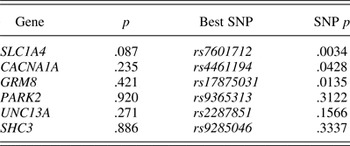
Associations between MDD and six genes from the glutamatergic system using gene-based VEGAS analysis

Note: The six genes considered in these analyses were identified by Lee et al. (Reference Lee, Perlis, Jung, Byrne, Rueckert and Siburian2012) as showing significant associations with major depressive disorder (MDD). SNP, Single nucleotide polymorphism.
Results
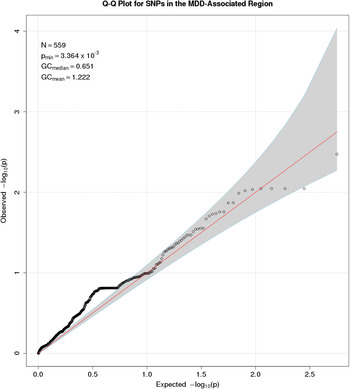
We first conducted individual SNP-based tests for SNPs in SLC1A4, CACNA1A, GRM8, PARK2, UNC13A, and SHC3 using RFGLS. A Q-Q plot of the expected distribution of p values for SNPs plotted against the observed p values (Figure 1) indicated that no p value for the association of any of the 567 SNPs with MDD approached significance after correction for multiple tests. We tested 567 SNPs, yielding a Bonferroni-corrected p value of 9 × 10⁻⁵. The smallest RFGLS p value for the association for the 567 SNPs with MDD was p = .00336. Thus, none of the SNPs we tested could be considered significant. We next conducted gene-based analysis of SLC1A4, CACNA1A, GRM8, PARK2, UNC13A, and SHC3 and their surrounding regions using VEGAS. The results of these analyses are presented in Table 2. We tested six genes, yielding a Bonferroni-corrected p value of 8 × 10⁻³. The smallest VEGAS p value for the association for the six genes with MDD was p = .09 for SLC1A4. Thus, none of the six genes we tested showed significant associations with MDD. Because neither the individual SNP-based or gene-based approach indicated any significant associations with a diagnosis MDD after correcting for multiple tests, we did not conduct further analysis of early onset or recurrent MDD.
(Color online) Q–Q plot for single nucleotide polymorphisms (SNPs) in the major depressive disorder (MDD) associated region using individual SNP-based analysis.

Discussion
In Study 2, we attempted to confirm Lee et al.'s (Reference Lee, Perlis, Jung, Byrne, Rueckert and Siburian2012) positive finding of associations between MDD and SNPs in six glutamatergic genes using individual SNP-based tests and gene-based analyses. Although we had a larger sample size than is typically seen in candidate gene analyses, and that included a large number of cases of MDD (n = 1,993), we found no evidence of significant associations with MDD for any of the genes after adopting conventionally accepted procedures applied in molecular genetics studies to correct for multiple tests.
It could be that had we used a different set of candidate genes, we would have found significant associations with MDD. However, the genes we examined emerged from a carefully reasoned analytic plan that included text-mining statistical analysis to identify 178 gene sets potentially implicated in the pathogenesis of MDD and multilocus enrichment analysis of these gene sets using over 4,000 MDD cases and over 4,000 non-MDD controls (Lee et al., Reference Lee, Perlis, Jung, Byrne, Rueckert and Siburian2012). Using this approach, only one gene set produced significant effects, but missing from the literature was an attempted replication of these findings, thus leaving ambiguous how much confidence to place in them. Our interest was also stimulated by the possibility that especially severe MDD, such as that characterized by early onset or recurrent course, might be related to these genes. It is unfortunate that our effort to confirm and extend the Lee et al. (Reference Lee, Perlis, Jung, Byrne, Rueckert and Siburian2012) positive findings for a lifetime diagnosis of MDD in our sample failed; given the absence of a significant effect for MDD, we did not attempt to extend the findings by examining effects specific to an earlier onset or recurrent course. Gene × Environment interaction (G × E) studies have shown some promise for identifying effects for MDD for certain genes (Dick, Reference Dick2011; Rutter, Moffitt, & Caspi, Reference Rutter, Moffitt and Caspi2006; Thapar, Harold, Rice, Langley, O'Donovan, Reference Thapar, Harold, Rice, Langley and O'Donovan2007), and it is possible that had we examined G × E effects for these glutamatergic genes, our results would have been different. However, in the absence of either a main effect for the genes of interest or a reasonable hypothesis supporting such a G × E analysis, we had no justification for undertaking such an analysis here.
General Discussion
In the present paper, we sought to identify risk factors for MDD and predictors of an earlier onset and recurrent course. We considered indicators of risk assessed at multiple levels of analysis, including family (parental psychiatric disorders, parent–child relationship), individual (personality, internalizing and externalizing psychopathology, academic functioning, physical development, childhood maltreatment), and genetics levels. We identified a number of risk factors for MDD, as well as several that were specific to early onset and recurrent MDD.
Our examination of risk factors for MDD assessed at multiple levels of analysis reflects a growing appreciation for the importance of considering the interdependent biological, psychological, and social systems that underlie the development and manifestation of psychopathology. Study 1 showed that indicators of risk from a broad range of domains predicted the subsequent development of MDD. These results are notable in highlighting the severity and pervasiveness of dysfunction evident well before the onset of MDD, while suggesting important directions of future research. For example, does impairment in the parent–child relationship simply reflect parental psychopathology and offspring liability to MDD, or does it play a causal role in the development of MDD? Does successful intervention of premorbid risk, such as treatment of externalizing symptoms, protect against the subsequent development of MDD? What are the mechanisms by which early pubertal development confers risk for the development of MDD and does this finding reflect biological (e.g., hormonal) or social influences, or both? Answering these questions will further understanding of the etiology of MDD, while also informing the most targeted and effective prevention and intervention efforts.
Taking a multiple-levels approach allows us to go beyond descriptive study and has yielded tremendous leaps in our understanding of the etiology of psychopathology, as well as mechanisms of its development. This is an exciting time of discovery, but it is also clear that we have much to learn. The field of molecular genetics has made considerable advances in recent years, including novel analytic approaches such as that taken by Lee et al. (Reference Lee, Perlis, Jung, Byrne, Rueckert and Siburian2012), but important work remains. Our failure to confirm the positive findings of Lee et al. (Reference Lee, Perlis, Jung, Byrne, Rueckert and Siburian2012) joins many candidate gene replication failures since the recent explosion of candidate gene studies (see Sullivan, Reference Sullivan2007). The problem of finding common or rare variants that influence psychopathology is not an issue only when it comes to MDD but also a broader one in psychiatric genetics as a whole, where consistent replicable findings have proven hard to come by. Nonetheless, important advances in our understanding of the etiology and manifestation of MDD and other psychiatric disorders are being made, and continued interdisciplinary efforts that span fields of research, methodologies, and informants will lead to the most targeted and effective prevention and intervention efforts for these devastating diseases.
Strengths and limitations
The present study has a number of strengths, including the examination of several putative risk factors for MDD assessed at multiple levels of analysis using multiple methods and informants in a large, community-based sample. Offspring were prospectively assessed from late childhood into early adulthood, with minimal attrition bias. However, there are also notable limitations that prompt caution in interpreting the results and suggest important directions for future research. Our assessment of offspring MDD at multiple time points through age 29 allowed us to examine premorbid risk for offspring classified as having early onset versus later onset MDD, recurrent versus single-episode MDD, or no MDD. However, it is possible that some offspring classified as never depressed will eventually be diagnosed with MDD and that some classified as having had only a single MDD episode will ultimately experience a recurrence. Our assessment of MDD included information on age of onset and number of episodes, but the MTFS does not assess dysthymic disorder or the duration of MDD episodes; thus, we were able to examine MDD recurrence, but not duration or chronicity. The lack of racial or ethnic diversity in our sample limits the generalizability of the results of Study 1, though it allowed us to retain a large proportion of our sample for our candidate gene analysis in Study 2, which was limited to Caucasian participants.
Conclusions
Our longitudinal study of premorbid risk for MDD, spanning two decades and encompassing indicators of risk assessed at multiple levels of analysis, found evidence of both family- and individual-level risk for MDD that was evident in late childhood, well before the onset of MDD. Moreover, a number of risk factors, largely reflecting externalizing psychopathology, predicted an earlier onset of MDD, while risk for a recurrent course of MDD was largely specific to recurrent MDD that also showed an early onset. Continued examination of risk factors for an earlier age of onset and a recurrent course of MDD assessed at multiple levels of analysis will further our understanding of the etiology of MDD, its effects on functioning and ultimately inform prevention and intervention efforts.