Introduction
The negative effects of fluid accumulation in paediatric cardiac surgery patients have been described. Reference Hassinger, Wald and Goodman1–Reference Piggott, Soni and Decampli7 Approaches to mitigate these effects include intraoperative slow continuous ultrafiltration, modified ultrafiltration, Reference Pasquali, Ohye and Lu8–Reference Bierer, Stanzel and Henderson10 postoperative utilization of peritoneal catheters for passive drainage or dialysis, Reference Kwiatkowski, Menon and Krawczeski11–Reference Kwiatkowski, Alten and Mah16 and intra- and postoperative diuretic administration. Reference Blinder, Alten and Bailly17–Reference Klinge, Scharf and Hofbeck21 With limited data regarding safety and efficacy, published guidelines remain vague and are based on predominantly single-centre studies with heterogeneous patient populations. Reference Foote, Hornik and Hill22–Reference McCammond, Axelrod and Bailly23 Utilizing data from the Neonatal Pediatric Heart and Renal Outcomes Network dataset, Reference Gist, Blinder and Bailly24 we aim to Reference Hassinger, Wald and Goodman1 describe intraoperative and postoperative fluid removal practices across institutions during neonatal cardiac surgery and Reference Lex, Tóth and Czobor2 assess associations of fluid management practices with clinically relevant outcomes. We hypothesized that there would be significant practice heterogeneity and a differential association with outcomes.
Materials and methods
Institutional Review Board approval
The University of Michigan Institutional Review Board provides oversight for the Pediatric Cardiac Critical Care Consortium (PC4) Data Coordinating Center. The need for written informed consent was waived.
Study design
We performed a retrospective study utilizing the Neonatal Pediatric Heart and Renal Outcomes Network dataset, Reference Gist, Blinder and Bailly24 a collaborative within PC4, of neonates who underwent cardiac surgery between September 2015 and January 2018. PC4 is a clinical registry for patients with critical cardiovascular disease. Reference Gaies, Cooper and Tabbutt25 Details regarding data collection, subject identification, and inclusion criteria have been previously published. Reference Gist, Blinder and Bailly24 Exclusion criteria included reoperation in the first 7 days following the index cardiac surgery, preoperative renal replacement therapy, preoperative serum creatinine elevation greater than or equal to 1.5 mg/dL, and extracorporeal membrane oxygenation during the first 24 hours after the index operation. Surgical complexity was defined using Society of Thoracic Surgery-European Association for Cardio-Thoracic Surgery Congenital Heart Surgery (STAT) categories. Reference Jacobs, O’Brien and Pasquali26 Supplemental Table 1 lists PC4 definitions of postoperative complications.
Demographics, perioperative characteristics, and postoperative outcomes

Table 1 Long description
The table presents data on demographics, perioperative characteristics, and postoperative outcomes of neonates who underwent cardiac surgery. It includes 24 columns and 2246 rows. Column headers are Variable, Overall (N = 2246), Yes (N = 1,091), No (N = 1,149), and p-value. Row labels include variables such as Age at surgery (days), Gender, Race/ethnicity, Prematurity (< 37 weeks' gestation), Chromosomal abnormality, Preoperative feeding, Preoperative acute kidney injury (AKI), Inotropes at time of surgery, Vasoactive inotropic score at time of surgery, Ventilated at time of surgery, Prostaglandin infusion, Cardiopulmonary bypass (CPB), CPB duration (minutes), Cross clamp, Cross clamp duration (minutes), Deep hypothermic circulatory arrest, Delayed sternal closure, Postoperative lactate (highest value in first 24 hours, mmol/L), Postoperative lactate missing/unknown, Received RRT (renal replacement therapy), Highest vasoactive inotropic score in 24 hours postop, Highest vasoactive inotropic score in 48 hours postop, Chest tube output (first 2 postoperative hours, mL), Peak cumulative fluid balance (%), Urine output (cc/kg/hr) from POD 0 to POD 6, 1st day of negative fluid balance, Maximum AKI stage, Severe persistent AKI, Duration of inotropes (days), Duration of mechanical ventilation (hours), Postoperative hospital length of stay (days), and Hospital mortality. Each row provides values for each column, detailing the overall data and comparisons between the Yes and No groups, along with p-values indicating statistical significance.
CICU = cardiac ICU; POD = postoperative day.
Definitions of exploratory variables and outcomes
Predictive variables investigated in multivariable analysis included methods of intraoperative and postoperative fluid removal. Intraoperative fluid removal included modified ultrafiltration and/or diuretics. Postoperative fluid management included diuretics and/or the use of peritoneal catheters for either passive drainage or prophylactic dialysis, defined as receiving peritoneal dialysis within 24 hours postoperatively. Diuretic use was also classified by timing of administration including intraoperative and by postoperative day.
Outcomes included duration of mechanical ventilation, delay in achieving first negative daily fluid balance, peak cumulative fluid balance, and severe persistent acute kidney injury. Duration of postoperative mechanical ventilation was calculated using time to first extubation without need for reintubation within 48h. Daily fluid balance was calculated as daily fluid in (litres) – daily fluid out (litres). Delay in achieving negative daily fluid balance was defined as a first negative daily fluid balance > postoperative day 2. Percent cumulative fluid balance was calculated as (total fluid in [litres] – total fluid out [litres])/preoperative weight (kg) × 100. Reference Goldstein, Currier and Graf27 Peak percent cumulative fluid balance was the highest combined fluid balance from ICU admission through postoperative day 6, transfer/discharge, or death. Acute kidney injury was defined using serum creatinine and/or urine output staging of the modified neonatal Kidney Disease: Improving Global Outcomes criteria. Reference Goldstein, Currier and Graf27,Reference Chawla, Bellomo and Bihorac28 Severe persistent acute kidney injury was defined as the presence of any acute kidney injury on postoperative day 0–2 that persisted on postoperative day 3 and met criteria for modified neonatal Kidney Disease: Improving Global Outcomes stage 2 or 3 acute kidney injury. Reference Chawla, Bellomo and Bihorac28–Reference Hasson, Alten and Bertrandt29
Statistical analysis
Categorical variables were summarized using frequencies and proportions and compared using the chi-square test. Continuous variables were summarized using medians and interquartile ranges and compared using the Wilcoxon rank sum tests or Kruskal–Wallis tests as appropriate. Univariate analyses assessed associations between demographic, preoperative, intraoperative, and postoperative variables and receipt of continuous infusion on postoperative day 0 or 1. Multivariable logistic regression models were used to fit time to first negative daily fluid balance >2 days and severe persistent acute kidney injury. Ordinal regression was used to fit duration of mechanical ventilation and peak cumulative fluid balance. The ordinal regression model was used as it has a great robustness advantage for skewed outcome variables while preserving power. Reference Liu, Shepherd and Li30 For continuous outcomes estimated via ordinal regression, a common odds ratio and 95% confidence interval were calculated, where an odds ratio greater than 1 indicated an association with higher outcome levels. Robust standard errors computed via the Huber–White method were used to correct for clustering of patients within hospitals. A p-value < 0.05 was considered statistically significant. Analyses were performed using the R statistical programme (version 4.3.1, https://www.r-project.org/). The rms package (version 6.7.1) was used for regression analyses.
Results
Patient characteristics
This study includes 2,240 neonates. Demographics and perioperative characteristics are shown in Table 1. The median (interquartile range) age and weight at surgery were 7 days Reference Brandewie, Selewski and Bailly5,Reference Kwiatkowski, Menon and Krawczeski11 and 3.2 kg (2.80, 3.65), respectively. 61% of subjects were male, 13% were premature, and 25% had single ventricle physiology. 70% were STAT category 4 or 5.
Intraoperative fluid management
Modified ultrafiltration
Of 2,240 neonates included, 74% (n = 1,645) of subjects underwent surgery with requiring cardiopulmonary bypass. Of these, 60% (n = 993) underwent modified ultrafiltration. Modified ultrafiltration was utilized at some frequency at 82% (18/22) of institutions. However, modified ultrafiltration utilization frequency by institution varied widely (Supplemental Figure 1). While 14 institutions utilized modified ultrafiltration in more than half of their cardiopulmonary bypass patients, 6 institutions utilized modified ultrafiltration in <5% of cardiopulmonary bypass patients, and 10 institutions utilized modified ultrafiltration in >90% of cardiopulmonary bypass patients.
Diuretic administration on postoperative day 0-6 (POD0-6). This bar graph shows the total number of subjects (out of a total of 2,240 neonates) who received furosemide, bumetanide, and chlorothiazide on POD0-6. The y-axis is number of subjects, and the x-axis shows postoperative days. For each diuretic, subjects receiving (a) intermittent dosing only is shown in green, (b) continuous infusion only (of that agent) is shown in dark blue, and (c) both intermittent and continuous is shown in light blue. For example, if a patient received a one time dose bolus dose of furosemide and then a continuous infusion was started, that patient would be included in the light blue group.

Intraoperative diuretics
Twenty-five percent (n = 560) of subjects received furosemide in the operating room. Of 22 institutions, 6 never administered furosemide in the operating room, while 5 institutions administered furosemide to more than half of their patients (Supplemental Figure 2).
Postoperative fluid management
Peritoneal catheters
Peritoneal catheter placement occurred in 24% (n = 527) of subjects. 63% (n = 334) of those who received a peritoneal catheter (15% of the entire cohort) underwent passive peritoneal drainage, and 37% (n = 193) underwent prophylactic peritoneal dialysis (9% of the entire cohort). Supplemental Figure 3 summarizes variability in peritoneal catheter use by institution. Most institutions (77%) utilized peritoneal catheters to some degree for passive drainage, while 5 institutions reported no peritoneal catheter use.
Postoperative diuretics
Furosemide, bumetanide, and chlorothiazide were the most frequently used diuretics. Figure 1 summarizes diuretic utilization by type for postoperative day 0–6. Furosemide was the most frequently used diuretic on postoperative day 0 (48%, n = 1,061) and on each subsequent postoperative day. Of those who received furosemide on postoperative day 0, 60% (n = 632) received intermittent dosing, 32% (n = 340) received continuous infusion, and 8% (n = 89) received both. Utilization of furosemide as an infusion was highest on postoperative day 1–2. Bumetanide was used less frequently than furosemide, by fewer institutions, and was almost always administered as a continuous infusion with the most frequent use on postoperative day 1–2. Chlorothiazide use was low on postoperative day 0 and increased to approximately 20–25% of total subjects on postoperative day 1–3. Less than 1% of subjects received ethacrynic acid, metolazone, mannitol, or aminophylline on any given day.
Excluding intraoperative diuretics, 52% (n = 1,162) of all subjects received a diuretic on postoperative day 0. However, diuretic administration on postoperative day 0 was highly variable across institutions. Figure 2 shows the percent of subjects who received a diuretic on postoperative day 0–6 at each institution. On postoperative day 0, the percentage of patients who received a diuretic ranged from 6% to 95%. Diuretic use was more common by postoperative day 1. 88% of all patients received diuretics (55–98% of patients across institutions) on postoperative day 1, and diuretic use became ubiquitous on postoperative day 2–6.
Postoperative diuretic-use by institution. This spaghetti plot shows the percentage of subjects who received diuretic on the Y-axis and postoperative days (POD) 0-6 on the X-axis. Each institution (1-22) is represented by a different line.

Figure 2 Long description
A spaghetti plot showing the percentage of subjects who received diuretics on the Y-axis and postoperative days (POD) 0 to 6 on the X-axis. Each institution (1 to 22) is represented by a different colored line. The lines show varying trends, with most institutions starting at a lower percentage on POD 0 and increasing to higher percentages by POD 1, then stabilizing or slightly decreasing through POD 6. The Y-axis ranges from 0 to 100 percent, and the X-axis is labeled with POD 0, POD 1, POD 2, POD 3, POD 4, POD 5, and POD 6.
Of 2,240 subjects, 49% (n = 1,091) received a continuous diuretic infusion on postoperative day 0 or 1 (Supplemental Figures 4 and 5). The most frequently utilized diuretic for continuous infusion was furosemide. Twelve of 22 institutions rarely (<15%) used a loop diuretic infusion on postoperative day 0, while one institution started loop diuretic infusions on over 80% of their patients on postoperative day 0 (Supplemental Figure 4). The use of loop diuretic infusions increased on postoperative day 1 (Supplemental Figure 5).
Perioperative factors associated with receipt of continuous diuretic infusion
In univariate analysis, neonates receiving diuretic infusions on postoperative day 0–1 were more likely to be on inotropes and prostaglandin at the time of surgery (Table 1). They were less likely to be underweight (weight for age > 2 standard deviations below World Health Organization growth standards) (13% vs 18%, p = 0.002) and premature (gestational age < 37 weeks) (11% vs 15%, p = 0.002). They had longer median bypass times (139 min [interquartile range 102–176] vs 115 min [interquartile range 81–155], p < 0.001), longer median cross clamp times (65 min [interquartile range 44–98] vs 49 min [interquartile range 24–79], p < 0.001), and were more likely to undergo deep hypothermic circulatory arrest (34% vs 22%, p < 0.001). They were also more likely to undergo delayed sternal closure (50% vs 14%, p < 0.001).
Association of continuous diuretic infusion use with outcomes
In univariate analysis, receipt of continuous diuretic infusion on postoperative day 0 or 1 was associated with higher postoperative lactate (3.7 vs 2.6, p < 0.001) and higher median postoperative vasoactive inotropic score (10.0 [interquartile range 5.5–14] vs 6.0 [interquartile range 5–10] p < 0.001), along with greater median chest tube output (17 mL [interquartile range 9–34] vs 7 mL [interquartile range 0–16], p < 0.001) in the first 2 postoperative hours, and increased likelihood of requiring red blood cell transfusion (average 24% vs 29%, p < 0.001) (Table 1). Those who received continuous infusions had a lower median peak %cumulative fluid balance (4.1% [interquartile range−0.2–9.5] vs 5.6% [interquartile range 1.2–11.5], p < 0.001) but had lower urine output on postoperative day 0 and 1, which subsequently increased on postoperative day 2–4 (Table 1). Despite the initial slow urine output, 80% of those on continuous infusions on postoperative day 0 or 1 achieved first negative daily fluid balance by postoperative day 1 or 2 (Table 1). Though there was no difference in maximum acute kidney injury stage between the two groups, there was a higher likelihood of severe persistent acute kidney injury in the continuous infusion cohort (5.6% vs 3.3%, p = 0.009). Receipt of continuous infusion on postoperative day 0 or 1 was associated with longer median duration of inotropes (6 days [interquartile range 4–10] vs 3 days [interquartile range 1–6], p < 0.001), longer median duration of mechanical ventilation (97 hours [interquartile range 68–166] vs 46 hours [interquartile range 21–92], p < 0.001), and longer median postoperative hospital length of stay (20 days [interquartile range 12–35] vs 14 days [interquartile range 8–27], p < 0.001) on univariate analysis (Table 1). No differences in the incidence of any peak acute kidney injury stage were found based on initiation of continuous diuretic infusion on postoperative day 0–1 or later. Severe persistent acute kidney injury was more common in those who received continuous infusions on postoperative day 0–1 (5.6% vs 3.3%, p = 0.009). Inotrope duration, mechanical ventilation duration, and hospital length of stay were all significantly longer in those with early continuous diuretic use (Table 1).
Multivariable analysis
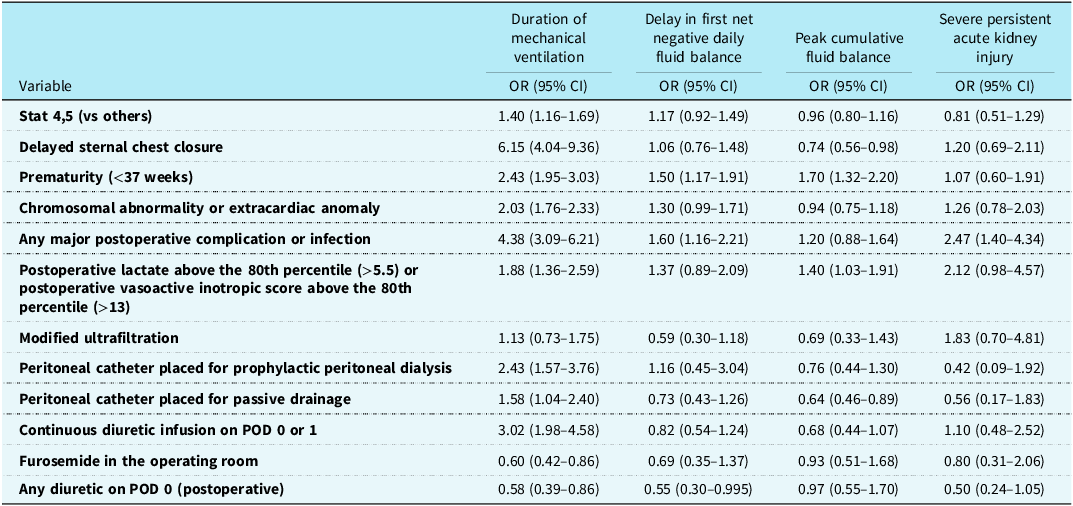
In multivariable analyses, intraoperative furosemide (odds ratio 0.60; 95% confidence interval 0.42–0.86) and diuretic use on postoperative day 0 (intermittent or continuous) (odds ratio 0.58; 95% confidence interval 0.39–0.86) were associated with shorter duration of mechanical ventilation (Table 2). Use of a peritoneal dialysis catheter for passive drainage (odds ratio 1.58; 95% confidence interval 1.04–2.40) and for prophylactic dialysis (odds ratio 2.43; 95% confidence interval 1.57–3.76) was associated with a longer adjusted duration of mechanical ventilation. Use of a continuous diuretic infusion on postoperative day 0–1 (odds ratio 3.02; 95% confidence interval 1.98–4.58) was also associated with a longer duration of mechanical ventilation. Postoperative day 0 diuretic use was associated with lower odds of delay in negative daily fluid balance (odds ratio 0.55; 95% confidence interval 0.30–0.995). Peritoneal catheter placement for passive drainage was associated with an overall lower peak cumulative fluid balance (odds ratio 0.64; 95% confidence interval 0.46–0.89). There were no associations between the fluid management strategies and severe persistent acute kidney injury.
Multivariable analysis investigating factors associated with clinical outcomes

CI = confidence interval; OR = odds ratio; POD = postoperative day.
Discussion
Despite known associations between fluid accumulation and adverse outcomes in paediatric cardiac surgery patients, optimal strategies for intraoperative and postoperative fluid removal remain unknown. Here, we present the first large, multicentre analysis of intraoperative and postoperative fluid management strategies in neonates undergoing cardiac surgery. As expected, we found marked intra- and inter-centre heterogeneity in practice. Use of continuous diuretic infusions and peritoneal dialysis catheter for passive drainage or prophylactic peritoneal dialysis was associated with longer duration of mechanical ventilation. Receiving diuretic on postoperative day 0 influenced early negative daily fluid balance but not peak cumulative fluid balance, which was instead influenced by passive drainage via peritoneal catheter. The only practices associated with decreased duration of mechanical ventilation were intraoperative or postoperative day 0 diuretic administration. No fluid removal strategies were found to be associated with severe persistent acute kidney injury.
Published benefits of modified ultrafiltration include reduction in excess total body water accumulation, hemoconcentration, improved hemodynamics, cytokine removal, and reduced blood product exposure in the postoperative period. Reference Draaisma, Hazekamp and Frank31–Reference Kotani, Honjo and Osaki36 However, others question the need for modified ultrafiltration in the current era of smaller cardiopulmonary bypass circuits and lower pump prime volumes. Reference McRobb, Ing and Lawson37–Reference Mejak, Lawson and Ing38 . Our finding that 6 institutions used modified ultrafiltration in < 5% of cardiopulmonary bypass patients while 10 institutions used modified ultrafiltration in > 90% of cardiopulmonary bypass patients supports a lack of consensus and suggests that institutional preference weighs heavily on the use of modified ultrafiltration. We did not find an association between modified ultrafiltration and any of our primary outcomes on multivariable analysis. This may be due to the lack of uniformity among those who did not receive modified ultrafiltration, as we are unable to distinguish whether these patients received slow continuous ultrafiltration or received no ultrafiltration, a limitation of this dataset.
Use of peritoneal catheters for either passive drainage or prophylactic peritoneal dialysis was associated with increased duration of mechanical ventilation in our study. We suspect that this reflects, in part, a sicker cohort of patients undergoing more complex surgical procedures. However, it could also reflect site-specific practices related to patients who have peritoneal dialysis catheters, such as delaying extubation until catheter removal to avoid omental herniation. Interestingly, we found peritoneal dialysis catheter use for passive drainage to be associated with lower peak cumulative fluid balance but not early negative daily fluid balance, which was instead influenced by receiving diuretic on postoperative day 0. These associations may represent (1) the steady and cumulative effects of a drainage catheter on fluid balance and (2) the immediate urine output/fluid balance effect afforded by immediate postoperative diuretic administration.
While 88% of patients received diuretics by postoperative day 1, wide variability in diuretic use occurred on postoperative day 0 (6–95% of patients, depending on institution), as well as variability in diuretic choice and mode of delivery. This likely represents both a lack of consensus on optimal diuretic strategy and factors that affect medication availability including formulary and compatibility with other necessary medications. As previous Neonatal Pediatric Heart and Renal Outcomes Network studies have investigated peritoneal catheters Reference Kwiatkowski, Alten and Mah16 and early postoperative diuretics, Reference Stegmeier, Alten and Borasino18 we focused this analysis on continuous diuretic infusions on postoperative day 0–1. Unlike our previous study showing an association between any diuretic on postoperative day 0 and shorter duration of mechanical ventilation, Reference Stegmeier, Alten and Borasino18 continuous diuretic infusions on postoperative day 0–1 were associated with longer duration of mechanical ventilation in this study. However, patients receiving infusions had many markers of higher acuity and severity of illness on univariate analysis. Thus, it is not surprising that receipt of continuous infusions on postoperative day 0–1 was associated with a longer duration of mechanical ventilation on multivariable analysis.
Aside from receiving intraoperative or postoperative day 0 diuretic as previously published, Reference Wise, Moffett and Akcan-Arikan20 no other fluid removal method examined was associated with any of the positive outcomes included in the multivariable analysis. Given marked practice variability across institutions, early diuretic administration may be a modifiable practice that can be targeted in quality initiatives and associated with positive outcomes. We must acknowledge, however, that the complexity and heterogeneity of the patients and perioperative management may preclude detection of associations. We also suspect that patient selection for use of certain practices impacts our findings, representing an opportunity for future research focused on fluid management in our sickest patients. Finally, it is worth noting that none of the fluid removal practices was found to be associated with severe persistent acute kidney injury despite continued concern about fluid removal leading to acute kidney injury. We chose severe persistent acute kidney injury as an outcome measure based on a growing body of literature demonstrating the differential impact of acute kidney injury phenotypes. Reference Hasson, Alten and Bertrandt29,Reference Basu, Hackbarth and Gillespie39–Reference Gist, Borasino and SooHoo41 We believe our findings represent the benefits of avoiding fluid accumulation and its deleterious effects.
This study is limited in its retrospective and largely descriptive design. Comparing fluid removal modalities is challenging in the setting of high centre variability and therapeutic bias. We are limited in our ability to identify if each specific practice is associated with an outcome or if they serve as surrogates of disease severity. While the granularity of this data was excellent for a large, multicentre study, we cannot comment on specific protocols used for modified ultrafiltration, passive peritoneal drainage, or peritoneal dialysis. Similarly, we cannot provide data on specific doses and dosing intervals of diuretics. Finally, this study examined a specific neonatal cardiac surgical population, and results may not be generalizable to other patient populations.
In conclusion, despite the proven deleterious effects of fluid accumulation in paediatric cardiac surgery, optimal fluid removal strategies remain unknown. This is reflected in the marked practice variability across institutions demonstrated in this large, multicentre study in neonates undergoing cardiac surgery. While diuretic infusions and peritoneal catheters were associated with increased duration of mechanical ventilation, univariate analysis suggests that collinearity with increased severity of illness may explain these findings. None of the studied fluid removal practices was associated with severe persistent acute kidney injury, and diuretic administration intraoperatively and on postoperative day 0 were the only practices associated with shorter duration of mechanical ventilation. Further study of the impact of early diuretic administration on outcomes is warranted as it represents a practice pattern change that could improve outcomes.
Supplementary material
The supplementary material for this article can be found at https://doi.org/10.1017/S1047951126113183.
Competing interests
The authors have no competing interests to disclose.