



1. Introduction
Let
 $\mathsf{K}$
be a number field, and
 $X/\mathsf{K}$
a projective variety. In a classical paper [Reference NorthcottNor49], Northcott showed that the set of points in
 $X(\mathsf{K})$
of height
 $\lt c$
is finite. If X is a moduli space for a family of varieties
 $\mathcal A \rightarrow X,$
this may be interpreted as a finiteness statement about the varieties of bounded height in
 $\{\mathcal A_x: x \in X(\mathsf{K})\},$
and one says that the set above satisfies the Northcott property. As in Faltings’ work on the moduli space of abelian varieties [Reference FaltingsFal83], this can sometimes be extended to families parameterized by a quasi-projective X, for an appropriate height function.
In this paper we prove a large part of a conjecture of the second author, which asserts an analogous finiteness property for elements of bounded height in the isogeny class of an abelian variety over an algebraic closure
 $\bar{\mathsf{K}}$
of
 $\mathsf{K}$
. To explain this, let
 $A/ \mathsf{K}$
be an abelian variety. We denote by h(A) the Faltings height of A, and by
 ${\mathscr I}(A)$
the isogeny class of A over
 $\bar{\mathsf{K}}$
.
Conjecture 1.1. For any
 $c \gt 0$
, the set
 \begin{align*} \{ A' \in {\mathscr I}(A): h(A') \lt c\}\end{align*}
contains only finitely many isomorphism classes of abelian varieties.
We emphasize that the abelian varieties in
 ${\mathscr I}(A)$
are not all defined over any finite extension of
 $\mathsf{K}$
. Thus, the conjecture gives a Northcott-type property for
 ${\mathscr I}(A)$
which is quite different from the more familiar versions mentioned above, involving varieties over a fixed number field. Although there are some results and conjectures on the Northcott property for fields obtained by taking the union of extensions of
 $\mathbb Q$
of some fixed degree d (see [Reference Bombieri and ZannierBZ01, Reference WidmerWid23]), the elements of
 ${\mathscr I}(A)$
are never all defined over such an extension either. The conjecture may be compared with Faltings’ results on heights of abelian varieties over number fields [Reference FaltingsFal83]. For example, he shows that the varieties in
 ${\mathscr I}(A)$
defined over
 $\mathsf{K}$
have bounded height, and contain only finitely many isomorphism classes.
In the case when A is an elliptic curve, the conjecture follows from a result of Ullmo and Szpiro [Reference Szpiro and UllmoSU99, Theorem 1.1]. The conjecture in the case of complex multiplication (CM) abelian varieties was considered in the thesis of the second author [Reference MoczMoc18]. For abelian varieties which are ordinary at a prime p, there is also a related result of Autissier which gives a formula for the average change in the height when dividing by a certain collection of p-isogenies. Our main result is the following.
Theorem 1.2. If A satisfies the Mumford–Tate conjecture, then Conjecture 1.1 holds for A.
By a result of Deligne [Reference Deligne, Milne, Ogus and ShihDMO+82, Theorem 2.11], after replacing
 $\mathsf{K}$
by a finite extension, for any prime
 $\ell$
the action of
 $\mathrm{Gal}(\bar{\mathsf{K}}/\mathsf{K})$
on the
 $\ell$
-adic Tate module of A gives rise to a Galois representation
 \begin{align*} \varrho_{A,\ell}: \mathrm{Gal}(\bar{\mathsf{K}}/\mathsf{K})\rightarrow G(\mathbb Q_{\ell})\end{align*}
associated to A, where G denotes the Mumford–Tate group. We assume, for the rest of the introduction, that
 $\mathsf{K}$
has been chosen so that
 $ \varrho_{A,\ell}$
is well-defined. The Mumford–Tate conjecture asserts that
 $\varrho_{A,\ell}$
has Zariski-dense image. This condition depends only on the isogeny class over
 $\bar{\mathsf{K}}$
.
The conjecture is known for many instances of the group G, in which case our theorem becomes unconditional. For example, if
 $g = \mathrm{dim\,}A$
and
 $G = \mathrm{GSp}_{2g},$
then the conjecture is known for all but 82 values of
 $g \lt 10^6$
(see [Reference PinkPin98, p. 191]). See also [Reference VasiuVas08].
By a result of Narasimhan and Nori [Reference Narasimhan and NoriNN81], for each
 $d \geq 1,$
there are only finitely many isomorphism classes of an abelian variety with a degree-d polarization in each isomorphism class of abelian varieties. This implies the following.
Corollary 1.3.
Let
 $\mathcal H$
be the Hecke orbit of an algebraic point
 $x_0$
on a Shimura variety of Hodge type
 $\mathrm{Sh}(G,X)$
. If the image of the Galois representation attached to
 $x_0$
is Zariski dense in G, then for
 $c \gt 0$
,
 \begin{align*} \{ x \in \mathcal H: h(x) \lt c \} \end{align*}
is finite.
To explain some of the ideas which go into the proof of the theorem, consider first an isogeny
 $\phi: A \rightarrow A'$
defined over
 $\mathsf{K},$
and let
 $H = \mathrm{ker}\, \phi$
. We assume, for simplicity, that
 $\deg(\phi) = p^r$
for some prime p. After replacing
 $\mathsf{K}$
by a finite extension, we may assume that
 $\phi$
extends to a map of semi-abelian schemes
 $\phi: \mathcal A \rightarrow \mathcal A'$
over
 $\mathcal O_{\mathsf{K}}$
. Then Faltings’ isogeny lemma gives a formula for the change of height:
 \begin{align*} h(A') - h(A) = \deg(\phi)(\tfrac{1}{2} -\nu(H)),\end{align*}
where
 $\nu(H)$
is what we call the global slope of H. It is a (weighted) average of local invariants
 $\mu_w(H)$
over places
 $w|p$
of
 $\mathsf{K}$
. The invariants
 $\mu_w(H),$
called local slopes, are defined in terms of
 $\omega_{\mathcal H/\mathcal O_{\mathsf{K}_w}} = s^*\Omega^1_{\mathcal H/\mathcal O_{\mathsf{K}_w}}$
, where s is the identity section of
 $\mathcal H = \mathrm{ker}\,(\phi)$
.
We are interested in situations where
 $\phi$
is only defined over
 $\bar{\mathsf{K}},$
so one would instead need to take an average over places
 $\bar w|p$
of
 $\bar{\mathsf{K}}$
. However, it is possible to instead express
 $\nu(H)$
in terms of an average over the Galois orbit of H:
 \begin{equation} \nu(H) = \sum_{w|p} \frac{[\mathsf{K}_w:\mathbb Q_p]}{[\mathsf{K}:\mathbb Q]}\int_{\mathrm{Gal}(\bar{\mathsf{K}}/\mathsf{K})}\mu_w(\sigma(H)) \, d\sigma. \end{equation}
Here,
 $\sigma(H) \subset A[p^\infty](\bar{\mathsf{K}})$
is the subgroup which satisfies
 $\sigma(H)(\bar{\mathsf{K}}) = \sigma(H(\bar{\mathsf{K}})),$
 $d\sigma$
denotes the Haar measure of volume 1 on
 $\mathrm{Gal}(\bar{\mathsf{K}}/\mathsf{K}),$
and we have fixed an extension of each place
 $w|p$
of
 $\mathsf{K}$
to
 $\bar{\mathsf{K}}$
.
Now consider a sequence
 $\{H_n\}_{n \geq 1}$
of finite subgroups of
 $A_{\bar{\mathsf{K}}}$
. It suffices to show that, for any such sequence, either
 $h(A/H_n)$
is unbounded or
 $\{A/H_n\}_{n \geq 1}$
contains only finitely many isomorphism classes. There are two essential cases to consider:
-
–
 $H_n$
has p-power order for some prime p, which is independent of n;
-
–
$H_n \subset A_{\bar{\mathsf{K}}}[p_n]$
for a sequence of distinct primes
$\{p_n\}_{n \geq 1}$
.


Let us explain the first case. Using the properties of local slopes, one can reduce (see § 2.5) to the case where
 $H_n = H[p^n]$
for
 $H \subset A_{\bar{\mathsf{K}}}[p^\infty]$
a p-divisible group. We then show the following.
Proposition 1.4.
Assume A satisfies the Mumford–Tate conjecture. Then the sequence
 $\{\nu(H[p^n])\}_{n \geq 1}$
is monotone non-increasing and
 \begin{align*} \lim_n \nu(H[p^n]) \leq \tfrac{1}{2} \end{align*}
with equality only if H is defined over
 $\mathsf{K}$
.
If the inequality in the proposition is strict, it follows that
 $h(A/H[p^n])$
goes to infinity. Otherwise, H is defined over
 $\mathsf{K},$
and
 $\{A/H[p^n]\}$
contains only finitely many isomorphism classes by Faltings’ theorem.
To explain the proof of the proposition, we suppose for simplicity that
 $\mathcal A$
has good reduction at all places
 $w|p$
of
 $\mathsf{K}$
. Let
 $\mathcal H_n$
denote the closure of
 $H[p^n]$
in
 $\mathcal A_{\mathcal O_{\bar{\mathsf{K}}_w}}$
. If H were defined over a finite extension of
 $\mathsf{K}_w,$
then
 $\{\mathcal H_n\}_{n \geq 1}$
would form a p-divisible group by a theorem of Raynaud [Reference RaynaudRay74, Proposition 2.3.1]. In general, this may not be the case, as for each
 $n \in \mathbb N^+,$
and
 $r \geq 1,$
the maps
 \begin{align*} \mathcal H_{r+n+1}/\mathcal H_{r+1} \rightarrow\mathcal H_{r+n}/\mathcal H_r\end{align*}
induced by multiplication by p need not become isomorphisms for r sufficiently large. However, we have the following.
Proposition 1.5.
The category of p-divisible groups
 $\mathcal J$
over
 $\mathcal O_{\bar{\mathsf{K}}_w},$
equipped with a map
 $\mathcal J \rightarrow \mathcal A[p^\infty]$
whose generic fiber factors through H, admits a final object
 $\mathcal H,$
whose generic fiber is H.
Moreover, the sequence
 $\{\mu_w(H[p^n])\}_{n \geq 1}$
is monotone non-increasing, and we have
 \begin{equation}\lim_n \mu_w(H[p^n]) = \frac{\mathrm{dim\,} \mathcal H}{\mathrm{ht\,} \mathcal H} = \frac{\mathrm{dim} (T_p H\otimes \bar{\mathsf{K}}_w \cap \mathrm{Lie\,} \mathcal A\otimes \bar{\mathsf{K}}_w(1))}{\mathrm{ht\,} H}.\end{equation}
Here, the intersection on the right is interpreted using the Hodge–Tate decomposition for A. We give two constructions of
 $\mathcal H$
. The first uses the Scholze–Weinstein classification of p-divisible groups over
 $\mathcal O_{\bar{\mathsf{K}}_w}$
(see [Reference Scholze and WeinsteinSW13]), and gives rise to the second equality in (1.2). The second constructs
 $\mathcal H[p^n]$
by taking a suitable limit over the system of maps
 $ \mathcal H_{r+n+1}/\mathcal H_{r+1} \rightarrow \mathcal H_{r+n}/\mathcal H_r$
for
 $r \geq 1,$
and gives the first equality.
To prove Proposition 1.4, we apply (1) to
 $H[p^n]$
for each n, pass to the limit with n, and exchange the order of the limit and the integral, to get
 \begin{equation} \lim_n\nu(H[p^n]) = \sum_{w|p} \frac{[\mathsf{K}_w:\mathbb Q_p]}{[\mathsf{K}:\mathbb Q]}\int_{\mathrm{Gal}(\bar{\mathsf{K}}/\mathsf{K})}\lim_n \mu_w(\sigma(H[p^n])) \,d\sigma. \end{equation}
By applying Proposition 1.5 to
 $\sigma(H)$
for
 $\sigma \in \mathrm{Gal}(\bar{\mathsf{K}}/\mathsf{K}),$
one sees that the contribution to the sum in (1.3), corresponding to the prime w, is (up to a scalar) just the minimal dimension of
 $T_p \sigma(H)\otimes \bar{\mathsf{K}}_w \cap \mathrm{Lie\,} \mathcal A\otimes \bar{\mathsf{K}}_w(1)$
for
 $\sigma \in \mathrm{Gal}(\bar{\mathsf{K}}/\mathsf{K}),$
as the set of
 $\sigma$
where the dimension is not minimal has measure 0. Assuming the Mumford–Tate conjecture, this is just the minimal dimension of
 $g\cdot(T_p H\otimes \bar{\mathsf{K}}_w) \cap \mathrm{Lie\,} \mathcal A\otimes \bar{\mathsf{K}}_w(1)$
for
 $g \in G(\bar{\mathsf{K}}_w)$
. This is a purely group-theoretic quantity, which no longer involves the Galois action.
A little book-keeping with the Hodge–Tate cocharacters
 $\boldsymbol{\mu}_w,$
attached to the representation of
 $\mathrm{Gal}(\bar{\mathsf{K}}_w/\mathsf{K}_w)$
on
 $T_pA,$
then leads to Proposition 1.4. More precisely, we show that either the inequality there is strict, or
 $T_p H[1/p] \subset T_pA[1/p]$
is stable by the action of all the cocharacters
 $\boldsymbol{\mu}_w$
and their conjugates under
 $G_{\mathrm{Gal}},$
the Zariski closure of the image of
 $\varrho_{A,p}$
. If
 $G_{\mathrm{Gal}} = G$
, it is generated by these conjugates and H is defined over
 $\mathsf{K}$
.
What we really use here is a special case of the Fontaine–Mazur conjecture, which follows from the Mumford–Tate conjecture for A. Namely, let
 $G_{{\mathrm{ur}}} \subset G_{\mathrm{Gal}}$
be the smallest normal subgroup containing the images under
 $\varrho_{A,p}$
of all inertia subgroups at
 $w|p$
. Then
 \begin{align*} G_{{\mathrm{ur}}} \subset G_{\mathrm{Gal}} \subset G,\end{align*}
and
 $G_{{\mathrm{ur}}}$
is precisely the subgroup generated by the
 $G_{\mathrm{Gal}}$
-conjugates of the
 $\boldsymbol{\mu}_w$
. What we use is that
 $G_{\mathrm{Gal}} = G_{{\mathrm{ur}}}$
. This is implied by
 $G_{\mathrm{Gal}} = G,$
because the group G is generated by the G-conjugates of the
 $\boldsymbol{\mu}_w,$
as these conjugacy classes are related to the complex Hodge theory of A.
To handle the second case, where
 $H_n \subset A_{\bar{\mathsf{K}}}[p_n]$
for a sequence of distinct primes
 $\{p_n\}_{n \geq 1},$
we need an effective estimate for
 $\nu(H_n)$
for
 $n \gg 0$
. This is provided by the following.
Proposition 1.6.
Assume A satisfies the Mumford–Tate conjecture. If
 $p\gg 0,$
then for any subgroup
 $H \subset A_{\bar{\mathsf{K}}}[p],$
either H is defined over
 $\mathsf{K}$
or
 \begin{align*} \frac 1 2 - \nu(H) \geq \frac 1{4g[\mathsf{K}:\mathbb Q]} - \frac {c_A} p \end{align*}
for some constant
 $c_A$
which depends only on A.
The proof of the proposition again uses the Mumford–Tate conjecture, but via a theorem of Cadoret and Moonen [Reference Cadoret and MoonenCM20], which describes the image of the adelic Galois representation
 \begin{align*} \varrho_A: \mathrm{Gal}(\bar{\mathsf{K}}/\mathsf{K}) \rightarrow G(\mathbb A_f)\end{align*}
associated to A. For
 $p \gg 0$
and H as in Proposition 1.6, this allows us to replace the integral which appears in the right-hand side of (1) by an average over a well-controlled subset of
 $G(\mathbb F_p)$
. This average can then be estimated using explicit calculations with Breuil–Kisin and Breuil–Kisin–Fargues modules. As in the case of a p-divisible subgroup considered above, one finds a dichotomy: either the inequality holds, or H is stable by
 $G(\mathbb F_p)$
and hence defined over
 $\mathsf{K}$
.
Sections 2 and 3 of the paper correspond roughly to the two cases considered above. In § 2.2, we construct the p-divisible group
 $\mathcal H$
and prove Proposition 1.5. This is used in § 2.4 to prove Proposition 1.4. In § 2.5, we deduce the case of the theorem corresponding to any sequence of finite subgroups
 $H_n \subset A_{\bar{\mathsf{K}}}[p^\infty]$
. After reviewing the relationship between Breuil–Kisin–Fargues modules and finite flat group schemes and their slopes in §§ 3.1–3.3, we prove an inequality on the slopes of Breuil–Kisin modules in § 3.4. In § 3.6, we use this to prove Proposition 1.6 and then complete the proof of the main theorem.
2. p-power isogenies
2.1 The Hodge–Tate decomposition
2.1.1.
Let K be a field, equipped with a complete p-adic valuation v with
 $v(p) = 1,$
and with perfect residue field k. We denote by
 $\mathcal O_K$
the ring of integers of K and by
 $\mathfrak m_K \subset \mathcal O_K$
the maximal ideal. Fix an algebraic closure
 $\bar K$
of K, and denote by C its completion. We write
 $\Gamma_K = \mathrm{Gal}(\bar K/K)$
for the absolute Galois group of K.
For G a p-divisible group over K, we denote by
 $T_p G$
its Tate module. Let
 ${\mathcal G}$
be a p-divisible group over
 $\mathcal O_K,$
with generic fiber G. We will sometimes write
 $T_p {\mathcal G}$
for
 $T_pG$
. Applying [Reference FarguesFar19, Theorem 0.1] to the base change of G to C gives a functorial injection
 \begin{equation}f_{{\mathcal G}}: \mathrm{Lie\,} {\mathcal G} \otimes _{\mathcal O_K} C(1) \rightarrow T_p G\otimes _{\mathbb Z_p} C,\end{equation}
where we abuse notation and write
 $\mathrm{Lie\,} {\mathcal G}$
for the Lie algebra of the formal group associated to
 ${\mathcal G}$
. In particular, (2.1) is
 $\Gamma_K$
-equivariant. We denote by
 ${\mathscr F}({\mathcal G})$
the triple
 $(T_pG, \mathrm{Lie\,} {\mathcal G}, f_{{\mathcal G}})$
.
By a result of Fargues [Reference FarguesFar19, Theorem 0.1] and of Scholze and Weinstein [Reference Scholze and WeinsteinSW13, Theorem B],
 ${\mathscr F}$
induces an equivalence between the category of p-divisible groups over
 $\mathcal O_K$
and the category of triples (T,W, f) consisting of a
 $\mathbb Z_p[\Gamma_K]$
-module T, which is finite free over
 $\mathbb Z_p,$
a K-vector space W, and a
 $\Gamma_K$
-equivariant injection
 $f: W\otimes _K C(1) \rightarrow T\otimes _{\mathbb Z_p}C$
.
2.1.2.
Let
 $\mathcal A$
be a semi-abelian scheme over
 $\mathcal O_K,$
such that
 $A = \mathcal A\otimes K$
is an abelian variety. We want to extend the above theory to
 $\mathcal A,$
and compare it to the Hodge–Tate decomposition for A, when it applies.
To explain this, let
 $\mathcal H$
be a quasi-finite flat separated group scheme over
 $\mathcal O_K$
. As
 $\mathcal O_K$
is Henselian, we may write
 $\mathcal H$
as a disjoint union of schemes
 $\mathcal H = \mathcal H^\circ \coprod \mathcal H_{\eta},$
where
 $\mathcal H^\circ$
is finite over
 $\mathcal O_K,$
and
 $\mathcal H_{\eta}$
has empty special fiber [Reference GrothendieckGro61, IV, 18.5.11(c)]. In particular,
 $\mathcal H_{\eta}$
is a finite K-scheme and
 $\mathcal H$
is affine. If we write
 $\mathcal H = {\operatorname{ Spec\,}} R,$
then ones sees from this decomposition that
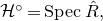 $\mathcal H^\circ = {\operatorname{ Spec\,}} \hat R,$
where
 $\hat R$
is the p-adic completion of R. As
 $\hat R$
is a finitely generated, torsion-free
 $\mathcal O_K$
-module, it is finite free over
 $\mathcal O_K$
(see [Reference KaplanskyKap52, Theorem 1]) [Reference ScholzeSch13, Proposition 2.8], so
 $\mathcal H^\circ$
is a finite flat
 $\mathcal O_K$
-group scheme. We will apply this discussion to
 $\mathcal H = \mathcal A[p^n]$
(cf. [Reference Grothendieck and DeligneGD72, IX, Lemma 2.2.1]).
Lemma 2.1. With the above notation, we have:
-
(1)
$\{\mathcal A[p^n]^\circ\}_{n \geq 1}$
forms a p-divisible group,
$\mathcal A[p^\infty]^\circ,$
over
$\mathcal O_K$
; -
(2)
$\mathrm{Lie\,} \mathcal A[p^\infty]^\circ \simeq \mathrm{Lie\,} \mathcal A$
and, in particular,
$\mathrm{dim\,} \mathcal A[p^\infty]^\circ = g = : \mathrm{dim\,} A$
; -
(3) if K is discretely valued, then the subspace
given by applying (2.1) to
\begin{align*} \mathrm{Lie\,} \mathcal A \otimes _{\mathcal O_K} C (1) \simeq \mathrm{Lie\,} \mathcal A[p^\infty]^\circ \otimes _{\mathcal O_K} C (1) \subset T_p \mathcal A[p^\infty]^\circ\otimes _{\mathbb Z_p} C \subset T_p A\otimes _{\mathbb Z_p} C\end{align*}
$\mathcal A[p^\infty]^\circ$
coincides with the subspace
$\mathrm{Lie\,} \mathcal A \otimes C(1)$
under the Hodge–Tate decomposition [Reference FontaineFon81, Theorem 2]
\begin{align*} T_p A\otimes C \simeq \mathrm{Lie\,} \mathcal A\otimes C(1) \oplus H^1(A,\mathcal O_A)^{\vee}\otimes C.\end{align*}






Proof. To check part (1), we have to check that for
 $m,n \geq 1$
the sequence
 \begin{align*} 0 \rightarrow \mathcal A[p^n]^\circ \rightarrow \mathcal A[p^{m+n}]^\circ \overset {p^n} \rightarrow \mathcal A[p^m]^\circ \rightarrow 0 \end{align*}
is exact. Using the fiber-by-fiber criterion for flatness, one sees that it suffices to check that the special fiber of this sequence is exact. This follows from the fact that
 $\mathcal A\otimes _{\mathcal O_K} k$
is a semi-abelian variety, so
 $\{\mathcal A\otimes _{\mathcal O_K}k[p^n]\}_{n \geq 1}$
is a p-divisible group.
Now, from the definitions, one sees that the formal group attached to
 $\mathrm{Lie\,} \mathcal A[p^\infty]^\circ$
is a subgroup of the formal group of
 $\mathcal A$
. Using an argument with the special fiber, as in the previous paragraph, one sees that it is equal to the formal group of
 $\mathcal A$
. In particular, this implies part (2).
Finally, for part (3), note that, by what we have seen above,
 $\mathrm{Lie\,} \mathcal A[p^\infty]^\circ \otimes _{\mathcal O_K} C (1)$
has dimension g, hence it must coincide with
 \begin{align*} (T_p A[p^\infty] \otimes _{\mathbb Z_p}C(-1))^{\Gamma_K}\otimes _K C(1) \simeq \mathrm{Lie\,} \mathcal A\otimes _K C(1). \end{align*}
2.2 Local change of height
2.2.1.
We retain the notation introduced in § 2.1.
Let
 ${\mathcal G}$
be a quasi-finite flat group scheme over
 $\mathcal O_K,$
such that
 ${\mathcal G}(C)$
has p-power order. We define the slope
 $\mu({\mathcal G})$
of
 ${\mathcal G},$
following Fargues [Reference FarguesFar10]: the height of
 ${\mathcal G}$
is defined as
 $\mathrm{ht\,} {\mathcal G} = \mathrm{log}_p |{\mathcal G}(C)|$
. Let
 $s: {\operatorname{ Spec\,}} \mathcal O_K \rightarrow {\mathcal G}$
be the identity section. Then
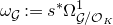 $\omega_{{\mathcal G}} : = s^* \Omega^1_{{\mathcal G}/\mathcal O_K}$
is a finitely presented
 $\mathcal O_K$
-module. Hence, by [Reference WarfieldWar70, Theorem 1] and [Reference ScholzeSch13, Proposition 2.10], it is of the form
 $\omega_{{\mathcal G}} = \bigoplus_{i=1}^n \mathcal O_K/a_i\mathcal O_K$
with
 $a_i \in \mathcal O_K$
. The degree
 ${\mathcal G}$
is defined as
 \begin{align*}\deg {\mathcal G} = v(\mathrm{Fitt}(\omega_{{\mathcal G}})) = \sum_{i=1}^n v(a_i),\end{align*}
where
 $\mathrm{Fitt}(\omega_{{\mathcal G}})$
denotes the Fitting ideal of
 $\omega_{{\mathcal G}}$
. Finally, we set
 \begin{align*} \mu({\mathcal G}) = \frac{\deg {\mathcal G}}{\mathrm{ht\,} {\mathcal G}} . \end{align*}
Using the notation of § 2.1.2, we have
 \begin{align*}\mu({\mathcal G}) = \mu({\mathcal G}^\circ) \cdot \frac{\mathrm{ht\,} {\mathcal G}^\circ}{\mathrm{ht\,} {\mathcal G}},\end{align*}
as
 $s^* \Omega^1_{{\mathcal G}/\mathcal O_K} \simeq s^{\circ*} \Omega^1_{{\mathcal G}^\circ/\mathcal O_K},$
where
 $s^{\circ*}$
denotes the identity section of
 ${\mathcal G}^{\circ}$
.
These invariants satisfy the following properties [Reference FarguesFar10, §§ 3, 4]:
-
(1)
$\deg({\mathcal G})$
is additive in short exact sequences of quasi-finite flat group schemes; -
(2) if
${\mathcal G}$
is a finite flat group scheme with Cartier dual
${\mathcal G}^*,$
then
\begin{align*} \mu({\mathcal G}) + \mu({\mathcal G}^*) = 1;\end{align*}
-
(3)
$\mu({\mathcal G}) \in [0,1];$
-
(4) if
$f:{\mathcal G} \rightarrow {\mathcal G}'$
is a map of quasi-finite, flat
$\mathcal O_C$
-group schemes, with
$f\otimes C$
an isomorphism, then
$\mu({\mathcal G}) \leq \mu({\mathcal G}'),$
with equality if and only if f is an isomorphism; -
(5) if
$\mathcal H$
is a p-divisible group over
$\mathcal O_C,$
having dimension d and height h, then for any
$n \geq 1,$
$\mu(\mathcal H[p^n]) = d/h$
.






For properties (1), (3), and (4), using the decomposition in § 2.1.2, one easily reduces to the case of finite flat group schemes considered in [Reference FarguesFar10]. Note that property (1) implies that for a short exact sequence of quasi-finite flat group schemes
 \begin{align*} 0 \rightarrow {\mathcal G}' \rightarrow {\mathcal G} \rightarrow {\mathcal G}'' \rightarrow 0,\end{align*}
we have
 \begin{equation} \min(\mu({\mathcal G}'), \mu({\mathcal G}'')) \leq \mu({\mathcal G}) \leq \max (\mu({\mathcal G}'), \mu({\mathcal G}'')).\end{equation}
We will use this property repeatedly. We need the following lemma, which complements property (4).
Lemma 2.2.
Let
 $f: {\mathcal G} \rightarrow {\mathcal G}'$
be a map of finite flat group schemes over
 $\mathcal O_K,$
such that
 $f\otimes K$
is an isomorphism. Let
 $a \in \mathcal O_K$
be non-zero and such that
 \begin{align*} a\cdot \mathcal O_{{\mathcal G}} \subset \mathcal O_{{\mathcal G}'} \subset \mathcal O_{{\mathcal G}}.\end{align*}
Then
 \begin{align*}\mu({\mathcal G}') \leq \mu({\mathcal G}) + 3v(a).\end{align*}
Proof. We may replace
 ${\mathcal G}$
and
 ${\mathcal G}'$
by their maximal connected subgroups, and assume that
 ${\mathcal G}$
and
 ${\mathcal G}'$
have connected special fibers.
Let
 $I \subset \mathcal O_{{\mathcal G}}\otimes _{\mathcal O_K}\mathcal O_{{\mathcal G}}$
and
 $I' \subset \mathcal O_{{\mathcal G}'}\otimes _{\mathcal O_K} \mathcal O_{{\mathcal G}'}$
denote the ideals of the diagonal, and
 $J \subset \mathcal O_{{\mathcal G}}$
and
 $J' \subset \mathcal O_{{\mathcal G}'}$
the ideals of the identity section. As multiplication by a maps
 $ \mathcal O_{{\mathcal G}}$
into
 $ \mathcal O_{{\mathcal G}'},$
multiplication by
 $a^2$
induces a map
 $I \rightarrow I'$
. Multiplying this last map by a, we obtain maps
 \begin{align*} \omega_{{\mathcal G}'} \rightarrow \omega_{{\mathcal G}} = (I/I^2)/J(I/I^2) \overset{\cdot a^3}\longrightarrow (I'/I^{\prime 2})/J'(I'/I^{\prime 2}) = \omega_{{\mathcal G}'} \end{align*}
whose composite is multiplication by
 $a^3$
.
By [Reference FontaineFon77, Proposition 4.3, 4.5.(i)],
 $\mathrm{dim}_k J'/J^{\prime 2}\otimes k \leq \mathrm{ht\,} {\mathcal G},$
so a minimal set of generators for
 $\mathcal O_{{\mathcal G}'}$
as an
 $\mathcal O_K$
-algebra has size at most
 $\mathrm{ht\,} {\mathcal G},$
as we are assuming that
 $\mathcal O_{{\mathcal G}'}$
is local. It follows that
 $\Omega^1_{{\mathcal G}'/\mathcal O_K}$
is generated by
 $\mathrm{ht\,} {\mathcal G}$
elements as an
 $\mathcal O_{{\mathcal G}'}$
-module, so
 $\omega_{{\mathcal G}'}$
is generated by
 $\mathrm{ht\,} {\mathcal G}$
elements as an
 $\mathcal O_K$
-module.
Now, let
 $C = \mathrm{ker}\,(\omega_{{\mathcal G}'} \rightarrow \omega_{{\mathcal G}})$
be the kernel of the natural map, that is the first map above. Then
 $a^3\cdot C = 0,$
and the previous paragraph implies that C is a quotient of
 $(\mathcal O_K/a^3)^{\mathrm{ht\,} {\mathcal G}},$
so
 $v(\mathrm{Fitt}(C)) \leq 3 v(a) \mathrm{ht\,} {\mathcal G} $
. This implies
 \begin{align*} v(\mathrm{Fitt}(\omega_{{\mathcal G}'})) \leq v(\mathrm{Fitt}(\omega_{{\mathcal G}})) + v(\mathrm{Fitt}(C)) \leq v(\mathrm{Fitt}(\omega_{{\mathcal G}})) + 3 v(a)\mathrm{ht\,} {\mathcal G} . \end{align*}
Dividing both sides by
 $\mathrm{ht\,} {\mathcal G}$
proves the lemma.
2.2.2.
Now let
 ${\mathcal G}$
be a p-divisible group over
 $\mathcal O_C,$
with generic fiber G, and let
 $H \subset G$
be a p-divisible subgroup. Denote by
 $\bar H[p^n] \subset {\mathcal G}$
the closure of
 $H[p^n]$
. We fix this notation for the remainder of this subsection. Our goal is to describe the limit
 $\lim_n \mu(\bar H[p^n])$
.
Proposition 2.3.
The category of p-divisible groups
 $\mathcal J$
over
 $\mathcal O_C,$
equipped with a map
 $\mathcal J \rightarrow {\mathcal G}$
whose generic fiber factors through H, admits a final object
 $\mathcal H,$
whose generic fiber is H. We have
 \begin{align*} {\mathscr F}(\mathcal H) = (T_pH, \mathrm{Lie\,}{\mathcal G}\otimes C(1) \cap T_pH\otimes C, f_{\mathcal H}),\end{align*}
where
 $f_{\mathcal H}$
is the restriction of
 $f_{{\mathcal G}}$
.
Proof. The triple
 \begin{align*}(T_pH, \mathrm{Lie\,} {\mathcal G}\otimes C(1) \cap T_pH\otimes C, f_{{\mathcal G}}|_{\mathrm{Lie\,} {\mathcal G}\otimes C(1) \cap T_pH\otimes C})\end{align*}
defines a p-divisible group
 $\mathcal H$
over
 $\mathcal O_C,$
as
 ${\mathscr F}$
is an equivalence. If
 $h: \mathcal J \rightarrow {\mathcal G}$
is a map of p-divisible groups whose generic fiber
 $J \rightarrow G$
factors through H, then
 $T_p J \rightarrow T_p G$
factors through
 $T_p H,$
and one sees that the map of triples
 ${\mathscr F}(\mathcal J) \rightarrow {\mathscr F}({\mathcal G})$
factors through
 ${\mathscr F}(\mathcal H)$
. Hence, by full faithfulness of
 ${\mathscr F},$
h factors through
 $\mathcal H$
.
2.2.3.
We give another description of the p-divisible group
 $\mathcal H$
in the previous proposition. To do this, we need some results on
 $\mathcal O_C$
-modules.
We call an
 $\mathcal O_C$
-module M finite rank if
 $M \otimes C$
is finite-dimensional over C, in which case this dimension is called the rank of M. We call M bounded if it can be embedded in
 $\mathcal O_C^m$
for some integer m. For M a bounded
 $\mathcal O_C$
-module, write
 $M^+ = \mathrm{Hom}_{\mathcal O_C}(\mathfrak m_C, M)$
. Recall that a map of
 $\mathcal O_C$
-modules is called an almost isomorphism if its kernel and cokernel are killed by
 $\mathfrak m_C$
.
Lemma 2.4.
Suppose that C is spherically closed and that v surjects onto
 $\mathbb R,$
and let M be a bounded
 $\mathcal O_C$
-module. Then:
-
(1)
$M^+$
is a finite free
$\mathcal O_C$
-module; -
(2) there is a natural map
$M \rightarrow M^+,$
which is an isomorphism if and only if M is finitely generated over
$\mathcal O_C$
; -
(3) for any bounded
$\mathcal O_C$
-modules M,N, the natural map is an isomorphism.
\begin{align*} M^+ \otimes _{\mathcal O_C} N^+ \rightarrow (M\otimes _{\mathcal O_C} N)^+\end{align*}


Proof. For
 $\lambda \in \mathbb R,$
denote by
 $p^{\lambda}$
some element of C with valuation
 $\lambda$
. Suppose first that M has rank 1, so that we may assume
 $M \subset \mathcal O_C$
. Let
 $\lambda_0 = \inf_{m \in M} v(m)$
. Then
 $p^{-\lambda_0}M$
is equal to either
 $\mathcal O_C$
or
 $\mathfrak m_C,$
depending on whether M contains an element of valuation
 $\lambda_0$
or not. In either case,
 $M^+$
is equal to
 $p^{\lambda_0}\mathcal O_C,$
which proves part (1) in this case.
In general, suppose
 $M \subset \mathcal O_C^m$
. By intersecting M with finite free submodules of
 $\mathcal O_C^m$
of smaller rank, we may write M as successive extensions of bounded
 $\mathcal O_C$
-modules of rank 1. Since C is spherically complete, a result of Matlis [Reference MatlisMat59, Theorem 9] asserts that all such extensions split, so M is a direct sum of rank-1, bounded
 $\mathcal O_C$
-modules. Then part (1) follows from the rank-1 case proved above.
The map
 $M \rightarrow M^+$
is given by sending
 $m \in M$
to the restriction of the map
 $\mathcal O_C \rightarrow M$
sending 1 to m. If this map is an isomorphism, then M is finite free, and in particular, finitely generated, by part (1) of the lemma. If M is finitely generated, then by considering C-linear relations among the generators, one sees that M is finite free over
 $\mathcal O_C$
. Now any map
 $\mathfrak m_C \rightarrow M$
factors through
 $\mathfrak m_CM,$
as
 $\mathfrak m_C = \mathfrak m_C^2$
. As M is finite free, this implies
 $M \simeq M^+$
.
Finally, we show part (3). Since
 $M^+, N^+$
are finite free, the composite
 \begin{align*} M^+ \otimes _{\mathcal O_C} N^+ \rightarrow (M\otimes _{\mathcal O_C} N)^+ \rightarrow (M^+\otimes _{\mathcal O_C} N^+)^+\end{align*}
is an isomorphism, and since both maps are injective, they are isomorphisms.
Lemma 2.5.
With the notation of Proposition 2.3, § 2.2.2 for each
 $i \geq 1,$
there is a natural map
 \begin{equation}\widetilde{\mathcal {O}}(\bar H[p^i]) : = \underrightarrow {\mathrm{lim}}_j \mathcal O(\bar H[p^{i+j}]/\bar H[p^j]) \rightarrow \mathcal O(\mathcal H[p^i])\end{equation}
and this map is an almost isomorphism.
Proof. The transition maps in the limit correspond to the maps
 \begin{align*}\bar H[p^{i+j}]/\bar H[p^j] \rightarrow \bar H[p^{i+j-1}]/\bar H[p^{j-1}]\end{align*}
induced by multiplication by p on
 ${\mathcal G}$
. The map
 $\mathcal H \rightarrow {\mathcal G}$
induces maps
 $\mathcal H[p^i] \rightarrow \bar H[p^i],$
and hence maps
 \begin{align*} \mathcal H[p^i] \simeq \mathcal H[p^{i+j}]/\mathcal H[p^j] \rightarrow \bar H[p^{i+j}]/\bar H[p^j].\end{align*}
Passing to functions gives rise to the map in the proposition, and it remains to show this map is an almost isomorphism.
Since the functor
 ${\mathscr F}$
is compatible with base change in the field C, we may assume that C is spherically complete, and that the valuation
 $v: C\backslash\{0\} \rightarrow \mathbb R$
is surjective. Note that (2.3) is an isomorphism after inverting p, as the generic fiber of
 $\mathcal H$
is the p-divisible subgroup
 $H \subset G,$
and that
 $\mathcal O(\mathcal H[p^i])$
is a finite free
 $\mathcal O_C$
-module. Hence, by Lemma 2.4, (2.3) induces a map
 \begin{equation} \widetilde{\mathcal {O}}(\bar H[p^i])^+\rightarrow \mathcal O(\mathcal H[p^i])^+ \simeq \mathcal O(\mathcal H[p^i]) \end{equation}
and
 $\widetilde{\mathcal {O}}(\bar H[p^i])^+$
is a finite free
 $\mathcal O_C$
-module, which is almost isomorphic to
 $ \widetilde{\mathcal {O}}(\bar H[p^i])$
. Thus, it suffices to show that (2.4) is an isomorphism.
By Lemma 2.4(2),
 $\mathcal O(\bar H[p^i])$
is a finite free
 $\mathcal O_C$
-module, as it is finitely generated, and this implies that
 ${\mathcal G}$
induces the structure of a finite flat group scheme on
 $\bar H[p^i]$
. Hence,
 $\bar H[p^{i+j}]/\bar H[p^j]$
is also a finite flat group scheme, and
 $\mathcal O(\bar H[p^{i+j}]/\bar H[p^j])$
is a Hopf algebra. Thus,
 $ \widetilde{\mathcal {O}}(\bar H[p^i])$
is also a Hopf algebra, and the sequence of group schemes
 $\{{\operatorname{ Spec\,}} \widetilde{\mathcal {O}}(\bar H[p^i])\}_{i \geq 1}$
satisfies all the axioms of a p-divisible group, except possibly the condition that the elements of the sequence are finite flat.
Now using Lemma 2.4(1), one sees that
 $\{{\operatorname{ Spec\,}} \widetilde{\mathcal {O}}(\bar H[p^i])^+\}_{i \geq 1}$
is a sequence of finite flat group schemes, and we claim that it forms a p-divisible group. Indeed, this sequence inherits the other properties of a p-divisible group from the sequence
 $\{{\operatorname{ Spec\,}} \widetilde{\mathcal {O}}(\bar H[p^i])\}_{i \geq 1}$
: the maps
 $\widetilde{\mathcal {O}}(\bar H[p^i])^+ \rightarrow \widetilde{\mathcal {O}}(\bar H[p^{i-1}])^+$
are surjective, as they are almost-surjective maps between finite free
 $\mathcal O_C$
-modules. This implies the maps between the corresponding finite flat group schemes are closed immersions. The same argument shows that the maps
 \begin{align*} {\operatorname{ Spec\,}} \widetilde{\mathcal {O}}(\bar H[p^{i+1}])^+/{\operatorname{ Spec\,}} \widetilde{\mathcal {O}}(\bar H[p])^+ \rightarrow {\operatorname{ Spec\,}} \widetilde{\mathcal {O}}(\bar H[p^i])^+ \end{align*}
induced by multiplication by p are isomorphisms. Thus,
 $\{{\operatorname{ Spec\,}} \widetilde{\mathcal {O}}(\bar H[p^i])^+\}_{i \geq 1}$
forms a p-divisible group, which we denote
 $\widetilde{\bar H}$
.
The maps in (2.4) induce a map of p-divisible groups
 $\iota: \mathcal H \rightarrow \widetilde{\bar H}$
. By construction, there is a map
 $\widetilde{\bar H} \rightarrow {\mathcal G}$
which is an isomorphism onto H on generic fibers. Hence, by the universal property for
 $\mathcal H,$
this map factors through
 $\mathcal H$
and induces an inverse to
 $\iota$
. It follows that (2.4) is an isomorphism.
Proposition 2.6.
With the notation of § 2.2.2, the sequence
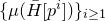 $\{\mu(\bar H[p^i])\}_{i \geq 1}$
is monotone non-increasing. We have
 \begin{align*} \lim_i \mu(\bar H[p^i]) = \frac{\mathrm{dim\,}\mathcal H}{\mathrm{ht\,} \mathcal H} = \frac{\mathrm{dim} (T_pH\otimes C \cap \mathrm{Lie\,} {\mathcal G}\otimes C(1))}{\mathrm{ht\,} H}.\end{align*}
Proof. The maps
 $\bar H[p^{i+1}]/\bar H[p^i] \rightarrow \bar H[p^i]/\bar H[p^{i-1}],$
induced by multiplication by p on H, are isomorphisms on generic fibers. Hence, by property (4) in § 2.2.1, the sequence
 $\{\mu(\bar H[p^{i+1}]/\bar H[p^i])\}_{i \geq 1}$
is monotone non-increasing. It then follows from property (1) in § 2.2.1 that
 $\{\mu(\bar H[p^i])\}_{i \geq 1}$
is monotone non-increasing, and we have
 \begin{align*}\lim_i \mu(\bar H[p^i]) = \lim_i \mu(\bar H[p^{i+1}]/\bar H[p^i]).\end{align*}
The second equality in the proposition follows from Proposition 2.3. Moreover, by § 2.2.1, we have
 $ {\mathrm{dim\,} \mathcal H}/{\mathrm{ht\,} \mathcal H} = \mu(\mathcal H[p])$
. Thus, it remains to show that
 \begin{align*} \lim_i \mu(\bar H[p^{i+1}]/\bar H[p^i]) = \mu(\mathcal H[p]). \end{align*}
By Lemma 2.5, for any
 $a \in \mathfrak m_C,$
we have
 $a\cdot \mathcal O(\mathcal H[p]) \subset \mathcal O(\bar H[p^{i+1}]/\bar H[p^i])$
for i sufficiently large. It follows from Lemma 2.2 that for any
 $\varepsilon \gt 0$
there exists i such that
 \begin{align*} \mu(\bar H[p^{i+1}]/\bar H[p^i]) \leq \mu(\mathcal H[p]) +\varepsilon. \end{align*}
Thus,
 $ \lim_i \mu(\bar H[p^{i+1}]/\bar H[p^i]) \leq \mu(\mathcal H[p]),$
and the opposite inequality follows from property (4) in § 2.2.1, as
 $\mathcal H[p]$
maps to
 $\bar H[p^{i+1}]/\bar H[p^i]$
.
2.2.4.
We need a generalization of Proposition 2.6.
Proposition 2.7.
Let
 $\mathcal A$
be a semi-abelian scheme over
 $\mathcal O_C,$
such that
 $A = \mathcal A\otimes C$
is an abelian variety. Let
 $H \subset A[p^\infty]$
be a p-divisible subgroup, and
 $\bar H[p^i]$
the closure of
 $H[p^i]$
in
 $\mathcal A$
. Then we have
 \begin{align*} \lim_i \mu(\bar H[p^i]) = \frac{\mathrm{dim} (T_pH\otimes C \cap \mathrm{Lie\,} \mathcal A\otimes C(1))}{\mathrm{ht\,}H}.\end{align*}
Proof. We first remark that the intersection is taken inside
 $T_pA[p^\infty],$
using that
 $\mathrm{Lie\,} \mathcal A\otimes C(1) \subset T_pA[p^\infty],$
as in Lemma 2.1. We use the notation introduced in that lemma.
Let
 $\bar H[p^i]$
denote the closure of
 $H[p^i]$
in
 $\mathcal A$
. Set
 $\bar H^\circ = \lim_i \bar H[p^i]^\circ$
as an fppf sheaf, and denote by
 $H^\circ$
its generic fiber. Let
 $H^{\circ\circ} \subset H^\circ$
be the p-divisible part of
 $H^\circ,$
so that
 $H^\circ/H^{\circ\circ}$
is finite, and write
 $\bar H^{\circ\circ}[p^i]$
for the closure of
 $H^{\circ\circ}[p^i]$
in
 $\mathcal A$
.
Using the definition of
 $\mu,$
as in § 2.2.1 and property (1) in 2.2.1, we obtain
 \begin{equation} \lim_i \mu(\bar H[p^i]) = \frac{\mathrm{ht\,} H^{\circ\circ}}{\mathrm{ht\,} H}{\lim_i \mu(\bar H[p^i]^{\circ})} = \frac{\mathrm{ht\,} H^{\circ\circ}}{\mathrm{ht\,} H}{\lim_i \mu(\bar H^{\circ\circ}[p^i]).}\end{equation}
We now apply Proposition 2.6 to
 $H^{\circ\circ} \subset \mathcal A[p^\infty]^\circ \otimes C,$
to obtain
 \begin{equation} \lim_i \mu(\bar H^{\circ\circ}[p^i]) = \frac{\mathrm{dim} (T_p H^{\circ\circ}\otimes C \cap \mathrm{Lie\,} \mathcal A \otimes C(1))}{\mathrm{ht\,} H^{\circ\circ}}.\end{equation}
From the definitions, one finds
 \begin{align*}T_pH^{\circ\circ} = \mathrm{Hom}(\mathbb Q_p/\mathbb Z_p, H^{\circ\circ}(C)) \simeq \mathrm{Hom}(\mathbb Q_p/\mathbb Z_p, H^\circ(C)) = T_pH \cap T_p \mathcal A[p^\infty]^\circ \subset T_p A, \end{align*}
and on the other hand, from Lemma 2.1(3),
 \begin{align*} \mathrm{Lie\,} \mathcal A\otimes C(1) \subset T_p\mathcal A[p^\infty]^\circ\otimes C,\end{align*}
which implies
 \begin{equation} T_p H^{\circ\circ}\otimes C \cap \mathrm{Lie\,} \mathcal A \otimes C(1) = T_p H \otimes C \cap \mathrm{Lie\,} \mathcal A \otimes C(1).\end{equation}
2.3 Faltings’ isogeny lemma
2.3.1.
Let
 $\mathsf{K}$
be a number field with ring of integers
 $\mathcal O_\mathsf{K},$
 $\bar{\mathsf{K}}$
an algebraic closure of
 $\mathsf{K},$
and
 $\Gamma_\mathsf{K} = \mathrm{Gal}(\bar{\mathsf{K}}/\mathsf{K})$
. Let
 $\mathcal H$
be a quasi-finite flat group scheme over
 $\mathcal O_\mathsf{K}$
. For p a prime, write
 $\mathcal H_p = \mathcal H[p^\infty] \subset \mathcal H$
for the p-power torsion subgroup of
 $\mathcal H,$
so that
 $\mathcal H \simeq \prod_p \mathcal H_p$
. When
 $\mathcal H = \mathcal H_p$
for some p, we set
 \begin{align*} \nu(\mathcal H) = \frac 1 {[\mathsf{K}:\mathbb Q]} \sum_{w|p} [\mathsf{K}_{w}:\mathbb Q_p]\mu_w(\mathcal H),\end{align*}
where for
 $w|p$
a prime of
 $\mathsf{K}$
, we write
 $\mu_w(\mathcal H) = \mu(\mathcal H|_{\mathcal O_{\mathsf{K}_w}})$
. For general
 $\mathcal H$
we set
 \begin{align*} \nu(\mathcal H) = \sum_p \frac{\mathrm{log}|\mathcal H_p(\bar{\mathsf{K}})|}{\mathrm{log}|\mathcal H(\bar{\mathsf{K}})|} \nu(\mathcal H_p). \end{align*}
Note that the sum of the coefficients
 ${\mathrm{log}|\mathcal H_p(\bar{\mathsf{K}})|}/{\mathrm{log}|\mathcal H(\bar{\mathsf{K}})|}$
is 1. We call
 $ \nu(\mathcal H)$
the global slope of
 $\mathcal H$
. Set
 $\omega_{\mathcal H/\mathcal O_\mathsf{K}} = s^*\Omega^1_{\mathcal H/\mathcal O_\mathsf{K}},$
and denote by
 $|\omega_{\mathcal H/\mathcal O_\mathsf{K}}\!|$
the order of
 $\omega_{\mathcal H/\mathcal O_\mathsf{K}}$
.
Lemma 2.8. We have
 \begin{align*} \nu(\mathcal H) = \frac{\mathrm{log}|\omega_{\mathcal H/\mathcal O_{\mathsf{K}}}\!|}{[K:\mathbb Q]\mathrm{log}|\mathcal H(\bar{\mathsf{K}})|}.\end{align*}
Proof. Since
 $\omega_{\mathcal H/\mathcal O_{\mathsf{K}}} = \prod_p \omega_{\mathcal H_p/\mathcal O_{\mathsf{K}}},$
we have
 \begin{align*} \frac{\mathrm{log}|\omega_{\mathcal H/\mathcal O_{\mathsf{K}}}\!|}{\mathrm{log}|\mathcal H(\bar{\mathsf{K}})|}= \sum_p \frac{\mathrm{log}|\mathcal H_p(\bar{\mathsf{K}})|}{\mathrm{log}|\mathcal H(\bar{\mathsf{K}})|} \frac{\mathrm{log}|\omega_{\mathcal H_p/\mathcal O_{\mathsf{K}}}\!|}{\mathrm{log}|\mathcal H_p(\bar{\mathsf{K}})|}, \end{align*}
so it suffices to consider the case when
 $\mathcal H = \mathcal H_p$
for some p, which we now assume.
For
 $w|p$
a prime of
 $\mathsf{K},$
as in § 2.2.1, write
 \begin{align*} \omega_{\mathcal H/\mathcal O_{\mathsf{K}_w}} : = \omega_{\mathcal H/\mathcal O_{\mathsf{K}}}\otimes _{\mathcal O_{\mathsf{K}}}\mathcal O_{\mathsf{K}_{w}} = \bigoplus_{i=1}^n \mathcal O_{\mathsf{K}_w}/a_i\mathcal O_{\mathsf{K}_w}.\end{align*}
Then
 \begin{align*} \mathrm{log}_p |\omega_{\mathcal H/\mathcal O_{\mathsf{K}_w}}\!| = [\mathsf{K}_w:\mathbb Q_p]\bigg(\sum_{i=1}^n v(a_i)\bigg) = [\mathsf{K}_w:\mathbb Q_p]\deg \mathcal H|_{\mathcal O_{\mathsf{K}_w}}.\end{align*}
Dividing both sides by
 $\mathrm{ht\,} \mathcal H = \mathrm{log}_p |\mathcal H(\bar{\mathsf{K}})|$
and summing over
 $w|p$
gives
 \begin{align*} \frac{\mathrm{log}|\omega_{\mathcal H/\mathcal O_{\mathsf{K}}}\!|}{\mathrm{log}|\mathcal H(\bar{\mathsf{K}})|} = \frac{\mathrm{log}_p|\omega_{\mathcal H/\mathcal O_{\mathsf{K}}}\!|}{\mathrm{log}_p|\mathcal H(\bar{\mathsf{K}})|}= \sum_{w|p} [\mathsf{K}_{w}:\mathbb Q_p]\mu_w(\mathcal H) = [K:\mathbb Q]\nu(\mathcal H). \end{align*}
2.3.2.
The following lemma shows that the invariant
 $\nu$
satisfies the analogue of the same properties in § 2.2.1. We use these repeatedly in what follows. It will be convenient to define the global degree
 $\deg \mathcal H$
by
 $\deg \mathcal H = \nu(\mathcal H)\mathrm{log}|\mathcal H(\bar{\mathsf{K}})|$
.
Lemma 2.9. We have the following.
-
(1) For a quasi-finite flat group scheme
$\mathcal H/\mathcal O_{\mathsf{K}},$
we have
$\nu(\mathcal H) \in [0,1]$
. -
(2) If
$\mathcal H \rightarrow \mathcal H'$
is a map of quasi-finite flat group schemes which is an isomorphism over
$\mathsf{K},$
then -
(3) We have
$\nu(\mathcal H) \leq \nu(\mathcal H')$
. -
(4) The function taking
$\mathcal H$
to
$\deg \mathcal H$
is additive in short exact sequences. -
(5) If
is a short exact sequence of quasi-finite flat group schemes over
\begin{align*} 0 \rightarrow \mathcal H' \rightarrow \mathcal H \rightarrow \mathcal H'' \rightarrow 0 \end{align*}
$\mathcal O_{\mathsf{K}}$
, then
\begin{align*} \min(\nu(\mathcal H'), \nu(\mathcal H'')) \leq \nu(\mathcal H) \leq \max (\nu(\mathcal H'), \nu(\mathcal H'')).\end{align*}





Proof. Parts (1) and (2) follow immediately from properties (3) and (4) in § 2.2.1, respectively. For part (3), note that
 $\mathrm{log} |\omega_{\mathcal H/\mathsf{K}}|$
is additive in
 $\mathcal H$
. For example, this follows from property (1) in § 2.2.1. Hence, part (3) follows from Lemma 2.8. In particular,
 $\nu(\mathcal H)$
is a quotient of two positive, real-valued functions which are additive in
 $\mathcal H,$
which implies part (4).
2.3.3.
For an abelian variety A over
 $\mathsf{K},$
we denote by h(A) the Faltings’ height of A (see [Reference FaltingsFal83, p. 354]). Suppose that A extends to a semi-abelian scheme
 $\mathcal A$
over
 $\mathcal O_\mathsf{K}$
. The following lemma is due to Faltings.
Lemma 2.10.
Let
 $\phi: \mathcal A \rightarrow \mathcal A'$
be an isogeny of semi-abelian
 $\mathcal O_\mathsf{K}$
-schemes, with kernel
 $\mathcal H$
, and write
 $A' = \mathcal A\otimes \mathsf{K}$
. Then
 \begin{align*} h(A') - h(A) = \mathrm{log} \deg (\phi)(\tfrac{1}{2} - \nu(\mathcal H)).\end{align*}
Proof. By [Reference FaltingsFal83, Lemma 5], we have
 \begin{align*} h(A') - h(A) = \frac 1 2 \mathrm{log} \deg (\phi) - \frac 1 {[\mathsf{K}:\mathbb Q]} \mathrm{log} (|\omega_{\mathcal H/\mathcal O_\mathsf{K}}\!|).\end{align*}
The lemma now follows from Lemma 2.8.
2.3.4.
Let
 $\mathcal A$
be as above, and
 $H \subset A_{\bar{\mathsf{K}}}[p^\infty]$
a finite subgroup, defined over a finite extension
 $\mathsf{K}' \subset \bar{\mathsf{K}}$
. For
 $w'|p$
a prime of
 $\mathsf{K}',$
we write
 $\mu_{w'}(H) = \mu_{w'}(\mathcal H)$
and
 $\nu(H) = \nu(\mathcal H),$
where
 $\mathcal H$
denotes the closure of H in
 $\mathcal A$
. Similarly, we sometimes write
 $\deg(H)$
for
 $\deg(\mathcal H)$
.
For
 $\sigma \in \Gamma_\mathsf{K},$
we denote by
 $\sigma(H) \subset A$
the subgroup
 $\sigma^* H \subset \sigma^*A \simeq A$
. Note that, with this notation,
 $\sigma(H)(\bar{\mathsf{K}}) = \sigma(H(\bar{\mathsf{K}})) \subset A(\bar{\mathsf{K}})$
. We denote by
 $d\sigma$
the Haar measure of volume 1 on the compact group
 $\Gamma_\mathsf{K}$
. For each place
 $w|p$
of
 $\mathsf{K},$
we extend w to a place of
 $\bar{\mathsf{K}},$
again denoted w.
Lemma 2.11.
Let
 $H \subset A_{\bar{\mathsf{K}}}[p^\infty]$
be a closed, finite subgroup. Then
 \begin{align*} \nu(H) = \sum_{w|p} \frac{[\mathsf{K}_w:\mathbb Q_p]}{[\mathsf{K}:\mathbb Q]}\int_{\Gamma_\mathsf{K}}\mu_w(\sigma(H))\,d\sigma,\end{align*}
where w runs over place of
 $\mathsf{K}$
dividing p.
Proof. Let
 $\mathsf{K}' \subset \bar{\mathsf{K}}$
be a finite Galois extension of
 $\mathsf{K},$
such that H is defined over
 $\mathsf{K}'$
. For
 $\sigma \in \mathrm{Gal}(\mathsf{K}'/\mathsf{K})$
, we have
 \begin{align*}\mu_{\sigma(w)}(H) = \mu_{w}(\sigma^*H) =\mu_{w}(\sigma(H)).\end{align*}
Thus,
 $\nu(H)$
is given by
 \begin{align}\frac 1 {[\mathsf{K}':\mathbb Q]} \sum_{w'|p} [\mathsf{K}'_{w'}:\mathbb Q_p]\mu_{w'}(H)&= \frac 1 {[\mathsf{K}:\mathbb Q]} \sum_{w|p} \frac{[\mathsf{K}_w:\mathbb Q_p]}{[\mathsf{K}':\mathsf{K}]}\sum_{\sigma \in \mathrm{Gal}(\mathsf{K}'/\mathsf{K})} \mu_w(\sigma(H)) \nonumber\\[5pt]&= \sum_{w|p} \frac{[\mathsf{K}_w:\mathbb Q_p]}{[\mathsf{K}:\mathbb Q]}\int_{\Gamma_\mathsf{K}}\mu_w(\sigma(H))d\sigma,\end{align}
where, as usual, w (respectively w’) runs over primes of
 $\mathsf{K}$
(respectively
 $\mathsf{K}'$
) dividing p.
2.4 Global change of height
2.4.1.
Let C be the completion of an algebraic closure of
 $\mathbb Q_p$
. It will be convenient to fix an isomorphism of
 $\mathbb C \simeq C$
. We continue to use the notation of § 2.3.1. For any embedding
 $w: \bar{\mathsf{K}} \rightarrow C,$
we denote by
 $\tilde w: \bar{\mathsf{K}} \rightarrow \mathbb C$
the corresponding embedding. Fix an embedding
 $w_0: \bar{\mathsf{K}} \rightarrow C$
.
For any ring R and a finite free R-module M, we denote by
 $M^\otimes $
the direct sum
 $\bigoplus_{m,n} M^{\otimes m} \otimes M^{*\otimes n}$
.
Let A be an abelian variety over
 $\mathsf{K}$
. We consider the complex points
 $A(\mathbb C),$
via the embedding
 $\tilde w_0|_\mathsf{K}$
. The Betti cohomology
 $H^1(A(\mathbb C),\mathbb Q)$
carries a Hodge structure, and we denote by
 $G \subset \mathrm{GL}(H^1(A(\mathbb C),\mathbb Q))$
the Mumford–Tate group of A, defined as the subgroup fixing all Hodge cycles in
 $H^1(A(\mathbb C),\mathbb Q)^\otimes $
of bidegree (0,0). It is a connected, reductive algebraic
 $\mathbb Q$
-group, which depends on
 $w_0|_K$
; groups corresponding to different embeddings may be inner forms [Reference SerreSer94, § 2].
Let
 $\{s_{\alpha}\}_\alpha \subset H^1(A(\mathbb C),\mathbb Q)^\otimes $
be a finite collection of Hodge cycles whose stabilizer is G. Using our fixed embedding
 $\tilde w_0$
, we have a canonical isomorphism
 \begin{equation} H^1_{{\mathrm{dR}}}(A_{\bar{\mathsf{K}}})\otimes _{\bar{\mathsf{K}},\tilde w_0} \mathbb C \simeq H^1(A(\mathbb C),\mathbb C),\end{equation}
where
 $H^1_{{\mathrm{dR}}}$
denotes the algebraic de Rham cohomology, and for each prime p canonical isomorphisms
 \begin{equation} H^1(A_{\bar{\mathsf{K}}}, \mathbb Q_p) \underset{\tilde w_0}\simeq H^1(A_{\mathbb C}, \mathbb Q_p) \simeq H^1(A(\mathbb C),\mathbb Q_p).\end{equation}
By a result of Deligne [Reference Deligne, Milne, Ogus and ShihDMO+82, I, Corollaries 2.7, 2.9, 2.11], for all
 $\alpha,$
there exists
 $s_{\alpha,{\mathrm{dR}}} \in H^1_{{\mathrm{dR}}}(A_{\bar{\mathsf{K}}})^\otimes $
and, for each p,
 $s_{\alpha,p} \in H^1(A_{\bar{\mathsf{K}}}, \mathbb Q_p)^\otimes $
mapping to
 $s_{\alpha}$
under the above isomorphisms. Moreover, for any embedding w, if we use
 $\tilde w$
to define isomorphisms analogous to (2.9) and (2.10), then
 $s_{\alpha,{\mathrm{dR}}}$
and
 $s_{\alpha,p}$
map to a Hodge cycle
 $s_{\alpha,w} \in H^1(A(\mathbb C),\mathbb Q)^\otimes $
.
Let
 $\mathsf{K}' \subset \bar{\mathsf{K}}$
be the smallest extension of
 $\mathsf{K}$
such that
 $s_{\alpha,{\mathrm{dR}}} \in H^1_{{\mathrm{dR}}}(A_{\mathsf{K}'})^\otimes $
for all
 $\alpha$
. It follows from the above that
 $s_{\alpha,w}$
depends only on
 $w|_{\mathsf{K}'},$
and hence that
 $\Gamma_{\mathsf{K}'}$
acts trivially on
 $s_{\alpha,p}$
for all p. Thus, the action of
 $\Gamma_\mathsf{K}$
on
 $H^1(A_{\bar{\mathsf{K}}}, \mathbb Q_p)$
induces a map
 \begin{align*} \varrho_A: \Gamma_{\mathsf{K}'} \rightarrow G(\mathbb Q_p).\end{align*}
Recall that the Mumford–Tate conjecture for A asserts that the image of
 $\varrho_A$
is Zariski dense. In particular, we have seen that
 $G \otimes \mathbb Q_p$
does not depend on
 $w_0$
and that G has a canonical
 $\mathsf{K}'$
-form, the stabilizer of
 $\{s_{\alpha,{\mathrm{dR}}}\}_\alpha \subset H^1_{{\mathrm{dR}}}(A_{\mathsf{K}'})^\otimes $
.
We call
 $\mathsf{K}'$
the reflex field of A. Although this terminology is not standard, it seems appropriate. Note that for any Hodge cycle s on A, of bidegree 0,
 $\varrho_A(\Gamma_{\mathsf{K}'})$
fixes
 $s_p,$
for all p, and hence
 $s_{{\mathrm{dR}}}$
is defined over
 $\mathsf{K}'$
. Thus, the definition of
 $\mathsf{K}'$
does not depend on the choice of
 $\{s_{\alpha}\}_{\alpha}$
. For the rest of this subsection we assume that
 $\mathsf{K}$
contains the reflex field of A.
2.4.2.
Let
 $H^1_{{\mathrm{HT}}}(A) = \mathrm{gr}^\bullet H^1_{{\mathrm{dR}}}(A_\mathsf{K}),$
the associated grading of the de Rham cohomology of A. We also fix an isomorphism
 $\mathbb Z_p \simeq \mathbb Z_p(1)$
. For any w, the Hodge–Tate decomposition gives an isomorphism
 \begin{equation}H^1(A_{\bar{\mathsf{K}}},\mathbb Q_p)\otimes _{\mathbb Q_p} C \simeq H^1(A_{\bar{\mathsf{K}}_w},\mathbb Q_p)\otimes _{\mathbb Q_p} C \simeq H^1_{{\mathrm{HT}}}(A)\otimes _{\mathsf{K},w} C.\end{equation}
This induces a grading on the left-hand side, and we denote by
 $\boldsymbol{\mu}_w$
the inverse of the corresponding
 $\mathrm{GL}(H^1(A_{\bar{\mathsf{K}}}, \mathbb Q_p))$
-valued cocharacter. That is,
 $\boldsymbol{\mu}_w(z)$
acts as
 $z^{-i}$
in degree i. This is the Hodge–Tate cocharacter of the
 $\Gamma_{\mathsf{K}_w}$
-representation
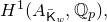 $H^1(A_{\bar{\mathsf{K}}_w},\mathbb Q_p),$
where we use the convention that the cyclotomic character has Hodge–Tate weight 1.
We denote by
 $\boldsymbol{w}: \mathbb G_m \rightarrow G$
the weight cocharacter. For
 $y \in \mathbb G_m,$
 $\boldsymbol{w}(y)$
acts via the scalar y on
 $H^1(A(\mathbb C), \mathbb Q)$
. For two G-valued cocharacters
 $\mu_1,\mu_2,$
we write
 $\mu_1 \sim \mu_2$
if
 $\mu_1$
and
 $\mu_2$
are conjugate over some sufficiently large field, containing the fields of definition of
 $\mu_1$
and
 $\mu_2$
.
Lemma 2.12. We have the following.
-
(1) The cocharacters
$\boldsymbol{\mu}_w$
are G-valued. -
(2) For any
$\sigma \in \mathrm{Aut}(C),$
we have
$\boldsymbol{\mu}_{\sigma\circ w} \sim \sigma^*(\boldsymbol{\mu}_w)$
. -
(3) Let c on
$\mathbb C \simeq C$
denote complex conjugation. Then
$\boldsymbol{\mu}_{c\circ w}\ \sim \boldsymbol{w}^{-1}\cdot \boldsymbol{\mu}_w^{-1}$
. -
(4) The images of the G(C)-conjugates of the cocharacters
$\boldsymbol{\mu}_w,$
where w runs over all embeddings
$\bar{\mathsf{K}} \rightarrow C,$
generate the group G.







Proof. Recall the p-adic period ring
 $B_{{\mathrm{dR}}}$
constructed from the field C. The isomorphism (2.11) arises from the p-adic de Rham comparison isomorphism
 \begin{equation}H^1(A_{\bar{\mathsf{K}}_w},\mathbb Q_p)\otimes _{\mathbb Q_p} B_{{\mathrm{dR}}} \simeq H^1_{{\mathrm{dR}}}(A)\otimes _{\mathsf{K},w} B_{{\mathrm{dR}}}\end{equation}
by passing to
 $\mathrm{gr}^0,$
and using the isomorphism
 $C \simeq C(1)$
. Here, the embedding
 $\mathsf{K} \rightarrow B_{{\mathrm{dR}}}$
is the unique embedding lifting w. A result of Blasius and Wintenberger [Reference BlasiusBla94] asserts that (2.12) takes
 $s_{\alpha,p}$
to
 $s_{\alpha,{\mathrm{dR}}}$
. Hence, one sees that (2.11) takes
 $s_{\alpha,p}$
to the image of
 $s_{\alpha,{\mathrm{dR}}},$
 $s_{\alpha,{\mathrm{HT}}} \in \mathrm{gr}^0(H^1_{{\mathrm{HT}}}(A)^\otimes )$
. In particular, the image of
 $\boldsymbol{\mu}_w$
acts trivially on
 $s_{\alpha,p},$
so
 $\boldsymbol{\mu}_w$
is G-valued.
We now consider two isomorphisms
 \begin{align*} H^1(A_{\bar{\mathsf{K}}},\mathbb Q_p)\otimes _{\mathbb Q_p} C \simeq H^1_{{\mathrm{HT}}}(A)\otimes _{\mathsf{K},\sigma\circ w} C. \end{align*}
The first is obtained by composing (2.11) with
 $1\otimes \sigma,$
and the second is the Hodge–Tate isomorphism (2.11) with
 $\sigma\circ w$
in place of w. By what we have just seen, each of these isomorphisms takes
 $s_{\alpha,p}$
to
 $s_{\alpha,{\mathrm{HT}}}$
. Hence, they differ by an element of G(C). The gradings induced on
 $H^1(A_{\bar{\mathsf{K}}},\mathbb Q_p)\otimes _{\mathbb Q_p} C$
by these isomorphisms correspond to the cocharacters
 $\sigma^*(\boldsymbol{\mu}_w)$
and
 $\boldsymbol{\mu}_{\sigma\circ w}$
, respectively, which proves part (2).
Next we show part (3). Consider the isomorphisms
 \begin{equation} H^1(A_{\bar{\mathsf{K}}},\mathbb Q_p)\otimes _{\mathbb Q_p} \mathbb C \simeq H^1(A(\mathbb C),\mathbb Q)\otimes _\mathbb Q \mathbb C \simeq H^1_{{\mathrm{HT}}}(A)\otimes _{\mathsf{K},\tilde w} \mathbb C, \end{equation}
where the first isomorphism uses the embedding
 $\tilde w,$
and the second is given by the Hodge decomposition. As we remarked above, the first isomorphism takes
 $s_{\alpha,p}$
to an element of
 $H^1(A(\mathbb C),\mathbb Q)^\otimes $
which maps to
 $s_{\alpha, {\mathrm{dR}}}$
under the (classical) de Rham isomorphism. Thus, (2.13) takes
 $s_{\alpha,p}$
to
 $s_{\alpha,{\mathrm{HT}}}$
. Denote by
 $\boldsymbol{\mu}'_w$
the inverse of the cocharacter corresponding to the grading on
 $H^1(A_{\bar{\mathsf{K}}},\mathbb Q_p)\otimes _{\mathbb Q_p} \mathbb C$
induced by (2.13). As above,
 $\boldsymbol{\mu}'_w \sim \boldsymbol{\mu}_w$
. Thus, using part (2), we have
 \begin{align*} \boldsymbol{\mu}_{c\circ w} \sim c^*(\boldsymbol{\mu}_w) \sim c^*(\boldsymbol{\mu}'_w). \end{align*}
As
 $\boldsymbol{\mu}^{\prime-1}_w$
corresponds to the Hodge decomposition on
 $H^1(A(\mathbb C),\mathbb Q)\otimes _\mathbb Q \mathbb C,$
we have
 $c^*(\boldsymbol{\mu}'_w)\boldsymbol{\mu}'_w = \boldsymbol{w}^{-1},$
so that
 \begin{align*} \boldsymbol{\mu}_{c\circ w} \sim c^*(\boldsymbol{\mu}'_w) = \boldsymbol{w}^{-1} \boldsymbol{\mu}^{\prime-1}_w \sim \boldsymbol{w}^{-1} \boldsymbol{\mu}_w^{-1},\end{align*}
which proves part (3).
Finally, we show part (4). As
 $\boldsymbol{\mu}'_w \sim \boldsymbol{\mu}_w,$
it suffices to prove part (4) with
 $\boldsymbol{\mu}'_w$
in place of
 $\boldsymbol{\mu}_w$
. As in part (2), for any
 $\sigma \in \mathrm{Aut}(\mathbb C),$
we have
 $\boldsymbol{\mu}'_{\sigma\circ w_0} \sim \sigma^*(\boldsymbol{\mu}'_{w_0}),$
so it suffices to show that the images of
 $\sigma^*(\boldsymbol{\mu}'_{w_0})$
generate G when
 $\sigma$
runs over
 $ \mathrm{Aut}(\mathbb C)$
. This is one possible definition of the Mumford–Tate group. To see that it agrees with our definition, let
 $H \subset G$
be the subgroup generated by the
 $\sigma^*(\boldsymbol{\mu}'_{w_0})$
. Then H is a
 $\mathbb Q$
-subgroup. The element
 $\boldsymbol{\mu}'_{w_0}(-1)\boldsymbol{w}(\sqrt{-1}) \in G(\mathbb C)$
is a Cartan involution, which is contained in
 $H(\mathbb C)$
. Thus,
 $H_{\mathbb R}/\boldsymbol{w}(\mathbb G_m)$
has a compact form, which implies that H is reductive. Any
 $t \in H^1(A(\mathbb C),\mathbb Q)^\otimes $
fixed by H is a Hodge cycle, as
 $\boldsymbol{\mu}_{w_0}$
and
 $c^*(\boldsymbol{\mu}_{w_0})$
act trivially on t, so H and G fix the same tensors, which implies that
 $H=G$
as H is reductive.
Corollary 2.13.
Assume that the Mumford–Tate conjecture holds for A. Then the images of the cocharacters
 $\boldsymbol{\mu}_w,$
w running over embeddings
 $\bar{\mathsf{K}} \rightarrow C,$
generate G as a C-group.
Proof. Let
 $\sigma \in \Gamma_\mathsf{K}$
. By functoriality of the Hodge–Tate isomorphism, we have
 $\boldsymbol{\mu}_{w\circ \sigma} = \varrho_A(\sigma)\boldsymbol{\mu}_w\varrho_A(\sigma)^{-1}$
. By Lemma 2.12(4), since
 $\varrho_A(\Gamma_\mathsf{K})$
is Zariski dense in G, the subgroup of G generated by the images of
 $\varrho_A(\sigma)\boldsymbol{\mu}_w\varrho_A(\sigma)^{-1},$
for all choices of w and
 $\sigma,$
is Zariski dense in G, hence equal to G.
2.4.3.
Let V be a G-representation over C,
 $L \subset V$
a non-zero subspace, and
 $\boldsymbol{\mu}$
a cocharacter of G. We call V pure if the action of
 $\mathbb G_m$
on V via the cocharacter
 $\boldsymbol{w}: \mathbb G_m \rightarrow G$
has only one weight.
Let
 $\mathrm{Fil}^{\boldsymbol{\mu}}$
denote the decreasing filtration on V induced by
 $\boldsymbol{\mu}$
. If L is 1-dimensional, we denote by
 $\langle \boldsymbol{\mu}, L \rangle$
the least integer n such that
 $\mathrm{Fil}^{\boldsymbol{\mu}, n+1} L = 0$
. In general, we set
 $\langle \boldsymbol{\mu}, L \rangle = {\langle \boldsymbol{\mu}, \wedge^{\mathrm{dim\,} L} L \rangle}/{\mathrm{dim}_C L},$
where we think of
 $\wedge^{\mathrm{dim} L} L$
as a subspace of the G-representation
 $\wedge^{\mathrm{dim} L} V$
.
We set
 $\langle \boldsymbol{\mu}, L \rangle_G = \min_{g \in G(C)} \langle \boldsymbol{\mu}, g\cdot L \rangle$
. Note that we have
 $\langle \boldsymbol{\mu}, L \rangle_G = \langle \boldsymbol{\mu}, g\cdot L \rangle$
for g in a Zariski-dense subset of G.
Lemma 2.14.
Let V be a pure G-representation, and
 $L \subset V$
and w as above. Then we have
 \begin{equation} \langle \boldsymbol{\mu}_w, L \rangle_G+ \langle \boldsymbol{\mu}_{c\circ w}, L \rangle_G\leq -\langle \boldsymbol{w}, L \rangle.\end{equation}
Moreover, if equality holds, then L is stable by the image of
 $\boldsymbol{\mu}_w$
.
Proof. We may replace
 $L \subset V$
by
 $\wedge^{\mathrm{dim} L} L \subset \wedge^{\mathrm{dim} L} V$
. Indeed, this has the effect of multiplying both sides of (2.14) by
 $\mathrm{dim\,}L,$
and
 $L \subset V$
is determined by
 $\wedge^{\mathrm{dim\,}L} L$
. Thus, we may assume that
 $\mathrm{dim\,} L = 1$
. We may also replace V by the smallest G-stable subspace containing L, and assume that V is spanned by the G-translates of L.
Now let
 $\boldsymbol{\mu}'_w$
be as in the proof of Lemma 2.12. Write
 $V = \bigoplus_{p+q = -m} V^{p,q}$
, where
 $\boldsymbol{\mu}'_w(z)$
and
 $\boldsymbol{\mu}'_{c\circ w}(z)$
act on
 $V^{p,q}$
via
 $z^{p}$
and
 $z^{q}$
, respectively, and m is the weight of
 $\boldsymbol{w}$
on V. Let
 $p_0$
be the minimum integer such that
 $V^{p_0,q} \neq 0$
for some q, and define
 $q_0$
similarly. We have
 \begin{align*} \langle \boldsymbol{\mu}'_w, L \rangle_G+ \langle c\circ\boldsymbol{\mu}'_w, L \rangle_G = p_0 + q_0 \leq -m = -\langle \boldsymbol{w}, L \rangle.\end{align*}
Here we are using that the G-translates of L span V. If equality holds in (2.14), then
 $p_0 + q_0 = -m$
. This implies that
 $V^{p,q} = 0$
for
 $(p,q) \neq (p_0,q_0)$
. That is,
 $\boldsymbol{\mu}_w$
acts as a scalar on V, and in particular leaves L stable.
Proposition 2.15.
Let
 $H \subset A_{\bar{\mathsf{K}}}[p^\infty]$
be a p-divisible subgroup. Then the limit
 $\lim_n \nu(H[p^n])$
exists, and we have
 \begin{equation} \lim_n \nu(H[p^n]) \leq \tfrac{1}{2}. \end{equation}
If the Mumford–Tate conjecture holds for A, then equality holds in (2.15) only if H is defined over
 $\mathsf{K}$
.
Proof. Note that H is defined over
 $\mathsf{K}$
if and only if
 $T_pH \otimes \mathbb Q_p \subset T_pA\otimes \mathbb Q_p$
is stable by G. Thus, the proposition holds only if it holds after replacing
 $\mathsf{K}$
by a finite extension. We may assume that
 $\mathsf{K}$
is Galois over
 $\mathbb Q$
. Denote by s(p) the number of primes
 $w|p$
of
 $\mathsf{K}$
. For each embedding
 $w: \mathsf{K} \rightarrow C,$
we have
 \begin{align} \lim_n \int_{\Gamma_\mathsf{K}}\mu_w(\sigma(H[p^n])) \,d\sigma &= \int_{\Gamma_\mathsf{K}}\lim_n \mu_w(\sigma(H[p^n])) \,d\sigma \nonumber\\[5pt] & = \int_{\Gamma_\mathsf{K}} \frac{\mathrm{dim}(\sigma(T_p H) \otimes C \cap \mathrm{Lie\,} A \otimes C(1))}{\mathrm{ht\,} H} \, d\sigma, \end{align}
where, in the first equality, we are using that
 $\mu_w$
takes values in [0,1] and in the second equality, we have applied Proposition 2.7 to
 $\mathsf{K}_w \hookrightarrow C$
. Since we are assuming the Mumford–Tate conjecture holds for A, the image of
 $\Gamma_\mathsf{K}$
in
 $G(\mathbb Q_p)$
is open. Hence, for
 $\sigma$
contained in a subset of
 $\Gamma_\mathsf{K}$
of measure 1, we have
 \begin{align*} \frac{\mathrm{dim}(\sigma(T_p H) \otimes C \cap \mathrm{Lie\,} A \otimes C(1))}{\mathrm{ht\,} H} = \langle \boldsymbol{\mu}_w,T_p H \otimes C \rangle_G, \end{align*}
where we view
 $T_pH \otimes C$
as a subspace of the G-representation
 $T_pA\otimes C$
.
Thus, using Lemma 2.14, we have
 \begin{align}\lim_n \nu(H[p^n]) &= \frac 1 {s(p)} \sum_{w|p} \langle \boldsymbol{\mu}_w,T_p H \otimes C \rangle_G \nonumber\\[5pt]&= \frac 1 {2s(p)} \bigg(\sum_{w|p} \ \langle \boldsymbol{\mu}_w,T_p H \otimes C \rangle_G+ \langle \boldsymbol{\mu}_{c\circ w},T_p H \otimes C \rangle_G\bigg) \nonumber\\[5pt]&\leq -\frac 1 {2s(p)} \bigg(\sum_{w|p} \langle \boldsymbol{w}, T_p H\otimes C \rangle\bigg) = \frac 1 2,\end{align}
with equality only if
 $T_p H\otimes C$
is stable by
 $\boldsymbol{\mu}_w$
for all
 $w|p$
. Now, if A satisfies the Mumford–Tate conjecture then, by Corollary 2.13, if
 $T_p H\otimes C$
is stable by all
 $\boldsymbol{\mu}_w,$
then
 $T_p H \subset T_p A$
is stable by G, and hence by
 $\Gamma_\mathsf{K}$
.
Corollary 2.16.
Let
 $H \subset A_{\bar{\mathsf{K}}}[p^\infty]$
be a p-divisible subgroup, and suppose that the Mumford–Tate conjecture holds for A. Then either
 $h(A/H[p^n]) \rightarrow \infty,$
or H is defined over a finite extension of
 $\mathsf{K}$
. In the latter case, the set of abelian varieties
 $\{A/H[p^n]\}_{n \geq 1}$
contains only finitely many isomorphism classes over
 $\mathsf{K}$
.
2.5 The Northcott property
2.5.1.
We keep the notation introduced above. In particular, we continue to assume that
 $\mathsf{K}$
contains the reflex field of A, so that the G-valued representation
 $\varrho_A$
exists. The aim of this subsection is to show the Northcott property for the set of abelian varieties over
 $\bar{\mathsf{K}}$
which are related to
 $A_{\bar{\mathsf{K}}}$
via a p-isogeny. We do this by reducing to the case considered in Corollary 2.16, where the kernels of these p-isogenies are the levels of a p-divisible group.
2.5.2.
Let M be a torsion, finite
 $\mathbb Z_p$
-module. We call M uniform if
 $M \simeq (\mathbb Z/p^n\mathbb Z)^r$
for some n and r, in which case we say that M is uniform of rank r and level n. Fix r, and denote by
 $X_r(\mathbb Z/p^n\mathbb Z)$
the set of submodules
 $M \subset A[p^\infty](\bar{\mathsf{K}})$
which are uniform of rank r and level n. Then the set
 $X_r(\mathbb Q_p/\mathbb Z_p) = \underleftarrow{\mathrm{lim}} X_r(\mathbb Z/p^n\mathbb Z)$
is profinite, and equipped with its profinite topology. Here, the transition maps are given by sending
 $M \in X_r(\mathbb Z/p^n\mathbb Z)$
to
 $M[p^{n-1}]$
.
A point
 $H \in X_r(\mathbb Q_p/\mathbb Z_p)$
corresponds to a p-divisible subgroup
 $H \subset A[p^\infty](\bar{\mathsf{K}})$
. We write
 $\nu(H)$
for
 $\lim_n \nu(H[p^n])$
, which is well-defined by Equation (2.16).
Let
 $\{H_n\}_{n \geq 1}$
be an infinite sequence of distinct uniform subgroups of
 $A[p^\infty](\bar{\mathsf{K}})$
of fixed rank r, and
 $\tilde H_n \in X_r(\mathbb Q_p/\mathbb Z_p)$
a lift of
 $H_n$
. We say
 $\{H_n\}_{n \geq 1}$
converges to
 $H \in X_r(\mathbb Q_p/\mathbb Z_p)$
if
 $\{\tilde H_n\}_{n \geq 1}$
converges to H. Since the
 $H_n$
are distinct, their levels go to
 $\infty,$
so this condition is independent of the choice of
 $\tilde H_n$
.
Lemma 2.17.
Let
 $\{H_n\}_{n \geq 1}$
be a sequence of distinct subgroups of
 $A[p^\infty](\bar K),$
which are uniform of fixed rank r, such that
 $\{H_n\}_{n \geq 1}$
converges to
 $H \in X_r(\mathbb Q_p/\mathbb Z_p)$
. Then
 \begin{align*} \lim \sup_n \nu(H_n) \leq \nu(H).\end{align*}
Proof. Choose lifts
 $\tilde H_n \in X_r(\mathbb Q_p/\mathbb Z_p)$
of
 $H_n,$
and let
 $m \geq 1$
. Since
 $\lim \tilde H_n = H$
in
 $X_r(\mathbb Q_p/\mathbb Z_p),$
for n large enough
 $\tilde H_n[p^m] = H_n[p^m] = H[p^m]$
. Denote by
 $\bar H_n$
the closure of
 $H_n$
in
 $\mathcal A$
. Suppose
 $H_n$
has level
 $mk+t,$
with k a non-negative integer, and
 $0 \leq t \leq m-1$
. Then, for
 $j \leq k-1,$
multiplication by
 $p^{mj}$
on
 $\mathcal A$
induces a map
 \begin{align*} \bar H_n[p^{m(j+1)}]/\bar H_n[p^{mj}] \rightarrow \bar H[p^m]\end{align*}
which is an isomorphism on generic fibers. Hence, using Lemma 2.9(2), we have
 \begin{align*}\nu(\bar H_n[p^{m(j+1)}]/\bar H_n[p^{mj}]) \leq \nu(H[p^m]),\end{align*}
and so
 \begin{align*}\deg(\bar H_n[p^{m(j+1)}]/\bar H_n[p^{mj}]) \leq \deg(H[p^m]).\end{align*}
Using the additivity of the global degree in short exact sequences Lemma 2.9(3), we obtain
 \begin{align}\deg \bar H_n &= \deg \bar H_n /\bar H_n[p^{mk}] + \sum_{j=0}^{k-1} \deg(\bar H_n[p^{m(j+1)}]/\bar H_n[p^{mj}]) \nonumber\\&\leq k\deg H[p^m] + \deg \bar H_n /\bar H_n[p^{mk}].\end{align}
Hence,
 \begin{align}\nu(H_n) &\leq \frac{k\deg H[p^m] + \deg \bar H_n /\bar H_n[p^{mk}]}{\mathrm{ht\,} H_n} \nonumber\\&\leq \frac{k\deg H[p^m] + (m-1)r}{k\mathrm{ht\,} H[p^m]} = \nu(H[p^m]) + \frac{(m-1)r}{k\mathrm{ht\,} H[p^m]}.\end{align}
Passing to the limit with n (so that
 $k \rightarrow \infty$
), and then with m, gives the inequality of the lemma.
2.5.3.
Let M be a finitely generated, torsion
 $\mathbb Z_p$
-module. For each i consider the map
 $\epsilon_i:M[p^i] \overset {p^{i-1}} \rightarrow M[p]$
. We define a decreasing filtration
 $M^j$
on M by setting
 $M^j = M[p^{i_j}]$
, where
 $i_j$
is the greatest integer i for which the image of
 $\epsilon_i$
has
 $\mathbb F_p$
-dimension
 $\geq j$
.
Lemma 2.18.
Let M be a finitely generated, torsion
 $\mathbb Z_p$
-module. For each j,
 $\mathrm{gr}^j M$
is a uniform
 $\mathbb Z_p$
-module. If
 $\mathrm{gr}^j M$
is non-zero, then it has rank j.
Proof. Let
 $M = \bigoplus_s (\mathbb Z/p^{a_s}\mathbb Z)^{r_s},$
where
 $a_1 \lt a_2 \lt \cdots \lt a_s$
are integers, and
 $r_s \gt 0$
. Note that
 $i_j = a_{s_j}$
for some
 $s_j$
by maximality of
 $i_j$
. We have
 \begin{align*}M^j = M[p^{i_j}] \simeq \bigoplus_{s\lt s_j} (\mathbb Z/p^{a_s}\mathbb Z)^{r_s} \bigoplus_{s \geq s_j} (\mathbb Z/p^{a_{s_j}}\mathbb Z)^{r_s}.\end{align*}
Thus
 \begin{align*} \mathrm{gr}^j M = \bigoplus_{s \geq s_j} (\mathbb Z/p^{a_{s_j}- a_{s_{j+1}}}\mathbb Z)^{r_s},\end{align*}
so this module is uniform. Moreover,
 $ \mathrm{gr}^j M$
is non-zero if and only if
 $s_j \neq s_{j+1},$
or equivalently
 $i_j \neq i_{j+1},$
in which case its rank is
 \begin{align*} \sum_{a_s \geq a_{s_j}} r_s = \sum_{a_s \geq i_j } r_s= \mathrm{rk\,} \epsilon_{i_j} = j. \end{align*}
Proposition 2.19.
Suppose that A satisfies the Mumford–Tate conjecture, and let
 $\{H_\alpha\}_{\alpha}$
be an infinite collection of distinct, finite subgroups of
 $A[p^\infty](\bar{\mathsf{K}}),$
such that no
 $H_{\alpha}$
contains a non-trivial
 $\Gamma_\mathsf{K}$
-stable subgroup. Then there exists a sequence
 $\{H_n\}_{n \geq 1} \subset \{H_{\alpha}\}$
such that
 \begin{align*} \lim_n \sup \nu(H_n) \lt \tfrac{1}{2}.\end{align*}
Proof. We consider the filtration
 $H^j_{\alpha}$
on
 $H_{\alpha}$
introduced in § 2.5.3. As usual, we denote by
 $\bar H^j_{\alpha}$
the closure of
 $H^j_{\alpha}$
in
 $\mathcal A$
. Multiplication by
 $p^{i_{j+1}}$
induces a map
 $\bar H^j_{\alpha}/\bar H^{j+1}_{\alpha} \rightarrow \bar H_{\alpha},$
which is an injection on generic fibers. We denote the image of the generic fiber of this map by
 $\underline {\mathrm{gr}}^j H_{\alpha} \subset H_{\alpha}$
. Then
 \begin{equation}\nu(\bar H^j_{\alpha}/\bar H^{j+1}_{\alpha}) \leq \nu (\underline {\mathrm{gr}}^j H_{\alpha}).\end{equation}
Now, by compactness of
 $X_j(\mathbb Q_p/\mathbb Z_p)$
and Lemma 2.18, we may choose a sequence
 $\{H_n\}_{n \geq 1} \subset \{H_{\alpha}\}$
such that, for each
 $j \geq 1,$
either
 $\underline {\mathrm{gr}}^j H_n$
is trivial for all n, or the sequence
 $\{\underline {\mathrm{gr}}^j H_n\}_n$
converges to a p-divisible group
 $H(j) \in X_j(\mathbb Q_p/\mathbb Z_p)$
. By Lemma 2.17 and Proposition 2.15, in the latter case we have
 \begin{align*}\lim_n \sup \nu(\bar H^j_n/\bar H^{j+1}_n) \leq \lim_n\sup \nu(\underline {\mathrm{gr}}^j H_n) \leq \nu(H(j)) \leq \tfrac{1}{2},\end{align*}
with equality only if H(j) is defined over K. Hence,
 \begin{equation}\lim_n \sup \nu(H_n) \leq \tfrac{1}{2},\end{equation}
with equality only if each H(j) is defined over
 $\mathsf{K}$
.
If H(j) is defined over
 $\mathsf{K},$
then
 $H(j)[p^m] \subset A[p^m](\bar{\mathsf{K}})$
is stable by
 $\Gamma_\mathsf{K}$
for every m. Since
 $\{\underline {\mathrm{gr}}^j H_n\}_n$
converges to H(j), for n sufficiently large,
 $H(j)[p^m] \subset \underline {\mathrm{gr}}^j H_n,$
which contradicts the assumption that
 $H_{\alpha}$
contains no non-trivial
 $\Gamma_\mathsf{K}$
-stable subgroups. Therefore, (2.21) is strict.
2.5.4.
Let
 ${\mathscr I}_p(A)$
denote the p-isogeny class of A over
 $\bar{\mathsf{K}}$
. We denote by
 ${\mathscr I}_p(A)'$
the collection of subgroups
 $H \subset A[p^\infty](\bar{\mathsf{K}})$
such that H contains no non-trivial
 $\Gamma_\mathsf{K}$
-stable subgroup. Thus,
 ${\mathscr I}_p(A)' \subset {\mathscr I}_p(A)$
via
 $H \mapsto A/H$
.
Theorem 2.20.
Let A be an abelian variety defined over a number field
 $\mathsf{K},$
and suppose that the Mumford–Tate conjecture holds for A. Then, for any
 $c \gt 0,$
the set
 \begin{align*} \{ A' \in {\mathscr I}_p(A): h(A') \lt c \}\end{align*}
contains a finite number of isomorphism classes of abelian varieties.
Proof. After replacing
 $\mathsf{K}$
by a finite extension, we may assume that
 $\mathsf{K}$
contains the reflex field of A.
Let
 $\{H_{\alpha}\}_{\alpha}$
be a collection of subgroups of
 $A[p^\infty](\bar{\mathsf{K}})$
. We have to show that the set
 $\{H_{\alpha}: h(A/H_{\alpha}) \lt c\}_{\alpha}$
contains only finitely many isomorphism classes of abelian varieties. Let
 $H_{\alpha}^0 \subset H_{\alpha}$
denote the maximal subgroup of
 $H_{\alpha}$
which is stable under
 $\Gamma_\mathsf{K}$
. As the sum of two
 $\Gamma_\mathsf{K}$
-stable subgroups is
 $\Gamma_\mathsf{K}$
-stable,
 $H_{\alpha}^0$
is well-defined. Moreover, if
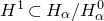 $H^1 \subset H_{\alpha}/H^0_{\alpha}$
is
 $\Gamma_\mathsf{K}$
-stable, then so is its preimage in
 $H_{\alpha}$
. Thus,
 $H_{\alpha}/H^0_{\alpha}$
contains no non-trivial
 $\Gamma_\mathsf{K}$
-stable subgroups.
By Faltings’ theorem, the set
 $\{A/H^0_{\alpha}\}_{\alpha}$
contains only finitely many isomorphism classes. Fix such an isomorphism class
 $\kappa,$
let
 $\alpha(\kappa)$
denote the set of
 $\alpha$
with
 $A/H^0_{\alpha}$
in
 $\kappa,$
and choose any
 $\alpha_0 \in \alpha(\kappa)$
. For
 $\alpha \in \alpha(\kappa),$
fix an isomorphism
 $A/H^0_{\alpha} \simeq A/H^0_{\alpha_0}$
. Then, for
 $\alpha \in \alpha(\kappa),$
we may view
 $H_{\alpha}/H^0_{\alpha}$
as a subgroup of
 $A/H^0_{\alpha_0},$
and it suffices to prove the finiteness statement with
 $A/H^0_{\alpha_0}$
in place of A, and
 $\{H_{\alpha}/H^0_{\alpha}: \alpha \in \alpha(\kappa)\}$
in place of
 $\{H_{\alpha}\}_{\alpha}$
. In particular, we may assume that no
 $H_{\alpha}$
has a non-trivial
 $\Gamma_\mathsf{K}$
-stable subspace.
We may assume that the
 $H_{\alpha}$
are distinct. If
 $\{H_{\alpha}: h(A/H_{\alpha}) \lt c\}_{\alpha}$
is infinite, then by Proposition 2.19 there is a sequence
 \begin{align*}\{H_n\}_{n \geq 1} \subset \{H_{\alpha}: h(A/H_{\alpha}) \lt c\}_{\alpha}\end{align*}
such that
 $\lim_n \sup \nu(H_n) \lt {1}/{2}$
. By Faltings’ isogeny lemma, 2.3.4, this implies the set of heights
 $\{h(A/H_n)\}_{n \geq 1}$
is unbounded, contradicting our assumption. Hence,
 $\{H_{\alpha}: h(A/H_{\alpha}) \lt c\}_{\alpha}$
is finite.
2.5.5.
In fact, the final paragraph of the proof of the theorem gives a more precise statement, which we now record.
Corollary 2.21.
Suppose
 $\mathsf{K}$
contains the reflex field of A. If the Mumford–Tate conjecture holds for A, then for any
 $c \gt 0,$
the set
 \begin{align*} \{H \in {\mathscr I}_p(A)': h(A/H) \lt c\}\end{align*}
is finite.
3. Effective bounds at large primes
3.1
$\varphi$
-Modules and slopes

3.1.1.
We now return to the notation of § 2.1.1, but we assume that K is a finite extension of
 $K_0 = W(k)[1/p],$
where k is a perfect field of characteristic p. We also fix a uniformizer
 $\pi \in \mathcal O_K,$
and denote by
 $E = E(u)$
the Eisenstein polynomial of
 $\pi$
. Fix a compatible sequence of p-power roots of
 $\pi$
in
 $\bar K,$
and set
 $K_{\infty} = K(\pi^{1/p^n})_{n \geq 1}$
.
Let
 $R = \underleftarrow{\mathrm{lim}}_{x \rightarrow x^p} \mathcal O_C/p\mathcal O_C$
be the integral subring of the tilt
 $C^\flat,$
and write
 $A_{\inf} = W(R)$
. Write
 $\xi = p - [\underline p],$
where
 $\underline p = (p, p^{1/p}, \dots) \in R$
. Set
 $\mathfrak S = W[\![ u ]\!]$
equipped with the Frobenius lift given by
 $u \mapsto u^p$
. We consider
 $\mathfrak S$
as a subring of
 $A_{\inf}$
via the map
 $u \mapsto [\underline \pi]$
, where
 $\underline \pi = (\pi, \pi^{1/p}, \dots) \in R$
. Note that this inclusion is compatible with Frobenius actions.
3.1.2.
Let A be a
 $\mathbb Z_p$
-algebra, equipped with a lift of Frobenius
 $\varphi,$
and a non-zero divisor
 $a \in A$
. We denote by
 $\mathrm{Mod}^{\varphi,c}_{/A}$
(respectively
 $\mathrm{Mod}^{\varphi}_{/A},$
respectively
 $\mathrm{Mod}^{\varphi,t}_{/A}$
) the category of a-torsion free A-modules M, which are finite (respectively finite free, respectively finite, p-power torsion) equipped with an isomorphism
 $\varphi_M:\varphi^*(M)[1/a] \overset{\sim}{\longrightarrow} M[1/a]$
. We again denote by
 $\varphi_M: M \rightarrow M[1/a]$
the corresponding
 $\varphi$
-semi-linear map on M. We sometimes write
 $\varphi$
for
 $\varphi_M$
. We call M effective if
 $\varphi_M(M) \subset M$
.
As M has no a-torsion,
 $\varphi_M$
identifies
 $\varphi^*(M)$
with a submodule of
 $M[1/a]$
. For a non-negative integer h, we denote by
 $\mathrm{Mod}^{\varphi,\leq h}_{/A}$
(respectively
 $\mathrm{Mod}^{\varphi,t,\leq h}_{/A}$
) the subcategory of
 $\mathrm{Mod}^{\varphi}_{/A}$
(respectively
 $\mathrm{Mod}^{\varphi,t}_{/A}$
), consisting of effective objects M, such that
 $M/\varphi^*(M)$
is killed by
 $a^h$
.
We think of
 $A_{\inf}$
and R (respectively
 $\mathfrak S$
) as equipped with the divisor
 $(\xi)$
(respectively (E)). We regard any quotient or localization of
 $A_{\inf}$
(respectively
 $\mathfrak S$
) as equipped with the same element
 $\xi$
(respectively E).
Since
 $E \in \xi A_{\inf},$
we have functors
 \begin{align*} \mathrm{Mod}^{\varphi}_{/\mathfrak S} \rightarrow \mathrm{Mod}^{\varphi}_{/A_{\inf}}\quad \text{ and }\quad\mathrm{Mod}^{\varphi}_{/k[\![ u ]\!] } \rightarrow \mathrm{Mod}^{\varphi}_{/R};\quad M \mapsto M\otimes _{\mathfrak{S}}A_{\inf}. \end{align*}
3.1.3.
Let
 $\mathrm{Rep}^{\mathrm{fin}}_{\mathbb Z_p}$
denote the category of finite
 $\mathbb Z_p$
-modules. For M in
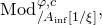 $\mathrm{Mod}^{\varphi,c}_{/A_{\inf}[1/\xi]},$
we write
 \begin{align*} \textbf V(M) = (M\otimes _{A_{\inf}} W(C^\flat))^{\varphi = 1},\end{align*}
which is a finitely generated
 $\mathbb Z_p$
-module. As
 $W(C^{\flat})$
is a p-adically complete discrete valuation ring, with algebraically closed residue field (it is equal to the p-adic completion of
 $A_{\inf}[1/\xi]$
), the natural map
 \begin{align*} \textbf V(M)\otimes _{\mathbb Z_p}W(C^\flat) \rightarrow M\otimes _{A_{\inf}} W(C^\flat)\end{align*}
is an isomorphism. Thus,
 $\textbf V$
gives rise to an exact tensor functor.
 \begin{align*} \mathrm{Mod}^{\varphi,c}_{/A_{\inf}[1/\xi]} \rightarrow \mathrm{Rep}^{\mathrm{fin}}_{\mathbb Z_p}; \quad M \mapsto \textbf V(M), \end{align*}
which induces an equivalence on p-power torsion objects. For M in
 $\mathrm{Mod}^{\varphi,c}_{/A_{\inf}},$
we will write
 $\textbf V(M)$
for
 $\textbf V(M[1/\xi])$
.
If M is in
 $\mathrm{Mod}^{\varphi,c}_{/\mathfrak S[1/E]},$
we likewise write
 \begin{align*} \textbf V(M) = (M\otimes _{\mathfrak S} W(C^\flat))^{\varphi = 1},\end{align*}
when
 $\textbf V(M)$
inherits the structure of a
 $\Gamma_{K_{\infty}} : = \mathrm{Gal}(\bar K/K_{\infty})$
-module from the
 $\Gamma_{K_{\infty}}$
-action on
 $W(C^\flat)$
. If
 $\mathrm{Rep}_{\mathbb Z_p}^{\mathrm{fin}}(\Gamma_{K_{\infty}})$
denotes the category of
 $\mathbb Z_p-\Gamma_{K_{\infty}}$
-modules which are finitely generated over
 $\mathbb Z_p,$
then
 $\textbf V$
induces an exact tensor functor
 \begin{align*} \mathrm{Mod}^{\varphi,c}_{/\mathfrak S[1/\xi]} \rightarrow \mathrm{Rep}_{\mathbb Z_p}^{\mathrm{fin}} (\Gamma_{K_{\infty}}); \quad M \mapsto \textbf V(M), \end{align*}
which is an equivalence on p-power torsion objects [Reference FontaineFon90, A.1.2.7]. As above, for M in
 $\mathrm{Mod}^{\varphi,c}_{/\mathfrak S},$
we write
 $\textbf V(M) = \textbf V(M[1/E])$
.
3.1.4.
We recall the definition of slopes of objects of
 $\mathrm{Mod}^{\varphi,t}_{/A_{\inf}}$
which was introduced by Cornut and Peche Irissarry [Reference Cornut and Peche IrissarryCPI19]; see also [Reference Wang-Erickson and LevinWEL20]. We ultimately make use of this only for modules in
 $\mathrm{Mod}^{\varphi}_{/R},$
so the reader may restrict themselves to this case, in which case the definitions are slightly simpler.
As in § 2.2.1, for a finitely presented torsion R-module
 $\mathfrak N,$
we have
 $\mathfrak N \simeq \bigoplus_{i=1}^n R/a_i R$
with
 $a_i \in R$
. We define the normalized length of
 $\mathfrak N$
as
 $\ell(\mathfrak N) = \sum_i v_R(a_i)$
, where
 $v_R$
is the valuation on R, normalized so that
 $v_R(\underline p) = 1$
. The normalized length is additive in short exact sequences. Now suppose that
 $\mathfrak N$
is a finitely presented
 $A_{\inf}$
-module, which is killed by some power of
 $(p,\xi)$
. Then
 $\mathfrak N$
has a filtration whose associated grading is a finitely presented torsion R-module, and we extend the definition of
 $\ell$
to such modules by additivity [Reference Cornut and Peche IrissarryCPI19, 2.2.13].
Let
 $\mathfrak M$
be an effective object in
 $\mathrm{Mod}^{\varphi,t}_{/A_{\inf}}$
. Then
 $\mathfrak M/\varphi^*(\mathfrak M)$
is a finitely presented
 $A_{\inf}$
-module, killed by some power of
 $(p,\xi),$
and we define
 \begin{align*} \deg \mathfrak M = \ell(\mathfrak M/\varphi^*(\mathfrak M)).\end{align*}
Set
 $\mathrm{rk\,} \mathfrak M = \ell_{W(C\flat)}(\mathfrak M\otimes W(C^\flat)),$
and define the slope of
 $\mathfrak M$
by
 \begin{align*} \mu(\mathfrak M) = \frac{ \deg \mathfrak M}{\mathrm{rk\,} \mathfrak M}.\end{align*}
The definition of
 $\mathrm{rk\,} \mathfrak M$
is motivated by the case of
 $\mathfrak M$
in
 $\mathrm{Mod}^{\varphi}_{/R},$
when this is just the R-rank of
 $\mathfrak M$
. If
 $\mathfrak M$
is in
 $\mathrm{Mod}^{\varphi,t,\leq h}_{/A_{\inf}}$
, then
 $\mu(\mathfrak M) \in [0,h],$
but the converse does not hold.
Let
 $A_{\inf}(1)$
denote
 $A_{\inf}$
equipped with the Frobenius given by
 $a \mapsto \xi\varphi(a)$
. We may extend the functions
 $\deg$
and
 $\mu$
to all objects in
 $\mathrm{Mod}^{\varphi,t}_{/A_{\inf}}$
as follows. For any
 $\mathfrak M$
in
 $\mathrm{Mod}^{\varphi,t}_{/A_{\inf}},$
 $\mathfrak M\otimes A_{\inf}(1)^{\otimes m}$
is effective for m large enough, and we set
 $\mu(\mathfrak M) = \mu(\mathfrak M\otimes A_{\inf}(1)^{\otimes m}) - m$
and
 $\deg \mathfrak M = \mu(\mathfrak M)\mathrm{rk\,} \mathfrak M$
. That these invariants are well-defined follows from Lemma 3.1(3) below applied to effective modules.
For the convenience of the reader, we summarize some of the properties of these invariants.
Lemma 3.1.
-
(1) If
is a short exact sequence in
\begin{align*} 0 \rightarrow \mathfrak M_1 \rightarrow \mathfrak M \rightarrow \mathfrak M_2 \rightarrow 0\end{align*}
$\mathrm{Mod}^{\varphi,t}_{/A_{\inf}},$
then we have
\begin{align*} \deg \mathfrak M = \deg \mathfrak M_1 + \deg \mathfrak M_2. \end{align*}
-
(2) If
$h:\mathfrak M_1 \rightarrow \mathfrak M_2$
is a map in
$\mathrm{Mod}^{\varphi,t}_{/A_{\inf}}$
which induces an isomorphism after inverting
$\xi,$
then
$\mu(\mathfrak M_1) \geq \mu(\mathfrak M_2)$
with equality if and only if h is an isomorphism. -
(3) For
$\mathfrak M_1, \mathfrak M_2$
in
$\mathrm{Mod}^{\varphi,t}_{/A_{\inf}},$
we have
\begin{align*} \mu(\mathfrak M_1\otimes \mathfrak M_2) = \mu(\mathfrak M_1) + \mu(\mathfrak M_2).\end{align*}
-
(4) For
$\mathfrak M$
in
$\mathrm{Mod}^{\varphi,t}_{/R},$
we have
\begin{align*} \deg(\mathfrak M) = \deg(\wedge_R^{\mathrm{rk\,}_{\!\!R}\, \mathfrak M} \mathfrak M). \end{align*}








Proof. It is easy to reduce the lemma to the case when all modules are effective. Since any module in
 $\mathrm{Mod}^{\varphi,t}_{/A_{\inf}}$
is an extension of modules in
 $\mathrm{Mod}^{\varphi}_{/R}$
(see [Reference Cornut and Peche IrissarryCPI19, 2.3.4]), one reduces parts (1), (3) and (4) to the case of modules in
 $\mathrm{Mod}^{\varphi}_{/R}$
, when they follow directly from the definitions.
For part (2) we may assume
 $\mathfrak M_1$
and
 $\mathfrak M_2$
are effective. Let
 $\mathfrak C = \mathfrak M_2/\mathfrak M_1$
. Using the snake lemma, we get an exact sequence
 \begin{align*} 0 \rightarrow \mathrm{ker}\,(\varphi^* \mathfrak C \rightarrow \mathfrak C) \rightarrow \mathfrak M_1/\varphi^*(\mathfrak M_1) \rightarrow \mathfrak M_2/\varphi^*(\mathfrak M_2)\rightarrow \mathrm{coker} (\varphi^* \mathfrak C \rightarrow \mathfrak C)\rightarrow 0. \end{align*}
Hence,
 \begin{align} \ell(\mathfrak M_2/\varphi^*(\mathfrak M_2)) - \ell(\mathfrak M_1/\varphi^*(\mathfrak M_1))&= \ell(\mathrm{coker} (\varphi^* \mathfrak C \rightarrow \mathfrak C)) - \ell(\mathrm{ker}\, (\varphi^* \mathfrak C \rightarrow \mathfrak C)) \nonumber\\&= \ell(\mathfrak C)- \ell(\varphi^* \mathfrak C) = (1-p)\ell(\mathfrak C) \leq 0\end{align}
and we get the required inequality, with equality if and only if
 $\mathfrak C = 0$
.
3.1.5.
Let
 $\mathfrak M$
be in
 $\mathrm{Mod}^{\varphi}_{/R},$
and write
 $\mathfrak M/\varphi^*(\mathfrak M) \simeq \bigoplus_{i=1}^n R/a_i R$
. We set
 \begin{align*}\mu_{ max}(\mathfrak M) = \max_i v_R(a_i),\end{align*}
and denote by
 $\mathcal H(\mathfrak M)$
the multiset
 $\{v_R(a_1), \dots, v_R(a_n)\}$
.
For
 $\mathfrak M$
in
 $\mathrm{Mod}^{\varphi}_{/k [\![ u ]\!]}$
, we write
 $\mu(\mathfrak M) = \mu(\mathfrak M\otimes _{k[\![ u ]\!]} R),$
and similarly for the other invariants defined above.
3.2
$\varphi$
-modules and finite flat group schemes

3.2.1.
We recall a classification of finite flat group schemes over
 $\mathcal O_K$
and
 $\mathcal O_C$
developed in [Reference KisinKis06, Reference KimKim12, Reference LauLau18, Reference Anschütz and Le BrasALB23]. Our goal is to explain the compatibility between the constructions over
 $\mathcal O_K$
and
 $\mathcal O_C,$
and also to relate the slopes of finite flat group schemes to slopes of objects in
 $\mathrm{Mod}^{\varphi,t}_{/A_{\inf}}$
. To do this, the approach in [Reference Anschütz and Le BrasALB23] via prismatic cohomology will be useful.
For any p-adically complete ring T, we denote by
 ${p{\text{- div}}}/T$
the category of p-divisible groups over T. We denote by
 $p{\text{- Gr}}/T$
the category of finite flat group schemes of p-power order over T, and by
 $p{\text{- Gr}}^1/T$
the full subcategory of
 $p{\text{- Gr}}/T$
consisting of objects killed by p.
Proposition 3.2. We have the following commutative diagram of exact functors, where the vertical maps are the natural ones and the horizontal maps are anti-equivalences of exact categories.

Proof. The top anti-equivalence is constructed in [Reference KisinKis06, Theorem 2.2.7] for
 $p \gt 2$
and [Reference KimKim12, Theorem 4.1] for
 $p=2$
. The bottom anti-equivalence is obtained by combining a result of Fargues [Reference Scholze and WeinsteinSW20, Theorem 14.1.1] with the equivalence
 ${\mathscr F}$
in § 2.1.1. That the diagram commutes follows from [Reference Anschütz and Le BrasALB23, §§ 4.3 and 5.2], which shows that each of these constructions is a special case of a more general one which is functorial in the base ring.
Proposition 3.3. We have the following commutative diagram of exact functors, where the vertical maps are the natural ones and the horizontal maps are exact anti-equivalences.

Proof. For
 ${\mathcal G}$
in
 $p{\text{- Gr}}/\mathcal O_K$
(respectively,
 $p{\text{- Gr}}/\mathcal O_C$
), write
 ${\mathcal G}$
as the kernel of an isogeny of p-divisible groups over
 $\mathcal O_K$
(respectively,
 $\mathcal O_C$
):
 \begin{align*} 0 \rightarrow {\mathcal G} \rightarrow {\mathcal G}_1 \overset f \rightarrow {\mathcal G}_2 \rightarrow 0.\end{align*}
This is possible by [Reference Berthelot, Breen and MessingBBM82, Theorem 3.1.1]. Applying the functors of Proposition 3.2 to f, we obtain a map
 $\mathfrak M(f): \mathfrak M_2 \rightarrow \mathfrak M_1$
in
 $\mathrm{Mod}^{\varphi, \leq 1}_{/\mathfrak S}$
(respectively
 $\mathrm{Mod}^{\varphi, \leq 1}_{/A_{\inf}}$
). We set
 $\mathfrak M({\mathcal G}) = \mathrm{coker}(\mathfrak M(f))$
.
If
 ${\mathcal G}$
is in
 $p{\text{- Gr}}/\mathcal O_K,$
then the fact that
 ${\mathcal G} \mapsto \mathfrak M({\mathcal G})$
is a well-defined functor to
 $\mathrm{Mod}^{\varphi, t,\leq 1}_{/\mathfrak S},$
and that the top map is an exact anti-equivalence, is already proved in [Reference KisinKis06, Theorem 2.3.5] for
 $p\gt2$
. The same proof applies when
 $p=2,$
using Proposition 3.2 in this case.
When
 ${\mathcal G}$
is in
 $p{\text{- Gr}}/\mathcal O_C,$
the same result was proved in [Reference LauLau18, Theorem 10.12, Remark 10.7] for
 $p \geq 3,$
and [Reference Anschütz and Le BrasALB23, Theorem 5.4] in general.
We remark that a finitely generated, p-power torsion
 $\mathfrak S$
(respectively
 $A_{\inf}$
) module
 $\mathfrak M$
is E (respectively
 $\xi$
) torsion free if and only if it has projective dimension 1 (cf. [Reference Cornut and Peche IrissarryCPI19, 2.3.4]). Thus, our categories
 $\mathrm{Mod}^{\varphi, t,\leq 1}_{/\mathfrak S}$
and
 $\mathrm{Mod}^{\varphi, t, \leq 1}_{/A_{\inf}}$
do coincide with the categories defined in the references above.
Corollary 3.4. We have the following commutative diagram of exact functors, where the vertical maps are the natural ones and the horizontal maps are exact anti-equivalences.

Lemma 3.5
For
 ${\mathcal G}$
in
 $p{\text{- Gr}}/\mathcal O_C,$
there is a canonical isomorphism of finite abelian groups
 \begin{align*} \textbf V(\mathfrak M({\mathcal G})) \simeq {\mathcal G}(C)^\vee : = \mathrm{Hom}({\mathcal G}(C), \mathbb Q_p/\mathbb Z_p) .\end{align*}
In particular, for
 ${\mathcal G}$
in
 $p{\text{- Gr}}/\mathcal O_K,$
there is an isomorphism of
 $\Gamma_{K_{\infty}}$
-modules
 \begin{align*} \textbf V(\mathfrak M({\mathcal G})) \simeq {\mathcal G}(C)^\vee. \end{align*}
Proof. Let
 ${\mathcal G}$
be in
 $p{\text{- Gr}}/\mathcal O_C,$
killed by
 $p^n$
. We denote by
 $\mathfrak M({\mathcal G})^\vee$
the
 $\mathfrak S/p^n\mathfrak S$
-linear dual of
 $\mathfrak M({\mathcal G})$
. Then, using that
 $\textbf V$
is compatible with duals, we obtain canonical isomorphisms
 \begin{align}{\mathcal G}(C) &\simeq \mathrm{Hom}_{p{\text{- Gr}}/\mathcal O_C}(\mathbb Z/p^n\mathbb Z, {\mathcal G}) \nonumber\\& \simeq \mathrm{Hom}_{\mathrm{Mod}^{\varphi,t}_{/A_{\inf}}}(\mathfrak M({\mathcal G}), \mathfrak M(\mathbb Z/p^n\mathbb Z))\simeq (\mathfrak M({\mathcal G})^\vee)^{\varphi=1}\hookrightarrow \textbf V(\mathfrak M({\mathcal G}))^{\vee} .\end{align}
The final inclusion is a bijection, as both sides have the same length. Hence,
 $\textbf V(\mathfrak M({\mathcal G})) \simeq {\mathcal G}(C)^\vee$
. This proves the first claim, and the second claim follows from the functoriality of the isomorphism.
Proposition 3.6.
Let
 $A/\mathcal O_C$
be an abelian scheme, and
 ${\mathcal G}$
its p-divisible group. Then there is a canonical isomorphism
 \begin{align*} H^0(A, \Omega^1_{A/\mathcal O_C}) \simeq \mathfrak M({\mathcal G})/\varphi^*(\mathfrak M({\mathcal G})).\end{align*}
Proof. We use the description of
 $\mathfrak M({\mathcal G})$
in terms of prismatic cohomology of A proved in [Reference Anschütz and Le BrasALB23, Theorem 4.62]. In particular, there is a canonical isomorphism [Reference Bhatt and ScholzeBS22, Theorem 1.8(3)]
 \begin{align*}\varphi^*(\mathfrak M({\mathcal G}))\otimes _{A_{\inf}} \mathcal O_C \simeq H^1_{{\mathrm{dR}}}(A) \end{align*}
and
 $\varphi^*(\mathfrak M({\mathcal G}))$
is equipped with a filtration
 $\mathrm{Fil}^1\varphi^*(\mathfrak M({\mathcal G})) \supset \xi\mathfrak M({\mathcal G}),$
which identifies
 $\mathrm{Fil}^1 \varphi^*(\mathfrak M({\mathcal G}))/\xi\varphi^*(\mathfrak M({\mathcal G}))$
with
 $\mathrm{Fil}^1 H^1_{{\mathrm{dR}}}(A) = H^0(A, \Omega^1_{A/\mathcal O_C})$
. Now the linearized Frobenius identifies
 $\mathrm{Fil}^1 \varphi^*(\mathfrak M({\mathcal G}))$
with
 $\xi\mathfrak M({\mathcal G})$
. This follows from [Reference Li and LiuLL22, Corollary 7.11], which relates the Nygaard filtration on prismatic cohomology with the Breuil–Kisin filtration of [Reference Li and LiuLL22]. Thus, we have
 \begin{align*} H^0(A, \Omega^1_A) \simeq \mathrm{Fil}^1\varphi^*(\mathfrak M({\mathcal G}))/\xi\varphi^*(\mathfrak M({\mathcal G})) \simeq \xi\mathfrak M({\mathcal G})/\xi \varphi^*(\mathfrak M({\mathcal G}))\simeq \mathfrak M({\mathcal G}) /\varphi^*(\mathfrak M({\mathcal G})).\end{align*}
Proposition 3.7.
Let
 ${\mathcal G}$
be in
 $p{\text{- Gr}}/\mathcal O_C$
. Then there is a canonical isomorphism
 \begin{align*} \omega_{{\mathcal G}/\mathcal O_C} \simeq \mathfrak M({\mathcal G})/\varphi^*(\mathfrak M({\mathcal G})).\end{align*}
Proof. For an abelian scheme
 $A/\mathcal O_C,$
with identity section s, we set
 \begin{align*} \omega_{A/\mathcal O_C} = s^*\Omega^1_{A/\mathcal O_C} \simeq H^0(A, \Omega^1_{A/\mathcal O_C}). \end{align*}
By [Reference Berthelot, Breen and MessingBBM82, Theorem 3.1.1],
 ${\mathcal G}$
is the kernel of an isogeny of abelian schemes
 $f: A_1 \rightarrow A_2,$
and we write
 $f: {\mathcal G}_1 \rightarrow {\mathcal G}_2$
for the corresponding map of p-divisible groups. Then, using Proposition 3.6, we have
 \begin{align}\omega_{{\mathcal G}/\mathcal O_C} &\simeq \mathrm{coker} (\omega_{A_2/\mathcal O_C} \rightarrow \omega_{A_1/\mathcal O_C}) \nonumber\\&\simeq \mathrm{coker}(\mathfrak M({\mathcal G}_2)/\varphi^*\mathfrak M({\mathcal G}_2) \rightarrow \mathfrak M({\mathcal G}_1)/\varphi^*\mathfrak M({\mathcal G}_1))\simeq \mathfrak M({\mathcal G})/\varphi^*\mathfrak M({\mathcal G}).\end{align}
That this isomorphism is independent of the choice of f can be shown in the same way one shows the definition of
 $\mathfrak M({\mathcal G})$
is independent of
 $f:$
given two resolutions, one reduces to the case where there is a map between them, when the result follows from the functoriality of the isomorphism in Proposition 3.7.
Corollary 3.8.
Let
 ${\mathcal G}$
be in
 $p{\text{- Gr}}/\mathcal O_C$
. Then we have
 \begin{align*}\text{$\mu({\mathcal G}) = \mu(\mathfrak M({\mathcal G}))$ and $\deg({\mathcal G}) = \deg(\mathfrak M({\mathcal G}))$.} \end{align*}
Proof. Since
 $\ell_{\mathbb Z_p}({\mathcal G}(\mathcal O_C)) = \ell_{W(C^\flat)} (\mathfrak M({\mathcal G})\otimes W(C^\flat)),$
by Lemma 3.5, for each
 $\mathfrak M$
the two statements are equivalent. Using property (1) in § 2.2.1 and Lemma 3.1(1), the additivity of degrees, we reduce to the case where
 ${\mathcal G}$
is killed by p.
In this case, using Proposition 3.7, we have
 \begin{align*}\mathfrak M({\mathcal G})/\varphi^*(\mathfrak M({\mathcal G})) \simeq \omega_{{\mathcal G}/\mathcal O_C} \simeq \bigoplus_{i=1}^n \mathcal O_C/a_i\mathcal O_C \end{align*}
for some
 $a_i \in \mathcal O_C$
with
 $v_p(a_i) \leq 1$
. Let
 $\tilde a_i \in R$
be any element with
 $v_R(\tilde a_i) = v_p(a_i)$
. As
 $v_p(a_i) \leq 1,$
we may rewrite the composite of the above isomorphisms as
 \begin{align*} \mathfrak M({\mathcal G})/\varphi^*(\mathfrak M({\mathcal G})) \simeq \bigoplus_{i=1}^n R/\tilde a_i R.\end{align*}
Thus,
 \begin{align*} \deg({\mathcal G}) = \sum_{i=1}^n v_p(a_i) =\sum_{i=1}^n v_R(\tilde a_i) = \deg(\mathfrak M({\mathcal G})).\end{align*}
3.3 Fontaine–Laffaille modules
3.3.1.
From now on, unless stated otherwise, we assume that k is algebraically closed, and that
 $K = K_0$
is absolutely unramified. We take
 $\pi = p,$
so that
 $E(u) = u-p$
.
3.3.2.
Let
 $h: \mathfrak M \rightarrow \mathfrak N$
be a
 $\varphi$
-semi-linear map of finite free
 $k [\![ u ]\!]$
-modules of the same rank. We define a decreasing filtration on
 $\mathfrak M$
by
 \begin{align*} \mathrm{Fil}^i \mathfrak M = \{ m \in \mathfrak M: h(m) \in u^i \mathfrak N \}.\end{align*}
We define a map
 \begin{align*} \tilde h^i: \mathrm{Fil}^i \mathfrak M \rightarrow \mathfrak N: m \mapsto u^{-i}h(m) \end{align*}
which induces
 \begin{align*} \tilde h^i: \mathrm{gr}^i \mathfrak M \rightarrow \mathfrak N/u\mathfrak N. \end{align*}
Lemma 3.9. The following four conditions on h are equivalent.
-
(1) The map
is an isomorphism.
\begin{align*} \bigoplus_{i=0}^{p-1} \tilde h^i: \mathrm{gr}^{\lt p} \mathfrak M := \bigoplus_{i=0}^{p-1} \mathrm{gr}^i \mathfrak M \rightarrow \mathfrak N/u\mathfrak N \end{align*}
-
(2) The map
$ \bigoplus_{i=0}^{p-1} \tilde h^i$
is surjective. -
(3) The map
$ \bigoplus_{i=0}^{p-1} \tilde h^i$
is injective and
$\mathrm{Fil}^p \mathfrak M = u\mathfrak M$
. -
(4) There exist choices of
$k [\![ u ]\!]$
-bases for
$\mathfrak M$
and
$\mathfrak N$
such that h is given by a diagonal matrix with entries
$u^{i_1}, \dots, u^{i_r},$
with
$i_j \in [0,p-1]$
.





Proof. Note that
 \begin{align*} u \mathfrak M \subset \mathrm{Fil}^p \mathfrak M \subset \mathrm{Fil}^{p-1} \mathfrak M \subset \dots \subset \mathfrak M,\end{align*}
so
 $\mathrm{dim}_k \mathrm{gr}^{\lt p} \mathfrak M \leq \mathrm{dim}_k \mathfrak M/u\mathfrak M = \mathrm{dim}_k \mathfrak N/u\mathfrak N,$
with equality if and only if
 $\mathrm{Fil}^p \mathfrak M = u \mathfrak M$
. This implies that conditions (1), (2), and (3) are equivalent.
For (4)
 $\implies$
(1), we reduce to the case where h is given by multiplication by
 $u^t$
for
 $t \in [0,p-1],$
when the result is clear. Now, to check (1)
 $\implies$
(4), choose a basis
 $\bar e_1, \dots , \bar e_r$
for
 $\mathrm{gr}^{\lt p} \mathfrak M$
such that
 $\bar e_j \in \mathrm{gr}^{i_j} \mathfrak M$
for some
 $i_j,$
and lift
 $\bar e_j$
to
 $e_j \in \mathrm{Fil}^{i_j}\mathfrak M$
. Then
 $e_1, \dots, e_r$
is a
 $k[\![ u ]\!]$
-basis for
 $\mathfrak M$
. Let
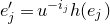 $e_j' = u^{-i_j}h(e_j)$
. Then conditions (1) implies that
 $e_1', \dots, e_r'$
is a
 $k[\![ u ]\!]$
-basis for
 $\mathfrak N,$
and with our choice of bases, h is given by the diagonal matrix with entries
 $ u^{i_1}, \dots, u^{i_r}. $
3.3.3.
We say that a module
 $\mathfrak M$
in
 $\mathrm{Mod}^{\varphi}_{/k[\![ u ]\!]}$
is of Fontaine–Laffaille (FL) type if it is effective, and
 $\varphi: \mathfrak M \rightarrow \mathfrak M$
satisfies the equivalent conditions of Lemma 3.9. We denote by
 $\mathrm{Mod}^{\varphi, { FL}}_{/k[\![ u ]\!]} \subset \mathrm{Mod}^{\varphi}_{/k[\![ u ]\!]}$
the full subcategory of modules of FL type. For h a non-negative integer, we denote by
 $\mathrm{Mod}^{\varphi, \leq h, { FL}}_{/k[\![ u ]\!]} \subset \mathrm{Mod}^{\varphi, { FL}}_{/k[\![ u ]\!]}$
the full subcategory consisting of objects in
 $\mathrm{Mod}^{\varphi, \leq h}$
. With the notation of § 3.1.5, we have the following.
Lemma 3.10.
The subcategory
 $\mathrm{Mod}^{\varphi, { FL}}_{/k[\![ u ]\!]} \subset \mathrm{Mod}^{\varphi, \leq p-1}_{/k[\![ u ]\!]}$
is closed under quotients and saturated subobjects. Moreover, if
 \begin{align*} 0 \rightarrow \mathfrak M_1 \rightarrow \mathfrak M \rightarrow \mathfrak M_2 \rightarrow 0 \end{align*}
is an extension in
 $\mathrm{Mod}^{\varphi, { FL}}_{/k[\![ u ]\!]},$
then
 $\mathcal H(\mathfrak M) = \mathcal H(\mathfrak M_1) \cup \mathcal H(\mathfrak M_2)$
as multisets.
Proof. Suppose that
 $\mathfrak M$
is in
 $\mathrm{Mod}^{\varphi, { FL}}_{/k[\![ u ]\!]},$
and let
 \begin{align*} 0 \rightarrow \mathfrak M_1 \rightarrow \mathfrak M \rightarrow \mathfrak M_2 \rightarrow 0 \end{align*}
be a short exact sequence in
 $\mathrm{Mod}^{\varphi}_{/k[\![ u ]\!]}$
. Consider the following commutative diagram, where the bottom row is exact.

Then the right vertical map is surjective, hence an isomorphism, and
 $\mathfrak M_2$
is of FL type. As
 $\mathfrak M_1 \subset \mathfrak M$
is saturated, we have
 $\mathrm{Fil}^i\mathfrak M_1 = \mathrm{Fil}^i\mathfrak M\cap \mathfrak M_1$
. Thus
 $\mathrm{gr}^{\lt p} \mathfrak M_1 \rightarrow \mathrm{gr}^{\lt p} \mathfrak M$
is injective, and
 $\mathrm{Fil}^p\mathfrak M_1= u\mathfrak M \cap \mathfrak M_1 = u\mathfrak M_1$
. Hence,
 $\mathfrak M_1$
satisfies condition (3) of Lemma 3.9, and so is of FL type. This proves the first claim, and also implies that the top line in the diagram is a short exact sequence, which implies that
 $\mathcal H(\mathfrak M) = \mathcal H(\mathfrak M_1) \cup \mathcal H(\mathfrak M_2)$
.
3.3.4.
We remark that the category
 $\mathrm{Mod}^{\varphi, { FL}}_{/k[\![ u ]\!]}$
is not closed under extensions, as the matrix
 $\left(\begin{smallmatrix}u & 1 \\0 & u\end{smallmatrix}\right)$
gives rise to a module
 $\mathfrak M$
in
 $\mathrm{Mod}^{\varphi,\leq 2}_{/k[\![ u ]\!]}$
which is a self extension of a rank-1 object of degree 1, but
 $\mathcal H(\mathfrak M) = \{0,2\} \neq \{1\} \cup \{1\}$
.
Lemma 3.11.
Let
 $\mathfrak M_1, \mathfrak M_2$
be in
 $\mathrm{Mod}^{\varphi, { FL}}_{/k[\![ u ]\!]}$
. If
 $\mathfrak M_1\otimes \mathfrak M_2$
is in
 $\mathrm{Mod}^{\varphi, \leq p-1}_{/k[\![ u ]\!]},$
then it is in
 $\mathrm{Mod}^{\varphi, { FL}}_{/k[\![ u ]\!]}$
.
Proof. Since
 $\mathfrak M_1, \mathfrak M_2$
are in
 $\mathrm{Mod}^{\varphi, { FL}}_{/k[\![ u ]\!]},$
the composite of the maps
 \begin{align*} \mathrm{gr}^{\lt p} \mathfrak M_1\otimes _k \mathrm{gr}^{\lt p} \mathfrak M_2 \rightarrow \mathrm{gr}^{\lt p} (\mathfrak M_1\otimes \mathfrak M_2) \rightarrow \mathfrak M_1/u\mathfrak M_1\otimes _k \mathfrak M_2/u\mathfrak M_2 \end{align*}
is surjective. Hence, the second map is surjective.
Proposition 3.12.
Suppose that
 $p \geq 3$
. Let
 $\mathfrak M$
in
 $\mathrm{Mod}^{\varphi}_{/k[\![ u ]\!]}$
be effective, and suppose that
 $\textbf V(\mathfrak M)$
arises as the mod p reduction of a crystalline representation of
 $\Gamma_K,$
with Hodge–Tate weights (counted with multiplicity)
 $\{-i_1, \dots, -i_r\},$
with
 $i_j \in [0,p-1]$
. Then
 $\mathfrak M$
is of FL type and
 $\mathcal H(\mathfrak M) = \{i_1, \dots, i_r\}$
.
Proof. The proposition is essentially a result of Gee, Liu, and Savitt [Reference Gee, Liu and SavittGLS14, Theorem 4.1]. We remark only that in [Reference Gee, Liu and SavittGLS14] there is a running assumption that K is a finite extension of
 $\mathbb Q_p,$
however, the proof works without change for any finite extension of
 $W(k)[1/p]$
with k perfect. Note also that the correspondence
 $\mathfrak M \mapsto \textbf V(\mathfrak M)$
used in [Reference Gee, Liu and SavittGLS14] is contravariant, whereas here we used the covariant one, so that our Hodge–Tate cocharacter is the inverse of the one used there.
3.4 Local slope estimate
3.4.1.
We keep the assumptions of the previous subsection. We denote by
 $\bar{\mathbb {F}}_p$
the algebraic closure of
 $\mathbb F_p$
in k, and by
 $\mathbb F_q \subset \bar{\mathbb {F}}_p$
the subfield of order
 $q = p^n$
.
Recall that the fundamental character of level n,
 $\omega_n: \Gamma_K \rightarrow \mathbb F_q^\times,$
is defined by
 $\omega_n(g) = g(p^{{1}/{q-1}})/{p^{{1}/{q-1}}}$
. It is a character of order
 $q-1,$
and we will again denote by
 $\omega_n$
the field
 $\mathbb F_q$
equipped with the
 $\Gamma_K$
-action given by
 $\omega_n$
. Any character
 $\omega: \Gamma_K \rightarrow \bar{\mathbb {F}}_p^\times$
can be written as a power of
 $\omega_n$
for some n.
3.4.2.
Fix
 $n \geq 1$
. Let
 $\boldsymbol{ j} = (j_1, \dots, j_n)$
be a tuple of integers. Write
 $\overline{\boldsymbol{ j}}= \sum_{i=1}^n p^{n-i}j_i$
and
 $\sigma(\boldsymbol{ j}) = (j_2, j_3, \dots, j_n, j_1)$
. The ring
 $\mathbb F_q\otimes k [\![ u ]\!]$
has a distinguished idempotent
 $e_1,$
corresponding to the given embedding
 $\mathbb F_q \subset k;$
it satisifies
 $ae_1 = e_1 a$
for
 $a \in \mathbb F_q$
. We set
 $e_i = \varphi^{i-1}(e_1)$
for
 $i= 1,2, \dots, n,$
where
 $\varphi$
is the Frobenius on k. Then
 $ae_i = e_i \varphi^{i-1}(a)$
. For
 $\boldsymbol{ j}$
as above, we denote by
 $\mathfrak M(\boldsymbol{ j})$
the module in
 $\mathrm{Mod}^{\varphi}_{/k [\![ u ]\!]}$
whose underlying
 $\mathfrak S$
-module is
 $\mathbb F_q\otimes k [\![ u ]\!],$
with the Frobenius given by
 $\varphi(e_i) = u^{j_i} e_{i+1}$
.
Lemma 3.13.
For any
 $\boldsymbol{ j}$
there is an isomorphism of
 $\mathbb F_q[\Gamma_{K_{\infty}}]$
-modules
 \begin{align*} \textbf V(\mathfrak M(\boldsymbol{ j})) \simeq \omega_n^{-\overline{\boldsymbol{ j}}}.\end{align*}
Proof. Let
 $\boldsymbol{ j}_1, \boldsymbol{ j}_2$
be n-tuples as above. As
 $\textbf V$
is a tensor functor, we have
 \begin{align*} \textbf V(\mathfrak M(\boldsymbol{ j}_1 + \boldsymbol{ j}_2)) \simeq \textbf V(\mathfrak M(\boldsymbol{ j}_1)\otimes \mathfrak M(\boldsymbol{ j}_2)) \simeq\textbf V(\mathfrak M(\boldsymbol{ j}_1))\otimes \textbf V(\mathfrak M(\boldsymbol{ j}_2)). \end{align*}
Hence it suffices to consider the case where
 $j_{i_0} = 1$
for some
 $i_0,$
and
 $j_i = 0$
for
 $i \neq i_0$
.
Let
 $\sigma$
denote the Frobenius on
 $\mathbb F_q$
. One checks that
 $\sigma(e_i) = e_{i-1}$
(when these idempotents are ordered cyclicly), and hence that
 $\sigma^*(\mathfrak M(\boldsymbol{ j})) = \mathfrak M(\sigma(\boldsymbol{ j}))$
. As
 $\omega_n$
has order
 $q-1,$
we have
 \begin{align*} \sigma^*( \omega_n^{\overline{\boldsymbol{ j}}}) = \omega_n^{p\overline{\boldsymbol{ j}}} = \omega_n^{\overline{\sigma(\boldsymbol{ j})}}, \end{align*}
so it suffices to consider the case
 $\boldsymbol{ j} = (0,\dots, 0,1),$
which we now assume.
Consider the element
 \begin{align*} v = \sum_{i=1}^n e_i \otimes [\underline p^{{-1}/({q-1})}]^{p^{i-1}} \in \mathfrak M(\boldsymbol{ j})\otimes _{\mathfrak S} C^\flat, \end{align*}
where
 $\underline p^{{-1}/{q-1}} \in R$
is a fixed
 $q-1$
th root of
 $\underline p^{-1}$
. Then
 $v \in (\mathfrak M(\boldsymbol{ j})\otimes _{\mathfrak S} C^\flat)^{\varphi = 1},$
and one checks easily that
 $\Gamma_{K_{\infty}}$
acts on v via
 $\omega_n^{-1},$
as required.
3.4.3.
We say that an object
 $\mathfrak M$
in
 $\mathrm{Mod}^{\varphi}_{/k [\![ u ]\!]}$
is irreducible if it cannot be written as a non-trivial extension in
 $\mathrm{Mod}^{\varphi}_{/k [\![ u ]\!]}$
. The following result is very similar to [Reference Gee, Liu and SavittGLS14, Lemma 6.2]. It may also be viewed as generalizing the classification of irreducible finite flat group schemes in [Reference RaynaudRay74].
Proposition 3.14.
Let
 $\mathfrak M$
be an irreducible object in
 $\mathrm{Mod}^{\varphi}_{/k[\![ u ]\!]}$
. Then, for some
 $q = p^n,$
we have
 $\mathbb F_q \simeq \mathrm{End}_{\varphi}(\mathfrak M[1/u])$
and
 $\mathfrak M[1/u]$
is a free rank-1
 $\mathbb F_q\otimes k((u))$
-module. If
 $\mathfrak M$
is stable by the action of
 $\mathbb F_q,$
then
 $\mathfrak M \simeq \mathfrak M(\boldsymbol{ j})$
for some
 $\boldsymbol{ j} = (\boldsymbol{ j}_1, \dots, \boldsymbol{ j}_n)$
.
Proof. As
 $\mathfrak M$
is irreducible in
 $\mathrm{Mod}^{\varphi}_{/k[\![ u ]\!]},$
 $\mathfrak M[1/u]$
is irreducible in
 $\mathrm{Mod}^{\varphi}_{/k((u))}$
. Indeed, if
 $\mathfrak N \subset \mathfrak M[1/u]$
is a proper non-zero subobject, then
 $\mathfrak N \cap \mathfrak M$
is a proper non-zero subobject of
 $\mathfrak M,$
such that
 $\mathfrak M/\mathfrak N$
is again in
 $\mathrm{Mod}^{\varphi}_{/k[\![ u ]\!]}$
.
As remarked in § 3.1.3, the functor
 \begin{align*} \mathrm{Mod}^{\varphi}_{/k (( u )) } \rightarrow \mathrm{Rep}^{\mathrm{fin}}_{\mathbb Z_p}(\Gamma_{K_{\infty}}); \quad \mathfrak M \mapsto \textbf V(\mathfrak M) \end{align*}
is an equivalence. Hence,
 $\textbf V(\mathfrak M)$
is an irreducible, mod p,
 $\Gamma_{K_{\infty}}$
-representation. This implies that
 $\textbf V(\mathfrak M)$
is a tame representation, and hence isomorphic to
 $\omega_n^j$
for some positive integers n,j, with j coprime to
 $p^n-1$
. Writing
 $q = p^n,$
it follows that
 $\mathfrak M[1/u]$
is an
 $\mathbb F_q\otimes k((u))$
-module, which has dimension n over k((u)), and
 $\mathbb F_q \simeq \mathrm{End}_{\varphi}(\mathfrak M[1/u])$
. As
 $\varphi$
permutes the idempotents
 $e_i,$
we see that
 $\mathfrak M[1/u]$
is free over
 $\mathbb F_q\otimes k((u))$
of rank 1.
Now, suppose that
 $\mathfrak M$
is stable by
 $\mathbb F_q,$
so that it is an
 $\mathbb F_q\otimes k[\![ u ]\!]$
-module. Then
 $\mathfrak M$
is free over
 $\mathbb F_q\otimes k[\![ u ]\!]$
of rank 1. Identifying
 $\mathfrak M$
with
 $\mathbb F_q\otimes k[\![ u ]\!],$
 $\varphi_{\mathfrak M}$
is given by
 $\varphi_{\mathfrak M}(e_i) = f_iu^{j_i}e_{i+1},$
where
 $j_i$
is an integer, and
 $f_i \in k [\![ u ]\!]^\times$
. Set
 $\boldsymbol{ j} = (j_1, \dots, j_n),$
and choose
 $(g_1, \dots, g_n) \in k[\![ u ]\!]^{\times,n}$
such that
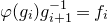 $\varphi(g_i)g^{-1}_{i+1} = f_i$
(the
 $g_i$
ordered cyclicly). This is possible, as k is algebraically closed: choose
 $g_1$
to satisfy
 $\varphi^n(g_1)g_1^{-1} = \varphi^{n-1}(f_1)\varphi^{n-2}(f_2) \dots f_n,$
and define
 $g_i$
recursively by
 $g_{i+1} = \varphi(g_i)f_i^{-1}$
. Then, composing the isomorphism
 $\mathfrak M \simeq \mathbb F_q\otimes k[\![ u ]\!]$
with the map
 $e_i \mapsto g_ie_i$
identifies
 $\mathfrak M$
with
 $\mathfrak M(\boldsymbol{ j})$
.
3.4.4.
Let
 $\mathrm{Mod}^{\varphi,\leq p-1,+}_{/k [\![ u ]\!]} \subset \mathrm{Mod}^{\varphi,\leq p-2}_{/k [\![ u ]\!]}$
denote the subcategory consisting of modules
 $\mathfrak M$
which contain no submodule isomorphic to
 $\mathfrak M((p-1))$
. (That is, the module
 $\mathfrak M(\boldsymbol{ j})$
with
 $n=1,$
 $j_1 = p-1$
.)
Lemma 3.15. The natural functors
 \begin{align*} \mathrm{Mod}^{\varphi,\leq p-2}_{/k [\![ u ]\!]} \rightarrow \mathrm{Mod}^{\varphi}_{/k ((u ))}\end{align*}
and
 \begin{align*} \mathrm{Mod}^{\varphi,\leq p-1,+}_{/k [\![ u ]\!]}\rightarrow \mathrm{Mod}^{\varphi}_{/k ((u ))} \end{align*}
are fully faithful.
Proof. We emphasize that the lemma holds only because we are assuming
 $K = K_0$
. Let
 $\mathfrak M_1,\mathfrak M_2$
be effective modules in
 $\mathrm{Mod}^{\varphi}_{/k [\![ u ]\!]}$
and
 $h: \mathfrak M_1[1/u] \rightarrow \mathfrak M_2[1/u]$
a Frobenius-compatible map. We first claim that if
 $\mathfrak M_1$
is in
 $\mathrm{Mod}^{\varphi,\leq p-2}_{/k [\![ u ]\!]}$
or
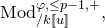 $\mathrm{Mod}^{\varphi,\leq p-1,+}_{/k [\![ u ]\!]},$
and h is an isomorphism such that
 $h(\mathfrak M_1) \subset \mathfrak M_2,$
then h identifies
 $\mathfrak M_1$
with
 $\mathfrak M_2$
.
We identify
 $\mathfrak M_1[1/u]$
and
 $\mathfrak M_2[1/u]$
via h, and we need to show that
 $\mathfrak M_1$
and
 $\mathfrak M_2$
correspond to the same submodule of
 $\mathfrak M_1[1/u]$
. Let
 $C = \mathfrak M_2/\mathfrak M_1$
. Using the snake lemma, one obtains an inclusion
 \begin{align*} \mathrm{ker}\,(\varphi^* C \rightarrow C)\hookrightarrow \mathfrak M_1/\varphi^*\mathfrak M_1.\end{align*}
Note that C is a torsion
 $k [\![ u ]\!]$
-module. Suppose that
 $C \neq 0,$
let m be the smallest integer such that
 $u^mC = 0,$
and let
 $x \in C$
be such that
 $u^{m-1}x \neq 0$
. Then
 \begin{align*} k [\![ u ]\!]/u^{pm} \simeq k [\![ u ]\!]\cdot (1\otimes x) \subset \varphi^*(C)\end{align*}
and
 \begin{align*} k [\![ u ]\!]/u^{(p-1)m} \simeq u^m k [\![ u ]\!]\cdot(1\otimes x) \subset \mathrm{ker}\,(\varphi^* C \rightarrow C).\end{align*}
If
 $\mathfrak M_1$
is in
 $\mathrm{Mod}^{\varphi,\leq p-2}_{/k [\![ u ]\!]},$
this contradicts the assumption that
 $u^{p-2}$
kills
 $\mathfrak M_1/\varphi^*\mathfrak M_1,$
and implies
 $C = 0$
.
Suppose
 $\mathfrak M_1$
is in
 $\mathrm{Mod}^{\varphi,\leq p-1,+}_{/k[\![ u ]\!]}$
. Then the above show that
 $m=1,$
so we have
 \begin{align*} u\mathfrak M_1 \subset u\mathfrak M_2 \subset\mathfrak M_1. \end{align*}
If
 $m \in \mathfrak M_2$
then we have
 $\varphi(um) = u^p\varphi(m)$
. If
 $m \notin \mathfrak M_1,$
and
 $\varphi(m) \in \mathfrak M_1,$
this contradicts that
 $\mathfrak M_1$
is in
 $\mathrm{Mod}^{\varphi,\leq p-1}_{/k [\![ u ]\!]}$
. Thus,
 $\varphi$
induces an automorphism of
 $\mathfrak M_2/\mathfrak M_1$
. Let
 $\bar{\mathfrak{M}}_1' \subset \mathfrak M_2/u\mathfrak M_2$
be the largest
 $\varphi$
-stable submodule on which
 $\varphi$
is nilpotent, and let
 $\mathfrak M_1 \subset \mathfrak M_2$
be the preimage of
 $\bar{\mathfrak{M}}_1'$
. Then
 $\varphi$
induces an automorphism of
 $\mathfrak M_2/\mathfrak M_1',$
and
 $r = \mathrm{dim}_k \mathfrak M_2/\mathfrak M_1' \neq 0,$
by what we just saw.
As k is algebraically closed,
 $\mathfrak M_2/\mathfrak M_1'$
is spanned by its
 $\varphi$
-invariants. If
 $\bar m \in \mathfrak M_2/\mathfrak M_1'$
is
 $\varphi$
-invariant, and
 $m \in \mathfrak M_2$
is any lift, then one sees easily that
 $\{\varphi^n(m)\}_{n \geq 1}$
converges to a
 $\varphi$
-invariant element of
 $\mathfrak M_2$
. Thus, there exists a
 $\varphi$
-stable submodule
 $\mathfrak N \subset \mathfrak M_2,$
with
 $\mathfrak N \simeq \mathfrak M((0))^r$
. Finally,
 $\mathfrak M((p-1))^r \simeq u\mathfrak N \subset \mathfrak M_1$
, which contradicts that
 $\mathfrak M_1$
is in
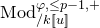 $\mathrm{Mod}^{\varphi,\leq p-1,+}_{/k [\![ u ]\!]}$
. This completes the proof of the claim.
Now consider any h, as above, and suppose
 $\mathfrak M_2$
is in
 $\mathrm{Mod}^{\varphi,\leq p-2}_{/k [\![ u ]\!]}$
or
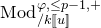 $\mathrm{Mod}^{\varphi,\leq p-1,+}_{/k [\![ u ]\!]}$
. Then we apply the above to the map
 $ \mathfrak M_2 \rightarrow h(\mathfrak M_1) + \mathfrak M_2$
to conclude that
 $h(\mathfrak M_1) \subset \mathfrak M_2,$
so that h is induced by a map
 $\mathfrak M_1 \rightarrow \mathfrak M_2$
. In particular, this implies that functors in the lemma are fully faithful.
Corollary 3.16.
An irreducible object in
 $\mathrm{Mod}^{\varphi, \leq p-1}_{/k[\![ u ]\!]}$
is isomorphic to
 $\mathfrak M(\boldsymbol{ j})$
for some n and
 $\boldsymbol{ j}$
.
Proof. Let
 $\mathfrak M$
be an irreducible object in
 $\mathrm{Mod}^{\varphi,\leq p-1}_{/k[\![ u ]\!]}$
. By Proposition 3.14, we have
 $\mathbb F_q \simeq \mathrm{End}_{\varphi}(\mathfrak M[1/u])$
for some q, and it suffices to show that
 $\mathfrak M$
is stable by
 $\mathbb F_q$
. This follows from Lemma 3.15 if
 $\mathfrak M$
is in
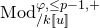 $\mathrm{Mod}^{\varphi, \leq p-1,+}_{/k[\![ u ]\!]}$
. If
 $\mathfrak M$
is not in
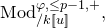 $\mathrm{Mod}^{\varphi, \leq p-1,+}_{/k[\![ u ]\!]},$
then
 $\textbf V(\mathfrak M)$
contains a copy of the trivial representation
 $\textbf V(\mathfrak M((p-1)))$
. As
 $\textbf V(\mathfrak M)$
is irreducible, this implies
 $q=p,$
when there is nothing to show.
3.4.5.
In the following, it will be convenient to fix a coherent set of roots of
 $u = \underline p \in R,$
so that we have well-defined elements
 $u^\epsilon \in R$
for
 $\epsilon \in \mathbb Q$
.
Let
 $\mathfrak M$
be a finite free R-module. By a saturated submodule
 $\mathfrak N \subset \mathfrak M,$
we mean an R-submodule which is such that
 $\mathfrak M/\mathfrak N$
is torsion free, or equivalently free, over R. For
 $\mathfrak M$
in
 $\mathrm{Mod}^{\varphi}_{/ k[\![ u ]\!]},$
denote by
 $\mathfrak M_R = \mathfrak M \otimes R$
the corresponding object in
 $\mathrm{Mod}^{\varphi}_R$
.
Proposition 3.17.
Let
 $\boldsymbol{ j} = (j_1, \dots, j_n)$
be an n-tuple of non-negative integers. For any saturated rank-1
 $\varphi$
-stable submodule
 $\mathfrak N \subset \mathfrak M(\boldsymbol{ j})_R$
, we have
 \begin{align*} \mu(\mathfrak N) = \frac{p-1}{p^n-1} \max_i {\overline{\sigma^i(\boldsymbol{ j})}} \geq \bigg(1-\frac 1 p\bigg)\max_ij_i .\end{align*}
Proof. Using the equivalence in § 3.1.3, saturated rank-1
 $\varphi$
-stable submodules
 $\mathfrak N \subset \mathfrak M(\boldsymbol{ j})_R$
correspond to
 $\mathbb F_p$
-lines in the 1-dimensional
 $\mathbb F_q$
-vector space
 $\textbf V(\mathfrak M(\boldsymbol{ j})_R),$
where
 $q = p^n$
. As
 $\mathbb F_q^\times$
acts transitively on this set of lines, it suffices to prove the proposition for one such submodule.
Recall that we defined
 $\sigma(\boldsymbol{ j}) = (j_2, j_3, \dots, j_n, j_1)$
. Consider the element
 \begin{align*} v = \sum_{i=1}^n e_i\otimes u^{-{\overline{{\sigma^{i-1}(\boldsymbol{ j})}}}/{q-1}} \in \mathfrak M(\boldsymbol{ j})[1/u]. \end{align*}
Note that
 $\varphi(e_i\otimes u^{-{\overline{{\sigma^{i-1}(\boldsymbol{ j})}}}/{q-1}}) = e_{i+1}\otimes u^{{\epsilon_i}/{q-1}},$
where
 \begin{align*} \epsilon_i = (q-1) j_i -p\overline{{\sigma^{i-1}(\boldsymbol{ j})}} = -\overline{{\sigma^i(\boldsymbol{ j})}}. \end{align*}
Hence, v is
 $\varphi$
-stable.
Let
 $\tilde{\boldsymbol{ j}} = \max_i {\overline {\sigma^i(\boldsymbol{ j})}}$
. Then
 $\mathfrak N = R\cdot u^{{\tilde{\boldsymbol{ j}}}/{q-1}} v \subset \mathfrak M(\boldsymbol{ j})_R$
is a saturated rank-1
 $\varphi$
-stable submodule. We have
 \begin{align*} \mu(\mathfrak N) = \ell_R(\mathfrak N/\varphi^*(\mathfrak N)) = \frac{p-1}{q-1}\tilde{\boldsymbol{ j}}. \end{align*}
This proves the equality in the proposition. To prove the inequality, note that
 $\overline{{\sigma^i(\boldsymbol{ j})}}\geq p^{n-1}j_{i+1},$
so that
 \begin{align*} \frac{p-1}{q-1} {\overline {\sigma^i(\boldsymbol{ j})}} \geq \frac{p^n-p^{n-1}}{p^n-1} j_{i+1} \geq\bigg(1-\frac{1}{p}\bigg) j_{i+1} .\end{align*}
3.4.6.
Let
 $\mathfrak M$
be in
 $\mathrm{Mod}^{\varphi}_{/R}$
or
 $\mathrm{Mod}^{\varphi}_{/k[\![ u ]\!]}$
. For a subspace
 $L \subset \textbf V(\mathfrak M),$
we set
 $\mathfrak N(L) = L\otimes _{\mathbb F_p} C^\flat \cap \mathfrak M_R$
. Using the notation of § 3.1.5, we have
Proposition 3.18.
Let
 $\mathfrak M$
in
 $\mathrm{Mod}^{\varphi}_{/k[\![ u ]\!]}$
be an effective module, which is a successive extension of irreducible modules
 $\mathfrak M(\boldsymbol{ j}_1), \dots , \mathfrak M(\boldsymbol{ j}_s)$
in
 $\mathrm{Mod}^{\varphi}_{/k[\![ u ]\!]}$
. Then there exists a proper subspace
 $W \subset \textbf V(\mathfrak M)$
such that, for any
 $\mathbb F_p$
-line
 $L \subset \textbf V(\mathfrak M)$
with
 $L \nsubseteq W,$
we have
 \begin{align*} \mu(\mathfrak N(L)) \geq \bigg(1-\frac 1 p\bigg)\max_i \mu_{ max}(\mathfrak M(\boldsymbol{ j}_i)).\end{align*}
Proof. Define an increasing filtration, indexed by
 $\mathbb Q,$
on
 $V = \textbf V(\mathfrak M)$
by
 \begin{align*} \mathrm{Fil}^\epsilon V = \{ v \in V: u^\epsilon v \in \mathfrak M_R\}.\end{align*}
Since
 $\mathfrak M_R$
is a finite free R-module, for any non-zero subspace
 $V' \subset V,$
there exists a minimal
 $\epsilon = \epsilon(V') \in \mathbb Q$
such that
 $V' \subset \mathrm{Fil}^\epsilon V$
. For
 $L \subset V$
a line, we have
 $\mathfrak N(L) = u^{\epsilon(L)}R\cdot L \subset \mathfrak M$
and
 $\mu(\mathfrak N(L)) = (p-1)\epsilon(L)$
. Thus, it suffices to show that
 \begin{align*}\epsilon(V) \geq \frac 1 p\max_i \mu_{ max}(\mathfrak M(\boldsymbol{ j}_i)),\end{align*}
as we can then take
 \begin{align*} W = \bigcup_{\epsilon \lt \epsilon(V)}\mathrm{Fil}^\epsilon V.\end{align*}
If
 $\boldsymbol{ j} = (j_1, \dots, j_n)$
is an n-tuple of non-negative integers, then
 $\mu_{ max}(\mathfrak M(\boldsymbol{ j})) = \max_i j_i,$
so this inequality holds when
 $s=1$
by Proposition 3.17. By induction on s, it suffices to show that if
 $\mathfrak M$
is a non-trivial extension in
 $\mathrm{Mod}^{\varphi}_{k[\![ u ]\!]},$
 \begin{align*} 0 \rightarrow \mathfrak M_1 \rightarrow \mathfrak M \rightarrow \mathfrak M_2 \rightarrow 0, \end{align*}
then
 $\epsilon(\textbf V(\mathfrak M)) \geq \max(\epsilon(\textbf V(\mathfrak M_1)), \epsilon(\textbf V(\mathfrak M_2)))$
. This follows from the fact that we have an exact sequence
 \begin{align*} 0 \rightarrow \textbf V(\mathfrak M_1) \rightarrow \textbf V(\mathfrak M) \rightarrow \textbf V(\mathfrak M_2) \rightarrow 0 \end{align*}
and, for any
 $\epsilon,$
an exact sequence
 \begin{align*} 0 \rightarrow \mathrm{Fil}^\epsilon \textbf V(\mathfrak M_1) \rightarrow \mathrm{Fil}^\epsilon \textbf V(\mathfrak M) \rightarrow \mathrm{Fil}^\epsilon \textbf V(\mathfrak M_2). \end{align*}
Corollary 3.19.
Let
 $\mathfrak M$
be in
 $\mathrm{Mod}^{\varphi, { FL}}_{/k[\![ u ]\!]}$
. Then there exists a proper subspace
 $W \subset \textbf V(\mathfrak M)$
such that, for any
 $\mathbb F_p$
-line
 $L \subset \textbf V(\mathfrak M)$
with
 $L \nsubseteq W,$
we have
 \begin{align*} \mu(\mathfrak N(L)) \geq \bigg(1-\frac 1 p\bigg) \mu_{ max}(\mathfrak M).\end{align*}
Proof. By Corollary 3.16,
 $\mathfrak M$
is a successive extension of irreducible modules of the form
 $\mathfrak M(\boldsymbol{ j}_1), \dots , \mathfrak M(\boldsymbol{ j}_s)$
. Now the corollary follows from Proposition 3.18 and Lemma 3.10, which implies that
 \begin{align*} \mu_{ max}(\mathfrak M) = \max_i \mu_{ max}(\mathfrak M(\boldsymbol{ j}_i)). \end{align*}
3.5 Modules with G-structure
3.5.1.
Let G be a reductive group over
 $\mathbb Z_p$
. Denote by
 $\mathrm{Rep}_{\mathbb Z_p} G$
the category of algebraic representations of G on finite
 $\mathbb Z_p$
-modules. We denote by
 $G\text{-}\mathrm{Mod}^{\varphi}_{/\mathfrak S}$
the category consisting of tensor functors
 \begin{align*} \mathfrak M: \mathrm{Rep}_{\mathbb Z_p} G \rightarrow\mathrm{Mod}^{\varphi}_{/\mathfrak S}; \quad V \mapsto \mathfrak M_V\end{align*}
such that there exists an isomorphism of tensor functors
 $\omega(\mathfrak M) \simeq \textbf 1\otimes \mathfrak S,$
where
 $\textbf 1$
denotes the identity on
 $\mathrm{Rep}_{\mathbb Z_p} G$
and
 $\omega(\mathfrak M)$
is the functor which assigns to V the underlying
 $\mathfrak S$
-module of
 $\mathfrak M_V$
.
We give two more explicit ways of encoding the data of an object
 $\mathfrak M$
of
 $G\text{-}\mathrm{Mod}^{\varphi}_{/\mathfrak S}$
. Let V in
 $ \mathrm{Rep}_{\mathbb Z_p} G$
be a faithful representation. Then
 $G \subset \mathrm{GL}(V)$
is the pointwise stabilizer of a collection of tensors
 $\{s_{\alpha}\} \subset V^\otimes $
(see [Reference KisinKis10, Proposition 1.3.2]). Thinking of each
 $s_{\alpha}$
as a morphism from the unit object in
 $\mathrm{Rep}_{\mathbb Z_p} G,$
we see that
 $\mathfrak M_V^\otimes $
is equipped with a collection of tensors
 $\{\tilde s_{\alpha}\} \subset (\mathfrak M_V^\otimes )^{\varphi = 1},$
and that there exists an isomorphism
 $V\otimes \mathfrak S \simeq \mathfrak M_V $
taking
 $s_{\alpha}$
to
 $\tilde s_{\alpha}$
.
Conversely,
 $\mathfrak M$
can be recovered from the collection
 $(\mathfrak M_V, \{\tilde s_{\alpha}\})$
as follows: let
 $\mathcal P$
be the (trivial) G-torsor over
 $\mathfrak S$
consisting of isomorphisms
 $V\otimes \mathfrak S \simeq \mathfrak M_V$
taking
 $ s_{\alpha}$
to
 $\tilde s_{\alpha}$
. Then
 $\mathcal P$
is equipped with an isomorphism
 $\varphi^* \mathcal P \simeq \mathcal P$
over
 $\mathfrak S[1/E]$
. For W in
 $\mathrm{Rep}_{\mathbb Z_p} G$
there is a canonical isomorphism in
 $\mathrm{Mod}^{\varphi}_{/\mathfrak S},$
 $\mathfrak M_W \simeq W \times \mathcal P/G$
.
Now fix an isomorphism
 $V\otimes \mathfrak S \simeq \mathfrak M_V $
taking
 $s_{\alpha}$
to
 $\tilde s_{\alpha}$
. Then
 $\varphi_{\mathfrak M_V}$
corresponds to a semi-linear endomorphism of
 $V\otimes \mathfrak S[1/E]$
which has the form
 $g(1\otimes \varphi)$
for some
 $g \in G(\mathfrak S[1/E])$
. Conversely, the isomorphism class of
 $\mathfrak M$
can be recovered from g as follows: given g, we can consider the functor
 $\mathfrak M'$
which assigns to W in
 $\mathrm{Rep}_{\mathbb Z_p} G$
the
 $\mathfrak S$
-module
 $W\otimes \mathfrak S,$
equipped with
 $g(1\otimes \varphi)$
.
3.5.2.
Let
 $\mathfrak M$
be in
 $G\text{-}\mathrm{Mod}^{\varphi}_{/\mathfrak S},$
and V in
 $\mathrm{Rep}_{\mathbb Z_p} G$
a faithful representation. Fixing an isomorphism
 $V\otimes \mathfrak S \simeq \mathfrak M_V$
taking
 $s_{\alpha}$
to
 $\tilde s_{\alpha},$
as above, identifies the pointwise stabilizer of
 $\{\bar s_{\alpha}\}$
in
 $\mathrm{GL}(\mathfrak M)$
with
 $G_{\mathfrak S},$
and this identification is independent of the choice of isomorphism, up to inner conjugation by an element of
 $G(\mathfrak S)$
. In what follows we will sometimes silently choose such an isomorphism, and make such an identification.
Since the
 $\tilde s_{\alpha}$
are
 $\varphi$
-invariant, we may regard
 $\tilde s_{\alpha} \in \textbf V(\mathfrak M)^\otimes $
. The scheme of isomorphisms
 $V \simeq \textbf V(\mathfrak M)$
taking
 $s_{\alpha}$
to
 $\tilde s_{\alpha}$
is a G-torsor over
 $\mathbb Z_p,$
as such an isomorphism exists over
 $W(C^\flat)$
. By Lang’s lemma, this G-torsor is trivial, so there exists an isomorphism
 $V \simeq \textbf V(\mathfrak M)$
. This allows us to identify the pointwise stabilizer of
 $\{\tilde s_{\alpha})$
in
 $\mathrm{GL}(\textbf V(\mathfrak M))$
with G, as above. Actually, in our application
 $\textbf V(\mathfrak M)$
will be canonically isomorphic to V.
3.5.3.
The entirety of the preceding discussion can be repeated for the category
 $\mathrm{Rep}_{\mathbb F_p} G$
of
 $\mathbb F_p$
-representation of G. In particular, we denote by
 $G\text{-}\mathrm{Mod}^{\varphi}_{/k[\![ u ]\!]}$
the category of tensor functors
 \begin{align*} \mathfrak M: \mathrm{Rep}_{\mathbb F_p} G \rightarrow \mathrm{Mod}^{\varphi}_{/k [\![ u ]\!]} ; \quad V \mapsto \mathfrak M_V \end{align*}
such that
 $\omega(\mathfrak M) \simeq \textbf 1\otimes k[\![ u ]\!]$
. As above, the objects of this category can be described using tensors, or by an element
 $g \in G(k ((u)))$
. For
 $\boldsymbol{\mu}$
a
 $G_k$
-valued cocharacter, denote by
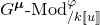 $G^{\boldsymbol{\mu}}\text{-}\mathrm{Mod}^{\varphi}_{/k [\![ u]\!]}$
the full subcategory of
 $G\text{-}\mathrm{Mod}^{\varphi}_{/k [\![ u]\!]}$
consisting of objects
 $\mathfrak M$
such that the element g satisfies
 $g \in G(k [\![ u]\!]) \boldsymbol{\mu}(u) G(k [\![ u]\!])$
. Note that although g depends on the choice of isomorphism
 $\omega(\mathfrak M) \simeq \textbf 1\otimes k[\![ u ]\!],$
the condition on g does not, so
 $G^{\boldsymbol{\mu}}\text{-}\mathrm{Mod}^{\varphi}_{/k [\![ u]\!]}$
is a well-defined subcategory.
3.5.4.
Let
 $\varrho: \Gamma_K \rightarrow G(\mathbb Z_p)$
be a continuous representation. We say that
 $\varrho$
is crystalline if, for some (and hence any) faithful representation of G on a finite-dimensional
 $\mathbb Q_p$
-vector space W, the induced
 $\mathbb Q_p$
-representation of
 $\Gamma_K,$
 $\varrho_W$
, is crystalline. As in Lemma 2.12, there is a conjugacy class of cocharacters
 $\boldsymbol{\mu}$
of G such that the weights of
 $\boldsymbol{\mu}$
acting on any such W are the Hodge–Tate weights of
 $\varrho_W$
. We call such a
 $\boldsymbol{\mu}$
the Hodge–Tate cocharacter of
 $\varrho$
.
Given a crystalline
 $\varrho,$
any V in
 $\mathrm{Rep}_{\mathbb Z_p} G$
gives rise to a lattice in a crystalline representation, which we again denote by
 $\varrho_V,$
and hence (covariantly) an object
 $\mathfrak M_V$
in
 $\mathrm{Mod}^{\varphi}_{/\mathfrak S}$
. By [Reference KisinKis10, Proposition 1.3.4],
 $V \mapsto \mathfrak M_V$
gives rise to an object
 $\mathfrak M(\varrho)$
in
 $G\text{-}\mathrm{Mod}^{\varphi}_{/\mathfrak S}$
. The most subtle point is that the functor
 $V \mapsto \mathfrak M_V$
is isomorphic to the identity.
3.5.5.
We now change notation, and consider a reductive group G over
 $\mathbb Z[1/N],$
for some positive integer N. When no confusion arises, we will again denote by G the base change of G to any
 $\mathbb Z[1/N]$
-algebra. Fix a maximal torus
 $T \subset G$
defined over some algebraically closed field of characteristic 0, and let
 $\Omega_G$
be the corresponding Weyl group. If
 $\boldsymbol{\mu}$
is a cocharacter of G defined over any
 $\mathbb Z[1/N]$
-algebra, then we may view
 $\boldsymbol{\mu} \in X_*(T)/\Omega_G$
.
Proposition 3.20.
Let
 $p\nmid N$
be a prime,
 $K/\mathbb Q_p$
a finite unramified extension, and
 $\varrho: \Gamma_K \rightarrow G(\mathbb Z_p)$
a crystalline representation with Hodge cocharacter
 $-\boldsymbol{\mu} \in X_*(T)/\Omega_G$
. There is a constant c, depending only on G and
 $\boldsymbol{\mu},$
such that if
 $p \gt c,$
then
 $\bar{\mathfrak{M}}(\varrho) = \mathfrak M(\varrho)\otimes \mathbb F_p$
is in
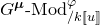 $G^{\boldsymbol{\mu}}\text{-}\mathrm{Mod}^{\varphi}_{/k [\![ u]\!]}$
.
Proof. Note that the conjugacy class of
 $\boldsymbol{\mu}$
has a representative defined over K, and hence over the residue field k, so the statement of the proposition makes sense.
We first consider the case
 $G = \mathrm{GL}_r$
, for some r. Let V be the standard representation of G. Suppose that the Hodge–Tate weights of
 $\varrho_V$
are contained in the interval [a,b], and choose
 $p \gt \max(b-a,2)$
. After twisting
 $\varrho_V$
by a power of the cyclotomic character, we may assume that
 $b=0$
. Then the result follows from the theorem of Gee, Liu, and Savitt (Proposition 3.12).
For the case of general G, we argue as in [Reference Rapoport and RichartzRR96, Lemma 2.2]. Let
 $g \in G(k((u)))$
be the element attached to
 $\bar{\mathfrak{M}}(\varrho),$
and suppose that
 $g \in G(k [\![ u]\!]) \boldsymbol{\mu}'(u) G(k [\![ u]\!])$
where
 $\boldsymbol{\mu}' \in X_*(T)/\Omega_G$
. Such a
 $\boldsymbol{\mu}'$
exists, by the Cartan decomposition for G over k((u)), because
 $G_k$
is quasi-split. Fix a set of positive roots
 $\{\alpha_i\}_i$
for the root system of G in
 $X_*(T)$
. Then we may assume that
 $\boldsymbol{\mu}, \boldsymbol{\mu}'$
are a non-negative sum of fundamental coweights, so that
 $\langle\boldsymbol{\mu},\alpha_i\rangle, \langle\boldsymbol{\mu}',\alpha_i\rangle \geq 0$
for all i. Let
 $\{\lambda_1, \dots , \lambda_s\}$
be a collection of integral dominant weights, which span
 $X^*(T)_{\mathbb R},$
and let
 $V_{\lambda_i}$
be the G-representation with highest weight
 $\lambda_i$
. Then
 $\langle \boldsymbol{\mu}, \lambda_i\rangle$
and
 $\langle \boldsymbol{\mu}', \lambda_i\rangle$
are equal to the largest weight of
 $V_{\lambda_i}$
under the action of
 $\mu$
and
 $\mu'$
, respectively. Hence, by the case
 $G=\mathrm{GL}_r$
considered above, applied to
 $\mathrm{GL}(V_{\lambda_i}),$
for
 $ p \gg 0$
, we have that
 $\langle\boldsymbol{\mu}'-\boldsymbol{\mu}, \lambda_i\rangle = 0$
. Since this holds for each i, it follows that
 $\boldsymbol{\mu}' = \boldsymbol{\mu}$
.
3.5.6.
The above result can be regarded as a refined version of Serre’s conjecture on the action of inertia on the mod p cohomology of a variety over a p-adic field [Reference SerreSer72, Reference CarusoCar08]. Serre’s conjecture, which was proved by Caruso, says that characters of tame inertia on the cohomology
 $H^d(X_{\bar K}, \mathbb F_p)$
has exponents in [0,de], where e is the ramification degree of K. The result above says that if p is large enough (so
 $e=1$
), then one can recover the Hodge cocharacter from the inertial weights.
3.5.7.
Now let
 $\rho_V: G \rightarrow \mathrm{GL}(V)$
be a representation on a finite free
 $\mathbb Z[1/N]$
-module. We do not assume that V is faithful.
In the following, the symbol
 $c_*$
denotes a constant which depends only on the indicated quantity
 $*$
. We need the following lemma.
Lemma 3.21.
Let
 $p\nmid N,$
 $V' \subset \bar V = V\otimes \mathbb F_p$
a proper subspace, and
 $L \subset \bar V$
a line. Let
 $U(\mathbb F_p) = \{g \in G(\mathbb F_p): g\cdot L \subset V'\},$
and suppose that
 $U(\mathbb F_p) \neq G(\mathbb F_p)$
. Then there exists a constant
 $c^1_V$
such that, for
 $p \gg 0$
and any L, V’ as above, we have
 \begin{align*} \frac{|U(\mathbb F_p)|}{|G(\mathbb F_p)|} \leq\frac{c^1_V}{ p}.\end{align*}
Proof. Let
 $\mathcal Y/\mathbb Z[1/N]$
be the scheme parameterizing pairs (V’,L) consisting of a subspace
 $V' \subset V$
and a line
 $L \subset V$
. We let
 $f:\mathcal U \rightarrow \mathcal Y$
be the subscheme of
 $G\times \mathcal Y$
whose points correspond to triples (g,V’,L) with
 $g\cdot L \subset V'$
. Let
 $Y \subset \mathcal Y$
denote the open subscheme where the fibers of f have dimension
 $\lt \mathrm{dim\,} G,$
and set
 $U = \mathcal U\times_{\mathcal Y} Y$
.
Now fix a prime
 $\ell,$
and consider the complex
 $Rf_! \mathbb Q_{\ell}$
over
 $Y|_{{\operatorname{ Spec\,}} \mathbb Z[1/N\ell]}$
. These are complexes of constructible sheaves on
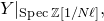 $Y|_{{\operatorname{ Spec\,}} \mathbb Z[1/N\ell]},$
and hence the ranks of the stalks of the cohomology sheaves of
 $Rf_! \mathbb Q_{\ell}$
at any geometric point are bounded by some constant which does not depend on the geometric point. As the fibers of
 $f|_Y$
have dimension
 $\lt \mathrm{dim\,} G,$
the result follows from Deligne’s theorem [Reference DeligneDel80] on the weights of Frobenii acting on the stalks of these sheaves.
Lemma 3.22.
For
 $p \gg 0$
and
 $p\nmid N,$
we have:
-
(1) the G-representation
$\bar V = V\otimes \mathbb F_p$
is semi-simple; -
(2) any irreducible G-subspace
$W \subset \bar V$
is irreducible as a
$G(\mathbb F_p)$
-representation.


Proof. The first claim follows from [Reference JantzenJan03, II, 6.20]. For semi-simple G, the second claim can be found in [Reference HumphreysHum06, 2.11]. We will reduce the general case to this one by checking that part (2) holds for induced tori; that is, tori of the form
 $\mathrm{Res}_{\mathcal O_{\mathsf{K}}[1/N]/\mathbb Z[1/N]} \mathbb G_m,$
where
 $\mathsf{K}/\mathbb Q$
is a finite Galois extension, unramified for
 $p \nmid N$
. Assuming this, write G as a quotient
 $\tilde G \rightarrow G,$
where
 $\tilde G = G^{\mathrm{der}} \times T$
and T is a product of induced tori
 $T_1, \dots, T_s$
. This is possible, after increasing N, and one sees immediately that it suffices to prove the statement for
 $\tilde G$
in place of G. Then
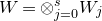 $W = \otimes _{j=0}^s W_j$
, where
 $W_0$
is an irreducible representation of
 $G^{\mathrm{der}},$
and
 $W_j$
is an irreducible representation of
 $T_j$
for
 $j \geq 1$
. For
 $p \gg 0,$
we know that
 $W_j$
is an irreducible representation of
 $T_j(\mathbb F_p)$
(respectively
 $G^{\mathrm{der}}(\mathbb F_p)$
) for
 $j \geq 1$
(respectively
 $j=0$
), and hence W is an irreducible representation of
 $\tilde G(\mathbb F_p)$
.
It remains to check part (2) for
 $T = \mathrm{Res}_{\mathcal O_{\mathsf{K}}[1/N]/\mathbb Z[1/N]} \mathbb G_m$
. Fix an algebraic closure
 $\bar{\mathbb {Q}}$
of
 $\mathbb Q,$
and denote by
 $\bar {\mathbb Z}$
its ring of integers. Étale locally on
 $\mathbb Z[1/N],$
V is a direct sum of characters of T. For
 $a = (a_\sigma)_{\sigma}$
a tuple of integers indexed by the embeddings
 $\sigma:\mathsf{K} \rightarrow \bar{\mathbb {Q}},$
let
 $\chi_a \in X^*(T)$
denote the character which for a
 $\bar {\mathbb Z}[1/N]$
-algebra R takes
 $z \in T(R) = (R\otimes \mathsf{K})^\times $
to
 $\prod_{\sigma} \sigma(z)^{a_{\sigma}} \in R^\times$
. All characters in
 $X^*(T)$
have this form for some a. We take
 $p \gt |2a_{\sigma}|$
for all
 $\sigma$
and all characters
 $\chi_a$
which occur as a summand in V.
Now
 $T\otimes \mathbb F_p$
is a product of tori of the form
 $T_1 = \mathrm{Res}_{\mathbb F_q/\mathbb F_p} \mathbb G_m,$
where
 $\mathbb F_q$
is the residue field of a prime
 $v|p$
of
 $\mathsf{K}$
. Then W is a tensor product of irreducible representations of
 $T_1$
. If
 $W_1$
is such a representation, then, as above, over
 $F_q,$
 $W_1$
is a direct sum of characters of
 $T_1,$
each of which is indexed by a tuple of integers
 $b = (b_{\tau})_{\tau},$
where
 $\tau$
runs over embeddings
 $\mathbb F_q \rightarrow \bar{\mathbb {F}}_p$
. Each such
 $b_{\tau}$
appears as an
 $a_{\sigma}$
for some direct summand
 $\chi_a$
of V, so
 $p \gt |2b_{\tau}|$
. Using this, one easily checks that if b,b’ are two such tuples, then the restrictions of
 $\chi_b, \chi_{b'}$
to
 $T_1(\mathbb F_p) = \mathbb F_q^\times$
are equal only if
 $b = b'$
. It follows that
 $(\mathrm{End}_{\mathbb F_p} W_1)^{T_1(\mathbb F_p)} = (\mathrm{End}_{\mathbb F_p} W_1)^{T_1},$
which implies that the left-hand side is a field, and hence
 $W_1|_{T_1(\mathbb F_p)}$
is irreducible. Therefore,
 $W|_{T(\mathbb F_p)}$
is irreducible.
3.5.8.
For
 $\mathfrak M$
in
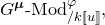 $G^{\boldsymbol{\mu}}\text{-}\mathrm{Mod}^{\varphi}_{/k [\![ u]\!]},$
denote by
 $\mathrm{Fil}^{\circ\boldsymbol{\mu}}$
the increasing filtration defined by
 $\boldsymbol{\mu}$
on
 $\textbf V(\mathfrak M)_{C^{\flat}} \simeq \mathfrak M_{C^{\flat}}$
. Let
 $L \subset \textbf V(\mathfrak M)_{C^\flat}$
be a non-zero subspace. If L is 1-dimensional, we set
 $\langle \boldsymbol{\mu}, L \rangle^\circ$
equal to the greatest integer m such that
 $\mathrm{Fil}^{\circ\boldsymbol{\mu},m-1} L= 0$
. In general, if L has dimension i, we set
 \begin{align*}\langle \boldsymbol{\mu}, L \rangle^\circ = \frac{\langle \boldsymbol{\mu}, \wedge^i L \rangle^\circ}{\mathrm{dim}_{C^{\flat}} L},\end{align*}
where we think of
 $\wedge^i L \subset \textbf V(\wedge^i \mathfrak M)_{C^\flat}$
. Finally, we set
 \begin{align*}\langle \boldsymbol{\mu}, L \rangle_G^\circ = \max_{g \in G(C^\flat)} \langle \boldsymbol{\mu}, g\cdot L \rangle^\circ.\end{align*}
Note that this depends only on the G-conjugacy class of
 $\boldsymbol{\mu}$
. If
 $L \subset \textbf V(\mathfrak M)$
is an
 $\mathbb F_p$
-subspace, we write
 $\langle \boldsymbol{\mu}, L \rangle^\circ$
and
 $\langle \boldsymbol{\mu}, L \rangle^\circ_G$
for
 $\langle \boldsymbol{\mu}, L_{C^\flat} \rangle^\circ$
and
 $\langle \boldsymbol{\mu}, L_{C^\flat} \rangle^\circ_G$
, respectively.
Proposition 3.23.
There exists a constant
 $c_V^2$
such that, for
 $ p \gg 0$
, the following holds. Let
 $\mathfrak M$
be in
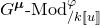 $G^{\boldsymbol{\mu}}\text{-}\mathrm{Mod}^{\varphi}_{/k [\![ u ]\!]}$
such that
 $\mathfrak M_V$
is in
 $\mathrm{Mod}^{\varphi, { FL}}_{/k [\![ u ]\!]}$
. Then, for any
 $\mathbb F_p$
-line
 $L \subset \textbf V(\mathfrak M_V),$
we have
 \begin{align*} \frac{1}{|G(\mathbb F_p)|} \sum_{g \in G(\mathbb F_p)} \mu(\mathfrak N(g\cdot L)) \geq \bigg(1-\frac{c_V^2}{p}\bigg) \langle \boldsymbol{\mu}, L \rangle_G^\circ . \end{align*}
Proof. Fix isomorphisms of tensor functors
 $\omega(\mathfrak M) \simeq \textbf 1\otimes k [\![ u ]\!]$
and
 $\textbf V\circ \mathfrak M \simeq \textbf 1$
. By Lemma 3.22, for
 $ p \gg 0$
we have
 $V\otimes \mathbb F_p \simeq \bigoplus_{r=1}^m W_r,$
where each
 $W_r$
is an irreducible G-module, such that
 $W_r(\mathbb F_p)$
is irreducible as a
 $G(\mathbb F_p)$
-module. This gives a corresponding decomposition
 $\mathfrak M_V \simeq \bigoplus_{r=1}^m \mathfrak M_{W_r},$
into G-modules, such that
 $\textbf V(\mathfrak M_{W_r})$
is identified with
 $W_r$
. For each r, denote by
 $L_r$
the projection of L into
 $W_r$
.
Now consider the increasing filtration defined by
 $\boldsymbol{\mu}$
on
 $W_r,$
and if
 $L_r$
is non-trivial, define
 $\langle \boldsymbol{\mu}, L_r \rangle^\circ$
and
 $\langle \boldsymbol{\mu}, L_r \rangle_G^\circ,$
as above:
 $\langle \boldsymbol{\mu}, L_r \rangle^\circ$
is the greatest integer m such that
 $\mathrm{Fil}^{\circ\boldsymbol{\mu},m-1} (L_r\otimes C^\flat)= 0$
and
 $\langle \boldsymbol{\mu}, L_r \rangle_G^\circ = \max_{g \in G(C^\flat)} \langle \boldsymbol{\mu}, g\cdot L_r\rangle^\circ$
. Then
 \begin{align*} \langle \boldsymbol{\mu}, L \rangle_G^\circ = \max_r \langle \boldsymbol{\mu}, L_r \rangle_G^\circ ,\end{align*}
where r runs over the indices such that
 $L_r$
is non-trivial.
Similarly, if
 $L_r$
is non-trivial, for
 $g \in G(\mathbb F_p),$
set
 $\mathfrak N(g\cdot L_r) = g\cdot L_r\otimes C^\flat \cap \mathfrak M_{W_r}$
. Then there is a map
 $\mathfrak N(g\cdot L) \rightarrow \mathfrak N(g\cdot L_r)$
which becomes an isomorphism after
 $\otimes C^\flat,$
so
 $\mu(\mathfrak N(g\cdot L)) \geq \mu(\mathfrak N(g\cdot L_r))$
. Thus, it suffices to show that for some
 $c_V^2$
we have, for all such r and
 $ p \gg 0$
,
 \begin{align*} \frac{1}{|G(\mathbb F_p)|} \sum_{g \in G(\mathbb F_p)} \mu(\mathfrak N(g\cdot L_r)) \geq \bigg(1-\frac{c_V^2}{ p}\bigg) \langle \boldsymbol{\mu}, L_r \rangle_G^\circ . \end{align*}
By Corollary 3.19, there is a proper subspace
 $W_r' \subset W_r$
such that
 \begin{align*} \mu(\mathfrak N(g\cdot L_r)) \geq \bigg(1-\frac 1{p}\bigg)\mu_{ max}(\mathfrak M_{W_r}) \end{align*}
whenever
 $g \in G(\mathbb F_p)$
satisfies
 $g\cdot L_r \nsubseteq W_r'$
. Hence, using Lemma 3.21, for
 $ p \gg 0$
we have
 \begin{align*} \frac{1}{|G(\mathbb F_p)|} \sum_{g \in G(\mathbb F_p)} \mu(\mathfrak N(g\cdot L_r)) \geq \bigg(1-\frac{c_V^1}{ p}\bigg)\bigg(1-\frac 1{p}\bigg)\mu_{ max}(\mathfrak M_{W_r})\end{align*}
for some
 $c^1_V$
, which can be taken to be independent of r. Now, as
 $W_r(\mathbb F_p)$
is an irreducible
 $G(\mathbb F_p)$
-module, the lines
 $g\cdot L_r$
with
 $g \in G(\mathbb F_p)$
span
 $W_r\otimes _{\mathbb F_p}k$
. Hence,
 $ \langle \boldsymbol{\mu}, L_r \rangle_G^\circ$
is equal to the largest weight of
 $\boldsymbol{\mu}$
acting on
 $W_r,$
which is also equal to
 $\mu_{ max}(\mathfrak M_{W_r})$
. Thus, taking
 $c^2_V = c_V^1 + 1$
proves the proposition.
Corollary 3.24.
There exists a constant
 $c_V$
such that, for
 $ p \gg 0$
, the following holds. Let
 $\mathfrak M$
in
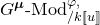 $G^{\boldsymbol{\mu}}\text{-}\mathrm{Mod}^{\varphi,}_{/k [\![ u ]\!]}$
be such that
 $\mathfrak M_V$
is in
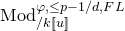 $\mathrm{Mod}^{\varphi,\leq {p-1}/d,FL}_{/k [\![ u ]\!]}$
. Then, for any non-trivial
 $\mathbb F_p$
-subspace
 $W \subset \textbf V(\mathfrak M_V),$
we have
 \begin{align*} \frac{1}{|G(\mathbb F_p)|} \sum_{g \in G(\mathbb F_p)} \mu(\mathfrak N(g\cdot W)) \geq \bigg(1-\frac{c_V}{p}\bigg) \langle \boldsymbol{\mu}, W \rangle_G^\circ . \end{align*}
Proof. Let
 $i = \mathrm{dim}_{\mathbb F_p} W$
and
 $L = \wedge^i W$
. Note that
 $\mathfrak N(g\cdot W)$
is a saturated submodule of
 $\mathfrak M_V$
. Hence
 $\wedge^i\mathfrak N(g\cdot W)$
is a saturated submodule of
 $\wedge^i\mathfrak M_V,$
and therefore
 \begin{align*} \wedge^i\mathfrak N(g\cdot W) \simeq \mathfrak N(\wedge^i g\cdot W) \simeq \mathfrak N(g\cdot L) .\end{align*}
Our assumptions, together with Lemmas 3.10 and 3.11, imply that
 $\wedge^i\mathfrak M_V$
is in
 $\mathrm{Mod}^{\varphi,FL}_{/k [\![ u ]\!]}$
. Hence, the corollary follows from Proposition 3.23
Corollary 3.25.
There exists a constant
 $c_V$
such that, for
 $ p \gg 0$
, the following holds. If
 $\varrho: \Gamma_K \rightarrow G(\mathbb Z_p)$
is a crystalline representation with Hodge–Tate cocharacter
 $-\boldsymbol{\mu} \in X_*(T)/\Omega_G$
and
 $W \subset \textbf V(\bar{\mathfrak{M}}(\varrho)_V)$
is a non-trivial
 $\mathbb F_p$
-subspace, then
 \begin{align*} \frac{1}{|G(\mathbb F_p)|} \sum_{g \in G(\mathbb F_p)} \mu(\mathfrak N(g\cdot W)) \geq \bigg(1-\frac{c_V}{p}\bigg) \langle \boldsymbol{\mu}, W \rangle_G^\circ . \end{align*}
Proof. Let
 $G' = G \times \mathbb G_m$
. We extend
 $\rho_V$
to a representation of G’ by letting
 $\mathbb G_m$
act on V via scalars, and we may regard
 $\varrho$
as a G’-valued representation. For
 $g \in G'(\mathbb F_p),$
 $g\cdot W$
depends only on the projection of g to
 $G(\mathbb F_p),$
and one sees easily that it suffices to prove the corollary with G’ in place of G. Then we may twist
 $\varrho$
by a power of the cyclotomic character composed with
 $\mathbb G_m(\mathbb Z_p) \rightarrow G'(\mathbb Z_p),$
and it suffices to prove the corollary for this twist. We may then assume that the weights of
 $\boldsymbol{\mu}$
on V are non-negative, so that
 $\bar{\mathfrak{M}}(\varrho)_V$
is effective.
Now, for
 $ p \gg 0$
, it follows from Proposition 3.12 that
 $\bar{\mathfrak{M}}(\varrho)_V$
is
 $\mathrm{Mod}^{\varphi, { FL}}_{/k [\![ u ]\!]},$
and the corollary follows from Corollary 3.24.
3.6 Global slope estimate
3.6.1.
We return to the notation introduced in § 2.4, so that
 $\mathsf{K}$
is a number field and A is an abelian variety over
 $\mathsf{K}$
of dimension g. Fix an embedding
 $\mathsf{K} \hookrightarrow \mathbb C,$
and let G be the Mumford–Tate group of A with respect to this embedding. We may regard G as a reductive group over
 $\mathbb Z[1/N]$
for some N, and assume that there is a closed immersion of
 $\mathbb Z[1/N]$
-groups
 $G \hookrightarrow \mathrm{GL}(H^1(A_{\mathbb C}, \mathbb Z[1/N]))$
. We assume that
 $\mathsf{K}$
contains the reflex field of A, so that for any prime p, the Galois representation on the p-adic Tate module of A is given by a map
 \begin{align*} \varrho_{A,p}: \Gamma_\mathsf{K} \rightarrow G(\mathbb Q_p). \end{align*}
For
 $p\nmid N,$
 $\varrho_{A,p}$
then factors through
 $G(\mathbb Z_p)$
. We need the following lemma.
Lemma 3.26.
Assume that the Mumford–Tate conjecture holds for A. Then there exists a central isogeny
 $\tilde G \rightarrow G$
such that, for p large enough, depending on A, we have the following.
-
(1) The image of
$ \Gamma_\mathsf{K} \overset{\varrho_{A,p}} \rightarrow G(\mathbb Z_p) \rightarrow G(\mathbb F_p)$
contains
$\mathrm{Im}(\tilde G(\mathbb F_p)\rightarrow G(\mathbb F_p))$
. -
(2) For each prime
$w|p$
of
$\mathsf{K},$
let
$I_{\mathsf{K}_w} \subset \mathrm{Gal}(\bar{\mathsf{K}}_w/\mathsf{K}_w)$
be the inertia subgroup. Then
$\varrho_{A,p}|_{I_{\mathsf{K}_w}}$
lifts to a crystalline representation
$\tilde \varrho_{A,w}: I_{\mathsf{K}_w} \rightarrow \tilde G(\mathbb Z_p)$
.







Proof. Let (G,X) be the Shimura datum corresponding to the Hodge structure of A. To prove part (1), we use the results of Cadoret and Moonen [Reference Cadoret and MoonenCM20]. Consider maps of Shimura data
 $(\tilde G, \tilde X) \rightarrow (G,X)$
with
 $\tilde G \rightarrow G$
a central isogeny. As in [Reference Cadoret and MoonenCM20, § 2.7], we call such a
 $(\tilde G, \tilde X)$
maximal if any map of Shimura data
 $(\tilde G', \tilde X') \rightarrow (\tilde G, \tilde X)$
, with
 $\tilde G' \rightarrow \tilde G$
a central isogeny, is an isomorphism. Choose a maximal
 $(\tilde G, \tilde X)$
.
Let
 $\mathbb K \subset G(\mathbb A_f),$
 $\tilde{\mathbb {K}} \subset \tilde G(\mathbb A_f)$
be compact open subgroups, such that there is a map of Shimura varieties
 $\mathrm{Sh}_{\tilde{\mathbb {K}}}(\tilde G, \tilde X) \rightarrow \mathrm{Sh}_{\mathbb K}(G, X)$
. For some finite extension
 $\mathsf{K}' \subset \mathbb C$
of
 $\mathsf{K},$
which contains the reflex field of
 $(\tilde G, \tilde X),$
let
 $\tilde x \in \mathrm{Sh}_{\tilde{\mathbb {K}}}(\tilde G, \tilde X)(\mathsf{K}')$
be a point whose image
 $x \in \mathrm{Sh}_{\mathbb K}(G, X)(\mathsf{K}')$
is isogenous to A. We slightly abuse notation and denote by
 $\bar x$
both the
 $\mathbb C$
points induced by
 $\tilde x$
and x. By [Reference Cadoret and MoonenCM20, Main Theorem], the representation
 \begin{align*} \pi_1(\mathrm{Sh}_{\tilde{\mathbb {K}}}(\tilde G, \tilde X), \bar x) \rightarrow \tilde G(\mathbb A_f)\end{align*}
has open image. On the other hand, since A satisfies the Mumford–Tate conjecture,
 \begin{align*} \pi_1(x, \bar x) \rightarrow G(\mathbb Q_{\ell})\end{align*}
has open image for any prime
 $\ell,$
and hence x is
 $\ell$
-Galois generic in the terminology of [Reference Cadoret and MoonenCM20, § 4]. It follows by [Reference Cadoret and MoonenCM20, Theorem 4.3] that the image of
 $\pi_1(x, \bar x) \rightarrow G(\mathbb A_f)$
is open in the image of
 \begin{align*} \pi_1(\mathrm{Sh}_{\mathbb K}(G, X), \bar x)\rightarrow G(\mathbb A_f),\end{align*}
and hence contains an open subset of
 $\mathrm{Im}(\tilde G(\mathbb A_f) \rightarrow G(\mathbb A_f)),$
by what we saw above. In particular, for
 $ p \gg 0,$
the image of the representation
 $\varrho_{A,p}: \Gamma_{\mathsf{K}'} \rightarrow G(\mathbb Z_p)$
contains
 $\mathrm{Im}(\tilde G(\mathbb Z_p) \rightarrow G(\mathbb Z_p))$
. This implies part (1).
To show the second claim, we may assume that
 $\varrho_{A,p}$
is crystalline at all places
 $w|p$
of K. By [Reference WintenbergerWin02, Theorem 1.2.1],
 $\varrho_{A,p}|_{I_{\mathsf{K}_w}}$
lifts to a semi-stable
 $\tilde \varrho_{A,w}: I_{\mathsf{K}_w} \rightarrow \tilde G(\mathbb Z_p)$
. The monodromy operator of
 $\tilde \varrho_{A,w}$
is an element
 $N \in \mathrm{Lie\,} \tilde G = \mathrm{Lie\,} G$
. As
 $\varrho_{A,p}$
is crystalline at w,
 $N=0,$
and so
 $\tilde \varrho_{A,w}$
is also crystalline.
Proposition 3.27.
Suppose that the Mumford–Tate conjecture holds for A. If
 $p\gg 0,$
then for any subgroup
 $H \subset A_{\bar{\mathsf{K}}}[p],$
either H is defined over
 $\mathsf{K}$
or
 \begin{align*} \frac 1 2 - \nu(H) \geq \frac 1{4g[\mathsf{K}:\mathbb Q]} - \frac {c_A} p \end{align*}
for some constant
 $c_A$
which depends only on A.
Proof. We apply a number of our previous results which hold for
 $ p \gg 0$
, and we always assume that p is large enough that these results apply. To begin with, choose a positive integer M such that A extends to an abelian scheme
 $\mathcal A$
over
 $\mathcal O_\mathsf{K}[1/M]$
. We assume
 $p\nmid M$
.
We denote by
 $\mathsf{K}' \subset \bar{\mathsf{K}}$
the smallest extension of
 $\mathsf{K}$
over which all torsion points
 $A[p](\bar{\mathsf{K}})$
are defined. Then H is defined over
 $\mathsf{K}'$
. We again write
 $\mathcal A[p]$
for
 $\mathcal A[p]_{\mathcal O_{\mathsf{K}'}[1/M]}$
. Denote by
 $\mathcal H$
the closure of H in
 $\mathcal A[p],$
and let
 $\mathcal H' = \mathcal A[p]/\mathcal H$
. For
 $\sigma \in \mathrm{Gal}(\mathsf{K}'/\mathsf{K}),$
we denote by
 $\sigma(\mathcal H')$
the finite flat quotient of
 $\mathcal A[p]$
whose generic fiber is
 $A[p]/\sigma(H)$
. The Cartier dual
 $\mathcal H^{\prime*}$
is a subgroup of the dual abelian scheme
 $\mathcal A^*$
. Thus, applying Lemma 2.11 to
 $\mathcal H^{\prime*},$
and using property (2) in § 2.2.1, we have
 \begin{align*} \nu(\mathcal H') := \frac 1 {[\mathsf{K}':\mathbb Q]} \sum_{w'|p} [\mathsf{K}'_{w'}:\mathbb Q_p]\mu_{w'}(\mathcal H')= \frac{1}{s(p)}\sum_{w|p} \frac 1 {[\mathsf{K}':\mathsf{K}]}\sum_{\sigma \in\mathrm{Gal}(\mathsf{K}'/\mathsf{K})}\mu_w(\sigma(\mathcal H')),\end{align*}
where s(p) denotes the number of places
 $w|p$
of
 $\mathsf{K},$
as before.
Now let
 $\tilde G$
be as in Lemma 3.26. Then we may assume
 \begin{align*} \mathrm{Im}(\tilde G(\mathbb F_p) \rightarrow G(\mathbb F_p)) \subset \mathrm{Gal}(\mathsf{K}'/\mathsf{K}) \subset G(\mathbb F_p). \end{align*}
Let
 $h_1, \dots, h_t$
be coset representatives for
 $\mathrm{Im}(\tilde G(\mathbb F_p) \rightarrow G(\mathbb F_p))$
in
 $\mathrm{Gal}(\mathsf{K}'/\mathsf{K})$
. Then
 \begin{align*} \nu(\mathcal H') = \frac{1}{s(p)t}\sum_{w|p,j} \frac 1 {|\tilde G(\mathbb F_p)|}\sum_{\tilde g \in \tilde G(\mathbb F_p)}\mu_w(\tilde g(h_j\mathcal H'))\end{align*}
where, for any
 $g \in G(\mathbb F_p),$
 $g(\mathcal H')$
is the finite flat quotient of
 $\mathcal A[p]$
which satisfies
 $g(\mathcal H')(\bar{\mathsf{K}}) = A[p](\bar{\mathsf{K}})/g\cdot H(\bar{\mathsf{K}})$
.
Let
 $w|p$
be a place of
 $\mathsf{K},$
 $\kappa(w)$
the residue field of w, and
 $\bar \kappa(w)$
an algebraic closure. We assume p is unramified in
 $\mathsf{K}$
. Denote by
 \begin{align*}\mathfrak M_w: p{\text{- Gr}}^1/W(\bar\kappa(w)) \rightarrow \mathrm{Mod}^{\varphi,\leq 1}_R \end{align*}
the functor defined in Corollary 3.4. By Lemma 3.5, we have
 \begin{align*}W := \textbf V(\mathfrak M_w(\mathcal H')) \simeq \mathcal H'(\bar{\mathsf{K}})^\vee \subset \mathcal A[p](\bar{\mathsf{K}})^\vee \simeq \textbf V(\mathfrak M_w(\mathcal A[p])). \end{align*}
Note that, as a submodule of
 $\mathcal A[p](\bar{\mathsf{K}})^\vee,$
W does not depend on the choice of w. As in § 3.4.6, for any
 $\mathbb F_p$
-subspace
 $L \subset \textbf V(\mathfrak M_w(\mathcal A[p])),$
we set
 $\mathfrak N_w(L) = L\otimes C^\flat \cap \mathfrak M_w(\mathcal A[p])$
. We have
 \begin{align*} \mathfrak N_w(W)\otimes _R C^{\flat} \simeq W\otimes _{\mathbb F_p} C^{\flat} \simeq \mathfrak M_w(\mathcal H')\otimes _R C^{\flat}.\end{align*}
As
 $\mathfrak M_w(\mathcal H'),\mathfrak N_w(W) \subset \mathfrak M_w(\mathcal A[p])$
are saturated R-submodules, this implies
 \begin{align*}\mathfrak M_w(\mathcal H') = \mathfrak N_w(W) \subset \mathfrak M_w(\mathcal A[p]).\end{align*}
Thus,
 $\mu_w(\mathcal H') = \mu_w(\mathfrak N_w(W)),$
by Corollary 3.8. Applying this to
 $g\mathcal H'$
in place of
 $\mathcal H',$
for
 $g \in G(\mathbb F_p),$
we obtain
 $\mu_w(g(\mathcal H')) = \mu_w(\mathfrak N_w(g\cdot W))$
. Therefore,
 \begin{align*} \nu(\mathcal H') = \frac{1}{s(p)t}\sum_{w|p,j} \frac 1 {|\tilde G(\mathbb F_p)|}\sum_{\tilde g \in \tilde G(\mathbb F_p)}\mu_w(\mathfrak N_w(\tilde gh_j\cdot W)).\end{align*}
Now, using Lemma 3.26(2), we have
 $\mathfrak M_w(\mathcal A[p]) \simeq \bar{\mathfrak{M}}(\tilde\varrho_w)_V,$
where V is the representation of
 $\tilde G$
on the dual of the Tate module
 $T_pA$
. Note that the Hodge–Tate cocharacter of
 $\tilde\varrho_w$
is the unique cocharacter of
 $\tilde G$
lifting
 $\boldsymbol{\mu}_w,$
the cocharacter defined in Lemma 2.12. Applying Corollary 3.25 to
 $\tilde\varrho_w$
and the subspaces
 $h_j\cdot W \subset \mathcal A[p](\bar{\mathsf{K}})^\vee,$
we may assume that
 \begin{align*} \nu(\mathcal H') \geq \frac{1}{s(p)}\sum_{w|p} \bigg(1-\frac{c_V}{p}\bigg) \langle -\boldsymbol{\mu}_w, W \rangle_G^\circ,\end{align*}
for some constant
 $c_V,$
which does not depend on p.
Now, if
 $c \in G(\mathbb F_p)$
denotes the image of any complex conjugation in
 $\mathrm{Gal}(\mathsf{K}'/\mathsf{K}),$
then by Lemma 3.28,
 \begin{align*} \langle -\boldsymbol{\mu}_w, W \rangle^\circ_G + \langle -\boldsymbol{\mu}_{c\circ w}, W \rangle^\circ_G \geq \langle \boldsymbol{w}, W \rangle = 1, \end{align*}
with equality only if
 $W_{C^{\flat}}$
is stable by
 $\boldsymbol{\mu}_w$
. Thus, either
 \begin{align*} 2\nu(\mathcal H') \geq \bigg(1-\frac{c_V}{p}\bigg)\bigg(1+\frac 1 {s(p)}\bigg) \geq \bigg(1-\frac{c_V}{p}\bigg)\bigg(1+\frac 1 {[\mathsf{K}:\mathbb Q]}\bigg)\end{align*}
or W is stable by
 $G(\mathbb F_p)$
. The latter condition implies that
 $H(\bar{\mathsf{K}})$
is stable under
 $\mathrm{Gal}(\mathsf{K}'/\mathsf{K})$
, so H is defined over
 $\mathsf{K}$
. In the former case write
 $d = \mathrm{dim}_{\mathbb F_p}\mathcal H(\bar{\mathsf{K}})$
and
 $d' = \mathrm{dim}_{\mathbb F_p}\mathcal H'(\bar{\mathsf{K}}) = 2g-d$
. Then one computes easily that
 \begin{align}\nu(H) &= \frac{2g}{d}\nu(\mathcal A[p]) - \frac{d'}{d}\nu(\mathcal H') \nonumber\\&\leq \frac g d - \frac{d'}{2d} \bigg(1-\frac{c_V}{p}\bigg)\bigg(1+\frac 1 {[\mathsf{K}:\mathbb Q]}\bigg) \leq \frac 1 2 - \frac 1 {4g[\mathsf{K}:\mathbb Q]} + \frac {c_A}p,\end{align}
where we may take
 $c_A = c_Vg$
.
Lemma 3.28.
Let
 $w|p$
be a place of
 $\mathsf{K},$
and
 $c \in \mathrm{Gal}(\mathsf{K}'/\mathsf{K})$
a complex conjugation. For any subspace
 $W \subset \textbf V(\mathfrak M_w(\mathcal A[p]))_{C^{\flat}},$
we have
 \begin{align*} \langle -\boldsymbol{\mu}_w, W \rangle^\circ_G + \langle -\boldsymbol{\mu}_{c\circ w}, W \rangle^\circ_G \geq \langle \boldsymbol{w}, W \rangle = 1,\end{align*}
with equality only if W is stable by
 $\boldsymbol{\mu}_w$
.
Proof. This may be proved exactly as in the proof of Lemma 2.14, using that, over
 $C^{\flat},$
 $\boldsymbol{\mu}_w$
and
 $\boldsymbol{\mu}_{c\circ w}$
are conjugate to cocharacters
 $\boldsymbol{\mu}'_w$
and
 $\boldsymbol{\mu}'_{c\circ w}$
, respectively, whose product is
 $\boldsymbol{w}^{-1}$
. This in turn follows from the corresponding fact over C.
3.6.2.
Denote by
 ${\mathscr I}(A)$
the isogeny class of A over
 $\bar{\mathsf{K}}$
. Write
 ${\mathscr I}(A)'$
for the collection of finite subgroups
 $H \subset A(\bar{\mathsf{K}})$
such that H contains no non-trivial
 $\Gamma_{\mathsf{K}}$
-stable subgroup. We may regard
 ${\mathscr I}(A)' \subset {\mathscr I}(A)$
via
 $H \mapsto A/H$
.
Corollary 3.29.
Suppose that the Mumford–Tate conjecture holds for A. If
 $p\gg 0,$
then for any subgroup
 $H \subset A_{\bar{\mathsf{K}}}[p^\infty],$
with
 $H \in {\mathscr I}(A)',$
we have
 \begin{align*} \frac 1 2 - \nu(H) \geq \frac 1{4g[\mathsf{K}:\mathbb Q]} - \frac {c_A} p, \end{align*}
with the constant
 $c_A$
of Proposition 3.27.
Proof. We proceed by induction on the smallest integer n such that
 $H[p^n] = H$
. As before, denote by
 $\mathcal H$
the closure of H in
 $\mathcal A$
. Multiplication by
 $p^{n-1}$
induces a map
 $\mathcal H/\mathcal H[p^{n-1}] \rightarrow \mathcal H[p]$
which is an injection over
 $\mathsf{K}$
. Denote its image by
 $\mathcal H[p]_n,$
and note that our assumptions imply that
 $H[p]_n = \mathcal H[p]_n\otimes \mathbb Q$
is not
 $\Gamma_{\mathsf{K}}$
-stable. Then, using Lemma 2.9, we have
 \begin{equation}\nu(H) \leq \max(\nu(H[p^{n-1}]),\nu(\mathcal H/\mathcal H[p^{n-1}]))\leq \max(\nu(H[p^{n-1}]),\nu(H[p]_n)),\end{equation}
so the corollary follows from Proposition 3.27 by induction on n.
Theorem 3.30.
Let A be an abelian variety defined over a number field
 $\mathsf{K},$
and suppose that the Mumford–Tate conjecture holds for A. Then, for any
 $c \gt 0,$
the set
 \begin{align*} \{ A' \in {\mathscr I}(A): h(A') \lt c \}\end{align*}
contains a finite number of isomorphism classes of abelian varieties.
Proof. After replacing
 $\mathsf{K}$
by a finite extension, we may assume that
 $\mathsf{K}$
contains the reflex field of A. Let
 $\{H_{\alpha}\}_{\alpha}$
be a collection of finite subgroups of
 $A(\bar{\mathsf{K}})$
. We have to show that
 $\{A/H_{\alpha}: h(A/H_{\alpha}) \lt c\}_{\alpha}$
contains only finitely many isomorphism classes. As in the proof of Theorem 2.20, we may assume that no
 $H_{\alpha}$
contains a non-trivial
 $\Gamma_\mathsf{K}$
-stable subgroup, and that the
 $H_{\alpha}$
are distinct. Let
 $I_c = \{\alpha: h(A/H_{\alpha}) \lt c\}$
.
For each prime p, write
 $H_{\alpha,p}$
for the p-part of
 $H_{\alpha},$
so that
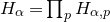 $H_{\alpha} = \prod_p H_{\alpha,p}$
. By Lemma 2.10 we have
 \begin{align*} h(A/H_{\alpha}) - h(A) = \sum_p \mathrm{log}|H_{\alpha,p}|\bigg(\frac{1}{2} - \nu(H_{\alpha,p})\bigg).\end{align*}
Let S denote a finite set of primes such that, for
 $p \notin S,$
the conclusion of Corollary 3.29 holds. Then, if
 $H_{\alpha,p}$
is non-trivial and
 $p \notin S,$
we have
 \begin{equation} \frac 1 2 - \nu(H_{\alpha,p}) \geq \frac 1{4g[\mathsf{K}:\mathbb Q]} - \frac {c_A} p.\end{equation}
In particular, after enlarging S, we may assume that for all
 $p \notin S,$
 $ \tfrac{1}{2} - \nu(H_{\alpha,p}) \geq 0,$
if
 $H_{\alpha,p}$
is non-trivial. Using this, and Corollary 2.21, it follows that the set of subgroups
 $H_{\alpha,p}$
for
 $\alpha \in I_c$
and
 $p \in S$
is finite. Using (3.6) again, one sees that the set of non-trivial subgroups
 $H_{\alpha,p},$
for
 $\alpha \in I_c$
and
 $p \notin S$
is finite.
3.6.3.
As before, we get a more precise version of the result.
Corollary 3.31.
Suppose
 $\mathsf{K}$
contains the reflex field of A. If the Mumford–Tate conjecture holds for A, then for any
 $c \gt 0,$
the set
 \begin{align*} \{H \in {\mathscr I}(A)': h(A/H) \lt c\}\end{align*}
is finite.
Acknowledgements
We thank Johannes Anschütz, Pierre Colmez, Tony Feng, Toby Gee, Arthur-César Le Bras, Alice Lin, Tong Liu, Ananth Shankar, Yunqing Tang and Shou-Wu Zhang for useful conversations and comments. Finally, we thank the anonymous referee for many helpful comments.
Conflicts of interest
None.
Financial support
MK was partially supported by DMS-2200449.
Journal information
Compositio Mathematica is owned by the Foundation Compositio Mathematica and published by the London Mathematical Society in partnership with Cambridge University Press. All surplus income from the publication of Compositio Mathematica is returned to mathematics and higher education through the charitable activities of the Foundation, the London Mathematical Society and Cambridge University Press.



