Implications
Calf diseases and mortality have short-term and long-term detrimental effects on performance of a dairy farm. Risk factors for calf infectious diseases associated with design and management of housing facilities have been demonstrated in different surveys. In order to assess if calf health can been improved in Europe, it is necessary to understand how calves are currently raised and to identify consequences in terms of risk factors of transmissible calf diseases. Differences between countries in terms of calf management can result in different control measures used in each country.
Introduction
Infectious diseases such as diarrhoea and respiratory diseases are the most frequent health disorders of calves during their first 3 months of life (Olsson et al., Reference Olsson, Viring, Emanuelsson and Jacobsson1993; Virtala et al., Reference Virtala, Mechor, Gröhn and Erb1996; Svensson et al., Reference Svensson, Hultgren and Oltenacu2006a; Gulliksen et al., Reference Gulliksen, Lie and Osteras2009d). They impair both growth rate and replacement capacity of the herd. For other diseases such as paratuberculosis, only young animals are susceptible to the pathogen; therefore their exposure to the pathogen at a young age is critical (Doyle, Reference Doyle1953). Lastly for some zoonotic pathogens such as high shiga toxin-producing Escherichia coli, a high prevalence can be found more specifically in calves (Garber et al., Reference Garber, Wells, Hancock, Doyle, Tuttle, Shere and Zhao1995). In all these examples, direct contacts between calves or their exposure to a contaminated environment enable the transmission of the pathogens. Calf housing systems result in variable risk for direct contacts and risk for transmission via the equipment or the environment.
Dairy calves are raised under a wide variety of housing systems, defined by the facilities (number of calf pens, group size) and their use at different ages. Calf management takes into account several factors such as practicality, animal welfare, regulations and existing facilities on a farm. Nowadays, the European Union (EU) regulations set a maximal age limit (8 weeks) for raising calves in individual pens and the necessity for calves to have social contact with other animals (Council Directive 91/629/EEC and Council Directive 97/2/EC). Individual pens for calves must not have solid walls (except those for isolating sick animals), but perforated walls that allow the calves to have direct visual and tactile contact. In this general framework, very different housing systems can be chosen, while complying with EU regulations. When comparing calf disease incidence in different areas, or when summarising known risk factors of calf diseases to define control plans, one should be aware of the differences in calf housing systems.
The objective of this study was to describe the main dairy calf housing systems across Europe, to identify differences influencing the exposure of calves to pathogens and to assess the risk for calf infectious diseases for each reported type of calf housing system.
Material and methods
The study was conducted through a country-level questionnaire on dominant housing systems and through a qualitative risk assessment for the transmission of the most frequent pathogens involved in diarrhoea and respiratory diseases of dairy calves.
Questionnaire conception and distribution
Thirty-seven questionnaires were distributed to persons with experience in the field of calf raising and infectious diseases. These persons were collected from or through the participants of the society of veterinary epidemiology and preventive medicine conference, held in London from 1 to 3 April, 2009, which is attended by epidemiologists who are aware of disease transmission and risk assessment. Answers were expected within a month by mail, fax or email. The questionnaire had been previously tested on veterinarians of the National veterinary school of Nantes, France, and on professionals or people working regularly in contact with dairy herds in France, the Netherlands and UK.
Study population
European countries holding more than 300 000 dairy cows were targeted in this study. It was however not possible to collect questionnaires from Bulgaria, Czech Republic, Hungary, Lithuania, Poland, Portugal and Romania, in absence of relevant contacts. Greece was added and at the end, 14 countries were included holding 73% of the dairy cows in the EU for 84% of the milk delivery (EUROSTAT, 2009).
Questionnaire design
The questionnaire aimed at identifying the most common practice, or two main practices in terms of dairy calf housing facilities (and in terms of dairy herd size).
It was subdivided into five parts. In the first part, information on the country, on the person’s background to check for experience in dairy farming systems and the mean number of cows on dairy farm were asked. Name and email address were facultative. The following four parts asked for housing facilities and management from birth to weaning, after weaning, before first calving, and on pastures. Finally, additional information or comments or remarks could be added at the end of the document.
The questionnaire was composed of 25 closed questions and two open questions to specify the answer of a closed question.
Vocabulary linked to housing facilities was used such as individual or collective pens. When really specific, a brief definition was added after the word. For example, igloos and huts were defined as individual pens with complete separation from other pens in contrast with individual pens where a calf can have at least one neighbour with which it shares the wall of its pen.
The questionnaire can be available from the first author on request.
Assessment of the relevance of the answers
On top of the fact that only experienced persons were asked to answer, experience was assessed via a question on the number of dairy farms they visited during the last 12 months. When results were obtained from more than one expert for a country, similar answers were aggregated. When answers differed, all the information on specific areas has been kept.
Review of risk factors and qualitative risk assessment
A literature review of the main risk factors for neonatal diarrhoea and calf respiratory diseases complex (BRD: bovine respiratory disease) linked to housing facilities was performed (mainly on Pubmed and CAB abstracts databases). Only studies from 1990 to present were considered as being relevant. The search terms were: bovine respiratory disorders, bovine respiratory diseases, bovine respiratory disease complex and/or neonatal diarrhoea, enteric infectious diseases and dairy calf/calves combined with risk factors. Information relative to hygiene practices (removing litter, disinfection, straw quantity) and air conditioning while being recognised as main risk factors for calf diseases (Svensson et al., Reference Svensson, Lundborg, Emanuelson and Olsson2003 and Reference Svensson, Linder and Olsson2006b; Lago et al., Reference Lago, McGuirk, Bennett, Cook and Nordlund2006) were not investigated through the questionnaire because these practices and data are very different between farms even within the same calf housing system.
Finally, a qualitative risk assessment of the different reported calf housing systems for neonatal diarrhoea and BRD complex was performed. A level of risk was assigned to each system based on identified risk factors for calf-to-calf pathogen transmission from birth to weaning and age of occurrence of these diseases. Therefore, for neonatal diarrhoea, viral, bacterial and parasitic diseases were distinguished. Five risk factors were considered. Three were directly linked to housing facilities as contacts between calves are likely to increase the transmission of the pathogen (individual pens, hutches and pen size). Two were linked to the management performed and were factors enhancing pathogen transmission (automatic milk feeding, variable age of calves in a same pen).
Results
Global analysis of the answers
Among the 37 questionnaires distributed, 24 were completed either by the person contacted (10) or by a contact of that person (14). If no answer was received within 2 months, a reminder email was sent. At the end, answers from Austria (6), Belgium (1), Denmark (1), Finland (1), France (1), Germany (2), Greece (1), Ireland (1), Italy (1), Spain (2), Sweden (1), Switzerland (3), The Netherlands (1) and UK (South East and South West England, Wales) (2) were collected. When it was not possible to consider one most common practice in terms of calf housing system, several practices were kept for a country, one for each region using certain housing system.
Apart from the numeric answers, there were generally few comments added in the questionnaire. One of the main comments was that there was huge variation between farms in terms of calf rearing practices (France, Ireland, Switzerland, Spain and Sweden); the answer given was sometimes an interval instead of a number.
Description of housing systems
Reported results include description of housing systems and figures describing the typical system they rely on.
Assessment of the relevance of the answers
Answers were given generally by vets and/or researchers working in a university (herd health management department), or clinicians or vets working with large animals. Their answers were based on their own observations in 2008 with more than 50 farm observations for 8 out of 24 questionnaires, between 10 and 50 observations for 12 questionnaires and on 10 observations (but around 400 in the last 10 years) for one questionnaire. One questionnaire was based on a previous survey done on 96 dairy farms (Austria), one was based on statistics (Denmark), and one was based on a report of the Swiss federal office of agriculture.
Mean size of the dairy herds
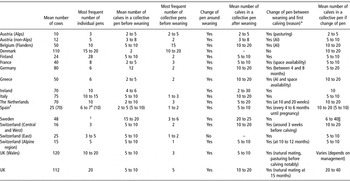
Mean size of dairy herds was reported to vary from around 10 to around 120 cows that had calved at least once (Table 1). In terms of mean size, the smallest farms were found in some regions of Switzerland (Alpine and central regions) and Austria (Alps). The biggest farms were found in Denmark and South East and South West England. A rapid increase of the average herd size was reported in the Netherlands.
Main characteristics of dairy calf housing systems in the European countries (number of animals, number of pens and change of pen)

– = not applicable.
*Artificial insemination.
†Numbers for Basque country (North of Spain) are in brackets if different.
‡20% of cows in milk at farm.
§Large variation, but not enough pens when excessive calvings.
||Dependent on herd size and type of pen (individual or collective).
Housing system from birth to weaning
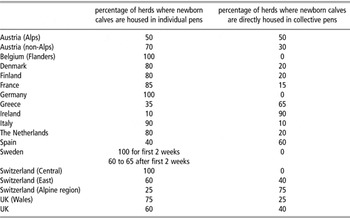
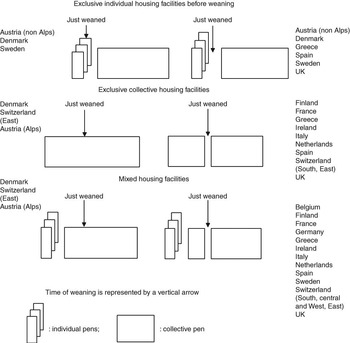
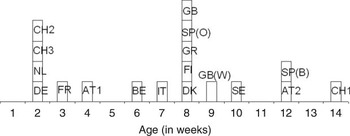
All countries but Belgium, Germany and Sweden described having both types of systems with calves either housed in individual pens before being moved to collective pens or directly housed in collective pens after birth (Table 2). Depending on the country, the variability in housing systems differed (Figure 1), as well as the percentage of each type of practice. In Germany and Belgium, calves were described to always be housed in individual pens before moving to collective pens. In Sweden, all calves were described to be housed in individual housing for 2 weeks before either staying in individual pens (60% to 65% of the calves) or being moved to collective pens. Most common maximum age in individual pens varied from 2 to 14 weeks with a median at 8 weeks (Figure 2). During this period, calves could be housed either in huts (individual covered pens with complete separation from other pens, generally outside) or in individual pens with possible contact with neighbouring calves. In order to comply with the EU-regulation on social contact, Denmark kept calves in pairs with a low fence between single pens. The use of individual pens after birth was reported to be the most frequent system in 11 out of 14 countries (Table 2). In individual pens, possible contacts with neighbours were reported to be predominant. The proportion of each individual housing facility varied depending on the country. One region of Austria (Alps) with small holdings reported using huts only. On the contrary, huts were reported being rare in Sweden (less than 1% to 3% of herds using huts). The most frequent number of individual pens (whatever the type) varied with average herd size, but not proportionally as one individual calf pen was available for 1 to 13 cows (calculated from Table 1). This number was reported to vary largely with herd size in Sweden, with a general lack of pens. During period with numerous calving, farmers generally have to use other solutions such as group pens in premises otherwise not used for calves.
Repartition of herds according to dairy calf housing systems after the calf is separated from its dam in the European countries

Types of dairy calf housing systems in the European countries before and after weaning.

Most common or maximum age of dairy calves in individual pen in the European countries. AT1, Austria (Alps); AT2, Austria (non Alps); BE, Belgium; CH1, Switzerland (Alpine region); CH2, Switzerland (Central, West); CH3, Switzerland (East); DE, Germany; DK, Denmark; Fl, Finland; FR, France; GB, Great Britain (South East, South West); GB(W), Wales; GR, Greece; IT, Italy; NL, The Netherlands; SE, Sweden; SP(B), Basque country; SP(O), Spain (other than Basque country). No information available for Ireland.

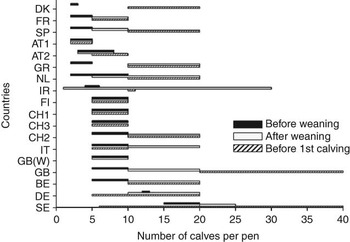
Before weaning, three main types of collective pens could be identified: pens with less than five calves (five countries), pens with less than 10 calves (eight countries), and pens with more than 10 calves (12 to 20 calves) in two countries (Table 1, Figure 3). The different group sizes of the collective pens were observed in herds of different size (Table 1). In most of the countries, several collective pens (two or more) were used. However, in three countries, only one collective pen was available per herd. Italy with a large herd size was one of these three countries; the two other countries having a small mean herd size. Mean size of collective pens has been reported to decrease over time in Sweden, decreasing from 20 to 25 calves 10 years ago, if automatic feeders were used, to mainly groups of 15 nowadays. However, the number of collective pens was stated not being sufficient implying too large group sizes notably before weaning. Still in Sweden, fixed groups were reported, at least in larger herds (>160 cows) for the period before weaning; calves being generally mixed together with other calves after weaning.
Number of calves per collective pen before weaning, after weaning and before first calving for typical dairy herds in the European countries. AT1, Austria (Alps); AT2, Austria (non Alps); BE, Belgium; CH1, Switzerland (Alpine region); CH2, Switzerland (Central, West); CH3, Switzerland (East); DE, Germany; DK, Denmark; Fl, Finland; FR, France; GB, Great Britain (South East, South West); GB(W), Wales; GR, Greece; IR, Ireland; IT, Italy; NL, The Netherlands; SE, Sweden; SP, Spain. Countries are ordered depending on the number of calves per pen before weaning (increasing number). Different areas of the same countries have been grouped together.

Housing system after weaning
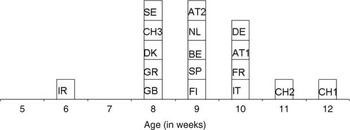
From the questionnaires it was found that the change of housing system could occur either at weaning or 1 week to 10 days after weaning in order to limit the stress already caused by the change of feed. In typical dairy herds within Europe, the most frequent age at weaning varied between 6 and 12 weeks of age, with a mean and a median at 9 weeks (Figure 4). Calves could be moved from one collective pen to another one at weaning (Figure 1). In addition, during this move, calves could either be mainly maintained and raised as a group (Alpine region of Austria, Italy, Spain, Alpine region of Switzerland and UK) or mainly shifted and mixed with another group (Belgium, Denmark, France, Greece, Ireland, Eastern, Central and Western Sweden and Switzerland), or a mix of both (Austria, Finland, Germany and Sweden). The size of the new collective pen varied from 2 to 30 calves depending on available space; the most frequent case being either between 5 and 10 for five countries or between 10 and 20 for six countries (Figure 3). Only one region out of the 14 countries studied declared never moving their calves around weaning (East Switzerland).
Most frequent age at weaning of dairy calves in the European countries. AT1, Austria (Alps); AT2, Austria (non Alps); BE, Belgium; CH1, Switzerland (Alpine region); CH2, Switzerland (Central, West); CH3, Switzerland (East); DE, Germany; DK, Denmark; Fl, Finland; FR, France; GB, Great Britain (South East, South West); GB(W), Wales; GR, Greece; IR, Ireland; IT, Italy; NL, The Netherlands; SE, Sweden; SP, Spain. No information available for Wales.

Housing system before first calving
Except for Denmark, young animals were grouped in a new pen between weaning and first calving. This could occur early after weaning, around artificial insemination or natural mating, close to calving (around 3 weeks before), during summer for pasturing, after high mountain pasturing (around 10 to 12 months of age), or depending on space availability. At that relocation, permanent groups were generally maintained and raised as a group (Finland, France, Italy, East and Alpine region of Switzerland and UK).
The size of the new pen (in terms of number of animals) varied between 2 and 40, the most frequent case being between 5 and 20 (Figure 2). Size was reported to depend on the type of pen in Sweden: generally 6 to 8 animals in slatted floor pen, 10 to 20 animals in litter pens and 20 to 40 animals if housed in loose house systems with cubicles.
Grazing of calves
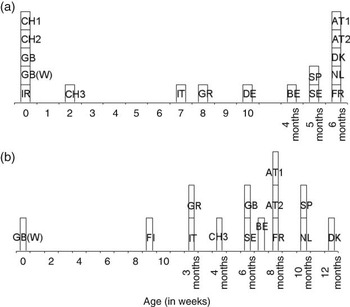
Reported age at first possible grazing varied from birth to 6 months (Figure 5a). Age limit varied in Denmark depending on whether herds were organic (1 day as a minimum age for grazing for 10% to 15% of organic herds) or non-organic (6 months as a minimum). Most common age at grazing could be very early (<3 months) to quite late (>10 months) (Figure 5b). Frequency of grazing varied with age of animals. Calves and heifers above 6 months of age were almost always allowed to go outside, grazing depending on season, with the exception of the Alpine region of Switzerland. In Sweden, it is mandatory that young stock and dairy cows should be kept on pasture during summer time. Calves were almost never outside between 0 and 6 weeks of age, however it was sometimes possible in Ireland, Central, Eastern and Western Switzerland. Weaning could be the period of time at which grazing was allowed (UK, Finland and Germany). In the Netherlands, an increasing proportion of farmers (including most of the herds with automated milking system) were reported not grazing any cattle at all anymore. Grazing was also not common in Greece and Spain (except North Spain).
Minimum (a) and most common (b) age at first grazing outside for dairy calves in the European countries. AT1, Austria (Alps); AT2, Austria (non Alps); BE, Belgium; CH1, Switzerland (Alpine region); CH2, Switzerland (Central, West); CH3, Switzerland (East); DE, Germany; DK, Denmark; Fl, Finland; FR, France; GB, Great Britain (South East, South West); GB(W), Wales; GR, Greece; IR, Ireland; IT, Italy; NL, The Netherlands; SE, Sweden; SP, Spain. No information available for (a) Finland, (b) Ireland, Germany and Switzerland (Alpine, Central and West regions).

Qualitative risk assessment
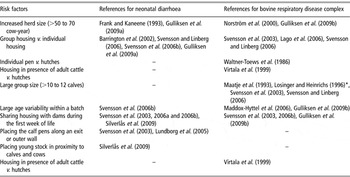
Reported risk factors related to housing facilities for respiratory and enteric infectious diseases of calves have been listed in Table 3. Risk factors are likely not to be independent because the number of calves within a pen, the age differences within a pen, the herd size and the calving season pattern interact. The pens of calves located near their dams are also at risk for pathogen transmission such as Cryptosporidium parvum (Silverlås et al., Reference Silverlås, Emanuelson, de Verdier and Björkman2009).
Reported risk factors related to housing systems associated with occurrence of neonatal diarrhoea and respiratory disorders in non-weaned dairy calves

*More than six calves before weaning.
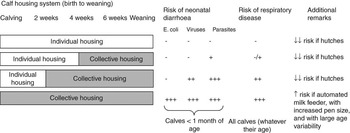
Individual housing was reported to be at lower risk than collective housing both for enteric and respiratory diseases. The risk for both type of diseases decreased if hutches were used. Collective housing facilities were associated with a higher risk for enteric and respiratory diseases. The risk was increased when the size of the collective pen increased and with age variability within a pen if automated milk feeders were used. The resulting overall estimated risk for enteric and respiratory diseases in the most common housing systems described is displayed in Figure 6.
Qualitative risk assessment of housing system for the main infectious diseases of dairy calves. −, low; +, moderate; ++, high; +++, very high; ↓, decrease;↑, increase.

Discussion
This study aimed at describing the most common housing system for calves used in the main dairy production countries of Europe. It confirms that a wide range of practices exists with variations both between- and within-countries. It appeared that many risk factors for calf morbidity reported in literature are linked to the housing systems described in this study. Housing systems have also been reported to have an effect on mortality (Svensson et al., Reference Svensson, Linder and Olsson2006b; Gulliksen et al., Reference Gulliksen, Lie, Loken and Osteras2009c). Risk factors are associated to characteristics of housing systems that vary a lot in our study, particularly when it comes to collective rearing at young age. Moreover, we can assume that for a given herd size, larger groups are associated with higher age differences, which also increase the risk. Control measure selection should be done after a specific risk assessment for each farm.
Expert data collected in this study fit with the system known by the experts, and thus cannot be considered as mean data. Before using the expert’s reported data, we checked that they had sufficient knowledge on the epidemiology of calf diseases and on cattle farming systems. However, it has to be reminded that experts usually are persons that are aware of the systems of the main production areas of their country. In some countries, experts spontaneously made mention of variability depending on the areas. Other experts only captured the most frequent system. Such a system can sometimes not be representative of the whole country, notably in mountainous areas.
Four different types of calf housing systems could be identified (Figure 6) on the basis of reported calf management before weaning. First of all, calves can be raised in individual housing until weaning, with a minimum of 8 weeks. This housing system is predominant in Austria, Denmark, Finland, Sweden and UK and frequently used in Greece and Spain. Such a housing system minimises the risk for pathogen transmission between young animals. Furthermore, raising calves in individual pens facilitates the surveillance for the farmer. However, the workload is increased (notably when it comes to feed distribution and cleaning). This system also requires a sufficient number of individual pens in the farm, condition that can be costly notably when calvings are grouped. Calves should be able to have social contacts with their herdmates according to the European regulations. While individual pens until weaning seem to be the most relevant system to decrease the risk for pathogen transmission, the EU regulation does not allow such a system after 8 weeks of age. To circumvent this rule, some countries such as Denmark gather calves in pairs in such ‘individual pens’. Furthermore, the decrease of the risk for pathogen transmission in individual pen can be limited if difficulties are encountered in the cleaning of individual pens between successive calves. Lastly, sanitary risk is postponed to the period after weaning when calves enter a collective pen. In this housing system where calves can be housed in individual housing until weaning, with a minimum of 8 weeks, respiratory disorders are the main problem and risk assessment needs to be concentrated on the period of changes around weaning when calves enter collective pens.
The second housing system that can be identified is the one in which calves can be housed in individual pen for a minimum of 4 weeks. This system is used in Austria (Alps), Belgium and Italy. The number of pens needed on a farm is more flexible than for the first described housing system. The risk in terms of disease transmission is linked to the fact that calves are mixed into collective pens 3 to 6 weeks before weaning. The first collective pen can be used either solely until weaning or also after weaning, meaning that calves of different ages can be mixed. Large age differences increase the risk for disease transmission, notably for respiratory disorders which are more important in such housing systems (Svensson et al., Reference Svensson, Lundborg, Emanuelson and Olsson2003). The age of occurrence of neonatal diarrhoea due to the main bacterial and viral pathogens (E. coli, rotavirus and coronavirus) being comprised within the first 3 weeks of life (Bartels et al., Reference Bartels, Holzhauer, Jorritsma, Swart and Lam2010), we can therefore assume that gathering within a same pen calves aged of more than 1 month is at a lower risk for occurrence of diarrhoea (except for cryptosporidiosis and coccidiosis for which shedding occurs in later ages) compared with gathering calves of 2 weeks of age for which shedding of enteric pathogens is frequent.
The third housing system consists in housing calves in an individual pen for a short period of 2 to 3 weeks after separation from the dam before changing them to a collective pen. This system is predominant in France, Germany, the Netherlands and Switzerland. It is also frequent in Sweden. The number of individual pens is reduced, decreasing the workload of the farmer. Risk for infectious disease transmission is mainly linked to the mixing of calves with different ages in the collective pens. If weaning occurs late, the difference of age between the non-weaned calves becomes important, with really young calves being housed with older ones.
Finally, calves can be housed just after birth in collective pens. This system is predominant in Greece, Ireland, Spain and the Alpine region of Switzerland. It is also frequent in the Alpine region of Austria, Denmark, Finland, France, the Netherlands and UK. This system is particularly convenient when automatic milk feeders are used. However, it is reported to be associated with an increased risk of both neonatal diarrhoea and respiratory diseases (Maatje et al., Reference Maatje, Verhoeff, Kremer, Cruijsen and Van den Ingh1993, Svensson et al., Reference Svensson, Lundborg, Emanuelson and Olsson2003). The size of the collective pens varies depending of the country, from small pens of two to five calves (two calves for Denmark) to larger pens. In Sweden, pen size tends to decrease nowadays. In order to decrease the high risk for infectious diseases in this kind of system, supplementary preventive measures such as vaccination of cows can be advised.
After weaning, the risk for infectious disease transmission comes from the number of calves per pen (pen size), which has been reported to vary largely in our study. Calves of different age can be mixed either after first service (limited risk) or really early, depending on the country.
Age at first grazing varies a lot depending on the country. No data are available on the sanitary risk linked to age at grazing, except for parasites, for which exposure of calves also depends on the way pastures are used.
Conclusion
This study provides a first description of major differences in calf housing systems across the main dairy countries of Europe. Four different types of calves housing facilities were identified. The least risky in terms of enteric and respiratory infectious diseases is housing calves in individual pens until weaning or at least 8 weeks before moving them to collective pens. Housing calves in collective pens directly from the separation from the dam after birth is the most risky housing system. Housing calves in individual pens prevent contact between calves and cleaning occurs more often as individual pens are more often empty. However, collective housing facilities still exist as they are more convenient and necessitate less work from the farmer. Differences in housing systems have to be acknowledged when using thresholds for analysis of disease incidence and when designing calf health control plans. For a specific herd, one should thus adapt the risk assessment to the housing system used, while considering in the mean time other factors not studied here such as hygiene, feeding practices and air conditioning.
Acknowledgements
The authors gratefully acknowledge all the persons who contributed anonymously or not to the survey: Silvia Alonso, Nathalie Bareille, Michele Bodmer, Marian Bos, Jeroen Dewulf, Laura Elviral, Ulf Emanuelson, Barbara Fiala, Joseba Garrido, Juan Vicente Gonzalez, Norbert Greber, Matthias Greiner, John Griffiths, Robert Gruber, Javier Guitian, Barbara Haesler, Kristiina Hakkarainen, Ramon Juste, Gerd Kaltenegger, Martin Kaske, Polychronis Kostoulas, Jozef Laureyns, Evelyn Loibernböck, Simon More, Søren Saxmose Nielsen, Annette Nigsch, Ian Roper, David Schley, Andrea Serraino, Charlotte Silverlas, Catarina Svensson, Bernd-Alois Tenhagen, Andreas Tschuor, Adriana Van den Berg, Steven Van Winden, Anna-Maija Virtala, Peter Wagner, Susanne Waiblinger, Maarten Weber and Paul Wood.