“I’m putting on my PPE. So, I must be safe.”
- Adapted from Efstathiou et al. Reference Efstathiou, Papastavrou and Raftopoulos1The coronavirus disease 2019 (COVID-19) pandemic is an ongoing existential threat to patients and healthcare workers (HCWs) world-wide. According to the World Health Organization (WHO), in May 2021, approximately 115,000 HCWs, including more than 3,600 United States (US) HCWs, had died from COVID-19 and millions of HCW have been infected while caring for patients. 2,Reference Spencer and Jewett3 By the end of June 2020, US HCWs filed 4,100 safety complaints surrounding safety concerns due to personal protective equipment (PPE) shortages to the Occupational Safety and Health Administration (OSHA), the US Labor Department’s workplace safety agency. Reference Pattani, Lewis and Jewett4,Reference Jewett, Luthra and Bailey5(pReference Efstathiou, Papastavrou and Raftopoulos1),Reference Cohen and van der Meulen Rodgers6 The Centers for Disease Control and Prevention (CDC) officially recognized “crisis” and “contingency” plans to guide staff protection amidst PPE shortages. Reference Kwon, Burnham and Reske7 “Crisis” periods of reuse admittedly do not adhere to standards of care; however, periods of “crisis” demand reuse of key pieces of PPE (e.g., N-95 respirator) as facilities were unable to meet the standard PPE safety utilization rates. 8
Protocols for donning and doffing of PPE remain ambiguous, lacking an evidence base, and often differ by PPE product, manufacturer and clinical location, resulting in wide deviations in practice. Reference Drews, Visnovsky and Mayer9 PPE donning and doffing protocol deviations commonly result in self-contamination, but, have not been addressed at the source. Reference Mitchell, Roth and Gravel10,Reference Zellmer, Van Hoof and Safdar11 Removal of PPE, for instance, is a deceptively complex procedure, associated with high rates of doffing errors and likely contamination even with basic PPE. Reference Kang, O’Donnell and Colaianne12 Emerging data suggest that most HCWs were contaminated during doffing PPE during single use periods, revealing an urgent need to examine the root causes of self-contamination risks, Reference Puro and Nicastri13,Reference Poller, Hall and Bailey14 and, particularly, when considering crisis periods for when PPE shortages required routine reuse.
PPE reuse presents an unresolved global occupational HCW hazard due to the COVID-19 pandemic. Reference Cohen and van der Meulen Rodgers6 The need for improved PPE reliability to protect HCWs has been known for several decades. Reference Puro and Nicastri13,Reference Lietz, Westermann and Nienhaus15–Reference Siegel, Rhinehart and Jackson17 However, critical PPE shortages have resulted in increased occupational HCW exposure risks by HCWs to both COVID-19 and other contagious diseases, Reference Finkenstadt and Handfield18–Reference Mehrotra, Malani and Yadav20 forcing health-care institutions to consider alternative PPE management approaches. Reference Mahmood, Crimbly and Khan21 The current literature on contamination during PPE use maintains a hyper focus on specific pieces of PPE (e.g., mask, gloves), Reference Preece, Lewis and Carre22–Reference Mumma, Durso and Ferguson24 and storage or doffing area spatial designs. Reference Mumma, Durso and Ferguson24–Reference Herlihey, Gelmi and Flewwelling26 However, latent sources of preventable errors in routine donning and doffing need to be identified to mitigate ongoing risks of contamination. Reference Hignett, Welsh and Banerjee27,Reference Corley, Hammond and Fraser28 These errors place HCWs at heightened risks for infection further depleting HCW ranks. Reference Lietz, Westermann and Nienhaus15
The goal of this study was to identify behaviors related to HCW safety associated with reusing PPE. Our intent is to more deeply understand the risks and processes that could protect HCW by mitigating against HCW exposure and self-contamination.
Methods
We used a Participatory Design (PD) approach to task analysis (TA) to better understand the risks involved in PPE reuse. TA research focuses on the end user requirements and the application of human factors and ergonomics (HF/E) principles to improve the system’s design and performance. This study was reviewed and approved by the Institutional Review Board at Indiana University School of Medicine, Protocol #: 2005953971.
Setting: Emergency Department (ED)
ED personnel on the frontline of care may be at higher risk for infection, making this a prime setting to understand and intervene where heightened risks are present with PPE reuse. Reference Woodruff and Frakt29
Approach: Participatory Design (PD)
PD is a co-design methodology which engages end users directly in the development of prospective solutions and applications to the problems and challenges they face. Reference Clemensen, Rothmann and Smith30,Reference Bodker31 PD approaches are used by researchers to better understand complex task flows and generate a step-by-step procedure which can inform the design of new technologies, workflow modifications, and clinical training. Reference Papautsky, Strouse and Dominguez32 The recruitment and management of stakeholders, use of outcome measures, and robust tools are key methodological elements in PD research. Reference Brandt, Binder, Sanders, Simonsen and Robertson33 This iterative process elicits user’s expert knowledge, perceptions, and opinions to generate a thorough depiction of occupational challenges.
We used the 3 PD key phases proposed by Papautsky and colleagues Reference Papautsky, Strouse and Dominguez32 to conduct the study, which includes: (1) identifying steps and sequence of the task(s), (2) developing initial task flows, and, (3) refining task flows through multiple iterations. Agendas, visual aids, PD literature, and reoccurring meetings were used in accordance with best practices to clarify roles, responsibilities, and vision of the PD approach. Reference Slattery, Saeri and Bragge34 We detail how we engaged in each of the 3 phases below.
Phase 1. Identify steps and sequence
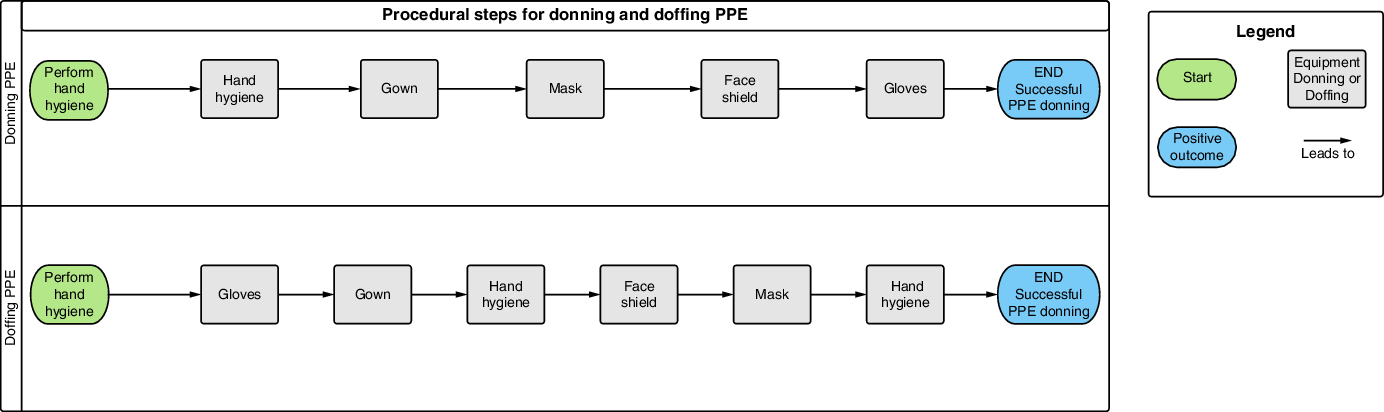
Phase 1 involves the identification of the steps and sequences involved in successful completion of the task at-hand. We used guidance from the CDC regarding PPE use (donning and doffing) and information related to PPE re-use to establish the task sequence. 35,36 CDC guidance controlled for variations in PPE donning and doffing sequences which are common in real-world clinical settings, allowing the current TA to focus on safety of PPE re-use. We used the CDC recommended sequence for donning and doffing for the purposes of satisfying Phase 1 of the TA in creating a common sequence of tasks as follows (see Figure 1).
CDC donning and doffing PPE procedural steps.

Phase 2. Develop initial task flow
To conduct the second and third phases (below) of the TA, we convened a panel of subject matter experts (SMEs), with backgrounds in Emergency Medicine (EM), Critical Care (CC), Patient Safety, Epidemiology, and HF/E. We elicited SME input to deeply understand the step-by-step behaviors involved in successful donning, doffing, re-donning, and re-doffing of PPE. The SMEs provided expert end user insights into PPE reuse under real-world constraints (e.g., personnel shortage) and pressures (e.g., patient volume). This information was compiled in the initial task flow to create a visual representation of the underlying tasks and risks to HCW. We supplemented this information with the literature on HFE infection control and PPE use. Reference Drews, Visnovsky and Mayer9,Reference Zellmer, Van Hoof and Safdar11,Reference Puro and Nicastri13,Reference Mumma, Durso and Ferguson24,Reference Hallihan, Baers and Wiley25,Reference Gurses, Rosen and Pronovost37–Reference Russo, Cheng and Richards39
Phase 3. Produce multiple iterations of task flow
The third phase of the TA produced multiple iterations of the task flow and involved reconvening SMEs until all members of the panel agreed the TA was complete and wholly representative of the tasks. Task flow modifications were done using a modified Delphi method to establish consensus, with modifications to task flows developed using LucidChart and Adobe software tools. This iterative process progresses task flows toward a more thorough task understanding by relying on repeated rounds of expert group consensus. Reference Meshkat, Cowman and Gethin40 The task flows underwent 4 iterations in total.
Results
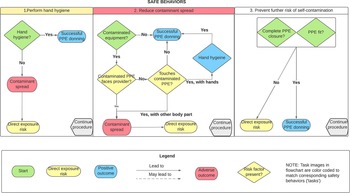
Three key task flows illustrate the safety behaviors and identified the presence of 2 key threats to HCWs in PPE reuse. The 3 task flows fit within the procedural steps recommended by CDC 41 and include: i) hand hygiene, ii) avoid touching patient-facing surface of PPE, and iii) ensure proper fit and closure of all PPE ties/materials. Interestingly, the task flows that highlight key safety behaviors and mishaps were conducted in the constant presence of occupational hazards. Two main emerging threats were associated with protective behaviors while donning, doffing, and re-using of PPE. These behaviors promote self-contamination and contaminant spread. Reference Kwon, Burnham and Reske7,Reference Phan, Maita and Mortiz42 We organized the results based on the risk(s) present during PPE donning and doffing: risk(s) of direct exposure (i.e., HCW has potential for direct contact with contaminant due to improperly fitted or open PPE) and contaminant spread (i.e., HCW mishandles PPE allowing contaminant to be further transmitted to self or other pieces of PPE), which may increase the likelihood of direct exposure.
(I) Risks of Direct Exposure
The risk of HCW direct exposure was the first threat to emerge. Two channels create a risk of direct contact in which PPE does not provide adequate coverage. This task flow involves improper fit of PPE (e.g., face shield, mask, gown, gloves) and/or failure to close all PPE ties correctly. Of interest, the risks of direct exposure are predominantly present during PPE donning. Safety behaviors which mitigate the risks of direct exposure require verifying that key pieces of PPE are fastened correctly and closed completely. The second safety behavior to emerge requires the PPE to be the proper size and fit securely on HCWs such that no gaps are present that could directly expose HCWs to the virus (see Figure 2). Achieving appropriate fit can be especially difficult for those with diverse, large, or petite body types due to ongoing limited PPE sizes. Reference Mumma, Durso and Ferguson24,Reference Flynn, Keller and DeLaney43
PPE donning and doffing taskflows and safety behaviors.

(II) Risks of Transmission/Contamination Spread
The second risk identified involves the persistent threat of spreading viral contaminant during doffing PPE and subsequent donning of PPE during periods of reuse. For our purposes, viral contaminant spread was defined as, when contaminated PPE touches other pieces of PPE during doffing or when a HCW touched the patient-facing sides of PPE directly. Engaging in proper hand hygiene and avoiding interaction with patient-facing sides of PPE in doffing and re-donning are key safety behaviors which may reduce the risks of contaminant spread. Hand hygiene emerged as a key task flow which could mitigate the risk of transmission and contaminant spread. However, hand hygiene does not adequately prevent all forms of contaminant spread (e.g., viral contaminant touching other parts of the body and/or PPE). Reference Kwon, Burnham and Reske7 For example, patient-facing PPE (e.g., gown) can spread contaminant to a body-size surface area (e.g., should the gown be re-donned with patient facing side toward the HCW). Therefore, touching the patient-facing side of PPE with one’s body (i.e., not hands) may NOT be remedied with hand hygiene alone. Safely doffing and re-donning contaminated PPE means taking precautions to avoid touching or incorrectly donning PPE which requires covering large body surface areas. Other instances in which hand hygiene may not add a layer of protection include the spread during gown removal (see “Hand hygiene” in task flow 2; Figure 2), which may result in viral particles spreading to arms, face, or other PPE (e.g., face shield or mask).
(III) PPE Reuse and Compounded Risk
Each protective behavior and risk in single use PPE offers additive safety in effective HCW protection. However, the complexity of task flows, behaviors, and risks in the context of repeated procedural steps in donning and doffing the same PPE (i.e., reuse) can escalate the risks of further exposure and subsequent infections. Each safety behavior can act as a protective additive factor against the ever-present risks posed by improper donning and doffing of PPE (including reused PPE). However, the TA also reveals several critical “gaps” that could impose additive risks should a HCW misstep occur in donning or doffing reused PPE. In other words, critical “at-risk” steps within the task flows reveal the layers of prospective or latent risks in health workflows, which are often opaque to HCW users. Even with staff spotters HCW can progress beyond a critical step where the process is highly likely to lead to an infection (i.e., latent risk). Reference Apostalskis and Barach44
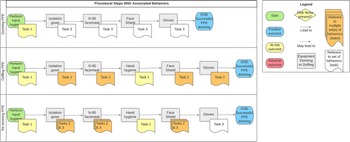
The procedural steps, task flows, and behaviors involved in donning and doffing are repeated with each reuse (see Figure 3). In other words, coupling the procedural steps (i.e., task sequence) with their underlying task flows exposes HCW to enhanced risks with each PPE’s reuse, thereby, heightening the risks of HCW exposure. Initially, hospitals trained and some offered support known as a “spotter” who offered PPE feedback and HCW protection stewardship by observing the proper HCW donning and doffing PPE steps. Reference Patel, O’Donnell and Bonebrake45 While this short-lived intervention can help mitigate contamination risks, there are no current solutions that offer fail-safe PPE reuse and regular monitoring of the potential spread of contaminant to HCW.
PPE donning and doffing procedural steps with associated risks and safety behaviors.

Discussion
The study found that inadequate process and PPE design allows routine improper PPE donning and doffing, allowing unintentional but common human errors in PPE reuse. Reference Barach and Johnson46 The ease of unsafe equipment use directly conflicts with the goal of PPE use. Reference Kwon, Burnham and Reske7,Reference Zamora47,Reference Casalino, Astocondor and Sanchez48 This dissonance motivated the current work to better protect health systems and workers.
It is important to reiterate that re-using PPE is not standard practice and carries safety risks. It is only sanctioned by the CDC for select pieces of PPE (i.e., N95 respirator) 49 during crisis scenarios. Yet, the severe shortage of PPE under the COVID-19 pandemic led to extraordinary circumstances encouraging PPE reuse. Not all PPE equipment can be reused (disposable isolation gown) and CDC recommended close attention be paid to the make and model of equipment for reuse guidance. The results bear two important implications for PPE use in crisis scenarios. First, the findings highlight several risky activities including improper or inadequate hand hygiene, spread contaminant across PPE and/or to self, and failure to secure fit and/or closure of PPE ties. These behaviors escalate the risks for HCW direct exposure and possible infection. The results can be used to inform the re-engineering of PPE and redesign of equipment that can better protect HCWs against risks when doffing and donning PPE. In particular, this study specifies the novel pathways of PPE use which can lead to HCW infections. Reference Beam, Gibbs and Boulter50 Notably, data are limited on estimating the likelihood of self-contamination or infection; however, previous studies attribute the relatively low rates of self- infection as a matter of “luck” rather than adequate PPE protection. Reference Zamora47,Reference Casanova, Rutala and Weber51–53
The second implication of our findings is the seminal concept of compounded exposure risks with continued PPE reuse. For instance, in the process of donning reused PPE, there is a unique, yet possible, pathway in which PPE is donned incorrectly during reuse so that a HCW is self-contaminated immediately. This finding is specific to isolation gowns that do not touch face, mouth, eyes, or nose directly. Isolation gowns designed for multi-use are explicitly not sanctioned by CDC due to associated exposure risks; however, reusable gowns exist and were reused by HCW. Furthermore, isolation gowns cover a large surface area. In instances of repeated use, “self-contamination” from improper reuse of isolation gowns may increase the likelihood of further spread to self and/or other pieces of PPE. This is critical as risk of exposure may be present AFTER direct patient contact. For instance, contaminated PPE may spread contagion to other HCW body parts and/or other pieces of PPE during re-donning. This highlights the urgent need to recognize and contain contagion immediately to prevent further spread. Hand hygiene may help prevent spread of contaminant; however, even correct hand hygiene may not fully protect against contaminant spread—particularly to other pieces of PPE. Failure to prevent contaminant spread may result in a compounded risk of HCW direct exposure with each instance of PPE reuse.
Recognize and Mitigate Risks
COVID-19 and other contagious diseases pose a pervasive threat to HCW safety and well-being. The study reports on PPE safety and design by identifying the underlying tasks involved in PPE reuse through participation of SMEs, an approach successfully leveraged in computer Reference Razak, Garibaldi and Wagner54 and engineering Reference Falconi and Palmer55 sciences. PD is a preferred approach to bridge the research-practice implementation gaps based on the HFE and safety literature, Reference Langley, Wolstenholme and Cooke56 and is particularly effective when leveraging a systems’ perspective to support patient and staff safety in complex clinical care procedures. Reference Greenhalgh, Jackson and Shaw57
HFE approaches analyze prospective risks and can be used to prevent HCW harm stemming from human error compounded by poorly designed PPE systems. Reference McLeod and Bowie58–Reference Barach and Van Zundert60 Understandably, some of the identified pathways in our study can increase the risks of infection. Additionally, the risks of direct exposure are likely increased in the presence of production pressures, cognitive workload, and HCW fatigue. New PPE design, policy, and donning/doffing areas need to be considered in promoting safe and well-being working conditions without sacrificing the quality of care. Reference Jecker, Dudzinski and Diekema16
Assistance With Human-Centered Solutions
Human factors are essential in the development, design, and engineering of new interventions, particularly for equipment and devices. Reference Wong, Ahmed and Ray61 The study’s results highlight the ever-present risks in reusing PPE beyond standard of care. Mitigating the risks of contamination requires a multi-pronged approach to increased awareness and countermeasures to combat contaminant spread. Interventions will need to target the underlying risks involved in PPE reuse and should consider work-related factors such as length of shifts, night shifts, heavy workload, chronic fatigue, etc. Reference Dai, Milkman and Hofmann62,Reference Gershon, Vlahov and Felknor63
Recommendations
Our study focused on the perceptions and work of ED personnel who are responsible for stabilizing COVID-19 and non-COVID patients. Reference Auerbach, Abulebda and Bona64 Coupled with long shifts, high production pressures, and frequent protocol changes (e.g., screening), ED personnel may face additional challenges to maintaining a sense of heightened awareness for COVID spread. We offer several recommendations for redesigning clinical workflows to help protect HCWs:
(I) Improve Training and Competency Enhancement Techniques
Most HCWs receive training on proper use of PPE. Reference John, Tomas and Cadnum65,Reference Candiotti, Kamat and Barach66 However, not all training opportunities are equally effective. In fact, most HCWs report receiving limited immersive training before treating COVID-19 patients, Reference Auerbach, Abulebda and Bona64,Reference Christensen, Rasmussen and Benfield67,Reference Rama, Murray and Fehr68 offering limited time and guidance and feedback for effective training in protective practices such as guided and audited practice. Reference Casalino, Astocondor and Sanchez48 Protecting HCW from self-contamination requires real-time feedback and greater transparency about the relative risk(s) associated with each step of PPE use. Solutions to these issues could be provided by a spotter providing immediate guidance from institutional experts (human), Reference Casalino, Astocondor and Sanchez48 video, or by using transparent materials (such as Glo Germ™) to make visible contaminated equipment during training. Reference Beam, Gibbs and Boulter50,Reference Hughes, Hughes and Ahmed69 Guided practice or simulation-based training is a low-resource method for improving PPE donning and doffing techniques by accelerating improved knowledge, skills, and attitudes relative to risk mitigation. Reference Verbeek, Rajamaki and Ijaz23,Reference Casalino, Astocondor and Sanchez48,Reference Wong, Ahmed and Ray61,Reference Auerbach, Abulebda and Bona64 Training solutions may not decrease risks at the source; however, transparent feedback approaches offer an approach to increase HCW’s awareness to encourage changing HCW behaviors during PPE donning and doffing.
(II) Implement Stewardship for PPE Preservation
Spotters (personnel directly observing HCW don and doff PPE in situ) are potentially helpful in assuring and auditing that PPE is placed appropriately. Reference Beam, Gibbs and Boulter50 Not much detail is available on the helpfulness, receptiveness, or impact of spotters in the correct application of PPE; however, understaffing and high patient volumes can limit availability and consistency of spotter support. In other words, spotters may offer an added layer of protection and support in appropriate PPE donning and doffing; however, their relative benefits remain unclear.
(III) Re-design Environment for Infection Control
Hospital spatial re-design can change workflows and be used to promote quality and safety. Reference Jurewicz, Neyens and Catchpole70 Unfortunately, current hospital space, flow, and PPE design will continue to facilitate nosocomial (hospital borne) infections unless root sources of infection spread are addressed by better design of hospitals. Reference Capolongo, Gola and Brambilla71 One way to successfully plan and implement spatial design is through implementation of standardized protocols. And herein lies the problem: validated protocols designed to prevent COVID-19 transmission do not yet exist; therefore, hospitals are implementing spatial redesigns on the fly. Reference Mumma, Durso and Ferguson24,72 This means that HCW safety takes a backseat awaiting implementation of effective and feasible PPE design adaptations and overall design guideline changes. PD offers practical and low-cost mitigation approaches to solve real world problems in health systems combatting the COVID-19 pandemic until the implementation of effective PPE design adaptations and guideline changes. Reference Gurses, Rosen and Pronovost37
(IV) Enhance PPE Design to Promote Risk Awareness
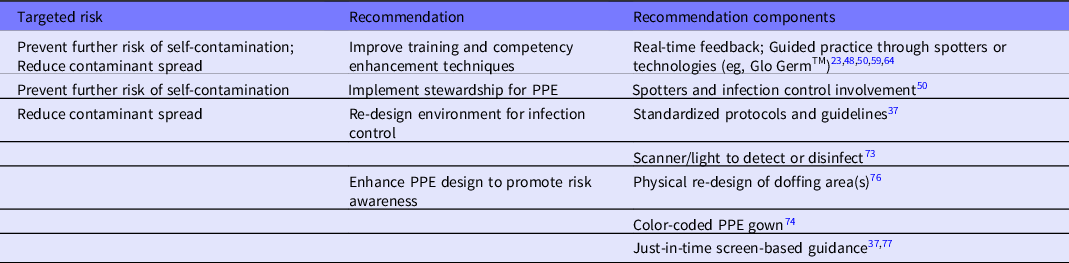
On-the-job tools, coupled with effective training, can increase awareness to PPE donning/doffing/reuse best practices, and thus, decrease the risks to HCW. A scanner or light source to detect the presence of the HCWs skin coming in contact with the exterior of the reused PPE before re-donning used equipment or after doffing used equipment might be helpful. Reference Derraik, Anderson and Connelly73 Other potential options offer greater transparency and immediate awareness of infection through PPE re-design. For instance, a simple redesign solution may include color coding the patient-facing sides of PPE garments to reflect the side facing the patient, which could prevent significant errors from occurring during PPE reuse. One example is the use of applying Glo Germ™ for self-identification of ineffective or high-risk doffing with a black light in the clinical environment. Reference Doos, Barach and Alves74 Further recommendations include re-design of PPE (improved fit, color coding) and other multi-level system design considerations (eg, policy, procedure, physical environment changes) for safety (Table 1). Reference Gurses, Rosen and Pronovost37,Reference Carayon, Schoofs Hundt and Karsh75
Human centered recommendations for protecting health care workers

Limitations
The study has several limitations and must be interpreted in the context of its exploratory design. First, the study reveals potentially risky behaviors in the everyday tasks of ED personnel during PPE donning, doffing, and associated reuse; however, the study does not specify the measures to determine how much these risky behaviors increased the likelihood of COVID-19 infections. Second, in following the procedural steps outlined by Papautsky et al., Reference Papautsky, Strouse and Dominguez32 we constrained our first step of the analysis to CDC-recommended procedural steps to donning and doffing, introducing a variant that may accommodate PPE reuse (addition of hand hygiene in a procedural step). However, the actual HCW practices of donning and doffing may vary by setting and provider preference. Third, the analysis reveals several risks that may increase the chances of HCW infection; however, our data cannot quantify the extent to which this risk is heightened during periods of PPE reuse. Finally, our study reflects the context and distinct constraints of emergency medicine workflows in the US health-care systems, which might differ from other health-care systems and limit its generalizability. Health institutions outside the United States (e.g., India, where outbreak rates are high and PPE resources are low) Reference Singleton, Johnson and Singleton76,Reference Kea, Johnson and Lin77 may face heightened or differing risks in supporting PPE reuse. We, therefore, believe that the results of the study have direct relevance for all HCW at risk.
These limitations invite a more detailed analysis of the factors affecting potential variations in CDC recommended donning and doffing procedures in the reuse of PPE. There is a need to examine the prospective benefits of design solutions proposed in light of our findings, and we highlight the need to quantify the increased risks of contaminant spread and self-infections caused by PPE reuse. Reference Puro and Nicastri13,Reference Jecker, Dudzinski and Diekema16,Reference Beckman, Materna and Goldmacher78
Conclusions
COVID-19 poses an existential risk to HCW due to inadequate PPE and poorly designed clinical workflows and PPE. Reference McMahon, Peters and Ivers79 PPE re-use is not consistent with standards of care and standards for occupational safety and health, and it should only be condoned when it is truly essential due to supply constraints. However, the practice of PPE reuse will likely arise again throughout the COVID-19 pandemic and during future infectious crises, especially in countries with limited resources.
The results have important implications for health-care management and training practices to prepare for crisis scenarios and equipment shortages. Prior research and the results of the current study reveal an ever-present risk of exposure in each procedural step in the PPE standard procedure donning, doffing, and re-using of PPE sequence.
Our study reports on the first application of a PD approach to identifying the safety of protective behaviors and underlying risks in reusing PPE during the global pandemic. Future work is needed to consider the real-world compounded risks and variations in PPE donning and doffing practices and their implications for clinical practice. It is imperative to reexamine the design of system PPE protocols and PPE equipment to maximize HCW safety and well-being.
Eliminating infection risks is impossible, however, reducing the likelihood of harm and minimizing risk to HCWs is possible through better design. Reference Jain80
Acknowledgements
The views expressed in this work are those of the authors and do not necessarily reflect the organizations with which they are affiliated or their sponsoring institutions or agencies. The views expressed in this presentation are those of the authors and do not necessarily reflect the position or policy of the Department of Veterans Affairs or the United States Government. The authors thank Divya Krishnakumar for her masterful editing to Figures 1-3.
Funding statement
This work received partial support from National Center for Advancing Translational Sciences (UL1TR002003; PI: AMH).
Conflict of interest
None to report.