INTRODUCTION
Non-suicidal self-injury (NSSI) is most commonly described as deliberate, direct destruction or alteration of body tissue without conscious suicidal intent (Pattison & Kahan, Reference Pattison and Kahan1983; Favazza, Reference Favazza1998). NSSI is deemed socially unacceptable (as opposed to ear piercing, for instance), direct (and thus differentiated from indirect self-harm, such as drinking and driving), repetitive (Briere & Gil, Reference Briere and Gil1998), and leads to minor or moderate harm (Suyemoto, Reference Suyemoto1998). NSSI is commonly encountered in in-patient (Favazza, Reference Favazza1989) and out-patient (Esposito et al. Reference Esposito, Spirito, Boergers and Donaldson2003) psychiatric and other institutionalized settings (Penn et al. Reference Penn, Esposito, Schaeffer, Fritz and Spirito2003) and most of what is known about NSSI is derived from these populations.
It is estimated that approximately 4% of the population have a history of NSSI (Briere & Gil, Reference Briere and Gil1998), with some suggestion that these rates may be on the rise (Hawton et al. Reference Hawton, Hall, Simkin, Bale, Bond, Codd and Stewart2003). Among young adults, rates range from 4% of young military recruits (Klonsky et al. Reference Klonsky, Oltmanns and Turkheimer2003) to up to 38% of college students (Gratz et al. Reference Gratz, Conrad and Roemer2002). NSSI is thought to begin in adolescence (Pattison & Kahan, Reference Pattison and Kahan1983), with prevalence ranging from 10·4% of incarcerated adolescent males (Chowanec et al. Reference Chowanec, Josephson, Coleman and Davis1991) to 60–80% of adolescent psychiatric in-patients (Ross & McKay, Reference Ross and McKay1979; Nock & Prinstein, Reference Nock and Prinstein2004).
Among those studies that have sampled from community settings, relatively few have investigated NSSI within adolescent populations. Differences in NSSI assessment may partially explain the wide range of prevalence estimates seen in studies of adolescent NSSI, with studies incorporating a more detailed, broadly defined assessment often yielding a higher rate of NSSI. Patton et al. (Reference Patton, Harris, Carlin, Hibbert, Coffey, Schwart and Bowes1997) reported a rate of 5·1% of Australian high-school students engaging in NSSI within the previous year. Hawton et al. (Reference Hawton, Rodham, Evans and Weatherall2002) reported that 6·9% (n=398) of their sample of adolescents recruited in the UK engaged in NSSI within the previous year. Among Turkish adolescents sampled from a school setting, Zoroglu et al. (Reference Zoroglu, Tuzun, Sar, Tutkun, Savas, Ozturk, Alyanak and Kora2003) found 21·4% (n=175) of students endorsed engaging in lifetime NSSI. Three North American studies of community adolescents found consistent rates of NSSI using disparate assessment methods. Ross and Heath (Reference Ross and Heath2002) found 14% (n=61) of a sample of US adolescents reported lifetime NSSI in a semi-structured interview, with one-third of these reporting currently self-harming two times a week. Muehlenkamp and Gutierrez (Reference Muehlenkamp and Gutierrez2004) documented 15·9% of their sample of 390 high-school students engaged in NSSI. More recently, 15% of a sample of 424 Canadian high-school students reported intentional self-harm in the past year (Laye-Gindhu & Schonert-Reichl, Reference Laye-Gindhu and Schonert-Reichl2005). Open-ended questions in an anonymous self-report survey yielded six non-mutually-exclusive categories of self-harm behaviors: cutting-type behaviors; hitting or biting self; abusing pills; eating disordered behavior; reckless behavior, and bone-breaking/falling/jumping, with over 50% of self-harmers reporting harming themselves between 2 and 10 times in the past year (Laye-Gindhu & Schonert-Reichl, Reference Laye-Gindhu and Schonert-Reichl2005).
Functions of NSSI
Numerous functions of NSSI are indicated in the clinical literature, including: to relieve negative emotions, such as anxiety, guilt, loneliness, alienation or self-hatred; to relieve unpleasant thoughts or feelings; to release anger, tension or emotional pain; to provide a sense of security or control; to punish self; to set boundaries with others; to end depersonalization/derealization, flashbacks or racing thoughts (see Gratz, Reference Gratz2003 for review). In fact, it is likely that NSSI serves multiple functions simultaneously (Suyemoto, Reference Suyemoto1998).
Little is known of the underpinnings of NSSI within community samples, in particular adolescents. In open-ended qualitative interviews with college students who reported a history of NSSI, the most common reason for NSSI was to relieve unwanted feelings (Gratz, Reference Gratz2003). Depression, self-anger and wanting to relieve tension were spontaneously reported as reasons for self-cutting in a study of community adolescents (Rodham et al. Reference Rodham, Hawton and Evans2004). Consistent with this, Laye-Gindhu & Schonert-Reichl (Reference Laye-Gindhu and Schonert-Reichl2005) found that adolescent self-harm functioned as emotional regulation, with the most common reasons for self-harm including: depression, feeling all alone, negative feelings toward self, distraction, and feeling a need to hurt oneself. Self-harmers reported that aversive emotions (anger, depression, loneliness and frustration) were reduced during and following self-harm, while emotions deemed as positive (relief) and self-conscious (guilt, shame, disgust) increased following self-harm. Males in this study were more likely to endorse self-harm to communicate/influence others or out of boredom, while females were more likely to engage in self-harm for relief of intra-punitive factors (e.g. self-hatred, depression, loneliness).
Nock & Prinstein (Reference Nock and Prinstein2004) proposed a four-factor theoretical model of NSSI functions, performed along two dichotomous dimensions. First, NSSI is either intra-personal, automatically reinforcing (e.g. to obtain a reduction in tension or create a more desirable state) or socially reinforcing (e.g. to alter one's environment). Second, NSSI is reinforced in either a positive (i.e. rewarded with a positive stimulus) or negative manner (i.e. rewarded by escaping a negative interpersonal demand). Nock & Prinstein (Reference Nock and Prinstein2004) evaluated the structural validity of the Functional Assessment of Self-Mutilation (FASM; Lloyd et al. Reference Lloyd, Kelley and Hope1997) in a sample of 108 adolescent psychiatric in-patients referred for self-injurious thoughts or behaviors. Their results confirmed the proposed four-factor model and suggested that the majority of the sample endorsed NSSI for automatic negative and positive reinforcement (e.g. to stop bad feelings; to feel something, even if it was pain).
The aims of the work presented here were twofold: first, to explore the prevalence and characteristics of NSSI in a relatively large sample of community adolescents. Second, based on the severity of NSSI, as measured by the FASM, to compare adolescents endorsing ‘minor NSSI’ or ‘moderate/severe NSSI’ with those teens denying NSSI on clinical variables of interest. We hypothesized that those engaging in moderate/severe NSSI were more likely to have a psychiatric history, a history of suicide attempt, and greater current suicide ideation than minor self-injurers, who in turn, were hypothesized to score higher on these measures than non-injurers. We also aimed to explore the motivations behind NSSI in community youth, and how these vary across minor and moderate/severe self-injurers.
METHOD
Participants
Students located in both the southern and midwestern United States participated in this anonymous survey. Participants were recruited from classroom announcements in five high schools (grades 9–12) convenience sampled. A total of 633 students (372 students from the Midwest and 261 from the South) participated in the study. Fifty-seven per cent of the sample was female. The average age was 15·5 years (s.d.=1·18). In terms of racial/ethnic composition of the entire sample, 50·9% were African-American (n=317), 43·7% (n=272) Caucasian, 1·8% (n=11) Asian-American, 1·3% (n=8) Latino, and 2·4% (n=15) Other. Racial and socio-economic characteristics of the sample are comparable to regional census tract data. Participants from the Midwest were more likely to be African-American (p<0·01) and poorer (p<0·01), with no regional differences noted in gender or age of participants.
Measures
The FASM was designed to assess the methods, frequency and functions of self-reported NSSI (Lloyd et al. Reference Lloyd, Kelley and Hope1997). It consists of two parts: first, a checklist of NSSI, of which respondents were asked whether they purposefully engaged in each of 11 different NSSI behaviors (plus a fill-in ‘other’ category) within the past year and, if so, the frequency of occurrence and whether medical treatment was obtained, a proxy for severity of injury. A principal components analysis of the 11 behaviors yielded two factors (Lloyd et al. Reference Lloyd, Kelley and Hope1997). The first factor included items considered more clinically severe in nature, denoted as ‘moderate/severe NSSI’: cutting/carving, burning, self-tattooing, scraping, and erasing (i.e. using an eraser to rub skin to the point of burning and bleeding) skin. The second factor consisted of less severe behaviors, denoted as ‘minor NSSI’: hitting self, pulling hair, biting self, inserting objects under nails or skin, picking at a wound, and picking areas to draw blood. Participants were also asked the length of time they contemplated the behavior(s); at what age their NSSI first began; whether NSSI was performed under the influence of drugs or alcohol; the degree of physical pain experienced during NSSI; and whether any of these behaviors was a suicide attempt.
The second part of the FASM consists of 22 statements assessing motivations for NSSI, presented in checklist format and rated on a four-point Likert scale, ranging from never to often. Items are drawn from more commonly described theories of NSSI, such as affect-regulation, interpersonal influence, anti-dissociation/feeling-generation, and self-punishment functions. As described previously, Nock & Prinstein (Reference Nock and Prinstein2004, Reference Nock and Prinstein2005) have demonstrated both structural and construct validity of a four-factor model of NSSI functions: automatic-negative reinforcement, automatic-positive reinforcement, social-negative reinforcement, and social-positive reinforcement.
The FASM has demonstrated acceptable psychometric properties within adolescent samples (Guertin et al. Reference Guertin, Lloyd-Richardson, Spirito, Donaldson and Boergers2001; Esposito et al. Reference Esposito, Spirito, Boergers and Donaldson2003; Penn et al. Reference Penn, Esposito, Schaeffer, Fritz and Spirito2003), yielding adequate internal consistency (coefficient α=0·65−0·66) for both minor and moderate/severe NSSI scales and concurrent validity as evidenced by significant associations with measures of suicide ideation, past suicide attempt (Guertin et al. Reference Guertin, Lloyd-Richardson, Spirito, Donaldson and Boergers2001), recent suicide attempt, hopelessness and depressive symptoms (Nock & Prinstein, Reference Nock and Prinstein2005).
Clinical variables
The Suicide Ideation Questionnaire (SIQ; Reynolds, Reference Reynolds1988) is a 30-item self-report measure of suicidal ideation in adolescents and young adults. High validity and a reliability of 0·97 have been documented (Reynolds, Reference Reynolds1988), with the SIQ related to changes over time in depression and hopelessness (Mazza & Reynolds, Reference Mazza and Reynolds1998). Additional clinical variables of interest included whether or not the individual had a history of suicide attempt; whether the individual had a history of psychiatric or mental health treatment; and whether he/she had ever been hospitalized for emotional problems.
Procedure
Students at participating high schools were informed of a research study being conducted to anonymously explore ways in which teens deal with difficult social and emotional problems they may face. Students were told when the study questionnaire would be administered and were instructed to return informed consent forms signed by both the parent and participating teen. Of the 670 students initially approached, 16 adolescents chose not to participate or were not present at school that day, and 21 adolescents provided incomplete, unusable questionnaires.
Thus, 633 students completed anonymous surveys, which were administered in a group setting during regularly scheduled class times. Measures of NSSI and suicide ideation were embedded within a larger assessment battery containing psychosocial self-report instruments assessing constructs such as problem-solving and self-perception. Study participants at each school were eligible for a small cash drawing. Following administration of the questionnaires, subjects were debriefed regarding the purpose of the study. Included in the debriefing statement, provided both orally and written, was referral information for the local mental health hotline, should a student wish to discuss issues raised in the questionnaire packet in more detail. All study procedures were approved by the Louisiana State University Institutional Review Board.
Data analytic plan
Descriptive statistics were first conducted to examine the frequency and basic characteristics of NSSI in a community sample. Those adolescents endorsing minor NSSI only were then compared to those endorsing at least one episode of moderate/severe NSSI on the behavioral characteristics and motivational functions of NSSI. Group comparisons of non-injurers with (1) those endorsing ‘minor’ NSSI only and (2) those endorsing ‘moderate/severe’ NSSI were also conducted to evaluate differences on demographic and clinical variables. Group comparisons were performed using χ2 tests for proportions of categorical measures and t tests for means of continuous variables. Confirmatory factor analysis (CFA) was conducted to evaluate whether the four-function model proposed by Nock & Prinstein (Reference Nock and Prinstein2004) held true in a community sample of adolescents. CFA was conducted with EQS structural equation modeling software (Bentler, Reference Bentler2004). All other analyses were conducted using SPSS version 13.0 (SPSS Inc., Chicago, IL, USA).
RESULTS
Frequencies and descriptive characteristics of NSSI
Of the 55% (n=349) of the overall sample who endorsed engaging in one or more of the 12 NSSI behaviors in the past year, 44% (n=279) endorsed the item ‘picked at a wound’, suggesting that this may be a clinically insignificant behavior among adolescent participants. We conservatively chose to eliminate from further analyses those who endorsed only the item ‘picked at a wound’. Furthermore, 7% (n=27) of adolescents indicated that one or more of their self-reported NSSI behaviors was a suicide attempt. One of these reported a single episode of self-injury, describing it as ‘other’ (the only participant endorsing ‘other’ NSSI). Given our operational definition of NSSI (deliberate, direct destruction or alteration of body tissue without conscious suicidal intent), we chose to exclude this individual from further analyses but opted to include these remaining 26 participants, given their frequent NSSI (mean=90·5, s.d.=147·3).
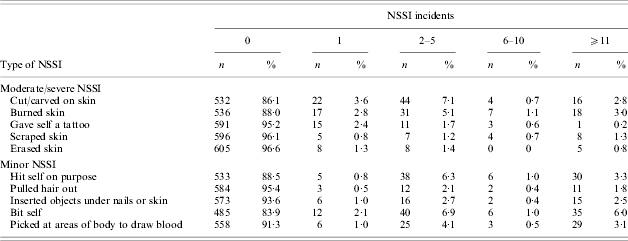
Thus, 46·5% (n=293) of our sample endorsed engaging in NSSI in the past year. Those engaging in NSSI reported an average of 12·87 incidents (s.d.=29·4, median=4·0, mode=2·0, range=1–205). Frequencies of behaviors are presented in Table 1.
Descriptive characteristics of non-suicidal self-injury (NSSI) within the past year in a community sample of adolescents (n=293)Footnote a

a Responses of ‘don't know’ to number of times performed NSSI were excluded.
The mean number of types of NSSI performed was 2·35 (s.d.=1·67, median=2·0, mode=1, range=1–10). Forty-two per cent of self-injurers (n=110) reported engaging in only one type of NSSI in the past year, while 52% (n=136) of self-injurers endorsed engaging in two to five different types of NSSI, and 6% (n=15) endorsed six or more different types of NSSI. Few self-mutilators endorsed receiving medical treatment for any of their injuries (3%).
Differences between minor and moderate/severe NSSI characteristics
We found that 18·8% (n=119) of the overall sample engaged in minor NSSI only and 27·7% (n=175) engaged in at least one act of moderate/severe NSSI. While the two factors are strongly correlated (r=0·458, p<0·01), there appear to be important distinctions between the two. Those individuals endorsing moderate/severe NSSI (n=175) were likely to engage in more types of NSSI [3·23 (s.d.=2·02) v. 1·45 (s.d.=0·71); t=−9·25, df=292, p<0·001] and more incidents of NSSI [63·89 (s.d.=131·50) v. 28·06 (s.d.=46·75); t=–2·83, df=268, p<0·01] over the previous year than those endorsing only minor NSSI. While the majority of self-injurers reported little forethought about their acts, moderate/severe injurers were more likely to contemplate NSSI before engaging in the behavior [31·1% v. 11·7%; χ2 (7, n=244)=19·23, p<0·01]. They were also more likely than minor injurers to report experiencing pain during NSSI [73·5% v. 55·3%; χ2 (5, n=282)=14·84, p<0·01], to have received medical treatment for their injuries [χ2 (1, n=197)=5·64, p<0·05], and to have used alcohol or drugs during NSSI [26·5% v. 3·4%; χ2 (2, n=289)=27·0, p<0·001].
Differences between minor NSSI, moderate/severe NSSI and non-injurers on demographic and clinical variables
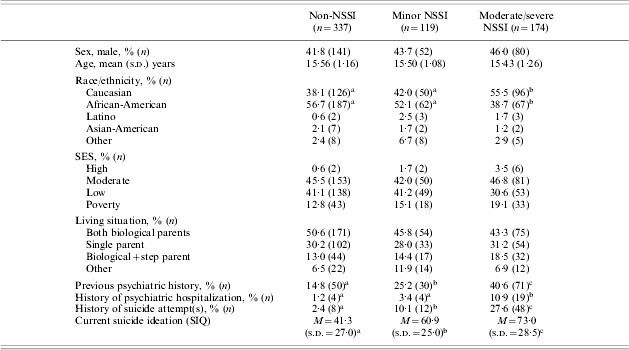
There were no significant differences between groups by age, sex, socio-economic status (SES), living situation, or region of the country (see Table 2). Evaluation of our two largest racial groups found that Caucasians were significantly more likely to engage in NSSI than African-Americans [χ2 (2, n=600)=12·16, p<0·01], with Caucasians more likely to engage in moderate/severe NSSI but African-Americans more likely to engage in minor NSSI.
Demographic and psychosocial characteristics of adolescent self-injurers compared to non-injurers
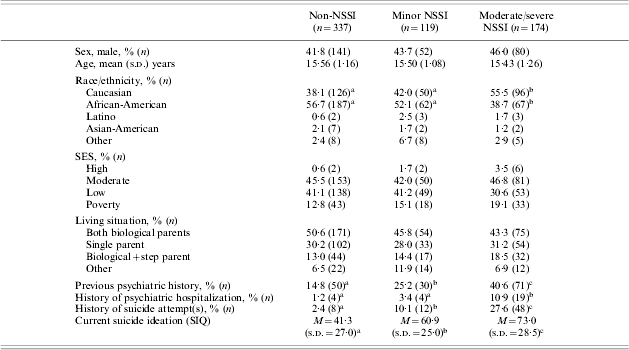
NSSI, non-suicidal self-injury; s.d., standard deviation; SES, socio-economic status; SIQ, Suicide Ideation Questionnaire.
a,b,c Row values with different superscripts are significantly different from one another.
Evaluation of clinical variables revealed significant group differences in history of out-patient psychiatric treatment [χ2 (2, n=631)=42·04, p<0·001], psychiatric hospitalization [χ2 (2, n=629)=26·72, p<0·001], history of suicide attempt [χ2 (2, n=629)=75·61, p<0·001], and also level of current suicide ideation [F(2, 617)=82·25, p<0·001]. Considering only those findings associated with a p<0·01, Tukey post-hoc contrasts showed significant differences between non-NSSI and both the minor NSSI and moderate/severe NSSI groups, with moderate/severe self-injurers generally demonstrating the highest occurrence rates, the non-NSSI group the lowest, and the minor self-injurer group in between (see Table 2).
Functions of NSSI
A CFA was conducted evaluating four models differing in the number of latent factors (1, 2, 3 and 4) suggested to represent underlying motivations for NSSI among adolescents. The four-factor model provided the best fit to data from this sample [χ2 (70, n=261)=103·64, p<0·05] and was consistent with other fit indices (data available upon request).
Overall, self-injurers endorsed an average of 4·76 (s.d.=5·56) individual motives for NSSI. Items on the intra-personal, automatic-reinforcement scales were endorsed by 22–28% of all self-injurers, while items on the social-reinforcement scales were endorsed by 19–31% of injurers. Thus, community adolescents reported engaging in NSSI to influence the behaviors of others, as well as to regulate their emotional states. No significant gender differences emerged when comparing the four motivational factors, although males were more likely than females to endorse the item ‘to make others angry’ [χ2 (1, n=259)=8·7, p<0·01] and females were more likely than males to endorse the item ‘to punish yourself’ [χ2 (1, n=258)=4·05, p<0·05].
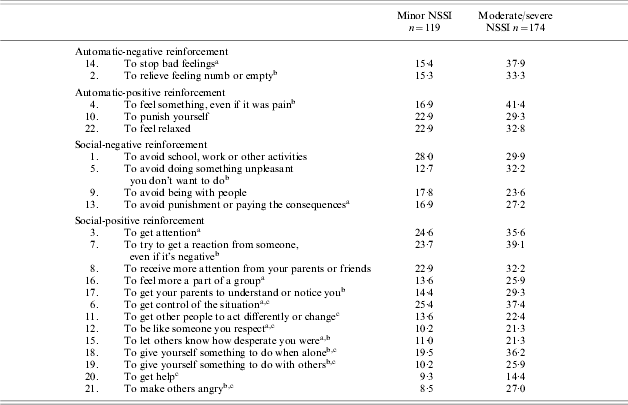
Table 3 presents items contained within the four-factor model of NSSI, as well as the percentage of those engaging in minor NSSI and moderate/severe NSSI who endorsed each of these items. Moderate/severe injurers endorsed more motivations for NSSI than minor injurers [6·7 (s.d.=6·0) v. 4·0 (s.d.=5·0), t=4·03, df=288, p<0·001). Indeed, minor injurers were more likely to deny engaging in NSSI for any of the reasons listed, as compared to moderate/severe injurers (21·2% v. 14·5%, t=4·17, df=288, p<0·001). Inter-correlational analyses noted that, while moderate/severe NSSI was highly correlated with all four latent factors (all p's <0·01), minor NSSI was correlated only with automatic-negative reinforcement (r=0·128, p<0·05) and automatic-positive reinforcement (r=0·212, p<0·01). All four functions were significantly related to clinical variables of history of psychiatric treatment, in-patient treatment, suicide attempt, and current suicide ideation (all p's<0·01).
Rate of reported reasons for engaging in minor and moderate/severe non-suicidal self-injury (NSSI)

Groups differ significantly at the ap<0·05 level, bp<0·01 level.
c These eight items theoretically associated with social-positive reinforcement were excluded from the model because of significant skew and kurtosis.
Differences between NSSI suicide and non-suicide attempters
Given a lack of clear understanding in the literature on the relationship between NSSI and suicide attempt, we chose to investigate further the differences between those endorsing past-year NSSI and a suicide attempt(s) (NSSI suicide; n=26) versus those endorsing past-year NSSI without suicide attempt(s) (NSSI non-suicide; n=267). These two groups did not differ on demographic characteristics. Evaluation of clinical variables found that the NSSI suicide group was more likely than the NSSI non-suicide group to have a history of out-patient psychiatric treatment [χ2 (2, n=293)=12·07, p<0·01], psychiatric hospitalization [χ2 (2, n=292)=14·27, p<0·001], and greater current suicide ideation [F(2, 283)=47·87, p<0·001]. The NSSI suicide group endorsed greater frequency of moderate/severe NSSI [65·88 (s.d.=115·23) v. 10·57 (s.d.=42·54), t=5·04, df=290, p<0·001] and used more types of NSSI [4·50 (s.d.=2·39) v. 2·32 (s.d.=1·66), t=6·11, df=290, p<0·001]. They also reported a greater number of reasons for NSSI than the NSSI non-suicide group [10·76 (s.d.=5·41) v. 5·09 (s.d.=5·52), t=4·91, df=287, p<0·001] and were more likely to endorse items from all four functions of NSSI (all p's <0·001).
DISCUSSION
Prevalence of NSSI
Our results indicate that NSSI is indeed prevalent, occurring in 46% of our community sample. Sixty per cent of these, or 28% of the overall sample, indicated moderate/severe NSSI in the past year, most commonly biting, cutting/carving, hitting, and burning skin. No gender, race or age differences were noted in overall NSSI rates. This prevalence rate is generally higher than earlier studies of adolescent community samples (Ross & Heath, Reference Ross and Heath2002; Muehlenkamp & Gutierrez, Reference Muehlenkamp and Gutierrez2004; Gindhu & Schonert-Reichl, Reference Laye-Gindhu and Schonert-Reichl2005), although consistent with rates reported in one study of college students, with 38% reporting a lifetime history of NSSI (Gratz et al. Reference Gratz, Conrad and Roemer2002). There are several possible explanations for these high rates of NSSI. First, the items may not be assessing self-mutilation as defined herein. Because of high self-reported rates on the item ‘picked at a wound’, we eliminated this item as it may have reflected non-pathological, non-NSSI. When evaluating moderate/severe NSSI only, the rate becomes more comparable to that found in other investigations. Further predictive validity studies are needed to evaluate the clinical significance of various types of NSSI. A second possible explanation of our findings could be the method in which NSSI was assessed, namely anonymous self-report on a detailed listing of various self-harm behaviors. There are wide differences in NSSI assessment, and it is possible that more detailed, broadly defined assessments that provide cued listings of self-harm behaviors (Gratz et al. Reference Gratz, Conrad and Roemer2002; Zoroglu et al. Reference Zoroglu, Tuzun, Sar, Tutkun, Savas, Ozturk, Alyanak and Kora2003), as compared to free-response survey formats (Muehlenkamp & Gutierrez, Reference Muehlenkamp and Gutierrez2004), capture a greater breadth of NSSI and thus yield a higher rate of NSSI. Finally, if we are to assume that the behaviors described are of significant clinical interest, then a third interpretation of our response rates is that NSSI may be more prevalent in the community than previously suspected.
Clinical correlates of NSSI
Several important distinctions were noted between minor and moderate/severe self-injurers. Moderate/severe injurers engaged in more frequent NSSI and more types of NSSI than minor injurers, factors found to be predictive of more severe pathology in adults (Zlotnick et al. Reference Zlotnick, Mattia and Zimmerman1999). Moderate/severe injurers were also more likely to experience pain, to use alcohol or drugs during their NSSI, and to have received medical treatment for their injuries. Consistent with our hypothesis, moderate/severe injurers were more likely than minor self-injurers, who in turn were more likely than non-injurers, to report a history of psychiatric treatment and hospitalization, suicide attempt, and current suicide ideation. While there are clear benefits to assessing a wide range of NSSI, these results suggest that certain NSSI may be more predictive of more serious outcomes. Differentiating between ‘minor’ and more severe forms of NSSI allows for further consideration of clinical markers that may distinguish between clinically significant behaviors and those merely a clinically insignificant behavioral habit or perhaps a ‘normative expression’ of teen culture.
The theory of suicidal behavior proposed by Joiner et al. (Reference Joiner, Conwell, Fitzpatrick, Witte, Schmidt, Berlim, Fleck and Rudd2005) suggests that experience with self-harm facilitates future self-harm through repeated exposure to the experience, as well as through opponent-processing effects, namely a decline of fear-inducing effects and an increase in the reward value of self-harm (e.g. to feel relaxed; to get control of a situation). While distinguishing between NSSI and suicide attempts is important, there is evidence that these behaviors may overlap in some individuals (Penn et al. Reference Penn, Esposito, Schaeffer, Fritz and Spirito2003; Joiner et al. Reference Joiner, Conwell, Fitzpatrick, Witte, Schmidt, Berlim, Fleck and Rudd2005). Indeed, our sub-analysis of self-injurers who also attempt suicide found these teens were engaging in much more frequent and varied NSSI than those who denied that their self-injury was a suicide attempt. Thus, the question remains of whether repeated exposure to NSSI in the long term leads to a decreased fear threshold and, thus, greater attraction to suicide and death.
Functions of NSSI
The most common reasons for NSSI included ‘to try to get a reaction from someone’, ‘to get control of a situation’, and ‘to stop bad feelings’. Consistent with Nock & Prinstein (Reference Nock and Prinstein2004), a four-factor model of self-mutilation was supported in our community sample. Of note, social-reinforcement items were, on average, endorsed as frequently as intra-personal, automatic-reinforcement items, in contrast to Penn et al. (Reference Penn, Esposito, Schaeffer, Fritz and Spirito2003) and Nock & Prinstein (Reference Nock and Prinstein2004) who found stronger support for intra-personal, automatic functions in their institutionalized adolescent samples. In a community sample, the range of adolescent functioning is extended, and thus teens on balance may be less socially isolated, depressed or hopeless than clinical populations who self-injure (Guertin et al. Reference Guertin, Lloyd-Richardson, Spirito, Donaldson and Boergers2001). Therefore, it is possible that there may be more varied meanings for engaging in NSSI. It is also likely that the meaning of NSSI may change over time with greater amounts of NSSI. We noted that moderate/severe NSSI was significantly related to both automatic and social functions, while minor NSSI was related only to intra-personal, automatic functions, perhaps reflecting a clinically insignificant behavioral habit engaged in unconsciously. Prospective studies should explore how NSSI and its functions may change over time, given additional exposure to NSSI, as well as changes in inter- and intra-personal variables.
Limitations
Our sample was drawn from two geographically distinct areas, consisting of data from five non-randomly selected high schools. Future research is needed to investigate NSSI in nationally representative samples. Incorporating NSSI items within national survey designs would allow for better estimation of prevalence rates and opportunities to evaluate the predictive validity of these behaviors with other health risk factors, such as depression and substance abuse. This would also allow opportunity to evaluate and distinguish between seemingly trivial cases of NSSI and those that increase in severity and/or frequency and may lead to other harmful actions. While national surveys have begun incorporating single-item assessments of self-injury (e.g. 2003 Massachusetts YRBS; www.doe.mass.edu/cnp/hprograms/yrbs/), our results suggest the benefits of including multiple items assessing a spectrum of NSSI. In addition, the findings are cross-sectional and based on anonymous self-report not verified by other methods, such as parental self-report.
Clinical implications
The present study highlights the frequency and breadth of NSSI engaged in by community adolescents. While adolescents reported little to no forethought before engaging in NSSI, they described a range of motivations for engaging in NSSI, namely to influence the behaviors of others, as well as to influence and manage their own internal emotions. Thus, intervention efforts should focus on reducing issues that contribute to NSSI and building alternative skills for positive coping, communication and stress management. There is growing evidence suggesting the efficacy of problem-solving treatment approaches for NSSI (Townsend et al. Reference Townsend, Hawton, Attman, Arensman, Gunnell and Hazell2001), which may be useful in addressing some of the prominent characteristics of NSSI, such as the lack of reflection before engaging in NSSI and alternatives for managing intense affect. In addition, the role of social support from friends and family should not be overlooked, particularly given that poor social relations have been associated with greater probability of adolescent depression, poor self-esteem, suicide ideation and attempts (Valois et al. Reference Valois, Zullig, Huebner and Drane2004). It is also worth noting that while elicitation of a response from others is often cited as a motivation for NSSI in the clinical literature, the fact that an individual's NSSI may influence others does not imply intent of this behavior, although may end up reinforcing the behavior nonetheless (Gratz, Reference Gratz2003). While there remain few empirically validated functional models of and proven treatments for NSSI (Linehan, Reference Linehan1993), understanding the specific motivations behind an individual's NSSI may allow for the development of an informed treatment plan that may comprise a variety of psychotherapeutic options (from medication management to skills training), and the prevention of future NSSI episodes.
ACKNOWLEDGMENTS
Support for this work was provided by a grant from the National Heart, Lung, and Blood Institute (K23-HL069987) awarded to E.E.L-R.
DECLARATION OF INTEREST
None.