INTRODUCTION
With the development of the global nuclear energy industry, the most serious accidents occurred at the Chernobyl nuclear power plant in April 1986 and at the Fukushima Daiichi nuclear power plant in March 2011 (Trapeznikov et al. Reference Trapeznikov, Molchanova, Karavaeva and Trapeznikova2007; Hirose Reference Hirose2012; Suchara Reference Suchara, Gupta and Walther2017). These events have led to excessive public skepticism about plans to develop nuclear power in many countries. Today, such a situation exists in Lithuania, which, upon joining the European Union, shut down the only nuclear power plant in the country, the Ignalina NPP (INPP), and started to decommission it. The operation history of INPP, consisting of two reactor units, only lasted for 26 years. As a part of the obligations of the European Union Accession Treaty, Unit 1 of INPP was shut down on 31 December 2004, and Unit 2 on 31 December 2009. The history of the INPP operation and data on radiation in the environment indicate that the INPP was operated safely and benefited the society (https://www.iae.lt).
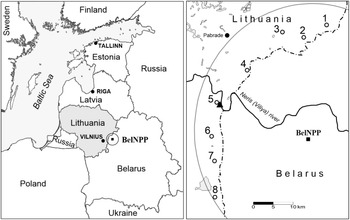
Active discussions in Lithuania on nuclear energy issues, both within the general public and on a political level, resumed again when the neighbouring country Belarus began to actively develop the projects for the construction of a nuclear power plant in the immediate proximity of the state border with Lithuania. Today, the Belarusian Nuclear Power Plant (BelNPP) has already been constructed, and the first unit was put into operation at the end of 2020. The industrial site of BelNPP is located close to the Lithuanian border (20 km) and the capital of the country, Vilnius (50 km). A part of the BelNPP 30-km zone is located on Lithuanian territory (Figure 1).
Sampling locations (a triangle in the scheme represents a position of surface water sampling point at Neris River, the circles represent the position of 8 monitoring sites for terrestrial ecosystems).

The increase in the number of operating nuclear power reactors in the east Baltic region and sensitive attitude to this issue from the general public facilitates the need for new research and the implementation of monitoring programs to keep the discussions on anthropogenic radionuclides originating from the BelNPP scientifically sound in future.
As it was previously shown in many studies (Mikhailov et al. Reference Mikhailov, Kolkovsky and Pavlova1999; Mažeika Reference Mažeika2002; Nedveckaitė et al. Reference Nedveckaitė, Filistovic, Marciulioniene, Kiponas, Remeikis and Beresford2007; Jasiulionis and Rozkov Reference Jasiulionis and Rozkov2007; Gudelis et al. Reference Gudelis, Druteikienė, Lukšienė, Gvozdaitė, Nielsen, Hou, Mažeika and Petrošius2010; Mazeika et al. Reference Mazeika, Marciulioniene, Nedveckaite and Jefanova2016; Jefanova et al. Reference Jefanova, Mažeika, Petrošius and Skuratovič2018), Lithuanian terrestrial and aquatic ecosystems near the INPP contained traces of carbon-14 (14C), tritium (3H), cobalt-60 (60Co), and caesium-137 (137Cs) originating from the INPP. We assume that the same radionuclides, especially mobile ones, such as 14C and 3Н, may be present in the BelNPP environment in the future during its normal operation. Therefore, we initiated a baseline study of these radionuclides distribution in the Lithuanian part of the 30-km zone of the new NPP before the start of its operation. Some results on this topic have already been published. The aim of the study (Marčiulionienė et al. Reference Marčiulionienė, Lukšienė, Montvydienė, Jefanova, Mažeika, Taraškevičius, Stakėnienė, Petrošius, Maceika, Tarasiuk, Žukauskaitė, Kazakevičiūtė and Volkova2017) was to determine activities of 137Cs and plutonium (Pu) isotopes and identify the sources of their origin in flooded soil and bottom sediments attributed to the water system of Neris and Nemunas Rivers and the Curonian Lagoon. The distribution of anthropogenic radionuclides (14C, 3H, 137Cs, and 239,240Pu) in forest soils and plants at the Lithuanian border region before the start of the BelNPP was analyzed by Jefanova et al. (Reference Jefanova, Baužienė, Lujanienė, Svediene, Raudoniene, Bridziuviene, Paskevicius, Levinskaite, Zvirgzdas, Petrosius, Skuratovic and Mazeika2020).
The aim of this paper, therefore, is to present the distribution of 14C in terrestrial and aquatic ecosystems at the Lithuanian border region before the start of the BelNPP operation. Because of the mobility, well-known atmospheric abundance, biological importance of carbon (12C, 13C, and 14C), and the biological incorporation of radioactive 14C through photosynthesis, it is of great importance to run 14C measurements in the environment surrounding nuclear facilities. 3H is the second mobile radionuclide that in addition to global origin can be traced in the environment surrounding nuclear facilities, especially in water bodies. The rather wide spreading of 3H from NPPs is due to its transport with atmospheric precipitation and river runoff. Therefore, in this work, much attention is paid to the temporal distribution of 3H in atmospheric precipitation and in the water of the Neris River, which will receive operational liquid discharges from the BelNPP. Furthermore, the data on other radionuclides (3H, 137Cs, and 239,240Pu) are given here as evidence of the baseline pre-operational radioecological state of the area, but they are presented only briefly for comparison.
SAMPLING SITES, MATERIAL, AND METHODS
For a proper understanding of migration of the radionuclides upon release in the environment, the ecosystem components of interest and representative sampling sites must be carefully selected. Studies of the environmental consequences of the Chernobyl accident have evidenced that, for example, the uptake and retention of 137Cs have generally been much higher in semi-natural ecosystems than in agricultural ecosystems (Balonov Reference Balonov2013). To represent terrestrial ecosystems in this study, the monitoring sites in forest ecosystems were established in the Lithuanian part of the 30-km zone of the BelNPP (Jefanova et al. Reference Jefanova, Baužienė, Lujanienė, Svediene, Raudoniene, Bridziuviene, Paskevicius, Levinskaite, Zvirgzdas, Petrosius, Skuratovic and Mazeika2020). The eight sampling sites were selected near the Belarus-Lithuania border in a ∼60-km-long semi-regular arc (Figure 1). Forest ecosystems on Arenosols with a low groundwater table are spread in the Lithuanian part of 30-km zone territory of the BelNPP. The undisturbed organic soil is composed of the sequence of organic topsoil horizons, OL (organic litter), OF (organic fragmented horizon) and OH (organic humus horizon), distinguishable according to the decomposition degree of organic matter (IUSS 2015). Mineral topsoil horizon A composed of sand underlies by the organic horizons and contains < 20% of organic material (IUSS 2015). Blueberry pine forest more than 50 years old with rowan and other shrubs dominates here. The sampling sites are represented by natural pine forest ecosystems with low human impact.
A quadrat frame of 400 cm2 in area and 20 cm in height was used to collect organic and mineral soil samples for radionuclide analysis. The frame was driven vertically into the soil with hummer until reaching 20 cm in depth from the moss surface. The sampling point distance from the stems of trees was > 3 m. Series of living moss and soil horizons were collected.
Terrestrial plant samples included mosses and vascular plants: blueberry shrubs (Vaccinium myrtillus L.), rowan leaves (Sorbus aucuparia L.), mugwort stems (Artemisia sp.) and birch leaves (Betula sp.). Pleurozium schreberi prevailed in sampling sites 1 and 3–7, and Hylocomium splendens prevailed in sampling sites 2 and 8. In most cases, samples were mixes of different moss taxes.
To study the aquatic ecosystem under the influence of the BelNPP, a monitoring station (station 5, see Figure 1) was selected on the Neris River in immediate proximity of the state border with Belarus. Aquatic biota samples included: arrowhead (Sagittaria sp.), flowering rush (Butomus umbellatus), water-plantain (Alisma sp.), sedge (Carex rostrata), European bur-reed (Sparganium sp.), pondweed (Potamogeton sp.), common reed (Phragmites australis), frogbit (Hydrocharis morsus-ranae), Canadian waterweed (Elodea canadensis), and freshwater bivalve mussels (Anadonta sp. and Unio sp.).
Macrophytes were taken according to standard radioecological methods using a special hook (Marčiulionienė et al. Reference Marčiulionienė, Lukšienė, Montvydienė, Jefanova, Mažeika, Taraškevičius, Stakėnienė, Petrošius, Maceika, Tarasiuk, Žukauskaitė, Kazakevičiūtė and Volkova2017). Along with biota samples, bottom sediment and water samples were also taken for further analysis. The 5-cm-thick top layers of bottom sediment were collected using an Ekman bottom grab sampler (20 × 20 cm). Large volume water samples were collected using a submersible pump. To determine the activity of 14C in water, dissolved inorganic carbon (DIC) was precipitated using appropriate quantities of NaOH and CaCl2 as described in (Arslanov Reference Arslanov1987). To determine the total activity of 137Cs in water, including soluble and associated with particles, pretreated by ion exchange material filters were used (Lehto and Hou Reference Lehto and Hou2011).
A sampling of terrestrial and aquatic biota for all types of analysis, as well as water for the determination of 14C and 137Cs was carried out at the end of the growing season, namely in August or September of 2017–2020. Soil sampling for all types of analysis with a very limited number of samples for Pu isotopes was carried out once in 2017, with the exception of the soil profile for the 14C, which was implemented in 2021.
At present, the level of 3Н in atmospheric precipitation is mainly due to its cosmogenic origin, with a pronounced minimum in winter and maximum in summer. Therefore, the dynamics of 3Н as one of the most mobile radionuclides in the aquatic environment, which can be influenced by the BelNPP, should be accurately compared with the variable background levels of 3H in atmospheric precipitation. To take water samples from the Neris River to determine 3H once a month, the same monitoring station 5 was used, from which samples were also taken for other analyses. Furthermore, for monthly precipitation collection for 3H determination, two stations of east Lithuania were used: Zarasai (55°43'46"N, 26°10'42"E) and Vilnius (54°46'40"N, 25°17'36"E).
After standard pretreatment of corresponding material, the specific activity of 14C in samples of plant, soil, and DIC in water was measured using the liquid scintillation counting (LSC) method (Gupta and Polach Reference Gupta and Polach1985; Arslanov Reference Arslanov1987). A conventional procedure for benzene synthesis was applied (Kovaliukh and Skripkin Reference Kovaliukh and Skripkin1994). 14C activity counting in benzene was performed with a TriCarb 3170 TR/SL.
The specific activity of 3H in monthly samples of atmospheric precipitation, river water periodic samples, and tissue free water tritium (TFWT) form of plant samples was measured using the low-background LSC method according to the procedure (ISO 9698 2019). The water fraction for 3H determination was extracted from plant samples using the vacuum distillation and lyophilization methods. The precipitation and river water samples underwent primary distillation, electrolytic enrichment, neutralization and final distillation. Eight milliliters of tissue-free water or water after electrolytic enrichment were mixed with the scintillation cocktail, and 3H activity was measured with a Quantulus 1220.
Air-dried terrestrial and aquatic plants, bivalve mussels, and samples from organic soil sub-horizons OL, OF and OH were combusted in a muffle furnace at 450°C for 5 hr. Deeper soil layers and crushed mussel valves were measured in the dry condition. Two geometries, 60 and 3 mL, were applied. Gamma-ray spectrometry using an ORTEC gamma-ray spectrometer with an HPGe GWL-120-15-LB-AWT detector (resolution 2.25 keV at 1.33 MeV) was applied to measure the specific activity of gamma-emitting radionuclides in biotic and soil samples (Gudelis et al. Reference Gudelis, Remeikis, Plukis and Lukauskas2000; Jefanova et al. Reference Jefanova, Baužienė, Lujanienė, Svediene, Raudoniene, Bridziuviene, Paskevicius, Levinskaite, Zvirgzdas, Petrosius, Skuratovic and Mazeika2020).
In order to determine the specific activity of plutonium isotopes, the ash samples of plants, bottom sediment and soil were dissolved in strong acids (HNO3, HCl, HF, and HClO4). TOPO/cyclohexane extraction and radiochemical purification using TEVA resins (100–150 μm) were used to separate Pu isotopes. Pu isotopes were electroplated onto stainless steel disks and measured using an alpha-spectrometry system with passivated implanted planar silicon (PIPS) detectors with an active area of 450 mm2 (AMETEK, Oak Ridge, Tennessee, USA). For more information, see Lujanienė (Reference Lujanienė2013).
RESULTS AND DISCUSSION
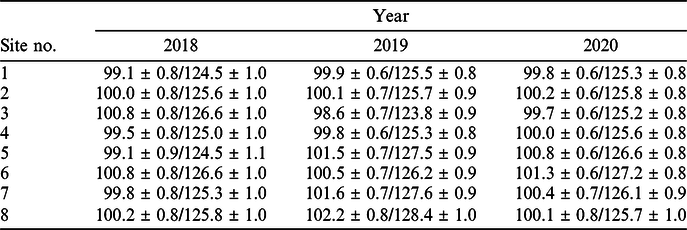
The data on 14C specific activity in terrestrial plants (mugwort) in the Lithuanian part of the BelNPP 30-km zone for the period of observations 2018–2020 are presented in detail in Table 1.
14C specific activity (pMC, ± 1 sigma/Bq/kg of biota*, dry weight, ± 1 sigma) in terrestrial plants (mugwort, Artemisia vulgaris) from Lithuanian part of the 30 km zone of the BelNPP, Belarus.

*Calculated basing on approximate Corg fraction in biota material.
We compared the data on 14C for annual terrestrial plant species from the edge of the 30-km zone of the BelNPP with the data on the level of 14C in atmospheric CO2, which is currently approaching the level of 14C from cosmogenic origin ∼100 pMC. The background 14CO2 levels due to fossil fuel burning CO2 emissions depending on reduction scenarios are predicted to reach pre-1950 levels (i.e., 14CO2 < 100 pMC) by 2021 in the Northern Hemisphere with a 20% probability (Sierra Reference Sierra2018; Zhang et al. Reference Zhang, Liu, Li, Li, Wei and Xu2021).
14C specific activity in mugwort from all sites studied in the BelNPP 30-km zone varied insignificantly (Table 2). In all samples for 2018–2020, the specific activity of 14C varied from 98.6 ± 0.7 to 102.2 ± 0.8 pMC, and the mean value within standard deviation (SD) was 100.2 ± 0.9 pMC, which is close to the current level of 14C in the atmosphere (Hua et al. Reference Hua, Turnbull, Santos, Rakowski, Ancapichún, De Pol-Holz, Hammer, Lehman, Levin, Miller, Palmer and Turney2021). The average value of 14C specific activity in mugwort (± SD) for different years was as follows: 99.9 ± 0.7 pMC in 2018, 100.5 ± 1.2 pMC in 2019, and 100.3 ± 0.6 in 2020. All these data sets do not differ statistically significantly, and the average value of 14C specific activity in mugwort can be taken for the terrestrial ecosystem as a 14C background value. A slight depletion of 14C in some plant samples (up to 1 pMC) relative to atmospheric CO2 can be associated with the peculiarities of plant metabolism or the input of a small fraction of “old” carbon. The 14C background value can be used in the future when assessing the contribution of routine airborne emissions from BelNPP to the 14C level in the terrestrial ecosystem.
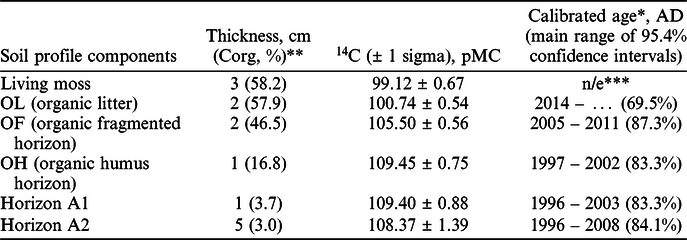
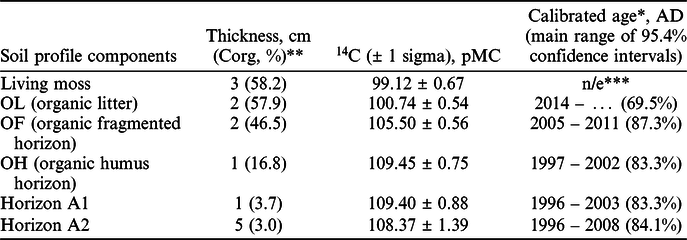
14C specific activity in living moss and soil horizons taken from pine forest ecosystem in Lithuanian part of the 30 km zone of the BelNPP, Belarus (sampling point 8, see Figure 1).
*Calibrated using OxCal 4.4 software (Bronk Ramsey, Reference Bronk Ramsey2009) and post-bomb atmospheric NH1 curve (Hua et al. Reference Hua, Turnbull, Santos, Rakowski, Ancapichún, De Pol-Holz, Hammer, Lehman, Levin, Miller, Palmer and Turney2021).
**Corg derived from loss on ignition (LOI) data.
***Data does not fit post-bomb atmospheric NH1 curve.
For example, we refer to the 14C data attributed to the terrestrial environment of the INPP and collected throughout the entire period of its operation. These data recorded the 14C activity excess compared to the corresponding 14C background level of certain periods. Pine tree ring measurements evidenced an increase in 14C concentrations by 3–6 pMC during the first 14 years of INPP operation (1983–1997) when no maintenance works of the reactors were needed (Mazeika et al. Reference Mazeika, Petrosius and Pukiene2008). During the operational period of 1998–2003, increased 14C specific activity values up to 6–14 pMC coincided with the replacement events of the zirconium alloy tubes of the fuel channels in both units of the INPP (Ežerinskis et al. Reference Ežerinskis, Šapolaitė, Pabedinskas, Juodis, Garbaras, Maceika, Druteikienė, Lukauskas and Remeikis2018).
The data on 14C in the soil profile in the Lithuanian part of the BelNPP 30-km zone for the recent period of observations (2021) are presented in detail in Table 2.
The content of 14C in living moss (99.1 ± 0.7 pMC) did not differ from its content in other terrestrial plants, as well as in organic litter (100.7 ± 0.5 pMC). The content of 14C in organic soil horizons varied more considerably compared to that of living moss and organic litter depending on the mean time elapsed since carbon in the soil system was fixed from atmospheric CO2. Soil organics age evaluation using OxCal 4.4 software (Bronk Ramsey, Reference Bronk Ramsey2009) and post-bomb atmospheric NH1 curve (Hua et al., Reference Hua, Turnbull, Santos, Rakowski, Ancapichún, De Pol-Holz, Hammer, Lehman, Levin, Miller, Palmer and Turney2021) revealed the following values: living moss and OL horizon < 10 yr, OF and OH horizons: 13 ± 3 and 22 ± 3 yr, respectively. The age of organics admixture in the sand (horizons A1 and A2) was similar to that of organic soil horizons (Table 2).
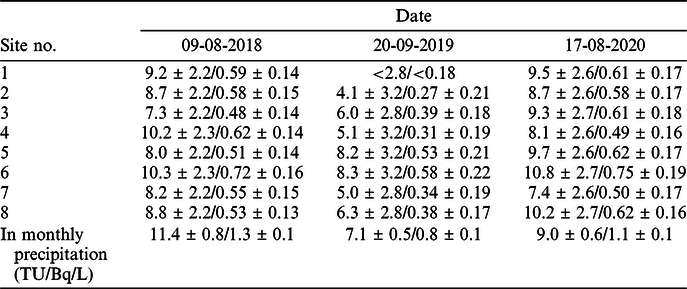
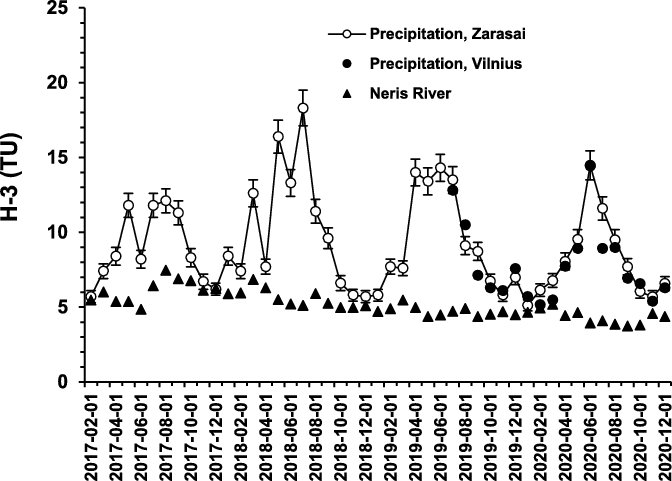
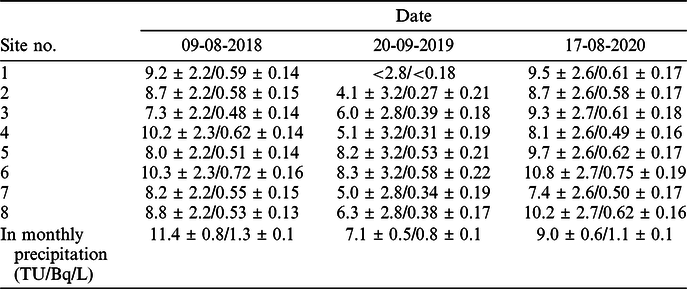
The data on 3H activity in terrestrial plants and atmospheric precipitation within the 30-km zone of the BelNPP for the period of observations (2018–2020) are presented in Table 3 and Figure 2.
3H specific activity in tissue free water form (TU, ± 1 sigma/Bq/kg* of fresh biota, ± 1 sigma) of terrestrial plants (rowan leaves, Sorbus aucuparia) taken from Lithuanian part of the 30 km zone of the BelNPP, Belarus.
*Calculated basing on tissue free water content of terrestrial plants.
3H activity concentration in monthly atmospheric precipitation in eastern Lithuania. The observations in long-term monitoring station Zarasai in 1999 (in detail after Jefanova et al. Reference Jefanova, Mažeika, Petrošius and Skuratovič2018) and in Vilnius station in 2017 were started. There is a strong correlation between 3H from two precipitation stations (y = 0.9947x – 0.0616, R2 = 0.81). Together 3H activity concentration in Neris River water sampled one time a month is shown.

The TFWT values in rowan leaves selected from the 30-km zone of the BelNPP in different years varied insignificantly (averaged value ±SD): 8.8 ± 1.0 TU for samples taken on 08-08-2018, 6.1 ± 1.6 TU – on 20-09-2019, 9.2 ± 1.1 TU – on 17-08-2020. TFWT values for plants were close to the 3H level in precipitation (Figure 2). The 3H specific activity in monthly precipitation collected from Vilnius station was as follows: 11.4 ± 0.8 TU for August of 2018, 7.1 ± 0.5 TU for September of 2019 and 9.0 ± 0.6 TU for August of 2020.
Despite its low radiation significance, 3H is a very important specific mobile radionuclide, due to its complex global inventory from thermonuclear weapons testing and from cosmogenic production, as well as because of its local excess often being traced as originating from NPP sites (Jefanova et al. Reference Jefanova, Mažeika, Petrošius and Skuratovič2018). 3H in atmospheric precipitation has been measured in Lithuania for the past 20 years, which allows the 3H time series of monthly precipitation since 1999 to act as a basis for interpretation of the 3H distribution in terrestrial and aquatic ecosystems, both for background areas and NPP sites.
The observed 3H variations in precipitation of Zarasai station are similar to those at the GNIP station Vienna, Hohe Warte (Jefanova et al. Reference Jefanova, Mažeika, Petrošius and Skuratovič2018). 3H monthly data clearly express seasonal variations with maximum values in the spring-summer months (May–August) and with minimum values in autumn-winter months (October–February). The averaged trend evidences the decline of 3H from thermonuclear weapons testing to almost the 3H level in precipitation corresponding to cosmogenic production. Very similar 3H variations were observed since 2017 in Vilnius station, which is located closer to the BelNPP site compared to Zarasai station. However, both 3H datasets are very similar with a correlation coefficient of 0.9 for the 2017–2020 period. The seasonal variations of 3H activity in precipitation, with some smoothing and averaging effects dependent on the water turnover rate, form the 3H background level in terrestrial plants.
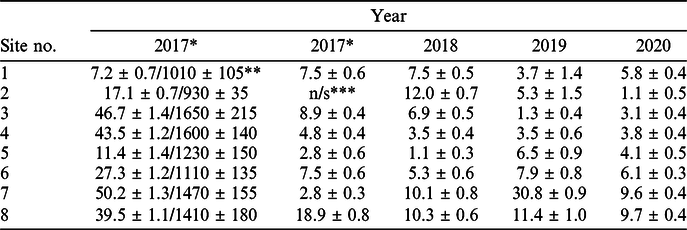
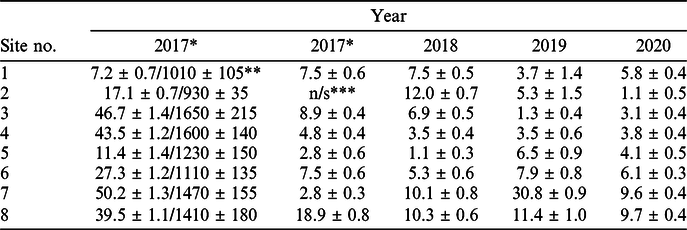
Data on the specific activity of 137Cs in terrestrial plants (rowan leaves) and soils in the Lithuanian part of the 30-km zone of the BelNPP for the last observation period (2017–2020) are presented in Table 4.
137Cs specific activity (Bq/kg dry weight ± 1 sigma) of terrestrial plants (rowan leaves, Sorbus aucuparia) taken from Lithuanian part of the 30 km zone of the BelNPP, Belarus.
*After Jefanova et al. (Reference Jefanova, Baužienė, Lujanienė, Svediene, Raudoniene, Bridziuviene, Paskevicius, Levinskaite, Zvirgzdas, Petrosius, Skuratovic and Mazeika2020).
**137Cs specific activity of soil Oh horizon (Bq/kg dry weight ± 1 sigma)/inventory of 137Cs in soil (Bq/m2 ± 1 sigma).
***n/s, not sampled.
The average value of 137Cs specific activity in rowan leaves (± SD) in different years was as follows: 7.6 ± 5.5 Bq/kg in 2017, 7.1 ± 3.7 Bq/kg in 2018, 8.8 ± 9.4 Bq/kg in 2019, and 5.4 ± 3.0 Bq/kg in 2020. The temporal dynamics of 137Cs specific activity in rowan leaves at the monitoring points was mostly uniform over 4 years. Despite the fact that the average level of 137Cs in the rowan leaves was low, it is characterized by a large areal variation in site 8 in 2017 and in site 7 in 2019. Individual cases of increased activity of 137Cs up to 30 Bq/kg and even more may be associated with the resuspension of 137Cs from soils, especially of agricultural land, and its airborne transport due to forest fires in Belarus and Ukraine that took place in the summer of 2019.
Analyzing briefly the data on 137Cs specific activity in rowan leaves, one should pay attention to the 137Cs activity changes at different sampling sites with time, as well as to spatial changes that depend on the areal distribution of 137Cs inventory. The data on the specific activity of 137Cs in typical soil profiles and various terrestrial plants have been studied in detail previously (Jefanova et al. Reference Jefanova, Baužienė, Lujanienė, Svediene, Raudoniene, Bridziuviene, Paskevicius, Levinskaite, Zvirgzdas, Petrosius, Skuratovic and Mazeika2020). One of the main findings of the study (Jefanova et al. Reference Jefanova, Baužienė, Lujanienė, Svediene, Raudoniene, Bridziuviene, Paskevicius, Levinskaite, Zvirgzdas, Petrosius, Skuratovic and Mazeika2020) was the recovering of changes in 137Cs inventory in the north-south direction as follows: 970 ± 110 Bq/m2 in sampling sites 1 and 2, 1625 ± 260 Bq/m2 in sampling sites 3 and 4, 1170 ± 200 Bq/m2 in sampling sites 5 and 6 and 1440 ± 240 Bq/m2 in sampling sites 7 and 8. Furthermore, natural fallout radionuclides (7Be and 210Pb) were found in rowan leaves, which indicate that rowan leaves effectively intercept atmospheric deposition during one growing season, and the contribution by roots is negligible. This fact makes it possible to use rowan leaves as a bioindicator of short-term airborne transport (year by year) of 137Cs from a nuclear source.
We also found plutonium isotopes in soil samples with specific activity approaching ∼1 Bq/kg (site 2, OF horizon 0.85 ± 0.04 Bq/kg; site 3, OH horizon 1.01 ± 0.10 Bq/kg; site 7, OH horizon 0.95 ± 0.05 Bq/kg) and an activity ratio of 238Pu/239,240Pu, a ratio typical of global fallout. Contrarily, lower activity concentration (by twice) containing traces of the Chernobyl-derived plutonium was found in a moss sample (site 7, 0.40 ± 0.04 Bq/kg).
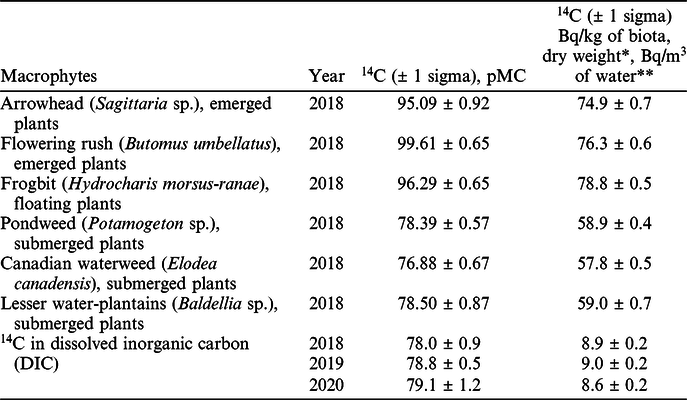
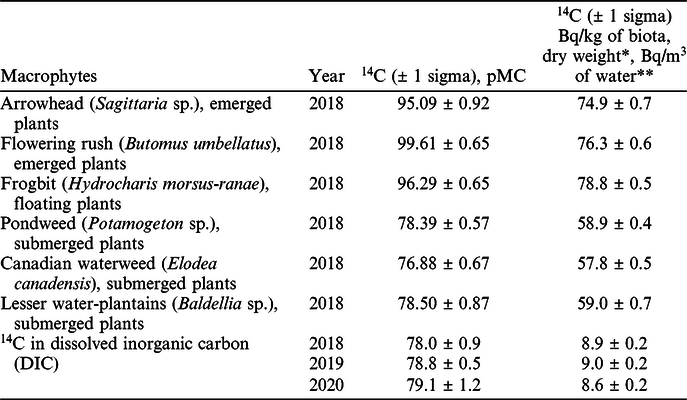
Data on 14C in macrophytes and surface water samples in the Lithuanian part of the 30-km zone of the BelNPP for the observation period 2018–2020 are detailed in Table 5.
14C specific activity in macrophytes and surface water samples taken from Neris River in Lithuanian part of the 30 km zone of the BelNPP, Belarus (sampling point 5, see Figure 1).
*Calculated basing on approximate Corg fraction in biota material.
**Calculated basing on concentration of DIC in water.
The data on 14C in macrophytes showed significant variability depending on the ecological group of macrophytes: from 76.88 ± 0.67 pMC in Canadian waterweed to 99.61 ± 0.65 pMC in a flowering rush. Different ecological groups of macrophytes are influenced to a varying degree by the so-called freshwater reservoir effect (FRE). This effect, known for many lakes and rivers (Philippsen Reference Philippsen2013), is determined by the presence of dissolved ancient carbonates in the watershed area.
Floating macrophytes (Hydrocharis morsus-ranae) and habituating nearshore zone emerged plants (Sagittaria sp., Butomus umbellatus) had a very similar, compared to atmospheric CO2 only slightly depleted 14C content (∼3 pMC): the average value ± SD was 97.0 ± 2.3 pMC. The submerged species (Potamogeton sp., Elodea canadensis and Baldellia sp.) were highly depleted with respect to 14C level in the atmosphere (∼22 pMC): the average value of 14C specific activity ± SD was 77.9 ± 0.9 pMC. This value, within the limits of uncertainty, is very close to the specific activity of 14C in DIC (78.6 ± 0.6 pMC), which indicates that submerged macrophytes utilize the carbon of DIC.
To show the radioecological significance of the background 14C level, we calculated the 14C activity concentrations in the samples in Bq units using the Corg content in biota (33–35% for macrophytes of the Neris River) and the DIC content in water (240–280 mg/L in the water of Neris River). Thus, the following levels of 14C were obtained: 74.9–78.8 Bq/kg in emerged and floating plants, 57.8–59.0 Bq/kg in submerged plants, 8.6–9.0 Bq/m3 in water.
The specific activity of 3H in the water of Neris River was relatively constant with an average value ± SD of 5.9 ± 0.9 TU (Figure 2), which corresponds to low specific activity of 3H in the fall-winter precipitation, which forms the base flow to the riverbed. This level of 3H serves as a baseline for interpreting the distribution of 3H excess in the aquatic ecosystem, which in the future may be affected by the BelNPP.
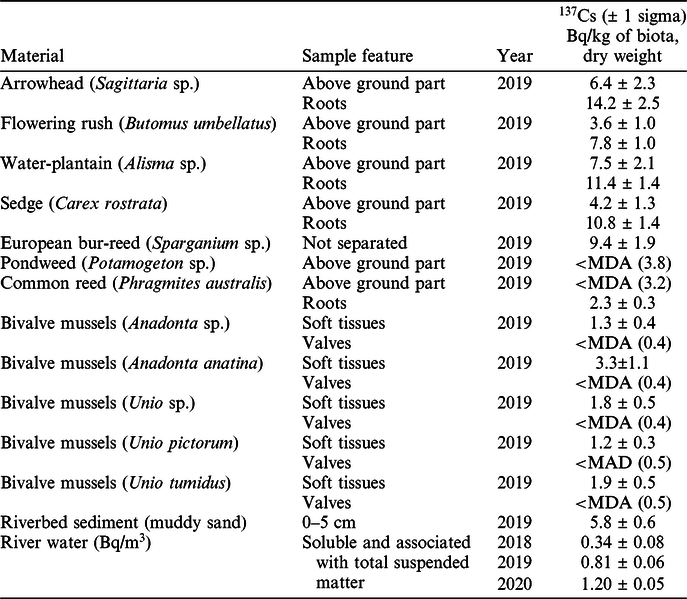
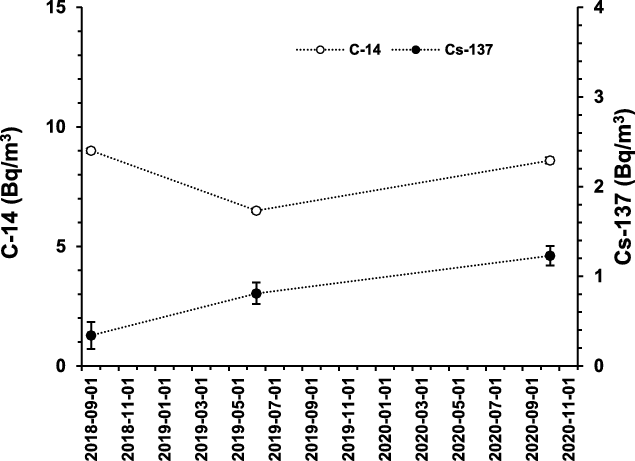
As in the case of 14C, the distribution of 137Cs in various environmental samples from the aquatic ecosystem of the Neris River was studied with similar detail (Table 6, Figure 3).
137Cs specific activity in macrophytes, freshwater bivalve mussels, riverbed sediments and surface water samples taken from Neris River in Lithuanian part of the 30 km zone of the BelNPP, Belarus (sampling point 5, see Figure 1).

14C activity concentration in DIC and 137Cs activity concentration (soluble and associated with total suspended matter) in water in Neris River.

137Cs and plutonium isotopes are of great concern among anthropogenic radionuclides prevalent in the environment after nuclear weapons testing and nuclear accidents at Chernobyl and Fukushima NPPs. From the river catchment area, a small fraction of the inventory of low-mobile radionuclides (137Cs and Pu isotopes) is constantly transferred to the river ecosystem, where it is distributed between water, suspended matter, riverbed sediments and biota (Trapeznikov et al. Reference Trapeznikov, Molchanova, Karavaeva and Trapeznikova2007).
Since the watershed of the Neris River was slightly contaminated with artificial radionuclides as a result of global fallout and the fallout after the Chernobyl accident (Atlas 1995), the content of 137Cs in the components of the aquatic ecosystem is low and fluctuates within the following ranges: from < MDA (minimum detectable activity) to 14.2 Bq/kg for macrophytes and from 1.2 to 1.9 Bq/kg for soft tissues of freshwater bivalve mussels. The above-ground part of macrophytes contains fewer 137Cs than the roots: the average values of the specific activity of 137Cs (± SD) were 5.4 ± 1.8 Bq/kg and 9.3 ± 4.5 Bq/kg, respectively. 137Cs specific activity in valves of mussels was <MDA in all cases. In addition to biotic components, 137Cs was also detected in riverbed sediments and water of the Neris River, where its specific activity ± SD was 5.8 ± 1.1 Bq/kg and 0.78 ± 0.43 Bq/m3, respectively.
Furthermore, in riverbed sediments, the specific activity of 239,240Pu was also determined, which was very low and varied in the range of 0.035–0.090 Bq/kg, and the average activity with a standard deviation was 0.057 ± 0.023 Bq/kg. 239,240Pu in riverbed sediments from the Neris River at an observation site close to the state border with Belarus was mainly due to global fallouts after nuclear tests with minor traces of plutonium of Chernobyl origin in some places.
CONCLUSIONS
We have collected data to characterize the main radioecological parameters of terrestrial and aquatic ecosystems located in the Lithuanian part of the 30-km zone of the BelNPP, as a basis for continuing the radioecological assessment when the BelNPP is operational. In the samples of terrestrial plants, 14C concentration varied insignificantly from 98.6 ± 0.7 to 102.2 ± 0.8 pMC, which was close to the level of 14C in atmospheric CO2. The specific activity of 3H in the TFWT form ranged from 6.1 ± 1.6 to 9.2 ± 1.1 TU, which corresponded to the 3H level in precipitation for this region in the fall season. The relatively low 137Cs inventory in this region determined the level of 137Cs activity in terrestrial plants ranging from 1.0 ± 0.5 to 40.5 ± 1.8 Bq/kg dry weight. An increase in 137Cs activity up to 30–40 Bq/kg and even more may be associated with the resuspension of 137Cs from soils and forest fires in Belarus and Ukraine. We also found plutonium isotopes in soil samples with specific activity approaching ∼1 Bq/kg.
In the samples of aquatic plants, the 14C concentration varied within wide limits from 76.9 ± 0.7 to 99.6 ± 0.6 pMC, depending on the ecological group of macrophytes, which, to varying degrees, have experienced the influence of a freshwater reservoir effect. The specific activity of 3H in the water of Neris River was relatively constant with an average value ± SD of 5.9 ± 0.9 TU, which corresponded to low specific activity of 3H in the fall-winter precipitation. The content of 137Cs in the components of the aquatic ecosystem was low and fluctuated from < MDA to 14.2 Bq/kg for macrophytes and from 1.2 to 1.9 Bq/kg for soft tissues of freshwater bivalve mussels. 137Cs was also detected in riverbed sediments and water of the Neris River, where its specific activity was 5.8 ± 1.1 Bq/kg and 0.78 ± 0.43 Bq/m3, respectively. In riverbed sediments, the specific activity of 239,240Pu was very low and varied in the range of 0.035–0.090 Bq/kg.
The data on artificial radionuclides (14C, 3H, 137Cs, and 239,240Pu) obtained in this study will be used in the future to assess the contribution of conventional radioactive effluents from BelNPP to the radionuclides level in terrestrial and aquatic ecosystems of the transboundary region of Belarus and Lithuania.
ACKNOWLEDGMENTS
We would like to thank the anonymous reviewer and Editor in Chief A. J. T. Jull for their valuable comments, which improved the manuscript.