Introduction
Chilli or chilli pepper (Capsicum spp.) is an economically important crop grown as a vegetable and spice worldwide. The 2010 world production of fresh and dried chillies has been reported to be 26.8 and 2.8 MT, respectively (FAOSTAT, 2012). Germplasm conservation is essential to maintain genetic diversity for food security and future uses. Given that chilli is one of the most important crops of Thailand, the Tropical Vegetable Research and Development Center (TVRC), Kasetsart University, Thailand has collected 2827 chilli accessions from around Thailand and overseas since 1989 (Mongkolporn and Taylor, Reference Mongkolporn, Taylor and Kole2011). Utilizing these germplasm accessions requires a good management programme including seed storage, seed rejuvenation and germplasm evaluation, which, in turn, requires a high maintenance cost. Consequently, a large germplasm collection without proper management will not enhance its utilization (Reed et al., Reference Reed, Engelmann, Dulloo and Engels2004).
A core collection is a limited collection containing selected germplasm that represents a similar diversity level to that of the large collection (Frankel and Brown, Reference Frankel, Brown, Holden and Williams1984). Development of core collections has been encouraged as an essential activity in plant genetic resources conservation by the FAO since 1996. Establishing a core collection requires information on the genetic diversity of accessions and varieties that will serve as a basis for the development of the core collection. To a large extent, genetic diversity has been best identified using the molecular analysis of repetitive DNA sequences (microsatellites) of genomes.
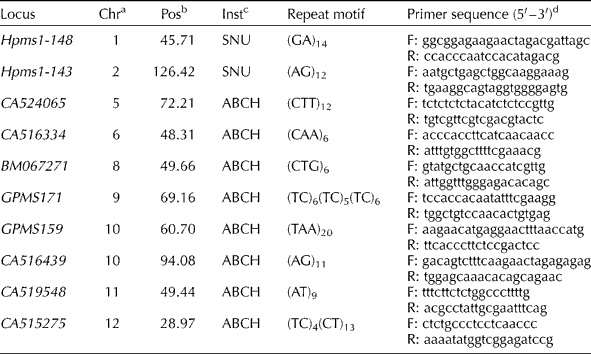
Repeat sequences, also known as microsatellites, are well known to be hypervariable and highly conserved in plant genomes (Lagercrantz et al., Reference Lagercrantz, Ellegren and Andersson1993; Gupta et al., Reference Gupta, Balyan, Sharma and Ramesh1996). Several groups of researchers have developed Capsicum microsatellites that are available publicly (Huang et al., Reference Huang, Zhang, Milbourne, Cardle, Yang and Guo2000; Lee et al., Reference Lee, Nahm, Kim and Kim2004; Portis et al., Reference Portis, Nagy, Sasvári, Stágel, Barchi and Lanteri2007; Nagy et al., Reference Nagy, Stagel, Sasvari, Roder and Ganal2007; Huang et al., Reference Huang, Zhang, Zhang, Mao, Wang and Zhang2011). The present study utilized ten microsatellite loci anchored to nine chilli chromosomes (Table 1) to investigate the genetic diversity of 230 chilli germplasm accessions collected by the TVRC, which were then used to form a core collection of chilli germplasm. These ten microsatellite loci were selected based on their best polymorphic information content (PIC) values (>0.5–0.8) reported in a preliminary study, whereby 23 microsatellites covering all 12 Capsicum chromosomes based on the published Pepper FAO3 map (Bombarely et al., Reference Bombarely, Menda, Tecle, Buels, Strickler, Fischer-York, Pujar, Leto, Gosselin and Mueller2011) were tested with 96 chilli accessions.
Ten microsatellite loci used in this study

a The chromosome number located by the microsatellite locus.
b The position of the microsatellite locus residing on the chromosome, expressed as the genetic distance (in cM) from the first marker mapped on that chromosome.
c The institute that developed the microsatellites: ABCH – Istvan Nagy, Agricultural Biotechnology Center, Hungary; SNU – Byung-Dong Kim, Seoul National University, Korea.
d F, forward primer; R, reverse primer.
Materials and methods
Plant material
A total of 230 Capsicum accessions collected by the TVRC were selected to cover a wide range of morphological characteristics based on the morphological cluster analysis of 2827 chilli accessions (Wasee et al., Reference Wasee, Kaewson, Srisawat, Chunwongse, Damrongkittikul and Chunwongse2005). Originally, the chilli accessions were divided into seven main groups by the NTSYS-pc software based on 16 morphological characteristics, which were known to be controlled by single genes, including hypocotyl colour, cotyledon colour and shape, nodal anthocyanin, plant growth habit, leaf colour and shape, leaf pubescence density, number of pedicel per axil, pedicel position at anthesis, corolla colour and spot, anther colour, filament colour, fruit shape, and neck at the base of the fruit. An additional six quantitative traits that included plant size, number of tilling, leaf size, days to first and last harvesting, and fruit weight were subsequently evaluated within each main group for further grouping. The selection was made with the aim to obtain representative chilli accessions from all clusters and subclusters. Species identification was based on floral and fruit morphologies following the description of IPGRI et al. (1995). Of the 230 accessions, 184 were C. annuum, 30 were C. frutescens, eight were C. chinense and eight were C. baccatum.
For each chilli accession, five plants were grown. Total genomic DNA was separately extracted from each plant at the 30-d-old seedling stage, using a modified CTAB method following Mongkolporn et al. (Reference Mongkolporn, Dokmaihom, Kanchana-Udomkan and Pakdeevaraporn2004). The DNA was equally pooled from each of the five plants within a chilli accession.
Microsatellite analysis
The ten anchored microsatellite loci (Table 1) were used to amplify the chilli DNA. A polymerase chain reaction (PCR) was set up in a total volume of 15 μl containing 50 ng genomic DNA, 1 × PCR buffer, 2.5 mm MgCl2, 0.24 mm dNTPs (Promega, Madison, USA), 0.45 unit Taq DNA polymerase (Invitrogen Life Science Technologies, Sao Paulo, Brazil), and 0.2 mm each of forward and reverse microsatellite primers. DNA amplification was performed in a thermocycler (Biometra TProfessional Thermocycler, Goettingen, Germany) with an initial denaturation step at 94°C for 3 min, followed by 35 cycles of 30 s at 94°C for denaturation, 30 s at 50–65°C for annealing, and 1 min at 72°C for extension, with 7 min at 72°C for final extension. The annealing temperatures were optimized to suit each primer pair. Amplified PCR products were separated on a 4.5% polyacrylamide gel, and visualized by silver staining. A ϕX174/Hinf I (Fermentas, Ottawa, Canada) and Capsicum allelic ladder (developed by J. Chunwongse, unpublished data) were used as references for DNA size. DNA sizes were measured more accurately using the PhotoCapMw program version 99.03 (Vilber Lourmat, Cedex, France) and the AlleloBin software program (Idury and Cardon, Reference Idury and Cardon1997).
Genetic diversity and cluster analyses
Microsatellite variation was estimated as the total number of alleles and the number of alleles per locus. The PIC, a measure of allelic diversity at a locus (Botstein et al., Reference Botstein, White, Skolnick and Davis1980), and the probability of identity (PI) or probability that two individuals in a population were the same genotype at multiple loci (Kaul et al., Reference Kaul, Singh, Vijh, Tantia and Behl2001) were calculated.
Microsatellite allelic bands were scored as 1 or 0 for the presence or absence of the allelic band, respectively. The similarity index (SI) was calculated from the scoring data using Nei and Li's (Dice's) coefficient (Nei and Li, Reference Nei and Li1979). A dendrogram was constructed based on similarity matrix data using the unweighted pair-group method with arithmetic average (UPGMA) clustering using the NTSYS-pc software version 2.20e (Rohlf, Reference Rohlf1997). Cophenetic correlation (r) and bootstrap were calculated using WinBoot (Yap and Nelson, Reference Yap and Nelson1996) to justify how reliable the groupings were.
Establishment of the core collection
PowerCore software version 1.0 (Kim et al., Reference Kim, Chung, Cho, Ma, Chandrabalan, Gwag, Kim, Cho and Park2007) was used for the selection of chilli accessions to form a core collection following the maximization strategy proposed by Schoen and Brown (Reference Schoen and Brown1993), which maximized the number of the observed alleles in the dataset.
Results
Genetic diversity and cluster analyses
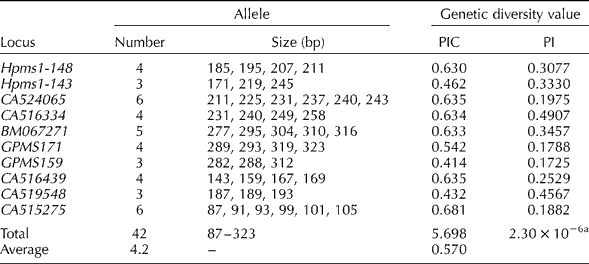
The ten anchored microsatellite loci generated a total of 42 alleles from the entire 230 chilli accessions, one of which is shown in Fig. 1. The number of alleles per microsatellite locus ranged from 3 to 6 with sizes ranging from 87 to 323 bp (Table 2). The average PIC was 0.57 (0.414–0.681), and the PI values ranged from 0.1725 to 0.4907. The combined PI of the ten microsatellite loci was 2.30 × 10− 6.
GPMS171 microsatellite alleles of 230 Capsicum accessions (codes 1–248). M1 is the DNA marker ϕX174/Hinf I (Fermentas, Ottawa, Canada) and M2 is the Capsicum allelic ladder (J. Chunwongse, unpublished data).

Number and size of alleles, polymorphic information content (PIC) and probability of identity (PI) of the ten microsatellite loci assessed using the entire 230 Capsicum accessions

a Combined PI of the ten microsatellite loci.
The UPGMA cluster analysis was carried out using the similarity matrix to construct a dendrogram. The SI of the entire chilli germplasm ranged from 0.29 to 1.00. The dendrogram contained two main clusters at a SI of 0.29 (Fig. 2). Cluster 1, the larger group, comprised 180 chilli accessions and was divided into 13 subgroups (A–M). Cluster 2 comprised 50 chilli accessions and was divided into four subgroups (N–Q). Almost all chilli members in cluster 1 (176 out of 180) were C. annuum, and the rest were C. frutescens, C. chinense and C. baccatum. Cluster 2 had a combination of all Capsicum species, most of which were C. frutescens (29 accessions), eight were C. annuum, seven were C. chinense and six were C. baccatum. Grouping reliability was predicted by cophenetic correlation (r), whose value was 0.798, indicating a highly reliable grouping.
UPGMA dendrogram illustrating the relatedness of 230 Capsicum accessions generated from ten anchored microsatellite loci, drawn by the NTSYS-pc software 2.2e using Nei and Li's similarity coefficient with a cophenetic correlation (r) of 0.789. The asterisks represent the 28 chilli accessions selected by the PowerCore software version 1.0 for the development of a core collection.

Development of the core collection
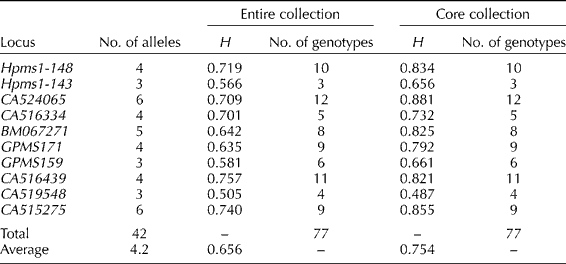
The 42 alleles detected by the ten microsatellite loci were used to develop a set of core collections using the PowerCore software with a maximization approach. The PowerCore program selected 28 chilli accessions that captured all the 42 alleles from the entire 230 germplasm accessions (Fig. 2). The size of the derived core collection was accounted for 12% of the entire size (28 out of 230), with minimum redundancy. The 42 alleles revealed 77 genotypes in both the entire collection and the core collection (Table 3). The average genetic diversity index (H) (Nei, Reference Nei1973) value was 0.754, ranging from 0.487 to 0.881. Compared with the entire collection, the average H value was 0.656, ranging from 0.505 to 0.757.
Genetic diversity index (H) and number of genotypes of the ten microsatellite loci in the entire 230 chilli germplasm and core collections

Discussion
Genetic diversity of chilli germplasm accessions
The genetic diversity of the 230 chilli accessions was found to be relatively high based on the average PIC of 0.570 with the SI ranging from 0.29 to 1.00. The high variability among the chilli accessions may have reflected the diverse species and the diverse origins, from where the accessions had been collected. Although most of the germplasm accessions were collected from Thailand, the rest were from other Asian, European and South American countries (data not shown). Briefly, 56% of the germplasm had Thai origins, while 33% had other Asian origins (Taiwan, Japan, Laos, China, Vietnam, the Philippines and Bhutan), 5% had European and South American origins (Hungary, Costa Rica, Spain, Bolivia, Brazil, Peru, Columbia and Mexico) and 6% were unknown origins. The grouping did not seem to relate to the germplasm origins. In addition, these germplasm accessions were originally selected based on their diverse morphological traits.
The ten microsatellite loci that were used were highly informative based on the PI values. The PI of a locus generally suggested a probability that two individuals were identical at that locus (Kaul et al., Reference Kaul, Singh, Vijh, Tantia and Behl2001). Based on the total of ten loci, the combined PI was 2.30 × 10− 6, which indicated that the chance that two chilli genotypes were the same was 1 in 434,500. Therefore, these ten anchored microsatellite loci appeared to be most suitable for the diversity analysis of 230 chilli accessions.
The clustering seemed to fairly relate to the grouping of the Capsicum species. Cluster 1, the larger group, contained mainly C. annuum, while cluster 2 contained all the four Capsicum species. Cluster 2 had four subgroups, i.e. N, O, P and Q (Fig. 2), whereby most C. frutescens belonged to P and Q, most C. chinense belonged to O and most C. baccatum belonged to N subgroups (data not shown). Species identification followed the Capsicum taxonomic key (IPGRI et al., 1995), which was based on seed, flower and fruit characteristics. In addition, there were no species-specific microsatellite markers.
These microsatellites were developed from C. annuum; however, they were able to amplify all the other three Capsicum species. The four Capsicum species were domesticated species, and retained some degree of close relatedness among the species. C. annuum, C. frutescens and C. chinense are in the C. annuum complex (Mongkolporn and Taylor, Reference Mongkolporn, Taylor and Kole2011), which are crossable between different species. Artificial interspecific hybridization is often accomplished between the species within the C. annuum complex for disease-resistant breeding purposes. C. baccatum is more distant to the others; however, interspecific crosses can be accomplished via an embryo rescue technique. Interspecific hybridization among these species has been shown to occur naturally; for example, ‘Bhut Jolokia’ the world hottest chilli was morphologically identified as C. chinense (Bosland and Baral, Reference Bosland and Baral2007), but was molecularly proven to be a natural hybrid between C. chinense and C. frutescens (Bosland and Baral, Reference Bosland and Baral2007; Purkayastha et al., Reference Purkayastha, Alam, Gogoi, Singh and Veer2012). Therefore, the morphology-based species identification may not be completely accurate in all cases, which could have an impact on molecular species discrimination.
Core collection
The core collection contained 28 chilli accessions, which accounted for 12% of the entire germplasm studied. A suitable size of a core collection proposed by Frankel and Brown (Reference Frankel, Brown, Holden and Williams1984) was 10% of the entire germplasm collection. These 28 accessions retained the 42 microsatellite alleles with an average H value of 0.754, which was slightly greater than the H value of the entire germplasm. The selection made by the PowerCore program seemed to fairly represent the entire collection (Fig. 2), although the selection did not represent all the subclusters. However, additional chilli accessions can be manually selected from the subgroups that were missed out by the PowerCore program. For example, subgroups E, H, J, K and L had no representatives, few more accessions can be manually selected from each of E and H-J-K-L. This core collection development strategy can be applied to larger chilli germplasm collections at the TVRC; thus, these germplasm collections can be managed more efficiently with respect to time and cost.
Acknowledgements
This study was financially supported by the National Center for Genetic Engineering and Biotechnology, the National Science and Technology Development Agency, and partially supported by the Center of Excellence on Agricultural Biotechnology, Science and Technology Postgraduate Education and Research Development Office, Office of Higher Education Commission, Ministry of Education (AG-BIO/PERDO-CHE).