

INTRODUCTION
In much of the colonial world, the decades before independence saw a rapid increase in the political importance of ascriptive identities among nascent political elites, with groups large and small forming organizations, petitioning government bodies, and distributing propaganda, all in an attempt to improve the political and social position of the groups they represented (Laitin Reference Laitin1986; Dirks Reference Dirks2002). Even more interesting than the general rise in ethnic or caste consciousness was its uneven distribution across groups, with many individuals disdaining narrow ethnic appeals in favor of the broader rhetoric of imperial loyalty or incipient nationalism (Anderson Reference Anderson1994).
In explaining which identities become salient, the ethnic politics literature has tended to focus on group size (Kasfir Reference Kasfir1979; Chandra Reference Chandra2004; Reference Chandra2012; Posner Reference Posner2004) or intergroup inequality (Baldwin and Huber Reference Baldwin and Huber2010; Huber and Suryanarayan Reference Huber and Suryanarayan2016). Another branch of the literature has traced changes in ethnic salience to the policies of the state, either in favoring some identities over others or by creating the vocabulary in which such identity projects could be expressed (Laitin Reference Laitin1986; Cohn Reference Cohn1987; Dirks Reference Dirks2002; Rao and Ban Reference Rao and Ban2007; Cassan Reference Cassan2010).
This paper supplements these accounts by emphasizing the role of group education. As groups grow more educated, they are more likely to produce individuals with the literacy, sophistication, and disposable time necessary to become involved in politics, but as middle-status groups grow more educated their members are more likely to possess the resources and contacts necessary to be successful in a broader political context. Increasing levels of education should thus have a non-linear impact on individual politicization, which should, in turn, be strongly (though imperfectly) related to group-level politicization. While the existence of some link between education and politicization may seem intuitive, this non-linear relationship means that the effects of increasing education or “modernity” are likely to vary from group to group.
This theory is tested using a new panel dataset of caste groups in colonial India. This dataset enables us to examine the causes of identity change within groups over time, rather than by comparing groups with each other. This allows the paper, unlike much of the existing literature on ethnic politics, to isolate economic changes from the many fixed cultural and social differences between groups. It also adds to the vibrant existing literature on the rise of caste activism in colonial India (Srinivas Reference Srinivas1966, Reference Srinivas1956; Bayly Reference Bayly1999; Gupta Reference Gupta2000; Dirks Reference Dirks2002) by examining systematically why caste rhetoric was more important in some groups than in others.
In the panel dataset, attempted caste mobilization by elites is measured through petitions submitted by caste organizations to the colonial census authorities demanding a change of name, a common strategy of caste activists in this period. While they are an imperfect and partial measure of group activism, these petitions provide evidence about the existence and goals of non-state political activists whose behavior is usually difficult to study in a comprehensive way due to a lack of source material. The petition data support the hypothesis about the non-linear role of education. Group-level literacy is positively related to petitioning, but very high levels of literacy are associated with lower levels of petitioning, though these highly literate groups dominate contemporary arenas of non-caste-based political action, like the colonial bureaucracy and the Congress Party. While only observational in nature, the data provide suggestive evidence of the links between education and group mobilization.
Besides answering the empirical question, this project is designed to unite three somewhat divergent literature. A large body of work (Kasfir Reference Kasfir1979; Chandra Reference Chandra2004, Reference Chandra2012; Posner Reference Posner2004) has focused on variation in identity formation across groups or identity dimensions, but its focus on contemporary and quasi-democratic cases, and on mass rather than elite behavior, has led it to emphasize the effect of group size rather than group social traits. The older literature associated with the causes of nationalism (Deutsch Reference Deutsch1969; Gellner Reference Gellner1983; Anderson Reference Anderson1994) or the growth of the nation state more generally (Weber Reference Weber, Henderson and Parsons1947; Bendix Reference Bendix1977) is closely attuned to the socio-economic causes of identity change, which its authors link to the broader phenomena of social modernization. However, these accounts fail to explain why the effects of social change are often non-linear, and why the initial stages of modernization are often accompanied by a resurgence of “traditional” or sub-national identities. Finally, the late colonial upsurge in caste identity, often referred to as sanskritization, was structured by the colonial state. As authors such as Dirks (Reference Dirks2002) and Cohn (Reference Cohn1987) have shown, colonial preoccupations (both scholarly and political) with caste identity shaped the process of sanskritization, and the interactions between caste activists, and colonial institutions, most notably the Census of India, provided important legitimation for their efforts. However, colonial policies and ideologies, since they affected India as a whole, can at best provide only a partial explanation for sanskritization. While the rhetoric of caste may have been universally available, there were sharp differences, both across regions and across groups, in the degree to which Indians engaged with this rhetoric.
THEORY
Identity Activism
A large literature in comparative politics has argued that individuals possess a wide “repertoire” of traits, the exact content of which varies from society to society (Laitin Reference Laitin1986; Posner Reference Posner2004; Chandra Reference Chandra2012). Common categories of traits include skin color, occupation, religion, language, tribe, and region of residence. At any given time only a few of an individual's traits are “relevant” or “activated” for the purposes of political decision making; these are the traits that individuals consider as important when making decisions about whom to vote for, whether to engage in political violence, and whether to enter into patron–client relationships (Chandra Reference Chandra2012). In India, for instance, caste, religion and language identities have all been strongly politicized, while skin color remains politically (though not socially) unimportant.
Individuals, to say the least, receive a great deal of advice from outside political actors about which of these identities they should use in their political decision-making. Elites conduct elaborate campaigns to get them to emphasize particular identities, which may take the form of propaganda, the formation of social organizations, the selective distribution of resources, and even the selective use of political violence (Bates Reference Bates1974; Horowitz Reference Horowitz1985; Chandra Reference Chandra2004; Eifert, Miguel and Posner Reference Eifert, Miguel and Posner2010). However, it should be noted that not all mobilization efforts by elites are successful and that some identities widely promoted by elites do not become widely influential (Horowitz Reference Horowitz1985).
The ethnic politics literature has tended to focus on the choice individuals face between broad dimensions of traits, either cross-cutting or nested (Posner Reference Posner2004; Dunning Reference Dunning2009; Chandra Reference Chandra2012). Even within these dimensions of traits, however, there is considerable variation in the extent of politicization, often independent of group size. In modern India, some caste (jati) identities, such as that of the Chamars, are strongly politicized while others, such as that of the Dhobis, are not (Chandra Reference Chandra2004).Footnote 1 This paper will focus on this “within-dimension” variation, developing a theory of why some identities are strongly predictive of political behavior while others are not. As such, it argues that while all identities within a particular dimension are potentially politically salient, not all are salient in fact.Footnote 2
One specific case of identity mobilization, the process of caste politicization in India, has already been the subject of an extensive literature (Gupta Reference Gupta2000; Dirks Reference Dirks2002). These authors sometimes interpret in saying that caste identities were created by colonialism, despite Dirks's explicit denial that caste “was simply invented by the too clever British.” Instead, they hold that colonialism was successful in “systematizing India's diverse forms of social identity” (Dirks Reference Dirks2002, 5), a process similar to the effect of Anderson's (Reference Anderson1994) “totalizing classificatory grid.” As we shall see, however, there was considerable variation in the degree to which vernacular elites adopted these newly systematized identities and made them the focus of political and social activism.Footnote 3
Barriers to Political Action
Why did some groups begin to talk about identities while others did not? A simple way to answer this question is that groups with no elites will be unlikely to see elite activism. To see why, consider the correlates of political and social activism in general. A very consistent finding in the political behavior literature is that education is associated with higher levels of political participation and social activism as it provides information about political issues, the connections to enter political circles and the skills necessary to publicize oneself or one's cause to others. For these reasons, studies in a wide variety of social contexts have found that more educated individuals are more likely to participate in politics at all levels (Huntington Reference Huntington1969; Verba, Schlozman and Brady Reference Verba, Schlozman and Brady1976; Lee Reference Lee2011), and that ethnic activism is common in the urban sector (Bates Reference Bates1974). Some groups will have a higher concentration of such individuals than others, giving them a head start in any form of political action. Low levels of education, in this view, serve as a barrier to political mobilization, because they mean that the elite that would lead it does not exist.Footnote 4
There are even more direct reasons for why the activation of supralocal, politicized identities in this period was closely associated with the rise of literacy (Weber Reference Weber1976; Anderson Reference Anderson1994). Firstly, most of the actions required in a campaign—the circulation of petitions, the publication of spurious histories, the founding of newspapers—required literate authors, both for the simple act of writing and because print culture provided the best source of information on what such efforts should look like, given that many mobilization efforts are inspired by hearing about the mobilization efforts of other groups (Anderson Reference Anderson1994). Secondly, literacy provides not just the materials for such a campaign but also vastly extends the audience. Without writing, even the most energetic ideological campaign had little chance of influencing those beyond the immediate social circle of its leaders. However, with writing, such a campaign could influence people (and coordinate their activities) across large distances and across subgroups that may previously have had little contact with one another (Huntington Reference Huntington1969). Groups with poorly educated populations should thus have a much smaller elite capable of discovering ideas about ethnic identity, applying them to their own situation and publicizing their cause.
This cutoff is not fixed since the relationship between the social traits of groups overall and the social traits of the individuals within these groups is imperfect. In particular, a poorly educated caste may include a few individuals with high levels of education who happen to be interested in political activism. The general relationship, however, still holds: A caste with a hundred literate individuals is more likely to produce a group or political activists than one with ten. In colonial India, caste-level English and vernacular literacy were correlated at .7 in British India, indicating that groups with high levels of literacy also had many people with relatively high education.
Incentives to Political Action
The discussion of the barriers to identity activism has temporarily ignored the question of why elites would want to engage in such activity in the first place. Following the existing literature, we argue that the primary goal of the social elites who engage in ethnic activism is to gain political power and the economic resources that political power brings (Laitin Reference Laitin1986; Posner Reference Posner2004; Chandra Reference Chandra2012). If identity politics plays no role, the rewards of office will be distributed based on “objective” criteria, such as an individual's wealth, charisma, intelligence, family position, or social network size. While competition on such criteria advantages some, it disadvantages others. As Ernst Gellner (Reference Gellner1983) has argued, the disadvantages are particularly acute for the first generation of educated people from traditionally poor groups, who have a far less useful set of skills and contacts than those from more established groups. Such individuals have an obvious incentive to create other criteria on which to base political competition.
Social identities fill this need for an “extra advantage.” If elites can successfully convince others that certain identity markers are important, they can gain an advantage in competing for resources, because individual voters and power brokers will tend to favor others who share identity traits with them (Chandra Reference Chandra2004; Posner Reference Posner2004). The reasons behind this favoritism are widely debated (Habyarimana et al. Reference Habyarimana, Humphreys, Posner and Weinstein2007; Chandra Reference Chandra2012), but are typically thought to involve some combination of common preferences, ease of monitoring and communication, and the development of mutually beneficial patronage relationships. Crucially, an activated identity enables a would-be politician to have “something in common” individuals with whom he/she is not personally acquainted (Chandra Reference Chandra2004).
The potential benefits of caste politics to educated elites in colonial India can be seen through the careers of men like W.P.A Soundrapandian, “The uncrowned King of the Nadar community.” Soundrapandian co-founded and dominated the central association of his caste, the Nadar Mahajana Sangam, serving for 4 years as general secretary, 17 years as vice president (Templeman Reference Templeman1996). By using his Nadar electoral support, Soundrapandian was able to have a very successful political career, serving for 17 years on the Madras legislative council representing the Justice Party, and for 6 years as a district board president (Hardgrave Reference Hardgrave1969). Like many jati-based political entrepreneurs, Soundrapandian did not form a separate political party but used his jati constituency to build a position within a larger political organization (Rudolph and Rudolph Reference Rudolph and Rudolph1967).
The Well-Educated
For members of well-educated groups, the calculus was different. Relative to the elites of the less-educated groups, the elites of the best-educated groups were likely to possess rare social traits such as a professional qualification, a college degree, and fluency in English (Jaffrelot, Reference Jaffrelot2003). To the extent that these qualities enable them to be politically successful, these very educated individuals have no incentive to engage in the costly mobilization of ascriptive traits in pursuit of a political advantage.Footnote 5
In the colonial period, there were several potential identities available to highly educated individuals who wished to become involved in politics. They could either become involved in the colonial state itself (and in the imperial or loyalist ideologies associated with the colonial state) or become involved in the political challenge to the colonial state (and in the nationalist ideologies associated with these movements) (Anderson Reference Anderson1994). Both these identities offered access to networks much larger and richer than those associated with a single ethnic group. Individuals may thus prefer to be associated with these non-ethnic (or more broadly ethnic) forms of political participation.
The concentration of these highly skilled individuals in the colonial bureaucracy and in the anti-colonial movement meant that the often less skilled elites of lower status groups had all the more incentive to focus on narrow ethnic politics, since they may suffer discrimination from more entrenched elites. The relationship between education and identity politics is thus potentially self-reinforcing: The highly educated pursue broader identities and mainstream institutions, and the emergent elites seek to use narrower forms of identity politics to gain an opening. We should thus expect that higher group literacy should be associated with higher levels of identity mobilization, but very high levels of group education should be associated with lower levels of identity mobilization. We should thus expect the elites of the most educated groups to be heavily involved in politics but to avoid explicit caste mobilization.Footnote 6 This additional observable implication of the theory suggests that very high levels of group literacy should be associated with participation in non-identity-based political participation.
This aversion to narrow identity rhetoric does not mean that politicians will not attempt to mobilize their own group in a less public matter, or advancing the interests of their own group while in office—in fact “pan-ethnic” identities are often accused by their opponents as being covers for some small group's interests. However, it does mean that they will seek support outside their ethnic group, and attempt to avoid being solely thought of as the representatives of a particular group.
HISTORICAL BACKGROUND
Education
In pre-colonial India, levels of literacy were generally quite low. In these circumstances, attempts to emphasize or change the relative status of caste identities were evolutionary and concentrated within the elite. In the post-independence period, the rapid growth of literacy even among the very poor and an even more rapid development of mass political awareness has led to a large-scale mobilization of caste identities, among even very poor groups. These changes are reflected in the secondary literature, with the pre-colonial period often being portrayed as a static hierarchy, (Dumont Reference Dumont1980[1966]) while the post-independence period has been described as exhibiting high levels of caste mobilization fundamentally similar to the ethnic parties of Africa (Chandra Reference Chandra2004).
The colonial period contained neither of these extremes but was characterized by moderate shifts in literacy, from 4.5% in 1891 to 8% in 1931 (including Burma). The rise in literacy was inhibited by colonial underinvestment in education, itself a product of the suspicion of both British and Indian elites towards an educated populace (Chaudhary Reference Chaudhary2009; Suryanarayan Reference Suryanarayan2014). Colonial educational policy consequently favored English over the vernacular, and high education over primary education (Seth Reference Seth2007; Chaudhary Reference Chaudhary2009). In some areas, however, missionary schools (Bellenoit Reference Bellenoit2015) or enlightened princely rulers (Bhagavan Reference Bhagavan2003) made a conscious effort to educate poorer individuals.
The very patchiness and elitism of the colonial educational system allowed some groups were able to outperform the country as a whole. The bland trend toward increased education concealed considerable internal variation, across both jatis and regions. It is beyond the scope of this paper to review the causes of this variation in detail, especially given that many of them are closely correlated. In general, gains in education were the product of both a group's traditional position and the degree to which colonization impacted that position. Land-cultivating groups tended to do well under the permissive land revenue settlements of the latter raj, even if they had not earlier been well-educated, or part of the higher aristocracy. Bihari Bhumihars, for instance, saw their male literacy rate increase from 12% in 1891 to 23% in 1931. Similarly, groups traditionally associated with trading or government did well as those sectors expanded. Male literacy among B.R. Ambedkar's Mahar caste, traditionally village watchmen, increased by a factor of 10, from .3% in 1891 to 3.1% in 1921. Other groups, particularly those associated with declining traditional crafts like weaving, saw little or no improvement in their economic position.
Caste Associations
One of the most important aspects of caste activism in colonial India was the formation of caste organizations—the caste sabhas. Unlike the traditional local caste panchayats that they superseded, and which had always existed in most Indian villages, the sabhas were generally urban, supra-local, and had some degree of formal institutionalization. Their constitutions, still preserved in the National Archives of India, record their often highly elaborated structure, with procedures for the election of officers, the holding of annual sessions, the handling of funds, and the affiliation of local groups.Footnote 7
The leadership of the sabhas was generally composed of the well-off, urban, and educated stratum within the caste. The surviving membership list for one organization, the Pradham Bhumihar Sabha, gives us some sense of the profiles of activists in a relatively well-off caste. Of the 10 officers, four were zamindars (large landlords), two were lawyers, and one was a college president. Of the 53 ordinary members, 10 were zamindars, seven were lawyers, and one was a senior civil servant.Footnote 8
Caste identities and caste institutions were central to politics in colonial India. Caste sabhas, or informal networks of caste elites, formed the principal contestants in local elections (Gould Reference Gould1987) and the protagonists of bitterly fought local conflicts over temple entry and lower caste attempts to assert themselves symbolically (Sobhanan Reference Sobhanan1985). At a grander level, the ability of the Congress in some areas to bring these mobilized lower caste groups into its coalition was a key factor in its success. However, many activities of the sabhas were cultural and social rather than directly political. Some activities would come under the heading of social service and self-help: raising money for scholarships, trying to discourage expensive weddings, and providing a network to meet prospective spouses.Footnote 9 The Rawani [Chandravanshiya Kshatriya] Sabha included a fairly typical list of goals in their constitution:
Rendering pecuniary assistance to promising young Chandravanshiya Kshatriya students to enable them to prosecute their studies. Publication of a Patrika (a journal) of their own or any book or pamphlet containing subjects of interest to the community or likely to promote their interests. Appointment of itinerant Upadeshaks to popularize the work of the MahasabhaFootnote 10
The causes of this rise in caste activism have been the subject of some debate. Srinivas felt that the urge to sanskritize was inherent in Indian society and that any changes in the colonial period were only quantitative in nature (492). However, later scholars have emphasized the causal role of colonialism, in particular, the census, in rigidifying caste boundaries and making them more salient (Cohn Reference Cohn1987; Dirks Reference Dirks2002). As Dirks put it: “Under colonialism, caste was thus made out to be far more—far more pervasive, far more totalizing, and far more uniform—than it had ever been before.”
This argument had a great deal of evidence on its side: As we will see below, the colonial state was closely involved in the collection of knowledge about caste, and many of those collecting this knowledge appeared to have taken a rigidly empirical view of caste divisions that glossed over the more ambiguous history of caste in pre-colonial societies (Dirks Reference Dirks2002). However, this argument fails to explain why Indians so eagerly participated in such a project, and enthusiastically joined caste association and gave up beef even with no state pressure. Still further, this argument fails to explain any variation in the adoption of this rigid idea of caste.
Caste in the Census
The most conspicuous and well-documented activity of sabhas was their interaction with the colonial census authorities. This connection was the product of the work of H.H. Risley, who became superintendent of the Census of India in 1901. Risley was determined to use the census as an opportunity to prove his own theories on the racial origins of caste. He decreed that the census tables should record castes not by occupation, but by ritual “precedence,” which was to be determined by the provincial census superintendents in consultation with specially appointed committees of Indians. At best, this was a controversial and error-ridden procedure.
More annoyingly for the census officials, many sabhas saw the policy as an opportunity to make a political point and bombarded the provincial superintendents with petitions demanding a new and more honorable name. To avoid this problem, the censuses after 1901 avoided classification by precedence, listed. However, the number of petitions for a name change kept rising, hitting a peak in 1931:
No part of the census aroused so much excitement as the return of caste. There was a general idea in Bengal that the object of the census is not so much to show the number of persons belonging to each caste, as to fix the relative statuses of subsequent castes and to deal with claims of social superiority….Hundreds of petitions were received—their weight alone amounts to 1.5 maunds [143 pounds]. (O'Malley Reference O'Malley1912, 440)
Even without Risley's efforts, the census's terminology would probably have become politicized eventually, and in fact, the peak of petitioning activity came long after 1901. But his work probably made the census more central to caste activism than it would otherwise have been. Risley was certainly blamed by his successors for increasing their workload:
All subsequent census officers in India must have cursed the day when it occurred to Sir Herbert Risley, no doubt in order to test his admirable theory of the relative nasal index, to attempt to draw up a list of castes according to their rank in society. He failed, but the results of his attempt are almost as troublesome as if he had succeeded, for every census gives rise to a pestiferous deluge of representations, accompanied by highly problematical histories, asking for recognition of some alleged fact or hypothesis of which the census as a department is not legally competent to judge. (Hutton Reference Hutton1932, 433)
The attitude of the census officials toward the petitions and stacks of supporting documentation they received varied widely, though virtually no claims were accepted fully. Some officials, particularly those who had been schooled in traditional Sanskritic Indology, became angry in their rejection of these claims. As time went on, however, opinions became more tolerant, and officials began to evolve a compromise by which castes would be recorded by its traditional name with their new one in parentheses, or the new one with the old one in parentheses. This eventually became national policy for the 1931 census.
The high rate of rejection should not make us think that petitioning was in any way futile or irrational. Petitioning was a public act, planned in public meetings, made on stamped paper, and presented in occasionally strident public confrontations with district and census officials (Mukerjea Reference Mukerjea1922, 325). Petitioners did gain a small probability of acceptance of their claims to a new name, which would lend legitimacy to their mobilization efforts and ideological claims. However, even having a petition considered by the government gave a group's claims a measure of publicity that might otherwise have been denied them.Footnote 11
Petitioning is a useful measure of caste activism in two respects. Firstly, it serves as an index of the willingness of elites to use caste-based rhetoric in the public sphere in pursuit of a higher ritual status. Secondly, petitioning usually indicates that a caste association or network of caste activists existed. The fragmentary data that are available do indeed show that organized groups submitted the majority of petitions. In the United Provinces in 1931, a year for which information on petitioners was collected, 62.5% of sample petitions were submitted by caste sabhas already registered as associations, while another 33% were submitted by large informal groups, many of them local caste panchayats (Turner 1932). As we have seen in the case studies, such an organized and aggrieved group would almost certainly be conducting activities other than petitioning, many of which are described in the petitions themselves.
DATA AND VARIABLES
Empirical Strategy
A major obstacle in the empirical study of political identities is the unobserved variation between groups. Some group identities may be better developed than others, or be based on more readily observable traits. Similarly, some groups may benefit from state policies. In the context of caste, a particularly concerning problem is the ascribed status of the caste, since low-status castes might have a particularly urgent imperative to attempt to challenge existing identity forms.
The solution adopted here is to make comparisons within rather than across ethnic groups. This variation is of two types: Firstly, members of the same groups in different regions may have different levels of education, and thus potentially different political outcomes. Secondly, a given group's education may change over time. This is particularly true in modernizing societies like colonial India, where education and economic well-being were rising generally. In the appendix, we will see through case studies how such over-time change affected the political behavior of groups. In this section, I will explain the structure of a new panel dataset of Indian castes in the late colonial period, which can be used to examine intragroup variation in political identity quantitatively. It takes advantage of both the substantial variation that we observe in the independent variable (literacy) across time and also the relatively large number of groups, many of which coexist within a given territory. This contrasts with the solution in many other countries, where the number of groups is often very small, and where groups are often closely associated with particular areas.
The Unit of Analysis
The unit of analysis for the quantitative analysis is the jati-province-year, with separate observations for each census year from 1901 to 1931. Jati with the same name present in multiple provinces thus has separate observations for each province-year. One potential problem is that both individuals and groups can move from one jati to another (Rao and Ban Reference Rao and Ban2007; Cassan Reference Cassan2010) making jati-level social measures endogenous to the political variables we are attempting to measure. However, the effects of individual movement do not seem to be driving the reported results (see Section A-4.)
As an economy measure, census officials did not always tabulate occupational and literacy information for all castes, and in the depression year of 1931, a few provinces (notably Madras) did not tabulate the population results for all castes. To minimize this problem, I have confined the analysis to castes with over .5% of a province's Hindu population at the 1901 census, among whom these omissions are less severe (these castes also tend to be much more consistently named and classified than small ones.)
Further details on the construction of the dataset can be found in Section A-3 of the Appendix. Summary statistics are given in Table A-1.
The Dependent Variable
As an indicator of caste activism, I use the circulation of petitions for a name change in the census. The centrality of the census to many accounts of sanskritization makes this a very natural measure from a theoretical mechanism. In addition, unlike other types of caste activism that did not involve interaction with the colonial state, the records of petitioning are relatively well preserved.
As we have seen, petitioning was not particularly significant in and of itself—most caste members probably never heard of the efforts made on their behalf, and the formation of a caste sabha, or some less formal caste organization, was probably far more important in the long term than the circulation of a petition. However, petitioning serves as a visible indicator that activist efforts of some sort were under way within the castes elite.
The petitioning variable is coded as a binary indicator for each jati-province-year, with a “1” indicating that a petition reached the census authorities. The information was taken from the annual census reports for each province.
Independent Variables: Literacy and Population
As an index of education, I use the male literacy rate of each caste, which the census authorities calculated on the generous basis that anyone capable of writing his name in any language was literate.Footnote 12 The square of the literacy rate will be used to test the quadratic shape of the function. This simplifies a complicated empirical concept, as literacy is at best a reductive measure of individual education. It has the merit, however, of being relatively easy to measure, and highly correlated with many of the other aspects of socio-economic status. This last fact was due to the relative expense of education and the small number of literates (which made them scarce). Literacy thus seems to be a reasonable predictor of the existence of the kind of educated class that the theory posits as necessary for caste politicization. To supplement it, robustness checks will also use another variable that captures some of the economic aspects of socioeconomic status, the percentage of workers who are owners or managers of industrial firms. The models that use this measure produce identical results to those that use literacy, indicating that both are measuring the same underlying differences between “advanced” and “backward” castes.
I also include control variables for the male population for each caste,Footnote 13 which I use to calculate their proportion of the provincial population and their absolute male population.Footnote 14 For this purpose, I exclude castes that were below .5% of the provincial population, non-Hindu castes and tribal groups.Footnote 15 The absolute population is included to control for the possibility that petitioning is stochastic across individuals, and that simply having a large number of people (as would even a small caste in a large province) increases the probability of petitioning significantly.Footnote 16
RESULTS
Trends in Petitioning
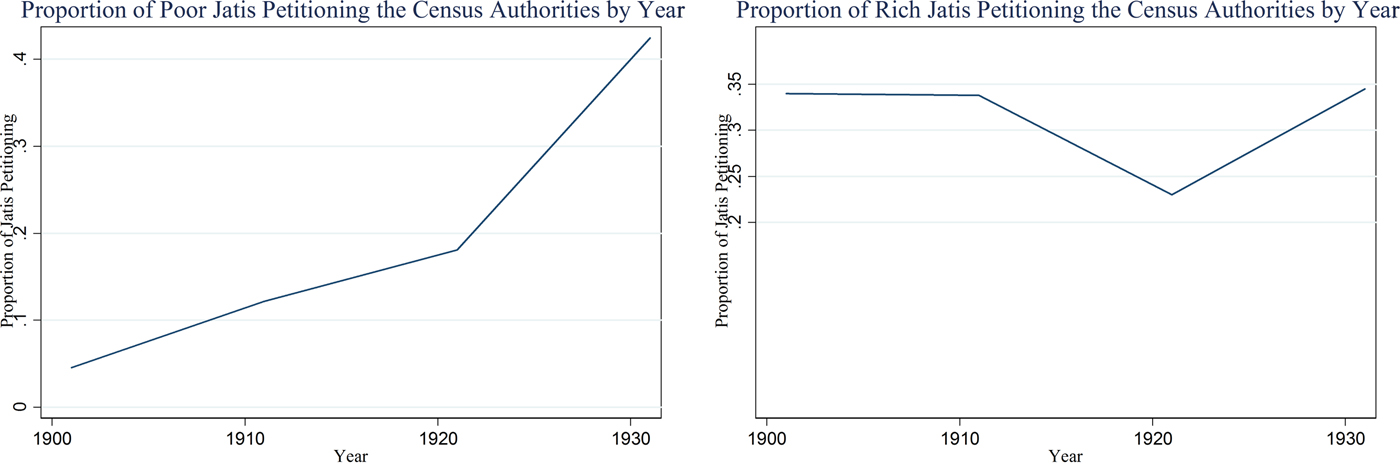
Before beginning with the quantitative analysis, it is worth examining some of the basic trends in the dependent variable. Table A-2 shows that there is an upward trend over time in petitions, from 16.2% of jatis in 1901 to 31.15% in 1931. Overall, 23.2% of caste-years had some sort of petition for a name change. Figure A-1 shows these trends graphically. There is a rise in the number of petitions over time, starting from fairly low levels and increasing to 33% of castes in 1931. Figure 1 shows the changing probabilities of petitioning over time relative to the initial (1901) literacy rate. As the theory predicts, the trends for rich and poor castes are different. Castes with low levels of literacy petition with increasing frequency in later decades, consistent with the hypothesis that the higher levels of literacy that some of these castes gain over time give them a sufficiently large elite to initiate the mobilization process. Among groups with high initial levels of literacy and status, the number of petitions stays constant over time, consistent with the hypotheses that some of these groups are merging into the provincial elite and have no need for identity politics.
Rate of Petitioning by 1901 Literacy Rate and Years, 1901–1931

Model Selection
This paper focuses on variation in petitioning within castes, using a set of caste fixed effects. However, several additional categories of bias-inducing unobserved variables may also exist in this case. Most notably, petitioning may vary by province (due to historical and institutional differences) and by year (due to time-related trends.) Observations are also not independent within castes (since jatis would find it easier to organize if their caste-fellows in other provinces had already done so) or within province-years (since groups might be more likely to petition if their neighbors were already doing so.)
The choice of a statistical model to analyze this data presents a fairly standard set of tradeoffs between bias and variance. Unfortunately, it is impossible to estimate the “pure” FE model with fixed effects for jati-province and province-year. While such a model would certainly be free of all these sources of bias, the broad and short structure of the panel would mean that this model would use a large number of degrees of freedom. Moreover, this model would have a very small N due to the loss of the large number of observations that do not vary within jati-province.Footnote 17
The basic specifications are thus based on a modified fixed effects model, with fixed effects for jati, province, and year. This last model differs from a conventional fixed effects model only in that the within-jati variance is not only across time but also across the province (for jatis located in multiple provinces.) It thus controls for most of the cultural and social unobserved variables associated with an individual's caste. The model estimated is:
 $$Y_{\,pjt} = {\rm \alpha} _p + {\rm \beta} _j + {\rm \gamma} _t + {\rm \delta} {\rm Li}{\rm t}_{\,pjt} + {\rm \rho} {\rm Li}{\rm t}^{\rm 2}_{\,pjt} + {\rm \theta} X_{\,pjt} + {\it \epsilon} _{\,pjt}$$
Where Y pjt is the log odds of petitioning for a given jati-province-year, αp, βj, and γt are vectors of province, jati and year fixed effects, and δ and ρ are the parameters of interest, and X is a vector of controls.
While this fixed effects model eliminates a great deal of bias, it is still relatively inefficient due to the very large number of castes. This is especially problematic in some of the specifications that test the robustness of the covariants to the inclusion of controls (many of which are available for only a portion of the data). Most of these specifications thus use a nested mixed-effects logistic regression model with random effects for jati and province-year and fixed effects for the province, year and caste ritual status. The random effects adjust the coefficients to take into account the probable non-independence of observations within province-year and within jatis. The fixed effects take into account the direct influences of time, geography, and the traditional social status (the fixed point against which castes were trying to appeal). This model is estimated as:
 $$Y_{\,pjt} = {\rm \alpha} _p + {\rm \beta} _s + {\rm \gamma} _t + {\rm \sigma} _{\,pt} + {\rm \tau} _j + {\rm \delta} Lit_{\,pjt} + {\rm \rho} Lit_{\,pjt}^2 + {\rm \theta} X_{\,pjt} + {\it \epsilon} _{\,pjt}$$
where βs is a vector of fixed effects for each level of caste status, and where σpt and τj are vectors of IID random effects for each province-year and jati.
Testing the Hypotheses
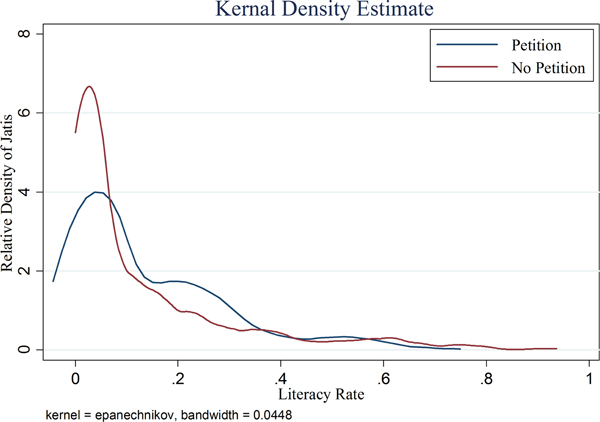
The inverted U relationship between literacy and petitioning is fairly obvious even in the raw data. Table A-3 gives the number of petitions in relation to the literacy rate of the caste. Castes at the lowest levels of education (below 1% literacy) petition in only 10.85% of jati-province-years, while those immediately above them (between 1 and 5% literacy) petition 24% of the time. The rate of petitioning is highest among castes with between 20 and 30% male literacy–38.8\% of these castes seek to change their name in any given year. At the highest levels of literacy (above 40%) the rate diminishes, with only 20.8% of castes submitting petitions. This pattern can be seen graphically in Figure 2, which shows the kernel density functions for petitioning and non-petitioning castes by literacy rate. The non-petitioning castes are concentrated at very high and very low levels of literacy, while the petitioning groups are relatively numerous at intermediate levels of literacy.
Kernel Density of Petitioning and Non-Petitioning Groups by Literacy Rate

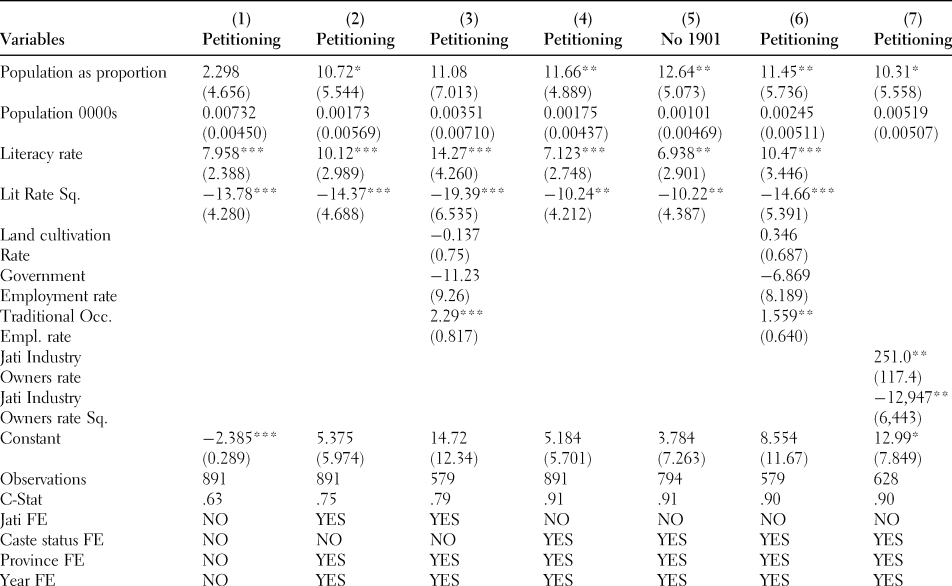
The curvilinear relationship between group literacy rate and petitioning is also apparent in the regressions in Table 1. Model One tests the simple quadratic relationship between literacy and petitioning. As the theory predicts, the literacy rate of a group is a positive predictor of its propensity to petition, but this effect reverses at high levels of literacy. Both results are statistically significant. Model Two runs the basic fixed effects model, with the key independent variables of interest, the literacy rate, and its square. As we have mentioned, the model also includes a set of variables associated with the level of modernization at the province level: the provincial literacy rate, the rate of urbanization, and the percent of male workers employed in public services, and employment in agriculture none of which affect the value of the literacy variables, which retain their strong quadratic relationship with petitioning. The predicted values from this model are shown graphically in Figure A-2.
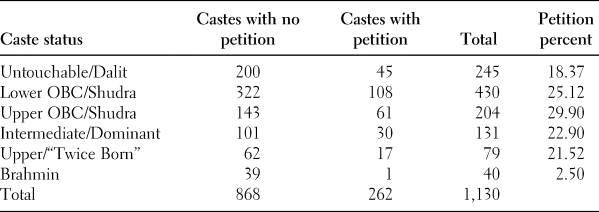
Number of petitions by caste status

Main results: logistic regression with petition as dependent variable

Standard errors in parentheses.
*** p < 0.01, ** p < 0.05, * p < 0.1Footnote 19.
Model Three of Table 1 introduces a set of variables drawn from the occupational data in the census tables, including the percentage of caste members cultivating land and the percentage involved in public administration. Of particular interest is a third variable, the percentage of caste members engaged in the caste's traditional occupation. One common explanation for the caste system is that it represents a system of economic complementarities, with groups providing each other with specialized services through the jajmani system or other similar arrangements (Dubois Reference Dubois and Beuchamp1806; Freitas Reference Freitas2006). What if this interpretation is correct, and economic specialization is an important motivating factor for individuals choosing to remain within the caste hierarchy? Traditional employment is a reasonable measure of exposure to these complementarities since a group concentrated in its traditional occupation is more likely to give and receive a large portion of its income through the cooperative exchange, if only because it has a less diverse array of buyers and sellers within the group. The effect of this variable on petitioning is substantial and positive: Traditionally employed castes are more likely to petition than non-traditionally employed castes, though whether this represents a challenge to the system or a rebellion against it is unclear. However, this variable does not affect the value of the literacy variables, which retain the same inverted U relationship with petitioning.Footnote 18
Model Four uses a mixed effects regression, and reruns the basic model using the mixed effects model discussed in the last section. As we might expect, the more efficient model produces substantially the same coefficients with greatly reduced standard errors. The effect of the literacy variable in these models is not only statistically significant but substantial in substantive terms: For an untouchable caste in Baroda in 1901, moving from a literacy rate of 1–11% increases the estimated probability of petitioning by seven percentage points (from 16 to 23%) and a further increase from 11 to 21% is associated with an additional 5.6 percentage point increase in the probability of petitioning (to 28.6%). However, the effect of literacy becomes negative as it goes higher, as a caste with 41% literacy has a predicted probability of petitioning of only 24%, and a caste with 61% literacy will petition only 7% of the time. This result remains strong even when we add controls for group occupation (Model Six) which reproduces the results in Model Three.
The results from 1901 might be plausibly thought to be biasing the results, given the effect of Risely's program of classification and the fact that some census used inconsistent definitions of literacy. Model Four reruns the mixed effects model without the 1901 data, and gets identical results.
Model Seven of Table 1 replaces the literacy variables with the rate of caste employment in the industry. This is intended as a check on whether the results extend outside education to more economic measures of social resources. The industrial ownership variables produce results similar to literacy: The effect of literacy on petitioning is positive, but attenuated at higher levels. This result gives us some confidence that the main regressions are measuring socio-economic status in general, rather than some factor unique to education.
Participation Among the Highly Educated
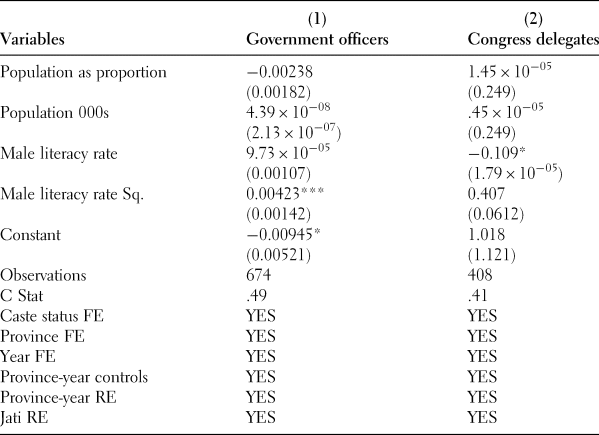
If the elites of very highly literate groups are not engaged in caste politics, what are they doing? The section Theory proposed that the elites of educated groups spend their time engaging in other forms of political action. Indeed, we should expect them to be over-represented in the political sphere as a whole, given the advantages conferred on them by their education. In colonial India, the two primary career paths for the politically ambitious led through the colonial bureaucracy and the nationalist elites gathered around the Indian National Congress, though in fact there was a significant interchange between the two groups. Model One of Table 4 regresses group literacy and size on caste-specific rates of employment as gazetted (senior) government officials. The squared literacy rate of the group has a statistically significant positive effect on bureaucratic employment, the only significant caste-level predictor. The same result holds true for caste-level attendance at the annual sessions of the Congress (Model Two of Table 3). As predicted, while their slightly less advantaged peers dominate caste mobilization, the literate urban castes seem to suffer from no handicap in the political system as a whole.
Alternative measures of participation

Standard errors in parentheses.
*** p < 0.01, ** p < 0.05, * p < 0.1.
ROBUSTNESS CHECKS AND ALTERNATIVE TESTS
The theoretical mechanisms we have discussed are obviously not the only ones which may affect caste mobilization. This section discusses several alternative mechanisms that may be driving caste petitioning and examines whether they affect the primary results reported in section five.
Caste Status
One of the most basic alternative hypotheses is that petitioning is driven by pre-existing levels of social status ascribed to groups. Groups with a high level of status within the traditional caste hierarchy might have a lesser incentive to change their caste name or to take other steps for their political advancement. All the reported models thus include either fixed effects for the jati or a set of dummy variables indicating the various levels of the caste hierarchy. The reported result should thus be seen as showing the effects of divergence in literacy among groups of similar ritual status.
In fact, there is considerable variance in petitioning, even among groups with a similar social status. Table A-4 shows the number of petitions by caste status level. The major empirical pattern is the virtual absence of petitioning among Brahmins, the groups at the top of the hierarchy, who cannot envisage improvement in their traditional social status. Otherwise, the differences among the various levels of status are relatively minor.
Caste Hierarchy
One obvious potential hypothesis is that the variation we see in petitioning is not the product of variation in the spread of literacy, but rather a variation in preexisting cultural conditions. Many have argued that caste norms are stronger in North India, the area first occupied by the Aryan invaders thought to have created the caste system and the area most influenced by Sanskritic culture. In particular, many observers have pointed to the small and “incomplete” position of the upper varnas in south Indian society, with the far south having only a few Brahmins and no groups universally acknowledged as Kshatriyas or Vaisyas (Kothari Reference Kothari1970; Frankel and Rao Reference Frankel and Rao1989–1990).
In its basic form, much of this cultural heterogeneity is already accounted for by including provincial and jati-level fixed effects. If norms about caste are stronger in Bihar than in Tamil Nadu, or among Brahmins than among Marathas, this should be accounted for in the fixed and random effect coefficients already included in the models.
Local variations in social status, however, might vary within jati due to regional differences in caste structure. Model One of Table A-5 adds a variable for the percentage of the province who have a higher social status than the caste in question. This is intended to account for the uneven “spread” of the caste system across regions of the country: Due to the smaller number of high castes in the south, some peasant castes in that region occupy a higher local social status than would otherwise be the case in the north. This variable has a small positive effect on petitioning–Groups at the bottom of the local status ordering are more likely to petition than those above them–but does not affect of the value of the literacy variables.
The Arya Samaj and Christianity
Closely related to this concern is the possibility that ideological efforts by outsiders could influence the willingness of groups to embrace or reject the caste system. One group in early twentieth century India, the Arya Samaj, was especially notable in such efforts. The Samaj was a social service organization strongest in North India, whose ideas have at various times been described as Hindu Protestantism, Hindu fundamentalism, and Hindu reformism. The group's leadership set itself against the caste system, at least in its existing form, favoring instead some sort of purified varna division (Bakshi Reference Bakshi1991). In general, we should expect the rapid growth of Arya Samaj to have a negative effect on petitioning, which represented that kind of jati-centered division of Hindu society that the Samaj was at pains to avoid. Model Two of Table A-5 includes variables for the percentage of Arya Samajists in each province in a given year. The growth of the Samaj does seem to have a marginal negative effect on petitioning, though it does not change the reported results.
Another over-time change that might affect the level of petitioning is the growth of Christianity. The Christian missionaries who arrived in India in the nineteenth century were also opposed to caste distinctions and the caste hierarchy in a more comprehensive way, though they never succeeded in eradicating caste consciousness among Indian Christians. More notable was the missionaries’ role in promoting primary education, particularly among their primary converts, lower caste groups in Southern India. While I have noted the effect of missionaries on literacy, it is possible that Christianity influenced caste mobilization more directly, for instance, if this exposure to non-Hindu ideals led to greater self-assertion of lower caste groups (Jaffrelot Reference Jaffrelot2003.) Variables for the percentage of Christians in the province, along with its interaction with caste status, are included in Model Three of Table A-5. While Christianity has a negative effect on hierarchical petitioning in some models, this effect does not substantially reduce the effect the literacy variables.
Region
The contrast between the north and south of the subcontinent is at the center of much social scientific and historical work on South Asia, with the south, often being portrayed as less “caste ridden” than the north, though in general, it seems that traditional strictures on ritual pollution were stronger in the south. Despite the presence of province fixed effects in all reported models, it is possible that these results are driven by one region. To test this possibility, Models Four and Five of Table A-5 report results with certain regions of the country excluded: Model Four reports the results excluding the non-Hindi-speaking provinces and Model Five for the non-Dravidian-speaking provinces. Despite the smaller sample, the non-linear effect of literacy remains a robust and statistically significant predictor of caste petitioning.
Petition Granting
The interpretation of petitioning advanced here is that approaching the census authorities was a primarily rhetorical act, a piece of public claim-staking that was part of a wide-ranging set of strategies for identity formation and mobilization. While a successful claim would give a caste's mobilization efforts an added level of legitimacy, the chance of success was not the primary goal of the petitioning process. What if this was not the case, and petitions were motivated by the desire for official recognition? In this situation, the dynamics of petitioning could be influenced by the dynamics of the census itself, as spurts of petitioning a caused purely by changes in the official attitude. To test this hypothesis, Model One of Table A-6 includes a variable for the rate of petition granting for that census year. The inclusion of this variable does not affect the reported results.
Census Classification Schemes
The secondary literature on the census of India has often promoted the view that caste petitions are the products of the ideas of the census takers, and of official support for a reified and Sanskritized caste system (Cohn Reference Cohn1987; Dirks Reference Dirks2002). In general, this explanation seems to account for little of the variance, since the census was one of the most nationally unified of Raj institutions, with strong national rules even in the princely states. However, there was one important area which varied both from province to province and from year to year: the arrangement of castes within the census table. The most common alternatives were alphabetical classification and occupational classification though in 1901 most provinces followed national policy and attempted to rank castes based on their ritual status. For the purposes of analysis, I simplified these differences into a binary variable, with a “1” indicating occupational and “precedence”-based classifications. Model Two of Table A-6 includes this hierarchical classification variable and its interaction with caste status. Neither of these variables has a statistically significant effect on caste mobilization, nor does the inclusion of these variables does not affect the values of the coefficients for the independent variables of interest.
The Coding of Jatis
The main models assume that the petition made a claim on behalf of the whole group (even if it was only submitted by a handful of individuals) and that only one petition was submitted on the group's behalf (or, if multiple petitions were submitted, that they were substantially similar in content). In fact, neither of these conditions is always the case. In some cases, a petition was submitted on behalf of a subcaste of a jati claiming to be either a separate caste or the members of a different jati entirely. In Bengal, for instance, a subcaste of the Kayasth caste claimed to be Kshatriyas while fully admitting the shudra status of the remainder of Kayasths. More rarely, two groups made differing claims on behalf of the whole caste. Model Three of Table A-6 drops these split cases from the analysis, which have no effect on the results.
In the section Data and Variables, we discussed the problems presented for the coding for the caste merger movement among Dalits in south India. Not only does it mean that some groups are exiting the dataset (into the artificial “merged castes,”) but the broad anti-Brahmin or pre-Hindu identity advanced by the campaigners made it difficult to know whether castes were actually active in a political movement or were merely “annexed” by activists from other castes. In addition, the broad environment of the non-Brahmin movement in interwar South India could be seen to be an ideological confound affecting all groups. To test this hypothesis, Model Four of Table A-6 excludes the province-years affected by the non-Brahmin movement (Madras, Mysore, and Hyderabad in 1931 and Mysore in 1921). This exclusion does not substantively affect the reported results.
Population Shifts
While the units of observation in this study, jatis, are constant over time, their compositions are not, as individuals could easily shift jati for census purposes. Despite the efforts of census officials, there are frequent references to such shifts in the census records, and such shifts are also detectable in quantitative analysis (e.g. Cassan Reference Cassan2010). A major concern here is that such ground-level status shifts may serve as a substitute for large-scale collective action like petitioning. Any jati that sees a major gain or loss might also see changes in its other covariates due to the influx of outsiders. To test this hypothesis, Model Five of Table A-6 includes a variable for the absolute percentage of gain or loss that a caste had in male population over the previous census year. However, this variable appears to have no significant effect on petitioning or the size of the literacy coefficients.
Intergroup Inequality
A final possibility is that differences in salience are a product of differences in the level of intergroup inequality (Baldwin and Huber Reference Baldwin and Huber2010; Huber and Suryanarayan Reference Huber and Suryanarayan2016). Model Six of Table A-6 includes an additional control at the province-year level: The index of difference between the literate population and the population overall, calculated following Huber and Suryanarayan, Reference Huber and Suryanarayan2016. Controlling for this variable does not substantially affect the reported results. As these authors would expect, however, increased inequality has a statistically significant and positive association with petitioning.
CONCLUSION
Colonial caste activism was a phenomenon with social and economic causes. Rising levels of education created the elite that makes caste mobilization possible, but higher levels of education made it unnecessary. This non-linear pattern supports the theory that education influences identity not just by empowering political actors but by altering the relative benefits of different forms of political actions. While the results shown here generally support the common theory that population size has a strong effect on identity mobilization, they supplement it with an understanding of the social conditions that make such mobilization possible and desirable for elites. As such, the result belongs squarely within the tradition of theories discussing the effects of economic modernization, though it modifies these theories by showing that the effect of social change on groups is decidedly non-linear, and does not involve the fading of “primitive” identities like caste.
Since the data are observational in nature, the finds are not fully causally identified: Education is not randomly assigned, and might be associated with group-specific trends even after jati is controlled for. While this is a common problem in the literature (if literacy is non-ignorably assigned, group size is certainly not), this should be taken into account when interpreting the findings. However, the observational data provide suggestive evidence that mobilization is non-linearly related to education.
Just as strikingly, from both a South Asian and a comparative perspective, is the sizable variation in the extent of mobilization in the colonial period even among groups of similar size, which serves as a corrective both to theories of a static caste system and to theories that emphasize the role of the colonial state and groups population. While some caste identities were politically salient, others, particularly at the extreme ends of the social scale, did not become the basis for political action until after independence.
SUPPLEMENTARY MATERIAL
The supplementary material for this article can be found at https://doi.org/10.1017/rep.2018.29.