


Impact Statement
Trait data are essential resources in ecological and evolutionary research, although their repositories often have high degrees of missing values. Imputation methods find likely values for these missing data by leveraging phylogenetic and trait covariance structures. Trait imputation methods are often statistical or use machine learning, although deep learning (DL) alternatives have seen increased attention in other fields, outperforming baseline methods such as Random Forest and k-Nearest Neighbors. We present the results of a literature review aimed at identifying DL methods that have not yet been applied to trait data. We identify autoencoders, feed-forward neural networks, and transformers as promising imputers of tabular trait data. We propose further research into the efficacy of these methods in trait data contexts.
1. Introduction
1.1. Traditional methods for dealing with missing trait data
Data describing the characteristics of both individual species and entire communities are essential across a variety of research questions and methodologies in ecological and evolutionary studies. Individual species and organismal-level trait data have been used, for example, for the parameterization of process-based models, for predicting how disturbances or climate change affect the persistence and functions of species and ecosystems (Stork et al., Reference Stork, Coddington, Colwell, Chazdon, Dick, Peres, Sloan and Willis2009; Newbold et al., Reference Newbold, Scharlemann, Butchart, Şekercioğlu, Alkemade, Booth and Purves2013; Johnson et al., Reference Johnson, Isaac, Paviolo and González-Suárez2021), and for conservation (Penone et al., Reference Penone, Davidson, Shoemaker, Di Marco, Rondinini, Brooks, Young, Graham and Costa2014; Greenberg et al., Reference Greenberg, Palen and Mooers2017). Although formal definitions of species traits often limit them to the morphological, physiological, and phenological features of individuals (Violle et al., Reference Violle, Navas, Vile, Kazakou, Fortunel, Hummel and Garnier2007), additional features describing both functional traits and emergent properties are often utilized within ecological and evolutionary studies (He et al., Reference He, Yan, Liu, Xu, Li, Van Meerbeek, Zhou, Zhou, Liu, Zhou, Li, Niu, Han, Buckley, Sack and Yu2023). To account for these additional features, in this article we use an expanded definition of the term “species trait data” to refer to a broader range of species’ features including morphological, demographic, physiological, and phenological data. Data measured at the community or plot level, such as mean canopy height, are used to address many questions in ecology and conservation biology, such as characterizing habitats to improve conservation approaches (Loehle et al., Reference Loehle, Irwin, Manly and Merrill2015) and incorporating species interactions into macroevolutionary analyses (Weber et al., Reference Weber, Wagner, Best, Harmon and Matthews2017). Accurate and complete data are essential for accurate predictions and analyses for both types of data, especially when methods are not robust to missing data (Urban et al., Reference Urban, Bocedi, Hendry, Mihoub, Pe’er, Singer, Bridle, Crozier, De Meester, Godsoe, Gonzalez, Hellmann, Holt, Huth, Johst, Krug, Leadley, Palmer, Pantel and Travis2016, Reference Urban, Travis, Zurell, Thompson, Synes, Scarpa, Peres-Neto, Malchow, James, Gravel, De Meester, Brown, Bocedi, Albert, Gonzalez and Hendry2022). However, datasets of species traits and community properties (hereafter referred to collectively as trait data) are rarely complete.
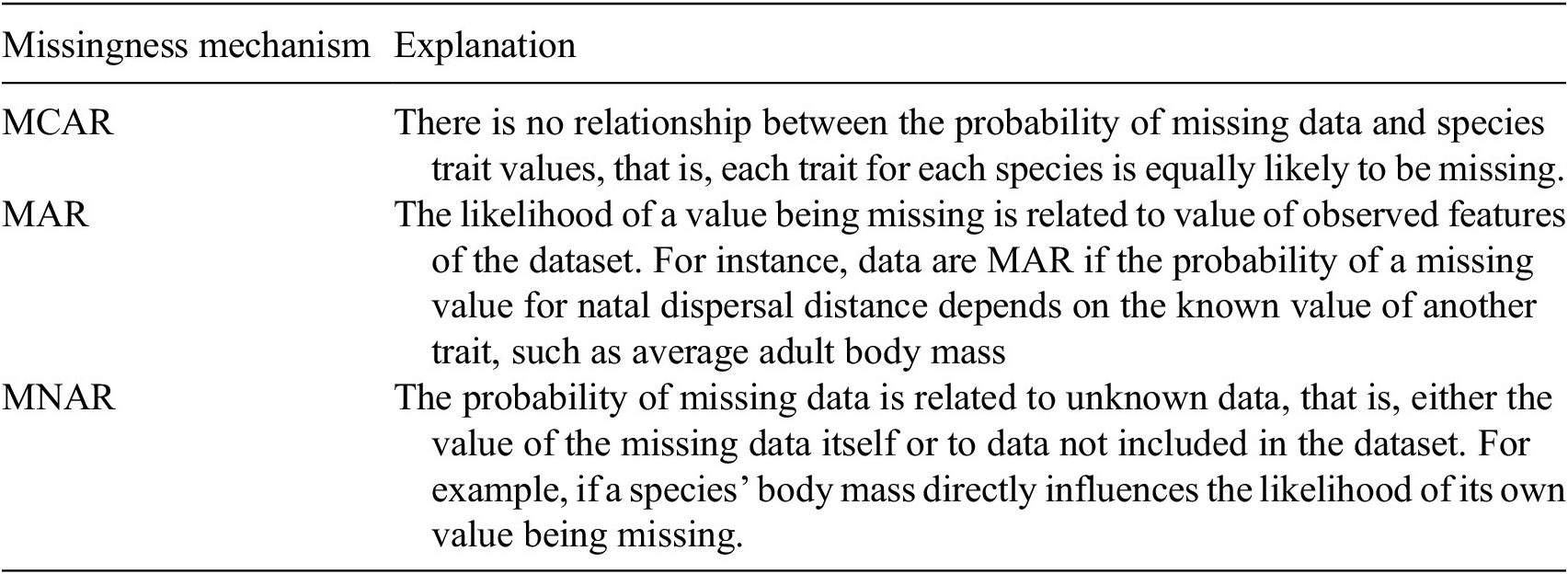
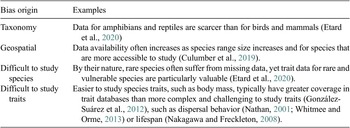
Missingness can be caused by three general mechanisms (Table 1), which are important when considering how to handle data gaps (Fielding et al., Reference Fielding, Fayers, McDonald, McPherson and Campbell2008; Gomer and Yuan, Reference Gomer and Yuan2023). However, identifying which mechanism applies to a given dataset is often challenging (Galimard et al., Reference Galimard, Chevret, Curis and Resche-Rigon2018). In ecological and evolutionary studies, and trait data repositories, missing species trait data are often the result of various origins of bias (Table 2). These origins of bias mean that species trait data are often comprised of values that are missing under various mechanisms, including missing at random (MAR) and missing not at random (MNAR) data (González-Suárez et al., Reference González-Suárez, Lucas and Revilla2012; Penone et al., Reference Penone, Davidson, Shoemaker, Di Marco, Rondinini, Brooks, Young, Graham and Costa2014).
Explanations of missingness mechanisms

Table 1. Long description
MCAR is described as the probability of missingness being unrelated to the values of the data in the dataset. MAR is described as the likelihood of a value being missing being related to the value(s) of the observed data in the dataset. MNAR is described as the probability of the data being missing is related to unobserved data, such as the value of the missing data itself.
Note: MCAR, missing completely at random; MAR, missing at random; MNAR, missing not at random.
Origins of bias in species trait data
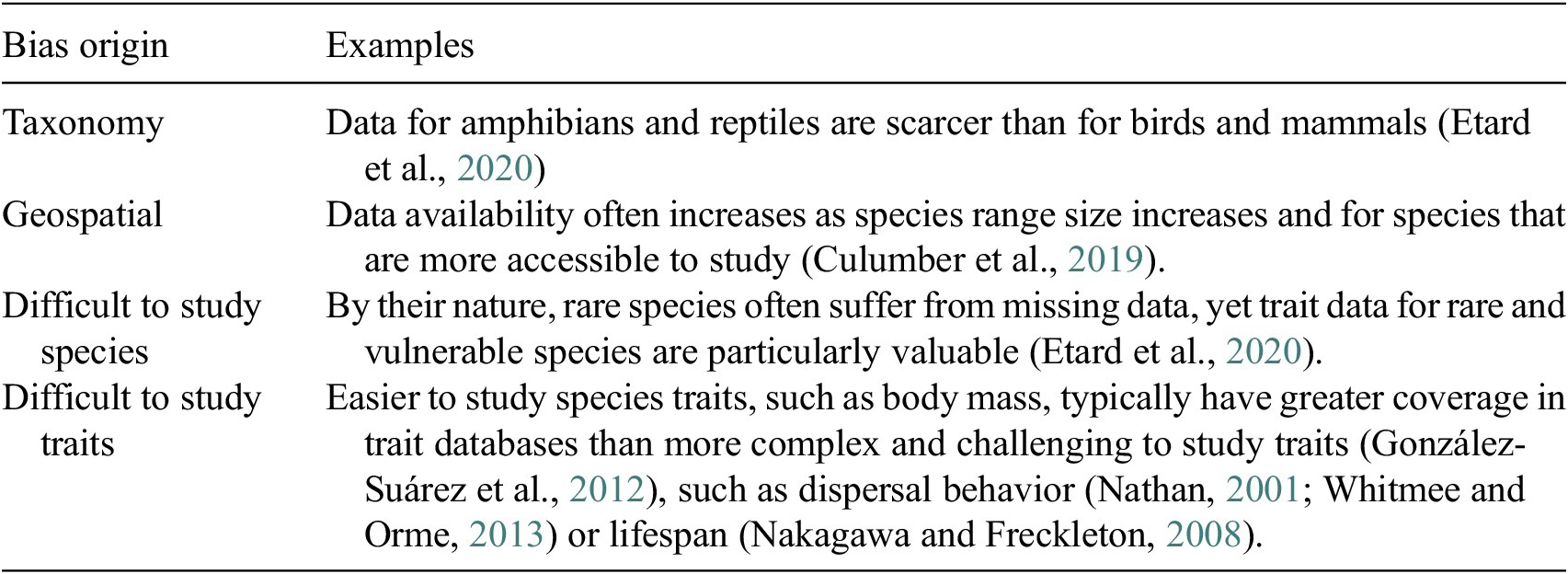
Table 2. Long description
Four sources of bias in trait datasets are identified with examples provided. These included: taxonomic origins, where data are more prevalent for some species than others; geospatial origins, with the example of species with larger range sizes have more available trait data, as well as those that are more accessible; difficult to study species being less likely to have available trait data, with the example of rare species being inherently difficult to gather data for; and difficult to study traits being less likely to have available data, such as dispersal behaviors or lifespan, which often require long-term studies to sample.
Within ecological and evolutionary studies, preprocessing data techniques are often employed to handle missing data (Penone et al., Reference Penone, Davidson, Shoemaker, Di Marco, Rondinini, Brooks, Young, Graham and Costa2014; Taugourdeau et al., Reference Taugourdeau, Villerd, Plantureux, Huguenin-Elie and Amiaud2014). Listwise deletion, also referred to as complete case analysis, is the process of removing samples with missing data. While quickly and easily implemented, listwise deletion reduces sample sizes and biases the results of studies using real-world MAR or MNAR data (Myers, Reference Myers2011; Zhang, Reference Zhang2016).
An alternative is data imputation, whereby missing values are replaced with plausible estimates derived from the observed data. Imputation approaches can be broadly divided into single imputation, which produces one completed dataset, and multiple imputation, which generates several completed datasets that reflect uncertainty in the missing values. Single imputation remains widely used but has been criticized for treating imputed values as if they were observed data, leading to underestimated uncertainty and overly confident statistical inferences, a problem termed the single imputation fallacy (Blomberg and Todorov, Reference Blomberg and Todorov2025). In contrast, multiple imputation explicitly propagates uncertainty by drawing imputations from the posterior predictive distribution of the missing data conditional on the observed data. Each completed dataset is analyzed separately, and parameter estimates are subsequently combined using Rubin’s rules (Rubin, Reference Rubin1987). As a result, multiple imputation generally produces more reliable estimates of both parameters and their associated uncertainty.
In ecological and evolutionary studies, imputation is typically not an end in itself. Rather, it is used to enable downstream analyses and hypothesis testing that would otherwise be limited in the presence of missing data. Consequently, the usefulness of an imputation method depends not only on its ability to recover missing values accurately but also on its capacity to preserve biologically meaningful relationships and support valid statistical inference. This distinction is illustrated by Blomberg and Todorov (Reference Blomberg and Todorov2025), who compared complete-case analysis, single imputation, and multiple imputation by evaluating downstream regression models. Specifically, they assessed bias in regression coefficients and the accuracy of estimated standard errors relative to analyses of complete data. Their results showed that multiple imputation yielded confidence intervals that more frequently recovered the true parameter values, whereas single imputation often produced overconfident estimates and, in some cases, performed worse than complete-case analysis. These findings highlight the importance of accounting for imputation uncertainty when the ultimate goal is biological inference rather than prediction alone.
Many imputation methods are available, varying in complexity (see Supporting information A for descriptions of common methods). Simple imputation methods include replacing a missing value with the feature (e.g., trait) average, or using the “last observation carried forward” in longitudinal datasets, where the missing value is replaced by the most recent observed value. Similar to listwise deletion, these simple imputation methods can result in biased results and poor accuracy when data are not MCAR, that is, the data are classified as MAR or MNAR (Fielding et al., Reference Fielding, Fayers, McDonald, McPherson and Campbell2008; Zhang, Reference Zhang2016).
More complex imputation methods draw on additional information available within the dataset to estimate a likely value. By leveraging relationships among variables or similarities between samples, these methods can better preserve feature distributions and inter-variable correlations (Gromski et al., Reference Gromski, Xu, Kotze, Correa, Ellis, Armitage, Turner and Goodacre2014; Zhang, Reference Zhang2016; May et al., Reference May, Feng and Adamowicz2023). For instance, k-nearest neighbors (kNN) imputation identifies samples that are most similar to the one with missing data to inform the imputation (Zhang, Reference Zhang2012). As closely related species tend to have similar trait values, the addition of phylogenetic information in these more advanced methods, either as a phylogenetic tree or in tabular format, can also boost model performance (Penone et al., Reference Penone, Davidson, Shoemaker, Di Marco, Rondinini, Brooks, Young, Graham and Costa2014; Johnson et al., Reference Johnson, Isaac, Paviolo and González-Suárez2021). Though relatively well performing, and more robust than simpler imputation methods (Zhang, Reference Zhang2016), the efficacy of advanced methods is dependent on the specific context of the missingness of the data. Conditions including the missingness type (MCAR, MAR, and MNAR), proportion of missing data, data type (such as numerical, categorical, longitudinal, image, text, or mixed), and the complexity of the missing data all influence their performance (Hunt, Reference Hunt, Palumbo, Montanari and Vichi2017; Johnson et al., Reference Johnson, Isaac, Paviolo and González-Suárez2021).
In their study on missing value handling in trait data, Johnson et al. (Reference Johnson, Isaac, Paviolo and González-Suárez2021) highlight that conventional imputation methods are not always the most appropriate solutions for missing trait data. These conventional methods, including multiple imputation by chained equations (MICE) (once via regression and again via random forest [RF]), phylogenetic imputation via phylopars (Goolsby et al., Reference Goolsby, Bruggeman and Ané2017), and Bayesian hierarchical probabilistic matrix factorization, all see a fall in accuracy when realistic missingness biases (MAR and MNAR) are included within simulated trait datasets and as the proportion of missingness increases. These findings underscore the urgent need to improve methods for imputing missing trait data.
1.2. Could data science and AI improve our efforts at imputation?
Over the past few decades, we have transitioned into the era of big data (Kitchin and Lauriault, Reference Kitchin and Lauriault2015; Duan et al., Reference Duan, Edwards and Dwivedi2019). Large datasets and databases are becoming more common and tools for handling such data are now essential. Data science is a discipline that focuses on the development of data analysis and management techniques (Dhar, Reference Dhar2013), and as such data science studies are a rich source of alternative imputation methods. It is possible that some of these alternative imputation methods could outperform the conventional trait data imputation methods used in ecological and evolutionary studies.
Artificial Intelligence (AI) methods, particularly Machine Learning (ML), are a common feature of state-of-the-art imputation methods in data science (Luo, Reference Luo2022; Adhikari et al., Reference Adhikari, Jiang, Zhan, He, Rawat, Aickelin and Khorshidi2023). AI and ML are renowned for their capacity to handle and analyze large and complex data efficiently (Zhuang et al., Reference Zhuang, Wu, Chen and Pan2017). Consequently, modern AI and ML methods have garnered attention for their capacity to effectively process and impute data (Irwin et al., Reference Irwin, Whitehead, Rowland, Mahmoud, Conduit and Segall2021). Deep learning (DL) is a branch of ML which uses neural networks (see Supporting information B for a more in-depth explanation of neural networks), such as AEs or recurrent neural networks (RNN), to “learn” complex relationships between data features (LeCun et al., Reference LeCun, Bengio and Hinton2015). By accurately representing these complex feature relationships, deep neural networks have the capability to conduct highly complex data analysis tasks and consequently show promise for data imputation (Duan et al., Reference Duan, Lv, Liu and Wang2016; Cardoso Pereira et al., Reference Cardoso Pereira, Seoane Santos, Pereira Rodrigues and Henriques Abreu2020; Fang and Wang, Reference Fang and Wang2020).
Despite its promise, the suitability of DL for data imputation remains contentious. A recent review has shown that DL architectures, including generative adversarial imputation networks (GAIN) and variational autoencoders (VAE), may be outperformed by conventional methods such as RF and MICE when assessed using root mean square error (RMSE) and overall accuracy (Sun et al., Reference Sun, Li, Xu, Zhang and Wang2023). Additionally, two studies (Elezaj et al., Reference Elezaj, Yildirim, Kalemi, Nicosia, Pardalos, Giuffrida and Umeton2018; Xie et al., Reference Xie, Gong and Dong2024) found that DL methods fail to outperform conventional methods in terms of not only RMSE but also in the preservation of variable distributions and mean absolute percentage error (MAPE). Conversely, many DL methods have been shown to perform well for data imputation tasks, outperforming simple statistical and ML alternatives (Cappelletti et al., Reference Cappelletti, Fontana, Di Donato, Di Tucci, Casiraghi and Valentini2020; Lin et al., Reference Lin, Tsai and Zhong2022). Reviews of DL architectures, such as autoencoders (AEs), have highlighted the effectiveness of AE-based methods in surpassing conventional techniques (Cardoso Pereira et al., Reference Cardoso Pereira, Seoane Santos, Pereira Rodrigues and Henriques Abreu2020). Moreover, the potential of DL has been recognized across various domains, including healthcare, where it has shown promise for improving imputation performance (Liu et al., Reference Liu, Li, Yuan, Ong, Ning, Xie, Saffari, Shang, Volovici, Chakraborty and Liu2023).
To evaluate the effectiveness of state-of-the-art DL methods for imputing species trait data, it is essential to first identify which imputation techniques are currently used in ecological and evolutionary research. In parallel, we must assess which specific DL architectures, and their extensions, are most suitable for these data types and research contexts. The broader field of data science likely offers a wide range of modern imputation methods that have yet to be applied in ecological or evolutionary studies. As such, DL methods represent a valuable opportunity to explore powerful alternatives for improving trait data imputation in these domains.
To this end, we conducted a systematic review of imputation methods used in ecological, evolutionary, and data science studies. By examining the distinct domains, we identify state-of-the-art DL imputation architectures from data science that hold promise for species trait data imputation. We compare the context of current applications of DL in terms of missingness proportion, missingness type, and data type with that of the equivalent in species trait datasets. Such comparisons allow for parallels to be drawn, and limitations identified. We conclude by deriving recommendations for the utilization of DL imputation methods for ecological and evolutionary studies (Figure 1).
High degrees of biased missing data are common in datasets used by both data science studies and ecological and evolutionary studies. Imputation methods can fill these gaps by estimating the most likely value for missing data. Data science studies employ a wider variety of imputation methods than those used for species trait data imputation, including the persistent use of deep learning. These deep learning methods can outperform the methods that are used most often for species trait data imputation, and as such, studies into their efficacy in ecological and evolutionary contexts are recommended. kNN = k Nearest Neighbor; MICE = Multiple Imputation by Chained Equations.

2. Materials and methods
2.1. Systematic review of the literature
The structure of the literature review followed the Protocol and Reporting result with Search, Appraisal, Synthesis, and Analysis framework (PSALSAR) methodology set out by Mengist et al. (Reference Mengist, Soromessa and Legese2020). To define the scope and aims of the review, we used the Population, Intervention, Comparison, Outcome(s), and Context (PICOC) protocol. We searched “Web of Science” (Primary collection and Citation Connection databases) and “Scopus” using strings of combinations of the following keywords/phrases: “Trait data,” “Imputation,” “Missing data,” “Ecology,” “Evolution,” “Parameterization,” “Data science,” and “Gap filling.” Certain keyword combinations were omitted because they resulted in large returns (e.g., “Missing data” AND “Ecology”) without any specific relevance to data imputation. Following this process, 13 search strings were chosen:
-
1. “Trait data” AND “Imputation”
-
2. “Trait data” AND “Missing data”
-
3. “Trait data” AND “Missing data” AND “Ecology”
-
4. “Trait data” AND “Missing data” AND “Evolution”
-
5. “Imputation” AND “Ecology”
-
6. “Imputation” AND “Ecology” AND “Trait data”
-
7. “Imputation” AND “Evolution”
-
8. “Imputation” AND “Evolution” AND “Trait data”
-
9. “Imputation” AND “Data science”
-
10. “Imputation” AND “Missing data” AND “Data science”
-
11. “Trait data” AND “Parameterization”
-
12. “Data science” AND “Parameterization”
-
13. “Gap filling” AND “Missing data”
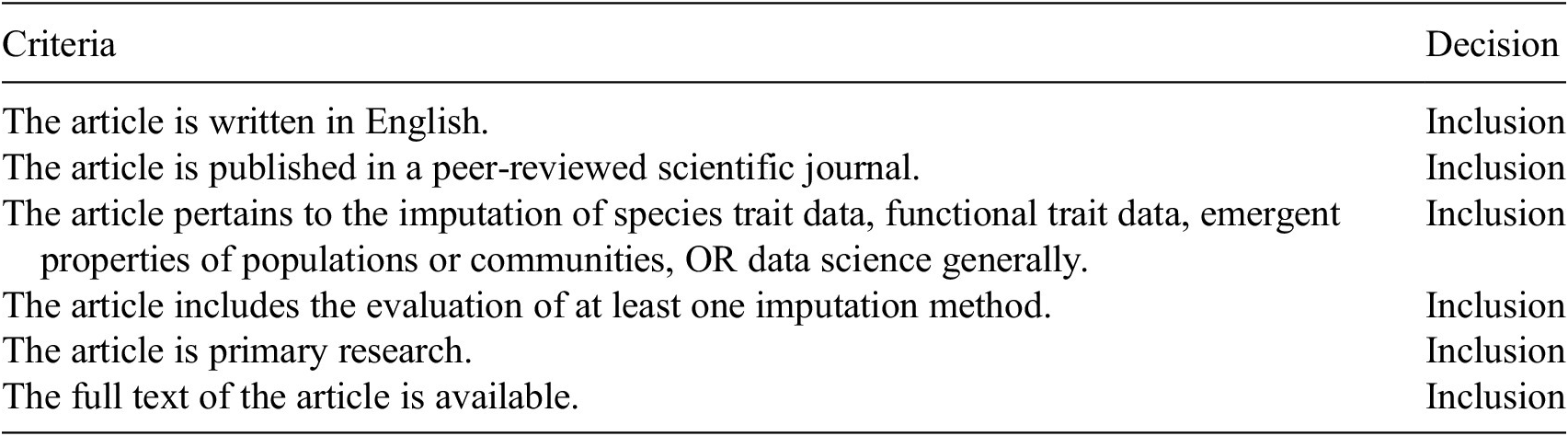
Studies were evaluated against a set of criteria (Table 3) and either included or excluded in the final review. Studies were deemed pertinent to data science based on the journal in which they were published. Those published in journals specific to computer science, data science, and mathematics were retained, whereas those published in journals tangentially related to these domains, such as the Journal of Medical Statistics and Informatics, were considered too far removed from these focal fields and were thus omitted. Data from the retained studies were then extracted, including article title, study domain, publication year, imputation method(s) used, type of data imputed, missingness type, and missingness proportion. The scope of this review is limited by our explicit search for studies that define their problem as a missing data problem, and our focus on use of the term “imputation” to define their missing data handling approach. In some contexts, methods that could be considered imputation, such as the reconstruction of temporal patterns, are not viewed as imputation problems by ecologists and evolutionary biologists, and as such, may be overlooked in our search. Additionally, alternative terms, such as “interpolation” or “gap-filling,” have also been used historically, and as such, it is likely that some studies were not discovered by our search terms. Despite these limitations, we consider this review to be a reliable representation of the current state of missing data handling within both domains because the term “imputation” is currently prominent in both ecological/evolutionary and data science studies (Table 4).
Inclusion criteria for articles in the systematic review

Table 3. Long description
We define six criteria for inclusion within our study, including: the paper is written in English; the paper is published in a peer-reviewed scientific journal; the paper pertains to the imputation of species trait data, functional trait data, emergent properties of populations or communities, OR data science generally; the paper includes the evaluation of at least one imputation method; the paper is primary research; the full text of the article is available.
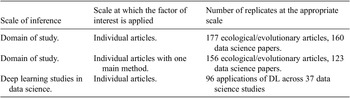
Replication statement covering the scale of inference, scale at which the factor of interest is applied, and number of replicates at the appropriate scale for our analyses

Table 4. Long description
We define the scale of inference, scale at which the factor of interest is applied, and the number of replicates at the appropriate scale for the different phases of our study.
2.2. Data analysis
2.2.1. Comparing domains
Comparisons were made between the preferences for imputation methods used in ecology and evolution studies and those in data science studies. Studies making comparisons between several imputation methods as opposed to focusing on a single method were omitted from this section of the study, as it was determined that they did not constitute the application or evaluation of an individual method.
Imputation methods were categorized into groups based on a methodological classification. For example, a generalized least squares method which incorporates phylogenetic information would be categorized as a form of regression. This yielded the following 19 categories: AEs, Average Imputation, Bayesian statistics, Decompositions, Feed-forward neural networks (FFNN), Generative adversarial networks (GAN), kNN, MICE, Phylogenetic imputation, Probabilistic, Regression, RF, RNN, Time series analysis, Other DL, Other ML, Other Statistical, Hybrid, and Other methods. Of these AE, GAN, RNN, FFNN, and Other DL were DL architectures.
The overall difference in methodological preference between domains was identified using Fisher’s exact tests. Studies were then divided into four time brackets: “1990–1999,” “2000–2009,” “2010–2019,” and “2020 Onwards.” Where methods used overlapped in these time brackets, Fisher’s exact tests were employed to compare the two domains. Comparisons were then made between time brackets within domains to identify trends in preferred methods within individual domains.
2.2.2. Reviewing the application of deep learning for imputation across data contexts
Three evidence maps were created to summarize the suitability of state-of-the-art DL architectures for imputing species trait data. Individual maps were created based on studies identified using the keywords “data type,” “missingness type,” and “missingness proportion,” which we define collectively as the “data context.”
To illustrate the suitability of state-of-the-art methods in terms of data type, studies were generalized into six types: numerical, categorical, longitudinal, image, text, and mixed. The missingness proportion was categorized into brackets of 10% from 0% to 100%, and the missingness type was classified as either MCAR, MAR, or MNAR. Here, a separate set of categorizations for observed DL imputation architectures was developed based on their generalized architecture, in part following the outline from Liu et al. (Reference Liu, Li, Yuan, Ong, Ning, Xie, Saffari, Shang, Volovici, Chakraborty and Liu2023). Overall, seven DL architectures were identified: graph neural networks (GNNs), FFNNs, RNNs, AEs, GANs, hybrid models including architectures such as long short-term memory (LSTM) with attention and a transformer, and “Other” models such as deep Gaussian mixture models.
Map generation was conducted using only data science studies, as DL methods used within ecological and evolutionary studies inherently already indicate their suitability. Articles reviewing the efficacy of multiple methods were excluded from the analyses comparing the two domains of study, but they were included in these evidence maps as they offer results that highlight the suitability of these alternative methods under different data contexts. We then consider this with respect to the type of missing data commonly found in empirical trait data. By doing so, we explore the suitability of DL methods for imputation under different types of missingness.
All data comparisons were conducted in R version 4.4.0 using RStudio version 2024.04.1 + 748 (R Core Team, 2025).
3. Results
3.1. Systematic review of the literature
A total of 2387 articles were identified by the initial search (1508 from the Web of Science and 849 from Scopus), which reduced to 337 following applications of the evaluation criteria in Table 3. Of these studies, 160 were classified as data science articles and 177 classified as ecological and evolutionary articles. A list of data sources used in this study can be found in the “Full Data” sheet of our Data files on our Github.
3.2. Comparing domains
Retaining only studies which focus on a single imputation method yielded a subset of 279 articles, 156 of which were classified as ecological/evolutionary studies, and the remaining 123 studies were classified as data science.
A strong difference was observed in the preferred imputation methods overall between the two domains (p < 0.0005) (Figure 2). This difference was maintained within each time bracket comparison, with the domains either having no method overlap, as in the brackets of “1990–1999” and “2000–2009,” or Fisher’s exact tests indicating substantial differences between the two in the case of brackets “2010–2019” and “2020 Onwards” (p < 0.005).
Imputation methods used in both data science and ecology/evolution studies by time bracket. AE = Autoencoder; FFNN = Feed-Forward Neural Network; GAN = Generative Adversarial Network; kNN = k-Nearest-Neighbors; MICE = Multiple Imputation by Chained Equations; MLP = Multilayer Perceptron; Other DL = Other Deep Learning; Other ML = Other Machine Learning; RF = Random Forest; RNN = Recurrent Neural Network.

In terms of comparing between contiguous time brackets within domains, Fisher’s exact tests indicated little difference in method preference between “1990–1999” and “2000–2009” and between “2000–2009” and “2010–2019” in ecological and evolutionary studies (p-values > 0.05), whereas a substantial difference between “2010–2019” and “2020 Onwards” was indicated by a p-value of < 0.0005. For data science studies, Fisher’s exact tests indicated a moderate difference in preferred imputation methods between “2000–2009” and “2010–2019” (p = 0.081), whereas results for between “2010–2019” and “2020 Onwards” were consistent with the null hypothesis (p = 0.388).
ML methods have consistently dominated species trait data imputation in ecological and evolutionary studies across time brackets, with RF and kNN being the most commonly used methods (23.7% and 16.7% of total methods, respectively). Following these methods in popularity was the trait-data-specific method of phylogenetic imputation (16.0%). DL methods were only applied twice, via FFNNs, accounting for only 1.3% of total imputation applications.
In data science studies, although ML methods were still commonly used, DL was far more prevalent. Here, explicitly ML methods accounted for 22.8% total (including kNN, RF, and other ML). The most commonly used individual categories within data science were regression, at 13.0% of the methods used, and kNN methods, at 12.2%. DL methods in data science accounted for 20.3% of the methods used, including applications of AEs, FFNNs, GANs, RNNs, Hybrid models, and Other DL architectures.
3.3. Reviewing the application of deep learning for imputation across data contexts
A total of 96 applications of DL methods across 37 data science studies were identified. Table 5 shows the evidence maps generated for missingness proportion, missingness type, and data type associated with each instance of applied DL methods. All studies provided the type of data being imputed, 28 provided the proportion of data missing in their imputation trials, and 20 referred to the specific type of the missingness of their data. Further details regarding the missingness scenarios to which each DL method was applied are available in Supporting information C.
Evidence maps of missing data contexts (missingness proportion, missingness type, and data type) provided within data science studies using deep learning imputation methods

Table 5. Long description
Our seven categorizations of deep learning methods are shown with a tally of times they were found to have been applied to different degrees of missingness (in brackets of 10% from 0–100%), missingness types (MCAR, MAR, and MNAR), and data types (including numerical, categorical, longitudinal, image, text, and mixed).
Note: GNN, graph neural network (4 articles); FFNN, feed-forward neural network (9 articles); RNN, recurrent neural network (9 articles); AE, autoencoder (9 articles); GAN, generative adversarial network (16 articles); Hybrid models (7 articles); Other models (16 articles). MCAR, missing completely at random; MAR, missing at random; MNAR, missing not at random. Shading refers to number of counts; green is higher, yellow is lower.
3.4. Deep learning methods for imputing different data types
3.4.1. Generative adversarial networks
A total of 13 studies used GAN-based methods. In eight of these, GANs were outperformed by conventional trait data methods (Lalande and Doya, Reference Lalande, Doya, Skopal, Falchi, Lokoč, Sapino, Bartolini and Patella2022; Santos et al., Reference Santos, Henriques Abreu and Santos2022; Wang et al., Reference Wang, Luo, Deng and Chen2022; Fuchs et al., Reference Fuchs, Pommeret, Stocksieker, Nicosia, Ojha, La Malfa, La Malfa, Pardalos, Di Fatta, Giuffrida and Umeton2023; Kim et al., Reference Kim, Benabderrahmane and Rahwan2024). This group includes the only studies to evaluate GANs on MAR and MNAR data (He, Yu et al., Reference He, Yu, Li, Fournier-Viger and Huang2024; Zhou et al., 2024), and the only application of a GAN to species trait data (Gendre et al., Reference Gendre, Hauffe, Pimiento and Silvestro2024).
The remaining five studies reported that GAN-based methods, including a GAN-VAE hybrid architecture, outperformed conventional methods (Vi et al., Reference Vi, Tan Nguyen, Tran, Phuc Ngo, Nguyen and Phan2021; Ali et al., Reference Ali, Ren and Wu2024; Wang et al., Reference Wang, Xu, Hu, Liu, Yan and Ren2024b; Bannany and Qahtan, Reference Bannany, Qahtan, Stahlbock and Arabnia2025; Sarmad Ali et al., Reference Sarmad Ali, Ren, Wu, Zhang and Chao2025). However, these studies either used MCAR data or did not specify the missingness mechanism. Overall, the performance of GAN imputation methods, relative to conventional methods, was dictated primarily by missingness mechanism.
3.4.2. Autoencoders
AE-based models outperformed baseline alternatives including kNN, RF, and MICE in five of the eight studies retained (Cappelletti et al., Reference Cappelletti, Fontana, Di Donato, Di Tucci, Casiraghi and Valentini2020; Ali et al., Reference Ali, Ren and Wu2024; He, Yu et al., Reference He, Yu, Li, Fournier-Viger and Huang2024; Wang et al., Reference Wang, Xu, Hu, Liu, Yan and Ren2024b; Sarmad Ali et al., Reference Sarmad Ali, Ren, Wu, Zhang and Chao2025). AEs were applied to several data types including image, categorical, longitudinal, and mixed data, with missingness proportions, when defined, ranging from 5% up to 80%. He, Yu et al. (Reference He, Yu, Li, Fournier-Viger and Huang2024) and Zhou et al. (2024) evaluated their models on biased MAR and MNAR datasets. He, Yu et al. found that their novel AE-Neural network classifier hybrid method consistently achieved the best performance. Their baseline AE model, MIDA (Multiple imputation using overcomplete denoising autoencoders), also performed comparably to conventional alternatives. Zhou et al. (2024) reported that while AE-based methods performed well in terms of RMSE and correlation coefficient imputation, the imputed datasets performed poorly in downstream tasks.
In a study by Antonenko et al. (Reference Antonenko, Carreno and Read2024), auto-replicative RF models outperformed vanilla AEs when imputing mixed data at low missingness rates (<= 30%). When applied to image data in a study by Santos et al. (Reference Santos, Henriques Abreu and Santos2022), VAEs were found to add too much noise into imputed images compared to baseline alternatives including kNN and MICE. AEs were predominantly evaluated using MCAR data, or in studies that did not define their missingness scenario, and as such further analysis is required to better understand their capacity to handle MAR and MNAR data.
3.4.3. Recurrent neural networks
RNNs were used and compared to conventional methods four times. Bidirectional Recurrent Imputation for Time Series (BRITS) was used twice; in studies by both Amerise et al. (Reference Amerise, Fionda, Pirro, Endriss, Melo, Bach, Bugarin-Diz, Alonso-Moral, Barro and Heintz2024) and Wang et al. (Reference Wang, Xu, Hu, Liu, Yan and Ren2024b), it was shown to outperform kNN on longitudinal data and under MCAR conditions, although in the latter study BRITS was also found to be outperformed by RF. An LSTM model using the ReLU activation function was found to outperform all other models by Sowmya and Kayarvizhy (Reference Sowmya and Kayarvizhy2021).
3.4.4. Feed-forward neural networks
Lin et al. (Reference Lin, Tsai and Zhong2022) utilized both a multilayered perceptron (MLP) based method, and a deep belief network to impute numerical data under MCAR conditions, with missing rates between 10% and 50%. Here, both DL methods significantly outperformed baseline alternatives including kNN, decision trees, and support vector machines. In a study by Santos et al. (Reference Santos, Henriques Abreu and Santos2022), a deep image prior (DIP) network was used to impute image data across a range of missingness rates between 5% and 80%. Though DIP was only comparable to baseline alternatives including kNN and MICE when missingness rates were low, it consistently outperformed these baseline methods as missingness rates increased past 30%. As with their implementation of AEs, Cappelletti et al. (Reference Cappelletti, Fontana, Di Donato, Di Tucci, Casiraghi and Valentini2020) found convolutional neural networks to outperform baseline kNN models.
3.4.5. Transformers
Four transformer-based methods were utilized across two studies. In a study by Amerise et al. (Reference Amerise, Fionda, Pirro, Endriss, Melo, Bach, Bugarin-Diz, Alonso-Moral, Barro and Heintz2024), Self-Attention-based Imputation for Time Series (SAITS), Multivariate time series imputation with transformers (MTSIT), and a transformer encoder model were used to impute longitudinal data under MCAR conditions. All three transformer methods outperformed the baseline kNN model, with SAITS showing the strongest performance, followed by the transformer encoder model. SAITS was also used by Wang et al. (Reference Wang, Xu, Hu, Liu, Yan and Ren2024b) to again impute longitudinal MCAR data. Here, SAITS outperformed kNN whilst showing comparable performances to RF.
3.4.6. Other
Four studies used architectures categorized as “Other.” A mixed deep Gaussian mixture model was used by Fuchs et al. (Reference Fuchs, Pommeret, Stocksieker, Nicosia, Ojha, La Malfa, La Malfa, Pardalos, Di Fatta, Giuffrida and Umeton2023) and was shown to have lower variation in performance across missingness scenarios (MCAR and MAR) and missingness rates compared to RF and kNN when imputing mixed type data. Zhou et al. (Reference Zhou, Bouadjenek, Aryal, Bifet, Krilavičius, Miliou and Nowaczyk2024) found that conditional score–based diffusion models performed poorly when imputing continuous data across all three missingness scenarios, and at missingness rates of 30%, 50%, and 70%. So et al. (Reference So, Ma, Griffith and Balakrishnan2025) found that self-organizing maps were consistently outperformed by baseline alternatives including RF and MICE when imputing mixed data under MNAR conditions at low missingness rates (5%, 10%, and 15%). A novel GNN method was introduced by Amerise et al. (Reference Amerise, Fionda, Pirro, Endriss, Melo, Bach, Bugarin-Diz, Alonso-Moral, Barro and Heintz2024) and was found to outperform all alternative methods including DL and kNN methods when imputing longitudinal data under MCAR conditions.
3.4.7. Additional DL architectures
A total of 18 studies used DL methods for imputation without comparison to conventional trait imputation methods. These studies evaluated a range of DL architectures, including VAEs, GANs, transformer-based models, deep Markov models, and novel GNN-based methods. DL-based methods outperformed non-DL alternatives in 9 of the 18 studies (Zawistowski and Grzenda, Reference Zawistowski, Grzenda, Kolehmainen, Toivanen and Beliczynski2009; Fraccaro et al., Reference Fraccaro, Kamronn, Paquet and Winther2017; Lai et al., Reference Lai, Zheng, Hu and Zhang2018; Nguyen et al., Reference Nguyen, He, An, Alexander, Feng and Yeo2020; Utomo et al., Reference Utomo, Hu and Hsiung2024; Wang et al., Reference Wang, Xu, Hu, Fan and Han2024a; Gan and Yan, Reference Gan and Yan2025; Gonzalez-Calabuig et al., Reference Gonzalez-Calabuig, Fernández-Torres and Camps-Valls2025; Wang et al., Reference Wang, Chen, Zhou, Duan and Shi2025); 2 studies found that non-DL methods outperformed DL methods (Elezaj et al., Reference Elezaj, Yildirim, Kalemi, Nicosia, Pardalos, Giuffrida and Umeton2018; Xie et al., Reference Xie, Gong and Dong2024); and a further two studies found DL methods could outperform non-DL methods under certain conditions. Pingi et al. (Reference Pingi, Zhang, Bashar and Nayak2024) found that their novel FaIC-GAN model showed varied performance across datasets, with poorer performance attributed to data with significant class imbalances. Skudnik and Jevšenak (Reference Skudnik and Jevšenak2022) imputed species trait data, comparing the performance of an MLP with a mixed-effect model (MEM) to impute tree height for forest mensuration. While the MEM was more accurate at the plot level, when plots were clustered or additional variables were included, the MLP proved more accurate in terms of RMSE.
In the remaining 5 of the 18 studies, three developed novel methods, including a spatial-temporal aware data recovery network (Liang et al., Reference Liang, Li, Xie, Zhang, Li, Souri and Li2023), a diffusion probabilistic model (DBiker) (Huang et al., Reference Huang, Li, Gao, Liu, Luo and Li2024), and a novel use of large language models for information extraction from metadata (Cannizzaro, et al., Reference Cannizzaro, Leone, Bernasconi, Canakoglu, Carman, Dong, Ifrim, Mladenić, Saunders and Van Hoecke2021). One method used DL in an array of available imputation methods (Olier and Vellido, Reference Olier and Vellido2008), and Karlaš et al. (Reference Karlaš, Li, Wu, Gurel, Chu, Wu and Zhang2020) used generative topographic mapping to fill gaps in time series data.
4. Discussion
4.1. Differences between domains
Ecological and evolutionary studies differed markedly from data science in terms of preferred imputation methods. Within ecological and evolutionary studies, ML and phylogenetic imputation methods dominate all four time periods, with kNN, phylogenetic imputation, and RF being particularly prominent. Data science studies, on the other hand, make use of a wider variety of methods across the range of data contexts found within the domain.
DL has been prominent since the earliest instances of imputation in data science studies examined here (2000–2009). Of the three data science studies within this period, two used DL methods: Zawistowski and Grzenda (Reference Zawistowski, Grzenda, Kolehmainen, Toivanen and Beliczynski2009) included self-organizing maps in a repertoire of imputation methods, and Olier and Vellido (2008) used generative topographic mapping. Following these early studies, although not the dominant method, DL has been consistently used across various data contexts, and its applications are becoming increasingly widespread. Conversely, DL methods have only recently garnered attention within ecological and evolutionary studies, with only two studies (Skudnik and Jevšenak, Reference Skudnik and Jevšenak2022; Gendre et al., Reference Gendre, Hauffe, Pimiento and Silvestro2024) using DL for trait data imputation.
This difference in methodological preference is exemplified by the variations in the use of different kNN-based methods between the two domains. Within ecological and evolutionary studies, nine kNN methods are utilized across 26 studies. Considering that multiple methods are employed within individual studies, kNN for species trait data imputation is primarily dominated by gradient kNN and vanilla kNN, which are used in 43.8% and 28.1% of studies, respectively. However, in data science, 11 different kNN methodologies are applied over only 15 studies, including fuzzy case clustering kNN, a Gaussian mixture model kNN, and weighted kNN. While over time there has been a shift within ecological and evolutionary studies away from kNN to RF methods (likely due to the improved performance of RF over kNN for trait data [Penone et al., Reference Penone, Davidson, Shoemaker, Di Marco, Rondinini, Brooks, Young, Graham and Costa2014]), there is a general preference by ecologists and evolutionary biologists for a subset of established and accessible methods.
4.2. Why do they differ?
Data science applies imputation across a wide range of domains, such as financial forecasting (John et al., Reference John, Ekpenyong and Nworu2019), traffic analysis (Duan et al., Reference Duan, Lv, Liu and Wang2016; Chen et al., Reference Chen, Zhang, Chen, Jiang, Huang, Gu, Farkaš, Masulli, Otte and Wermter2021), and web traffic prediction (Liu et al., Reference Liu, Yan, Yang and Hauskrecht2015), while the ecological and evolutionary studies selected for this review focus solely on species trait data. Across the articles we reviewed, species trait data are often presented in a static tabular format, with predominantly discrete nominal or numerical data types. In contrast, the type of data used within data science studies is more variable, with imputation of longitudinal, image, text, or mixed type data. This difference in data structure encourages the development of innovative multimodal methods to imputation in data science compared to ecology and evolutionary work. Conventional methods are also often user-friendly, including readily available R packages for species trait data imputation (Buuren and Groothuis-Oudshoorn, Reference Buuren and Groothuis-Oudshoorn2011; Stekhoven and Bühlmann, Reference Stekhoven and Bühlmann2012). Conversely, DL packages (such as Haghish, Reference Haghish2022) for imputation are less well established or require expert knowledge, which adds an additional barrier to their adoption in ecology and evolution.
Additionally, the intention of imputation has historically differed between the two domains. In ecological and evolutionary contexts, trait data are imputed primarily to facilitate downstream inference and enable the study of relationships and patterns in data. Consequently, imputed trait data isn’t focused so much on accuracy as it is on propagating uncertainty to the point of inference, with multiple imputation being more appropriate (Nakagawa and Freckleton, Reference Nakagawa and Freckleton2008). Whereas in data science contexts, the aim of imputation is often to yield complete datasets for prediction (Shmueli, Reference Shmueli2010; Daoud and Dubhashi, Reference Daoud and Dubhashi2020), and therefore, focuses far more on point accuracy and single imputation methods. This difference explains to some extent the difference in methods used, as ML and DL methods have often followed this path of being primarily focused on accuracy, and so may not have been appropriate for use in trait data contexts. However, many modern DL methods do lend themselves to error propagation and multiple imputation, making them more applicable to ecological and evolutionary studies.
4.3. Suitability of DL for eco-evolutionary data imputation
GANs were the most commonly used DL architectures for imputation, although they were often outperformed by baseline alternatives, including when applied to categorical trait data (Gendre et al., Reference Gendre, Hauffe, Pimiento and Silvestro2024). Despite this, GANs still show the potential for outperforming conventional trait data imputation methods, with several studies finding that they performed particularly well when incorporated into hybrid models (Wang et al., Reference Wang, Xu, Hu, Liu, Yan and Ren2024b). Additionally, GAN-based methods have yet to be used to impute continuous or mixed type trait data.
AEs were often found to outperform baseline alternatives, showing strong performance even under MAR and MNAR conditions, and hybrid VAE architectures have been found to be particularly promising (He et al., Reference He, Yu, Li, Fournier-Viger and Huang2024). Despite this promise, too few studies have yet investigated their performance with regards to tabular data under MAR and MNAR conditions to come to a robust conclusion with regards to their suitability for outperforming conventional trait data imputation methods.
Transformer-based methods consistently performed well, with no transformer models performing worse than baseline methods. These models utilize attention mechanisms (Vaswani et al., Reference Vaswani, Shazeer, Parmar, Uszkoreit, Jones, Gomez, Kaiser and Polosukhin2017), which may allow such networks the capacity to better account for inter-trait dependencies when imputing likely trait values. However, no studies in our review investigated the capacity of transformer models to impute missing data under MAR or MNAR conditions. RNNs and FFNNs also performed well across data types and missingness proportions, but as for transformers no studies utilized them for imputing MAR or MNAR data. Due to the low number of studies investigating the performance of transformers, RNNs, and FFNNs for data imputation, their potential for imputing species trait data is questionable, particularly when data are MAR or MNAR.
Multiple imputation is an essential capability for any DL method to be suitable for imputing species trait data. It allows us to propagate uncertainty in our imputed data through to our downstream analyses, yielding more realistic confidence in parameter estimates (Blomberg and Todorov, Reference Blomberg and Todorov2025). Although many DL approaches are trained explicitly for deterministic, single outputs, such as FFNNs trained to minimize mean squared error, there are several ways to incorporate predictive uncertainty and enable multiple imputation.
One approach is to modify the training objective so that the models predict parameters that approximate the probability distribution of the missing data conditional on the observed values. For example, Mixture Density Networks (Bishop, Reference Bishop1994) combine neural networks with mixture models to predict probability distributions rather than single values, allowing for uncertainty to be explicitly represented. Model uncertainty can also be approximated using ensembles of DL models (Lakshminarayanan et al., Reference Lakshminarayanan, Pritzel and Blundell2016). In this framework, multiple models are trained with different random initializations and/or on bootstrap resamples of the training data to provide an ensemble of predictions. This ensemble of predictions can then be interpreted as an approximation of the predictive distribution. Bayesian neural networks also offer a powerful, albeit computationally expensive (Lakshminarayanan et al., Reference Lakshminarayanan, Pritzel and Blundell2016), alternative. With Bayesian neural networks, parameters are sampled from prior distributions, which are subsequently updated through back propagation (Goan and Fookes, Reference Goan, Fookes, Mengersen, Pudlo and Robert2020). Repeated forward passes from these models generate different samples reflective of the predictive distribution of the missing values, naturally reflecting multiple imputation. Some DL models are inherently well suited to multiple imputation, particularly generative models. For example, VAEs, through their latent-variable framework, can be prompted multiple times to yield a distribution of likely values for a given missing value. Similarly, some models, such as TabPFN, are explicitly designed to approximate Bayesian inference, yielding posterior predictive distributions for their targets from which imputations can be sampled (Hollmann et al., Reference Hollmann, Müller, Eggensperger and Hutter2022). Overall, through either adapted training procedures, or native capability, many DL models demonstrate strong suitability for multiple imputation.
Closely related species often have similar trait values owing to their shared evolutionary history. As such, representations of how species relate to one another can be useful in determining likely values in imputation processes. Several studies have shown that the inclusion of such phylogenetic information can improve imputation performances (Penone et al., Reference Penone, Davidson, Shoemaker, Di Marco, Rondinini, Brooks, Young, Graham and Costa2014; Johnson et al., Reference Johnson, Isaac, Paviolo and González-Suárez2021). The capacity for DL models to also incorporate phylogenetic information is likely to be an important requirement if they are to serve as viable alternatives to conventional imputation methods. Phylogenetic information is often represented using phylogenetic trees, and some imputation approaches are explicitly designed to account for this (Goolsby et al., Reference Goolsby, Bruggeman and Ané2017). However, phylogenetic eigenvector mapping can be used to represent phylogenies in a tabular format that can be readily incorporated into ML workflows. Given their capacity to model complex relationships of input features, DL architectures have strong potential to effectively integrate tabular phylogenetic information for trait data imputation.
Within the studies found in this review, many evaluate their respective imputation methods using imputation accuracy metrics, such as RMSE or MAPE. Based on these measures we identify several approaches that are suitable for imputing species trait data, However, predictive accuracy is often limited as an imputation metric and may be insufficient for evaluating the utility of imputed datasets in ecological and evolutionary contexts. By focusing on the recovery of missing values, these metrics implicitly treat imputed values as equivalent to observed data, potentially overlooking the extent to which important biological patterns are preserved (Blomberg and Todorov, Reference Blomberg and Todorov2025). Instead, performance metrics should focus on quantifying the preservation of insightful biological patterns and data structure, such as trait–trait relationships or phylogenetic signal. Consequently, the true performance of the methods we identify may differ when evaluated using such criteria rather than conventional accuracy metrics alone. Considering this, we highlight that future evaluations of DL imputation method performances in trait data contexts should place greater emphasis on performance measures that assess the suitability of imputed datasets in downstream analyses. Developing and adopting such metrics will be essential for determining whether improvements in predictive accuracy translate into meaningful gains for ecological and evolutionary research. Ultimately, we want to avoid judging imputation methods by predictive accuracy alone. Rather we should ascertain whether they support valid inference, an aim which requires multiple imputation rather than single imputation.
A major consideration when using DL methods for imputation is the volume of empirical data available for training. Often, DL models are trained on vast amounts of training data, a requirement that may be difficult to satisfy in species trait databases, where data are often sparse, incomplete, or taxonomically biased. Recent advances in DL may offer alternatives for overcoming this constraint. Foundational neural networks are models that are pre-trained on large, generic datasets, and then fine-tuned using comparatively small amounts of domain-specific data for a specific task. The foundational transformer model TabPFN has recently shown state-of-the-art performance in both classification and regression tasks with small- and medium-sized datasets (Hollmann et al., Reference Hollmann, Müller, Purucker, Krishnakumar, Körfer, Hoo, Schirrmeister and Hutter2025). Additionally, models such as LEKA:LLM have made advances in harmonizing data from different domains for use in transfer learning, improving target domain performances (Zhang et al., Reference Zhang, Zhang, Mo, Wang, Fu and Liu2025). In-context learning (ICL) likewise offers an approach for overcoming data shortfalls. ICL refers to the ability of neural networks to adapt predictions to a new task using importation provided in the input context without updating their parameters, that is, without training for the specific task (Dong et al., Reference Dong, Li, Dai, Zheng, Ma, Li, Xia, Xu, Wu, Liu, Chang, Sun and Sui2023). Specifically, the models use examples, instructions, or contextual information at inference to adapt their behaviors. This phenomenon has been used in large language models, where the use of a series of prompts can adapt a network to a previously unseen task. Powerful novel methods such as TabPFN have also started using ICL for tabular data to improve performance on small datasets (Hollmann et al., Reference Hollmann, Müller, Eggensperger and Hutter2022).
Alternatively, several studies have shown that synthetic data can be used in place of empirical data for training DL models when data availability is limited (Gutierrez et al., Reference Gutierrez, Luschkova, Cordier, Shukor, Schappert, Dahmen, Komuro and Shimizu2021). Although some studies have highlighted the lack of a consensus with regards to the best approach for generating synthetic data (Petrakos et al., Reference Petrakos, Moodie and Savy2025), and others have warned of a lack of evidence for its utility (Manousakas and Aydöre, Reference Manousakas and Aydöre2023), many studies found strong performance when trained on synthetic data (Nikolenko, Reference Nikolenko2019; Hollmann et al., Reference Hollmann, Müller, Purucker, Krishnakumar, Körfer, Hoo, Schirrmeister and Hutter2025). As such, the use of virtual species in ecological and evolutionary contexts could provide suitable training data for DL imputation models. By generating realistic trait datasets under controlled ecological and evolutionary processes, virtual species could enable the creation of large training corpora that would otherwise be impossible to obtain empirically. However, further research is necessary to identify the best approach for generating them. These state-of-the-art DL techniques and models offer powerful avenues for maximizing model performance in imputing missing species trait data when available empirical data is otherwise prohibitively sparse.
Taken together, synthetic data generation, alongside advances in foundation models, transfer learning, and ICL, offers a promising pathway for overcoming the data limitations that have traditionally constrained the application of DL methods. These developments may prove particularly valuable for species trait imputation, where empirical datasets are often sparse, incomplete, and unevenly distributed across taxa.
Overall, the most promising architectures to trial at an early stage are AEs, especially VAEs and hybrid models such as WGAIN-VAE (Wang et al., Reference Wang, Xu, Hu, Liu, Yan and Ren2024b); FFNNs, such as MLPs may also perform well (Lin et al., Reference Lin, Tsai and Zhong2022), although for these models to be appropriately used in ecological and evolutionary contexts, measures must be taken to adapt them to a multiple imputation framework. Following these, despite mixed performance, and poor performance on categorical species trait data, GANs show some promise, particularly advanced implementations such as cue Wasserstein models (Wang et al., Reference Wang, Xu, Hu, Fan and Han2024a) or when used in hybrid architectures (Ali et al., Reference Ali, Ren and Wu2024). Additional architectures, not typically designed for data types common to trait data contexts, also show strong performance, such as transformers and GNNs, and have been adjusted for use on tabular continuous and categorical type data (Huang et al., Reference Huang, Khetan, Cvitkovic and Karnin2020; You et al., Reference You, Ma, Ding, Kochenderfer and Leskovec2020; Guo et al., Reference Guo, Quan, Zhao, Yao, Li and Tu2021).
5. Conclusions and future directions
Species trait data are an essential resource within ecological and evolutionary studies. Their reliability is therefore paramount for improving our understanding of various ecological and evolutionary patterns and processes, as well as facilitating decisions relevant to conservation management. Missing data pose a particular issue within these datasets, and while comprehensive data collection is an ideal solution, this is infeasible at the scale necessary to fill gaps in global species trait databases. Consequently, alternative methods for handling missing data are required. In this study, we show how the methods deployed for one such technique, imputation, differ within ecological and evolutionary studies compared to the domain of data science, which has a far greater focus on the evaluation of state-of-the-art data handling techniques.
We find that ecological and evolutionary studies use a narrower set of methods compared to data science and show a lack of uptake of advanced DL methods. DL imputation methods are rapidly advancing and are gaining popularity in data science, but have been underexplored in ecology and evolution. Though current applications of DL to trait data contexts show mixed results (Skudnik and Jevšenak, Reference Skudnik and Jevšenak2022; Gendre et al., Reference Gendre, Hauffe, Pimiento and Silvestro2024), most DL architectures have yet to be evaluated in trait data contexts. We highlight AEs (specifically variational AEs), transformer-based architectures such as TabPFN, Bayesian neural networks, and FFNNs explicitly trained for multiple imputation as architectures that could be particularly promising for imputing missing species trait data. Trait data are most often available in tabular format; hence, architectures such as transformers and GNNs also hold promise as they have recently been used with tabular data. Alongside these general architectures, we also recommend investigations into the use of frontier DL models and techniques, including foundational models and transfer learning to help account for limited data availability for training. In particular, TabPFN is promising due to its state-of-the-art performance in both classification and regression tasks with tabular data. We highlight the need for further quantitative investigations into the applicability of these DL methods for imputing missing species trait data in ecological and evolutionary contexts and studies to compare them to conventional methods, particularly when applied to biased MAR and MNAR data. Furthermore, for these investigations to be robust, DL imputation performance must be carried out with multiple imputation in mind, and evaluated not just in terms of prediction accuracy, but also in terms of downstream task performance.
The improved uptake of state-of-the-art imputation methods could also be facilitated within ecological and evolutionary studies through interdisciplinary collaborations with data scientists. Such collaborative efforts would not only allow for rapid uptake of state-of-the-art imputation methodologies but also the development of bespoke techniques with specific data contexts in mind. Comparative studies looking into the efficacy of such novel methods would also benefit from established, well-curated datasets for use in benchmarking. In the computer vision community for instance, datasets such as ImageNet, CIFAR-10/100, PASCAL VOC, and others are well-regarded benchmark datasets, allowing the DL community to use a common ground to compare methods (Mukhoti et al., Reference Mukhoti, Kirsch, van Amersfoort, Torr and Gal2021). The development of similar datasets in ecological and evolutionary studies would allow for standardized analyses of novel methods, streamlining their further development and uptake by ecologists and evolutionary biologists.
Abbreviations
- AE(s)
-
autoencoder(s)
- AI
-
artificial intelligence
- BRITS
-
bidirectional recurrent imputation for time series
- DIP
-
deep image prior
- DL
-
deep learning
- FFNN
-
feed-forward neural network
- GAIN
-
generative adversarial imputation network
- GAN
-
generative adversarial network
- GNN
-
graph neural network
- kNN
-
k-nearest neighbors
- LEKA
-
large language model–enhanced knowledge augmentation
- LLM
-
large language model
- LSTM
-
long short-term memory
- MAPE
-
mean absolute percentage error
- MAR
-
missing at random
- MCAR
-
missing completely at random
- MEM
-
mixed effect model
- MICE
-
multiple imputation by chained equations
- ML
-
machine learning
- MLP
-
multilayer perceptron
- MNAR
-
missing not at random
- MTSIT
-
multivariate time series imputation with transformers
- PICOC
-
population, intervention, comparison, outcome(s), and context
- PSALSAR
-
protocol and reporting result with search, appraisal, synthesis, and analysis framework
- ReLU
-
rectified linear unit
- RF
-
random forest
- RMSE
-
root mean squared error
- RNN
-
recurrent neural network
- SAITS
-
self-attention-based imputation for time series
- TabPFN
-
tabular prior fitted network
- VAE
-
variational autoencoder
Open peer review
To view the open peer review materials for this article, please visit http://doi.org/10.1017/eds.2026.10067.
Supplementary material
The supplementary material for this article can be found at http://doi.org/10.1017/eds.2026.10067.
Acknowledgments
This work was supported by the Natural Environment Research Council (grant number NE/S007377/1) via the Quadrat DTP.
Author contribution
Conceptualization: M.T.T., G.L., D.FRP.B., J.MJ.T., and R.C.H.; Data curation: M.T.T.; Formal analysis: M.T.T.; Funding acquisition: G.L., D.FRP.B., J.MJ.T., and R.C.H.; Investigation: M.T.T.; Methodology: M.T.T., G.L., D.FRP.B., J.MJ.T., and R.C.H.; Project Administration: M.T.T.; Resources: M.T.T.; Software: M.T.T.; Supervision: G.L., D.FRP.B., J.MJ.T., and R.C.H.; Validation: M.T.T., G.L., D.FRP.B., J.MJ.T., and R.H.; Visualization: M.T.T.; Writing – original draft: M.T.T.; Writing – review and editing: M.T.T., G.L., D.FRP.B., J.MJ.T., and R.C.H.
Competing interests
The authors declare none.
Data availability statement
The data that support this study are available on GitHub: https://github.com/MTurner-ABDN/Imputation-Review-Data.
Funding statement
This work was supported by the Natural Environment Research Council (grant number NE/S007377/1).



 Open access

