Introduction
Nasal polyposis is a disease of the mucous membranes of the nose and paranasal sinuses, and is characterised by the protrusion of oedematous polyps from the meatus into the nasal cavity.Reference Mygind 1 , Reference Kramer and Rasp 2 It is estimated that the condition affects 1–4 per cent of the population.Reference Hedman, Kaprio, Poussa and Nieminen 3 – Reference Klossek, Neukirch, Pribil, Jankowski, Serrano and Chanal 5
Although the exact aetiology of this inflammatory disease remains unknown, it can coexist with asthma, aspirin intolerance, allergic fungal rhinosinusitis, cystic fibrosis and ciliary dyskinesia.Reference Bateman, Fahy and Woolford 6 , Reference Mygind and Lund 7
There is some debate about the role of allergy in the pathogenesis of nasal polyps. Although some authors' findings have suggested a significant role of allergy in the pathogenesis, severity and recurrence of nasal polyposis,Reference Kirtsreesakul 8 – Reference Munoz del Castillo, Jurado-Ramos, Fernandez-Conde, Soler, Barasona and Cantillo 10 other studies have not shown any association between allergy and nasal polyposis severity.Reference Erbek, Erbek, Topal and Cakmak 11 – Reference Bonfils and Malinvaud 13 Furthermore, some studies have demonstrated a higher prevalence of nasal polyposis in non-atopic subjects than allergic subjects.Reference Settipane and Chafee 4 , Reference Grigoreas, Vourdas, Petalas, Simeonidis, Demeroutis and Tsioulos 14 , Reference Lourenco, Fonseca and Taborda-Barata 15 Moreover, there is conflicting evidence on the impact of nasal polyposis on the severity of allergic disorders, especially asthma.Reference Erbek, Erbek, Topal and Cakmak 11 , Reference Staikuniene, Vaitkus, Japertiene and Ryskiene 16 , Reference Ceylan, Gencer and San 17
This study was performed to investigate the prevalence of nasal polyposis and its effect on the severity of symptoms in patients with allergic rhinitis and with asthma.
Materials and methods
This study was carried out in the allergy clinic and ENT department of Valie Asr Hospital, Zanjan University of Medical Sciences, Zanjan, Iran, between December 2007 and July 2008. It was approved by the ethics committee of Zanjan University of Medical Sciences. Patients with allergic rhinitis or asthma were consecutively enrolled in the study.
The diagnosis of asthma was made based on clinical history, clinical findings and pulmonary function test results. Patients were divided into three groups according to the Global Initiative for Asthma organisation's categories of intermittent, mild persistent, and moderate and severe persistent asthma. 18
Allergic rhinitis was diagnosed on the basis of clinical history, symptoms and the presence of at least one positive skin test result (Stallergen; Stalerpoint, Paris, France) for a common allergen. All patients had persistent symptoms. Allergic rhinitis severity was classified on the basis of the Allergic Rhinitis and its Impact on Asthma organisation's categories of mild allergic rhinitis and moderate to severe allergic rhinitis.Reference Mullol, Valero, Alobid, Bartra, Navarro and Chivato 19
We excluded from the study any patients with other chronic inflammatory conditions, cystic fibrosis or mucociliary disorders, and those who had received systemic corticosteroid therapy for more than two weeks. Patients who had symptoms of both rhinitis and asthma were also excluded.
After giving informed consent, all subjects were referred to an ENT specialist. Nasal polyps were identified by anterior rhinoscopy and confirmed by endoscopic examination of the nose. Information about each patient was compiled using questionnaires.
Data were analysed using the Statistical Package for the Social Sciences software program. The chi-square test was used for parametric data and the Mann– Whitney U test for non-parametric data. A p value of less than 0.05 was considered statistically significant.
Results and analysis
Two hundred and fifty patients (141 females and 109 males) with either allergic rhinitis (144 individuals) or asthma (106 individuals), with a mean age ± standard deviation of 29.4 ± 14 years, were consecutively recruited into the study.
Nasal polyps were detected in 60 patients (24 per cent); they were found in 22.9 per cent of the allergic rhinitis patients and 25.4 per cent of the asthmatic patients. Nasal polyposis was detected on the right side, left side and bilaterally in 19, 16 and 25 patients, respectively.
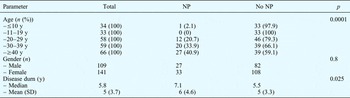
There was no statistically significant difference in the prevalence of nasal polyposis among patients with asthma versus allergic rhinitis (p = 0.65). Moreover, there was no statistically significant difference in the prevalence of nasal polyps in male versus female patients (p = 0.8) (Table I). However, there was a significant association between patient age and nasal polyposis prevalence (p = 0.001) (Table I). In addition, the duration of allergic rhinitis or asthma was significantly greater in patients with nasal polyposis than in those without nasal polyposis (Table I).
Patient characteristics

NP = nasal polyposis present; y = years; durn = duration; SD = standard deviation
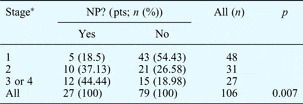
An increased prevalence of nasal polyposis was associated with an increased asthma severity (Table II). However, there was no association between nasal polyposis prevalence and allergic rhinitis severity (Table III).
Nasal polyposis prevalence by asthma severity stage

*From Global Initiative for Asthma guidelines: stage 1 = intermittent; stage 2 = mild persistent; stage 3 = moderate persistent; stage 4 = severe persistent. NP = nasal polyposis; pts = patients
Nasal polyposis prevalence by allergic rhinitis severity

NP = nasal polyposis; pts = patients; Mod = moderate
Patients with allergic rhinitis had at least one positive skin prick test result, from a test battery involving 16 common aeroallergens including grass, weeds, trees, mites, moulds, cats, cockroaches and feather. However, there was no significant association between nasal polyposis prevalence and skin prick test results.
Four (3.5 per cent) of the asthmatic patients with nasal polyps had anti-inflammatory drug sensitivity, and were categorised as stage three or four (i.e. moderate persistent or severe persistent) according to the Global Initiative for Asthma guidelines.
The identification of nasal polyps was based on direct observation. The severity of nasal polyposis was not assessed.
Discussion
In the present study, a high prevalence of nasal polyposis was reported in patients with either allergic rhinitis or asthma; about one-quarter of these patients had nasal polyps, a much greater proportion than previously reported. A study in a Greek population reported a nasal polyposis prevalence of 4 per cent.Reference Grigoreas, Vourdas, Petalas, Simeonidis, Demeroutis and Tsioulos 14 Another study in Rhode Island, USA, reported a nasal polyposis prevalence of 6.7 per cent in asthmatic patients and 2.2 per cent in rhinitis patients.Reference Settipane and Chafee 4 Another studyReference Braunstahl and Fokkens 20 reported a higher prevalence of nasal polyposis in asthmatic patients (10 per cent), while our study found a higher prevalence still (25.4 per cent). These differences might be due to environmental or ethnic variations.
The male-to-female ratio of nasal polyposis sufferers was approximately equal in our study. This is similar to Klossek and colleagues' findings.Reference Klossek, Neukirch, Pribil, Jankowski, Serrano and Chanal 5 However, other studies have shown a male preponderance.Reference Collins, Pang, Loughran and Wilson 21 , Reference Toledano Munoz, Herraiz Puchol, Navas Molinero, Garcia Simal, Navarro Cunchillo and Galindo Campillo 22
Allergic rhinitis was diagnosed on the basis of itching of the nose, rhinorrhoea, sneezing occasionally with stuffiness, and a positive skin prick test. Some of these symptoms are similar to those of nasal polyposis. However, we did not find any association between allergic rhinitis severity and nasal polyposis prevalence.
-
• The observed prevalence of nasal polyposis in asthma and allergic rhinitis patients was higher than in previous reports
-
• Nasal polyposis prevalence correlated significantly with asthma severity
-
• Nasal polyposis prevalence increased with age and disease duration
Our study found a significant correlation between nasal polyposis prevalence and asthma severity. Some previous studies have also found increased asthma severity in the presence of nasal polyps.Reference Ceylan, Gencer and San 17 , Reference Bavbek, Celik, Ediger, Mungan, Sin and Demirel 23 There is some evidence to support this association. The number of mast cells and the histamine content of polyps are much higher than in other tissues. Arachidonic acid generated mediators and cytokines such as interleukins (ILs) 5, 6, 8, 9 and 17A are also found in polyp fluid. The expression of adhesion molecules, with recruitment of eosinophils and derivatives such as eosinophilic cationic protein, is also abundant. These patients suffer from an altered breathing pattern and preferential mouth breathing concomitant with post-nasal drip. These events could lead to a consistent inflammatory reaction in the upper and lower respiratory tracts.Reference Braunstahl and Fokkens 20 , Reference Mygind, Dahl and Bachert 24 – Reference Tsicopoulos, Shimbara, de Nadai, Aldewachi, Lamblin and Lassalle 26 Eosinophilia seems to be the most important feature of nasal polyps. Some evidence indicates that the colonisation of Staphylococcus aureus superantigen in polyp tissue induces IL5 and local immunoglobulin E production; these products amplify eosinophilic inflammation. However, these changes are similar in atopic and non-atopic patients.Reference Bachert, Claeys, Tomassen, van Zele and Zhang 27 – Reference Fan, Wang and Takenaka 30 All of these mechanisms could explain the severity of symptoms in asthmatic patients in the presence of nasal polyposis.
Some evidence also supports the role of allergens in the pathogenesis of nasal polyps, especially indoor allergens.Reference Kirtsreesakul 8 , Reference Munoz del Castillo, Jurado-Ramos, Fernandez-Conde, Soler, Barasona and Cantillo 10 , Reference Muñoz-Del-Castillo, Jurado-Ramos, Soler, Fernández-Conde, Barasona and Cantillo 31 However, we found no differences in skin prick test allergen positivity, comparing allergic rhinitis patients with and without nasal polyps. This result was similar to our previous study on allergens in the same region.Reference Ahmadiafshar, Sepehri, Mousavinasab and Torabi 32
In the current study, the prevalence of nasal polyposis increased with patient age and disease duration, similar to previous studies.Reference Klossek, Neukirch, Pribil, Jankowski, Serrano and Chanal 5 , Reference Grigoreas, Vourdas, Petalas, Simeonidis, Demeroutis and Tsioulos 14 This indicates that the persistence of reactions in the respiratory tract may increase the chance of polyp development.
Several patients in our study were aspirin-hypersensitive and were classified as having either moderate or severe persistent asthma according to the Global Initiative for Asthma guidelines. This was similar to a study by Ceylan et al. Reference Ceylan, Gencer and San 17 Aspirin hypersensitivity is thought to be a risk factor for asthma severity.
Conclusion
We found a high prevalence of nasal polyps in our asthma and allergic rhinitis patients. Therefore, nasal polyposis should be considered a common disorder, and a comorbid factor, in these patients. Nasal examination, and appropriate management of nasal polyposis when present, is recommended in patients with asthma or allergic rhinitis.
Acknowledgement
This study was part of the graduate thesis of Dr Hamid Reza Farjad, and was supported by the Zanjan University of Medical Science. The authors would like to thank Drs Said Talaei and Omid Ebrahimi for their valuable help during the study, and Dr Nima Rezaei for his excellent advice in preparing the manuscript.