Introduction
The presence of a family member with cancer is a major life event, with the family members of cancer patients known to experience psychological, physical, and social as well as spiritual burdens. It has, therefore, been highlighted that the families of cancer patients are “second-order patients” and require treatment and care (Lederberg, Reference Lederberg and Holland1998).
Thiamine is, through its biologically active derivative thiamine pyrophosphate, a cofactor essential for glucose metabolism but one that cannot be produced in vivo, with the physiological store depending on intake from external sources. The store of thiamine within the body is depleted within about 18 days, and deficiency is likely to occur if a loss of appetite continues for a few weeks (Sechi et al., Reference Sechi, Sechi and Fois2016). Wernicke encephalopathy (WE) is a neuropsychiatric disorder known to be caused by thiamine deficiency. This disease is said to present with a classical triad of symptoms: impaired consciousness, ataxic gait, and nystagmus, and if detected early and treated appropriately with thiamine replacement therapy, it can be resolved without sequelae. However, the triad of symptoms are nonspecific and cases are often overlooked due to the low proportion of cases showing all three (Sechi and Serra, Reference Sechi and Serra2007). If the condition continues to be overlooked, Korsakoff syndrome can develop, resulting in irreversible brain damage.
Fatigue and depression are common physical and psychological symptoms among the family members of cancer patients (Braun et al., Reference Braun, Mikulincer and Rydall2007; Hudson et al., Reference Hudson, Thomas and Trauer2011; Johansen et al., Reference Johansen, Cvancarova and Ruland2018). However, although these symptoms are both symptoms of thiamine deficiency and thiamine deficiency-inducing symptoms, there is only one report to date on thiamine deficiency in family members caring for cancer patients (Onishi et al., Reference Onishi, Ishida and Uchida2019).
Herein, we report a case in which delirium was observed in a family member caring for a cancer patient, and as a result of detailed examination, WE was diagnosed. Appropriate treatment led to patient recovery without any sequelae.
Case report
The caregiver was a 71-year-old female whose husband had been treated with chemotherapy for gastric cancer and liver metastasis for 5 months, but whose condition had progressed. She and her husband had been told that chemotherapy would be discontinued two days prior to her visit to the “caregivers’ clinic” to which she was referred by the oncologist who was concerned with her psychological status due to the insomnia and depression she had been experiencing for several weeks. She had a history of diabetes mellitus and had been receiving vildagliptin 50 mg/metformin hydrochloride 500 mg combination tablets. No decline in memory or history of alcohol and drug dependence was observed.
Some giddiness was observed on entering the room at the time of the interview and she was unable to answer simple questions from the medical staff. She was suspected of a decreased level of consciousness, and when her consciousness level was checked, she could not state the date or perform calculations (serial seven). Neurologically, some disorientation was observed, but there was no sign of nystagmus. She was 146.7 cm in height, her body temperature was 36.7°C, she was 44.0 kg in weight (body mass index = 20.45), her blood pressure was 140/63 mmHg, and her pulse rate was 74 beats/min. Her family reported that she had been experiencing a loss of appetite and she had lost 10 kg since her husband was diagnosed with cancer.
Based on the above clinical findings, her psychiatric features fulfilled the Diagnostic and Statistical Manual of Mental Disorders, 5th edition, criteria (American Psychiatric Association, 2013) for delirium.
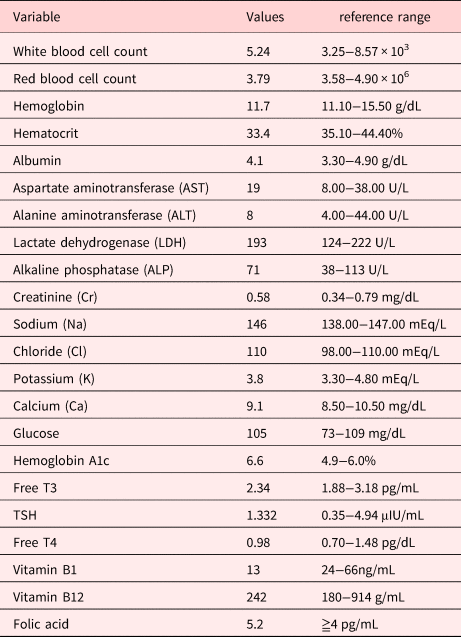
A blood sample was collected to investigate the cause of the delirium, but the test data showed no hypoglycemia. Further, no other abnormalities were found with regard to liver function, renal function, thyroid function, etc. that could explain her medical condition (Table 1).
Laboratory findings

Thiamine deficiency was suspected as the stores of thiamine in the body are depleted within about 18 days (Sechi et al., Reference Sechi, Sechi and Fois2016), and the patient had experienced a loss of appetite lasting 5 months and had lost 10 kg in weight. After intravenous injection of 100 mg of thiamine, her level of consciousness returned to normal in 1 h. Her serum thiamine level, as measured using high-performance liquid chromatography, was found to be abnormally low at 13 ng/mL (reference range: 24–66 ng/mL), whereas her serum vitamin B12 and folic acid levels were within the normal ranges. Based on these findings, she was diagnosed with WE.
In an interview after recovery from delirium, the patient complained that her general malaise had eased, but her depressed mood, decreased motivation, decreased appetite, sleep disorders, difficulty in concentrating, feelings of self-condemnation, and suicidal ideation continued for more than two weeks. She was diagnosed with depression and was given 15 mg of mirtazapine and 3 mg of aripiprazole. One week later, the above symptoms had improved. A consideration of these facts suggests that, in this case, the depression developed during the course of nursing care and as a result of a continued loss of appetite, with WE developing due to an insufficient intake of thiamine.
Oral administration of 100 mg of fursultiamine has since been continued as a treatment for thiamine deficiency. She has continued to care for her husband, but no deterioration in consciousness or depressive symptoms has been observed.
Discussion
A family member of an advanced cancer patient presented with delirium that arose during the course of care, and detailed interviews and examinations revealed WE. However, proper diagnosis and treatment allowed recovery without any CNS-related sequelae.
To our knowledge there have been no reports of cases of delirium in cancer patient caregivers. This report suggests that family members may also develop delirium as well as WE.
The present case showed a history of diabetes mellitus and the patient presented with impaired consciousness, so a differential diagnosis would be hypoglycemia. However, vildagliptin/metformin combination tablets rarely lead to hypoglycemia (Matthews et al., Reference Matthews, Paldánius and Proot2019). Treatment with glucose can lead to the further depletion of thiamine and symptoms may be exacerbated (Bhardwaj et al., Reference Bhardwaj, Watanabe and Shah2008). Therefore, thiamine should be given before glucose in cases in which a thiamine deficiency is suspected.
The patient's general malaise improved after intravenous thiamine injection. Fatigue is one of the symptoms of thiamine deficiency (Sechi and Serra, Reference Sechi and Serra2007), but the symptoms are nonspecific and can occur in relation to other illnesses. Although general malaise is common in the family of cancer patients and in patients with depression, it is also a symptom of WE, as in this case, so careful discrimination may be required.
In conclusion, staff involved in cancer care should pay attention to the level of consciousness of family members and perform screening when necessary. Family members who care for cancer patients should also be considered as having the potential to develop WE due to loss of appetite and nutritional problems associated with fatigue due to the care burden. Proper diagnosis and immediate therapeutic intervention are valuable in preventing WE-induced brain damage.