The legacy of communist rule has been invoked to explain a host of political, economic, and social outcomes, either comparing the varying legacies of state socialism within Eastern Europe and the former Soviet Union, or comparing the region to its Western European neighbors or the world more generally. Among numerous other phenomena, legacies of the old order are argued as critical for understanding privatization, levels of social and political trust, strength of civil society, constitutional development, variation in democratization, and electoral outcomes (Epperly Reference Epperly2011; Howard Reference Howard2003; Mishler and Rose Reference Mishler and Rose1997; Murrell and Yijiang Reference Murrell and Yijiang1993; Pop-Eleches Reference Pop-Eleches2007). Indeed, as the dust settled, Jowitt (Reference Jowitt1992) famously argued that whatever resulted from the turmoil of communist extinction would be shaped by the legacy of Leninist rule.
Recent years have witnessed a resurgence of careful attention to communist legacies and their lasting effects (Beissinger and Kotkin Reference Beissinger, Kotkin, Beissinger and Kotkin2014; Pop-Eleches Reference Pop-Eleches2015, Reference Pop-Eleches2007; Wittenberg Reference Wittenberg2015), and to this day, legacies are invoked to explain continued problems in the post-communist region, with the implicit reference point being Western Europe: policy makers, scholars, and citizens alike often suggest, explicitly or otherwise, that were it not for the pernicious legacy of communist rule, Eastern Europe would be doing much better.Footnote 1 In this article, I argue that references to a communist legacy (or legacies, depending) are by and large ill-defined, undertheorized, and—at least concerning political trust, the phenomenon analyzed here—lacking in explanatory power.
I build on and extend existing research regarding potential legacy effects of the communist experience, contributing to the research agenda on communist legacies in four ways. First, I take recent calls for an iterative and cumulative approach to the study of legacies seriously, incorporating the argument that a persuasive general account of legacies needs to focus on the individual level (Beissinger and Kotkin Reference Beissinger, Kotkin, Beissinger and Kotkin2014; Pop-Eleches and Tucker Reference Pop-Eleches and Tucker2011), while advancing this discussion with regard to both theory and data. Second, I highlight a number of ways scholars of transition—in the post-communist region and elsewhere—can better empirically analyze the issue of legacies. I argue for a consistent and sensible reference category that provides a strong test of a legacy hypothesis, and furthermore that without a theoretically grounded reference category defined ex ante, any discussion of legacies is problematic. Third, while analyses demonstrate a post-communist political trust deficit exists, I show exhaustively that this deficit cannot be explained through reference to any communist legacy working at the individual level, either between Eastern and Western Europe or among the post-communist states. Finally, I provide evidence that poor institutional performance, of the prosaic rather than legacy variety, accounts for the bulk of the trust deficit found in the region.
Political Trust and Legacies
During the first decade after the collapse of communism, there was a broad consensus regarding the “trust deficit,” the comparably low levels of reported trust that characterized the region. Far less consensus was reached regarding its causes, or whether it would continue to be a defining feature of post-communism (Catterberg and Morena Reference Catterberg and Morena2005; Letki and Evans Reference Letki and Evans2005; Luhiste Reference Luhiste2006; Mishler and Rose Reference Mishler and Rose1997, Reference Mishler and Rose1998, Reference Mishler and Rose2001). Political trust remains an important component of legacy discussions (Wittenberg Reference Wittenberg2015) and is a key test for understanding whether legacy arguments retain their importance. Legacy accounts consider political attitudes a phenomenon greatly affected by the communist experience, and the lasting effects of communism are expected to retain their importance in understanding political trust into the second post-communist decade.Footnote 2
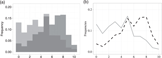
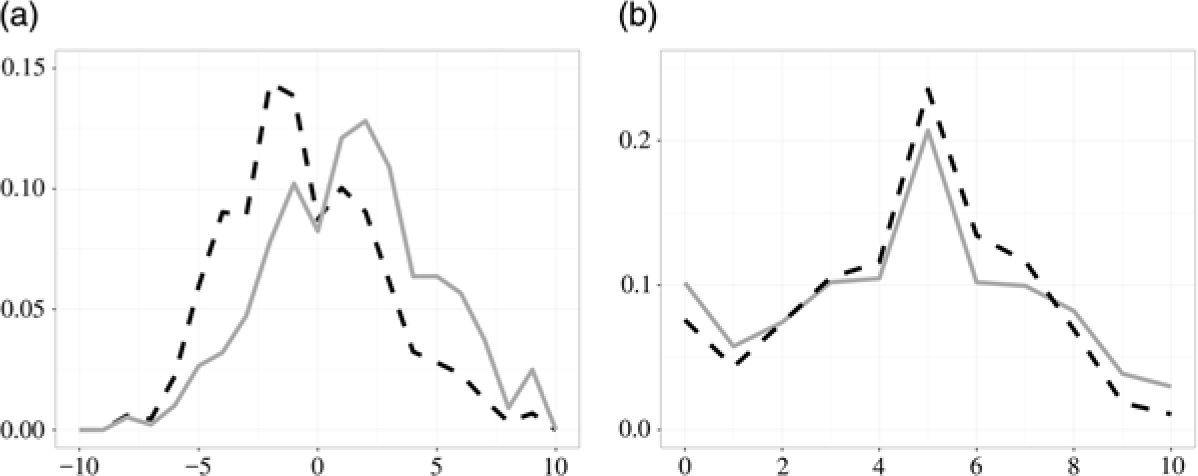
Figure 1 demonstrates that significantly lower levels of political trust continue to characterize the region when compared to Western Europe. Plot (a) in Figure 1 shows the distribution of trust in the legal system, while plot (b) shows trust in parliament (data are drawn from the 2002–10 waves of the European Social Survey [ESS]). Each consists of two overlapping distributions: solid gray lines show the distribution of post-communist observations and dashed black Western European. Both plots (a) and (b) show that aggregate levels of trust are significantly lower in post-communist countries: solid gray distributions in both plots are skewed left toward lower trust, while dashed black are skewed right toward higher values. Obviously, the deficit remains substantial. Whether this can plausibly be explained by a legacy of communist rule is the focus of the remainder of this essay.
Distribution of trust. Plot (a) shows the distribution of trust in the legal system across both Western and Eastern Europe. Plot (b) shows the distribution of trust in parliament. In both, solid gray lines represent post-communist observations, dashed black shows non–post-communist. Data are from the 2002–10 waves of the European Social Survey.

Reference Categories for Legacy Arguments
As is common in the discussion of legacies, when speaking of a post-communist trust deficit I implicitly assume the relevant reference category is Western Europe. However, explicitly discussing the relevant comparison and implied counterfactual is preferable, as it forces one to address whether the legacy suggests differences between states that did or did not experience communism, or among post-communist states; any discussion of communist legacies needs to first clearly specify the scope of comparison for the legacy effect, which can fall into one of two categories.
The first category supposes life under communism left lasting marks on politics and society in Eastern Europe and the former Soviet Union (FSU), and that these legacies make patterns of values, behavior, and institutions different in countries that experienced communism compared to those that did not (Beissinger and Kotkin Reference Beissinger, Kotkin, Beissinger and Kotkin2014). The second supposes that different aspects of the communist experience produce varying legacies across individuals or countries that experienced communism, and that as a result significant variation in outcomes should exist between post-communist countries (Ekiert and Hanson Reference Ekiert and Hanson2003). These two types of legacies are not mutually exclusive: it is entirely possible for there to be, for example, attenuated levels of trust in the post-communist region as compared to Western Europe, and for variation to remain within the post-communist region. Rather, these two potential types of legacies suggest both different mechanisms through which they affect outcomes and different causal pathways to examine.
A result of thinking explicitly about what form of legacy is relevant for the outcome of interest is that the reference group for comparison becomes much clearer for the first form of legacy and obvious for the second. In the second instance, the reference group is inarguably other post-communist countries or citizens, as the goal is understanding variation in legacy effects among post-communist states. If one aims to understand broader legacy effects of the communist experience in contrast to other regions, the reference group is not set by default. For most, Europe is the obvious answer: the overwhelming majority of post-communist states are located in Europe, had their reference points set to Western Europe both before and after communism, and are now integrated or integrating with the European Union.
The strongest objection to this decision involves the five Central Asian former Soviet Republics, with few historic or cultural ties to Europe and no chance joining the European project. This is also true, to a lesser extent, for the three former Soviet Republics located in the Caucasus, straddling the border of Europe and Asia. There are two responses to this objection. First: include these countries, make the rest of the world one’s reference point, and attempt to control for the vast differences between the pre-and post-communist experience in Europe and Asia. This is the route that Pop-Eleches and Tucker (Reference Pop-Eleches and Tucker2011, Reference Pop-Eleches and Tucker2017) take, though data limitations prevent their analysis from including more than a single Central Asian country. The second response limits analysis to European countries that experienced communism. Although either decision should flow from the specific question regarding legacies, in most instances and especially when the object is political values the latter choice is preferable, for three reasons.
First, the Central Asian experience before and during communism was vastly different than Central and Eastern Europe. In Central Asia there existed no pre-communist legacy of the nation-state as either an idea or reality. The creation of such was a significant project of the Soviet state, which attempted to solve this aspect of the “nationalities question” by constructing national identities in the region, often on clan-based ties (Smith et al. Reference Smith, Law, Wilson, Bohr and Allworth1998; Szporluk Reference Szporluk, Hajda and Beissinger1990).Footnote 3
Second, after the collapse of communism the non-European states were in vastly different situations politically and economically, both domestically and internationally. The distribution of various initial conditions at the collapse of communism underscores this, illustrating just how clearly non-European former Soviet Republics differ from European post-communist states, being underurbanized, reliant on agriculture, and significantly poorer and less educated (de Melo et al. Reference de Melo, Denizer, Gelb and Tenev2001). In addition, neither was there the possibility of “return to Europe,” nor the significant aid and attention given to the transition experience in Europe. Perhaps as a result of these factors, regime transitions in the region were minimal, and, with the exception of democratic blips in Armenia and Georgia (and later Kyrgyzstan), the non-European post-communist states have remained firmly nondemocratic since the collapse of communism.
The third reason is rather pedestrian, involving data issues. For most interesting outcomes for which legacies might be relevant, the quality of data in the European post-communist world far outpaces the quality in the Caucasus or Central Asia. This is especially true of political values: in the wider European context there are thorough, regularly conducted cross-national surveys on attitudes and values, allowing us to examine the phenomena over time and across the divide of Western/Eastern Europe.
If the goal is accounting for variation between the post-communist countries and elsewhere, restricting analysis to European post-communist states produces no problems in the sense of the generalizability of findings or widespread applicability to the post-communist experience. Additionally, restricting analysis at worst minimally impedes understanding potential legacies within the post-communist space that scholars have been primarily interested in, especially the many permutations of the Soviet/non-Soviet divide or form of communist rule (Kitschelt Reference Kitschelt, Hanson and Ekiert2002). Explicitly restricting analysis to post-communist states allows one to use a more theoretical and historically informed reference category for comparison, with the downside of excluding a handful of post-communist countries.
This downside, it should be stressed, is also present in studies not explicitly restricting analysis to European post-communist states, and instead using the world: in comparative case studies or cross-national data analyses, Central Asia is almost wholly missing.Footnote 4 Thus, any costs of explicitly and theoretically restricting analysis to the European post-communist states are also paid by most studies purporting to a broader analysis.
Focusing on Europe, however, is not only preferable for these reasons, but also because it is what most mean when they think of potential effects of legacies of the communist era. If a communist legacy is to mean anything, it has to mean that lasting effects of the communist era inhibit or produce some counterfactual scenario in which the legacy would not exist and the phenomenon being studied is thus different (Wittenberg Reference Wittenberg2015). A focus on political values such as trust in institutions makes this clear: to say, for example, that the experience of communism has created a “trust deficit” (Lovell Reference Lovell2001; Mishler and Rose Reference Mishler and Rose1997) by definition implies that there exist reference countries where—because they did not experience communism—trust is greater. If not, speaking of lower levels is meaningless: Lower compared to what? The logic of the legacy argument is then, implicitly, that were it not for the communist interruption the post-communist countries would have developed along a “normal” trajectory and look different (always better) than they do today. Instead, however, four to seven decades of communism stalled, reversed, or derailed (depending on your preferred metaphor) politics and society. In other words, without communism Eastern Europe’s development and, as a result, a panoply of its social and political phenomena would closely resemble Western Europe.Footnote 5 In their discussion of generalized trust, Mishler and Rose (Reference Mishler and Rose1997) make this explicit: the trust deficit they identify is a deficit when compared to Western Europe.
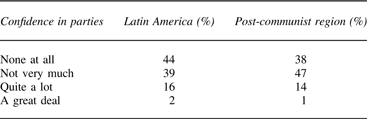
Table 1 further illustrates that the legacy of communism often only has meaning if the reference group, explicit or otherwise, is Western Europe. It shows two regional averages for each response category to the question analyzed by Pop-Eleches and Tucker (Reference Pop-Eleches and Tucker2011), “How much confidence do you have in political parties?” from a recent wave of the World Values Survey. It highlights that if one wants to speak of a communist legacy resulting in a trust deficit, Latin America (merely an example) cannot adequately serve as a reference category: results are highly similar across regions. In fact, the only significant difference are the rates for the two categories of no trust or not much trust. And here, the post-communist countries are doing better than Latin America.
Confidence in political parties

Note: Regional averages (of aggregated country averages) for Latin America and the post-communist region of the response categories to the question “How much confidence do you have in political parties?” Produced from the data used in Pop-Eleches and Tucker (Reference Pop-Eleches and Tucker2011).
Without a clearly defined and theoretically justifiable reference category, legacies are just-so stories accounting for regional differences in social, political, and economic outcomes that could either be the result of shared histories or random chance. This is most clear if one attempts to explain the results of Table 1 with some reference to a “Latin American legacy” that produces low levels of public trust and confidence similar to those in the post-communist region. While this could be an interesting historical explanation, perhaps the result of the nature of Iberian colonialism, it offers us little in the way of comparative analysis.Footnote 6 If each region’s peculiarities are explained by reference to its history, one is merely saying that different regions of the world are different because they’re different, not because some specific aspect of their shared history makes them different than a well-developed counterfactual. This is the equivalent to saying that the interesting parts of panel regressions are country fixed effects: while they can certainly tell us that there are differences among countries, they tell us little more. In experimental terms, this is the equivalent of multiple groups of individuals, each group having received a different treatment, and no control.
If, however, one has an historical explanation with a well-developed and plausible reference point, one can begin to formulate hypotheses about the nature of how the past might influence outcomes today. In the post-communist context, this is to say something along the lines of in the absence of communism, individuals in Prague or Budapest would today have political values similar to those in Vienna. This is, implicitly or otherwise, the counterfactual imagined by scholars, policymakers, and citizens alike.
Pathways for Individual Legacies
There are two main causal pathways through which legacies of the post-communist experience might remain salient for individuals in the region.Footnote 7 This pathway suggests outcomes influenced through the individual experience of having lived under communism, or second through the individual experience of having lived through its tumultuous collapse and subsequent transition (Pop-Eleches and Tucker Reference Pop-Eleches and Tucker2011). The first is most prevalent in the literature: living under communism affected how people related to each other and the state, and that lasting effects remain (Howard Reference Howard2003; Pop-Eleches and Tucker Reference Pop-Eleches and Tucker2017). The second suggests the breakdown of social structures and radical upheavals occurring during and immediately after the collapse of communism colored perceptions of those experiencing them for years after (McFaul Reference McFaul2002).
There are significant difficulties, however, in ascertaining which of these two individual explanations may be correct. Pop-Eleches and Tucker (Reference Pop-Eleches and Tucker2011) theorize that one way these might vary is temporally, as the first should recede gradually and the second fluctuate. This is unsatisfactory, however, as there is little reason to expect the salience of either should be independent of various political and economic conditions that vary temporally and cross-sectionally across Eastern Europe, as well as little reason to expect that memories of hard transition years would not fade in a slow, consistent manner as well. Put simply, not enough attention has been paid to ascertain through temporal differences which pathway it might be. A potentially more fruitful way is by examining variation across space, rather than time: the nature of the collapse and the difficulties of the transition varied significantly across the post-communist space, with religion playing a role in some places, ethnicity in others, and still others being a function of diffusion or elite-driven processes (Beissinger Reference Beissinger2002; Pfaff Reference Pfaff2006).Footnote 8
Regardless of difficulties differentiating between these two potential legacy effects, they are not mutually exclusive: life under communism may have attenuated levels of trust, and collapse may have furthered this. And, obviously, most anyone alive today who may be suffering from a communism-induced trust deficit also lived through the collapse of communism and its attendant difficulties, making the counterfactual individual rare.
Political Trust: The Legal System and Parliament
To examine the alternative (though not mutually exclusive) pathways of legacy effects, I draw on the most extensive source of survey data in the region, the ESS, conducted biannually in approximately two dozen European countries since 2002 (Jowell Reference Jowell2003). The ESS is “designed to chart and explain the interaction between Europe’s changing institutions and the attitudes, beliefs and behavior patterns of its diverse populations” (European Social Survey 2012b). The use of standardized fieldwork procedures and adherence to social scientific standards makes the ESS appropriate for cross-national research (Jowell Reference Jowell2003). The first round surveyed 21 countries, including four post-communist countries (Czech Republic, Hungary, Poland, and Slovenia). This number increased, with the 2008 survey covering 12 post-communist countries and the 2010 wave covering 11.Footnote 9 The survey is conducted by local social scientists in each country, and is the product of seven research centers across Europe (European Social Survey 2012a).
The two specific ESS questions I employ as dependent variables are trust in the legal system and trust in parliament. I include these two different institutions because they should gauge different aspects of popular political values, if those values do in fact vary significantly within individuals. This is perhaps clearest when one considers that trust in parliament is trust in a specific, apex, electorally accountable political institution whose composition varies over time. The legal system, by contrast, is far less concrete, comprising various institutions like courts, police, and prosecutors. This, combined with both the fact that constitutional review chambers are part of the legal system in most European countries but separate from the typical court structure, and that judicial bodies are unelected, means that these two political institutions are different. Furthermore, while these two variables are correlated (r = 0.6), they are not too highly correlated to think they fail to capture different concepts, and thus provide two similar but distinct snapshots of political trust.
Legacies between East and West
To assess individual-level legacy arguments one needs to examine how individual-level factors explain the lasting lower levels of political trust in the post-communist region. To test this I first employ hierarchical linear models of trust in the legal system and parliament with a split-sample design, fitting models to post-communist and Western European respondents separately, allowing me to assess if there is a clear differential effect produced by a given factor in Eastern as opposed to Western Europe.Footnote 10 If coefficients for a specific covariate are similar across groups, strong evidence exists that the individual-level characteristic in question is not a channel through which any communist legacy flows. If the intercept for the post-communist fit, however, is significantly smaller than Western Europe, evidence exists that such factors do not explain the deficit. An alternative but equivalent method would be to interact every covariate with a post-communist dummy, and assess how interactions affect covariates, with the dummy serving the role as the difference in intercepts; I turn to this method in later specifications. In all instances, I employ hierarchical (multilevel) models with intercepts allowed to vary by country (with models in the appendix including numerous country-level covariates).
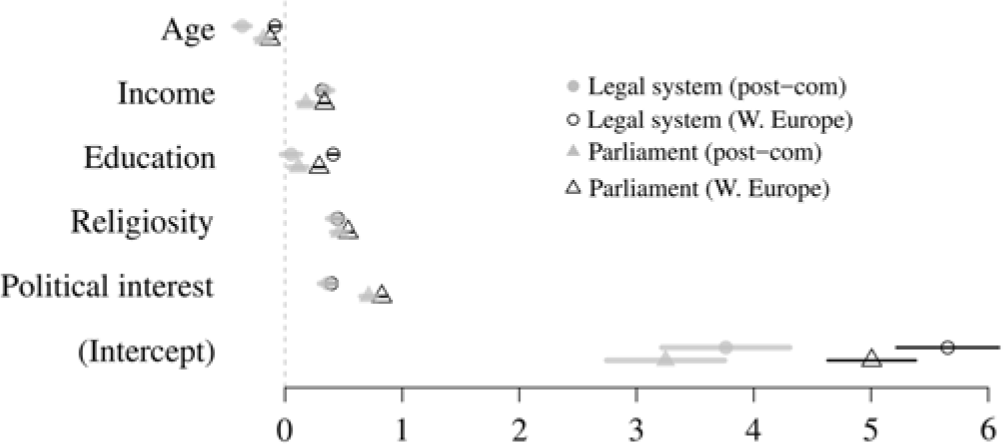
Figure 2 plots standardized coefficients along with 99 percent confidence intervals from hierarchical linear models with trust in legal institutions and trust in parliament the respective dependent variable. Visualizing the relative effects of a two-standard deviation change in each covariate across the split samples aids in interpreting statistical and substantive differences across data. Given the goal is comparison across groups rather than model fit per se, this strategy is used in the rest of the article (typical regression tables are in the appendix). Post-communist coefficients are gray in Figure 1, Western European black; circles show models of trust in the legal system, triangles trust in parliament.
Political trust. Ropeladder plot showing standardized coefficient estimates for each covariate of four hierarchical linear models. Gray represents model estimates from post-communist data, black from Western Europe. Circular point estimates are models of trust in legal institutions, triangles are models of trust in parliament.

As noted, in no instance is a coefficient both statistically and substantively different across the East/West divide: income, religiosity, and political interest visibly overlap for both trust in legal institutions and parliament. Age is comparable for trust in parliament, but statistically distinguishable for trust in legal institutions: older Eastern and Western Europeans are less likely to trust the legal system, but the difference is substantively minimal, as these are standardized coefficients reflecting a two-standard deviation change for each covariate. Similarly, education is slightly different, with more educated Western Europeans reporting slightly higher levels of trust in the legal system. In neither instance, however, is the difference of a two-standard deviation change in the covariate even half a point on the 11-point dependent variable (the standard deviation of which is 2.6). Furthermore, the fact that income and education are not different for post-communist and Western Europe across both dependent variables makes them unlikely candidates as consistent pathways for legacy effects, in that it is implausible that the communist legacy works for only certain forms of political trust.
One possible response to these results, and attempt to save the argument that strong communist legacies explain the post-communist trust deficit, is to argue that the negative effects of communism are more pronounced for those exposed longer to state socialism (Pop-Eleches and Tucker Reference Pop-Eleches and Tucker2017). This argument in some sense blends the two types of legacies, suggesting that there may be differences among post-communist citizens, but that these differences are less pronounced than differences between post-communist citizens and those who never lived under communism.
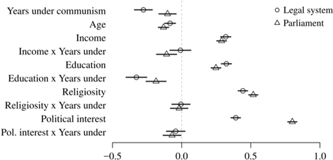
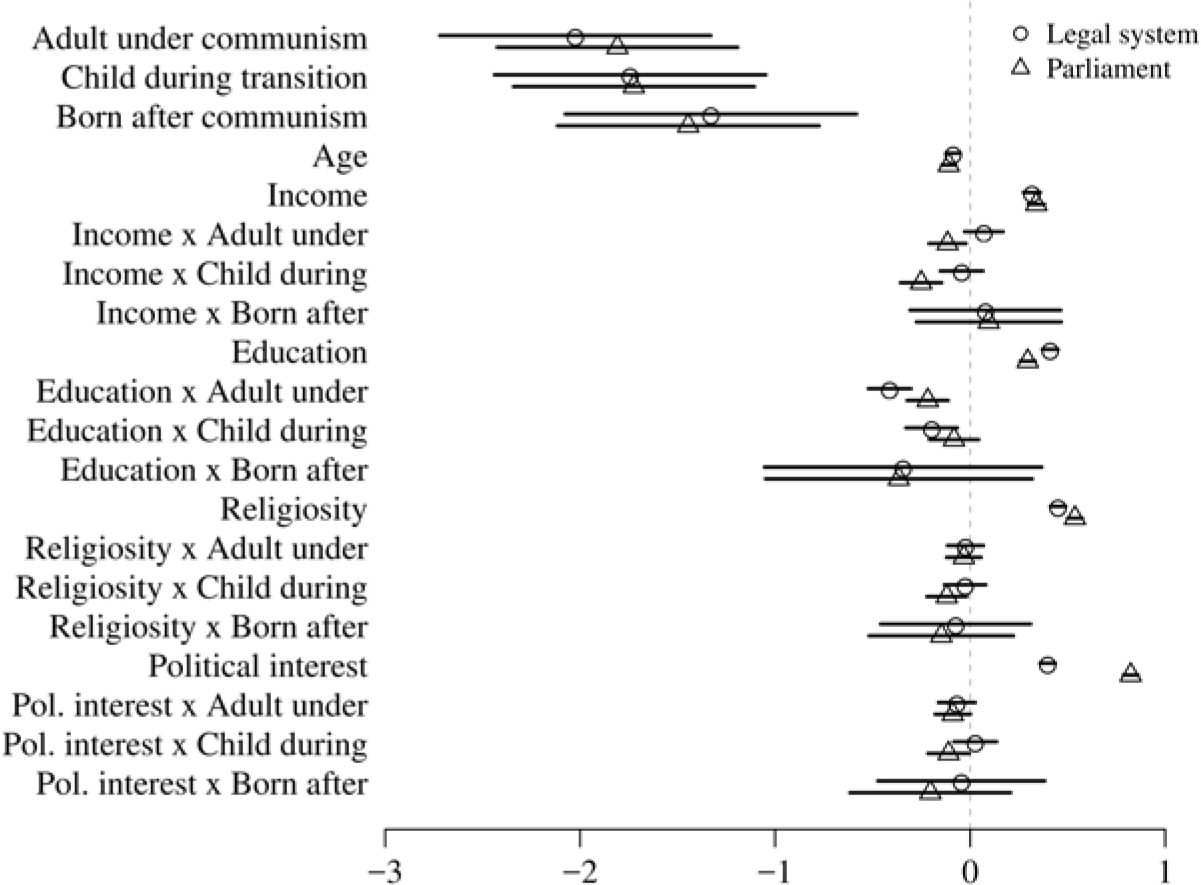
Figures 3 and 4 present results of models assessing precisely this. Figure 3 uses the absolute years under communism for each individual, while Figure 4 looks at potential cohort effects of whether a person was an adult under communism, a child during the transition years (and thus potentially more strongly effected by the transition), or born after the collapse of communism. Rather than just modeling whether a person lives in a post-communist country or not, results are broken down across possible specifications modeling an individual’s relationship to communism, and interacted with each substantive covariate (with the exception of age, as it measures almost exactly the same thing for those in the post-communist data).
Years under communism. Ropeladder plot showing standardized coefficient estimates for each covariate of two hierarchical linear models with interactions. These examine the effects of time spent under communism. Circular point estimates are models of trust in legal institutions, triangles are models of trust in parliament.

Cohort effects. Ropeladder plot showing standardized coefficient estimates for each covariate of two hierarchical linear models with interactions. These examine cohort effects for when a post-communist citizen was born. Circular point estimates are models of trust in legal institutions, triangles are models of trust in parliament.

Interpreting the results of Figures 3 and 4 is fairly straightforward: to assess whether years under communism or one’s communist cohort has an effect, one need simply compare the coefficient for the interaction with the coefficient for the noninteracted covariate (if the interaction effect is roughly zero or not statistically significant it suggests there is no difference between how the characteristic operates in Western and Eastern Europe). Being standardized, the effect of a two-standard deviation change is assessing a 30-year increase in years spent under communism.
Looking at the effect of income on trust in legal institutions, in Figure 3 it has a positive effect, completely unaffected by the number of years spent under communism (the coefficient for the interaction is almost exactly zero, with wide confidence intervals). The same effect is true in Figure 4, with the coefficient for each cohort’s interaction with income indistinguishable from zero. In fact, the only covariate with an interaction statistically distinguishable from zero in Figure 3 for both trust in legal institutions and parliament is education: those who spent more time under communism and are more highly educated are more likely to exhibit slightly lower levels of trust. Again, however, even including the lower bounds of the confidence intervals around this estimate, the effect is substantively minimal, hardly able to account for the large post-communist trust deficit (as evidenced by the negative effect of years under communism). Similar but even weaker results are found in plot Figure 4: being an adult under communism slightly weakens the positive effects of education for trust in both the legal system and parliament, whereas being a child during or born after communism is not consistently associated with education attenuating trust. For every other covariate in both years under and cohort specifications, consistent interactions are impossible to find, further suggesting there is no clear communist legacy on political trust.
Figures 2 through 4 provide strong evidence for the argument that there is no clearly identifiable individual-level legacy of communism associated with decreased political trust. This is true when one accounts for demographic changes or changed individuals. Figure 2 shows that the estimated effects of demographic factors are highly similar in both Eastern and Western Europe. Figures 3 and 4 show that using more complicated conceptions of post-communist citizenship, predicated on time spent under communist rule or one’s cohort, produce no clear results. These suggest that any specific legacies of communism are not working through channels in which they change the way individuals respond to political, economic, or social life.
Legacies among Post-Communist States
The second conception of communist legacies suggests the nature of communism has differential effects among countries experiencing communism. Results in section 3 suggest that one shouldn’t expect significant among-legacies: it would be surprising if the communist experience were salient enough to produce differences among the post-communist countries but not between them and Western Europe. As such, the discussion of these results is cursory, as they follow clearly from those in the preceding text. Note, that although results presented here employ a former Soviet/nondichotomization, no substantive differences are observed if one uses a nonbinary measure for the form of communist rule following the logic articulated by Kitschelt (Reference Kitschelt, Hanson and Ekiert2002), or the balance of power during regime transition following the logic articulated by McFaul (Reference McFaul2002) (discussions of each are found in the appendix).
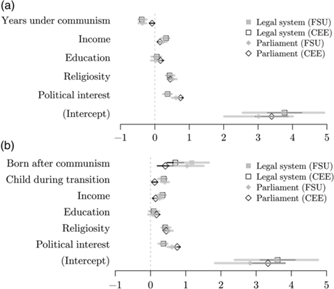
Plots in Figure 5 demonstrate unequivocally that there is no evidence to be found in the data for a communist legacy affecting Eastern Europe and the former Soviet Union differently: results are so similar that most every plotted coefficient overlaps enough to make differentiating among those countries that experienced the more thorough state socialist project found in the FSU and those in the Eastern European satellite states nearly impossible. Plots (a) and (b) examine the question of whether effects differ based on experience with communism, looking at years lived under communism and cohort effects, respectively. Results strongly confirm that individual sociodemographic factors do not have any different role, as coefficients are alike across subsets.
Political trust within the post-communist region. Two plots of hierarchical linear models showing differences across the Soviet/Central and Eastern European post-communist divide. Plot (a) assesses years spent under communism and plot (b) assesses cohort effects. In each, squares denote trust in the legal system and triangles denote trust in parliament. Solid gray shows the FSU and hollow black shows Central and Eastern Europe.

Alternative Explanations for the Trust Deficit
Analyses in the previous sections suggest that it is difficult to account for individual-level trust deficits by reference to a communist legacy: individual-level demographic characteristics do not associate with political trust any differently in Eastern Europe. Despite this, a gap remains, as in all models post-communist citizens have a lower baseline trust response (captured by the lower intercepts for the post-communist samples). Results here suggest one of two potential explanations: either legacy effects occur at the institutional, rather than individual, level, or lower levels of trust simply reflect institutions performing worse in post-communist Europe. In the former formulation, some institutional commonality exists as a legacy of communism, which is associated with correspondingly low levels of trust. In the latter, lower levels of trust are just rational responses to poorly performing institutions that are, in fact, less trustworthy; thus, they are not legacies of “living in” post-communism (Pop-Eleches and Tucker Reference Pop-Eleches and Tucker2017), but a function of living in a state with poor institutional performance.
Despite talk of institutional legacies, a significant problem exists with attributing institutions of the post-communist region as being in some way legacies of the previous order. Multiple contributors to the recent volume edited by Beissinger and Kotkin (Reference Beissinger, Kotkin, Beissinger and Kotkin2014) stress this previously underdiscussed point: although states in the region may share similar political institutions, without showing how these are a direct and unique result of communism, they need be treated as institutional explanations unrelated to communism per se. State exploitation and shoddily built political and economic institutions that are endemic to the region are examples of this, as they can easily be attributed to the lack of political competition, not simply a legacy of the previous order (Frye Reference Frye2010; Grzymala-Busse Reference Grzymala-Busse2007).
The two main institutional legacy pathways forwarded are formal and informal institutions directly resulting from the communist experience or its collapse. Examples of the former offered are many of the lasting economic institutions created by Stalinist economics, such as diverse intrafirm supply chains and spatial misallocation (Gaddy Reference Gaddy, Beissinger and Kotkin2014).Footnote 11 An additional plausible institutional feature of the collapse that might have lasting effects is the nature of privatization, especially with regard to satisfaction with economic outcomes and political trust. Informal institutions that are legacies of communism and its collapse, however, are typified by the “protest repertoires” established in years before and during the collapse, and social networks attenuated by years of communist rule (Ekiert and Kubik Reference Ekiert and Kubik1998; Howard Reference Howard2003).Footnote 12
Besides the lack of a clear mechanism, three factors mitigate against the proposed institutional legacy explanation. First, the empirical results presented in previous sections analyzing trust demonstrate no differences by region, time lived under communism, or cohort. If the causal pathway by which institutional legacies affect individuals was by conditioning their views using subjective processes such as economic outcomes, one should expect these to vary either within the region or between individuals. The FSU has had poorer economic performance than Eastern Europe, and Stalinist economic institutions were much more pervasive in the USSR. Yet the results of Figure 5 clearly demonstrate no differences among regions. Similarly, results of these and Figures 3 and 4 show that how long an individual lived under communism or age cohort are not consistently related to trust. This is counter to the empirical implication of the hypothesized causal mechanisms by which institutional legacies are salient, as these legacy effects should be more robust for those who experienced a greater portion of their life under communism and/or experienced the transition years.
The second factor mitigating against the idea that any institutional legacy attenuates political trust in the post-communist world is the fact that neither generalized trust (trust in other people) nor trust in the European parliament are different in Eastern and Western Europe. Plot (a) in Figure 6 shows the distribution of generalized trust, while plot (b) shows trust in the European parliament.Footnote 13 In each, solid gray shows post-communist Europe, dashed black shows Western.
Generalized trust and trust in the European Parliament. Plot (a) shows the distribution of generalized trust. Plot (b) shows the distribution of trust in the European Parliament. In both plots, solid gray represents post-communist observations and dashed represents Western European. Data are drawn from the 2002–10 waves of the European Social Survey.

While the plots in Figure 6 do not provide conclusive evidence against institutional legacies, they mitigate against this explanation as opposed to the poorly performing institutions alternative. The reason for this is that it is far less plausible that some institutional legacy exists that only attenuates political rather than generalized trust and, in fact, only trust in domestic institutions. These results—similar trust in other people, similar trust in the European parliament—suggest rather that it is some aspect of domestic institutions that produces lower levels of political trust in post-communist Europe.Footnote 14
The third factor that suggests the post-communist trust deficit is a function of poorly performing institutions, rather than some communist legacy, is that a significant portion of the deficit can be explained once one accounts for the quality of institutions. To examine this question of varying institutional quality I take two paths. First, I include a covariate capturing institutional quality.Footnote 15 Second, I choose three divergent post-communist countries and examine whether what we know about the quality of their legal institutions maps onto empirical results. Results strongly suggest that it is institutional quality, not some legacy of communism, that accounts for variation in trust.
Figure 7 illustrates both of these mechanisms for assessing the empirical implications of the poorly performing institutions argument against a post-communist legacy working at the institutional level. Plot (a) includes the World Bank Governance Indicators Rule of Law measure in the model assessing trust in legal institutions and the Voice and Accountability measure for trust in parliament.Footnote 16 When one includes the Rule of Law measure, which seeks to capture the extent to which people have “confidence in and abide by the rules of society, and in particular the quality of contract enforcement, property rights, the police, and the courts,” the residual difference between Eastern and Western Europe dissipates: confidence intervals around the intercept for each model overlap for the first time (World Bank 2013). For reference, the dotted lines are confidence intervals around the intercept when the governance indicator covariate is not included.
Quality of institutions. Two plots showing estimates for models assessing the poorly performing institutions argument. Plot (a) shows results of hierarchical linear models capturing the quality of institutions. Plot (b) shows estimates for single-country (linear, nonhierarchical) models of Estonia, Latvia, and Bulgaria.

While such a kitchen sink index is obviously an imperfect measure of the effectiveness or fairness of the legal system, the fact that including an imperfect measure explains the remaining variation between post-communist and Western Europe suggests that the trust deficit is a function of the relatively poor quality of post-communist legal systems rather than any communist legacy. This is further underscored by the fact that including the Voice and Accountability measure does almost nothing to shrink the gap between the intercepts of the post-communist and Western European models (despite it being highly correlated with the rule of law measure, r = 0.9). No governance indicator adequately captures the performance of parliament, and while this measure includes such and is the closest fit, it seeks to capture perceptions “of the extent to which a country’s citizens are able to participate in selecting their government, as well as freedom of expression, freedom of association, and a free media” (World Bank 2013). The fact that so much unrelated to parliamentary performance is included suggests that no clear effect should be expected, which is in fact what the models demonstrate.
Plot (b) in Figure 7 seeks to assess quality of institutions in the opposite manner: rather than using data on the quality of the legal institutions, it plots the results of three models of trust in legal institutions in three divergent post-communist countries. Estonia is widely considered to have the best-performing legal system (and institutions generally) of all post-communist states, whereas the Bulgarian legal system is regarded as severely problematic (Popova Reference Popova2012). Latvia falls somewhere in the middle, neither an example of exceptionally good nor bad reform (Freedom House 2016). A legacies argument would predict that Estonia and Latvia are highly comparable, given that their economies, political institutions and classes, and demographics were affected almost identically after they were incorporated into the Soviet Union, and in fact share nearly identical pre-communist legacies as well (de Melo et al. Reference de Melo, Denizer, Gelb and Tenev2001). Additionally, any account focusing on the legacy of either the form of communist rule (Ishiyama Reference Ishiyama2015; Kitschelt Reference Kitschelt, Hanson and Ekiert2002) or the nature of the transition away from communism (McFaul Reference McFaul2002) would predict highly comparable results for these two states. It is unclear what a legacy argument would predict with regard to Bulgaria: it is far more agrarian than the Baltic states, but also did not suffer as much under direct Soviet control (the inability for the legacies argument to make clear predictions is an argument against its utility, rather than its existence). If differences result from the quality of institutions, however, the empirical predictions are clear: intercepts for best-of-class Estonia should be higher than Latvia despite their identical legacies, and far higher than basket-case Bulgaria. Plot (b) demonstrates exactly this: Estonia’s estimated intercept is more than a point higher than Latvia’s, and 2.5 points higher than Bulgaria’s. In no case are 99 percent confidence intervals close to overlapping.
In this section four new—albeit preliminary—empirical implications were presented: results of each mitigate against the argument for communist legacies, and are instead consistent with the argument of poorly performing institutions. Generalized trust and trust in European institutions are indistinguishable across the East/West divide, and including a covariate that at least poorly captures the performance of the legal system results in the residual difference between post-communist and Western Europe to dissipate. Finally, results of analyses of three post-communist countries that observers view as having differing quality of legal systems map precisely to what a performance-based explanation predicts. These bolster the results of sections 3 and 4: a deficit exists, but evidence strongly suggests it is not a function of communist legacies.
Conclusions
This article has four key implications for the study of post-communism. First, I contribute to recent work advocating a consistent approach to legacies, taking the call to cumulative work on legacies starting from comparable premises seriously (Beissinger and Kotkin Reference Beissinger, Kotkin, Beissinger and Kotkin2014; Pop-Eleches and Tucker Reference Pop-Eleches and Tucker2017; Wittenberg Reference Wittenberg2015). In doing so, I extend the analysis of individual legacy effects to broader sets of data and different forms of political trust, as well as suggest better modeling strategies for determining any individual-based legacy effects. Second, I build on the existing framework, arguing that an explicit, historically plausible reference category is required. Without such a counterfactual, asking about the legacies of communism is nonsensical. The most salient reference category for post-communist Eastern Europe is Western Europe, as it has a number of advantages, not least of which its status as the implicit reference category for scholars, policy makers, and citizens alike; the ubiquity of the “return to Europe” trope makes this clear. Additionally, any potential drawbacks it has are shared by any other reference groups, a result of data limitations in Central Asia and (to a lesser extent) the Caucasus.
The third contribution is providing further support that there continues to exist a post-communist trust deficit while showing that such a deficit is not the result of any individual-level legacy of communism. These results hold in a host of model specifications, including those where the analysis is extended to complicated forms of post-communist citizenship. To assess whether such a deficit is a function of an institutional-level legacy of communism, I look to four empirical implications. All are consistent with a poorly performing institutions argument, and combined they argue strongly against any institutional legacy argument. Finally, results show there is scant evidence for variable legacies among the post-communist states, be these differences modeled as years spent under communism, cohort effects, status as a former Soviet republic, form of communist rule, or experience with the transition away from state socialism.
The combination of these results calls into question legacy effects for political trust, or that there exists a “post-communist citizen” whose interaction with the state differs significantly from her Western European counterparts. Much as the state socialist project failed to create “socialist man”; it appears that it also failed to create “post-communist man.” The broader implication here for the study of legacies is that scholars should question accounts arguing that any outcomes in the region that are less than expected or observed in Western Europe are a result of fundamental differences in individuals resulting from the communist experience. The agenda for legacy research—at the very least that which involves political values such as trust—needs to also assess differences in institutional arrangements that might account for continued outcomes that are comparably worse than in Western Europe.
In doing so, however, scholars need be cognizant of the fact that institutions that differ are not necessarily, or even usually, a direct “communist legacy.” As Frye (Reference Frye, Beissinger and Kotkin2014) points out, without showing clearly how the institution in question is a direct result of communism rather than just an institutional arrangement common in the post-communist space, one cannot speak of it as an institutional legacy of communism per se; it is incumbent on researchers advocating communist legacy arguments to lay out explicitly how something a legacy of communism, rather than authoritarian rule, underdevelopment, or poorly performing institutions. A preliminary examination of just this issue is offered here, offering persuasive evidence against an institutional legacy explanation: the implications of models of political trust are not consistent with such an explanation, and four further empirical implications strengthen an explanation grounded in the far more prosaic issue of poorly performing institutions, a trait the post-communist region shares with most post-authoritarian and postcolonial states around the globe. If it is the case that suboptimal outcomes in the post-communist space are a result of poorly performing institutions, an additional and important implication is the need to reassess the question of legacies, and instead more carefully focus on how institutions—in post-communist Europe and beyond—affect political trust.
Supplementary material
To view supplementary material for this article, please visit https://doi.org/10.1017/ssh.2019.5