Introduction
Long-term care (LTC) systems that arrange care for people with chronic care needs face significant economic and demographic pressures in Europe. In particular, the expected growth of the sixty-five-plus age group by 68 per cent to 133 million in 2050 is a pressing issue (Muenz, Reference Muenz2007). Against this background, social policies promoting self-reliance for long-term care needs are becoming the norm. Even countries with extensive LTC systems are restricting access to services by introducing user-pay principles, budget ceilings and tightened eligibility criteria. Instead of relying on public services, citizens are encouraged to find care arrangements within their own networks, in the voluntary sector, or on the market.
This ‘surrender of public responsibility’ marks a clear break with ‘universal’ welfare schemes developed in the post-war era to reduce social risks such as family care dependence (Gilbert, Reference Gilbert2004). Note that equal access to services was an ideal; in reality, citizens lived under unequal circumstances (Vabø, Reference Vabø2011). The basis of universalism, however, lays in viewing care as a social right, an entitlement of citizenship. In contrast, the current trend towards a less formal conception of care rights, with an emphasis on selective assistance, seeks to entrench individual responsibility (Cox, Reference Cox1998). While protection of the most vulnerable remains an integral part of public long-term care, it is no longer the default option, but a ‘safety net’.
In contrast to the vast literature on welfare state expansion, less is known about the mechanisms of welfare state retrenchment (Pierson, Reference Pierson1996). For instance, we do not know whether tightening access to LTC will reduce state expenditures as citizens may apply for related social services instead (Jordan, Reference Jordan2010). The operational costs of restricting access may also be greater than any savings achieved through reduced use. How LTC recipients themselves cope with retrenchment is also unknown. Do they search for alternative means to receive the care they need? Is their coping based on practical or moral considerations? If they do find alternatives, what shifts in responsibility are involved? How are these negotiated?
This article examines client experiences of welfare state retrenchment in long-term care in the Netherlands. We first outline the policy background of the current cutbacks. Based on a telephone survey of 500 respondents and thirty face-to-face interviews, we then review the different care-seeking strategies of elderly and disabled persons in response to retrenchment of public LTC. As affected individuals mostly turn to their families, we focus on their (re-)negotiations with relatives. In our conclusion, we assess the extent to which recent reforms have led to the return of the family in long-term care, and the attendant effects on care recipients’ experiences of autonomy.
Policy background
The Netherlands is known for its extensive rights to care and its services-led dual health care system (Pavolini and Ranci, Reference Pavolini and Ranci2008). In addition to the National Healthcare Insurance (ZVW), there is a comprehensive public scheme to cover non-insurable expenditures related to long-term care. The AWBZ, or the General Exceptional Medical Expenses Act of 1968, covers care functions such as nursing, personal care and support with daily living. The ideal of alleviating the burden on family members was an explicit aim in the allocation of public LTC (VWS, 1966: 16).
Nevertheless, the extent of AWBZ coverage and the development of a universal LTC system was controversial from its inception. The Christian Democratic and Conservative parties pointed to the possible substitution effects of broad LTC services; later on, the Left – inspired by the anti-psychiatry movement of the 1970s – grew critical of institutional settings and professional dominance (Tonkens, Reference Tonkens1999). While the AWBZ initially provided institutional care, it was increasingly extended to care at home, thereby moving towards a social model of disability (Barnes, Reference Barnes and Shakespeare1998; Oliver, Reference Oliver1996).
AWBZ legislation witnessed thorough-going reforms in the late 1990s and 2000s to create more flexible care markets in response to a growing variety of care needs. The introduction of market principles assumed a greater level of individual responsibility, with recipients of long-term care expected to act as informed, critical and assertive consumers (Mol, Reference Mol2006). The Ministry of Health (VWS, 1999: 50) expressed the need for clients to be more active in managing their own care needs:
Primarily, we plea for more demand-oriented services in the whole system, with a full position for the (individual) client (no longer a passive subject but an actively engaged player).
Care providers had previously been contracted to provide comprehensive care. With the introduction of market principles, care was split into several ‘care functions’ such as nursing and personal care that could be purchased separately, allowing for greater competition between care providers. Such demand-oriented home care allowed for a wider coverage of needs. Moreover, the new Personal Budget (PGB) gave LTC clients the option to privately purchase care on the market. This cash-for-care scheme aimed to both provide greater choice and to contain costs, with privately purchased care estimated to be on average 25 per cent cheaper (Kaaij and Huijsman, Reference Kaaij and Huijsman2008). But due to its popularity, the PGB created new care markets, including the monetisation of previously unpaid informal care (Grootegoed et al., Reference Grootegoed, Knijn and Da Roit2010; Kremer, Reference Kremer2006).Footnote 1
Between 2000 and 2003, the LTC costs of the public system rose from 3.5 to 4 per cent of GDP (Eggink et al., Reference Eggink, Pommer and Woittiez2008) – high compared to other European countries and, without reforms, predicted to rise to 8 per cent by 2050 (Comas-Herrera et al., Reference Comas-Herrera, Wittenberg, Costa-Font, Gori, Di Maio, Concepcio, Pickard, Pozzi and Rothgang2006; OECD, 2011). Workers’ premiums for the collective LTC system can add up to 340 euros monthly. Even then, user-pay principles, health care funds and state finances are needed to pay the remaining 40 per cent of the costs. According to the Ministry of Health, the AWBZ's unintended expansion has resulted in excessive claims and has made people overly dependent on public aid (VWS, 2008: 5):
By the state taking over too many responsibilities from people, citizen participation has increasingly declined . . . Individual responsibility [for LTC] should be returned [to citizens].
To create more civic responsibility for long-term care, contain expenditures and combat ‘welfare dependency’, the Dutch government passed the Social Support Act (WMO) in 2007. The WMO promotes ‘self-reliance’ – introducing as a positive term for disabled and elderly people who can manage ‘on their own’ without professional help. But in practice, disabled and elderly people often cannot manage on their own; ‘own’ in their case therefore means their ‘own network’.
The renewed emphasis on informal care is present in other European countries as well, the ‘Big Society’ agenda in the UK perhaps being the most prominent (Alcock, Reference Alcock2010; Kisby, Reference Kisby2010). As with the Big Society, the Dutch government's underlying assumption in the WMO is that many LTC clients receive care that they do not really need, and that untrained informal care-givers can provide this type of care. The WMO moreover assumes that people have a social network, are able to articulate their care needs and arrange for assistance. The responsibility to arrange for care in one's own social network is believed to enhance one's self-reliance. The WMO also suggests that all citizens can support their compatriots with care needs. In practice, however, we know that mostly female relatives perform informal LTC (Boer and Keuzenkamp, Reference Boer and Keuzenkamp2009).
In sum, we see a clear shift from public to private responsibilities for LTC in the Netherlands, with the previous generous scheme being replaced by targeted services. The message of the 2007 Social Support Act is normative, as it explicitly promotes independence from public services. Hence autonomy is no longer realised by receiving welfare aid or consuming it by choice, but by relying on one's ‘own strengths’ and that of active citizens (Tonkens, Reference Tonkens, Newman and Tonkens2011).
Welfare state retrenchment: a case study
Our study of client experiences with the retrenchment of long-term care focuses on the effects of the so-called AWBZ-pakketmaatregel. This reform, enacted between 2009 and 2010, entails the tightening of access to one specific AWBZ home care function: practical support for elderly and disabled persons in their daily living. It includes personal aid with shopping, administration, making social contacts, structuring the day and/or group-based activities, such as day-care for the elderly (i.e. not their personal care or nursing).
The AWBZ-pakketmaatregel entailed two core changes. First, it discontinued the daily living support for promoting social participation. Second, it categorised disabled and elderly people as having mild, moderate or severe care needs. These new categories are domain-related, such as mobility, and are assessed independently of the type of disability. Those in the mildest category can no longer count on support with daily living. This resembles retrenchment measures in other European countries, such as in the UK, where critical needs have been prioritised over other needs in the provision of home care (Glendinning and Wilde, Reference Glendinning, Wilde and Rostgaard2011) and, more recently, adult day care centres, that offer social and recreational activities for the elderly and disabled in a group setting, have been closed by several city councils.
The new legal divide in the Netherlands not only affects future applicants, but also current clients. After a re-classification of 230,000 legitimate clients, approximately 120,000 had their support with daily living reduced; 60,000 were cut off entirely. The people most frequently affected by the reform included the elderly using day-care, psychiatric patients and persons with cognitive disabilities (in contrast to individuals suffering from chronic illness and physical impairments) (CIZ and HHM, 2008).
Affected clients thus need to switch from public to private care arrangements, while local authorities – under the aforementioned 2007 Social Support Act – have been made responsible for facilitating the social participation of those in need.Footnote 2 The WMO is a typical framework law; allowing for a local variation of welfare provision (Trydegård and Thorslund, Reference Trydegård and Thorslund2001). To carry out these responsibilities, municipalities receive additional funding from the state, though the decentralisation of LTC encompasses cutbacks.Footnote 3 Municipal help related to one's daily activities in and outside the home is generally limited to support with informal care and/or making referrals to the voluntary sector.Footnote 4 To ease the transition for elderly and disabled persons, a special foundation (MEE) has received funding to assist people in their search for alternative care.
As the Ministry of Health (VWS, 2010: 1) stated in an evaluation of the reform, its objective was to reduce access to public LTC:
The introduction of the AWBZ measure in 2009 has led to a reduction in the number of people that use support with daily living [i.e. public LTC]. Thus the measure has had the intended effect.
The AWBZ reform differs markedly from previous reforms as it explicitly replaces the right to care (AWBZ) with care favours that need to be negotiated with local authorities (WMO). We focus on this measure as it combines all the factors by which we define ‘retrenchment’, namely: (i) tightened LTC eligibility for existing and future clients, (ii) an explicit goal of cost containment and (iii) a strong normative appeal to greater self-reliance. The retrenchment of public services can also imply the marketisation of care. But, in practice, purchasing care on the market is not an option for most AWBZ clients who, on average, have low incomes (Woittiez and Sadiraj, Reference Woittiez and Sadiraj2010).
Autonomy
The debate on the changing public-private boundaries of long-term care usually focuses on the providers – and not the recipients – of LTC. However, the willingness of persons to accept care is of equal importance to the success of any care arrangement (Daatland and Herlofson, Reference Daatland, Herlofson, Lowenstein and Ogg2003). In negotiating personal care arrangements, expectations to receive and felt obligations to provide care have to match (Finch and Mason, Reference Finch and Mason1993). Asking relatives for care when it has not been offered can upset relationships and harm one's reputation. Even in cases where family members do feel responsibility, requesting care can undermine the flexibility of providing aid voluntarily, which Finch and Mason (Reference Finch and Mason1993) call the ‘donor right’. Although this inequality of power is not necessarily a one-way street as the recipients of care may offer care-givers status or money (Kittay, Reference Kittay1999), accepting long-term care does come with concerns regarding autonomy.
The feeling of being in control over one's life is often considered essential to the quality of life of disabled and elderly people (Bowling, Reference Bowling, Mollenkopf and Walder2007; Boyle, Reference Boyle2008; Rabiee and Glendinning, Reference Rabiee and Glendinning2010; Rummery, Reference Rummery2009). Client and patient movements have indeed been central in advancing LTC schemes that enable disabled persons and people with LTC needs to live autonomously. There is, however, an inherent tension between receiving care and preserving autonomy (Fine and Glendinning, Reference Fine and Glendinning2005; Tronto, Reference Tronto1993). In the realm of care, autonomy has to be understood as a form of ‘relational autonomy’ (Mackenzie and Stoljar, Reference Mackenzie and Stoljar2000; Reindal, Reference Reindal2010; Verkerk, Reference Verkerk2001) – the ability to control or influence decisions and express personal choices and values in interactions with the care-giver (Boyle, Reference Boyle2008). The relational autonomy of elderly and disabled people can be severely constrained when they cannot choose the type of care relationship. This is particularly true when they no longer have the means to remunerate informal care and/or opt for professional care. Our study therefore critically examines retrenchment in relation to negotiations of care needs and autonomy.
Methods
We base our findings on a survey conducted in the city of Rotterdam and face-to-face interviews held between January and September 2010 in Rotterdam and five other Dutch cities (Haarlem, Utrecht, Amersfoort, Zwolle and Dordrecht). The latter was part of a larger research project on the Social Support Act (WMO). We received ethical approval for both studies by the city councils; for the personal interviews, we arranged that critical, unresolved care needs would be reported to the responsible local authority with the respondent's consent.
For the survey and interviews we selected people whose entitlement to support for daily living had been reduced by the AWBZ reform and who authorised their names and addresses to be transferred to the municipality (since we have no data on those who did not give this permission, we cannot generalise our results to all affected clients). We expect that people who did not give permission include individuals who do not, or no longer, consider support with daily living necessary due to improved health or access to privately funded care, as well as people who avoid being cared for.
Survey
The Rotterdam survey sought information on the consequences of reduced care, how affected individuals dealt with these consequences, and whether and how they searched for alternative (public or informal) care. Most questions were close-ended, with different answer categories. To reduce non-response, all potential respondents or representatives of clients received a letter announcing and explaining our telephone survey. Of this group (1,461 persons), 1,367 persons were called. We first asked if they had received notification from the authorities that their access to care had been reduced, or that they had noticed that they received less care. Of the respondents, 358 (26 per cent) answered ‘no’ to both questions, at which point the session ended because they did not fit the selection criteria.Footnote 5 There are a number of possible reasons why respondents claimed their care was not reduced while according to our information it was. First, their actual use of care may have differed from what was assigned to them. Respondents were sometimes also confused over which type of care we meant, as many received different types of care. Before asking if they received notification that their access to care had been reduced, clients were asked if they handled their care administration themselves. If a relative or representative helped them, we asked if this person could answer the survey questions. In 53 per cent of the cases, the representative or relative of the client answered the questions. Other non-response reasons were refusal (8 per cent) and technical/non-contact (wrong telephone number or number not in use) (29 per cent). Most respondents said the reason for their refusal was a health problem (45 per cent). As our aim was to conduct 500 survey interviews, no further respondents were approached after the 500th interview.Footnote 6
Face-to-face interviews
We also held thirty in-depth, face-to-face interviews with disabled and elderly persons facing reduced care to see how they now met their care needs. We selected individuals whose entitlements to daily support had been more than halved despite their conviction that they required this care. We aimed for a wide age distribution to capture the variety of care needs. We selected twenty potential respondents per city and requested their participation (120 persons in total), of whom six denied their cooperation and eighty-four could either not be reached or did not belong to the target population. We omitted respondents who did not or no longer perceived their allotment of care as appropriate. When we asked them why this was, the most common replies were that day care did not meet their preferences (it was usually requested by a professional or relative) or they lacked the energy to take part in activities. Regarding individual assistance, the most frequent answer was that the client's health had improved.
The final sample included respondents with problems managing their daily lives due to old age (9), cognitive disability (8), psychiatric need (7) and physical constraints or chronic illness (6).Footnote 7 Their ages ranged from ten to ninety-one; in six cases a parent served as a spokesperson.
The interviews were semi-structured and consisted of open-ended questions on the following topics: understanding of the AWBZ reform, its quantitative and qualitative impact, care-seeking strategies and moral values regarding professional, family and voluntary care. At the end of the interview, we posed some hypothetical dilemmas regarding alternative care-seeking strategies. In the analysis, we used a text analysis program (AtlasTi) to code the different (public versus private) care-seeking strategies. The public route was infrequently taken; one respondent had the financial means to purchase care on the market, and eight people turned to the local authorities for help (which, as we will see, was unsuccessful in most cases). Most respondents considered the private route as the only option. Here we coded their negotiations with family members for signs of resistance or acceptance. But as the first category was predominant, we integrated sub-codes to distinguish the different techniques used, such as ‘masking’ and ‘hinting’. Finally, we analysed the relationship between increased family care and perceived autonomy for half of our respondents for whom this shift took place.
Findings
Prior to the AWBZ-pakketmaatregel, survey respondents had received support with daily living on the basis of their physical constraints (24 per cent), needs related to old age (21 per cent), a chronic disease (16 per cent) or psychological problems (13 per cent). They had received care and support to help them engage in daytime social activities other than work or education (42 per cent), to do their financial or other administration (42 per cent), to go for a walk/outside (39 per cent), to visit government agencies (37 per cent), to plan their week (29 per cent) and/or to find and maintain social contacts (20 per cent).
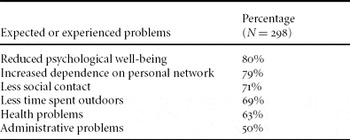
We asked survey respondents if they had experienced problems due to reduced care. This was the case for 45 per cent of our respondents, while 15 per cent anticipated problems in the future. One-third (34 per cent) stated that they neither experienced nor expected any problems. Of the rest, 3 per cent said they had experienced problems in the past and 3 per cent answered they did not (yet) know. The most frequently mentioned problems are listed in Table 1.
The most frequently mentioned problems

We asked clients if they had searched for alternative care. Surprisingly, only 20 per cent of survey respondents said they had done so. However, there was a discrepancy between searching for and actually receiving alternative care. Of all respondents, 15 per cent reported receiving care that partially replaced the lost care and 24 per cent received care that fully replaced it. Alternative care was most often (54 per cent) provided by family members. Although 39 per cent of our survey respondents had found alternative sources of care, half of these respondents (51 per cent) stated that they were still in need of additional care. Most survey respondents (61 per cent) reported not receiving any alternative care. Of these clients, 62 per cent stated that they needed it.
Of the small group that searched for alternative care (eighty-five respondents), the majority sought help from their families, followed by professional organisations and then voluntary organisations. The MEE foundation, designated to mediate between affected clients and the local authorities, was only mentioned nine times. Only two respondents sought direct contact with the municipal central service point. One third of those who did not search for alternative care stated that they did not need it; a quarter claimed that they did not know how and where to search for it. But as we will see below, it was not only a lack of information but also low expectations which made respondents less inclined to turn to the municipal authorities for help.
Turning to the local authorities
In the in-depth interviews, we asked respondents about their understanding and expectations of the reform and its institutional changes. Interview respondents understood the intentions behind the reform, i.e. that long-term care has become a private responsibility. Most were highly sceptical of the Social Support Act (WMO) – installed to ‘buffer’ LTC retrenchment – and considered going to the local authorities as a ‘dead end’. Respondents, moreover, doubted the ability of the available publicly financed alternatives to meet their (perceived) needs. A ninety-one-year-old woman explained why she had not approached the MEE Foundation:
I know that I could request MEE to seek for alternatives, but they cannot do anything for you. They just give advice, but they do not have financial resources to support you. They can only provide you with free care.
By ‘free care’, she is referring to voluntary care. Although interview respondents appreciated the altruism of volunteers, most rejected voluntary care as a valid alternative. In some cases, their needs were considered too complex for volunteers. Most considered the lack of a long-term contractual commitment a problem. As a fifty-year-old woman with psychiatric disorders stated:
Voluntary care is an informal agreement, so it lasts until one of the parties decides to end it. If the volunteer decides to opt out, you just have to accept that. You can never rely on it.
Voluntary care does not deliver the safety of ‘being in control’ over one's own care arrangement. Affected clients regarded voluntary care as ‘an extra’ rather than a substitution for public care, as it cannot provide the solid basis for living ‘independently’.
Our interviewees showed a general distrust of the local authorities. Their ‘needs’ were no longer recognised at the national level (within the AWBZ) and they expected that at the municipal level they would similarly not be eligible for public funds (through the Social Support Act). A parent of two autistic children (aged twelve and fifteen, who had previously received help with daily planning) stated:
Under the new rules, they [AWBZ authorities] reason that the problems my children are having are unrelated to their autistic syndromes but are part of their ‘puberty’, as they have become teenagers. And that all parents have difficult teenagers, so it is our parental task to deal with it. I cannot see why they would reason differently under the Social Support Act.
For the few interviewees who did turn to the municipality for help, the initial contact proved particularly meaningful. When this was unsatisfactory, our interviewees renounced approaching the municipality again. Disappointment was fuelled by unmet expectations, which were fed by municipal brochures, magazines and websites inviting citizens with special needs to participate in the community. As a mother of a ten year-old disabled boy recalled:
I've read the Social Support Act flyers and they all talk about ‘participation for all’, but when I called them [the local authorities] to arrange a weekly sports activity for my disabled son, they told me they don't have anything that is suitable for him.
Receiving ‘no’ for an answer informs people that they have to ‘manage on their own’. Nevertheless, interviewees felt that they had the right to express their disappointment over the lack of local alternatives. This was true for both respondents who realised that their needs are no longer ‘recognised’ at any level of government, and those who expected municipal aid to make up for their lost care.
Turning to the family
The survey revealed that people who do search for alternative care often turn to their families. Simultaneously, they experience the increased dependence on their personal networks as a problem. How do these people renegotiate care-giving and receiving with relatives? In the following section, we first examine our interview respondents’ normative beliefs regarding the limits of family care. We then reflect on the different strategies used to ‘manage’ needs in relation to family care boundaries. Finally, we relate shifting family responsibilities to care recipients’ perceptions of autonomy.
We asked people to define their ideas about the limits of family care by responding to fictional storylines in which people had lost their support for daily activities. One storyline, that of a middle-aged man (Tim, forty-two), was particularly meaningful as it exemplified the boundaries of ‘acceptable’ family involvement. The storyline goes as follows: ‘Tim has a psychiatric disorder. He cannot do his own finances and was supported in his administration [i.e. personal affairs] for many years. Due to the AWBZ reform, he no longer receives public aid. Tim can choose to do three things: object to the decision, ask a relative for help, or try to do it himself. What do you think Tim should do?’
The majority of interviewees said that Tim, out of self-respect, should try to do it himself first – despite the storyline framing it beyond his abilities. A fifty-year-old woman with a psychiatric disorder argued:
Yes, you should first try to do it yourself, just endure and if you do not succeed right away, then maybe you will the second time. And, if not, then you can ask a relative.
Asking relatives for help was only legitimate once he had tried to substitute the lost public aid himself. In other words, affected clients first need to ‘prove’ to others that help is necessary. Even when the grounds for asking for help were sound, a process of negotiation followed. A thirty-seven-year-old interviewee with a psychiatric disorder ventured:
I do not think you should force your relatives to do it [the finances], I mean, if you decide on it with mutual consent than it is different, but, in this case, his family may think it goes far beyond their responsibilities.
The discomfort involved in turning down a request for help is considered a form of enforcement. This is considered unacceptable, even if the situation is created by an external factor, in this case reduced access to public aid.
In the fictional case, where the parent offers administrative help, Tim struggles to accept the offer. He fears it might harm his relationship with his parent. Again, the majority considered this a valid doubt, showing a clear preference for a more distanced care relationship with relatives. A fifty-one-year-old interviewee with a cognitive disability stated:
Yes, I can see myself in this situation. Because it is his father, and I think that my father would become overly involved, and then I would feel very controlled. I think that if an outsider performs the job, it is different, more neutral. With all due respect for the father, I do not think I would want that.
Letting a relative do one's administration was viewed as particularly threatening as family members can gain (too) much control over one's life. Interviewees thus wished for ‘intimacy at a distance’: if relatives could gain control over non-care related decisions, our interviewees preferred to maintain greater distance.
We found that affected clients did not consider welfare state retrenchment a legitimate reason to place greater demands on their families, though some clearly desired their families to help. In the interviews, we found different mechanisms to conceal and display the message of need, which we refer to as masking and hinting.
Masking need
None of the affected clients regarded it as the family's duty to solve the care gap resulting from the AWBZ reform. Some interviewees felt inhibited to inform their relatives about their reduced care. As an eighty-five-year-old man explained:
I didn't tell my relatives that I lost the care. Why should I? I mean, they will only start worrying about me. And I don't want that. Besides, I don't think it is my children's responsibility to substitute public care.
By not telling one's relatives, relatives cannot enquire whether help is needed. In fact, this is the goal. While this may seem contradictory – especially given that most affected clients perceived a need for care – it protects them from having to negotiate new boundaries and expectations with their relatives.
Another way to mask the need for care is to pretend that all is well despite the lost care. This strategy occurs most frequently among adults and the elderly living alone. An eighty-eight-year-old woman told us about her reduced social contacts and time spent outdoors, but when asked how she reports this to her relatives she stated:
My children ask me how I am getting on [since the day-care loss], and then I tell them I am just fine, but inside I feel devastated.
Again, the purpose is to show to her relatives that no help is needed – or rather expected – from them.
Though our interviewees experienced problems, this did not automatically mean that they conveyed a message of need to their relatives. This partly stems from their resistance to greater reliance on the family. They also wanted their relatives to be able to offer care on their own volition – that is, to help without the feeling of obligation, as will become clear below.
Hinting at need
In principle, some of our interviewees welcomed (more) family care. To convey a message of need, they used subtle hinting techniques so as not to offend their relatives and to uphold their self-reliant image. These could consist of general complaints about the cutbacks to care and the gaps that arise from it. An eighty-four-year-old woman who wanted her children to do more for her tried to convey her message of need subtly:
I would like my children to visit me more often now. I do ask for it, or, at least, I tell them something needs to be done, so that they can offer to do it, and see me at the same time. But they do not always get it, and, as you see, my lamp is still not working.
The woman points out that a broken lamp needs to be repaired by ‘someone’, whereas what she really values is increased social contact with her children. Clearly, relatives do not always understand or act upon subtle hints. Our interviewees did not blame their relatives for this, tracing their lack of response to their busy lives with children and careers.
Another strategy was to not discuss the new needs for care. Accepting additional family care is less problematic if renegotiation is not required. As a twenty-two-year-old woman with a chronic illness stated:
Well, we do not really talk about it [the reform], I mean, my mother just does more for me now, it is the only solution we see for now. And she does not complain about it. For me, now I think it is all right, but I am aware that it makes me more dependent on my parents.
The young woman is aware of the extra burden for her mother, but because care is taken over as a natural thing and her mother ‘does not complain’, it does not result in a moral conflict. This natural way of taking over lost care mostly occurs in families where the exchange of care is to be expected from past conduct. The Matthew principle therefore applies: those affected clients who already received a lot of family care prior to the reform will receive even more when public services are cut back. Other factors such as residential proximity and age can also predict why, in some cases, care is taken over as a ‘natural thing’. But it is most likely that retrenchment of public long-term care will increase women's unpaid labour, as women typically have more time and inclination to care (Waerness, Reference Waerness1984).
Renegotiating family care and perceived autonomy
Accepting help from relatives affects perceptions of autonomy and dependency among recipients of care. Our interviewees often stressed what they could still do themselves, rather then pointing to what they could not do. The far-reaching involvement of relatives in one's affairs was considered intimidating. As a thirty-two-year-old woman with a physical disability explained:
Well, I think I lost part of my independence now that my family takes on more responsibility for me. I am 32 years old, and I am like a mollycoddle to both my parents. I don't want to be like that. To me, to be autonomous, means I can be at home by myself, and not bothering others with my problems.
Interview respondents did not consider expressing care requests to professionals as ‘bothering others’. As they are not part of one's inner social circle, professional care-givers pose lesser threats to one's autonomy; with them one can discuss needs in a more business-like manner. With relatives, control over care-giving is more complicated and embedded within existing social relationships. A thirty-six-year-old woman with a cognitive disability explained:
Well, my family now comes in at times that fit them well, or have available, they do not understand that with my disability, structure and rest is very important. My previous professional carer tried to assist me in renegotiating the familial assistance, but they still do not understand my needs, and I find it hard to tell them, because they will think of me as being ungrateful.
This shows that feelings of gratitude are more complicated in informal care relations. Moreover, interview respondents often stated that their relatives do not fully understand the nature of their disability, disorder or chronic illness. These findings support the notion of a ‘request scruple’ that people with care needs have vis-à-vis members of their private networks (Linders, Reference Linders2010). Interview respondents who faced greater dependence on family members resisted entanglement with the burden of gratitude.
Conclusion: the autonomy trap
Based on a survey of 500 affected clients in Rotterdam and thirty in-depth interviews in six Dutch cities, this article examined client experiences of reduced access to publicly funded long-term care, focusing on a recent reform of the AWBZ (General Exceptional Medical Expenses Act).
Of our survey respondents, 60 per cent were experiencing or anticipating problems due to reduced access to care. The most frequently mentioned problems were reduced psychological well-being and increased dependence on private networks. The latter is striking in light of the Social Support Act's stated intent: to encourage self-reliance. Our findings suggest that accepting (more) informal care reduces the sense of autonomy of people with care needs. Due to conflicting public and private definitions of autonomy, clients face an autonomy trap. If trying to remain autonomous means not asking for the care one needs to buffer reduced public aid, one ends up becoming less self-reliant than before the reforms.
The survey found most respondents stating that they have unfulfilled care needs. Yet, most of them do not search for alternative care. Of the survey respondents who had found an alternative to (partially) substitute the reduced public care, this care was most often provided by relatives. Very few survey and interview respondents turned to the local authorities for help. The interviews revealed widespread scepticism of what they had to offer: referrals to ‘free’ (i.e. voluntary) care rather than individually tailored professional care. As interview respondents did not consider voluntary care an adequate solution, the only option left was to turn to the family.
The face-to-face interviews revealed that most affected clients resist (further) family involvement in their care. Here the normative belief that relatives should not be responsible for substituting public aid was an important inhibiting factor. Rather than asking relatives for help directly, many of our interview respondents employed strategies to hint at their needs more subtly. They did this to respect their relatives’ right to offer care freely. Some of our interview respondents consciously concealed their needs from their relatives, or portrayed themselves as capable of covering for the loss of public care on their own, a strategy called ‘acting as if’ (Finch and Mason, Reference Finch and Mason1993). Their normative beliefs meant that they considered direct requests of help threatening to their autonomy and reputation, as well as disrespectful to family members, on whom most did not want to structurally depend. Nor did the severity of care needs change the desire to limit dependence on family care.
When (more) care was given by relatives (which happened in half of the survey and interview cases), our respondents reported feeling less autonomous. The ability to reciprocate gifts (of care) clearly matters here. People with disabilities and the elderly often feel that they have nothing to offer in return or do not have the resources to do this. This can cause a burden of gratitude towards their (mostly female) relatives, which is experienced to a much lesser extent under publicly financed care (Galvin, Reference Galvin2004).
We did find a difference between seeking and finding alternative care arrangements. While only 20 per cent of all survey respondents said they searched for alternative care, 24 per cent were receiving care that fully replaced the previous publicly financed care. In such cases, greater informal care responsibilities may have been negotiated without the respondents’ knowledge. Future research is thus needed to examine negotiations on family care responsibilities using a network perspective. Our findings are, moreover, based on a snapshot in time; longer-term studies are needed to understand the longer-term effects of LTC retrenchment on affected clients’ well-being and social participation. We found that, in particular, the elderly and young disabled adults experienced the reform as a threat to their quality of life. The elderly whose day-care was discontinued experienced severe social and/or emotional loneliness, in two cases to the extent that they no longer wished to live. Young disabled or chronically ill adults living in the parental home saw their increased dependence on family caretakers as preventing them from achieving a more independent future. These signs of decreased quality of life require further study to inform future LTC policy-making.
Autonomy clearly mattered to our interview and survey respondents. The difficulty of maintaining an ‘autonomous identity’ lies in the mixed messages people receive from social policy. Recent policy posits ‘self-reliance’ as the ideal – attained by refraining from claiming publicly financed care. The use of this term, however, reflects an imaginary gap between the individual and society that neglects people's interdependency (Elias, Reference Elias1987).
For people with care needs, an autonomous identity means not being overly dependent on one's own social network. In contrast to the policy definition of self-reliance, our survey and interview respondents viewed state support as a means to remain autonomous. The ‘return of the family’ in long-term care is thus resisted by disabled and elderly persons, who carefully ration or filter requests for care to their family and friends. The most problematic aspect of this filtering of needs is that they can become invisible. Affected individuals may be able to hide their problems for a long time. However, challenges may grow in severity over time, creating insurmountable obstacles to their participation in society. Based on these findings, we can conclude that making people more autonomous, self-reliant or engaged in society is not attained by reducing state obligations to provide care to its citizens. A more thorough and uniform recalibration of the welfare state is needed to establish citizen−state partnerships that bridge people's experiences and policy ideas of ‘what counts’ as autonomy.
Acknowledgements
We wish to thank Kirstein Rummery for comments on an earlier version of this paper and David Hymans for editing our text. The financial support of the NICIS Institute, the Dutch Ministry of Health, and ten Dutch City Councils is gratefully acknowledged.