Mastitis in dairy cattle is the most prevalent disease, and is responsible for losses of milk production and reduction of milk quality.
Staphylococcus aureus is perhaps the most important pathogen involved in bovine mastitis and is common in Polish dairy herds (Bystroń et al. Reference Bystroń, Bania, Lis, Molenda and Bednarski2009; Kot et al. Reference Kot, Piechota, Wolska, Frankowska, Zdunek, Binek, Kłopotowska and Antosiewicz2012b; Szweda et al. Reference Szweda, Schielmann, Frankowska, Kot and Zalewska2014). Mastitis caused by Staph. aureus is the result of production of several virulence factors, that can contribute in different ways of pathogenesis. The virulence factors produced by Staph. aureus can be divided into different groups, including degradative enzymes, cell wall-associated adhesins, and superantigenic toxins. The differences in pathogenicity of Staph. aureus strains could result from geographical distribution and from host- and tissue-related characteristics (van Leeuwen et al. Reference Van Leeuwen, Melles, Alaidan, Al-Ahdal, Boelens, Snijders, Wertheim, van Duijkeren, Peeters, van der Spek, Gorkink, Simons, Verbrugh and van Belkum2005). The numbers and combination of virulence genes may be important contributions to pathogenic potential of Staph. aureus strains (Zecconi et al. Reference Zecconi, Cesaris, Liandris, Daprà and Piccinini2006). High number of Staph. aureus genotypes present in bovine herds worldwide has been studied to develop better strategies of treating mastitis. However, molecular data on Staph. aureus causing bovine mastitis in Poland remain scarce. The aim of this study was to examine the presence of 30 important virulence genes encoding adhesins, proteases and superantigenic toxins in 124 of Staph. aureus isolates and to determine the genetic profiles specific for Staph. aureus causing subclinical mastitis in cows in eastern Poland.
We investigated the presence of seven genes encoding different adhesins to determine if they may be involved in binding of Staph. aureus to the epithelial cells of the cows mammary gland. Staphylococcal proteases are important virulence factors, which can cleave host proteins and allow the transition of Staph. aureus cells from an adhesive to an invasive phenotype, and that's why the presence of the three serine protease-encoding genes was investigated. Although the genes encoding exfoliative toxins are primarily associated with human Staph. aureus strains, we also investigated the presence of these genes in our isolates because it is not fully understood whether these toxins are also produced by animal strains.
We also investigated the presence of the genes encoding the superantigenic toxins, which play an important role in modulating the host immune response and would promote the persistence of Staph. aureus in bovine mammary gland.
Materials and methods
Bacterial isolates
A total of 124 Staph. aureus isolates from subclinical bovine mastitis milk samples were used in this study. The diagnosis of mastitis was made on the basis of clinical examination of the udder by the veterinarian. Additionally, a quarter was identified as infected when somatic cell counts (SCC) increased above 200 000/ml (Malinowski et al. Reference Malinowski, Lassa, Kłossowska, Markiewicz, Kaczmarowski and Smulski2006). SCC were measured with Fossomatic™Minor (Foss, Denmark).
All isolates were collected in 2007 and 2008 in the eastern part of Poland. The methods of identification of bacterial isolates as Staph. aureus were described previously (Szweda et al. Reference Szweda, Schielmann, Milewski, Frankowska and Jakubczak2012, Reference Szweda, Schielmann, Frankowska, Kot and Zalewska2014).
Isolation of DNA
Genomic DNA from the Staph. aureus isolates was extracted by using the Genomic Mini DNA kit (A&A Biotechnology-Gdynia, Poland) according to the manufacturer's protocol. 2·5 µl of the total extracted material from each test sample was used as a template DNA for PCR application.
Detection of virulence-associated genes by PCR
Primer sequences for adhesin genes were used according to Tristan et al. (Reference Tristan, Ying, Bes, Etienne, Vandenesch and Lina2003), for protease and toxic shock syndrome toxin-1 genes according to Ote et al. (Reference Ote, Taminiau, Duprez, Dizier and Mainil2011), for A and B enterotoxins according to Park et al. (Reference Park, Fox, Seo, McGuire, Park, Rurangirwa, Sischo and Bohach2011), for C, D and E enterotoxins according to Becker et al. (Reference Becker, Roth and Peters1998), for enterotoxin H according to Monday & Bohach (Reference Monday and Bohach1999), while genes for G, I, J, K, L, M, N, O, P and Q enterotoxin were detected using primers described by Bania et al. (Reference Bania, Dąbrowska, Bystron, Korzekwa, Chrzanowska and Molenda2006).
The primers were synthesised by DNA-Gdańsk (Poland). The method described by Tristan et al. (Reference Tristan, Ying, Bes, Etienne, Vandenesch and Lina2003) was used to the detection of genes: cna, fib, fnbA i fnbB, ebps, bbp, eno encoding for the adhesins such as collagen-, fibrinogen-, fibronectin A- and B-, elastin-, bone sialoprotein-, laminin-binding proteins, respectively. The thermal cycling conditions for detection of genes encoding protease (etA and etB) included predenaturation at 95 °C for 4 min, 35 cycles of denaturation at 95 °C for 0·5 min, primer annealing at 56 °C for 0·5 min and extension at 72 °C for 1 min. The primer annealing at 59 °C was used for the detection of genes coding the remaining proteases (etD, splA, splE, sspA). A 5-min extension at 70 °C was performed at the end of the final cycle. The detection of genes coding the enterotoxins A to E was performed using the following cycling conditions: predenaturation at 95 °C for 10 min, 30 cycles of denaturation at 95 °C for 0·5 min, primer annealing at 58 °C for 45 s and extension at 72 °C for 1 min. A 10-min extension at 72 °C was performed at the end of the final cycle. PCR method described by Bania et al. (Reference Bania, Dąbrowska, Bystron, Korzekwa, Chrzanowska and Molenda2006) was used to amplify the genes coding the enterotoxins G to Q, while the gene coding the toxic shock syndrome toxin-1 was detected in accordance with method described by Ote et al. (Reference Ote, Taminiau, Duprez, Dizier and Mainil2011). Amplification of DNA was performed using the Multi Gene II thermal cycler (Labnet International, Inc., USA). The volume of 25 µl of PCR mixture was prepared and contained 2·5 µl of DNA template, 1 × PCR buffer, 0·2 mM each dATP, dCTP, dGTP, and dTTP (Fermentas, Lithuania), 200 nM each of pair of primers, and 1 U of RedTag Genomic DNA polymerase (Sigma-Aldrich, Germany).
The PCR products were analysed by electrophoresis in 1·5% agarose gels stained with ethidium bromide. Molecular size markers (GenoPlast Biochemicals, Poland and Sigma-Aldrich) were also run for product size verification. The gel was electrophoresed in 2 × Tris-borate buffer at 70 V for 1·5 h.
Statistical analyses
Statistics 12 (Analytical Software, Tallahassee, FL) was used for cluster analysis.
Results
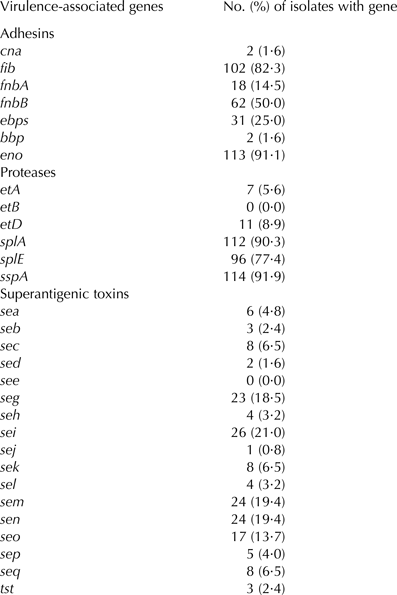
The frequency of 30 genes that was investigated by PCR in 124 Staph. aureus isolates is shown in Table 1. The results are presented for three groups created according to related genes: the adhesins genes, the proteases genes and the superantigenic toxin genes encoding the enterotoxins and the toxic shock syndrome toxin-1. Among the seven investigated genes encoding proteins that are responsible for adherence of Staph. aureus to the host extracellular matrix, the eno (91·1%) and fib (82·3%) genes, encoding laminin- and fibrinogen binding protein, respectively, were the most frequently identified in tested isolates. The genes encoding fibronectin binding protein were present in 64·5% isolates, among which the fnbB gene was detected in 50% isolates. Remaining isolates had the fnbA.
The prevalence of virulence-associated genes in Staph. aureus isolates from cows with subclinical mastitis

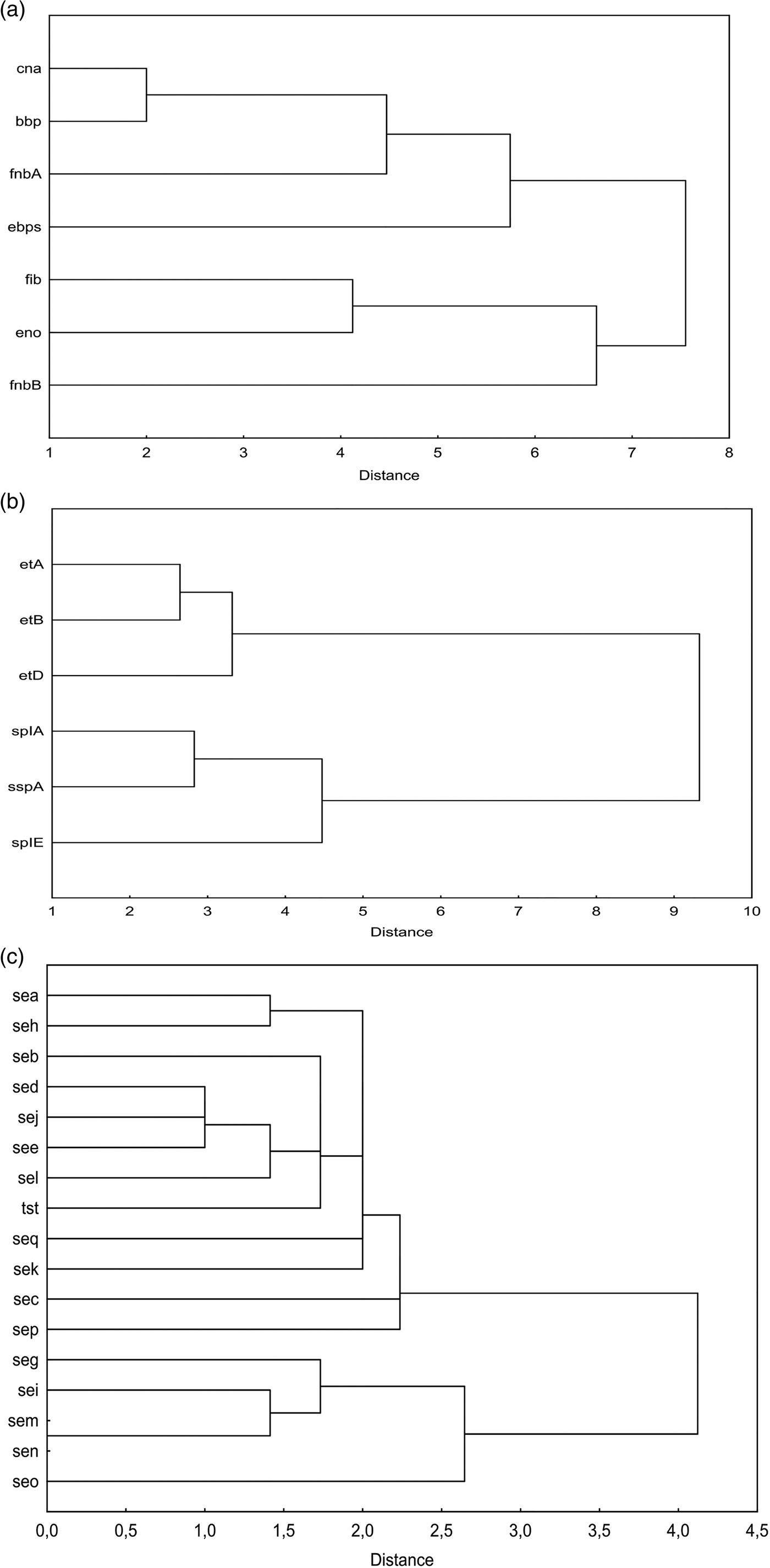
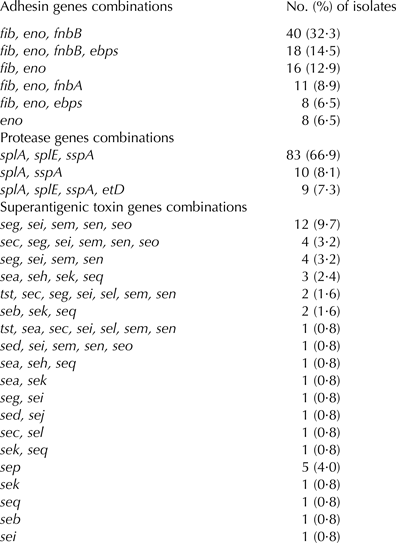
The presence of ebps gene, encoding elastin binding protein, was detected in 25% of isolates. The cna and bbp genes, encoding collagen- and bone sialoprotein binding protein, were detected only in two isolates. Cluster analysis of genes encoding adhesins showed that cna, bbp, fnbA and ebps belonged to one group of genes that were rarely detected in contrast to the second group of genes (fib, eno and fnbB) which occurred more frequently in this population of Staph. aureus isolates (Fig. 1a). The 17 different combinations of adhesin genes were identified in 124 isolates. Six of them were the most frequent and found in 81·5% of the isolates (Table 2). Three major patterns occurred in 59·7% of the isolates. In all isolates showing these patterns the fib and eno genes were detected, furthermore the fnbB gene was detected in 46·8%. Additionally, in 14·5% isolates ebps gene was detected.
The groups of genes encoding adhesins (a), proteases (b) and superantigenic toxins (c) in Staph. aureus isolated from cows with subclinical mastitis created based on the cluster analysis. (a) – cna, bbp, fnbA, ebps, fib, eno, fnbB – genes encoding adhesins such as collagen-, bone sialoprotein-, fibronectin A-, elastin-, fibrinogen-, laminin-, fibronectin B-binding proteins, respectively. (b) – etA, etB, etD – genes encoding exfoliative toxins; splA, sspA, splE – genes encoding serine proteases. (c) – sea, seb, sec, sed, see, seg, she, sei, sej, sek, sel, sem, sen, seo, sep, seq – genes encoding the enterotoxins A to E and genes for G, H, I, J, K, L, M, N, O, P and Q enterotoxin; tst – gene encoding the toxic shock syndrome toxin-1.
The most frequent combinations of the adhesin, the protease and superantigenic toxin genes in Staph. aureus isolated from cows with subclinical mastitis
The presence of etA, etB, etD genes, encoding exfoliative toxins, was also investigated in Staph. aureus isolates from milk of cows with subclinical mastitis. The etA and etD genes were present in genome of 5·6 and 8·9% isolates, respectively. Whereas, the etB gene was not detected in any of the isolates. Of the three investigated serine protease-encoding genes, the splA and sspA were identified in above 90% isolates. The splE gene was present in 77·4% tested Staph. aureus (Table 1). Based on cluster analysis, it was found that the genes encoding exfoliative toxins belonged to one cluster rarely observed among isolates, while second cluster comprised genes encoding serine proteases occurred with high frequency, in which splA and sspA showed very similar frequency of occurrence (Fig. 1b). According to the results, 12 combinations of these six protease genes were identified, with three major patterns found in 82·3% isolates. These patterns differed by presence or the absence of the splE and etD genes (Table 2).
The genes encoding the enterotoxins were identified in 44 (35·5%) Staph. aureus isolates. Of the 16 investigated genes, the sei (21%), sem (19·4%), sen (19·4%), seg (18·5%) and seo (13·7%) were detected more often than other enterotoxin-coding genes (Table 1) and belonged to one cluster of genes. Remaining toxin genes were rarely detected and were grouped in the separate cluster (Fig. 1c). The sec, sek and seq genes were identified in 6·5% isolates, while the sea and sep in 4·8 and 4% isolates, respectively. The seb was detected only in 2·4% of isolates, while the sed and sej genes in 1·6 and 0·8% isolates, respectively. The see was absent in all investigated isolates. The tst gene, encoding the toxic shock syndrome toxin-1, was harboured by 2·4% isolates. A total of 19 combinations of the superantigenic toxin genes were detected. Three of them (seg, sei, sem, sen, seo; sec, seg, sei, sem, sen, seo and seg, sei, sem, sen) were the most frequent and found in 16·1% of the isolates. Other isolates positive for superantigenic toxin genes differed in the patterns and harboured from one to seven superantigenic toxin genes (Table 2).
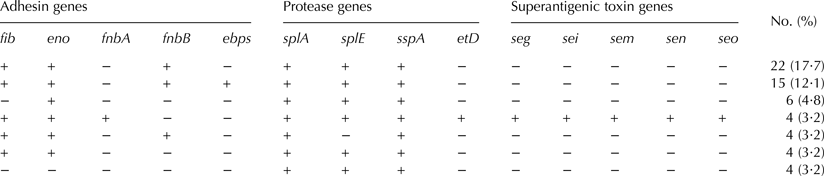
The most common virulotype which included 17·7% of the isolates was virulotype carrying the splA, splE and sspA genes encoding serine proteases, fibrinogen (fib) and laminin (eno) binding proteins genes and the fnbB gene encoding fibronectin binding protein (Table 3). Besides these genes, in 12·1% of isolates ebps gene, encoding elastin binding protein was detected. In 3·2% of isolates besides adhesin genes (fib, eno, fnbA) and serine protease genes (splA, splE, sspA), the etD gene encoding exfoliative toxin and five superantigenic toxin genes (seg, sei, sem, sen, seo) were detected. In other 3·2% of isolates only genes encoding serine proteases were present. The other most frequent virulotypes of Staph. aureus differed in the presence or absence of the genes encoding different adhesins and proteases.
PCR profiles of the most frequent virulotypes of Staph. aureus mastitis isolates
Discussion
Pathogenic factors of Staph. aureus enable this bacteria to attach, colonise, invade and infect the host. In Poland comprehensive data concerning genes encoding adhesins, proteases and enterotoxins in Staph. aureus from mastitis cases are limited (Kot et al. Reference Kot, Piechota, Antos-Bielska, Zdunek, Wolska, Binek, Olszewska, Guliński and Trafny2012a; Jagielski et al. Reference Jagielski, Puacz, Lisowski, Siedlecki, Dudziak, Międzobrodzki and Krukowski2014). In our study, we investigated the presence of 30 important virulence genes encoding adhesins, proteases and superantigenic toxins. Among genes encoding adhesins, the eno and fib genes, encoding adhesion for laminin and fibrinogen, respectively, were ubiquitous in investigated Staph. aureus isolates. Fibrinogen binding protein gene is widespread among Staph. aureus isolated from cows showing mastitis (Singh et al. Reference Singh, Kumar and Yadav2011) but research conducted by Zecconi et al. (Reference Zecconi, Cesaris, Liandris, Daprà and Piccinini2006) did not show statistically significant association between fib gene and the presence of subclinical mastitis. The ability to bind laminin correlates with an invasive phenotype of Staph. aureus (Carneiro et al. Reference Carneiro, Postol, Nomizo, Reis and Brentani2004). In our study above 91% Staph. aureus isolates showed the presence of gene encoding laminin binding protein, whereas in the research conducted by other authors all Staph. aureus isolates involved in human hematogenous infections (Tristan et al. Reference Tristan, Ying, Bes, Etienne, Vandenesch and Lina2003) and intra-mammary infections in cattle and buffaloes (Singh et al. Reference Singh, Kumar and Yadav2011) were positive for this gene. We also investigated the presence of the fnbA and fnbB genes, encoding fibronectin binding protein. Genes encoding receptor for fibronectin were present in 64·5% of isolates. Haveri et al. (Reference Haveri, Roslöf and Pyörälä2008) showed that the genes fnbA and fnbB coexisted in the predominant PFGE types of Staph. aureus strains isolated from bovine intramammary infections and extramammary sites in Finland, while only fnbA was detected in other, less frequent PFGE types. In our work, fnbB was more common than fnbA in Staph. aureus isolates from subclinical mastitis. The ability of adhesion to fibronectin is important during several steps of the disease process, because fibronectin is a ubiquitous host protein present in soluble form in the blood and in fibrillar form in cellular matrices (Patti et al. Reference Patti, Allen, McGavin and Hook1994). In our study, only 25% of Staph. aureus isolates were positive for gene encoding elastin binding protein, while Singh et al. (Reference Singh, Kumar and Yadav2011) reported that in different experimental herds of various animals in India, 43% to over 69% Staph. aureus isolates from mastitis carried ebps gene. Elastin is present in tissues that require elasticity such as the skin, lung, and blood vessels. Elastin-binding protein of Staph. aureus may be significant first of all in colonisation of injured tissues abundant in elastin (Downer et al. Reference Downer, Roche, Park, Mecham and Foster2002). In this study, the presence of gene encoding collagen binding protein was detected only in two isolates, what is in agreement with results obtained by others authors who detected this gene in a few of the Staph. aureus isolates of bovine origin in India (Singh et al. Reference Singh, Kumar and Yadav2011).
In many studies conducted in other countries, none of Staph. aureus isolates from cows with mastitis carried exfoliative toxin genes (Karahan et al. Reference Karahan, Açik and Cetinkaya2009; Piccinini et al. Reference Piccinini, Borromeo and Zecconi2010; Singh et al. Reference Singh, Kumar and Yadav2011; Silveira-Filho et al. Reference Silveira-Filho, Luz, Campos, Silva, Barros, Medeiros, Freitas, Mota, Sena and Leal-Balbino2014). In our work, the presence of genes encoding exfoliative toxins A, B and D was investigated, and in 14·5% of isolates etA or etD genes were detected. The presence etA gene in 18·3% Staph. aureus isolated from milk of cows with clinical or subclinical mastitis was also detected in Belgium (Ote et al. Reference Ote, Taminiau, Duprez, Dizier and Mainil2011). This might suggest that the evolutionary precursors to bovine specialist Staph. aureus clones were human-associated Staph. aureus clones (Herron-Olson et al. Reference Herron-Olson, Fitzgerald, Musser and Kapur2007).
Staphylococcal proteases are important virulence factors, which can cleave important host proteins, including the heavy chains of all human immunoglobulin classes, plasma proteinase inhibitor and elastin (Potempa et al. Reference Potempa, Dubin, Korzus and Travis1988). Proteases by degrading bacterial cell surface proteins, such as fibronectin binding protein and protein A allow the transition of Staph. aureus cells from an adhesive to an invasive phenotype (Rice et al. Reference Rice, Huesca, Vaz and McGavin2001). In our study, we investigated the presence of three serine protease-encoding genes. Among them, the splA and sspA genes were identified in above 90% isolates which is similar to the results obtained by Ote et al. (Reference Ote, Taminiau, Duprez, Dizier and Mainil2011).
The important group of virulence factors of Staph. aureus are superantigenic toxins, which might facilitate immunosuppression and would promote the persistence of Staph. aureus in cattle, and contribute to chronic infection. Several studies have shown that most Staph. aureus harbour one or more enterotoxin genes (Ote et al. Reference Ote, Taminiau, Duprez, Dizier and Mainil2011; Silveira-Filho et al. Reference Silveira-Filho, Luz, Campos, Silva, Barros, Medeiros, Freitas, Mota, Sena and Leal-Balbino2014). In presented study, in 44 (35·5%) isolates at last one gene encoding superantigenic toxin was detected. Similar prevalence of Staph. aureus with enterotoxin genes was shown by Bystroń et al. (Reference Bystroń, Bania, Lis, Molenda and Bednarski2009) who investigated strains from bovine milk from herds localised in the Lower Silesia region in Poland (35%). Frequency of enterotoxin genes differs according to geographical location, and for example in China almost 65% of the isolates from bovine mastitis cases harboured at last one enterotoxin gene (Wang et al. Reference Wang, Wu, Xia, Qi, Xia and Shen2009), while in Brazil 68·4% Staph. aureus from milk were positive for one or more enterotoxin gene (Rall et al. Reference Rall, Vieira, Rall, Vieitis, Fernandes, Candeias, Cardoso and Araújo2008). The most frequently observed enterotoxin genes in Staph. aureus from our collection were sei, sem, sen, seg and seo and comprised one cluster in terms of frequency. Our results are consistent with reports of other authors, who showed that the newly described enterotoxin genes are predominant among Staph. aureus isolated from food, various animal species and food poisoning cases in humans (Rosec & Gigaud, Reference Rosec and Gigaud2002; Smyth et al. Reference Smyth, Hartigan, Meaney, Fitzgerald, Deobald, Bohach and Smyth2005; Bania et al. Reference Bania, Dąbrowska, Bystron, Korzekwa, Chrzanowska and Molenda2006). The sei and seg genes were also detected in high frequency among Staph. aureus isolates from bovine mastitis in Switzerland, Indonesia and China (Akineden et al. Reference Akineden, Annemüller, Hassan, Lämmler, Wolter and Zschöck2001; Stephan et al. Reference Stephan, Annemüller, Hassan and Lämmler2001; Wang et al. Reference Wang, Wu, Xia, Qi, Xia and Shen2009). Many studies show that the sei and seg genes occur together in Staph. aureus (Zschöck et al. Reference Zschöck, Kloppert, Wolter, Hamann and Lämmler2005; Bania et al. Reference Bania, Dąbrowska, Bystron, Korzekwa, Chrzanowska and Molenda2006; Silveira-Filho et al. Reference Silveira-Filho, Luz, Campos, Silva, Barros, Medeiros, Freitas, Mota, Sena and Leal-Balbino2014) which is corresponding with our results. Jarraud et al. (Reference Jarraud, Peyrat, Lim, Tristan, Bes, Mougel, Etienne, Vandenesch, Bonneville and Lina2001) found that the sei and seg genes coexist with three other genes: sem, sen, seo and sometimes with seu in a common genetic element, called the enterotoxin gene cluster (egc), and this cluster is located on the genomic island Type II vSaβ. In our study the egc was detected in 26 isolates but complete cluster was occurred only in 16 isolates. The presence of variants or incomplete clusters of genes encoding enterotoxin was observed in Staph. aureus isolated from milk of cows with clinical and subclinical mastitis in Belgium (Ote et al. Reference Ote, Taminiau, Duprez, Dizier and Mainil2011). We detected isolate which had only sei gene, although we used the primers designed by Bania et al. (Reference Bania, Dąbrowska, Bystron, Korzekwa, Chrzanowska and Molenda2006) targeting the conserved regions of sei and seg. The Staph. aureus strains with sei or seg alone were also detected by other researchers (Omoe et al. Reference Omoe, Hu, Takahashi-Omoe, Nakane and Shinagawa2003; Zecconi et al. Reference Zecconi, Cesaris, Liandris, Daprà and Piccinini2006; Karahan et al. Reference Karahan, Açik and Cetinkaya2009). In our results, the classical enterotoxin genes were rarely detected which confirmed the results obtained by other authors, who showed that these genes were absent or seldom detected in Staph. aureus isolated from cows with mastitis (Zecconi et al. Reference Zecconi, Cesaris, Liandris, Daprà and Piccinini2006; Bystroń et al. Reference Bystroń, Bania, Lis, Molenda and Bednarski2009; Karahan et al. Reference Karahan, Açik and Cetinkaya2009; Piccinini et al. Reference Piccinini, Borromeo and Zecconi2010). In this study, the sea gene was detected in only 4·8% of the isolates which is in concordance with the results obtained by Ote et al. (Reference Ote, Taminiau, Duprez, Dizier and Mainil2011) who found this gene in 5·2% of isolates associated with bovine mastitis. The presence of sea gene in genome of Staph. aureus was detected with different frequency in studies conducted by other authors. Fournier et al. (Reference Fournier, Kuhnert, Frey, Miserez, Kirchhofer, Kaufmann, Steiner and Graber2008) reported that 30% of Staph. aureus strains from milk of cows with intramammary infection showed sea gene, while it was absent in strains from milk of cows with mastitis investigated by other researchers (Srinivasan et al. Reference Srinivasan, Sawant, Gillespie, Headrick, Ceasaris and Oliver2006; Karahan et al. Reference Karahan, Açik and Cetinkaya2009). The observed discrepancy may be due to irregular geographical distribution of bacteriophages the genomes of which contain sea gene, therefore, the frequency of infected Staph. aureus is different or even lacking (Le Loir et al. Reference Le Loir, Baron and Gautier2003).
The results by other authors also showed, as in our study, that seb and see genes were absent or present in a very few isolates (Fournier et al. Reference Fournier, Kuhnert, Frey, Miserez, Kirchhofer, Kaufmann, Steiner and Graber2008; Bystroń et al. Reference Bystroń, Bania, Lis, Molenda and Bednarski2009; Ote et al. Reference Ote, Taminiau, Duprez, Dizier and Mainil2011). In this study, we also investigated the presence of tst gene and this gene was detected in 3 Staph. aureus isolates. The Staph. aureus isolates negative for tst genes were detected among isolates from dairy herds in Italy (Piccinini et al. Reference Piccinini, Borromeo and Zecconi2010) and in the Lower Silesia in Poland (Bystroń et al. Reference Bystroń, Bania, Lis, Molenda and Bednarski2009). Only three Staph. aureus from bovine subclinical mastitis in Turkey were positive for tst (Karahan et al. Reference Karahan, Açik and Cetinkaya2009). In our study, among isolates with tst genes, two also carried sec, seg, sei, sel, sem and sen genes and one had tst, sea, sec, sei, sel, sem, sen genotype. Zschöck et al. (Reference Zschöck, Riße and Sommerhäuser2004) reported the presence of a positive correlation between sec-tst. In this study, sec gene was detected in all tst-positive isolates.
In conclusion the genes encoding laminin-, fibrinogen- and fibronectin binding proteins were the most commonly identified among the genes encoding adhesins. The genes encoding serine proteases also were ubiquitous. Among superantigenic toxins genes, the newly defined enterotoxin genes such as sei, sem, sen, seg and seo were the most frequently detected. Investigation of virulence gene profiles of Staph. aureus revealed a variation in the prevalence of different adhesin and toxin genes in the isolates associated with subclinical bovine mastitis. The presence of isolates with genes encoding toxins involved in human infections in the milk of cows with mastitis is a potential danger for human health. The identification of pathogenic factors of Staph. aureus isolates allows a more detailed characterisation of this pathogen, which is important for evaluation of pathogen transmission rate, disease development rate and its severity. Therefore, analysis of potential virulence of Staph. aureus provides information important for choice of appropriate methods of prophylaxis and therapy of mastitis.
The work was financed from funds provided by the Ministry of Science and Higher Education of Poland
Conflict of interest
All authors declare that they have no conflicts of interest.