INTRODUCTION
In the recent decades, Marine Protected Areas (hereinafter MPAs) have received an increasing attention worldwide as tools for both conservation and fisheries management (see details in Halpern, Reference Halpern2003; Palumbi et al., Reference Palumbi, Gaines, Leslie and Warner2003; Leslie, Reference Leslie2005; Claudet et al., Reference Claudet, Osenberg, Benedetti-Cecchi, Domenici, García-Charton, Pérez-Ruzafa, Badolmenti, Bayle-Sempere, Brito, Bullen, Culiol, Dimech, Falcón, Guala, Milazzo, Sánchez-Meca, Somerfield, Stobart, Vandeperre, Valle and Planes2008; White et al., Reference White, Kendall, Gaines, Siegel and Costello2008). A widely accepted definition of a MPA is: ‘any area of the intertidal or subtidal terrain, together with its overlying water and associated flora, fauna, historical and cultural features, which has been reserved by law or other effective means to protect part or the entire enclosed environment’ (IUCN, 1988). Many studies have shown that density, biomass and individual size of species targeted by fisheries, as well as entire community structures and species interactions, can be significantly affected by protection (Micheli et al., Reference Micheli, Halpern, Botsford and Warner2004; Guidetti & Sala, Reference Guidetti and Sala2007; Claudet et al., Reference Claudet, Osenberg, Benedetti-Cecchi, Domenici, García-Charton, Pérez-Ruzafa, Badolmenti, Bayle-Sempere, Brito, Bullen, Culiol, Dimech, Falcón, Guala, Milazzo, Sánchez-Meca, Somerfield, Stobart, Vandeperre, Valle and Planes2008; Lester et al., Reference Lester, Halpern, Grorud-Colvert, Luchenco, Ruttenberg, Gaines, Airamé and Warner2009). MPAs, in addition, have also the potential to guarantee the persistence and recovery of biological diversity and ecosystem functions in the face of human over-exploitation and climate change (Hughes et al., Reference Hughes, Baird, Bellwood, Card, Connolly, Folke, Grosberg, Hoegh-Guldberg, Jackson, Kleypas, Lough, Marshall, Nyström, Palumbi, Pandolfi, Rosen and Roughgarden2003; Mumby et al., Reference Mumby, Dahlgren, Harborne, Kappel, Micheli, Brumbaugh, Holmes, Mendes, Sanchirico, Buch, Box, Stoffler and Gill2006; Ledlie et al., Reference Ledlie, Graham, Bythell, Wilson, Jennings, Polunin and Hardcastle2007; Graham et al., Reference Graham, McClanahan, MacNeil, Wilson, Polunin and Jennings2008; Mouillot et al., Reference Mouillot, Culioli, Pelletier and Tomasini2008).
In the Mediterranean Sea, based on the most recent survey available, approximately 100 MPAs established are listed (Abdulla et al., Reference Abdulla, Gomei, Maison and Piante2008). In the Mediterranean, MPAs are often divided into subzones regulated by different protection regimes: i.e. fully protected zones (often called A zones or no-access/no-take zones) and partially protected zones (B and C zones), where human activities are regulated (Francour et al., Reference Francour, Harmelin, Pollard and Sartoretto2001). A number of Mediterranean studies assessed direct and indirect effects of protection (hereafter called ‘reserve effect’), especially inside no-take zones (Garcia-Rubies & Zabala, Reference Garcia-Rubies and Zabala1990; Harmelin et al., Reference Harmelin, Bachet and Garcia1995; Renones et al., Reference Renones, Moranta, Coll and Morales-Nin1997; Macpherson et al., Reference Macpherson, Gordoa and Garcia-Rubies2002; Garcia-Charton et al., Reference Garcia-Charton, Pérez-Ruzafa, Sanchez-Jerez, Bayle-Sempere, Reñones and Moreno2004, Reference Garcia-Charton, Pérez-Ruzafa, Marcos, Claudet, Badalamenti, Benedetticecchi, Falcon, Milazzo, Schembri and Stobart2008; Guidetti & Sala, Reference Guidetti and Sala2007).
Most of the ‘reserve effect’ assessment studies in the Mediterranean basin were carried out taking into account fish assemblages associated with hard substrates because: (1) rocky reefs are the most common habitat protected within MPAs in the Mediterranean Sea (Boero et al., Reference Boero, Bussotti, D'Ambrosio, Fraschetti, Guidetti and Terlizzi2005); and (2) fish assemblages associated with these habitats more clearly respond to protection from fishing than others (Francour, Reference Francour1994). Rocky substrates, however, include a wide array of environments that may differ, for instance, in terms of three-dimensional complexity (Garcia-Charton & Pérez-Ruzafa, Reference Garcia-Charton and Pérez-Ruzafa2001), macroalgal cover (Guidetti, Reference Guidetti2006a), lithological features (Guidetti et al., Reference Guidetti, Terlizzi and Boero2004) or patchiness with other habitat types (Garcia-Charton & Pérez-Ruzafa, Reference Garcia-Charton and Pérez-Ruzafa2001). All these features have the potential to affect distribution patterns of associated fishes and some community descriptors (e.g. species richness and total biomass). From this perspective, in the Mediterranean Sea there are widely spread rocky structures rising from the sea bottom towards the surface (without emerging from the water), often located relatively close to the coast, that represent biologically and socio-economically relevant sites, even though they have received until now little scientific attention. Hereinafter we call such rocky formations ‘rocky banks’ (sometimes they are called ‘shallows’ when the top is very close to the water surface). There is no scientific and universally accepted definition of this kind of rocky habitat. Rocky banks may show different morphologies but generally resemble sea mounts (from pinnacle-like shaped structures to flat sea mounts), vary in terms of size (from tens of square metres to few square kilometres), and may develop offshore or at quite short distance from the coast. Rocky banks, therefore, substantially differ from rocky reefs in continuity with the emerged rocky coast, where most of the available studies on reserve effects on fish have been done. These structures are usually well known by local people, especially because they host unusually high densities of fish, which makes them particularly attractive to fishermen and, in more recent years, divers. These peculiar habitats make part of the traditional heritage and knowledge of local fishing communities (Berkes et al., Reference Berkes, Colding and Folke2000). In each language of the Mediterranean countries, in fact, there are words defining these rocky banks that are of very popular use (e.g. secca in Italy; sec in France; seca or bajo in Spain), and many of these banks have specific local names. At the Tavolara-Punta Coda Cavallo MPA (Sardinia Island, Italy), for instance, approximately 35% of total dives performed in 2005–2006 were done at rocky banks that were also well known and frequented by local professional and recreational fishermen before the MPA was established (Guidetti, unpublished data). Rocky banks are well known by fishermen as they aggregate fish, especially during spawning of species like e.g. Epinephelus marginatus and Mycteroperca rubra (Bava, personal communication), and Spondyliosoma cantharus (Guidetti, unpublished data). They are also known as places where fish aggregate for feeding, which is the case of many large predators like Dentex dentex, Seriola dumerili and Sphyraena viridensis (Vacchi et al., Reference Vacchi, Boyer, Bussotti, Guidetti and La Mesa1999). Due to these important but often unreported features, there is an increasing concern about the fishing impacts that rocky banks could be subject to. The recent use of new fishing techniques (e.g. vertical jigging) expose fish aggregations at rocky banks to the risk of overexploitation. Due to their recognized naturalistic, ecological and socio-economic importance and attractiveness, high priority was recently given to rocky banks when some MPAs were established (e.g. ‘Secche di Tor Paterno’ and ‘Secche della Meloria’ MPAs in the Tyrrhenian Sea, Italy). Surprisingly, however, the scientific information available on rocky banks and associated fish assemblages is very scanty and usually reported in local journals as anecdotal information (Bussotti et al., Reference Bussotti, Buia, Di Capua, Gambi, Lorenti, Scipione, Terlizzi and Zupo1999; Guidetti et al., Reference Guidetti, Bussotti, Panzalis and Navone2007). The only international papers available on this subject, to our knowledge, reported records of fishes locally observed in rocky banks (Vacchi et al., Reference Vacchi, Boyer, Bussotti, Guidetti and La Mesa1999) or the fact that density of E. marginatus is higher in rocky banks than in other rocky substrates (probably due to seasonal reproductive aggregations: Lenfant et al., Reference Lenfant, Louisy and Licari2003). The above issues suggest that rocky banks could exert important roles for fishes as sites of feeding or reproductive aggregation, and would urgently need management and protection measures to preserve these important functions (e.g. as spawning and aggregation areas: Lenfant et al., Reference Lenfant, Louisy and Licari2003; Sadovy De Mitcheson et al., Reference Sadovy De Mitcheson, Colin and Domeier2006). However, such measures aimed at safeguarding their integrity need more robust scientific information than the information presently available.
This study, carried out at a MPA in north-eastern Sardinia (Italy, Western Mediterranean Sea), is thus aimed at improving knowledge about rocky banks by assessing: (1) putative differences between fish assemblages associated with rocky banks subject to full protection versus those opened to fishing; and (2) whether or not the response of fish assemblages to protection in rocky banks is comparable with the response obtained in rocky reefs in continuity with the rocky coastline.
MATERIALS AND METHODS
The studied area
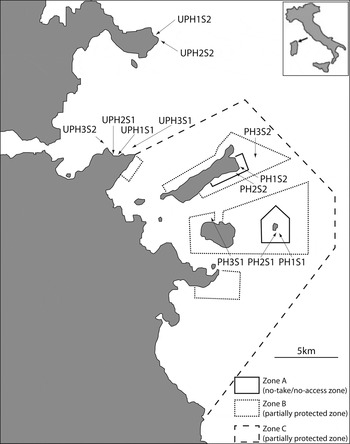
The Tavolara-Punta Coda Cavallo Marine Protected Area (TMPA), located in north-east Sardinia (Italy), was established in 1997 but enforcement became effective around 2003–2004. The TMPA covers about 76 km of coastline and extends over an area of 15,357 ha (Figure 1). The spatial zoning of the TMPA consists of three types of zones, where restrictions are progressively more lax: (1) A zones that correspond to no-take/no-access zones (529 ha; access restricted to the reserve personnel, scientists and police authorities); (2) B zones (3113 ha), where only local artisanal fishery is allowed (except for a few sites frequented by divers, like the two rocky banks in zone B investigated here); and (3) the C zone (11,715 ha) that embeds the rest of the MPA and where artisanal and regulated recreational fishing are allowed except for spearfishing. Outside the TMPA, the fishing regulations are those imposed by the Italian law; all kinds of legally accepted fishing activities are allowed including spearfishing.
Map of the Tavolara-Capo Coda Cavallo Marine Protected Area and location of sampling sites. P, protected conditions; UP, unprotected conditions; H1, shallow coastal rocky substrates; H2, deep coastal rocky substrates; H3, rocky banks; S, site.

Sampling design and data collection
Surveys were conducted at two different times in August 2007 and 2008, in three rocky habitat types (defined here below), under two conditions: protected against fishing (hereafter called ‘protected condition’: P) and unprotected (‘unprotected condition’: UP) outside the TMPA. The first and second habitat types were represented by rocky substrates developing at shallow (5–10 m; habitat type 1: H1) and deep stands (12–18 m; H2), dropping from the emerged rocky coast. Hereafter, for the sake of brevity, we will call these habitat types ‘shallow/deep coastal rocky substrates’. The third investigated habitat type was represented by rocky banks (at 15–35 m; H3). These habitats were chosen to be representative of three different habitat types, each characterized by specific related environmental factors (e.g. distance from the coastline, depth, water temperature, biotic cover, current regime, etc). All three habitat types were sampled under both P and UP conditions. In each of the three habitat types, under both P and UP conditions, two sites (10s–100s m far from each other) were randomly selected from a larger pool of sites using the information taken from the habitat mapping report by Bianchi & Morri (Reference Bianchi and Morri2006). We used an unbalanced sampling design (Underwood, Reference Underwood1997): six replicates (i.e. visual census transects) were performed at each rocky bank site, while four replicates were performed at each site at shallow and deep rocky substrates.
The sampling design thus consisted of three factors: Protection (Pr; fixed factor with 2 levels), Habitat (Ha; fixed and orthogonal, with three levels) and Site (Si; random and nested in Pr × Ha, with two levels). Due to the possible overlap of sampled surfaces at rocky banks during the two sampling times the factor ‘time’ was not considered as a formal factor to avoid temporal dependence of data (Underwood, Reference Underwood1997). Therefore, the analyses were conducted separately for each year of sampling. A number of 4–6 replicated units (depending on the habitat examined) were performed in each of the 2 sampling times for a total of N = 112 replicates.
Each replicate consisted of a 25 m-long and 5 m-wide underwater visual census (UVC) fish transect, conducted by divers well trained in UVC surveys. Along each transect, the diver swam one way (within the pre-established depth range) for about 8–10 minutes, identifying and recording the number and size of each fish encountered. Sampling methodology and divers were the same during both sampling campaigns to minimize biases inherent in the use of UVCs (Kulbicki, Reference Kulbicki1998; Edgar et al., Reference Edgar, Barrett and Morton2004). UVCs were performed on shallow and deep coastal rocky substrates where other habitat types (e.g. sand or seagrasses) represented less than 5% in cover. The number of fish encountered was recorded up to 10 individuals, whereas categories of abundance were used for larger groups (11–30, 31–50, 51–200, 201–500, >500 individuals) (Harmelin-Vivien et al., Reference Harmelin-Vivien, Harmelin, Chauvet, Duval, Galzin, Lejeune, Barnabé, Blanc, Chevalier, Duclerc and Lassane1985). Fish size (total length) was recorded within 2 cm size-classes for most of the species, and within 5 cm size-classes for large-sized species (maximum size > 50 cm; e.g. E. marginatus). Fish wet-weight was estimated from size data by means of length–weight relationships from the available literature, and existing databases (Bayle-Sempere et al., Reference Bayle-Sempere, Valle and Verdù2002; Froese & Pauly, Reference Froese and Pauly2009), selecting coefficients referred to Mediterranean samples whenever possible.
Analysis of data
Multivariate and univariate analyses were conducted to examine: (1) whether fish assemblage structures (i.e. composition of taxa and relative densities or biomasses) and single variables (e.g. density and biomass of single species) responded to protection in rocky banks; and (2) if responses were different compared to the responses observed in shallow and deep coastal rocky substrates.
The putative effects of protection were analysed on whole fish assemblages (using species × sample matrices for each sampling time; 51 taxa, 56 samples) using three-way permutational multivariate analysis of variance (PERMANOVA: McArdle & Anderson, Reference McArdle and Anderson2001) both on density and biomass data, according to the sampling design reported above. Post-hoc pairwise tests were carried out, whenever appropriate, after PERMANOVA detected significant differences. PERMANOVA procedures can handle unbalanced sampling designs like the one used here. Multivariate analyses were based on Bray–Curtis dissimilarity matrices and ln(x + 1) transformed data. Species that contributed most to the significant differences observed between P and UP conditions were identified using SIMPER (similarity percentage: Clarke & Warwick, Reference Clarke and Warwick2001). More in depth analyses, moreover, were conducted on Diplodus sargus and E. marginatus (hereafter called ‘target species’) due to their crucial ecological role as predators in coastal systems (Sala et al., Reference Sala, Aburto-Oropeza, Reza, Paredes and Lopez-Lemus2004; Guidetti, Reference Guidetti2006b; Guidetti & Micheli, Reference Guidetti and Micheli2012). Univariate analyses were carried out on some relevant variables; total species richness, total fish density and biomass, and density and biomass of D. sargus and E. marginatus were thus analysed by PERMANOVA based on Euclidean distance (Terlizzi et al., Reference Terlizzi, Anderson, Fraschetti and Bendetti-Cecchi2007).
Potential effects of protection on fish size were illustrated through size–frequency distributions obtained by pooling individual fish size data in P and UP conditions (in order to have a number of specimens large enough to perform formal analyses) and were formally tested using 1-way PERMANOVA in order to avoid any assumption about the distribution of the variable (Anderson, Reference Anderson2001).
All analyses were performed using PRIMER 6 and PERMANOVA package (Clarke & Warwick, Reference Clarke and Warwick2001).
RESULTS
A total of 51 fish taxa belonging to 19 different families were identified (see Appendix). Thirty-six taxa were found in shallow rocky substrates (H1), 43 in deep rocky substrates (H2) and 44 in rocky banks (H3).
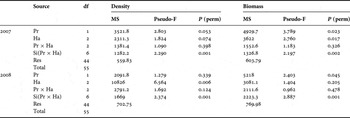
Fish assemblages in 2007 significantly differed between P and UP conditions, and between rocky banks versus coastal rocky substrates (pairwise tests H3 ≠ H1 = H2; P < 0.05) in terms of biomass, but not in terms of density (Table 1). In 2008 fish assemblages differed between P and UP conditions in terms of biomass, while a significant difference was detected between rocky banks versus coastal rocky substrates in terms of density (i.e. H3 ≠ H1 = H2; P < 0.01). A significant variability was recorded at the scale of sites for both density and biomass, in 2007 and 2008. Both in terms of density and biomass, therefore, the response to protection of whole fish assemblages in rocky banks did not differ from the response of fish assemblages in coastal rocky substrate habitats, both in 2007 and 2008 (formally the ‘Protection × Habitat’ interactions were not significant; see Table 1).
Permutational multivariate analysis of variance table of relative densities and biomasses of the whole species assemblages in 2007 and 2008.

Pr, protection; Ha, habitat; Si; site.
SIMPER analyses were used to highlight the species that mainly contributed to the differences in fish assemblages between P and UP conditions in term of biomass in both sampling years. In both years, the species that mainly contributed (>4% of total dissimilarity) to the differences between fish assemblages in P and UP conditions were E. marginatus, S. salpa, D. sargus, D. puntazzo, O. melanura, Spicara maena, D. annularis, Symphodus tinca and T. pavo (Supplementary materials 1, 2). Species driving differences between protected and unprotected conditions varied across habitats with E. marginatus driving the most of differences between P and UP for H2 and H3 and S. salpa for H1, both in 2007 and 2008.
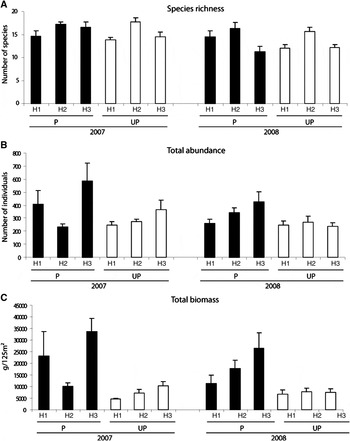
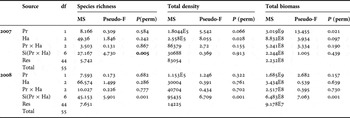
In 2007 species richness and total density (univariate analyses performed summing the contribution of all species) did not differ between P and UP conditions, while significantly higher average density were assessed in rocky banks than deep coastal rocky substrates (H3 > H2). Total fish biomass was significantly higher in P than in UP condition, but did not change significantly among habitat types (Table 2; Figure 2).
Mean values (±SE) of species richness (A), total abundance (B) and total biomass (C) assessed in the protected (P) and unprotected conditions (UP) in 2007 and 2008. H1, shallow coastal rocky substrates; H2, deep coastal rocky substrates; H3, rocky banks.

Permutational multivariate analysis of variance table for analyses of variance of species richness, total density and total biomass in 2007 and 2008.

Pr, protection; Ha, habitat; Si, site.
In 2008 species richness and total density and biomass only displayed significant differences at the scale of sites (Table 2).
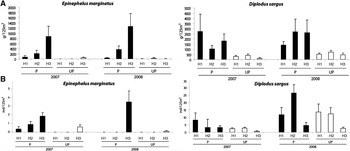
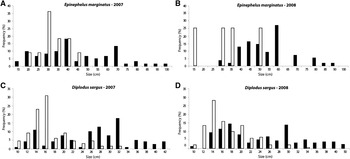
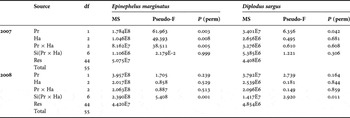
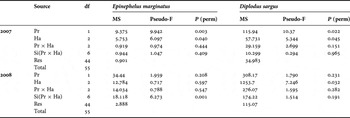
Average biomass of E. marginatus in 2007 showed a significant interaction P × Ha (Table 3; Figure 3), which involves that the effects of protection are not the same in the three habitat types considered. Pairwise tests revealed that only in rocky banks (H3) the average biomass of E. marginatus was significantly higher in P than in UP conditions (P < 0.01). Density of E. marginatus in 2007 was higher in protected than unprotected condition, and higher in rocky banks and deep coastal rocky substrates than in shallow coastal rocky substrates (Table 4, pairwise test: H3 = H2 > H1; P < 0.01). In 2008 biomass and density of E. marginatus did not change in relation to the protection level or habitat type (Tables 3 & 4). Size distributions of E. marginatus clearly showed significant differences between P and UP conditions in both 2007 and 2008 (PERMANOVA; P < 0.01), with bigger fish sizes observed in P condition (Figure 4; Supplementary material 3).
Mean values (±SE) of (A) biomass and (B) density of the target species in the protected (P) and unprotected (UP) conditions in 2007 and 2008. H1, shallow coastal rocky substrates; H2, deep coastal rocky substrates; H3, rocky banks.

Size–frequency distributions of the target species (A) Epinephelus marginatus (2007), (B) E. marginatus (2008), (C) Diplodus Sargus (2007) and (D) D. Sargus (2008) in the protected (black) and the unprotected (white).

Permutational multivariate analysis of variance table for analyses of variance of biomasses of target species in 2007 and 2008.

Pr, protection; Ha, habitat; Si, site.
Permutational multivariate analysis of variance table for analyses of variance of densities of target species in 2007 and 2008.

Pr, protection; Ha, habitat; Si, site.
Diplodus sargus showed significantly higher biomass and density in P than UP condition in 2007 (Tables 3 & 4). PERMANOVA revealed a significant effect of the factor ‘Habitat’ on D. sargus density in 2007 (Table 4) and related pairwise tests showed that average density was higher in rocky banks than in shallow and deep coastal rocky substrates (H3 > H1 = H2; P < 0.05). In 2008 no effects of protection were recorded for biomass or density. A significant effect of factor ‘habitat’ was recorded for density with H3 > H1 = H2 (pairwise test; P < 0.01). Size distribution was significantly different between P and UP conditions (PERMANOVA; P < 0.01), with bigger sizes observed in P condition both in 2007 and 2008 (Figure 4; Supplementary material 3).
DISCUSSION
This study on the one hand provided confirmatory evidence that MPAs, provided they are well managed and the enforcement is effective (Guidetti et al., Reference Guidetti, Milazzo, Bussotti, Molinari, Murenu, Pais, Spanò, Balzano, Agardy, Boero, Carrada, Cattaneo-Vietti, Cau, Chemello, Greco, Manganaro, Notarbartolo di Sciara, Russo and Tunesi2008), can positively affect coastal fish assemblages associated with rocky reefs (Claudet et al., Reference Claudet, Osenberg, Benedetti-Cecchi, Domenici, García-Charton, Pérez-Ruzafa, Badolmenti, Bayle-Sempere, Brito, Bullen, Culiol, Dimech, Falcón, Guala, Milazzo, Sánchez-Meca, Somerfield, Stobart, Vandeperre, Valle and Planes2008; Di Franco et al., Reference Di Franco, Bussotti, Navone, Panzalis and Guidetti2009; Fenberg et al., Reference Fenberg, Caselle, Claudet, Clemence, Gaines, García-Charton, Gonçalves, Grorud-Colvert, Guidetti, Jenkins, Jones, Lester, McAllen, Moland, Planes and Sørensen2012; Sala et al., Reference Sala, Ballesteros, Dendrinos, Di Franco, Ferretti, Foley, Fraschetti, Friedlander, Garrabou, Güçlüsoy, Guidetti, Halpern, Hereu, Karamanlidis, Kizilkaya, Macpherson, Mangialajo, Mariani, Micheli, Pais, Riser, Rosenberg, Sales, Selkoe, Starr, Tomas and Zabala2012) and, on the other hand, assessed for the first time the effects of protection from fishing on fish assemblages associated with Mediterranean rocky banks.
Whole fish assemblages associated with rocky banks showed in some cases (e.g. in terms of biomass in 2007 and density in 2008) different structures from those of coastal rocky substrates, but the response to protection was similar. Univariate descriptors, like species richness and total density of fish did not change with protection, while total biomass was higher in protected than unprotected condition. As a general rule, in any case, patterns were similar in rocky banks and coastal rocky substrates.
Fish species relevant ecologically and as targets for fisheries, like E. marginatus and D. sargus, clearly responded to protection in terms of greater individual size. Biomass and density also tended to be greater under protected than unprotected conditions, but the response was more variable. Fish size is more and more indicated as a crucial indicator of the effects of protection from fishing, since fishing selectively targets the more economically valuable large individuals of commercial species (Erzini et al., Reference Erzini, Gonçalves, Bentes, Moutopoulos, Casal, Soriguer, Puente, Errazkin and Stergiou2006 and references therein). Since fish biomass mainly reflects size distributions of fish, according to our outputs, many studies report that fish response to protection is mainly detected in terms of greater individual sizes and overall population biomass (see syntheses in Pelletier et al., Reference Pelletier, Garcí-Chorton, Ferraris, David, Thébaud, Letourneur, Claudet, Amand, Kulbicki and Galzin2005; Lester et al., Reference Lester, Halpern, Grorud-Colvert, Luchenco, Ruttenberg, Gaines, Airamé and Warner2009).
It is worth noting that biomass was higher and individuals of E. marginatus larger in protected conditions than in fished conditions especially in rocky banks. This result could be explained considering the summed effects of protection from fishing (e.g. in terms of reduced fishing mortality) and the special habitat features provided by rocky banks related to behavioural/reproductive patterns of groupers. In the Sec of Rédéris, situated in the fully protected zone of the Cerbère-Banyuls MPA (France), E. marginatus is reported to aggregate probably for reproduction (Lenfant et al., Reference Lenfant, Louisy and Licari2003), whereas La Mesa et al. (Reference La Mesa, Di muccio and Vacchi2006) reported that different species of groupers aggregate in rocky habitats in the Ustica MPA (Sicily, Italy). Other studies showed high densities of E. marginatus in July and August, i.e. the warmest months when the peak of the reproductive activity takes place (Zabala et al., Reference Zabala, Garcia-Rubies, Louisy and Sala1997a, Reference Zabala, Louisy, Garcia-Rubies and Garciab; Culioli & Quignard, Reference Culioli and Quignard1999; Louisy & Culioli, Reference Louisy and Culioli1999; Mathieu-Tissot, Reference Mathieu-Tissot1999). Epinephelus marginatus, therefore, could display aggregations that are more likely to occur where fishing is banned (e.g. in MPAs) and at special places like rocky banks where, consequently, reproductive events are more likely to take place and be successful. Aggregations of different species of groupers at rocky banks, especially during the reproductive season when dramatically high density of large-sized spawners can be observed, is a quite common feature of Epinephelinae fishes (e.g. E. striatus in Belize: Sala et al., Reference Sala, Ballesteros and Starr2001). The need for careful protection and management of such reproductive aggregations, therefore, is urgent, considering that the places where aggregations occur (like rocky banks) can be of paramount importance for sustaining local populations and fishing stocks (Sadovy De Mitcheson et al., Reference Sadovy De Mitcheson, Cornish, Domeier, Colin, Russell and Lindeman2008). From this perspective, rocky banks in the Mediterranean may represent a habitat type deserving high priority to be included within MPA designs.
The points discussed above are particularly important in terms of management decisions to take in coastal areas where rocky banks are common and traditionally used by different categories of stakeholders. The fact that large predatory and charismatic fishes are common and large in size, or use such habitats during crucial phases of their life cycle such as spawning areas makes them particularly attractive for fishermen and divers. Rocky banks are therefore important habitats that may have more relevant socio-economic and ecological roles than previously thought. They should receive much more attention within environmental management plans. The fact they attract both fishermen and divers, from this perspective, may generate conflicts among users. Fishermen (both professional and recreational) have the main target to get their catches (especially targeting large individuals). Intense fishing, however, may cause local depletion of large fish and consequently determine economic losses to diving centres (Davis & Tisdell, Reference Davis and Tisdell1996) since sites with few charismatic fish like Epinephelus and Mycteroperca are less attractive to tourist-divers (Williams & Polunin, Reference Williams and Polunin2000). Therefore, careful conservation and management measures should be set up in order to protect spawning aggregation areas and harmonize the activities of different categories of stakeholders within MPAs and, more in general, coastal areas.
In conclusion, the present study provides for the first time useful information on the response to protection of rocky banks compared to rocky reefs close to the coastline, suggesting the potential ecological and socio-economic importance of this habitat that, until now, did not receive sufficient attention within management plans and conservation initiatives like prioritized inclusion within MPAs.
ACKNOWLEDGEMENTS
We thank Salvatore Vitale (TMPA) for his help during the field activities and Joachim Claudet for his useful comments. Many thanks are due to Fabio Bulleri (University of Pisa) for his useful suggestions about data analysis and to the Executive Editor and two anonymous referees for their critical reviews. This work was supported by the TMPA.
Supplementary materials and methods
The Supplementary material referred to in this article can be found online at journals.cambridge.org/mbi.
Appendix
List of the fish species found in the three habitats inside and outside the Tavolara-Punta Coda Cavallo Marine Protected Area.