1. Introduction
Syntax and syntactic parsing play a vital role in the construction of meaning from speech and text (Chomsky, Reference Chomsky1965; Frazier, Reference Frazier1979; MacDonald, Pearlmutter & Seidenberg, Reference MacDonald, Pearlmutter and Seidenberg1994; Traxler, Reference Traxler2012, Reference Traxler2014). Syntax governs various aspects of language production (Griffin & Ferreira, Reference Griffin and Ferreira2006; Levelt, Roelofs & Meyer, Reference Levelt, Roelofs and Meyer1999) and provides cues that comprehenders use to determine how words in sentences relate to one another (Frazier, Reference Frazier and Coltheart1987; Vosse & Kempen, Reference Vosse and Kempen2000). Some models of language comprehension posit a role for syntax operating simultaneously with other interpretive processes, including lexical access (as in Marslen-Wilson, Tyler & Seidenberg, Reference Marslen-Wilson, Tyler and Seidenberg1978; Spivey-Knowlton & Sedivy, Reference Spivey-Knowlton and Sedivy1995; Trueswell, Tanenhaus & Kello, Reference Trueswell, Tanenhaus and Kello1993; Trueswell, Tanenhaus & Garnsey, Reference Trueswell, Tanenhaus and Garnsey1994; van Gompel, Pickering & Traxler, Reference Van Gompel, Pickering and Traxler2001), while others posit a discrete, post-lexical stage of processing (Frazier & Rayner, Reference Frazier and Rayner1982; Frazier & Clifton, Reference Frazier and Clifton1996; Frisch, Hahne & Friederici, Reference Frisch, Hahne and Friederici2004). Hybrid or dual-streams accounts offer the notion that, under some circumstances, default conceptual relationships can determine how expressions are interpreted (Ferreira, Reference Ferreira2003; Ferreira & Patson, Reference Ferreira and Patson2007; Kuperberg, Reference Kuperberg2007), but that syntactically derived dependencies still form the basis of interpretation. Hence, most accounts assign a prominent role to syntactic parsing operations during every-day comprehension.
An important goal in sentence processing research is to understand the cognitive mechanisms underlying successful parsing and how these mechanisms differ across individuals. Previous work in psycholinguistics has suggested that higher-order cognitive abilities such as executive function and working memory capacity may play a critical role in parsing and comprehension (Just & Carpenter, Reference Just and Carpenter1992; Novick, Trueswell & Thompson-Schill, Reference Novick, Trueswell and Thompson-Schill2005). In addition to these general cognitive faculties, language experience across the lifespan may also directly influence the efficiency of sentence processing, particularly through exposure to rare or complex syntactic structures (MacDonald & Christiansen, Reference MacDonald and Christiansen2002; Waters & Caplan, Reference Waters and Caplan1996; Wells, Christiansen, Race, Acheson & MacDonald, Reference Wells, Christiansen, Race, Acheson and MacDonald2009).
The influence of experience and proficiency are particularly important when investigating sentence processing in second language learners. Currently, a large body of evidence suggests that bilinguals do not process their second language (L2) as native speakers do (Kroll & De Groot, Reference Kroll and De Groot2005; Traxler, Reference Traxler2012, Chapter 11), but recent evidence also suggests that late L2-learners may be able to acquire native-like syntactic processing as their second-language proficiency increases (see Steinhauer, White & Drury, Reference Steinhauer, White and Drury2009 for a review). The goal of the present study was to investigate online processing of temporary syntactic ambiguities in monolinguals and bilinguals with a specific focus on the individual difference variables that mediate parsing and reanalysis in these groups.
1.1 Individual differences in syntactic parsing
Traditionally, working memory capacity has been viewed as an important predictor of sentence processing ability, particularly in the diagnosis and repair of syntactic misanalyses (Wanner & Maratsos, Reference Wanner, Maratsos, Halle, Bresnan and Miller1978; King & Just, Reference King and Just1991; MacDonald, Just & Carpenter, Reference MacDonald, Just and Carpenter1992; but see Caplan & Waters, Reference Caplan and Waters2002; MacDonald & Christiansen, Reference MacDonald and Christiansen2002; Traxler et al., Reference Traxler, Williams, Blozis and Morris2005, Reference Traxler, Long, Johns, Tooley, Zirnstein and Jonathan2012). Under the shared resource account, sentence processing depends on the finite pool of working memory resources that are required when performing a wide range of linguistic and non-linguistic “span” tasks (see also Conway, Kane, Bunting, Hambrick, Wilhelm & Engle, Reference Conway, Kane, Bunting, Hambrick, Wilhelm and Engle2005). On the other hand, dedicated resource accounts suggest that interpretive processes during sentence processing tap into their own pool of working memory resources, while post-interpretive processes call on general working memory resources (Caplan & Waters, Reference Caplan and Waters2005; Waters & Caplan, Reference Waters and Caplan1997). The shared resources account straightforwardly predicts that readers with different levels of non-linguistic working memory capacity should also differ in their ability to diagnose and repair syntactic parsing errors during comprehension. Some studies have shown some support for this claim, especially those using dual-task paradigms (Fedorenko, Gibson & Rohde, Reference Fedorenko, Gibson and Rohde2006). In contrast, prior individual differences studies have generally not supported this prediction, especially in cases where other individual differences variables are evaluated alongside working memory capacity (Traxler et al., Reference Traxler, Williams, Blozis and Morris2005; Reference Traxler2012; Van Dyke, Johns & Kukona, Reference Van Dyke, Johns and Kukona2014; Freed, Hamilton & Long, Reference Freed, Hamilton and Long2017). In these studies, other factors besides working memory, such as language experience and processing speed, have accounted for differences in syntactic processing across individuals.
Other studies suggest that, rather than working memory capacity, executive function abilities can better explain variability in sentence processing across individuals (Novick, Trueswell & Thompson-Schill, Reference Novick, Trueswell and Thompson-Schill2005; Novick, Hussey, Teubner-Rhodes, Harbison & Bunting, Reference Novick, Hussey, Teubner-Rhodes, Harbison and Bunting2014) and age groups (Trueswell, Sekerina, Hill & Logrip, Reference Trueswell, Sekerina, Hill and Logrip1999). For example, some neuroimaging studies have shown links between linguistic tasks involving syntactic ambiguity resolution and non-linguistic tasks requiring cognitive control (January, Trueswell & Thompson-Schill, Reference January, Trueswell and Thompson-Schill2009). In contrast, other studies have shown little anatomical overlap when performing linguistic and non-linguistic tasks (Fedorenko, Behr & Kanwisher, Reference Fedorenko, Behr and Kanwisher2011). More evidence is clearly needed to help specify the link between executive function and syntactic parsing, particularly at the behavioral level (see Key-DeLyria & Altmann, Reference Key-DeLyria and Altmann2016 for a review).
1.2 Syntactic parsing in second language learners
One major factor that contributes to parsing performance is whether readers are processing a native or second language. Prior research indicates that bilingual parsing may be affected by a number of factors, including age of second language exposure, degree of proficiency in the second language, the typological relationship between the two languages in question, and lexical and syntactic aspects of the second language materials (Clahsen & Felser, Reference Clahsen and Felser2006a, Reference Clahsen and Felser2006b; Love, Maas & Swinney, Reference Love, Maas and Swinney2003; Weber-Fox & Neville, Reference Weber-Fox and Neville1996). One important question is whether bilinguals routinely activate knowledge from their first language while processing their second (Costa, Miozzo & Caramazza, Reference Costa, Miozzo and Caramazza1999; Hoversten, Brothers, Swaab & Traxler, Reference Hoversten, Brothers, Swaab and Traxler2015; Hoversten & Traxler, Reference Hoversten and Traxler2016), particularly the influence of first language grammar and syntax when processing a second language (Frenck-Mestre & Pynte, Reference Frenck-Mestre and Pynte1997; Kim, Baek & Tremblay, Reference Kim, Baek and Tremblay2015; Roberts, Gullberg & Indefrey, Reference Roberts, Gullberg and Indefrey2008; Tokowicz & MacWhinney, Reference Tokowicz and MacWhinney2005; Zawiszewski, Gutiérrez, Fernández & Laka, Reference Zawiszewski, Gutiérrez, Fernández and Laka2011).
Another important question is whether second language learners can eventually develop native-like grammatical knowledge and apply this knowledge in real time. Some theoretical accounts suggest that late (post-puberty) learners of second languages do not use native-like mechanisms to process and interpret sentences (Ullman, Reference Ullman2001) or that they routinely construct shallow parses of syntactically complex sentences (Clahsen & Felser, Reference Clahsen and Felser2006a; Reference Clahsen and Felser2006b). Others have suggested that any L1/L2 processing differences result from inefficiencies in lexical access (McDonald, Reference McDonald2006, Hopp, Reference Hopp2010; Diependaele, Lemhöfer & Brysbaert, Reference Diependaele, Lemhöfer and Brysbaert2013), increased cognitive or working memory demands during L2 processing (Sagarra, Reference Sagarra2013; Wen, Mota & McNeill, Reference Wen, Mota and McNeill2015; Pozzan & Trueswell, Reference Pozzan and Trueswell2016), or increased interference during memory retrieval for L2 learners (Cunnings, Reference Cunnings2017). Some accounts propose that, with the right kinds of experience, second language learners can become highly proficient, processing most sentence types in the same way as native speakers (Hopp, Reference Hopp2006, Reference Hopp2010; Kotz, Reference Kotz2009; Steinhauer, White & Drury, Reference Steinhauer, White and Drury2009; Van Hell & Tokowicz, Reference Van Hell and Tokowicz2010; Diependaele et al., Reference Diependaele, Lemhöfer and Brysbaert2013).
The present study investigated how Chinese–English bilinguals and monolingual English speakers assign meaning to sentences in real time. One question is whether late L2 learners can make use of different types of word category cues (noun, verb) and subcategorization cues (transitive, intransitive) when processing syntactic ambiguities. By comparing the reading performance of native and non-native speakers, we assessed whether late L2 learners process each type of cue in a native-like manner. In addition to these group differences, we also examined the extent to which working memory capacity, executive function, and language experience influenced monolinguals’ and bilinguals’ use of these cues during sentence processing.
1.3 Subcategorization cues in syntactically ambiguous sentences
Prior research has suggested that proficient monolingual readers can assign different parses to sentences based on the subcategorization features of individual words (Adams, Clifton & Mitchell, Reference Adams, Clifton and Mitchell1998; Garnsey, Pearlmutter, Myers & Lotocky, Reference Garnsey, Pearlmutter, Myers and Lotocky1997; Spivey-Knowlton & Sedivy, Reference Spivey-Knowlton and Sedivy1995; Trueswell, Tanenhaus & Kello, Reference Trueswell, Tanenhaus and Kello1993; but see Pickering, Traxler & Crocker, Reference Pickering, Traxler and Crocker2000; van Gompel & Pickering, Reference Van Gompel and Pickering2001). One of these subcategorization features is transitivity, which determines whether a verb commonly appears with direct objects. For example, visit is a transitive verb which can optionally take a direct object (John visited the admiral), while the verb arrive is intransitive and cannot (*John arrived the admiral is not an acceptable string in English). Verb transitivity has been shown to affect attachment decisions in sentences that contain object-subject ambiguities, such as (1a):
1a) After visiting the retired admiral received a call on his cellphone.
Sentences like (1a) are temporarily syntactically ambiguous because the noun phrase the retired admiral could serve as the object of the preceding verb visiting, but ultimately must be interpreted as the subject of the following verb received. Because the retired admiral is a semantically plausible object of visiting, readers will initially treat it as such. This assumption holds regardless of the particular parsing theory one subscribes to, albeit for different reasons.Footnote 1
In English, the main verb of a clause must have a subject (*Received a call on his cellphone. is ungrammatical). Therefore, having attached the retired admiral as the object of the preceding verb, readers have a strong syntactic expectation for an upcoming noun phrase and should be surprised when they encounter the disambiguating verb received (Frazier & Rayner, Reference Frazier and Rayner1982; Traxler & Pickering, Reference Traxler and Pickering1996; Pickering & Traxler, Reference Pickering and Traxler1998). This violation of expectations produces longer reading times on the disambiguating verb, as well as increased regressions into earlier parts of the text. This type of processing difficulty is known as a garden-path effect because readers have been “led down the garden-path” by a plausible, but ultimately incorrect, interpretation of the sentence.
Now, consider the difference between the garden-path sentence (1a), and sentence (1b), which includes the intransitive verb, arriving.
1a) After visiting the retired admiral received a call on his cellphone.
1b) After arriving the retired admiral received a call on his cellphone.
In (1b), the subcategorization preference of the verb arriving alters the syntactic ambiguity present in (1a), because the ambiguous noun phrase cannot serve as a subject of the preceding clause (arriving an admiral is impossible). Monolingual readers have been shown to be sensitive to these differences in verb subcategorization during online parsing, with sentences like (1b) showing reductions in reading time at the disambiguating verb received (Adams et al., Reference Adams, Clifton and Mitchell1998, Staub, Reference Staub2007).
According to some parsing accounts, readers can immediately use subcategorization information to block certain syntactic analyses (MacDonald et al., Reference MacDonald, Pearlmutter and Seidenberg1994; Garnsey et al., Reference Garnsey, Pearlmutter, Myers and Lotocky1997). Under other accounts, readers will initially attempt to attach the ambiguous noun phrase to the preceding verb in (1b) but then detect a mismatch between this initial parse and the verb's subcategorization constraints (van Gompel & Pickering, Reference Van Gompel and Pickering2001, see Staub, Reference Staub2007 for a discussion). Regardless, both accounts predict reading time differences between (1a) and (1b), due to reader's online sensitivity to verb subcategorization information.
1.4 Bilinguals’ response to temporary syntactic ambiguities
In previous studies, sentences with object-subject ambiguities have been used to investigate online parsing and the availability of verb subcategorization information in non-native readers. In one series of experiments, bilinguals from various language backgrounds (Chinese, Korean, Japanese, Spanish) showed lower accuracy and longer acceptability judgment times for sentences like (1a) compared to (1b) while reading in English (Juffs, Reference Juffs1998b; Juffs & Harrington, Reference Juffs and Harrington1996; see also Juffs, Reference Juffs1998a; Juffs, Reference Juffs2004). This suggests that bilinguals, like native speakers, had less difficulty processing and interpreting sentences like (1b), where the initial verb was intransitive, compared to sentences like (1a), where the initial verb could more easily take an object argument. However, these experiments produced ambiguous results in terms of online processing because sentence materials were not carefully matched between conditions.
Other studies have produced mixed evidence on bilinguals’ ability to use subcategorization information to guide parsing decisions. Some studies have shown evidence that monolinguals and bilinguals are equally skilled in assessing the plausibility of the ambiguous noun phrase in transitive and intransitive sentences (Jegerski, Reference Jegerski2012; Roberts & Felser, Reference Roberts and Felser2011), while other studies have shown evidence of weakened sensitivity to verb subcategorization in second language learners (Frenck-Mestre & Pynte, Reference Frenck-Mestre and Pynte1997 Experiment 2), or difficulty reanalyzing sentences following an incorrect parse (Jacob & Felser, Reference Jacob and Felser2016). While some of the variability across studies may be attributed to issues of cross-language similarity (e.g., Frenck-Mestre & Pynte, Reference Frenck-Mestre and Pynte1997) or methodological differences between eye-tracking and self-paced reading, an important source of variability may be differences in L2 proficiency across samples. For example, studies with highly proficient or “native-like” readers appear to show stronger evidence for L2 subcategorization effects (e.g., Dussias & Cramer Scaltz, Reference Dussias and Scaltz2008; Jegerski, Reference Jegerski2012; Lee, Lu & Garnsey, Reference Lee, Lu and Garnsey2013). While this explanation is compelling, none of these previous studies have directly investigated the effects of language experience on the online use of verb transitivity information.
In the present study, we used eye-tracking to investigate how native and non-native readers respond to syntactic ambiguity and subcategorization information during the interpretation of sentences like (1a) and (1b). In addition, we also included a novel unambiguous control condition, in which the verb in the subordinate clause was replaced with a noun, as in (1c):
1c) After dinner the retired admiral received a call on his cellphone.
Including this control condition allowed us to determine whether readers experience processing difficulty while fixating the ambiguous region (the retired admiral) in sentences like (1b). Longer fixation times or more regressions in this region in (1b) compared to (1c) would provide evidence that readers attempted to attach “admiral” to “arriving” and realized that this analysis was inconsistent with the prior verb's subcategorization constraints. Similarly, we can compare the disambiguating verb (received) in (1a) to the same region in the unambiguous control condition (1c) to estimate processing difficulty associated with recovery from prior syntactic misanalysis. By comparing reading behavior in native English and Chinese–English bilingual participants, we can determine the degree to which the two groups respond similarly or differently to lexical (subcategorization) and syntactic (category) cues to phrase structure.
Finally, this study was also designed to assess how individual differences in working memory capacity, executive function, and language experience impact sentence processing performance. According to shared resource accounts (King & Just, Reference King and Just1991; Just & Carpenter, Reference Just and Carpenter1992; Daneman & Carpenter, Reference Daneman and Carpenter1980), working memory capacity should be the strongest predictor of successful syntactic reanalysis across both groups. In contrast, alternative models would predict that executive function abilities (Novick et al., Reference Novick, Trueswell and Thompson-Schill2005) or language experience (MacDonald & Christiansen, Reference MacDonald and Christiansen2002) will account for more variability in online parsing. Finally, our battery of language experience measures allows us to investigate whether late, bilingual readers show qualitative or quantitative differences in parsing behavior. In other words, to what extent can differences in syntactic processing between monolingual English speakers and late-L2 learners be attributed to differences in language experience, as indexed by measures such as vocabulary size?
2. Methods
2.1 Participants.
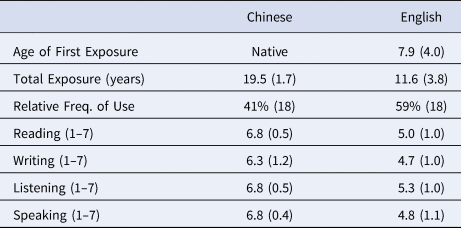
In this study we recruited 60 monolingual English speakers and 60 Chinese–English bilinguals from the UC Davis undergraduate participant pool. An additional 11 participants (8 monolinguals and 3 bilinguals) had to be excluded due to excessive eye-tracker noise or a failure to follow instructions. The final set of participants all had normal or corrected-to-normal vision and had no history of reading impairments. All Chinese–English bilingual participants were raised in Hong Kong, Taiwan, or mainland China (mean age = 19.5 years) and were of intermediate English proficiency. These bilinguals all learned English later in life, with no English exposure before the age of five (mean age of first exposure = 7.9, range = 5–15). On average, they had lived in the United States for three years (range: 1–8 years) prior to participating in the study (for additional language history information, see Table 1). All the monolingual speakers (mean age = 19.4 years) were raised in the United States and were only exposed to English before the age of five. None of the monolinguals reported proficiency in a second language. Both groups of participants provided informed consent before participating.
Language history information for the Chinese-English bilinguals, with average self-rated proficiency (1–7) in both languages. Standard deviations are shown in parentheses.

2.2 Stimuli
The critical stimuli included 48 triplets of sentences like the following:
1a) Transitive Verb: After visiting the retired admiral received a call on his cellphone.
1b) Intransitive Verb: After arriving the retired admiral received a call on his cellphone.
1c) Noun Control: After dinner the retired admiral received a call on his cellphone.
Each sentence began with a temporal adjunct, containing either an optionally transitive verb (visiting), an intransitive verb (arriving) or an event noun (dinner). These three continuations were matched in word length (noun: 7.6 characters, intransitive: 7.7, transitive: 7.6, F < 1) and log-per-million word frequency (noun: 1.39, intransitive: 1.26, transitive: 1.26, F < 1) in the SUBTLEX-US corpus (Brysbaert & New, Reference Brysbaert and New2009).
To assess the subcategorization preferences of each verb, we conducted a sentence completion task with two separate groups of twenty-one monolingual and fifteen Chinese–English bilingual undergraduates, none of whom participated in the main eye-tracking study. These participants read two-word sentence frames containing the past-tense form of each verb (e.g., “He visited…”, “She arrived…”), and they were asked to write the first completion that came to mind.
Consistent with our predictions, monolingual participants provided a direct object completion on 61% (SD = 9%) of trials for the optionally transitive verbs, and on only 3% (SD = 4%) of trials for the intransitive verbs. Bilingual participants produced a similar proportion of direct object continuations following optionally transitive verbs (mean = 58%, SD = 13%), but provided a higher proportion of direct object completions for the intransitive verbs (mean = 10%, SD = 8%, t(34) = 3.46, p = 0.002), including a number of ungrammatical direct-object continuations (e.g., She napped the child, She stumbled her friend). This finding suggests there may be systematic differences in lexically-based syntactic knowledge between these two groups – an issue which we examined in more detail in our main eye-tracking experiment.
To investigate the cross-language consistency of these verbs, we asked two highly proficient, Chinese–English bilinguals to translate the full set of stimulus materials into Mandarin, and to rate the transitivity of each critical verb. On average, 84% of the optionally transitive verbs and 47% of the intransitive verbs had a consistent transitivity bias in Mandarin and English.
In the main eye-tracking experiment, the optional comma between the temporal phrase and the following noun phrase was omitted to introduce a temporary syntactic ambiguity (Frazier & Rayner, Reference Frazier and Rayner1982). The 48 critical sentences were randomly intermixed with a set of 166 filler sentences of various types. Thirty-two of these fillers included complex cleft constructions (e.g., That's the paperwork that the intern grumbled in the break room about after lunch), and twenty-four of the fillers contained a temporarily ambiguous noun-noun compound (e.g., Larry poured the pencil shavings into the wastebasket).
2.3 Individual Differences Battery.
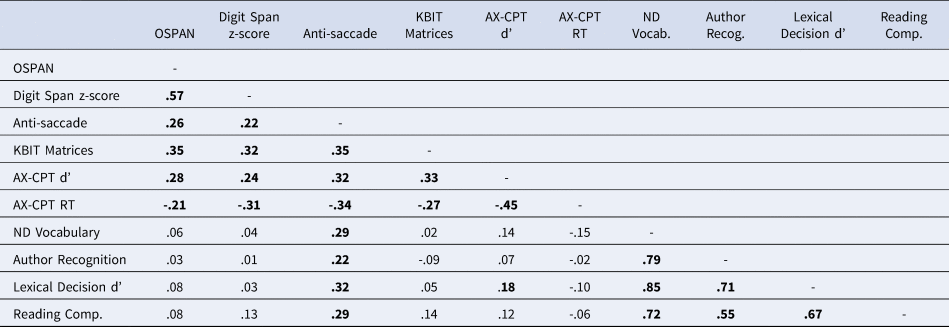
To assess differences in cognitive ability and language experience, participants completed a battery of individual differences measures in the same experimental session. Each participant completed eight tasks, which can be divided into three categories assessing working memory capacity, executive function, and language experience. Table 7 presents correlations between each of the individual differences measures.
Working memory tasks
The working memory tasks included a forward digit span task and an operation span (OSPAN) task (Unsworth, Heitz, Schrock & Engle, Reference Unsworth, Heitz, Schrock and Engle2005). For the digit span task, participants were presented with a string of digits at a rate of one digit per second. Each string was 4, 5, 6, 7, or 8 digits long. Afterward, participants had to recreate this string, in order, by entering digits on a keyboard. In the OSPAN task, participants had to solve mathematical equations with two operations while simultaneously remembering a list of 3, 4, 5, 6, or 7 letters. Equation verification trials and the presentation of memory items were interleaved. At the end of the memory phase, participants used the mouse to select the presented letters in serial order from a list of 12 candidates.
Executive Function tasks
Executive Function tasks included an antisaccade task, the “AX” continuous performance task (AX-CPT), and a non-verbal matrix reasoning task from the Kaufman Brief Scale of Intelligence (KBIT-2). In the antisaccade task (Friedman & Miyake, Reference Friedman and Miyake2004), participants had to suppress a reflexive saccade toward a flashing cue and instead look in the opposite direction to identify a briefly presented target. In the AX-CPT (Servan-Schreiber, Cohen & Steingard, Reference Servan-Schreiber, Cohen and Steingard1996), participants had to maintain a contextual cue (A or B) across a two-second delay in order to respond correctly to an upcoming target (X or Y). During this task, participants build up a prepotent response for the most frequent trial type (AX) that must be overridden on rare, non-target trials (BX). In the KBIT matrices task, participants saw a complex visual array with one element missing. For each item, participants had to identify a set of abstract rules to correctly complete the pattern.
Language experience tasks
The language tasks included the Nelson Denny (ND) vocabulary test, the author recognition test (ART, Acheson, Wells & MacDonald, Reference Acheson, Wells and MacDonald2008), and a lexical decision task modelled after LexTALE (Lemhöfer & Broersma, Reference Lemhöfer and Broersma2012), which included a larger number of English words with a broad range of frequencies. As an additional proficiency measure, we also included accuracy on the set of comprehension questions presented during the main eye-tracking task.
2.4 Equipment and procedure
Eye movements were monitored from the right eye using an SR Research EyeLink 1000 Plus. At the beginning of each session, the eye-tracker was calibrated using a 9-point grid. Tracker accuracy was monitored throughout the experiment, and re-calibrations were performed when necessary. The sentence stimuli were displayed in Consolas font using a Viewsonic P220f monitor. This monitor had a resolution of 1024 x 768 and a refresh rate of 132 Hz. Subjects were seated approximately 80 cm from the monitor with their chin resting comfortably on a chin rest. At this viewing distance, three characters corresponded to approximately 1° of visual angle.
During the eye-tracking task, subjects were asked to read each sentence carefully for comprehension. After one quarter of the trials, subjects were presented with a comprehension question about the preceding sentence. For example, after reading the sentence “After midnight the identical twins hailed a cab on the street corner”, participants might see the question “Where were the twins?”, along with two response options: “bus stop” and “street corner”. Individual difference measures were administered immediately following the eye-tracking task. In total, the experimental session lasted approximately three hours.
2.5 Data Analysis
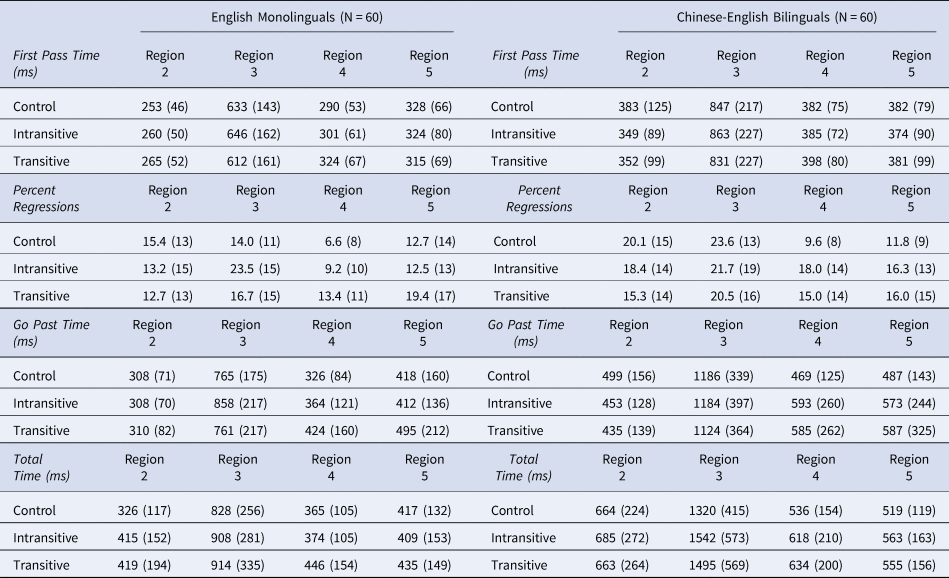
Prior to conducting statistical analyses, all fixations less than 80 ms in duration were either merged with an adjacent fixation within 1 character or else they were discarded. For the reading time data, we analyzed several measures that have been shown to be influenced by manipulations of syntactic difficulty (see Clifton & Staub, Reference Clifton, Staub, Liversedge, Gilchrist and Everling2011 for a review). These measures included 1) first pass time – the summed duration of fixations that occur before leaving a region, 2) percent regressions – the proportion of trials with a first-pass regressive saccade to material earlier in the sentence, 3) go past time – the sum of all fixations before crossing a region's right-hand boundary. For completeness, we also report total time – the sum of all fixations falling within a region (see Table 2). Eye-movement measures were calculated for each region of the sentence, including the ambiguous noun phrase, the disambiguating verb, and a two-word spillover region (see below).

Eye-tracking during reading measures for Noun Control, Transitive, and Intransitive sentences across groups. By-subject standard deviations are shown in parentheses.

In these analyses there were two main comparisons of interest: the effects of verb transitivity (Transitive vs. Intransitive), which we expected to observe at the critical noun phrase (region 3) and the effects of garden-path reanalysis (Transitive vs. Control), which we expected to observe at the disambiguating verb (regions 4). Analyses were also conducted for a two-word spillover region (region 5), although these results were largely consistent with the results at the disambiguating verb (see footnote 4).
Statistical analyses were performed with linear mixed effect models using the lme4 package in R (Bates, Maechler, Bolker & Walker, Reference Bates, Maechler, Bolker and Walker2015). For each contrast of interest, a maximal mixed-effects model was fit to the data with crossed random slopes and intercepts for both subjects and items (Barr, Levy, Scheepers & Tily, Reference Barr, Levy, Scheepers and Tily2013). For percent regression data, we used binomial general linear mixed-effect models with a logit link function. In our initial omnibus test, the significance of the three-level, categorical factor of Condition was assessed using Chi-squared model comparisons using the anova() function. In addition, we also performed pair-wise comparisons to separately examine the effects of verb transitivity and garden-path disambiguation within each participant group. These pair-wise comparisons were conducted by directly compared data in the two conditions of interest via contrast coding and mean-centered predictor variables. Reported p-values were obtained using likelihood ratio tests for the reading time data, and Wald Z tests for the regression rate data.
After describing the group-level eye-tracking results in detail, we will turn to examining the results of our individual difference analyses. In this secondary analysis, individual factor scores were obtained for each participant via exploratory factor analysis (EFA), and these factor scores were then used to predict individual differences in reading behavior via multiple regression.
3. Results
During the reading task, bilinguals showed longer fixation durations (Monolingual: 231 ms (26), Bilingual: 251 ms (26), p < .001) and longer sentence reading times (Monolingual: 3491 ms (1111), Bilingual: 4853 ms (1331), p < .001) relative to monolinguals. In addition, bilinguals showed reduced comprehension accuracy (Monolingual: 95% (4%), Bilingual: 86% (7%), p < .001), although all participants performed significantly above chance. These results replicate the basic finding of longer reading times and reduced comprehension accuracy in late L2 learners (Jacob & Felser, Reference Jacob and Felser2016; Juffs & Harrington, Reference Juffs and Harrington1996).
Because we observed reliable main effects of Group (Bilingual vs. Monolingual) across a majority of eye-tracking measures, we do not report these main effects in detail. Instead, we examined the omnibus (2 x 3) Group by Condition interaction to determine whether the two groups of participants showed differential responses to our verb subcategorization manipulation. To explore differential responses across the two groups, we also examined condition effects separately for monolinguals and bilinguals. See Table 2 for means and standard deviations for all conditions and measures in Regions 2 through 5.
Omnibus Analysis of Eye-tracking Results

3.1 Verb transitivity effects (region 3)
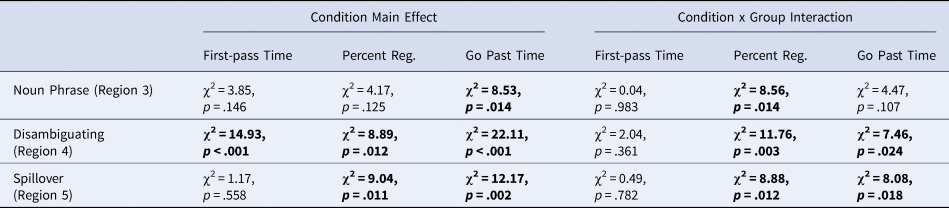
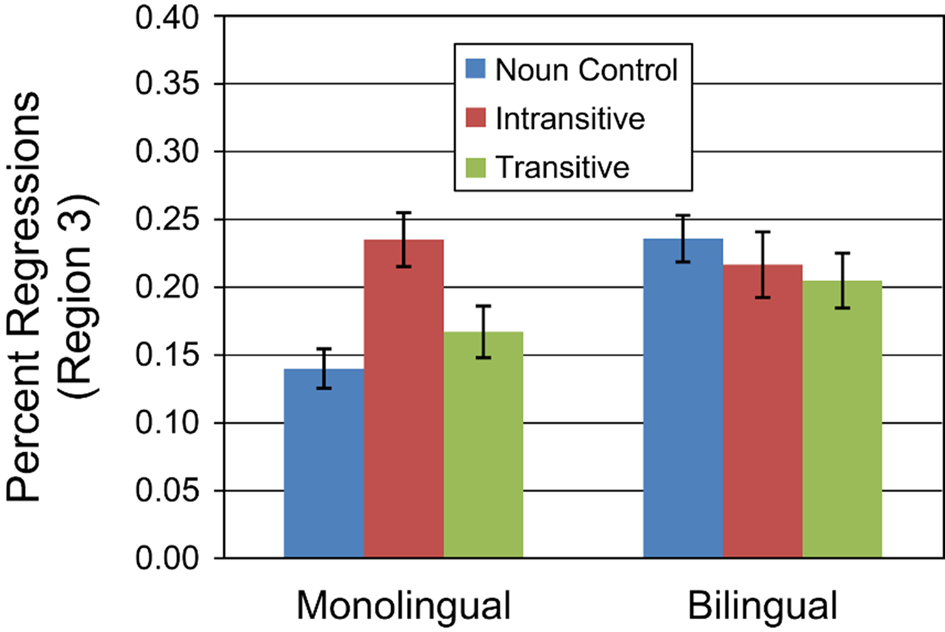
To investigate the effects of verb subcategorization information, we compared reading times for our three sentence types at the critical noun phrase.Footnote 2 In a combined analysis, we observed a main effect of Condition in go-past times (X 2 = 8.53, p = .014), as well as a Group by Condition (2 × 3) interaction that was significant for percent regressions (X 2 = 8.56, p = .013), see Figure 1.
Differences across groups in percent regressions at the critical noun phrase (the retired admiral…) across conditions.

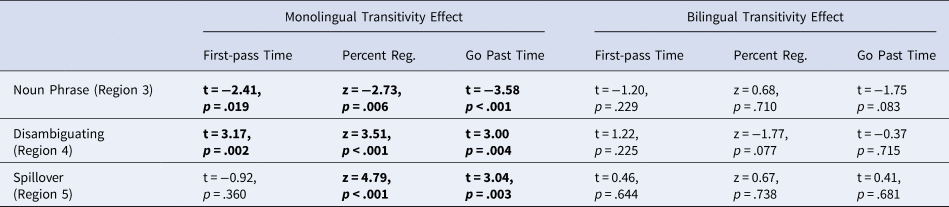
When analyzing this data separately for Monolinguals and Bilinguals, reading time data for the Monolingual group closely replicated the findings of previous studies. Monolinguals showed longer first pass reading times on noun phrases following an Intransitive verb compared to a Transitive verb (b = −33.6, t = 2.41, p = .018). They also showed increased regression rates (b = −0.62, z = −2.73, p = .006) and go past times (b = −97.0, t = 3.58, p < .001).
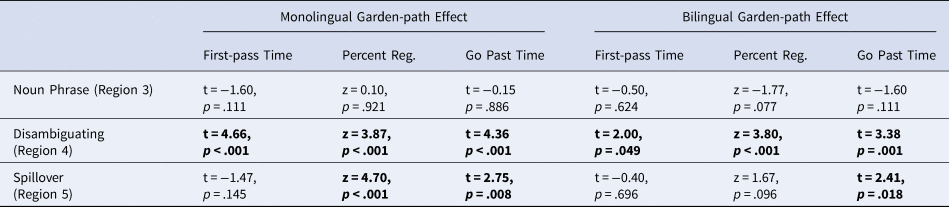
Notably, these increased reading times could not be attributed to the absence of a comma between clauses (Staub, Reference Staub2007). While both the Noun Control condition and the Intransitive verb condition signaled the end of a clause without a comma, we still observed longer reading times in the Intransitive condition relative to the Noun Control condition (% reg: b = 0.660, z = 3.39, p < .001; go past: b = −94.0, t = 3.55, p < .001). The Transitive and Noun Control conditions showed no differences in this region on any measure (all ts < 1.6).
For the Chinese–English bilinguals, we observed a different pattern of effects. In this group, the effects of verb transitivity were generally weaker and failed to reach significance. We observed no significant differences between the Transitive and Intransitive verb conditions on any reading time measure in Region 3 (first pass: b = −31.4, t = 1.20, p = .22; % reg: b = −0.07, z = −0.42, p = .68; go past: b = −60.4, t = −1.75, p = .08). We also observed no significant differences between the Intransitive condition and the Noun Control condition (first pass: b = 17.7, t = 0.75, p = .25; % reg: b = −0.25, z = −1.42, p = .16; go past: b = −1.8, t = −0.05, p = .99).
Pairwise comparisons examining the transitivity effect (Intransitive vs. Transitive) for Monolingual readers and Chinese-English bilinguals.

Pairwise comparisons examining the garden-path effect (Transitive vs. Control) for Monolingual readers and Chinese-English bilinguals.

3.2 Verb transitivity and garden-path effects (region 4)
In Region 4, we again observed significant main effects of Condition (first-pass: X 2 = 14.93, p < .001; % reg: X 2 = 8.89, p = 0.012; go past: X 2 = 22.1, p < 0.001) and a significant Group by Condition (2 × 3) interaction (% reg: X 2 = 11.77, p = .003; go past: X 2 = 7.46, p = .024). At the disambiguating verb, Monolinguals showed a “reversal” of the verb transitivity effect, which has also been reported in previous studies (Pickering & Traxler, Reference Pickering and Traxler1998; Staub, Reference Staub2007; Traxler & Pickering, Reference Traxler and Pickering1996; Van Gompel & Pickering, Reference Van Gompel and Pickering2001). While the critical noun phrase is initially plausible in the Transitive verb condition (After visiting the retired admiral…), this changes at the subsequent verb (received). At this point, readers should experience a garden-path effect in which they must re-interpret the prior noun phrase (the retired admiral) as the subject of a new clause. Consistent with this effect, Monolinguals showed longer reading times in the Transitive condition relative to the unambiguous Noun Control condition (first pass: b = 34.1, t = −4.66, p < .001; % reg: b = 0.79, z = 3.87, p < .001; go past: b = 94.5, t = 4.36, p < .001). Monolinguals also showed longer reading times in the Transitive condition relative to the Intransitive condition (first pass: b = 22.3, t = −3.17, p = .002; % reg: b = 0.71, z = 3.51, p < .001; go past: b = 60.5, t = 3.00, p = .004). Interestingly, Monolingual readers showed no clear reading time differences between Intransitive and Noun Control sentences in this region (first pass: b = 11.3, t = 1.46, p = .15; % reg: b = −0.06, z = 0.28, p = .78; go past: b = −33.7, t = 1.84, p = .07). This suggests that the processing difficulty for Intransitive sentences in Region 3 allowed Monolingual readers to identify the correct parse prior to encountering the disambiguating verb.
Bilinguals again showed a different pattern of reading behavior from the Monolinguals in this disambiguating region (Region 4). Similar to Region 3, Bilinguals again showed no significant differences between Transitive and Intransitive sentences (first pass: b = 11.6, t = 1.22, p = .22; % reg: b = −0.24, z = −1.77, p = .08, go past: b = −9.3, t = −0.37, p = .71). Interestingly, both of these conditions showed inflated reading times and increased regression rates relative to the Noun Control (Transitive Verbs: first pass: b = 17.9, t = 2.00, p = 0.049; % reg: b = 0.59, z = 3.80, p < .001, go past: b = 116.6, t = 3.38, p = .001; Intransitive Verbs: first pass: b = 6.0, t = 0.63, p = .53; % reg: b = 0.62, z = 3.82, p < .001, go past: b = 126.2, t = 3.91, p < .001).
To compare the relative strength of the garden-path effect in the Transitive condition across groups, we conducted an additional 2 x 2 analysis (Transitive vs. Noun Control x Monolingual vs. Bilingual). This model produced a highly significant main effect of Condition (first pass: b = 25.9, t = 4.48, p < .001; % reg: b = 0.48, z = 3.72, p < .001, go past: b = 106.0, t = 4.93, p < .001) but no significant Group by Condition interactions (ts < 1.4). This suggests that Bilinguals experienced garden-path effects of similar magnitude to Monolinguals, despite their apparent insensitivity to verb subcategorization information.
The results from Region 4 indicate that Bilinguals did experience a garden-path effect at the disambiguating region, but that this garden-path effect was about the same magnitude following both Transitive and Intransitive verbs. This result is consistent with Bilinguals’ reduced sensitivity to verb subcategorization cues observed in Region 3, and it suggests that Bilinguals continued to maintain an incorrect direct object parse for both Transitive and Intransitive sentences until entering the disambiguating region.Footnote 3
In summary, these reading-time data reveal different patterns of syntactic parsing for native monolingual and late-L2 learners of English. While both groups showed sensitivity to some forms of syntactic mis-analysis, in the form of garden-path effects (After visiting the retired admiral received…), bilingual readers showed reduced sensitivity to subtle verb subcategorization information (visiting vs. arriving). As a group, late-L2 learners did not appear to distinguish transitive and intransitive verbs in the same way as monolinguals. In our individual differences analyses below, we examine how individual variability in linguistic and non-linguistic cognitive abilities may account for these group differences.
3.3 Individual differences measures
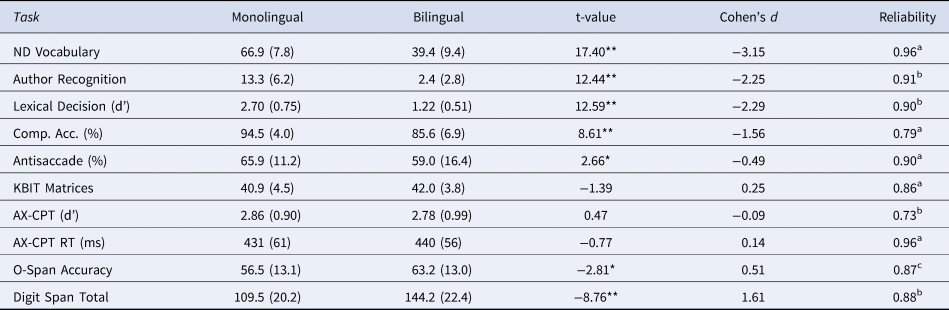
In addition to our primary eye-tracking task, all 120 participants completed a battery of individual difference measures. The goal of these assessments was to determine whether individual variability in working memory, executive function, and/or English language experience would play a role in the online use of verb subcategorization information during sentence processing. Performance on these measures across the two groups are summarized in Table 6, and a correlation matrix describing the relationships between these measures can be found in Table 7.
Individual difference task performance across groups * p < 0.01, ** p < 0.001.

Nelson Denny vocabulary (max score = 80), Author recognition (max = 65), Antisaccade (chance = 33%), KBIT Matrices (max = 46), O-Span (max = 75), Digit Span (max = 165), Reliability measures, a: Cronbach's alpha, b: split-half reliability corrected with Spearman-Brown prophecy formula, c: from Foster, et al., 2015
Correlation matrix for individual difference tasks. Correlation coefficients highlighted in bold are significant, p < 0.05.

As expected, bilinguals performed significantly worse than monolinguals on measures of vocabulary, reading experience, and comprehension. The two groups performed similarly on measures of executive function (e.g., KBIT matrices, AX-CPT).
Performance on the antisaccade task was somewhat higher in the monolingual group, while O-SPAN performance was higher in the bilingual group. We also observed differences in digit span performance across groups, with bilinguals outperforming monolinguals. Previously, differences in digit-span performance between English and Mandarin-speaking samples have been attributed to differences in digit pronunciation latency across languages, rather than group differences in WM capacity per se (Stigler, Lee & Stevenson, Reference Stigler, Lee and Stevenson1986; Mattys, Baddely & Trenkic, 2017). To account for this language-specific effect, digit-span scores were standardized into z-scores separately for each group.
3.4 Factor analysis
Before examining individual differences in syntactic processing, these ten dependent measures were combined into a smaller set of underlying variables using Exploratory Factor Analysis (EFA). Before conducting this factor analysis, any task score more than 3 standard deviations from the group mean was replaced with this cutoff value. This trimming procedure affected less than 1% of the data. In addition, due to experimenter error, five participants had data missing from one task, and three participants had data missing from two tasks, representing 1.2% of the data. Rather than excluding these participants, missing values were interpolated using the remaining task scores.
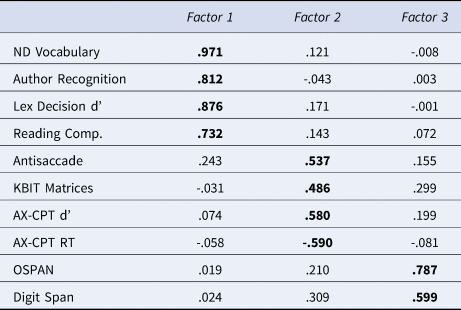
The EFA was conducted in SPSS using principal axis factoring and a Varimax rotation. This EFA resulted in three primary factors (see Table 8, below). Factor 1 (30% total variance) loaded highly on measures of language experience, Factor 2 (14% total variance) loaded on tasks related to executive function, and Factor 3 (11% total variance) loaded on measures of working memory. For each participant, a normalized factor score was obtained for each factor, and these three variables were then used to predict online reading behavior related to syntactic reanalysis.
Rotated factor matrix for the three-factor solution (Varimax rotation)

3.5 Multiple Regression Analyses
Based on our initial by-group analyses, we were interested in two primary dependent measures: 1) sensitivity to verb subcategorization information – as indexed by the early transitivity effect in Region 3, and 2) sensitivity to word category violations, as indexed by the garden-path effect between the Transitive and Noun Control conditions in Region 4. We chose percent regressions as our dependent variable of interest because it is an oculomotor measure that has been closely linked with syntactic reanalysis (Clifton & Staub, Reference Clifton, Staub, Liversedge, Gilchrist and Everling2011). In addition, this measure showed the most robust differences in the by-group analyses. For each set of difference scores, we performed a linear multiple regression analysis, with the three latent variables (Language Experience, Executive Function, Working Memory) and their higher order two-way interactions as predictors (see Table 9).
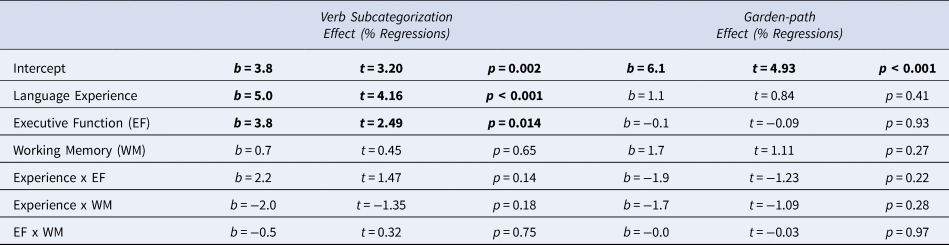
Results of multiple regression analyses, predicting syntactic reanalysis effects as a function of Language Experience, Executive Function (EF), Working Memory (WM), and their higher order interactions.

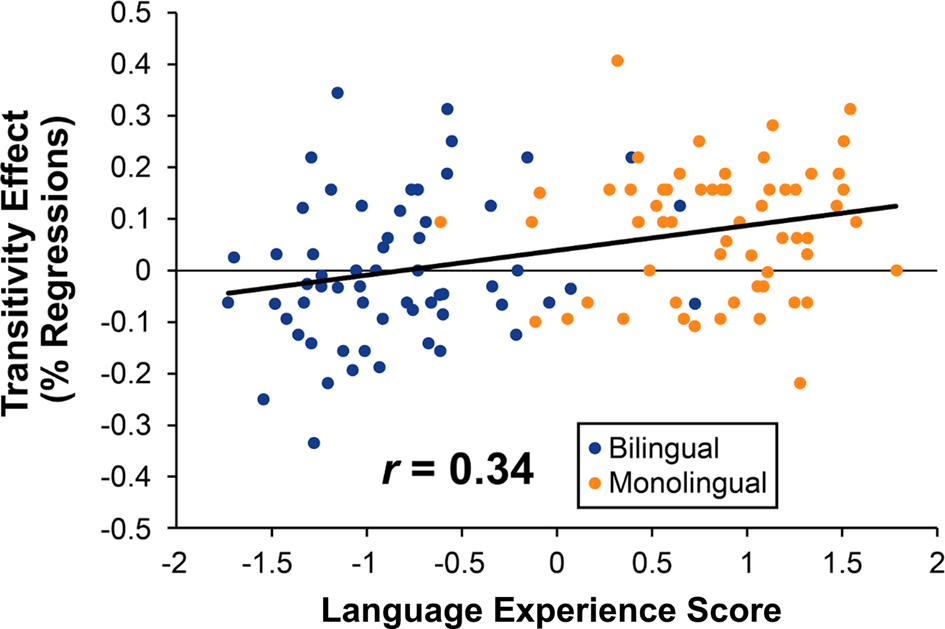
For the transitivity effect in Region 3, the intercept was significantly different from zero (b = 3.8, t = 3.20, p = .002), indicating an increase in regressions following an Intransitive verb relative to a Transitive verb (After arriving/visiting the retired admiral…). The model showed that this transitivity effect was larger for individuals with stronger English Language Experience (b = 5.0, t = 4.16, p < .0001), consistent with the observed differences between monolingual and bilingual readers (see Figure 2). In addition, this transitivity effect was larger for readers high in Executive Function (b = 3.8, t = 2.49, p = .014). There were no significant effects of Working Memory capacity (b = 0.6, t = 0.32, p = .75), and no higher order interactions (ts < 1.5). The addition of language group status (Monolingual vs. Bilingual) to this model did not account for additional variance in the size of the subcategorization effect.
The relationship between Language Experience scores and verb transitivity effects (percent regressions in Region 3).

Because Language Experience and language group status were highly correlated, we also investigated individual differences in verb transitivity effects separately for each group. For Bilinguals, we observed a significant effect of Language Experience (b = 7.2, t = 2.06, p = .044) but no effects of Executive Function or Working Memory (ts < 0.9). This suggests that Bilinguals showed increasingly native-like syntactic processing as proficiency increased. In the Monolingual group, we observed a significant effect of Executive Function (b = 9.3, t = 2.13, p = .038), but no reliable effects of Language Experience and Working Memory (ts < 1.6).
Our next regression model predicted the size of the garden-path effect in Region 4. Again, this model showed a significant intercept (b = 6.0, t = 4.93, p < .001), indicating more regressions in the Transitive verb condition relative to the unambiguous Noun control (After visiting/dinner the retired admiral received…). Critically, the size of this garden-path effect was not influenced by any of the individual difference factors or their higher order interactions (see Table 9).
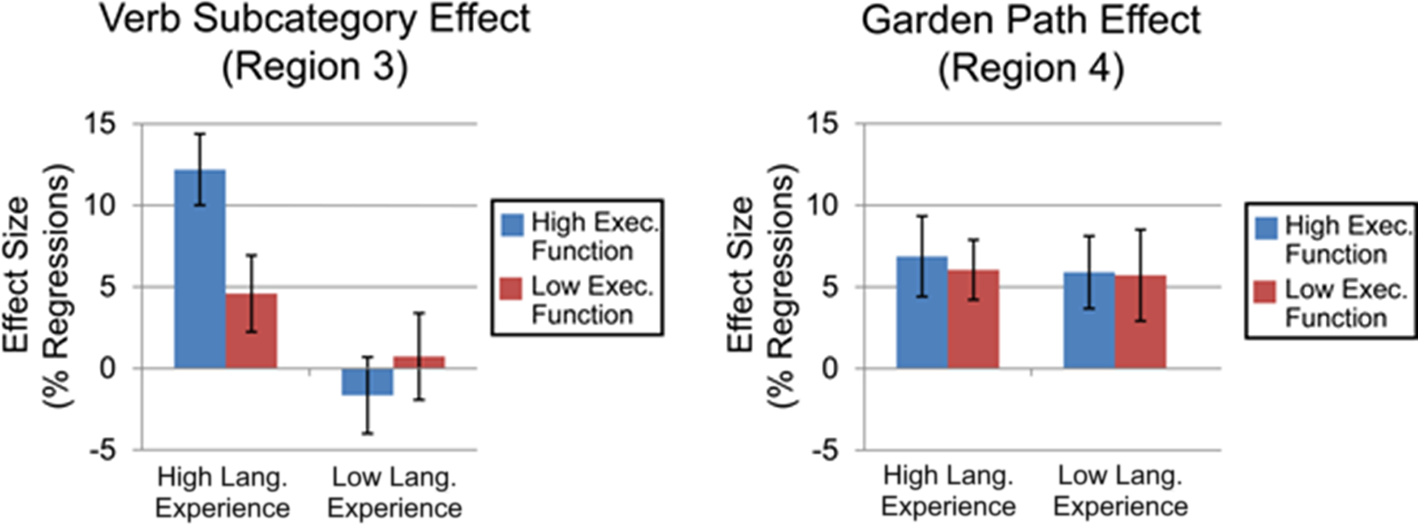
Differences in syntactic processing across all participants when separated (via median split) on their Language Experience and Executive Function abilities. Early sensitivity to verb subcategorization information differed as a function of both Language Experience and Executive Function. Neither of these predictors influenced the magnitude of the garden path effect. Error bars represent ±1 standard error of the mean.

4. Discussion
This eye-tracking study investigated the processing of temporary syntactic ambiguities in English monolinguals and Chinese–English bilinguals. Our first goal was to determine whether these native and non-native readers are equally sensitive to subcategorization cues such as verb transitivity during parsing. Another question was whether individual differences in language experience, executive function, and working memory would mediate online sensitivity to transitivity and garden-path effects. Participants read two types of ambiguous sentences which differed in the subcategorization properties of the initial verb (e.g., After visiting vs. After arriving…), as well as a control condition in which a noun signaled the end of the subordinate clause (e.g., After dinner…).
Generally, bilinguals showed slower sentence reading times and higher error rates on comprehension questions compared to the native English speakers, replicating results from prior studies (Cop, Dirix, Drieghe & Duyck, Reference Cop, Dirix, Drieghe and Duyck2016; Jacob & Felser, Reference Jacob and Felser2016; Juffs & Harrington, Reference Juffs and Harrington1996). More importantly, monolinguals and bilinguals differed in their online sensitivity to verb subcategorization information. Reading behavior in monolingual English speakers generally replicated the findings of previous studies. This group showed longer reading times and more regressions at the temporarily ambiguous noun phrase (the retired admiral) in the Intransitive condition (1b) compared to the Transitive (1a) and Noun Control conditions (1c). In contrast, Chinese–English bilinguals did not show a reliable transitivity effect, either in fixation times or regression measures. At the disambiguating verb (received), native English speakers also showed the commonly observed “reversal” effect (Pickering & Traxler, Reference Pickering and Traxler1998; Traxler & Pickering, Reference Traxler and Pickering1996), with shorter fixations and fewer regressions in the Intransitive compared to the Transitive condition. By contrast, bilinguals showed equally large garden-path effects at the disambiguating region regardless of verb subcategorization. In bilinguals, both sentence types (1a and 1b) produced greater processing load at the disambiguating verb (received) compared to the unambiguous Noun Control condition.
These results indicate that both monolinguals and bilinguals initially attached the critical noun phrase (the retired admiral) to the preceding verb regardless of whether it was transitive or intransitive. However, monolinguals appeared to recover faster than bilinguals in the Intransitive condition, suggesting that they were able to quickly detect the conflict between their initial parse and the verb's subcategorization restrictions. In this condition, monolinguals showed evidence of syntactic reanalysis already at the critical noun phrase and no evidence of lingering processing difficulty at the main verb (relative to the Noun Control condition). In our view, this pattern of reading time effects is most consistent with the model proposed by Mitchell (Reference Mitchell and Coltheart1987) and Van Gompel and Pickering (Reference Van Gompel and Pickering2001). According to these accounts, readers initially compute a direct-object interpretation of the noun phrase independent of the subcategorization restrictions of the previous verb. In the case of an intransitive verb, monolingual readers quickly detect that this initial commitment is implausible (“arriving an admiral”), which results in a subsequent syntactic reanalysis.
In contrast, the bilingual group as a whole showed no clear evidence that they differentiated between transitive and intransitive verbs at any point in the sentence. Like monolinguals, they seem to have attached the critical noun phrase to the prior verb regardless of its subcategorization. However, in both conditions, bilinguals only reanalyzed the parse when they reached the main, disambiguating verb. In fact, the magnitude of the garden-path effect (Transitive vs. Noun Control condition) was very similar for monolinguals and bilinguals, which suggests that the two groups were equally equipped to detect and repair structural difficulties based on unexpected word category information (noun vs. verb). These results indicate that lower proficiency bilingual readers can engage in syntactic reanalysis, but that these readers are less able to take advantage of relevant verb subcategorization information.
On the surface, these results appear to conflict with some previous studies showing relatively intact verb subcategorization processing in bilingual readers. It should be noted that bilinguals in these prior studies were either highly proficient translators (Dussias & Cramer Scaltz, Reference Dussias and Scaltz2008) or near-native speakers (Jegerski, Reference Jegerski2012) who likely had higher L2 language abilities than the Chinese–English bilinguals in the current study, consistent also with the results of our offline norming study. Moreover, the bilingual verb subcategorization effect reported by Dussias and colleagues was approximately half the magnitude of the subcategorization effect observed in their group of native, monolingual speakers, although these differences did not reach significance (see also, Frenck-Mestre and Pynte Reference Frenck-Mestre and Pynte1997, Experiment 2). In addition to our eye-tracking and sentence completion results, these findings provide further evidence that exposure and proficiency in a second language are important moderators of syntactic parsing, particularly in the case of lexically-based syntactic information (Lee, Lu & Garnsey, Reference Lee, Lu and Garnsey2013).
4.1 Individual differences in syntactic parsing
Our battery of individual differences measures included a variety of tasks assessing working memory capacity, executive function, and language experience. As expected, the data fit best into a three-factor solution, with each of these domains constituting a separate factor. As discussed in the Introduction, different theories of syntactic parsing make different claims regarding the relative importance of these three cognitive constructs when processing ambiguous or syntactically complex sentences. In the sections below, we discuss each of these factors in turn and how they related to eye-movement behavior in the sentence comprehension task.
4.2 Language experience
Consistent with the group differences observed between monolinguals and bilinguals, our multiple regression analyses indicated that language proficiency predicted online sensitivity to verb subcategorization information (as indexed by transitivity effects in Region 3). This relationship suggests that readers with lower language proficiency may not strongly differentiate verbs either in terms of their semantic-thematic properties (e.g., number and type of thematic role possibilities; Jackendoff, Reference Jackendoff2002) or in terms of the types of syntactic structures in which they may participate (MacDonald et al., Reference MacDonald, Pearlmutter and Seidenberg1994). As a result, lower proficiency readers appear to rely more strongly on coarse, word category distinctions (noun, verb) when making parsing decisions.
While bilinguals did show reduced online sensitivity to subcategorization cues, these parsing differences depended on their level of L2 proficiency. Non-native speakers with the highest levels of English experience showed reanalysis effects that were more similar to English monolinguals at the critical noun phrase (see Figure 2). Most importantly, after accounting for proficiency differences, language status was no longer a reliable predictor of parsing behavior. These findings support the idea that native and non-native speakers co-exist along single continuum of proficiency, and that syntactic processing becomes more “native-like” as L2 experience increases (Hopp, Reference Hopp2006; see also Anible, Twitchell, Waters, Dussias, Piñar & Morford, Reference Anible, Twitchell, Waters, Dussias, Piñar and Morford2015).
While there were clear effects of language experience in the online use of subcategorization information, experience scores did not predict the size of the garden-path effect in Region 4. At the disambiguating verb, both groups responded rapidly to violations of word category expectations (e.g., encountering a verb instead of a noun phrase at the disambiguating region). This finding suggests that the processing of word categories (noun vs. verb) and word subcategories (transitive vs. intransitive) may have different developmental trajectories during second language acquisition. The correct application of verb-based preferences may only emerge later in second language development as the lexical representations of individual words becomes more precise (consistent with the lexical quality hypothesis; Perfetti & Hart, Reference Perfetti and Hart2002).
In previous studies, similar effects of language experience have also been observed in the processing of filler-gap dependencies (Dallas, DeDe & Nicol, Reference Dallas, DeDe and Nicol2013; cf. Traxler & Pickering, Reference Traxler and Pickering1996). In filler-gap sentences, a moved constituent needs to be associated with a subsequently encountered word. For example, player needs to be associated with threatened in the sentence That's the player (filler) that the coach threatened (gap site) yesterday. Dallas and colleagues found that Chinese–English bilinguals responded less strongly than native English speakers to implausible filler gaps. In fact, bilinguals showed no significant plausibility effects at the group level. However, in both monolinguals and bilinguals, sensitivity to implausible filler-gaps correlated with measures of language experience. Hence, across different sentence types, L2 experience seems to be a critical predictor of online parsing abilities in bilinguals (see also Lee, Lu & Garnsey, Reference Lee, Lu and Garnsey2013; Dussias & Piñar, Reference Dussias and Pinar2010; Steinhauer, White & Drury, Reference Steinhauer, White and Drury2009; Williams, Reference Williams2006; Jessen & Felser, Reference Jessen and Felser2018; Rah & Adone, Reference Rah and Adone2010).
4.3 Executive function
In addition to highlighting the importance of language experience, the present results also provide some partial support for theories linking syntactic re-analysis and domain-general cognitive control abilities (Novick et al., Reference Novick, Trueswell and Thompson-Schill2005). According to these theories, cognitive control is critical for the successful detection and resolution of conflict between competing representations. Readers with diminished cognitive control abilities may therefore struggle to resolve conflicts between competing syntactic cues (e.g., attachment preferences and verb subcategorization biases) or fail to detect these conflicts during online reading comprehension.
From neuroimaging studies, it has been demonstrated that overlapping areas of the left inferior frontal gyrus (LIFG) are recruited, both when performing syntactic reanalysis and when performing non-linguistic, control-demanding tasks (January, Trueswell & Thompson-Schill, Reference January, Trueswell and Thompson-Schill2009). Moreover, patients with focal lesions to LIFG show increased errors in tasks requiring cognitive control, as well as specific behavioral impairments when resolving syntactic ambiguities (Novick, Kan, Trueswell, Thompson-Schill, Reference Novick, Kan, Trueswell and Thompson-Schill2009). While the evidence from neuroimaging and neuroanatomical studies is quite clear, there is little behavioral evidence demonstrating a link between cognitive control abilities and reading performance (although see Novick, Hussey, Teubner-Rhodes, Harbison & Bunting, Reference Novick, Hussey, Teubner-Rhodes, Harbison and Bunting2014; Teubner-Rhodes et al., Reference Teubner-Rhodes, Mishler, Corbett, Andreu, Sanz-Torrent, Trueswell and Novick2016 for evidence from cognitive control training).
In the current study, participants who performed well in a variety of non-linguistic, executive function tasks (anti-saccade, AX-CPT) also showed stronger initial responses to verb subcategorization violations during natural reading. This group of readers showed more immediate regressions from the critical noun phrase following an intransitive verb (After arriving the retired admiral…), suggesting that they could rapidly detect the conflict between the verb's subcategorization preferences and their initial direct-object analysis of the sentence. This type of conflict monitoring ability has been described as a central component of executive functioning and is often impaired in disorders such as schizophrenia and frontal lobe dementia (Botvinick, Braver, Barch, Carter & Cohen, Reference Botvinick, Braver, Barch, Carter and Cohen2001; Krueger, Bird, Growdon, Jang, Miller & Kramer, Reference Krueger, Bird, Growdon, Jang, Miller and Kramer2009).
While executive function was related to verb subcategorization processing, we observed a different pattern for garden-path effects at the disambiguating verb. Specifically, in this region, we observed robust garden-path effects for both monolingual and bilingual readers and no correlations with executive functions. This finding is relatively inconsistent with the accounts, outlined earlier, which suggest that cognitive control is a critical factor in all forms of successful syntactic re-analysis (Novick et al., Reference Novick, Trueswell and Thompson-Schill2005, although see Englehardt, Nigg & Ferriera, 2017). One possible explanation for this discrepancy is that violations of word category expectancies produce a clear disambiguating cue that readers can easily detect (Brothers & Traxler, Reference Brothers and Traxler2016), while subtler verb subcategorization information may only be available to readers with strong conflict monitoring abilities. If this is the case, this finding adds an interesting wrinkle to traditional, constraint-based models of syntactic parsing (MacDonald, Pearlmutter & Seidenberg, Reference MacDonald, Pearlmutter and Seidenberg1994), suggesting that some sources of syntactic information are only immediately available to readers with certain cognitive profiles. To test this hypothesis more directly, it will be important, in future studies, to investigate a wider range of syntactic structures, as well as readers with a broader range of cognitive control abilities (e.g., see Christianson, Williams, Zacks & Ferreira, Reference Christianson, Williams, Zacks and Ferreira2006; Yoo & Dickey, Reference Yoo and Dickey2017).
Although executive functioning predicted some aspects of syntactic parsing in the present study, we should note that there were no consistent differences in executive functioning between monolinguals and bilinguals – either at the level of individual tasks (Table 6) or underlying factor scores (Bilinguals: mean = −0.01, SD = 0.80; Monolinguals: mean = 0.03, SD = 0.78, t(118) = −0.32, p = 0.74). Although this was not a primary goal of the present research, these findings could be considered a failure to replicate the “bilingual advantage” in domain-general cognitive control for late L2 learners (see Paap & Greenberg, Reference Paap and Greenberg2013; Paap, Johnson & Sawi; von Bastian, Souza & Gade, Reference Paap, Johnson and Sawi2015).
4.4 Working memory
Previous studies, particularly those employing dual-task paradigms, have argued that working memory plays a critical role in sentence processing (Fedorenko, Gibson & Rohde, Reference Fedorenko, Gibson and Rohde2006); however, several individual difference studies have failed to support this position (Traxler et al., Reference Traxler, Williams, Blozis and Morris2005, Reference Traxler2012; Van Dyke et al., Reference Van Dyke, Johns and Kukona2014; Freed et al., Reference Freed, Hamilton and Long2017). For example, Van Dyke and colleagues (Reference Van Dyke, Johns and Kukona2014) found that working memory ability was only spuriously related to comprehension performance during a memory interference task. When general intelligence was taken into account, receptive vocabulary – and not working memory – was the only factor that uniquely predicted reading outcomes. Similarly, in the current experiment, performance on non-verbal working memory tasks was not a strong predictor of online syntactic reanalysis or offline comprehension (for a similar pattern in bilingual readers, see Dallas et al., Reference Dallas, DeDe and Nicol2013).Footnote 4
These results are inconsistent with shared resource accounts, which claim that working memory capacity places a critical bottleneck on the computation of syntactic dependencies (King & Just, Reference King and Just1991; Just & Carpenter, Reference Just and Carpenter1992; Daneman & Carpenter, Reference Daneman and Carpenter1980). Instead, they more closely align with experience-based accounts, in which sentence comprehension abilities are determined by a reader's cumulative language exposure (MacDonald & Christiansen, Reference MacDonald and Christiansen2002) and the quality of their lexical representations (Perfetti & Hart, Reference Perfetti and Hart2002). Particularly, in bilingual readers, increasing L2 experience seems to allow for more efficient access to lexically-based syntactic information, resulting in more native-like sentence processing.
5. Conclusion
Relative to native speakers, late L2 learners of English showed less accurate knowledge of lexically based subcategorization information and were less able to use these cues in real time to guide syntactic parsing decisions. Critically, objective measures of L2 proficiency and vocabulary knowledge fully accounted for these group-level differences, suggesting that syntactic processing abilities can improve with additional language exposure. Finally, executive function abilities (but not working memory capacity) also predicted the successful application of verb subcategorization information online. These findings suggest that both linguistic and non-linguistic cognitive abilities must be considered when accounting for variability in sentence processing outcomes across individuals.
Acknowledgements
This project was supported by awards from the National Institutes of Health (#1R0101HD073948; 11601946). We would like to thank Rebecca Horton and John Clayton Young for their assistance in data collection.
Appendix
Appendix: The 48 critical sentences used in the main eye-tracking experiment. Each participant saw one of the three continuations in parentheses (optionally transitive verb /intransitive verb/noun control).
1) After (waking/napping/nightfall) the large raccoon climbed the oak tree out front.
2) After (visiting/arriving/dinner) the strange fellow wandered around the neighborhood.
3) After (bathing/sitting/surgery) the frail patient needed some help from the nurse.
4) After (serving/crying/dessert) the young woman exited the dining room quietly.
5) After (filming/waiting/midnight) the talented hipster returned to Brooklyn on the train.
6) Before (asking/sleeping/bedtime) my older brother compiled a list of pros and cons.
7) Before (moving/rising/sunset) the stunned victim made sure she wasn't bleeding.
8) After (losing/falling/Easter) the valuable goalie handed in his resignation.
9) After (wrestling/stumbling/practice) the young recruit slipped on the stairs and hurt himself.
10) Before (investigating/apologizing/Thanksgiving) the failed businessman called his friends to ask for help.
11) After (fighting/competing/Tuesday) the skilled samurai refused to talk to anyone.
12) Before (killing/dying/sunrise) the dangerous criminal delivered a message to the police chief.
13) Before (shooting/departing/lunchtime) the lieutenant loaded a shell into the artillery.
14) Before (paying/going/class) the hardworking student gathered up all of his bags.
15) Before (dressing/responding/showtime) the ugly clown applied some makeup to his face.
16) After (attacking/appearing/breakfast) the mad scientist escaped through a hidden doorway.
17) After (waking/napping/nightfall) my tired wife rubbed her eyes and yawned.
18) After (visiting/arriving/dinner) the retired admiral received a call on his cellphone.
19) After (bathing/sitting/surgery) the small child wondered where his parents were.
20) After (serving/crying/dessert) the emotional teenager stormed out of the restaurant.
21) After (filming/waiting/midnight) the identical twins hailed a cab on the street corner.
22) Before (asking/sleeping/bedtime) the young children kneeled to say their prayers.
23) Before (moving/rising/sunset) the wounded soldier looked around for his helmet.
24) After (losing/falling/Easter) my dancing partner vowed to never compete again.
25) After (wrestling/stumbling/practice) the strong athlete collapsed on the floor in a heap.
26) Before (investigating/apologizing/Thanksgiving) the former general contacted the New York Times.
27) After (fighting/competing/Tuesday) the evil villain retreated to his secret lair.
28) Before (killing/dying/sunrise) the accused heretic screamed at the top of his lungs.
29) Before (shooting/departing/lunchtime) the deranged convict yelled at the prison guard.
30) Before (paying/going/class) the rich lawyer accused the shopkeeper of charging too much.
31) Before (dressing/responding/showtime) the fidgeting toddler threw a huge tantrum.
32) After (attacking/appearing/breakfast) the huge bear headed back to its cave.
33) After (waking/napping/nightfall) my youngest daughter decided to brush her teeth.
34) After (visiting/arriving/dinner) the well-known scholar rested on the couch for a while.
35) After (bathing/sitting/surgery) the elderly woman felt a whole lot better.
36) After (serving/crying/dessert) the quiet gentleman asked if he could be excused.
37) After (filming/waiting/midnight) the distinguished artist walked back to his apartment.
38) Before (asking/sleeping/bedtime) the busy principal considered some alternate solutions.
39) Before (moving/rising/sunset) the injured patient checked the bandages on his arm.
40) After (losing/falling/Easter) the skilled player informed us that he was quitting.
41) After (wrestling/stumbling/practice) the brave soldier stopped to catch his breath.
42) Before (investigating/apologizing/Thanksgiving) the respected senator spoke with his lawyers.
43) After (fighting/competing/Tuesday) the heavyweight champion wanted to return home.
44) Before (killing/dying/sunrise) the convicted felon broke into the woman's house.
45) Before (shooting/departing/lunchtime) the old pirate inspected the cannon very carefully.
46) Before (paying/going/class) the rude stranger complained to everyone standing nearby.
47) Before (dressing/responding/showtime) the nervous child took a deep breath.
48) After (attacking/appearing/breakfast) the guilty criminal apologized to his victim.