Verb–particle constructions, also known as phrasal verbs, are semantic units composed of a verb and a particle, which may be superficially similar to either a preposition (e.g., turn out of the house) or an adverb (e.g., break the question down). Common examples in English include throw out, look up, chew out, finish up, pull over, and hundreds of others. These expressions are common in some languages (e.g., English, German), though notably absent in others (e.g., French, Spanish, Italian). The language-specific properties of this phenomenon make it of interest to research in both monolingual and bilingual psycholinguistics. Current bilingualism research has demonstrated that non-native speakers have particular difficulty using these constructions, but has not yet identified the source of this difficulty. The present study was thus designed to investigate one aspect of verb–particle constructions that has been shown to affect monolinguals’ processing: semantic transparency of the construction, which ranges from transparent (e.g., finish up) to opaque (e.g., chew out). Semantic transparency was investigated using an off-line task to test explicit processing, and an on-line task to measure implicit processing, to determine how monolinguals and bilinguals differ in their comprehension of phrasal verbs.Footnote 1
The nature and processing of phrasal verbs
Semantically, phrasal verbs are generally assumed to be stored as units in the lexicon, similarly to words or idioms (e.g., Jackendoff, Reference Jackendoff, Everaert, van der Linden, Schenk and Schreuder1995; Wray & Perkins, Reference Wray and Perkins2000). That is, the meanings of such expressions are memorized holistically, separately from the meanings of the component words. There is much less consensus, however, as to whether these units are processed lexically in the same way as any other word, or whether syntactic processing is also necessary. Arguments based on traditional linguistic analysis have shed some light on this issue, but have been ultimately inconclusive. For example, phrasal verbs are amenable to processes of derivational morphology, changing from verbs into nouns in expressions such as “a show-off”, “a fixer-upper” or “a passer-by” (e.g., Farrell, Reference Farrell2005). On the other hand, the verb and particle are clearly distinct units in the sentence that can be separated both by a noun phrase (e.g., throw it out) and by an adverb (e.g., fixed it right up). Under some models of the linguistic system, this type of insertion should not be possible within a single word, according to the so-called Lexical Integrity Principle (Chomsky, Reference Chomsky, Jacobs and Rosenbaum1970; Spencer, Reference Spencer, Štekauer and Lieber2005); thus, in this sense verb–particle constructions behave similarly to syntactic phrases.
More recently, researchers have approached the question of whether verb–particle constructions are more phrase-like or word-like using psycholinguistic and neuroimaging techniques. For example, Konopka and Bock (Reference Konopka and Bock2009) showed that word order preferences for verb particles can be structurally primed; participants were more likely to remember a sentence as having an adjacent (or non-adjacent) verb and particle if they had just seen a different sentence with the same structure. This finding, which held regardless of the idiomaticity of the construction, was taken as evidence for more structurally-based accounts of phrasal verb processing. A different conclusion was drawn by Cappelle, Shtyrov and Pulvermüller (Reference Cappelle, Shtyrov and Pulvermüller2010), who used magnetoencephalograpy (MEG) to record neural responses to verb–particle pairs that were congruent (e.g., heat up) or incongruent (e.g., heat down). The mismatch negativity responses to these pairs were comparable to response patterns typically elicited by words, rather than sentences. The authors concluded that at a neural level, phrasal verbs are processed lexically rather than syntactically. Thus, both linguistic and neuro-cognitive methods have yielded mixed results with regard to the nature of phrasal verb processing.
An alternative perspective holds that this strictly modular view of the lexicon versus the syntax creates a false dichotomy that fails to account for the behaviour of many linguistic structures, verb–particle constructions included. For example, recent work on morphologically complex words (Gonnerman, Seidenberg & Andersen, Reference Gonnerman, Seidenberg and Andersen2007) indicates that native speakers recognize an entire spectrum of gradations in the extent to which words can be semantically decomposed. This finding is inconsistent with a view of the lexicon that maintains only the options of “compositional analysis” or “direct retrieval”, and suggests that both processes can simultaneously play a role to varying extents. Similarly, many researchers have categorized phrasal verbs strictly as either “transparent”, that is, interpretable on the basis of knowledge of the component words, or “idiomatic”, having an opaque meaning that can only be memorized (e.g., Dagut & Laufer, Reference Dagut and Laufer1985). However, it has recently been recognized that an entire spectrum exists between these two extremes. Gonnerman and Hayes (Reference Gonnerman and Hayes2005) asked native English speakers to rate, on a scale of 1–9, the degree of similarity between a verb–particle construction and its component verb alone (e.g., “How similar is carry off to carry?”). Their participants gave highly consistent ratings that were distributed through the entire range of the scale. For example, the pair finish up/finish was considered to be very similar, while chew out/chew was rated as very dissimilar. Other items, such as look up/look were generally rated around the middle of the scale.
A useful way to conceptualize this spectrum of similarity ratings is provided by the linguistic notion of “dependency”. Hawkins (Reference Hawkins2004, p. 31) states that “two categories A and B are in a relation of dependency [if and only if] the parsing of B requires access to A for the assignment of syntactic or semantic properties to B”. With respect to verb–particle constructions, the dependency of a verb can be simply defined as the extent to which its meaning changes when a particle is added. This change can be very slight, as in finish up, or more substantial as in chew out. Gonnerman and Hayes’ (Reference Gonnerman and Hayes2005) data showed that native English speakers demonstrate a good understanding of these relationships in an off-line task measuring explicit awareness. In the same study, the authors tested participants’ implicit sensitivity to dependency using masked priming, an on-line task. Participants were asked to make a lexical decision to target words presented visually on a computer screen. Before each target, a prime consisting of another word or word combination was presented for 35 ms, long enough to be processed subliminally but too short to be recognized consciously. Lexical decisions were facilitated when a target verb (e.g., finish) was primed by a low-dependency verb–particle construction (e.g., finish up), but not when the target (e.g., chew) was primed by a high-dependency construction (e.g., chew out). Thus, these participants were shown to recognize dependency variations in both off-line and on-line semantic processing. Finally, Gonnerman and Hayes (Reference Gonnerman and Hayes2005) used a self-paced reading task to demonstrate that semantic dependency influences speakers’ preferences for shifted (e.g., look the number up) vs. adjacent (e.g., look up the number) constructions. Participants had more difficulty reading shifted sentences with highly dependent constructions, especially when the intervening noun phrase was long.
Taken together, recent work on phrasal verbs suggests that they may not fit neatly into the categories of “words” or “sentences”, but can be usefully conceptualized by considering elements of both. Moreover, the property of semantic dependency is an important factor that native speakers reliably recognize as a graded spectrum. In addition, semantic dependency influences speakers’ syntactic preferences, both in comprehension and in production.
Verb–particle constructions in second-language acquisition
Phrasal verbs have long been recognized as among the most difficult aspects of English to acquire for second-language (L2) learners, and are also therefore of interest to those in the English as a Second Language (ESL) teaching profession (Neagu, Reference Neagu2007). Verb–particle constructions appear to present a particular difficulty for non-native speakers which is not simply due to their inherent complexity; in first-language (child) acquisition, phrasal verbs are acquired at roughly the same rate and time course as simple verbs in English, Dutch and German (Behrens, Reference Behrens1998). Laufer's (Reference Laufer, Coady and Huckin1997) analysis of L2 lexical development suggests some reasons why these constructions may be particularly problematic. Laufer argues that major difficulties with comprehension, particularly reading comprehension, in one's second language result from three main problems: first, many words are simply unfamiliar; second, words may be superficially similar to other known words, leading to incorrect guessing; and third, many words are unrecoverable from usual reading strategies, or from the context. The second and third of these problems may be particularly relevant to the comprehension of phrasal verbs. Many verb–particle constructions contain extremely common verbs and prepositions that might lead non-native speakers to make incorrect assumptions about their meaning. Similarly, less transparent phrasal verbs in particular often cannot be interpreted based on their component words or on the context in which they occur.
Several researchers have investigated this phenomenon in bilinguals, though most of this work has focused on the avoidance of verb–particles in production. For example, Dagut and Laufer (Reference Dagut and Laufer1985) found that in written English tasks, advanced second-language English, first-language (L1) Hebrew speakers tended to avoid phrasal verbs (e.g., let down) in favour of single-verb synonyms (e.g., disappoint). Avoidance was strongest for phrasal verbs perceived as strongly “idiomatic”, or less semantically transparent. While the authors attributed this effect to the lack of verb–particle constructions in Hebrew, a subsequent study (Hulstijn & Marchena, Reference Hulstijn and Marchena1989) showed that native speakers of Dutch, a language that includes verb–particle constructions, expressed similar avoidance patterns in English. Hulstijn and Marchena (Reference Hulstijn and Marchena1989) interpreted this finding as evidence that the difficulties non-native speakers experience with verb–particle constructions are due to semantic rather than structural factors. Moreover, they reported that their participants’ avoidance levels did not decrease with increased English proficiency levels (however, these results have more recently been re-analyzed by Liao & Fukuya (Reference Liao and Fukuya2004), to argue that a difference between intermediate- and advanced-proficiency levels did in fact exist but was not detected statistically). The results of this study have been interpreted (e.g., Liao & Fukuya, Reference Liao and Fukuya2004) in light of Kellerman's (Reference Kellerman1977) observation that structures that are highly similar between one's L1 and L2 may actually be susceptible to avoidance, due to a bilingual's perception of the distance between her two languages; thus, L1 Dutch, L2 English speakers may have avoided phrasal verbs in English precisely because they perceived them as too Dutch-like.
A third study by Laufer and Eliasson (Reference Laufer and Eliasson1993) built on these early attempts at interpreting avoidance, aiming to distinguish between three possible explanations: (i) L1–L2 differences (Dagut & Laufer, Reference Dagut and Laufer1985); (ii) L1–L2 similarity (Hulstijn & Marchena, Reference Hulstijn and Marchena1989); and (iii) inherent complexity of the L2. Laufer and Eliasson (Reference Laufer and Eliasson1993) administered two production tasks to a group of native Swedish speakers who were advanced second-language learners of English. As phrasal verbs are present in Swedish, the authors used these participants as a comparison group for the results from native Hebrew speakers in Dagut & Laufer (Reference Dagut and Laufer1985). Their results indicated that unlike native Hebrew speakers of the same English proficiency level, Swedish learners did not avoid phrasal verbs as a group, nor did they show particular avoidance of less transparent items; thus, they theorized that structural distance between the L1 and L2 is the most important factor in determining avoidance behaviour. When integrated with the findings of the two previous studies, Laufer and Eliasson's (Reference Laufer and Eliasson1993) results suggested that difficulty of L2 English phrasal verbs appears to result from a compounding of factors that are both syntactic (inter-language differences) and semantic (inherent difficulty of acquiring idiomatic vocabulary). Thus, Dutch and Swedish learners (for example) may be expected to display more native-like behaviour than either intermediates with the same L1s or advanced learners with L1s such as Hebrew.
More recent studies on L2 avoidance of verb–particle constructions have focused on clarifying the roles of L2 proficiency level, L1–L2 transfer, semantic transparency, and context or task effects. Liao and Fukuya (Reference Liao and Fukuya2004) administered three production tasks to intermediate and advanced English learners who were native speakers of Chinese, which, as does Hebrew, lacks verb–particle constructions. The intermediate learners avoided phrasal verbs more strongly than the advanced learners, who did not differ significantly from the native speakers. Moreover, the intermediate learners were more likely to disproportionately avoid “figurative” phrasal verbs over “literal” ones, although both advanced and native speakers also used more literal than figurative constructions overall. Liao and Fukuya (Reference Liao and Fukuya2004) interpreted their findings, in the context of past research (Dagut & Laufer, Reference Dagut and Laufer1985; Hulstijn & Marchena, Reference Hulstijn and Marchena1989; Laufer & Eliasson, Reference Laufer and Eliasson1993), to show that non-native speakers experience a continuum from avoidance to non-avoidance as their L2 proficiency increases, irrespective of L2. However, they allowed for the possibility that structural similarity between the L1 and L2 might accelerate this process, allowing learners to use verb–particle constructions in a native-like manner at lower proficiency levels.
Additional support for the L1 transfer hypothesis was provided by González (Reference González, Campoy-Cubillow, Bellés-Fortuño and Gea-Valor2010a, Reference Gonzálezb), who analyzed corpora of English essays written by L1 Spanish, L1 Swedish and native English speakers. Avoidance of phrasal verbs using the particle out was found in both groups of non-native speakers, but was more strongly present in the L1 Spanish corpus. For both L2 English groups, however, the specific constructions they produced were predicted by their frequency of appearance in the native speaker corpora, and by the “prototypicality” of the particle's meaning; thus, these non-native speakers appeared to be sensitive to regularities in the input during the acquisition process. A different corpus study by Siyanova and Schmitt (Reference Siyanova and Schmitt2007) supported the notion of L2 phrasal verb avoidance, but cast some doubt on the hypothesis that advanced learners can achieve native-like performance. Where many past studies had focused on formal written corpora or elicitation tasks, Siyanova and Schmitt compared three bodies of evidence: a corpus of informal spoken English, a collection of written essays, and a survey that asked participants to rate their preference for a phrasal versus a simple verb in colloquial contexts. All speakers in this study were native speakers of non-Germanic languages, but were highly advanced, professional users of English. While the L2 speakers used approximately the same number of phrasal verbs as native English speakers in the written corpus, they more strongly favoured simple verbs in both the ratings and the spoken corpus. The authors concluded that the apparent lack of avoidance previously found in advanced English learners might have been an effect of measuring their production in formal contexts, where phrasal verbs are naturally less common among native speakers. In more colloquial registers, even advanced learners may have difficulty using these constructions in a native-like manner.
A different trend in the literature on L2 phrasal verb production has recently shifted the focus from avoidance studies to practical consequences for second-language instruction. As Chen (Reference Chen2007) observes, verb–particle constructions, which are often neglected in formal L2 curricula, are an important part of colloquial language competence that can greatly impact a learner's perceived fluency in English. Thus, several researchers have attempted to apply the findings of research in this area to concrete strategies for teaching and learning. Boers (Reference Boers2000) first demonstrated that the conceptual metaphors that underlie much of figurative language (e.g., Lakoff & Johnson, Reference Lakoff and Johnson1980) could be explicitly taught to help learners grasp the meanings of idiomatic expressions. Based on these findings, Rudzka-Ostyn (Reference Rudzka-Ostyn2003) created a curriculum for teaching verb–particle constructions specifically using the insights of cognitive linguistics. Her program focused on the semantics of 17 common particles and the ways in which they combine with hundreds of verbs. This approach was empirically tested by Condon (Reference Condon, Boers and Lindstromberg2008) who used an adaptation of Rudzka-Ostyn's (Reference Rudzka-Ostyn2003) method to instruct a group of L1 French speakers on the semantics of English phrasal verbs. Compared with a control group who was instructed using translations or paraphrases of the constructions, those who received a discussion of particle semantics performed significantly better in a post-test measuring elicited production of verb–particle constructions. This advantage was especially pronounced when the post-test occurred after a six-week delay, suggesting that a cognitive linguistic approach to teaching verb–particle constructions can improve long-term retention. However, the instruction was less effective for more opaque phrasal verbs, for which it is more difficult to establish clear relationships between the meaning of a particle and that of the construction as a whole. Moreover, the improvement did not generalize to non-target items.
The studies reviewed so far emphasize the fact that production of verb–particle constructions is particularly difficult for non-native English speakers, especially those whose native languages lack phrasal verbs, and that their performance can be improved by teaching methods targeting the semantics of the individual components. However, little attention has been directed toward the comprehension and processing of these constructions by L2 speakers. An investigation at the level of receptive language processing is important for a number of reasons. First, it is well attested that comprehension of various linguistic structures precedes their production, both in first language (e.g., Benedict, Reference Benedict1977) and second language (e.g., Ringbom, Reference Ringbom1992) acquisition. Thus, studying L2 speakers’ comprehension might reveal a higher level of competence with these structures than can be assessed using production tasks. Second, while several attempts at designing curricula have focused on targeting the semantic properties of specific items, little work has been aimed at identifying whether in fact second-language learners respond to verb–particle constructions semantically in a similar manner to native speakers. A better understanding of these speakers’ comprehension could help design teaching methods that build on areas of existing competence and help strengthen areas of weakness.
In one of the few studies of phrasal verbs in on-line L2 comprehension, Matlock and Heredia (Reference Matlock, Heredia, Heredia and Altarriba2002) measured the time it took for non-native speakers with various L1s to read English sentences involving the same phrase in either a verb+preposition context (e.g., John ate up the street) or a verb+particle context (e.g., John ate up the pizza). While native English speakers and early bilinguals (i.e., having acquired English before age 12) reacted more quickly to verb–particle constructions, late bilinguals seemed to process phrases involving a literal preposition most easily. This was taken as evidence that in processing figurative language, native speakers and early bilinguals can activate a figurative meaning instantly while late bilinguals must first retrieve the literal meaning before seeking alternate interpretations. While promising, however, this study had several limitations. First, the authors’ on-line measure was response time to an entire sentence, a relatively crude method that may not have been able to isolate the processing of the verb–particle construction itself. Moreover, first language and current proficiency level were not carefully controlled in this experiment.
A separate, though related line of research that has been more thoroughly developed is the study of idioms in second language comprehension. Like phrasal verbs, idioms consist of words that appear in other contexts but which take on a new meaning in a particular combination and a particular context. Given this similarity, it is not surprising that both types of constructions are difficult for second language learners. Models of monolingual idiom comprehension differ in the role they attribute to “direct access” (e.g., Bobrow & Bell, Reference Bobrow and Bell1973) versus “compositional” (e.g., Abel, Reference Abel2003; Gibbs, Nayak & Cutting, Reference Gibbs, Nayak and Cutting1989) processes: however, most current theories agree that native speakers use both mechanisms to varying extents, depending on the construction itself and the time course of processing as well as contextual and discourse factors (Cacciari & Tabossi, Reference Cacciari and Tabossi1988; Giora, Reference Giora2002; Libben & Titone, Reference Libben and Titone2008; Titone & Connine, Reference Titone and Connine1999). There is somewhat less consensus in the literature about whether non-native speakers take full advantage of this complex processing strategy. One proposal (Cieslicka, Reference Cieslicka2006; Cieslicka & Heredia, Reference Cieslicka and Heredia2011; see also Siyanova-Chanturia, Conklin & Schmitt, Reference Siyanova-Chanturia, Conklin and Schmitt2011) is that the literal meanings of idioms enjoy universal salience for non-native speakers; that is, these speakers will always activate a literal interpretation before seeking an alternative reading. This “Literal Salience Hypothesis” is proposed to hold regardless of the context, familiarity, or decomposability of an idiom. However, not all researchers agree with this account; for example, Bulut and Çelik-Yazici (Reference Bulut and Çelik-Yazici2004) argue that second-language learners, like native speakers, use all discourse and contextual factors available to select the appropriate interpretation of an idiom; they differ only in that some of the existing knowledge they have to draw on may be incomplete.
Thus, despite some differences in interpretation, psycholinguistic studies generally agree that both phrasal verbs and other types of non-literal language are processed in fundamentally different ways by native versus non-native speakers. However, there remains a significant need for more work describing the comprehension of L2 phrasal verbs. First, while work on idiom processing has made valuable contributions to this line of research, it must be recognized that full idioms, such as kick the bucket and let the cat out of the bag, differ from phrasal verbs in several important respects. While idioms constitute a large class of expressions with a great deal of variation in their syntax and flexibility, verb–particles pattern fairly regularly and behave much like literal verb–preposition combinations syntactically (Dixon, Reference Dixon1982). Some particles also behave more like morphemes in the sense that they can be applied productively; for example, the perfective up can be applied to any verb that can be thought of as completive, yielding finish up, wash up, grow up, roll up, write up and many more. Thus, it might be expected that in interpreting verb–particles, as opposed to idioms, second-language learners would have additional sources of information (from regularities in the language) and may not rely so heavily on an initial literal interpretation.
Second, research on second language learning in general must distinguish between explicit and implicit language processes. The importance of dissociating these aspects of comprehension has been recognized at least as far back as Bialystok (Reference Bialystok1979), who found that while learners acquired both explicit and implicit knowledge of a new language, it was largely the explicit component that improved with increased instruction. This study also found that learners employed implicit knowledge in simple detection tasks, such as deciding whether a sentence was ungrammatical; however, they had to rely on their conscious (i.e., metalinguistic) instruction for the more sophisticated step of correcting grammatical errors. More recently, Ellis (Reference Ellis2005) emphasized the difference between these types of knowledge, which he defined using a variety of criteria including awareness, time available, attention, systematicity, certainty, metalinguistic knowledge, and learnability. On a battery of psychometric tests, the performance of L2 English speakers indicated, among other things, that implicit language measures elicit more consistent and more certain responses, but that explicit measures correlate more strongly with metalinguistic knowledge. Moreover, this study found that explicit language ability was more strongly related to years of instruction, while implicit competence was correlated with age of acquisition.
Taken together, these results underscore the need to measure acquisition of a particular structure both implicitly and explicitly, an approach we have taken in the present study. The following experiments were conducted to test whether native speakers of French, a language that lacks verb–particle constructions, are sensitive to the same semantic variations recognized by native speakers. Specifically, our research questions were as follows:
1. Are L1 French, L2 English bilinguals sensitive to the gradations in semantic similarity that exist between verb–particle constructions and their component verbs?
2. Are bilinguals’ semantic similarity judgments more native-like for more transparent (high similarity) verb–particle constructions as opposed to opaque ones?
3. Do non-native speakers show sensitivity to semantic similarity gradations in an on-line processing task as monolinguals do, with their on-line processing reflecting their off-line semantic judgments?
4. Does performance on either the off-line or the on-line semantic task improve as a function of overall English language proficiency?
In order to address these questions, we administered both off-line (explicit) and on-line (implicit) measures of sensitivity to semantic dependency gradations to a group of second-language English speakers. Results were compared to past research on processing of verb–particle constructions, and in particular to the results obtained from monolinguals in Gonnerman and Hayes (Reference Gonnerman and Hayes2005).
Verb–particle similarity ratings
To measure bilinguals’ sensitivity to the semantic transparency of verb–particle constructions, we used an explicit, off-line similarity rating task. Past research (Gonnerman & Hayes, Reference Gonnerman and Hayes2005) has shown that when asked to rate the similarity between verbs and their corresponding verb–particle constructions, native English speakers provide consistent ratings across a spectrum ranging from low (chew out/chew) to mid (look up/look) to high (finish up/finish) similarity. To determine whether L2 speakers are sensitive to these gradations, we administered the same survey to French-dominant French–English bilinguals. This metalinguistic task was designed to measure participants’ explicit knowledge of verb–particle semantics, which we predicted would be similar to, but less robust than that of monolinguals. We further predicted that that the proximity of bilinguals’ to monolinguals’ scores would vary as a function of their English language proficiency as determined by an independent measure.
Experiment 1
Participants
Thirty native speakers of French, aged 18 to 35, were recruited through internet and poster advertisements in downtown Montreal and participated for monetary compensation. Ten males and twenty females participated. Participants were required to consider themselves non-native speakers of English but to have functional proficiency in English. Participants also reported their highest level of education obtained or in progress, which for all participants was one of three levels: college/professional training (n = 5); undergraduate degree (n = 21); or masters degree (n = 4).
Proficiency measures
Self-report
Prior to their testing sessions, all participants completed an on-line questionnaire in which they were asked to self-rate their English proficiency level as Beginner, Intermediate, Advanced or Near-native. No participants rated themselves as Beginners; for all others, proficiency was self-reported as Intermediate (n = 7), Advanced (n = 18) or Near-native (n = 5). Age of first exposure to English ranged from 1 to 15 years, with a mean of 7.79 years.
Proficiency self-assessment
As a general measure of English language proficiency, each participant performed a written cloze task where they supplied the missing words in a text from a set of multiple-choice answers. Missing words in the text included content nouns and verbs as well as articles, prepositions, auxiliaries and verb conjugations. This test was adapted from a normed proficiency assessment tool developed at the University of Ottawa (Self-assessment Reading Test, 2010).
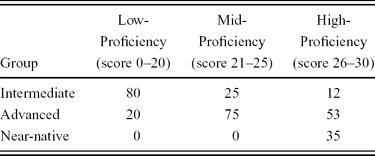
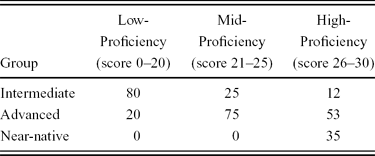
Responses to the cloze task were scored out of a possible 30 points. Scores ranged from 10 to 30, with a mean of 24.4 and a standard deviation of 4.53. Based on their self-assessment scores, bilinguals were classified as Low (10–20), Mid (21–25) and High (26–30) Proficiency. A one-way ANOVA revealed that cloze task scores were significantly different among these groups (F(2,27) = 70.26, p < .01), with High Proficiency participants (M = 27.17, SD = 1.25) scoring significantly higher than Mid Proficiency (M = 23.28, SD = 1.49) participants (t(23) = 6.61, p < .01), who in turn scored higher than those in the Low Proficiency (M = 16.00, SD = 3.74) group (t(10) = 4.72, p < .01). Table 1 gives the percentage of participants in each of these categories who identified themselves as Intermediate, Advanced and Near-native. This distribution shows self-report to be a reasonably accurate measure of proficiency; a substantially higher proportion of participants in the Low Proficiency group reported themselves to be Intermediate speakers, while the majority of the Mid Proficiency group self-identified as Advanced, and only those in the High Proficiency group described themselves as Near-native.
Percentage of participants in each proficiency category (as defined by proficiency self-assessment scores) identifying themselves as Beginner, Intermediate or Advanced speakers of English.
Average age of first exposure to English was 9.2 years in the Low Proficiency group, 8.2 years in the Mid Proficiency group and 7.2 years in the High Proficiency group. One-tailed independent samples t-tests revealed that none of these averages were significantly different from one another (Low vs. Mid: t(11) = .558, ns; Mid vs. High: t(16) = .274, ns; Low vs. High: t(13) = .793, ns) although there was a trend towards higher proficiency levels in participants with earlier English exposure. Age of acquisition and proficiency self-assessment score were only weakly negatively correlated, with coefficient –0.143. Thus, in subsequent analyses dealing with proficiency level, self-assessment test scores were considered to be a more reliable measure than age of acquisition against which to compare the bilinguals’ correspondence with native speakers.
Materials
Stimuli consisted of the same 212 verb–particle constructions that were rated by monolinguals in Gonnerman and Hayes’ (Reference Gonnerman and Hayes2005) study. These constructions were divided into six lists, so that each participant rated 35 or 36 items.
Procedure
Participants were scheduled for individual testing sessions. The similarity rating survey was administered as part of a larger battery of measures, including the masked priming task discussed in Experiment 4. Each participant was given one of the six paper questionnaires to fill out by hand; thus, the items on each list received five ratings. Participants were asked to rate the similarity in meaning of verb–particle/verb pairs on a scale from 1 (very dissimilar) to 9 (very similar). Instructions for this task included examples of highly similar, highly dissimilar and mid-similarity pairs with corresponding ratings. The ratings of each individual and of the group were then compared to those obtained from the monolingual participants in Gonnerman and Hayes’ (Reference Gonnerman and Hayes2005) study.
Results and discussion
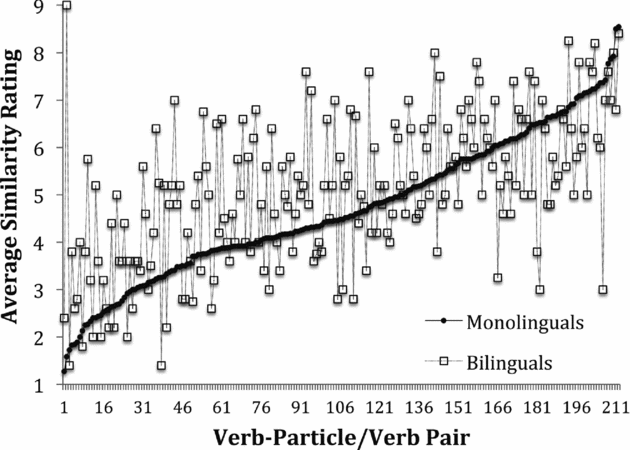
Similarity rating from all lists were compiled and average ratings calculated for each of the 212 verb–particle/verb pairs. These averages are plotted in Figure 1 along with average ratings from Gonnerman and Hayes’ (Reference Gonnerman and Hayes2005) monolingual participants. The correlation between bilingual and monolingual ratings was 0.574 (p < .05), indicating that the bilingual ratings were similar as a group to those of the monolinguals. However, as Figure 1 illustrates, the monolingual and bilingual ratings diverged substantially for certain items.
Mean semantic similarity ratings from French–English bilinguals along with the ratings from the English monolingual participants in Gonnerman & Hayes’ (Reference Gonnerman and Hayes2005) study. Verb-particle/verb pairs are arranged in descending order of the monolinguals’ mean similarity ratings.

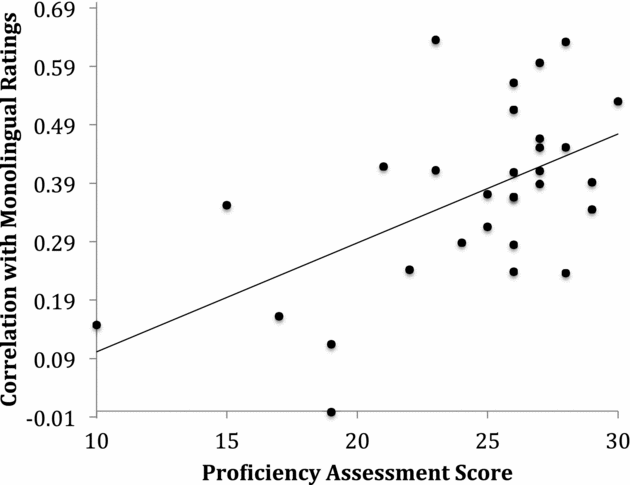
In addition to the bilinguals’ performance as a group, we were interested in the variation among individual participants’ ratings. We also examined whether the similarity of an individual's ratings to the monolingual ratings could be predicted by their English proficiency. For each individual participant, therefore, the correlation between his or her ratings and the average ratings of the same items from monolinguals was calculated. We then investigated whether the strength of these correlations was positively related to participants’ English proficiency. The correlations, which ranged from –0.002 to 0.636 with an average of 0.370, are plotted in Figure 2, against the same participants’ cloze task scores. As this figure illustrates, the extent to which bilinguals’ scores resemble monolinguals’ is positively related to their proficiency scores on the cloze task, with a correlation of 0.547 (p < .05). Thus, the bilinguals with better English language abilities as measured on a general proficiency task were more native-like in their semantic ratings of verb–particle constructions.
Correlations between each individual bilingual's semantic similarity ratings and the monolinguals’ mean ratings, plotted against each bilingual's score on the language proficiency cloze task (30 points maximum possible).
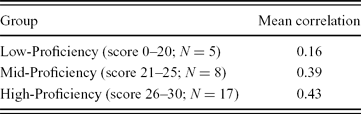
Table 2 shows the averages of the bilinguals’ correlations with monolingual means, sorted according to their scores on the proficiency measure (cloze task). One-tailed independent samples t-tests revealed that correlations in the Low Proficiency group were significantly lower than those in the Mid Proficiency group (t(11) = 3.32, p < .01), but that the Mid and High Proficiency groups did not differ significantly (t(23) = 0.77, ns).
Mean correlations between individual participants’ ratings and the monolingual mean ratings from Gonnerman & Hayes (Reference Gonnerman and Hayes2005), by language proficiency as determined by the self-assessment measure (cloze task).
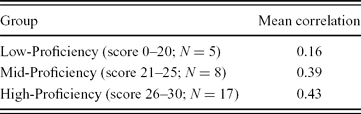
The results of the semantic similarity rating survey raised several questions for further investigation. First, the correlations by group in Table 2 suggest that the judgments of non-native speakers become more native-like in their judgments as proficiency increases, but that this effect may diminish at higher proficiency levels (i.e., the Mid and High Proficiency groups did not differ significantly), raising the question of whether these High Proficiency groups had actually reached the same level of accuracy as native English speakers. To answer this question, we collected similarity ratings from an independent sample of native speakers for comparison with the highest proficiency group. In addition, we wanted to determine whether bilinguals’ ratings would more closely resemble those of monolinguals with a larger number of observations per item in each group. Experiments 2 and 3 were conducted to address these questions.
Experiment 2
Participants
A new group of 10 native English speakers from Montreal was recruited via internet-based announcements, and participated voluntarily. Although smaller than the bilingual group, 10 participants was considered an adequate sample size for the native speakers because they have elsewhere been shown to be highly consistent in their semantic ratings on this type of task (Devlin, Jamison, Matthews & Gonnerman, Reference Devlin, Jamison, Matthews and Gonnerman2004; Gonnerman et al., Reference Gonnerman, Seidenberg and Andersen2007). The participants ranged in age from 18 to 34 years and all identified English as their language of earliest exposure and primary use, although some were also proficient in one or more other languages. There were five male and five female participants.
Materials
Based on the results from Experiment 1, it was decided that participants’ ratings of a subset of the verb–particle/verb pairs would be representative of the entire set, and that not all six lists of items needed to be administered. In order to obtain a greater number of ratings per item while keeping the survey to a manageable length, a new list of 78 items was chosen from the original 212. This subset contained an even distribution of Low (mean rating < 4), medium (4–6) and High (> 6) similarity items as rated by the monolinguals in Gonnerman and Hayes’ (Reference Gonnerman and Hayes2005) study. Particles (e.g., up, on, off) were evenly distributed among high, medium and low-similarity items. In addition, items in each group were matched for the frequency (Kucera & Francis, Reference Kucera and Francis1967) of the verbs (e.g., throw), as well as for the frequency of verb–particle constructions in their entirety (e.g., throw up).
Procedure
Participants responded to an internet-based survey in which they rated each of the verb–particle/verb pairs on a scale of 1–9; instructions were identical to those presented to the bilinguals in Experiment 1. Each participant rated all 78 items, so that 10 ratings per item were obtained.
Results and discussion
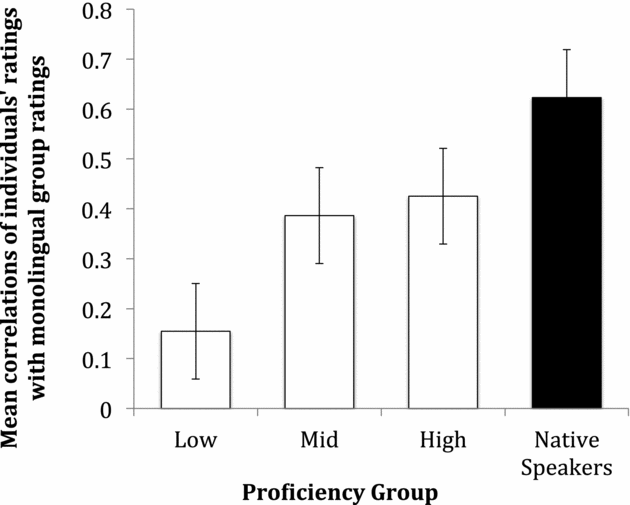
For each item, an average rating was calculated across those of the 10 participants. These averages were then compared with the average ratings from Gonnerman and Hayes’ (Reference Gonnerman and Hayes2005) monolingual participants. The two sets of native speaker ratings were strongly correlated with coefficient 0.854 (p < .01). As with the bilingual participants, individual participants’ ratings were also correlated against the original monolingual averages. Individual correlations were generally stronger than those of the bilinguals, ranging from 0.434 to 0.741 with a mean of 0.623. This value was then compared to the average correlations from the low-, mid- and high-proficiency bilinguals, illustrated in Figure 3. A one-tailed independent samples t-test showed that the native speakers’ average correlation was significantly higher than that of the highest-proficiency bilingual group (t(25) = 4.62, p < .01). This finding suggests that non-native speakers can improve their intuitive grasp of verb–particle constructions, but that there may be a ceiling level of attainment that does not match that of native speakers.
Mean correlations of three groups of French–English bilinguals’ and one group of native English speakers’ similarity ratings with those of the English monolinguals in Gonnerman & Hayes’ (Reference Gonnerman and Hayes2005) study, grouped by proficiency level as measured on a cloze task.
Taken together, the results of Experiments 1 and 2 provided evidence that second-language speakers of English can recognize the range of verb–particle dependency relations, and that their judgments of semantic similarity are reasonably, though not perfectly, native-like at higher levels of English proficiency. Given that these results were obtained from a relatively small number of ratings per item, we were interested in whether a larger number of observations would strengthen these findings. This question was addressed in Experiment 3.
Experiment 3
In order verify the findings of Experiment 1 using a greater number of observations, a larger group of bilingual participants was recruited to provide ratings for the same subset of items rated by the monolinguals in Experiment 2. A further aim of this experiment was to determine whether the correspondence of bilingual and monolingual ratings would depend on the semantic similarity of the items themselves.
Participants
Thirty-four adult (aged 18–40) native speakers of Canadian French were recruited through web-based advertisements on a university research mailing list, and participated voluntarily. While all participants claimed at least functional ability in English, their proficiency was self-rated as either Beginner (n = 1), Intermediate (n = 9), Advanced (n = 20) or Near-native (n = 4). Participants also reported their age of first exposure to English, which ranged from 1 to 20 years, with a mean of 8.21 years. There were 11 male and 23 female participants.
Materials
The same 78 verb–particle/verb pairs selected for Experiment 2 were presented in an internet-based survey. Instructions for the survey were identical to those provided in Experiments 1 and 2.
Procedure
Each participant rated all 78 items, yielding 34 ratings per item, in a procedure identical to that of the earlier experiments.
Results and discussion
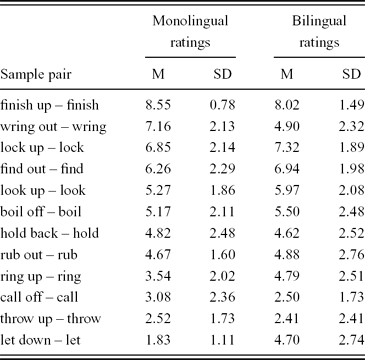
Average ratings were calculated across the 34 bilinguals and compared to those of the monolinguals in Gonnerman and Hayes (Reference Gonnerman and Hayes2005). A sample of items with mean monolingual and bilingual ratings is presented in Table 3. As this table illustrates, bilingual ratings in each portion of the scale were sometimes higher and sometimes lower than those of the monolinguals; in addition, the two groups were much more discrepant in their average ratings for certain items (e.g., let down) than for others (e.g., rub out). Notably, ratings of the two groups agreed more consistently in the middle of the scale than at either end, with those of the lowest-similarity items being most discrepant. This finding is discussed in more detail below (see Table 4).
Sample items with mean ratings (Ms) and standard deviations (SDs) from monolinguals, compared to ratings from a group of 34 French–English bilinguals, who answered an internet-based semantic similarity rating survey.
Correlations between monolingual ratings from Gonnerman & Hayes (Reference Gonnerman and Hayes2005) and those of the group of 34 French–English bilinguals, sorted according by similarity ratings and compared to correlations from the native English speakers from Experiment 2.
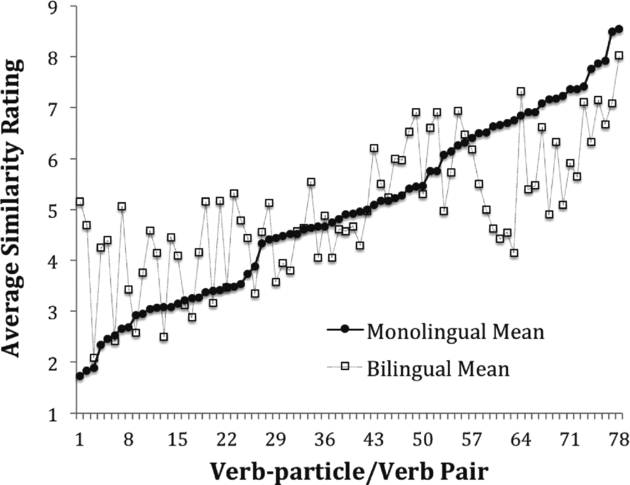
Similarity ratings of the 78 items by monolinguals and bilinguals are shown in Figure 4. Results are arranged in descending order of the monolinguals’ ratings, which coincide with their dependency values as determined on linguistic grounds (Lohse, Hawkins & Waslow, Reference Lohse, Hawkins and Wasow2004). Monolingual and bilingual ratings are positively correlated with correlation coefficient 0.707 (p < .01), supporting the finding from Experiment 1 that bilinguals can make similar judgments of semantic similarity to native English speakers.
Mean ratings obtained from French–English bilinguals who answered an on-line semantic similarity rating questionnaire, plotted alongside mean ratings from Gonnerman & Hayes’ (Reference Gonnerman and Hayes2005) English monolingual participants. Verb-particle/verb pairs are arranged in ascending order of the monolinguals’ mean similarity ratings.
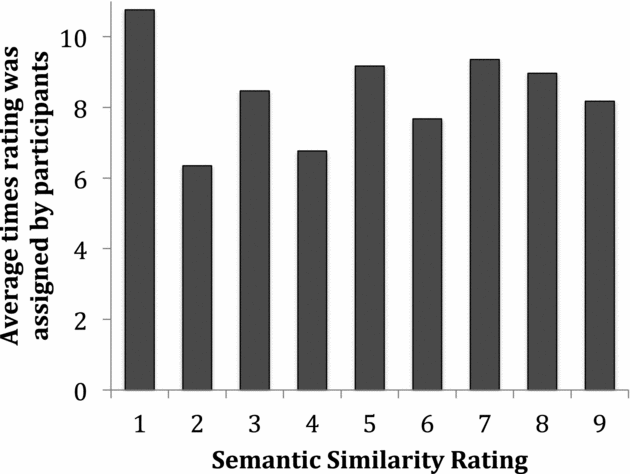
While the overall correlation provided a global measure of similarity to monolingual ratings, another variable of interest was whether bilinguals, like monolinguals, would use the entire range of the scale evenly or whether they would tend toward using the extremes out of discomfort with the more ambiguous middle items; or, conversely, whether they might favour the middle of the scale for items with which they were less familiar. In fact, however, the bilinguals’ ratings were approximately equally distributed across the range of the scale; Figure 5 shows the average number of times that each participant selected a particular number.
Average number of times that bilingual participants selected each point on the semantic similarity rating scale, where 1 = very dissimilar and 9 = very similar.
In other respects, however, bilinguals’ ratings differed from those of the monolinguals. Bilingual speakers’ ratings were significantly less consistent than those of monolinguals, with an average standard deviation of 2.33, as opposed to 1.96 for the monolinguals (F(1,77) = 56.16, p < .001). Bilinguals’ ratings also showed a reduced range (5.94), as compared to the monolinguals’ range of 6.82. Note that this increased variability occurred despite the fact that each item was rated 34 times by bilinguals but only 21 times by monolinguals, which underscores the fact that the higher variability in the bilinguals’ ratings cannot be attributed to a smaller sample size. These results indicate that while second language speakers are sensitive to a range of semantic transparency levels across verb–particle constructions, their responses are generally less consistent.
Based on past research, we also wished to investigate whether the accuracy of bilinguals’ ratings would vary according to the particular items assessed. Liao and Fukuya (Reference Liao and Fukuya2004) found that second-language learners had more difficulty with “figurative” (non-transparent) than “literal” (transparent) verb–particle constructions. Although this binary distinction is a relatively broad way to conceptualize the variations between phrasal verbs, it corresponds roughly to our variable of semantic dependency, where low-dependency (high-similarity) items are generally more transparent and high-dependency (low-similarity) items are more opaque. We therefore hypothesized that bilinguals’ ratings would correspond most closely to monolinguals for pairs rated as highly similar, and would be most disparate for low-similarity items.
To test this hypothesis, we calculated the correlations between monolingual and bilingual ratings separately for Low-similarity (mean rating < 4), Mid-similarity (4–6) and High-similarity (> 6) items. For comparison purposes, these same correlations were calculated between the ratings of the monolinguals in Gonnerman and Hayes (Reference Gonnerman and Hayes2005) and those of the independent group of native speakers who participated in Experiment 2. These correlations are presented in Table 4.
As Table 4 illustrates, correlations of the native English speakers are largely constant across similarity conditions, while those of the bilinguals differ substantially. Bilinguals’ ratings were most highly correlated with the monolinguals’ in the middle of the scale than at either extreme, which may simply reflect a tendency of participants to rate items closer to the middle when they were less confident in the meaning of an expression. More interestingly, bilinguals were more native-like in their responses for the high-similarity (more transparent) items than for the low-similarity (opaque) items, supporting Liao and Fukuya's (Reference Liao and Fukuya2004) finding that literal verb–particle constructions are more easily understood by second-language learners than figurative constructions.
Summary
Experiments 1 through 3 examined bilinguals’ semantic ratings of verb–particle constructions in an off-line, explicit task. The first experiment demonstrated that individual participants’ ratings of a subset of items varied in their correspondence to monolingual ratings, and that this variation could be predicted by their language proficiency as determined by an independent measure. However, as demonstrated by Experiment 2, even the highest-proficiency bilinguals did not attain the accuracy level of a group of native speakers. When measured with a larger number of observations per item (Experiment 3), bilingual ratings were found to be significantly correlated with those of monolinguals, though still not as strongly as the group of native speakers.
Masked priming
As an on-line measure of semantic processing, participants completed a masked priming task in which a target verb (e.g., look) was primed by its corresponding verb–particle construction (e.g., look up). In past research (Gonnerman & Hayes, Reference Gonnerman and Hayes2005), priming has been found to be strongest for verb–particle constructions rated as highly similar in meaning to their isolated verbs. This task was designed to determine whether bilinguals’ implicit processing of verb–particle constructions would be predicted by the degree of semantic transparency, as has been shown for monolinguals. In addition, the task serves as an implicit comparison to the explicit data obtained from the ratings task. If applicable to verb–particle constructions, the Literal Salience Hypothesis (Cieslicka, Reference Cieslicka2006; Cieslicka & Heredia, Reference Cieslicka and Heredia2011), would predict poor performance on the priming task; Literal Salience holds that non-literal language is always first interpreted literally and only then re-analyzed, a process which would not have time to occur in a masked priming paradigm. Thus, under this hypothesis one would expect bilinguals to deviate more strongly from monolinguals on this task compared to the similarity ratings, because of the lack of access to conscious knowledge in the masked priming paradigm.
In Experiment 1, it was also found that participants’ off-line ratings of verb–particle constructions differed in the extent to which they matched monolinguals’ ratings, and that this difference could be at least partially predicted by their overall language proficiency. A second goal of the masked priming experiment, therefore, was to determine whether performance on an off-line measure of semantic similarity would predict results in an on-line measure; that is, whether participants whose similarity ratings correlated most strongly with the monolinguals’ would also show the most native-like performance in a masked priming task.
Experiment 4
Participants
The same 30 native speakers of French who completed Experiment 1 participated for monetary compensation.
Materials
The same 78 verb–particle constructions from Experiments 2 and 3 were used as related primes for their corresponding verbs (e.g., cover up/cover). For each construction, an unrelated control prime was created to match in frequency and number of letters (e.g., show off/cover). Control primes did not overlap with test primes in meaning or orthography. Finally, identity primes (e.g., cover/cover) were included for each item. Stimuli were divided into three lists, with one of these conditions in each list so that no participant responded to any verb more than once. To reduce the proportion of related prime–target pairs, 78 real word prime–target filler items were added to each list. In addition, 156 non-word filler items were included, matching the real words in frequency and orthography as closely as possible. The overall number of non-word items included in the task (156) equalled the number of real word items, so that the participants would not develop any response expectations about the lexical nature of the targets given the primes, since half of the targets were real words, and half were non-words. In addition, of the non-words, half employed verb–particle primes with non-words that were either “related” (e.g., keep out/keem) or “unrelated” (e.g., live down/bool), while the other half used single words (e.g., basil/grook) as primes. Using different types of non-word primes avoiding the possibility that participants would anticipate a real word target based only on the overlap with the preceding prime. Thus, each participant responded to 312 items: 78 verb–particle/verb pairs; 78 simple word/real word pairs; 78 verb–particle/non-word pairs; and, 78 simple word/non-word pairs.
Procedure
Participants were tested individually in a quiet room with dim, natural lighting. Stimuli were presented using PsyScope (Cohen, MacWhinney, Flatt & Provost, Reference Cohen, MacWhinney, Flatt and Provost1993) software on CRT monitors running at 85 Hz. Each trial consisted of a fixation point (*) displayed for 1000 ms, after which a mask (%#@!&^$) was displayed for 500 ms; subsequently, the prime appeared briefly for 35 ms followed immediately by the target, which remained on the screen for 200 ms. Participants made a lexical decision to the target by pressing the yes/no buttons on a button box, from which reaction times were recorded. After the participant's response, a 500 ms delay occurred before presentation of the next trial. Stimuli appeared in white on a black background, with primes in lower case letters and targets in upper case letters. Participants were instructed to respond as quickly as possible to each target, while minimizing errors. Two breaks were included in the experiment to minimize participant fatigue.
After completing the masked priming experiment, participants filled out the cloze task and the semantic similarity rating survey from Experiment 1.
Results and discussion
Four participants, who made errors on more than 40% of the items, were excluded from the analyses. Error rates for the remaining 26 participants were relatively low, with averages of 7.13% (SD = 3.40) for words and 8.32% (SD = 6.28) for non-words. Only correct responses were included in the analyses of response latencies. Data were trimmed to exclude outliers; that is, response latencies slower than 300 ms or faster than 1000 ms, representing responses more than four standard deviations from the means. Trimming the data according to these criteria resulted in the exclusion of 3.13% of responses.
Bilingual group results
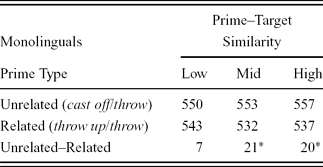
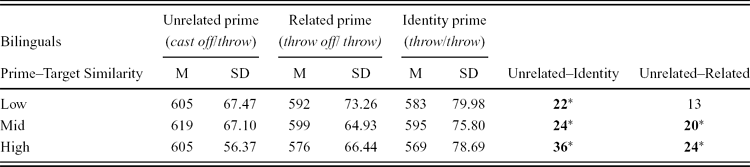
Mean response latencies and priming effects for the monolinguals (from Gonnerman & Hayes, Reference Gonnerman and Hayes2005) and bilinguals are shown in Tables 5 and 6 below. A 3 (Prime Type: Related vs. Unrelated vs. Identity) by 3 (Prime–Target Similarity: Low vs. Mid vs. High) repeated measures ANOVA was conducted to determine whether priming effects were modulated by semantic similarity. Because we were interested in how the specific effects observed in bilinguals would compare to those found by Gonnerman and Hayes (Reference Gonnerman and Hayes2005), we also planned to perform statistical comparisons between unrelated and related, and unrelated and identity response times in each condition.
English monolinguals’ mean lexical decision response latencies for target words by Prime Type and Similarity (from Gonnerman & Hayes, Reference Gonnerman and Hayes2005).
* = significant priming at p < .05
Bilinguals’ mean response latencies (Ms) and standard deviations (SDs) for target words by Prime Type and Similarity.
* = significant priming result
An identity condition was also included for the bilinguals. The identity condition allowed us to rule out the possibility that bilinguals were only reading the first word in the verb–particle primes, that is, reading only the first element (e.g., throw) and ignoring the particle that is separated by a space (e.g., up). Including the identity condition therefore allowed us to determine whether priming for related targets reflected the whole prime, since otherwise throw off/throw would simply elicit the same identity priming as throw/throw if the participants were ignoring the particle.
The ANOVA yielded a significant main effect of Prime Type (F(2,50) = 7.96, p < .01), with the Identity condition faster than the Related one, which was faster again than the Unrelated. There was also a significant main effect of Similarity (F(2,50) = 7.19, p < .01). The interaction of these factors was non-significant (F < 1). Planned comparisons revealed significant differences between the unrelated and identity primes in the Low (F(1,25) = 4.25, p < .05), Mid (F(1,25) = 7.73, p < .05) and High (F(1,25) = 10.87, p < .05) Similarity conditions. The difference between unrelated and related primes was significant for the Mid (F(1,25) = 5.24, p < .05) and High (F(1,25) = 7.50, p < .05) Similarity conditions, but not for the Low Similarity condition (F(1,25) = 2.16, ns).
Bilingual response latencies were slower overall, consistent with an increased processing cost of responding in one's second language. In all other respects, however, results from the two groups are strikingly similar. As with the monolinguals, the bilingual speakers showed no priming effect for low-similarity items, but significant facilitation from verb–particles rated as having mid or high similarity to the target verbs. These results suggest that, contrary to our expectations, at an implicit level L2 speakers are sensitive to the same gradations in semantic transparency that are reflected in monolingual priming effects. In addition, for the bilinguals, identity priming was higher than Unrelated–Related priming across all three conditions. While these differences between identity and related priming did not reach statistical significance, the differential effect of Prime–Target Similarity for the related, but not the identity primes, was taken as evidence that bilinguals did in fact respond differently to the verb–particle constructions than to the verbs alone. That is, if the bilinguals had ignored the particles altogether, there would be no reason for them to show different priming to Low- versus Mid-/High-Similarity verb–particle constructions.
Bilingual results in relation to semantic similarity ratings
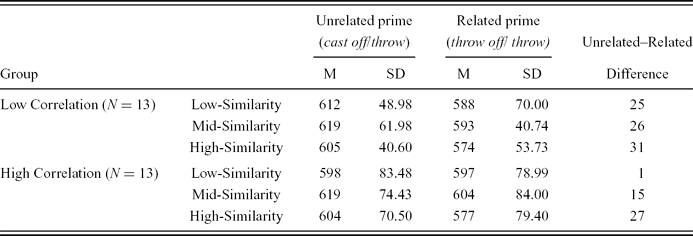
In Experiment 1, results showed that bilinguals’ semantic similarity ratings varied in the extent to which they matched those of monolinguals. Moreover, the correlations of bilinguals’ and monolinguals’ ratings were strongly predicted by the bilinguals’ scores on an independent measure of English language proficiency. In analyzing the masked priming results, therefore, it was of interest whether participants’ off-line similarity ratings would predict which of the bilinguals would be closest to monolinguals in their implicit processing of verb–particle constructions. To answer this question, participants were divided into two groups based on the correlations of their ratings with the average monolingual ratings. In the Low Correlation group, correlations with the monolinguals ranged from –0.002 to 0.370 with a mean of 0.255, while the High Correlation group's range was 0.388 to 0.636 with a mean of 0.485. After removing the four participants who were excluded due to high error rates, 13 participants remained in each group. The masked priming results from these groups were analyzed separately, and are presented in Table 7.
Bilinguals’ mean response latencies (Ms) and standard deviations (SDs) by Similarity, for the Unrelated versus Related conditions. Bilingual groups (Low-Correlation vs. High- Correlation) are based on the correlations between bilingual participants’ semantic similarity ratings and the average ratings of monolinguals. Differences between the Unrelated and Related conditions are also shown.
A 2 (Participant group: Low Correlation vs. High Correlation) by 3 (Similarity: Low vs. Mid vs. High) by 3 (Prime Type: Unrelated vs. Related vs. Identity) mixed factor ANOVA was conducted on the response latency data from the two groups. Results showed main effects of Similarity (F(2,48) = 7.42, p < .01) and of Prime Type (F(2,48) = 7.70, p < .01), but no main effect of group (F < 1). The two-way interactions were non-significant (Group × Similarity: F(2,48) = 1.92, p = .16; Group × Prime Type: F < 1; Similarity × Prime Type: F < 1, as was the three-way interaction (F = 1.52, p = .20).
Planned comparisons for unrelated–related priming were conducted for both the Low and High Correlation groups. In the Low Correlation group, unrelated–related priming was significant in the High-Similarity condition (F(1,12) = 14.00, p < .05) and was marginally significant in the Mid- (F(1,12) = 4.65, p = .05) and Low- (F(1,12) = 3.004, p = .11) Similarity conditions. The overall pattern of priming for this group is very interesting, since it differs from that of monolinguals and from the High Corrrelation bilinguals; this group did not show differential priming according to the semantic similarity level of the prime–target pairs (mean priming effects of 25 ms, 26 ms, and 31 ms for the Low-, Mid-, and High-Similarity conditions, respectively; see Table 7). Thus, it appears that the lower-proficiency bilinguals, who also had difficulty rating the semantic similarity of verb–particle constructions, responded to all primes in the same way, regardless of the similarity relationship between the prime and target. It could be the case that the lower-proficiency bilinguals are more strongly influenced by the verb alone, and are not integrating the particle into the verb–particle constructions as monolinguals do.
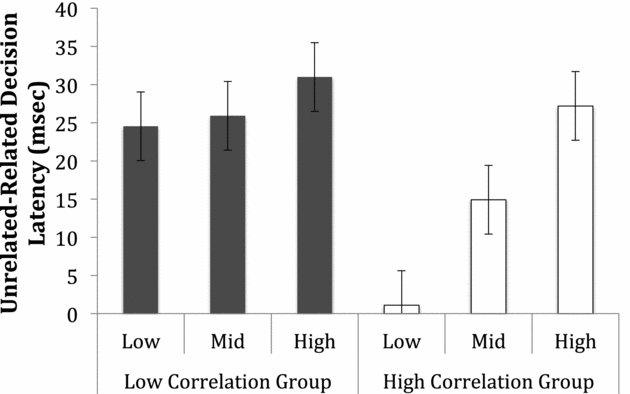
In the High Correlation group, unrelated–related priming was non-significant for the Low- (F(1,12) = .01, ns) and Mid- (F(1,12) = 1.31, ns) Similarity conditions, and was marginally significant in the High-Similarity condition (F(1,12) = 2.81, p = .12). Although, once again, the sample size was too small to obtain significant effects, the overall trend of data from these participants much more closely resembled native-like performance. While identity priming was similar across conditions, related verb–particle primes elicited a clear effect of semantic similarity, with High-Similarity items priming more strongly than Mid-Similarity items, which primed more strongly than Low-Similarity items. This relationship, in contrast with the relatively undifferentiated priming effects from the low-correlation group, is depicted in Figure 6, where we graph the priming effects (i.e., difference scores) across conditions.
Mean priming effects (unrelated minus related) by similarity condition for the Low and High Correlation groups. The High Correlation group includes the French–English bilingual participants whose semantic similarity scores from Experiment 1 were highly correlated with the semantic similarity ratings of English monolinguals. The Low Correlation group includes the bilinguals with low mean correlations in their similarity ratings.
Summary
While Experiments 1, 2, and 3 measured bilinguals’ responses to an off-line, metalinguistic survey, Experiment 4 investigated their sensitivity to gradations in semantic similarity in an on-line processing task. As a group, bilingual priming results were notably similar to those of the monolinguals: Mid- and High-Similarity items primed significantly more than Low-Similarity items, while identity priming occurred in all conditions. The extent to which participants’ semantic similarity ratings correlated with those of monolinguals was predictive of their masked priming results, with high-correlation bilinguals showing a more native-like pattern.
General discussion
The present study was designed to investigate the performance of non-native English speakers on implicit and explicit measures of phrasal verb comprehension. Based on past research, we hypothesized that bilinguals would have difficulty with both aspects of phrasal verb processing, showing decreased sensitivity to the variations in verb–particle/verb similarity that are easily recognized by monolinguals. We also predicted that their performance would approach that of monolinguals with increased proficiency, and that their responses would be more native-like for transparent compared to opaque verb–particle constructions.
Our first research question asked whether non-native speakers would be sensitive to the cline in semantic dependency between verbs and particles that is recognized by monolinguals. Experiments 1 and 3 indicated that our bilingual participants did in fact show such sensitivity. As with monolinguals, their similarity ratings were distributed evenly across the entire scale, indicating sensitivity to semantic transparency as a graded spectrum, and not simply a binary distinction between ‘transparent’ and ‘opaque’ items. Moreover, when a comparable number of observations were included in the bilingual and monolingual samples, bilingual average ratings showed a reasonably strong correlation with those of the monolinguals. On the other hand, this correlation was still not as strong as that of an independent group of monolinguals. Monolinguals and bilinguals also diverged significantly in their standard deviations, indicating that the bilinguals were less consistent in their responses as a group.
The second question, motivated by findings from research on L2 avoidance, concerned the hypothesis that L2 speakers’ ratings would diverge more from those of monolinguals on more opaque phrasal verbs. This, too, was supported by our data; on the semantic similarity ratings, correlations with the monolinguals were much higher for highly transparent (less dependent) items than for more opaque (high dependency) items, indicating that non-native speakers not only avoid more figurative phrasal verbs in production (e.g., Liao & Fukuya, Reference Liao and Fukuya2004), but also have difficulty comprehending their semantic properties. This finding is consistent with Laufer's (Reference Laufer, Coady and Huckin1997) observation that L2 learners often have difficulty with new vocabulary when the target words are superficially similar but semantically distinct from other more familiar words, which is the case for many non-transparent verb–particle constructions. A more surprising result was that the strongest correlation between bilinguals and monolinguals occurred in the middle of the semantic similarity scale. While this finding may have been a function of the scale itself (i.e., bilinguals tended toward the middle of the scale when they were uncertain), it would be worthwhile to investigate further whether it represents a true finding that L2 speakers process mid-dependency phrasal verbs more easily.
Our third research question was whether non-native speakers would show sensitivity to variations in semantic dependency at an implicit level in the masked priming experiment. Somewhat surprisingly, the overall bilingual group data was remarkably similar to that of the monolinguals, indicating that these participants not only explicitly recognized the differences in semantic dependency, but also reacted to them at an unconscious level.
The results from the masked priming experiment do not support an extension of the Literal Salience Hypothesis (Cieslicka, Reference Cieslicka2006; Cieslicka & Heredia, Reference Cieslicka and Heredia2011) to verb–particle construction processing in L2, at least not as a universal process that applies to bilinguals regardless of proficiency level. Being below the consciousness threshold, the presentation length of the primes in this experiment was considered brief enough to measure initial, automatic interpretation. Thus, if bilingual speakers universally activated the literal meaning of a verb without considering it in conjunction with a particle, then identical priming would be expected for verb–particle constructions and identity primes across conditions. In contrast, our bilingual participants showed consistently higher priming for identity primes than for related verb–particle primes overall (see Table 6). Additionally, the difference between High- and Low-/Mid-Similarity items for the High Correlation group can only be explained if participants were responding to the construction as a unit and not simply to the literal combination of words (see Table 7). These data suggest that the literal salience account of idiom processing in bilinguals does not apply to processing of verb–particle constructions, at least for higher-proficiency speakers. On the other hand, it is possible that Literal Salience influenced our low-proficiency bilinguals, who responded related primes in the same way, regardless of their semantic similarity to the targets.
Finally, a goal of the present study was to determine the effect of English language proficiency level on L2 learners’ grasp of verb–particle constructions. Research on avoidance of phrasal verbs by L2 speakers has yielded somewhat ambiguous results on the effect of proficiency: Hulstijn and Marchena (Reference Hulstijn and Marchena1989) found no difference between intermediate and advanced learners (though this interpretation was later questioned by Liao and Fukuya, Reference Liao and Fukuya2004); Liao and Fukuya (Reference Liao and Fukuya2004) reported that advanced English learners, in contrast to intermediate learners, were essentially identical to monolinguals in their behaviour, while Siyanova and Schmitt (Reference Siyanova and Schmitt2007) found that even highly proficient bilinguals avoided verb–particle constructions significantly in colloquial contexts. With regard to comprehension, Matlock and Heredia (Reference Matlock, Heredia, Heredia and Altarriba2002) analysed their participants’ on-line processing results with respect to age of acquisition, though not by current proficiency level, finding early bilinguals to be significantly more native-like than late bilinguals. Note, however, that by Matlock and Heredia's (Reference Matlock, Heredia, Heredia and Altarriba2002) standards, the participants in our study would almost universally be classified as “early” bilinguals, all but two of them having been exposed to English before the age of 12. Nonetheless, the bilinguals in our study showed a clear effect of proficiency on both the implicit and explicit tasks. On the survey task, the extent to which participants’ ratings matched those of monolinguals was significantly correlated with their scores on the proficiency assessment. Individual participants’ correlations with the monolingual ratings were also predictive of their performance on the masked priming task: while the low-correlation group experienced large and relatively undifferentiated priming effects to all verb–particle constructions, the high-correlation group showed a clear trend whereby priming magnitude was directly related to the semantic transparency of the construction. These results indicate that despite the difficulties bilinguals experience in acquiring verb–particle constructions, their grasp of phrasal verbs’ semantic properties improves as their overall competence in the language increases, presumably without explicit instruction. Nevertheless, as even our most advanced participants were not identical to monolinguals in their performance, we cannot rule out the possibility that they had reached a ceiling of ultimate attainment. It is possible that direct instruction might be beneficial in helping non-native speakers improve beyond this level.
The apparent discrepancy between these results and those of Siyanova and Schmitt (Reference Siyanova and Schmitt2007) may be due to a variety of factors. First, although age of acquisition information is not given directly in Siyanova and Schmitt's (Reference Siyanova and Schmitt2007) study, their participants were described as having “studied English at the university level at overseas or UK universities and graduated in the previous six years” (p. 124). Thus, it seems likely that these participants had largely acquired English as adults in a formal institutional setting, in contrast to our participants who had likely been raised in a more bilingual milieu, as well as having had earlier exposure to the language. The tasks used in the two experiments also differed substantially; while Siyanova and Schmitt (Reference Siyanova and Schmitt2007) focused on corpus analysis and preferences in production, our study targeted whether participants’ judgments of the meanings of verb–particle constructions resembled those of monolinguals. It is theoretically possible that even having achieved a nearly native-like grasp of the semantics of phrasal verbs, non-native speakers may avoid using them spontaneously, in colloquial speech if not in more formal written tasks (see Liao & Fukuya, Reference Liao and Fukuya2004). If this were the case, it would be important for teaching interventions to target reasons for avoidance beyond lack of comprehension.
Although designing an intervention program was not a primary aim of this study, certain aspects of our results may be applicable in a teaching context. Cognitive/linguistic-based curricula such as that proposed by Rudzka-Ostyn (Reference Rudzka-Ostyn2003) often focus on teaching the semantics of particles (e.g., completive up) that have consistent meanings and can be applied generatively. However, while this approach works well for teaching highly transparent constructions (Condon, Reference Condon, Boers and Lindstromberg2008) it may be misleading if applied to more opaque items (e.g., the out in chew out does not add any predictable meaning to the verb). At a minimum, drawing English learners’ attention to the spectrum of dependency could sensitize them to the fact that these types of strategies may apply more reliably in some cases than in others. The large set of ratings from monolinguals and bilinguals that is presented here could also help teachers design curricula to target specific items where native and non-native speakers tend to diverge in their ratings. Knowing that many L2 speakers will acquire the more transparent items simply as a function of overall language competence, instructors could focus their efforts on explaining specific meanings of the more opaque constructions.
When comparing the present study to past research, it should be noted that the bilingual participants in this study had a somewhat different language experience than those in most previous studies of phrasal verb acquisition (e.g., Dagut & Laufer, Reference Dagut and Laufer1985; Hulstijn & Marchena, Reference Hulstijn and Marchena1989; Laufer & Eliasson, Reference Laufer and Eliasson1993). While past research has largely focused on speakers learning English in a formal or foreign-language setting, our participants were inhabitants of Montreal, where both French and English are regularly used in formal/educational as well as informal contexts. Thus, although context of exposure was not explicitly controlled in our study, it is reasonable to expect that most of our participants had (either currently or at some point in the past) some degree of contact with and use of English in everyday speaking situations. Although Siyanova and Schmitt (Reference Siyanova and Schmitt2007) found only minor effects on phrasal verb avoidance when participants had spent a substantial amount of time in an English-speaking country, there is too little research on this question to rule out the possibility that degree of English immersion was a factor in our participants’ performance. The present study therefore offers an important extension of work on L2 phrasal verbs to a bilingual population more apt to use English in informal as well as formal contexts.
Several possible directions for future research are suggested by the present study. One limitation of this study was small sample of bilinguals at different proficiency levels. Thus, future studies using larger groups could build on our findings regarding semantic processing as a function of language competence. For example, including more participants at the highly advanced/near-native level could determine whether bilinguals ever reach the level of monolinguals in their judgments, or whether a true ceiling effect exists in their ultimate attainment. It is also important to dissociate the effects, if any, of current proficiency level versus age of acquisition, something we were unable to do as most of our participants reported similar ages of first English exposure. It could be argued, based on Matlock and Heredia's (Reference Matlock, Heredia, Heredia and Altarriba2002) data, that the relatively native-like performance of our bilinguals was due to the fact that most of them acquired English before the age of 12. This hypothesis could be evaluated using a group of bilinguals with an equal number of “early” and “late” bilinguals at each proficiency level.
Second, an important aspect of verb–particle constructions that is closely related to semantic dependency is the optional placement of the particle, which can be either adjacent (e.g., look up the number) or separated from the verb by an NP (e.g., look the number up). Past research has shown that native speakers’ preferences for one or the other syntactic order are affected by the dependency of the item, both in production (from corpora; Lohse et al., Reference Lohse, Hawkins and Wasow2004) and in on-line sentence processing (Gonnerman & Hayes, Reference Gonnerman and Hayes2005). Knowing that L2 speakers are capable of recognising the gradations in semantic dependency among items, it is of interest whether their syntactic preferences would also be influenced by this variable, whether in off-line or on-line measures. While the present study discussed semantics as one area of possible difficulty for non-native speakers, an investigation of processing at the sentence level could help determine whether syntactic factors also contribute to their tendency toward avoidance.
Third, the present study focused on comprehension of isolated constructions, in both off-line and on-line tasks. While comprehension is a crucial area of investigation that has been largely neglected in the L2 verb–particle literature, it is equally important to integrate these findings with studies on production and, ultimately, on teaching intervention. One interesting question would be whether bilinguals whose semantic ratings and/or masked priming results most closely resemble those of monolinguals are also most native-like in their use of verb–particle constructions, either in elicited or spontaneous speech. An experiment in which the same participants complete both a comprehension and a production task could help define the interplay between overall language competence, recognition of semantic properties, and real-world application of this knowledge. Similarly, cognitive/linguistic-based teaching programs should investigate whether drawing attention to the semantic dependency scale can improve accurate comprehension and use of phrasal verbs. Finally, while it is beyond the scope of this study, evidence from both bilingual and monolingual processing must ultimately be integrated with theoretical models of cognitive/linguistic function, addressing such issues as the lexical storage of multi-word items, and the interface between the lexical and syntactic systems.