Introduction
Azadirachta indica A. Juss., commonly known as neem, is a multipurpose tree belonging to the Meliaceae family, widely distributed across Asia and Africa, including regions such as India and Burma (Orwa et al., Reference Orwa, Mutua, Kindt, Jamnadass and Anthony2009; Patel et al., Reference Patel, Venkata, Bhattacharyya, Sethi and Bishayee2016). The seed kernels of neem contribute 40–50% of the oil used in the production of neem-coated urea, biopesticides, and products for medicinal and cosmetics (Prabakaran et al., Reference Prabakaran, Kumaran, Baburaj, Balaji, Mageshram, Balakumar and Radhakrishnan2019; Mia et al., Reference Mia, Mofasser, Bhat, Howlader, Sayed and Bakar2024). Due to its diverse applications, neem is cultivated as an important agroforestry species. Despite its importance, lack of comprehensive phenotypic characterization of large-scale neem germplasm accessions, which limits the ability to effectively understand genetic diversity and select suitable parents for breeding programmes aimed at enhancing productivity (Rajarajan et al., Reference Rajarajan, Sahu, Handa, Arunachalam, Priyadarshini, Bharti, Yuvaraja, Muthamilarasn and Anuragi2024). However, assessing genetic diversity is a critical step in successful tree breeding, possibly through the phenotypic characterization of large populations (Kesari and Rangan, Reference Kesari and Rangan2011). While some studies have assessed the genetic variability of neem, a comprehensive phenotypic evaluation involving diverse germplasm accessions is lacking. This gap presents a significant bottleneck in understanding the genetic diversity of neem. Comprehensive characterization of diverse genetic resources is essential for enabling tree breeders to effectively select breeding parents, thereby facilitating the development of high-yielding cultivars (Badu-Apraku et al., Reference Badu-Apraku, Garcia-Oliveira, Petroli, Hearne, Adewale and Gedil2021; Rajarajan et al., Reference Rajarajan, Uthappa, Handa, Chavan, Vishnu, Shrivastava, Handa, Rana, Sahu, Kumar, Singh, Ahmed and Rana2022a, Reference Rajarajan, Sakshi, Rana, Radhakrishna, Vishnu, Anuragi, Handa and Arunachalam2022b). Moreover, such characterization opens opportunities for identifying key traits that can be utilized in genetic improvement programs, accelerating the production of biopesticides and neem-coated urea for sustainable pest management and enhanced nitrogen use efficiency, respectively. In light of this, the present study aims to conduct a comprehensive phenotypic characterization of India's largest neem germplasm accessions collection at our research centre, with the goal of supporting genetic improvement initiatives.
Materials and methods
In this study, a total of 170 diverse neem germplasm accessions were evaluated for seed, kernel and oil yields at the field level in two consecutive years 2020 and 2021. The accessions were collected from different states of India (longitudes 72°19′E to 86°50′E, latitudes 11°05′N to 29°10′N) and assembled at the Central Agroforestry Research Institute (CAFRI), Jhansi (S1). The experiment was conducted in a 25-year-old plantation at CAFRI, India. The morphological characteristics of six trees of each genotype were observed. Traits such as plant height (PHT), diameter at breast height (DBH), fruit weight (g), 100 seed weight (g), 100 kernel weight (g) and oil content (%) were recorded. Plant height was measured using a measuring scale from the collar region to the tip of the canopy and expressed in meters. Diameter at breast height (DBH) was measured by a scale at breast height and expressed in centimeters. Fruit, seed and kernel weights were measured using weighing balance and expressed in grams. For seed yield estimation, healthy, disease-free and ripened fruits were collected from each germplasm accession, and the seeds were collected from different trees of the same germplasm accessions and composited to represent each germplasm accession. Fruiting in neem coincides with the rainy season, and the fruits falling on the ground are quickly attacked by mould; therefore, the fruits are directly picked from the trees. The freshly collected fruits were depulped manually and washed thoroughly with clean water to remove traces of pulp from the seed coat. Seeds enclosed in the endocarp were dried in the shade at ambient temperature. The extraction of oil from neem kernels was carried out using solvent extraction with petroleum ether (Qualigens [60–80°C] grade) in a Soxhlet apparatus (Socs Plus [SCS-06], Pelican Equipments, Chennai). A total of 5 g of kernel powder and 80 ml of petroleum ether were used per batch.
Statistical analysis
The phenotypic data collected from two years was used to combine for further analysis. XLSTAT (Addinsoft, Paris) software (2020) was utilized to construct boxplots, correlation coefficient and principal component analysis (PCA). To perform hierarchical clustering using the UPGMA method, we used the ‘dendextend’ and ‘factoextra’ packages using the R programming language.
Results
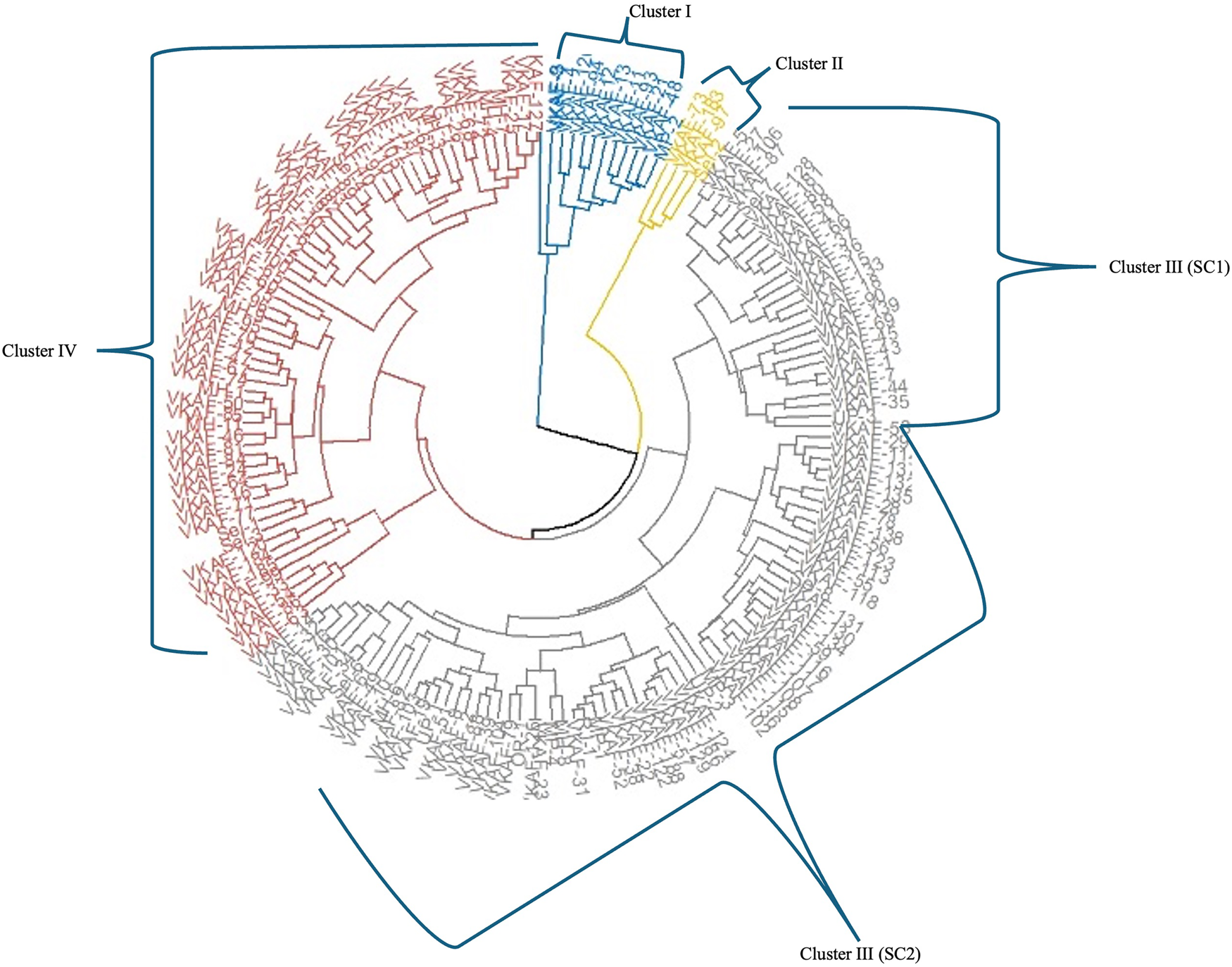
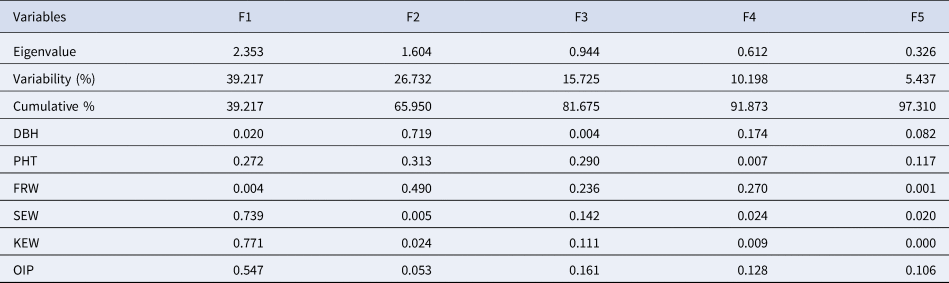
The mean performance of the 170 genotypes was significantly differed as evidenced by the range of values (S2). Also, in this study a correlation analysis was performed to assess the functional relationships among the traits. The results indicated that traits such as diameter at breast height (r = 0.37), seed weight (r = 0.42) and kernel weight (r = 0.50) were highly significantly positively associated with oil content. Notably, a negative correlation was observed between fruit weight and oil content (S3). Furthermore, an agglomerative hierarchical clustering using Euclidean distance was performed based on the morphological traits, which grouped the accessions into four distinct clusters (Fig. 1). Among the clusters, Cluster III is the largest (93 accessions) and was further subdivided into two subclusters (SC-1 and SC-2), followed by Cluster IV (60 accessions), Cluster I (13 accessions) and Cluster II (4 accessions). Cluster I consisted of accessions with high oil yield and associated traits, whereas Clusters III and IV contained accessions with medium oil yield. Cluster II included accessions where growth and yield performance were poor. Also, the PCA analysis revealed a total variation of 65.94%, in which PC1 and PC2 accounted for 39.21 and 26.73%, respectively (Table 1). Traits such as KEW and SEW suggest a higher contribution as compared with other traits to PC1, while DBH contributed maximum in PC2. Additionally, the biplot (S4) of the PCA revealed the close proximity of SEW, KEW and OC. Furthermore, the high oil yielding germplasm accessions were identified based on its mean performance for yield and associated traits such as VKAF-3, VKAF-9, VKAF-11, VKAF-13, VKAF-139, VKAF-85 and VKAF-20. These identified genetic resources can serve as potential donors in neem genetic improvement.
Hierarchical clustering of 170 neem accessions using unweighted pair group with arithmetic mean (UPGMA) based on six phenotypic traits.

Principal component analysis (PCA) based on six morphological traits explaining the variance contribution

Discussion
In this study, significant variation was found among the 170 neem genotypes (S2). The substantial amount of variability observed among the germplasm accessions increased the likelihood of better neem germplasm accessions to offer new candidates for genetic improvement. Notably, our study utilized a large-scale germplasm and reported a higher variability than others reported, thus clearly indicating the scope of utilizing this germplasm accessions pool in genetic improvement (Sidhu et al., Reference Sidhu, Kumar and Behl2003; Prabakaran et al., Reference Prabakaran, Kumaran, Baburaj, Balaji, Mageshram, Balakumar and Radhakrishnan2019; Mayavel et al., Reference Mayavel, Krishnan, Abinaya, Esakkiammal and Warrier2023). Furthermore, correlation analysis revealed that DBH, SEW and KEW were significantly and positively correlated with oil content, suggesting that indirect selection for DBH could contribute to improved seed and kernel yield (Mayavel et al., Reference Mayavel, Krishnan, Abinaya, Esakkiammal and Warrier2023). Ultimately SEW and KEW can be important considerations when selecting genotypes for high oil yields, also these traits have been key focal points for advanced tree breeding programmes (Prabakaran et al., Reference Prabakaran, Kumaran, Baburaj, Balaji, Mageshram, Balakumar and Radhakrishnan2019). In this study, the Euclidean distance-based cluster analysis revealed that Cluster I genotypes can potentially be utilized for improving oil and kernel yields (Tewari et al., Reference Tewari, Kaushish and Tewari2014; Mshelmbula et al., Reference Mshelmbula, Anoliefo, Ikhajiagbe and Edegbai2021; Mayavel et al., Reference Mayavel, Krishnan, Abinaya, Esakkiammal and Warrier2023). Similarly, Clusters III and IV would be useful for improving total biomass. In addition, the clustering we observed in our study was due to genetic variability within the neem accession; therefore, the selection of genotypes within a population enhances the possibilities of neem genetic improvement (Rajarajan et al., Reference Rajarajan, Sahu, Handa, Arunachalam, Priyadarshini, Bharti, Yuvaraja, Muthamilarasn and Anuragi2024). Also, the PCA analysis suggested that traits such as KEW, SEW and OC had a higher contribution for total variability with a strong correlation among them signifying that these traits should be given due consideration during the selection for developing high-yielding varieties (Rajarajan et al., Reference Rajarajan, Sakshi, Rana, Radhakrishna, Vishnu, Anuragi, Handa and Arunachalam2022b).
Overall, the neem germplasm accessions exhibited considerable variability for the traits examined, with DBH and oil content being key indicators for efficient selection due to their economic and environmental importance. Accessions VKAF-3, VKAF-9, VKAF-11, VKAF-13, VKAF-139, VKAF-85 and VKAF-20 were identified as high-yielding and promising candidates for future breeding initiatives. This approach aims to develop superior cultivars with enhanced agronomic traits, yield potential and resilience to variable climatic conditions. Such efforts will contribute to agricultural sustainability and improve the socio-economic conditions of farmers.
Supplementary material
The supplementary material for this article can be found at https://doi.org/10.1017/S147926212500005X
Acknowledgement
The authors are grateful to the Indian Council of Agricultural Research (ICAR), New Delhi, India, and National Rainfed Area Authority (NRAA), New Delhi for the facilities to complete this work.
Funding statement
Funding was received (F.No.11-10/2019-NRAA) for the completion of this work.
Competing interests
All the authors declare that no conflicts of interest are associated with this publication.
Consent to participate
This article does not contain any studies with human participants performed by any of the authors.
Consent to publish
The authors' consent to publication of this work.
Availability of data and material
The authors comply with the field standards of this journal.