Introduction
On March 11th 2020, COVID-19, the infectious disease associated with the coronavirus, SARS-CoV-2 was characterised as a global pandemic by the World Health Organisation (WHO). This pandemic has resulted in significant economic and societal disruption worldwide, and as of February 6th 2023, there have been approximately 754 million COVID-19 cases and approximately 6.82 million deaths attributable to COVID-19 (World Health Organisation 2023). Subsequent robust public containment measures, resulted in the closure of many facilities deemed as ‘non-essential" and included facilities attended by individuals with mental health disorders such as day hospitals and day centres. Throughout the pandemic, there have been periods of gradual easing and re-implementation of restrictions in many countries including Ireland, which, until February 28th, 2022 was based on the advice of Ireland’s National Public Health Emergency Team (NPHET). Many therapeutic interventions normally available for individuals with mental health difficulties both within and outside the mental health services were unattainable during this time, including group psychotherapeutic activities, and where these continued, most had to adapt to a range of public health measures, with for example face-to-face interactions often replaced by tele-consultations (Kopelovich et al., Reference Kopelovich, Monroe-DeVita, Buck, Brenner, Moser, Jarskog, Harker and Chwastiak2021; Rojnic-Kuzman et al., Reference Rojnic Kuzman, Vahip, Fiorillo, Beezhold, da Costa and Skugarevsky2021; Li et al., Reference Li, Glecia, Kent-Wilkinson, Leidl, Kleib and Risling2022).
The impact of these prolonged periods of restrictions and lockdowns for individuals’ mental well-being is somewhat unclear, with contrasting data available to date. Early research documented an initial increase in the prevalence of anxiety and depressive symptoms amongst individuals attending mental health services and in general population cohorts during 2020 (COVID-19 Mental Disorders Collaborators 2021; Hao et al., Reference Hao, Tan, Jiang, Zhang, Zhao, Zou, Hu, Luo, Jiang, McIntyre, Tran, Sun, Zhang, Ho, Ho and Tam2020; Hyland et al., Reference Hyland, Shevlin, McBride, Murphy, Karatzias, Bentall, Martinez and Vallières2020; Li et.al, Reference Li, Yang, Qiu, Wang, Jian, Ji and Li2020), although this was not a universal finding (Plunkett et al., Reference Plunkett, Costello, McGovern, McDonald and Hallahan2021; Fahy et al., Reference Fahy, Dineen, McDonald and Hallahan2021; McLoughlin et al., Reference McLoughlin, O’Grady and Hallahan2021). However, the longer-term veracity of this assertion was challenged on the grounds that data were collected during the nascent phase of COVID-19 (early 2020), where symptomatology was representative of an acute reaction/distress to an unknown, unexpected, and unfolding crisis (Daly and Robinson Reference Daly and Robinson2022). Subsequent studies revealed that some initial increase in symptoms at pandemic onset were not sustained, and declined significantly as the pandemic progressed, reverting to pre-pandemic levels within months of the initial outbreak (Bendau et al., Reference Bendau, Kunas, Wyka, Petzold, Plag, Asselmann and Strohle2021; Fancourt et.al, Reference Fancourt, Steptoe and Bu2021; Robinson et al., Reference Robinson, Sutin, Daly and Jones2022; Daly and Robinson Reference Daly and Robinson2021; Bartels et al., Reference Bartels, Hessmann, Schmidt, Vogelgsang, Ruhleder, Kratzenberg, Treptow, Reh-Bergen, Abdel-Hamid, Heß, Meiser, Signerski-Krieger, Radenbach, Trost, Schott, Wiltfang, Wolff-Menzler and Belz2022; Daly and Robinson Reference Daly and Robinson2022), with longitudinal studies conducted at this site noting in individuals with pre-existing anxiety (this study cohort) and psychotic disorders, that anxiety symptoms remained at a relatively low level 6 and 12 months after the onset of the COVID-19 pandemic respectively (Hennigan et al., Reference Hennigan, McGovern, Plunkett, Costello, McDonald and Hallahan2021; Rainford et al., Reference Rainford, Moran, McMahon, Fahy, McDonald and Hallahan2022).
There remains limited research to date assessing the impact of the COVID-19 pandemic on individuals attending mental health services with pre-existing mental health disorders. Extant international literature has noted general impairment for individuals with serious mental illness (schizophrenia and affective disorders), with those with affective and anxiety disorders particularly affected (Fleischmann et al., Reference Fleischmann, Dalkner, Fellendorf and Reininghaus2021; Asmundson et al., Reference Asmundson, Paluszeka, Landry, Rachor, McKay and Taylor2020). To our knowledge, there have been no studies that have evaluated this potential impact longitudinally over a 2-year period. Whilst, we previously noted a modest impact on symptomatology, variability was demonstrated between individuals with some participants describing ongoing anxiety symptoms with social isolation and significant distress (Hennigan et al., Reference Hennigan, McGovern, Plunkett, Costello, McDonald and Hallahan2021). However, this study did not demonstrate an overall change in symptomatology and functioning over time compared to their review 6 months previously (5-7 weeks after the introduction of COVID-19 mandated restrictions; Plunkett et al., Reference Plunkett, Costello, McGovern, McDonald and Hallahan2021; Hennigan et al., Reference Hennigan, McGovern, Plunkett, Costello, McDonald and Hallahan2021). Consequently, in this study we wanted to assess the psychological and social impact of COVID-19 including its associated mandated social restrictions on individuals with diagnosed anxiety disorders attending a general adult mental health service longitudinally over a longer time period (2 years). We hypothesised that participants would not have increased symptomatology, but that impaired social functioning would remain. We additionally wanted to evaluate participants’ views on the delivery of mental health services during the pandemic and suggestions participants had for the future delivery of mental health services based on their experiences.
Methods
Participants
This longitudinal study examines a cohort of individuals with pre-existing anxiety disorders who engaged in the initial study between April 20th and May 7th 2020, approximately 5-7 weeks after governmental mandated restrictions had commenced (Plunkett et al., Reference Plunkett, Costello, McGovern, McDonald and Hallahan2021). The same cohort were invited to participate in a further study utilising the same psychometric instruments approximately 6 months later (October 15th to October 29th, 2020; Hennigan et al., Reference Hennigan, McGovern, Plunkett, Costello, McDonald and Hallahan2021). At both of these time-points, significant mandated restrictions were in place, with these restrictions similar at both time-points and denoted as Level 5 on a 5-point level of NPHET mandated restrictions at the second time-point (this notation of restriction levels was not in situ when the initial study was conducted).
All patients (except one who had died in the interim from a medical illness) who previously engaged in the initial study (n = 30) (Plunkett et al., Reference Plunkett, Costello, McGovern, McDonald and Hallahan2021) were invited to participate in this second follow-up visit by letter and subsequently phoned to provide clarification regarding the purpose of and procedure associated with this study. Anxiety disorders, as previously detailed consisted of those related to triggering events denoted as ‘trigger disorders’ and included Obsessive Compulsive Disorder (OCD), social phobia and agoraphobia (e.g. obsessional thought or image, social engagement, crowded environment) and those predominantly unrelated to a trigger event denoted as ‘non-trigger disorders’ and included Generalised Anxiety Disorder (GAD), panic disorder and mixed anxiety and depressive disorder, with all clinical diagnoses based on International Classification of Diseases (ICD)-10 diagnostic criteria. Inclusion and exclusion criteria have previously been detailed (Plunkett et al., Reference Plunkett, Costello, McGovern, McDonald and Hallahan2021; Hennigan et al., Reference Hennigan, McGovern, Plunkett, Costello, McDonald and Hallahan2021) and included being over 18 years of age and having capacity to provide written informed consent for study participation. Research interviews were undertaken by psychiatrists with several years of clinical practice (KM, AMcL, KH, RP, BH), with training in study procedures provided by the principal investigator (BH). All responses were anonymised and all data stored securely and handled in accordance with the Data Protection Act, 2018. Ethical approval was attained prior to study commencement from the Galway University Hospitals Research Ethics Committee.
Procedure
All individuals previously provided written informed consent and consent was re-attained verbally for this study. For individuals providing informed consent for engagement in the follow-up study (n = 21, 70% response rate – one person refused, one person had died in the intervening period, and seven individuals were un-contactable (see Fig. 1), clinical case notes were reviewed to ascertain if there were any changes relating to clinical data, including changes in prescribed psychotropic medications including dose of medications, where participants described uncertainty pertaining to their treatment regimen.
Study flow chart.

Assessments
A semi-structured interview was conducted by telephone (in-line with governmental and health service policy) between April 15th and July 10th 2022, approximately 2 years and 18 months after individuals participated in baseline and initial repeat assessments, and occurred at a time when governmental mandated social restrictions had recently been discontinued but COVID-19 rates remained relatively high (HSE – Health Protection Surveillance Centre, July 2022).
Demographic and clinical variable data additionally attained in this study related to physical health status including COVID-19 diagnosis and testing status, and the effect of COVID-19 on the participants’ employment or vocational status and/or site of employment. Categorical data pertaining to the effect of COVID-19 on participants’ mental health status overall and severity of anxiety symptoms (better, no change, worse) was attained. Participants’ subjective experience of the impact of the COVID-19 pandemic was measured utilising the same Likert scales at both time-points (0-10) to measure: 1) anxiety symptoms, 2) mood symptoms 3) social functioning, 4) occupational functioning and 5) quality of life; with 0 indicating no adverse impact and 10 indicating a very severe impact due to restrictions imposed because of the COVID-19 pandemic.
The same established psychometric instruments with known high reliability and validity indices that had been utilised at both previous time-points were employed to measure current symptomatology and included the: 1) Beck Anxiety Inventory (BAI, Beck and Steer Reference Beck and Steer1993), 2) Hamilton Anxiety Rating Scale (HARS, Hamilton Reference Hamilton1959), 3) Clinical Global Impression-Severity (CGI–S, Guy Reference Guy1976), 4) Global Assessment of Function (GAF, Hall Reference Hall1995) and 5) the Yale-Brown Obsessive Compulsive Scale (Y-BOCS, Goodman et. al Reference Goodman, Price, Rasmussen, Mazure, Fleischmann, Hill, Heninger and Charney1989) (for participants with a diagnosis of OCD only (n = 11)). The Clinical Global Impression-Improvement (CGI-I) scale was utilised to compare participants overall mental state to previous observations. Free-text data illustrating participants’ perspectives on the performance of the mental health service during the pandemic and the impact of COVID-19 for them were also invited.
Statistical analysis
Statistical analysis was performed using the Statistical Package for Social Sciences (SPSS) 27.0 for Windows (SPSS Inc., IBM, New York, USA). Descriptive analyses (frequencies, percentages, means and standard deviation) on key demographic and clinical data were performed for both categorical and continuous variables, as appropriate. We utilised repeated measures analysis of co-variance (Wilkes-Lambda statistic) to compare psychometric data between baseline and both follow-up visits. Post hoc data to examine differences between groups was undertaken utilising analysis of variance, with the Wilcoxon ranked test utilised for non-parametrically distributed data.
Changes in psychometric data over time were examined for the entire group with analyses repeated for participants with ‘trigger’ or ‘non-trigger’ disorders, for individuals with and without a diagnosis of OCD, and for individuals with and without a diagnosis of a co-morbid mental health or physical health disorder. All statistical tests were two-sided and the α-level for statistical significance was 0.05.
Free-text data were examined and were open-coded based on the framework of the questionnaire and on any other themes unrelated to these questions that emerged. This data attained from free-texts was then grouped into themes by consensus of the researchers (AMcL, KM, BH).
Results
Demographic and clinical data
Of the 30 participants in the initial study, 20 (67.7%) were available for follow-up interview at both time-points, with 25 (83.3%) available at time-point 2, and 21 (70.0%) available at time-point 3. There was no significant difference in age, gender or diagnosis between respondents and non-respondents. Data for the 20 participants who engaged in all 3 stages of this study is presented in Table 1. Of note, 11 participants were female (55.0%), four participants lived alone (16.0%) and the mean age of participants was 40.9 (SD = 13.2) years at study onset. One of the initial participants had died prior to time-point 3 from a medical illness. Seven individuals (35.0%) had been in employment prior to the COVID-19 pandemic. At study end, eight individuals (40.0%) were employed, with two individuals employed who were not working initially, and one individual not regaining their employment that was lost shortly after the onset of the COVID-19 pandemic.
Demographic and clinical variables

* No participant fulfilled criteria for harmful use or dependence.
** Includes Autism Spectrum Disorder, Bipolar Disorder and,
*** Included neurological, inflammatory and musculoskeletal disorders.
Seven individuals (25.0%) had been diagnosed with COVID-19, with 19 (95.0%) previously vaccinated (18 had received a booster dose). None had been hospitalised secondary to adverse sequelae related to infection with COVID-19.
Twelve (60.0%) participants fulfilled criteria for an anxiety disorder denoted as a ‘trigger anxiety’ disorder. The most common anxiety disorder was OCD (n = 10, 50.0%) followed by GAD (n = 6, 30.0%). Nine (45.0%) participants fulfilled diagnostic criteria for an additional mental health disorder, with emotionally unstable personality disorder of borderline type (n = 3, 15.0%), and schizophrenia (n = 3, 15.0%) most common. Five (25.0%) participants were diagnosed with co-morbid physical disorders. Nineteen (95.0%) participants were prescribed psychotropic medication with 9 (45.0%) participants prescribed a Selective Serotonin Reuptake Inhibitor, and 6 (30.0%) participants prescribed a Serotonin and Noradrenaline Reuptake Inhibitor. Eight (40.0%) participants were prescribed more than one psychotropic medication.
Change in symptomatology
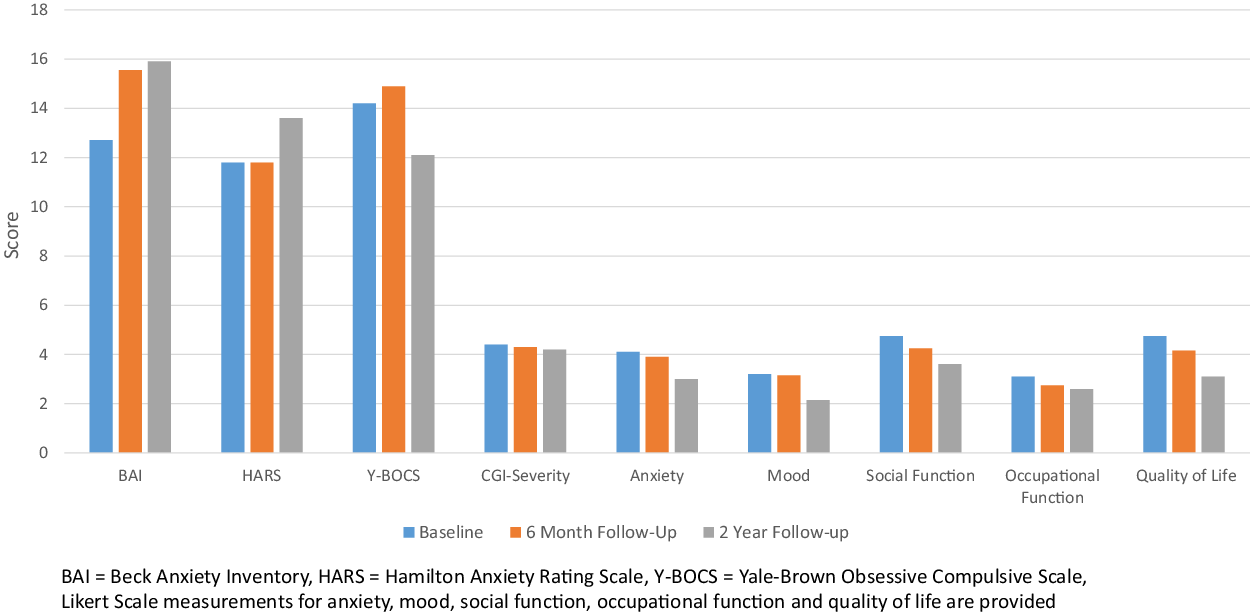
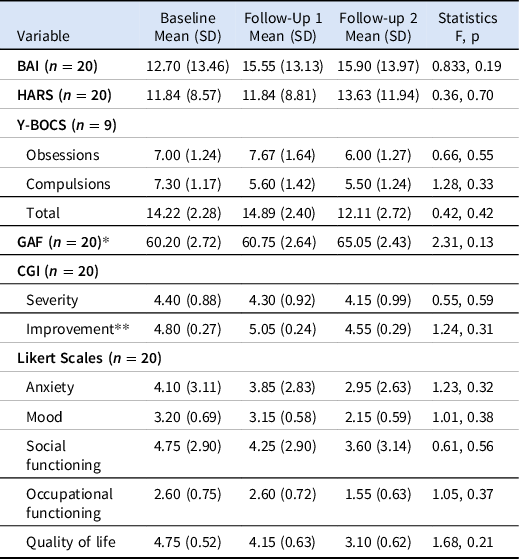
As demonstrated in Table 2, no statistical difference in symptomatology was noted between the three time-points when analysing the total group in relation to anxiety symptoms as measured utilising psychometric rating scales (BAI, HARS) or utilising a Likert Scale (Figs. 1 and 2). Similarly, there was no difference in levels of symptoms of OCD, or measures of mood, social or occupational functioning, quality of life or global functioning between the three time-points. However, post hoc testing noted an increase in global functioning at time-point 3 compared to time-point 1 (4.85 points, (95% CI 0.17, 9.53), p = 0.043). The greatest impact of COVID-19 related to social functioning and quality of life at all time-points. As some Likert scale data was non-parametrically distributed, analysis was repeated utilising the Wilcoxon Rank test and no difference in results was demonstrated.
Change in symptomatology.

Change in symptomatology over time

BAI = Beck Anxiety Inventory, CGI = Clinical Global Impression, GAF = Global Assessment of Functioning; HARS = Hamilton Anxiety Rating Scale, Y-BOCS = Yale-Brown Obsessive Compulsive Scale.
* Post hoc analysis demonstrated higher GAF scores at time-point 3 compared to baseline (4.85 points, (95% CI 0.17, 9.53), p = 0.043).
** Higher scores suggest less improvement.
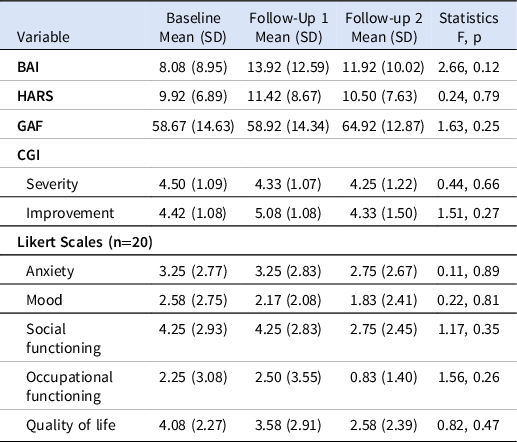
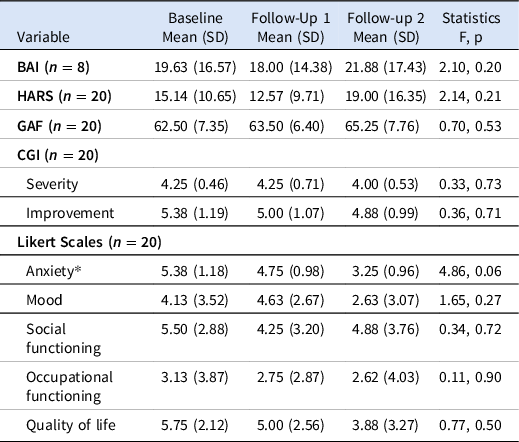
Data pertaining to clinical symptomatology for individuals characterised as ‘trigger’ and ‘non-trigger’ disorders are presented in Tables 3 and 4. No difference over time was noted across psychometric instruments or Likert Scales for either group. However post hoc analysis noted reduced anxiety symptoms at time-point 3 for individuals with a ‘trigger’ anxiety disorder, compared to baseline for the subjective anxiety Likert scale (-2.13 points, 95% CI -3.70, -0.55 points, p = 0.015). Including all study participants, individuals with ‘non-trigger’ anxiety disorders (n = 15) had higher levels of subjective depressive symptoms at time-point 2 (Mean = 4.10 (SD = 2.64) v. 1.87 (SD = 1.96), p = 0.37) compared to those with ‘trigger disorders’ (n = 10); with no other differences evident between these groups.
Trigger disorders (N = 12) – change in symptomatology over time

BAI = Beck Anxiety Inventory, CGI = Clinical Global Impression, GAF = Global Assessment of Functioning; HARS = Hamilton Anxiety Rating Scale, Y-BOCS = Yale-Brown Obsessive Compulsive Scale.
Non-trigger disorders (n = 8) – change in symptomatology over time

BAI = Beck Anxiety Inventory, CGI = Clinical Global Impression, GAF = Global Assessment of Functioning; HARS = Hamilton Anxiety Rating Scale, Y-BOCS = Yale-Brown Obsessive Compulsive Scale.
Post hoc analysis demonstrated reduced subjective anxiety symptoms at time-point 3 compared to time-point 1 (−2.13 points (95% CI = −3.70, −0.55), p = 0.015).
Qualitative data
The 21 participants at time-point 3 provided 56 separate comments. Nineteen individuals provided comments relating to the mental health services’ management of the COVID-19 pandemic and all participants provided comments regarding the impact of the COVID-19 pandemic for them, or their view for the future with regards to the COVID-19 pandemic.
The most common theme pertaining to mental health services was that participants believed that services did all that was possible for them (n = 14). The other most predominant theme was that the option of telemedicine consultations was helpful and could potentially remain as an option in the future where appropriate (n = 3). Four themes emerged pertaining to the current and future impact of COVID-19: (1) optimism for the future (n = 8), (2) beneficial impact of receiving the COVID-19 vaccine and booster (n = 4), (3) risk of re-opening of society too quickly and subsequent risk of re-emergence of COVID-19 (n = 7), and (4) concern for re-emergence of anxiety symptoms (n = 4).
Themes emanating from free-text responses (Free-Text Data Themes).
Mental Health Services (MHS)
Theme 1: MHS did all they could (n = 14)
-
‘They did everything possible for me’(#11, Male)
-
‘They did all they could, and I knew where they were’ (#16, Female)
Theme 2: Role for Telemedicine in the future
-
‘Having prescriptions emailed to the pharmacy and appointments on the phone were both helpful for me’ (#7, Male)
-
‘Virtual appointments were good and should continue into the future’ (#19, Female)
Impact of COVID-19
Theme 1: Optimism for the future (n = 8)
-
‘I am now hopeful for the future’ (#15, Male)
-
‘I will be able to go to town, and meet people in coffee shops and restaurants’ (#24, Female)
Theme 2: Beneficial Impact of COVID-19 and booster (n = 4)
-
‘I feel relieved that I have received my vaccines’ (#8, Male)
-
‘I am looking forward to my second booster to further reduce my risk of COVID-19’ (#18, Male)
Theme 3: Society re-opening too soon (n = 7)
-
’My anxiety is higher due to society re-opening’ (#7, Male)
-
‘Restrictions have been removed too quickly from a social and business perspective’ (#17, Female)
Theme 4: Re-emergent anxiety (n = 4)
-
’I am not looking forward to groups’ (#10, Female)
-
‘My anxiety is higher socially, my mask had been my safety blanket for my anxiety’ (#16 Female)
-
‘I am anxious around people without masks, that I or my family might contract COVID-19’ (#20, Female)
Discussion
This study evaluates at three time-points over a 2-year period, anxiety, functioning and quality of life since the onset of the COVID-19 pandemic in individuals with pre-existing diagnosed anxiety disorders who are attending secondary mental health services. Although individual differences were evident, the impact overall of the COVID-19 pandemic on anxiety symptoms was not marked, with only minimal changes in symptomatology noted over time. Free-text data, whilst noting optimism for the future, also demonstrated that many participants believed that the reduction in restrictions (March 2022) and re-opening of society was being undertaken too hastily, leading to a risk of another spike in COVID-19 case numbers and consequently a risk of additional societal restrictions. Some concern was expressed that societal re-opening would lead to participants experiencing increased anxiety symptoms, particularly in social scenarios.
The lack of change in anxiety symptomatology at the three time-points is consistent with studies in other jurisdictions of shorter duration, where no increase and in some instances a modest decrease in symptoms for individuals with high baseline levels of symptomatology were noted (Ahrens et al., Reference Ahrens, Neumann, Kollmann, Plichta, Lieb, Tuscher and Reif2021; Bendau et al., Reference Bendau, Kunas, Wyka, Petzold, Plag, Asselmann and Strohle2021; Pan et al., Reference Pan, Kok, Eikelenboom, Horsfall, Jörg, Luteijn, Rhebergen, Oppen, Giltay and Penninx2021). On a positive note, there was some evidence for a modest improvement in functioning at 2-year follow-up in this study, albeit this was not marked. The rationale for relatively modest levels of symptomatology in this patient cohort despite the significant impact of COVID-19 is likely multi-factorial. Firstly, each participant had continued access to supports from their multidisciplinary mental health team over the two year period of this study, despite some aspects of service provision arguably sub-optimal (i.e. lack of group therapeutic interventions such as anxiety management groups). Free-text comments from participants reflected that contact with their mental health team was predominantly positive with teams providing as much support as was feasible during the pandemic. This included access to key workers and pharmacological interventions. Secondly, none of the participants engage to our knowledge in consuming alcohol above the Health Service Executive recommended low-risk alcohol guidelines (https://www2.hse.ie/wellbeing/alcohol/improve-your-health/) or actively abuse psycho-active substances, which could potentially exacerbate symptomatology. Thirdly, a diagnosis of a mental disorder does not mitigate against an individuals’ ability to be resilient (Herrman et al., Reference Herrman, Stewart, Diaz-Granados, Berger, Jackson and Yuen2011). Viewed as a multi-dimensional capacity to adapt in the face of significant adversity, stress, and trauma by maintaining a stable trajectory of functioning via multiple pathways (Southwick et al., Reference Southwick, Bonanno, Masten, Panter-Brick and Yehuda2014; Bonanno Reference Bonanno2004), resilience is not intrinsically inherent to each individual; rather it is a process moulded by each person’s experience and evolving interaction with the world around them. It is probable that several of the study participants have adapted positively to maintain their mental health, despite the adversity experienced with COVID-19 and its associated restrictions activating previously learned coping strategies and adaptability to change, occurring in a milieu of decreased anxiety-provoking social and occupational demands mandated by restrictions.
Qualitative data noted divergent views, with many participants optimistic for the future, particularly after attainment of vaccinations (note 95% of cohort had attained a COVID-19 vaccination). However, several participants stated that their anxiety symptoms were increasing or expressed concern that anxiety symptoms might re-emerge or intensify in the face of increased social and workplace demands as restrictions are further removed. For some individuals, this anxiety is related to increasing social scenarios, with the COVID-19 pandemic restrictions enabling avoidance of stressful and anxiety-generating interactions and scenarios. For other participants, there was anxiety about the re-emergence of a COVID-19 spike due to a too-rapid reduction in social restrictions.
Many respondents found interaction with their mental health team reassuring and supportive. Telephone consultation as a viable alternative to face-to-face interaction was highlighted by some of the participants, with some stating that ‘tele-psychiatry’ could have an ongoing role, with recent research noting patient satisfaction for this form of clinical consultation in individuals with bipolar disorder and anxiety disorders (Farrell et al., Reference Farrell, George, Amado and Wozniak2022; Milosevic et al., Reference Milosevic, Cameron, Milanovic, McCabe and Rowa2022; Komariah et al., Reference Komariah, Amirah, Faisal, Prayogo, Maulana, Platini, Suryani, Yosep and Arifin2022). However, concerns such as the development of therapeutic rapport and the attainment of full informed consent to maintain patients’ privacy have also been expressed (Romo Reference Romo2022).
There are a number of limitations with this study, the most significant of which being the modest sample size. However, 70% (n = 21) of the original cohort engaged in the third phase of this longitudinal study and there was no difference in clinical or socio-economic factors between those who did and did not participate. A power analysis undertaken prior to study commencement indicated that to detect a clinically significant change in the HARS (score change of 7 points), 21 participants would be required for a desired power of 0.80 and allowing for a type 1 error of 0.05. Likert scales utilised were not validated for this study but have been widely used in previous studies and are identical to those utilised in the first two time-points of this study. Additionally, caution is required in interpretation of findings between different anxiety disorders given the relatively low sample size, and further studies might potentially be better powered to compare the impact of COVID-19 between individuals with different anxiety related disorders. This study was undertaken within one community mental health team, and thus it is possible that the findings may not be generalisable to other services with differential resources or co-morbid disorders. As previously described (Plunkett et al., Reference Plunkett, Costello, McGovern, McDonald and Hallahan2021; Hennigan et al., Reference Hennigan, McGovern, Plunkett, Costello, McDonald and Hallahan2021), separating individuals with anxiety disorders into ‘trigger’ and ‘non-trigger’ groups is not currently a recognised categorisation. Finally, the third time-point did not occur at a time of mandated social restrictions (unlike time-points 1 and 2) despite ongoing high COVID-19 rates, and this may have potentially impacted certain psychometric measures including the GAF.
Conclusion
This longitudinal study examining the impact of the COVID-19 pandemic and its restrictions on individuals with pre-existing anxiety disorders at three time-points over a 2-year period demonstrated no significant overall change in symptomatology or functioning over time, with optimism expressed by many individuals for the future. Variability was however demonstrated, with some individuals describing ongoing anxiety, and concerns that restrictions were being removed too quickly, with a re-emergence of social anxiety for some participants. Thus, despite COVID-19 having a minimal impact on many individuals with pre-existing anxiety disorders; identifying those with ongoing symptoms or distress remains important, particularly for those with anxiety associated with societal restrictions being removed. Moreover, ongoing provision of multidisciplinary tailored interventions is required, with tele-psychiatry a potential option to consider.
Conflicts of interest
AMcL, KM, EMcM, RP, KH, CMcD and BH declare no conflicts of interest.
Financial support
This research received no specific grant from any funding agency, commercial or not-for-profit sectors.
Ethical standards
Ethical approval was attained prior to study commencement from the Galway University Hospitals Research Ethics Committee. The authors assert that all procedures contributing to this work comply with the ethical standards of the relevant national and institutional committee on human experimentation with the Helsinki Declaration of 1975, as revised in 2008.