In the disorienting opening scene of George Lippard's 1845 novel The Quaker City, a group of the city's elite gentry wander through the moonlit streets of Philadelphia, stumbling and cursing over “how d- - - -d irregular these [street] bricks are.”Footnote 1 As they attempt to navigate the urban landscape, the topography of the city proves more disabling than the brandy they have consumed throughout the evening. Lippard thus brings us into a city that, for all its intended order, is rife with irregularity and unruliness. In so doing, he portrays an urban landscape that resists the colonizing impulses of a grid system tied to Neoplatonic ideals of egalitarian “space,” a system embraced by William Penn, Thomas Jefferson, cartographers of the nineteenth century, and even Lippard himself. As sites of perversion, the convoluted and marginalized urban space of The Quaker City's Philadelphia represents “queer space” in that it creates ruptures in the establishment of the urban grid, thus resisting a national ideology invested in regulatory institutions such as patrilineage.Footnote 2 Lippard's sensationalist novel, however, aims not to revolutionize such traditions, but to reconstitute them in Penn's democratic vision, which, Lippard believes, has been degraded by Philadelphia's illicit elite.
As a radical reformer dedicated to issues concerning the working class, Lippard placed The Quaker City at the center of his project to raise awareness about the antidemocratic injustices of mid-nineteenth-century Philadelphia. To purge what he considered a corrupted democracy of its elitism and anti-egalitarian principles, Lippard turned to the sensational novel and seduction narrative to shock his readers into political action. Driven by the abduction of the “flower of one of the first families in the city,” Mary Byrnewood, by the wealthy rake Gustavus Lorrimer, the sensational plot of The Quaker City would have touched a moral, perhaps even political, nerve with Lippard's audience (QC 15). Lippard thus strategically focusses the outrage and fury of his audience at the elite gentry who engage in the debauchery housed by the novel's infamous mansion, Monk Hall. By constructing the “space” of the novel, as well as the space of Monk Hall, as unruly, circuitous, and distorted, Lippard mobilizes deviant space to critique a ruling class that reigns over the city of brotherly love with corruption and licentiousness. Space then becomes the linchpin of Lippard's project, quite literally the place in which he attacks antidemocratic elitism. The novel's perversion of this space – indeed, the threat of “spatial deviance” – maps directly onto Lippard's radical critique of the corrupt elite in Philadelphia who themselves create, inhabit, and reveal “dens of iniquity and holes of wickedness” (QC 56).
SPATIAL DEVIANCE
To-night the city which William Penn built in hope and honor, – whose root was planted deep in the soil of truth and peace, but whose fruits have been poison and rottenness, Riot, Arson, Murder and Wrong, – will put on its face of smiles, and drink and feast and dance and pray for six hours at least! (QC 540)
In The Quaker City, Lippard presents the urban space of nineteenth-century Philadelphia as a threat to the egalitarian ideals of William Penn and Thomas Jefferson. While Penn focussed exclusively on local space and remained disinterested in a national project, Jefferson later employed principles of order and symmetry similar to Penn's to establish a democratic and uniquely American landscape. Rather than Jefferson's Neoplatonic ideal of land that would cultivate egalitarian social relations – one “whose root was planted deep in the soil of truth and peace” – Lippard's Philadelphia embodies the uneven development of hierarchical power relations. Indeed, the Jeffersonian “canker” of vice and degeneracy materializes in The Quaker City as the wanton den of Monk Hall.Footnote 3 Here the elite gentry of “the city which William Penn built in hope and honor” ritually convene to feast, drink, womanize, and smoke opium. Situated within yet teetering on the edge of Philadelphia's grid, sits Monk Hall – “A queer old house … where the very devil is played under a cloak, and sin grows fat within the shelter of the quiet rooms and impenetrable walls” (QC 23). The narrator repeatedly describes the mansion as “a place hard to find, abounding in mysteries” (QC 60), and claims that to find it at all one “would have had to wind up a narrow alley, turn down a court, strike up an avenue, which it would take some knowledge of municipal geography to navigate” (QC 48). In the opening chapters of the novel we witness a group of drunken elite attempt to locate this house of debauchery by “threading a labyrinth of streets” (QC 62). In a moment of frustration, one cries out,
I say, Gus, what a devil of a way you've led me! … up one alley and down another, around one street and through another, backwards and forwards, round this way and round that – damme if I can tell which is north or south except by the moon! (QC 50)
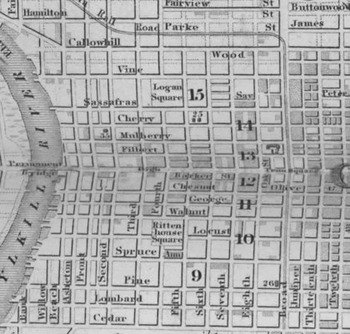
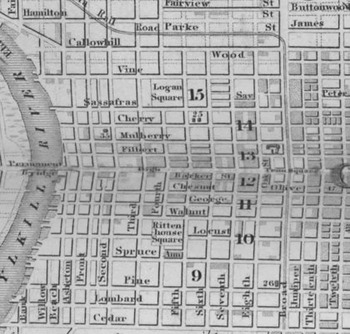
If the premise of ordering urban space according to a logical “grid” system is to facilitate navigation through the streets, Monk Hall proves to be a geographical loophole, quite literally: an elusive location that escapes the material geography of urban space by hiding within it (see Figure 1).Footnote 4
Detail of “Philadelphia and Environs,” Henry S. Tanner, The American Traveller; or Guide Through the United States, 4th edn (Philadelphia: Henry S. Tanner, 1839). Image accessed through the New York Public Library Digital Gallery on 16 July 2007. All figures are available at http://digitalgallery.nypl.org/nypldigital/id?433887.
The space within the great mansion is likewise slippery and shrouded in uncertainty. Characters often become discombobulated trying to navigate its myriad corridors, rooms, back alleyways, and side streets. Rooms spill into one another, trapdoors fall into hidden subterranean spaces, and a seemingly infinite number of closets and chambers emerge and recede in syncopated succession. Visitors fortunate enough to find their way to Monk Hall risk becoming enmeshed in its interior web of spaces. As Lorrimer warns fellow bachelor Byrnewood, “You see, the entire arrangements of this place may be explained in one word – it is easy enough for a stranger … to find his way in, but it would puzzle him like the devil to find his way out. That is, without assistance” (QC 53, original emphasis). Later, as Byrnewood races to divert Lorrimer from ruining his sister Mary, the narrator recalls he
entered the chamber, and … strode forward to the damask curtain.
He swung one of its hangings aside, expecting to behold the extreme wall of the chamber. To his entire wonder, another chamber, as spacious as the one in which he stood, lay open to his gaze. (QC 72–73)
Similarly, as Luke Harvey attempts to find his way through the manor, he encounters walls that seemingly melt away with the slightest touch:
The back wall of this closet, is nothing less than a portion of the wainscotting of the next room. Give me your hand – it is firm, by G—d! – Do you feel that bolt? It's a little one, but once withdrawn, the panelling swings away from the closet like a door, and – egad! – the next room lays before you! (QC 111)
Although Monk Hall occupies the Philadelphia grid as “a massive edifice” of “black and red brick,” its spaces remain intangible, transient (QC 46).
Monk Hall thus threatens the orderliness of Philadelphia's physical and ideological space. By allowing unrestricted activity (and movement) within its walls, Monk Hall violates the urban grid's normalizing tendencies. Lorrimer esteems that the mansion is a place where, upon entering, the rules of society no longer apply. He gleefully boasts to Byrnewood that it is a “queer old house … where, during the long hours of the winter nights, your husband, so kind and good, forgets his wife, your merchant his ledger, your lawyer his quibbles, your parson his prayers” (QC 22–23). The codes that police everyday life in the streets of Philadelphia hold no currency within the phantasmal walls of this illicit setting. Monk Hall realizes Jefferson's greatest fear of urban space as the festering “canker” that “eats to the heart of [a government's] laws and constitutions,” thereby perverting nineteenth-century notions of reason, order, and balance.Footnote 5 In so doing, Monk Hall yokes together the grid's failure to control space with its inability to preserve an ideology rooted in a type of genteel, bourgeois civility.
THE GEOGRAPHY OF THE GRID
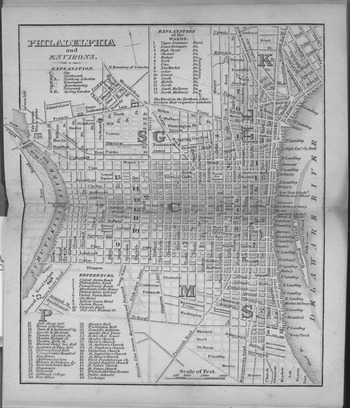
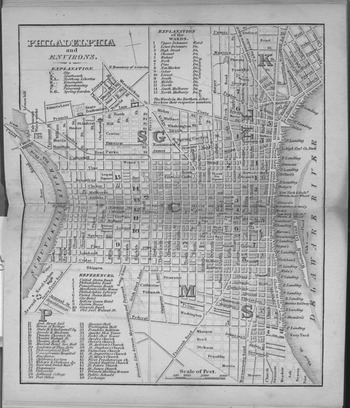
Within its effervescent boundaries, Monk Hall blurs the spatial and, more dangerously, the ideological system of Philadelphia's grid. Originally founded by William Penn in the seventeenth century on the egalitarian ideals of a Quaker utopia, Philadelphia was settled according to Penn's directions that “the streets hereafter may be uniform down to the water from the country bounds.”Footnote 6 By the nineteenth century, Philadelphia had emerged as a waffle-iron configuration of squares, rectangles, corners, and right angles (see Figure 2). Richard Sommer notes, “Philadelphia is credited – and blamed – for introducing the gridiron plan with a main square at its center as a model for establishing cities throughout the United States. The scheme was duplicated ad infinitum, often on hilly, less appropriate sites.”Footnote 7 The geometric landscape of Philadelphia thus became a municipal template that could be lifted from one site, positioned over another plot of land, and traced onto (thus “writing” over or filling in) its “emptiness.”Footnote 8
“Philadelphia and Environs,” in Henry S. Tanner, The American Traveller; or Guide Through the United States, 4th edn. Image accessed through the New York Public Library Digital Gallery on 16 July 2007.
Nearly a century later, Jefferson transposed this template onto the nation as a whole, creating what Philip Fisher terms “democratic social space”: space that “we might call a Cartesian social space, one that is identical from point to point and potentially unlimited in extent.”Footnote 9 Jefferson envisioned a national geography that emulated the egalitarian principles of the nascent democracy – a geography that “would, ideally, be a universal and everywhere similar medium in which rights and opportunities are identical, a space in which the right and even the ability to move from place to place is assured.”Footnote 10 Consequently, by the nineteenth century, the modeling of major US cities after Philadelphia had created a common urban geography across the nation. Having visited one major American city, a traveler could easily arrive at another and instantly be familiar with its macro-structure: the regularity of streets, predictable intersections, and geometric contours of the land. This common geography facilitated navigation for travelers, just as it facilitated commerce. Maps distinguished between residential and commercial areas within a municipal district, thereby allowing traveling salesmen to conduct their business with greater efficiency. Yet while visual representations of cityscapes reveal this intended logic of the grid, they also expose a tension within the grid's abstraction of space. Because they showcase this friction between spatial ideals and space as it actually exists, nineteenth-century maps become an important tool for understanding Lippard's perversion of urban space in his sensational novel.
The Quaker City directly responds to artifacts of normative space exemplified in nineteenth-century maps, such as those created by Henry Tanner (see Figure 2). Designed specifically to aid travelers as they traversed the nation, the cartographer's 1839 edition of The American Traveller includes “facts in relation to the several states, their population, number of counties, area, forms of government, cities, towns, roads, canals, distances, &c. as would be most likely to prove useful to, or deserve the notice of the traveller.”Footnote 11 For large cities such as Baltimore, Boston, New York, and Philadelphia, the popular cartographer includes detailed maps that illustrate the dizzying array of urban vectors crisscrossing these four topographies. Within each map, Tanner further highlights significant locations (with numbers and/or letters) such as banks, jails, courthouses, and so forth that are literally “key” to understanding the abstract squares and rectangles dotting the landscape. Thus, as Tanner assures his audience in his preface, “By consulting either the book or map, the place sought for in the other can be found with great facility.”Footnote 12
Like Jefferson's agricultural grid, Tanner's map of Philadelphia employs an alien or estranged perspective. Rather than depicting the town as it would appear on the ground to a pedestrian, this map “looks down” on Philadelphia, imagining its viewer positioned from a “bird's-eye” perspective. Such a perception, while an established mode of representation by the mid-nineteenth century, remains physically obscure and impractical to its audience because one must infer from it rather than recognize its perspective. This act of looking down onto a terrain also creates the illusion of a neutral or objective perspective, one void of personal experience. Furthermore, the area of the city, however sprawling, is depicted in its entirety within a single, enclosed representation, while its constitutive places are represented according to their relative size and shape. Tanner thus reduces an expansive area to a single page, a two-dimensional map in a book.Footnote 13 In this light, the place of Philadelphia is not experienced materially or physically – rather, it is represented as a virtual, and disembodied, version of itself.
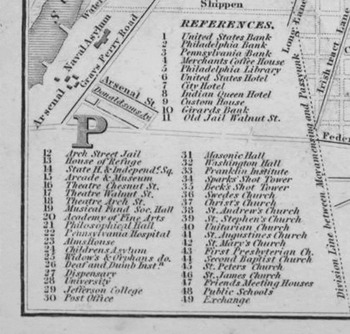
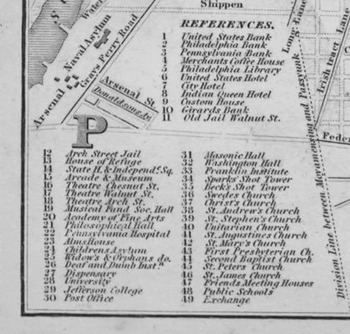
Despite its alienating abstraction, Tanner's representation of the Philadelphia grid creates or imagines a common and consensual space. The map normalizes the urban landscape, directing its readers to interpret it uniformly so that “this street” is Chesnut Street to me just as it is to you. We will also agree, then, that “this square” is Girard's Bank, and that another shape just to the north is called Independence Square. Yet, at the same time as it universalizes space, Tanner's map particularizes it. In the lower left-hand corner of the map, the cartographer includes a table of “References” or places on the map marked by sequential numbers (see Figure 3). In so doing, Tanner marks locations important to the identity of the city – locations that participate in community-building, such as banks, courthouses, prisons, schools, and churches. The list legitimates certain places in Philadelphia, classifying, naming, and privileging them. By highlighting these locations, the map acts as a guide to material and ideological community formation. Just as newspapers, pamphlets, and other circulating texts do, maps incite the movement, as well as the dialogue, between disparate bodies. In theory, Tanner's guide prevents the citizens of Philadelphia from getting lost, enabling them to “find” one another and consequently form groups, associations, and publics.Footnote 14
References, detail of “Philadelphia and Environs,” in Henry S. Tanner, The American Traveller, 4th edn. Image accessed through the New York Public Library Digital Gallery on 16 July 2007.
Even though the urban grid will always want to organize and universalize, space is ultimately experienced individually, so that maps such as Tanner's highlight the tension endemic to the urban grid. That is, the abstracting tendencies of the grid are continually at odds with the subjective embodiment that inevitably allows citizens to experience this landscape. As a result, despite the fact that you and I both call this street Chesnut Street, we might (and most likely will) experience it quite differently; therefore Chesnut Street will assume various meanings. This tension may also be described in terms of the dissonance between space and place, where space refers to an abstract notion, and place denotes location, material geography. Doreen Massey notes that place has the ability to “raise an image of one's place in the world, of reputedly … deep meanings of ‘a place called home’ or, with much greater intimations of mobility and agility, can be used in the context of discussions of positionality.”Footnote 15 The space of Philadelphia, then, is quite different from the place named Monk Hall. Tanner's map reveals the constant slippage between the controlling and transcending qualities of the grid, the ability of a material place to counteract its idealized space.Footnote 16
THE QUEER CITY
The Quaker City capitalizes on this slippage, this ultimately flimsy power of the grid by creating alternative, or “queer,” space. Because Monk Hall does not participate in the normative community-building that Tanner's “Philadelphia and Environs” attempts, the unruly mansion is off the map. By opening up pockets of space that allow for unregulated behaviors and experiences, Monk Hall creates space that defies normative (state-sanctioned) structures of organization and authority; it resists the grid's material and ideological control. Furthermore, Monk Hall resists the spaces of Penn's and Jefferson's imaginations that are inflected by, and immersed in, heteronormativity. Indeed, the entire notion of the early American landscape (rural or urban) was premised on its very reproducibility across geographical and human bodies.Footnote 17 Penn even associated his “Holy Experiment” with the birth of a child: “And, thou, Philadelphia, the virgin settlement of this province, named before thou wert born, what love, what care, what service, what travail has there been, to bring thee forth.”Footnote 18 In order to regulate the development of unruly land, Penn and Jefferson conflate spatial and genealogical normativity.
Yet as a “queer world,” Monk Hall challenges the security of the grid Penn and Jefferson believed in because it has “more spaces than can be mapped beyond a few reference points,” and “is a space of entrances, exits, unsystematized lines of acquaintance, projected horizons, typifying examples, alternate routes, blockages, incommensurate geographies.”Footnote 19 Because the space of Monk Hall develops “in opposition to the institutions of the family, heterosexuality, and reproduction,”Footnote 20 it violates not only the grid's logic of space, but also its investment in heteronormative institutions. By breaking with these traditions, Monk Hall embodies and constructs “queer space.” Like the polymorphous and perverse space of Monk Hall, queer space welcomes deviant penetration – indeed, is defined by it. The mansion's ability to harbor and celebrate socially reprehensible acts is precisely why Lorrimer brings Mary to Monk Hall to “ruin” her – because it is the place where he can live out his rape fantasy without fear of being socially alienated or legally reprimanded. His violent behavior can transpire, even thrive, within this blind spot of the ever-roving eye of the state. In revealing his meticulous plan to Byrnewood, Lorrimer explains he will bring Mary to the “queer old house” of Monk Hall, and, “Within its walls this night I will wed my pretty bride”; he also claims that Monk Hall will expose Byrnewood to “a few fresh ideas of the nature of the secret life of this good Quaker City” (QC 23, original italics). Only in the space Monk Hall harbors, then, can Lorrimer and his bachelor friends carry out their unregulated, unpoliced crimes.
By escaping the grid's “mastery,” Monk Hall typifies the relationship between space and power systems. The space of Monk Hall and its ability to resist normalizing forces illustrates Foucault's assertion that “space is fundamental in any exercise of power.”Footnote 21 Similarly, Henri Lefebvre describes the relationship between space and sovereignty in his analysis thus: “(Social) space is a (social) product.”Footnote 22 For Lefebvre, space is not a place where power struggles occur; rather it is an articulation of power that shapes and is shaped by the malleability of social relations. He asserts that
in addition to being a means of production [social space] is also a means of control, and hence of domination, of power; yet … it escapes in part from those who would make use of it. The social and political (state) forces which engendered this space now seek, but fail, to master it completely.Footnote 23
Like Monk Hall, Lefebvre's concept of space situates hegemonic sources of power against their antagonistic opponents, and squares them off quite literally in a battle over (ideological) territory.
In a comparable way, critical geographers acknowledge the power space has to shift cultural, historical, and political paradigms. Capitalism, gender relations, and class distinctions are just a few examples of the social systems constructed in tandem with space. Doreen Massey explains the significance of “the spatial” as a concept that
can be seen as constructed out of the multiplicity of social relations across all spatial scales, from the global reach of finance and telecommunications, through the geography of the tentacles of national political power, to the social relations within the town, the settlement, the household and the workplace.Footnote 24
The spatial is a powerful term insofar as it embodies “a way of thinking in terms of the ever-shifting geometry of social/power relations, and … is both open to, and a necessary element in, politics in the broadest sense of the word.”Footnote 25 As a place where both the elite and the working class clash, Monk Hall acts as a microcosm for the “ever-shifting geometry of social/power relations” that underpin the urban space of Philadelphia. By being truly “unmappable,” Monk Hall threatens the universal, controlled space that the state has so methodically and deliberately planned.
At the same time that Monk Hall provides a space for deviant, even resistant behavior, the manor does not go completely unregulated. Because it privileges elites who debauch by exploiting the workers of Monk Hall, it is no surprise, then, that the space of Monk Hall does not escape anti-egalitarian, stratified relationships based on race, class, and gender. Indeed, the “subversive” sphere facilitated by Monk Hall cannot exist except alongside the socially sanctioned, public sphere of banks, churches, and court houses: the two spaces are not diametrically opposed, but rather wed to one another in a symbiotic relationship. As Steve Pile argues,
There is never one geography of authority and there is never one geography of resistance. Further, the map of resistance is not simply the underside of the map of domination – if only because each is a lie to the other, and each gives the lie to the other.Footnote 26
Rather than a “geography of resistance” that challenges Philadelphia's “geography of authority,” Monk Hall constructs and is constructed by the troubled intersection of these two political landscapes. It is a space where women such as Mary and Bess fall prey to the sexual violence of men, where racially othered characters such as the brute henchmen Glow-worm and Musquito remain in the shadows, and where physically grotesque characters like Devil-Bug are treated as the personification of degeneracy. As a result of this systematized disenfranchisement, characters such as Lorrimer and Fitz-Cowles reap the same gendered, racialized, and classed privileges they would outside the walls of Monk Hall. Meanwhile, these inequalities are not invisible or unfelt by the marginalized characters of the novel. As the hunchbacked monster Devil-Bug explains, in Monk Hall, as in the streets of Philadelphia, the upper-class, white gentry exploit the racial and gendered “others” for their illicit entertainment: “While the broadcloth gentry of the Quaker City guzzle their champaigne two stories above, here, in these cozy cellars of Monk-Hall, old Devil-Bug entertains the thieves and cut-throats of the town with scorchin' Jamakey spirits and raw Moneygehaley!” (QC 220).
This ambivalence of Monk Hall, its ability to inhabit both types of space – the hegemonic and the subversive/queer – presents the mansion's greatest danger. Abiding as it does by a strict set of social rules that mimic those outside its boundaries, Monk Hall challenges Philadelphia by blurring sociopolitical and spatial boundaries. Like Jefferson, Lippard demonizes urban space as a threat to the egalitarian ideals of democracy, yet its most powerful threat is its ability to incite deviant behavior in any individual, including the elite gentry who supposedly uphold the bourgeois morals of a democratic society. Thus Monk Hall remains ambiguously situated between radical and contained space, resembling Foucault's notion of heterotopias. These places, Foucault writes, “are something like counter-sites, a kind of effectively enacted utopia in which the real sites, all the other real sites that can be found within this culture, are simultaneously represented, contested, and inverted.”Footnote 27 Although Monk Hall does not successfully “invert” the power and privilege of the elite, it does provide a world turned upside down, a strange utopia in which everyone (elite and illicit) thinks and even acts according to counterhegemonic principles. Instead, however, they revert to the same roles they occupy outside the devious mansion. In a paradoxical way, Monk Hall embraces both apparently exclusive definitions of space: it is counterhegemonic because it resists normalized identity formation and state surveillance. Conversely, it is a regulated space insofar as it facilitates illicit behavior by the ruling elite at the expense of socially marginalized groups of people.
Space thus operates for Lippard, and for the novel, as a means to engage audiences in a critique of the wealthy elite he deems responsible for a bastardized democracy. As a social reformer, Lippard aimed much of his criticism at the urban elite who, despite the economic hardships of the early nineteenth century, managed to profit.Footnote 28 Lippard himself supported labor reform, and was “a committed supporter of labor and anti-U.S. Bank policies.”Footnote 29 Not only did Lippard air his political grievances in his periodical, the Quaker City Weekly, but he also used his fiction as a strategy for bringing awareness to social-justice issues concerning the working class. As David Anthony notes, The Quaker City is one of many sensational novels of the early nineteenth century that feature “the debtor male” who “embodie[s] anxieties over an economy based increasingly on the ephemeral foundation of credit, speculation, and paper money.”Footnote 30 As he distrusts unmappable spaces, Lippard remains wary of modern money precisely because of its inability to be traced directly back to a source. In incorporating a general economic malaise throughout The Quaker City, Lippard thus reveals his own anxiety about the shaky financial state of the 1830s and 1840s. That only the privileged elite can partake in the “unruly” excess of Monk Hall highlights Lippard's disgust with the wealthy. Although Monk Hall escapes the grid, its clients depend on their privileged racial, class, and gendered status to engage in their immoral activities. In this way they benefit from a system in which they are members of both hegemonic and counterhegemonic social circles. As these circles merge – blurring the boundaries between respectable and deviant behaviors – Lippard ratchets up his readers' anxiety by questioning the ability to distinguish between productive, moral citizens and those who defile genteel civility.Footnote 31
Lippard's queering of space in The Quaker City allows him to critique the political, financial, and cultural malaise of the mid-nineteenth century. Because he believes such spatial deviance is symptomatic of Philadelphia's degenerate society, Lippard galvanizes space as the perfect “place” in which to enact his critique of perverted democracy. It is no surprise, then, that Lippard intensifies this critique by wedding deviant spaces with deviant genealogy: not only is space bastardized in The Quaker City, but so, too, are bloodlines. Lippard thus ties his critique of corrupted urban spaces to degenerative genealogy, warning his readers that immoral spaces harbor and even groom immoral citizens.
PERVERTED PATRIARCHY
Just as Lippard's characters find the streets of Philadelphia non-navigable, so, too, do we fail to “navigate” lineage in Lippard's novel. Much of the terror that emerges in the novel stems from histories and bloodlines that refuse to be mapped. The history of Monk Hall itself is warped, misunderstood, and shrouded in mystery: few are certain of its past, and the myths that remain in public circulation pervert the memory of its previous inhabitants. We learn, for instance, that the mansion was originally built by “a wealthy foreigner, sometime previous to the Revolution”; however, “Who this foreigner was, his name or his history, has not been recorded by tradition” (QC 46). The narrator recalls a long line of “strange rumors” (QC 46), and “conflicting traditions” (QC 47) that circulate. Some, “so vague and so conflicting, are still preserved in the memories of aged men and white-haired matrons” (QC 47). Likewise, Livingstone's magnificent estate at Hawkewood fails to preserve historical memory. After the rich merchant poisons his adulteress wife, Dora, both are consumed in a raging fire along with the mansion. Lippard also suspiciously designs Hawkewood after Monk Hall: Livingstone describes that it “was built in fact long before the revolution. Full of secret passages, solemn old rooms with wide fireplaces, lofty halls, and wainscotting without limit” (QC 194).Footnote 32 Both Monk Hall and Hawkewood reveal patriarchy's failure to pass on relics of its tradition.
Lippard also presents the genealogy of his characters as twisted, misconstrued, and transgressive. We are often unsure of people's true identities and their relationships to one another, and the majority of the novel's sensationalism derives from discoveries of how characters are or are not related. We learn dramatically, for instance, that Byrnewood and Mary are brother and sister (QC 96); Fitz-Cowles is not the “Son of an English Earl” but rather the “Bastard of a Creole slave” (QC 155, 551); the seductress Bess is really Emily Walraven (QC 80); and Devil-Bug is Mabel's illegitimate father, not the Rev. Pyne or Livingstone (QC 338, 340, 556). Genealogies that can be traced accurately are depicted as contaminated or polluted, as is the case with Devil-Bug, who appears to have been brought into this world without a family: “No mother had ever spoken words of kindness to him; no father had ever held him in his arms. Sister, brother, friends; he had none of these. He had come into the world without a name … to die in forgetfulness” (QC 106). Although chained to racialized forms of oppression, Devil-Bug remains free of familial ties, until we discover he is Mabel's true father. Meanwhile, Lorrimer suffers from a corrupt ancestry:
From generation to generation, the family of the Lorrimer's, had been subject to an aberration of intellect … From father to son, since the family has first come over to Pennsylvania, with the Proprietor and Peace-Maker William Penn, this temporary derangement of intellect, had descended as a fearful heritage. (QC 146–47)
A victim of his own lineage, Lorrimer's “fearful heritage” is “mappable,” yet stained.
To underscore his critique of perverted patrilineage, Lippard peppers his narrative with examples of the failed father figure. Mary's father, for example, neglects to protect her from ruin; instead her brother, Byrnewood, acts as a surrogate father. As he remains a prisoner in the Tower-Room of Monk Hall, Byrnewood cries,
I have held her in these arms, when she was but a babe – a smiling babe, with golden hair and laughing cheeks! And then when she left home for school, how it wrung my soul to part with her! So young, so lighthearted, so innocent! Three years pass – she returns grown up into a lovely girl. (QC 117)
Although the relationship between Byrnewood and Mary remains within the accepted boundaries of sibling behavior, Byrnewood speaks of his sister more as a father might than a brother. The “marriage” between Mary and Lorrimer (“Lorraine” to Mary) even hinges on the approval of Byrnewood – not her father, whom she hopes to surprise with the marriage on Christmas Day. Chapter 13 opens with Mary's exclamation, “My brother consents? Oh joy, Lorraine – he consents!” (QC 125). Additionally, the most unlikely character comes forth as the novel's only other “good” father: the onerous Devil-Bug keeps his daughter Mabel safe from the “incestuous” Rev. F. A. T. Pyne. As she lies slumbering in Monk Hall, her true father keeps vigil over her, planning to renounce her heritage from him and his former lover, Ellen. By substituting this tarnished family history with a more respectable, yet bogus, account of Mabel's lineage to Livingstone, the weary father hopes, “she shall ride in her carriage, and have goold pieces, thick as flies in a molasses jug” (QC 338).
Despite Devil-Bug's faith in the financial and social security of aristocracy, Lippard proves it otherwise unstable. Dora, for instance, manipulates her way in and out of certain lines of inheritance, depending on her romantic and sexual engagements. Of a modest background, Dora first marries the rich merchant Livingstone, then plots his murder so that she may climb even higher on the social ladder and marry the “Son of an English Earl,” Col. Algernon Fitz-Cowles. Amid her insatiable and criminal desires to become part of the aristocracy, however, she damns its legitimacy:
An Aristocracy founded on the high deeds of dentists, tape-sellers, quacks, pettifoggers, and bank directors, all jumbled together in a ridiculous mass of absurdities … Pah! There is no single word of contempt in the whole language, too bitter, to express my opinion of this magnificent Pretension – the Aristocracy of the Quaker City! (QC 183)
In Lippard's novel, aristocracy forfeits its virtue on account of those who are willing to commit murder to join its privileged ranks.
Moreover, Lippard reveals the degeneration of marriage, the definitive institution of patriarchy. Instead of a sentimental passing of a woman from one man to another, the only marriage in The Quaker City is a fake, a sham, a bet for money. While feasting in the Oyster-Cellar during the opening moments of the novel, Lorrimer informs his comrades of his plan to ruin a “sweet girl” by seducing her with the promise of marriage. “Only a pretend marriage, my boy,” he assures his male companions, “As for this ‘life interest’ in a woman, it don't suite my taste. A nice little sham marriage, my boy, is better than ten real ones” (QC 15). The “wedding,” when it occurs later that evening within the shadows of Monk Hall, proceeds as a façade of tradition and sanctity. Real members necessary to the ritual (father of the bride, maid of honor, officiator, and so on) are replaced by the cronies of Monk Hall, who stand in jest rather than in sincerity.Footnote 33
Without clear lines of inheritance, a legitimate aristocracy, and virile fathers, Monk Hall threatens to undo the egalitarian space steeped in heteronormative genealogy that Penn and Jefferson advocated. By presenting unmappable spaces and bloodlines as dangers to the preservation of spatial and ideological stability, Lippard uses this threat of queer space to caution his readers against immoral behavior that would plunge Philadelphia further into degeneracy. Determined “to write a book which should describe all the phases of a corrupt social system, as manifested in the city of Philadelphia” (QC 2), Lippard composed The Quaker City as an exposé of urban vice. In creating the queer space of his novel, Lippard attempts to rally the citizens of Philadelphia to reclaim their city from the greedy, corrupt, and vile urban elite.Footnote 34 He worried, however, that the novel might incite his readers to engage in wicked behavior themselves, and thus warns, “If you discover one word in its pages, that has a tendency to develop one impure thought, I beseech you reject that word” (QC 2).Footnote 35 Despite the fervor with which Lippard composed his novel as an act of social reform, many scholars argue that the radical potential of the novel is undercut by the author's frenzied narrative, which gets repeatedly sidetracked by gore and violence. Nowhere is Lippard's fascination with sensationalism more apparent than in the bizarre closing chapter, where the novel's political work breaks down, and the pulse of radical intervention comes to a standstill.
ALTERNATIVE ENDINGS
The spatial and genealogical threads of critique Lippard circuitously weaves throughout the narrative “knot” in the closing chapter of his novel. Here, in the final pages of The Quaker City, we witness concomitant spatial and genealogical displacement. Rather than the depraved streets of Philadelphia or the twisted corridors of Monk Hall, Lippard begins his final chapter in the secluded Wyoming frontier. Through a series of dramatic revelations, we learn that the two bachelors, Byrnewood and Lorrimer, have become tangled in a web of familial relationships: Byrnewood is now husband to the domestic servant Annie and father to her child, while Lorrimer's mother and sister come forward to reveal themselves. By ending his novel with such revelations, we might conclude that Lippard has sentimentally reconstituted the family, that he has finally created a scene in the novel for his audience to emulate, rather than reject.
While it may appear innocent, even idyllic, Lippard's ending remains sensational, not sentimental. It is agitating and discomforting since it fails to weave together the disparate threads of Lippard's narrative or to placate his readers. In so doing, Lippard only further complicates and “queers” his novel. He rejects a sentimental (heteronormative) answer to a sensational (queer) plot trajectory. If Lippard had intended a sentimental ending, he would have stopped the novel thirty pages earlier, when, at the Arlington home, Lorrimer faces the prospect of marrying Mary. The miscreant could have repented for his sins, begged for forgiveness from the Arlington family, married Mary, and started a family. In Lippard's sensationalist narrative, however, Lorrimer runs, thus catalyzing another circuitous set of chapters and plot deviations. Furthermore, the last scene of Byrnewood in the Wyoming cottage is displaced and unnerving. It does not legitimate the family or the role of the father; rather, it frames these institutions as a bizarre fantasy, even nightmare, in which dark spaces withhold desperate secrets, veiled figures are revealed sensationally, and the cries of a ruined virgin echo in our ears. We also learn that the cottage harbors dark spaces behind locked doors, for in a secret room Byrnewood keeps a portrait of Lorrimer. This token of his nemesis allows him to relive their violent encounter: “He had avenged his sister's wrong, but the memory of the scenes he had witnessed in Monk-Hall, in the parlor of his father's house, in the streets of the Quaker City, or on the broad river, dwelt like a shadow on his soul” (QC 574–75). Unable to leave behind the terrors of Monk Hall in the Wyoming frontier, Byrnewood continues to relive his dreadful night of sin and malice.
In this final, troubled scene of domestic malaise, Lippard reveals his own unease with an ending steeped in a middle-class lifestyle. Anthony argues that in The Quaker City “Lippard complicates – and seems resistant to – an unproblematized notion of middle-class security.”Footnote 36 While Byrnewood has escaped the depravity of urban life, he cannot escape its lingering effects. His new life, “secured” by a stable family and financial status, cannot overcome the sensationalized experiences of Monk Hall and the streets of Philadelphia. Lippard's novel is thus more ambiguous in its radical work than perhaps the writer would have estimated. As Shelley Streeby and David Reynolds have argued, Lippard's sensationalist fiction often subverts its radical political agenda.Footnote 37 The dramatic ending of The Quaker City, rather than successfully inciting (or threatening) its readers to social reform, suggests that a modest middle-class lifestyle does not represent a panacea for Philadelphia's woes.Footnote 38 Lippard's thrilling narrative, then, appears more invested in its own sensationalism than in its potential to enact social reform.Footnote 39 So be it, then, that Lippard ends the novel not with rehabilitative space – space that sutures the wounds Monk Hall tears in the fabric of society – but rather with pathological space. Rather than corrective, the rural space of the final chapter is degenerative. Indeed, the frontier setting of Wyoming further disorients the reader, much like the urban space in which the winding narrative begins: in the opening lines of The Quaker City, Lorrimer presents his gentlemen companions with the option to spend the night with “brandy and oysters, or quilts and feather-beds” (QC 5). Like his characters, Lippard chooses the former.