Implications
Fertility of the modern high-producing dairy cow has been decreasing for the last 30 to 50 years and has become a major concern of farmers and the dairy industry worldwide. Many reasons account for this reduced reproductive efficiency, but the most important component seems to be a reduction in embryonic survival and fertilization rates. As such, there is an urgent need to identify the genetic factors responsible for the decline in embryo survival. Identifying these factors would enable reduction in the frequency of the deleterious alleles at these loci by marker- or gene-assisted selection.
Introduction
There is growing concern with the decline in reproductive efficiency in high-producing dairy cows (Royal et al., Reference Royal, Smith and Friggens2008). A variety of reasons have been proposed to account for infertility in cattle, including genetic factors, nutrition, physiology and management (Lucy, Reference Lucy2001; Veerkamp and Beerda, Reference Veerkamp and Beerda2007). It is of particular interest to identify polymorphisms among specific genes and/or interactions between them that are associated with infertility in cattle, as this not only helps to elucidate the biology of infertility, but also provides genetic markers for use in marker-assisted selection. Although heritability is generally low, there is substantial genetic variation for fertility traits (Veerkamp and Beerda, Reference Veerkamp and Beerda2007), enabling possible identification of genetic factors. However, owing to the complex nature of fertility, it is very challenging to find significant associations between genetic polymorphisms and fertility traits. An in vitro fertilization (IVF) system has the advantage of a unified environment and well-isolated components of the embryonic development process. Indeed, using an IVF system developed in our laboratory, single-nucleotide polymorphisms (SNPs) in several genes have been successfully shown to be associated with fertilization rate and early embryonic survival rate (Khatib et al., Reference Khatib, Maltecca, Monson, Schutzkus, Wang and Rutledge2008a and Reference Khatib, Monson, Schutzkus, Kohl, Rosa and Rutledge2008b). Importantly, SNP–SNP interactions between biologically interacting genes in the same signaling pathway were also found to contribute significantly to fertilization and early embryonic development (Khatib et al., Reference Khatib, Huang, Wang, Tran, Bindrim, Schutzkus, Monson and Yandell2009).
Placental lactogen or chorionic somatomammotropin hormone 1 (CSH1), is a polypeptide hormone found in the placenta of mammals. It is structurally and functionally related to prolactin (PRL) and growth hormone (GH), two pituitary-derived hormones. Bovine placental lactogen (bPL) shares about 50% and 24% amino acid sequence homology with PRL and GH, respectively (Anthony et al., Reference Anthony, Pratt, Liang and Holland1995). However, no specific bPL receptor has been identified to date, yet it has been shown to be able to act through PRL receptor (PRLR) and GH receptor (GHR) (Byatt et al., Reference Byatt, Warren, Eppard, Staten, Krivi and Collier1992, Anthony et al., Reference Anthony, Pratt, Liang and Holland1995). bPL has a wide range of biological activities in vivo, including mammogenesis, ovarian steroidogenesis and fetal growth (Byatt et al., Reference Byatt, Warren, Eppard, Staten, Krivi and Collier1992). Nonetheless, the roles of bPL in fertility are less clear. Importantly, SNPs in GHR and PRLR, and their interactions with a STAT5A (signal transducer and activator of transcription 5A) SNP, have been shown to be associated with early embryonic survival rate (Khatib et al., Reference Khatib, Huang, Wang, Tran, Bindrim, Schutzkus, Monson and Yandell2009). The functional roles of bPL and its interacting genes make bPL a good candidate gene for fertility traits. The objectives of this study were to identify SNPs in the bPL gene and to test associations of SNPs or SNP–SNP interactions with fertility traits in the IVF system.
Material and methods
Phenotypic data were collected as described earlier (Khatib et al., Reference Khatib, Monson, Schutzkus, Kohl, Rosa and Rutledge2008b). Briefly, oocytes were aspirated from ovaries obtained from a local abattoir. A total of 6586 matured oocytes from 382 ovaries were fertilized with frozen-thawed semen samples from 12 bulls. Two reproductive traits were considered. The fertilization rate of oocytes for each ovary was calculated as the number of cleaved embryos 48 h after combining of semen and oocytes divided by the total number of fertilizations attempted. Embryos were cultured for 7 days until the blastocyst stage, before they were morphologically graded as ‘normal’ or ‘degenerative’. The survival rate of embryos was defined as the number of normal embryos divided by the total number of embryos produced.
DNA was extracted from ovaries through proteinase K digestion of ovary tissue followed by phenol/chloroform extraction and ethanol precipitation. To identify polymorphisms in the bPL gene, three DNA pools, each consisting of DNA from 10 ovaries, were constructed and amplified with PCR primers covering bPL exons; the PCR products were purified and sequenced. The sequence traces were visually inspected for DNA polymorphisms as indicated by multiple peaks at the same position, which were further confirmed by sequencing individual DNA samples. Only one C/T SNP was identified near the 5′ end of the bPL transcript (GenBank accession number NM_181007 position −198 upstream). Genotyping of this SNP was carried out by PCR-RFLP. Briefly, forward primer 5′TCAACTTAGCACGCCCGCATAGGGTGTATACAGGTA3′ and reverse primer 5′GGAATGCCTAAGGAGGAAAACC3′ were used to amplify a 237-bp fragment, in which the third nucleotide from the 3′ end of the forward primer was mutated from A to G to create a Csp6I recognition site. The PCR program had an initial denaturing step at 94°C for 5 min followed by 28 cycles of 94°C for 30 s, 58°C for 30 s, and 72°C for 30 s, followed by a final extension at 72°C for 10 min. The PCR products were digested by Csp6I (Fermentas, Glen Burnie, MD, USA) according to the manufacturer’s instructions, and then resolved in 2% agarose gel. The C allele appeared as 35-bp and 202-bp bands and the T allele was one intact band. Genotypes of PRLR (Blott et al., Reference Blott, Kim, Moisio, Schmidt-Küntzel, Cornet, Berzi, Cambisano, Ford, Grisart, Johnson, Karim, Simon, Snell, Spelman, Wong, Vilkki, Georges, Farnir and Coppieters2003) and GHR (Viitala et al., Reference Viitala, Szyda, Blott, Schulman, Lidauer, Mäki-Tanila, Georges and Vilkki2006) were obtained in an earlier study (Khatib et al., Reference Khatib, Huang, Wang, Tran, Bindrim, Schutzkus, Monson and Yandell2009) using similar PCR-RFLP approaches but different restriction enzymes.
To test the association between the bPL SNP and fertilization and survival rates, the following generalized linear mixed model was used to model the binary response of successful fertilization of oocytes or survival of embryos up to the blastocyst stage with a linear combination of predictors:

where b 1i is the fixed effect of genotype i for the bPL SNP, Bullj is the random effect of the jth bull and Ovaryk is the random effect of the kth ovary, which is nested within genotype of bPL SNP. The response variable was coded as binary (‘1’ for successful fertilization; ‘0’ otherwise and ‘1’ for normal development to blastocyst stage; ‘0’ otherwise, respectively). A canonical logit link function was used. The model was fitted using GLIMMIX procedure in SAS software version 9.1 (SAS Institute, 2009). The fixed effect of bPL SNP in the model was tested by a type-III F-test (using ‘contain’ for ‘DDFM’ option) with its denominator degrees of freedom computed from the ovary random effect nested within bPL genotype (SAS Institute, 2009). The genotypic effect can be interpreted as effect of mother’s genotype on the fertilization of oocytes or survival of embryos. To test for association between fertilization/survival rate and SNP–SNP interaction between bPL and PRLR, a similar model was used with PRLR and bPL : PRLR interaction as additional fixed effects in the model. Significance for bPL : PRLR interaction in the model was tested similarly by the type-III F-test in SAS software. Association of bPL : GHR interaction with each of the two traits was also tested using the same model.
Results and discussion
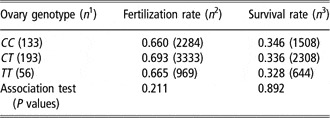
The observed fertilization rates for oocytes produced from ovaries with each of the three genotypes of bPL were 0.660 (CC), 0.693 (CT) and 0.665 (TT), whereas the observed survival rates of embryos were 0.346 (CC), 0.336 (CT) and 0.323 (TT). Interestingly, there was a pattern of overdominance for fertilization rate, which may explain the overrepresentation of heterozygotes in the population (Table 1). However, the differences in fertilization rates or survival rates did not reach statistical significance (Table 1).
Fertilization rate of oocytes and embryonic survival rate of embryos from ovaries segregating for the bPL SNP

bPL = bovine placental lactogen gene; SNP = single-nucleotide polymorphism.
1Number of ovaries with the genotype.
2Number of fertilizations attempted.
3Number of total embryos produced.
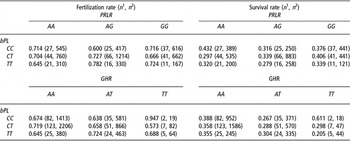
In addition to single SNP associations, SNP–SNP interactions between genes in the same signaling pathway have also been shown to contribute significantly to the variation in fertilization rate and survival rate (Khatib et al., Reference Khatib, Huang, Wang, Tran, Bindrim, Schutzkus, Monson and Yandell2009). Because of their biological interaction, SNP–SNP interaction between bPL and PRLR was also tested for association with fertilization and survival rates. As single SNPs, the SNP in PRLR was not associated with fertilization rate or survival rate, whereas the SNP in GHR was significantly associated with survival rate but not fertilization rate (Khatib et al., Reference Khatib, Huang, Wang, Tran, Bindrim, Schutzkus, Monson and Yandell2009). Interestingly, the genotypic effect of the bPL SNP depended on the genotype of PRLR, an indication of genetic interaction or epistasis. For example, the CC genotype of bPL had a negative effect on fertilization rate as compared to the CT and TT genotypes, only when the genotype of PRLR was AG (Table 2). Remarkably, interaction between the bPL SNP and the SNP in PRLR was statistically significant (P = 0.05) for fertilization rate and showed suggestive association (P = 0.10) with survival rate, suggesting a concerted genetic model involving epistasis between bPL and PRLR for fertilization and early embryonic development. However, interaction between the bPL SNP and the SNP in GHR was not significant for either trait.
Fertilization rates of oocytes and survival rates of embryos from ovaries by bPL, PRLR, and GHR genotypes

bPL = bovine placental lactogen gene; PRLR = prolactin receptor genotype; GHR = growth hormone receptor genotype.
1Number of ovaries with the genotype combinations.
2Number of oocytes (for fertilization rate) or embryos (for survival rate) produced from ovaries with the genotype combinations.
In summary, we investigated the association of a SNP in the bPL gene and its interactions with hormone receptors and fertility traits in dairy cattle. Although single gene analysis of bPL did not reveal significant association with either trait, its interaction with PRLR showed significant association with fertilization rate and suggestive association with survival rate. This is a further support of the significant contribution of SNP–SNP interactions between biologically interacting genes to these fertility traits in cattle (Khatib et al., Reference Khatib, Huang, Wang, Tran, Bindrim, Schutzkus, Monson and Yandell2009). In addition, it could justify the use of genotypic combination of interacting genes in marker-assisted selection programs to improve fertility in cattle.
Acknowledgements
The authors thank Rick Monson for help with the in vitro fertilization data. This study was supported by USDA Hatch grant No. WIS-142-PRJ16JH from the University of Wisconsin–Madison and by Igenity Livestock Production Business Unit, Merial Ltd, USA.