From 1966 to 1980, Malaysia began expanding its maritime border claims by expanding its 5.6 km (3 nautical miles, nmi) of territorial waters to cover 370.4 km (200 nmi) of continental shelf, creating an Exclusive Economic Zone (EEZ). This expansion of maritime jurisdiction culminated in the December 1979 publication of a new map of Malaysia (henceforth the New Map), which showed the country's new territorial waters and continental shelf border, followed by a proclamation of the EEZ in April 1980. The New Map, which included several islands that were at that time in dispute as Malaysia's sovereign claim, prompted neighbouring countries to lodge diplomatic protests. In particular, Malaysia laid claim to several islands in the Spratly archipelago. Thus, Malaysia became the fifth party in a region with complex overlapping claims.
Many scholars have attributed Malaysia's decision to claim extensive maritime territory and islands, despite the disputes, to the need for petroleum exploitation and for strategic concerns in anticipation of the enactment of the United Nations Convention of the Law of the Sea (UNCLOS).Footnote 1 However, I argue that these views are problematic and require a review because they overlook the implications of the World Oil Crisis that occurred against the background of the Cold War in late 1973. Malaysia did not escape the effects of the oil crisis, and faced international and domestic challenges. Internationally, the oil crisis created a huge demand for oil and increased oil prices; domestically, oil price hikes hit Malaysia so hard that its oil subsidies skyrocketed. In addition, the implementation of the New Economic Policy eroded the confidence of foreign companies to invest in Malaysia, forcing the federal government to depend more on oil revenues to overcome the shortage of foreign investment. Thus, both international and domestic factors inevitably provided an incentive for Malaysia to explore and exploit more oil reserves, particularly offshore of East and West Malaysia facing the South China Sea, in order to mitigate the shortfall. Without a doubt, the oil crisis fundamentally changed the course of Malaysia's foreign policy from one that abstained from the South China Sea territorial disputes, to becoming an active participant in the disputes from December 1979 onwards.
Nevertheless, while most scholars have recognised the importance of the petroleum factor in Malaysia's maritime claims, their attention has been overly focused on the nexus between strategic concerns, international law, and territorial disputes. There is a lack of depth in the research because scholars did not delve into the connections between the 1973 World Oil Crisis and the expansion of Malaysia's maritime claims. This article intends to fill this existing gap of knowledge. The crux of the problem is: to what degree and how did the oil crisis affect Malaysia's maritime jurisdiction policy? This article argues that the oil crisis had a huge effect. It employs economic reports, records of parliamentary debates (Hansard) and memoirs as primary sources, as well as secondary sources: news reports, journal articles and statistics from the Hansard. The Hansard of the time is crucial, as it officially captured the domestic events and policy changes in response to various stages of the World Oil Crisis and Malaysia's expanding oil and gas explorations. This study argues that Malaysia's policy changes were made in reaction to the oil crisis rather than other factors. Furthermore, I argue that it is important to understand the implications of the oil crisis in order to shed light on Malaysia's conduct in the maritime territorial disputes.
In order to limit its scope, this article focuses its investigation on the research related to general petroleum and maritime border policies that cover territories facing the South China Sea and will not go into the details of how every boundary point was drawn. The focus is on events that unfolded between 1973 and 1980. First, the article discusses why attention should be paid to the World Oil Crisis instead of other factors. Second, the investigation reviews the extent of the oil crisis and Malaysia's oil explorations. Third, this study examines the degree to which the crisis posed domestic inflationary pressures and how Malaysia mitigated those pressures. Fourth, the study investigates how Malaysia reacted at the policymaking level in the face of the oil crisis. Fifth, the study determines how Malaysia took advantage of the then upcoming UNCLOS 1982 to legalise its expansion of maritime jurisdiction, which was placed under the ambit of the armed forces.
The expansion of Malaysia's maritime jurisdiction
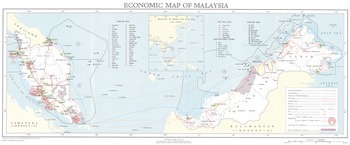
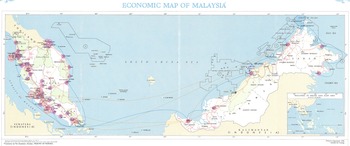
Malaysia's oil industry began after the first prospecting licence was issued to the Anglo-Saxon Petroleum Co. in 1909 by Sarawak's ‘White Rajah’, Charles Brooke, for oil exploration in Miri. The concession company sunk a well that produced 83 barrels per day (b/d) in December 1910. In total, ‘624 wells had been drilled in the field and a total volume of 80 million barrels of oil had been produced’ until it was depleted in 1972.Footnote 2 Subsequently, promising oil prospects were found in the offshore area after the first seismic survey was conducted off the coast of Sarawak in 1954 and similar surveys were made off the coast of Peninsular Malaysia in June 1968.Footnote 3 By using a mobile drilling rig, Sarawak Shell discovered the first Sarawak offshore oilfield in 1963 called Baram.Footnote 4 The encouraging news of an oil discovery off the coast of Sarawak resulted in the Malaysian government granting an 80,000 sq km mining concession area to Sarawak Shell Berhad in April 1968.Footnote 5 Six foreign oil companies also applied for oil exploration off the east and west coasts of Peninsular Malaysia. Esso Exploration Inc. and Continental Oil Co. of Malaysia were granted permission for oil exploration on 16 April 1968,Footnote 6 followed by Mobil Petroliam Inc., who were also granted an exploration permit. All of the oil companies operated in concession areas beyond the 5.6 km (3 nmi) of territorial waters (see fig. 1) designated by the government of Malaysia under the newly enacted Continental Shelf Act 1966.
Economic Map of Malaysia 1974/75, Ministry of Finance, Economic report 1974/75.

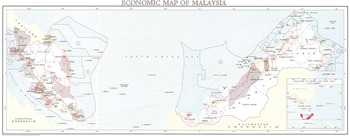
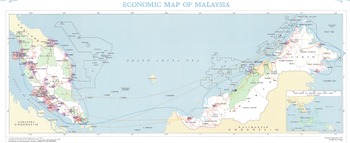
In the early years, Malaysia had claimed territorial waters up to 5.6 km (3 nmi), which was then extended to 22.2 km (12 nmi) in 1969. Malaysia ratified the 1958 Convention of the Continental Shelf and also enacted the Continental Shelf Act in 1966. The Act was to provide a legal framework for the leasing out of offshore concession areas to foreign oil companies for oil exploration.Footnote 7 However, the Continental Shelf Act did not specify the exact points, nor did it provide a map which showed the continental shelf border. At the time, the government was also required to publish ‘a large-scale map indicating the low water marks, the baselines, the outer limits and the areas of the territorial waters of Malaysia’ as soon as possible or from time to time under Section 5 of the Emergency (Essential Powers) Ordinance, No. 7, 1969.Footnote 8 Given there was no penalty for not publishing the map, the Malaysian government decided not to publish it immediately. The delay in publishing the map saw a complaint lodged by a parliamentarian during a budgetary debate.Footnote 9 Instead of fulfilling the large-scale map requirement, a simple concession area boundary was shown in official maps. The outer concession area boundary was shown in an Economic Map in the Economic report of 1974/75 (see fig. 1).Footnote 10 The outer boundary of the Economic Map of 1975/76 remained the same as the previous year. To a certain extent, the concession area boundary over the offshore areas of Sarawak and Sabah conformed to the 200-metre depth boundary, while the concession area boundary over the east coast of Peninsular Malaysia was entirely within the 200-metre depth shelf (comparing fig. 2 and fig. 8).
Economic Map of Malaysia 1975/76, Ministry of Finance, Economic report 1975/76.

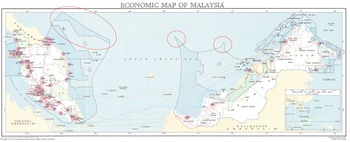
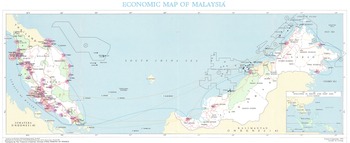
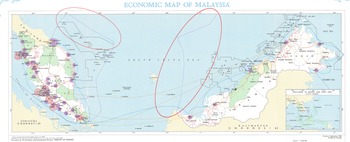
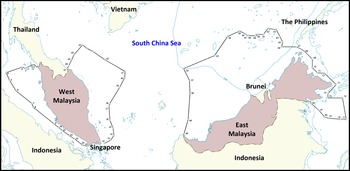
However, in the Economic Map of 1976/77, the concession area boundary over the east coast of Peninsular Malaysia was suddenly extended northeastward and straightened, while two tips of the boundary offshore of Sarawak were extended northwestward and northeastward (see fig. 3). Later, the Economic Maps of 1977/78, 1978/79 and 1979/80 did not show the outer boundary of the concession areas (see figs. 4, 5, 6). Subsequently, the outer concession area boundary was substituted by the continental shelf boundary in the Economic Map of 1980/81 (see fig. 7), which is identical to the continental shelf boundary shown in fig. 8. As a result, a large part of the South China Sea beyond the 200-metre depth of continental shelf was included into the New Map. Several of the Spratly Islands included in the New Map were already in dispute between China, Vietnam, Taiwan, and the Philippines. The New Map also included Batu Putih Island and Sipadan Island, which were in dispute with Singapore and Indonesia, respectively.
Economic Map of Malaysia 1976/77, Ministry of Finance, Economic report 1976/77.

Economic Map of Malaysia 1977/78, Ministry of Finance, Economic report 1977/78.

Economic Map of Malaysia 1978/79, Ministry of Finance, Economic report 1978/79.

Economic Map of Malaysia 1979/80, Ministry of Finance, Economic report 1979/80.

Economic Map of Malaysia 1980/81, Ministry of Finance, Economic report 1980/81.

Continental shelf boundaries of Malaysia shown in the 1979 New Map.

The publication of the outer boundary of the concession areas in the Economic Maps of 1974/75, and the changes of maritime jurisdiction which took place in the Economic Maps of 1976/77 and 1980/81, coincided with the aftermath of major oil price hikes in December 1973, October 1975 and December 1978, respectively. But why only focus on the oil crisis?
First, Malaysia did not engage in any overlapping maritime claims over the South China Sea during the 1970s. At that time, Malaysia focused on maritime border issues in the Straits of Malacca and the northeast of Peninsular Malaysia, adjacent to Indonesia and Thailand, respectively, as well as a major territorial dispute with the Philippines over the sovereignty of Sabah.Footnote 11 These disputes gave Malaysia no reason to include a large part of the South China Sea facing Sabah and Sarawak in its maritime jurisdiction. Secondly, despite Indonesia's claims to archipelagic rights during the UNCLOS III negotiations, Malaysia did not perceive this as a violation of its navigation and communication rights in connecting East and West Malaysia.Footnote 12 Expanding Malaysia's maritime jurisdiction over areas northeast off Sarawak and northwest off Sabah did not help to guarantee its communication rights between East and West Malaysia. Most importantly, Malaysia's support for Indonesia's claims helped to obtain the latter's guarantee of Malaysia's rights to communicate between East and West Malaysia.
Thirdly, the 1958 Convention of the Continental Shelf that Malaysia had ratified does provide the legal basis for a state to extend maritime jurisdictional claims, but it is applicable only to the seabed and subsoil of submarine areas.Footnote 13 If the Convention was the primary factor motivating Malaysia to advance its claims, Malaysia should have extended its claims to the maximum shortly after enacting the Continental Shelf Act 1966 to maximise its interest gains. Instead, Malaysia advanced its claims in increments, as shown in the Economic Maps, which also coincided with the successive oil price hikes. It is safe to say that the Convention empowers Malaysia to lay claims, but there were other factors motivating Malaysia to advance them in the 1970s, and even to include land features that went against the Convention's definition of a continental shelf. Fourth, in terms of security, Malaysia was concerned mostly with a communist insurgency on land and the arrival of Vietnamese refugees on boats fleeing their country in the aftermath of the Vietnam War.Footnote 14 In dealing with these issues, there was no need for Malaysia to expand its maritime jurisdiction, and there was no merit at that time for Malaysia to get involved in the Spratly Islands dispute, which had existed since the end of the Second World War. In fact, Malaysia would have been exposed to greater security concerns, and even to the possibility of armed conflicts with Vietnam and China, if it took part in the Spratly dispute.
I argue that the anticipated rewards of expanding its maritime borders, in Malaysia's calculation, must have outweighed all the risk considerations, leading Malaysia to disregard the above-mentioned threats and to get involved in the dispute. Indeed, the reward was the discovery of potentially large reserves of oil and gas in the South China Sea.Footnote 15 The expansion of the continental shelf boundary was largely associated with changing the concession area boundaries and a strong commitment to search for new oil reserves. By extending its maritime jurisdiction to nearly 370.4 km (200 nmi), Malaysia could gain unprecedented economic benefits from larger exploration and fishery areas. In particular, it was estimated that there was a 50 per cent probability that the state oil company, PETRONAS (Petroliam Nasional Berhad), had discovered 1 to 1.3 billion barrels of oil in the new area.Footnote 16 With regards to the reasons why Malaysia incorporated Amboyna Cay and Layang-Layang Reef (Swallow Reef) into the New Map, both located far beyond the 200-metre depth continental shelf, Mark Valencia argued that Malaysia would lose considerable marine space and seabed area if it did not own Amboyna Cay.Footnote 17 After two decades, Valencia's opinion resonated in a statement reproduced in former prime minister Mahathir Mohamad's memoir: ‘We don't know what resources may lie beneath Amboyna Cay and its vicinity… By claiming it as part of our territory, we also lay a claim to a larger part of the sea around it.’Footnote 18
The 1973 World Oil Crisis and Malaysia's responses
The World Oil Crisis began in October 1973 when six key member Arab states of the Organisation of Petroleum Exporting Countries (OPEC) decided to collectively raise the price of Arab light crude oil (LCO) from US$3.01 to US$5.12 per barrel, and imposed embargoes against Western countries who supported Israel during the 1973 Yom Kippur War. On 22 December 1973, the six states raised the posted price for LCO from US$5.119 to US$11.65 per barrel.Footnote 19 Although the rapidly rising oil prices posed great challenges to economic growth, Malaysia chose to support the Arab states in their oil price hikes for political, religious, and economic reasons.
During a 1973 parliamentary debate on Malaysia's position on an issue related to the war in West Asia, the Malaysian prime minister cum foreign minister, Abdul Razak, told Parliament that, ‘we support steps taken by Arab states including to utilise oil in their efforts to wrest back the areas illegally occupied by Israel … we support Arab states because their struggle is right and just and we shall give them all the assistance for their holy struggle.’Footnote 20 In return, Malaysia received an exemption from the global price rise in oil guaranteed by the Arab states and ongoing oil supplies flowing to Malaysia were also assured by oil companies.Footnote 21 Economically, Malaysia already produced more petroleum than it consumed, which enabled it to be a net oil exporting state at the time (1973 onwards). Malaysia's oil production was at 95,000 b/d against domestic consumption of 85,000 b/d.Footnote 22 In response to Malaysia's net positive oil-producing position, deputy prime minister Hussein Onn told Parliament:
The global energy crisis poses potential problems for us. But, given our own significant resources of petroleum and gas, as revealed by explorations now under way, Malaysia has the opportunity to turn the current energy crisis into a unique opportunity for the rapid development of our own petroleum-based industries. The Government is actively cooperating with the private sector to seize this opportunity.Footnote 23
Indeed, Malaysia seized the opportunity by bolstering its oil exploration and exploitation activities particularly in the offshore areas. After an oil reserve was found off the coast of Sarawak, explorations were also carried out off the East and West coasts of Peninsular Malaysia as well as Sabah. In 1971, Mobil Malaysia Exploration was awarded a contract to explore for oil off the coast of Penang in the Straits of Malacca, but failed to discover any oil reserves after exploring 32,115.9 sq km (12,400 sq m). As a result, the federal government gave up efforts to explore for oil in the Straits.Footnote 24 However, explorations off the east coast of Peninsular Malaysia and Sabah were encouraging. Esso Exploration Malaysia, whose concession area was 72,519.7 sq km (28,000 sq m) off the coast of Terengganu, discovered promising oil wells in 1973.Footnote 25 In 1973 alone, Malaysia recorded four oil strikes off the coasts of Sabah and Sarawak and one oil strike off the east coast of Peninsular Malaysia.Footnote 26
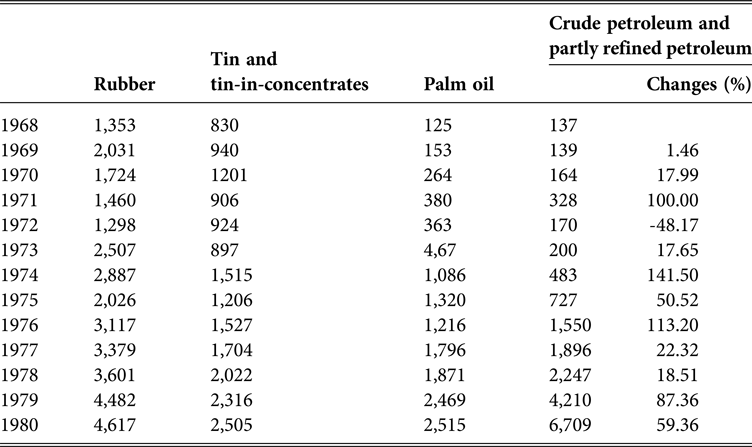
As such, the World Oil Crisis which erupted in late 1973 did not initially affect Malaysia's economy significantly. Any economic impacts due to the oil crisis were offset by the export value of petroleum produced in Sarawak and Sabah and federal revenues collected by the government, which rose rapidly. Throughout the first year of the oil crisis, the export price of Malaysian crude oil rose to US$10.80 per barrel on 2 January 1974. Soon after the price further increased to US$12.60 per barrel on 4 July 1974.Footnote 27 In 1974, the export value of crude and partly refined petroleum increased 141.50 per cent over 1973 (see table 1). With the expansion of oil exploration and production, it was estimated at the time that Malaysia would be able to produce 200,000 b/d by 1977 and 400,000 to 500,000 b/d by 1980.Footnote 28
Exports of major commodities, 1968–80 (RM million)

Sources: Ministry of Finance, Economic reports, 1974/75, 1975/76, 1976/77, 1977/78, 1978/79, 1979/80 and 1980/81.
Then OPEC raised the price of light crude oil by 10 per cent in October 1975. This resulted in Malaysia's export volume of crude and partly refined petroleum in 1976 increasing by an estimated 77 per cent, while the value of oil exports was estimated to have increased by 113.2 per cent over the previous year.Footnote 29 In 1976, the production of LCO increased 63 per cent to 160,000 b/d compared to the production level in 1975. This entire oil production came from Sarawak and Sabah, which each produced 73 per cent and 27 per cent, respectively, for a combined 58.4 million barrels per year. Nearly 20 per cent of the local production was consumed domestically while the remaining 80 per cent of production was exported.Footnote 30
On 1 January 1977, Saudi Arabia and United Arab Emirates raised oil prices 5 per cent and 10 per cent, respectively, along with the other OPEC members. As a result, the price of Malaysian LCO increased 6.6 per cent from US$12.66 per barrel in December 1976 to US$13.50 per barrel in January 1977. The price of LCO further increased to US$14.21 per barrel in July 1977. The higher prices resulted in a higher export value for Malaysian crude and partly refined oil, which increased 22.3 per cent in 1976, reaching RM1,896 million.Footnote 31 In mid-1977, nineteen oil fields of commercial value were discovered offshore of Sarawak, Sabah and Peninsular Malaysia. However, only eight oil fields were in production with six fields belonging to Sarawak Shell, namely West Lutong, Baram, Baronia, Tukau, Bakau, and Fairly Baram, while the other two fields belonged to Sabah Shell's Samarang and Sabah Exxon's Tembugo. The eight oil fields produced 191,854 barrels of oil per day in June 1977, a 29 per cent increase over 1976.Footnote 32 The exploration of oil went well and looked promising as the oil discovery ratio was higher than other parts of the world. For example, in the United States only two of ten drillings yielded oil while Malaysia obtained oil in one out of four drillings.Footnote 33
On 11 April 1978, oil fields off the east coast of Peninsular Malaysia started producing a new type of high-quality crude oil known as Tapis Blend. Tapis Blend was highly preferred by Japan and the United States, countries with stringent domestic environmental protection laws. With regard to international oil prices, OPEC agreed in June 1978 to freeze oil prices on the grounds that a price hike would jeopardise the growth of industrialised economies. Nevertheless, with the Tapis Blend, Malaysia's oil production and export earnings from crude and partly refined petroleum continued in 1978 to rise by about 24 per cent and 3 per cent, respectively from 1977.Footnote 34 There were 10 oil fields in production in June 1978 with the inclusion of Tapis and Pulai off the east coast of Peninsular Malaysia while the total number of oil wells in the country increased from 126 wells in June 1977 to 166 wells in June 1978.Footnote 35
In 1979, once again the world experienced great turbulence in world oil prices due to a major price hike by OPEC and Iran's Revolution. Nonetheless, the crisis benefited Malaysia again. On the one hand, OPEC decided to increase oil prices from US$12.70 per barrel in December 1978 to US$18.00 per barrel in June 1979, which was a substantial 41.7 per cent increase. On the other hand, the outbreak of the Iranian Revolution resulted in an oil export embargo imposed by Western powers on Iran and the cessation of its crude oil production in February 1979. The resulting enormous oil shortage was immediately filled by OPEC and non-OPEC oil producing countries, including Malaysia.Footnote 36 Given both encouraging factors, Malaysia's oil production and export earnings increased to 247,000 b/d and RM4,210 million, respectively.Footnote 37 The number of oil fields and wells increased from 10 to 13 oil fields and 166 to 239 wells, respectively, from June 1978 to June 1979.Footnote 38
In 1980, world demand for oil started declining after the United States and other industrialised countries underwent economic recessions. Although world demand was weakened, exports of Malaysian LCO were not affected because the stringent pollution laws in Japan and the United States resulted in an increasing preference for light crude oil, especially from Malaysia. The export value of Malaysian light crude reached RM6,709 million in 1980, up 59.4 per cent from 1979, thus making oil the largest export earner, overtaking rubber for the first time in history (see table 1).Footnote 39
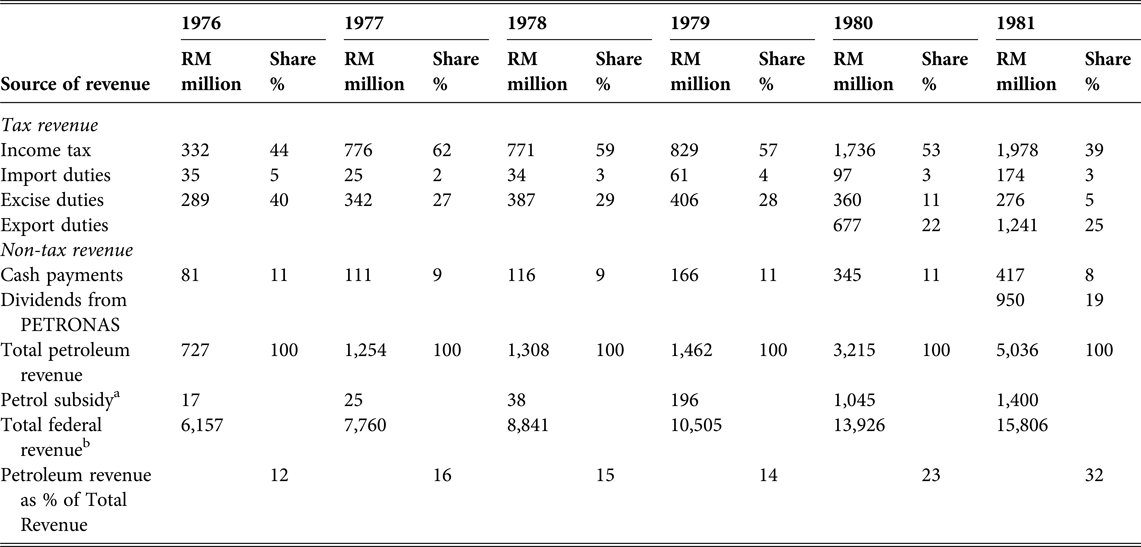
In addition to the above, the royalties, dividends, cash payments, taxes, export/import duties, and excise duties collected from petroleum contributed greatly to Malaysia's federal revenues. Before 1976, the export duties collected from the export of commodities such as rubber and tin were the main federal revenues. As a result of the World Oil Crisis and the expansion of oil production, petroleum revenues and related revenues became the largest source of federal income from 1977 onwards. Meanwhile, petroleum revenues as a portion of federal revenue grew from 12 per cent in 1976 to 32 per cent in 1981 (see table 2). It is noteworthy that in 1980, petroleum revenues overtook company income taxes, which accounted for 18 per cent of total federal revenue, becoming the single largest source of federal income. Since 1980, petroleum has become the strategic resource for Malaysia's economic growth.
Contribution of petroleum to federal revenue, 1976–84

Sources: PETRONAS, ‘A decade of growth 1974–1984: Supplement’, Nada PETRONAS (Kuala Lumpur: PETRONAS, 1984), p. 41; adata reproduced from parliamentary replies; bdata reproduced from Ministry of Finance, Economic Reports, 1976/77, 1977/78, 1978/79, 1979/80, 1980/81 and 1981/82.
Domestic oil price hike and oil subsidies
Although Malaysia benefited from the World Oil Crisis, the drastic oil price hikes from 1973 to 1980 led to inflationary problems in the domestic economy. At the beginning of the oil crisis, Malaysia hardly felt any inflationary effects. Malaysia was the last Asian country to raise its domestic oil price in May 1974. Prime Minister Razak said petrol and motor oil accounted for only 2 per cent of people's average expenditure. Additionally, the Consumer Price Index for the transportation and communication sectors recorded only a 3.4 per cent increase in May 1974 even though the petrol price hike had taken effect a few months earlier.Footnote 40 Nonetheless, livelihoods were negatively affected from May 1974 onwards as shortages of diesel began spreading all over the country. In July 1974, there was a serious shortage of diesel and kerosene. In the same month, the minister of primary industry, Abdul Taib Mahmud, informed Parliament that the federal government was unable to subsidise or provide a tax remission of more than RM50 million to RM60 million because the revenues gained from oil exports was insufficient to mitigate the soaring oil and essential goods prices.Footnote 41
OPEC announced another round of price hikes in late 1975, which forced Malaysia to establish a special committee to study its implications and to formulate relevant counter measures.Footnote 42 The World Oil Crisis was so far-reaching that the National Electric Board (LLN) launched a ‘Save Electricity’ campaign as the operating costs of power generation had skyrocketed 415 per cent from 1974 to June 1976.Footnote 43 The international oil price hike in January 1977 triggered five oil companies to pressure the federal government to further increase domestic oil prices. Moreover, the national carrier Malaysia Airlines (MAS), increased its international airfares by 40 per cent in 1974, its domestic airfares by 10 per cent in May 1974, and by 15 per cent in July 1976 due to the increase in fuel costs.Footnote 44
From 1978 to 1980, the world oil market was rocked by OPEC's tremendous oil price hikes and the Iranian Revolution, resulting in an oil embargo on Iran. In 1979, Malaysian domestic consumption was 125,000 b/d but only 40,000 barrels or 32 per cent of this was supplied by local oil refineries. Initially, the government refused to offset the impact of the crisis by increasing the use of locally produced petroleum for domestic consumption. The government then conceded to announce that locally produced petroleum would be channelled to the domestic market should any ‘acute’ shortages of oil occur.Footnote 45 By mid-1979, the global oil market encountered a 2 million barrel shortage and the price of oil rose to US$25–28 per barrel.Footnote 46 Furthermore, people felt the hardship of the oil price hike in that the Consumer Price Index in 1978 and 1979 recorded a 4.9 per cent and 5 per cent increase, respectively, which were higher than the inflation rate recorded in May 1974.Footnote 47 The nationwide oil shortage caused an opposition member of parliament to table an adjournment motion to hold the government accountable for failing to tackle the oil price hike for the first time. However, the motion was rejected by the speaker of the House of Representatives.Footnote 48
In order to prevent high domestic oil prices from hurting the national economy, the federal government started subsidising domestic petrol prices to stabilise the domestic oil market in 1976. For the first three years, the government subsidised diesel and kerosene with RM17 million, RM25 million and RM38 million in 1976, 1977, and 1978, respectively.Footnote 49 In 1979, as the oil prices increased tremendously, the petrol subsidy cost the government RM184 million. Additionally, the federal revenue was also reduced due to the loss of taxes and the excise duty of RM12 million from the tax reduction measures.Footnote 50 The subsidies were also expanded to cover agricultural products and more tax reductions. As a result, the subsidies skyrocketed to RM1.045 billion and RM1.4 billion, respectively, in 1980 and 1981.Footnote 51 These price easing measures would not have worked without the influx of lucrative revenues gained from exporting local petroleum to industrialised countries.
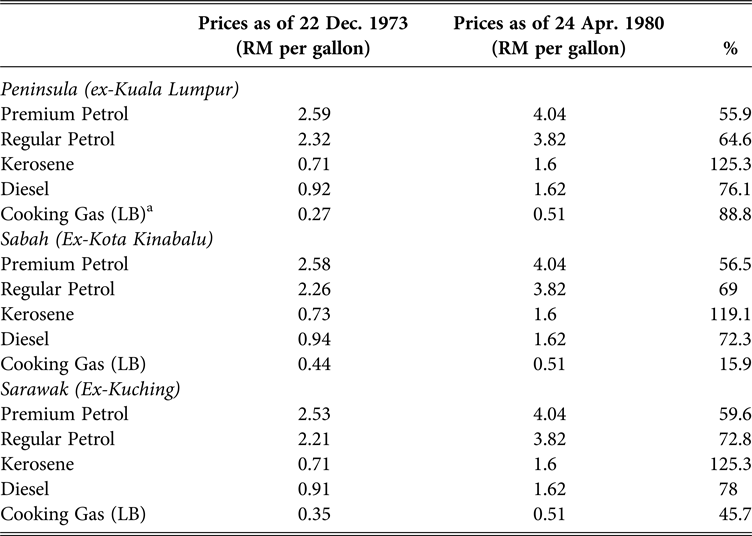
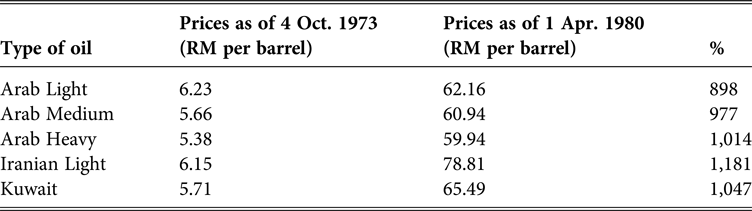
Overall, prices of petrol, kerosene, and diesel rose between 55.9 per cent to 72.8 per cent, 119.1 per cent to 125.3 per cent, and 72.3 per cent to 78 per cent from 1973 to 1980, respectively, in Peninsular Malaysia, Sabah, and Sarawak (see table 3). In comparison, the domestic oil prices rose less drastically against international oil prices, which had skyrocketed between 898 per cent to 1,047 per cent in the same period (see table 4), mainly due to substantial oil subsidies and the remission of taxes. The key to the success of the subsidy policy was the revenue resulting from increased oil exploration.
Petrol prices as of 1973 and 1980

Source: POM, ‘Parliamentary debates of House of Representatives, Fifth Parliament, second session’, 2, 16, 10 June 1980, p. 2174; aLB=RM per pound.
International petrol prices as of 1973 and 1980

Source: House of Representatives’ parliamentary debates, 16 June 1980, p. 2637.
The increasing petroleum revenue not only helped to offset the impact of the World Oil Crisis, but also mitigated the negative impacts that stemmed from the implementation of the controversial New Economic Policy (NEP). In the early 1970s, Malaysia underwent a paradigm shift of economic planning after the May 1969 racial riots. Prime Minister Razak announced the implementation of the NEP, which substituted laissez-faire economic policies with an affirmative action policy and the redistribution of wealth to bumiputera (sons of the soil) through the Second Malaysian Plan, which was then carried forward into subsequent Malaysia Plans.Footnote 52 The NEP was implemented through the enactment of the Industrial Coordination Act (ICA) 1975 that required a certain percentage of shares of companies to be allocated to shareholders considered bumiputera. The Third Malaysian Plan aimed to spend RM18.5 billion, up from RM9.82 billion in the Second Malaysian Plan, but it encountered serious challenges. In its initial plan, the government was supposed to raise the funds by borrowing roughly two-thirds of the amount from the Employees Provident Fund and revenues collected from exports of commodities, with the remaining one-third from foreign sources.Footnote 53
However, implementing the NEP disrupted the confidence of foreign investors. For example, in the first six months of 1976, the loss of confidence amongst foreign investors was so serious that the net foreign corporate investment inflow declined by 40 per cent in 1975. However, the weak foreign investment was compensated for by higher export values of commodities particularly with the export value of timber that rose 110 per cent while petroleum increased 105 per cent in 1975.Footnote 54 The finance minister Tengku Razaleigh admitted in his 1978 budgetary speech that ‘good revenue (collected from the exports of commodities) growth over the past two years greatly helped to finance this strong role of the public sector without resorting to heavy borrowing’.Footnote 55 In the Third Malaysian Plan Review Report, the government acknowledged that oil income had saved the economy, offsetting the sharp 38 per cent decline of private sector self-financing, which was originally estimated to be RM16.5 billion.Footnote 56
Oil exploration policies
Prior to the enactment of the Petroleum Development Act 1974, Malaysia's oil industry was regulated by separate federal and state laws. There was no national oil policy to guide the development of the oil industry in order to serve the national economic agenda. Malaysia started its oil industry regulation by tabling the Continental Shelf Bill and the Petroleum Mining Bill concurrently in 1966 to provide a legal framework for the regulation of exploration and exploitation of the continental shelf adjacent to Malaysia's states. During a parliamentary debate, the minister of lands and mines Abdul-Rahman Ya'kub admitted that, ‘the Continental Shelf Bill is essentially an enabling legislation providing for the sovereign rights and powers to deal with the mineral and other natural resources in the sea-bed and subsoil of the shelf’, but the bill did not specify the limits of the shelf.Footnote 57 While debating the Petroleum Mining Bill, the minister explained that the bill was ‘to make provisions relating to the issue of licences for the exploration and exploitation of petroleum not only in the sea-bed and subsoil of the Continental Shelf but also within the onshore areas beneath the territorial waters of the various States of Malaya’.Footnote 58
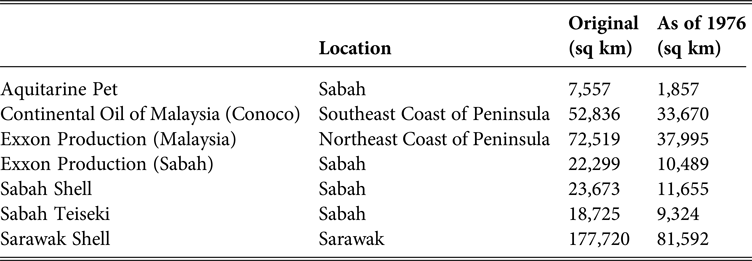
Subsequently, a concessionary system was established under the Petroleum Mining Act 1966 and the Petroleum Mining Rules 1968, so that concessions to foreign oil companies made these companies the sole authority responsible for the exploration, exploitation and marketing of oil. In return for this concession, Malaysia received payments made by foreign oil companies in the form of royalties.Footnote 59 Indeed, the continental shelf is perceived as a lifeline region for Malaysia where almost all oil and gas resources as well as exploitations are located beneath the continental shelf. Malaysia divided its offshore areas beyond territorial waters into concessionary areas pursuant to the Continental Shelf Act and leased these areas to oil companies for oil exploration and exploitation. By 1976, Sarawak Shell occupied the largest concession area at 81,592 sq km (see table 5).Footnote 60 In explaining Malaysia's exploration of oil beyond territorial waters, then deputy law minister Rais Yatim told Parliament that the few states who had oil wells beyond 32.2 km (20 miles) from the shore were operating based on calculation of early agreements of related states and given interpretation of law on international and territorial waters.Footnote 61 This may explain why the concession area boundary changed a few times during the 1970s as agreements and interpretation of laws varied over time. In addition, it may imply that the formulation of outer limits of concession areas was tied with the interpretation of laws on international and territorial waters and became the basis of drawing the outer limits of continental shelf. The concessionary system served Malaysia's interests at this point of time, but it became inappropriate after the boom of the oil industry, which I will discuss later.
Malaysia's offshore concession areas

Source: ‘Malaysian oil: Snags remain’, FEER, 24 Dec. 1976, p. 90.
Aside from the successful oil discoveries, natural gas was also first discovered off the shores of Sarawak in 1971, particularly in Central Luconia province, 120 km off the coast of Bintulu, Sarawak. Sarawak Shell had tested the field and found that the proven reserves were in quantities that would justify plans for a sizeable liquefied natural gas (LNG) plant.Footnote 62 The Central Luconia province gas field was estimated to be able to produce a total of 6.2 trillion cubic feet (cu ft) of gas. PETRONAS, Sarawak Shell, and Mitsubishi struck a deal on 31 March 1978 to invest US$1 billion to build an LNG plant in Bintulu to process 1 billion cu ft of gas per day or 6 million tonnes of LNG per year, equivalent to 140,000 barrels of crude oil per day.Footnote 63
In terms of domestic petroleum policy, the industrial manufacturing of petroleum and cold products was identified as one of sixteen pioneer industries in June 1968.Footnote 64 This particular pioneer industry was capable of producing international quality products at reasonable prices to cater to domestic demand.Footnote 65 From 1968 to 1973, Malaysia was a net crude petroleum importing state. In order to reduce its reliance on foreign oil, Malaysia provided incentives to encourage foreign investment to explore oil onshore and offshore. Sarawak Shell and Esso were among eight foreign oil companies who accepted the incentives.Footnote 66 From 1973 onwards, Malaysia became a net crude petroleum exporting country. Due to the fact that locally produced crude petroleum contained lower sulphur content that needed fewer refinery processes and could fetch higher prices compared to Arab light crude, the government adopted a policy of exporting local crude petroleum while importing Arab crude petroleum refined in Singapore for local consumption.Footnote 67 Furthermore, Arab crude petroleum could generate by-products such as bitumen, fuel oils, and gas oil, which constituted a major part of the domestic consumption of oil. By 1975, nearly 80 per cent of locally produced oil was exported.Footnote 68
With the lucrative results from the oil and gas exploration, the government identified oil and gas commodities as a catalyst for the national economy. Then minister of primary industry Abdul Taib bin Mahmud told Parliament that oil and gas commodities were lucrative resources that could help the government to earn foreign exchange and served as important means to enable the success of the NEP, especially in redistributing the wealth of society.Footnote 69 With the rapid growth of oil exploration, the concessionary system was no longer able to guarantee the rights and profits received by the federal government. The Ministry of Primary Industry reviewed the concessionary system and mooted an idea of forming a national oil company—Hidrokarbon Malaysia (HIKMA)—within two years from 1972 to provide a new type of industry regulation, subject to the NEP. The Ministry decided to learn from the lessons of Indonesia's oil monopoly authority—Pertamina. Malaysia started sending officers to Pertamina, who agreed to assist Malaysia's senior officers to formulate policies related to the economy and laws to address oil exploitation issues.Footnote 70 A Petroleum Division was set up by the ministry in 1972 to assist the government to address related issues by using the ‘integrated approach’.Footnote 71 Subsequently, a Petroleum Development Bill was tabled in July 1974 in Parliament, but the oil authority was renamed as Petroliam Nasional Berhad (PETRONAS) after objections from Sarawak's chief minister to the original name.Footnote 72 The enactment of the Petroleum Development Act empowers PETRONAS to become the sole authority to develop, regulate, and control all aspects of the oil and gas industry. In addition, the concessionary system was replaced by the production sharing system, which enabled the government to fully control the management of exploration and exploitation of petroleum and to enjoy greater petroleum profits.Footnote 73
By July 1976, PETRONAS had signed agreements with all state governments and the federal government to take over ownership of, and the exclusive rights, powers, liberties, and privileges of exploring, exploiting, winning, and obtaining petroleum whether onshore or offshore of Malaysia.Footnote 74 Between November and December 1976, PETRONAS reached production-sharing agreements with Sarawak Shell, Sabah Shell Petroleum, Pecten Malaysia, and Exxon Production Malaysia.Footnote 75 At the time, Malaysia's proven reserves of oil were estimated at around 1 billion barrels and would be exhausted in 13 years at the rate of production of 200,000 b/d.
Driven by the need to best exploit the existing oil reserves, the government formulated the first ever National Petroleum Policy in 1975. The policy was designed to:
(I) protect the national interest, (2) acquire sufficient control to enable the country to derive maximum benefit from its oil industry, (3) ensure adequate domestic supply of petroleum and petroleum products, (4) establish industries related to petroleum and petrochemicals and (5) ensure active participation of PETRONAS.Footnote 76
The conclusion of production-sharing agreements with foreign oil companies and the formulation of a Master Plan were the measures taken by the government, amongst others, to fulfil the objectives of the policy. The Master Plan was prepared by the Japanese consulting firm C. Itoh, which advised PETRONAS on what should be carried out in the short and long term as well as how to formulate proper policy and strategy to ensure the supply and production of oil and petrochemicals to meet national demand.Footnote 77 The core suggestions of the Master Plan were to streamline PETRONAS’ upstream operations to increase the efficiency of oil and gas exploitation as well as that PETRONAS use more gas reserves and develop oil refineries, and fertiliser and petrochemical plants in the downstream section. In particular, PETRONAS was advised to limit its oil production and to control the gas/oil ratio to conserve more natural energy.Footnote 78 The Master Plan's suggestions were translated into policies such as a National Depletion Policy, formulated to control the petroleum production level in accordance with ‘the overriding objective of safeguarding national interests’.Footnote 79
Legislation and national defence build-up
Malaysia saw international laws as legal justification for advancing its maritime claims. It signed the Geneva Convention on the Territorial Sea and the Contiguous Zone in December 1960 soon after Independence in 1957,Footnote 80 and actively participated in the United Nations-led negotiations on the Convention, particularly on laws that would guarantee Malaysia rights to exploit maritime resources. Apart from that, Malaysia focused on improving its domestic legal framework to legitimise its claims, such as enacting the Continental Shelf Act 1966, Emergency (Essential Powers) Ordinance, no. 7, in 1969, and the Petroleum Development Act in 1974. Realising that exploiting seabed resources was crucial to offsetting the negative impacts of the oil crisis and fund the NEP agenda, Malaysia took more concrete steps to consolidate its legal rights for resource exploration on the continental shelf. Nonetheless, Malaysia's position was to adhere to international norms and laws rather than act independently. For instance, in August 1972, Razak turned down a nationalistic motion tabled by UMNO's Mersing Division to rename the South China Sea as the Southeast Asia Sea on the grounds that the former was a well-known name and therefore renaming it was unnecessary.Footnote 81 Besides, the minister of law and attorney general Abdul Kadir bin Yusof revealed that Malaysia had always been supportive of claims and aspirations of other developing countries with regards to the negotiations of rights and interests in the seas and sea resources at the UNCLOS III proceedings. Malaysia's aims during the negotiations were to protect its sovereignty over its waters, which comprised the Straits of Malacca and the South China Sea between Peninsular Malaysia and East Malaysia.Footnote 82
All along, Malaysia tended to act after other countries had already done so rather than preemptively. On 8 September 1976, the Cabinet instructed the National Mapping Director to prepare a new Malaysia map after considering the fact that the People's Republic of China and the Philippines had published maps that indicated their new maritime borders and sovereign claims.Footnote 83 Subsequently, on 30 March 1977, the Cabinet decided to lay claim on Malaysia's border areas, islands, and so on, which would be shown on the New Map.Footnote 84 Thus, in July 1977, Malaysia extended its sea zone from 19.2 km to 320 km.Footnote 85 While preparing the New Map, Malaysia actively participated in the UNCLOS proceedings to preserve its rights over waters, continental shelf, EEZ, and delimitation of sea boundaries. In June 1979, Malaysia acknowledged the EEZ and was ready to carry out enforcement measures against foreign fishing ships that encroached into this zone.Footnote 86 On 21 December 1979, the New Map Showing Territorial Waters and Continental Shelf of Malaysia (New Map) was gazetted. The New Map indicated that the continental shelf of Malaysia was expanded to cover the sea-bed and subsoil of submarine areas adjacent to the coast of Sarawak and Sabah at a depth greater than 200 metres below the surface of the sea. Furthermore, the New Map also included disputed islands such as Batu Putih, Sipadan, and Amboyna Cay, and reefs such as the Layang-Layang/Swallow Reefs.Footnote 87 To complement the international legality of the New Map, Malaysia's government gazetted the proclamation of an EEZ in April 1980. Both the New Map and EEZ empowered Malaysia to proclaim a continental shelf of 373,500 sq km and an EEZ of 475,600 sq km against a land area of 332,800 sq km.Footnote 88
Unlike the EEZ, the New Map generated diplomatic protests from neighbouring countries including Thailand, Singapore, Indonesia, the Philippines, Vietnam, and China.Footnote 89 In defending the publication of the New Map, the deputy foreign minister Mokhtar Haji Hashim told Parliament that the publication should have been carried out much earlier given that many neighbouring countries had already published their continental shelf maps. His statement resonated with the Cabinet's position as mentioned above. Hashim then pledged to settle the overlapping claims peacefully through diplomatic negotiations with Malaysia's neighbours.Footnote 90
The deputy foreign minister hinted at the time that inter-state competition may have contributed to the expansion of Malaysia's maritime jurisdiction. However, when one looks at the timeline, we see that China and the Philippines officially made their territorial sea and continental shelf claims over the South China Sea in 1958 and 1968, respectively, while Malaysia decided to draw the New Map in September 1976 and to announce its new claims in March 1977. If inter-state competition was the primary motivation, it should not have taken Malaysia so long to make such a move. In contrast, the expansion of concession boundaries peaked at the height of the oil crisis. In addition, when comparing the outer limits of concession areas of the east coast of Peninsula and Sarawak, as shown in the Economic Map of 1976/77 (fig. 3), and continental shelf boundary shown in the Economic Map of 1980/81 (fig. 7), they are identical. It is safe to argue that the continental shelf boundary was based on the outer limits of concession areas which were formulated during the oil crisis.
Meanwhile, the offshore exploration and exploitation of oil was being conducted under the protection of the Malaysian Armed Forces, given that any expansion of maritime jurisdiction might have unpredictable security concerns. The Ministry of Defence made a public statement in 1976 that it had requested RM75 million to bolster its naval capacity to protect the country's maritime economic interests, including fisheries and oil exploitation.Footnote 91 Between 1976 and 1980, six Jerong class fast attack crafts were launched in 1976 and 1977 and four Swedish Spica-M fast attack crafts armed with four MM-38 anti-surface missiles entered into service in 1979.Footnote 92 In 1979, the Defence Ministry agreed to procure a few Maritime Hercules C-130 airplanes to assist the navy to monitor and safeguard the country's interests over the 370.4 km (200 nmi) economic zone which would be established in the following years.Footnote 93
In addition, the naval base in Labuan, Sabah, was upgraded in 1979 and a new naval base in Kuantan, in the east coast of Peninsular Malaysia, was completed in 1981.Footnote 94 A RM1.4 billion air base able to house 14,000 personnel was to be built in Gong Kedak, Kelantan, on the east coast of the Peninsula in early 1980, and estimated to be operational in 1983.Footnote 95 An ambitious Armed Forces Special Expansion Program (PERISTA) with a total allocation of RM7.19 billion was also implemented in late 1979. The primary aim of PERISTA was to transform the counterinsurgency-oriented Malaysian Armed Forces to become a conventional military-oriented force. Under PERISTA, between 1979 and 1981 two Sri Indera-class support ships, two Kasturi-class corvettes, and four Lerici-class mine counter ships were ordered.Footnote 96 These naval and air defence build-up efforts, coupled with the Five Power Defence Arrangement (FPDA), which focused on areas facing the South China Sea, were carried out in conjunction with the expansion of Malaysia's offshore oil and gas exploration. In June 1983, four years after the publication of the New Map, Malaysia landed troops on the disputed reefs after an FPDA joint military exercise code-named Starfish was held over adjacent waters.Footnote 97 With a combination of legal and military protection, Malaysia officially occupied those reefs, an occupation which continues till today.Footnote 98
Conclusion
The World Oil Crisis between 1973 and 1980 drove Malaysia to resort to exploring and exploiting more oil to develop its national economy as well as to mitigate the fallout. There were three major oil price hikes that occurred in December 1973, October 1975, and December 1978. The first oil crisis resulted in the export values of crude oil increasing by 141.50 per cent in 1974, the second crisis caused a 113.20 per cent surge in 1976, and the third crisis contributed to an 87.36 per cent increase in 1979. In the meantime, the revenues collected from oil increased from RM727 million to RM5,036 million, a substantial 592.7 per cent rise from 1976 to 1981. It was only with these substantial oil revenues that Malaysia could counter the effects of skyrocketing oil subsidies that stood at RM1.4 billion in 1981 and offset setbacks caused by the implementation of the NEP in the 1970s.
In terms of exploration, the oil fields and wells in production increased from 8 to 13 and from 126 to 239, respectively, between 1977 and 1979. These achievements were reactions to the oil crisis and made the oil industry a primary economic engine and an indispensable strategic asset for Malaysia. The establishment of PETRONAS in 1974, the formulation of the National Petroleum Policy in 1975 and the commissioning of the petroleum industry Master Plan were also part of the rapid expansion of the oil industry. In terms of the exploration areas, the government changed the concession areas incrementally, but they were always expanding. In addition, Malaysia also began to enhance its naval capacity to protect its interests in the oil exploration areas and maritime zone only after the number of oil exploration sites increased tremendously.
Considering all the factors discussed above, the answer to the first question of this article, ‘to what degree did the oil crisis affect Malaysia?’, is that the oil crisis played a key role in determining the course of Malaysia's oil exploitation policy. Secondly, the expansion of Malaysia's maritime jurisdiction was a reaction to the rapid development of oil exploration stimulated by the World Oil Crisis. Put simply, the oil crisis culminated in the expansion of maritime jurisdiction by the government of Malaysia. Specifically, the fact that the outer limits of the concession areas are highly identical to the continental shelf boundary suggests a causative effect in this sense. Finally, what can be inferred from the discussion above is that unlike countries such as China, Vietnam, and the Philippines, which expanded their maritime jurisdictions in the South China Sea based on historical claims or new discoveries, Malaysia's maritime expansion can be categorised as a mere reaction to the oil crisis rather than as a deliberate move. This argument is proven by what the Malaysian government did not do: it had not considered preparing a map to show its continental shelf until September 1976 and the Cabinet only decided to lay claims on the areas in dispute by March 1977, after experiencing much turbulence caused by the oil crisis. As a result, Malaysia adopted a less aggressive position on making its claims, and opted to follow other countries instead of adopting preemptive actions on the matter of publishing its new maritime map. As a small nation-state with limited national power, Malaysia's choice of manoeuvring under existing international norms served its interests well.
In summary, this article has examined and found a qualitative nexus amidst the World Oil Crisis, Malaysia's economy, oil explorations, oil policies and the expansion of the country's maritime jurisdiction. Future research can deepen the inquiry into the relationship between the variables of the regional strategic structure, Malaysia's expansion of maritime jurisdiction and the oil crisis.