On 13 November 2014, the Liaoning Daily (Liaoning ribao 辽宁日报) published an open letter to university professors of philosophy and the social sciences. The letter criticized some professors for not identifying with the Chinese Communist Party's (CCP) theories on socialism and socialist politics, and for lacking “feeling” for the party-state. It also claimed that some professors compared Mao Zedong 毛泽东 to ancient emperors, cast doubt on important policies of the party-state, and want China to follow the Western road of political development. The article caused a sensation and was nominated for an award in the 25th China News Annual Awards in 2015. Although it failed to win a prize, the article nonetheless raises the issue of the role of professors as intellectuals and how they engage with that role.Footnote 1
We know that professors have multiple academic identities, for example scholar and professional in general, or sociologist and engineer in particular, and they have academic roles in research, teaching and service. We hypothesize that in their relationship with the state they play multiple political roles as well which we categorize as: establishment/organic, non-establishment/professional, and contra-establishment/critical.Footnote 2 The term before the slash in these designations refers to physical and/or political distance from the establishment; the term after the slash refers to political position or attitude. Political roles, like academic ones, are multifaceted and synchronous, since a professor may play one or more such roles at the same time, or different roles at different times.Footnote 3 If one of these roles assumes a dominant function, it becomes a person's dominant political identity. Political identities and roles may be combined. For example, the main role of Hu Angang 胡鞍钢 (Tsinghua University) is to advise and advocate for the party-state, even though he may sometimes dissent.Footnote 4 His political identity and predominant role is therefore establishment/organic. We call this his “status role” among a plurality of roles associated with identity or status.Footnote 5 The status role of most professors in China is generally either establishment/organic or non-establishment/professional.
In the following pages, we first examine what China scholars say about the political identities and roles of intellectuals and how intellectuals take on those roles. We explain how our study may contribute to what Timothy Cheek calls “a long-standing cottage industry” of the study of China's intellectuals.Footnote 6 We then explain our methods of inquiry and show how our case study of a provincial university may provide the answer to our research question and test our hypothesis. Finally, we demonstrate professors’ multifaceted identities and roles as we find them in our research. Our conclusions should help to provide a better understanding of intellectuals’ intricate relationship with the state.
The Identities and Roles of China's Intellectuals and How They Play These Roles
It is difficult to provide a precise definition of an intellectual. Although some argue that the term should refer only to those who serve as the conscience of society by being dissident or otherwise critical,Footnote 7 a broad definition of “intellectual” traditionally used in the Chinese world includes those who have received a certain degree of education and who are doing professional/cultural work, whether as experts or as critics.Footnote 8 We adopt this definition here and examine intellectuals’ identities, their roles and how they perform these roles.
The identities of intellectuals and the roles they play
We may identify intellectuals and their roles according to the intrinsic characteristics of their intellectual activity, giving them professional identities, such as scientists, philosophers and artists, who tend to create knowledge, and engineers, doctors, lawyers, and journalists, who tend to use knowledge.Footnote 9 Professors (identity) both create and divulge knowledge, i.e. engage in research, teaching and service (academic roles). On the other hand, intellectuals can, for analytical and expository purposes, be distinguished more finely according to their social relations, as advocated by Gramsci.Footnote 10
Indeed, studying such relationships has shown that intellectuals play a number of roles. For example, Merle Goldman, in her aptly titled book China's Intellectuals: Advise and Dissent, describes how the intellectuals who worked for the government throughout 1959–1976, and in particular liberal intellectuals such as Ba Jin 巴金, Deng Tuo 邓拓, Mao Dun 茅盾, Liao Mosha 廖沫沙, Sun Yefang 孙冶芳, Wu Han 吴晗, Xia Yan 夏衍 and Zhou Peiyuan 周培源, both advised and dissented.Footnote 11 These are the eponymous “establishment intellectuals” of Carol Lee Hamrin and Timothy Cheek's edited book dealing with Yang Xianzhen 杨献珍, Deng Tuo, Sun Yefang, Wu Han, and Bai Hua 白桦.Footnote 12 The title of Cheek and Hamrin's introductory chapter, “Collaboration and conflict in the search for a new order,” illustrates the dual roles these intellectuals take on in their relationship with the party-state, the same roles Goldman identifies, and the political roles of both “conservative ideologues and reformist theorists.”Footnote 13
Goldman categorized the Cultural Revolution-era intellectuals Wang Li 王力, Guan Feng 关锋, Qi Benyu 戚本禹, Zhang Chunqiao 张春桥 and Yao Wenyuan 姚文元 as radical intellectuals.Footnote 14 However, according to Zhidong Hao's typology, these intellectuals, along with Goldman's liberal intellectuals and Hamrin and Cheek's establishment intellectuals, would be termed organic intellectuals, since they all served as advisers, administrators, spokespersons and theorists for the party-state. It is true that some of them sometimes dissented, and that establishment intellectuals also play the role of scholar, but they are predominantly classifiable as organic. In this paper, we would term them establishment/organic intellectuals, while treating separately other roles such as the critical and professional roles discussed below.Footnote 15 The term “establishment/organic” indicates their priority status role as organic to the state while acknowledging their occasional synchronic role of dissent. Intellectuals do not have to be in the establishment to be organic, although they usually are.
As noted above, to be an intellectual assumes that one is a professional or a scholar with associated roles. Since the Deng era, it has been possible for intellectuals to detach themselves from politics and focus on their professional identities and roles. Commercialization and professionalization have also reduced the incentive to be critical. This does not prevent intellectuals from dissenting and advising; however, their criticism of the government may be cloaked in abstract and opaque academic language and the advice they offer the government may be based on their technical knowledge.Footnote 16 We adopt and adapt Edward Gu and Merle Goldman's concept of non-establishment (non-official, non-governmental) intellectuals and term these intellectuals as “non-establishment/professional” intellectuals because of their distance from politics, their focus on professional and academic work, and their occasional organic and critical roles.Footnote 17 Here, the prefix “non” does not necessarily mean that they are not in the establishment, but rather that they are largely indifferent to the ideology and politics of the establishment, that is, they may be in it but are not of it.
The two intellectual roles described above are very different from those of the contra-establishment/critical intellectuals, who primarily play a critical role. Goldman and Cheek use the term “dis-established” to refer to all those who fell from the establishment.Footnote 18 We use the term “contra-establishment/critical intellectuals” to include not only the fallen heroes but also those who were never part of the establishment, or who are in the establishment but are vocally critical of it. This category includes Cultural Revolution-era intellectuals Gu Zhun 顾准 and Yu Luoke 遇罗克; Democracy Wall movement intellectuals such as Chen Ziming 陈子明, Wang Juntao 王军涛, Hu Ping 胡平, Fu Shenqi 傅申奇; reform and opening-era intellectuals Liu Binyan 刘宾雁, Wang Ruowang 王若望, Fang Lizhi 方励之; 1989 democracy movement scholars and students, as well as the intellectuals who organize the China Democracy Party and the overseas democracy movements.Footnote 19 This term would also refer to those who are viewed as social activists and NGO intellectuals, for example Xu Zhiyong 许志永 (lawyer, in prison) and Wang Gongquan 王功权 (businessman, detained but later released) from the civic organization Gongmeng 公盟, Guo Yushan 郭玉闪 (released in September 2015) from the civic organization Chuan Zhi Xing 传知行, Lu Jun 陆军 from Yi Ren Ping 益仁平 (a civic organization), activist lawyers Teng Biao 腾彪 and Pu Zhiqiang 浦志强 (sentenced to three years in prison, with a three-year reprieve),Footnote 20 journalists such as Gao Yu 高瑜 (imprisoned but now on probation), public intellectuals such as Zi Zhongjun 资中筠 (retired from the Chinese Academy of Social Science), Bao Tong 鲍彤 (the former Party secretary Zhao Ziyang's 赵紫阳 political secretary), He Weifang 贺卫方 (Peking University), Qin Hui 秦晖 (Tsinghua University), Zhang Weiying 张维迎 (Peking University), Sun Liping 孙立平 (Tsinghua University), Zhang Qianfan 张千帆 (Peking University), Zhang Ming 张鸣 (Renmin University), IlhamTohti 伊力哈木·土赫提 (Minzu University of China, imprisoned for life), Chen Danqing 陈丹青 (resigned from Tsinghua University), Zhang Xuezhong 张雪忠 (forced out from East China University of Political Science and Law), Xia Yeliang 夏业良 (fired from Peking University and living in exile in the US), Chen Hongguo 谌洪果 (resigned from Northwest University of Politics and Law), as well as those who clustered around the journal Yanhuang chunqiu 炎黄春秋 (formerly the foremost liberal magazine in China but which has now been taken over by newly appointed Party cadres).Footnote 21 These intellectuals can also be viewed as what some term as “public intellectuals” in that they serve as the conscience of society and openly air their concerns about social justice in China.Footnote 22
Contra-establishment/critics do not rule out the possibility of cooperating with the establishment. In the words of Chen Ziming, they would “contend but not clash, and cooperate but remain independent of each other” in their relationship with the government.Footnote 23 For example, there are occasions when dissident Ai Weiwei 艾未未 works closely with the state,Footnote 24 and Hu Shuli 胡舒立, the most influential journalist in China, conducts investigative reports while cooperating with the government in its anti-corruption campaign.Footnote 25 We call these intellectuals contra-establishment/critical intellectuals to indicate their critical stance towards the state; however, this does not preclude them from sometimes playing multiple and synchronic roles and cooperating with the state.
When William Callahan describes both Ai Weiwei on the one hand and Hu Angang, Pan Wei 潘维 and Zhang Weiwei 张维为 on the other as “citizen intellectuals,” he is mixing two very different status roles or political identities.Footnote 26 Ai Weiwei's political identity is contra-establishment/critical, and one of his major roles is as a critic and dissident, although he may occasionally cooperate with the government. Hu, Pan and Zhang's political identity is establishment/organic. They may sometimes dissent, but because dissent is not their major role, their political identity is very different.Footnote 27 Eddy U has forcefully argued against the reification of intellectuals in China into progressive/revolutionary and bourgeois/reactionary intellectuals.Footnote 28 In the same vein, the multifaceted identities and roles of intellectuals under discussion in this paper are building blocks rather than straitjackets.Footnote 29
Callahan's classification does raise another interesting question: how do these different “citizen intellectuals” engage with their multifaceted and often ambiguous critical roles, or demonstrate “creative dissent”? Are they simply living in truth, rejecting lies, and engaging in small-scale work in order to build parallel cultures, as advocated by Havel?Footnote 30 In fact, they may all play a critical role which might qualify them as “citizen intellectuals.” The question is only one of degree, as indicated by our categories.Footnote 31
How intellectuals play their roles
When discussing the political role of intellectuals, scholars invariably mention the political and ideological conditions under which intellectuals operate. Since Xi Jinping 习近平 assumed power in 2012, the “seven no's” have been implemented in universities as well as in the media, banning discussion of civil society, civil rights, universal values, legal independence, press freedom, the privileged capitalistic class, and the historical wrongdoings of the Party.Footnote 32 A 24-hour system to monitor public opinion on the internet has been established over the past few years, helping the government take early measures to control and reduce the effects of negative speech.Footnote 33 There is little manoeuvre room for contra-establishment/critics. Non-establishment/professionals have a hard time maintaining a professional stance in their research and teaching. Establishment/organic intellectuals dominate the official discourse but their critical role is even more limited. For example, as an advocate of Party policies, Li Shenming 李慎明, the former vice-president of the Chinese Academy of Social Sciences, argues that Western-style democracy is not universal, and he is against criticizing the past wrongs of the Party and Mao Zedong.Footnote 34 Yang Xiaoqing 杨晓青, a professor from Renmin University, argues that China must practise socialist democracy and not bourgeois constitutionalism.Footnote 35 Hu Angang maintains that “people's society” (renmin shehui 人民社会) is better than “civil society” (gongmin shehui 公民社会) and proclaims the great advantages of the Chinese CCP collective leadership as opposed to the American division of power.Footnote 36 In Max Weber's words, they sing the tune of those whose bread they eat.Footnote 37
Can intellectuals still play a critical role under the circumstances? Yes, to some extent. Here, Erika Evasdottir's concept of “obedient autonomy” may help.Footnote 38 Logically, if obedience is involved, there is no autonomy. An individual is “always immersed in a web of social rules, hierarchies, structures, stereotypes, and norms” which he or she has to obey.Footnote 39 Nonetheless, increased social restrictions come along with “practical opportunities to combine and reinterpret such restrictions,” providing a certain degree of fluidity, individuality and change, even if the systems and hierarchies may appear fixed and unchanging. Thus, obedient autonomy is “a self-directed control over change that takes effect only through the concerted effort to achieve and maintain a discourse of order and immutability.”Footnote 40 The individual effects change by participation in the system, and not in its destruction.Footnote 41
That is also the strategy of the intellectuals we study. Mass media, and especially the internet, has provided opportunities for intellectual/cultural contention and (transnational) online activism.Footnote 42 It is true that many controls have been in place for some years and that the government has intensified its crackdown on the mass media under the Xi regime.Footnote 43 The Southern Media Group (Nanfang baoye chuanmei jituan 南方报业传媒集团), one of the few liberal news groups in China in the 1990s and 2000s, has been finally brought into the orbit of the party-state's propaganda machine.Footnote 44 Internet control measures have been reinforced.Footnote 45 Yu Jianrong 于建嵘 posted online how the Party secretary in his work unit at the Chinese Academy of Social Sciences repeatedly called him in to warn him about his online and offline social activism.Footnote 46
However, activists still find a way to make their voices heard. Contra-establishment/critical intellectuals can still serve within the party-state yet act as critics. Focus Interviews, an investigative reporting programme broadcast by Central Television, is still able to continue with some of its critical reports. While these intellectuals function as mouth pieces of the party-state, in their own way they also perform the role of social critic.Footnote 47 The Southern Media Group's newspapers still try to assume a watchdog role, even though they are on tighter Party leashes (an apt metaphor used by Yuezhi ZhaoFootnote 48 ).
The Unirule Institute of Economics (Tianze 天则), an independent think tank whose intellectuals can be characterized as non-establishment/professionals, complained about its invited guest speakers being blocked by higher authorities, and was able to make its complaints online, albeit via the Financial Times Chinese website.Footnote 49 Zhang Yimou 张艺谋, Chen Kaige 陈凯歌 and Jia Zhangke 贾樟柯 make films that can serve the party-state by promoting nationalism, but they also advance their own interpretation of social justice in China.Footnote 50 Or, they can couch their intellectual thought, as Xu Jilin 许纪霖 does, in abstract academic language and pragmatic terms, veiling criticism of the party-state in professional and technical forms.Footnote 51
One of the founders of Yanhuang chunqiu, where contra-establishment/critics clustered, was able to complain about the Party's censorship of the journal through a Hong Kong publication.Footnote 52 Despite great pressure from the state (Yang Jisheng 杨继绳, the previous editor-in-chief, was forced to retire), the journal continued to be published from 1991 onwards as a liberal platform until it was taken over by the Party conservatives under government orders in 2016. The risks are high for contra-establishment/critics: they face having their works banned, losing their jobs, even imprisonment, but they carry on. He Weifang, Yu Jianrong, Zhang Qianfan and Zhang Ming continue to be active bloggers with hundreds of thousands of followers, and their articles could and can be seen on such websites as Gongshi wang 共识网 (closed by the government in 2016) and Ai sixiang wang 爱思想网.Footnote 53 The internet and globalization have accorded intellectuals opportunities to fulfil their organic, professional and critical roles by practising “obedient autonomy.”Footnote 54
Yan Xiaojun has studied the control and domination of university students.Footnote 55 As we will see in our case analysis below, similar methods have been used with university teachers, but the resultant order is not maintained “seamlessly.” Intellectuals are able to play the synchronic roles of non-establishment/professional and contra-establishment/critic in addition to the establishment/organic intellectual in their teaching and research.
A Note on Our Research Methods
Our case university has a history of more than a hundred years and is situated in a province in the central part of China. It has over 2,000 full-time faculty members and 28,000 undergraduate and graduate students. It is typical of provincial public universities. This case study does not aim for representation; it aims for understanding the operating mechanisms and processes that may have widespread applications. However, because party-state control of higher education in China creates homogeneity in Chinese universities, the mechanisms and processes of how professors play their establishment/organic, non-establishment/professional, and contra-establishment/critical roles can be viewed as typical of professors in mainland China.Footnote 56
In our case study, we interviewed five professors, 13 associate professors, five assistant professors (called lecturers), three administrators, and 10 students; altogether, 36 people from the departments of natural sciences, humanities and social sciences. Faculty interviews lasted between one and two hours; student interviews lasted about half an hour. The questions we asked focused on their academic roles of teaching, research and service, and the way they dealt with political issues associated with those roles.
Two more methodological issues related to case studies are worth explaining here. One is the matter of ideal types, and the other is the nature of case studies. When Weber discusses traditional, charismatic and legal authorities, he is using ideal types,Footnote 57 abstractions of reality and a “combination of an indefinite number of elements which, although found in reality, are rarely or never discovered in this specific form.”Footnote 58 Our analysis of establishment/organic, non-establishment/professional and contra-establishment/critical intellectuals assumes that intellectuals have multifaceted identities and roles. Even when one may play a distinct dominant status role, like Hu Angang as an establishment/organic intellectual, he or she rarely or never plays it in its pure form. This is what multifacetedness and synchronicity mean. The utility of the construct is to “facilitate the analysis of empirical questions,” which in our case would concern the political roles of professors as intellectuals.Footnote 59
On the other hand, case analysis helps us to understand the mechanisms and processes of role playing among professors. It is in line with the extended case method, “by which researchers analyze a particular social situation [in our case, the role of professors] in relation to the broader social forces shaping it,” and also with the principle of sequential interviewing where each case, or each interviewee, “provides an increasingly accurate understanding of the question at hand.”Footnote 60 The purpose is saturation, where through semi-structured interviews concerning the roles professors play in teaching, research and service, we obtain the information needed to describe the political role of professors as intellectuals.
Findings and Discussion
Professors as establishment/organic intellectuals
In our case study, we found that most professors clearly play the role of establishment/organic intellectuals to the party-state. In speeches and declarations, the university leadership has repeatedly pointed out that a key function of the university is to train students to be firm believers in and successors to socialism. It is proud of the “strategic cooperation” it has established with local and state-owned enterprises to promote the socialist economy and of its think-tank role in promoting social development.Footnote 61 Indeed, that determines the establishment/organic role professors play both consciously and under coercion. As one professor commented, “We live in a real society, which is ruled by the CCP. They have an ideology backed up by political power and a political structure. This is the foundation of the [socialist] identity. If we sabotage this identity, there may be more serious social problems. As university professors, we should respect this reality.”Footnote 62 According to this professor, education itself is political in nature, and one of its roles is to foster the party-state ideology in order to promote order and stability and to avoid social problems. It is therefore appropriate to ask professors to spread what he defines above as “positive energy” (zheng nengliang 正能量).
If this professor seems to be consciously doing what the party-state expects him to do, others seem to follow the Party directives only because they feel there is no alternative. The common rule professors follow is that “there is no restriction in academic studies but there is discipline in the classroom” (xueshu wu jinqu, ketang you jilu 学术无禁区, 课堂有纪律). Anything that is “anti-Party and anti-state” is not allowed in the classroom. As one interviewee put it:
There is, of course, no academic freedom. We in political science can't write and speak freely. This I understand. We can't be totally free. We must be the spokespersons (chui gu shou 吹鼓手) of the dominant ideology … It's better if we don't touch on sensitive issues in class or in writing. For example, it's better not to discuss or write about civil society. [If you did that,] you might go out of bounds. You cannot publish it anyway.Footnote 63
But some still try to do as much as possible: “I really dare not say [anything that's controversial]. I may touch on it a little bit, and that's as much as I can do. I can't afford to do more (zhende shang bu qi 真的伤不起).”Footnote 64
If there is no way to go around some topics, professors tell students that class discussion on controversial topics must not be spread outside the class.Footnote 65 Our student interviewees told us that professors avoid discussing sensitive topics.Footnote 66 These professors have some autonomy, although based on general obedience, and they practise careful self-censorship. Some may test the boundaries, but the establishment/organic ones do not go as far as the non-establishment/professional and contra-establishment/critical intellectuals, whom we will discuss below.
If teaching is restricted to what is allowed for the establishment/organic roles, research is usually restricted to approved government topics, which are decided by existing state and provincial grant structures. We examined the grant topics for the year 2014 that were sponsored by the state (192 topics), by the Ministry of Education (52 topics), and by the provincial Party and government (183 topics).Footnote 67 They concentrate on the study of the Sinicization of Marxism – that is, socialism with Chinese characteristics, the China dream, the study of Xi Jinping's talks (especially in provincial grant topics); historical, cultural, and environmental studies; and various political, social and economic policy studies. Research universities in particular are considered to be think tanks for the state and local governments and serve the strategic purposes of the state.Footnote 68
None of the 2014 grant topics dealt with matters such as civil society, controversial issues in CCP history, contemporary ethnic relations in Tibet and Xinjiang, or constitutionalism. There are topics on political reform, but they do not deviate from the Party line. For example, one can study consultative democracy, but not electoral democracy; administrative reform, but not political reform; how to train minority professionals, but not contemporary ethnic conflicts. The list of permitted topics guides researchers in their establishment/organic roles for the party-state. As some professors commented:
Our country does not promote a critical spirit. All they want you to do is to work for the government. If you don't work for the government, your research won't be recognized. This is how the state designs social science grant topics.Footnote 69
This is termed “administrationization” (xingzheng hua 行政化). All research must serve the state. Not what academic studies require, but what state policy requires determines the research.Footnote 70
Professors are kept busy with such research projects because papers are necessary to gain promotion. One professor commented that whether intended or not, the Party's requirements help to create a lot of academic garbage (xueshu laji 学术垃圾). This may be an unintended (or intended?) consequence on the Party's side:
Research is a matter of interest. If you make me do what I don't like, I will only produce garbage. When you apply for a state research grant, they give you guiding principles. You won't be able to get approved if your research doesn't fall within their guidelines. But true research needs freedom of choice.Footnote 71
Indeed, such academic study often results in something that is so useless that often neither the sponsoring organizations nor other academics are interested in reading it.Footnote 72 Another latent dysfunction, but maybe a manifest function for the Party, to reference Robert Merton, is to keep academics busy so that they will not be able to play more professional and critical roles.Footnote 73 As one professor put it, “The state might not really be interested in what you do in research. Its true interest is that you are not being critical. They will give you some research money so that you will shut up.”Footnote 74
That professor might be too cynical, but other professors also commented that academic promotion drives the generally instrumental and pragmatic approach to such research. One must serve the state and be recognized by it, or face a difficult time.Footnote 75 Professors have mortgages to pay and children to support, so they cannot afford to rock the boat and lose their jobs; they become assembly workers, simply doing a job to serve the state and make a living. Another professor explained:
Because of the influence of the party-state ideology on research, I'm not independent. I don't have an independent academic personality. In such a reality, I must [make] sacrifices in order to make a good living (shenghuo shang de yinshi 生活上的殷实).Footnote 76
One becomes a cog in the machine.Footnote 77 There is no free spirit, no creativity, no new thinking, no respect for oneself.Footnote 78
Similar to Li Shenming or Hu Angang, as discussed above, some establishment/organic intellectuals enlist the media to advocate Party policies and ideology. A good example of synchronic role playing is provided by Professor YW of our case university, who posted an article on China Net (Zhongguo wang 中国网) and CharharNet (Charhaer xuehui wang 察哈尔学会网) discussing the importance of NGOs but advocating Party control over NGOs that spread Western values and endanger the safety of the party-state.Footnote 79 He also supports the state's version of Chinese dreams and China's foreign policies. Another professor publishes articles on People Net (Renmin wang 人民网) and Chinese Communist Party News Net (Zhongguo gongchan dang xinwen wang 中国共产党新闻网) promoting socialist values and the spirit of Lei Feng 雷锋.Footnote 80
These professors play the ideal typical establishment/organic role, serving as the think tanks and spokespersons of the party-state. They may maintain some obedient autonomy as non-establishment/professionals and even contra-establishment/critics in their research and teaching, but that is not their status role.
Professors as non-establishment/professional intellectuals
Both establishment/organic and contra-establishment/critical roles presume that intellectuals must be professional, that is, they must possess some cultural capital, as Pierre Bourdieu would say, in order to play any of their roles well.Footnote 81 The non-establishment/professional role is therefore one for all professors. If the reluctantly obedient establishment/organic role is not always exciting and the contra-establishment/critical role is too risky, the autonomous non-establishment/professional role may be more enticing.
Professors in the natural sciences especially tend to enjoy this status role in its purest form, since they usually do not have to deal with politically sensitive issues; neither do they have to advise and dissent. As one professor admitted,
I truly love my subject, chemistry. I may be exaggerating, but it is more important than my life. I wonder why some students don't often go to the laboratory. If I were them, I'd go there every day … When you have a breakthrough, you're happier than if you have a baby.Footnote 82
Another professor told us that the professors in his faculty of physics and electronics all enjoy research and teaching.Footnote 83 They focus on training undergraduate students in basic knowledge, and graduate students in creative abilities. There is no censorship; professors teach whatever they need to teach, and the university encourages them to tackle the cutting-edge issues in their field.Footnote 84
However, part of being a professional, in the natural sciences as well as in the humanities and social sciences, is to teach students to be independent, critical thinkers. Indeed, all non-establishment/professionals and contra-establishment/critics have this role also. As another professor observed:
To teach well, one needs to know how to foster students’ academic ability step by step. We will need to teach them how to discover problems, to have a sense of the problem (wenti yishi 问题意识) … Graduate students need to learn to study on their own. If they find that they cannot solve a problem, then they should come to me and see whether I can provide a different angle, different method to look at the problem.Footnote 85
Independence and critical thinking are more difficult to maintain in the humanities and social sciences, except through obedient autonomy as with the establishment/organic intellectuals. For example, one professor explained that the required uniform textbooks were only references; s/he could use some of the materials and viewpoints but still develop her own views.Footnote 86
To say the least, as Weber comments, a professional teacher needs to acquaint students with “inconvenient” facts:
The primary task of a useful teacher is to teach his students to recognize “inconvenient” facts. I mean facts that are inconvenient for their party opinions. And for every party opinion there are facts that are extremely inconvenient, for my own opinion no less than for others. I believe the teacher accomplishes more than a mere intellectual task if he compels his audience to accustom itself to the existence of such facts. I would be so immodest as even to apply the expression “moral achievement,” though perhaps this may sound too grandiose for something that should go without saying.Footnote 87
It is important to provide students with different perspectives and viewpoints. It is the chief mission of the university to get students to think, and think critically. Professors should create an atmosphere of free thought, openness, independence and critical inquiry.Footnote 88 One professor suggested that one way to do this is to put on the table both the arguments and counter-arguments and ask students to judge for themselves, as Weber advises.Footnote 89 This interviewee believed that it is not necessary to tell students what the professor thinks. Students know how to judge.
One professor told us that if a topic was deemed too sensitive to tackle, he would touch on it and ask students to think further about it. It is unnecessary to challenge (jiaoban 叫板) the system; as long as one gets students to think, that is good enough.Footnote 90 This is typical of a non-establishment/professional attitude: in the establishment but not agreeing with its ideology; not openly challenging the ideology but approaching it, obediently autonomous, from a professional point of view. Another professor provided more examples:
You can always find a different angle from which to tackle sensitive issues. For example, you are teaching or researching civil rights. You can study peasant workers, urbanization, and you will have to deal with rights issues. Or if you are teaching the three equalities (sange pingdeng 三个平等) advocated by the Party's 18th congress, i.e. equality in rights, opportunities and rule enforcement, you can always give examples. And you don't have to talk about it as if you're subverting the government, but do it in a way that you hope the state can solve these developmental problems in achieving social progress. There is a lot you can talk about within the limits of the ideological controls.Footnote 91
This is obedient autonomy. Students do complain that, on the one hand, professors encourage them to think independently, but on the other hand, they themselves are not really doing so.Footnote 92 These professors, however, are already doing as much as they can under current conditions.
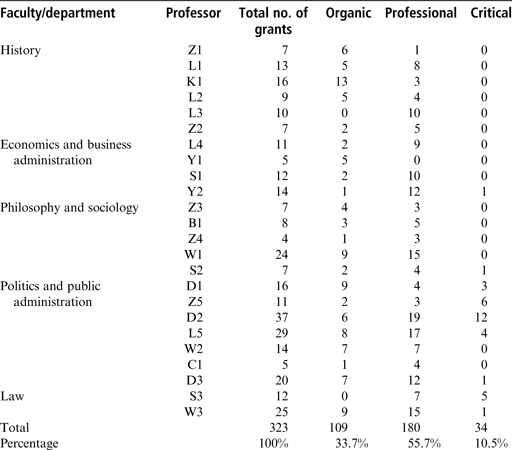
Professors’ research reflects the same dilemma. In Table 1, we summarize the recent research topics of five faculties and departments: history, economics and business administration, philosophy and sociology, politics and public administration, and law.Footnote 93 This is not a complete list, since not all professors’ research topics are available online, but what we find is probably typical of what people do. Judging from the titles of their projects, most of their research is organic and professional (34 per cent and 56 per cent, respectively). Research topics that are sponsored by the local government examine the industrial structures of the province or population change; corporations sponsor research on building a management team in an enterprise, or developing tourism; the Ministry of Education sponsors studies concerning the transformation of commercial systems in the Qing dynasty. Thus, the professors serve the role of establishment/organic and non-establishment/professional intellectuals. Topics on critical and politically sensitive issues are few (11 per cent).
The Nature of Professors’ Research Topics

Source:
Data taken from the departmental/faculty websites.
In fact, even topics which appear to be critical, like democratization or the life of children of peasant workers left behind with their grandparents or accompanying their migrant parents to the cities, can be researched in a variety of ways, ranging from largely organic – helping the party-state to solve practical problems; largely professional – analysing mechanisms; to mildly critical – pointing out problems or offering alternative solutions. In obedience one can find some autonomy. Faculty can play establishment/organic, non-establishment/professional, or even contra-establishment/critical roles to varying extents.
But the status role of the professors we discuss in this section is non-establishment/professional. Their typical priority role is not organic or critical, but professional.
Professors as contra-establishment/critical intellectuals
As we have seen above, all may play the contra-establishment/critical role, but few can play it in its purest form. Two examples will illustrate the extent to which the professors in our case university can go. We will call them Professor L and Professor W.
Professor L makes a point of teaching students to think logically and scientifically. He explores sensitive topics such as the land reform movement from a critical perspective. He also speaks on the media about issues such as the relationship between the government and the masses, from the perspective of the latter.Footnote 94 He published his critical ideas on the recently closed Gongshi wang.
Professor W also emphasizes independent thinking:
It's a shame if a professor only uses Party jargon (dang bagu 党八股) when he or she teaches and writes. It's a pity if he or she only repeats empty talk and lies, and if he or she does not relate theory to reality and tackle politically sensitive issues. One has to teach and write only sincere and new things that can endure the test of history.Footnote 95
He teaches students to read textbooks critically and apply what they read to the analysis of the difficult, important and hot issues of contemporary China.Footnote 96 His research touches on very sensitive issues that people tend to avoid. He promotes the use of “citizen” when the term “civil society” becomes sensitive. He claims that to deny universal values, as the dominant ideology does, is to deny Marxism. He calls on the party-state to practise constitutionalism, saying that the constitution does not give state power to the governing party. In his own blog, he has published over 100 articles calling for democratization. Because of the sensitivity of the topics he deals with, he has had to use his own money to publish a book of his essays on democratization.
These two examples tell us that indeed intellectuals can go further in their criticism than establishment/organic and non-establishment/professional intellectuals, both in teaching and research. Despite stricter ideological controls, mass media, especially the social media, has become an important platform for critical discourse for critics such as Qin Hui, Zhang Qianfan and Zhang Ming.Footnote 97 Proportionally, however, their number is still small, and few would go so far as to risk arrest and imprisonment like Xu Zhiyong for his new citizen movement and Ilham Tohti for advocating national minority rights in his classroom and on his website. Most contra-establishment/critical intellectuals’ efforts on the mainland maintain a kind of obedient autonomy, although they behave more autonomously than the establishment/organic and non-establishment/professional intellectuals described above.
Equally important, contra-establishment/critics, as professionals, may even want to be an organic part of the party-state. Professor L believes that he is, above all, a professional, and just like every other intellectual, he would like to play the role of adviser to the state.Footnote 98 Professor W believes that he is a critical intellectual but also that he is a professional and plays an organic role in what he believes to be the true Party course.Footnote 99 Thus, he plays multifaceted and synchronic roles although one identity or status role may dominate at any time. That is the contra-establishment/critical role. We must, therefore, treat the establishment/organic, non-establishment/professional, and contra-establishment/critical roles of intellectuals only as ideal types.
Conclusion
In this paper, we have explored the multifaceted and synchronic identities and roles of professors as intellectuals. Their academic identities may be as scholars and professionals, sociologists and engineers, but they may play political roles as establishment/organic, non-establishment/professional, and contra-establishment/critical intellectuals. If one of these roles assumes a dominant function or status role, it becomes the person's political identity. Thus, while playing different roles, Hu Angang is primarily an establishment/organic intellectual and Ai Weiwei is primarily a contra-establishment/critical intellectual.
We found that at least partly owing to tight ideological controls in China, most professors play an establishment/organic and/or non-establishment/professional role, and assume such political identities as intellectuals. They follow the Party line in teaching and research and serve the party-state as think tanks, informing the government in its public policymaking. But, that does not exclude them from also playing the less obvious role of contra-establishment/critical intellectuals and practising a form of obedient autonomy. On the other hand, both non-establishment/professional and contra-establishment/critical intellectuals may sometimes play the role of the establishment/organic intellectual by cooperating with the government in advising or advocating its policies. (Understandably, the contra-establishment/critical intellectuals are very small in number.) Professors as intellectuals thus have multifaceted and synchronic identities and roles, although one of these roles is their status role.
In addition, our case study of a university in provincial China shows that conditions and intellectual responses that obtain in smaller cities are similar to those found in larger ones, as is often seen in the studies on metropolitan intellectuals in Beijing, Shanghai or other megacities. Thus, we hope to contribute to the empirical range of such studies, as well as offering our own contributions to the model of the status role of intellectuals. We hope also that our study will contribute to the sociology of higher education, in which the faculty role, both academic and political, is an especially important issue to study.
Professors as intellectuals shape the university and the nation's political discourse whilst being shaped by the university and the party-state. Future studies should explore the political identity and role of professors in their academic service roles. Future studies could also analyse similar political roles played by lawyers, doctors, engineers and journalists. Within the limits of this paper, we have not been able to examine how personalities, family background, political ambitions, environmental factors, career positions and educational background affect professors’ choice of roles, but we hope that future research will.
The party-state is very conscious of what intellectuals do. If professors and other intellectuals are also conscious of what they do, they might be able to engage with their roles better and exert more influence on the direction of the party-state. As we have demonstrated, they can at least practise obedient autonomy and build parallel cultures by engaging in small-scale work, creative dissent, living in truth and rejecting lies.
Acknowledgement
The authors would like to thank the anonymous reviewers for their extensive comments and the University of Macau for a grant for the project.
Biographical notes
Zhidong Hao, professor of sociology, obtained his PhD in sociology from the Graduate School and University Center, the City University of New York. His research interests include political sociology, comparative sociology, historical sociology, and the sociologies of intellectuals and professionals, higher education, development, gambling and religion, as well as the history and society of Macau. His books include Liang'an si di zhengzhi yu shehui poxi 两岸四地政治与社会剖析 (An Analysis of Political and Social Developments in Hong Kong, Macau, Taiwan, and Mainland China) (2014); Social Issues in China: Gender, Ethnicity, Labour, and the Environment (co-edited, 2014); Gongmin shehui: Zhongguo dalu yu GangAoTai 公民社会: 中国大陆与港澳台 (Civil Society: Mainland China, Hong Kong, Macau, and Taiwan) (edited, 2013); Macau History and Society (2011); Whither Taiwan and Mainland China: National Identity, the State, and Intellectuals (2010); and Intellectuals at a Crossroads: The Changing Politics of China's Knowledge Workers (2003). He has also published a large number of scholarly papers in the aforementioned interest areas.
Zhengyang Guo is a lecturer at Shanxi University and a PhD student in sociology at the University of Macau. Her research interests are in political sociology. She is currently undertaking field research for her PhD dissertation on higher education in China.