I. INTRODUCTION
Since the Zr–Ti–Cu–Ni–Be and Zr–Cu–Al–Ni bulk glassy alloys (BGAs) were reported in 1993,Reference Peker and Johnson1, Reference Inoue, Zhang, Nishiyama, Ohba and Masumoto2 the multicomponent Zr-based glassy alloys have gained considerable attention because of their very high glass-forming ability (GFA), large supercooled liquid region, and high fracture strength with good toughness.Reference Johnson3, Reference Inoue4 However, their application has been hindered by their lack of plasticity. Recently, it has been reported that the multicomponent Zr-based BGAs with high Zr concentrations exhibit large plasticity,Reference Liu, Wang, Wang, Zhao, Pang and Wang5–Reference Yokoyama, Fujita, Yavari and Inoue7 which have gained considerable interest because of the promotion of practical applications for Zr-based BGAs. However, those BGAs with good plasticity had small critical diameters (d c) for glass formation.
It is important to develop binary or ternary glassy alloys with high GFA and good plasticity, because they are the base of the multicomponent BGAs with higher GFA, and their atomic structures are more easily analyzed for understanding the mechanisms of the formation and deformation of BGAs. Recently, Zr-based ternary BGAs with a d c of much more than 1 cm were formed in Zr–Cu–Al and Zr–Co–Al systems by a conventional casting process.Reference Yokoyama, Yamasaki, Liaw, Buchanan and Inoue8, Reference Wada, Qin, Wang, Yoshimura, Inoue, Sugiyama, Ito and Matsushita9 However, no distinct plasticity was exhibited in the ternary Zr-based BGAs with high GFA. The Zr–Ni–Al glassy system is the first Zr-based glassy alloys reported in 1990.Reference Inoue, Zhang and Masumoto10 However, the GFA has not been investigated yet systematically. Only Li’s group reported that the maximum d c of 8 mm was obtained in the system previously.Reference Jing, Zhang, Wang and Li11 In addition, as far as we know, there is no report on the mechanical properties of the Zr–Ni–Al BGAs.
It is well known that the compositions of all the glassy alloys with high GFA are typically close to the deep eutectic, which has been shown to have a theoretical basis.Reference Turnbull12 The resulting low liquidus temperature (T l) is attractive for approaching the alloy compositions with high GFA since the reduced glass transition temperature (T rg = T g/T l, T g: glass transition temperature)Reference Turnbull12 and γ value [T x/(T g + T l), T x: crystallization temperature]Reference Lu and Liu13 are fundamental parameters for GFA. In this study, with the aim to develop a ternary glassy alloy with high GFA and good plasticity, the effects of Al addition in a binary eutectic alloy with high Zr content on the thermal stability, GFA, and mechanical properties in a Zr75−xNi25Alx series were systematically investigated. Additionally, the possible mechanism for the high GFA, and the relationship among the concentration, characteristic temperature, mechanical properties, and Poisson’s ratio in this BGA series are discussed.
II. EXPERIMENTAL
The master ingots were prepared by arc melting of pure metals with purity of 99.9 mass% for Zr and 99.99 mass% for Al and Ni in a purified argon atmosphere. The ingots were melted repeatedly four times to attain chemical homogeneity. The prealloyed ingots were remelted and injected through quartz tube into cylindrical copper molds with a diameter of 2 to 5 mm and length of 40 mm under an argon atmosphere. The tilt casting methodReference Yokoyama, Kobayashi, Fukaura and Inoue14 was applied to prepare bulk glassy alloy rods of 5 to 16 mm in diameter and about 40 mm in length. Ribbon samples with a cross section of 0.02 × 1.2 mm2 were prepared by melt spinning. The glassy structure of the cast alloy rods was identified by x-ray diffraction (XRD). The rods were sectioned transversely, etched, and observed by optical microscopy. The thermal stability associated with glass transition, supercooled liquid region, and crystallization was examined by differential scanning calorimetry (DSC) at a heating rate of 0.67 K/s. The liquidus temperature and melting behavior were measured with a differential thermal analyzer (DTA) at a heating rate of 0.33 K/s. The mechanical properties under a compressive applied load were measured using an Instron testing machine. The specimen with a diameter of 2 mm and a length of 4 mm was prepared for the compressive test, and the strain rate was fixed as 5 × 10⁻⁴ s−1. Young’s modulus was measured by a strain gauge. The deformation shear bands and fracture morphology were examined by scanning electron microscopy (SEM). Densities of the as-cast glassy rod were measured at room temperature by the Archimedes principle. The Poisson’s ratio of the BGAs was measured by a resonant ultrasound spectroscopy.
III. RESULTS
A. Thermal stability
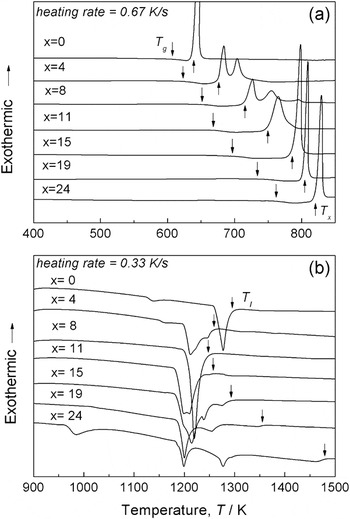
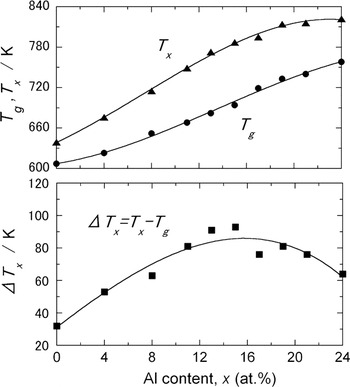
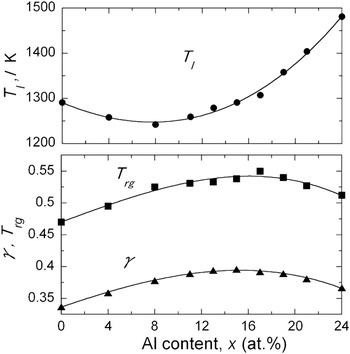
Figure 1 shows DSC and DTA curves of Zr75−xNi25Alx (x = 0 to 24) glassy alloys. All the DSC curves [see Fig. 1(a)] exhibit an endothermic reaction due to a glass transition, followed by exothermic peaks due to crystallization. Based on the DSC curves, T x, T g, and ΔT x values are plotted as a function of Al content in Fig. 2. The T g and T x increase gradually with increasing Al content, while the ΔT x increases from 32 to 93 K as x increases to 15, and then decreases to 64 K as x further increases to 24. From DTA scans [see Fig. 1(b)], the liquidus temperature (T l) decreases as x increases from 0 to 8, and the alloy with x = 8 exhibits the lowest T l of 1242 K and only a distinct endothermic peak. When the Al content is further increased, the multiple events are observed again and the T l rises. These results indicate that the Zr67Ni25Al8 alloy is located near a deep eutectic in this ternary alloy system. Figure 3 shows the T l, T rg, and γ value as a function of Al content. It can be seen that the off-eutectic alloys around Zr60Ni25Al15 in the alloy series possess larger T rg, γ value, and ΔT x (see Fig. 2) simultaneously, suggesting high GFA.Reference Peker and Johnson1, Reference Turnbull12, Reference Lu and Liu13
DSC and DTA curves of Zr75−xNi25Alx (x = 0–24) glassy alloys.

T g, T x, and ΔT x of Zr75−xNi25Alx (x = 0 to 24) glassy alloys as a function of Al content.

T l, T rg, and γ value of Zr75−xNi25Alx (x = 0 to 24) glassy alloys as a function of Al content.

B. Glass-forming ability
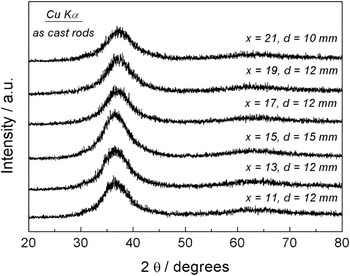
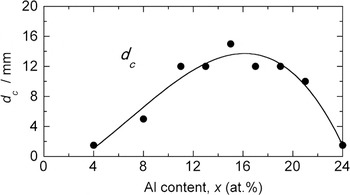
We examined the GFA of Zr75−xNi25Alx (x = 0 to 24) alloys by copper mold casting. Figure 4 shows the XRD results of as-cast Zr75−xNi25Alx alloys (x = 11 to 21) rods with diameters of 10 to 15 mm. It can be seen that all spectra consist of only broad peaks, and no distinct sharp peak due to the existence of a crystalline phase is observed, indicating that these alloy rods have a glassy structure. The Zr60Ni25Al15 alloy has a highest GFA, and its d c up to 15 mm is achieved. Figure 5 shows d c as a function of Al content. It can be recognized that there is good correlation between the d c and γ values or ΔT x and T rg in the alloy series (see Figs. 2 and 3).
Cross-sectional XRD patterns of as-cast Zr75−xNi25Alx (x = 11 to 21) rods with diameters of 12 and 15 mm.

The critical diameters (d c) for glass formation of Zr75−xNi25Alx (x = 4 to 24) alloys as a function of Al content.

C. Mechanical properties
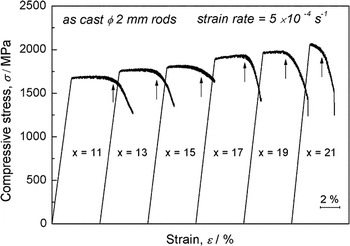
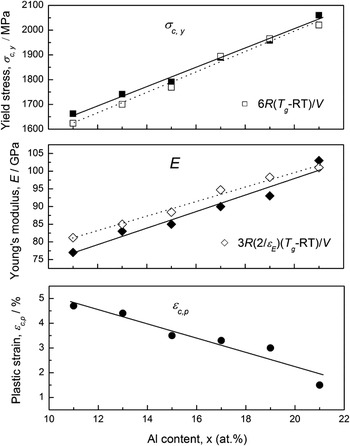
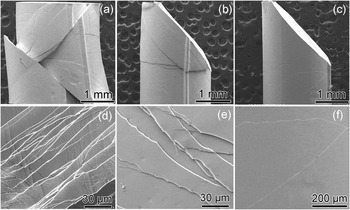
The mechanical properties of the glassy alloys with d c of over 10 mm were investigated using compression test. Figure 6 shows the compressive stress–strain curves of as-cast Zr75−xNi25Alx (x = 11 to 21) glassy alloy rods. All the samples exhibit high-yield fracture strength (σc,y) above 1650 MPa with a distinct plastic strain (εc,p). Figure 7 shows the changes of σc,y, Young’s modulus (E), and εc,p as a function of Al content. The σc,y and E increase almost linearly from 1662 MPa and 77 GPa, respectively, at x = 11 to 2060 MPa and 103 GPa, respectively, at x = 21, while the εc,p decreases gradually from 4.7 to 1.2% as x increases from 11 to 21. Figure 8 shows the outer shape of the Zr75−xNi25Alx (x = 11, 15, and 21) glassy rods after compression test. The fracture of all the alloys occurred along the maximum shear stress plane, which was declined by about 45° to the direction of applied load. It is also clear that the alloy with x = 11 shows two fracture surfaces, and the higher density of shear bands is observed on the outer surface. The large plastic strain of 4.7% can thus be attributed to the generation of many shear bands.
Compressive stress–strain curves of cast Zr75−xNi25Alx (x = 11 to 21) glassy rods with a diameter of 2 mm.

The σc,y, E, and εc,p of Zr75−xNi25Alx (x = 11 to 21) BGAs as a function of Al content. The calculated σc,y and E values based on σc,y = 6R(T g − RT)/V and E = 3R(2/εE)(T g − RT)/V Reference Liu, Liu, Wang, Inoue, Sakurai and Chen19 are also shown for comparison.

SEM images of the outer shapes (a) x = 11, (b) x = 15, and (c) x = 21, and the high-magnification images of the surface morphology (d) x = 11, (e) x = 15, and (f) x = 21 of Zr75−xNi25Alx glassy rods with a diameter of 2.0 mm after compression test.

IV. DISCUSSION
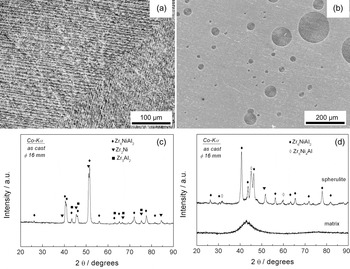
It is noticed that a near eutectic Zr67Ni25Al8 alloy has a d c of only 5 mm, what is much lower than that of the off-eutectic Zr75−xNi25Alx (x = 11 to 21) alloys (see Figs. 1 and 5). Figure 9 shows the micrographs of cross section of as-cast rods with a diameter of 16 mm for alloys with x = 8 [Fig. 9(a)] and x = 15 [Fig. 9(b)]. For the alloy with x = 8, a fine eutectic structure consisting of two binary compounds of Zr2Ni and Zr3Al2 and one ternary Zr6NiAl2 compound [see Figs. 9(a) and 9(c)] is observed in the cross section except in the outside region. For the alloy with x = 15, there are a number of small spherical regions with diameters less than 200 μm, which are dispersed in a glassy matrix [see Fig. 9(b)]. According to the XRD results [see Fig. 9(d)], it is determined that the structure is composed of two ternary compounds of Zr6NiAl2 and Zr5Ni4Al, which are consistent with results obtained by Li et al.Reference Li, Saida, Matsushida and Inoue15 and Yasuda et al.Reference Yasuda, Tamura, Nagira, Ohnaka, Yokoyama and Inoue16 The precipitation of ternary compounds may contribute to the high GFA in the alloy with x = 15, because the nucleation of ternary Zr6NiAl2 and Zr5Ni4Al is more difficult than that of Zr2Ni and Zr3Al2 in the Zr–Ni–Al alloy system.Reference Li, Saida, Matsushida and Inoue15 In addition, the growth of ternary Zr6NiAl2 and Zr5Ni4Al phases in the Zr60Ni25Al15 supercooled liquid is also difficult, because the significant atomic redistribution of Al and Ni, and the strict elemental limitation for a determined crystal site occur in the Zr6NiAl2 and Zr5Ni4Al phases.Reference Yokoyama, Kobayashi, Fukaura and Inoue14 It has been reported that growth velocity of the Zr2Ni compound is much higher than that of the Zr5Ni4Al phase in the ternary Zr–Ni–Al alloys.Reference Li, Saida, Matsushida and Inoue15 The phase morphologies of the alloy with x = 15 [see Fig. 9(b)] also indicate that the growth of crystal nuclei was limited. Therefore, it can be concluded that the effective suppression of the nucleation and growth of primary ternary phases during liquid solidification is the reason for the high GFA of the present alloys.
The cross-sectional structure of as-cast alloy rods with a diameter of 16 mm: (a) Zr67Ni25Al8, and (b) Zr60Ni25Al15. The cross-sectional XRD patterns of as-cast alloy rods with a diameter of 16 mm: (c) Zr67Ni25Al8 taken from the center, and (d) Zr60Ni25Al15 taken from matrix and spherical crystalline particle, respectively.

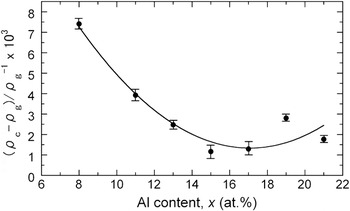
The density change upon crystallization (ρc − ρg)/ρg (ρg: density of glassy phase; ρc: density of crystalline phase) of the glassy alloys is also a fundamental factor for estimating GFA.Reference Li, Guo, Kalb and Thompson17 Figure 10 shows the changes in (ρc − ρg)/ρg as a function of Al content for Zr75−xNi25Alx (x = 8 to 21) alloys. From Figs. 10 and 5, we can see that a minimum value of the density changes accompanied by the best glass former, and there is a good correlation between the density change and the d c: the alloys with low (ρc − ρg)/ρg exhibit high GFA. The results also suggest that the formation of the Zr–Ni–Al BGAs correlates with reduced diffusivity in the glassy state, and the efficiency dense packing local structure are formed in the glassy alloys with high GFA.
The density change upon crystallization (ρc − ρg)/ρg of Zr75−xNi25Alx (x = 8 to 21) alloys.

From Figs. 2 and 7, it can be noticed that the T g, σc,y, and E of the Zr–Ni–Al BGAs increased almost linearly with increasing Al content. It has been reported that the E and σc,y are found to correlate linearly with the T g,Reference Wang18 and the good relationship between E or σc,y and T g associated with the molar volume was quantitatively described as equations, σc,y = 6R(T g − RT)/V and E = 3R(2/εE)(T g − RT)/V (V = M/ρ: molar volume; εE: elastic limit at RT), based on the fundamental thermodynamics by various multicomponent ductile BGAs.Reference Liu, Liu, Wang, Inoue, Sakurai and Chen19 We have calculated the σc,y and E values based on the two equations. The results are in good agreement with our experimental results (see Fig. 7), confirming that the elastic properties of Zr–Ni–Al BGAs play a key role during the glass transition.
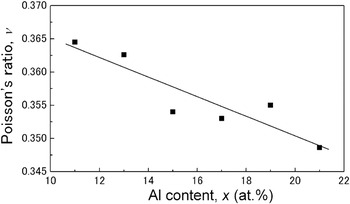
On the other hand, the εc,p of the Zr75−xNi25Alx BGAs decreased with increasing Al content (see Fig. 7). The results can be explained by a factor of Poisson’s ratio (ν).Reference Lewandowski, Wang and Greer20 Figure 11 shows the changes in ν as a function of Al content for Zr75−xNi25Alx BGAs. The ν decreased gradually from 0.365 to 0.348 as x increases from 11 to 21. From Figs. 7 and 11, it can be seen that there is a good correlation between εc,p and ν, because the BGAs with high Poisson’s ratio due to reduced icosahedral population in the internal structure are more prone to the shear transformations, leading to the nucleation of a high number density of shear bands, which attribute to plasticity.Reference Schroers and Johnson21 From Fig. 8 it also can be seen that the density of shear bands on the alloy rods after compression test increased with decreasing Al content.
Poisson’s ratio as a function of Al content for Zr75−xAlxNi25 (x = 11 to 21) BGAs.

V. CONCLUSION
Fully glassy rods with diameters greater than 10 mm were fabricated for off-eutectic Zr75−xNi25Alx (x = 11 to 21) alloys, which show large ΔT x of more than 80 K. The Zr60Ni25Al15 alloy corresponding to the largest ΔT x and γ value, along with the lowest density change upon crystallization showed the best GFA, and the critical diameter for glass formation up to 15 mm was achieved. The BGAs exhibited good mechanical properties, i.e., compressive yield strength (σc,y) of 1622 to 2060 MPa, Young’s modulus (E) of 77 to 103 GPa and plastic strain (εc,p) of 1.2 to 4.7%. The σc,y and E increased with increasing Al content, while the εc,p gradually decreased. The εc,p showed a good correlation with the Poisson’s ratio. In addition, linear correlations between Al content and the T g as well as the σc,y and E can be found in the BGA series.
ACKNOWLEDGMENT
This work was financially supported by Research and Development Project on Advanced Metallic Glasses, Inorganic Materials and Joining Technology from the Ministry of Education, Science, Sports, and Culture of Japan.