Introduction
In 1822, following a coup d’état that overthrew the absolute monarchy, a parliamentary regime was instated in Portugal. The three decades that followed were dominated by political feuds that more than once evolved to armed conflict. Any prospect of investment in large infrastructures was not feasible (Mata and Valério Reference Mata and Nuno1993: 142).
In 1851, another putsch pacified the nation and pledged to use science and technology, instead of sterile ideological discussions, to develop the kingdom and to bring it closer to its European neighbors. In a day and age when science and technology were the gauge that measured the value of each country’s past achievements and present worth (Adas Reference Adas1989: 134), most Portuguese elites acknowledged progress as the goal for which Portugal should aim. Throughout the nineteenth century, this consensus permitted the application of a large public works investment program laid out to modernize the kingdom, which became historically known as Fontismo, after its main promoter, Portuguese statesman, Fontes Pereira de Melo (Justino Reference Justino2016: 28–87; Pinheiro Reference Pinheiro2013: 111–39; Saraiva Reference Saraiva2007: 264).
One of the key problems addressed by this strategy was transportation. Since the mid-eighteenth century, the lack of a good transportation system was pointed out as the major obstacle to the economic development of Portugal (Cardoso Reference Cardoso1998: 94–95). Obstructed harbors and rivers, lack of lighthouses and roads, and the prevalence of ancient vehicles limited the mobility of people and goods. Traveling was risky, slow, and expensive, especially in the northern provinces of Beira Alta, Beira Baixa, and Trás-os-Montes (figure 1 shows the location of the Portuguese provinces). A return trip from Lisbon to the northeastern corner of Portugal could easily take more than a week (Alegria Reference Alegria1990: 104 and 126–27; Matos Reference Matos1980: 85–90). Railways were considered the best solution to modernize the transport and mobility systems.

The main goal of Fontismo was to build railways toward the border with Spain (thence to the French frontier) to take advantage of the worldwide expansion of commerce, migrations, and financial flows experienced throughout the nineteenth century (Bairoch Reference Bairoch1976: 33–36; Geyer Reference Geyer, Winfried and Christian2010: 510). With a large investment in railways, it was expected that the Portuguese economy integrated a broader market.
Additionally, the sublime and personification of modernity associated with railways (Kasson Reference Kasson1976: 162–80) could prove that Portugal was treading the path of progress and becoming a technologically prone nation.Footnote 1 Portuguese technocrats were determined to disprove Monsieur de Pradt (Reference Pradt1816: 168) that had once written, “it is an error of geography to assign Spain [meaning the Iberian Peninsula] to Europe; it belongs to Africa: blood, mores, tongues, the way they live and fight, in Spain everything is African” (C’est une erreur de la géographie que d’avoir attribué l’Espagne à l’Europe; elle appartient à l’Afrique: sang, mœurs, langage, manière de vivre et de combattre; en Espagne tout est africain).Footnote 2 Until the eve of World War I, Portugal built 3,115 km of railways in the mainland (Valério Reference Valério2001: 373).
Different authors have analyzed various aspects of the history of the railway sector in Portugal (financing, technopolitical lobbying, main agents/stakeholders, geography of transportation, etc.). However, from a history of technology angle, many other features are yet to be examined and an overall review is wanting (for a recent bibliographical review, see Pereira Reference Pereira2015).
In this article I add different primary sources (statistical data, parliamentary debates, nineteenth-and early-twentieth-century press and novels) to that critical mass and I offer a wider analytical approach using three distinct, but interwoven, methodological concepts in history of technology: circulation (especially of knowledge: see Raj Reference Raj2007: 10–22; Secord Reference Secord2004), territorial appropriation (Kärrholm Reference Kärrholm2012: 16), and globalization (Geyer Reference Geyer, Winfried and Christian2010: 516; Middell and Naumann Reference Middell and Katja2010).
These concepts determine the structure of the article. The first three sections are devoted to circulation of knowledge, capital, people, and goods and how these fluxes were crucial for the integration of Portugal in broader international networks, but also for the integration of different Portuguese regions in one national unit. This paves the way for the fifth section, where I claim that the integration of the Portuguese provinces, together with the symbolism of progress brought about by railways, promoted the reinvention of Portugal as technological nation. Section 6 analyzes how circulation promoted the globalization sought by the Portuguese technocrats, although in different terms from what was anticipated.
With this approach I add to the recent and vivid debate about the role of transport infrastructures in making Europe (Högselius et al. Reference Högselius, Arne and Erik2015: 24–47), by providing a case study of a peripheral nation.
A Product of Circulation of Ideas and Knowledge
The bickering that characterized Portuguese politics before 1850 forced many nationals into exile, mostly in England and France (Faria Reference Faria2016: 272), where they observed the technological sublime of trains that traveled across the European landscapes since the mid-1820s (Caron Reference Caron2005: 13–15; Kirby Reference Kirby2002: 1). The feeling of awe before these technological achievements is well illustrated in the parliamentary debates of the second half of the nineteenth century, in the speeches of those former expatriates (Pereira Reference Pereira2012: 82–153).
The exiled did more than witness the growth of European rail networks. Many attended prestigious engineering schools, mainly the École Nationale des Ponts et Chaussées (National School of Bridges and Roads) in Paris, where they acquired or improved their technical skills. Upon their arrival, they passed that knowledge to younger alumni of the Portuguese engineering schools.Footnote 3 Besides, they engaged with the Saint-Simonian movement (Macedo Reference Macedo2009: 5; Matos Reference Matos, Maria Paula, Irina and André2009a: 180–85).
Saint-Simonianism was an ideology created in the late eighteenth century, inspired by the teachings of French aristocrat, Claude-Henri de Saint-Simon, and promoted by the Industrial Revolution that considered science and technology as driving forces for the resolution of social, economic, and political problems (Ross Reference Ross1980; Williams Reference Williams1993: 382–87). It proposed the construction of large communication frameworks to promote the circulation of people, goods, and capital. In the 1830s, one of Saint-Simon disciples, French engineer Michel Chevalier, turned those transportation grids, especially railways, into objectifications of progress and the best tool to create civilizations of circulation (Laak Reference Laak, Alexander and Andreas2010: 27; Vleuten Reference Vleuten2006: 289–90; Vleuten et al. Reference Vleuten, Irene, Vincent and Frank2007: 322).
Different European nations followed this ideology. Belgium set its network toward the frontier to draw international traffic to its harbors in Antwerp and Oostende to maintain a steady commercial flux that justified its recent independence (Herten et al. Reference Herten, Michelangelo and Greta2001: 38–82). Greece suggested a bimodal system combining trains and steamers to attract traffic coming and going through the Suez Canal, “placing Athens in the middle of it as a major trade and civilisation center [sic]” (Tympas and Anastasiadou Reference Tympas, Irene, Erik and Arne2006: 28–30). Switzerland built the St. Gothard tunnel to safeguard its position as an important through-transit country in central Europe (Schueler Reference Schueler, Erik and Arne2006: 71).
Portuguese engineers followed these models, and, together with the government, they laid out a plan to build rail links from the harbors in the coast (specially Lisbon and Porto) to the border with Spain (and onward to France). The main goal was to take advantage of Portugal’s geographical position in the westernmost corner of Europe to attract traffic flowing between the Old and the New World (Alegria Reference Alegria1990: 213–338). A secondary goal was to build lines that connected peripheral areas of Portugal to the transnational tracks or to the two major cities of the nation: Porto and Lisbon (figure 2).
The Portuguese railway network in 1910.
Source: Author.

Between 1850 and 1870, the Portuguese railway network extended throughout 700 km,Footnote 4 but the role of Portuguese engineers in its construction and operation was limited. They planned the investment program within the Ministry of Public Works, wrote the contracts with the operators, surveyed the territory looking for the best route, and oversaw the contractors work; but when it came to lay the tracks down or erect engineering works, the government preferred British or French expertise. Only if foreign contractors failed, would Portuguese engineers step in and direct the work, until the government found another foreign replacement (Pinheiro Reference Pinheiro2008: 166–67).
In any case, work yards became extraordinary fields for transfer and circulation of technical knowledge (together with further travels of learning by Portuguese engineers). Although Portuguese engineers were not in charge, they worked closely to their foreign comrades (for a case study, see Pereira Reference Pereira2018: 174–78), learning new skills and practising those they acquired in training. British and French influence became particularly visible in some technical terms, transferred to Portuguese, as corruptions of the original words. For instance, jim crow (slang for rail straightener, a tool to bend rails) became genicró (ʒənikrɔ); gauge (distance between rails) became gue(i)ja (ɡɐ(j)ʒɐ); and sleepers entered the Portuguese language as chulipas (ʃuˈlipɐʃ). French terms like tirefonds (chair screws) became tira-fundos (tirɐˈfũdu), while éclisse (fishplate) entered directly in the Portuguese lexicon.Footnote 5
Throughout the nineteenth century, Portuguese engineers also contributed to the extension of the broad-gauge network. The travels of learning abroad and the accumulation of knowledge, expertise, and prestige (and a growing discomfort with the performance of foreign technicians)Footnote 6 led them to higher roles in the management and extension of the railway network from the late 1860s onward.
In 1869, for the first time ever, operation and extension of a railway (South and South Eastern lines, nationalized in that year) were assigned to a Portuguese team of state engineers (Tavares Trigueiros, Correia Pais, Canto e Castro, etc.). This solution—deemed temporary at the time—was applied continuously until 1951, when the operation of the line was handed back to a private corporation (Pereira Reference Pereira2012: 184–98; Santos Reference Santos2011: 541–62). In 1872, the government entrusted its technicians the construction and operation of two railways in the northern provinces of the kingdom (Minho, Douro, and Trás-os-Montes), departing from Porto toward the northern and eastern frontier with Spain. Engineers João Joaquim de Matos, Lourenço de Carvalho, Justino Teixeira, Xavier Cordeiro, and Luciano Carvalho, among others, handled the task effectively (both lines were inaugurated in 1886 and 1887). Some of those technicians (Xavier Cordeiro, Luciano Carvalho, Lourenço Carvalho) had French training, which became quite visible in some of the engineering works along those lines, especially bridges (Macedo Reference Macedo2009: 193–230; Matos and Diogo Reference Diogo, Maria Paula, Irina and André2009: 86–87).
Portuguese engineers also extended their influence outside the sphere of the state into private railway companies. In 1872, the nomination of Afonso Espregueira, another former student of the National School of Bridges and Roads, as general manager of the Companhia Real (the main railway operator in Portugal—see note 6) reinforced the influence of Portuguese engineering in Fontismo and in the Portuguese society. It was Espregueira who negotiated with Gustave Eiffel the building of Maria Pia bridge (across the Douro River, connecting Gaia to Porto). Another Portuguese engineer graduated from the Parisian school, Pedro Inácio Lopes, collaborated during construction with Eiffel’s technicians (Salgueiro Reference Salgueiro2008: 26–32 and 36–40). In the following decade, Portuguese engineers played relevant roles within the first entirely Portuguese-funded railway companies: the Companhia do Caminho de Ferro de Guimarães (Guimarães Railway Company) and the National Railway Company, which employed Portuguese engineers in the construction and operation of three narrow-gauge railways in the north of the country—Guimarães, Tua, and Viseu lines (Alegria Reference Alegria1990: 270; Santos Reference Santos2014: 67–76).
The ascension of Portuguese engineers did not mean that foreign technicians no longer worked in Portugal. Quite on the contrary, they kept contributing to the circulation of knowledge from the European core to its periphery. A good example is the team of French technicians, who excelled in the construction of the Beira Alta line, between 1878 and 1882, at the service of the Companhia do Caminho de Ferro da Beira Alta (Beira Alta Railway Company), another transnational track between the small harbor of Figueira da Foz and the border, across the homonymous province (Pereira Reference Pereira2012: 269).
In sum, Portuguese engineers were central to the integration of Portugal in transnational networks of knowledge and technical transfer. Many of them were trained abroad (mainly in France), brought the skills they acquired back home and taught them to new generations of engineers. While working with foreign technicians and going abroad on travels of learning, they kept the circuits of knowledge transfer active and the technical knowledge in Portugal up-to-date. Finally, while leading private companies they contacted and negotiated with foreign technicians and suppliers. All these roles and the integration they promoted contributed to show abroad that Portugal had capable human resources to modernize the kingdom and place it on the path of progress.
… and of Circulation of Capital
A similar story may be told about the financing of the Portuguese railway sector. It goes without saying that railway building is an extremely expensive and capital-intensive enterprise. Some nations had the financial resources necessary to the investment. That was not the case of Portugal, who lacked financial capability for large-scale investment in public works. In the first half of the nineteenth century, as I mentioned previously, the country also lacked the credit and the credibility to attract investors. The instability of the Portuguese internal politics rendered investments in the kingdom risky. Moreover, investors preferred to apply their money in public debt rather than in joint stock companies.
In 1854, Portugal joined the gold-standard system, which favored the credit of the Portuguese finances, decreased the risk of investing in the kingdom, and increased the attractiveness of the Portuguese economy for foreign direct investment. Borrowing money from international lenders was still expensive, but far cheaper than in previous epochs. More importantly, it allowed the raising of enough capital to build and operate railways (Santos Reference Santos2001: 188–89). Additionally, the passing of a joint stock companies law in 1867 attracted a number of limited liability foreign businesses into Portugal (Lopes and Simões Reference Lopes and Vítor Corado2020: 1085–86).
Initially, the London Stock Exchange was the main financier of Fontismo’s railway program. British capitalists linked with British transportation companies (railways and steamers) were amongst the founders of the Companhia Central Peninsular and in the South Eastern of Portugal Railway Company. Given the historical connections between Portugal and the United Kingdom, the predominance of British capital is not surprising. However, after a few disappointments with British financiers (see note 6), from the late 1850s onward, Portuguese rulers turned to French investors. French capital dominated Companhia Real and Companhia da Beira Alta. The former, financed by the Crédit Industriel et Commercial (Commercial and Industrial Credit), became the largest operator in Portugal, managing more than 800 km of track (and a few hundred more in Spain).Footnote 7 The latter, financed by the Comptoir d’Escompte (Discount Counter) and the Societé Fiancière de Paris (Paris Financial Society),Footnote 8 built and operated the Beira Alta line, considered, at the time, the most important cross-border link between Portugal and Spain, as it connected Lisbon with the French border by the shortest and most direct route (Pinheiro Reference Pinheiro1986: 480–81; Silva Reference Silva, Eduardo, José Manuel Lopes and Lourenço2012: 258–62; Vieira Reference Vieira1988: 741).
There were also a few small companies funded internally, but their relevance in the network and in the financial system was minimal and limited to short narrow-gauge lines. The Portuguese government invested in railway building either directly (the aforementioned cases of the Minho and Douro lines and the extensions of the South and South Eastern lines) or by subsidizing private companies (allowances per kilometer or guarantees of yield). The money for these applications was gathered through state bonds, which were issued mainly in the London and Paris financial markets, although some were taken by domestic investors (Vieira Reference Vieira1988).
These flows of capital contributed to the integration of the Portuguese economy and finance in global, transnational circuits, with a volume of inflows of foreign direct investment that cannot be neglected. Throughout the second half of the nineteenth century, Portugal hosted foreign enterprises and business investments. Considering that poorer countries offered higher return rates, it comes with no surprise that spare capital from their wealthier neighbors was directed toward them. In the Portuguese case, insurance companies were the main receivers of foreign capital, but railways followed closely as instigators of cross-border integration of financial markets (Lopes and Simões Reference Lopes and Vítor Corado2020: 1087; Mata Reference Mata, Magrit and Timo2002: 178–79 and 203).
Promoters of Circulation of People, Goods, and Ideas
Besides being products of circulation of expertise and capital, and promoters of the integration of the country in European networks of knowledge and finance, railways also favored the circulation of people and goods at a larger level.
As I mentioned, the Portuguese transportation system was poor. Many contemporary reports, parliamentary speeches, and novels testify this with descriptions of travelers who commended their soul to God before beginning their journey, of mountain ranges that closed entire provinces, or of how assigning a public servant to the peripheral provinces was considered a punishment (Matos Reference Matos1980).
In this sense, railways caused a revolution in the national transport sector by vanquishing centennial geographical obstacles and permitting safer, faster, and cheaper journeys. However, it is important to point out that their impact did not reach the entire country. It was limited to those areas that had access roads to train stations, which, even in 1920, only accounted for about half the country. The northern shoreline of Portugal was the region better served with railways and access roads, whereas most inland north—the poorest and most rugged area of the kingdom—had no easy access to the rail network (Silveira et al. Reference Silveira, Daniel, Nuno Miguel, Ana and Josep2011: 35 and 44–45).
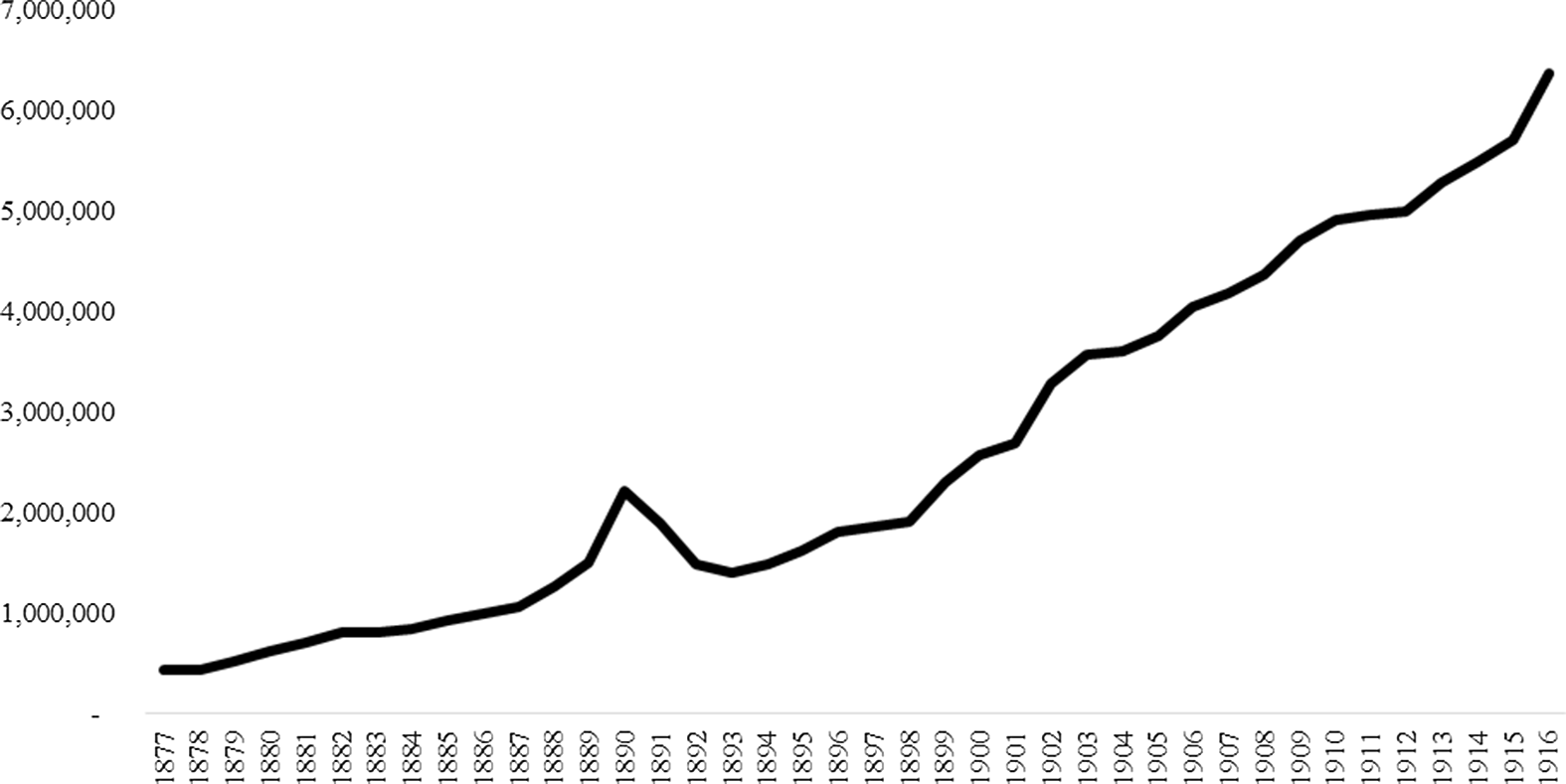
Regardless, transportation statistics clearly show how railways contributed to a solid and quick development of traffic and mobility. In the mainland, in 1868, the first year with available data, railways carried 181,000 tons of goods. By the end of the century, that figure grew fifteenfold to 2,706,000 tons, and in 1914 it reached 5,908,000 tons (figure 3).

In the mainland, goods traveled mostly from the coast to the countryside, and vice-versa, and in the axle north-south between Porto and Lisbon. Railways did not promote regional flows between the inland provinces and cities (Alegria Reference Alegria1990: 359 and 470–72; Pinheiro Reference Pinheiro2008: 44–53 and 63). Therefore, the integration of the different provinces had as focal points the two largest cities of the country. The configuration of the network encouraged this flow structure. In several plans for national and regional networks submitted to the government, Portuguese engineers suggested the construction of different internal lines to connect inland cities amongst themselves (Alegria Reference Alegria1990: 274–94). However, the network grew toward the frontier with Spain and the Northern line between Porto and Lisbon. Consequently, it does not surprise that both these cities grew much more than any other Portuguese city or town (Pinheiro Reference Pinheiro2008: 45–46). Nonetheless, railways were vital to supply the inland provinces more effectively, and they contributed to the integration of large extensions of the Portuguese provinces into a broader national market, which grew in tandem with the development of both rail and road networks (Justino Reference Justino1988–89, II: 180–86).
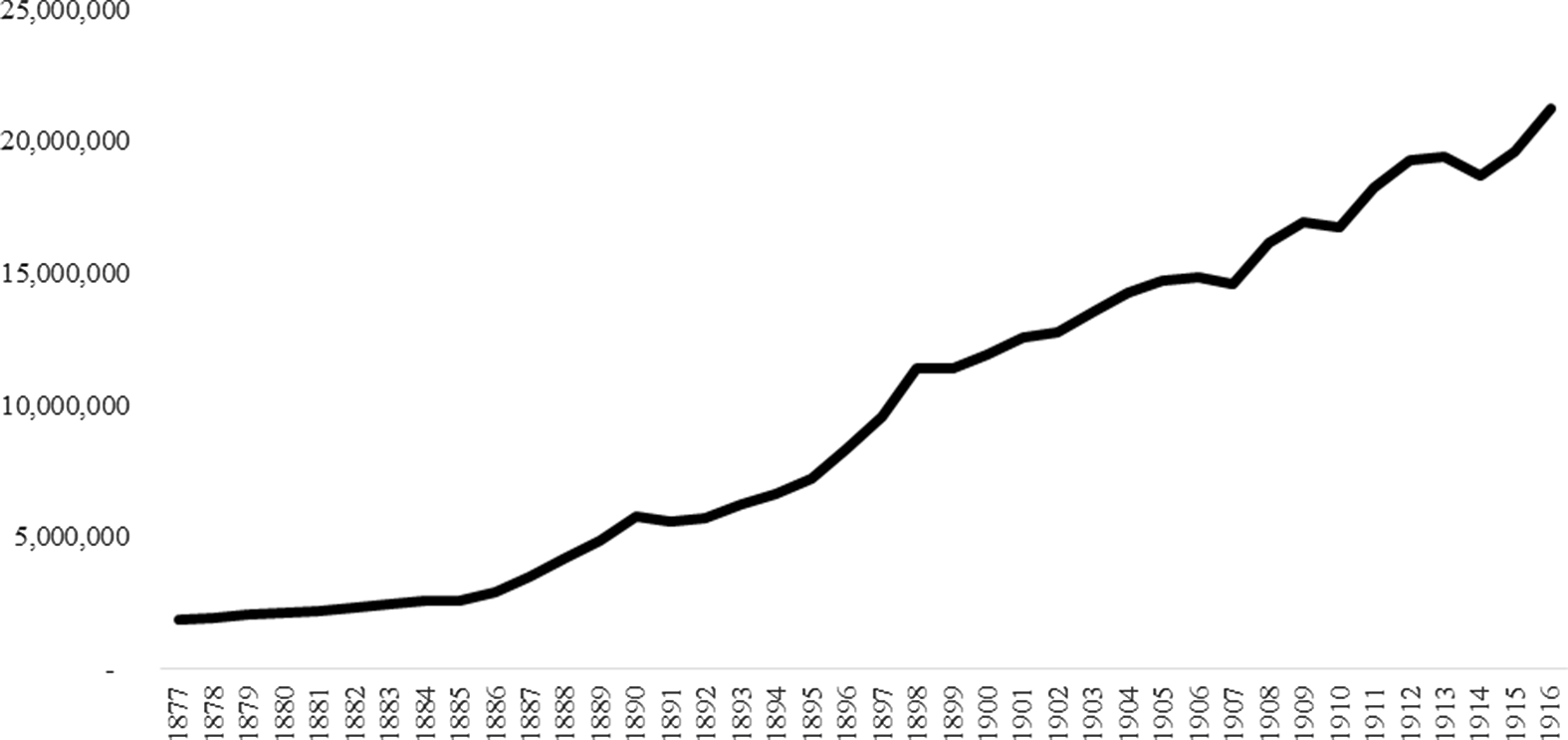
As for passenger transit, 300,000 men, women and children rode the train in the mainland in 1856, but in 1900 that figure rose to 12,000,000 (twofold the Portuguese mainland population at the time), and in 1914 to 19,000,000 (figure 4).

Flows of people were more complex. As the network extended, and the geographical obstacles that separated Portuguese territories from one another were being vanquished, Portuguese regions became closer and were integrated into a more unified country. Similarly to what happened with the transport of freight, Porto and Lisbon were the principal foci of passenger flows, which contributed to the accentuation of both cities’ macrocephaly in the Portuguese urban scenario (Pinheiro Reference Pinheiro2008: 45–46).
Traveling became faster, cheaper, and safer. Portuguese writer, Alberto Pimentel (Reference Pimentel1874: 39) hit the nail in the head when he wrote how the railway “shunned away for good … the highwaymen who assaulted the stagecoach and the horseman. It shortened the distances, … it put the sinister inns out of commission, as well as the nocturnal terrors, the hungry wolves, the lairs hidden in the pinewoods” (Apartou para sempre … os salteadores que surpreendiam a liteira e o macho. Encurtou os horizontes, … acabou com as hospedarias sinistras, com os pavores nocturnos, com os lobos famélicos, com os pinheirais—covis).
Similarly, railways broke the psychological barrier of traveling from the countryside to the coast and back in less than one day. In 1868, in parliament, engineer and MP, Belchior Garcês, evoked how a salesman who had sent his merchandise from Vendas Novas in the train to Lisbon (a distance of 90 km) had told him, “he could not believe, had he not seen it with his own two eyes, that in less than 24 hours it was possible to go from Vendas Novas to Lisbon, sell his olive oil, buy the goods he needed, and be back” (nunca poderia acreditar, se não tivesse visto, que em vinte e quatro horas se podia vir de Vendas Novas a Lisboa, vender o azeite, comprar o que se precisava e estar de volta).Footnote 9 In the northeastern and very rugged province of Trás-os-Montes, in 1887, during the opening of the Tua line (Tua-Mirandela), the king was able to travel from Porto to Tua and Mirandela, inaugurate the railway, and be back in Porto in a day. Even though in the day-to-day operation it was not possible to do the same (timetables did not permit it), the journey of the king shattered the representation of remoteness of Trás-os-Montes, an almost impervious region of the Portuguese (ultra-)periphery, which was losing its fame of wild and faraway country and beginning to become integrated in a new territorial reality (Pereira Reference Pereira2017a).
As for users, neorealist Portuguese writer, Alves Redol (Reference Redol1946: 353), identified some of the characters and types of mobility created or enhanced by the railway in his novel, Porto Manso, when he wrote, “traders, prostitutes, thieves, technicians, and tourists, an assorted mix of humanity” rode the trains (viajaram comerciantes, prostitutas, ladrões, técnicos e turistas—uma humanidade toda diferente). To that group I can add workers commuting to their jobs (Pinheiro Reference Pinheiro2008: 51), and migrants (specially from the inland north provinces of Beira Alta and Trás-os-Montes) traveling either to other provinces or to the Portuguese ports, where they boarded steamers that took them to Brazil or the African colonies (Alves Reference Alves1993; Silveira et al. Reference Silveira, Daniel, Nuno Miguel, Ana and Josep2011: 52).
Considering that these flows were particularly relevant around Porto and Lisbon, it is natural that these mobilities were more visible in those two cities (especially in the latter), where the central stations (Santa Apolónia and Rossio in Lisbon; Campanhã and São Bento in Porto) acted as converging centers for their urban expansion (Pinheiro and Matos Reference Pinheiro and Ana Cardoso2014). Porto’s urban population ranged between 110,000 people in 1878 and 200,000 in 1920, but users of trains ranged between 830,000 and more than three million in 1878 and 1916—eightfold and fifteenfold, respectively. In Lisbon the proportion was even larger: in 1878, 240,000 people lived in the capital, but more than 1.5 million (sevenfold) rode the trains; in the early years of the twentieth century, for a 485,000 population (1920), there were more than 8.5 million users (1920) of the lines of the capital (twentyfold).Footnote 10
In and around Lisbon railways promoted the development of industrial areas, initially in the vector Sacavém-Santa Iria (bordering the Northern line) and later in the Alcântara and Chelas valleys (traversed by the city’s urban and Western railways). Moreover, the railway company’s workshops (in Lisbon and Barreiro) were also centers of industrialization (Pinheiro Reference Pinheiro2008: 68–69 and 77). Porto also witnessed a development of its industrial activity, especially after 1870, but this growth was scattered along the city and did not focus on one railway route (Serén and Pereira Reference Serén and Pereira1994: 438–43).
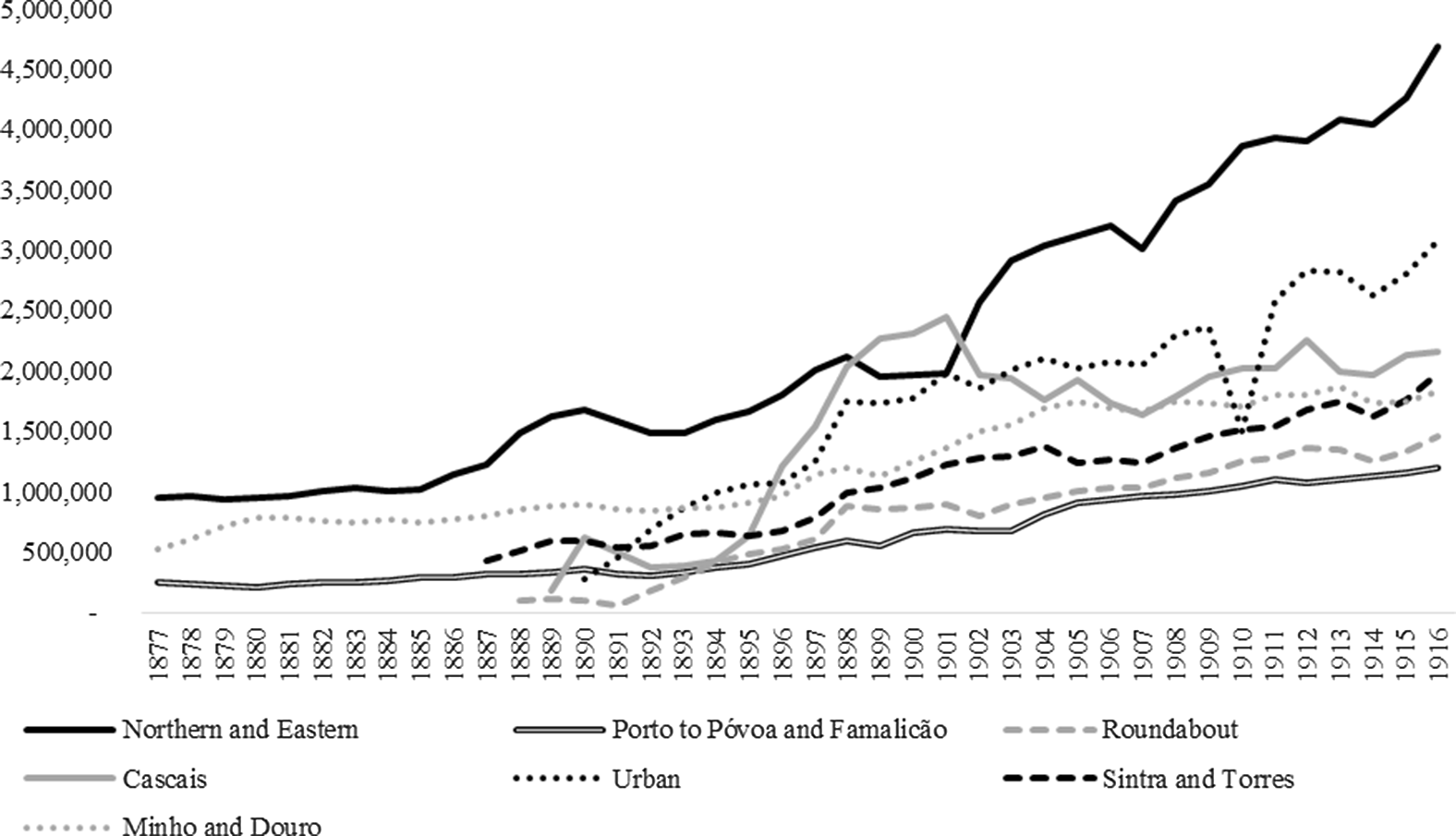
In any case, one may speculate that these and other professionals used trains and the tramways set in Lisbon since the mid-1850s (Vieira Reference Vieira1980, 72) in their commute, which contributed to the suburbanization in the capital (Paulino Reference Paulino2012: 117–18; Pinheiro Reference Pinheiro2008: 78). Something similar happened in Porto, where population grew outside the city center to the peripheral parishes (Serén and Pereira Reference Serén and Pereira1994: 401–4). Operation figures from the lines connecting Lisbon and Porto to their outskirts (figure 5) support this hypothesis. However, one must note that part of that traffic includes passengers from other lines (mainly Northern and Western) or from longer distances (cases of the Minho and Douro lines that extended throughout a couple hundred kilometers), who resumed their journeys to the city centers, and also travelers who were not commuting to their work. Therefore, this is a hypothesis that requires further examination.
Passenger traffic in the lines of the outskirts of Porto (Minho and Douro, and Porto to Póvoa and Famalicão) and Lisbon (Urban, Roundabout, Cascais, and Sintra and Torres). Northern and Eastern railway (the busiest of the network) is included for comparison (1877–1916).

Another type of human flows in those lines (especially those ending in Cascais and Sintra) was tourism. Besides enhancing a work-related mobility, railways created a new form of travel associated with leisure and tourism that until then had little relevance (or no relevance at all). Trains transported nationals and foreigners to the Portuguese beaches, spas, bullfights, fairs, and cultural heritage sites.
Small towns like Cascais, Sintra, or Caldas da Rainha took on the role of touristic attractions (Pinheiro Reference Pinheiro2008: 77). In her memoirs, Portuguese poet, Branca de Gonta Colaço, remembers, “Lisboners fell for the Cascais train. They packed it each Sunday carrying lunch baskets” (o comboio de Cascais, contudo, caiu em cheio no agrado do lisboeta. Enchiam-no em cada domingo, carregados com cestos de farnéis para o almoço) (Colaço and Archer Reference Colaço and Maria2013: 40; see also Paulino Reference Paulino2012: 124–25). Sintra, a town that for decades was the favorite resort of the monarchs and the wealthiest in Portugal, became a leisure attraction for all (Ribeiro Reference Ribeiro2002: 51–53). Caldas da Rainha attracted many tourists that arrived by train to its many spas (Trigo Reference Trigo2003: 46, 57, and 64).
In Lisbon, the central station of Rossio became a touristic attraction with its bold and innovative architecture, combining engineering skills with an iconography that evoked the age of the Portuguese Discoveries. Right next to it, a luxury hotel hosted foreign travelers that arrived in Rossio in the trains of the Compagnie Internationale des Wagons-Lits (International Company of Hotel Trains). For some years, the main service of this company—the Sud Express—extended its journey from Rossio to Sintra and Estoril (a small town between Cascais and Lisbon), where a grand leisure park, which included a casino and a hotel, was built from 1916 onward (Paulino Reference Paulino2012: 54–62; Pinheiro Reference Pinheiro2008: 76).
Further north, the Beira Alta line transported thousands of tourists from Portugal and Spain to the beaches of Figueira da Foz. Since 1884, two years after the inauguration of the line, tourists could attend the new theater, Teatro-Circo Saraiva de Carvalho, and from 1895 onward they could spend their money in the brand-new Grande Casino Peninsular (Vaquinhas Reference Vaquinhas2015: 5–6).
As years went by, railways offered new touristic destinations (county fairs, pilgrimages, bullfights, exhibitions, beaches, spas, mountain resorts, castles, and cities with relevant cultural heritage), both in Portugal and abroad. They promoted the health tourism, intimately connected with the spa sites spread across Portugal. Portuguese medical doctor and politician, Brito Camacho (quoted by Abragão Reference Abragão1956: 242), mentions in one of his writings, “simple touristes … stricken with disease, to whom doctors recommend alkaline waters, flow to the little bric-a-brac that will take them to their destination” (simples touristes … achacados da figadeira, a quem os médicos recomendam águas alcalinas, todos correm para a traquitanazita que há-de levá-los ao seu destino). Since its 1888 debut issue, the Gazeta dos Caminhos de Ferro de Portugal e Hespanha (Railway Gazette of Portugal and Spain) advertised those places and how to get there by train. Occasionally, it offered tickets to its readers. At the same time, Portuguese railway companies offered promotional tickets and fares to their customers. In 1889, for instance, Companhia Real offered 5 pounds sterling (today’s US$685)Footnote 11 return tickets to Paris to visit the World Fair (Ribeiro Reference Ribeiro2009; Saraiva Reference Saraiva2007: 268). The price was steep (equivalent to 22,500 Portuguese réis),Footnote 12 but affordable to some classes of workers. For instance, a typographer working in Lisbon earned 1,800 réis/day. For a worker of the vineyards of Vila Real, however, with a daily salary ranging between 139 and 185 réis, such voyage was an unaffordable luxury (Martins Reference Martins1997: 486).
Besides goods, workers, and tourists, trains also promoted the circulation of ideas, at least if we believe the words of Portuguese realist novelist and diplomat, Eça de Queiroz (cited by Matos Reference Matos2009b: 60), when he wrote,
railways … transported each day … torrents of brand-new things, ideas, systems, aesthetics, forms, feelings, humanitarian interests.… Each morning brought its own revelation, as if they were a new Sun. It was Michelet that arrived in Portugal, and Hegel, Vico and Prouhdon; and Hugo, announced as a prophet and a king slayer; and Balzac with his wicked and languid world; and Goethe, vast as the Universe; and Poe, Heine, Darwin—I believe—and so many others! (pelos caminhos de ferro … rompiam cada dia … torrentes de coisas novas, ideias, sistemas, estéticas, formas, sentimentos, interesses humanitários … Cada manhã trazia a sua revelação, como um Sol que fosse novo. Era Michelet que surgia, e Hegel, e Vico e Proudhon; e Hugo tornado profeta e justiceiro de reis; e Balzac, com seu mundo perverso e lânguido; e Goethe, vasto como o Universo; e Poe, e Heine, e creio já que Darwin, e quantos outros!).
Of course, such a claim requires further studies to verify its accuracy. In any case, the flows of people hence described indicate two forms of integration. The first is a corollary of the easiness in traveling provided by railways. I already mentioned how railways overcame centennial geographical obstacles that separated different areas of the nation. Second, by encouraging tourism, railways also contributed to a higher level of integration: the Portuguese could easily go to other areas of the country and to know those regions better. This kind of integration was also promoted across borders by the flows of passengers that came from abroad to the beaches of Figueira, the pleasantries of Cascais and Sintra or the casino at Estoril.
Nation Builders
American writer, Mary Jessamyn West, once described the railway as a big iron needle stitching the country together. The metaphor is well suited for the Portuguese case, where railways enhanced communication between the Portuguese provinces that were separated by distance and geographical obstacles, even though the network did not reach all the areas of the country and it favored flows from the countryside to the coast. Operational statistics (figures 3 and 4) attest that these flows were not sporadic; quite on the contrary, they were steady and promoted “a repetitive and consistent use of an area by a certain person or group who, at least to some extent, perceive this area as their own” (Kärrholm Reference Kärrholm2012: 16 and 137–38), and therefore the territorial appropriation of the land.
This territorial appropriation was not accomplished alone with the transportation of people and goods across regions. In administrative terms, the transportation of different agents of central administration and military widened the influence of the central state, and its capital, Lisbon, and rendered it closer to the nation’s periphery. There is no statistical data available about the use of railways by agents of the central state, but most concession contracts stipulated that the companies had to transport public servants and military personnel free of charge or with reduced fares (Pereira Reference Pereira2012: annex 18).
By 1890, all district capitals were connected by railway with Lisbon, except for the district capitals of the province of Trás-os-Montes: Vila Real and Bragança had to wait for the first decade of the twentieth century to inaugurate their own train stations. With this network (and the telegraph network established throughout the extension of the rail tracks), the issuance of ordinances, dispatches, orders, and other administrative bills, and the distribution of mail became quicker. Politically, I can speculate that railways became an asset for central government to find allies in the periphery to impose its agenda. The government could promise a railway to local caciques, who in exchange would act as their agents in their areas of influence, extending the grasp of the central State (for a practical case study, see Pereira Reference Pereira2017b). However, this is also an hypothesis that requires further studies.
When speaking about territorial appropriation, one may wonder from whom the territory was appropriated, particularly when we recall that Portugal was an established country with its borders defined since the late thirteenth century. However, as I mentioned before, the lack of proper means of circulation limited the integration of different areas of the kingdom, which remained isolated and unruly. In Portuguese lore, tales of legendary robbers in the mountains of Beira endured until the late nineteenth century (Pinto Reference Pinto2004) and an old Portuguese saying considered the inhabitants of Trás-os-Montes the true rulers of the province. Therefore, I argue that railways contributed to the appropriation of territories from those dwellers of the Portuguese inland who enjoyed some informal independence from the central state, who, in return, benefited from a more integrated country, with easiness of access to different regions, cities, and commodities.
The process of territorial appropriation was not merely political or administrative. It was also deeply symbolic, in the sense that railways were a token of progress that conquered territory and domesticated nature. Moreover, they gradually created a technological nation, that is, a nation that embraced technology as the gauge for modernity, and where technological artifacts (locomotives, engineering works, ports, etc.) become national icons, especially within the urban masses (Diogo Reference Diogo, Maria Paula, Irina and André2009; Saraiva Reference Saraiva2007).
In the major cities, that role belonged to railway stations, built to impress. Throughout the nineteenth century, stations “consistently represented … instrument of progress, if indeed not progress incarnate” (Kerr Reference Kerr2003: 296). Often, they were compared with cathedrals, as they possessed the same stately details (great arches, wide rooms, stained glasses) to act as diffusers of progress (Deiss Reference Deiss2013: 36; Löfgren Reference Löfgren2008: 336; Peters Reference Peters and Jeremy2013: 36–45). Portuguese writer and parliamentarian, Pinheiro Chagas (cited by Abragão Reference Abragão1956: 65), described them as “temples of material progress.” Another MP, the aforementioned Belchior Garcês, firmly believed in the regenerating capabilities of stations (and locomotives), when he guaranteed in parliament, “if we bring the least civilised man, the least educated, a Hottentot or a cannibal to a train station and if we show him a locomotive, emblem of industrial majesty, admirable product of the mechanical arts, quasi-self-aware being, this man will necessarily feel excited about railways and his first wish is to take those railways back to his country” (se trouxermos a uma estação de caminho de ferro o homem menos civilisado, menos culto, um hottentote, ou um cannibal, e lhe mostrarmos uma locomotiva, emblema da magestade industrial, producto admiravel das artes mechanicas, ser quasi pensante, este homem enthusiasmou-se necessariamente pelos caminhos de ferro, e o seu primeiro desejo é levar esses caminhos para a sua terra).Footnote 13
The symbolism attached to railways extended beyond the grounds of its stations. The tracks shortened distances between regions, but they did so with an apparent contempt for the geographical obstacles that for ages hindered mobility. Engineering works (bridges, viaducts, tunnels) easily crossed rivers, valleys, and mountains, taking on the role of civilizing works (Dreicer Reference Dreicer2000: 139). Their geometric and ordered features, their straightness, contrasted blatantly with the surrounding environment, underlining the modernization and domestication of the landscape they traversed (Fortier-Kriegel Reference Fortier-Kriegel2005: 93 and 98; Ryan Reference Ryan1997: 42 and 81; Snyder Reference Snyder and Mitchell1994: 187).
This symbolism was particularly visible in three regions of mainland Portugal. In the Douro Valley, the railway replaced the ancient and dangerous Douro River that once had taken the lives of many. The track was an evident example of the triumph of human ingenuity and hard labor over nature. Engineering works in the Douro basin, the most impressive in the entire Portuguese network, attested that triumph (Macedo Reference Macedo2009: 193–230). The Beira Alta railway put to the test the expertise of the engineers, as it also demanded impressive engineering works. When it was opened in 1882, it overcame the natural obstacles of the province and at the same time it connected Lisbon to the border via the shortest and most direct route—promising to turn Lisbon into the main commercial platform between Europa, Africa, and America (Alegria Reference Alegria1990: 485). Finally, the Tua railway (a tributary of the Douro line) was also a remarkable engineering feat, although it didn’t have large engineering works in its route (Martins et al. Reference Martins, Graça, Lourenço and Hugo Silveira2017, 99–106, and 109–18). Nonetheless, its route toward the heart of Trás-os-Montes was one of the first steps to tame “a curtain of mountains that surrounds the horizon” (uma cortina de montanhas que fecha o horizonte de todos os lados) and segregated that province from the rest of the nation (Ortigão Reference Ortigão1986: 104).
In different points of the network, other engineering works testified the triumph of technology over nature, the integration of the Portuguese territory, and the reinvention of Portugal as a technological nation. In the north, a bridge designed by House Eiffel, over the Lima River in the proximity of Viana do Castelo, shortened the distance between Porto and the Minho province (Vasconcelos and Pinto Reference Vasconcelos and Adriano Barros2015). Further to the south, midway between Porto and Lisbon, a formidable tunnel (the longest in the network) was drilled in Albergaria, through the mountains between the Mondego and Tagus Rivers (Rosário Reference Rosário1964).
Other works were particularly important in the connection points with the Spanish network. Bridges over the Minho and Águeda Rivers (in the Minho and Douro lines) were impressive pieces of work; but their importance came specially from overcoming a much more imposing obstacle: the political frontier. When those bridges were inaugurated in the late-1880s, linking Portugal to the neighboring Spanish provinces of Galicia and Castile (Pereira Reference Pereira2012: 242–43 and 271), they were more than just engineering feats, they were the materialization of the Saint-Simonian promise of transnational circulation and integration, and the breaking of a line that for centuries based a vivid rivalry between the nations that shared the Iberian Peninsula.
The construction of the new technological nation was predominantly visible in the two major cities of Portugal: Porto and Lisbon. In the former, Maria Pia bridge (named after the Portuguese queen, Mary of Savoy), inaugurated in 1877, crossed the Douro River with steel beams and girders, shunning well into the past the frailty of the ancient boat bridge (that had collapsed during the French Invasion of Porto in the early nineteenth century, killing hundreds). For decades, the bridge was the largest steel arch in Europe. It became a national icon, part of an iconography of nationhood (for this concept, see Osborne Reference Osborne, Denis and Stephen1988: 162–66) based on technology. In Lisbon, several engineers projected a fantastic 2.5-km bridge across the Tagus (Pinheiro Reference Pinheiro2008: 74–76). If built, it would be an unparalleled work in the Portuguese context that would indelibly mark Lisbon as a technological capital. The same can be said about the project to set a network of underground and overpass railways in Lisbon, presented in 1888 (Cunha Reference Cunha1888). Both the bridge and the metropolitan railway had to wait until the mid-twentieth century to be built; but still in the nineteenth century, Lisbon witnessed the inauguration of the 2.6-km Rossio railway tunnel that put in communication the city’s center with its periphery.
Photography was crucial in the process of building a new technological nation, as it spread these images of technological modernity across a larger audience. Photography became a regular activity in Portugal since the 1870s (Sena Reference Sena1998: 40–51 and 147) and it covered the implementation of the railway network, with the publication of several albums with pictures of construction and operation. The albums of the Minho, Douro, Beira Alta, and Tua are good (arguably the best) examples (Beira Reference Beira2014: 21–44; Macedo Reference Macedo2009: 291–326; Pereira Reference Pereira2016).Footnote 14 Assorted photos from other lines or other works (e.g., Maria Pia Bridge) complete the collection. Many of these images were vastly divulged in the press. In the last two decades of the nineteenth century, drawings of stations, inaugurations, and engineering works predominated, as printing original photos in newspapers was not economically viable. One newspaper, O Occidente: Revista Illustrada de Portugal e do Estrangeiro (The West: Illustrated Journal of Portugal and Abroad), innovated by printing drawings of the original photos. In the first years of the twentieth century, photographic reports became more common.Footnote 15
All contributed to divulge the modernization of the country. Those photos were presented as products of technology and thus advertised as completely objective, unlike what happened with paintings and drawings, which were products of their author’s subjectivity (Schwartz and Ryan Reference Schwartz and Ryan2003: 8; Snyder Reference Snyder and Mitchell1994: 183; Taylor Reference Taylor1994: 39 and 63). Although that objectivity was more alleged than real, it turned photography into an instrument of power and control and a mean to produce ideology (Kelsey Reference Kelsey, Gareth and Charles2016: 90; Osborne Reference Osborne2003: 179). Moreover, photography could be understood and interpreted by everyone, unlike technical drawings that required a formal training to be comprehended. The latter promoted technology by intimidation; the former by empathy (Macedo Reference Macedo2009: 320; Saraiva Reference Saraiva2007: 267). It is important to note here that in that epoch the vast majority of the population did not how to read or write, therefore the images published in the press were the most efficient way to disclose the technical sublime of the railways, convey a message of modernity, announce the creation of technological landscapes in Portugal (Nye Reference Nye1999: 3; Macedo Reference Macedo2009: 4; Spero and Pereira Reference Spero and Hugo Silveira2016), and reveal its reinvention as a technological nation (Saraiva Reference Saraiva2007: 268–69).
Portals of Globalization and Integration in Global Trade
The main goal of the Portuguese investment in railways was to build transnational links that integrated Portugal within circuits of global flows of trade. This was achieved in different levels. Railways acted as portals of globalization, that is, those places that take the role of centers for world trade or global communication and serve as entry points for cultural transferences (Castryck Reference Castryck2015: 8; Middell and Naumann Reference Middell and Katja2010: 162–63).
Some of the processes described previously already demonstrate how Portugal shared a globalized idea of progress, how it was integrated in global finance, and how its engineers entered global circuits of technical knowledge. However, the integration process had other features, especially in construction and operation.
Portugal lacked basic raw materials to build and operate railways (only timber and rock were abundant in the country). Portuguese coal and iron were of poor quality and they were not mass produced, thus they had to be imported together with most of the permanent way (rails) and rolling stock. Throughout the nineteenth and early twentieth centuries, France, Britain, Belgium, and Germany were the main suppliers (Pinheiro Reference Pinheiro1988: 749 and 762).
With raw materials, locomotives, and wagons, came the knowledge and expertise to produce and maintain them. Since the 1860s, Portuguese manufacturers began supplying the railway industry with small utensils (spikes, splints, fishplates, treenails, etc.). From 1870 onward, the workshops of Companhia Real and the State railways made their own wagons. Locomotives and coaches were mostly imported from abroad (Pinheiro Reference Pinheiro1988: 751–52). One Portuguese engineer, Dinis da Mota, became famous for setting up locally a locomotive his employer (Companhia Nacional) bought in Germany, surprising the German technicians when they arrived in Portugal to assemble the steamer (Cordeiro Reference Cordeiro, Eduardo, José Manuel Lopes and Lourenço2012: 285). In 1897, Companhia Real manufactured two locomotives in its workshops.Footnote 16 In the first years of the twentieth century, Companhia Real and the State workshops produced their own railcars (Pedreira Reference Pedreira2010: 76–77).
During construction, the work yards became globalized stages as well. Previously, I described how Portuguese engineers worked alongside foreign technicians, but the workforce was more than just a handful of experts. Most of the hard, pick-and-axe, labor was left to a crowd of thousands of petty contractors, foremen, and laborers. Some were Portuguese, but because most lacked basic skills to open cuttings, drill tunnels, build bridges, or lay rail tracks, foreign workers had to be hired.
In the Northern line, Irish and Italian experts used their previous expertise in the tunnel under the Thames to drill the tunnel of Albergaria, through what was then considered a mountain of sand and water (Rosário Reference Rosário1964: 13). In the Douro line, Spanish, French, Italian, and German contractors executed different tasks (Macedo Reference Macedo2009: 209). In Trás-os-Montes, thousands of Galicians, directed by Catalan contractors (Pereira Reference Pereira2014: 48), worked in the Tua Valley. Many stayed after construction and married local women (Lage et al. Reference Lage, Otília, Manuela, Eduardo, José Manuel Lopes and Lourenço2013: 218–22). In the south, British and Spanish contractors laid down the rails across the province of Alentejo to Algarve (Pereira Reference Pereira2012: 180–82). All contributed to the creation of a global stage within Portugal. Additionally, they also added to the circulation of knowledge and expertise in the lower ranks of construction. Portuguese laborers and contractors, who were ignorant in the art of laying railways, gradually acquired new skills that allowed them to take on several contracts decades later.
Operation reinforced the role of railway as portals of globalization and managed to integrate Portugal in a broader and more global market, even though the expected movements and revenues from its five transnational railways fell short of the expectations.Footnote 17 During the nineteenth century, most of the Portuguese international traffic was done by sea and through Portugal’s harbors (mainly Lisbon and Porto). Railways were important by accelerating transport of goods not to/from the border, but from the hinterland to the harbors for exportation and in the opposite direction carrying imported goods. Export commodities like wine, olive oil, timber, leather, cork, and marble, and imported commodities like manufactured goods, minerals, metals, fertilizers, coal, fodder, and grain found larger and more global markets with railways (Alegria Reference Alegria1990: 183–87, 363–87, and 468–82).
Final Note
In 1956, in the 100th anniversary of Portuguese railways, Roberto Espregueira Mendes, president of the board of the Portuguese Railway Company,Footnote 18 described the quick voyages, the shortening of distances, the effective distribution of goods, and the easy access to beaches and spas, provided by trains (cited by Abragão Reference Abragão1956: XIV). His speech was marked by an exacerbated rhetoric, typical of the political situation of the time (a fascist dictatorship), but it summed up the impact railways had in the Portuguese economy, society, and culture.
A corollary of Saint-Simonianism and the general belief in progress based on technological grounds, the railway was a product of circulation of technical knowledge that Portuguese engineers acquired from their training and travels of learning abroad and that foreign engineers brought to their assignments in Portugal.
Considering that it was a capital-intensive technology, its implementation placed Portugal within the globalized circuits of international finance. Lacking the necessary financial resources to build railways, Portuguese governments had no choice but to put themselves in the hands of British and French financiers.
As soon as railways spread across the landscapes of Portugal, they accelerated circulation of people and goods in a country where mobility was severely restricted by the archaism of its previous transportation systems. The publication of images of these technical achievements in national newspapers testified the modernization Portugal was undertaking and the creation of national icons. Moreover, trains carried foreign goods that arrived in Portuguese ports and, in the opposite direction, national merchandises for exportation. However, the grandiose project of turning Lisbon into the most important European commercial entrepôt through the construction of cross-border rail links did not come true. In any case, millions of Portuguese used trains regularly to commute to their jobs, place their productions in a broader market, move to harbors and from here to other nations or to the colonial hinterlands, or travel around the nation in leisure trips.
The development of mobility and circulation encouraged the territorial appropriation of the nation. Railways promoted the creation of a larger market in Portugal and they helped the central state seeded in Lisbon to extend its authority and influence on the peripheral areas of the kingdom that once were almost completely disconnected from the rest of the nation.
Therefore, the integration railways promoted in Portugal was achieved in different levels, even though the main goal of integrating the national market within Europe directly by railways was not met. Regardless, Portugal’s finance and economy were integrated in a larger dimension; Portuguese engineers were also integrated in European networks of knowledge and transfer of technology; and the different provinces of Portugal, separated between themselves by broad rivers, deep valleys, or high mountains, became closer to one another. Although the rail network did not reach every corner of the country and did not serve every region/province equally, it was more than just a scattered archipelago of modernity in a sea of backwardness. It contributed to stitch the country together, integrating it in different global circuits (financial, economic, technical, cultural) and to reinvent it as a technological nation in the path of progress.
The example of Portuguese railways adds to the debate about the impact of transport technology in those peripheral nations that are usually depicted as backward and isolated from the center. It also contributes to a broader characterization of the concepts of circulation, globalization, and territorial appropriation, and how they can and must be applied to those regions historically known for its backwardness. Obviously, the example of Portugal cannot be compared in dimension with nations from the European core or North America and their enormous railways networks. However, this article shows that a smaller country like Portugal that struggled to invest in railway technology adhered to international flows of knowledge, expertise, capital, and trade, which stimulated its own modernization; that one can include Portugal in the globalization trend that characterized the second-half of the nineteenth and early years of the twentieth centuries; and how railways were crucial to create steady flows of goods and people that fostered the appropriation of isolated areas into a more unified nation/market. Finally, this article shows how three concepts are very useful to analyze integration processes at a national and international level.
Acknowledgments
I wish to acknowledge the institutional and academic support provided by CITCEM—Transdisciplinary Research Centre Culture, Space and Memory, Portugal (UID/HIS/04059), CIUHCT—Interuniversity Research Centre for the History of Sciences and Technology, Portugal (UID/HIS/00286), and the Department of History, United Kingdom, as well as the funding provided by the Foundation for Science and Technology, Portugal (doctoral fellowship SFRH/BD/46011/2008, postdoctoral fellowship SFRH/BPD/95212/2013, and legal umbrella provided by the decree-law 57/2016 and law 57/2017).