Among the traditional, familiar rudiments of music theory, the plagal cadence is oddly controversial. Few concepts of introductory theory, other than the fundamental identity of the cadential six–four chord, are subject to such unanimity with respect to their constitution, and such dispute concerning their proper interpretation. For the past two centuries, theory textbooks have described the plagal cadence (cadence plagale, plagalische or plagale Schluß, and so forth) in terms immediately recognizable to us: as ‘the progression of the Subdominant to the Tonic’, ‘die Harmonieenfolge [sic] IV–I und iv–i’, and ‘celle dont l’accord final est précédé de l’accord parfait de la sous-dominante sans renversement’.Footnote 1 Yet even these textbooks differed in their explanations of whether it can occur only after an ordinary perfect cadence, and whether its use as a final cadence is restricted to church music.Footnote 2
Accounts of the plagal cadence in the nineteenth century share another characteristic with today's discourse on the topic – namely, a puzzling silence concerning the reason for characterizing it as ‘plagal’. Dichotomous qualifications of cadences in terms such as ‘full’ or ‘authentic’ versus ‘half’ and ‘perfect’ versus ‘imperfect’ correspond well enough to our present-day musical intuitions; they rarely strike us as problematical.Footnote 3 The opposition of authentic and plagal, however, is less obviously suited to cadences. Yet behind the lack of explanation for why these terms denote their respective cadences lies a fascinating back-story, one which locates the origin and explanation of the term ‘plagal cadence’ in a mid-eighteenth-century French debate about the types of progressions that can end pieces of music, and about the nature of what would come to be called tonality. This article uncovers that context, explains why ‘plagality’, or the quality of being plagal, was first attributed to a type of cadence, and demonstrates that our modern varying interpretations of the event traditionally called the ‘plagal cadence’ have striking parallels with the debates of the time in which that cadence was first proposed.
BASIC TERMINOLOGY
Before beginning, a few words about the key terms ‘plagal’ and ‘cadence’ are in order. The concept of the ‘plagal’, or what I call ‘plagality’, had a fairly consistent meaning for many centuries before it was first applied to the cadence. The concept itself, under the name plagius and similar spellings, entered Western Europe's musical discourse in about the ninth century, when it was put to use by Carolingian musicians attempting to organize the plainchant repertoire.Footnote 4 These musicians classified chant melodies as belonging to one of either the four authentic or the four plagal modes, a division that remained stable for hundreds of years, even as the particular meanings attributed to these words shifted over time. Following an initial lack of clarity regarding the distinction between plagal and authentic, later medieval treatises differentiate these two on the basis of whether the given final of the mode in question lies at the bottom of the mode's octave ambitus (in authentic modes), or in the middle (in plagal modes).Footnote 5 In plagal modes, the modal final divides the octave ambitus into a fourth below a fifth; in the case of authentic modes, however, the octave was conceived of as being divided into a fifth below a fourth.Footnote 6
Significant additions to this conception of plagal and authentic modes did not occur until the late fifteenth century, when theorists starting with Tinctoris applied the monophonic modal system to polyphonic compositions, and then Glarean and his followers expanded that system to include an additional four modes, two plagal and two authentic with finals on A and C, for a total of twelve.Footnote 7 Zarlino famously synthesized these two innovations in his Istitutioni harmoniche (1558), in which he also used harmonic and arithmetic means to characterize authentic and plagal modes.Footnote 8 In brief, the intervals of a perfect fifth above a perfect fourth (c, f, c1, for example) correspond both to the plagal modes’ standard disposition of an octave range with the modal final a fourth above the lowest note, and also to the musical equivalents of the arithmetic mean of the duple ratio.Footnote 9 Zarlino's use of these terms was widely transmitted, and formed the basis of many theorists’ discussions of modes for the next century and more.
As for the term ‘cadence’, it too reflects a discursive tradition extending back to the Middle Ages, this time concerned with the matter of musical closure. The concept of cadence can be analysed as involving two different properties, which are not always clearly expressed or distinguished in the eighteenth-century passages I quote. The first property is that cadences serve to articulate musical structure by marking the conclusions of sections, phrases and entire pieces. The second is that cadences exhibit particular musical configurations, featuring specific harmonic progressions, voice-leading patterns (often incorporating the resolution of dissonance) and metrical placement.Footnote 10 Similarly, we can distinguish between where a cadence is made – that is, on what scale degree it closes – and how it is made – by what harmonic-contrapuntal pattern it is manifested. For example, a progression from the tonic to the subdominant triad can be made in the same way as a dominant-to-tonic progression, but it closes on the wrong scale degree, so it cannot be a full, or authentic, cadence. It is helpful to keep the properties of formal closure and musical configuration in mind when we read authors from the eighteenth century, since they frequently describe cadences merely on the basis of how and/or where they are made, and in doing so they simply take for granted cadences’ essential form-articulating function.Footnote 11 As for what modern musicians call the plagal cadence – that is, a closing progression from subdominant to tonic – the question of whether a progression must entail formal closure to count as a cadence is central to the current disagreements about its proper interpretation, and, as we shall see, eighteenth-century authors also debated whether the progression from subdominant to tonic can, in fact, play a special role in concluding pieces of music, or is a mere chordal succession like any other.
THE CONTEXT OF THE PLAGAL CADENCE
In so far as Charles-Henri de Blainville (1711–1769) is remembered today, it is principally as a music writer who engaged with Rameau's theoretical ideas, primarily in his Harmonie théorico-pratique of 1746.Footnote 12 Blainville's contribution to this story, however, occurs in a highly idiosyncratic pair of works: an untitled simphonie he composed that had its premiere in Paris on 30 May 1751Footnote 13 and the Essay sur un troisieme mode, a brief theoretical work he penned to serve as an introduction to the score of the composition, both of which were published in October 1751.Footnote 14 This simphonie required special introduction because Blainville composed it to instantiate a so-called ‘third’ or ‘mixed mode’, which he newly proposed as a supplement to the major and minor modes. This mode became something of a cause célèbre in Paris in the following years, attracting the attention and pens of authors both noteworthy and obscure, such as Jean-Jacques Rousseau and Jean-Adam Serre. Most notably, Blainville's initial discussion of his third mode in his Essay contains what may be the earliest published statement of the notion that a cadence can be plagal. Consequently, discussion concerning this third mode provides important information about how and why the term entered music-theoretical circulation, and thus it merits our attention for that reason as well.
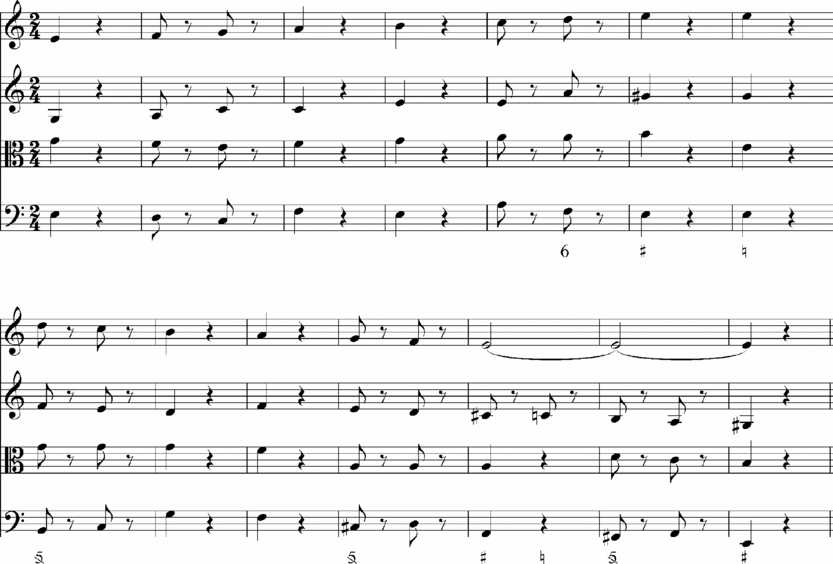
Little information survives concerning how the idea of a third mode was introduced in public, or how the simphonie was said to exemplify that mode at its premiere.Footnote 15 Fortunately, Blainville's Essay provides substantial information about how he conceptualized his innovation of a third, or mixed, mode. It makes clear that he conceived of it as a means to expand compositional possibilities beyond those afforded by the major and minor modes.Footnote 16 With respect to its scale, the mode corresponds to the octave species from E to E: that is, what is often thought of as the ‘Phrygian mode’, or the Hypoaeolian mode of renaissance theorizing. Thus, as Blainville emphasizes, his third mode – in contrast to the (tonal) minor mode – is the same both ascending and descending.Footnote 17 More noteworthy is the assertion that his mode ‘differs from the major mode in that its third is minor when beginning and major when concluding’.Footnote 18 And, indeed, the first and last movements of Blainville's simphonie begin on E minor chords and conclude on E major ones. He also acknowledges that this mode's normal diatonic modulation, which he exemplifies with a règle de l’octave-like progression at the start of the simphonie (see Example 1), will often involve many successive parallel triads, in apparent violation of the (Rameau-defined) rules of harmony. Rather than accepting this as a deficiency of his mode, Blainville points out that the rules of harmony have exceptions, and also argues that as the melody moves conjunctly when the basse fondamentale leaps, in the same way the basse fondamentale can progress conjunctly if the melody leaps.Footnote 19 His règle de l’octave-like progression contains no such melodic leaps, of course, so he evidently feels that his reasoning has broadly nullified Rameau's proscription of conjunct basse fondamentale successions.
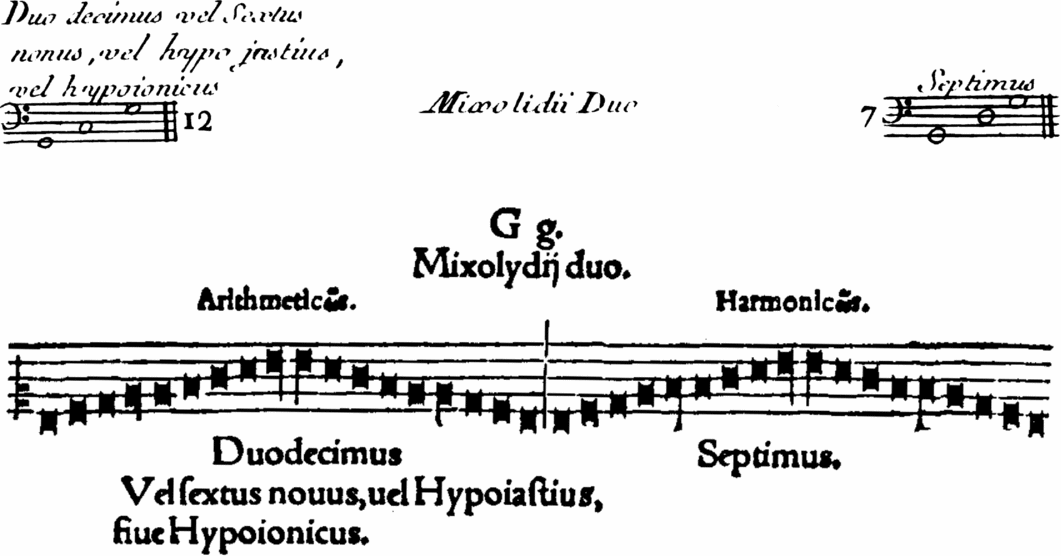
Illustrations of modes twelve and seven. Top staves from Blainville, Histoire générale, critique et philologique de la musique, plate 21; bottom staff from Henricus Glareanus, Dodecachordon (Basel: Henrichus Petrus, 1547), book 2, chapter 5, 74

Charles-Henri de Blainville, simphonie, first movement, from Essay sur un troisieme mode (Paris: Ballard, 1751), bars 1–14
The third mode's diatonic scale on E (that is, the white notes on a keyboard starting on E) is clearly distinct from the major and minor modes, but it overlaps in obvious ways with older, modal conceptions of pitch organization. Particularly pertinent is the system of so-called ‘church keys’ of Catholic psalmody, which were expounded in French by Guillaume Gabriel Nivers and Sébastien de Brossard, among others, between the mid-seventeenth and early eighteenth centuries.Footnote 20 This system, which has been elucidated by scholars such as Walter Atcherson, Joel Lester and Harold Powers,Footnote 21 comprises eight keys, or tones, which were understood as compositional frameworks defined in part by octave range and modal final (rather than tonic), and were based on the eight traditional formulas used for intoning psalms in liturgical settings. Of these eight keys, the fourth one (ton du quart) was traditionally distinguished by its octave range based on the note E, and a melodic emphasis on the notes A and C.Footnote 22 These similarities between the fourth church key and Blainville's mode mixte were apparent to authors of the day as well, and were mentioned both to defend and to dismiss the idea of a third mode. Blainville himself acknowledged that his mixed mode ‘existed in ancient counterpoint under the name “Ton du quart”’, but held that previous composers had not fully exploited its possibilities, and that composers of his day had abandoned an important resource.Footnote 23 Rousseau, in contrast, used the similarities between the mixed mode and other musical phenomena to minimize the former's originality. In a reflection on the troisiéme mode written shortly after the premiere of Blainville's simphonie, Rousseau observed that the third mode's scale is identical to that of a minor scale beginning on its dominant.Footnote 24 He also noted that the mixed mode's principal notes are the fourth and sixth, which we have seen is the case in the fourth church key, although he does not make this particular connection explicit.Footnote 25 Given these similarities in scale forms, Rousseau concluded that Blainville was brave to challenge the good opinion his day held of itself by extolling an antiquated mode, and also that one could argue about the validity of Blainville's claim to have invented or discovered a ‘new’ mode.Footnote 26
Although his third mode and the ton du quart do overlap in their pitch resources, Blainville defines many more of the characteristics of his mode's compositional usage than do most authors who write about the church-key system. The most significant of these characteristics for our purposes is the manner in which Blainville says the mode's scale ends.Footnote 27 He mentions two different kinds of progression that can function as conclusions in the third mode. The first of these occurs when the melody (dessus) and lowest voice both move by step to converge on the tonic, with one of these two voices, normally the lower, descending (rather than ascending) by semitone. This motion corresponds, of course, to what is today called the Phrygian cadence (major sixth expanding to octave with semitone step in the lower voice), and to its inversion (minor third contracting to unison with semitone in the upper voice, and compounds thereof). Blainville makes a few interesting observations about this progression: he proposes that the semitone that characteristically ascends in major and minor modes ‘is found in the mixed mode a degree above [the tonic], either in the bass or in the melody [dessus]’,Footnote 28 a conception that is quite similar to the descending leading note of late nineteenth- and early twentieth-century German theory, in which the minor scale was conceived of as descending from dominant to dominant.Footnote 29 Thus it concludes with a descending semitone from the submediant to dominant, analogous to the ascending semitone with which the major scale ends. He also likens the aural experience of this progression to cadences found in major and minor, first claiming that ‘the major sixth of the second note [that is, the minor seventh scale degree over the minor second degree] thus comes to acquire the influence on the ear that the major third of the dominant would have’.Footnote 30 Shortly thereafter, Blainville states that there is only a resemblance between this progression and what he calls the ‘cadence de repos’, which does not correspond to any of Rameau's standard cadence types.Footnote 31 The surrounding sentences reveal that Blainville here uses the phrase ‘cadence de repos’ to refer to the progression from a major sixth on scale degree six to an octave on the dominant, and possibly only in the minor mode, given the context of the mixed mode's semitone above the tonic. Thus he acknowledges that the succession of f–d1 to e–e1 occurs in both the minor and the third modes, but in the former it is a mere resting-point on the dominant. In his third mode, on the contrary, that same progression closes on the mode's tonic, and this, Blainville implies, is one of the things that distinguishes it from the minor mode.
For Blainville, however, this Phrygian-type cadence is not the preferred one for music in his new third mode. Rather, the cadence which he proposes as that mode's correlate to the perfect cadence of major and minor keys is none other than what we – and he, for what seems to be the first time in any extant printed source – call the ‘plagal cadence’. It too is the result of the third mode's unique scale. Because there is a diminished fifth above the mode's fifth scale degree, Blainville anticipates that his critics will object that ‘this mixed mode has neither a dominant [note], nor a perfect cadence’. To this objection he immediately responds, ‘I agree; but it does have the plagal cadence of the Ancients’.Footnote 32 This so-called cadence plagale is proposed as the troisiéme mode's functional equivalent to the perfect cadence, and consequently would be capable of ending pieces in the mixed mode. The passage is, to my knowledge, the first in print in which a particular cadence itself is characterized as ‘plagal’ (as opposed to, say, a listing of different cadences that could be used in plagal modes). There are a number of peculiarities. One is that Blainville characterizes his newly coined term as being ‘of the Ancients’, an odd claim that we will consider below, when we examine the strands of tradition upon which Blainville tacitly draws in order to call the cadence ‘plagal’. Another peculiarity is the lack of clarity affecting the term ‘cadence plagale’ itself, since neither here in the Essay nor in the subsequent Observation, which he published later the same year, does Blainville provide a clear explanation, much less a real definition, of his so-called ‘cadence plagale’.Footnote 33
The closest Blainville comes in these works to describing how to construct such a cadence is in a problematic passage slightly further on in the Essay:
En descendant j’ai le choix de finir ma Gamme par l’Accord parfait de sa quatriéme note, ou par l’Accord parfait majeur de sa tonique; ce qui se fait de deux façons, ou par la note soutenue dans le dessus ou par la cadence plagale dans la Basse.Footnote 34
When [the melody is] descending, I can choose to conclude my scale with the perfect chord of the scale's fourth note, or with the major perfect chord of its tonic, which is done in two ways: either by the [tonic] note sustained in the melody or by the plagal cadence in the bass.
Clearly, when the melody descends to E, the tonic, it can be supported by both an A triad (Example 2a) and an E major triad (2b), so the first part of the quotation is clear enough. As for what bass progressions might accompany the melody's descent, in Example 2a a descending fourth is the strongest candidate. The bass progression in Example 2b is drawn from Blainville's discussion of ways to descend to the tonic, and is, of course, the inversion of what we call the ‘Phrygian cadence’. In the second part of the quotation Blainville lays out two more compositional elements – namely, a sustained melody note, presumably the tonic (Example 2c), and ‘the plagal cadence in the bass’. He offers no more explanation for this latter phrase, but, as we will see, it quite certainly refers to the progression of a descending fourth to the tonic (Example 2d). This second half of the quotation is where Blainville's text becomes problematic. His reference to a conclusion ‘which is done in two ways’ is unclear, for we cannot tell whether he is referring to concluding on the scale's fourth note, on its tonic or both. More confusing still is the mutually exclusive relationship that Blainville sets up between the sustained melody note and the plagal cadence in the bass. His wording can only be taken to refer to two separate options, but as Example 2e shows, these two options can coexist, and, indeed, they often do so in Phrygian-identified pieces. In order to find a way out of this textual morass we will require more information.
Potential realizations of the descent to the tonic in the mixed mode, after Blainville, Essay sur un troisieme mode, 6
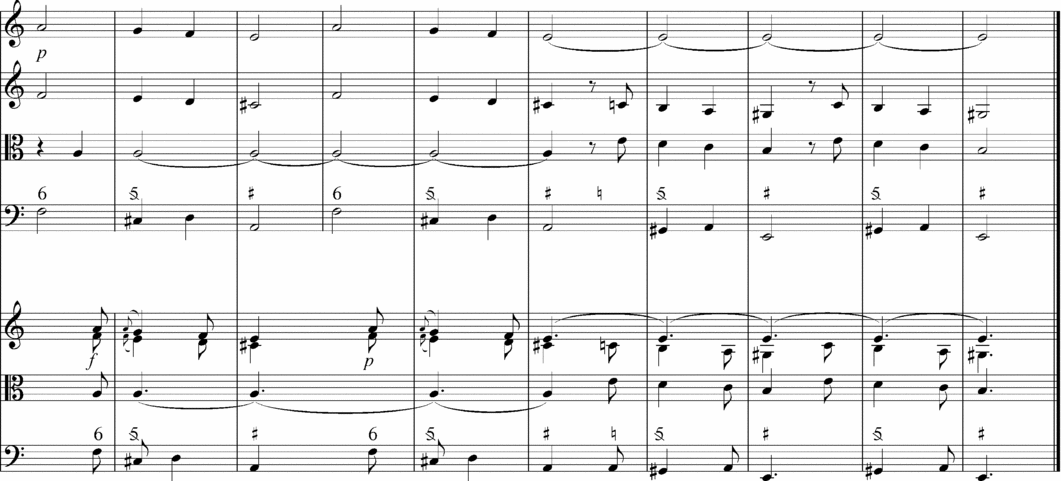
Fortunately, we can turn to Blainville's simphonie to see how he concludes movements in the troisiéme mode. The first and third movements both end with progressions from A minor triads to E major ones, with each chord in root position. These progressions confirm our earlier surmise that by the phrase ‘plagal cadence in the bass’ Blainville means the bass's descending-fourth progression from the fourth scale degree to the tonic (Example 2d). The upper system of Example 3 shows the conclusion of the first movement, and the lower system aligns the final movement's ending with that of the first movement above. This layout makes clear the extent to which Blainville recycles the pitch material of the first ending in the second. Both movements’ conclusions feature repeated harmonic progressions by falling fourth. Two motions from the root-position triad of D minor to that of A major accompany the melody's descent to the tonic, and, immediately thereafter, these harmonic progressions are reiterated a perfect fourth lower (A minor to E major), the two segments of the passage being identical except for their pitch level, some rhythmic alterations and swappings of the contrapuntal lines so that the melody now sustains the tonic.
Thus in this passage we have all four compositional elements that Blainville mentions in the ambiguous quotation considered above: harmonic support with an A triad and an E major one, a sustained note in the melody and a plagal cadence in the bass. Yet the simphonie presents a different relationship between these elements than is found in Blainville's text, as the four elements are gathered into two events, and the sustained tonic and plagal cadence are not mutually exclusive. The first of these events is characterized by the stepwise semitone descent of the melody to the tonic. While Blainville could accompany this with the inverted form of the ‘Phrygian’ cadence (Example 2b), he instead uses a form of the plagal cadence transposed to support the f1–e1 descent. Consequently, when the melody arrives on the tonic note, it is supported by an A major chord (Example 2a). Yet Blainville seems to require his mode mixte to conclude on an E major chord, so another progression is necessary. In this second event, the melody sustains the tonic (Example 2c), while the bass progresses by means of another plagal cadence (2d) to the required E major triad; these features combine to create the progression in Example 2e.
Blainville, simphonie, endings of first and third movements, from Essay sur un troisieme mode: (top staff) first movement, bars 238–247, (bottom staff) third movement, bars 36–44
The movement endings shown in Example 3 also point to a peculiar quirk of Blainville's conception of the cadence plagale. In the Essay, Blainville dwells on the significance of the semitone above the tonic, but he ignores the important role that other descending semitones play. His insistence that the troisiéme mode end on a major triad (a Picardy third) means that there must be a descending semitone from scale degrees four to three. Yet the Essay completely passes over the mixed mode's semitone between scale degrees six and five, an interval necessarily exploited in that mode's cadence plagale to the tonic. As a result of this scale and the obligatory Picardy third, the mixed mode's plagal cadence to the tonic will always proceed from an A minor triad to an E major one (or transpositions thereof). Although Blainville's discussion of the cadence plagale in this context may suggest that he understands the plagal cadence to apply only to the succession from a minor to a major triad, we will soon see that he also acknowledges the presence of the cadence plagale in repertory that is not in the third mode. Thus there is reason to believe that he also understands the plagal cadence to include descending-fourth progressions from major triad to major triad, and from minor triad to minor triad as well, as we do today.
While it appears that the association of ‘plagality’ and the descending-fourth bass progression originates with Blainville, the linkage between that progression and the concept of the cadence is most certainly not his responsibility. As far back as the early sixteenth century, German theorists described how to construct a ‘formal close’ (clausula formalis) in which the lowest voice falls by a fourth, and in the 1670s Wolfgang Caspar Printz explained that Phrygian and Hypophrygian modes end exclusively with a progression from an A minor triad to an E major one, for which he coined the verbose term ‘clausula formalis perfecta dissecta acquiescens’.Footnote 35 French theorists also addressed this kind of progression, conceiving of it as occurring either when the bass falls by fourth or rises by fifth (Nivers’ cadence imparfaite), or as the specific progression from tonic to dominant (Masson's cadence irreguliére).Footnote 36 Most famously, Rameau recast these ideas in his doctrine of the cadence irreguliere (or cadence imparfaite, as he called it in some mid-career publications), in which a triad with added sixth resolves to the triad a fourth lower. As with many other aspects of his theory, Rameau revises his position on this cadence over the years: in his early and late writings, including his Traité de l’harmonie (1722), Rameau conceives of the cadence irreguliere as including the progressions both from the fourth scale degree to tonic and from the tonic to its dominant.Footnote 37 In many of his intervening publications, however, he restricts the cadence to the progression from subdominant to tonic alone, perhaps in response to the Newtonian theory of gravitation which, as Thomas Christensen argues, may have informed Rameau's theorizing in his Génération harmonique (1737).Footnote 38
Thus far we have interpreted Blainville's ‘plagal cadence in the bass’ simply as a descending-fourth progression. Yet this understanding may be too broad. For if that were the intended extension, then the cadence plagale would be defined solely as a harmonic progression, not as a structural articulation, and thus the initial repeated progression in Example 3 (from d to A in the bass) would also count as a plagal cadence. There are several reasons, however, to restrict our understanding of ‘plagal cadence in the bass’ to the descending fourth from scale degree four to the tonic, just as Rameau did with his cadence imparfaite in the years before Blainville's Essay. The first such reason is that Blainville initially brings up the cadence plagale in a discussion of the third mode's lack of a dominant chord and perfect cadence. This context strongly suggests that the plagal cadence should be understood as a substitute for the tonic–dominant relationship, and thus that it should conclude on the tonic.
The second reason to restrict our understanding of the cadence plagale to the descending-fourth bass progression to the tonic draws upon the ‘Extrait des registres de l’Academie royale des sciences’ that was appended to the Essay. It comprises a summary of Blainville's ideas and a brief commentary upon them, and is co-signed by Jean-Jacques Dortous de Mairan (1678–1771) and Jean-Paul Grandjean de Fouchy (1707–1788), then the perpetual secretary of the Académie royale des sciences. Whereas Fouchy was primarily an astronomer and has not been remembered as having any particular connection to music, Dortous de Mairan had previously contributed to discussions of music theory in Paris, and thus is likely to have played the more active role in the composition of this text.Footnote 39 The crucial passage from the excerpt occurs at the end of a list of ways in which the third mode differs from the major and minor ones. The first three features that the authors mention are that the scale's first semitone is placed between the first and second notes of the scale, that the mode ends with a major third above the tonic and that the principal notes of the mode are the fourth and sixth, rather than the third and fifth. Then they write:
Les deux autres [modes] ont pour Cadence finale l’Intervalle de quinte: celui-ci aucontraire termine naturellement par celui de quarte. Cette terminaison à la quarte n’est pas cependant si particuliere à ce mode, qu’elle n’ait été très souvent employée en Musique. Les Anciens la connoissoient sous le nom de cadence plagale.Footnote 40
The two other [modes, that is, major and minor] have for their final cadence the interval of the fifth; this one, on the contrary, naturally ends with the interval of the fourth. This ending by the fourth is not, however, so unique to this mode that it could not have been employed very frequently in music. The ancients knew it by the name ‘cadence plagale’.
Here Dortous de Mairan and Fouchy make clear that the cadence plagale is defined by the interval of the fourth, and their earlier statement that the principal notes of the mode are the fourth and sixth suggests that the descending fourth from scale degree four to the tonic would have particular significance in the mode mixte.Footnote 41
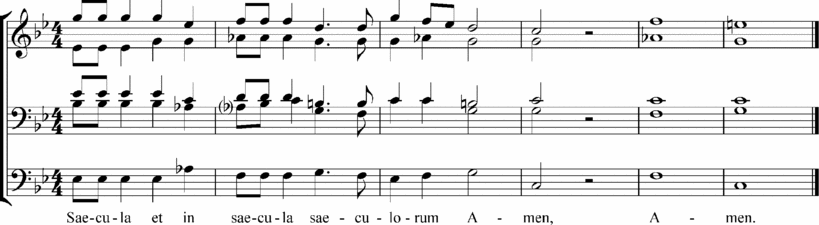
The final reason to restrict our understanding of the cadence plagale to the descent to the tonic looks to other repertoire said to exhibit plagal cadences. Immediately after his first mention of the cadence plagale, Blainville writes, ‘By what right do we reject this cadence? Do we not have the motets of Lalande, which it ends?’Footnote 42 While concluding plagal cadences do occur in Michel Richard de Lalande's motets, this happens much more rarely than Blainville's assertion would lead us to suspect.Footnote 43 Indeed, of the more than fifty distinct, complete Lalande motets preserved in two main collections, one copied by André Danican Philidor and the other owned (and perhaps copied) by Gaspard Alexis Cauvin, a mere two end with the interval of a descending fourth or ascending fifth in the lowest voice. One of the two examples comes at the end of the motet ‘De profundis’ (Example 4) from the Philidor collection. The final movement, which is a setting of the Gloria text, begins and ends on C minor harmonies, and the combination of the presence of B♮s and the lack of D♭s makes clear that this movement is not an example of Blainville's third mode. As for the final cadence, it conforms well to the modern interpretation of the plagal cadence as a postcadential elaboration: the descending-fourth progression to the tonic occurs immediately after a perfect cadence, and is even set to the word ‘Amen’.Footnote 44
A plagal cadence in Lalande (vocal parts only), from ‘De profundis’, S23/5, bars 47–52. Bibliothèque municipale de Versailles, Ms mus 13
Furthermore, the other motet that ends with a plagal cadence similarly concludes with a setting of the Gloria, this time beginning and closing on F major harmonies, which suggests that Blainville's cadence plagale could include the progression from the major subdominant as well.Footnote 45 The plagal cadence occurs analogously to that in Example 4, immediately after a strong perfect cadence and on the word ‘Amen’. From these two cases we may conclude that Blainville was not invoking Lalande's music to demonstrate the troisiéme mode generally, but rather only to prove that the plagal cadence, which he claimed was proper to his new mode, was already established as an acceptable and effective cadential progression in well-respected music.Footnote 46
There are, however, a few reasons to be cautious about understanding the cadence plagale as a fourth descending from scale degree four to the tonic. In later years, some French theorists, such as Choron, conceived of the cadence plagale as including the motion from the subdominant to tonic and also from the tonic to the dominant, which corresponds exactly to Rameau's conception of the cadence irreguliere in his early and late treatises.Footnote 47 While the authors of the ‘Extrait’ may have understood the term cadence plagale to embrace one or both of these progressions, they never explicitly restrict its descending fourth to any particular scale degrees. A late work by Blainville himself, the Histoire générale (1767), further complicates matters. Surprisingly, in this text an explicit explanation of the cadence plagale actually occurs. Blainville glosses the phrase as denoting a
progression de quarte en descendant d’une quatrieme à la tonique, ou bien montant de la tonique à la dominante, laquelle cadence la basse termine, portant toujours l’accord parfait majeur; note qui paroît en même-temps tonique & dominante.Footnote 48
progression of a fourth descending from a fourth [scale degree] to the tonic, or rising from the tonic to the dominant – a cadence ending with the bass, which always bears a major triad, [on a] note that appears simultaneously to be tonic and dominant.
Here, in 1767, Blainville unambiguously addresses how and where plagal cadences are made: a descending-fourth progression from scale degrees four to one or one to five, just like Rameau's cadence irreguliere. Yet one should be cautious about applying this gloss to the Essay's description of how the plagal cadence occurs in the troisiéme mode. In this passage from the Histoire, Blainville brings up the cadence plagale in the context of ecclesiastical contrapuntal practice, and not in a discussion of the third mode. Furthermore, the third distinctive feature of the mode mixte as described in the ‘Extrait’ is that its principal notes are the fourth and sixth scale degrees. The lack of emphasis on the tonic–dominant relationship in both the ‘Extrait’ and in the Essay itself – undoubtedly owing to the presence of a diminished triad on the third mode's fifth scale degree – makes it exceedingly likely that Dortous de Mairan and Fouchy, and probably Blainville as well, understood the cadence plagale in the mixed mode as encompassing only the harmonic progression from the subdominant harmony to the tonic chord, much as it is described today.
A DIGRESSION ON THE CADENZA PLAGALE
In a curious coincidence, an entirely independent Italian tradition of associating the concepts of cadence and plagality arose a mere two years after Blainville's coining of the cadence plagale. This tradition was initiated by Giuseppe Tartini (1692–1770), in his Trattato di musica of 1754. In contrast to Blainville, whose treatise was a brief attempt to extend compositional possibilities, Tartini penned a substantial volume of a primarily speculative nature. Considerations relating to acoustics constitute one significant component of his work, as his discovery of combination tones (terzi suoni) attests. Yet much of his theoretical output is concerned with manipulations of string lengths and numerical proportions in the antiquated manner of musica speculativa, a venerable tradition extending back to Plato and the Pythagoreans, but moribund by Tartini's time.Footnote 49
While Tartini does not explicitly state why he applies the concept of plagality to the cadence, his interest in string divisions and proportions makes his reasoning perfectly evident. In the fourth chapter of the treatise he introduces three types of cadences, defined in relation to the harmonic and arithmetic means. Given string lengths sounding the octave c–c1, g forms the harmonic mean, and thus a bass progression from g to c forms a harmonic cadence (cadenza armonica). Similarly, f is the arithmetic mean, so moving from f to c creates an arithmetic cadence (cadenza aritmetica).Footnote 50 The final cadential type is the ‘mixed’ cadence (cadenza mista), which proceeds from one mean to the other, namely, from f to g.
After setting forth these three kinds of cadences, Tartini then writes, ‘The harmonic cadence is called “authentic” by the ancient Greeks, and the arithmetic cadence “plagal”. We need not be concerned about the names; it is enough to know their demonstrative deduction’ (‘La cadenza armonica si è chiamata dagli antichi Greci Autentica, la cadenza [a]ritmetica Plagale. Nulla a noi per ragione de’ nomi; basta sapere la loro dimostrativa deduzione’).Footnote 51 In the context of traditional, quadrivium-based musical enquiry, an association between the terms ‘plagal’ and ‘arithmetic’ had long been posited, as we saw when we considered the origins of the term ‘plagal’. As a result of this association of ‘plagal’ and the arithmetic mean, Tartini's description of this cadence type as plagal is contingent upon understanding that its descending-fourth bass progression is actually set within an octave span, a span which the fourth mediates arithmetically. One can see that Tartini gives this arithmetic-proportional conception of the cadence priority over the plagal one because his standard way of referring to the progression is with the phrase cadenza aritmetica, and because he only involves the term plagale when glossing aritmetica.Footnote 52
Tartini's Trattato was first published three years after Blainville's use of the phrase cadence plagale in the Essay. Yet according to Pierluigi Petrobelli, Tartini had completed his treatise before Blainville's text:
By 1750, as can be inferred from his correspondence, the text of what was to become the Trattato di musica secondo la vera scienza dell’armonia was complete, and it was circulated to the ‘learned world’ (as Tartini himself called it) to be evaluated and discussed.Footnote 53
Disappointingly, Petrobelli does not elaborate how he made this inference, and in an earlier study he claims that Tartini's correspondence with Padre Martini makes clear that Tartini was still working on the final draft of the Trattato in 1752.Footnote 54 If Petrobelli's assertion that the text circulated widely in 1750 is correct, then it is possible that Blainville's articulation of the plagal cadence in fact drew its association of plagality and the cadence from Tartini. Yet this possibility is made unlikely by the fact that Tartini's principal French-language expositors do not appear to have encountered the Trattato until the mid-1750s at earliest.Footnote 55 Furthermore, both Rousseau and Jean-Adam Serre describe Tartini's doctrine of three cadential types in works published in the 1760s, yet neither author mentions Tartini's association of plagality and the descending-fourth cadence.Footnote 56 Indeed, with the exception of Blainville's aforementioned brief discussion of contrapuntal uses of the cadence plagale in his Histoire générale, the only explicit references to the cadence plagale in the French literature over the course of the 1750s to 1770s occurred in other authors’ descriptions of Blainville's third mode.Footnote 57 From this we may conclude that the French conception of the cadence plagale did not depend on Tartini's treatise.Footnote 58
THE ORIGIN OF BLAINVILLE’S CADENCE PLAGALE
One significant peculiarity of Blainville's explanation of the plagal cadence has yet to be mentioned, which is that he employs the term cadence plagale as if it were already well established in the literature.Footnote 59 He asserts that his mixed mode has ‘the plagal cadence of the Ancients’, in spite of the fact that musicians of earlier generations had no conception of a ‘plagal cadence’. Furthermore, Blainville neither clearly defines the term, nor even indicates that his readers might be unfamiliar with it. In contrast, when Jean-Philippe Rameau coined the term cadence interrompuë in his Nouveau systême, he clearly marked it as being an innovation: ‘These two other cadences derive from the perfect cadence. One is known by the name cadence rompuë, and the other, which does not yet have a name, can be called the cadence interrompuë.’Footnote 60 The questions of why Blainville attributed this cadence to ‘the Ancients’ and why he expected his readers to comprehend his term immediately are significant, and they connect directly to the central question of this study, namely, why this cadence type was described as ‘plagal’ in the first place.
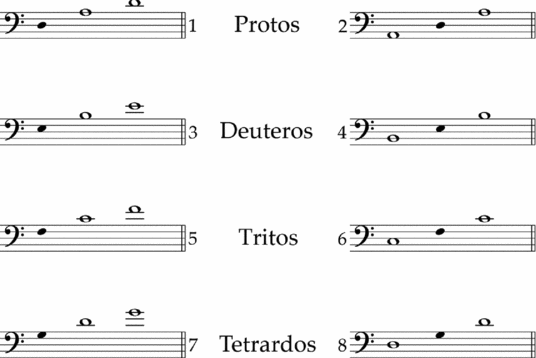
We have already mined Blainville's brief Essay for the information it provides on the cadence plagale, and it has not provided us with answers to any of these questions. Yet an explanation for why Blainville associates the fourth above the tonic with ‘plagality’ does exist elsewhere in his writings, and in a rather surprising context. In fact, the key to Blainville's innovation is buried within his highly idiosyncratic discussion of plainchant theory in the Histoire générale (1767). In order for the important peculiarities of Blainville's account to be clear, it is necessary to keep in mind the three characteristics that medieval authors used to classify modes: the familiar concepts of modal final and ambitus, as well as melodic emphasis (what came to be called the repercussio). This last characteristic serves to differentiate between authentic and plagal modes even when the chant melody's range is not decisively either authentic or plagal, and it does so on the basis of the note upon which the melody dwells. Thus the theorist we now call Pseudo-Odo, writing around the beginning of the eleventh century, recommends that a chant melody lying entirely between the note one step below the final and the sixth degree above it, a range too narrow to be clearly authentic or plagal, should be classified as authentic if it often ‘restrikes’ (repercutiat) the fifth and sixth degrees above the final (or begins on the fifth), but otherwise as plagal.Footnote 61 By at least the early sixteenth century this idea had developed into a fully fledged doctrine in which each mode, authentic and plagal, was associated with a certain pitch, called the repercussio (that is, ‘restriking’) by Nicolaus Wollick and later authors.Footnote 62 (See Example 5 for a transcription of Wollick's example of each mode's repercussio.) One should also note that when this doctrine was adapted by French theorists in the mid-sixteenth century, they chose to translate the term ‘repercussio’ as ‘dominante’, which is the point at which that term (and its cognates) entered musical discourse.Footnote 63
Modal repercussiones, from Nicolaus Wollick, Opus aureum musicae (Cologne: Henricus Quentel, 1501), f. E1v

Blainville's account of plainchant, however, fundamentally alters the relationships between these three characteristics. After taking his readers through a brief potted history of the development of ecclesiastical chant, Blainville turns his attention to the modal structure underlying that music, and to the distinction between authentic and plagal modes in particular:
Comme ils ne faisoient pas encore usage de l’harmonie, non plus que de la distinction de mode majeur ou mineur; c’étoit la finale de ce Chant qui décidoit le ton ou mode, & l’intervalle de quarte ou quinte en montant ou en descendant, & sur lequel le Chant rebattoit le plus souvent, décidoit aussi s’il étoit autentique ou plagal. . . Le mode est autentique, si la tonique monte à la quinte, & il est plagal si elle ne monte qu’à la quarte. . .
Il est bon de remarquer que l’origine d’autentique & de plagal, eu égard au progrès de quinte ou de quarte, peut se définir en deux manieres différentes; car ou la tonique en étoit elle-même la source par un double progrès, ou le plagal venoit de l’extension de l’autentique.
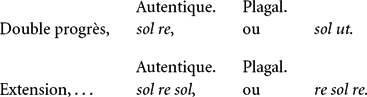
As [the Ancients] did not yet make use of harmony, nor the distinction between major and minor modes, it was the chant's final that decided the tone or mode; and the interval of a fourth or fifth (ascending or descending) which the chant restrikes the most frequently decided if it was authentic or plagal. . . The mode is authentic if the tonic [that is, final] ascends to the fifth, and it is plagal if it only ascends to the fourth. . .
It is good to note that the origin of authentic and plagal, with regard to the progression of fifth or fourth, can be defined in two different ways: for either the tonic was itself the source of it [that is, of the authentic/plagal distinction] by way of a twofold progression [to the fourth or fifth], or the plagal came from the extension of the authentic:
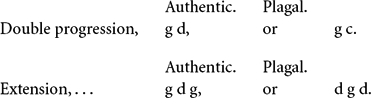
This quotation, in conjunction with a plate he provides to illustrate the modes, shows that Blainville was able to associate the descending-fourth cadence with ‘plagality’ because he misunderstood modal theory in two crucial respects. The first is that he confuses modal final, tonic and the lowest note of the modal octave, and the second is that he confounds the medieval doctrine of modal species of fourth and fifth with the idea of the repercussio, or dominante. Let us consider each of these in turn.
By the 1750s, as major–minor thinking became increasingly dominant in Western Europe, the concept of the tonic began to be mixed anachronistically into discussions of modal theory. When Rousseau does so, for example, he uses the term tonique as a synonym for the modal final, but otherwise transmits traditional doctrine quite faithfully.Footnote 65 As our quotation from the Histoire générale shows, however, Blainville imports the term ‘tonic’ into discussion of plainchant in a manner suggesting that he straightforwardly equates the concepts of modal final and tonic; furthermore, the aforementioned plate that Blainville provides to help explain the modes also suggests that he believes that the modal final always occurs at the bottom of the mode's octave scale. This is, of course, the case in authentic modes, but Blainville does not seem to be aware that the scale of every plagal mode descends below the modal final; indeed, considerations of ambitus are oddly underplayed in his account of modal theory.
The other crucial respect in which Blainville misunderstands modal theory is that he confounds the concept of the repercussio with the tradition of describing modes as combinations of species of fourths and fifths. In short, this tradition, which dates back to eleventh-century southern Germany, conceives of the ambitus of each authentic mode as a fifth extending up from the modal final, and then a fourth atop that fifth; plagal modes, in contrast, have the same fifth extending up from the modal final, but with a fourth below it (Example 6).Footnote 66 As a result, the octave range of authentic modes is divided at the perfect fifth above the lowest note, whereas that of plagal modes is divided at the fourth.
Analysis of modes into species of fifths and fourths (modal finals indicated by solid noteheads)
It is true that in most authentic modes the repercussio coincides with the note dividing the modal octave into fifth plus fourth in late medieval doctrine. Yet in the plagal modes there is no such correlation, as the note mediating the modal octave is a third or a fourth below the repercussio. Blainville, however, seems to believe that repercussiones always align with the species-based divisions of octaves, writing that ‘the interval of a fourth or fifth (ascending or descending) which the chant restrikes the most frequently decided if it was authentic or plagal’. His reference to an interval (that is, the note a given interval above the final/tonic) whose frequent repetition partially defines the mode is doubtless a reference to the concept of the repercussio/dominante, whereas his reduction of all authentic modes to the fifth and plagal modes to the fourth derives from the rigid systematization of the species approach, in which all authentic modes are analysed in the same way, and all plagal modes in another uniform fashion.
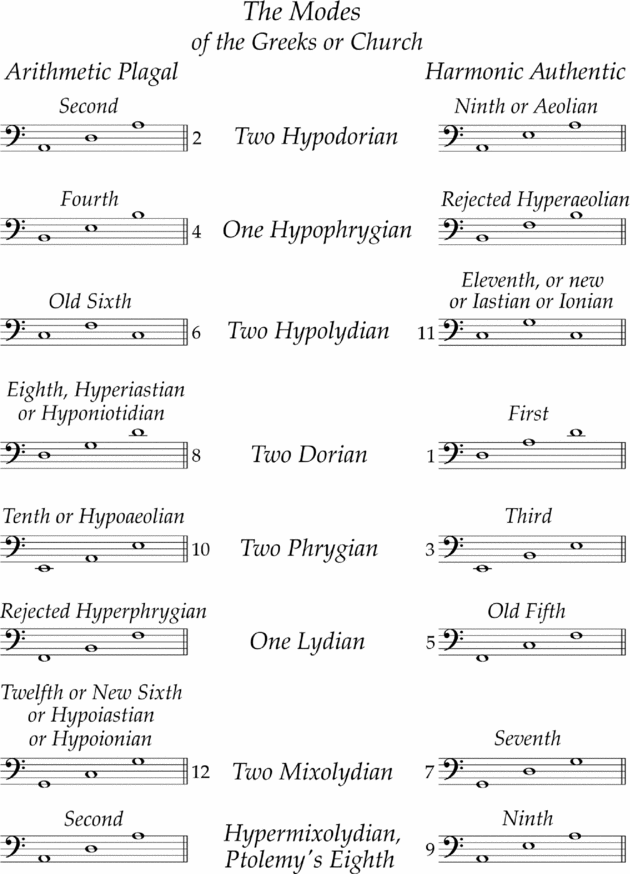
Blainville's illustration of the modes, from Charles-Henri de Blainville, Histoire générale, critique et philologique de la musique (Paris: Pissot, 1767), plate 21
Example 7 transcribes a plate from Blainville's Histoire générale.Footnote 67 Curiously, although this is the sole illustration Blainville provides to explain the modal system, it does not effectively convey the essential details of modal theory, such as final, overlapping ambitus and repercussio. Rather, it is a slightly mangled transcription of a diagram created by Glarean more than two hundred years earlier, which the latter theorist used to demonstrate his contention that there are actually twelve modes, rather than eight. Glarean's example shows that if one constructs octave scales on each of the notes A to G and then divides each octave both arithmetically and harmonically, then twelve usable modes are produced. In every octave Glarean emphasized the highest note of the scale, and also the note that mediates that octave into the applicable species of fifth and fourth. Blainville, however, makes several changes to Glarean's diagram, and his description of the modes strongly suggests that he interprets the diagram in a significantly different manner. The most important alteration is that Blainville reduces each modal illustration to the boundary notes of the octave and the mediating note, and thereby gives the lowest note of the modal octave more importance than it has in Glarean's version (see Figure 1). As a result of this reduction, Blainville's version of the illustration visually emphasizes the interval of the fourth above the lowest note in every plagal mode, and the fifth above in authentic modes. Since Blainville describes precisely these intervals above the tonic as constituting the difference between plagal and authentic modes, we can conclude that he chose to reproduce this unusual diagram (rather than one clearly communicating modal final and overlapping ambitus, such as Example 6) because it seems to fit his misapprehension that modes are distinguished primarily by the repetition of a particular interval above the tonic (that is, above the modal scale's lowest note).
We now see the two misconceptions that led Blainville to think erroneously that the interval of a fourth above the tonic was particularly characteristic of plagal modes in plainchant – the music of ‘the Ancients’. The connection he drew between his troisiéme mode and the concept of ‘plagality’ also becomes clearer. According to Blainville's diagram (Example 7), the modal octave labelled ‘third’ (what we call the Phrygian mode) and that labelled ‘tenth’ (our Hypoaeolian) are both Phrygian; the authentic ‘third’ one emphasizes the fifth above the tonic, whereas the plagal ‘tenth’ mode – and also the mode mixte – emphasizes the fourth above. Indeed, Blainville comments in the Histoire générale that ‘since [the mixed mode’s] fourth note is used as its dominant, [the mode] is divided by this fourth note, and it can give the property of [being] plagal to [the fourth note]’ (‘en ce que sa quatrieme note lui tient lieu de dominante, ce qui fait qu’il se partage par cette quatrieme note, & ce qui peut lui donner la propriété de plagal’), thereby making explicit the connection between his new troisiéme mode and the quality of ‘plagality’.Footnote 68
Blainville's decision in the Essay to name a descending-fourth cadence the cadence plagale, and to call it ‘the plagal cadence of the Ancients’, is finally understandable. Yet with this mystery explained, another arises: whence did Blainville get this idiosyncratic understanding of the plagal modes that led him to coin the term cadence plagale?Footnote 69 To answer this question, we will consider the significant shifts undergone by the concept of the modal final from the medieval period to the eighteenth century, and, in particular, how that concept was transmitted by the Dictionaire de musique (1703) of Sébastien de Brossard. This was the first musical dictionary in French, and was reprinted at least four times.Footnote 70 It also remained in circulation into the 1750s, as it was an important source for Rousseau's Dictionnaire, and was cited by Blainville when clarifying his ‘mode mixte’ in a rejoinder to Serre.Footnote 71 In his lengthy definition of the word tuono, Brossard clearly lays out the basics of the medieval understanding of modes, and treats in turn the characteristics of final, ambitus and repercussio, which he calls the dominante.Footnote 72 In this passage Brossard's account of the modal final (finale) is entirely concordant with traditional plainchant theory.
Yet the concept of the modal final was not restricted to discussions of monophonic music. From the earliest attempts to apply the modal system to polyphony, theorists drew upon the modal final in their discussions, and by the time of Zarlino it was held that the lowest voice of a composition should end on the finale.Footnote 73 When we turn to Brossard's definition of the term finale, we find a similar reference to the importance of the lowest voice, but with a newly added emphasis on the interval by which the bass leaps to its final note:
En général c’est la derniere Notte de chaque piece. Mais en particulier, c’est la derniere Notte de chaque mode ou Ton, qui luy donne le nom et qui le charactérise ou distingue de tous les autres. Si l’on tombe à cette Finalle dans la Basse par l’intervalle de 5e. en descendant, ou de 4e. en montant, Ce Mode est Authentique, ou Parfait. Si l’on y tombe par intervalle de 4e. en descendant, ou de 5e. en montant le Mode est Plagal ou Imparfait.Footnote 74
In general this is the last note of each piece. But in particular, it is the last note of each mode or tone, which gives its name to [the mode], and which characterizes or distinguishes [the mode] from all the other [modes]. If one lands on this final by the interval of a descending fifth or ascending fourth in the bass, the mode is authentic, or perfect. If one lands there by the interval of a descending fourth or ascending fifth, the mode is plagal, or imperfect.
Note, in particular, that in authentic modes the bass may rise by a fourth to the final. In this conception of modality, it is scarcely possible to distinguish between plagal and authentic modes based on whether the melody extends far below or above the final. Instead, the distinction between plagal and authentic rests not on ambitus but on the type of concluding cadence.Footnote 75 Indeed, if Blainville consulted this passage during his reading of the Dictionaire, which is entirely possible, he would have found nothing that challenged his apparent misapprehension that the concepts of modal final and tonic are essentially interchangeable.
Since it was difficult for Brossard and others to describe the modality of contemporaneous polyphonic repertoire by appealing to the combination of finale and ambitus, they sought other means by which to determine the mode. Thus, after his thorough discussion of modal ambitus, Brossard plays down its relevance, and instead proposes a different set of criteria: ‘One ought also to note well in all other chants of whatever ambitus that nothing is more certain for knowing the tone than to examine the final and the dominante’.Footnote 76 Here we find striking similarities to Blainville's neglect of modal ambitus, and, more importantly, to his emphasis on the determinant nature of the dominante/repercussio.
Furthermore, at times Brossard also exhibits a tendency to blend together language suggestive of the concept of repercussio with the species-based mediation of modal octaves into fifths and fourths. With the exception of the final reference to the note a third above the final, one can easily map this quotation onto Blainville's mistaken scheme:
Entre tous les Sons compris dans l’étenduë de l’Octave, il y en a un qui la divise Harmoniquement, c’est à dire, qui est une 5e juste au dessus de sa plus basse Chorde; & un autre qui la divise Arithmetiquement, c’est à dire, qui est une 4e plus haut que sa plus basse Corde.. . . C’est cette double division qui a formé les deux classes des Modes, dont il est si souvent parlé dans les Auteurs, sçavoir, celle des Modes Authentiques, & celle des Modes Plagaux. Car lorsque dans un Chant, on rebat ou l’on fait entendre souvent le Son qui est une 5e au-dessus de la plus basse Corde de l’Octave d’un Mode, c’est pour lors un Mode Authentique; & lorsqu’on rebat celuy qui n’en est éloigné que d’une 4e, ou un autre qui fait la 3e contre sa Finalle, c’est un Mode Plagal.Footnote 77
Between all the sounds included in the ambitus of the octave, there is one which divides it harmonically, that is, which is a just fifth above its lowest note, and another which divides it arithmetically, that is, which is a fourth above its lowest note.. . . It is this twofold division which has formed the two categories of modes (of which authors so often speak), to wit, that of the authentic modes, and that of the plagal modes. Because when in a chant one re-sounds or often makes heard the sound which is a fifth above the lowest note of a mode's octave, it is then an authentic mode; and when one rearticulates that [note] which is only a fourth distant, or another which makes a third against the final, it is a plagal mode.
Note in particular Brossard's indication of two possible ‘re-sounded notes’ – which surely evokes the repetition of a note so characteristic of the repercussio – in plagal modes. As Example 5 demonstrated, traditional modal theory held that the repercussio in plagal modes was either a third or a fourth above the final. When confronted with the ambiguity of Brossard's mention of ‘that note which is a fourth distant’, readers familiar with how the repercussiones work could read the phrase proleptically, such that the repercussio is a fourth distant from the modal final to which Brossard will soon refer. Yet the grammatical structure more easily supports interpreting the phrase as referring to the note a fourth from the lowest note of a mode's octave, as Blainville understands it, and this reading could be corroborated by Brossard's omission of the fact that the repercussio occurs on the sixth above the final in the third (authentic) mode.
Thus Brossard's descriptions of how to differentiate plagal from authentic modes included several passages that could be misread to support an unorthodox account of plainchant's system of modality, and his account of the modal final draws an explicit connection between plagal modes and the descending-fourth cadence. All that was left was for Blainville to misread Brossard's text to produce the system shown in Example 7, and then explicitly to yoke the concepts of plagality and the cadence, on the basis of his distorted understanding of the practice of ‘the Ancients’.
As we have seen, the early history of the cadence plagale is bound up with Blainville's proposed third mode. The latter innovation, however, was met with scepticism. Rousseau emphasized that Blainville had little right to call it an innovation, since, as Blainville himself noted, the mode mixte was not new, and had formerly existed under the name ‘fourth tone’ (ton du quart).Footnote 78 Additionally, neither Rousseau nor Serre was willing to grant the E-based scale the autonomy which Blainville claimed for it, as Rousseau derived it from a dominant-beginning minor scale, and Serre described it as the mirror image of the major scale.Footnote 79 As a result, both authors doubted Blainville's contention that his mode mixte constituted a style of modulation distinct from major and minor. In his Dictionnaire Rousseau writes:
l’on conclut que son Mode mixte est moins une espèce particulière qu’une dénomination nouvelle à des manières d’entrelacer & combiner les Modes majeur & mineur, aussi anciennes que l’Harmonie, pratiquées de tous les tems. . . Footnote 80
one concludes that his mixed mode is less a specific species [of modulation] than a new name for some styles of interweaving and combining the major and minor modes, as ancient as harmony, practised at all times. . .
In effect, this disagreement amounts to a debate about the nature of what would come to be called tonality: is the system of major and minor scales sufficient to describe all acceptable music of the day, or is it possible that other scales could also be musically fruitful?
The disagreement about the status of the third mode also pertains to the cadence plagale. If Blainville had, in fact, identified a musical mode equivalent in status to major and minor, then the plagal cadence had to be recognized as being equally conclusive and important as the cadence parfaite of major and minor keys. If, on the other hand, Blainville's mode mixte were merely an unusual style of composing within the major/minor system, as Rousseau and Serre contended, then there would be no distinct musical system requiring the plagal cadence. Consequently, this eighteenth-century debate about the nature of tonality, which was the context of the first published articulation of the cadence plagale, also entails the question of whether that cadence is equal in status to the cadence parfaite, and capable of concluding music by itself. In more recent terminology, is the IV–I progression merely a postcadential, contrapuntal elaboration of a requisite perfect cadence, or is it an independent, functional cadence?
History, however, was not kind to Blainville's proposal. The hegemony of major–minor tonality was scarcely disturbed, and Rousseau was the closest Blainville had to a defender of his ideas. Indeed, even Blainville himself came to have doubts about his mode mixte: in an undated letter he wrote to Rousseau, he admitted that he had come to believe that the troisiéme mode was imaginary, and that rather than being a real mode, it was merely a style of modulation.Footnote 81 Thus the problem of how to end this new mode, which was motivation for the first published application of plagality to cadence, was eventually a moot point. Before Blainville, the descending-fourth progression, under such names as cadence irreguliere and cadence imparfaite, had been described by Rameau and others as merely one of several possible cadential progressions, and Blainville's attempt to recast it as the cadence plagale and link it with his third mode was not successful in challenging the status quo. In the following years, there was no musical situation that was understood to demand the concept of the cadence plagale, nor did any French author articulate a compelling justification for conceiving of that cadence as plagal in the first place. Based on this, it hardly seems surprising that the following generation of writers largely ignored the cadence plagale. And yet even though the nineteenth century saw neither a dramatic increase in descending-fourth conclusions nor a new compelling explanation of the term, the concept of the plagal cadence – plagalische Schluß, cadenza plagale and cadence plagale – together with its complement the authentic cadence, which was added to fill out the terminological system,Footnote 82 none the less came to assume a new vitality within musical discourse, and a longevity that has lasted even up to the present day.