Introduction
The definitive host of the acanthocephalan Pallisentis (Neosentis) celatus (van Cleave) (Quadrigyridae) is the rice-field eel Monopterus albus (Zuiew) which lives in the rivers, lakes, ditches and paddies of Southeast Asia. Reservoir hosts include Anguilla anguilla, Silurus asotus, Pelteobagrus fulvidraco, Erythroculter ilishaeformis, Ctenopharyngodon idellus and Misgurnus anguillicaudatus (Zhang et al., Reference Zhang, Qiu and Ding1999). Wang (Reference Wang1965) studied the morphology and life cycle of P. (N.) celatus in China, and confirmed that Mesocyclops leuckarti Claus (Crustacea, Cyclopoida) served as the intermediate host.
There are some reports in China about the population ecology and infection of P. (N.) celatus in the intestine of the rice-field eel (e.g. Chen et al., Reference Chen, Mao and Li1993; Fang, Reference Fang1996; Zeng & Liu, Reference Zeng and Liu1996; Fang et al., Reference Fang, Liu and Tang1998; Wen et al., Reference Wen, Yang and Zhang2000; Zeng et al., Reference Zeng, Liu, Tan and Zhou2000; Wen, Reference Wen2003; Bing & Xia, Reference Bing and Xia2004; Wang et al., Reference Wang, Zeng, Wang, Luo and Wang2004). The mean abundance and intensity of P. (N.) celatus in M. albus increased with an increase in fish body length, which was related to the greater intestinal space and larger eating capacity of bigger fish (Wang et al., Reference Wang, Zeng, Wang, Luo and Wang2004). There is only an incomplete study on seasonal dynamics of P. (N.) celatus, which was studied by Fang & Xiang (Reference Fang, Xiang and China Zoological Society1999) from March to December, and only two studies on seasonal population variations of Pallisentis and quadrigyrid acanthocephalans in fish have been reported (Khan et al., Reference Khan, Bilquees and Shaukat1991; Rosim et al., Reference Rosim, Ceccarelli and Silva-Souza2005). The present study therefore focuses on the seasonality of P. (N.) celatus population dynamics in M. albus.
Materials and methods
In the Dong-ting Lake basin, spring lasts from March to May, summer from June to August, autumn from September to November, and winter from December to February of the following year.
The wild rice-field eels examined in the present study were from paddies and ditches in the Dong-ting Lake basin. From June 2002 to May 2003, about 50 fish were netted each month and transferred live to the laboratory. Fish ranging between 250 mm and 500 mm in body length were selectively sampled in order to avoid any biased effect of host size on the results because the bigger fish have more P. (N.) celatus than fish less than 250 mm in body length (Wang et al., Reference Wang, Zeng, Wang, Luo and Wang2004).
Fish were taken to the laboratory alive, measured, sexed, and dissected within 48 h of capture. The entire intestine was removed and divided into ten sections based on percentages of the total length from the pylorus end. Each section was opened in physiological saline solution and examined for acanthocephalans, which were placed into distilled water for 12 h to enhance eversion of the proboscis prior to being preserved in 70% ethanol solution. The number of P. (N.) celatus in each fish was recorded.
About 1151 worms from all season samples were prepared for staining by standard methods. Female worms were divided into three developmental stages: (i) immature ovary not fragmented; (ii) ovarian balls present; and (iii) gravid-ovarian ball and eggs present and those with eggs only. Males were also divided into three groups: (i) immature (testes and sperm duct smaller and indistinct in stained specimens), (ii) mature; and (iii) mature with everted bursa (Muzzall, Reference Muzzall1980). Worm length was measured in millimetres from the top of the proboscis to the posterior end of the body as worms become fully extended when placed in cold water prior to fixation.
Prevalence, mean intensity and mean abundance of parasites were used as defined by Bush et al. (Reference Bush, Lafferty, Lotz and Shostak1997).
The software package SPSS 10.0 for Windows was used to analyse the data. The significance test for seasonal changes in abundance, mean intensity, mean length of parasites and mean length of fish was carried out using one-way ANOVA. The method of calculating the negative binomial distribution parameter k, which is inversely related to the degree of aggregation, was taken from Southwood (Reference Southwood1978). The index of niche breadth was calculated using an equation based upon the diversity index of Shannon-Weiner (Sun, Reference Sun2001) and the significance of seasonal changes of P. (N.) celatus distribution along the host intestine was tested by the dependence test of r × c crosstabs (Li et al., Reference Li, Wang and Wang2000).
Results
Seasonal changes in infection parameters of P. (N.) celatus
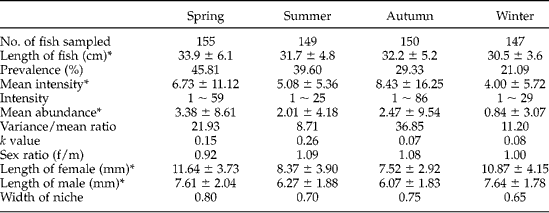
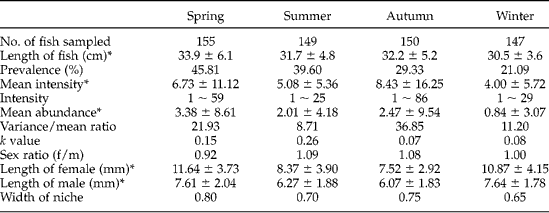
A total of 1273 individuals of P. (N.) celatus were collected from 601 individuals of M. albus between June 2002 and May 2003 for seasonality analyses. The prevalence, intensity and other parameters of P. (N.) celatus in the fish host throughout the seasons are shown in table 1. Prevalence values were above 21% in all seasons sampled and with a distinct seasonal trend. Prevalence value was highest (45.81%) in the spring, after that decreased by degrees. Mean intensity reached a peak in the autumn and its lowest level in winter, somewhat increased in the spring, but decreased in the summer. Significant seasonal differences were found in mean abundance between winter and spring (sig. = 0.005), winter and autumn (sig. = 0.040 < 0.050). However, no significant seasonal variations were found in mean abundance between other seasons (F ratio = 1.171, P = 0.311) and mean intensities (F ratio = 1.368, P = 0.254).
Seasonal parameters of Pallisentis (Neosentis) celatus in the host Monopterus albus.
*Mean ± standard error.
The sex ratio of females to males was highest in the summer (1.09:1), then decreased through the autumn (1.08:1) and winter (1.00:1) and reached its lowest level in the spring (0.92:1) of the following year.
Frequency distribution of P. (N.) celatus
The distributions were highly over-dispersed (table 1) with the frequency distributions showing similar patterns in different seasons. Variations in the binomial distribution parameter k related to the change in prevalent values, with a lower prevalence generating a higher degree of over-dispersion in the autumn and winter, and a higher prevalence generating a lower degree of over-dispersion in the spring and summer.
Size composition of the P. (N.) celatus population
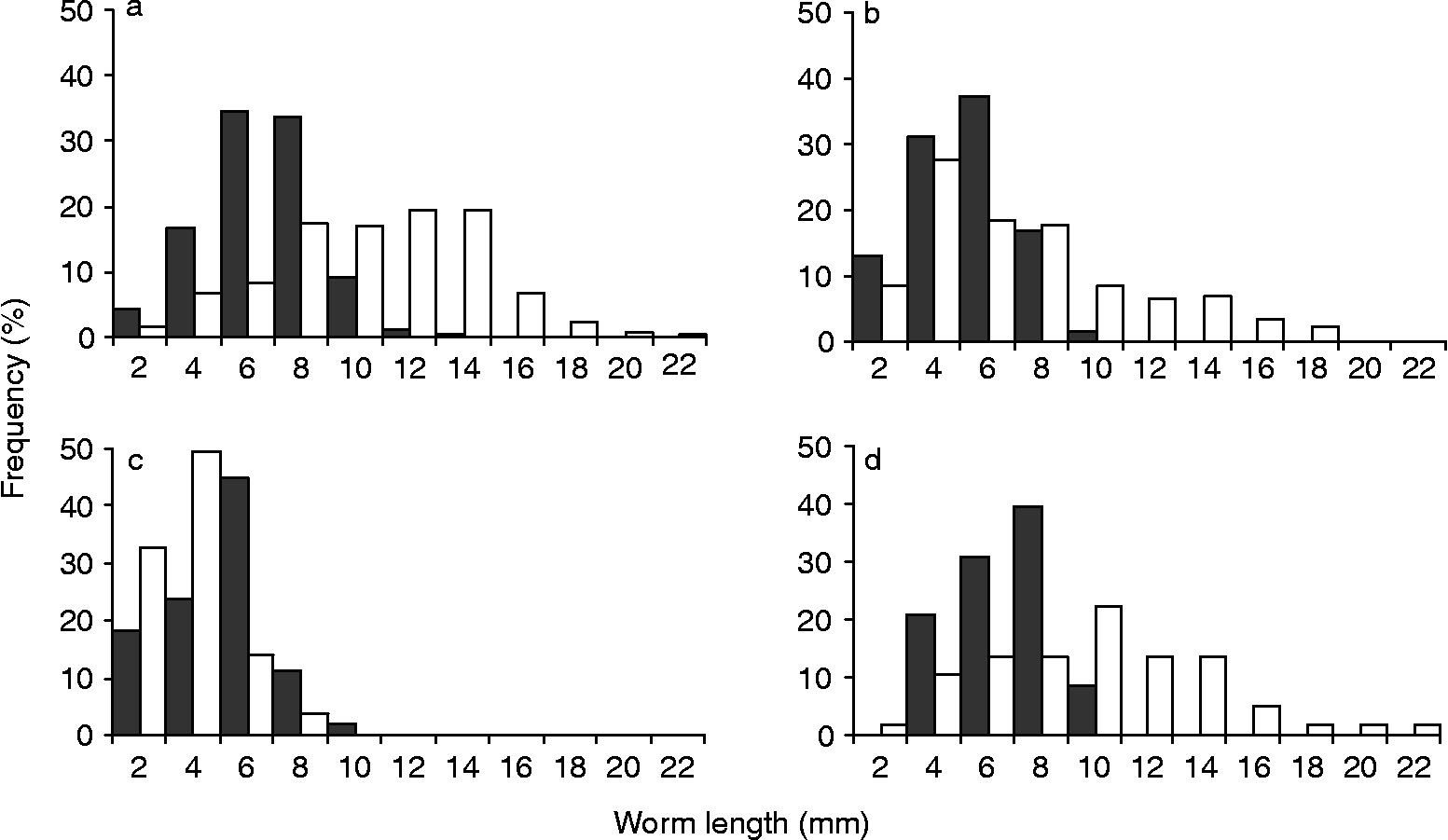
The lengths of female P. (N.) celatus ranged between 2.2 mm and 22.2 mm and those of males between 2.0 mm and 14.0 mm. The mean female length was significantly higher than that of males (2-tailed sig. P = 0.000, df = 1189). The proportion of individual females and males less than 4 mm peaked in the autumn (32.75% and 18.24%), was lowest during the winter (1.72% and 0), and then increased slowly throughout the spring (1.75% and 4.45%) and summer (8.51% and 13.18%) (fig. 1). These changes indicate that the main recruitment phase in the worm populations occurred in the summer and autumn, especially in the autumn. The proportion of males larger than 8 mm in length decreased considerably from the spring (9.31%) to the summer (1.55%) and autumn (1.89%), whereas females with lengths more than 10 mm which had not begun to decrease at the same time as the males decreased to 1.21% in spring, 0 in summer, 0 in autumn and 0 in winter (fig. 1). This indicated a significant loss of larger males, which was considerable throughout the seasons, especially in the autumn, summer and winter.
The length of male (■) and female (□) Pallisentis (Neosentis) celatus populations in the host Monopterus albus in spring (a), summer (b), autumn (c) and winter (d).
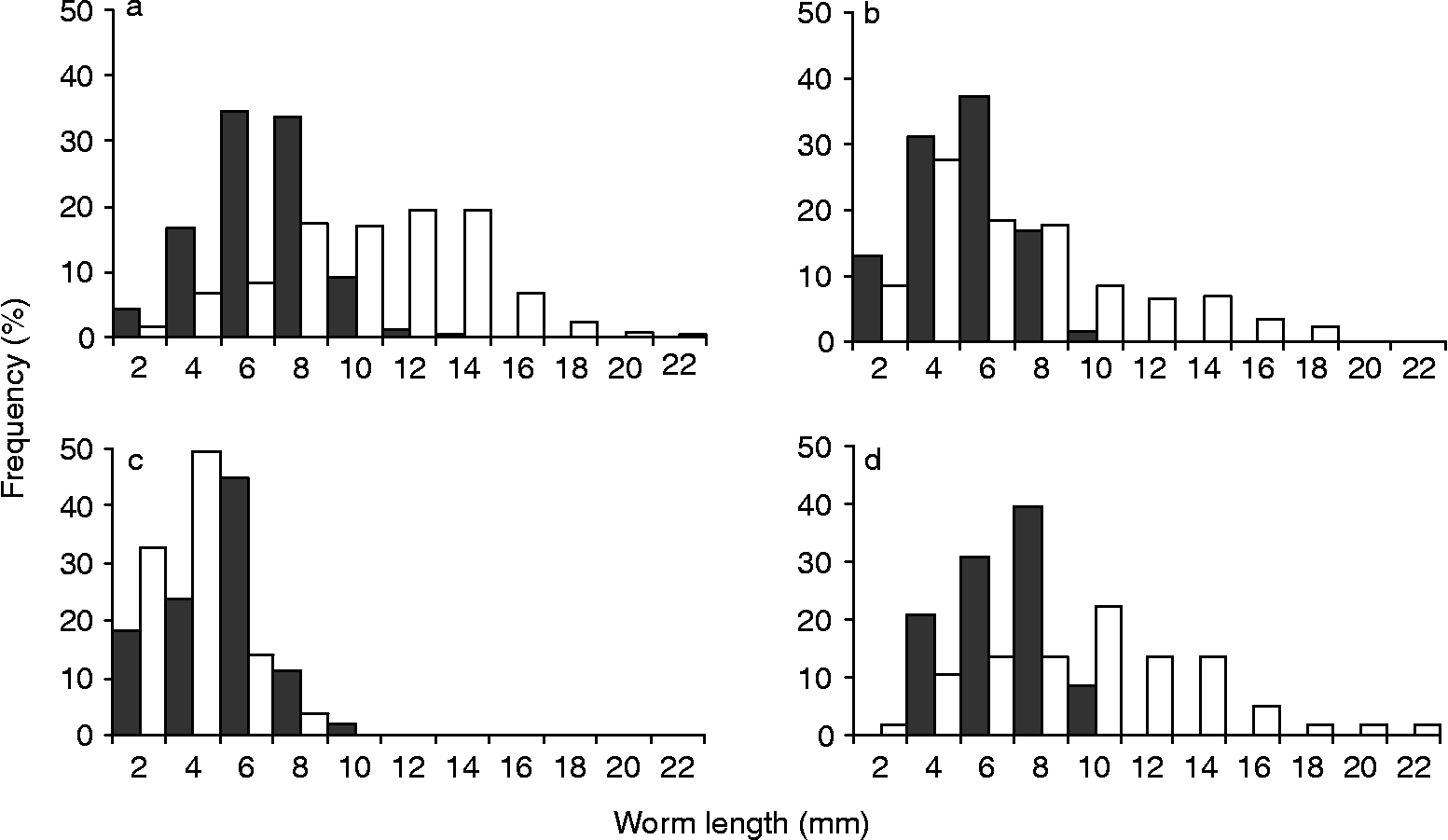
The results of t-tests for mean worm lengths in different seasons demonstrated that both the males and females in the winter and spring were significantly longer than those in the summer and autumn. From the spring to summer mean lengths of both sexes significantly decreased (for males 2-tailed sig. < 0.0001, df = 374; for female 2-tailed sig. < 0.0001, df = 367). From the summer to autumn the change was not statistically significant (2-tailed sig.>0.39 and 0.18 for males and females respectively). From the autumn to winter mean lengths of both sexes significantly increased (for males 2-tailed sig. < 0.0001, df = 215; for female 2-tailed sig. < 0.0001, df = 227). From the winter to spring the change was not statistically significant (2-tailed sig.>0.89 and 0.73 for males and females respectively).
Population structure of P. (N.) celatus
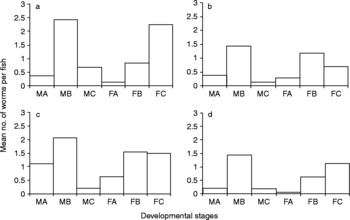
Males with an everted bursa and gravid females were present throughout the seasons, with maximum numbers in the spring (fig. 2). Immature worms were also recovered throughout the seasons, with a peak in the autumn. There was a clear loss of mature males and females from the spring to summer, with a few losses of mature males and females occurring from the autumn to winter. This demonstrated loss of post-copulatory males and gravid females at the same time.
The population structure of Pallisentis (Neosentis) celatus in Monopterus albus in spring (a), summer (b), autumn (c) and winter (d). FA, immature female; FB, ovarian ball female; FC, gravid female; MA, immature male; MB, mature without everted bursa; MC, mature male with everted bursa.

Distribution of P. (N.) celatus along the intestine
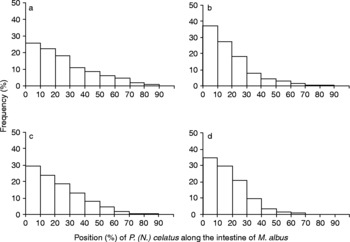
The distribution of P. (N.) celatus population along the intestine was not stable in all four seasons (fig. 3). Significant seasonal variations were found in niche breadths between spring and summer (χ 2 = 32.70 >  , P < 0.01, df = 10), between spring and winter (χ 2 = 22.02> χ 20.05 = 18.31, P < 0.05, df = 10), but were not found in niche breadths between other seasons. In all four seasons, the highest number of worms was recovered from the anterior 10–40% of the intestine and a small number of worms were recovered from the next 50–90%, but none were found in final posterior 10% of the intestine. The niche breadths of worms varied with the mean intensity of infection in different seasons, its value was highest in the spring and lowest in the winter. Seasons with higher mean intensities had wider ecological niches.
Distribution of Pallisentis (Neosentis) celatus in intestine of Monopterus albus in spring (a), summer (b), autumn (c) and winter (d).

Discussion
The present results showed significant seasonal variations in prevalence and mean abundance of P. (N.) celatus in the host population in the year. The high prevalence found in spring and summer tallies with the fact that pallisentisiosis occurs in all seasons and has a prevalent peak in the summer (Lu, Reference Lu1989). The trend of seasonal changes in the prevalence of P. (N.) celatus was similar to that found in the investigation by Chen et al. (Reference Chen, Mao and Li1993) from fishponds in Hubei Province and Bing & Xia (Reference Bing and Xia2004) from random sampling in Jiangsu Province, but the latter both had only observed 4 or 5 months of a year and found higher prevalence in all months than the present paper. However, this result was different from the investigation by Fang & Xiang (Reference Fang, Xiang and China Zoological Society1999) from paddies in Hubei Province and Wen et al. (Reference Wen, Yang and Zhang2000) from random sampling in Sichuan Province, who discovered that the lowest prevalence values occurred at the end of the summer and the highest at the end of the autumn. These differences related to the different environments sampled (e.g. paddies, ditches, fishponds and lakes). The fact that prevalence was most obviously higher in lakes than fishponds had been discovered by Chen et al. (Reference Chen, Mao and Li1993). It is possible that human actions (farming and using chemical fertilizers and drugs) have influenced the feeding of the eel and quantitative distribution of the intermediate host, M. leuckarti in paddies and fishponds. It may be considered that the density of M. leuckarti is not entirely identical in different water environments. Kennedy (Reference Kennedy, Crompton and Nickol1985) affirmed that the population of an acanthocephalan parasitic in fish is at a dynamic equilibrium, continually recruiting and losing, and the primary factors limiting population size of the parasite are water temperature, density of intermediate host, feeding habit and feed composition of definitive host, etc. Thus, the seasonality in mean abundance of P. (N.) celatus is related to the seasonal changes of the water temperature, the density of M. leuckarti and feeding habit and feed composition of the eel.
Over-dispersed distributions of P. (N.) celatus populations in M. albus in the four seasons are observed, which follow the common distribution pattern of parasites in their host population (Anderson, Reference Anderson1974; Gordon & Rau, Reference Gordon and Rau1982; Scott, Reference Scott1982; Yang & Liao, Reference Yang and Liao2001). This pattern is generally described as the negative binomial distribution model of a different parameter k, an index used to judge the relative degree of aggregation (Crofton, Reference Crofton1971). The distribution pattern reported herein might be primarily determined by density independent factors such as heterogeneity in temporal and spatial distribution of infective stages together with changes in the feeding behaviour and food selectivity of M. albus. The distribution of P. (N.) celatus in the rice-field eel population in all seasons was over-dispersed. This fact has proved that the acanthocephalans that co-exist in host fish for a long time have formed a relatively stable host–parasite relationship. This is of the same view as Anderson & May (Reference Anderson and May1978).
For dioecious parasites like nematodes, acanthocephalans, some species of trematodes, and some parasitic protozoa, the sex ratio and mating system (monogamous or polygamous) have a profound impact on the fecundity and relationship of host and parasite (Morand & Rivault, Reference Morand and Rivault1992). The present result that the sex ratio of females to males of P. (N.) celatus was highest in the summer is similar to the findings of Eure (Reference Eure1976), who observed a drastic loss in the male acanthocephalan, Neoechinorhynchus cylindratus, during the summer when copulation had already been completed. Similar results were reported for Echinorhynchus clavula (Chubb, Reference Chubb1964), E. truttae (Awachie, Reference Awachie1965), Acanthocephalus parksidei (Amin, Reference Amin1975), Moniliformis dubius, Macracanthorhynchus hirudinaceus, Polymorphus minutus and Neoechinorhynchus saginatus (Parshad et al., Reference Parshad, Crompton and Nesheim1981) and this may result in the loss of presumably short-lived males. Interestingly, numbers of immature males were higher than those of immature females in all seasons.
Significant changes in the distribution of P. (N.) celatus along the intestine of the fish were observed between summer, winter and spring. The result is different to that of Neoechinorhynchus qinghaiensis, which showed no significant changes in distribution along the alimentary canal of the fish (Yang & Liao, Reference Yang and Liao2001). Sun (Reference Sun2001) expounded that the range of space distribution widens with an increase of population density. The seasonality related to the range of worm space niches reduced with a decrease of population densities from the spring to summer, from the autumn to winter. The distribution pattern of P. (N.) celatus, in which most worms colonized the anterior 10–40% of the intestine, was similar to the results obtained by Fang et al. (1998). This is possibly because the worms parasitic in the anterior intestine benefit nutritionally and are not easily ejected with faeces (Wei & Liu, Reference Wei and Liu1998).
Acknowledgements
This study was supported by the Chinese National Science Research Fund (No.30270229), Hunan Natural Science Foundation (No.01JJY2030) and the grant of the 11th Five-year Plan for Key Construction Academic Subject (Zoology) of Hunan Province (No.XJT2006180).